inf r a s t r u c t u r e p r oj e c t s : a c a s e of
N i g e r i a
B a b a t u n d e , S, E k u n d a y o, DO, U d e a j a , C E a n d Ab u b a k ar, U
h t t p :// dx. d oi.o r g / 1 0 . 1 1 0 8 / SA SB E-0 4-2 0 2 0-0 0 4 8
T i t l e An i nv e s ti g a ti o n in t o t h e s u s t ai n a b ility p r a c ti c e s in P P P inf r a s t r u c t u r e p r oj e c t s : a c a s e of N i g e r i a A u t h o r s B a b a t u n d e , S, E k u n d a y o , DO, U d e aj a, C E a n d Ab u b a k ar, U Typ e Ar ticl e U RL T hi s v e r si o n is a v ail a bl e a t : h t t p :// u sir. s alfo r d . a c . u k /i d/ e p ri n t/ 5 7 7 4 1 / P u b l i s h e d D a t e 2 0 2 0 U S IR is a d i gi t al c oll e c ti o n of t h e r e s e a r c h o u t p u t of t h e U n iv e r si ty of S alfo r d . W h e r e c o p y ri g h t p e r m i t s , f ull t e x t m a t e r i al h el d i n t h e r e p o si t o r y is m a d e f r e ely a v ail a bl e o nli n e a n d c a n b e r e a d , d o w nl o a d e d a n d c o pi e d fo r n on-c o m m e r n-ci al p r iv a t e s t u d y o r r e s e a r n-c h p u r p o s e s . Pl e a s e n-c h e n-c k t h e m a n u s n-c ri p t fo r a n y f u r t h e r c o p y ri g h t r e s t r i c ti o n s .
F o r m o r e i nfo r m a t io n , in cl u di n g o u r p olicy a n d s u b m i s sio n p r o c e d u r e , p l e a s e c o n t a c t t h e R e p o si t o r y Te a m a t : u si r @ s alfo r d . a c. u k.
Smart and Sustainable Built Environment
An Investigation into the Sustainability Practices in PPPInfrastructure Projects: a Case of Nigeria
Journal: Smart and Sustainable Built Environment
Manuscript ID SASBE-04-2020-0048.R3 Manuscript Type: Original Research Paper
Smart and Sustainable Built Environment
An Investigation into the Sustainability Practices in PPP
Infrastructure Projects: a Case of Nigeria
Abstract
Purpose – In the global construction industry, the concept of sustainability is not new, particularly within building projects. Against this backdrop, several studies have been conducted, mostly in developed countries, on sustainability in construction projects. However, efforts at investigating sustainability practices in Public-Private Partnership (PPP) infrastructure projects in developing countries have received limited attention. Hence, the purpose of this study is to investigate the incorporation of sustainability practices within the context of Nigeria PPP infrastructure projects.
Design/methodology/approach – A questionnaire survey, which targeted four different types of stakeholders, was conducted in this study. These stakeholders included public sector authorities, concessionaires, consultants, and banks undertaking PPP infrastructure projects in Lagos State, Nigeria. The data collected were analysed using frequency, percentage, mean score, standard deviation analyses, and the Kruskal-Wallis test.
Findings – The findings of this study revealed that all the respondents are very much aware of sustainability principles, and majority of the respondents from the public sector authorities and the consultant organizations confirmed that they have incorporated sustainability requirements into their bidding documents for PPP infrastructure projects. The study revealed sustainability features in the three aspects of sustainability, namely economic, environmental and social factors. Furthermore, the study revealed the top three ranked economic factors of sustainability (considered to be the most important factors) were low maintenance costs, whole life costing, and supporting the local economy, respectively. Similarly, the study revealed the top three ranked environmental factors of sustainability were biodiversity, energy use during the operation stage, and energy use during the construction stage, respectively. Furthermore, the study further revealed that the top three ranked social factors of sustainability were the educational aspect, equity between stakeholders, and health and safety, respectively.
Practical implications – The study will be of great value to PPP stakeholders involved in sustainability decision-making processes when delivering sustainable PPP projects, particularly in Nigeria. Also, the study findings are important as not many empirical studies have been conducted on the sustainability practices of current PPP projects in Nigeria.
Originality/value –The study findings would further inform the need for both the public and private sectors to take a more strategic approach to enhancing sustainability in PPP projects. Keywords: PPPs, sustainability, infrastructure, projects, developing countries
Paper type: Research paper 3 4 5 6 7 8 9 10 11 12 13 14 15 16 17 18 19 20 21 22 23 24 25 26 27 28 29 30 31 32 33 34 35 36 37 38 39 40 41 42 43 44 45 46 47 48 49 50 51 52 53 54 55
Smart and Sustainable Built Environment
Introduction
The physical infrastructure sector is at a peak in terms of creating new infrastructure for the world (Jallow et al., 2020). Infrastructure can be considered as a key player in social and economic development all over the world. The improved development and functions of an infrastructure can make important contributions to sustainable development (Shen et al., 2016). Thus, such a factor necessitates many countries to revolutionize public infrastructure delivery through PPPs. For instance, Wojewnik-Filipkowska and Wegrzyn (2019) pronounced that PPP procurement is consistent in developing urban sustainability in the context of sustainable human resources. One of the major reasons for adopting PPP is the extent to which sustainability issues can be integrated into the operations during the development phase, the construction phase and the operation phase. Existing PPP projects have, in many cases, increased the incorporation of sustainability concepts into their operations because if sustainability concerns are insufficient, it will be difficult for both sectors (public and private) to achieve long-term benefits; additionally, it will, in return, increase the cost of maintenance of the facility of the infrastructure.
There are changes that the infrastructure sector has to undertake in order to be productive (Jallow
et al., 2020). Thus, adoption of sustainability practices has successfully overcome formidable economic and technological hurdles in recent years. The economic benefit of sustainability practices goes beyond the capital cost of the infrastructure. Stan (2014) described sustainable development as development that promotes new socio-economic and environmental requirements which should be enacted upon urban ecosystems in order to adjust and improve the living conditions of a city. Patil and Laishram (2016) opined that the policies and programmes of sustainability are aimed at fulfilling governmental commitment in relation to enhancing social progress, to accelerating economic growth and to increasing environmental conservation. It is a fact that many public sector infrastructures in developed and developing countries have been delivered through PPPs. In Nigeria, however, the questions which agitate people’s minds are: how sustainable are these public infrastructure projects delivered through PPPs? Are there prominent sustainability principles in these PPP project life cycles? Unfortunately, there are very limited empirical studies on the sustainability practices of current PPP projects in Nigeria.
In the global construction industry, the concepts of sustainability are not new, particularly on building projects. For example, several frameworks for sustainability assessments within building projects have been developed in different countries (Howard, 2005). Against this backdrop, several studies have been conducted in developed countries on the sustainability performance of infrastructure projects (Shen et al., 2002; Shen et al., 2011). Relevant previous studies (see Zhou et al., 2013; Shen et al., 2016, among others) have focused on sustainability indicators’ frameworks and sustainability performance in PPP projects. In developing countries, relevant studies focused on barriers to the application of life cycle costing in building projects, the drivers and practices for implementing sustainable construction, and the impediments to the development of green building markets (see Addy et al., 2020; Opawole et al., 2020; Tunji-Olayeni et al., 2020). It is obvious that efforts at examining sustainability practices in PPP infrastructure projects have received limited attention. In Nigeria important earlier studies on PPP projects (see Ibrahim et al., 2006; Babatunde et al., 2012; Babatunde et al., 2015; Babatunde et al., 2016a; Babatunde et al., 2016b; Babatunde and Perera, 2017a; Babatunde and Perera, 2017b; Babatunde et al., 2019; Opawole and Jagboro, 2017) have paid attention to PPP’s risk factors, critical success factors, barriers to implementation, and performance indicators 3 4 5 6 7 8 9 10 11 12 13 14 15 16 17 18 19 20 21 22 23 24 25 26 27 28 29 30 31 32 33 34 35 36 37 38 39 40 41 42 43 44 45 46 47 48 49 50 51 52 53 54 55 56
Smart and Sustainable Built Environment
among others. Despite these previous studies, applications of sustainability practices in PPP projects have received limited attention in Nigeria. Therefore, there is a major gap to explore in terms of research and practice in this subject area in Nigeria. Hence, this study is important in investigating sustainability practices in PPP infrastructure projects in Nigeria.Literature review
PPP and Sustainability
The importance of sustainability is increasingly being recognized in public procurement. The term sustainability has been described in different ways but a consensus has been reached as to its general implication, which is sustainable development needs a certain level of improved environment that will assure good well-being for future generations (Abdelfattah, 2017). Brundtland (1987) described sustainable development as those development activities that satisfy the requirement of the immediate need without unnecessarily compromising the ability of the generation to come to meet their own needs. It can be inferred that sustainability contains two major concepts; the first concept is needs; it is essential for any sustainable practices to place priority on how to meet the basic needs of society in terms of socio-economic infrastructure. The second concept is the state of technology and social organization which can impose limitations on the environmental ability to meet the immediate and future needs (Mustaq and Azeem, 2012). Mouraviev and Kakabadse (2014) opined that the connection between sustainability and PPP can, however, be highlighted by emphasizing the positive features that PPP offers by the incorporation of greater efficiency, by technological and management innovation and by the consideration of whole life cycle costing within the designing period. PPPs promote economic and social sustainability by broadening opportunities for the private sector, generating larger revenue and creating a larger demand for public and private services (Mouraviev and Kakabadse, 2012). Sustainability and innovation will, however, find their way through PPP. The benefits that the private partners are expecting to derive create a favorable environment for sustainability and innovation (Aschieri, 2018). The structures, process of planning and management involved in PPP have, to a large extent, the potential for sustainability consideration integration. Aschieri (2018) identified some features of PPP that are capable of fostering effective sustainability in the delivery of public infrastructures through PPP-type projects. These features are as follows:
Extra budgetary funds for investment in sustainable and innovative practices.
Private know-how and skills applied in every phase in a project for sustainable and innovative solutions.
Allocation of tasks and risks to the party better capable of handling them.
Payment mechanisms based on availability and performance targets. Incentives for over performances and penalties for under-performances.
Long duration of contractual relationships. Investments are made in more coherent projects with a high level of maintenance over time.
PPPs are actually capable of promoting sustainable development through the generation of socio-environmental benefits. PPPs can, therefore, be considered as a model of infrastructure delivery which is capable of promoting sustainable development goals through the generation of economic and socio-environmental benefits.
3 4 5 6 7 8 9 10 11 12 13 14 15 16 17 18 19 20 21 22 23 24 25 26 27 28 29 30 31 32 33 34 35 36 37 38 39 40 41 42 43 44 45 46 47 48 49 50 51 52 53 54 55
Smart and Sustainable Built Environment
Sustainability practices’ performance The performance of sustainability practices is a process of assessing and identifying the efficiency and effectiveness of the actions involved in sustainability practices in project development from the design stage to the completion stage in which the whole life costing will be fully examined (Liu et al., 2015). The performance of sustainability needs to be assessed across the life cycle of a construction project (Shen et al., 2007). Litman (2007) stated that overall project performance can be monitored by the function of the sustainability factors. Hence, the solutions to the problems of a construction project are related to the degree of sustainability performance of such a project (Amiril et al., 2014). The adoption of sustainability factors, most of the time, is highly influenced by satisfying the needs of clients. Cost, time and quality in relation to sustainability have been described as the elementary conditions for measuring construction project performance (Chan and Chan, 2004). However, Ugwu and Haupt (2007) found that better decision-making, wastage minimization, efficient project delivery and avoiding delays are the factors that lead to the implementation of sustainability. Similarly, Lim (2009) identified that pollution minimization and environmental impacts, quality standards, minimization of operation and maintenance costs, risk minimization, and early completion (among others) are the construction performance outcomes from sustainability implementation. In the construction industry globally, building environmental performance assessment tools have been developed in many countries such as BREEAM, LEED, GBTools, CEEQUAL (Howard, 2005). Measurement of sustainability performance has to include several factors based on the various dimensions of sustainability, including economic, environmental and social factors (Epstein, 2008). However, BRE (2004) reported that environmental and economic factors attract more attention with less consideration given to social issues. It can, however, be inferred that all the dimensions of sustainability need a tool that can cover them, and that sustainability measurements need to be measured from the early stages of the procurement.BRE (2002, 2004, 2006), Zhou et al. (2013), Amiril et al. (2014) presented the sustainability features that are incorporated in each of the sustainability aspects and these are presented in Table I.
>>>>>>>>Insert Table I>>>>>>>>>
One of the challenges facing society worldwide is how sustainable development can be achieved. Holistically management of sustainability is very important, hence, a framework that will integrate economic and social performance with environmental performance is required (Boron and Murray, 2008).
Research methodology
The study targeted four groups of different key stakeholders already undertaking PPP infrastructure projects in Lagos State, Nigeria. These stakeholders included public sector authorities, concessionaires, consultants, and banks. The study area was selected because it hosts appropriate PPP infrastructure projects and because there is easy accessibility to obtaining the required data for the analysis (Babatunde et al., 2016a, Babatunde and Perera, 2017b). A comprehensive list of key stakeholders already undertaking PPP infrastructure projects generated by Babatunde (2015), when exploring strategies for PPP infrastructure projects in Nigeria, was 3 4 5 6 7 8 9 10 11 12 13 14 15 16 17 18 19 20 21 22 23 24 25 26 27 28 29 30 31 32 33 34 35 36 37 38 39 40 41 42 43 44 45 46 47 48 49 50 51 52 53 54 55 56
Smart and Sustainable Built Environment
adapted. Hence, a total list of 145 stakeholder organizations was generated as the sampling frame for this study. These comprised 31 public sector authorities (including ministries, department and agencies), 41 concessionaires, 51 consultants, and 22 financiers (i.e. banks) in the study area. Utilising the total list of 145 stakeholder organizations is based on the assertion of Fellows and Liu (2008) who stated that if the target population for the study is small, a full population sample may be considered. Thus, in this regard, the entire population of the identified 145 key stakeholder organizations was sampled in this study.In addition, the study used a literature review and a questionnaire survey. For example, the identified sustainability features in the different aspects of sustainability (indicated in Table I) was considered when designing the questionnaire for the study. A questionnaire survey was used to obtain the wide range of experience from the respondents in the study area. This approach has been widely supported by many researchers in PPP studies (see Babatunde and Perera, 2017a). In addition, a reliability test, particularly Cronbach’s alpha test using SPSS was conducted in this study. A Cronbach’s alpha test is considered as one of the frequently used and acknowledged reliability coefficients. Therefore, the questionnaire for this study was subjected to Cronbach’s alpha test using SPSS. The results showed the reliability coefficient values of Cronbach’s alpha 0.871, 0.874, and 0.837 for economic factors of sustainability, environmental factors of sustainability, and social factors of sustainability respectively. These values signified that the questionnaire, including the Likert scale used was significantly reliable and indicate evidence of internal consistency (Pallant, 2007). The questionnaires were self-administered to the identified 145 key stakeholder organizations regarded as respondents. Therefore, a total of 145 questionnaires were self-distributed, out of which 94 questionnaires were fully completed and returned. The designed questionnaire for the study was divided into two parts. This included part ‘A’, which comprised the respondents’ demographic characteristics. Part ‘B’ was designed in relation to the respondents’ organizations’ sustainability strategy and guidelines in PPP projects and to identifying sustainability features in different aspects of sustainability. The data collected were analyzed through the Statistical Package for Social Science (SPSS V 21.0) using both descriptive and inferential statistics. These included standard deviation, mean score, and the Kruskal-Wallis test. For instance, the mean score was used for the ranking of identified sustainability features in different aspects of sustainability (which comprised economic, environmental and social factors). The Kruskal-Wallis test was conducted to confirm if there was a statistically significant difference in the ranking among the four stakeholder groups of respondents (see Fellows and Liu, 2008).
Results and discussions
Respondents’ demographic characteristics
Table II shows the demographic characteristics of the respondents. As indicated in Table II, a total of 94 respondents participated in the survey and the breakdown (see Table II) shows that 23 of the respondents were from public sector authorities, 26 were concessionaires, 15 of the respondents were financiers (banks), and 30 of the respondents were consultants. Regarding the designation of respondents, it is evident that the vast majority of respondents are in top management position and they are directly involved in PPP sustainability decision-making processes. In addition, the respondents’ academic qualifications showed that majority of the respondents had Master of Science (MSc) degrees, followed by Bachelor of Science (BSc) 3 4 5 6 7 8 9 10 11 12 13 14 15 16 17 18 19 20 21 22 23 24 25 26 27 28 29 30 31 32 33 34 35 36 37 38 39 40 41 42 43 44 45 46 47 48 49 50 51 52 53 54 55
Smart and Sustainable Built Environment
degrees. Information on the years of the professional experience of the respondents indicated that the largest percentage of the respondents had 6-10 years’ experience, followed by 11-15 years of professional experience. Table II further indicates the number of PPP projects that the respondents had already undertaken. It can be seen that a very large number of the respondents had undertaken more than one PPP infrastructure project in the study area. Based on the aforementioned respondents’ demographic characteristics, it is adjudged that the respondents possessed adequate qualifications and experience to provide reliable data and, through their knowledge of PPP projects’ execution, have afforded accurate data for this study.>>>>>>>>Insert Table II>>>>>>>>> Awareness of sustainability concepts in PPP infrastructure projects
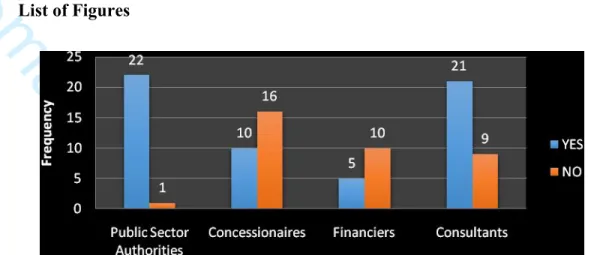
This part of the study examined the understanding and sustainability application of the respondents’ organisations in relation to sustainability awareness and sustainability requirements in PPP infrastructure projects undertaken in the study area. It started with the respondents’ sustainability awareness in PPP infrastructure projects. It revealed that all the respondents irrespective of their organisations were very much aware of sustainability concepts in PPP infrastructure projects. This is unsurprising because the respondents had the understanding that PPPs promote the integration of sustainability into the PPP project phases, which comprise the development phase, the construction phase and the operation phase. In addition, all the respondents being very much aware of sustainability concepts could be further attributed to the fact that project risks can increase, if they (particularly the concessionaires) have limited knowledge of sustainability. Figure I showed the respondents’ responses in relation to the sustainability requirements in the bidding documents of the PPP projects in which they have participated. As presented in Figure I, the vast majority of respondents, particularly those from the public sector authorities and the consultant organizations, confirmed that they have incorporated sustainability requirements into their bidding documents as one of the criteria in their bidding stage. It can further be deduced from Figure I that a total of 58 (out of 94) respondents indicated the inclusion of sustainability requirements into their bidding stage. This finding implies that the vast majority of respondents from the public sector authorities have their own sustainability requirements incorporated into the PPP bidding stage as one of the evaluation criteria in selecting a suitable bidder in PPP projects.
>>>>>>>>Insert Figure I>>>>>>>>>
Ranking of the economic factors of sustainability in PPP infrastructure projects
Table III shows the ranking of six identified economic factors of sustainability from the four different stakeholders’ organizations (which comprised public sector authorities, concessionaires, financiers, and consultants). As indicated in Table III, standard deviation (SD) was used to rank factors with the same mean value. For instance, a factor with the lowest standard deviation is given a higher rank (Field, 2005). Therefore, the outcomes from theanalysis of the ranking based on each respondent category are as follows:
3 4 5 6 7 8 9 10 11 12 13 14 15 16 17 18 19 20 21 22 23 24 25 26 27 28 29 30 31 32 33 34 35 36 37 38 39 40 41 42 43 44 45 46 47 48 49 50 51 52 53 54 55 56
Smart and Sustainable Built Environment
Public sector authorities: The top three ranked economic factors of sustainability integrated within PPP infrastructure projects from respondents in the public sector authorities are: whole life costing, low maintenance cost, and supporting the local economy, with their mean values of 4.57, 4.17 and 4.00 respectively.Concessionaires: The top three ranked economic factors of sustainability considered the most important factors by the concessionaires are: supporting the local economy, capital cost, and extra investment, with their mean values of 4.31, 4.00 and 3.92 respectively.
Financiers: The top three ranked economic factors from the financiers are: whole life costing, supporting the local economy, and low maintenance costs, with their mean values of 4.33, 4.07 and 3.87 respectively.
Consultants: The top three ranked economic factors from the consultants are: capital cost, low maintenance costs, and extra investment, with their mean values of 4.47, 4.40 and 3.80 respectively.
>>>>>>>>Insert Table III>>>>>>>>>
Moreover, the total mean values’ ranking of the top three ranked economic factors of sustainability considered the most important factors to be low maintenance costs, whole life costing, and supporting the local economy, with their total mean values of 4.07, 4.02 and 3.98 respectively. These findings are not surprising due to the nature of PPP infrastructure projects with the private sector aiming at using the lowest investment possibleto gain maximum returns or profits. These findings further confirm those in the existing literature, particularly on whole life costing. For example, PPP concepts offer a means of valuing whole life costing. Whole life costing is an effective tool employed to assess sustainable building performance (Zhou et al., 2005; Swaffield and McDonald, 2008). Also, the increased usage of PPP procurement methods is often cited as the main driver of life cycle costing usage with the aim of promoting sustainability (Boussabaine, 2007; Swaffield and McDonald, 2008). In addition, the total mean values for the six identified economic factors of sustainability ranged from 3.61 to 4.07 (see Table III). This implies that the aforementioned four respondent groups consider these six identified economic factors of sustainability as very important in PPP infrastructure projects. It should be noted that any factor is very important if it has mean value of 3.5 or above, based on a five-point Likert scale (Badu et al., 2012; Babatunde and Perera, 2017b).
Furthermore, the Kruskal-Wallis test was carried out to ascertain if there was a significant statistical difference in the perceptions of the four respondents’ groups (which comprised public sector authorities, concessionaires, financiers, and consultants) in the ranking of six identified economic factors of sustainability in PPP infrastructure projects. The results of the Kruskal-Wallis test revealed that there is no significant statistical difference in the perceptions of the four respondents’ groups because the Kruskal-Wallis significance value for each of the six identified economic factors of sustainability is greater than 0.05 (see Table III). This finding indicates that there was consensus among the four respondent groups on the ranking. This could be attributable to the respondents’ good understanding of sustainability integration in PPP infrastructure projects. 3 4 5 6 7 8 9 10 11 12 13 14 15 16 17 18 19 20 21 22 23 24 25 26 27 28 29 30 31 32 33 34 35 36 37 38 39 40 41 42 43 44 45 46 47 48 49 50 51 52 53 54 55
Smart and Sustainable Built Environment
Ranking of environmental factors of sustainability in PPP infrastructure projects Table IV indicates the ranking of ten identified environmental factors of sustainability in PPP infrastructure projects from the four groups of respondents. As presented in Table IV, the results of the ranking, based on each respondent category is as follows:Public sector authorities: The top three ranked environmental factors from the respondents in the public sector authorities regarding sustainability incorporation in PPP infrastructure projects are: water consumption during operation, energy use during the construction stage, and energy use during the operation stage, with their mean values of 4.35, 4.35 and 4.00 respectively.
Concessionaires: The top three ranked environmental factors of sustainability which were considered the most important factors by the concessionaires are:biodiversity, energy use during the operation stage, and eco-landscaping, with their mean values of 4.38, 4.38 and 4.19 respectively.
Financiers: The top three ranked environmental factors from the financiers are: energy use during the operation stage, biodiversity, and noise reduction, with their mean values of 4.73, 4.20 and 4.00 respectively.
Consultants: The top three ranked environmental factors from the consultants are: biodiversity, energy use during the construction stage, and noise reduction, with their mean values of 4.70, 4.33 and 4.23 respectively.
>>>>>>>>Insert Table IV>>>>>>>>>
In addition, Table IV displays the ranking of the total mean values of the ten identified environmental factors of sustainability incorporation in PPP infrastructure projects. It showed the total mean values range from 3.12 to 4.28; with 9 (of 10) identified environmental factors having total mean values above 3.50 (see Table IV). It implies that all the respondent groups regarded these 9 identified environmental factors of sustainability as very important in PPP infrastructure projects. Moreover, the top three ranked environmental factors of sustainability are biodiversity, energy use during the operation stage, and energy use during the construction stage, with their total mean values of 4.28, 4.24 and 4.19 respectively. These findings allude to the fact that profit could be maximised by constructing with low energy usage in PPP infrastructure projects. In addition, this finding affirms a European Commission (2002) priority within environmental public procurement which identified nature and biodiversity as one of the priorities within environmental areas which need to be tackled with urgent action to assist in aiding improvement and in shaping the European Union (EU) sustainability policy. (This policy was reviewed and documented as the Environmental Policy Review and Action Plan for Biodiversity of EU policy in 2007). Table IV further reveals the results from the Kruskal-Wallis test which was carried out to ascertain if there is a significant statistical difference in the perceptions of the four respondents’ groups in the ranking of the ten identified environmental factors of sustainability in PPP infrastructure projects. The results of the Kruskal-Wallis test confirmed that there is no significant statistical difference in the perceptions of the four respondents’ groups (see Table IV). 3 4 5 6 7 8 9 10 11 12 13 14 15 16 17 18 19 20 21 22 23 24 25 26 27 28 29 30 31 32 33 34 35 36 37 38 39 40 41 42 43 44 45 46 47 48 49 50 51 52 53 54 55 56
Smart and Sustainable Built Environment
Ranking of the social factors of sustainability in PPP infrastructure projects Table V shows the ranking of the six identified social factors of sustainability in PPP infrastructure projects from the four groups of respondents. The results of the ranking as shown in Table V, based on each respondent group, are as follows:Public sector authorities: The top three ranked social factors of sustainability from respondents in the public sector authorities are: educational aspects, equity between stakeholders, and health and safety, with their mean values of 4.57, 4.13 and 3.96 respectively.
Concessionaires: The top three ranked social factors of sustainability (considered the most important factors) by the concessionaires are: educational aspects, care of end users, and ethical issues, with their mean values of 4.58, 3.65 and 3.46 respectively.
Financiers: The top three ranked social factors from the financiers are:educational aspects, care of end users, and public image, with their mean values of 4.67, 3.73 and 3.73 respectively.
Consultants: The top three ranked social factors from the consultants are: equity between stakeholders, health and safety, and public image, with their mean values of 4.40, 4.13 and 3.83 respectively.
>>>>>>>>Insert Table V>>>>>>>>>
Table V further reveals the total mean ranking of the six identified social factors of sustainability. It can be seen that the total mean values range from 3.50 to 4.32 (see Table V). This implies that the four respondent groups regarded these six identified social factors of sustainability as very important in PPP infrastructure projects. In addition, the top three total ranked social factors of sustainability are: educational aspects, equity between stakeholders, and health and safety, with their total mean values of 4.32, 3.84 and 3.70 respectively. This finding affirms the role that PPP can play in social sustainability. For instance, achieving sustainable development involves collaboration with all stakeholders, which is the central feature of sustainable development concepts. Fulcrum (2003) stated that PPP is the only process that brings together all those stakeholders involved in a project which will meet everyone’s needs. This is affirmed by Mouraviev and Kakabadse (2014) who asserted that PPPs create value for the stakeholders involved in a project. Moreover, the Kruskal-Wallis test was carried out to confirm if there is a significant statistical difference in the perceptions of the four respondents’ groups in the ranking of the six identified social factors of sustainability in PPP infrastructure projects. The Kruskal-Wallis test results revealed that there is no significant statistical difference in the perceptions of the four respondents’ groups.
Conclusion
The study investigated the sustainability awareness and sustainability requirements among key stakeholder organizations undertaking PPP infrastructure projects in Nigeria. The study further investigated the incorporation of sustainability features in the three aspects of sustainability in PPP infrastructure projects (which comprises the economic, environmental, and social aspects). The findings revealed that all the respondents from public sector authorities, concessionaires, financiers, and consultants’ organizations are very much aware of sustainability principles in 3 4 5 6 7 8 9 10 11 12 13 14 15 16 17 18 19 20 21 22 23 24 25 26 27 28 29 30 31 32 33 34 35 36 37 38 39 40 41 42 43 44 45 46 47 48 49 50 51 52 53 54 55
Smart and Sustainable Built Environment
PPP infrastructure projects. This is not surprising because the respondents have the understanding that PPPs promote the integration of sustainability into PPP projects’ life cycles. In addition, the study revealed that the vast majority of respondents from public sector authorities and consultant organizations confirmed that they have incorporated sustainability requirements into their bidding documents in the PPP infrastructure projects in which they have participated as one of the criteria in their bidding stage to select a suitable bidder in PPP infrastructure projects. Moreover, the study revealed the sustainability features in the three aspects of sustainability in PPP infrastructure projects, namely, the economic, environmental, and social aspects. The top three ranked economic factors of sustainability were considered to be low maintenance costs, whole life costing, and supporting the local economy, respectively. These findings are not surprising due to the nature of PPP infrastructure projects, whereby the private sector aims at using the lowest investment to gain maximum returns or profits. These findings further confirm the findings in the existing literature, particularly on whole life costing. The study further revealed that the top three ranked environmental factors of sustainability are biodiversity, energy use during the operation stage, and energy use during the construction stage, respectively. These findings allude to the fact that profit could be maximized by constructing with low energy in PPP infrastructure projects. Furthermore, the study revealed the top three ranked social factors of sustainability are the educational aspects, equity between stakeholders, and health and safety, respectively. This study is not without limitation. Although using questionnaire survey allows large sample to be captured, using other methods (such as interviews) together may enrich the findings. Despite this limitation, the study will be of great value to PPP stakeholders involved in sustainability decision-making processes when delivering sustainable PPP projects, particularly in Nigeria. Also, the study findings are important as not many empirical studies have been conducted, in the study area, in Nigeria. Further studies should be conducted on the barriers to the integration of sustainability concepts into PPP infrastructure projects.References
Abdelfattah, F. (2017), “Relation between green buildings and sustainable development practices”, The 1st International Conference: Towards A Better Quality of Life.
Available at: https://papers.ssrn.com/sol3/papers.cfm?abstract_id=3163476 (accessed 20 January 2020).
Addy, M., Adinyira, E., Danku, J. C. and Dadzoe, F. (2020), “Impediments to the development of the green building market in sub-Saharan Africa: the case of Ghana”, Smart and Sustainable Built Environment, ahead-of-print. doi.org/10.1108/SASBE-12-2019-0170.
Amiril, A., Nawawi, A., Takim, R., AbLatif, S. (2014), “Transportation infrastructure project sustainability factors and performance”, Procedia - Social and Behavioral Sciences, Vol.153, pp. 90-98.DOI: 10.1016/j.sbspro.2014.10.044.
Babatunde, S. O., Opawole, A. and Akinsiku, O. E. (2012), “Critical success factors in public-private partnership (PPP) on infrastructure delivery in Nigeria”, Journal of Facilities Management, Vol. 10 No. 3, pp.212-225.DOI: 10.1108/14725961211246018.
3 4 5 6 7 8 9 10 11 12 13 14 15 16 17 18 19 20 21 22 23 24 25 26 27 28 29 30 31 32 33 34 35 36 37 38 39 40 41 42 43 44 45 46 47 48 49 50 51 52 53 54 55 56
Smart and Sustainable Built Environment
Babatunde, S. O. (2015), “Developing public-private partnership strategy for infrastructure delivery in Nigeria”, (Ph.D. Thesis), Northumbria University, United Kingdom.Available at: https://core.ac.uk/download/pdf/46520274.pdf (accessed 15 January 2020).Babatunde, S. O., Perera, S., Zhou, L. and Udeaja, C. (2015), “Barriers to public-private partnership (PPP) projects in developing countries: a case of Nigeria”, Engineering,
Construction and Architectural Management, Vol. 22 No. 6, pp. 669-691.DOI: 10.1108/ECAM-12-2014-0159
Babatunde, S. O., Perera, S. and Zhou, L. (2016a), “Methodology for developing capability maturity levels for PPP stakeholders’ organizations using critical success factors”,
Construction Innovation, Vol. 16 No.1, pp.81-110. DOI: 10.1108/CI-06-2015-0035.
Babatunde, S. O., Perera, S., Zhou, L. and Udeaja, C. (2016b), “Stakeholder perceptions on critical success factors for public-private partnership projects in Nigeria”, Built Environment Project and Asset Management, Vol. 6 No.1, pp.74-91. DOI: 10.1108/BEPAM-11-2014-0061.
Babatunde, S. O. and Perera, S. (2017a), “Barriers to bond financing for public-private partnership infrastructure projects in emerging markets: a case of Nigeria”, Journal of Financial Management of Property and Construction, Vol.22 No.1, pp. 2-19. DOI: Doi.org/10.1108/JFMPC-02-2016-0006.
Babatunde, S. O. and Perera, S. (2017b), “Analysis of traffic revenue risk factors in BOT road projects in developing countries”, Transport Policy, Vol.56, pp.41-49. DOI: 10.1016/j.tranpol.2017.03.012
Babatunde, S. O., Perera, S. and Adeniyi, O. (2019), “Identification of critical risk factors in public-private partnership project phases in developing countries: a case of Nigeria”,
Benchmarking-an International Journal, Vol.26 No.2, pp.334-355. DOI: 10.1108/BIJ-01-2017-0008
Badu, E., Edwards, D. J., Owusu-Manu, D. and Brown, D. M. (2012), “Barriers to the implementation of innovative financing of infrastructure”, Journal of Financial Management of Property and Construction, Vol.17 No.3, pp.25-273.
Doi.org/10.1108/13664381211274362.
Boron, S. and Murray, K. (2008), “Bridging the unsustainability gap: a framework for
sustainable development”, Sustainable Development, Vol. 12, pp. 65-73. Doi.org/10.1002/sd.231.
Boussabaine, A. (2007), Cost Planning of PFI and PPP Building Projects. Taylor Francis, London. ISBN10: 0–415–36622–4.
BRE (2002), Profiting from Sustainability: Business and Sustainability, Building Research Establishment, London. Available at:
https://tools.breeam.com/filelibrary/Non%20Domestic%20Manuals/BREEAM_Educatio n_2008.pdf (accessed 20 January 2020). 3 4 5 6 7 8 9 10 11 12 13 14 15 16 17 18 19 20 21 22 23 24 25 26 27 28 29 30 31 32 33 34 35 36 37 38 39 40 41 42 43 44 45 46 47 48 49 50 51 52 53 54 55
Smart and Sustainable Built Environment
BRE (2004), Assessment of Sustainability Tools, Building Research Establishment, Glasgow.Available at: https://download.sue-mot.org/envtooleval.pdf (accessed 20 January 2020). BRE (2006), BREEAM 2006 Version, Watford BRE Global Ltd, London. Available at:
https://tools.breeam.com/filelibrary/Technical%20Manuals/EcoHomes_2006_Guidance_ v1.2_-_April_2006.pdf (accessed 20 January 2020).
Brundtland, G. O. (1987), “Our common future”, The Brundtland Report, The World Commission on Environment and Development, Brussels. Available at: https://sustainabledevelopment.un.org/content/documents/5987our-common-future.pdf (accessed 20 January 2020).
Chan, A. P. C. and Chan, A. P. L. (2004), “Key performance indicators for measuring construction success”, Benchmarking: An International Journal, Vol. 11 No. 2, pp. 203-221. Doi.org/10.1108/14635770410532624.
Epstein, M. J. (2008), Making Sustainability Work: Best Practices in Managing and Measuring Corporate Social, Environmental and Economic Impacts, Greenleaf Publication Limited,
Sheffield. ISBN-13: 978-1576754863.
European Commission (2002), “Buying Green: A handbook on environmental public procurement”, Commission staff working document, Brussels. Available at: https://ec.europa.eu/environment/gpp/buying_handbook_en.htm (accessed 20 March 2020).
Fellows, R. F. and Liu, A. (2008), Research Methods for Construction, Wiley-Blackwell Science, London.ISBN: 978-1-118-91574-5.
Field, A. (2005), Discovering Statistics using SPSS, Sage, London. ISBN 0 7619 4452 4.
Fulcrum (2003), PFI is a good mechanism for delivering sustainable building, workshop note, sustainability forum. Available at: http://www.fulcrumfirst.com/ (accessed 20 March 2020).
Howard, N. (2005), “Building environmental assessment methods: in practice”, paper presented at the 2005 World Sustainable Building Conference, Tokyo, Japan .Available at: www.sb05.com/academic/academic_45.html (accessed 20 March 2020).
Ibrahim, A. D., Prince, A. D. F. and Dainty, A. R. J. (2006),“The analysis and allocation of risks in public-private partnerships in infrastructure projects in Nigeria”,Journal of Financial Management of Property and Construction, Vol. 11 No. 3, pp.149-163. DOI: 10.1108/13664380680001086.
Jallow, H., Renukappa, S. and Suresh, S. (2020), “The impact of COVID-19 outbreak on United Kingdom infrastructure sector”, Smart and Sustainable Built Environment, ahead-of-print. doi.org/10.1108/SASBE-05-2020-0068. 3 4 5 6 7 8 9 10 11 12 13 14 15 16 17 18 19 20 21 22 23 24 25 26 27 28 29 30 31 32 33 34 35 36 37 38 39 40 41 42 43 44 45 46 47 48 49 50 51 52 53 54 55 56
Smart and Sustainable Built Environment
Lim, S. K. (2009), Framework and Processes for Enhancing Sustainability Deliverables in Australian Road Infrastructure Projects, Queensland University of Technology, Australia. Available at: https://eprints.qut.edu.au/32053/ (accessed 20 March 2020).Litman, T. (2007), “Well measured developing indicators for comprehensive and sustainable transport planning: research record”, Journal of the Transportation Research Board,
pp.10–15. DOI: 10.3141/2017-02.
Liu, J., Love, P. E. D., Smith, J., Regan, M., and Palaneeswaran, E. (2015), “Review of performance measurement: implications for public–private partnerships”, Built
Environment Project and Asset Management, Vol.5 No.1, pp.35-51. Doi.org/10.1108/BEPAM-12-2013-0070.
Mouraviev, N. and Kakabadse, N. K. (2012), “Conceptualising public – private partnerships: a critical appraisal of approaches to meanings and forms,” Society and Business Review, Vol. 7 No. 3, pp. 260-276. Doi.org/10.1108/SBR-04-2016-0024.
Mouraviev, N. and Kakabadse, N. (2014), “Impact of externalities on sustainable development: evidence from public-private partnerships in Kazakhstan and Russia”, Corporate Governance, Vol. 14 No.5, pp.653-669.DOI: 10.1108/CG-03-2014-0037.
Mustaq, N. and Azeem, M., (2012), “Conceptual understanding of sustainable development”,
Academic Research International, Vol.2 No.2, pp.627-640. ISSN: 2223-9944.
Opawole A. and Jagboro G. O (2017), “Factors Affecting the Performance of Private Party in Concession-Based PPP Projects in Nigeria”, Journal of Engineering, Design and Technology, Vol.15 No.1, pp.44-57. Doi.org/10.1108/JEDT-09-2015-0058.
Opawole, A., Babatunde, S. O., Kajimo-Shakantu, K. and Ateji, O. A. (2020), “Analysis of barriers to the application of life cycle costing in building projects in developing countries: A case of Nigeria”, Smart and Sustainable Built Environment, ahead-of-print. doi.org/10.1108/SASBE-11-2018-0057.
Patil, N. A. and Laishram, B. S. (2016), “Sustainability of Indian PPP procurement process: development of strategies for enhancement”, Built Environment Project and Asset Management, Vol. 6 No.5, pp.491-507.Doi.org/10.1108/BEPAM-09-2015-0043.
Shen, L. Y., Wu, M., Wang, J. Y. (2002), “A model for assessing the feasibility of construction project in contributing to the attainment of sustainable development”, Journal of Construction Research, Vol.3 No.2, pp.255–269.DOI:10.1142/S1609945102000151.
Shen, L., Hao, J. L., Tam, V., and Yao, H. (2007), “A checklist for assessing sustainability performance of construction projects”, Journal of Civil Engineering and Management, Vol.13 No.4, pp.273–281. DOI:10.3846/13923730.2007.9636447.
Shen, L., Wu, S. and Zhang, X. (2011), “Key assessment features for the sustainability of infrastructure projects”, Journal of Construction Engineering and Management, Vol.6 No.3, pp 441–451.DOI:10.1061/(ASCE)CO.1943-7862.0000315. 3 4 5 6 7 8 9 10 11 12 13 14 15 16 17 18 19 20 21 22 23 24 25 26 27 28 29 30 31 32 33 34 35 36 37 38 39 40 41 42 43 44 45 46 47 48 49 50 51 52 53 54 55
Smart and Sustainable Built Environment
Shen, L., Tam, V. W. Y., Gan, L., Ye, K. and Zhao, Z. (2016), “Improving sustainability performance for public-private-partnership (PPP) projects”, Sustainability, Vol.8 No.3, pp.1-15. DOI:10.3390/su8030289.Stan, M.I. (2014), “Public-private partnership – a solution for sustainable urban development of cities”, Curentul Juridic, Vol.56 No.1, pp.139-147. Available at: https://econpapers.repec.org/article/pmucjurid/v_3a56_3ay_3a2013_3ap_3a139-147.htm (accessed 20 March 2020).
Swaffield, L. M. and McDonald, A. M. (2008), “The contractor’s use of life cycle costing on PFI projects”, Engineering, Construction and Architectural Management, Vol.15 No.2, pp. 132-148. DOI:10.1108/09699980810852664.
Tunji-Olayeni, P., Kajimo-Shakantu, K. and Osunrayi, E. (2020), “Practitioners' experiences with the drivers and practices for implementing sustainable construction in Nigeria: a qualitative assessment”, Smart and Sustainable Built Environment, ahead-of-print. doi.org/10.1108/SASBE-11-2019-0146.
Ugwu, O. O. and Haupt, T. C. (2007), “Key performance indicators and assessment methods for infrastructure sustainability – a South African construction industry perspective”,
Building and Environment, Vol. 42 No. 2, pp. 665-680. Doi.org/10.1016/j.buildenv.2005.10.018
Wojewnik-Filipkowska, A. and Wegrzyn, J. (2019), “Understanding of public private partnership stakeholders as a condition of sustainable development”, Sustainability, Vol.11 No.4, pp.1-16. DOI: 10.3390/su11041194.
Zhou, L., Lowe, D. J., Kurul, E, and Keeping, M (2005), Is private finance initiative a good mechanism to deliver sustainable construction? Proceedings of The 2005 World Sustainable Building Conference, Tokyo, Japan. Available at: http://centaur.reading.ac.uk/31329/1/CME25-Whole_Procs.pdf (accessed 20 March 2020).
Zhou, L., Keivani, R. and Kurul, E. (2013), “Sustainability performance measurement framework for PFI projects in the UK”, Journal of Financial Management of Property and Construction, Vol.18 No.3, pp.232-250. Doi.org/10.1108/JFMPC-08-2012-0032. 3 4 5 6 7 8 9 10 11 12 13 14 15 16 17 18 19 20 21 22 23 24 25 26 27 28 29 30 31 32 33 34 35 36 37 38 39 40 41 42 43 44 45 46 47 48 49 50 51 52 53 54 55 56
Smart and Sustainable Built Environment
List of FiguresFigure I: Respondents response if their clients state any sustainability requirements in the PPP projects involved-in 3 4 5 6 7 8 9 10 11 12 13 14 15 16 17 18 19 20 21 22 23 24 25 26 27 28 29 30 31 32 33 34 35 36 37 38 39 40 41 42 43 44 45 46 47 48 49 50 51 52 53 54 55
Smart and Sustainable Built Environment
List of Tables Table I: Sustainability indicators identified in sustainability dimensions3 4 5 6 7 8 9 10 11 12 13 14 15 16 17 18 19 20 21 22 23 24 25 26 27 28 29 30 31 32 33 34 35 36 37 38 39 40 41 42 43 44 45 46 47 48 49 50 51 52 53 54 55 56
Smart and Sustainable Built Environment
Table II: Background information of the respondents Respondent’s profile Frequency PercentageCategory of organization
Public sector authorities 23 24.4
Concessionaires 26 27.7 Financiers 15 16.0 Consultants 30 31.9 Total 94 100.0 Designation of respondent Managing directors 10 10.6 Managers 32 34.0 Assistant managers 4 4.3 Directors 6 6.4 Assistant directors 5 5.3 Project managers 9 9.6 Operational staff 28 29.8 Total 94 100.0
Highest Academic qualification
Higher National Diploma (HND) 7 7.4
Bachelor of Science (BSc) 35 37.2
Master of Science (MSc) 46 48.9
Doctor of Philosophy (PhD) 6 6.4
Total 94 100.0
Year of professional experience
5 years and below 2 2.1
6-10 years 44 46.8
11-15 years 39 41.5
16 years and above 9 9.6
Total 94 100.0
Number of PPP projects involved-in
One 13 13.8
Two 19 20.2
Three 40 42.6
Four and above 22 23.4
Total 94 100.0 3 4 5 6 7 8 9 10 11 12 13 14 15 16 17 18 19 20 21 22 23 24 25 26 27 28 29 30 31 32 33 34 35 36 37 38 39 40 41 42 43 44 45 46 47 48 49 50 51 52 53 54 55
Smart and Sustainable Built Environment
Table III: Ranking of economic factors of sustainability in PPP infrastructure projects Public sector authorities Concessionaires Financiers Consultants TotalEconomic factors Mean SD Rank Mean SD Rank Mean SD Rank Mean SD Rank Mean SD Rank
Kruskal-Wallis Sig. EC1 Capital cost 3.30 0.117 6 4.00 0.184 2 3.60 0.214 5 4.47 0.115 1 3.91 0.86 4 0.090 EC2 Whole life
costing 4.57 0.187 1 3.88 0.150 4 4.33 0.232 1 3.57 0.124 5 4.02 0.88 2 0.110 EC3 Low maintenance cost 4.17 0.136 2 3.73 0.197 5 3.87 0.192 3 4.40 0.141 2 4.07 0.85 1 0.120 EC4 Extra investment 3.65 0.173 5 3.92 0.175 3 3.47 0.236 6 3.80 0.176 3 3.74 0.90 5 0.334 EC5 Financial incentive 3.78 0.166 4 3.69 0.144 6 3.67 0.211 4 3.37 0.189 6 3.61 0.87 6 0.194 EC6 Support local
economy
4.00 0.063 3 4.31 0.156 1 4.07 0.153 2 3.63 0.176 4 3.98 0.78 3 0.125 Note: Significant at 5%, SD-Standard Deviation
3 4 5 6 7 8 9 10 11 12 13 14 15 16 17 18 19 20 21 22 23 24 25 26 27 28 29 30 31 32 33 34 35 36 37 38 39 40 41 42 43 44 45 46 47 48 49 50 51 52 53 54 55 56
Smart and Sustainable Built Environment
Table IV: Ranking of environmental factors of sustainability in PPP infrastructure projects Public sector authorities Concessionaires Financiers Consultants TotalEN1 Environmental factors Mean SD Rank Mean SD Rank Mean SD Rank Mean SD Rank Mean SD Rank
Kruskal-Wallis Sig. EN1 Energy use during
construction stage
4.35 0.162 2 4.08 0.175 5 3.87 0.192 5 4.33 0.221 2 4.19 0.97 3 0.148 EN2 Energy use during
operation stage
4.00 0.199 3 4.38 0.097 2 4.73 0.118 1 4.07 0.046 4 4.24 0.63 2 0.101 EN3 Water consumption
during construction
3.91 0.060 4 3.69 0.155 9 3.73 0.153 6 3.23 0.079 9 3.61 0.61 7 0.090 EN4 Water consumption
during operation
4.35 0.135 1 4.00 0.124 7 3.67 0.252 7 3.53 0.283 6 3.88 1.10 6 0.130 EN5 Use of brownfield
land
3.43 0.152 8 3.85 0.190 8 3.27 0.153 8 3.50 0.115 7 3.54 0.77 8 0.070 EN6 Eco-landscaping 3.70 0.171 5 4.19 0.147 3 3.93 0.153 4 4.00 0.117 5 3.97 0.73 5 0.116 EN7 Minimum waste 3.35 0.240 9 4.04 0.196 6 3.20 0.223 10 3.37 0.140 8 3.52 0.99 9 0.107 EN8 Noise reduction 3.61 0.151 7 4.12 0.169 4 4.00 0.138 3 4.23 0.079 3 4.01 0.70 4 0.115 EN9 Biodiversity 3.65 0.119 6 4.38 0.095 1 4.20 0.107 2 4.70 0.085 1 4.28 0.63 1 0.085 EN10 Transport 3.22 0.251 10 3.27 0.275 10 3.27 0.330 9 2.83 0.160 10 3.12 1.18 10 0.444
Note: Significant at 5%, SD-Standard Deviation 3 4 5 6 7 8 9 10 11 12 13 14 15 16 17 18 19 20 21 22 23 24 25 26 27 28 29 30 31 32 33 34 35 36 37 38 39 40 41 42 43 44 45 46 47 48 49 50 51 52 53 54 55
Smart and Sustainable Built Environment
Table V: Ranking of social factors of sustainability in PPP infrastructure projectsNote: Significant at 5%, SD-Standard Deviation
Public sector authorities Concessionaires Financiers Consultants Total
Social factors Mean SD Rank Mean SD Rank Mean SD Rank Mean SD Rank Mean SD Rank
Kruskal-Wallis Test SO1 Health and safety 3.96 0.239 3 3.12 0.279 5 3.47 0.236 5 4.13 0.150 2 3.70 1.17 3 0.117 SO2 Public image 3.57 0.164 5 2.88 0.150 6 3.73 0.153 3 3.83 0.128 3 3.50 0.81 6 0.070 SO3 Care of end users 3.48 0.165 6 3.65 0.095 2 3.73 0.118 2 3.70 0.153 5 3.64 0.69 4 0.744 SO4 Equity between
stakeholders
4.13 0.181 2 3.27 0.275 4 3.27 0.267 6 4.40 0.132 1 3.84 1.14 2 0.131
SO5 Ethical issues 3.70 0.171 4 3.46 0.159 3 3.73 0.159 4 3.47 0.093 6 3.56 0.70 5 0.294 SO6 Education aspect 4.57 0.164 1 4.58 0.099 1 4.67 0.211 1 3.73 0.191 4 4.32 0.91 1 0.110 3 4 5 6 7 8 9 10 11 12 13 14 15 16 17 18 19 20 21 22 23 24 25 26 27 28 29 30 31 32 33 34 35 36 37 38 39 40 41 42 43 44 45 46 47 48 49 50 51 52 53 54 55 56