A Novel Adaptation Model for E-Learning
Recommender Systems Based on Student’s
Learning Style
Ph.D. Thesis
Shaimaa Mohamed Nafea
Under the Supervision of:
Prof. François Siewe
Dissertation submitted in fulfilment of the requirements for the degree of
Doctor of Philosophy
Software Technology Research Laboratory (STRL)
School of Computer Science and Informatics
Faculty of Computing, Engineering and Media
De Montfort University, Leicester
Declaration of Authorship
I declare that the work described in this thesis is original work undertaken by me for the degree of Doctor of Philosophy (Ph.D), at the Software Technology Research Laboratory (STRL) at De Montfort University, United Kingdom.
Neither this material nor its part has been submitted for the award of any other degree or qualifi-cation to any other higher eduqualifi-cational institution. All the work produced in this thesis was done so in collaboration with my supervisor Prof. François Siewe.
This thesis is written by me and produced using LATEX
Name of candidate: Shaimaa Mohamed Nafea
Signed: . . . . Date: . . . .
Approval
The undersigned certify that they have read and recommended to the graduate school, De Montfort University for acceptance of the thesis entitled ”A Novel Adaptation Model for E-Learning Recommender Systems Based on Student’s E-Learning Style” submitted by Shaimaa Mohamed Nafea in partial fulfilment of the requirements for the degree of Doctor of Philosophy.
First supervisor: Prof. François Siewe
Reader in Computer Science
Head of Software Technology Research Laboratory (STRL)
Cyber Technology Institute (CTI)
School of Computer Science and Informatics
De Montfort University
Signed: . . . .
Date: . . . .
Second supervisor: Dr Ying He
Senior Lecturer in Computer Science
Cyber Security Centre (CSC)
Cyber Technology Institute (CTI)
School of Computer Science and Informatics
De Montfort University
Signed: . . . .
Abstract
In recent years, a substantial increase has been witnessed in the use of online learning resources by
learn-ers. However, owing to an information overload, many find it difficult to retrieve appropriate learning
resources for meeting learning requirements. Most of the existing systems for e-learning make use of
a “one-size-fits-all” approach, thus providing all learners with the same content. Whilst recommender
systems have scored notable success in the e-commerce domain, they still suffer from drawbacks in terms
of making the right recommendations for learning resources. This can be attributed to the differences
among learners’ preferences such as varying learning styles, knowledge levels and sequential learning
patterns. Hence, to identify the needs of an individual student, e-learning systems that can build profiles
of student preferences are required. In addition, changing students’ preferences and multidimensional
attributes of the course content are not fully considered simultaneously. It is by failing to review these
issues that existing recommendation algorithms often give inaccurate recommendations.
This thesis focuses on student learning styles, with the aim of dynamically tailoring the learning process
and course content to meet individual needs. The proposed Ubiquitous LEARNing (ULEARN) system
is an adaptive e-learning recommender system geared towards providing a personalised learning
environ-ment, which ensures that course learning objects are in line with the learner’s adaptive profile. This thesis
delivers four main contributions: First, an innovative algorithm which dynamically reduces the number of
questions in the Felder-Silverman Learning Styles (FSLSM) questionnaire for the purpose of initialising
student profiles has been proposed.
The second contribution comprises examining the accuracy of various similarity metrics so as to select
the most suitable similarity measurements for learning objects recommendation algorithm.
The third contribution includes an Enhanced Collaboration Filtering (ECF) algorithm and an Enhanced
Content-Based Filtering (ECBF) algorithm, which solves the issues of cold-start and data sparsity
in-herent to the traditional Collaborative Filtering (CF) and the traditional Content-based Filtering (CBF),
Moreover, these two new algorithms have been combined to create a new Enhanced Hybrid Filtering
(EHF) algorithm that recommends highly accurate personalised learning objects on the basis of the
stu-dents’ learning styles.
The fourth contribution is a new algorithm that tracks patterns of student learning behaviours and
dynam-ically adapts the student learning style accordingly.
The ULEARN recommendation system was implemented with Visual Studio in C++ and Windows
Pre-sentation Foundation (WPF) for the development of the Graphical User Interface (GUI). The experimental
results revealed that the proposed algorithms have achieved significant improvements in student’s profile
adaptation and learning objects recommendation in contrast with strong benchmark models. Further
find-ings from experiments indicated that ULEARN can provide relevant learning object recommendations
based on students’ learning styles with the overall students’ satisfaction at almost 90%. Furthermore, the
results showed that the proposed system is capable of mitigating the problems data sparsity and cold-start,
thereby improving the accuracy and reliability of recommendation of the learning object. All in all, the
ULEARN system is competent enough to support educational institutions in recommending personalised
course content, improving students’ performance as well as promoting student engagement.
Keywords: Adaptive learning, Algorithms, Behaviour patterns, Collaborative Filtering, Content-Based Filtering, E-learning, Felder-Silverman Learning Style Model, Hybrid Filtering, k-means clustering,
Learning object profile, Learning style, Questionnaire, Rating prediction, Recommendation system,
Dedication
To My Beloved Father
Mr. Mohamed Nafea
Who encouraged me to do my PhD. Thank you for your endless support.
To My Loving Mother
Mrs. Seham Anwar
For her endless love, support, encouragement, and ceaseless prayers.
To My Beloved Brothers
Nafea & Ali
Thank you for being with me during the tough times and for endless love.
To My Sister in Law
Yasmin
I achieved my dream with your support and supplications. I love all of you, and I promise to do my best to make all of you happy.
Acknowledgements
In the name of Allah, the Most Gracious and the Most Merciful
’and say:’My Lord’, Increase me in knowledge’ [The Quran 20:114]
I am thankful to Allah Subhanahu wa-ta’ala that by His grace and bounty, I am able to
complete my PhD.
I owe a debt of gratitude to several people who provided me with their continual support throughout this
arduous journey.
First and foremost, I would like to express my deepest gratitude to my doctoral supervisorProf. François
Siewe, who made this research possible. Without his careful instruction, I would never achieve so much
success and finish the degree. He was always ready to help and give a piece of good advice. He has been
an exemplary guide, critic, and reviewer who instilled in me a deep passion to pursue research. Prof.
Sieweis a very patient, supportive and attentive supervisor. Whenever I needed his assistance, he was
always there. Thanks for believing in me and teaching me. I am grateful to have been able to finish my
PhD under his supervision.
In addition, I thankDr Ying Hefor her input as part of my dissertation committee. My sincere thanks also toDr Leandros Maglarasfor his invaluable professional advice.
In addition, I thank my directors and colleagues at the Arab Academy for Science, Technology and
Maritime Transport. In particular, I am grateful toDr Tarek Abdeen,Dr Nermeen Magdi,Dr Ahmed
FaroukandDr Nihal Ayadfor supporting me in all imaginable ways during my research.
I would like to thank my amazing family for all the support, and constant encouragement they have
showered on me over the years, specially my mumSeham Anwar and dadMohamed Nafea, for their unconditional love, belief and understanding. Heartfelt thanks to my brothers NafeaandAli for their continuous support. Thank you all for encouraging me to climb this ladder, and not look at ’how far,
challenges that I faced throughout the PhD programme. Rather than give up, you all let me see reasons
to move on.
I acknowledge the moral support of all my friends and colleagues,Shafiaa Rafeah,Dr Adekunle Isaac,
Judith Willems,Maria Miranda, andRuba JadAllah, my sincere thanks to you all.
Lastly, I would like to thank everyone who supported me throughout my PhD who I have not been able
List of Publications
Publications arising from this thesis:
1. Nafea, Shaimaa M., François Siewe, and Ying He. "On Recommendation of Learning Objects
using Felder-Silverman Learning Style Model." IEEE Access 7 (2019): 163034-163048. DOI:
10.1109/ACCESS.2019.2935417.
2. Nafea, Shaimaa M., François Siewe, and Ying He. "A novel algorithm for dynamic student profile
adaptation based on learning styles." In Proceedings of SAI Intelligent Systems Conference, pp.
29-51. Springer, Cham, 2019.
3. Nafea, Shaimaa M., François Siewe, and Ying He. "A Novel Algorithm for Course Learning
Object Recommendation Based on Student Learning Styles." In 2019 International Conference on
Innovative Trends in Computer Engineering (ITCE), pp. 192-201. IEEE, 2019.
4. Nafea, Shaimaa M., François Siewe, and Ying He. "ULEARN: Personalised Learner’s Profile
Based on Dynamic Learning Style Questionnaire" In Proceedings of SAI Intelligent Systems
Con-ference, pp. 1105-1124. Springer, Cham, 2018.
5. Nafea, Shaimaa M., Francois Siewe, and Ying He. "ULEARN: Personalized Course Learning
Objects Based on Hybrid Recommendation Approach," International Journal of Information and
Education Technology vol. 8, no. 12, pp. 842-847, 2018.
6. Nafea, Shaimaa M., Francois Siewe, and Ying He. "An Adaptive Learning Ontological
Frame-work Based on Learning Styles and Teaching Strategies." International Conference on Education
7. Nafea, Shaimaa, Leandros A. Maglaras, Francois Siewe, Richard Smith, and Helge Janicke.
"Per-sonalized Students’ Profile Based On Ontology and Rule-based Reasoning."EAI Endorsed
Trans-actions on e-Learning (2016). DOI: 10.4108/eai.2-12-2016.151720.
8. Nafea, Shaimaa M., Leandros A. Maglaras, Francois Siewe, and M. Elemam Shehab. "A novel
adaptive learning management system using ontology." In 2015 IEEE Seventh International
List of Abbreviations
Abbreviations Explanation
AAST ArabAcademy forScience andTechnology
AEH AdaptiveEducationalHypermedia
AERSs AdaptiveE-LearningRecommenderSystems
CBF Content-BasedFiltering
CF CollaborativeFiltering
CMS Course/ContentManagementSystems
DSP Module DynamicStudentProfile adaptationModule
ECBF EnhancedContent-BasedFiltering
ECF EnhancedCollaborativeFiltering
EHF EnhancedHybridFiltering
ELS E-LearnerSatisfaction
FSLSM Felder-SilvermanLearningStyleModel
GUI GraphicalUserInterface
HF HybridFiltering
KB Knowledge-Based
LMS LearningManagementSystem
LO LearningObject
LS LearningStyle
LS Module LearningStyles initialisationModule
MAE MeanAbsoluteError
MBTI Model Myers-BriggsTypeIndicatorModel
MOODLE ModularObjectOrientedDynamicLearningEnvironment
OWL WebOntologyLanguage
RMSE RootMeanSquareError
RS RecommenderSystem
SMS StudentManagementSystem
SP StudentProfile
SQL StructuredQueryLanguage
SUS SystemUsabilityScale
ULEARN UbiquitousLEARNing system
VARK Model Visual,Aural,Read/write, andKinestheticModel
VLE VirtualLearningEnvironment
WPF WindowsPresentationFoundation
WWW WorldWideWeb
XAML eXtensibleApplicationMarkupLanguage
Contents
List of Figures xx
List of Tables xxiii
1 Introduction 1
1.1 Motivation . . . 1
1.2 Problem Identification . . . 3
1.3 Research questions . . . 5
1.4 Aims and objectives . . . 6
1.5 Contributions . . . 6
1.6 Research Methodology . . . 8
1.7 Structure of thesis . . . 9
2 Background and Literature Review 12 2.1 Learning theories . . . 13
2.2 Learning Styles . . . 15
2.2.1 Kolb Learning Style . . . 16
2.2.2 Honey and Mumford learning style model . . . 18
2.2.3 VARK learning style model . . . 18
2.2.4 Myers and Briggs Learning Type Model . . . 19
2.2.5 Felder and Silverman Learning Styles Model . . . 20
2.2.6 Choice of learning style model . . . 21
2.2.7 Learning Style Detection . . . 23
2.2.7.1 Explicit approach . . . 23
2.3 E-learning and educational technology . . . 25
2.3.1 Definition of e-Learning . . . 25
2.3.2 E-Learning platforms . . . 28
2.4 Adaptive e-learning . . . 31
2.4.1 Components of adaptive e-learning systems . . . 31
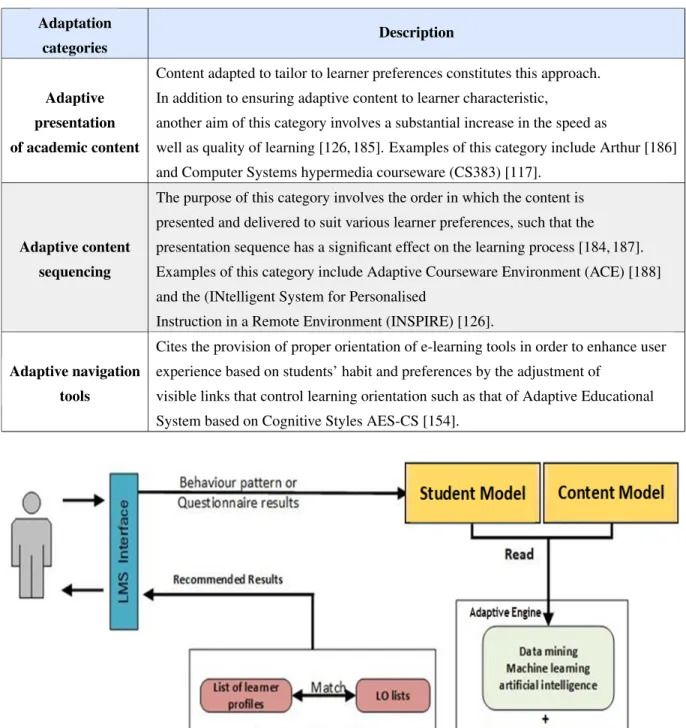
2.4.1.1 Student Model . . . 32
2.4.1.2 Content Model . . . 33
2.4.1.3 Adaptive Engine . . . 34
2.4.2 Adaptive e-learning evaluation methods . . . 34
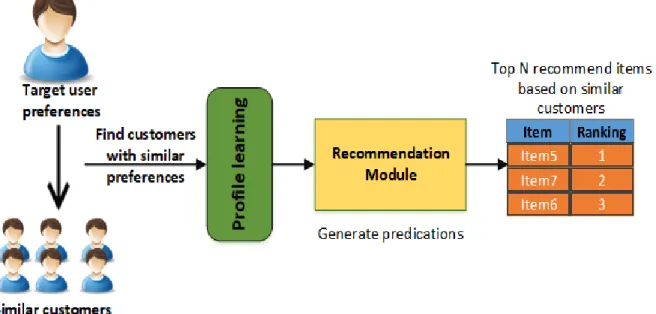
2.5 Recommender Systems . . . 35 2.5.1 Recommendation Techniques . . . 36 2.5.1.1 Content-Based Filtering (CBF) . . . 36 2.5.1.2 Collaborative Filtering (CF) . . . 38 2.5.1.3 Knowledge-Based (KB) . . . 41 2.5.1.4 Hybrid Filtering (HF) . . . 42
2.5.1.5 Recommendation techniques in e-learning . . . 43
2.6 Clustering in recommender systems . . . 43
2.7 Similarity metrics . . . 47 2.7.1 Euclidean Distance . . . 48 2.7.2 Pearson Correlation . . . 49 2.7.3 Cosine Similarity . . . 50 2.7.4 Manhattan Distance . . . 50 2.8 Summary . . . 51
3 Ubiquitous LEARNing system (ULEARN) Architecture 52 3.1 Proposed adaptive e-learning recommendation . . . 53
3.1.1 Student Profile . . . 53
3.1.2 Learning object Profile . . . 54
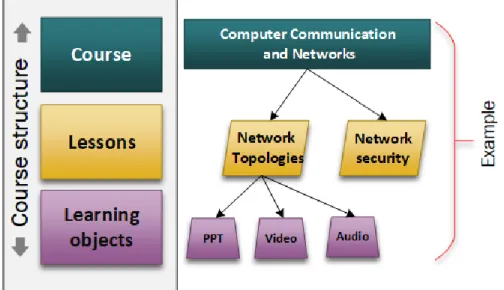
3.1.3 Course structure . . . 54
3.2 Architecture of ULEARN . . . 55
3.2.2 Data Layer . . . 57
3.2.3 Adaptive-recommendation layer . . . 58
3.2.3.1 Learning Styles initialisation Module . . . 58
3.2.3.2 Learning Objects recommendation Module . . . 59
3.2.3.3 Dynamic Student Profile adaptation Module . . . 59
3.3 Computational Model of ULEARN . . . 60
3.4 Examples . . . 62
3.4.1 First scenario (New students) . . . 62
3.4.2 Second scenario (Existing students) . . . 63
3.5 Summary . . . 65
4 Dynamic Learning Styles Questionnaire for Student Profile Initialisation 66 4.1 Algorithm for Initialising Student Learning Styles . . . 67
4.2 Index of Learning Styles . . . 68
4.3 Ranking the Questionnaire Questions . . . 69
4.3.1 Participants . . . 70
4.4 Proposed algorithm for calculating Initial Learning Style . . . 73
4.5 Modelling a real academic example . . . 75
4.6 Summary . . . 80
5 Learning Objects Recommendation 81 5.1 Comparison of different similarity matrices . . . 82
5.1.1 Proposed algorithm for similarity metrics selection in the Context of e-learning . 83 5.1.2 Experiment 1: Which similarity metrics provide the best prediction accuracy? . . 84
5.1.2.1 Dataset . . . 85
5.1.2.2 Evaluation of similarity performance . . . 85
5.1.2.3 Results and Discussion . . . 86
5.2 Learning Objects recommendation Module . . . 89
5.2.1 Enhanced Collaborative Filtering recommendation algorithm . . . 90
5.2.2 Enhanced Content-Based Filtering recommendation algorithm . . . 91
5.2.4 Experiment 2: Which recommendation algorithm has the highest
recommenda-tion accuracy? . . . 94
5.2.4.1 Evaluation on Rating Prediction . . . 94
5.2.4.2 Evaluation of Cold-start . . . 96
5.3 Summary . . . 98
6 Dynamic Student Profile Adaptation 101 6.1 Proposed architecture for dynamic student Profiling . . . 102
6.2 Proposed algorithm for dynamic student Profiling . . . 104
6.2.1 Capturing student learning behaviour patterns . . . 104
6.2.1.1 Time spent . . . 104
6.2.1.2 Number of messages . . . 106
6.2.1.3 Mapping LOs to FSLSM dimensions . . . 107
6.2.2 Dynamic Profile Modeling . . . 107
6.2.3 Profile updating . . . 109
6.3 Example . . . 110
6.3.1 Profile adaptation scenario . . . 110
6.4 Experiment: Examining the effectiveness of the proposed algorithm in predicting student learning styles . . . 112
6.4.1 Experimental results and discussion . . . 113
6.5 Summary . . . 114
7 Implementation and Evaluation of ULEARN recommender system 116 7.1 ULEARN recommender system implementation . . . 116
7.1.1 Database Model . . . 118
7.1.2 ULEARN Interface . . . 120
7.1.3 Student Learning Style initialisation . . . 122
7.1.4 Learning objects Recommendation . . . 123
7.1.5 Student behaviour monitoring . . . 124
7.1.6 Student profile adaptation . . . 126
7.2 System Testing . . . 126
7.2.2 system testing . . . 127
7.3 ULEARN system evaluation . . . 131
7.3.1 Student satisfaction . . . 131
7.3.2 Testing system usability . . . 138
7.4 Summary . . . 140
8 Conclusions and Recommendations for Future Work 143 8.1 Conclusion . . . 143
8.2 Limitations . . . 146
List of Figures
1.1 Research questions and research objectives to achieve the research aim . . . 7
2.1 Kolb’s experiential learning cycle [1] . . . 17
2.2 FSLSM learning style model [2] . . . 20
2.3 Identification of learning styles and automatic detection of learning styles [3] . . . 24
2.4 Definitions of e-learning [4] . . . 27
2.5 The most popular learning management systems . . . 30
2.6 Adaptive e-learning systems’ components . . . 32
2.7 Student modelling in e-learning systems [5] . . . 33
2.8 Breakdown of recommendation algorithms used for recommender systems . . . 37
2.9 Content-based filtering recommendation based on similar items . . . 37
2.10 Generate predictions using collaborative filtering recommendation based on similar cus-tomers . . . 39
3.1 Structure of the course materials in Egyptian higher education system . . . 55
3.2 Conceptual model of Ubiquitous LEARNing system (ULEARN) . . . 56
3.3 Computational Model of ULEARN . . . 61
4.1 Initialising Student Learning Styles Architecture . . . 67
4.2 Difficulty level of questions in Information Processing . . . 70
4.3 Difficulty level of questions in Information Perception . . . 71
4.4 Difficulty level of questions in Information Input . . . 71
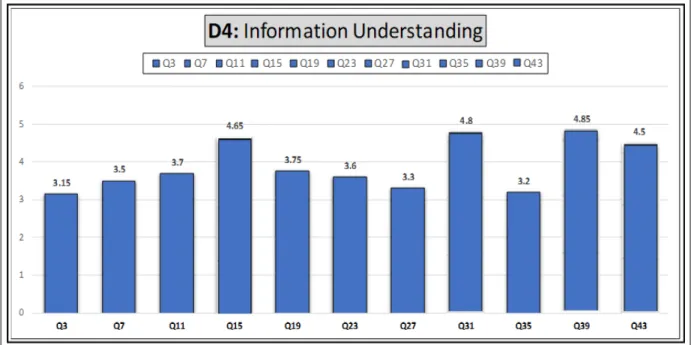
4.5 Difficulty level of questions in Information Understanding . . . 72
4.6 Pseudo-code of the algorithm for calculating initial learning style . . . 76
5.1 ULearn interface . . . 86
5.2 Distribution of students to nearest clusters . . . 87
5.3 Accuracy of the recommender algorithm using MAE . . . 88
5.4 Accuracy of the recommender algorithm using RMSE . . . 88
5.5 Accuracy of the recommender algorithm using MAE and RMSE . . . 95
5.6 Performance comparison for cold students using MAE . . . 96
5.7 Performance comparison for cold students using RMSE . . . 97
5.8 Performance comparison for cold LOs using MAE . . . 97
5.9 Performance comparison for cold LOs using RMSE . . . 98
6.1 Architecture for updating student profile dynamically . . . 103
6.2 Updating student profiles dynamically flowchart . . . 108
6.3 Dynamic student profile adaptation interface . . . 113
6.4 Adaptation algorithm accuracy using MAE . . . 114
6.5 Adaptation algorithm accuracy using RMSE . . . 114
7.1 ULEARN prototype sequence diagram . . . 117
7.2 Example of Student Class Definition . . . 118
7.3 Student’s Profile Class Diagram . . . 119
7.4 student’s Behaviour Class Diagram . . . 120
7.5 Learning object’s profile Class Diagram . . . 121
7.6 Students rate Class Diagram . . . 122
7.7 ULEARN Welcome Page . . . 123
7.8 Use case diagram for student . . . 124
7.9 Use case diagram for teacher . . . 125
7.10 Use case diagram for Administrator . . . 126
7.11 Create an account in ULEARN system . . . 127
7.12 Example of hashed passwords in a database using MD5 . . . 127
7.13 Dynamic ILS questionnaire . . . 128
7.14 Learning object Recommendation . . . 128
7.15 My lesson (Current learning object) . . . 129
7.17 Student’s rating . . . 130
7.18 Time spent . . . 131
7.19 Messages sent by students through online chatting . . . 132
7.20 Results for questions about assessment satisfaction by the content . . . 135
7.21 Results for questions about assessment satisfaction by the interactive features . . . 136
7.22 Results for questions about measuring the effect of ULEARN system in promoting stu-dents learning performance . . . 137
7.23 Results for questions about assessment satisfaction by the quality of personalisation and system performance. . . 137
7.24 Students responses to the SUS questionnaire . . . 141
D.1 Student registration page in ULEARN system . . . 191
D.2 Registration page forgot password . . . 191
D.3 Administrator’s page . . . 192
List of Tables
1.1 The constructive research stages with respect to the thesis chapters . . . 10
2.1 Learning theories with respect to learner characteristics . . . 14
2.2 Learning Styles as defined by Honey and Mumford [6] . . . 18
2.3 Learning modes as per the VARK model [7] . . . 19
2.4 Learning styles criteria grouping according to learning style models . . . 22
2.5 Summary of student’s learning styles detection approaches in existing adaptive e-learning systems . . . 26
2.6 Comparisons between the traditional and adaptive e-learning environment . . . 30
2.7 Adaptation categories . . . 32
2.8 User-item rating matrix . . . 36
2.9 Summary of recommendation techniques in e-learning systems . . . 44
2.10 An overview of recent researches on adaptive e-learning recommender systems using clustering algorithms . . . 46
2.11 A summary of widely used similarity metrics in approaches related to e-learning recom-mendation systems . . . 48
3.1 Examples of student learning style vectors . . . 54
3.2 Examples of learning object profile . . . 55
3.3 Emma’s and Oliver’s initial profile . . . 62
3.4 Recommended learning object profile according to Emma’s and Oliver’s initial profiles . 63
3.5 Emma’s and Oliver’s new learning styles profile . . . 63
3.7 The new learning object recommended list according to Emma’s and Oliver’s new learn-ing styles . . . 64
3.8 Emma’s and Oliver’s updated learning style learning styles profiles (Second scenario) . . 64
4.1 Order of Questions in Information Processing Dimension . . . 72
4.2 Order of Questions in Information Perception Dimension . . . 73
4.3 Order of Questions in Information Input Dimension . . . 74
4.4 Order of Questions in Information Understanding Dimension . . . 75
4.5 Examples of execution output Information Processing dimension of the algorithm Initial_LS 78
4.6 Examples of execution output ( D1, D2, D3 and D4) of the algorithm Initial_LS . . . 79
4.7 Calculating Initial_LS . . . 79
4.8 Student’s initial learning styles . . . 80
5.1 Rating scale . . . 85
5.2 Showing predicted rating using the proposed algorithm . . . 100
6.1 Behaviour pattern based on learning object type and FSLSM . . . 105
6.2 An Example of Time spent . . . 106
6.3 An Example of forum discussion . . . 106
6.4 Mapping of Learning Objects format and activities as FSLSM . . . 107
6.5 Examples of student learning style vectors . . . 110
6.6 Examples of Students’ behaviour patterns . . . 111
6.7 KSSP Calculation For Victoria’s behaviour . . . 111
6.8 KSSP Calculation For Michelle’s behaviour . . . 111
6.9 Victoria ’s Updated learning style profile . . . 112
6.10 Michelle’s Updated learning style profile . . . 112
7.1 Module Testing . . . 129
7.2 Test Cases for Student Portal . . . 133
7.3 Networks topics used in the evaluation . . . 133
7.4 Students’ satisfaction with the ULEARN system . . . 134
7.5 System usability SUS questionnaire testing sample . . . 139
Chapter 1
Introduction
1.1
Motivation
The World Wide Web has substantially grown in the past few decades to become a prominent platform
for information and learning. Nevertheless, this massive volume of knowledge available from the Internet
has resulted in an information overload making it difficult for users to navigate through and find relevant
information. To overcome this issue, personalisation is a broadly used concept which promotes a tailored
support system that supports learners to learn [8–10].
However, learners do not have adequate time to manage enormous recommendations, which may
sometimes result in lower student satisfaction. As a result, since e-learning systems are not considered
useful by students, many of them have moved away from making use of these systems [11–14]. The
reason for not finding e-learning frameworks useful is linked to the fact that these learning environments
aren’t usually able to interact with students including through traditional face-to-face interactions.
An-other cause is linked to the freedom of learners, where learners are in charge of making few choices for
themselves including ‘how to learn’, ‘with whom to learn’, and ’which learning route to follow’ among
others.
Furthermore, in e-learning recommendation systems, adaptability and flexibility of recommendations
are crucial due to reasons linked to the ever-changing needs and preferences of students in addition to
the continuing change in the functionality of certain learning resources for active students. The Student
Profile (SP) is important for building an efficient personalised learning environment [15]. If SPs contain
course content over time. The SP model includes the characteristics of the learner, such as knowledge
level and learning styles, both of which are essential in terms of the adaptation mechanism [5, 16, 17].
An adaptive learning environment’s critical problem is to discover an appropriate way to dynamically
model student preferences and track their changes. Personalisation in e-learning requires changing
con-tent and delivering it in line with individual student preferences such as Learning Styles. However,
limita-tions of present e-learning recommendation systems, such as CS383 [10], eTeacher [18] and LSAS [19],
do not detect changes in learner preferences due to their respective behaviour patterns. Furthermore, these
systems permit the creation of student profiles just once in the beginning without the possibility of future
updates [20].
Learning Style (LS) is one of the most significant parameters that consider individual differences
while designing personalised learning environments [21, 22]. Several studies have shown that
person-alised e-learning environments based on particular LSs generate higher rates of student satisfaction,
de-creased learning times and an inde-creased sense of academic achievement in addition to being more
pro-ductive [2,19,21,23,24]. It is also argued that students who exhibit strong preferences for a particular LS,
experience learning difficulties when the learning environment fails to support their respective learning
style [19, 25, 26].
Recommender Systems (RSs) offer a promising approach to information filtering by helping users
to find the most suitable product that matches with their preferences [27–30]. The task of providing
personalised content is often described as a recommendation process where users are offered different
items and services in line with their needs and preferences [31].
RSs have been used to provide recommendations in diverse industries ranging from e-commerce
[9,32,33] to news [34–36], movies [37] and music [37]. Content-Based Filtering (CBF) and Collaborative
Filtering (CF) techniques constitute the most popular recommendation systems among others. The CF
approach is known to work on the basis of recommending items to a user in line with items which have
already been of interest to like-minded users. On the other hand, the CBF approach recommends items
similar to those which the target user previously liked. The two above-described approaches expect users
to provide a large amount of rating data to show how much users like the items they previously owned
before the system provides them with new personal recommendations.
An e-learning recommendation system is responsible for the recommendation of relevant learning
materials for various learners in order to assist with improving their performance and achievements [38].
processing, filtering and recommendation of learning resources to relevant learners takes place in a
per-sonalised manner [39]. More specifically, for various reasons, the development of an effective system of
e-learning recommendations differs from recommendation in other areas.
First, adaptive e-learning recommendation systems cannot recommend a learning resource to a learner
merely because the learning resource was previously liked by other learners with similar preferences.
However, the learning styles of the learner must be considered before making the recommendation.
Sec-ond, learning resources unlike items in other forms of recommendation usually do not have a collection
of clearly defined features.
As an example, let us consider a situation where two learners with distinct profiles possess the same
rating on the same learning objects. Evidently, under an entirely personalised perspective, the top-n
Learning Objects (LOs) list built on predicted ratings will not be similar for both learners. Consequently,
it is necessary to consider student learning styles so as to improve the accuracy of the recommendation
process.
The remainder of this chapter is organised in a logical way as follows. The problem statement of this
research is described in Section 1.2, while Section 1.3 presents the research questions followed by Section
1.4 which describes the aim and objectives of this research. Next, Section 1.5 presents contributions
related to this study. Finally, the research methodology and the structure of the thesis are presented in
Sections 1.6 and 1.7, respectively.
1.2
Problem Identification
Prior studies on SP adaptation and Learning Objects recommendation have many drawbacks that affect
their accuracy [40–43]. In this respect, the key challenges are listed below.
• Firstly, many traditional recommendation approaches developed for e-commerce applications fail
to include all learning environment requirements [44,45] and particularly do not take in account the
learning process in their recommendation approach [43]. Within a certain system, it is necessary
that every user rate a definite number of items in order for the system to be able to make precise
recommendations by learning user preferences [46]. In the process of continuous learning, students
do not actively rate or comment since they aim at achieving goals within the scheduled time period.
Therefore, learners’ learning profiles quite often seem isolated from one another. This utmost data
of traditional recommendations techniques [47].
• Secondly, e-learning frameworks generally make use of a “one-size-fits-all” approach where all
students are provided with similar learning materials by taking into account only common aspects,
and not considering various learning styles and preferences of students. Yet, it is important to
note that students vary greatly in terms of their Learning Styles, knowledge levels, background
and goals [48–50]. Nevertheless, some personalised systems provide students with the ability to
choose content that match their preferences. Other systems construct algorithms based on fixed
learning styles that cannot be changed during the student’s progress. These systems provide a
somewhat inflexible form of adaptation to adapt to an individual student’s needs in the beginning
of a course but does not permit changes afterwards.
• Thirdly, attributes of the learning object profile which include learning styles are crucial in order to
provide quality as well as accurate recommendations and have to be taken into account. Hence, this
research will look into multi-dimensional attributes of learning objects to personalise a learner’s
learning path by means of selection and sequencing suitable learning object profiles according to
individual student’s preferences.
• Fourthly, a majority of the current adaptive recommendation techniques suffer from clustering
approaches which are of low accuracy. This is due to the high risk of creating clusters that include
data points that are actually not too close as well as the risk of obtaining distinct clusters when
running the same clustering algorithm repeatedly, denoting that the clustering algorithms do not
consistently group the nearest data points.
• Furthermore, there exists an uncertainty in identifying students’ learning styles, particularly with
developing and implementing frameworks to effectively infer preferences from students’ actions
[26, 51, 52]. It takes a long time while obtaining student behaviour patterns in online learning and
at times, these patterns are not strong enough to be used in algorithms [40] [41].
To overcome the above-mentioned drawbacks and substantially enhance the accuracy of top-n learning
objects recommendation and student profile adaptation. In this research, a novel e-learning
recommen-dation system, which is called Ubiquitous LEARNing system (ULEARN) will be proposed. First, the
Felder-Silverman (FSLSM) learning style questionnaire [2] which determines a learner’s initial learning
dynam-ically adapted during system usage based on student learning behaviour patterns (i.e. interactions with
the system). After that, a novel recommendation algorithm is applied to recommend the most suitable
learning objects taking into considerations various student learning styles.
1.3
Research questions
As our contribution is overcoming the current challenges in adaptive e-learning recommendation systems
such as information overload, recommendation accuracy, and profile adaptation. Therefore, the main
re-search question addressed by this rere-search is:
How can e-learning adapt student profile dynamically in order to recommend the most suit-able learning objects?
The primary aim of this study constitutes addressing the question above; it is helpful to first split it
into several smaller problems that will be addressed. The idea is that the individual solutions to each of
these sub-questions can be put together to form a complete solution to the main question.
RQ1. What is an appropriate architecture for an adaptive learning object recommender system?
RQ2.What is the best way to initialise student learning styles?
RQ3. What similarity metrics should be used in the learning object recommendation algo-rithm to achieve the best accuracy?
RQ4. How can personalised learning objects be recommended based on student’s learning styles and object profiles?
RQ5.How to model dynamic student profiles based on student learning behaviour patterns?
Addressing all of these questions satisfactorily still comprises an open problem within the field of
adaptive e-learning recommendation systems. Although many studies in the past [53, 54] have attempted
to address some of these issues independently, no generic adaptive e-learning system has been developed
to address all of these issues in an integrative and effective way. The following section will demonstrate
1.4
Aims and objectives
The primary aim of this research constitutes improving the effectiveness of e-learning recommender
systems by dynamically tracking changes in student learning styles based on their learning behaviour
patterns to recommend suitable learning objects. In order to accomplish the proposed aim, the objectives
of this study are as below:
1. To carry out a critical literature survey related to the adaptation of e-learning recommendation
systems as well as to identify research challenges and gaps (Chapter 2).
2. To develop a novel e-learning architecture to provide personalised learning objects
recommenda-tions according to individual student’s learning styles (Chapter 3).
3. To develop an algorithm for initialisation of student profile (learning styles) (Chapter 4).
4. To conduct an experimental study in order to determine the best similarity metrics for the purpose
of adaptive e-learning from the pool of available similarity metrics (Chapter 5).
5. To develop an efficient personalised learning objects recommendation algorithm by taking into
account student learning styles (Chapter 5).
6. To develop an adaptation algorithm for updating students’ profile dynamically according to student
learning behaviour patterns (Chapter 6).
7. To implement a prototype adaptive learning object recommender system and evaluate its
perfor-mance in real-world scenarios (Chapter 7).
Figure 1.1 presents the linkages between Research Questions (RQs) and Research Objectives (ROs) to
achieve research aims. The following section describes the specific contributions of this research in more
detail.
1.5
Contributions
This thesis introduces a novel algorithm for adaptive e-learning recommender system, known as the
ULEARN (Ubiquitous LEARNing) system. The idea behind the development of the ULEARN
recom-mender system is to personalise the recommendation of learning objects in line with adaptive student’s
Figure 1.1: Research questions and research objectives to achieve the research aim
• (C1)A novel student learning style initialisation model. An innovative algorithm in order to
construct an adaptive learner profile in line with the FSLSM during the registration process called
“Dynamic ILS Questionnaire” is proposed in this thesis. Initially, an empirical study was carried
out to ascertain the sequence of questions for all of the four dimensions within the FSLSM model
followed by the construction of the algorithm in line with the questions so as to compute the
initial learning style of the learner. This algorithm possesses another novel feature which is its
ability to deduce learners’ learning style from their response to a few questions in each of the four
dimensions of the questionnaire, thus saving significant time and effort from having to answer
all 44 questions within the FSLSM model. Later within this research, specifically in Chapter 4
• (C2)Evaluation of similarity metrics performance in the context of learning objects
recom-mendation. An experimental study was carried out to determine the most appropriate similarity
metrics to utilise in an adaptive recommender algorithm for learning objects. The experimental
study will later be introduced in Chapter 5.
• (C3)A novel recommendation model. An innovative algorithm to recommend learning objects
in line with student learning styles and the learning object profiles is proposed. In addition to
improving the accuracy of recommendations, the new algorithm overcomes the cold-start problem
and the data sparsity problem. This contribution will be discussed in Chapter 5.
• (C4)A novel algorithm for adapting student learning styles dynamically. Considering learning
behaviour patterns such as time spent on learning objects and number of messages exchanged, an
efficient algorithm has been proposed to dynamically adapt student learning styles. This includes
the proposal of a new methodology to transform learning behaviour patterns into the FSLSM
learn-ing style preferences in order to update student profiles dynamically. More about this module will
be discussed in Chapter 6.
1.6
Research Methodology
This section comprises the method of research as applied in this thesis linking new knowledge developed
as part of this research to the process leading to outcomes. For purposes of scientific research within
all domains of Computer Science and Software Engineering, the majority uses the constructive research
method [55, 56]. The constructive research aims at producing novel solutions to practical or theoretical
problems through construction of models, algorithms, diagrams or systems. The constructive research
method is appropriate for this thesis given the aims and objectives of the thesis stated above to develop
a novel adaptive e-learning recommender system based on student learning styles. As customary in the
constructive approach, the research method comprises six stages, as follows.
• Stage 1 (Define research problem): Find practically relevant problems that also have research
potential as previously explained in Section 1.2.
• Stage 2 (Literature review): Conduct background research initially with a theoretical literature
view to reinforce the understanding of all approaches related to the research question. It produces
styles identification; conducts number of comparative studies to demonstrate the advantages of our
approach; identifies the research gap related to the development of adaptive e-learning
environ-ment, as well as proposes a detailed research methodology to address the research gap. Therefore,
this review has become the foundation of the proposed system introduced by this thesis.
• Stage 3(Construct a solution): This phase aims at developing a novel solution for improving the
accuracy of e-learning recommendation systems. Based on the investigation in the first phase, an
innovative solution to build an adaptive e-learning recommendation system shall be introduced.
• Stage 4(Implement and refine the solution): This stage focuses on developing (i) the algorithm
for initialising the student learning styles using the ILS questionnaire; (ii) the algorithm for
recom-mending learning objects in line with student learning styles; and (iii) the algorithm to dynamically
adapt student learning styles based on student learning behaviour patterns.
• Stage 5 (Evaluate the performance of the solution): This phase aims at assessing proposed
ULEARN system performance, in addition, results have been discussed
• Stage 6(Examine the scope of applicability of the solution): The proposed system (ULEARN)
will be evaluated using real-world scenarios in order to examine its capability while recommending
the most suitable learning objects which meet the student’s preferences.
The research conducted in this thesis proposes novel recommendation algorithms for the purpose of
e-learning based on students’ e-learning styles. Table 1.1 presents the proposed approach with respect to the
thesis chapters.
1.7
Structure of thesis
This section outlines the structure of this thesis, which is ordered into eight chapters, in addition to a
summary of the contents within each chapter as described below.
• Chapter 2: Background and Literature Review.
This chapter introduces the initial relevant research background by providing a brief overview of
the current approaches related to adaptive e-learning recommendation as well as student profile
Table 1.1: The constructive research stages with respect to the thesis chapters
Stages of Constructive Research
Related Chapters
(Stage 1) Define research problem -The first phase is addressed in
Sections 1.1and1.2of the current chapter.
(Stage 2) Literature review -The second phase is presented inChapter 2, which contains a literature review.
(Stage 3) Construct a solution
The third phase is discussed in Chapters 3,4,5and6.
- Chapters 3comprises the ULEARN system
architecture.
- Chapters 4presents student profile initialisation. - Chapters 5presents learning objects
recommendation algorithms and an evaluation of similarity metrics performance.
-Chapters 6covers student profile adaptation algorithms based on their learning
behaviour patterns.
(Stage 4) Implement and refine
thesolution
-The fourth stage which is presented inChapter 7 covers the implementation of the
proposed system (ULEARN) modules.
(Stage 5) Evaluate the performance
of the solution
-Chapter 7evaluates the approach in addition to a discussion of the results.
The evaluation shows how the objectives of the proposed algorithms are achieved.
(Stage 6) Examine the scope of
applicability of the solution
-Chapter 8outlines the contribution,
limitations and future directions of this study.
• Chapter 3: Ubiquitous LEARNing system (ULEARN) Architecture.
This chapter presents the architecture of the proposed Ubiquitous LEARNing (ULEARN)
ap-proach and its modules such as a new dynamic ILS questionnaire, a new learning objects
rec-ommendation module and a novel dynamic student profile adaptation module. This chapter also
introduces an illustrative example to clarify how the different modules work together within one
• Chapter 3: Dynamic Learning Styles Questionnaire for Student Profile Initialisation.
This chapter presents a novel proposal of the dynamic ILS Questionnaire module, which is made
use of within ULEARN in order to dynamically decrease the number of questions within the
FSLSM questionnaire used to initialise learning styles of the learner.
• Chapter 3: Learning Objects Recommendation.
This chapter introduces an innovative and efficient recommender algorithms which recommend
personalised learning objects by considering various student learning styles. Also included within
this chapter is an experimental study which permits an investigation of suitable similarity metrics
for use in an e-learning recommender algorithm followed by a novel algorithm to recommend top-n
Learning Objects (LOs) according to student learning styles.
• Chapter 6: Dynamic Student Profile Adaptation.
This chapter introduces the latest algorithms designed to track learning behaviour patterns of
stu-dents besides identifying learning styles and maintaining dynamic student profiles in a
Recom-mender System (RS).
• Chapter 7: Implementation and Evaluation of ULEARN Recommender System.
This chapter presents the actual implementation of the proposed e-learning recommender system.
This chapter also provides a detailed definition of the evaluation criteria as well as the results
of implementing ULEARN components which includes measuring student satisfaction using two
valid questionnaires E-Learner Satisfaction (ELS) and System Usability Scale (SUS).
• Chapter 8: Conclusions and Recommendations for Future Work.
The main findings of this thesis are summarised within this chapter followed by the discovery
of its strengths and weak points and identification of areas which require improvement. Future
directions for research in the area related to personalised e-learning recommendation techniques
Chapter 2
Background and Literature Review
Presented in this chapter is the background related to this research in the field of adaptive and
person-alised e-learning. As introduced earlier, this research combines several research domains: e-learning and
learning styles on the one hand together with recommendation techniques and clustering in recommender
systems on the other. In addition, relevant sections within this chapter explore how this research relates
to previous work undertaken in the above-mentioned area and in what ways it significantly differs from
these. The purpose of this chapter aims at addressing research objective 1 (Section 1.4) which is described
as follows:
Objective 1: To carry out a critical literature survey associated with the adaptation of e-learning recommendation systems, as well as to examine related areas of research that require further
ex-ploring, by identifying key challenges as well as gaps found in the literature and focusing on
contributing in this area, each of which serve as motivation and background knowledge to support
all the research questions defined in Chapter 1 (Section 1.3).
This chapter is categorised into six sections. An overview of learning theories and learning styles, which
are crucial for developing adaptive e-learning applications are presented in Sections 2.1 and 2.2
respec-tively. Next, Section 2.3 seeks to explain the concepts of e-learning and educational technology. Section
2.4 discusses adaptive e-learning in addition the architecture of adaptive systems and an overview of
eval-uation methods, while Section 2.5 describes recommender systems and their techniques. Subsequently,
Section 2.6 presents clustering in recommender systems, followed by Section 2.7 which describes
simi-larity metrics in e-learning systems. Lastly, Section 2.8 comprises a summary of the entire chapter, which
explored further, thus highlighting the contributions of this research in contrast to the present literature.
2.1
Learning theories
Learning theories seek to explain how learners think and what features control their learning behaviour.
These theories which comprise frameworks and are usually conceptual in nature, determine how
knowl-edge is absorbed, processed and retained throughout the process of learning [57]. Owing to the fact that
interpretation of the learning process is fairly complex, quite a few learning theories developed in the
past century have different viewpoints. Learning theories are vastly essential since design principles for
learning environments, materials, and tasks could be derived from these theories in addition to explaining
the phenomenon of learning [58].
Furthermore, it is also possible for learning theories to create actionable knowledge from learner
actions to be used in instructional and learning design [59]. The three major approaches to learning
theories which have had an immense influence on e-learning and instructional design are described below
as follows:
• Behaviourism theory: Within this behavioural approach, learning is defined by the change in
current behaviour or the acquisition of a new behaviour [60]. According to this theory, the learner
reacts in response to being triggered by an environmental stimulus [60]. While these responses
are usually ordered to simulate desired behaviour, the new behaviour is repeated so as to become
automatic. Thus, behavioural changes are generated by the above-described associations between
stimuli and responses.
• Constructivism theory:As maintained by this theory, learners construct knowledge on the basis
of their interaction with the environment [61, 62]. As stated in [61], a notion among constructivists
is that knowledge is constructed in the minds of humans through basic processes such as discovery
and problem solving among others.
• Cognitivism theory: This approach which emerged in response to the limitations of the
be-haviourism theory [61] deals with the learner’s information processing habits [61, 63, 64],
particu-larly on the thought process involved behind certain behaviours. Generally, changes in behaviour
Table 2.1: Learning theories with respect to learner characteristics
Learning Theories Learner characteristics Authors
Learning style [65–68]
knowledge Level [69–73]
Cognitivism theory
Emotions [74–78]
Behaviourism theory Learning effect [79–81]
Constructivism theory Learner context (external
learning environment)
[82–85]
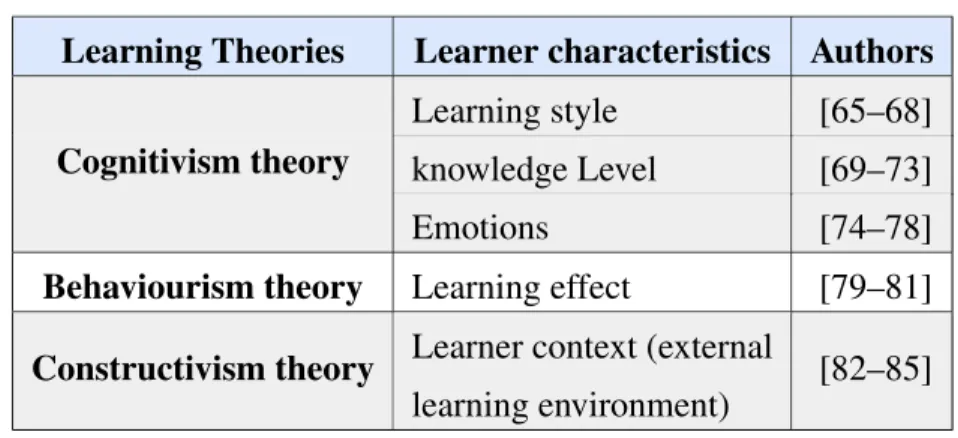
All the three learning theories described above possess distinct effects related to the development of
adaptive e-learning systems since they seek to interpret how effective learning takes place through such
systems. Table 2.1 shows learner characteristics used when particular theories are employed. Since the
behaviourism theory does not take into account the learner’s internal mental processes, this approach
is particularly not applicable in terms of implementing adaptive e-learning systems. Additionally,
be-haviourism does not learn for creative thinking or problem-solving. In fact, students only recall few
generic details or automatic responses and not known to take any initiative in order to change or improve
things [86].
Since constructivists view the learning process differently, they believe that knowledge is generated
by learners through the integration of new information with existing knowledge and experience [87]. In
addition, it is thought that constructivism has a rather positive effect in the learning process whereby
learners are involved in their respective progress and simultaneously control their own learning while
making use of interactive and adaptive instructional techniques and eliminating grades. Consequently,
constructivism in education poses a threat since it is known to generate uncontrolled learning instead of
a systematic way of learning, thus making evaluation process difficult.
The cognitive approach which seeks to combine artificial intelligence and learning analytics is used
to enhance adaptive and personalised learning. This theory is more commonly used in learning systems
as demonstrated in Table 2.1.
Hence, this study is focussed on proposing an adaptive e-learning environment which recommends
every suitable learning object according to a student’s learning styles. These Learning Styles are
fre-quently applied in education, and their influence on students’ learning process and outcomes are
increas-ingly emphasised upon [88, 89]. The following section comprises descriptions of numerous Learning
2.2
Learning Styles
A Learning Style (LS) is denoted by the manner in which a learner absorbs, processes and retains
knowl-edge [90]. These styles are generally different for each student based on personal factors. For instance,
during an experiment, some students are able to grasp quite well just by following verbal instructions,
whereas others gain a sound understanding only after physically practising the experiment on their own.
It is key that educational systems recognise and consider different learning styles so as to improve the
learning process for all.
Today’s literature contains quite a few definitions of the term LS. According to [90], Learning
Styles comprised the means by which information was processed in addition to constituting the learner’s
strengths as well as preferences. In [91], the authors perceived Learning Styles as the"composite of
char-acteristic cognitive, affective, and physiological factors that serve as relatively stable indicators of how a learner perceives, interacts with, and responds to the learning environment". Subsequently in [92], it was
widely understood that Learning Styles were "based on individual differences in learning in addition to
the learner’s preference for employing different phases of the learning cycle".
As pointed out by [93], Learning Styles constitute a crucial factor during the learning process as per
numerous educational researchers who have also suggested that their implementation in the educational
system would drastically enhance the learning process. Moreover, [2] speculated that learners accustomed
to a specific style of learning could experience difficulties especially in situations where the way of
teach-ing fails to match with the learner’s style of learnteach-ing. Accordteach-ing to [93], learners are more acquainted to
know themselves better, especially in terms of their strengths and weaknesses once they become aware of
their Learning Styles. It is through focusing on these weaknesses that they might develop their learning
processes. Furthermore, Learning Styles form a supporting factor throughout the process of designing
online learning environments.
For the purpose of classifying learners into specific categories, the development of several learning
style models has taken place. Learner types are made use of to enhance the learning potential of a learner
by providing relevant learning material. Certain well-known learning styles include models developed by
David Kolbs (Kolb’s Learning Style) [1], Peter Honey and Alan Mumford (Honey and Mumford’s
learn-ing style model) [6], Neil Flemlearn-ing (VARK learnlearn-ing style model) [7], Katherine Briggs and Isabel Myers
(Myers-Briggs Type Indicator) [94], and lastly Richard Felder and Linda Silverman (Felder-Silverman
The following sub-sections review the above-mentioned Learning Style models and the methods that
were used to characterise each learner’s preferred styles of learning.
2.2.1
Kolb Learning Style
Developed by David Kolbs [1], this theory is closely related to experiential learning, i.e. knowledge
creation when a change of experience occurs in the process of learning. Kolb’s LS model is measured
using LSs Inventory (LSI) [95]. The Kolb model [1] which is measured using LSs inventory includes
four basic learning modes, namely, Concrete Experience (CE), Reflective Observation (RO), Abstract
Conceptualization (AC), and Active Experimentation (AE), as shown in Fig. 2.1 [1]:
• Concrete Experience (CE)includes senses such as hearing, seeing, touching and feeling; • Reflective Observation (RO)represents reflecting about the knowledge developed; • Abstract Conceptualisation (AC)defines logical examination of the new knowledge; • Active Experimentation (AE)refers to the practical application of concepts and ideas.
The sequence of the four modes as defined by Kolb [1] is as follows: The first stage includes an
expe-rience that the learner encounters. This expeexpe-rience establishes the foundation for observation. Next, the
learner reflects on this experience and interprets its meaning followed by the creation of abstract ideas
and concepts based on their interpretation. Lastly, the ideas are tested and applied in the environment.
This four-stage process is then repeated where the latest experience is used as the concrete experience of
the first mode. The process then cycles back to the initial stage of the experience. In order to completely
understand this topic, it is necessary that the learner completes the entire cycle of all four modes.
As part of the Kolb Theory, a learner is positioned at the intersection as illustrated in Fig. 2.1. This
intersection occurs where the vertical line (which connects CE and AC) and the horizontal line (which
joins RO and AE) connect. Kolb [1] divided Learning Styles into four types:
TheAccommodator (Concrete/Active)Style where knowledge is gained by learners through the first
and last stage, i.e., through concrete experiences and active experimentation. It is also presumed that
though such learners might be impatient sometimes, they are generally good problem solvers.
TheDiverger (Concrete/Reflective)) Style where learners are usually creative and are always thinking
of the entire picture. Such people also excel at brainstorming by being able to reflect from different
Figure 2.1: Kolb’s experiential learning cycle [1]
TheConverger (Abstract/Active)Style where learners are highly skilled in practically applying their
ideas to their surroundings in addition to being creative and excellent decision-makers.
The Assimilator (Abstract/Reflective)Style where learners are experts in abstract conceptualisation
and reflective experiences. It is known that such learners are highly skilled in creating theoretical models
and generally excel in abstract ideas while not being too interested in the application of concepts. In
general, these people avoid interactions with people.
Although Kolb’s theory has been received quite positively for performance improvements specifically
in the educational sector, numerous issues have been observed with the model [96]. It is known that
Kolb’s model does not justify the significant number of new skills specific to e-learning environments and
technology such as social learning and interactive environments [97]. In addition, this model does not
possess the characteristic to be able to locate and utilise information which is delivered in several distinct
formats, such as audio, video, text, animation and image. It is necessary to note that learners prefer
different learning types over time based on various situations. Hence, the LSI may not be adequately
2.2.2
Honey and Mumford learning style model
Inspired by Kolb’s four Learning Styles [1], the Honey and Mumford model was developed by a pair
Peter Honey and Alan Mumford [6] to further identify four distinct Learning Styles, namely, Activist,
Theorist,Pragmatist, andReflector, characteristics of which are described below in Table 2.2.
Table 2.2: Learning Styles as defined by Honey and Mumford [6]
Learning Styles Characteristics
Activists People who learn best by doing and those who open themselves up to
learning and new experience.
Theorists Learners who thoroughly enjoy the learning process through models and facts.
Pragmatists Individuals keen on the practical application of ideas during experiments.
Reflectors Individuals who prefer learning and reflecting through observing other
people’s experiences.
Honey and Mumford also initiated the Learning Styles Questionnaire (LSQ) to aid learners in
iden-tifying their Learning Styles [99]. To date, two types of questionnaires exist, one with 80 questions; and
the other with 40 questions. Though the LSQ is quite popular and commonly used for human resource
purposes, its accuracy and validity are unknown. Furthermore, since the questionnaire is a commercial
solution and not free, it’s used by individual learners is very limited [100]. Thus, the Honey and Mumford
model has restricted applications in the case of e-learning training designers and instructors while they
identify appropriate learning styles for instruction purposes through digital media [100].
2.2.3
VARK learning style model
The VARK (an acronym forVisual,Aural,Read/write, andKinesthetic) Learning Style model is one
au-thored by [7]. The model focuses on representing how learners choose to perceive and absorb information
and is based on four learning modes, particularly,visual learning,auditory learning,physical learning
andsocial learning. Using these learning modes which are also shown in Table 2.3, it is up to learners on
what mode to choose in order to experience a first-class learning process. At times, a single learner can
demonstrate a preference for multiple Learning Styles. Such learners are known as multi-model learners.
So as to identify the learning mode for a particular learner, the VARK model makes use of a questionnaire
Table 2.3: Learning modes as per the VARK model [7]
Mode Tendency in learning process
Visual (V) Learner prefers to learn by seeing, i.e., through visual aids such as
pictures, videos, etc.
Aural (A) The desire to learn by listening, i.e., with the help of audiotapes,
lectures and music.
Read/Write (RW) Learners inclined towards learning through reading and writing in the
form of presentations.
Kinesthetic (K) Learning through practical real encounters and hands on work instead
of listening or watching.
2.2.4
Myers and Briggs Learning Type Model
Taking inspiration from Carl Jung [101] who postulated that every individual possesses one of four
per-sonality traits, Katherine Briggs and Isabel Myers developed the Myers-Briggs Type Indicator ((MBTI)
which is primarily a questionnaire to classify individuals in four categories based on their personalities.
These categories, popularly known as dichotomies includeExtroversion/Introversion,Sensing/Intuition,
Thinking/Feeling, andJudging/Perceiving[94], adding up to a total of (24), i.e., 16 patterns.
• TheExtroversion/Introversiondichotomy is based on an individual’s attitude, where extraversion refers to an extrovert’s response to his/her surroundings, such as people or things, while introverts
delve upon their own ideas.
• Reflecting on functions, the Sensing/Intuitioncategory refers to an individual’s perceptions to gather information. These are those who collect information through their five senses, while others
are those who use intangible information by believing in their intuition.
• Referring to an individual’s method of judging, the Thinking/Feelingdimension is used by indi-viduals to arrive at a rational decision. Thinkers are those who make use of logical quantifiable
frameworks to arrive at a decision while feelers are those that judge based on taking their feelings
into consideration and empathising with the situation above all.
• The final dimension which includes Judging/Perceiving refers to an individual’s preferences, whether they want to judge by making a structural and sequential approach or judge by being
According to [102, 103], MBTI has limited applicability for recommending the most suitable learning
materials in e-Learning.
2.2.5
Felder and Silverman Learning Styles Model
Reflecting on popular learning style models such as that of Kolb’s [1] and the work of Myers and Briggs
[94], Richard Felder and Linda Silverman [2] developed a model consisting of four dimensions to provide
a balance between extremes. Illustrated in Figure 2.2 are the characteristics of the model as prescribed by
Felder and Silverman. Each of these dimensions is defined as below:
Figure 2.2: FSLSM learning style model [2]
• Active/Reflectivecites the ability of a learner to be able to process information. While an active learner learns best by practising and working in groups, a reflective learner prefers learning by
thinking things through and working individually.
• Sensing/Intuition deals with how individuals prefer to perceive information. Sensing learners choose to deal with concrete facts whereas an intuitive learner works based on abstract concepts
and ideas.
• Visual/Verbalis related to an individual’s preference on how information is presented. While vi-sual learners process information better when presented through graphics and presentations, verbal
• Sequential/Global is concerned with a learner’s ability to understand information. Generally, a sequential learner inclines towards thinking in an orderly manner, in sequential steps, a global
learner prefers learning by integrating various ideas and in large leaps.
Felder and Silverman proposed a questionnaire comprising 44 questions known as the Index of Learning
Styles (ILS) (see Appendix A), to aid individuals in finding out what their learning preferences were.
Each dimension is represented by 11 questions, where there are two possible solutions “a” or “b” for
each question. For instance, a dimension characterised by Learning Styles X/Y could have two solutions,
either “a” which corresponds to preference for X, or “b” which indicates inclination towards Y.
To determine a learner’s learning style within a specific dimension using Felder-Silverman’s
question-naire, it is sufficient to count the number of answers “a” and the number of answers “b” on all 11 questions
corresponding to that dimension followed by calculating the difference between these two numbers.
Ob-viously, this score is an odd number between 11 (all responses of the learner are equal to “a”) and -11 (all
responses are equal to “b”). A learner with a score of 1 or 3 (-1 or -3) has a mild preference for X (resp.
for Y); yet is essentially well balanced to learn in a teaching environment that favours X or Y. For a score
of 5 or 7 (-5 or -7), the learner has a moderate preference for X (resp. for Y) and will learn more easily in
a teaching environment that favours X (resp. Y). Finally, a score of 9 or 11 (-9 or -11) indicates a strong
preference for X (resp. for Y).
2.2.6
Choice of learning style model
For this research the FSLSM has been employed (as defined in Section 2.2.5 above) to constitute the
student profile (Learning Styles) as well as the learning object profiles, due to the below justifications:
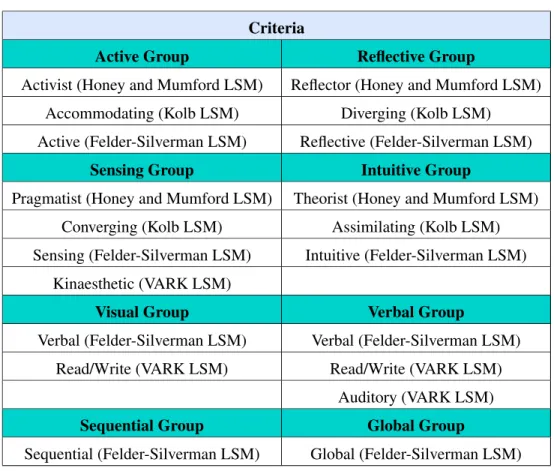
• Firstly, as displayed in Table 2.4, in addition to integrating the work of various popular Learning
Style models such as Kolb [1], Myers and Briggs [94], Honey and Mumford [6] and the VARK
model [7], the FSLSM is known to be the only existing model till present which covers all
cate-gories. For instance, theActive/Reflectivedimension in the FSLSM replicates theActivist/Reflector
Learning Style as defined by Honey and Mumford. Furthermore, theSensing/Intuitiveaspect in
the FSLSM is identical to theConcrete/Abstractmode as specified by Kolb [104, 105] in addition
to the Pragmatist/Theorist in Honey and Mumford’s model. Moreover, theVisual/Verbalgroup
corresponds to the Visual/Read-Writemode within the VARK model. Moreover, FSLSM is

![Figure 2.1: Kolb’s experiential learning cycle [1]](https://thumb-us.123doks.com/thumbv2/123dok_us/9937028.2486496/41.918.198.822.75.538/figure-kolb-s-experiential-learning-cycle.webp)
![Figure 2.3: Identification of learning styles and automatic detection of learning styles [3]](https://thumb-us.123doks.com/thumbv2/123dok_us/9937028.2486496/48.918.178.852.294.575/figure-identification-learning-styles-automatic-detection-learning-styles.webp)