Improving Image Classification using Fuzzy Neural
Network and Backtracking Algorithm
Abdul Haris Rangkuti
1, Ayuliana
1, Muhammad Fahri
21School of Computer Science, Bina Nusantara University, Jakarta, Indonesia.
2Faculty of Mathematics and Natural Sciences, University of Gadjah Mada, Jogjakarta, Indonesia. [email protected]
Abstract—We propose an improved image classification method using fuzzy neural network (EFNN) which describes an algorithm in order to create a class rule based on the training data image. Redundant rule on 2 or more of data training image is generated in some data processing. A solution to the problem using backtracking algorithm, which will determine the appropriate class rule, is used by one of the training data images. Thus, every rule has an image of the appropriate class. In the process of inputting the data EFNN algorithm, 7 statistical parameters are used as a representation of the image characteristics, for feature extraction using wavelet Haar 2. The image becomes more leverage and has different characteristics to the representation of the image of the other. All input from crisp number is converted into fuzzy number with 5 membership function, which are Very Low, Low, Medium, High and Very High. Here, each image is represented by 7 statistical parameters and each parameter is divided into 5 categories. Percentage of accuracy in the classification process by using algorithms EFNN is above 95 percent for all data training, especially when it is compared with the original FNN.
Index Terms—Image Classification; Fuzzy Neural Network;
Backtracking; Fuzzyfication; Wavelet Haar; Statistical
Parameters.
I. INTRODUCTION
Batik is one of Indonesia's cultural richness that needs to be preserved and maintained. Basically, Batik is cloth with special Indonesia pattern and has an important role in conducting traditional ceremonies, in Java island as well as other places in Indonesia. Even in several official states where all guests are requested to wear special batik apparel. Batik is an Indonesian cultural heritage that has been very popular in all over the world. However, there are some batik patterns which has special pattern and repeated many times in the design. The patterns can be used as a feature in order to identify the origin of the batik characteristic. Actually, the retrieval Batik process based on low-level feature (characteristic) which is an area that is mostly under research and there are still many to be explored in image processing [1,3,4]. This is also to anticipate the storage of the images and retrieval of the images from a collection of images become optimal, fast and effective. One of the approaches that will be used is Query by Example, which is one derivative of the development of CBIR (Content-Based Image Retrieval) [2]. The content-based image classification is an important process in terms of doing an index and image retrieval. Because of this reason, the image retrieval concept based on low-level feature is the best retrieval based on human concept [2, 4]. Images with different textures have different characteristics [5]. Relative to batik image, texture
feature is important because the ornament in the cloth can be viewed as different texture composition [5, 6]. On top of that, the batik pattern can be influenced by the shape characteristics which batik is composed of kinds. For example, patterns of slopes with slanted lines, machete shaped pattern with slanted lines that has a dent on each top and bottom and other patterns [6, 7]. This research will extend knowledge to understand batik patterns based on characteristics of the Image texture [8]. These characteristics are the base for conducting image classification [9]. There is a couple of research that focuses on image classification process based on texture, especially of Batik images [6, 9].
Researchers have been using neural network in conducting classification. Neural network for classification is preferable because of its ability to process in parallel and to perform decision making [10, 11]. Besides, this research can increase the ability to group or to classify content based images. For supporting this approach, Fuzzy Logic and Wavelet Transform are also used it [11,12]. This research focuses on batik image, which is already under research started a couple of years ago, although it used similar method to another general classification method [7, 8]. The target of this research is to obtain effective rules in conducting batik pattern classification based on the pattern similarity, whether it is more accurate or more relevant towards its image classification. Therefore, it will become easier to recognize the original pattern of the batik, including the associated traditional story behind every single pattern of batik.
The objectives of the research are:
1. To develop an effective rule for doing image classification process on batik that they will be defined and classified as a group.
2. To improve the performance of Batik image classification based on pattern characteristic because of the rule development is a simpler process for classification.
The research focused on image batik patterns with a specific texture and shape. This research can be done and developed for another image characteristic such as Natural Phenomenon, Forest Condition, saying shapes, paintings and candy (cultural Informatics).
The Output of research are:
1. To generate rule of classification in term of recognizing a batik pattern based on segmentation of image texture and shape with simple way, but having a good performance.
2. To improve the accuracy and efficiency of the retrieval system based on feature image similarity in batik. In this research there are 12 types of batik patterns, such as “ceplok”, “”lereng”, “parang”, “Mega mendung”, “kawung”,
“nitik” dan “tambal”, “sekar jagad”, “sida luhur”, “sida dradjat” with classification process on Batik patterns.
II. RELATED WORKS A. Previous Research
There are some research focused on image classification method such as content-based classification using the neural network and fuzzy logic [14]. Example of implementation in medical image classification is a technique for assigning a medical image to a class among a number of image categories. There is an important task in the content-based image retrieval due to computational complexity [12]. The conventional method in medicine for brain MR image classification and tumor detection is usually done by human inspection [13]. However, fuzzy logic technique is more accurate but it fully depends on expert knowledge, which sometime may not always available [13, 14]. Here, we extract the feature using PCA and after that training using the ANFIS tool. The performances of the ANFIS classifier was evaluated in terms of training performance and classification accuracy [11]. Fuzzy Neural Network (FNNs) is a Neural Network based fuzzy logic decision system [11, 12]. The model consists of three layers. The first layer is an input layer. The second layer is used for fuzzification wherein input feature values are mapped to membership functions. The last layer implements fuzzy inference rules. Units in the input and output layers represent input features and output categories, respectively. Beside, FNN also provides a new approach to classify multispectral data and to generate classification rules. Neural Network handles problems at the numerical level, whereas fuzzy is related to it from semantics level or linguistic level, and NNs synthesize fuzzy logic and neural network [14, 16, 17].
The Classification Method is conducted using group approach using the concept of neuro-fuzzy. This approach is used to classify image based on content with the retrieval of 2D images and using wavelet transformation [10, 15, 17]. The research that is related to batik image is using conventional CBIR concept, where for image retrieval becomes relevant to sample images, the batik pattern recognition allows the approach to become more flexible using Generalized Hough Transform. This method is applied to recognize some patterns within the same collection of images (classification) [8]. The classification concept showed that performing classification with cluster batik image based on patterns, contrast and supporting color, where the color and contrast is supported by the supporting algorithm [18].
B. Supporting Theory a. Wavelet Feature
The Wavelet feature is obtained from the original image texture and the associated supporting images. The feature consists of different combination of the sub-band images that offers a better strategy to differentiate image classification and improve the classification level [8]. The input image is interpreted as signal, decomposed using Lo_D (Low Pass Filter Decomposition) and Hi_D (High Pass Filter Decomposition) and then second downsampling is performed. The output is a low-frequency signal and high-frequency signal. The two process described previously is performed twice for each row and columns so that four sub-band will be produced containing low frequency and
high-frequency information. The approximation coefficient contains background information and coefficient detail which are horizontal detail, vertical detail, and diagonal detail that contain edge information [17].
The following illustrates the image decomposition process, as can be seen in Figure 1. LH1, HL1, and HH1 is the result of decomposition level 1. Meanwhile, LL2 is not shown on the diagram because it is immediately decomposed into LL2, LH2, HL2 and HH2. Decomposition process always starts from the top left corner [19].
Figure 1: Image Decomposition on wavelet discrete III. CLASSIFICATION METHODOLOGY A. The Stage of batik Image Classification
The framework of batik image classification based on feature image similarity by implementing of Fuzzy Neural Network. Actually, there are 5 main steps for doing image classification using EFNN algorithm. They are:
1. Collection and Selection 2. Preprocessing Image 3. Feature Extraction 4. Classification
5. Solving for rule conflict
At the first step, the collection is performed and at the same time selecting all collected batik images. Doing the collection of batik image have been done in several ways such as through the Internet, taking a digital photograph or from an image collection CD–batik, or by selecting the images manually. All the collected images have a file extension of *. jpg, *. png or *. bmp. Batik image must also be clear in shape and texture. The stage of batik image classification to optimize the percentage of accuracy using an Improving of image classification is presented in Figure 2.
Figure 2: The Stage of batik image classification Using Fuzzy Neural Network Category of fuzzification process is : 1. Very Low (VL) 2. Low (L) 3. Middle (M) 4. High (H) 5. Very High (VH)
characteristic texture variable 1. Wavelet of Mean 2. Wave;et of Standard Deviation 3. Wavelet of Energy 4.Wavelet of entrophy 5. contrast 6.corelation 7. Skewness Feature Extraction Using Wavelet Transform and Invariant moment Classification using Neural Network Fuzzy Input Selection and resize
of batik image Preporcessing (Grayscale) Rule Generation Measurement Similarity
B. Preprocessing Image
In the second step, all data will be pre-processed by treating all images to be grey-scaled. The purpose of this step is to ensure there will be no interference due to RGB during feature extraction process.
C. Feature Extraction
Feature extraction process is elaborated into 7 statistical parameters, which are Mean, Standard Deviation Energy, Entropy, Correlation, Skewness and Contrast. The 4 variables above will be processed using wavelet haar transform in 2 types. This is a new study of the characteristic texture in which the variable will be calculated using the wavelet transform method. Some characteristic values are generated through the wavelet decomposition process, including obtaining approximation coefficient [17, 19]. The process stage can be seen in Figure 3.
Figure 3: Feature Extraction process using Wavelet Transform This variable is only focused on calculating the approximation coefficients which are part of the 4 sub-bands. There are some supporting of command such as (MATLAB):
[C,S]=wavedec2(i,2,'db2'), A= appcoef2(C,S,'db2',2).
Note : Wavedec 2 = wavelet decompotition 2D, db2 = Haar type 2,
appcoef2= approximation coefficients 2D. D. Classification
In the batik image classification, we used an improved Fuzzy Neural Network algorithm from Kulkarni et al. (2006). Nevertheless, the feature extraction image employed wavelet haar2 method, of which for the representation of image texture characteristics, 7 statistical parameters are used. With this feature, extraction will be able to represent batik image side and to distinguish the characteristics of texture on the other image. As expected, the classification system will produce the right rules. So, the process of classification on a set of images of batik is expected to produce a level of accuracy and precision can be above 90 percent.
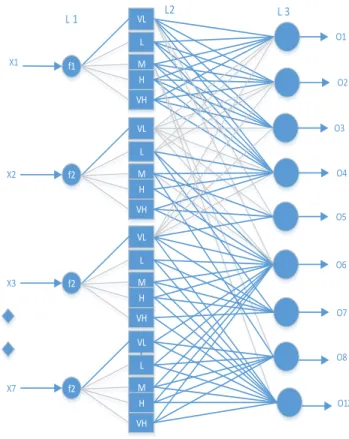
At Layer 1, there are 7 (seven) crisp values features and representation of the batik image. There are Energy (X1),
Mean (X2), Standard deviation (X3), Entropy (X4),
Correlation (X5), Skewness(X6), Contrast (X7). Based on figure 3, the 1st layer, for each image represented by 7
statistical parameters, the feature extraction process using wavelet haar will be performed. The results obtained (as crisp value) will be input for the 2nd layer to perform the
fuzzification process. An improved Fuzzy Neural Network algorithm can be seen in Figure 4.
Figure 4: Improving Image Classification using Fuzzy Neural Network Architecture
The fuzzification stage is the initial stage where there is a process of mapping a crisp value in the fuzzy set. In other words, it creates a crisp value into a value that ranges from 0 to 1 in the available fuzzy sets. At the fuzzification process, every crisp input will be converted into fuzzy input with 5 membership function for each crisp which is very low (VL), Low (L), middle (M), high (H) and Very High(VH).
Layer 3 has 7 (seven) neurons to classify twelve types of batik image such as: ceplok (CP), kawung (KW), parang (PR), mega mendung (MM), lereng (LR), Tambal(T), Nitik(N), Sida Drajat (SD), Sida Luhur (SL),Sekar Jagad (SJ) and Truntum (T). Every neuron will produce an output which is a binary value “0” or “1”. The combination of twelve binary numbers at layer 3 shows the class that is input into the system. The conversion of value uses FNN algorithm in the form of binary value in Table 1.
Table 1
The result of FNN Algorithm in the form of Binary Value f1 f2 X1 L 1 O1 O2 O3 O4 O5 O6 O7 L 3 VL L M H VH VL L M H VH X2 f2 VL L M H VH X3 f2 VL L M H VH X7 O8 O12 L2 No Name of Batik Pattern 1 Ceplok 1 0 0 0 0 0 0 0 0 0 0 0 2 Kawung 0 1 0 0 0 0 0 0 0 0 0 0 3 Nitik 0 0 1 0 0 0 0 0 0 0 0 0 4 Parang 0 0 0 1 0 0 0 0 0 0 0 0 5 Lereng 0 0 0 0 1 0 0 0 0 0 0 0 6 Tambal 0 0 0 0 0 1 0 0 0 0 0 0 7 Mega Mendung 0 0 0 0 0 0 1 0 0 0 0 0 8 Truntum 0 0 0 0 0 0 0 1 0 0 0 0 9 Sekar Jagat 1 0 1 0 0 0 0 0 1 0 0 0 10 Sida Luhur 1 0 0 0 0 0 0 0 0 1 0 0 11 Sida drajat 0 0 0 0 0 0 0 0 0 0 1 0 12 Sida Mukti 0 0 0 0 0 0 0 0 0 0 0 1
Value Conversion using FNN algorithm in Binary Number Preprocessing
(graylevel and Canny edge detection)
Feature Extraction Process Using Wavelet Decomposition
Get Approximation Coefficients for 7 Statistics Parameters
Wavelet Energy, Wavelet Mean, Wavelet Standard Deviation, Wavelet Entropy
E. Learning Algorithm
The purpose of the learning process on FNN is to obtain an optimal network scale at the network connection between layer 2 and layer 3.The Learning algorithm is described below:
Set learning ratevalue(α); Set network scale ( ); i: neuron index at layer 2, j: neuron index at layer 3; While not stop condition do : For each learn data, perform:
✓Calculate fuzzy input for variable Energy (X1);
✓calculate fuzzy input for variable Mean (X2);
✓calculate fuzzy input for variable Standard Deviation (X3);
✓calculate fuzzy input for variable Entropy (X4);
✓calculate fuzzy input for variable Correlation (X5);
✓calculate fuzzy input for variable Skewness (X6);
✓calculate fuzzy input for variable Contrast (X7);
For each neuron j at layer 3, perform:
1. Calculate value at layer 3 using the formula:
2. Calculate value y(j) at layer 3 using the formula:
3. Calculate error (E) using the formula:
4. Calculate with the formula:
5. Calculate delta rule ( ) using the formula:
For each scale between layer 2 and layer 3 ( ), perform: 1. Calculate difference of scale ( ) using the formula: 2. Calculate new scale ( ) using the formula:
3. Calculate the average MSE for one epoch ( ) using the formula:
F. Solving Rule Conflict
We use the learning data to perform feed forward process on layer 2 and layer 3 (part of neural network). For each data pattern on the learning data, the following processes are performed:
For each neuron on the output layer, find the neuron having the value f(net) of y >= threshold. For this case, the threshold value is set to 0.5. This neuron is called the active neuron. For each neuron on the input layer, which is connected to the active neuron on the output layer, perform the following process:
• Perform the calculation of activity level (z) using the formula: z(i,j) = w(i,j) . y(j), where, w is the network scale, y is the output on each neuron at the output layer, i is the index number for neurons at the input layer and j is the index number for neurons at the output layer. • Next, if a neuron at the input layer has an activity level
(z) that is ≥ threshold (0.5), then the connection between neuron at the input layer and output layer is called the active connection.
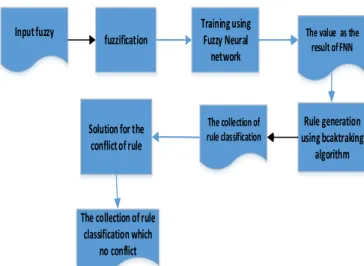
Therefore, one active neuron at the output layer will have a collection of active connection which is connected to neuron at the input layer that has activity level (z) >= threshold. One unit of active connection for one active neuron means one rule candidate. The backtracking algorithm can be seen in Figure 5. fuzzification Training using Fuzzy Neural network Rule generation using bcaktraking algorithm Solution for the
conflict of rule
The value as the result of FNN
Input fuzzy
The collection of rule classification
The collection of rule classification which
no conflict
Figure 5: The Backtracking algorithm solve the rule conflict The Stages of backtracking algorithm is as follows: 1. For each training data, the output value will be
generated in NN process on layer 3. However, for NN output value generated is not rounded to 0 or 1, but a fixed value in its decimal value. For example the output at layer 3 with the value (0.3 | 0.4 | 0.7 | 0.23 | 0.12 | 0, 5 | 0.33), then rounded the value to (0 | 0 | 1 | 0 | 0 | 1 | 0).
2. For each neuron on layer 3 which will produce a value of > = 0.5. eg. neurons 3 and neurons 6, generates a value of > = 0.5 are : 0.7 and 0.5. It will be backtracking from neuron to-3 (layer 3) to all the neurons in layer 2.
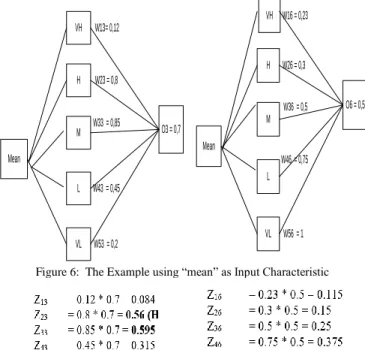
The first step calculates value which is obtained by multiplying the value of the neuron in layer 3 with respective weights that connect it, to the network each neuron in layer 2 as shown by the equation: 𝑧𝑖𝑗= 𝑤𝑖𝑗. 𝑜𝑗, where Zij =The value
of the product of the neuron j in layer 3 with the weight connecting neuron i in layer 2 and neuron j in layer 3.
Wij = network weights between neuron i to j
Oj = The output value of the neuron j (in layer 3).
For example, for the fuzzy input from Mean characteristics, it is known that neurons have a value > = 0.5 at layer 3 is the 3rd neurons and neuron-6, i.e. with the value of 0.7 and 0.5,
then the value of this Zij is calculated like this (see Figure 6). Characteristics "Mean" while for other characteristics, do the same thing to calculate the value of Zij. If the fuzzy input for other characteristics, such as characteristics of "standard deviation" and "Energy" has been calculated and the obtained value Zij, the complete rules obtained like this:
• IF "Mean = H" OR "Mean = M" AND "STD = M" AND "Energy = VL" THEN "class = 3". Each rule is grouped by similarity class.
• The other example after processing of the fuzzy neural network another rule can obtain such as :
"Energy = L" AND Correlation = L” AND Entropy = “L” OR Entropy = “VL” AND Skewness = “M” And Contrast = “VL” THEN "class = 6".Each rule is grouped by similarity class. Mean VH H M L VL W13= 0,12 W23 = 0,8 W33 = 0,85 W43 = 0,45 W53 = 0,2 O3 = 0,7 Mean VH H M L VL W26 = 0,3 W36 = 0,5 W46 = 0,75 W56 = 1 W16 = 0,23 O6 = 0,5
Figure 6: The Example using “mean” as Input Characteristic
After all learning data input into the system, and with several rule candidates, then the rule candidates will be selected and remove redundant rules and contradictory rules. Rules that are contradictory is defined to have the same antisenden, but different consequences.Suppose there are two candidate rule that is contradictory of each other,
• rule 1: “if EA = ‘Low’ and STD = ‘Medium’ then class is ‘pattern 1’”,
• rule 2: “if EA = ‘Low’ and STD = ‘Medium’ then We determine which rule will be used and calculated by using the formula Degree of significance (D). The formula: D = µ0 . µ1 . µ2 ... µn . yj
• D is a degree of significant value
• where µ is fuzzy input (result from fuzzification) and • yjis the value obtained at the output layer.
Therefore, such as for example, D can be calculated as follows:
D(rule 1) = µEA(Low) . µSTD(Medium). y1 D(rule 2) = µEA(Low) . µSTD(Medium). y3
The Rule the larger of value D is the rule that will be used (Kulkarni, 2006).
• For Example the first rule, the value of mean (H) = 0.5, Standard Deviation (H) = 0.7 and Energy (VL) = 0.6 and the output value (01) = 0.65 and the the total of D1 value is 0.5 * 0.7 * 0.6 * 0.65 = 0.1365,
• For the second rule, the value of mean (H) = 0.8, Standard Deviation (H) = 0.7 and Energy (VL) = 1 and the output value (01) = 0.8 and the the total of D2 value is 0.8 * 0.7 * 1 * 0.8 = 0.448.
Based on the result, the D1 and D2 value, which is the strongest in terms of its significance, is the second rule, because the value of D2 > D1, and the result the first rule will be deleted.
IV. RESULTS AND DISCUSSION
This research is an improvement of the research that is already performed earlier, adding an object of study ranging from the number of image of batik. The goal is to be able to determine the level of precision to be more precise and relevant to the additional object in the database using the fuzzy Neural Network algorithm.
In determining the performance of the image classification based on shape or texture using the Backtracking Algorithm, the result will be correct and accurate if a number of images that have similar characteristic are identified correctly by the system and included to solve the redundant problem when every image has the same class, although the invisible accuracy can be determined from the resulting percentage.
This algorithm is the establishment of rule classification. It will be faster and easier to determine the class to query images (testing images), without having to perform data processing for training.
After we compare to the other algorithm, we have a conclusion as follows (See Figure 7).
Figure 7: Rate accuracy of Classification using some algorithm Based on Figure 7, it can be concluded that an improved image classification using FNN and backtracking algorithm has higher accuracy in terms of percentage value than the other algorithms. The boundaries of the images that are studied as follows:
• Images tested are the images that already exist in the training data. Despite the change in the color degradation.
• The image of the study did not change the rotation or scale
• The images that will be investigated may include batik images that have texture and shape which are obvious. On the basis of this research in classification process of the motive by using the Fuzzy Neural Network with different structure, these images will be identified as having characteristics that resemble or are almost the same as the original batik image. However, there is no different for rotation and scaling the image.
Table 2
Summary for classification using an Improving of Fuzzy Neural Network but have different Architecture NN
MSE 9,99E-01 9,81E-01
Epoch 279.135 184.800
Architecture Fuzzy
Neural Network 7 - 35 – 12 7 - 35 - 12 – 12
Learning Rate 0,2 0,2
% Precision for data
training 92 95
Based on Table 2, In processing the data testing and training for the percentage of precision on the neural network system using an architecture with a hidden layer that is 7 - 35 - 12 - 12 better results than those not with hidden layer 7 - 35 - 12. In addition to the difficulty will occur in data testing that has very irregular patterns such as mega mendung patterns, tambal and truntum patterns. For that for the percentage of accuracy to the data testing is lower than using the data training. Especially with the pattern of changing rotation and scale, including the position of the pattern. Therefore the percentage of precision in data testing is less than 60 percent. For that reason, the next research becomes an interesting part of the review.
V. CONCLUSION AND RECOMMENDATION
To produce the performance of image classification, an improving fuzzy neural network algorithm and supporting with backtracking algorithm will be used as a solution if there is the rule generation with the same class. In determining the rule that will be used when the required degree of significance in the backtracking algorithm.
An improved image classification using Fuzzy Neural Network Architecture for Batik Image Classification using with 7-35-12-12, it means 7 nodes in Layer 1, 35 nodes in layer 2, 12 nodes as hidden layer, 12 layers as output can directly determine the class for batik image.By determining the learning rate of 0.2, epoch around 184,800 and architecture network using 7-35-12-12, resulting in the precision of classification around 95 percent.
This algorithm is the establishment of rule classification. It will be faster and easier to determine the class to query images (test images), without having to perform data processing for training.
The proposed method can be used in doing research for conducting advanced research related to the image retrieval technique. The classification process would be optimal if statistical parameters were added in improving the accuracy and precision performance
To generate rules in determining the process of classification, the algorithm should be maximized in completing the rule that produces the same class. With doing another to improve FNN algorithm is expected in subsequent research to maximize the accuracy performance of images with rotational and scale changes.
In this study can be used another image such as image of fruit, vegetables, informatics culture and image of blood cells. Where all data will be entered into the database to become data training ready to support for retrieval process by using data testing (query data)
REFERENCES
[1] Rangkuti A H, R. B. Bahaweres, and A. Harjoko,2012, "Batik image retrieval base on similarity of shape and texture characteristic," in International Conference on Advanced Computer Science and Information Systems (ICACSIS 2012), Universty of Indonesia. [2] Rangkuti A H, Nashrul Hakiem, Rizal Broer Bahaweres, Agus
Harjoko, 2012, “Analysis of image similarity with CBIR concept using wavelet transform and threshold algorithm”, IEEE Symposium on Computers & Informatics.
[3] Rangkuti A H, Agus Harjoko,Agfianto Eko Putro, “Content Based batik Image retrieval, Jurnal of Computer science, 2015” page 925 – 934, 2014.
[4] Ali, N., Bajwa, K. B., Sablatnig, R., Chatzichristofis, S. A., Iqbal, Z., Rashid, M., & Habib, H. A. (2016). A novel image retrieval based on visual words integration of SIFT and SURF. PloS one, 11(6), e0157428.
[5] Pratama, A. A., Suciati, N., & Purwitasari, D. (2012). Implementasi Fuzzy C-Means untuk Pengelompokan Citra Batik Berdasarkan Motif dengan Fitur Tekstur. JURNAL TEKNIK POMITS Vol.1, No.1. [6] Meccasia, K., Hidayat, B., & Sunarya, U. (2015). Klasifikasi Motif
Batik Banyuwangi Menggunakan Metode Ekstraksi Ciri Wavelet Dan Metode Klasifikasi Fuzzy Logic. eProceedings of Engineering, 2(2). [7] Wahyudi, Azurat A, Manurung M, and Murni A, 2009, “Batik Image
Reconstruction Based On Codebook and Keyblock Framework”, University of Indonesia.
[8] Sanabila HR and Manurung R, 2009, “Recognition of Batik Motifs using the Generalized Hough Transform”, University of Indonesia. [9] Pratikaningtyas D dkk, 2010, “Klasifikasi Batik Mengunakan Metode
Transformasi Wavelet ”, Paper Skirpsi, UNDIP.
[10] Balamurugan V and Anandhakumar P, “Neuro-Fuzzy Based Clustering Approach For Content Based Image Retrieval Using 2D-Wavelet Transform”, International Journal of Recent Trend in Engineering vol.1 No.1 May,2009.
[11] Ajay KS, Tiwari S, VP Shukla,2012, ”Wavelet Base Multi Class Image Classification using Neural Network”,International Journal of Computer Applica. ”, vol 37 – No.4
[12] Bhardwaj, A., & Siddhu, K. K. (2013). An Approach to Medical Image Classification Using Neuro Fuzzy Logic and ANFIS Kelasifier. International Journal of Computer Trends and Technology- volume4 issue3
[13] Pourghassem H, Ghassemian H, 2011, “Content-based medical image classification using a new hierarchical merging scheme” Comput Med Imaging Graph. 2011 Pub. Dec;32(8):651-61
[14] Celso A Franca, Adilson Gonzaga,2010, “Classification of wood plates by neural networks and Fuzzy logic”, University Federal at Sao Carlos. [15] Kulkarni and Sara MC Caslin,”Fuzzy Neural Network Models For Multispectral Image Analysis”, Circuit System, Electronics control, Signal Processing, USA, Nov. 2006
[16] M. Kokare, P. K. Biswas, and B. N. Chatterji, "Texture image retrieval using rotated wavelet filters," Pattern Recogn. Lett., vol. 28, pp. 1240-1249, 2007.
[17] Hazra D et al., 2011, “Texture Recognition with combined GLCM, Wavelet and Rotated Wavelet Features”, International Journal of Computer and Electrical Engineering, Vol.3, No.1, February, 201 [18] Margaretha E, Azurat A, Manurung R, and Murni A, 2009,
“Content-Based Information Retrieval System for Batik Application”. University of Indonesia.
[19] Joseph B, P. Darwin, 2012, “Multi Wavelet for Image Retrieval Based On Using Texture and Color Querys”, IOSR Journal of Computer Engineering (IOSRJCE) ISSN: 2278-0661, ISBN: 2278-8727Volume 6, Issue 6 (Nov. - Dec. 2012), PP 10-1.