http://researchcommons.waikato.ac.nz/
Research Commons at the University of Waikato
Copyright Statement:
The digital copy of this thesis is protected by the Copyright Act 1994 (New Zealand). The thesis may be consulted by you, provided you comply with the provisions of the Act and the following conditions of use:
Any use you make of these documents or images must be for research or private study purposes only, and you may not make them available to any other person.
Authors control the copyright of their thesis. You will recognise the author’s right to be identified as the author of the thesis, and due acknowledgement will be made to the author where appropriate.
You will obtain the author’s permission before publishing any material from the thesis.
Towards the development of a financial reporting
framework for Sri Lankan SMEs
A thesis
submitted in fulfilment
of the requirements for the degree
of
Doctor of Philosophy in Accounting
at
The University of Waikato
by
Wijekoon Mudiyanselage Himali Nisansala Wijekoon
ii
ABSTRACT
The study has two objectives: to identify the users and their information needs ofSri Lankan small and medium enterprises (SMEs) financial information; and to examine the need for internationally comparable accounting information for Sri Lankan SMEs. The findings clarify issues with the current SME financial reporting standards and provide useful insights to assist in developing an appropriate reporting framework for Sri Lankan SMEs. An analysis of the literature reveals a paucity of empirical research on financial reporting by SMEs and little about the users and their financial information needs in the context of developing countries. No prior empirical research that examines the effects of adopting the International Financial Reporting Standard for Small and Medium Enterprises (IFRS for SMEs) in Sri Lanka was found to exist.
This thesis contributes to the literature, through applying a mixed methods approach. A questionnaire survey was used to collect data from 323 accountants and owners of SMEs. Quantitative data was analysed using a statistical package for social sciences. The responses are subdivided into three categories: small; medium and large SMEs to reveal differences according to size. Forty-one face-to-face semi-structured interviews were conducted with accountants and owners, bank lending officers, income tax officers, and representatives from government agencies, and the accounting standards setting authority of Sri Lanka. Follow-up interviews were conducted with the same group of interviewees to obtain their comments on a proposed financial reporting framework. Qualitative data was analysed using thematic analysis via the NVivo software. Institutional theory was adopted as the theoretical framework to study Sri Lanka’s decision to adopt the IFRS for SMEs.
This decision was in response to institutional pressures rather than alleged benefits of internationally comparable financial information. Coercive institutional pressures are the most obvious which drove the adoption of IFRS for SMEs both at country and individual firm levels. SMEs do not see any need to provide internationally comparable accounting information due to their limited cross border activities. Many of the accounting topics included in the IFRS for SMEs appear to be irrelevant. The prime users of the financial information are owner-managers,
iii
banks, and the Inland Revenue Department. Government institutions are also users of financial information, particularly for the large SMEs. Users and their financial information needs vary according to the size of the SME. The results indicate that SME financial statements are unable to meet the needs of the main users. Tax oriented reporting, a lack of detail and a lack of up-to-date information are the main weakneses in SME financial statements. Further, users indicate the existing financial reporting framework, based on general purpose financial reporting, is neither cost effective nor relevant to the diverse SME sector in Sri Lanka.
Based on the findings, a framework for Sri Lankan SME financial reporting is proposed, which includes four tiers. The proposed framework allows non-publicly accountable entities to determine the objective of their financial reporting and tailor their information to users’ needs in a cost effective manner. These findings have implications, and recommendations for policy makers, and standard setters charged with developing and implementing an appropriate financial reporting framework for SMEs. The government and the local standard setters should pay greater attention to SME financial reporting and take steps to make it credible, relevant, and appropriate to the needs of users. The findings provide useful insights for developing countries, particularly the Asian countries where adoption of IFRS for SMEs is being considered.
iv
ACKNOWLEDGEMENTS
The completion of this thesis involved a number of people who have contributed in various ways. I express my sincere appreciation and thanks to these people for their contributions without which this project would never have come to a completion.
I cannot adequately express my gratitude to my panel of supervisors. First and foremost, I am indebted to Professor Grant Samkin, my chief supervisor for his guidance, encouragement and prompt critical comments on my work. His excellent supervision, expertise and valuable advice have enabled me to progress until completion. I am also grateful to Associate Professor Umesh Sharma for his gentle guidance and timely, constructive feedback on my chapters. I consider myself extremely fortunate to have had this team involved in my research with such a great deal of interest. I remain deeply indebted to them. I also wish to thank Dr Helen Samujh, who resigned from my supervisory team in mid-2016. Helen did not only support me to secure a PhD placement at the University of Waikato, but she also played a very important role in shaping the thesis and helped me improve the clarity of my writing.
I express my sincere thanks to the New Zealand Ministry of Foreign Affairs and Trade for offering me the NZ commonwealth scholarship to pursue doctoral studies in New Zealand. In particular, I thank Thomas McDonald the NZAP scholarship administrator at the University of Waikato. I am also grateful to the School of Graduate Research and the Department of Accounting at the University of Waikato for organising various seminars and events which supported the successful accomplishment of my study.
I acknowledge the support provided by academic and administrative staff of the Waikato Management School. I thank the former co-chairpersons of the Department of Accounting, Dr Mary Low and Professor Howard Davey, and the Department Administrator, Mrs Maxine Hayward, for providing me necessary institutional and infrastructural support. Also, I am thankful to the Department for giving me the opportunity to be a tutor for the past two years. My gratitude also goes to all the University of Waikato’s library staff, especially Clive Wilkinson for
v
his support in formatting my thesis. I also thank the University of Kelaniya, Sri Lanka, for granting me academic leave to read for my PhD at the University of Waikato. Special thanks is due to Professor Lal Tillakaratne, Dr Anura Karunarathne, and Dr, Wasanthi Madurapperuma for their moral support. My sincere thanks goes also to all the academics in the Department of Accountancy of Kelaniya University of Sri Lanka; especially to senior lecturers Saman Bandara, Nayomi Wijesinghe, Mudith Sujeewa, Amila Rajapakshe, and Hashika Rathnasiri for supporting me to undertake my data collection in Sri Lanka. I would also like to thank senior partner of Nihal Hettiarachchi & co., Mr. Nihal Hettiarachchi and senior partner of Jayasinghe & co., Mr. Asoka Jayasinghe for providing me some contacts of owners and accountants of SMEs in order to conduct my interviews in Sri Lanka. Without their supports this thesis would not have been possible.
My data collection would not have been possible without the assistance of Dr Satharasinghe, the Director General of Department of Census and Statistics Sri Lanka, who permitted me access to the Department’s database of SMEs in Sri Lanka. I am immensely thankful to all those people who responded to the questionnaire survey and participated in the interviews. They provided their time willingly to make this study possible. Also, I thank my colleagues and friends in Hamilton for their enormous support and making my time in New Zealand memorable and enjoyable. Special thanks goes to Kumudika Boyagoda, Sujani and Junead Wasana, Imesha and Bakthi Mendis, Nalaka and Ruwani Fernando, Chaminda Dassanayake, Nirupika Liyanapathirana, Udith Ramanayake, and, Sameera and Dushanthi Lokuge.
I wish to pay tribute to my parents for providing me with strong educational background that enabled me to undertake PhD studies. I am grateful to them for always putting my education first before anything else in life. I have been able to undertake this study because of their inspiration and continuous support. This thesis is dedicated to my parents Piyaratna and Udani Wijekoon, my husband Lakshan Attanayake (who was also with me in New Zealand pursuing his PhD) and my son Devmith Attanayake. Each of these beloved ones provided much love, patience and encouragement during this long journey. Finally, I believe I owe an apology to
vi
anybody who supported and helped me in completing my PhD but whom I have forgotten to acknowledge here.
vii
TABLE OF CONTENTS
ABSTRACT ... ii
ACKNOWLEDGEMENTS ... iv
LIST OF TABLES ... xiii
LIST OF FIGURES ... xv
LIST OF ABBREVIATIONS ... xvi
CHAPTER ONE ... 1
RESEARCH INTRODUCTION ... 1
1.1 Introduction ... 1
1.2 Background of the thesis ... 2
1.3 Research problem and motivation for the thesis ... 3
1.4 Research objective and questions ... 6
1.5 Research methodology, methods and theory ... 7
1.6 Contributions of the thesis ... 8
1.7 Outline of the thesis ... 10
1.8 Summary ... 11
CHAPTER TWO ... 12
THE SRI LANKAN CONTEXT ... 12
2.1 Introduction ... 12
2.2 Historical, religious and cultural environment in Sri Lanka ... 13
2.3 Legal and political environment in Sri Lanka ... 16
2.4 Economic and social environment in Sri Lanka ... 17
2.5 SME sector in Sri Lanka... 21
2.6 Financial reporting environment in Sri Lanka... 24
2.6.1 Companies Act No. 7 of 2007 ... 25
2.6.2 Institute of Chartered Accountants of Sri Lanka ... 26
2.6.3 Sri Lanka Accounting and Auditing Act No 15 of 1995 ... 28
2.6.4 Inland Revenue Act No. 10 of 2006 ... 29
2.7 IFRS adoption in Sri Lanka ... 30
2.8 Summary ... 32
CHAPTER THREE ... 34
viii
3.1 Introduction ... 34
3.2 Defining Small and Medium Enterprises (SMEs) ... 35
3.3 Objectives of financial reporting ... 39
3.3.1 Stewardship ... 39
3.3.2 Decision usefulness... 40
3.4 Previous research on users of SME financial reporting ... 43
3.5 Research literature on financial information needs of SME users ... 45
3.6 Financial reporting frameworks in various jurisdictions ... 51
3.7 Summary ... 61
CHAPTER FOUR ... 63
THE INTERNATIONAL FINANCIAL REPORTING STANDARD FOR SMES (IFRS FOR SMES) ... 63
4.1 Introduction ... 63
4.2 Analysis of comment letters to Discussion paper and Exposure Draft of the accounting standard IFRS for SMEs ... 64
4.2.1 Developing countries and their needs ... 67
4.2.2 IASB’s Framework, SME users and their information needs ... 72
4.2.3 Appropriateness of SME definition given by the IASB ... 73
4.3 Research on IFRS for SMEs ... 75
4.3.1 Need for international accounting standards for SMEs ... 79
4.3.2 Relevance of the content of the IFRS for SMEs ... 81
4.3.3 Cost and benefit of international financial reporting standards for SMEs ... 83
4.3.3.1 Benefits of international financial reporting standards ... 83
4.3.3.2 Costs of international financial reporting standards ... 84
4.4 Summary ... 88
CHAPTER FIVE ... 90
THEORETICAL FRAMEWORK ... 90
5.1 Introduction ... 90
5.2 Institutional theory ... 90
5.3 New institutional sociology ... 93
5.3.1 Coercive isomorphism ... 93
ix
5.3.3 Normative isomorphism ... 95
5.4 Theoretical framework for adoption of IFRS for SMEs in Sri Lanka ... 97
5.5 Prior research on NIS theory for adoption of IFRS ... 100
5.6 Summary ... 106
CHAPTER SIX ... 107
RESEARCH METHODOLOGY ... 107
6.1 Introduction ... 107
6.2 Towards a choice of methodological perspective ... 108
6.2.1 Positivism... 111
6.2.2 Interpretivism ... 112
6.2.3 The pragmatic worldview ... 114
6.3 Mixed methods approach ... 117
6.4 Mixed methods research design for this thesis ... 119
6.5 Summary ... 123
CHAPTER SEVEN ... 125
RESEARCH METHODS ... 125
7.1 Introduction ... 125
7.2 Interviews ... 125
7.2.1 The design of the interview guide and its administration ... 126
7.2.2 Sample selection for interviews ... 128
7.2.3 Follow-up interviews ... 130
7.2.4 Data analysis for interviews ... 132
7.3 Questionnaire survey ... 137
7.3.1 The design of the questionnaire instrument ... 139
7.3.2 Pilot testing ... 141
7.3.3 Sample selection for questionnaire survey ... 142
7.3.5 Data analysis for the questionnaire survey ... 144
7.3.6 Treatment of missing data and conducting non-response test ... 145
7.4 Ethical considerations ... 146
7.5 Summary ... 147
CHAPTER EIGHT ... 149
QUANTITATIVE DATA ANALYSIS ... 149
x
8.2 Characteristics of the sample entities ... 149
8.2.1 Legal form, industry, age, and size ... 149
8.2.2 Ownership structure ... 150
8.2.3 Accounting system ... 152
8.2.4 Services provided by external accountants ... 152
8.3 Users of Sri Lankan SME financial statements? ... 154
8.4. Financial information needs of owner-managers of SMEs ... 156
8.5 Users and their information needs with regard to the size of SMEs ... 158
8.6. International exposure of SMEs ... 163
8.7 Relevance of the accounting topics included in the SLFRS for SMEs to Sri Lankan SMEs ... 165
8.8 Adoption of the SLFRS for SMEs ... 168
8.9 Costs and benefits of adopting the SLFRS for SMEs ... 169
8.9.1 Costs of using the SLFRS for SMEs ... 169
8.9.2 Benefits of preparing financial statements in accordance with SLFRS for SMEs ... 171
8.9.3 Relationship between the costs and benefits... 173
8.9.4 Additional exemptions for the SLFRS for SMEs ... 173
8.10 The new accounting standard: SLFRS for Smaller Entities ... 174
8.11 Summary ... 175
CHAPTER NINE ... 178
QUALITATIVE DATA ANALYSIS ... 178
9.1 Introduction ... 178
9.2 Users of SME financial information... 178
9.3 Use of SME financial information ... 184
9.3.1 Use of financial information by owner-managers ... 185
9.3.2 Use of financial information by bank lending officers ... 189
9.3.3 Use of financial information by income tax officers ... 194
9.4. Need for international comparable accounting information ... 196
9.5 Adoption process, awareness and knowledge of SLFRS for SMEs ... 200
9.6 Costs and benefits of SLFRS for SMEs ... 206
9.6.1 Perceived costs of SLFRS for SMEs ... 206
xi
9.7 Summary ... 214
CHAPTER TEN ... 218
DISCUSSION ... 218
10.1 Introduction ... 218
10.2 Institutional pressures on the adoption of IFRS for SMEs in Sri Lanka ... 218
10.3 Users of Sri Lankan SME financial information ... 224
10.4 Uses of SME financial information ... 227
10.4.1 Use of SME financial information by owner-managers ... 227
10.4.2 Use of SME financial information by bank lending officers ... 229
10.4.3 Use of SME financial information by income tax officers ... 231
10.5 Relevance of international financial reporting standards for Sri Lankan SMEs ... 232
10.5.1 Need for internationally comparable accounting information ... 233
10.5.2 Relevance of the specific topics covered in the SLFRS for SMEs to Sri Lankan SMEs ... 235
10.5.3 Costs and benefits of adopting SLFRS for SMEs in Sri Lankan context ... 236
10.5.3.1 Costs of adopting SLFRS for SMEs ... 236
10.5.3.2. Benefits of SLFRS for SMEs ... 241
10.6 Summary ... 243
CHAPTER ELEVEN ... 247
DEVELOPMENT OF A FINANCIAL REPORTING FRAMEWORK FOR SRI LANKAN SMEs ... 247
11.1 Introduction ... 247
11.2 Financial reporting framework of Sri Lanka pre-2012... 248
11.3 Current financial reporting framework of Sri Lanka (post 2012) ... 250
11.4 Stage 1: Draft framework for financial reporting by Sri Lankan SMEs .. 252
11.5 Stage 2: User evaluation of the draft financial reporting framework and their comments on the SLFRS for Smaller Entities ... 258
11.5.1 Follow-up Interviews: perception on the SLFRS for Smaller Entities ... 258
11.5.2 Interviewees’ feedback on the draft financial reporting framework for Sri Lankan SMEs ... 265
xii
11.6 Stage 3: Proposed financial reporting framework for Sri Lankan SMEs . 268
11.7 Summary ... 270
CHAPTER TWELVE ... 272
RESEARCH SUMMARY, IMPLICATIONS, AND CONCLUSION ... 272
12.1 Introduction ... 272
12.2 Research background, questions and approach ... 272
12.3 Key findings ... 275
12.4 Proposed financial reporting framework for Sri Lankan SMEs ... 283
12.5 Contribution of this thesis ... 285
12.6 Implications for policy and practice ... 287
12.6.1 Implications for policy making ... 287
12.6.2 Implications for Sri Lankan standard setter ... 287
12.6.3 Implications for the IASB and other countries ... 289
12.7 Limitations of this thesis ... 289
12.8 Recommendations for future research ... 290
12.9 Conclusion ... 291
REFERENCES ... 294
xiii
LIST OF TABLES
Table 1: Key economic indicators of the Sri Lankan economy for the period
2009-2013 ... 19
Table 2: Principal indicators of industrial activity classified by major industry division ... 22
Table 3 : Audit firms in Sri Lanka ... 27
Table 4 : SME definition around the world ... 38
Table 5 : Previous studies on main users of SME financial reporting ... 44
Table 6 : Financial reporting frameworks in various jurisdictions, as of June 2016 ... 57
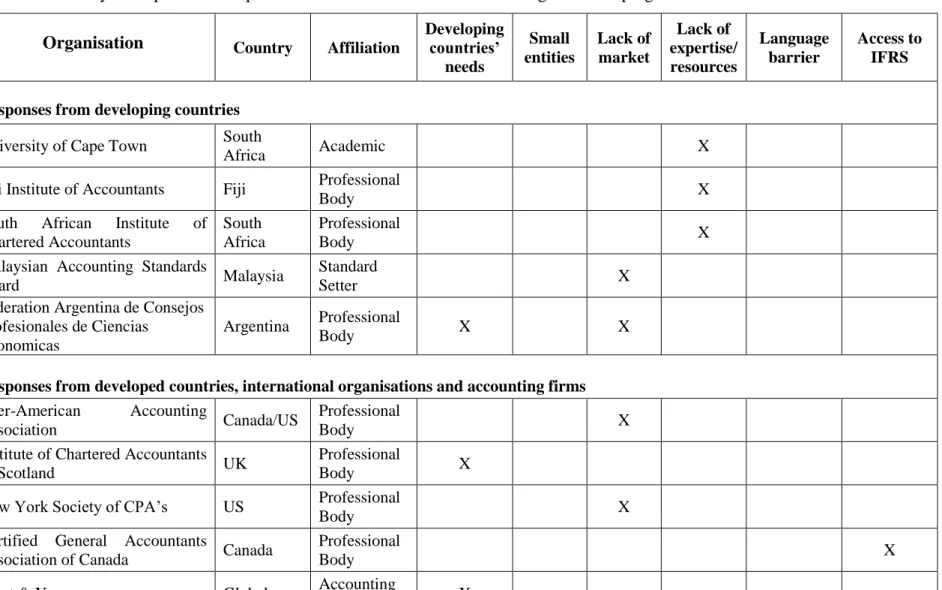
Table 7: Comment letters from developing countries to IASB’s project documents ... 65
Table 8: Comment letters from developed countries and other organisations to IASB’s project documents ... 66
Table 9 : Summary of responses to Exposure Draft IFRS for SMEs commenting on developing countries ... 69
Table 10 : Prior research on IFRS for SMEs (after issuance of the accounting standard IFRS for SMEs) ... 76
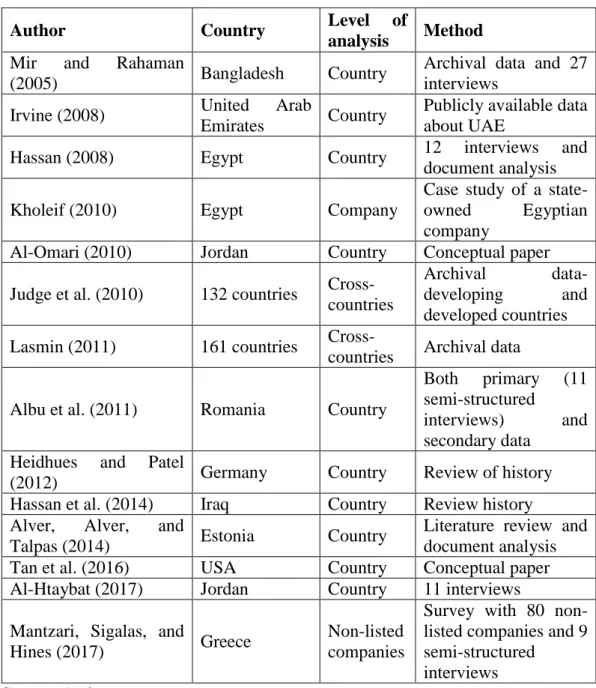
Table 11: Prior research on IFRS using NIS theory ... 101
Table 12 : Alternative to the key issues in Social Science Research Methodology ... 115
Table 13 : Number of interviews with each group ... 129
Table 14 : Number of interviews with SME owner-managers. ... 129
Table 15: Follow-up interviews with each group ... 131
Table 16: Phases of thematic analysis ... 132
Table 17: Example of a Sinhala translation of the questionnaire... 140
Table 18: Responses from each survey ... 144
Table 19: Business characteristics of the sample entities ... 150
Table 20: Number of owner-managers ... 151
Table 21 : Existence of non-manager owners ... 151
Table 22 : Analysis of accounting system ... 152
xiv
Table 24: Owner-managers and the usefulness of financial reports ... 157
Table 25: Owner-managers and the usefulness of management information ... 158
Table 26: Entity size and the main users of SME financial information. ... 159
Table 27: Entity size and SME owner-managers use SME financial information. ... 160
Table 28 : Entity size and analysis of the usefulness of financial reports... 161
Table 29 : Entity size and analysis of usefulness of management information. . 162
Table 30: International exposure of SMEs... 163
Table 31: Need to provide internationally comparable accounting information 164 Table 32: Frequency of specific transactions occur in SMEs ... 165
Table 33 : Significance of costs of preparing SLFRS for SMEs financial statements ... 170
Table 34: Benefits from SLFRS for SMEs compliant financial statements ... 171
Table 35: Perceptions of SME owner-managers and accountants on the benefits ... 172
Table 36 : Relationship between the costs and the benefits ... 173
Table 37 : Perception on the requirement to provide additional exemptions to the SLFRS for SMEs ... 174
Table 38 : SME size and awareness of the SLFRS for Smaller Entities ... 174
Table 39 : SME size and Analysis of potential implementation of the SLFRS for Smaller Entities ... 175
Table 40: Financial reporting framework of Sri Lanka pre-2012 ... 249
Table 41: Current financial reporting framework of Sri Lanka ... 251
xv
LIST OF FIGURES
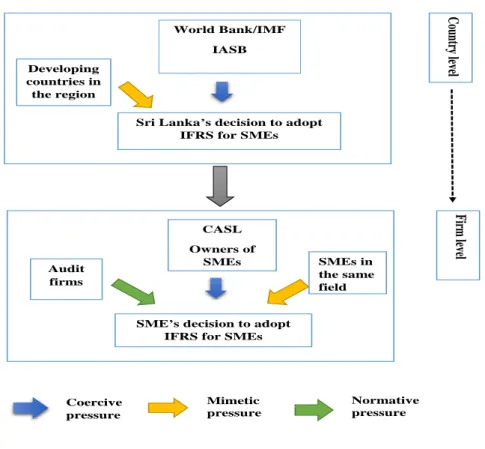
Figure 1: Theoretical framework for adoption of the accounting standard IFRS for
SMEs in Sri Lanka ... 98
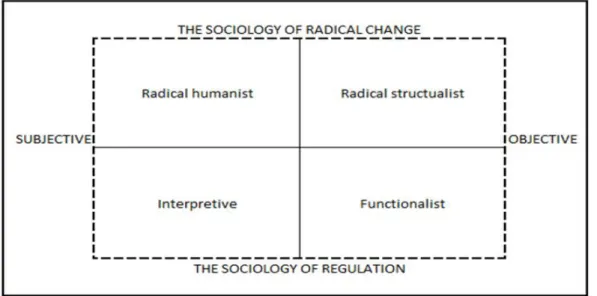
Figure 2: Burrell and Morgan’s four paradigms for the analysis of social theory ... 110
Figure 3 : Concurrent mixed methods design for this thesis ... 122
Figure 4: An example of interview transcripts imported to NVivo ... 133
Figure 5: An example of ‘coding’ in NVivo ... 134
Figure 6 : Examples of parent and child nodes created in NVivo ... 136
Figure 7 : An illustration for themes and sub themes created in the study ... 137
Figure 8: Users of SME financial information ... 155
Figure 9: Purposes for which owner-managers of SMEs use SME financial information ... 156
Figure 10 : Adoption status of SLFRS for SMEs ... 169
Figure 11: Evolution of financial reporting framework for SMEs in Sri Lanka . 252 Figure 12: Proposed financial reporting framework for Sri Lankan SMEs ... 270
Figure 13 : An overview of the proposed financial reporting framework for SMEs ... 284
xvi
LIST OF ABBREVIATIONS
ADB Asian Development Bank
ASEAN Association of South East Asian Nations CASL Institute of Chartered Accountants of Sri Lanka
EU European Union
FASB Financial Accounting Standards Board (The United States) GAAP Generally Accepted Accounting Principles
GDP Gross Domestic Product
IASB International Accounting Standard Board IASC International Accounting Standard Committee IFAC International Federation of Accountants IFRS International Financial Reporting Standards
IFRS for SMEs International Financial Reporting Standards for Small and Medium sized Entities
IMF International Monetary Fund
LKR Sri Lankan rupee
POBA Professional Oversight Board For Accountancy
SD Standard deviation
SLFRS for SMEs
Sri Lanka Accounting Standards for Small and Medium sized Entities
SME/SMEs Small and Medium Enterprise(s) SPSS Statistical Package for Social Sciences
UK United Kingdom
USA United States of America
1
CHAPTER ONE
RESEARCH INTRODUCTION
1.1 Introduction
This thesis develops a financial reporting framework for Sri Lankan small and medium sized entities (SMEs) by identifying users and their financial information needs and examining the need of internationally comparable financial information. SMEs play an economically significant role in most countries (Isaga, Masurel, & Van Montfort, 2015). For instance, within the European Union (EU), over 99 per cent of enterprises belong to the SME category (Kaya & Koch, 2015). Further, the economic importance of SMEs, especially in developing countries,1 is widely documented (Islam, Rahman, & Ali, 2011; Rasool, Dars, & Shah, 2013).
In Sri Lanka, SMEs account for more than 90 per cent of the total number of industrial establishments (Department of Census and Statistics, 2013) and contribute 30 per cent to the country’s Gross Domestic Product (GDP) (Ministry of Finance and Planning, 2013). In South Africa another developing country, Ramukumba (2014) estimates over 90 per cent of formal business entities are SMEs, and they account for over 50 per cent of GDP and 55 per cent of jobs. Similarly, in Pakistan and Bangladesh the SME sector comprises of more than 90 per cent of business entities (Islam et al., 2011; Rasool et al., 2013). Given the important role of SMEs in economic development, the survival and growth of SMEs is vital to the overall health of an economy. Any change in the financial reporting standards for SMEs could impose additional reporting burdens as many SMEs lack the capacity or resources to meet the requirements. Any financial reporting framework for SMEs therefore, needs to strike an appropriate balance between satisfying the information users’ needs and reducing the reporting burden for SMEs.
1 World Bank defines developing countries as those with “low income and middle income
economies” (World Bank, 2015). The term country, is used interchangeably with economy. The term developing country isused interchangeably with emerging country.
2
This chapter is organised as follows: Section 1.2 presents a brief background to the thesis. Section 1.3 describes the research problem and the motivation for this research. Section 1.4 discusses the objectives and research questions of the thesis. Section 1.5 introduces the research methodology and methods adopted in this research. Section 1.6 describes the research contribution. Section 1.7 outlines the structure of the thesis and section 1.8 concludes the chapter.
1.2 Background of the thesis
It is claimed that SMEs require a simplified/differential accounting and financial reporting framework to alleviate unnecessary reporting burdens (Busuioc, 2011). This reporting framework should be appropriate for the size and types of transactions conducted by the SME, and the limited range of financial information required by users. The main argument for simplifying financial reporting requirements is because they are disproportionately affected by the costs resulting from requiring them to comply with the same financial reporting regulations as large entities (Eierle, 2008). Financial statements prepared under the full application of generally accepted accounting principles (GAAP) are suitable for the users of large companies whose shares are publicly traded and they are not appropriate for financial statement users of SMEs (Rennie & Senkow, 2009).
In their efforts to ease the financial reporting burden on SMEs, and to address the need for international comparability in the financial reporting of SMEs, the International Accounting Standard Board (IASB) 2 issued the International Financial Reporting Standards for Small and Medium-sized Entities (IFRS for SMEs) on July 9, 2009 (International Accounting Standards Board, 2009a). The accounting standard IFRS for SMEs is aimed at entities that publish general purpose financial reports and are not publicly accountable (International Accounting Standards Board, 2009b).The standard was developed as an alternative to the full
2The IASB was founded in 2001 and was preceded by the International Accounting Standards
Committee (IASC) from 1973 to 2000. In this study, both bodies will be referred to as the IASB, and the term IFRS used when referring to any standards issued by either the IASC or the IASB.
3
International Financial Reporting Standards (IFRS), which was created for financial reporting by large publicly accountable entities.
The IASB applied the same conceptual framework when developing the IFRS for SMEs (International Accounting Standards Board, 2004). The IASB argued that the information needs of users of SME financial statements were similar in most ways to those of users of publicly accountable entities’ financial statements (International Accounting Standards Board, 2004). The content of the accounting standards for SMEs was therefore extracted from the IFRS, employing a so-called ‘top-down approach’. This involved removing topics considered irrelevant to SMEs, and reducing the accounting options available. Currently, over 70 countries apply IFRS for SMEs or have plans to adopt this set of accounting standards in the near future (Kaya & Koch, 2015, p. 94). Sri Lanka did not modify the IFRS for SMEs and adopted them as Sri Lanka Accounting Standards for Small and Medium sized Entities (SLFRS for SMEs) (International Financial Reporting Standards Foundation, 2016). The implications resulting from the adoption and application of IFRS for SMEs in Sri Lanka is significant as more than 90 per cent of business entities are SMEs.
1.3 Research problem and motivation for the thesis
How the IASB developed the standard IFRS for SMEs has attracted opposition. A major criticism was the ‘top down’ approach using a framework that is biased towards large and/or listed companies (Devi & Samujh, 2014; Di Pietra et al., 2008; Evans et al., 2005). Unlike large entities, SMEs are more likely to focus on survival than on growth and profit maximisation (Hasle, Limborg, Kallehave, Klitgaard, & Andersen, 2012; Samujh, 2011). Additionally, the separation of ownership and control is not common in the majority of SMEs (Carsberg, Page, Sindall, & Waring, 1985) and most of them are formed and operated as family businesses (Fox, Nilakant, & Hamilton, 1996; Motwani, Levenburg, Schwarz, & Blankson, 2006; Tatoglu, Kula, & Glaister, 2008). It is claimed that SMEs have fewer financial statement users with different information needs when compared to large entity information users (Di Pietra et al., 2008; Evans et al., 2005). Additionally, it is difficult to design a single standard that is useful for the heterogeneous group of
4
SMEs (Di Pietra et al., 2008; Eierle & Haller, 2009; Evans et al., 2005). Thus, a critical question arises: Are the primary users of SME financial information the same as the users of financial information provided by large entities?
Although most researchers identify owner-managers and taxation authorities as the main users of the financial statements of SMEs, the IASB identifies the users of SMEs’ financial statements as non-manager owners, credit rating agencies, lenders, suppliers, other creditors, and employees (International Accounting Standards Board, 2009b). The list of financial statements’ users identified by the IASB is consistent with its 1989 conceptual framework for the preparation and presentation of financial statements. However, the IASB’s revised conceptual framework for financial reporting, issued in 2010, identifies the primary users of financial statements as capital providers, potential investors, and creditors. The users such as owner-managers and the tax authority are thereby excluded from the target audience. In this context, Schiebel (2008) argues that the IASB did not undertake worldwide empirical analyses to identify users and their SME financial reporting needs. As Schiebel (2008, p. 2) explains, “International research is essential. Otherwise it will be a matter of luck whether an IFRS for SMEs meets the common information needs of its targeted users”.
In addition to these concerns, the IASB’s project on IFRS for SMEs has been criticised for a lack of input from developing countries in the discussions leading to the formulation of the standard (Bohušová & Blašková, 2012; Chand & Cummings, 2008; Devi & Samujh, 2014; Singh & Newberry, 2009). The summary of submissions to the Exposure Draft on the IFRS for SMEs shows that a substantial number of responses were received from the United Kingdom and Germany (Bohušová & Blašková, 2012; Singh & Newberry, 2009). No responses were provided by users of SME financial information, the intended recipients of reports prepared under the IFRS for SMEs. Following a study of comment letters from 1995 to 2007, Jorissen, Lybaert, Orens, and van der Tas (2013) claim the opinions the IASB received were biased. They call for more research to investigate the position of the different users who are not always directly involved in formal lobby activities.
5
The director of the IFRS for SME project did however, establish an informal user panel to obtain comments from users (Ram & Newberry, 2013). The panel membership was criticised by some board members of IASB as they were investment and security analysts who dealt mostly with large entities and therefore were not appropriate individuals to comment on SMEs (Ram & Newberry, 2013). Without SME voice on the panel, particularly from developing countries, the IFRS for SMEs does not have representation from the international SME community and lacks input from developing countries. Its adoption therefore, could result in undesirable consequences.
Developing and developed countries are not a homogeneous group. Differences exist in, for example, legal systems, taxation, sources of finance, inflation, political ties, colonial history, and culture, shape diversity in accounting practices (Doupnik & Salter, 1995; Evans, 2004; Jaggi & Low, 2000; Nobes, 1998; Richardson, 2007). These contextual factors are deeply embedded in the accounting environment of a country. As such, they may not be simply changed. They could therefore, act as an impediment to adoption of the IFRS across countries (Poudel, Hellmann, & Perera, 2014). Additionally, social, political, economic, and cultural factors influence accountants' professional judgment, and these differences across countries may lead to inconsistent interpretation and application of IFRS (Poudel et al., 2014). The needs of users of financial statements of SMEs in developing (or emerging) economies may be very different from the needs of users in developed economies. In this context, Hussain, Chand, and Rani (2012, p. 116) argue:
… careful consideration must be given in deciding whether the full set of IFRS for SMEs should be adopted by emerging economies, or should they use IFRS for SMEs as a reference point in developing their own standards or should such economies adopt IFRS for SMEs with modifications to suit their reporting needs. For that reason, it is advisable for regulatory bodies in emerging economies to give considerable thought to the adoption of IFRS for SMEs and engage in wider consultations before deciding on the matter.
Uyar and Güngörmüş (2013, p. 86) similarly contend:
… more studies on IFRS for SMEs are needed in developing countries since they may provide different feedback for future directions. Besides, differences in the views of jurisdictions, who
6
have or have not adopted, might be examined to learn their perceptions. Such studies enable voicing of satisfactions or concerns which may guide standard setters for future revisions.
Research on IFRS for SMEs has tended to focus on the views of SME accountants about implementation issues, knowledge of IFRS for SMEs, and cost benefit considerations (see for example: Aboagye-Otchere & Agbeibor, 2012; Chand, Patel, & White, 2015; Devi & Samujh, 2014, 2015; Eierle & Haller, 2009; Kiliç, Uyar, & Ataman, 2016; Laing, 2012; Neag, 2010; Perera & Chand, 2015; Uyar & Güngörmüş, 2013; Van Wyk & Rossouw, 2009). Although a number of studies have been oriented towards the issues of the adoption of IFRS for SMEs, there are gaps in the literature about the need of internationally comparable accounting information for SMEs. Comprehensive evidence is missing on the relevance of accounting topics included in and costs and benefits of the IFRS for SMEs. There appears to be a dearth of literature on the subject in developing and Asian countries and Sri Lanka in particular. Most of the existing studies surveyed a narrow range of users. They omit the views of users such as bank lending officers and income tax officers on the need for internationally comparable accounting standards for SMEs.
An analysis of the literature shows a diversity of findings regarding SME users and their uses of financial information in developed countries. To date, there has been limited research on financial reporting by SMEs and even less is known about the users and their SME financial information needs in the context of developing countries. There is a lack of empirical research to ascertain who are the users of SME financial information and their information needs (Evans et al., 2005; Sian & Roberts, 2006). According to Evans et al. (2005), the main problem for regulators is the significant gap in the literature on the users of SME financial statements. Therefore, they recommended that, “before progressing with the project IFRS for SMEs, the IASB should initiate a research to determine to what extent the needs of owner-managers and other users of SME financial statements differ between larger versus the smallest SMEs” (Evans et al., 2005, p. 38).
1.4 Research objectives and questions
Sri Lanka adopted the accounting standard IFRS for SMEs without making any modifications to suit the local SME needs. Consequently, excessive reporting
7
burdens arising from the imposition of an unmodified version of IFRS for SMEs could impede the growth of SMEs and in turn limit their ability to make full contributions to the country’s economy. It is noted that some developed countries, such as the New Zealand and Australia, are not considering adopting the standard IFRS for SMEs (Devi & Samujh, 2014). Many SMEs in Australia and New Zealand are not required to prepare general purpose financial statements. Rather, they prepare special purpose financial reports that comply with taxation regulations developed locally to meet the reporting needs of SMEs in these countries (Devi & Samujh, 2014). Similarly, the formulation of a financial reporting framework that can meet the reporting needs of Sri Lankan SMEs could benefit SMEs and the Sri Lankan economy.
Therefore, the objectives of this thesis are to identify Sri Lankan SME users and their financial information needs and to examine the need for internationally comparable accounting information for SMEs. Hence, the following research questions are posed to achieve the objectives of the thesis:
1. How do Sri Lankan users and their financial information needs differ with regard to size of SMEs?
2. Do Sri Lankan SMEs need internationally comparable financial information?
Findings from these two questions are then used to develop a proposed financial reporting framework for Sri Lankan SMEs.
1.5 Research methodology, methods and theory
This thesis implements the pragmatist paradigm using a mixed method approach. It incorporates both qualitative and quantitative methods for data collection to identify the users of SME financial information and their financial information needs as well as their perceptions of the accounting standard IFRS for SMEs. This thesis adopts a quantitative method, using a questionnaire survey, to collect data from accountants and owners of SMEs in Sri Lanka.
Face to face semi-structured interviews, with a sample of accountants and owners of SMEs, bank lending officers, tax officers, government agencies personnel, and
8
accounting standards setting authority representatives in Sri Lanka provide qualitative data. The interviews provided in-depth perspectives of the phenomena being studied from a sample of users not usually surveyed in studies reported in the literature. The collective outcome of both types of data (i.e. quantitative and qualitative) was used to develop a financial reporting framework for Sri Lankan SMEs. Follow-up interviews were conducted with the same groups of interviewees to obtain their comments on the proposed financial reporting framework.
The quantitative data gathered from the questionnaire survey was analysed using the statistical package for social sciences (SPSS). Qualitative data gathered from the questionnaire survey and the interviews were analysed using thematic analysis. NVivo software was used to organise and manage qualitative data. The New Institutional Sociology, provided the theoretical framework to examine the decision to adopt the accounting standard IFRS for SMEs in Sri Lanka.
1.6 Contributions of the thesis
The literature on users and uses of SME financial statements is informed by a small number of studies. Most of the studies (see for example: Barker & Noonan, 1996; Carsberg et al., 1985; Collis & Jarvis, 2000; Dang-Duc, Marriott, & Marriott, 2006; Maingot & Zeghal, 2006; Page, 1984) were undertaken more than ten years ago, thus their findings are dated. Notably, research on SME financial reporting in the developing countries is limited. In addition, Di Pietra et al. (2008), Evans et al. (2005), and Sian and Roberts (2009) identify significant gaps in the research literature on SMEs. They conclude that there is a lack of clarity about the users and uses of SME financial information. This is an under-researched area and, the views of user groups such as the bank lending officers, income tax officers, and representatives from the government institutions have largely been ignored. This thesis fills a gap by obtaining views of SME owners and accountants, bank lending officers, income tax officers, and representatives from government institutions to identify users and their financial information needs of SMEs in Sri Lanka, a developing country. The empirical research that examines the effects of adopting the IFRS for SMEs in developing countries in Asia is scarce. There has been no such research in Sri Lanka.
9
Criticisms expressed at the discussion paper and exposure draft stage included an absence of research on the suitability of the standard from a users’ perspectives (see for example: Aboagye-Otchere & Agbeibor, 2012; Albu, Albu, & Fekete, 2010; Di Pietra et al., 2008; Evans et al., 2005; Schiebel, 2008). An extensive literature search has been unable to identify any studies devoted to assess the suitability of the accounting standard IFRS for SMEs from a users’ perspectives. Therefore, this thesis will attempt to fill this gap in the literature by investigating SME users’ perceptions to the accounting standard IFRS for SMEs, in the context of a developing country, Sri Lanka.
There are considerable gaps in the available literature regarding the IFRS for SMEs. First, there is a lack of empirical research concerning the need for internationally comparable financial reporting information for SMEs. Second, comprehensive evidence is missing regarding the relevance of accounting topics addressed in the IFRS for SMEs. Third, there is a lack of empirical evidence on the specific costs and benefits of preparing financial information in accordance with IFRS for SMEs. There have been calls by Chand et al. (2015), Uyar and Güngörmüş (2013), and Devi and Samujh (2015) for additional research in developing country contexts.
The thesis’s findings in terms of what users require from small and medium enterprise financial information will contribute to the development of a users’ need financial reporting framework for small and medium enterprises. The proposed financial reporting framework developed from the findings of this thesis would direct the Institute of Chartered Accountants of Sri Lanka (CASL) in revising current financial reporting framework for Sri Lankan SMEs. In addition, standards setters in other developing countries in general can gain useful insights into what constitutes an appropriate financial reporting framework for small and medium enterprises, based on user needs.
Findings from Sri Lankan SMEs, as a representative of developing countries, enhance the IASB’s views of the effects and future revisions of the IFRS for SMEs. Results provide useful insight on types of SMEs that are likely to benefit from an international accounting standards. Findings of the thesis are informative to other developing countries in determining the need for a global accounting standards for
10
SMEs and the relevance of the content of the IFRS for SMEs. Further, current thesis provides empirical evidence that informs the debate regarding the relevance of international financial reporting standards for SMEs.
This thesis also provides useful material for researchers/academics with an interest in international accounting research in general, as there is a dearth of studies and research regarding the users of SME financial information and effects of IFRS for SMEs. Finally, as this thesis integrates both quantitative and qualitative approaches within one thesis, it provides deeper insight into SME financial reporting.
1.7 Outline of the thesis
The thesis is presented in twelve chapters as follows.
Chapter 1 introduces the background and motivation for the thesis. It is followed by an overview of the research objectives, questions, research methodology and methods and contribution of the thesis. Finally, an outline of the thesis is given.
Chapter 2 locates Sri Lanka as the research context and provides contextual understanding about the research field. It discusses the significance of SMEs in the Sri Lankan economy and describes the country’s financial reporting environment.
Chapter 3 reviews and analyses the literature on financial reporting in the context of SMEs. The discussion focuses primarily on two main issues: the users and uses of SME financial information; and the current financial reporting frameworks in a selected number of jurisdictions.
Chapter 4 discusses and analyses the literature that relates to the development of the IFRS for SMEs, and the subsequent research literature on the IFRS for SMEs.
Chapter 5 conveys the theoretical lens used to analyse the research findings.
Chapter 6 explains the research approach adopted in this thesis. It sets out the philosophical views underpinning the thesis, and provides justification for using a mixed methods research design.
11
Chapter 7 details the data collection methods, the sample selection strategies, and the data analysis methods.
Chapter 8 exhibits the results from the questionnaire survey of accountants and owners of SMEs. It includes the findings from the analysis of data using SPSS.
Chapter 9 presents the data analysis of the qualitative data collected through the open-ended questions in the questionnaire survey and semi-structured interviews.
Chapter 10 discusses the results from the questionnaire survey and the interviews and presents the key findings.
Chapter 11 develops a financial reporting framework for Sri Lankan SMEs incorporating the findings as discussed in chapter 10.
Chapter 12 summarises the research. The implications and limitations of the thesis are presented and directions for future research are recommended. This chapter concludes the thesis.
1.8 Summary
This chapter provided an introduction, and background to the thesis. The research problem was outlined and followed by the research objectives. The research methodology and methods were introduced. This was followed by the motivation driving the research and the contribution of the thesis were briefly discussed, relating to prior studies and Sri Lankan context. An overview of the structure of the thesis concluded the chapter. The next chapter discusses the Sri Lankan context in which financial reporting operates.
12
CHAPTER TWO
THE SRI LANKAN CONTEXT
2.1 Introduction
The purpose of this chapter is to provide the background necessary for understanding the characteristics of the environment in which financial reporting operates in Sri Lanka. This basic understanding is important, particularly for assessing the relevance of the accounting standard, IFRS for SMEs to a developing country, Sri Lanka. Given that the main objective of this thesis is to provide useful insights for developing the financial reporting framework for Sri Lankan SMEs, the contextual understanding is vital for assessing and modifying the existing financial reporting framework for Sri Lankan SMEs.
Evidence suggests that financial reporting practices are affected by and could be explained by a number of environmental factors such as: a country’s particular colonial history or stage of economic development; historical; socioeconomic; legal; political; professional; cultural; language; and religious settings (Devi & Samujh, 2015; Doupnik & Richter, 2003, 2004; Doupnik & Salter, 1995; Evans, 2004; Jaggi & Low, 2000; Joshi, Yapa, & Kraal, 2016; Kiliç et al., 2016; Kraal, Yapa, & Joshi, 2015; Nobes, 1998; Poudel et al., 2014; Richardson, 2007). These environmental factors differ greatly from country to country, especially between developed and developing countries (An & Sharma, 2015; Briston, 1978; Chand et al., 2015; Perera, 1989; Samuels & Oliga, 1982). For this reason, “practises that have worked in developed countries will not necessarily work in a developing country because the culture and needs differ” (An & Sharma, 2015, p. 377). Developing countries have a much broader assortment of economic and social indicators than do developed countries (Chamisa, 2000).
It was said that “less developed countries are relatively distinctive as they have a larger residue of traditional cultures, their poverty renders them more dependent on external finance, ideologies and structural reforms, with lower institutional capacity
13
to deliver change” (Graham, Hopper, Tsamenyi, Uddin, & Wickramasinghe, 2009, p. 496). Further, the relevance of the IFRS to developing countries has also been questioned on the ground that national environments in developing countries are different from those of developed countries where the IFRS originated (Briston, 1978; Perera, 1989; Samuels & Oliga, 1982). Samuels and Oliga (1982, p. 69) articulate this argument as follows:
… where economic, socio-political, cultural, and contextual differences between countries, nations, or societies exist, the problem of appropriate accounting standards will assume a different conceptual meaning as well as contextual significance …. in the case of developing countries where such differences tend to be not only highly pronounced, but also in a highly dynamic and fluid state, the relevance of international accounting standards becomes even more questionable.
Similarly, Nurunnabi (2015) establishes that socio-cultural factors present a critical deterrent when implementing the IFRS in developing countries. Additionally, it is well documented that professional judgements are applied inconsistently across countries, particularly in countries where accounting environments differ from those in Anglo-American countries where the IFRS were developed (Doupnik & Richter, 2003, 2004; Poudel et al., 2014).
This chapter provides an overview of the context in which financial reporting operates in Sri Lanka. Section 2.2 provides a discussion of historical, religious, and cultural settings in Sri Lanka. Sections 2.3 and 2.4 describe Sri Lanka’s legal and political environment and the economic and social environment of Sri Lanka respectively. Section 2.5 describes the SME sector in Sri Lanka. Section 2.6, explains the financial reporting environment. Section 2.7 outlines the IFRS adoption in Sri Lanka. Section 2.8 concludes the chapter.
2.2 Historical, religious and cultural environment in Sri Lanka
Sri Lanka is a tropical island nation with a total land area of 65,610 square kilometres. It is located in the Indian Ocean close to the southern part of India. Sri Lanka’s population was 20.4 million, with a population density of 324 persons per sq km in 2012 (Central Bank of Sri Lanka, 2013). Population density in Sri Lanka
14
is one of the highest in the world (United Nations Educational Scientific and Cultural Organisation, 2013).
Sri Lanka has a rich historical and cultural heritage covering more than 2,500 years (Daskon & Binns, 2010). The most formative event in Sri Lanka’s long history was the arrival of Buddhism in the 3rd century BCE (Rajapakse, 2003). According to the Mahavamsa,3 one of the traditional chronicles of early Sri Lankan history, Buddhism was brought by Bhikkhu Mahinda. Bhikkhu Mahinda is believed to have been the son of the Mauryan emperor Ashoka.4 Mahinda’s mission won over the Sinhalese monarch Devanampiya Tissa5 (Rajapakse, 2003). Devanampiya Tissa embraced Buddhism and propagated it throughout the Sinhalese population (Rajapakse, 2003). He established the monastery of Mahavihara, which became the historic centre of Theravada Buddhism. The Buddhist kingdoms of Sri Lanka maintained a large number of Buddhist schools and monasteries, and supported the propagation of Buddhism into Southeast Asia. However, the Buddhist-Sinhalese civilization and institutions in Sri Lanka came under attack during the colonial eras of the Portuguese, the Dutch, and the British.
Colonial rule in Sri Lanka began with the Portuguese in 1505. They ruled the maritime provinces of the country for 153 years (Wickramasinghe, 2006). The Dutch conquered the areas that were under the Portuguese and continued colonial rule for a further 140 years (Yogasundram, 2008). In 1796, the country was taken over by the British who created the Crown Colony of Ceylon. Sri Lanka obtained political independence from the British in 1948 (De Silva, 2005). In 1972, the
3The Mahavamsa, the great chronicle of Sri Lanka, is the epic tale of Sri Lanka’s founding and
early history.
4Ashoka, is the last major emperor in the Mauryan dynasty of India. His patronage of Buddhism
during his reign furthered the expansion of that religion throughout India. He sent his only daughter Sanghamitra and son Mahinda to spread Buddhism in Sri Lanka.
5King Devanampiya Tissa was one of the earliest rulers of Sri Lanka based at the ancient capital of
Anuradhapura from 307 BCE to 267 BCE. His reign was notable for the arrival of Buddhism in Sri Lanka under the aegis of Mauryan Emperor Ashoka.
15
country became a Republic within the Commonwealth, and its name was changed to Sri Lanka.
The periods of colonisation impacted the Sri Lankan ethnic mix, religious mix, and cultural values. For example, during the Portuguese era, a large number of people in the coastal areas were converted to Roman Catholicism (Wickramasinghe, 2006). After the Portuguese were expelled, the Dutch encouraged conversion to Protestantism from both Roman Catholicism and the traditional religions of the island. As a result, many in the low country converted to obtain Dutch favour (Wickramasinghe, 2006). At the beginning of 19th century, the British brought 900,000 Tamil labourers from South India to work the plantations (De Silva, 2005). This mass scale immigration created enormous change in the ethnic mix of the country. As a result of its history, Sri Lanka is a multi-ethnic, multi-religious, and multi-lingual country.
The main ethnic groups are the Sinhalese, Tamils and Muslims. The largest ethnic group, the Sinhalese compose 73.9 per cent of the population. The largest minority group, the Sri Lankan Tamils, compose 12.7 per cent of the population. The Indian Tamils, who were brought to Sri Lanka under British colonialism to work on the tea plantations in the central hills, comprise 5.5 per cent, and Muslims 7.1 per cent of the population. Other small communities are the Burghers, (of Portuguese and Dutch descent), and the Veddas, who were the original indigenous inhabitants of Sri Lanka who together make up 0.8 per cent of the total population (Central Bank of Sri Lanka, 2012a).
Buddhism represents the largest religious affiliation, with 69.3 per cent of the population, while Hinduism and Islam are practised by 15.5 per cent and 7.6 per cent of the population respectively. Christianity is practised by 7.6 per cent of the population (Central Bank of Sri Lanka, 2012a). Linguistically, the Sinhalese speak the Sinhala language, while Tamils and Muslims speak Tamil. English is spoken by a small percentage within most communities. Sinhala and Tamil are the official languages in Sri Lanka. The language of most of the government organisations and SMEs is Sinhala. Multinational companies and most listed companies use English,
16
the language used by the IASB for publishing their views, declarations, decisions, discussions and standards.
Sri Lankan society is structured along steep hierarchies based on caste, class, generation, sex, as well as on wealth and power (Marecek, 1998). The society accepts hierarchy. Consequently, those at the upper levels are powerful and enjoy privileges. As a result, people do not usually question authority. Silence is a signifier of respect for one’s superiors (Marecek, 1998).
2.3 Legal and political environment in Sri Lanka
The legal system of Sri Lanka is made up of English common law, Roman-Dutch law, Tesawalamai law, and Kandyan law. This complex mixture of legal systems reflects the history of the country. English principles have been adopted for criminal law, mercantile law, and the Law of Evidence (Chandrakumara & Budhwar, 2005). The Laws of Persons, Property, Succession, Contracts, and Torts are fundamentally Roman-Dutch law modified by statute and English law incorporated through judicial decisions (Chandrakumara & Budhwar, 2005). English legal principles apply to contracts, copyrights, patents and trademarks, and insurance.
Kandyan law is a system of law based on the age-old customs prevailing among the Sinhalese. Today it is the customary law applicable to Kandyan Sinhalese. The main customary areas relevant to this law are marriage, divorce, and property (Chandrakumara & Budhwar, 2005). Tesawalamai is the customary law applicable to the Tamil inhabitants of Jaffna, an administrative district in north Sri Lanka. This law have evolved from the ancient Tamil customs of India (Chandrakumara & Budhwar, 2005).
The Second Republican Constitution of 1978 broke with Westminster tradition and introduced a strong Executive Presidency. The constitution vests extensive powers in the office of the President. The President is the head of the Government and the Commander-in-Chief of Armed Forces. He appoints the prime minister, the cabinet, and personnel to staff the most important positions in the military, judiciary, and various Ministries. Both the President and Parliament are elected every six years. Two parties, the conservative United National Party and the leftist Sri Lanka
17
Freedom Party have alternated in government since independence in 1948. Sri Lanka’s political parties are structured and managed in a top-down, hierarchical manner that does not allow party members to influence decision-making (Transparency International Sri Lanka, 2011). Rather than representing social diversity and citizens’ aspirations, political parties are alliances for elite power-sharing.
Most of the important positions in the government are filled by close relatives of ministers and relatives of those in power. This is not based on merit but rather on self-interest. This may contribute to the widespread corruption and fraud which exists in Sri Lanka (Transparency International, 2013). Indeed, Sri Lanka is ranked 91 out of 175 countries on the corruption perception index in 2013 (Transparency International, 2013). According to Transparency International, corruption is a serious problem threatening democratic and economic development in Sri Lanka. High tolerance of corruption, non-sanctioning of corrupt behaviour, and a culture that tends not to question authority, provide an environment in which corruption can flourish (Transparency International Sri Lanka, 2011). This corruption in Sri Lanka is closely linked to inadequate legal and institutional frameworks (Freedom House, 2013).
2.4 Economic and social environment in Sri Lanka
Sri Lanka was mainly an agricultural country at the time of independence in 1948. The contribution of the agricultural sector to the economy and the number of people who were engaged in the agricultural sector declined only slightly between 1948 and 1977 (Kelegama, 2006). Before 1977, the economy was inward looking, with strict trade and financial sector controls that included high import restrictions and exchange controls. These controls created economic problems, such as a high budget deficit, a balance-of-payments crisis, a low economic growth rate and high unemployment levels (Kelegama, 2006).
In 1977, Sri Lanka introduced open economic policies and adopted a market oriented approach (Central Bank of Sri Lanka, 2012b). The economic policies during this period were directed towards industrialisation, private sector participation in economic activities, and institutional reforms in the public sector
18
(Kelegama, 2006). Textiles and apparel, food and beverages, telecommunications, insurance, and banking and other financial service sectors became the most dynamic sectors of the country’s economy (Kelegama, 2006).
However, the economy of Sri Lanka and the life of its people were affected by two major events. The first event, was the prolonged civil war6 that started in the early 1980s. According to the World Bank (2013), there were 77,832 war-related deaths between 1980 and 2008. The total economic cost of the 26-year war was estimated at US$200 billion (Athukorala, 2010). In May 2009, the Government of Sri Lanka declared victory and the civil war ended. This created hopes of peace and stability. The second event, was the Indian Ocean tsunami in December 2004. The Indian Ocean tsunami brought the largest natural disaster to the country in its recorded history (United Nations Development Programme, 2012). More than 35,000 people died, 100,000 houses were damaged, and 500,000 people were displaced (Harsha, Samarawickrama, & Imamura, 2007). The severe damage caused to the infrastructure and the environment exceeded US$900 million (Harsha et al., 2007).
In spite of these events, Sri Lanka has experienced rapid economic growth (United Nations Development Programme, 2012). The economy has seen robust annual growth of 6.4 per cent over the period 2003 to 2012. This growth is well above that of its regional peers (World Bank, 2014). The macroeconomic indicators show positive trends in economic and social performance during the last 5 years (Central Bank of Sri Lanka, 2013). Table 1 illustrates key economic indicators of the Sri Lankan economy for the period 2009 - 2013.
6 The civil war waged between the government of Sri Lanka and a separatist guerrilla group from
1983 to 2009. The guerrillas attempted to break off the northern and eastern regions of the country as a separate sovereign state. The terror attacks were directed towards destroying government-owned infrastructure such as roads, rail, airports, and seaports. The effect of terror activities was felt outside the north and east regions of the country, with separatist guerrillas detonating bombs in other regions of the country to destroy government-owned property and human life (Abeysekera, 2011).
19
Table 1: Key economic indicators of the Sri Lankan economy for the period 2009-2013 Economic indicator 2009 2010 2011 2012 2013 Real GDP growth (%) 3.5 8.0 8.2 6.3 7.3 GDP by sectors (%) Agriculture 12.0 11.9 11.2 11.1 10.8 Industry 28.6 28.7 29.3 30.4 31.1 Services 59.3 59.3 59.5 58.6 58.1
Per capita GDP (US $) 2,057 2,400 2,836 2,922 3,280
Unemployment as a % of labour force 5.8 4.9 4.2 4.0 4.4 Inflation rate 3.5 6.2 6.7 7.6 6.9 Export (US $ Mn) 7,085 8,626 10,559 9,774 10,394 Imports (US$ Mn) 10,207 13,451 20,269 19,190 18,003 Public debt as a % of GDP 86.2 81.9 78.5 79.2 78.3
Source: Central Bank of Sri Lanka (2013)
Sri Lanka has Gross Domestic Product (GDP) of US$67.2 billion (Central Bank of Sri Lanka, 2013). The GDP growth rate has averaged close to 7 per cent per annum over the past 5 years. In 2011, Sri Lanka recorded its highest growth rate since independence of 8.2 per cent with the major contribution coming from an increase in the industry and service sectors (Central Bank of Sri Lanka, 2013). The industrial sector’s total contribution to the GDP was 31.1 per cent in 2013. The services sector, where wholesale and retail trade, transport and communication and banking, insurance and real estate play a major role, contributed 58.1 per cent of GDP in 2013. Agriculture, which was the mainstay of the economy when the country gained its independence and accounted for 40 per cent of GDP, has decreased in relative importance over the years. By 2013, the agriculture sector accounted for only 10.8 per cent of GDP.
Between 2009 and 2013, the per capita income of the country increased from US$2,057 to US$3,280. This growing trend in per capita income supports the country’s rising economic status as a middle-income country (Dutz & O'Connell, 2013). As a result the World Bank has listed Sri Lanka as a lower-middle income developing country (World Bank, 2014). Other economic indicators such as a one-digit inflation rate and a low unemployment rate over the past 5 years are also favourable (Central Bank of Sri Lanka, 2013). However, the exchange rate continues to show an unstable continuous decline due to a negative foreign trade
20
balance, unfavourable world economic conditions, and continuous increases in the price of crude oil (Central Bank of Sri Lanka, 2013). Rising oil prices and the 30-year long civil war have also contributed to Sri Lanka’s high public debt (78 per cent of GDP in 2013).
Sri Lanka is a recipient of large amounts of foreign assistance from the World Bank, the International Monetary Fund (IMF), the Asian Development Bank, China and Japan (U.S. Department of State, 2011). The World Bank has been providing financial assistance to Sri Lanka for close on six decades (World Bank, 2005, 2017). The current active World Bank portfolio comprises of 18 projects with a total net commitment value of US$2.1 billion (World Bank, 2017). Sri Lanka has a 3-year Extended Fund Facility program with the IMF, which is primarily focused on reducing fiscal deficit, rebuilding foreign exchange reserves, and introducing a simpler, more equitable tax system to restore macroeconomic stability and promote inclusive growth (International Monetary Fund, 2017). These financial aid packages however, come with conditions as requirements of the loans. For example, the IMF announced that the second review reached a staff-level agreement with Sri Lankan authorities subject to submission of a new Inland Revenue Act to the Parliament by June 2017 (World Bank, 2017). The United States of America, United Kingdom, other European countries (Germany, Italy, Belgium, Netherland and France), and India are the main destinations for Sri Lankan exports. China, India, Singapore, United Arab Emirates and Japan are the main origins of Sri Lanka imports (Central Bank of Sri Lanka, 2017).
Sri Lanka ranks high on the Physical Quality of Life Index and the Human Development Index. In 2012, Sri Lanka was ranked 92 in the Human Development Index7 and grouped in the high human development category (United Nations Development Programme, 2013). In comparison with other developing countries, Sri Lanka had a literacy rate of 95.6 per cent and a high life expectancy of 75.1 years in 2012 (Central Bank of Sri Lanka, 2013). These quality of life indices reflect
7 This classification is based upon the island’s indicators of life expectancy (75.1 years); mean years
of schooling (9.3) in association with expected years of schooling (12.7); and its per capita gross national income at purchasing power parity (US$5,170).