Information Overload and Disclosure Smoothing
Abstract
This paper examines whether managers can reduce the detrimental effects of information overload by spreading out, or temporally smoothing, disclosures. In our initial set of analyses, we attempt to identify managerial smoothing behavior. We find that when there are multiple disclosures for the same eventdate, managers, on average, spread the disclosures out over several days. We also find that managers are more likely to delay a disclosure (from its event date) when there has been a previous disclosure made within the three days before the event date. Finally, we show that managers are more likely to engage in disclosure smoothing when disclosures are longer, when the information environment is more robust, when firm information is complex, when uncertainty is high, and when disclosure news is more positive. In our second set of analyses, we examine whether there are market benefits to disclosure smoothing. Using two different measures of disclosure smoothing, we find that smoothing is associated with increased liquidity, reduced stock price volatility and increased analyst forecast accuracy. Finally, in additional analyses, we show that managers are less likely to engage in smoothing when they have negative news; they also release good news more quickly after bad news. Combined, our results suggest managers smooth disclosures and the smoothing is associated with several beneficial market outcomes.
1
1. Introduction
Efficient capital markets rely on disclosure to reduce information asymmetry and facilitate trade (Leuz and Verrecchia, 2000; Beyer et al., 2010; Shroff et al., 2013). Accordingly, since the 1930s, regulators have progressively expanded mandatory disclosure rules to increase both the frequency and length of firm disclosures (Paredes, 2003). At the same time, there has been a significant increase in firms’ voluntary disclosure, as investors demand more and more timely information and firms attempt to further combat adverse selection. However, the volume of disclosure has reached the point that regulators and practitioners are expressing concern that the market is overloaded with information, which is reducing its ability to adequately process firm disclosures (Radin, 2007; White, 2013; Higgins, 2014).
Exacerbating this issue is the fact that firm disclosures typically trigger a significant number of media articles in the days immediately after a firm disclosure (Drake et al., 2017). In particular, both traditional news outlets (e.g., newspapers, financial publications and news shows) and, increasingly, technology-enabled intermediaries (e.g., investor websites, blogs and social media) provide additional disclosure regarding a firm as they analyze, summarize and interpret firm news, contributing further to information overload around firm-initiated disclosures.
Despite the large increase in disclosure over the years, information users’ time horizon to process information has not increased, and in fact is arguably shrinking. In particular, investors have incentives to make trading decisions more and more quickly in order to preserve an information advantage. Similarly, analysts are under significant pressure to provide insights and reports while the firm news is still ‘fresh’ and clients can act quickly. Thus, market participants
2
often have to process increasingly large amounts of information in shorter periods of time, and therefore must make decisions without fully processing the information.1
In this paper, we examine whether managers can combat information overload by spreading out, or temporally smoothing, firm disclosures.2 We argue that managers can smooth disclosures
out to reduce the amount of information being disclosed in a short period of time (as compared to providing multiple disclosures at one time), which allows the market to more fully process each disclosure along with any related information produced by intermediaries.3 Investors typically need
additional time to devote to a disclosure because full assimilation of new information requires much more than simply reading the disclosure. It often involves additional due diligence including computational analyses, competitor related analyses, disclosure synthetization with other pieces of information (e.g., other firm disclosures and/or peer firm disclosures), and discussions with various firm stakeholders (e.g., suppliers, customers, other investors) or even firm management in order to fully understand the implications of the disclosure (Brown et al., 2015, 2018; Soltes, 2014; Chapman, Miller and White, 2018).4
1It is important to note that our theory, and corresponding predictions, are based on fundamental traders, i.e., those traders that read firm disclosures and incorporate that information into their trades. Traders conducting technical analysis do not process firm disclosures, and thus do not require time to read firm disclosures.
2 In Section 3, we discuss our two disclosure smoothing proxies, measured over a quarter: (1) the number of disclosures made in short (less than 3-day) intervals, and (2) the standard deviation of the time between firm disclosures. Figure 1 provides examples of low, moderate and high disclosure smoothing using both proxies.
3 Managers can also mitigate overload by reducing disclosure. However, mandatory reporting requirements make this option less viable, and reduced disclosure arguably could make the information environment even worse. In contrast, smoothing allows the same amount of information to be disclosed. By spreading out the timing of the disclosures, managers give investors less information to process over any short period of time.
4 For example, consider disclosures about a new product or a corporate acquisition. Stakeholders cannot simply read these disclosures and understand the implications of this information for firm value. For product announcements, investors would want to better understand the technology behind the product, associated costs and revenues, adjustments to the product mix, impact on competitors, consumer demand, etc. For an acquisition, investors would want to know considerable detail about the target firm, synergies between the firms, how the acquisition fits into the strategy of the firm, etc. Moreover, merger proxy statements can be hundreds of pages long. Thus, disclosures can take time to process adequately.
3
Given the volume of information and time constraints market participants face when processing firm news, overloaded individuals are susceptible to several well-documented biases that can negatively impact the effectiveness of information assimilation by the market. Academic research on bounded rationality (Simon, 1955) and limited investor attention (Merton, 1987; Bloomfield, 2002; Hirshleifer and Teoh, 2003) indicate that when investors lack sufficient time and/or resources to fully process all available information, they will rationally resort to simplified information processing techniques, or heuristics. These techniques may overlook or underweight relevant information leading to inferior decisions, resulting in various detrimental market effects related to liquidity, volatility and valuation (Abdel-Khalik, 1973; Chewning and Harrell, 1990; Miller, 2010; You and Zhang, 2009; Lee, 2012; Lawrence, 2013; Loughran and McDonald, 2014).5
Moreover, theories on ‘anchoring and adjustment’ predict that after an initial reference point has been set, future adjustments are inadequate (Tversky and Kahneman, 1974). Thus, time-constrained individuals may make an initial assessment about a new disclosure based on preliminary analysis; however, when the period of high-intensity information processing has passed and there is time to revisit their initial judgment, subsequent adjustments will be incomplete. Importantly, anchoring and adjustment leads to incomplete adjustments even in the absence of new information (Epley and Gilovich, 2006).
Although regulators govern firm disclosure and thus limit managers’ disclosure flexibility, there is still a nontrivial amount of discretion in firms’ disclosure choice. Managers’ arguably have the
5 As Hirshleifer and Teoh (2003, p.339) point out, “[i]nattention seems foolish…as inattentive investors lose money by ignoring aspects of the economic environment. However, if time and attention are costly, such behavior may be reasonable.” This intuition is also consistent with that in Grossman and Stiglitz (1980) and Bloomfield (2002) in that higher processing costs leads to less information assimilation. See Section 2.2 for a more detailed discussion.
4
most flexibility to smooth voluntary disclosures (e.g., earnings guidance, product announcements, customer or supplier contracts); however, managers can also adjust the timing of many mandatory disclosures as well. Specifically, even though current SEC rules require firms to disclose material news, they are given leeway of up to four business days to disclose after the triggering event. Moreover, the designated date of the triggering event, i.e., ‘event date,’ may reflect some degree of managerial discretion, particularly for events that are firm choices (e.g., merger announcement). So, although these disclosures are mandated, there is still discretion related to the precise timing of the disclosure. Separating information-rich disclosures by even a couple days can greatly help investors process each disclosure more completely, particularly those that require additional analysis and follow up by the user to adequately process. Thus, disclosure smoothing can contribute to more complete information processing and therefore a better understanding of the firm and its prospects. Accordingly, we predict that disclosure smoothing should lead to better market outcomes, namely greater liquidity, lower volatility, and more accurate analyst forecasts. 6
We conduct two sets of analyses. In our initial set, we attempt to determine whether managers do indeed engage in disclosure smoothing using three distinct approaches. In our first approach, we examine settings where there are multiple disclosures made related to the sameevent date. We find that when there are multiple events requiring disclosure on the same date, managers, on average, spread the disclosures out over the following several days. In order to rule out the possibility that managers smooth disclosures out because producing multiple same-day disclosures
6 Note too that we expect disclosure smoothing to be relevant even when there are relatively few disclosures in a given week or month. That is, firm disclosures are typically not uniformly distributed in time over the quarter; rather, they tend to be clustered around events within the quarter, while other periods in the quarter (such as quiet periods) tend to have few if any disclosures (NIRI, 2015). Therefore, managers may engage in disclosure smoothing to smooth out clustering even when the overall level of disclosure frequency is low.
5
is too time-consuming, we next examine whether recent disclosures (within the past three days) also explain a delay in the next disclosure. Consistent with managers smoothing disclosures to reduce information overload rather than because of disclosure costs, we find that managers are more likely to delay a disclosure (from its event date) when there has been a disclosure in the previous three days. Finally, we examine whether managers smooth disclosures during periods in which there are increased incentives to help investors fully process new information. We find that disclosure smoothing is more pronounced when (i) there is more information about the firm, (ii) the information environment is more robust, (iii) the firm has more complex information, (iv) there is more uncertainty about the firm and its prospects, and (v) when disclosure news is more positive. Collectively, these analyses provide robust evidence that suggest managers behave in a manner consistent with managers smoothing out disclosures.
In our second set of analyses, we examine the market impact of disclosure smoothing. Prior literature suggests information overload contributes to adverse selection problems that reduce incentives to trade (Miller, 2010), increase the amount of time required to make a trading decision (Cohen, 1980; Jacoby et al. 1974), and reduce decision quality (Abdel-Khalik, 1973; Chewning and Harrell, 1990). We predict that disclosure smoothing offsets these negative effects by allowing investors to more fully process each disclosure. Consistent with these predictions, we find that disclosure smoothing is associated with increased liquidity, reduced stock price volatility, and increased analyst forecast accuracy. We generate these results using two proxies for disclosure smoothing: (i) minus one times the number of firm-initiated press releases disclosed less than 3 days apart (Short Interval Smoothing) and, (ii) minus one times the standard deviation of the number of hours between firm-initiated press releases (Variance Smoothing). We also use two methods to
6
improve our empirical identification: (i) entropy balancing, which is a quasi-matching technique that ensures covariate balance between treatment (high smoothing) and control (low smoothing) observations, and (ii) a changes regression specification.7
In additional analyses, we consider a situation in which managers’ incentives to group disclosures closer together (“bundle” disclosures) may dominate their incentives to smooth disclosures. Specifically, we analyze whether managers bundle disclosures in order to provide more net positive news to the market. We find that (i) managers are more likely to disclose good news after a bad news disclosure, and (ii) managers disclose good news more quickly after bad news than they do after good or neutral news. This evidence is consistent with managers bundling (as opposed to smoothing) disclosures when they have negative news.8
Our research provides a contribution along two dimensions. First, we contribute to the extensive information overload literature (Miller, 2010; You and Zhang, 2009; Lee, 2012; Lawrence, 2013) that documents numerous adverse effects of information overload, particularly those related to costly capital market frictions. In contrast to these studies that focus on the impact to investors (i.e., users of information), we focus on the relation between information overload and managers (i.e., suppliers of information). In particular, we provide evidence suggesting that managers can adjust the timing of their disclosures to help investors combat information overload. Second, our findings are relevant to regulators with long-held concerns about information overload, as they are trying to
7 In Section 4, we discuss the entropy balancing methodology and its advantages in our setting.
8 Prior empirical evidence has documented a recent increase in the frequency of “bundled” management forecasts, or management earnings forecasts issued concurrently with earnings announcements (e.g., Anilowski et al., 2007, Rogers and Buskirk, 2013). In untabulated analyses, we find that both of our measures of disclosure smoothing are negatively and significantly associated with the practice of bundling guidance and earnings announcements. These results suggest that firms that smooth more are less likely to bundle and more likely to disclose guidance separately from earnings, consistent with distinct incentives driving bundling and smoothing decisions.
7
determine alternative approaches to combat this growing trend. We argue that rather than reduce disclosure, which can actually lead to further impairments of the information environment, firms can smooth the timing of their disclosures to help investors more thoroughly process news about the firm, thereby leading to improved market outcomes.
2. Motivation
In this section, we discuss the various factors contributing to information overload and their growth over time. We then discuss the ways in which information overload adversely impacts investors and what regulators are doing to try to address this issue. Finally, we highlight managers’ views on information overload and how disclosure smoothing can help to address their concerns.
2.1. Information overload in capital markets
Efficient capital markets rely on disclosure to reduce information asymmetry and facilitate trade (Diamond and Verrecchia, 1991). Accordingly, federal securities laws have long prioritized more disclosure as the preferred means for supporting fair and efficient capital markets (Paredes, 2003). However, over time the scope and breadth of disclosure requirements has continued to increase to the point that many experts have expressed concern that there is simply too much disclosure for investors to be able to process adequately (Paredes, 2003; Radin, 2007; KPMG, 2012; White, 2013; E&Y, 2014; Higgins, 2014).
Beginning with the Securities Act of 1933 and the Securities Exchange Act of 1934, which were passed in response to the speculative bubble and subsequent crash of equity prices in the 1920’s and early 1930’s, disclosure has been a foundational principle of securities regulations (Thompson and Sale, 2003). In 1982, the SEC adopted another significant disclosure regulation, Regulation
S-8
K, which standardized the set of disclosures that publicly listed firms were required to provide under the Securities Exchange Act of 1934. With the adoption of Regulation S-K, the SEC also standardized the level of detail required in various sections of mandatory filings (Thompson and Sale, 2003). More recently, in the wake of corporate scandals in the early 2000’s, the SEC further increased the amount and frequency of mandatory disclosures through the Sarbanes-Oxley Act in 2002 by requiring the disclosure of an expanded number of corporate events. Additionally, from time to time the SEC updates rules and guidelines that often result in more disclosure. In recent years, these have included requirements for more disclosure on topics ranging from executive compensation to hedging transactions.9
In addition to expanded mandatory disclosure rules, information overload has grown over time through the evolution of voluntary disclosure practices and its unintended consequences, particularly in the last couple decades. For example, the Private Securities Litigation Act of 1995 provided firms a “safe harbor” in making forward-looking statements so long as certain risks were disclosed. As a result, firms began releasing more forward-looking earnings guidance; however, they also added significantly more items to the list of risk factors such that these disclosures not only grew longer, but also became increasingly “boilerplate” and less informative.
To provide a sense for the magnitude of the disclosure increase in recent years, in untabulated analysis, we find that the average number of filings per firm posted to the SEC’s EDGAR website has increased monotonically over the past 20 years, from 10.1 in 1996 to 30.8 in 2015. Over the same period, the average number of 8-K filings provided per firm-year has increased from 2.4 in 1996 to
9In a recent study, Dyer, Lang and Stice-Lawrence (2017) find that much of the increase in 10K length is attributable to
9
10.9 in 2015. Similarly, the aggregate number of firm-initiated press releases on the four major newswire services (PRNewswire, BusinessWire, MarketWire and Globe Newswire as collected from Factiva) more than tripled, increasing from 156,243 in 1996 to 505,818 in 2015. These trends suggest that disclosure frequency has increased dramatically over the past two decades alone and likely further contributed to the level of information overload.
In addition to the significant growth in both mandatory and voluntary disclosure, there has been an increase in the coverage of firm disclosures by the media. In particular, when firms publicly release information, it typically triggers a “multiplier effect” in the form of firm-related articles produced by both traditional news outlets, e.g., newspapers, financial publications and news shows, and, increasingly, technology-enabled intermediaries, e.g., investor websites, blogs and social media (Drake et al. 2017). This coverage consists not only of the dissemination of information released by the firm, but also the provision of additional disclosure regarding a firm as the media analyze, summarize and interpret firm news, exacerbating information overload around firm-initiated disclosures. As noted by Groysberg and Healy (2013, p. 47), “voluminous information is available at so little cost, leading to information overload. This is certainly true for many stocks where a wealth of information is available from the financial media, online investment advisors, and sell-side analysts, as well as from the company itself. It is thus challenging for portfolio managers to screen all the new information potentially available on a stock.”
Importantly, information overload arises not only because of increased disclosure, but also because investors have limited time to process the information they receive. The notion that time constraints give rise to information overload has been addressed in prior literature, including by Shick et al. (1990) who model information overload arising from time constraints, and by Schroder
10
et al. (1967) and Snowball (1980), who show that information overload increases with the amount of information processed per unit of time. Moreover, Tuttle and Burton (1999) use an experimental setting to show that information overload arises primarily because of time constraints.
2.2. Impact of information overload on investor behavior
Prior literature is helpful in providing predictions regarding how information overload is likely to affect investor behavior. Simon (1955; 1978) contends that overloaded investors will rationally curtail information searching or processing and simplify their decision process within their processing constraints in order to achieve an acceptable outcome; that is, they tend to “satisfice” rather than “optimize.”10 The intuition is that investors have limited time and cognitive ability, and
so must decide how much time and effort they want to expend on processing information, given the potential costs and benefits. They then rationally exclude pieces of information when it is too costly (net) to process all relevant information. Although adopting simplifying decision strategies that require less effort results in less accurate decisions, investors prefer this outcome given the decision-process tradeoffs.
Limited investor attention theory similarly predicts incomplete information processing when investors have limited time or ability to detect less visible information. For example, Merton (1987) argues that it is costly for investors to gain awareness of a firm and low-visibility firms suffer a valuation penalty. Grossman and Stiglitz (1980) show that because information acquisition is costly, stock prices will only reflect the information that informed investors have incurred the cost (and
10 Subsequent studies provide evidence supporting Simon’s predictions. For example, Einhorn (1971) finds that as information increases, individuals use mixed modeling strategies (“compound models”) in order to simplify the decision-making process. Payne (1976) documents that when faced with information overload, individuals use heuristics to quickly eliminate some of the available alternatives without rigorously investigating them in order to reduce the number of alternatives in consideration.
11
earned the associated compensation) of acquiring. Similarly, Bloomfield (2002) contends that when information is costlier to interpret, it is reflected less completely in stock prices. Finally, Hirshleifer and Teoh (2003) show that information presented in a more salient form is absorbed more quickly and completely by the market, consistent with investors having limited attention. Combined, these studies argue that when investors become overloaded with information and information acquisition costs increase, investors process less information.
Consistent with these arguments, Eppler and Mengis (2004) note in their review of 97 empirical and experimental studies documenting the effects of information overload that although larger amounts of information can be helpful to decision-makers to a point, after that the performance of the decision-maker will rapidly decline. This literature suggests one reason that information overload reduces decision quality is that it makes it more difficult for decision-makers to identify the relationship between the details of the information and the higher-order inferences (Owen, 1992; Schneider, 1987). Thus, even when information is processed and understood, information overload inhibits individuals from clearly understanding the inferences that are most decision-relevant (i.e. “getting lost in the weeds”).
Another impact of information overload is that individuals might knowingly omit relevant information or possible alternatives from their consideration as a technique to simplify the decision (Payne, 1976; Herbig & Kramer, 1994; Sparrow, 1999). Moreover, the process by which individuals choose which information to ignore, or rule out, is idiosyncratic and difficult to predict (Payne, 1976). To the extent that overloaded investors knowingly omit relevant information from their investment valuation decisions, they are likely to be aware of their information disadvantage, which can increase adverse selection concerns.
12
Finally, information overload can increase variability and decrease predictability of how individuals interpret information. Einhorn (1971) was among the first to observe that as the set of available information increases, not only are individuals more likely to rely on simplifying heuristics to reach a decision, but they are also likely to do so in idiosyncratic ways. This reduces the consistency of the final decision relative to settings in which the information set is smaller. Chewning and Harrell (1990) provide additional evidence on information-overloaded decision makers using accounting information. They find that as information loads increased, participants varied relative to a benchmark in their predictions of a firm’s future financial distress. Additionally, prior literature finds that information overload decreases decision quality even for cognitively sophisticated individuals and financial professionals (Malhotra, 1982; Casey, 1980; Iselin, 1988). 2.3. Regulatory concerns about information overload
Although there have been significant increases in disclosure requirements in recent years, securities market regulators have long been concerned about the problem of information overload. In 1969, an SEC-sponsored commission concluded that some disclosures, including prospectus disclosures, had grown too long and overly complex, thereby laying the foundation for subsequent disclosure reforms.11 In its 1976 landmark case establishing standards of materiality (TSC
Industries, Inc. v. Northway, Inc.), the Supreme Court was mindful of the risk that establishing a lower materiality threshold could contribute to information overload. As stated by Supreme Court Justice Marshall, “[M]anagement’s fear of exposing itself to substantial liability may cause it simply
13
to bury the shareholders in an avalanche of trivial information — a result that is hardly conducive to informed decision making.”
Over the intervening decades, concerns of information overload have prompted multiple initiatives to simplify disclosures. In 1995, the SEC formed the Task Force on Disclosure Simplification, whose recommendations included (among other things) that the Commission should “eliminate or modify many rules and forms, and simplify several key aspects of securities offerings.” The work of the Task Force led to the adoption of “Plain English” rules in 1998 that were intended to improve the readability of SEC filings.
More recently, reducing information overload and improving disclosure effectiveness has been a top priority of the SEC. This focus has been reinforced by congressional mandates requiring the SEC to study disclosure effectiveness.12 The SEC has responded by initiating a broad review of its
current disclosure regime.13 These initiatives are ongoing but initial indications from the SEC
indicate a wide range of possible changes to the current disclosure regime. Some proposals include changing from a rules-based to a principle-based disclosure framework, requiring information to be presented in more user-friendly formats and providing more summary-type information or multi-tiered reports that allow users to read information at their preferred detail level (White, 2016). 2.4. Managers’ efforts to combat information overload
In addition to regulatory concerns, there is evidence that managers also recognize the problem of information overload and are taking steps to mitigate its effects. As stated by a senior executive at Ford, “We often find ourselves challenged in balancing our disclosures between what is required
12 JOBS Act, Section 108 requires the SEC to comprehensively analyze the rules of the current disclosure regime. 13 See SEC concept release for updating Regulation S-K: https://www.sec.gov/rules/concept/2016/33-10064.pdf
14
and what is relevant for the users, particularly when either the disclosure is for something that is immaterial, or when the volume or content of the required disclosure could obfuscate the important information” (emphasis added). Similarly, a recent survey of 120 firms found that managers’ own concerns about providing clear and informative disclosure are a primary motivation for them to initiate disclosure simplification initiatives (E&Y, 2014). Additionally, there are several recent high-profile examples of firms recognizing the need to simplify their disclosures and investing significant resources in order to do so even in the absence of a regulatory mandate. For example, in speaking of his 2013 annual report which contained over 100,000 words, the CFO of GE lamented that “not a single retail investor on planet Earth could get through it, let alone understand it.” These and other concerns related to information overload prompted GE to undertake a costly disclosure simplification effort.14
A complicating factor, however, in combatting information overload is that reducing disclosure length and/or complexity is a nontrivial task. Survey evidence suggests that these efforts are limited by a hesitancy to remove or update stale information, uncertainty about materiality thresholds, pressure to conform to prevailing practices and the inherent difficulty of making complicated disclosures clear and concise (E&Y, 2014). Even for managers who are motivated to simplify their disclosures, there is the difficult challenge of determining which information to remove or simplify. As stated by IASB Chairman Hans Hoogervorst, “One investor’s disclosure clutter is another investor’s golden nugget of information. Taking information away is never easy.” Thus,
14 See WSJ article on GE’s disclosure simplification efforts available at: http://blogs.wsj.com/cfo/2015/06/02/the-109894-word-annual-report/
15
overcoming information overload by reducing disclosure length or complexity is likely to be a difficult task for many firms.
In contrast, rather than remove disclosures, managers can use discretion in the timing of their disclosures to temporally smooth out the disclosures. By smoothing out disclosures, firms can provide smaller amounts of information at any one point in time, thereby allowing investors to more fully assimilate each firm disclosure, as compared to providing multiple disclosures at one time. Importantly, when new information is disclosed by the firm, interpreting and assimilating the new information is likely to involve much more than simply reading the disclosure. Prior literature documenting how investors and analysts assimilate information shows that it is a time-consuming process that often involves information acquisition from various other sources in order to interpret a single piece of new information from the firm (Brown et al., 2015, 2018; Soltes, 2014; Chapman, Miller and White, 2018). For example, a firm could announce an acquisition in a press release that may be no longer than a few pages. Reading the press release may only require a trivial amount of time. However, assimilating this information with all of the prior information (both public and private) available to the investor or analyst could take much longer. They would reasonably want to find out a broad range of information related to how the acquisition will change the future prospects of the firm, which may require contacting customers, suppliers, other investors or even the managers of the firm in order to understand all of the relevant details.
Moreover, a disclosure of an acquisition would likely elicit significant media coverage, including analyses and opinions, which would add to the large amount of assimilation that must occur to properly value the economic event. To the extent investors learn of this acquisition during periods of information overload, they might either (partially) ignore the other disclosures or spend less
16
time understanding the acquisition, resulting in increased uncertainty about the firm and it prospects. To at least partially combat information overload, managers can smooth the timing of their disclosures. Separating information-rich disclosures by even a couple days can help investors fully process the new information.
3. Sample
To conduct our analyses, we start by collecting all 8-K filings for which event and disclosure dates are available from 2000 to 2013. We also collect articles from the RavenPack Dow Jones and PR Edition database from January 2000 to July 2013. We follow the approach in Bushman et al. (2017) to identify firm-initiated press releases, and we exclude all articles with a relevance score lower than 90.15 Since our primary interest is in disclosures initiated by the firms themselves, we
also exclude articles from media outlets, such as the Wall Street Journal, and keep only ‘Press Release’ type articles.16 In cases where the firm issues multiple press releases within a 15-minute
period, we assume these are duplicates and remove them from the sample.17 These exclusions result
in an initial sample of 1,274,876 press releases from 8,134 firms. We then group these disclosures by quarter and delete firm-quarters with fewer than two press releases.
Table 1 presents our firm-quarter sample selection process. We exclude observations without the necessary data on Compustat and CRSP to construct our main variables, namely total assets,
15 The relevance score is assigned by RavenPack to measure how strongly the firm is related to the underlying news story. The scores range from 0 (low relation) to 100 (high relation).
16 Other RavenPack type articles include News Flash, Tabular Material, and Full Article. News flash articles rebroadcast headline information from the initial press release issued by the firm. Full articles contain additional editorial content. 17 We validate this assumption across the subset of observations for which the unique subject of the press release is identified in RavenPack (via the novelty score). We find that eliminating subsequent press releases within 15 minutes correctly removes duplicates in 80.7% of cases. We find similar results when using the same process over 5, 10 or 30-minute intervals.
17
shareholders equity, the number of shares outstanding, daily stock returns, daily trading volume, daily bid and ask quotes, prior 12 month returns and earnings over the prior 5 quarters. This process results in a sample of 170,764 quarterly observations from 6,219 unique firms. The sample is reduced to 131,216 observations when we impose a minimum of two EPS quarterly analyst forecasts in I/B/E/S in the current and prior quarter for our analyst forecast accuracy tests.
In our initial set of analyses examining managerial smoothing behavior, we focus on the distance between the event date and disclosure date to infer smoothing behavior. In our second set of analyses, where we examine market outcomes, we use two proxies for our primary variable of interest, Smoothing, that are more general in nature to allow us to examine smoothing over longer windows.18,19 Specifically, for our first proxy, we calculate the number of disclosures that are within
a three-day interval. For each firm-initiated press release, we compute the number of days since the last firm-initiated press release. If this interval is less than 3 full days, we consider the release a short interval disclosure. We then count the number of short interval disclosures made by the firm over the quarter and multiply it by minus one. The intuition is that if managers smooth disclosures over the quarter to avoid information overload, there should be fewer disclosures made within short intervals. We calculate our second smoothing measure as minus one times the standard
18 As we note in the introduction, managers can adjust not just the timing of their disclosures, but for some events, they can also influence the stated event date. This is particularly true for events for which there is managerial discretion as to when the event will occur. For example, managers have some discretion as to when they announce a merger or the firing/resignation of an employee or board member; however, there is less discretion in determining an event date for events beyond managers’ control. In our initial analyses, we assume the event date filed with the SEC is correct; however, even if some event dates were adjusted, this should bias against our findings, since there is no need to delay the disclosure date when the event date can be adjusted. That is, it would just bring attention to the delay. In our second set of analyses, we relax this assumption to allow for the event and/or disclosure dates to be adjusted.
19 Untabulated analysis indicates that the delay in the disclosure of multiple 8-Ks is positively and significantly associated with our Short-Interval Smoothing measure, suggesting that firms that spread out multiple-event 8-Ks are also firms that tend to more generally spread out their press releases.
18
deviation of the number of hours between firm-initiated press releases disclosed during the quarter divided by 100.The intuition behind this variable is that it measures the extent to which disclosures are made over consistent intervals of time during the quarter. Firms with more variation in the length of time between their disclosures will have a higher standard deviation of the number of hours between disclosures and therefore have less “smooth” (i.e., more clustered) disclosures by our definition. In addition, keeping the number of disclosures constant, a lower standard deviation represents longer spacing between any two disclosures made over the quarter. See Figure 1 for an illustration comparing variations in smoothing. Given the median level of Short-Interval Smoothing (Variance Smoothing) in our sample of -1 (-3.327), the moderate smoothing example in Figure 1 best reflects the degree of smoothing in our sample. Note that we do not expect firms to have ‘perfect’ smoothing across a quarter, but rather that firms will simply adjust their disclosures by a few days to temporally distance disclosures.
Table 2, Panel A presents the descriptive statistics. The average (median) firm in our sample discloses 7.17 (5) press releases per quarter and has 6.87 (5) analysts. Table 3 provides information on the topics of the disclosures in our sample, as provided by RavenPack.20 The most common topic
is earnings, including both announcements and guidance, closely followed by product and service related disclosures.
4. Research design and empirical results
In this section, we discuss our empirical approach to examine how disclosure smoothing improves the information environment and capital market outcomes. We begin by establishing
20 RavenPack provides topic descriptions for around 47% of the releases in our sample. The proportions presented in Table 3 are therefore relative to the sample of press releases for which there is a topic description available.
19
whether managers do indeed engage in disclosure smoothing in an attempt to benefit the firm. We conduct this investigation by analyzing when managers choose to disclose events occurring on the same day; we use 8-K filings for which the disclosure date and event date are both observable. Second, we construct a determinants model based on firm characteristics which we would expect motivate managers to help investors fully understand their disclosures. Next, we turn to the consequences of disclosure smoothing based on our prediction that it improves capital market outcomes and the information environment of the firm. More specifically, we examine the relation between disclosure smoothing and trading liquidity, stock price volatility, and analysts’ earnings forecast accuracy using both levels and changes specifications. Lastly, in the additional analyses section, we consider managers’ incentives to bundle good news with bad news.
Our approach to studying the determinants of disclosure smoothing is to use a standard OLS regression to test whether smoothing is more common under the conditions we predict. However, throughout our empirical tests of the consequences of disclosure smoothing, we use two methods to improve the empirical identification of our results. First, we employ an entropy balancing technique, which is a quasi-matching approach that weights each observation such that post-weighting distributional properties of treatment and control observations are virtually identical, thereby ensuring covariate balance (Hainmueller, 2011; McMullin and Schonberger, 2015; Chapman et al. 2018).21
21 In comparison to propensity score matching, which effectively weights observations on a binary scale (meaning they are either included or excluded), entropy balancing weights observations on a continuous scale, thereby preserving the entire sample and ensuring covariate balance by identifying the precise weights of control observations that allow for an optimal weighted match with treatment observations. Entropy balancing works by first determining the mean and variance of the treatment observations, which become the target mean and variance of the post-weighting control sample (also known as the “balance conditions”). The algorithm proceeds by first assigning possible weights to control observations and then testing whether the balance conditions have been met (meaning distributional properties of
20
We implement entropy balancing by first splitting our sample into high and low smoothing observations (based on the median value for smoothing across our sample). We then use the Stata ebalance function to force covariate balance among high and low smoothing observations along the determinants of smoothing used in Table 5: disclosure length (Length of Press Releases), firm size (Log Assets), an indicator for multiple reporting segments (Segments), earnings volatility (Earnings Volatility), cumulative press release returns (Cumulative Press Release Returns), and disclosure frequency (Number of Press Releases).
As an additional method to improve the empirical identification of our results, and because disclosure patterns have changed over time and are likely to have different levels across firms, we replicate all of our level regressions using changes regressions.
4.1. Main analysis
4.1.1 Delays in the disclosure of 8-Ks
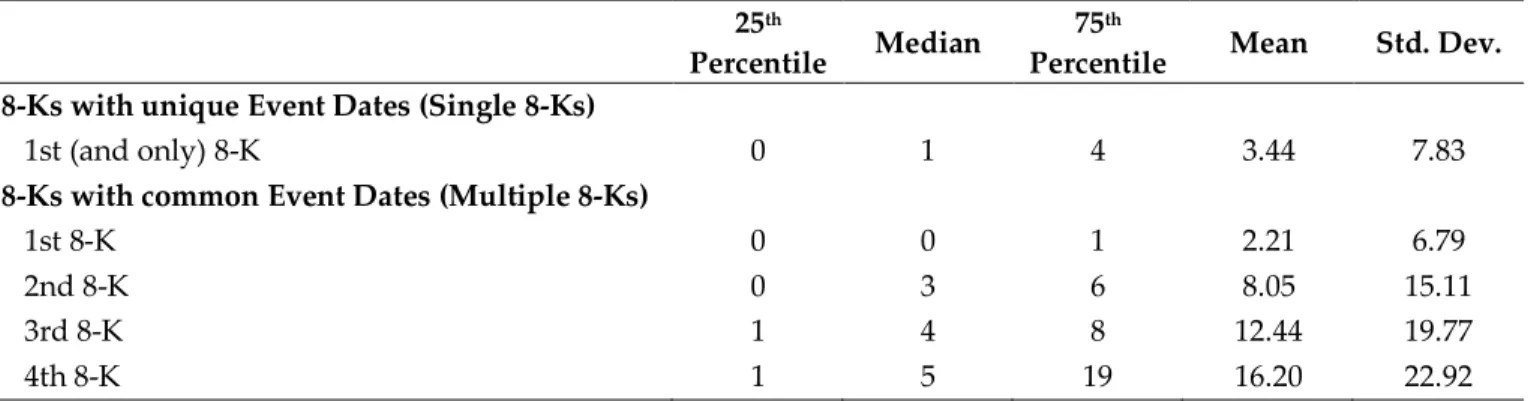
To provide initial evidence that managers intentionally smooth out disclosures to avoid information overload, we analyze the timing of 8-K disclosures, for which both the disclosure date and underlying event date are identifiable. Our sample of 8-Ks excludes amendments. We begin by looking at the distribution of the distance in days between event and filing dates for 8-Ks. Table 4 Panel A presents the results. The data suggests that firms promptly file 8-Ks when there are no other events on the event day, with a median (mean) delay of 1 day (3.4 days). However, when
treatment and post-weighted control observations are identical). The algorithm repeats this process over multiple iterations until a set of weights for control observations are found such that the balance conditions are met. Treatment observations are not re-weighted, meaning they retain their default weighting of one while control observations are assigned a positive weight that may be greater or less than one. After the algorithm finishes assigning weights to each observation, these weights are used in subsequent regression analyses.
21
there are multiple events on the same day, we observe a clear pattern of staggered delays. The median (mean) number of days between the event date and filing date are 0, 3, 4 and 5 (2.2, 8.0, 12.4 and 16.2) for the first, second, third and fourth 8-Ks on the same event date, respectively.22
Extending this analysis in a regression framework, we estimate the following equation:
Distance between Event Date and 8-k Filing Dateit= β0
+ β1Number of 8-Ks with the same Event Dateit+ βkFirm-Year-Quarter Fixed Effects+εit (1)
The unit of observation is each 8-K. The variable of interest is the count of firm 8-Ks with the same event date (i.e., report date). We include firm-year or firm-quarter fixed-effects to control for firm and time characteristics that may be related to the delay in disclosure. Standard errors are clustered by firm. We predict that firms will delay the disclosure of 8-Ks when they have multiple triggering events on the same day. Table 4 Panel B presents the results. We find evidence consistent with managers delaying the disclosures of concurrent news, which is consistent with managers timing disclosures to minimize information overload.
Complex information takes more time to adequately process. Thus, we also split the sample of 8-Ks into high and low complexity, based on the sample median of the Gunning Fog Readability Index. Columns 3 and 4 of Table 4 Panel B present the results. We find that the delay in the disclosure of concurrent news is significantly longer for high complexity 8-Ks, consistent with
22 In August of 2004, the SEC shortened the filing deadline for all mandatory 8-K items to four business days (from the prior deadlines of between 5 and 15 days depending on the item). Our sample includes pre-2004 8-Ks as well as voluntary 8-Ks, which do not have to follow the 4-business day deadline. In untabulated tests, we exclude pre-2004 and voluntary 8-Ks and replicate the tests in Table 4. Although the mean delays get shorter and within SEC deadlines, we still observe a similar pattern of staggered delays when there are multiple events on the same day for mandatory 8-Ks after 2004.
22
managers delaying the disclosure of concurrent information more when the information is more complex and harder to process.
One possible alternative explanation of this result is that when multiple events occur on the same day, managers are too busy to disclose them immediately or disclosure costs otherwise limit the timeliness of the 8-K filing. In order to rule out this alternative explanation, we next examine whether recent prior disclosures (within the past three days) also predict a delay in the next disclosure. If managers are delaying because of disclosure costs, we would not expect a previous disclosure to explain a future delay because the costs of the previous disclosure have already been incurred. Consistent with managers smoothing disclosures to reduce overload rather than because of disclosure costs, Table 4 Panel C shows that managers are more likely to delay a disclosure (from its event date) when there has been a disclosure in the previous three days. This result supports our view that managers delay or smooth disclosures at least in part to minimize information overload.
4.1.2 Determinants of disclosure smoothing
We next analyze the association between disclosure smoothing and five information-related characteristics which we would expect motivate managers to help investors fully understand their disclosures: information quantity, information environment, information complexity, information uncertainty, and information content. We focus on these information-related characteristics because we believe each represents a different dimension of information that might affect investors’ processing costs. In particular, we examine information quantity because investors can get overloaded with too much information in a short period of time, such that firms have incentives to
23
smooth out disclosures, allowing more time for investors to fully process firm disclosures. We use the length of press releases (Length of Press Releases) to proxy for information quantity.
We consider the firm information environment since more information available to investors from other sources, such as analysts, media, etc. (Blankespoor, Miller and White, 2013), may also lead to overload. We expect that managers anticipate the increased likelihood of information overload with a more robust information environment and increase disclosure smoothing to offset this potential effect. We use firm size (Log of Assets) as our empirical proxy for the information environment. We use firm size to capture a richer information environment rather than the actual number of media articles following a particular disclosure or actual press releases in an industry, because we are trying to capture the ex ante expectation of overload, and it is difficult for a manager to know exactly when, and how much, their disclosure will coincide with other information outside the firm’s control.23
We examine information complexity, as prior literature documents incomplete processing of complex disclosures (Plumlee, 2003). We expect that managers anticipate the increased likelihood of information overload with complex disclosures and smooth disclosures accordingly. We use an indicator variable for multiple reporting segments (Segments) to proxy for information complexity. We also examine information uncertainty, as investors’ information processing costs should be higher when there is greater uncertainty about the firm and its prospects. We use the volatility of prior firm performance (Earnings Volatility) to proxy for uncertainty (Billings, Jennings and Lev, 2015). When uncertainty is high, there is a greater chance of increased stock price volatility and
23 Coefficient signs and statistical significance are similar when, in untabulated tests, we use lagged analyst and media coverage as proxies for the firms’ information environment.
24
lower firm valuation. Thus, managers have an incentive to smooth disclosure in an attempt to help reduce uncertainty.
Lastly, we consider information content. Prior literature documents managers’ incentives to provide timely disclosures of bad news. For example, Skinner (1997) finds that managers can reduce potential litigation costs by providing timely disclosures of bad news. Similarly, Graham et. al. (2005) find that managers believe they can increase credibility with investors by not delaying bad news disclosures. In our setting, this would imply more smoothing as news become more positive.
We test these predictions by estimating the following OLS regression, as indicated:
Smoothingit = β0+ β1Length of Press Releasesit+ β2Log of Assetsit
+ β3Segmentsit + β4Earnings Volatilityit + β5Cumulative Press Release Returnsit
+ β6Number of Press Releasesit + Fixed-Effects + εit, (2)
where Smoothing is one of our two smoothing measures: Short-Interval Smoothing or Variance Smoothing. Short-Interval Smoothing is minus one times the number of firm-initiated press releases disclosed less than 3 days apart, and Variance Smoothing is minus one times the standard deviation of the number of hours between firm-initiated press releases divided by 100. Both variables increase in disclosure smoothing. Length of Press Releases is the log of the total number of characters in the disclosures made by the firm over the quarter; Log of Assets is the log of total assets in the current fiscal quarter; Segments is an indicator variable equal to one if the firm reported more than one business or geographic segment in the year; Earnings Volatility is the standard deviation of earnings before extraordinary items in the same fiscal quarter in the five prior years scaled by average total
25
assets; and Cumulative Press Release Returns, our proxy for the overall sign and magnitude of the news disclosed during the quarter, is the sum of the market-adjusted firm stock returns on the days of press release disclosures during the quarter. We also control for disclosure frequency (Number of Press Releases) given the likelihood that our measures of smoothing are related to the number of press releases provided during the quarter.
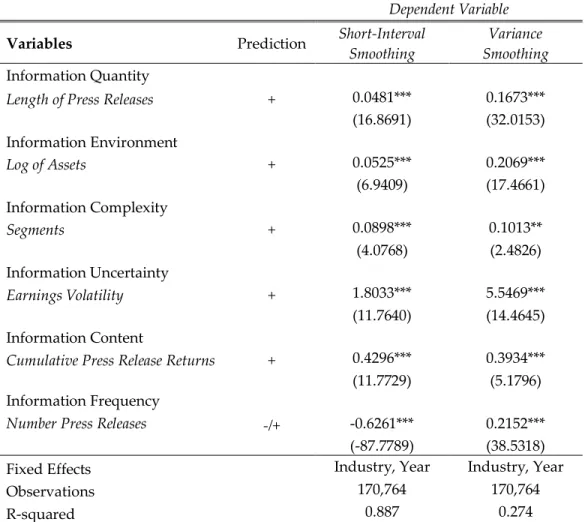
Table 5 reports the results of estimating Equation (1), where Column 1 (2) reports the results for Short-Interval Smoothing (Variance Smoothing) with industry and year fixed effects. Consistent with our predictions, the coefficient estimates for β1 to β5 are statistically significant in the expected positive directions. These results suggest that managers engage in disclosure smoothing in a way consistent with their anticipation of information overload and their incentive to mitigate its effects.
We find a negative (positive) relationship between the number of press releases and Short-Interval Smoothing (Variance Smoothing). We interpret this as likely due to a relationship between disclosure frequency and our proxies for smoothing, which is unsurprising given how the proxies are constructed. This result motivates our steps to control for disclosure frequency in the subsequent tests of the market outcomes associated with disclosure smoothing, either by including a control variable, or by taking fixed effects for the number of press releases, which we do in all results presented in Tables 6 through 9.
On a related note, the coefficient estimate on β4 (representing a positive relationship between earnings volatility and disclosure smoothing) helps to address the potential concern that our subsequent results reflect smooth economic conditions at the firm rather than smooth disclosure patterns. This concern is based on the intuition that firms with smooth economic conditions might naturally have smooth disclosures. However, the positive relationship between disclosure
26
smoothing and earnings volatility suggests the opposite; disclosure smoothing is more pronounced when economic conditions are more volatile.24
4.1.3 Disclosure smoothing and trading liquidity
Prior literature suggests that when confronted with information overload, investors are more likely to rely upon heuristics to process large amounts of information, which often omits relevant information from the decision process (Simon, 1955; Einhorn, 1971, Payne 1976; Herbig & Kramer, 1994; Sparrow, 1999). Because overloaded investors using these simplifying techniques are likely to recognize their potential information disadvantage, they may rationally abstain from trading in order to avoid adverse selection (Miller, 2010). However, in the presence of smoothing, investors are less likely to rely on heuristics because they have more time to process each new disclosure, thereby reducing their perceived information disadvantage. Thus, they are more willing to trade at low cost (Harris 1990).25 Accordingly, we predict that disclosure smoothing will increase liquidity.
We test the effect of disclosure smoothing on liquidity by estimating the following OLS regression across the entropy-balanced sample, as indicated:
Liquidityit or Turnoverit or Average Bid-Askit= β0+ β1Smoothingit
+ β2Number of Press Releasesit + β3Length of Press Releasesit + β4Log Assetsit
+ β5Number of Analystsit + β6Segmentsit + β7Earnings Volatilityit
+ β8Volatility Prior 12-Month Returnsit + β9Proportion of Bad News Releasesit
+ β10Cumulative PR Returnsit + β11Market-to-Bookit + β12Leverageit+ β13ROAit
+ β14Prior 12-Month Returnsit + β15Lossit + Fixed-Effects + εit , (3)
24 In our subsequent tests, we further address this potential concern by controlling for earnings volatility.
25 Harris (1990, p.3) states, “A market is liquid if traders can quickly buy or sell large numbers of shares when they want and at low transaction costs. Liquidity is the willingness of some traders (often but not necessarily dealers) to take the opposite side of a trade that is initiated by someone else, at low cost” (Emphasis added).
27
where we use three measures of stock liquidity: (i) minus one times the Amihud (2002) illiquidity measure during the quarter, calculated as the average of the absolute value of the daily return-to-volume ratio (Liquidity); (ii) the sum of the daily share volume divided by total shares outstanding in the quarter (Turnover); and (iii) the average of the daily ask minus the daily bid quotes during the quarter according to CRSP (Average Bid-Ask). Short-Interval Smoothing and Variance Smoothing are our two variables of interest and are measured as described in Equation (2). We control for various factors likely to explain liquidity or to be related to the timing of disclosures such as disclosure frequency (Number of Press Releases), which is included either as a control variable or as a fixed effect, 26 information quantity (Length of Press Releases), firm size (Log Assets), analyst
coverage (Number of Analysts), business complexity (Segments), earnings uncertainty (Earnings Volatility), prior return volatility (Volatility Prior 12-Month Returns), disclosure content (Proportion of Bad News Releases and Cumulative Press Release Returns), firm valuation (Market-to-Book), capital structure (Leverage), profitability (ROA), prior returns (Prior 12-month Returns), and earnings losses (Loss). When Average Bid-Ask is the dependent variable, we also include stock price (Average Price) in order to control for the differences in spread caused by differences in stock price levels. We expect disclosure smoothing will increase liquidity, leading to a prediction of β1 > 0 in Equation (3) when the dependent variable is Liquidity or Turnover and a prediction of β1 < 0 when the dependent variable is Average Bid-Ask.
Table 6 Panel A (B) reports the results for Short-Interval Smoothing (Variance Smoothing). In order to fully control for disclosure frequency, we report the results using two specifications for each
26 Controlling for the number of press releases helps mitigate the potential concern that our measure of smoothing is mechanically related to press release frequency.
28
dependent variable, including (i) the number of press releases as a control variable, or (ii) the number of press releases as a fixed effect. The coefficient estimates for β1 are consistent with our predicted sign and statistically significant, with the exception that the coefficient estimate on Short-Interval Smoothing in the second specification of Turnover in Panel A is positive (as predicted) but not significant (t-stat= 1.15). Overall, these results support our prediction that disclosure smoothing is associated with increased liquidity.
4.1.4 Disclosure smoothing and market uncertainty
Next, we analyze the relation between disclosure smoothing and both investor uncertainty and analyst error. Prior literature indicates that information overload reduces decision accuracy or quality (Einhorn, 1971; Payne, 1976; Cohen, 1980; Malhotra 1982; Chewning & Harrell, 1990; Eppler and Mengis, 2004). Not only are overloaded investors more likely to make errors in judgments, prior literature suggests they are likely to do so in inconsistent ways (Chewning and Harrell, 1990). Consistent with this intuition, Loughran and McDonald (2014) show that larger 10K filings are associated with increased stock price volatility.
To the extent that disclosure smoothing mitigates these effects for investors, we expect disclosure smoothing to be negatively associated with stock price volatility. Further, to the extent disclosure smoothing helps analysts more effectively process information, we predict disclosure smoothing should be positively associated with forecast accuracy. We test these predictions by estimating the following OLS regression, as indicated:
29
Stock Volatilityit or Analyst Forecast Accuracyit = β0+ β1Smoothingit
+ β2Number of Press Releasesit + β3Length of Press Releasesit + β4Log Assetsit
+ β5Number of Analystsit + β6Segmentsit + β7Earnings Volatilityit
+ β8Vol. Prior 12-Month Returnsit + β9Prop. Bad News Releasesit
+ β10Cumulative PR Returnsit + β11Market-to-Bookit + β12Leverageit+ β13ROAit
+ β14Prior 12-Month Returnsit + β15Lossit + Fixed-Effects + εit , (4)
where StockVolatility equals the standard deviation of stock returns during the quarter, Analyst Forecast Accuracy is minus one times the absolute difference between the median quarterly analyst EPS forecast consensus and the actual, scaled by the stock price at the end of the quarter. We control for disclosure frequency (Number of Press Releases), which is included either as a control variable or as a fixed effect, information quantity (Length of Press Releases), firm size (Log Assets), analyst coverage (Number of Analysts), business complexity (Segments), earnings uncertainty (Earnings Volatility), return volatility (Volatility Prior 12-Month Returns), disclosure content (Proportion of Bad News Releases and Cumulative Press Release Returns), firm valuation (Market-to-Book), capital structure (Leverage), profitability (ROA), prior returns (Prior 12-month Returns), and earnings losses (Loss). We predict β1 < 0 (β1 > 0) when Stock Volatility (Forecast Accuracy) is the dependent variable in Equation (4).
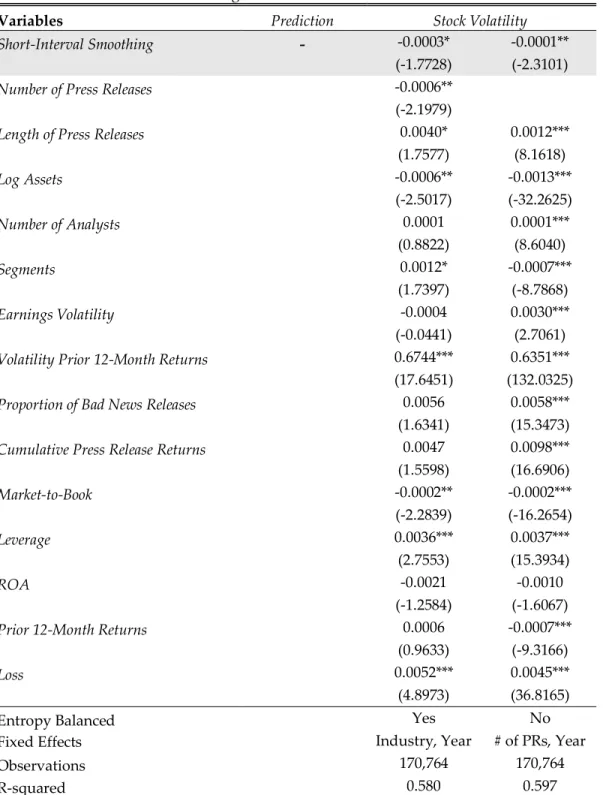
Table 7 reports the results of estimating Equation (4) when Stock Volatility is the dependent variable. Panel A (B) reports the results for Short-Interval Smoothing (Variance Smoothing). We report the results using two specifications, including (i) the number of press releases as a control variable, and (ii) the number of press releases as a fixed effect. The coefficient estimates for β1 are in the expected directions and statistically significant across both estimation methods. This supports our prediction that disclosure smoothing mitigates the volatility-increasing effect of information overload.
30
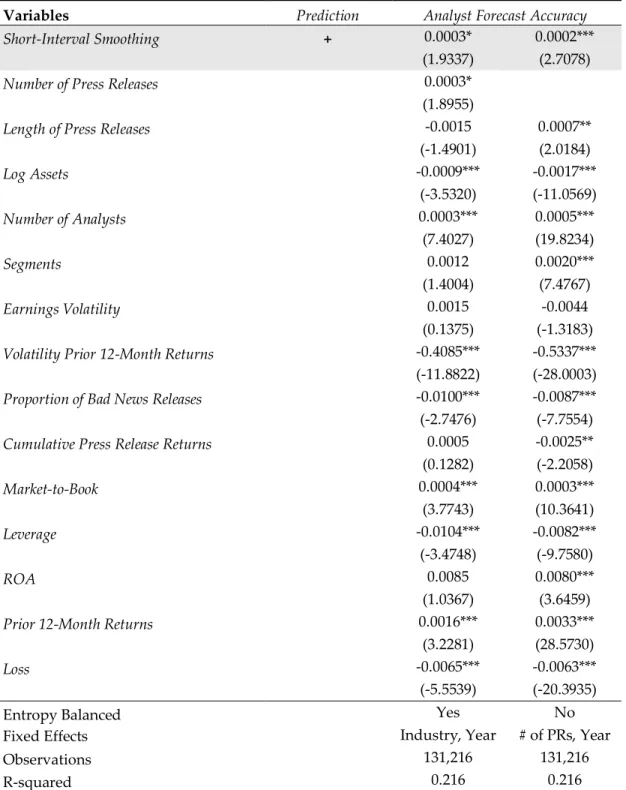
Table 8 reports the results of estimating Equation (4) when Forecast Accuracy is the dependent variable. Panel A (B) reports the results for Short-Interval Smoothing (Variance Smoothing). The coefficient estimates for β1 are in the expected directions and statistically significant across both estimation methods for Short-Interval Smoothing and Variance Smoothing. These results support our prediction that disclosure smoothing mitigates the effect of information overload.
4.2. Additional analyses 4.2.1 Changes specifications
To provide additional support for our main inferences and improve our empirical identification, we replicate the results in Tables 6 through 8 using changes specifications. In each regression, we convert all variables to measures of changes from the previous period. Table 9 Panel A (B) reports the results of estimating the corresponding equations for Short-Interval Smoothing (Variance Smoothing). For Short-Interval Smoothing, we find statistically significant coefficient estimates in the predicted direction for four of the five dependent variables (the exception is change in stock volatility, which remains negative as expected but is no longer statistically significant). For Variance Smoothing, we also find statistically significant coefficient estimates in the predicted direction for four of the five dependent variables (the exception is change in turnover, which remains positive as expected but is no longer statistically significant). Overall, these results support our main inferences.
4.2.2 Bundling of negative news
In our main analyses, we show that managers smooth earnings when they have incentives to help investors fully process information and that smoothing facilitates better market outcomes. In
31
this section, we consider whether managers might bundle (rather than smooth) disclosures when they have bad news. Our intuition follows from prior research (e.g., Waymire 1984) indicating that managers bundle bad news with good news to avoid negative market impacts. To conduct this analysis, we model (i) the provision of a subsequent positive disclosure (Next PR is Positive) and (ii) the amount of time until the next positive disclosure (Number of Days Until Next Positive PR) as a function of a negative current disclosure as described in the following regression:
Next PR is Positiveit or Number of Days Until Next Positive PRit= β0
+ β1 Current PR is Negativeit + Firm-Year or Firm-Year-Quarter Fixed Effects + εit (5)
where Next PR is Positive is a binary indicator variable for a positive news subsequent press release and Number of Days Until Next Positive PR measures the number of days until the next positive news disclosure. Both measures are constructed from indicators of the tone of the news available in the RavenPack database, which categorize news events as either positive, neutral, or negative.27 To the
extent that managers accelerate good news disclosures following the release of bad news, we expect a positive coefficient on β1 when Next PR is Positive is the dependent variable, and a negative coefficient estimate on β1 when Number of Days Until Next Positive PR is the dependent variable.
Consistent with this prediction, Panel A of Table 10 shows that managers are more likely to disclose good news after a bad news disclosure. Moreover, Panel B of Table 10 indicates that managers disclose good news more quickly after bad news than they do after good or neutral news.
27 We follow Bushman et. al. (2017) in using the Composite Sentiment Score (CSS) provided by Ravenpack to categorize news stories as positive, neutral or negative. The CSS score ranges from 0 to 100, with values below 50 indicating negative news, values equal to 50 indicating neutral news and values greater than 50 indicating positive news. The CSS score is the combination of five proprietary sentiment measures that combine textual analysis (identifying emotionally charged words and phrases), expert categorization of topics likely to cause positive or negative short-term market reaction, and an algorithm that ensures agreement among the five sentiment measures. The five sentiment measures are PEQ, BEE, BMQ, BCA and BAM. Detailed definitions of these measures are described in Appendix A of Bushman et. al. (2017).
32
This evidence is consistent with managers bundling (as opposed to smoothing) disclosures when they have negative news.
As additional evidence of managers bundling disclosures by accelerating good news conditional on prior bad news, we look at the reporting delay in 8-K filings of good news after bad news. We modify Equation (5) by creating an interaction variable between Current PR is Negative and Next PR is Positive and regressing it on the distance between the event date and disclosure date of the next release. Panel C of Table 10 reports the result of estimating this equation on the 8-K sample. We find that managers reduce the delay between the event and disclosure date of the next good news 8-K when the current press release is negative. We interpret this result as additional evidence of managers bundling bad news by accelerating disclosure of good news. Our findings are related to those of Niessner (2015), who suggests that managers are more likely to disclose negative news during low investor attention periods (on Fridays, before national holidays and after the market closes). While Niessner (2015) documents evidence consistent with strategic timing of negative news 8-Ks, we document evidence consistent with strategic timing of good news following negative news.
4.3 Robustness tests
We perform a series of untabulated sensitivity tests. We find that results from Tables 5 to 8 are robust to (i) including of the number of press releases squared, cubed and logged as control variables to address the concern that our variables of interest are capturing a non-linear relation between disclosure frequency and market outcomes, (ii) scaling our smoothing variables by the number of press releases to further address the concern that these measures are mechanically associated with the number of releases, (iii) using alternative intervals of 1 and 2 days in the