https://doi.org/10.1007/s10551-019-04331-4 ORIGINAL PAPER
Higher Ethical Objective (
Maqasid al
‑
Shari’ah
) Augmented Framework
for Islamic Banks: Assessing Ethical Performance and Exploring Its
Determinants
Arman Mergaliyev1 · Mehmet Asutay1 · Alija Avdukic2 · Yusuf Karbhari3
Received: 29 July 2018 / Accepted: 22 October 2019 © The Author(s) 2019
Abstract
This study utilises higher objectives postulated in Islamic moral economy or the maqasid al-Shari’ah theoretical frame-work’s novel approach in evaluating the ethical, social, environmental and financial performance of Islamic banks. Maqasid al-Shari’ah is interpreted as achieving social good as a consequence in addition to well-being and, hence, it goes beyond traditional (voluntary) social responsibility. This study also explores the major determinants that affect maqasid performance as expressed through disclosure analysis. By expanding the traditional maqasid al-Shari’ah,, we develop a comprehensive evaluation framework in the form of a maqasid index, which is subjected to a rigorous disclosure analysis. Furthermore, in identifying the main determinants of the maqasid disclosure performance, panel data analysis is used by including several
key variables alongside political and socio-economic environment, ownership structures, and corporate and Shari’ah
gov-ernance-related factors. The sample includes 33 full-fledged Islamic banks from 12 countries for the period of 2008–2016. The findings show that although during the nine-year period the disclosure of maqasid performance of the sampled Islamic banks has improved, this is still short of ‘best practices’. Through panel data analysis, this study finds that the Muslim population indicator, CEO duality, Shari’ah governance, and leverage variables positively impact the disclosure of maqasid
performance. However, the effect of GDP, financial development and human development index of the country, its political and civil rights, institutional ownership, and a higher share of independent directors have an overall negative impact on the
maqasid performance. The findings reported in this study identify complex and multi-faceted relations between external
market realities, corporate and Shari’ah governance mechanisms, and maqasid performance.
Keywords Islamic moral economy · Maqasid al-Shari’ah · Ethical performance · Islamic banks · Disclosure · Determinants
Introduction
Islamic banking and financial institutions (IBFIs) emerged during the mid-1970s as ‘commercial banks’ to fulfil the religiously constructed financial needs of individual Mus-lims. They are considered value-oriented financial institu-tions shaped by the principles, morals and ethical norms
of Islam. While the legal rulings in the form of Shari’ah
injunctions determine the operational nature of IBFIs in the form of compliance, the normative nature of their operations is determined by the precepts of an Islamic Moral Economy (IME) (Asutay 2012). As a result, IBFIs are expected fulfil the normative expectations of IME as articulated by maqasid al-Shari’ah or ‘objectives of the Shari’ah’ (Asutay 2013;
Asutay and Yilmaz 2018), which is defined as ‘promoting
human and social well-being’ (Chapra 2000).
* Mehmet Asutay [email protected] Arman Mergaliyev [email protected] Alija Avdukic [email protected] Yusuf Karbhari [email protected]
1 Durham Centre for Islamic Economics and Finance, Durham
University Business School, Durham University, Durham, UK
2 Al-Maktoum College of Higher Education, Dundee,
Scotland, UK
The emergence of IBFIs was expected to motivate the socio-economic development of Muslim countries as institu-tions of IME by serving the financial needs of Muslim peo-ple in accordance with Islamic legal or Shari’ah principles, as IME emerged to construct a human-centred economic development paradigm. However, while IBFIs have been successful in mobilizing financial resources, they have been subjected to heavy criticism on the grounds that they are not fulfilling the ‘substance’ or the maqasid (objectives) of
Shari’ah or ‘human and social well-being’ as identified by IME’s transformational framework.
Despite the dynamic growth of the Islamic finance indus-try both in asset terms (1893.10 billion USD in 2016) and
number (360) of IBs (The Banker 2017), the current
prac-tices of Islamic Banks (IBs) have been strongly criticised as not being truly ‘Islamic’ in their operations (El-Gamal 2006; Khan 2010; Asutay 2007a, b, 2012; Aksak and Asutay 2015). To compete with conventional financial institutions, IBFIs have oriented their strategies towards financial objec-tives rather than ethical and social objecobjec-tives that require them to serve communities rather than contributing to finan-cialization. The increasing financialization can be seen with the increased use of debt instruments as well as financing provided for financial markets and banks along with other activities which has financialisation consequences (on finan-cialisation and debt orientation, see among others: Aggrawal and Yousef 2000; Nagaoka 2007; Asutay 2007a, b, 2012; Rudnyckyj 2014, 2018; Suzuki and Miah 2015; Farooq and Selim 2018; Yilmaz 2018). For example, in Malaysia, the use of organised tawarruq, which is a short-term liquidity solution within the Islamic sphere, has increased by 104
per-cent between 2014 and 2016 (Bank Nagara Malaysia 2016,
pp. 90–91). The nature of organised tawarruq creates debt and increased further financialisation, and therefore is sub-jected to strong criticism, which was, therefore, ruled unlaw-ful or Shari’ah non-compliant by the International Islamic Fiqh Academy but it is used liberally by the majority of Islamic banks due to market pressure, as indicated by the statistics in the case of Malaysia.
Contextually, in the IME-based operational axioms through which IBFIs can operate, they have adopted neo-classical assumptions and pragmatic attitudes and have therefore shifted away from the IME framework (Asutay 2007a). Consequently, IBs have ‘failed’ in achieving their social objectives as required by the IME foundations (Asutay
2012) and in the implementation of maqasid al-Shari’ah
into their activities, in particular in social impact areas. Considering that essential economic and social issues are still on the agenda of most of the Muslim countries world-wide, such as poverty reduction and enhancing levels of human development, IBFIs are expected to contribute to the ethical, social and economic spheres to realise the maqasid al-Shari’ah or social well-being. Therefore, it is crucial to
assess the performance of Islamic banks (IBs) through the ‘higher objectives’ or the maqasid al-Shari’ah theoreti-cal framework and identify factors which could positively or negatively influence IBs’ ethical, social and economic performance. This will help to determine how IBs should be directed and operated in fulfilling the multidimensional objective of IBs and satisfy both the ‘form’ (Shari’ah legal
rulings) as well as the ‘substance’ (social and moral filters)
requirements of the Islamic worldview (Asutay 2012, pp.
98–99).
Since the theoretical framework of IME implies that IBs should conduct their financial operations in an ethical manner with social impact consequences, this study aims to fill the gap by going beyond the classical corporate social responsibility measures to assess their ‘social and ethical responsibility’. In doing so, this study approaches the mat-ter through the embedded notion of Islamic morality by
developing a maqasid index to measure the endogenously
constructed social or ethical behaviour of IBs. The evalua-tion of IBs’ maqasid performance across 12 countries within the nine-year time frame (2008–2016) is studied to explore the determinants of maqasid performance consisting of the ethical, social and economic performance of the IBs. As a result, this research advances extant literature concerning the performance of IBs beyond financial performance and their determinants in relation to the normatively expressed objectives including their contribution to social development in their operating countries and communities.
This study also provides empirical evidence as to whether or not distinct corporate governance (CG) structures are affected by the maqasid al-Shari’ah’s aspirational founda-tions within the IME framework and whether they perform better than other IFBIs, vis-à-vis CG, in areas of ethical, social and economic affairs. At the same time, the ethical, social and economic performance of IFBIs are also affected by external macro-factors and their environment, as exam-ined in this study.
To the best of our knowledge, this is the first extended research to provide a cross-country empirical analysis of the factors which influence the performance of IBs in ful-filling the objectives within the maqasid al-Shari’ah theo-retical framework through data gathered utilising disclosure analysis. Asutay and Hernangitas (2015) provided the initial descriptive study using a similar maqasid index, which this study applied as a basis for developing the current maqasid
index utilised to generate the necessary data for assessing the maqasid performance of the sampled banks.
This study has, therefore, potential policy implications that can contribute to the work of national regulators, gov-ernment authorities, and international standard setting organizations, such as the IFSB and AAOIFI, in constructing and developing appropriate mechanisms and best practices for the Islamic finance industry in improving IB performance
to contribute to the development of communities and socie-ties, which is essentialised by maqasid al-Shari’ah as the foundational objective function and methodology of IME. This study also contributes to the academic literature on Islamic finance by exploring factors which could influence the maqasid performance of IBs, and thus it discovers ways
to enhance IBs by improving their maqasid performance
with the idea that IBs should contribute to the socio-eco-nomic development of societies and countries in which they operate.
Overall, this study provides a novel approach and under-standing of evaluating the social performance of IBs beyond merely replicating or mimicking CSR or corporate govern-ance-related disclosure indices, as it develops an authentic evaluation method specific to IME as expressed through extended maqasid al-Shari’ah principles. It is hoped that such a method that is inherently Islamic in nature can prevail as a novel method in the literature.
The rest of the paper is organised as follows: a
litera-ture review on IME-based maqasid al-Shari’ah
theoreti-cal framework is presented in “Maqasid al-Shari’ah as the Ethical Framework for Islamic Banks” section. In “Islamic Banking and Finance and Its Ideal Identities” section, Islamic banking and finance and its ideal identities are dis-cussed. “Survey of the Empirical Literature” section pre-sents a survey of relevant empirical studies, while “ Method-ology” section provides a detailed description and procedure of research methodology including maqasid index construc-tion and details of disclosure analysis, hypotheses formu-lation and method of analysis is employed. The empirical results relating to the maqasid performance of IBs with their determining factors are presented in “Empirical Results of Assessing the Maqasid Performance of Islamic Banks and Its Determinants” section. Finally, “Conclusion” section summarises the findings and provides the conclusion of the study which also offers a critical reflection on some of the more outstanding and pertinent issues.
Maqasid al‑Shari’ah as the Ethical
Framework for Islamic Banks
The ideal objective of IBs and their performance cannot be explored properly without discussing a theoretical frame-work of IME, which rationalises the existence of IBs. The IME-related debate emerged in the 1960s as a critique of both the capitalist and communist models of economic development, which ignores religious and ethical values, whereas, the primary objective of IME is to develop an economic system that would be human-centric and based on Islamic values and guided by the substantive justice of Islam (Asutay 2007a, p. 169). As a result of the knowledge creation process led by Muslim economists, the conceptual
foundations of IME, its axioms, value system, operational dimensions and the behavioural norms of individual
Mus-lims (‘homoislamicus’) have been developed based on the
ontology and epistemology of Islam, namely, the Quran
and Sunnah (Asutay 2007a, p. 171, 2007b, p. 5).
Asutay (2007b; 2012; 2013) summarizes the
founda-tional axioms of IME, which include the following:
Tawhid as complementarity and unitarity or God’s unity and sovereignty, constitutes the nature of knowledge and its articulation implying that none of the stakeholders can have dominance over the others. This identifies that IME suggests an extended
stake-holder governance system for IBs based on ihsan or
equilibrium. For example, the prohibition of riba
accordingly implies de-centring of capital and bring-ing capital to the same level with other stakeholers through the ihsani process.
Al-adl wa’l-ihsan refers to socio-economic justice and beneficence to establish equilibrium between the interests of all the stakeholders in an intergenera-tional and intrageneraintergenera-tional manner, which defines the objective function of IBs. When justice cannot establish equal access, then ihsan through its balanc-ing nature aims to overcome exclusion and fairness.
Rububiyyah refers to a developmentalist path in the form of divine arrangements for nourishment, suste-nance and guidance towards perfection, which identi-fies the operational objectives of IBs. It implies that all the stakeholders have a given path for develop-ment, and therefore, such development path must be sustained through the opportunity spaces.
Tazkiyah implies growth in harmony within tawhid’s complementarity so that interests of all stakehold-ers can be served without harming any other, which implies a constraint on the operation of IBs.
Khilafah or vicegerency and accountability defines the role of humans in such an extended stakeholder governance; and
Maqasid al-Shari’ah, or the higher objectives of Islam, implies ‘well-being’ indicating that whatever action is taken and whatever is done should be in line with the well-being all of the stakeholders including human well-being.
Based on such foundational axioms, IME as a system, in a consequential manner, “refers to economic and sus-tainable development, social justice and social
investing-oriented principles” (Asutay 2012, p. 96). Therefore, it
can be argued that an effective IME system requires that IBs conduct their activities in accordance with the
princi-ples of maqasid with an emphasis on social and economic
development practices along with fulfilling Islamic fiqhi
or jurisprudential requirements.
Give that the foundational axioms are constructed by the
maqasid al-Shari’ah methodological base of IME, which provides the legal and moral rationale and the theoretical framework within which economic activities should be performed (Asutay 2007b, p. 8; Asutay and Yilmaz 2018). Despite the existence of several different views of maqasid al-Shari’ah, a common treatment summarises it as the ‘reali-zation of well-being of all the stakeholders’ (Asutay 2012,
p. 96). The most common reference to maqasid in Islamic
economics is given to the Ghazalian definition of maqasid, which is interpreted as ‘human well-being’ and articulated as “safeguarding their faith (dīn), their self (nafs), their intel-lect (‘aql), their posterity (nasl), and their wealth (māl)” (Al Ghazali 1937; as cited in Chapra 2008, pp. 5–6) in
consti-tuting the IME axioms (Asutay and Yilmaz 2018). Chapra
(2008) argues that while these five objectives could be con-sidered primary, there are other necessary corollaries which can be found in the Qur’an, the Sunnah or in the writings of different Shari’ah scholars. Moreover, all primary objectives along with their corollaries are important, as “they are all interdependent and play the role of supporting each other” (Chapra 2008, p. 50). The Ghazalian definition of maqasid
is, however, criticised for its individual-oriented objectives and its lack of social consideration (Auda 2007; Asutay and Yilmaz 2018). Among others, Siddiqi (2004), Auda (2007),
Asutay (2007b) argue that maqasid should include wider
issues such as justice and equity. Asutay and Yilmaz (2018), therefore, state that in order to develop into a comprehensive methodology of IME, maqasid al-Shari’ah should be taken away from the constraints of fiqh, while in terms of a tawhidi
nature of knowledge must also be complemented by a moral base so that policy oriented consequences can be developed. In providing such a frame, Asutay and Yilmaz (2018) along with Siddiqi (2004) and Auda (2007) re-interpret maqasid to include a dynamic nature rather than ‘safeguarding’ or ‘pro-tection’, and the non-limitation of objectives so that it will better conceptualize and handle contemporary issues beyond a narrow Ghazalian frame. Therefore, Asutay and Yilmaz (2018), among others, highlight that Ghazalian maqasid is not able to respond to the contemporary challenges in the operations of IBs in relation to IME’s normative world. In responding to such concerns, this study refers to ‘invigora-tion’ rather than ‘safeguarding’ as part of Chapra’s (2008) redefinition of maqasid.
Contrary to a Ghazalian view on the articulation of
maqasid al-Shari’ah, with an attempt to respond to Siddiqi (2004), Auda (2007) and Asutay and Yilmaz’s (2018) re-interpretation, Al-Najjar extended the maqasid based on four objectives and eight corollaries, as identified by Bedoui and Mansour (2014, p. 13), which is depicted in Table 1. How-ever, Bedoui (2012, p. 5) points out that implementation of
the corollary objectives is also required since the realization of the primary objectives may be onerous without them. Therefore, all eight maqasid corollaries should constitute the framework for a full assessment of IBs’ social reference as an endogenously constructed frame based on Islamic ontology. In other words, through such a re-interpretation
and extended maqasid as a dynamic construct beyond a
safeguarding role, an embedded IME frame is constituted for the IBs to operate within (Asutay and Yilmaz 2018). In this, embeddedness refers to IBs operating within the social formation of an Islamic normative world rather than the mechanisms and instruments of a market system.
Islamic Banking and Finance and Its Ideal
Identities
The creation of the first IBs in the 1970s represented the emergence of an alternative financial industry, which was expected to conduct its activities according to Shari’ah or Islamic legal requirements and the substantive morality promulgated by Islam. In relation to the IME framework,
Asutay (2007a, p. 172) described Islamic finance as “an
institutional aspect of Islamic economics which finances and regulates economic activity” to promote the economic development and well-being of all creatures, including human well-being through social justice. Therefore, IBs have emerged in response to expectations to operationalise IME.
Consequently, based on the IME theoretical framework, several ideals and principles have been advanced as key
charecteristics of IBs. Among others, Chapra (1985, pp.
154–156) outlined several distinctive features of IBs, which include the abolition of interest, an orientation towards pub-lic interest, a universal or multi-purpose nature and not rep-resenting purely commercial or conventional banks but being catalysts for economic development through profit-and-loss
Table 1 Najjar’s concept of Maqasid al-Shariah. Source Adapted from Bedoui and Mansour (2014, pp. 567–568); modified version
Maqasid al-Shari’ah Corollaries
(i) Invigorating the value of human life
(a) Faith (b) Human rights (ii) Invigorating the human self
(a) Self (b) Intellect (iii) Invigorating society
(a) Posterity (b) Social entity (iv) Invigorating the physical environment
(a) Wealth
sharing (PLS), and risk sharing principles with the objective of fulfilling social and economic justice, aiding the fair and impartial allocation of wealth and emancipating and empow-ering all the stakeholders.
In accordance with the IME’s holistic approach, Asutay (2012) classified four characteristics of the values and norms of the ideal IB:
(i) As Islamic finance principles are derived from the ontology of Islam, the operations of IBs should not derive from riba (interest-based transactions), gharar (gambling), and speculative transactions, nor from the production of goods and services that violate Islamic norms (Ayub 2007) so that the interest of all the stakeholders should be posi-tively considered by de-centring the hegemony of capital. Therefore, IBs in their operations are expected to endogenise the interests of all stakeholders beyond narrow shareholder maximisation objectives.
(ii) Based on Islamic values and norms, IB activities should be akin to ethical investing beyond just eliminating
riba and gharar. At the same time, PLS-based financial con-tracts are encouraged in the form of mudharabah and mush-arakah or equity financing which will promote the devel-opment of entrepreneurial activities and greater stability in financial markets (Mirakhor and Zaidi 2007). Furthermore, the ‘two-tier mudharabah model’ was argued to be an ideal model of IBs as it “would fulfil the overall objectives of
Shari’ah and achieve growth, equity and stability” (Ahmed 2011a, p. 73).
(iii) IB operations are based on asset-backed transactions as an articulation of their embedded financing proposition to link the monetary and real economy along with promoting stability, productivity and economic development (Iqbal and Molyneux 2005, p. 31).
(iv) As an IME aims to promote social justice, IBs are expected to endogenise socially oriented expectations with the aim to serve communities and not only ‘markets’ (Asutay
2012). Therefore, IBs are expected to serve the financial
needs of all market segments, including small/micro-enter-prises (SME) and the poor (Ahmed 2011b, p. 153). In addi-tion, concepts such as waqf, zakah, sadaqah and qard hassan
reflect the social dimensions of Islamic frameworks, and which is expected to also be presented in IBs’ corporate social responsibility (CSR) practices (Platonova 2013).
According to the above ideal values within the IME framework beyond the financialised meaning of IBs, the ethical, social and economic dimensions are essentialised in IB operations as endogenous constructs rather than exter-nally adopted principles. By definition, these correspond to
maqasid al-Shari’ah consequences. Therefore, consider-ing that the maqasid constitutes the main construct of IBs in articulating IME in their operations, it is important to assess the performance of IBs through the prism of these dimensions so that the proximity of their performance to
the essentialised embedded nature can be identified beyond instrumentalised morality through exception-based moral-ity essentialised by fiqhi forms as prevalent in the IB sector (Sencal and Asutay 2019).
Survey of the Empirical Literature
This section aims to present a review of the relevant empiri-cal literature by clustering according to their objectives. Ethical, Social and Financial Performance of Islamic Banking and Financial Institutions
In contrast to classical views on the performance assessment of financial institutions which are based mainly on finan-cial and economic measures, a performance view in light of the maqasid al-Shari’ah is multidimensional and has a wider scope with the purpose of enhancing and sustaining
human and societal well-being (Bedoui and Mansour 2014).
However, Mohammed et al. (2008) argue that the failure of academic scholars to construct the multidimensional objec-tives for IBs has left no choice but to adopt the conventional unidimensional benchmarks of financial indicators to evalu-ate the performance of IBs. Therefore, performance assess-ment models and criteria are important to link IB activities with maqasid al-Shari’ah objectives in the context of IME.
To fill the gap in performance measurement-related theo-retical frameworks, several studies have been conducted. For
example, Hameed et al. (2004) developed the ‘Islamicity
Disclosure Index’, which consists of Shari’ah compliance, CG and social/environmental indicators, and some financial ratios. In addition, Mohammed et al. (2008) constructed per-formance ratios for assessing the achievements of IBs in nine dimensions and ultimately covered three objectives includ-ing educatinclud-ing individuals, establishinclud-ing justice and promotinclud-ing
welfare. Furthermore, Ngalim et al. (2015) has developed
an ‘Islamic Vision for Development’ based indicators for the assessment of the maqasid al-Shari’ah of IBs in light of the five Ghazalian maqasid with supplementary corollaries. In addition to maqasid al-Shari’ah performance measure-ment frameworks, some studies analysed the ethical iden-tity of IBs through CSR-based disclosure analysis based on annual reports, such as Haniffa and Hudaib (2007) and Belal et al. (2014). Moreover, Kasri and Ahmed (2015), in their
attempt to develop operational indicators for a maqasid
-based multidimensional poverty measure, included merely 21 items over five dimensions. In another attempt, Amir-Ud-Din (2014:25), using the fiqhi classification, “developed a
Maqasid al-Shari’ah Index (MSI) corresponding to three lev-els of necessities, complementarities and embellishments”, while this study is mainly related to expressed morality in terms of IME rather than ‘rational-legal reasoning’ provided
by fiqh. In developing a structural model for human develop-ment, Mili (2014) utilises Ghazalian maqasid by adding a further dimension that is ‘human well-being’ resulting into six dimensions and 15 elements. In addition, with the
objec-tive of developing policy oriented maqasid index, Hasan
and Ali (2018) constructs a maqasid al-Shari’ah depriva-tion percepdepriva-tion index (MSDPI) for the Muslim countries utilising five dimensional Ghazalian maqasid index with 26 deprivation-related consequences to evidence the impact of the lack of such maqasid on human well-being. Despite the resemblances and utilising similar constructs, the methodo-logical frameworks and measurements used in these attempts
do not cover all the aspects of maqasid and they remain
within the methodology and framework of CSRs applied to conventional banks. Therefore, a comprehensive and
inte-grated maqasid index should be developed as attempted by
this study, which covers an important gap in the literature. In terms of the evaluation of actual ethical performance, several empirical studies provided evidence that while IBs achieve significant financial performance, they perform poorly in ethical and social dimensions targeted by IME. Asutay (2012) concluded that, based on empirical research, it can be claimed that there is a ‘social failure’ of IBs as a result of their shift from IME’s equity-based objective to the neo-classical objective of efficiency.
In evidencing this, a number of benchmarks can be uti-lised. For example, in contrast to the ideal PLS or ‘equi-ty’-based financial contracts, IBs currently heavily utilize debt financing instruments, which has been referred to as
the ‘murabahah syndrome’ (Yousef 2004). Among others,
Nagaoka (2007) and Asutay (2012) demonstrate the
domi-nance of debt-based Islamic instruments in the operations of Islamic banks, accounting for over 90% of their financing. As a result, more stakeholders perceive that the financing methods of IBs are the same as those of conventional banks, which provide debt financing deploying different mechanics.
Second, despite their impact on economic growth, the performance of IBs has not promoted the economic and social development of the communities they serve. Aksak
and Asutay (2015) pointed out that the GCC countries,
which themselves have a dynamic economic growth and a high level of wealth per capita in general, have failed in their human development. They showed that IBs have not helped in contributing to such objectives as part of their maqasid
efforts. Therefore, it is claimed that IBs have not fulfilled the aspirations of IME in socio-economic developmental-ist areas or embedding their operations within the maqasid
frame.
Third, the IME paradigm provides a rationale for CSR as a social responsibility towards society and extends it
through maqasid expectations. In contrast, according to
several empirical studies, IBs have failed in their CSR prac-tices. For example, among others, Sairally (2007), Haniffa
and Hudaib (2007), Platonova (2013) and Belal et al. (2014)
found that most IBs conduct only zakah distribution and
other charitable activities without a systemic approach towards CSR. Thus, the social performance is a weak area in IB performance indicating dis-embeddedness in relation to the maqasid al-Shari’ah defined objectives.
Maqasid frame and IME identifies that IBs are expected to have the best practices and a comprehensive CG
frame-work. According to Choudhury and Hoque (2006), tawhidi
or shuratic models of CG have wider groups of stakeholders in comparison with Anglo-Saxon and even European mod-els. Nevertheless, currently IBs have not developed distinct CG structures which continue to utilize shareholder-oriented models; therefore, Chapra and Ahmed (2002) identified that IBs do not protect the interests of all stakeholders. In relation to Shari’ah governance (SG), Hassan (2012) identified that there are no ‘best practices’ in SG, which could lead to the deterioration of Shari’ah dimensions in IB operations and therefore increase Shari’ah non-compliance risks.
Based on the stated empirical evidence, it can be argued IBs have not met the expectations of Islamic economists and Muslims in general, which is further substantiated by El-Gamal (2006: xii) who stated that “Islamic finance has argu-ably failed to serve the objectives of Islamic law (maqasid al-Shari’ah)”. Therefore, it is important to develop an empirical framework based on maqasid to test the observed shortcomings in the ethical and social performance of IBs in the context of maqasid al-Shari’ah by adopting an extended
maqasid frame beyond the Ghazalian framework, as dis-cussed above.
Determinants of Islamic Banks’ Performance and Disclosures
Despite the dynamic growth of IBs in asset size and the complexity of their operations, few studies have addressed questions regarding the determinants of the financial, ethi-cal, social and environmental performance of IBs, which is essentialised by the maqasid al-Shari’ah frame within the scope of Islamic finance, including both the institutional or socio-political context as well as organizational features. However, most of the empirical studies have explored only determinants of financial performance and the development
of IBs. For example, Gazdar and Grassa (2015) identified
the positive influence of macroeconomic factors, such as income per capita, economic openness and population, for Islamic finance in GCC countries while institutional factors were not considered relevant to the development of IBs. In
another study, Mollah and Zaman (2015) investigated the
positive influence of Shari’ah supervisory boards (SSB) on financial performance, and they found that corporate gov-ernance attributes, such as the board of directors’ size, inde-pendence and its CEO, overall negatively impact IB financial
performance. In focusing on ownership, Zouari and Taktak
(2012) trace family and government ownership of IBs with
higher financial performance while institutional and foreign shareholders do not have such influence on IBs.
In relation to the ethical, social and environmental dimen-sions, most studies have explored the determinants of the social and ethical reporting of IBs. Farook et al. (2011) report that the relative size of Muslim populations, the level of social and political freedom, the SSB, and the share of investment account holders (IAHs) to total assets positively influence CSR disclosure.
In addition, Yousef’s (2004) cross-country analysis of ‘murabahah syndrome’ showed that legal institutions and political factors significantly influence the prevalence of debt-based instruments over equity-based ones in Islamic finance. As a result, Yousef (2004, p. 76) expects “that over-all institutional environment will be a more important deter-minant of the evolution of financial structures in Muslim societies than … rigid religious interpretations”.
In conclusion, the IBs, as institutions of IME, are expected to emphasize their socio-economic role in society by enhancing their economic, social, ethical and environ-mental performance. However, as mentioned in the above-presented studies, there is a gap in the current practices of IBs with regard to their ideal behaviour. Moreover, there is a lack of research in relation to the determinants of the economic, social, ethical and environmental performance of IBs. As a result, further empirical studies are required to determine the factors affecting the performance of IBs in light of maqasid al-Shari’ah, a task this study aims to fulfil in this paper.
Methodology
The empirical research in this paper is framed using a mix of qualitative and quantitative data based on the content analy-sis of annual reports for the generation of disclosure-related data for maqasid corollaries to identify the ethical perfor-mance of the sampled Islamic banks. In addition, secondary data were collected to identify the determining factors of disclosure performance through panel data analysis.
In conducting the content analysis for generating disclo-sure-related data, a crucial step is the design of specific cat-egories or pre-determined keywords and their criteria into which content units of documents and texts can be attributed (Haniffa and Hudaib 2007). The categories and list of indica-tors for this research were designed mainly from the existing literature on the concept of the maqasid al-Shari’ah and its measurement of the performance of IBs, ethical and social reporting as well as ‘the best practices’ from Islamic and conventional finance.
The unit of analysis is the annual reports of the sampled banks, the contents of which are attributed to the maqasid
dimensions. The generated disclosure data were converted into measurable categories.
In analysing the text through content analysis, the
maqasid al-Shari’ah index was constructed and used as a benchmark. To mitigate any possible bias in scoring items during index calculation, an un-weighted approach was used to be consistent with previous studies, such as Belal et al. (2014) and Haniffa and Hudaib (2007). In the calculation of the maqasid al-Shari’ah index with all its sub-indices, as per
Haniffa and Hudaib (2007), a mainly dichotomous approach
was used in the sense that an item scored ‘1’ if it was found in the annual report and ‘0’ (zero) if it could not be found in the annual report.
Following estimations of the maqasid al-Shari’ah index and its dimensions as dependent variables, in the second part of the empirical analysis a linear regression model based on panel data was utilised to explore the impact of several independent variables of the disclosure performance. Construction of maqasid al‑Shari’ah Index: Composition and List of Indicators for Disclosure Analysis
For the purposes of designing the evaluative framework for the maqasid or ethical performance of the sampled IBs
through disclosure analysis, Najjar’s extended maqasid
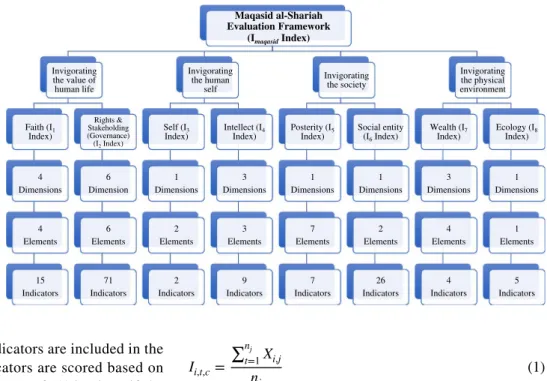
framework is implemented with four primary objectives and eight corollaries, as discussed in Bedoui and Mansour (2014). However, to link practice-related indicators of the economic, social, ethical and environmental performance of IBs with theoretically developed maqasid al-Shari’ah objec-tives and corollaries, Sekaran’s (2000) method is utilized. Accordingly, ‘concepts and notions’ can be broken down into observable characteristics or ‘dimensions’, and, subse-quently, they can be divided into measurable behaviours or ‘elements.’ In line with Mohammed et al. (2008), ‘elements’ are separated into a list of indicators of various performance ratios. Therefore, a comprehensive evaluative framework in relation to the maqasid al-Shari’ah framework is presented in Fig. 1, which is utilised in the empirical analysis.
Based on the existing literature, such as ethical per-formance by Belal et al. (2014), along with current ‘best practices’ in both Islamic and conventional finance (for example AAOIFI, IFSB and others), as well as macro and
micro-level maqasid indicators developed by Mohamed
(2018), a comprehensive list of benchmark performance
indicators is constructed which are then traced to each ‘element’, to each ‘dimension’ and then ultimately to each ‘concept’ or maqasid objective. The index in its fullness is presented in “Appendix”. It should be noted that not all performance indicators from the above-mentioned sources
are utilised as only relevant indicators are included in the list. In quantifying, most indicators are scored based on a ‘dichotomous approach’: a score of ‘1’ is given if the indicator is found in the annual report and ‘0’ is given if not (Belal et al. 2014). In addition, some indicators are calculated based on ratios or other financial calculations.
To measure the overall maqasid performance of IBs and
their separate performance in each primary objective, a
maqasid al-Shariah index with sub-indices in each corol-lary is constructed. As mentioned above, the calculation of the index is based on an un-weighted approach and all indicators were weighted equally in each element’s groups
to control possible bias in the measurement of maqasid
performance of the sampled IBs in line with previous
studies such as Haniffa and Hudaib (2007). It should be
noted that Antonio et al. (2012) used a weighted approach, which is not considered in this study due to its heavily sub-jective nature, as he constructed the weights through the interviews with the Shari’ah scholar. In addition, Moqbel (2014) in his research referred to the frequency of each of the MSI dimensions mentioned in the Qur’an is
determin-ing the weightage. However, tawhid axiom of the IME
being complementarity within unitarity suggests that each dimension of MSI should be considered equally, as assign-ing different weights will essentialise certain dimensions on other by creating dominance. Tawhid by definition pre-vents any domination of any of the dimensions of MSI over the other, as this would be contrary to ‘justice (adl)’
and ‘beneficence (ihsan)’ axiom of IME too. Therefore,
this paper refers to the unweighted method to fulfil the
tawhidi expectation.
The calculation of maqasid al-Shari’ah sub-indices
according to each corollary is completed through the
fol-lowing formula (Haniffa and Hudaib 2007):
where Ii,t,c: Maqasid al-Shari’ah sub-indices of ‘c’ corol-laries of Najjar’s maqasid of ‘i’ IB in year t; Xi,j: score of indicators of ‘i’ IBs in year t; nj: the overall number of indi-cators in ‘c’ corollaries.
Consequently, the calculation of the overall maqasid al
-Shariah index is based on the following formula:
where Ii,t is the maqasid al-Shari’ah index of the perfor-mance of IBs i in year t.
As there are eight corollaries in Najjar’s maqasid frame-work, the sum of all sub-indices on each corollary was divided by eight.
Hypotheses Development
The research hypotheses in this study were developed based on the literature review, both on the determinants of per-formance and the disclosure practices of IBs as well as of conventional banks and corporations.
There are several factors which may have an impact on the economic, social, ethical and environmental performance
of organizations. For example, Aguinis and Glavas (2012)
highlight that companies conduct CSR activities due to insti-tutional, organisational or individual factors. As for social reporting of IBs, Farook et al. (2011) analyse the influence of both country and IB-specific factors, in which two main groups of determinants are considered, including country-specific factors such as socio-economic development and political context and IB-level specific factors.
(1) Ii,t,c= ∑nj t=1Xi,j nj (2) Ii,t = ∑8I i,t,c 8 Fig. 1 The evaluation
frame-work for IBs’ Maqasid performance. Source: Adapted from Mohammed et al. (2008), Bedoui and Mansour (2014) and Asutay and Harningtyas (2015)
Maqasid al-Shariah Evaluation Framework (ImaqasidIndex) Invigorating the value of human life Faith (I1 Index) 4 Dimensions 4 Elements 15 Indicators Rights & Stakeholding (Governance) (I2Index) 6 Dimension 6 Elements 71 Indicators Invigorating the human self Self (I3 Index) 1 Dimensions 2 Elements 2 Indicators Intellect (I4 Index) 3 Dimensions 3 Elements 9 Indicators Invigorating the society Posterity (I5 Index) 1 Dimensions 7 Elements 7 Indicators Social entity (I6Index) 1 Dimensions 2 Elements 26 Indicators Invigorating the physical environment Wealth (I7 Index) 3 Dimensions 4 Elements 4 Indicators Ecology (I8 Index) 1 Dimensions 1 Elements 5 Indicators
As part of the business environment, political and socio-economic factors shape the environment in which every
corporation operates, including IBs. Jones (1999) argues
that a country’s institutional arrangements in politics, law and economics along with the level of national develop-ment can enhance the social responsibility of organiza-tions, neutrally sustain it or actively resist it. In line with
this, Yousef (2004) traced the prevalence of ‘murabahah
syndrome’ in civil law countries with weak institutions and non-democratic politics. Farook et al. (2011) outlined that within countries where political rights and civil liberties are limited, IBs could face lower social expectations and, thus, have incentives towards lower social disclosure. In contrast, in countries with a higher degree of freedom, IBs provide more disclosure to legitimize their existence. Therefore, it is expected that the higher a country’s economic and human
development, the higher the maqasid performance of IBs.
Meanwhile, the higher the repression of political rights and civil liberties along with civil law system, the lower the
maqasid performance of IBs. Hence, hypotheses 1, 2 and 3 are defined as follows:
H1: Human development positively affects the maqasid performance of IBs;
H2: Political and civil repression negatively influences the maqasid performance of IBs;
H3: Civil law based legal systems negatively influence the maqasid performance of IBs.
Secondly, the size of the Muslim population in countries where IBs operate may influence their maqasid performance. Based on the concept of a ‘relevant public’ to whom the
corporations are accountable, Newson and Deegan (2002)
found evidence of a positive impact of the size of Muslim populations on the social reporting of IBs. Therefore, it is expected that the higher the Muslim population, the higher the maqasid performance of IBs, as Muslim communities could put pressure on IBs to perform better in the ethical, social and environmental dimensions of their activities. Hence hypothesis 4 is formulated as follows:
H4: The share of the Muslims population in a
coun-try’s total population positively affects the maqasid
performance of IBs.
As for the third factor, the ownership structure of IBs, Zouari and Taktak (2012) indicated that, according to the exist-ing literature, the ownership structure and concentration are crucial factors that impact a company’s financial perfor-mance and stability. However, they summarise that previous empirical studies reported mixed results on the relationship between ownership concentration and structure and perfor-mance. Nevertheless, their empirical study showed that fam-ily and government ownership of IBs positively influences their financial performance, whereas the same impact was
not found in institutional and foreign shareholders. There-fore, it is expected that ownership structure either positively or negatively affects the maqasid performance of IBs, which is stated in hypothesis 5 as follows:
H5: There is a positive relationship between ownership structure and the maqasid performance of IBs.
The fourth factor is corporate governance related organiza-tional structures and the features of the board of directors in
IBs. Mollah and Zaman (2015) summarised that, according
to the existing available literature related to all types of com-panies, there is mixed empirical evidence of the influence of governance mechanisms on a company’s performance. Nevertheless, their study showed that a board of directors’ size and independence are negatively affected by the finan-cial performance of IBs. In contrast, Zeitoun (2013) identi-fied that, within several corporate governance features of companies, only ‘board independence’ has a significantly positive effect on social performance. Thus, based on the above rationalisation, it is expected that the corporate
gov-ernance structure may affect the maqasid performance of
IBs, as identified in hypothesis 6:
H6: There is a positive relationship between corporate
governance structures and the maqasid performance
of IBs.
Finally, Shari’ah governance is one of the main features of IBs, ensuring that their products and operations are Shari’ah
compliant, which are mainly presented by SSB features. Farook et al. (2011) proposed that SSBs could be a factor for CSR activities and social disclosures, and this was deduced
from the SSBs’ role as promoters of Shari’ah compliance
and presenters of Islamic laws and principles. Therefore, it is expected that the better the Shari’ah governance, the higher the maqasid performance of IBs, as stated in hypothesis 7:
H7: Shari’ah governance structures positively affect the maqasid performance of IBs.
After identifying the hypotheses, the following section explains the panel data model used to examine the factors impacting the disclosure performance in relation to maqasid al-Shari’ah.
Panel Data Econometric Model
In order to analyse and test the identified hypotheses in line with the stated aims, the following linear regression model was utilized:
where Ii,t is the Maqasid al-Shari’ah Index and its eight corollaries in bank i in year t; PSECi,t is the vector of (3)
time-varying political and socio-economic context variables;
Oi,t is the vector of time-varying ownership structure vari-ables; CGi,t is the vector of time-varying board of directors’ variables; SSBi,t is the vector of time-varying SSB variables;
Ci,t is the vector of control variables; Ɛi,t is the white-noise error term.
In this paper, the dependent variable is the maqasid al
-Shari’ah index (MSI), which is constructed by this study and calculated as explained above.
The independent variables in this paper are grouped into four main categories: (i) political and socio-economic con-text variables, (ii) corporate governance, (iii) SSB features related variables, and (iv) ownership structures of IBs along with economic and financial variables, as consistent with previous studies.
The political and socio-economic context variables
include the ‘Human Development Index’1 (HDI, as obtained
from the UNDP website), ‘political and civil repressions’ (PCR, as presented using data from the Freedom in the World Index), and the ‘Muslim population ratio’ (MUS-LIMRATIO, as a percentage of the Muslim population of a country using data from the CIA World Factbook). Three dummy variables relating to legal systems are ‘common law’ (COMLAW is marked ‘1’ if the country uses a common law system and ‘0’ if not), ‘civil law’ (‘CIVLAW’ is marked ‘1’ if the country uses a civil law system and ‘0’ if not) and ‘Shari’ah law’ (‘SHARLAW’, is marked ‘1’ if the country uses an Islamic law system and ‘0’ if not) by using data from the JuriGlobe database of Ottawa University. These variables are utilised in the existing literature, including by Jones (1999) and Farook et al. (2011).
The ‘corporate governance’ variables consists of ‘board independence’ (‘INED’ as a percentage of non-executive directors in the board of directors), ‘board pro-stakeholders directors’ (‘BPSD’ as a percentage of board members, for example politicians, academic scholars and others who have not held any other positions in the other organizations in the same industry), ‘board size’ (‘BS’, as the number of mem-bers in the board of directors), ‘CEO duality’ (‘CEOD’ is marked as ‘1’ if the CEO and chairman are the same person and ‘0’ if otherwise) and ‘investment account holders ratio’ (‘IAH’ as a percentage of IAHs account deposits to equity). It should be noted that these variables have all been utilized in previous studies, such as Farook et al. (2011) and Mollah and Zaman (2015).
The SSB-related variables are presented by a few indica-tors as ‘SSB composition’ (‘SSBC’ is marked ‘1’ if the SSB consists of more than 3 members and ‘0’ if otherwise), ‘SSB disclosure level’ (‘SSBD’ represents the level of compli-ance of the SSB report with AAOIFI standards) and ‘SSB control and monitoring abilities’ (‘SSBCM’ represents the average marks of the three components including the number of meetings, cross-membership in other IBFs, and the SSBs’ audit activities).
As regards to ownership structure, four dummy vari-ables are included: ‘government owned’ (GOV), ‘family owned’ (FAM) ‘institutional’ (INST) and ‘foreign owner-ship’ (FORG). The respective variables are marked ‘1’ if the IBs are owned by such owners. The same variables have been used in a previous study by Zouari and Taktak (2012), among others.
All the control variables are grouped into bank-specific control variables since several IB characteristics may posi-tively or negaposi-tively influence maqasid performance in the form of social, economic and environmental performance according to previous studies. The control variables included in this paper are the ‘IBs’ size of assets’ (SIZE), which is presented by a log of the total assets; ‘the leverage level’ (LEV), which is measured as the ratio of total debt to equity, and the ‘date of incorporation’ (AGE). All these variables have been utilized in several studies such as Beck et al.
(2013), Zouari and Taktak (2012), and Rizkiningsih and
Dewi (2015).
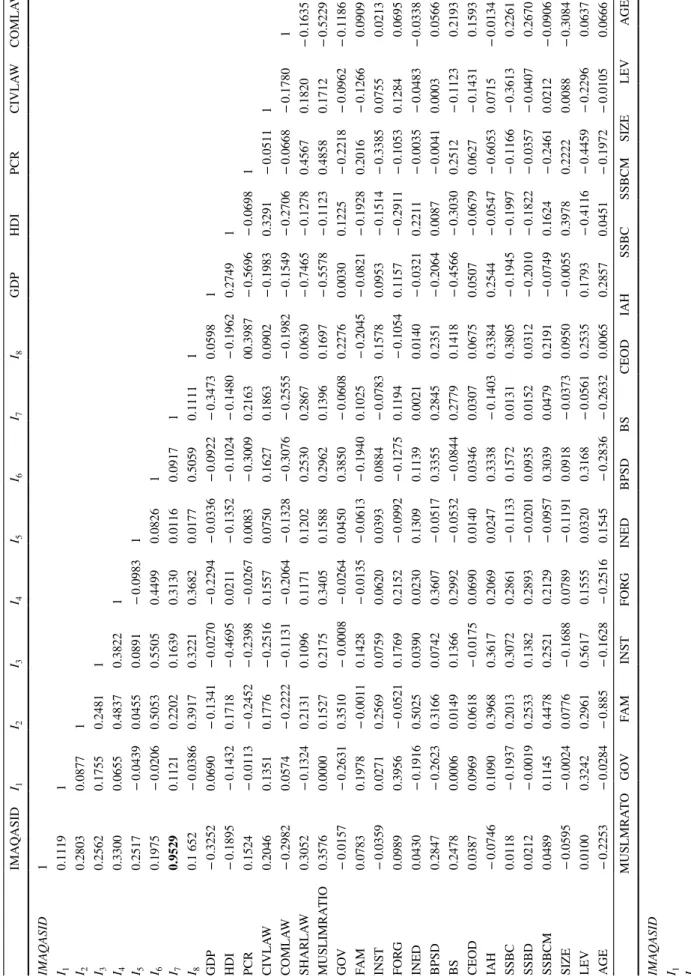
Furthermore, Gross Domestic Product’ (GDP, as obtained from the World Bank) and ‘Financial Development’ (FD obtained from IMF) variables are included to capture the role of economic growth and financial development, respec-tively, on the maqasid performance.
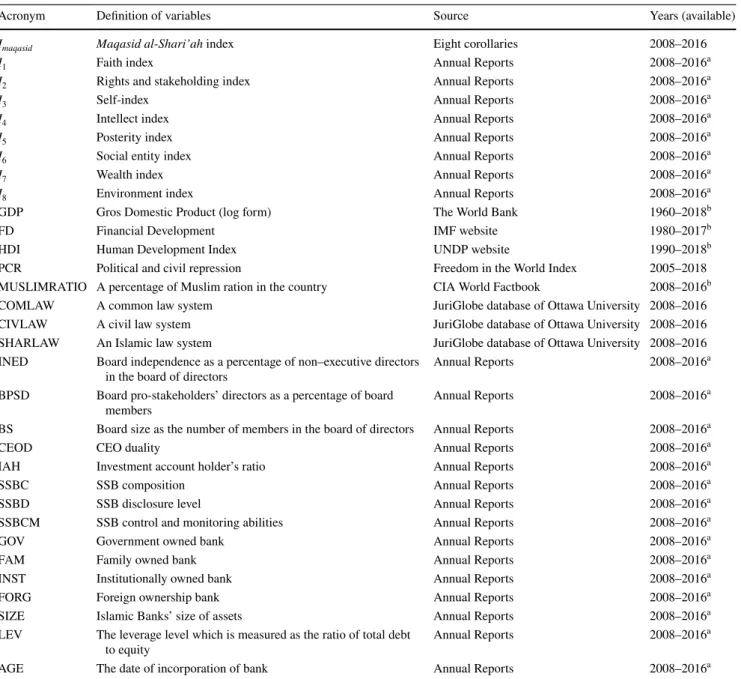
Table 2 presents the independent and dependent variables and the data sources.
1 HDI is used in this study as an independent variable, which could
be considered as a universal benchmark. While HDI has limitations in addition being the product of Eurocentric worldview, it remains one of the best proxies to reflect human development. The observed short-comings in HDI has not stopped researchers to use it as a variable for human development as there is a vast literature in development field utilising HDI as a benchmark. Dar (2004), for example discusses the shortcomings of HDI and suggests that it should be made more humane. In a similar manner, Aydin (2017) proposes an alternative Islamic HDI and compares its results with the conventional HDI for ten Muslim countries. However, despite being a novel attempt, his research again uses benchmarks generated within conventional sphere. Similarly, Biggeria et al. (2018) propose a more ‘sustainable’ HDI by integrating the environment and freedom. Search, hence, will continue to develop a better measure for capturing the human devel-opment in an integrated manner, while HDI will be a subject for many other empirical researches such as Mishra and Nathan (2018) and Ngoo and Tey (2019). As the latter study uses HDI as a predictor of life satisfaction. Since this study utilises HDI only as an independ-ent variable to capture the global debate, the philosophical nature of the discussion was avoided in the paper, as due to the ontological dif-ferences, a maqasid index is proposed and developed by this study to present a broader human well-being by integrating the other stake-holders’ interests.
Generating Data Through Disclosure Analysis
In order to test the hypotheses developed, the annual reports of 33 IBs from 12 countries over nine-year period covering 2008–2016 were utilised for disclosure analysis, with a total number of 297 annual reports. The sample selection was determined by the availability of the annual reports on the IBs’ websites with a preference for large and well-estab-lished IBs in terms of assets in each country. The choice of selecting 12 countries was motivated by the necessity to cover a wider range of countries with IB presence along with the aim of capturing the impact of different socio-political,
institutional and human development level contexts. The sample of IBs, with such characteristics as being listed or non-listed companies, their country of origin, as well as their total assets by the end of 2016, are presented in Table 3. Since the data generation is based on disclosure index and analysis, expanding the sample was not possible due to a very large maqasid index with 139 items.
As for the bank-specific, economic and political econ-omy variables, the Zawya, BankScope, IMF, the UNDP and World Bank databases were utilised.
Table 2 Variables and data sources (sample 2008–2016)
a Differ from bank to bank; bdiffer from country to country
Acronym Definition of variables Source Years (available)
Imaqasid Maqasid al-Shari’ah index Eight corollaries 2008–2016
I1 Faith index Annual Reports 2008–2016a
I2 Rights and stakeholding index Annual Reports 2008–2016a
I3 Self-index Annual Reports 2008–2016a
I4 Intellect index Annual Reports 2008–2016a
I5 Posterity index Annual Reports 2008–2016a
I6 Social entity index Annual Reports 2008–2016a
I7 Wealth index Annual Reports 2008–2016a
I8 Environment index Annual Reports 2008–2016a
GDP Gros Domestic Product (log form) The World Bank 1960–2018b
FD Financial Development IMF website 1980–2017b
HDI Human Development Index UNDP website 1990–2018b
PCR Political and civil repression Freedom in the World Index 2005–2018
MUSLIMRATIO A percentage of Muslim ration in the country CIA World Factbook 2008–2016b
COMLAW A common law system JuriGlobe database of Ottawa University 2008–2016
CIVLAW A civil law system JuriGlobe database of Ottawa University 2008–2016
SHARLAW An Islamic law system JuriGlobe database of Ottawa University 2008–2016
INED Board independence as a percentage of non–executive directors
in the board of directors Annual Reports 2008–2016
a
BPSD Board pro-stakeholders’ directors as a percentage of board
members Annual Reports 2008–2016
a
BS Board size as the number of members in the board of directors Annual Reports 2008–2016a
CEOD CEO duality Annual Reports 2008–2016a
IAH Investment account holder’s ratio Annual Reports 2008–2016a
SSBC SSB composition Annual Reports 2008–2016a
SSBD SSB disclosure level Annual Reports 2008–2016a
SSBCM SSB control and monitoring abilities Annual Reports 2008–2016a
GOV Government owned bank Annual Reports 2008–2016a
FAM Family owned bank Annual Reports 2008–2016a
INST Institutionally owned bank Annual Reports 2008–2016a
FORG Foreign ownership bank Annual Reports 2008–2016a
SIZE Islamic Banks’ size of assets Annual Reports 2008–2016a
LEV The leverage level which is measured as the ratio of total debt
to equity Annual Reports 2008–2016
a
Empirical Results of Assessing the Maqasid
Performance of Islamic Banks and Its
Determinants
This section presents the empirical results including the dis-closure performance assessment, the descriptive statistical analysis of the evaluations of maqasid performance at the individual bank and country levels as well as results of the panel data econometric analysis to locate the determinants of disclosure. Finally, in ensuring the reliability of the empiri-cal process, a robustness test was performed; this is also presented in this section.
The Maqasid Performance of the Sampled IBs The first set of analyses in this section examines the maqasid
performance of each of the sampled IBs, which is
sum-marised in Table 4.2As can be seen, Safwa Islamic Bank
(4.8488), Jordan Islamic Bank (2.473), Faisal Islamic Bank (Sudan) (1.8896) and PT Bank Syariah Mandiri (Indonesia) (1.8087), PT Bank BRI Syariah (Indonesia) (1.4398) are the
Table 3 Sampled Islamic banks.
Source: BankScope Database No Bank Country Listed/not listed Total assets (USD) 2016
1 Al-Rajhi Saudi Arabia Listed 90,589
2 KFH Kuwait Listed 53,893
3 DIB UAE Listed 47,643
4 QIB Qatar Listed 38,415
5 ADIB UAE Listed 33,298
6 Alinma Bank Saudi Arabia Listed 27,927
7 Masraf Al Rayan Qatar Listed 25,145
8 Al Baraka Bahrain Listed 23,425
9 Bank Rakyat Malaysia Unlisted 22,117
10 Bank Al Jazira Saudi Arabia Listed 17,685
11 Bank Islami MB Malaysia Unlisted 12,411
12 Ahli United Bank Kuwait Kuwait Listed 12,059
13 Al-Hilal UAE Unlisted 11,824
14 QIIB Qatar Listed 11,689
15 RHB Islamic Bank Berhad Malaysia Unlisted 10,725
16 IBBL Bangladesh Listed 10,138
17 BPM Berhad Malaysia Unlisted 5987
18 Bank Syariah Mandiri Indonesia Unlisted 5867
19 Jordan Islamic Bank Jordan Listed 5773
20 Bank Muamalat Malaysia Unlisted 5314
21 Al Salam Bank Bahrain Listed 4471
22 KFH Bahrain Bahrain Unlisted 4276
23 Meezan Bank Pakistan Listed 4226
24 PT Bank Muamalat Indonesia Indonesia Unlisted 4152
25 Export-Import Bank of Bangladesh Bangladesh Listed 3699
26 Bahrain Islamic Bank Bahrain Listed 2771
27 Faisal Islamic Bank (Sudan) Sudan Unlisted 2378
28 PT Bank BRI Syariah Indonesia Unlisted 2060
29 Al Rayan Bank Plc UK Delisted 1766
30 BankIslami Pakistan Ltd Pakistan Listed 1736
31 Safwa Islamic Bank Jordan Listed 1295
32 Al Baraka Sudan Sudan Listed 408
33 Al-Shamal Bank Sudan Listed 340
2 The full results of the evaluation of the IBs’ performances for each
component of the maqasid can be made available upon request as due to length issue they are not presented here. It should also be noted that since certain financial ratios have also been included as part of the MSI developed in this study, the scores are higher than 1; how-ever, normally disclosure analysis scores should be maximum 1.
Table 4 Ov er all Maqasid per for
mance of individual IBs
No Bank Countr y 2008 2009 2010 2011 2012 2013 2014 2015 2016 Av er ag e % Chang e 2008–2016 1 Safw a Islamic Bank Jor dan N/A N/A − 0.0631 1.8985 5.4685 6.4589 6.7160 6.7261 6.7370 4.8488 10,777 2 Jor
dan Islamic Bank
Jor dan 2.2634 2.2333 2.1676 2.8469 2.9789 2.3174 2.4988 2.2193 2.3208 2.4273 − 3 3
Faisal Islamic Bank (Sudan)
Sudan 1.6362 1.8706 1.9897 2.2131 1.9114 1.8472 1.8484 1.8518 1.8382 1.8896 − 14 4 PT Bank BRI Sy ar iah Indonesia N/A N/A N/A 4.5665 0.8211 1.2917 1.3595 1.3873 1.4262 1.8087 69 5 PT Bank Sy ar iah Mandir i Indonesia 1.3503 1.6666 N/A 1.4149 1.1830 1.2924 1.6394 1.4279 1.5440 1.4398 − 4 6
PT Bank Muamalat Indonesia
Indonesia N/A 1.6616 1.2023 1.2863 1.2948 1.1401 1.0975 1.1208 1.1505 1.2442 31 7 Meezan Bank Pakis tan 0.8519 0.9090 1.0327 1.3298 1.2603 1.3203 1.1687 1.5302 1.3117 1.1905 − 54 8 Bank R aky at Mala ysia 1.1160 0.9924 1.2951 1.3593 1.1630 1.1700 1.1837 1.2250 1.1846 1.1876 − 6 9 Al-R ajhi Saudi Ar abia N/A 1.2579 1.1752 1.1748 1.1565 1.0443 1.1044 1.0763 1.1568 1.1432 8 10 Bank Islami MB Mala ysia 1.4565 0.9163 1.1325 1.0438 1.0945 1.1058 1.0676 1.0614 1.1300 1.1120 22 11 Expor t-Im por t Bank of Bang ladesh Bang ladesh 1.1612 1.1649 1.3587 0.9499 0.9850 0.9240 1.0380 1.0224 0.9037 1.0564 22 12 IBBL Bang ladesh 1.0145 0.9697 1.1567 1.0830 1.0790 1.0410 1.0375 1.0328 1.0429 1.0507 − 6 13 Al Bar ak a Bahr ain 0.8540 0.7614 0.7925 0.8207 0.9881 1.3579 1.3207 1.3790 1.3928 1.0741 − 63 14 Al Bar ak a Sudan Sudan 0.9456 0.7619 0.8534 0.8887 0.8537 1.2190 1.0216 1.0902 1.2724 0.9896 − 35 15 Masr af Al R ay an Qat ar N/A 0.9504 1.0713 0.9694 0.9173 0.9604 0.9791 0.9658 1.0090 0.9778 − 6 16 QIB Qat ar 1.4553 1.0099 0.9198 0.8647 0.7998 0.8199 0.8269 0.7962 0.8449 0.9263 − 42 17 Alinma Bank Saudi Ar abia N/A 0.9198 1.1509 0.6128 0.5563 0.6373 0.9257 1.6697 1.1021 0.9468 − 20 18 QIB Bank P embangunan Mala ysia Qat ar N/A 0.8617 0.8781 0.8622 0.8215 0.8421 0.8489 0.8682 0.8965 0.8599 − 4 19 ADIB UA E 0.9015 0.7545 0.8472 0.8750 0.8070 0.8229 0.8356 0.8558 0.9457 0.8494 − 5 20 DIB UA E N/A N/A N/A 0.7645 0.8204 0.8172 0.8142 0.8332 0.8279 0.8129 − 8 21 Al-Hilal UA E N/A N/A 0.6796 0.7008 0.7375 0.8449 0.9047 0.8981 0.8990 0.8092 − 32 22 Ahli U nited Bank K uw ait K uw ait N/A 0.6131 0.6827 0.7242 0.8610 0.8926 0.8662 0.9061 0.9142 0.8075 − 49 23 Al Salam Bank Bahr ain 0.9577 0.6982 0.5836 1.4264 0.5405 0.5187 1.3856 0.5551 0.5433 0.8010 43 24 Bank Al Jazir a Saudi Ar abia 0.5768 0.8971 0.8797 0.6464 0.7643 0.8129 0.7911 0.8316 0.8313 0.7812 − 44 25 Bank Muamalat Mala ysia 0.5986 N/A 0.6311 0.6172 0.8741 0.7352 0.7887 0.8293 0.8749 0.7436 − 46 26 BPM Ber had Mala ysia N/A N/A N/A 0.7611 0.6240 0.6772 0.7358 0.7450 0.7002 0.7072 8 27 KFH K uw ait N/A 0.4790 0.5988 0.6053 0.7141 0.7798 0.7972 0.7913 0.8058 0.6964 − 68 28
RHB Islamic Bank Ber
had Mala ysia 0.5776 0.6567 0.5783 0.7343 0.7346 0.6765 0.7478 0.7612 0.7768 0.6937 − 34 29 BankIslami P akis tan Ltd Pakis tan N/A 0.2379 − 0.0568 0.7704 0.7515 0.7968 0.8520 0.8767 0.9224 0.6438 − 288 30 Al-Shamal Bank Sudan 0.5693 0.5642 0.7709 0.6030 − 0.2739 0.5163 0.4938 0.4942 1.3573 0.5661 − 138 31 KFH Bahr ain Bahr ain 0.8841 0.5346 0.4370 0.4878 0.4802 0.4632 0.4698 0.5013 0.4610 0.5243 48 32 Bahr
ain Islamic Bank
Bahr ain 0.8132 − 0.1742 − 0.9045 − 0.3452 − 1.1175 0.7094 0.8338 0.7522 − 0.2615 0.0339 132 33 Al R ay an Bank UK UK − 0.7450 − 1.6393 − 1.1219 − 1.2882 − 1.1821 − 0.8006 − 0.6936 − 0.5630 − 0.2063 − 0.9155 72
five best banks with the highest scores for their maqasid per-formance, whereas BankIslami Pakistan Limited (0.6438), Al-Shamal Bank (Bahrain) (0.5661), KFH Bahrain (0.5243), Bahrain Islamic Bank (0.0329) and Al Rayan Bank UK (− 0.9155) demonstrated the lowest scores. Overall, except for a high dispersion in safeguarding the ‘wealth’ maqasid
corollary, no best practices were identified in the perfor-mance of IBs within other maqasid corollaries, which sup-ports the findings of previous studies including, among oth-ers, Hassan (2012), Belal et al. (2014), Haniffa and Hudaib (2007) and others. Only a few IBs, which are in the top five
maqasid performers, scored higher than half of the score in the maqasid indices.
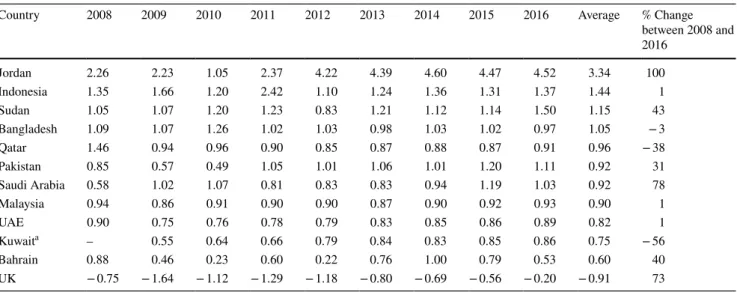
As regards to country level performance, as can be seen in Table 5, Jordan scored the highest average maqasid per-formance index score of 3.34, followed by Indonesia (1.44) and Sudan (1.15). The three countries with a low IB maqasid
performance index are Kuwait (0.75), Bahrain (0.60) and the
United Kingdom (− 0.91). Such a low maqasid performance
from IBs in these two rich GCC countries supports criticism of the IBs, namely, that they are ‘delivering a new capitalism to the Muslim world’ which is oriented towards financializa-tion rather than focusing on their social role (Asutay 2012, p. 108).
In addition, the performance of IBs per each maqasid
corollary except I7 (wealth), as IBs are inherently oriented towards financial performance, are presented in Fig. 2. As can be seen, mostly IBs in Indonesia, Bangladesh, Jordan and Pakistan are oriented towards safeguarding the ‘self’, ‘posterity’ and ‘social entity’ maqasid corollaries, which indicates their more active social and developmentalist role in these countries as opposed to the IBs in the GCC coun-tries (Bahrain, Qatar, and Kuwait) and the UK. These results
are consistent with Aksak and Asutay’s (2015) findings
regarding the poor role of IBs in the economic and social development of the GCC countries.
Determinants of the Maqasid Performance of IBs: Econometric Analysis
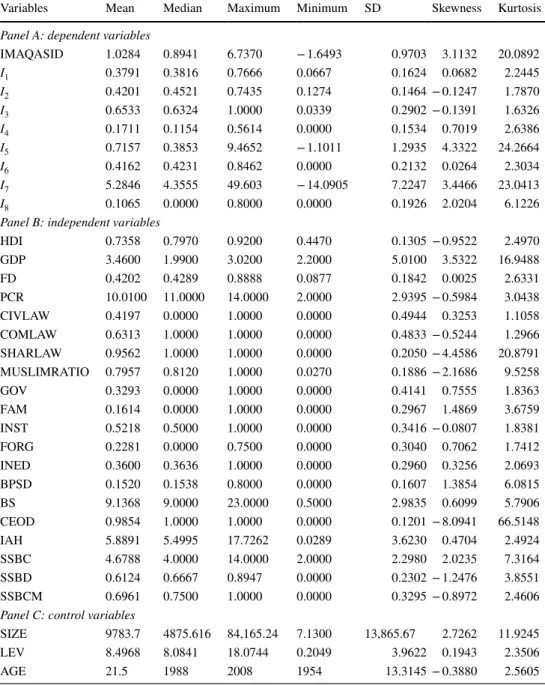
Table 6 presents the summary of the descriptive statistics. As can be seen, the mean of the overall Imaqasid index is approximately 1.0284 while the range of this index is from a minimum of − 1.6493 to a maximum of 6.7370. Such wide dispersion in the Imaqasid index is due to the wide spread
of the I7 (wealth) index component (from − 14.0905 to
49.6030), which indicates that some IBs overperformed in financial terms, while others faced significant financial dif-ficulties during the 2008–2016 period. Although the mean of the I7 (wealth) index is approximately 5.2846, the mean of
the Imaqasid index is significantly lower as a result of the low
scores in the other maqasid performance indices as compo-nents of the Imaqasid index. Such indices as I8 (ecology), I4
(intellect), and I6 (social entity) scored 0.1065, 0.1711 and 0.4162, respectively, as these indices have minimum zero (0) scores, which indicates that some IBs did not undertake any actions in these maqasid corollaries during 2008–2016. Furthermore, the most surprising finding is the low I1 (faith) index mean score (0.3791), which is in contrast to the expectation that IBs are niche financial institutions that are expected to serve the financial needs of people according to Islamic expectations. Thus, low Imaqasid index is an indication of the low scores prevailing throughout the sample banks and periods as well as dimensions.
Table 5 Overall Maqasid performance of IBs at country level
a Average and change were calculated for 2009–2013
Country 2008 2009 2010 2011 2012 2013 2014 2015 2016 Average % Change
between 2008 and 2016 Jordan 2.26 2.23 1.05 2.37 4.22 4.39 4.60 4.47 4.52 3.34 100 Indonesia 1.35 1.66 1.20 2.42 1.10 1.24 1.36 1.31 1.37 1.44 1 Sudan 1.05 1.07 1.20 1.23 0.83 1.21 1.12 1.14 1.50 1.15 43 Bangladesh 1.09 1.07 1.26 1.02 1.03 0.98 1.03 1.02 0.97 1.05 − 3 Qatar 1.46 0.94 0.96 0.90 0.85 0.87 0.88 0.87 0.91 0.96 − 38 Pakistan 0.85 0.57 0.49 1.05 1.01 1.06 1.01 1.20 1.11 0.92 31 Saudi Arabia 0.58 1.02 1.07 0.81 0.83 0.83 0.94 1.19 1.03 0.92 78 Malaysia 0.94 0.86 0.91 0.90 0.90 0.87 0.90 0.92 0.93 0.90 1 UAE 0.90 0.75 0.76 0.78 0.79 0.83 0.85 0.86 0.89 0.82 1 Kuwaita – 0.55 0.64 0.66 0.79 0.84 0.83 0.85 0.86 0.75 − 56 Bahrain 0.88 0.46 0.23 0.60 0.22 0.76 1.00 0.79 0.53 0.60 40 UK − 0.75 − 1.64 − 1.12 − 1.29 − 1.18 − 0.80 − 0.69 − 0.56 − 0.20 − 0.91 73