Succinct Data Structures:
From Theory to Practice
Simon Gog
Computing and Information Systems The University of Melbourne
...and Variety
Picture source IBM
This talk addresses two Vs
Variety: Index unstructured data Volume: Index larger data sets Velocity is not directly addressed
1 The Inverted Index: a success story
2 Suffix sorted based indexes: a tour de force
3 More virtues of the Wavelet Tree
4 Various Structures
5 SDSL: A toolbox of succinct structures
Inverted Indexes for a collection of documentsC used for web indexing
practical in domains with well-definedvocabulary space is usually 5−10%ofC(without positions) space is about 50%if positions are included
can not be used to reconstruct original text (parsing, stemming, stopping,...)
original text has to be stored separately to allow snippet extraction
Inverted Index
Documents (already normalized) d0:is big data really big
d1:is it big in science d2:big data is big
Inverted Lists big : {(0,1),(0,4),(1,2),(2,0),(2,3)} data : {(0,2),(2,1)} in : {(1,3)} is : {(0,0),(1,0),(2,2)} really : {(0,3)} science : {(1,4)}
Exact search using Inverted Index based systems (2)
Advantages:
Sequential locality in many operations (fast!) Index can be stored on disk
Good compression for natural language text Disadvantages:
Decision, what is searchable, made at parsing time No fast calculation of phrase queries
No alphabet⇒not applicable Adapt data to index structure
Search quality seems to be enough for casual web search. Scientific tasks require high quality search.
Outline
1 The Inverted Index: a success story
2 Suffix sorted based indexes: a tour de force
3 More virtues of the Wavelet Tree
4 Various Structures
5 SDSL: A toolbox of succinct structures
Suffix sorted based indexes for a textT sort allnsuffixes ofT
works also in domains with no well-defined vocabulary used in Bioinformatics
space
uncompressed:5×to 50×size ofT
compressed:n×Hk(T)≤bzip’dT
index structure adapts to data
can be used to reconstruct original text (Self-Index) Not cover in this talk: LZ compressed indexes (works well for highly repetitive data)
Hk
of
Pizza&Chili
corpus texts (200MB versions)
Hk(T)in bitscontexts/|T|in percent
k DBLP.XML DNA ENGLISH PROTEINS
0 5.26 0.0 1.97 0.0 4.53 0.0 4.20 0.0 1 3.48 0.0 1.93 0.0 3.62 0.0 4.18 0.0 2 2.17 0.0 1.92 0.0 2.95 0.0 4.16 0.0 3 1.43 0.1 1.92 0.0 2.42 0.0 4.07 0.0 4 1.05 0.4 1.91 0.0 2.06 0.3 3.83 0.1 5 0.82 1.3 1.90 0.0 1.84 1.0 3.16 1.7 6 0.70 2.7 1.88 0.0 1.67 2.7 1.50 17.4
siz
e
Self-Index Operations
LetPbe a character pattern of lengthm=|P|.
Operations:
count(P) How many times doesP occur inT?
locate(P) List all count(P) positions whereP occurs.
extract(i,j) Extract textT[i..j]from the index. Operations are efficient (likeO(mlogσ),O(mlogn))
15 $ 7 dumulmum$ 11 m$ 3 ndumulmum$ lmu 14 $ 9 m$ 1 ndumulmum$ lmu 12 m$ 4 ndumulmum$ u m 6 ndumulmum$ 10 m$ 2 ndumulmum$ lmu 13 $ 8 m$ 0 ndumulmum$ ulmu m 5 ndumulmum$ u n=16 Σ ={$,d,l,m,n,u} σ =6 O(n)construction (Weiner,1973) Problem: Structure size: ≥20× |T|
Suffix Array (SA) of T=
umulmundumulmum$
i 0 1 2 3 4 5 6 7 8 9 10 11 12 13 14 15 0 1 2 3 4 5 6 7 8 9 10 11 12 13 14 15 T umulmundumulmum$ mulmundumulmum$ ulmundumulmum$ lmundumulmum$ mundumulmum$ undumulmum$ ndumulmum$ dumulmum$ umulmum$ mulmum$ ulmum$ lmum$ mum$ um$ m$ $i 0 1 2 3 4 5 6 7 8 9 10 11 12 13 14 15 SA 15 7 11 3 14 9 1 12 4 6 10 2 13 8 0 5 T $ dumulmum$ lmum$ lmundumulmum$ m$ mulmum$ mulmundumulmum$ mum$ mundumulmum$ ndumulmum$ ulmum$ ulmundumulmum$ um$ umulmum$ umulmundumulmum$ undumulmum$ Size:≥5× |T|
Binary search to answer
count(|P|)
Match pattern from left to right: e.g.mum
Burrows-Wheeler Transform (BWT) of T
i 0 1 2 3 4 5 6 7 8 9 10 11 12 13 14 15 SA 15 7 11 3 14 9 1 12 4 6 10 2 13 8 0 5 TBWT m n u u u u u l l u m m m d $ m T $ dumulmum$ lmum$ lmundumulmum$ m$ mulmum$ mulmundumulmum$ mum$ mundumulmum$ ndumulmum$ ulmum$ ulmundumulmum$ um$ umulmum$ umulmundumulmum$ undumulmum$ Well-compressible Newsearchalgorithm (Ferragina & Manzini, 2000): Backward search Does not require SA.0 a $ 1 r a$ 2 r abarbara$ 3 d abrabarbara$ 4 $ abracadabrabarbara$ 5 r acadabrabarbara$ 6 c adabrabarbara$ 7 b ara$ 8 b arbara$ 9 r bara$ 10 a barbara$ 11 a brabarbara$ 12 a bracadabrabarbara$ 13 a cadabrabarbara$ 14 a dabrabarbara$ 15 a ra$ 16 b rabarbara$ 17 b racadabrabarbara$
ArrayCcontains start of each character interval:
$ a b c d r r+1
0 1 9 13 14 15 19
rank(i,c) =# occurences of c in TBWT[0,i).
Backward Search
i TBWT T 0 a $abracadabrabarbara 1 r a$ 2 r abarbara$ 3 d abrabarbara$ 4 $ abracadabrabarbara$ 5 r acadabrabarbara$ 6 c adabrabarbara$ 7 b ara$ 8 b arbara$ 9 r bara$ 10 a barbara$ 11 a brabarbara$ 12 a bracadabrabarbara$ 13 a cadabrabarbara$ 14 a dabrabarbara$ 15 a ra$ 16 b rabarbara$ 17 b racadabrabarbara$ 18 a rbara$ C $ a b c d r 0 1 9 13 14 15Now search backwards for bar.
Initial interval:
[sp0,ep0] = [0..n−1] Determine interval forr: sp1=C[r]+rank(sp0,r) ep1=C[r]+rank(ep0+1,r)−1
0 a $abracadabrabarbara 1 r a$ 2 r abarbara$ 3 d abrabarbara$ 4 $ abracadabrabarbara$ 5 r acadabrabarbara$ 6 c adabrabarbara$ 7 b ara$ 8 b arbara$ 9 r bara$ 10 a barbara$ 11 a brabarbara$ 12 a bracadabrabarbara$ 13 a cadabrabarbara$ 14 a dabrabarbara$ 15 a ra$ 16 b rabarbara$ 17 b racadabrabarbara$ C $ a b c d r 0 1 9 13 14 15
Now search backwards for bar.
Initial interval:
[sp0,ep0] = [0..n−1] Determine interval forr: sp1=15+rank(0,r) ep1=15+rank(19,r)
Backward Search
i TBWT T 0 a $abracadabrabarbara 1 r a$ 2 r abarbara$ 3 d abrabarbara$ 4 $ abracadabrabarbara$ 5 r acadabrabarbara$ 6 c adabrabarbara$ 7 b ara$ 8 b arbara$ 9 r bara$ 10 a barbara$ 11 a brabarbara$ 12 a bracadabrabarbara$ 13 a cadabrabarbara$ 14 a dabrabarbara$ 15 a ra$ 16 b rabarbara$ 17 b racadabrabarbara$ 18 a rbara$ C $ a b c d r 0 1 9 13 14 15Now search backwards for bar.
Initial interval:
[sp0,ep0] = [0..n−1] Determine interval forr: sp1=15+0
0 a $abracadabrabarbara 1 r a$ 2 r abarbara$ 3 d abrabarbara$ 4 $ abracadabrabarbara$ 5 r acadabrabarbara$ 6 c adabrabarbara$ 7 b ara$ 8 b arbara$ 9 r bara$ 10 a barbara$ 11 a brabarbara$ 12 a bracadabrabarbara$ 13 a cadabrabarbara$ 14 a dabrabarbara$ 15 a ra$ 16 b rabarbara$ 17 b racadabrabarbara$ C $ a b c d r 0 1 9 13 14 15
Now search backwards for bar.
Initial interval:
[sp0,ep0] = [0..n−1] Determine interval forr: sp1=15+0=15 ep1=15+4−1=18
Backward Search
i TBWT T 0 a $ 1 r a$ 2 r abarbara$ 3 d abrabarbara$ 4 $ abracadabrabarbara$ 5 r acadabrabarbara$ 6 c adabrabarbara$ 7 b ara$ 8 b arbara$ 9 r bara$ 10 a barbara$ 11 a brabarbara$ 12 a bracadabrabarbara$ 13 a cadabrabarbara$ 14 a dabrabarbara$ 15 a ra$ 16 b rabarbara$ 17 b racadabrabarbara$ 18 a rbara$ C $ a b c d r 0 1 9 13 14 15Now search backwards for bar.
Interval: [sp1,ep1] = [15..18] Determine interval forar: sp2=C[a]+rank(sp1,a) ep2=C[a]+rank(ep1+1,a)−1
0 a $ 1 r a$ 2 r abarbara$ 3 d abrabarbara$ 4 $ abracadabrabarbara$ 5 r acadabrabarbara$ 6 c adabrabarbara$ 7 b ara$ 8 b arbara$ 9 r bara$ 10 a barbara$ 11 a brabarbara$ 12 a bracadabrabarbara$ 13 a cadabrabarbara$ 14 a dabrabarbara$ 15 a ra$ 16 b rabarbara$ 17 b racadabrabarbara$ C $ a b c d r 0 1 9 13 14 15
Now search backwards for bar.
Interval: [sp1,ep1] = [15..18] Determine interval forar: sp2=1+rank(15,a) ep2=1+rank(ep1,a)
Backward Search
i TBWT T 0 a $ 1 r a$ 2 r abarbara$ 3 d abrabarbara$ 4 $ abracadabrabarbara$ 5 r acadabrabarbara$ 6 c adabrabarbara$ 7 b ara$ 8 b arbara$ 9 r bara$ 10 a barbara$ 11 a brabarbara$ 12 a bracadabrabarbara$ 13 a cadabrabarbara$ 14 a dabrabarbara$ 15 a ra$ 16 b rabarbara$ 17 b racadabrabarbara$ 18 a rbara$ C $ a b c d r 0 1 9 13 14 15Now search backwards for bar.
Interval: [sp1,ep1] = [15..18] Determine interval forar: sp2=1+rank(15,a) ep2=1+rank(ep1,a)
0 a $ 1 r a$ 2 r abarbara$ 3 d abrabarbara$ 4 $ abracadabrabarbara$ 5 r acadabrabarbara$ 6 c adabrabarbara$ 7 b ara$ 8 b arbara$ 9 r bara$ 10 a barbara$ 11 a brabarbara$ 12 a bracadabrabarbara$ 13 a cadabrabarbara$ 14 a dabrabarbara$ 15 a ra$ 16 b rabarbara$ 17 b racadabrabarbara$ C $ a b c d r 0 1 9 13 14 15
Now search backwards for bar.
Interval: [sp1,ep1] = [15..18] Determine interval forar: sp2=1+6
Backward Search
i TBWT T 0 a $ 1 r a$ 2 r abarbara$ 3 d abrabarbara$ 4 $ abracadabrabarbara$ 5 r acadabrabarbara$ 6 c adabrabarbara$ 7 b ara$ 8 b arbara$ 9 r bara$ 10 a barbara$ 11 a brabarbara$ 12 a bracadabrabarbara$ 13 a cadabrabarbara$ 14 a dabrabarbara$ 15 a ra$ 16 b rabarbara$ 17 b racadabrabarbara$ 18 a rbara$ C $ a b c d r 0 1 9 13 14 15Now search backwards for bar.
Interval: [sp1,ep1] = [15..18] Determine interval forar: sp2=1+6=7
0 a $ 1 r a$ 2 r abarbara$ 3 d abrabarbara$ 4 $ abracadabrabarbara$ 5 r acadabrabarbara$ 6 c adabrabarbara$ 7 b ara$ 8 b arbara$ 9 r bara$ 10 a barbara$ 11 a brabarbara$ 12 a bracadabrabarbara$ 13 a cadabrabarbara$ 14 a dabrabarbara$ 15 a ra$ 16 b rabarbara$ 17 b racadabrabarbara$ C $ a b c d r 0 1 9 13 14 15
Now search backwards for bar.
Interval: [sp2,ep2] = [7..8] Determine interval forbar: sp3=C[b]+rank(sp2,b) ep3=
Backward Search
i TBWT T 0 a $ 1 r a$ 2 r abarbara$ 3 d abrabarbara$ 4 $ abracadabrabarbara$ 5 r acadabrabarbara$ 6 c adabrabarbara$ 7 b ara$ 8 b arbara$ 9 r bara$ 10 a barbara$ 11 a brabarbara$ 12 a bracadabrabarbara$ 13 a cadabrabarbara$ 14 a dabrabarbara$ 15 a ra$ 16 b rabarbara$ 17 b racadabrabarbara$ 18 a rbara$ C $ a b c d r 0 1 9 13 14 15Now search backwards for bar.
Interval: [sp2,ep2] = [7..8] Determine interval forbar: sp3=9+rank(7,b) ep3=9+rank(ep1,b)
0 a $ 1 r a$ 2 r abarbara$ 3 d abrabarbara$ 4 $ abracadabrabarbara$ 5 r acadabrabarbara$ 6 c adabrabarbara$ 7 b ara$ 8 b arbara$ 9 r bara$ 10 a barbara$ 11 a brabarbara$ 12 a bracadabrabarbara$ 13 a cadabrabarbara$ 14 a dabrabarbara$ 15 a ra$ 16 b rabarbara$ 17 b racadabrabarbara$ C $ a b c d r 0 1 9 13 14 15
Now search backwards for bar.
Interval: [sp2,ep2] = [7..8] Determine interval forbar: sp3=9+rank(7,b) ep3=9+rank(ep1,b)
Backward Search
i TBWT T 0 a $ 1 r a$ 2 r abarbara$ 3 d abrabarbara$ 4 $ abracadabrabarbara$ 5 r acadabrabarbara$ 6 c adabrabarbara$ 7 b ara$ 8 b arbara$ 9 r bara$ 10 a barbara$ 11 a brabarbara$ 12 a bracadabrabarbara$ 13 a cadabrabarbara$ 14 a dabrabarbara$ 15 a ra$ 16 b rabarbara$ 17 b racadabrabarbara$ 18 a rbara$ C $ a b c d r 0 1 9 13 14 15Now search backwards for bar.
Interval: [sp2,ep2] = [7..8] Determine interval forbar: sp3=9+0
0 a $ 1 r a$ 2 r abarbara$ 3 d abrabarbara$ 4 $ abracadabrabarbara$ 5 r acadabrabarbara$ 6 c adabrabarbara$ 7 b ara$ 8 b arbara$ 9 r bara$ 10 a barbara$ 11 a brabarbara$ 12 a bracadabrabarbara$ 13 a cadabrabarbara$ 14 a dabrabarbara$ 15 a ra$ 16 b rabarbara$ 17 b racadabrabarbara$ C $ a b c d r 0 1 9 13 14 15
Now search backwards for bar.
Interval: [sp2,ep2] = [7..8] Determine interval forbar: sp3=9+0=9
Conclusion Backward Search
String matching onT only requires
a structure which can answer rank queries on TBWT the C array
TextT itself is not needed.
We search a data structure represents TBWTcompressed answers rank quickly
LetX be a sequence of lengthnover alphabetΣof sizeσ.
Efficient Wavelet Tree operations:
access(i) RecoverX[i].
rank(i,c) How many times doesc occur inX[0,i)?
select(i,c) Location of thei-th count(P) positions whereP occurs.
WT operation
rank
arrd$rcbbraaaaaabba 0111011001000000000 a$bbaaaaaabba 0011000000110 a$aaaaaaa 101111111 $ 0 aaaaaaaa 1 0 bbbb 1 0 rrdrcr 110101 dc 10 c 0 d 1 0 rrrr 1 1Only the bitvectors (dark gray) is stored code(a) = 001
Reduce WT rank on bitvector rank
rank(11,a,WT) =rank(rank(rank(11,0,b) =5,0,b0) = 3,1,b00) =2
arrd$rcbbraaaaaabba 0111011001000000000 a$bbaaaaaabba 0011000000110 a$aaaaaaa 101111111 $ 0 aaaaaaaa 1 0 bbbb 1 0 rrdrcr 110101 dc 10 c 0 d 1 0 rrrr 1 1
Only the bitvectors (dark gray) is stored code(a) = 001
Reduce WT rank on bitvector rank
rank(11,a,WT) =rank(rank(rank(11,0,b) =5,0,b0) = 3,1,b00) =2
WT operation
rank
arrd$rcbbraaaaaabba 0111011001000000000 a$bbaaaaaabba 0011000000110 a$aaaaaaa 101111111 $ 0 aaaaaaaa 1 0 bbbb 1 0 rrdrcr 110101 dc 10 c 0 d 1 0 rrrr 1 1Only the bitvectors (dark gray) is stored code(a) = 001
Reduce WT rank on bitvector rank
rank(11,a,WT) =rank(rank(rank(11,0,b) =5,0,b0) = 3,1,b00) =2
arrd$rcbbraaaaaabba 0111011001000000000 a$bbaaaaaabba 0011000000110 a$aaaaaaa 101111111 $ 0 aaaaaaaa 1 0 bbbb 1 0 rrdrcr 110101 dc 10 c 0 d 1 0 rrrr 1 1
Only the bitvectors (dark gray) is stored code(a) = 001
Reduce WT rank on bitvector rank
rank(11,a,WT) =rank(rank(rank(11,0,b) =5,0,b0) = 3,1,b00) =2
Rank on bitvectors
n+o(n)bit space and constant time solution
Jacobson: Space-efficient Static Trees and Graphs, FOCS 1989. Two level schema:
Divide bitvector in superblocks of size log2nand blocks of logn/2.
Store absolute prefix sums for superblocks. Relative perfix sums for blocks.
Four Russian-Trick (Lookup-Table counting set bits) for blocks.
Practice today
Since 2008 CPUs supportpopcountoperation⇒no need for Lookup-Tables.
arrd$rcbbraaaaaabba 1000000000111111001 rrd$rcbbrbb 11001000100 d$cbbbb 0001111 d$c 100 $c 01 $ 0 c 1 0 d 1 0 bbbb 1 0 rrrr 1 0 aaaaaaaa 1 Char c codeword(c) $ 00000 a 1 b 001 c 00001 d 0001 r 01
Other WT parametrizations
Shape: balanced, Huffman-shape, Hu-Tucker-shape, Wavelet Matrix
for large alphabets (decreasesO(σlogn)toO(logσlogn)) run-length compressed versions
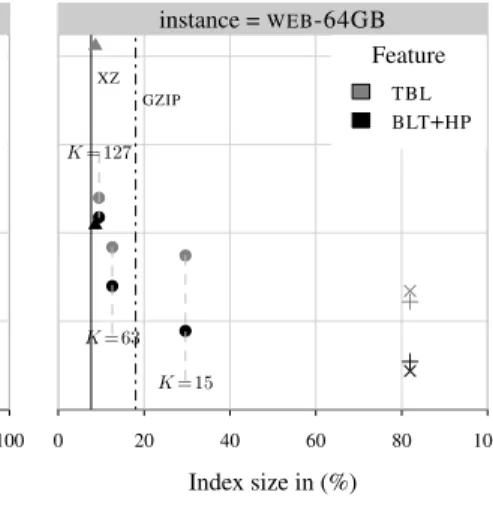
0 20 40 60 80 100 0 2 4 6 8 Index size in (%) Time per character in ( µs ) XZ GZIP K= 15 K= 63 K= 127 Index FM-HF-R3K FM-RLMN FM-HF-V FM-HF-1L instance =WEB-64MB Index size in (%) 0 20 40 60 80 100 XZ GZIP K= 15 K= 63 K= 127 Feature TBL BLT+HP instance =WEB-64GB
Figure 10. Count time and space of our index implementations on input instances of different size with compression effectiveness baselines using standard compression utilitiesXZandGZIPwith option--best. FM-RLMN profits from each feature. Especially replacing the lookup table version forpopcnt
andselect64with more efficientBLTversions discussed above. Since FM-RLMN is a rather complex structure the differentrankandselectsub data structures “compete” for cache. As expected the
FM-index based onRANK-1L is slower than FM-HF-V when no optimization is used but slightly faster whenBLTandHPare activated. This reflects the outcome of the experiments of the basicrankdata structures used in both indexes shown in Figure 3.
Finally we discuss the time-space trade-offs of the different index types in Figure 10. As discussed above, optimizationsBLTand hugepages only affects the runtime performance on larger data sets (right). The uncompressed representations FM-HF-V and FM-HF-1L, and FM-RLMN are affected the most by the features. The FM-indexes based onH0compressed bitvectors are also affected. Interestingly, the indexes forK= 63and128achieve better compression then ourgzip --best baseline. The FM-index usingRANK-R3KandK= 128is only5%larger than thexzcompressed representation of the test input. The index forK= 256is even smaller but is not shown in Figure 10 due to the increased runtime as shown in Table IX.
Overall our new data structures, improvements and optimized implementations enable FM-indexes that are faster than the state of the art (usingRANK-1L) or smaller than state of the art indexes (usingRANK-R3KwithK= 128,255).
7. CONCLUSION
We proposed a simple, cache-friendly rank data structure, a practical select data structure for uncompressed bitvectors and an improved implementation of compressed bitvector representations. We explore the behavior of rank and select data structures for binary and general sequences for varying data sizes, implementations, instruction sets and operating system features. We show that using the built-inpopcnt and our optimized select64 operation significantly improve the performance of classic rank and select data structures. We further discuss the effect of larger page sizes on the performance of succinct data structures. We demonstrate that these improvements propagate directly to more complex succinct data structures such as FM-indexes. Using larger page sizes has not yet been explored in literature in the context of succinct data structures and
Copyright c 0000 John Wiley & Sons, Ltd. Softw. Pract. Exper.(0000)
Prepared usingspeauth.cls DOI: 10.1002/spe
Experimental results: construction
Resource diagram for the construction of a Self-Index for 200MB of English text.
1 The Inverted Index: a success story
2 Suffix sorted based indexes: a tour de force
3 More virtues of the Wavelet Tree
4 Various Structures
5 SDSL: A toolbox of succinct structures
More WT operations: Query point grids
σ
n
Operations:
count(x0,x1,y0,y1) # points in rectangle[x0,x1][y0,y1].
CSA
ω2 0 ω1 0 ω3 0 ω3 0 # 1 ω1 0 ω1 0 ω4 0 ω1 0 # 1 ω1 0 ω4 0 ω3 0 ω1 0 # 1 ω5 0 ω5 0 # 1 T = b= 0 1 2 3 4 5 6 7 8 9 10 11 12 13 14 15 16 17 4 0 9 1 14 2 17 3 8 1 13 2 5 1 6 1 1 0 10 2 12 2 0 0 3 0 2 0 7 1 11 2 16 3 15 3 D= position=ω
1
WT application: Top-
k
document retrieval
Represent document arrayDas wavelet tree
First explore nodes, which contain the maximal interval Example: Search top-2 documents (frequency based ranking)
012312110220001233 001101000110000111 0111100001 0111100001 00000 0 11111 1 0 23222233 01000011 22222 0 333 1 1
Represent document arrayDas wavelet tree
First explore nodes, which contain the maximal interval Example: Search top-2 documents (frequency based ranking)
012312110220001233 001101000110000111 0111100001 0111100001 00000 0 11111 1 0 23222233 01000011 22222 0 333 1 1
WT application: Top-
k
document retrieval
Represent document arrayDas wavelet tree
First explore nodes, which contain the maximal interval Example: Search top-2 documents (frequency based ranking)
012312110220001233 001101000110000111 0111100001 0111100001 00000 0 11111 1 0 23222233 01000011 22222 0 333 1 1
Represent document arrayDas wavelet tree
First explore nodes, which contain the maximal interval Example: Search top-2 documents (frequency based ranking)
012312110220001233 001101000110000111 0111100001 0111100001 00000 0 11111 1 0 23222233 01000011 22222 0 333 1 1
WT application: Top-
k
document retrieval
Represent document arrayDas wavelet tree
First explore nodes, which contain the maximal interval Example: Search top-2 documents (frequency based ranking)
012312110220001233 001101000110000111 0111100001 0111100001 00000 0 11111 1 0 23222233 01000011 22222 0 333 1 1
Other results:
2n+o(n)structure answers document frequency in constant time (Sadakane 2007)
Use RMQs for document listing (Sadakane 2007)
Prestore selected intervals (Hon et al. 2009). Use skeleton Suffix Tree for mapping.
Outline
1 The Inverted Index: a success story
2 Suffix sorted based indexes: a tour de force
3 More virtues of the Wavelet Tree
4 Various Structures
5 SDSL: A toolbox of succinct structures
Applications
Graphs (deBruijn subgraph, web graph,...) Lists (Inverted Lists,...)
monotone sequenceX with 0≤x0≤x1≤. . .≤xm−1≤n.
Lower`=blogmncbits stored explicitly.
Upper bits as sequenceH of unary encoded gaps Uses 2+blogmncbits per element
Compressed Bitvectors: SD-array (Elias-Fano coding)
X = δ = H= L= 6 00110 1 2 01 2 1 1-0 8 01000 2 0 01 0 1 2-1 9 01001 2 1 1 1 0 2-2 17 10001 4 1 001 1 2 4-2 17 10001 4 1 1 1 0 4-4 31 11111 7 3 0001 3 3 7-4 X[3]=rank0(H,select1(H,4))·22+L[3] =4·4+1=17InterpretX as positions of set bits in a bitvectorb. Constant timeacccess,rank,selectonb. Well suited for sparse bitvectors.
b= H= L= 0 0 0 1 0 2 0 3 0 4 0 5 1 6 0 7 1 8 1 9 0 0 0 1 0 2 0 3 0 4 0 5 0 6 1 7 0 8 0 9 0 0 0 1 0 2 0 3 0 4 0 5 0 6 0 7 0 8 0 9 0 0 0 1 01 2 01 0 1 1 001 1 1 1 0001 3
select(b,4) =rank0(H,select1(H,4))·22+L[3] =4·4+1=17
rank(b,i)andaccess(b,i): useselect0onH to select right upper part + scan left for entry inL
Balanced Parentheses Sequences (BPS)
Represent BPS as bitvector.
(()()(()())(()((()())()()))()((()())(()(()()))()))
find_open(i) Find matching closing paren ofBPS[i].
find_close(P) Find matching opening paren ofBPS[i].
enclose(i) Find tightest paren pair which encloses pair (i,find_close(i))
and more (double_enclose(i,j),rank(i),select(i),. . . ) can be answered in constant time by just addingo(n)space. (Munro 1996, Geary et al. 2004 & 2006)
Application: Succinct representation of trees 15 $ 7 dumulmum$ 11 m$ 3 ndumulmum$ lmu 14$ 9 m$ 1 ndumulmum$ lmu 12 m$ 4 ndumulmum$ u m 6 ndumulmum$ 10 m$ 2 ndumulmum$ lmu 13 $ 8 m$ 0 ndumulmum$ ulmu m 5 ndumulmum$ u (()()(()())(()((()())()()))()((()())(()(()()))())) BPSdfs= tree uncompressed O(nlogn)bits compressed 4nbits
Balanced Parentheses Sequences (BPS)
Application: Succinct representation of trees
15 $ 7 dumulmum$ 11 m$ 3 ndumulmum$ lmu 14$ 9 m$ 1 ndumulmum$ lmu 12 m$ 4 ndumulmum$ u m 6 ndumulmum$ 10 m$ 2 ndumulmum$ lmu 13 $ 8 m$ 0 ndumulmum$ ulmu m 5 ndumulmum$ u (()()(()())(()((()())()()))()((()())(()(()()))())) BPSdfs=( BPSdfs= 0 tree uncompressed O(nlogn)bits compressed 4nbits
Application: Succinct representation of trees 15 $ 7 dumulmum$ 11 m$ 3 ndumulmum$ lmu 14$ 9 m$ 1 ndumulmum$ lmu 12 m$ 4 ndumulmum$ u m 6 ndumulmum$ 10 m$ 2 ndumulmum$ lmu 13 $ 8 m$ 0 ndumulmum$ ulmu m 5 ndumulmum$ u (()()(()())(()((()())()()))()((()())(()(()()))())) BPSdfs=(( BPSdfs= 0 1 tree uncompressed O(nlogn)bits compressed 4nbits
Balanced Parentheses Sequences (BPS)
Application: Succinct representation of trees
15 $ 7 dumulmum$ 11 m$ 3 ndumulmum$ lmu 14$ 9 m$ 1 ndumulmum$ lmu 12 m$ 4 ndumulmum$ u m 6 ndumulmum$ 10 m$ 2 ndumulmum$ lmu 13 $ 8 m$ 0 ndumulmum$ ulmu m 5 ndumulmum$ u (()()(()())(()((()())()()))()((()())(()(()()))())) BPSdfs=(() BPSdfs= 0 1 tree uncompressed O(nlogn)bits compressed 4nbits
Application: Succinct representation of trees 15 $ 7 dumulmum$ 11 m$ 3 ndumulmum$ lmu 14$ 9 m$ 1 ndumulmum$ lmu 12 m$ 4 ndumulmum$ u m 6 ndumulmum$ 10 m$ 2 ndumulmum$ lmu 13 $ 8 m$ 0 ndumulmum$ ulmu m 5 ndumulmum$ u (()()(()())(()((()())()()))()((()())(()(()()))())) BPSdfs=(()( BPSdfs= 0 1 3 tree uncompressed O(nlogn)bits compressed 4nbits
Balanced Parentheses Sequences (BPS)
Application: Succinct representation of trees
15 $ 7 dumulmum$ 11 m$ 3 ndumulmum$ lmu 14$ 9 m$ 1 ndumulmum$ lmu 12 m$ 4 ndumulmum$ u m 6 ndumulmum$ 10 m$ 2 ndumulmum$ lmu 13 $ 8 m$ 0 ndumulmum$ ulmu m 5 ndumulmum$ u (()()(()())(()((()())()()))()((()())(()(()()))())) BPSdfs=(()() BPSdfs= 0 1 3 tree uncompressed O(nlogn)bits compressed 4nbits
Application: Succinct representation of trees 15 $ 7 dumulmum$ 11 m$ 3 ndumulmum$ lmu 14$ 9 m$ 1 ndumulmum$ lmu 12 m$ 4 ndumulmum$ u m 6 ndumulmum$ 10 m$ 2 ndumulmum$ lmu 13 $ 8 m$ 0 ndumulmum$ ulmu m 5 ndumulmum$ u (()()(()())(()((()())()()))()((()())(()(()()))())) BPSdfs=(()()( BPSdfs= 0 1 3 5 tree uncompressed O(nlogn)bits compressed 4nbits
Balanced Parentheses Sequences (BPS)
Application: Succinct representation of trees
15 $ 7 dumulmum$ 11 m$ 3 ndumulmum$ lmu 14$ 9 m$ 1 ndumulmum$ lmu 12 m$ 4 ndumulmum$ u m 6 ndumulmum$ 10 m$ 2 ndumulmum$ lmu 13 $ 8 m$ 0 ndumulmum$ ulmu m 5 ndumulmum$ u (()()(()())(()((()())()()))()((()())(()(()()))())) BPSdfs=(()()(( BPSdfs= 0 1 3 5 6 tree uncompressed O(nlogn)bits compressed 4nbits
Application: Succinct representation of trees 15 $ 7 dumulmum$ 11 m$ 3 ndumulmum$ lmu 14$ 9 m$ 1 ndumulmum$ lmu 12 m$ 4 ndumulmum$ u m 6 ndumulmum$ 10 m$ 2 ndumulmum$ lmu 13 $ 8 m$ 0 ndumulmum$ ulmu m 5 ndumulmum$ u (()()(()())(()((()())()()))()((()())(()(()()))())) BPSdfs=(()()(() BPSdfs= 0 1 3 5 6 tree uncompressed O(nlogn)bits compressed 4nbits
Balanced Parentheses Sequences (BPS)
Application: Succinct representation of trees
15 $ 7 dumulmum$ 11 m$ 3 ndumulmum$ lmu 14$ 9 m$ 1 ndumulmum$ lmu 12 m$ 4 ndumulmum$ u m 6 ndumulmum$ 10 m$ 2 ndumulmum$ lmu 13 $ 8 m$ 0 ndumulmum$ ulmu m 5 ndumulmum$ u (()()(()())(()((()())()()))()((()())(()(()()))())) BPSdfs=(()()(()( BPSdfs= 0 1 3 5 6 8 tree uncompressedO (nlogn)bits compressed 4nbits
Application: Succinct representation of trees 15 $ 7 dumulmum$ 11 m$ 3 ndumulmum$ lmu 14$ 9 m$ 1 ndumulmum$ lmu 12 m$ 4 ndumulmum$ u m 6 ndumulmum$ 10 m$ 2 ndumulmum$ lmu 13 $ 8 m$ 0 ndumulmum$ ulmu m 5 ndumulmum$ u (()()(()())(()((()())()()))()((()())(()(()()))())) BPSdfs=(()()(()() BPSdfs= 0 1 3 5 6 8 tree uncompressedO (nlogn)bits compressed 4nbits
Balanced Parentheses Sequences (BPS)
Application: Succinct representation of trees
15 $ 7 dumulmum$ 11 m$ 3 ndumulmum$ lmu 14$ 9 m$ 1 ndumulmum$ lmu 12 m$ 4 ndumulmum$ u m 6 ndumulmum$ 10 m$ 2 ndumulmum$ lmu 13 $ 8 m$ 0 ndumulmum$ ulmu m 5 ndumulmum$ u (()()(()())(()((()())()()))()((()())(()(()()))())) BPSdfs=(()()(()()) BPSdfs= 0 1 3 5 6 8 0 1 3 5 6 8 11 12 14 15 16 18 21 23 27 29 30 31 33 36 37 39 40 42 46 tree uncompressed O(nlogn)bits compressed 4nbits
Application: Range Minimum Queries
ArrayX ofnelements from a well-ordered set.
rmq(i,j)returns position of minimum element inX[i,j]. 2n+o(n)bits andO(1)time solution (Fischer & Heun 2011)
X =1 0 4 1 6 2 2 3 99 4 10 5 5 6 13 7 2 8 74 9 32 10 rmq(2,6)=3
Compressed Suffix Trees (CST)
15 $ 7 dum ulm um$ 11 m$ 3 ndum ulm um$ lm u 14 $ 9 m$ 1 ndum ulm um$ lm u 12 m$ 4 ndum ulm um$ u m 6 ndum ulm um$ 10 m$ 2 ndum ulm um$ lm u 13 $ 8 m$ 0 ndum ulm um$ ulm u m 5 ndum ulm um$ u 15 7 11 3 14 9 1 12 4 6 10 2 13 8 0 5 0 0 0 3 0 1 5 2 2 0 0 4 1 2 6 1 (()()(()())(()((()())()()))()((()())(()(()()))())) Full functionality... root() is leaf(v) parent(v) degree(v) child(v,c) select child(v,i) sibling(v) depth(v) lca(v,w) sl(v),wl(v,c) id(v),inv_id(i) Size: |CSA|+|LCP|+|BPS|, i.e. about original text sizeResource diagram for the construction of a CST for 200MB of English text.
Outline
1 The Inverted Index: a success story
2 Suffix sorted based indexes: a tour de force
3 More virtues of the Wavelet Tree
4 Various Structures
5 SDSL: A toolbox of succinct structures
https://github.com/simongog/sdsl-lite Input from about 40 research papers
Fast and space-efficient construction
Index structures available for byte and integer alphabets Well-optimized (e.g. hardware POPCOUNT, hugepages,... ) Easy configuration of myriads of CSAs, CSTs, WTs
Fast prototyping
Outline
1 The Inverted Index: a success story
2 Suffix sorted based indexes: a tour de force
3 More virtues of the Wavelet Tree
4 Various Structures
5 SDSL: A toolbox of succinct structures
Limitations/Challenges of Succinct Structures: Often only work for a static setting
Memory access pattern often non-local Implementation from scratch difficult Construction is often the bottleneck
Algorithms have to be adapted to work fast with succinct structures
Conclusion
Advantages of Succinct Structures:
Allow indexation of larger data sets (about 10-100 larger compared to classical indexes).
Adapt to the data: E.g. capture repetitions. Often provide more functionality.
More functionality often produces conceptional easier solutions.
Many applications heavily depend on Indexes. Self-Indexes made it possible to process Next Generation Sequencing inGenomics andLife Sciences.
Why?
Only the speed of self indexes matches the amazing throughput of sequencing technologies.