Encryption Revisited
Leixiao Cheng1 and Fei Meng2? 1
School of Mathematical Sciences, Fudan University, Shanghai 200433, China
2
School of Mathematics, Shandong University, Jinan Shandong 250100, China
Abstract. Efficient user revocation has always been a challenging prob-lem in identity-based encryption (IBE). Boldyreva et al. (CCS 2008) first proposed and formalized the notion of revocable IBE (RIBE) based on a tree-based revocation method. In their scheme, each user is required to store a number of long-term secret keys and all non-revoked users have to communicate with the key generation center periodically to update its decryption key. To reduce the workload on the user side, Qin et al. (ESORICS 2015) proposed a new system model, server-aided revocable IBE (SR-IBE). In SR-IBE model, each user is required to keep only one private keyPrivIDand unnecessary to communicate with the key
genera-tion center or the server during key updating. However, in their security model, the challenge identityID∗ must be revoked once the private key PrivID∗was revealed to the adversary. This is too restrictive since
decrypt-ing a ciphertext requires both the private keyPrivIDand the long-term
transformation keyskID.
In this paper, we first revisit Qin et al.’s security model and propose a stronger one called SSR-sID-CPA security. Specifically,ID∗is revoked only when bothskID∗ and PrivID∗ are revealed and the adversary is
al-lowed to access short-term transformation keys oracle. We also prove that Qin et al.’s scheme is insecure under our new security model. Sec-ond, we construct a lattice-based SR-IBE scheme based on Katsumata’s RIBE scheme (PKC 19), and show that our lattice-based SR-IBE scheme is SSR-sID-CPA secure. Finally, we propose a generic construction of SR-IBE scheme by combining a RIBE and a 2-level HIBE scheme. The security of the generic SR-IBE scheme inherits those of the underlying building blocks.
Keywords: IBE·Revocation·Server-aided.
1
Introduction
The concept of identity-based encryption was proposed by Shamir [28]. One practical issue of IBE in real applications is to find an effective revocation method
?
to revoke users in multi-user cryptosystems, because users may behave inappro-priately or their secret keys may be compromised. In 2001, Boneh et al. [6] proposed a naive identity revocation mechanism, in which the up-to-date revo-cation list is controlled by a trusted authority called Key Generation Center (KGC), who issues secret key skid||t for each non-revoked userid in every time
periodt. Only non-revoked users can decrypt ciphertext bound to their identity and the same time slot (i.e.,id||t). However, this approach is inefficient since the KGC has to generateO(N−r) new secret keys in each time period, whereN is the total number of users andris the number of revoked users in time periodt. The workload of the KGC is proportional to the number of usersN.
In 2008, Boldyreva et al. [4] proposed another revocation mechanism based on the tree-based revocation scheme of [19], and formalized the notion of revocable IBE (RIBE). In this mechanism, each user keepsO(logN) long-term secret keys and the KGC broadcasts O(rlog(N/r)) update keys for each time period t. Only non-revoked users can obtain their decryption keys from their long-term secret keys and the update keys. Compared with Boneh et al. [6], Boldyreva et al.’s revocation mechanism significantly reduces the total size of update keys from linear (i.e.,O(N−r)) to logarithmic (i.e.,O(rlog(N/r))) in the number of users. However, this solution still does not provide an efficient revocation for the following reasons: (1) the KGC has to stay online regularly and all non-revoked users need to communicate with the KGC and update their decryption keys periodically; (2) the sizes of update keys (i.e.,O(rlog(N/r))) and users’ secret keysO(logN) are logarithmical in the number of users.
Boldyreva et al. [4] also defined the selective-revocable-ID security for RIBE scheme, a security model that captures the standard notion of selective-identity security and formalizes the possible threats as much as possible. Seo-Emura [26] revisited the Boldyreva et al. security model by considering a realistic threat which they calleddecryption key exposure(DKE), and proved that the scheme of Boldyreva et al. [4] is vulnerable against DKE. Since then, there have been many follow-up works concerning RIBE scheme with DKE resistance (DKER) [12, 16, 23, 29, 30].
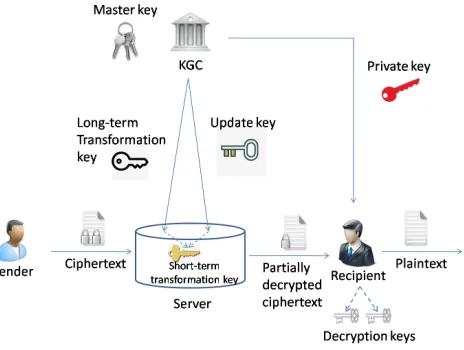
Fig. 1.System model of SR-IBE.
under the DBDH assumption. Following [23], Nguyen et al. [20] proposed the first lattice-based SR-IBE that satisfies selective-identity security (SR-sID-CPA security). One application of SR-IBE is encrypted email supporting lightweight devices in which an email server plays the role of the untrusted server so that only non-revoked users can read their email messages.
As mentioned above, the SR-IBE security model of [20, 23] has considered the DKE attack against users’ local decryption keys. But the DKE attack pro-posed in [26] is actually defined for user’s short-term transformation key. This is because the decryption key generated by a data user in a normal RIBE scheme is now created by the server and renamed as short-term transformation key in their SR-IBE schemes. From now on, in the SR-IBE model, we’ll let DKE specif-ically refer to the local decryption key exposure, and use “STKE” to indicate the short-term transformation key exposure. Since the untrusted server could be operated by anyone, including the adversary, all short-term transformation keys could be exposed to the adversary.
1.1 Motivations and Contributions
Motivation. In the security model of SR-IBE [20, 23], the challenge identity ID∗ must be revoked before the challenge time period t∗ once the private key PrivID∗ was revealed to the adversary. But if we think it more carefully, we
will find that this limitation is too strict for the following reason: as shown in Fig. 1, a ciphertext issued by the sender is first decrypted by the server into a partially decrypted ciphertext using a short-term transformation key obtained by combining the long-term transformation keyskID and the update key, and then
transformation key for the first decryption and the private key for the second decryption are revealed that we need to consider revocation of the challenge identity ID∗. Noting that SR-IBE was introduced by envisioning the real-world use of IBE systems, their security definitions should be as close to the practical scenarios as possible. A more natural and weaker limitation may be: ifboth the long-term transformation keyskID∗and the private keyPrivID∗for the challenge
identityID∗are revealed to the adversary,ID∗will be revoked before the challenge period timet∗.
Now, under the weaker limitation mentioned above, despite the exposure of the private keyPrivID∗, as long as the long-term transformation keyskID∗is not
revealed to the adversary, the challenge identityID∗does not need to be revoked before t∗. In this case (where ID∗ is not revoked before t∗), the previous SR-IBE schemes (i.e. [20, 23]) are vulnerable to “STKE” attack for the same reason as mentioned in [26]: if the short-term transformation keytkID∗,tis exposed, the
short-term transformation keytkID∗,t∗can be obtained by the adversary through
a simple combination oftkID∗,t,uktand ukt∗. Then, the adversary obtains both
tkID∗,t and PrivID∗, and can simply decrypt the challenge ciphertext encrypted
under ID∗ andt∗.
Contribution. Our contribution consists of three parts. First, we revisit Qin et al.’s security model [23], and enhance it by weakening the limitation on revoking the challenge identity and capturing both DKE attacks on the local decryption key and STKE attacks on the short-term transformation key. In our new security model, ID∗ is revoked before the challenge period time t∗ only when both the long-term transformation keyskID∗and the private keyPrivID∗are revealed to the
adversary. In addition, the adversary is allowed to issue short-term transforma-tion key reveal queries. As mentransforma-tioned above, these modificatransforma-tions are necessary because the previous schemes (i.e. [20,23]) are vulnerable under our new security model. In Section 3.2, we describe the formal definitions of our security models, SSR-sID-CPA security and SSR-aID-CPA security.
recipien-t’s workload from decrypting the ciphertext of messageM encrypted by RIBE with DKER [12] to decrypting the ciphertext ofM encrypted by HIBE [1]. This is because the amount of workload required to decrypt a ciphertext of RIBE with DKER [12] is strictly greater than that required to decrypt a ciphertext of HIBE [1]. Moreover, we prove that our lattice-based SR-IBE scheme is secure under our new security model.
Third, we propose a generic construction of SR-IBE scheme by employing a RIBE with DKER scheme and a 2-level HIBE scheme, and prove that the security of SR-IBE scheme inherits those of the underlying building blocks. In other words, the SR-IBE is SSR-sID-CPA (resp. SSR-aID-CPA) secure if the underlying RIBE is selective-identity (resp. adaptive-identity) secure and the underlying 2-level HIBE is selective-identity (resp.adaptive-identity) secure.
1.2 Related Work
Boldyreva et al. [4] proposed the first RIBE scheme from bilinear map. Chen et al. [8] proposed the first lattice-base RIBE scheme. Seo and Emura [25] in-troduce the security notion of DKER along with a RIBE with DKER from bilinear map. Since then, several improvements and variants have been pro-posed [11, 13, 17, 22, 31]. Recently, Ma and Lin [16] propro-posed a construction of RIBE without DKER from IBE, and a generic construction of RIBE with DKER from IBE and 2-level HIBE. The first SR-IBE scheme was proposed by Qin et al. [23]. Nguyen et al. [20] proposed the first SR-IBE from lattice.
1.3 Roadmap
The rest of this paper is organized as follows. Section 2 describes some nec-essary preliminaries. Section 3 introduces our new security model of SR-IBE. Section 4 presents our constructions of lattice-based SR-IBE. Section 5 presents a generic construction of SR-IBE. In the end, We give a conclusion in Section 6.
2
Preliminaries
2.1 Notations
For a binary stringα, let|α|denote its binary length. For a positive integer
n, Let [n] denote the set {1,· · · , n}. If S is a finite set then x ← S is the operation of choosing an element uniformly at random fromS. For a probability distributionD,x← D denotes the operation of choosing an element according to D. If γ is either an algorithm nor a set then x← γ is a simple assignment statement.
Letλdenote the security parameter. A function f(λ) is negligible, denoted as negl(λ), if for every c >0, there exists an λc such that f(λ) <1/λc for all
by some polynomial functionpoly(λ). Two distribution ensembles {Xλ}λ∈Nand
{Yλ}λ∈Narecomputationally indistinguishable, if for any PPT algorithmD, and for sufficiently largeλ, we have |Pr[D(Xλ) = 1]−Pr[D(Yλ) = 1]| is negligible in λ.
For notational convenience, we sometimes view a matrix as simply the set of its column vectors. For a matrix T = [t1· · ·tk] ∈ Rm×k, let kTk denote
the L2 length of its longest column, i.e., kTk := maxiktik for 1 ≤ i ≤ k; let
s1(T) denote the largest singular value ofT, i.e.,s1(T) := supu∈Rk,kuk=1kTuk. Further, ift1,· · · ,tk in Tare linearly independent, letTe := [˜t1,· · · ,˜tk], where ˜
t1,· · · ,˜tk denote the Gram-Schmidt orthogonalization of t1,· · · ,tk. For two matrices X ∈ Rn×m1 and Y ∈
Rn×m2, let [X | Y] ∈ Rn×(m1+m2) denote the
concatenation of the columns of X and Y. For two matrices X ∈ Rn×m and
Y∈Rm×k, we havekXk,kX>k ≤s1(X), ands1(XY)≤s1(X)·s1(Y).
2.2 The Binary Tree Data Structure and the CS method
The complete subtree (CS) method was introduced by Naor et al. [19]. A binary tree along with the CS method is an efficient revocation mechanism, which has been widely used in systems [5, 12, 21, 25]. To introduce this mechanism, we use the following notations:BTdenotes a binary-tree.rootdenotes the root node ofBT. θdenotes a node in the binary tree andη emphasizes that the nodeθ is a leaf node. The setPath(BT, ηID) stands for the collection of nodes on the path
from the leafηID to theroot(includingηIDand theroot). Ifθis a non-leaf node,
thenθ`,θr denote the left and right child ofθ, respectively.
Before introducing the CS method, we recall the node selection algorithm KUNodesas in previous RIBE systems [5, 25]. The KUNodesalgorithm takes as input a binary treeBT, a revocation listRL, and outputs a set of nodesY, such that the subtrees with rootθ∈Y cover all leavesηID inBT forID∈/ RLand do
not cover any leavesηID forID∈RL. The description of the KUNodesalgorithm
is as follows:
KUNodes(BT,RL):
X, Y ← ∅; ∀ID∈RL,add Path(BT, ηID) toX;
∀θ∈X, ifθ`∈/X then addθ` toY, ifθr∈/ X then addθr toY; IfY =∅then addrootto Y; ReturnY;
We adopt the definition of the CS method given by Katsumata et al. [12], which consists of the following four algorithms:
CS.Setup(N)→BT: on input the number of usersN, it outputs a binary tree BTwith at leastN and at most 2N leaves.
CS.Assign(BT,ID)→(ηID,BT): on input a binary tree BT and an identity ID,
it randomly assigns the identity ID to a leaf node ηID, to which no other
identities have been assigned yet. Then, it outputs a leaf node ηID and an
“updated” binary treeBT.
CS.Match(Path(BT, ηID),KUNodes(BT,RL))→θ/∅: on inputPath(BT, ηID) and
KUNodes(BT,RL), it outputs an arbitrary nodeθ∈Path(BT, ηID)∩KUNodes(BT,RL)
if it exists. Otherwise, it outputs∅.
2.3 Background on Lattice
LetB ={b1· · ·bm} ⊂Zm consist of m linearly independent vectors. The
(full-rank-integer) m-dimensional lattice Λ generated by the basis B is Λ =
L(B) := {P
i∈[m]xibi | xi ∈ Z}. For any positive integers n, m and q ≥ 2, a
matrixA∈Zn×mq and a vectoru∈Znq, we defineΛq⊥(A) :={z∈Zm:A·z=0n modq}andΛu
q(A) :={z∈Zm:A·z=u modq}.
Discrete Gaussian over Lattice. Let Λ be a lattice in Zm. For any
vec-tor c ∈ Rm and any parameter σ ∈ R+, define ρσ,c(x) = exp(−πkx−ck
2
σ2 ) and
ρσ,c(Λ) = Px∈Λρσ,c(x). The discrete Gaussian distribution over Λ with
cen-ter cand Gaussian parameter σ is DΛ,σ,c =
ρσ,c(y)
ρσ,c(Λ) for ∀y ∈ Λ. If c= 0, we
conveniently useρσ andDΛ,σ.
Lemma 1 ( [10]). Let Λ be an m-dimensional lattice. LetT be a basis forΛ, and supposeσ≥ kTek ·ω(
√
logm). ThenPr[kxk> σ√m:x← DΛ,σ]≤negl(m).
Lemma 2 ( [10]). Let n, m, q > 0 be positive integers with m ≥ 2ndlogqe
and q a prime. Let σ be any positive real such that σ ≥ ω(√logm). Then for
A←Zn×mq and e← DZm,σ, the distribution of u=Ae modq is statistically
close to uniform over Znq. Furthermore, for a fixed u ∈ Znq, the conditional
distribution of e← DZm,σ, givenAe=u modq for a uniformly randomA in
Zn×mq isDΛu
q(A),σ with all but negligible probability.
Sampling Algorithms. Let’s first review two sampling algorithms in the fol-lowing lemmas. The first algorithm generates a matrixA∈Zn×mq that is statis-tically close to uniform, together with a short trapdoor basis for the associated lattice Λ⊥q(A). The second algorithm generates a basis for the lattice Λ⊥q(G), whereGis what they call the primitive matrix.
Lemma 3 ( [2, 3, 18]). Let n, m, q >0be positive integers with m≥2ndlogqe
andq a prime. Then, we have:
– [2, 3, 18] a PPT algorithm TrapGen(n, m, q)that outputs a pair (A,TA)∈
Zn×mq ×Zm×msuch thatAis statistically close to uniform andTAis a basis
forΛ⊥q(A)satisfyingkgTAk ≤O(
√
nlogq).
– [18] a fixed full rank matrix G∈Zn×mq such that the lattice Λ⊥q(G) has a
publicly known basisTG∈Zm×mwith kTgGk ≤
√
5.
Lemma 4 ( [1, 7]). Letn, m,m, q >¯ 0 be positive integers withm > n andqa prime. Then, there exist PPT algorithms as follows:
ExtRndLeft(A,F,TA, σ)→T[A|F]: On input matrices A∈ Zn×mq , F∈Zn×q m¯,
a basis TA of Λ⊥q(A), and a Gaussian parameter σ ≥ kgTAk ·ω( √
logn), outputs a matrix T[A|F] ∈ Z(m+ ¯m)×(m+ ¯m) distributed statistically close to
(DΛ⊥
q([A|F]),σ) m+ ¯m.
ExtRndRight(A,G,R,TG, σ)→T[A|AR+G]: On input full rank matricesA,G∈
Zn×mq , a matrixR∈Zm×mq , a basisTG ofΛ⊥q (G), and a Gaussian
param-eterσ≥s1(R)· kTgGk ·ω( √
logm), outputs a matrixT[A|AR+G] ∈Z2m×2m distributed statistically close to(DΛ⊥
q([A|AR+G]),σ) 2m.
The following algorithms allow one to sample short vectors from a given lattice equipped with a short basis.
Lemma 5 ( [1, 10]). Letn, m,m, q >¯ 0be positive integers withm≥2ndlogqe
andq a prime. Then, we have the following algorithms:
SamplePre(A,TA,u, σ)→e [10]: on input a full rank matrix A ∈ Zn×m q , a
basisTA ∈ Zm×m of Λ⊥q(A), a vector u∈ Znq, and a Gaussian parameter
σ≥ kTgAk·ω( √
logm), it outputs a vectore∈Zmsampled from a distribution
statistically close toDΛu
q(A),σ.
SampleLeft(A,F,u,TA, σ)→e [1]: On input a full rank matrixA ∈Zn×mq , a
matrix F ∈ Zn×q m¯, a vector u ∈ Znq, a basis TA ∈ Zm×m of Λ⊥q (A), and
a Gaussian parameter σ ≥ kTgAk ·ω(
p
log(m+ ¯m)), it outputs a vector
e∈Zm+ ¯m sampled from a distribution statistically close toDΛu
q([A|F]),σ.
Hardness Assumption. The learning with errors (LWE) assumption was in-troduced by Regev [24]. For integersn, m, a primeq, a realα∈(0,1) such that
αq >2√n, and a PPT algorithmA, the advantage for learning with errors prob-lemLWEn,m,q,D
Zm ,αq ofAis defined as
Pr[A(A,A>s+x) = 1]−Pr[A(A,v) = 1], where A← Zn×mq , s←Znq, x← DZm,αq, v ←Zmq . We say that the LWE assumption holds if the above advantage is negligible for all PPT adversaryA.
2.4 Facts
Lemma 6 ( [1,15]).LetRbe am×kmatrix chosen at random from{−1,1}m×k,
then there exists a universal constant C such that Pr[s1(R) > C
√
m+k] < e−(m+k).
Lemma 7 ( [1, 9]). Suppose that m >(n+ 1) logq+ω(logn) and that q is a
prime. Let A,B be matrices chosen uniformly in Zn×mq and let R be an m×
m matrix chosen uniformly in {−1,1}m×m modq. Then, for all vectors w in
Definition 1 (FRD [1]). Let q be a prime and n a positive integer. We say
that a function H:Zn
q →Zn×nq is a full-rank difference (FRD) map if: for all
distinct ID,ID0 ∈Znq, the matrix H(ID)−H(ID 0)∈
Zn×nq is full rank, and His
computable in polynomial time innlogq.
2.5 Revocable Identity-based Encryption
Recall that in PKC 2019, Katsumata et al. [12] re-specified the syntax and security definition for RIBE to address the ambiguity of previous security defi-nitions [4,25–27] (e.g. in some cases it is not clear when the values such as secret keys and update keys are generated during the security game). Specifically, they mainly made the following four adjustments:
– An entity capable of deriving a secret key for a low-level user is modeled as a stateful entity, and is supposed to maintain a so-called “state” in addition to its own secret key. The roles of the “state” information (used by the revocation mechanism) and the secret key are merged in the syntax.
– They do not explicitly include the “revoke” algorithm, which adds a user to be revoked into the revocation list, as part of the syntax. Instead, a revocation list is treated as a subset of identity space and is considered together with the update key information.
– They explicitly separate the secret key generation and secret key reveal queries to capture cases when some secret keyskID has been generated but
not revealed to an adversary.
– They combine the “revoke” and “update key” queries into the single “revoke & update key” query and introduce a global counter tcu representing the
“current time period” which is coordinated with the adversary’s revoke & update key query.
In this section, we introduce the more rigorous definition of RIBE and its security model given in [12]. Note that the default security definition captures the DKER security considered in [25]. For convenience, we sometimes refer to a RIBE scheme that satisfies the default security definition as RIBE with DKER.
Syntax. A RIBE scheme Π = (Setup,GenSK,KeyUP,GenDK,Encrypt,Decrypt) is described as follows:
Setup(1λ)→(pp,skkgc): On input the security parameter 1λ, it outputs a public
parameterpp and the KGC’s secret key skkgc (also called a master secret
key). We assume that the message spaceM, the time period spaceT, and the identity spaceIDare determined only by the security parameterλ, and their descriptions are contained inpp.
GenSK(pp,skkgc,ID)→(skID,sk0kgc): On input a public parameterpp, the KGC’s
secret keyskkgc, and an identityID∈ ID, it outputs a secret keyskIDfor the
KeyUP(pp,skkgc,t,RLt)→(ukt,sk0kgc): On input a public parameterpp, the KGC’s
secret keyskkgc, a time period tand a revocation list RLt ⊂ ID, it outputs
an update keyuktand also the “updated” secret keysk0kgc.
GenDK(pp,skID,ukt)→dkID,t or ⊥: On input a public parameter pp, a secret
key skID and an update key ukt, it outputs a decryption key dkID,t for the
time periodtor the special “invalid” symbol⊥indicating thatIDhas been revoked.
Encrypt(pp,ID,t, M)→ctID,t: On input a public parameter pp, an identity ID,
a time periodtand a messageM, it outputs a ciphertextctID,t.
Decrypt(pp,dkID,t,ctID,t)→M: On input a public parameter pp, a decryption
keydkID,t and a ciphertextctID,t, it outputs the decryption resultM.
Correctness. For all λ ∈ N, (pp,skkgc) ← Setup(1λ), ID ∈ ID, t ∈ T, M ∈
M and RLt ⊂ ID\{ID}, the correctness requires that M0 = M to hold after
executing the following procedures: (1) (skID,skkgc)←GenSK(pp,skkgc,ID).
(2) (ukt,skkgc)←KeyUP(pp,skkgc,t,RLt).
(3) dkID,t←GenDK(pp,skID,ukt).
(4) ctID,t←Encrypt(pp,ID,t, M).
(5) M0←Decrypt(pp,dkID,t,ctID,t).
Note that it is allowed to execute an arbitrary polynomial number of ex-ecutions of GenSK in between steps (1) and (2). However, for simplicity and readability, the correctness is defined as above.
Security. Let the global counter tcu be initialized to 1. Let SKList be a list
that initially contains (kgc,skkgc). Whenever a new secret key is generated for
an identityID∈ ID or the secret key skkgc is updated due to the execution of
GenSK or KeyUP in the security game, the challenger C will store (ID,skID) or
update the corresponding entry (kgc,skkgc) in SKList, and we will not mention
this addition/update explicitly.
LetORIBE be the set of queries as follows:
Secret Key Generation Query: Upon a query ID ∈ ID from the adver-sary A, where it is required that (ID,∗) ∈/ SKList, the challenge C runs (skID,sk0kgc)←GenSK(pp,skkgc,ID) and returns nothing toA.
We require that all identitiesIDappearing in the following queries be “acti-vated” in the sense thatskIDis generated via this query and hence (ID,skID)∈
SKList.
Secret Key Reveal Query: Upon a query ID∈ ID from A, C checks if the following condition is satisfied:
– Iftcu≥t∗ andID∗∈/RLt∗, thenID6=ID∗.
Revoke & Update Key Query: Upon a query RL ⊂ ID (which represents the set of identities that are going to be revoked in the next time period) fromA,C checks if the following conditions are satisfied simultaneously:
– RLtcu⊂RL.
– Iftcu=t∗−1 andskID∗ for the challengeID∗ has been reveled toAvia
a secret key reveal queryID∗, then ID∗∈RL.
If these conditions are not satisfied, then C returns ⊥to A. Otherwise, it increments the current time period bytcu ←tcu+ 1, setsRLtcu ←RL, runs
(uktcu,sk
0
kgc)←KeyUP(pp,skkgc,tcu,RLtcu) and returnsuktcu toA.
Decryption Key Reveal Query: Upon a query (ID,t)∈ ID × T from A,C
checks if the following conditions are simultaneously satisfied:
– t≤tcu.
– ID∈/RLt.
– (ID,t)6= (ID∗,t∗).
If these conditions are not satisfied, then C returns ⊥to A. Otherwise, it findsskID from SKList, runsdkID,t←GenDK(pp,skID,ukt) and returnsdkID,t
toA.
Definition 2. A RIBE (with DKER) scheme satisfies selective-identity (resp.
adaptive-identity) security, if any PPT adversary A has negligible advantage
AdvRIBEA,ORIBE-sel(λ)(resp.AdvRIBEA,ORIBE-ad(λ)) in experimentExpRIBEA,ORIBE-sel(λ)(resp.ExpRIBEA,ORIBE-ad(λ)):
ExpRIBEA,ORIBE-sel(λ) :
ID∗,t∗← A;
(pp,skkgc) ← Setup(1λ); SKList ← (kgc,skkgc); (uk1,sk0kgc) ←
KeyUP(skkgc,tcu= 1,RL1=∅); (M0, M1)← AO
RIBE
(pp), where|M0|=|M1|;
b← {0,1};ctID∗,t∗ ←Encrypt(pp,ID∗,t∗, Mb);
b0← AORIBE
(ctID∗,t∗);
Return 1 if b0 =b and 0 otherwise.
ExpRIBEA,ORIBE-ad(λ) :
(pp,skkgc) ← Setup(1λ); SKList ← (kgc,skkgc); (uk1,sk0kgc) ←
KeyUP(skkgc,tcu= 1,RL1=∅); (M0, M1,ID∗,t∗)← AO
RIBE
(pp), where it is required that the following conditions are satisfied simultaneously:
– |M0|=|M1|,
– ift∗≤tcu, thenAhas not submitted (ID∗,t∗)as a decryption key
reveal query,
– ifskID∗ has been revealed toA, then it is required thatID∗∈RLt∗;
b← {0,1};ctID∗,t∗ ←Encrypt(pp,ID∗,t∗, Mb);
b0← AORIBE
(ctID∗,t∗);
The advantage ofAin the experiment ExpRIBEA,ORIBE-sel(λ)(resp.ExpRIBEA,ORIBE-ad(λ)) is defined as:
AdvRIBEA,ORIBE-sel(λ) = 2·
PrhExpRIBEA,ORIBE-sel(λ) = 1
i
−1
2
,
resp. AdvRIBEA,ORIBE-ad(λ) = 2·
PrhExpRIBEA,ORIBE-sel(λ) = 1
i
−1
2
.
(1)
The weak security notions (i.e. security without DKER) are defined by chang-ing the correspondchang-ing security experiments so that an adversaryAis not allowed to make any decryption key reveal query. The advantage of the adversaryAin weak selective-identity (resp.weak adaptive-identity) security experiment is de-fined asAdvRIBEA,ORIBE-sel-weak(λ) (resp.Adv
RIBE-ad-weak
A,ORIBE (λ)).
Definition 3. A RIBE scheme satisfies weak selective-identity (resp.weak adaptive-identity) security, if any PPT adversaryAhas negligible advantageAdvRIBEA,ORIBE-sel-weak(λ) (resp.AdvRIBEA,ORIBE-ad-weak(λ)).
For convenience, we sometimes refer to a RIBE scheme satisfying weak secu-rity as RIBE without DKER.
2.6 2-level Hierarchical Identity Based Encryption
In this section, we introduce the notion of 2-level hierarchical identity based encryption (HIBE) [1, 12].
Syntax. A 2-level HIBE schemeΠ = (Setup,GenSK,Delegate,Encrypt,Decrypt) is described as follows:
Setup(1λ)→(pp,skkgc): on input the security parameter 1λ, it outputs a public
parameterpp and the KGC’s secret key skkgc (also called a master secret
key).
We assume that the message spaceMand the identity spaceIDare deter-mined only by the security parameterλ, and their descriptions are contained inpp.
GenSK(pp,skkgc,id1)→skid1: on input a public parameterpp, the KGC’s secret
keyskkgcandid1∈ ID, it outputs a secret keyskid1.
Delegate(pp,skid1,id2): on input a public parameterpp, a secret keyskid1 (of a
first-level user withid1∈ ID), a second-level identityid2∈ ID, it outputs a secret keyskid1,id2.
Encrypt(pp,ID= (id1,id2), M)→ctID,t: on input a public parameterpp, a
level-2 user’s identity ID = (id1,id2) ∈ (ID)2, and a message M, it outputs a ciphertextct.
Decrypt(pp,skid1,id2,ct)→M: on input a public parameterpp, a decryption key
skid1,id2 (for a lever-2 user with identityID= (id1,id2)), and a ciphertextct,
Correctness. For all λ∈N, (pp,skkgc)←Setup(1λ), ID= (id1,id2)∈(ID)2, skid1 ← GenSK(pp,skkgc,id1), skid1,id2 ← Delegate(pp,skid1,id2), M ∈ M and
ct←Encrypt(pp,ID, M), the correctness requiresDecrypt(pp,skid1,id2,ct) =M.
Security. Let SKList be a list that initially contains (kgc,skkgc). Whenever a
new secret key is generated for an identityID∈(ID)≤2during the security game, the identity/secret key pair (ID,skID) will be stored intoSKList and we will not
mention this addition explicitly. LetOHIBEbe the set of queries as follows:
Level-1 Secret Key Generation Query: upon a query id1 ∈ ID from the adversaryA, the challengeC check if (id1,∗)∈SKList, and returns⊥toAif this is the case. Otherwise,C runs skid1 ←GenSK(pp,skkgc,id1) and returns
nothing toA.
Level-1 Secret Key Reveal Query: upon a queryid1∈ IDfromA,Cchecks if (id1,skid1) ∈SKList for some skid1 and id1 6=id
∗
1. If this is not the case, thenCreturns⊥toA. Otherwise, it returnsskid1 to A.
Level-2 Secret Key Reveal Query: upon a query (id1,id2)∈(ID)2fromA,
C checks if (id1,skid1) ∈ SKList for some skid1, ((id1,id2),skid1,id2)∈/ SKList
and (id1,id2) 6= (id∗1,id∗2). If this is not the case, then C returns ⊥ to A. Otherwise, it runs skid1,id2 ← Delegate(pp,skid1,id2) and returns skid1,id2 to
A.
Definition 4. A 2-level HIBE scheme satisfies selective-identity (resp. adaptive-identity) security, if any PPT adversaryAhas negligible advantageAdvHIBEA,OHIBE-sel(λ) (resp.AdvHIBEA,OHIBE-ad(λ)) in experimentExp
HIBE-sel
A,OHIBE(λ)(resp. Exp
HIBE-ad
A,OHIBE(λ)):
ExpHIBEA,OHIBE-sel(λ) :
ID∗= (id∗1,id∗2)← A;
(pp,skkgc)←Setup(1λ);SKList←(kgc,skkgc);
(M0, M1)← AO
RIBE
(pp), where|M0|=|M1|;
b← {0,1};ct∗←Encrypt(pp,ID∗= (id∗1,id∗2), Mb);
b0← AOHIBE
(ct∗);
Return 1 if b0 =b and 0 otherwise.
ExpHIBEA,OHIBE-ad(λ) :
(pp,skkgc)←Setup(1λ);SKList←(kgc,skkgc);
(M0, M1,ID∗ = (id∗1,id ∗
2))← AO
HIBE
(pp), where it is required that the following conditions are satisfied simultaneously:
– |M0|=|M1|,
– ((id∗1,id2∗),∗)∈/SKList,
– skid∗
1 has not been revealed toA;
b← {0,1};ct∗←Encrypt(pp,ID∗= (id∗1,id∗2), Mb);
b0← AOHIBE
(ct∗);
The advantage of A in the experiment ExpHIBEA,OHIBE-sel(λ) (resp. ExpHIBEA,OHIBE-ad(λ)) is defined as:
AdvHIBEA,OHIBE-sel(λ) = 2·
PrhExpHIBEA,OHIBE-sel(λ) = 1
i
−1
2
,
resp. AdvHIBEA,OHIBE-ad(λ) = 2·
PrhExpHIBEA,OHIBE-sel(λ) = 1
i
−1
2
.
(2)
3
Framework and Security model of SR-IBE
In Section 2.5 we described why and how Katsumata et al. [12] redefined the definition and security model of RIBE, and the four adjustments they made. In this section, by absorbing the ideas of Katsumata et al. [12], we first re-formalize the framework of server-aided revocable identity-based encryption scheme (SR-IBE) based on [12, 20, 23]. Then, we propose a new and more refined security model for SR-IBE.
Note that in the previous security model of SR-IBE [20, 23], the challenge identityID∗must be revoked before the challenge timet∗if the private keyskID∗
was revealed to the adversary. However, decrypting a ciphertextctID,t issued by
the sender requires not only the private key PrivID(for delegation of the local
decryption keydkID,t), but also the long-term transformation key skID (for
gen-erating the short-term transformation keytkID,t). Therefore, it is more natural
to revoke ID∗ before t∗ when both the private key PrivID∗ and the long-term
transformation key skID∗ for ID∗ are revealed. We additionally consider STKE
attack, which means that the adversary is allowed to issue short-term trans-formation key queries for (ID,t) 6= (ID∗,t∗). The new SR-IBE security model with the above two changes is stronger because as mentioned in Section 1.1, the previous SR-IBE schemes [20, 23] are insecure in our new security model.
3.1 Framework of SR-IBE
In this section, we re-formalize the framework of SR-IBE. Compared with previous SR-IBE [20, 23], we make the following adjustments:
– An entity capable of deriving a secret key is modeled as a stateful entity and is supposed to maintain a so-called “state” in addition to its own secret key.
– We remove the “revoke” algorithm.
– We integrate the system parameter generation algorithm Sys(1λ) into the setup algorithmSetup(1λ).
A SR-IBE involves four parties: KGC, sender, recipient and server. Algo-rithms among the parties are as following:
Setup(1λ)→(pp,sk
kgc) is run by the KGC. It takes as input a security
param-eter 1λ and outputs a public parameterpp, and the KGC’s secret keysk
kgc
L-TranKG(skkgc,ID)→(skID,sk0kgc) is run by the KGC. It takes as input the
KGC’s secret keyskkgc, an identityID, and may update the KGC’s secret key
skkgc. Then, it outputs a long-term transformation keyskID and the KGC’s
“updated” statesk0kgc. The long-term transformation keyskID is sent to the
server through a public channel.
UpdKG(skkgc,t,RLt)→(ukt,sk0kgc) is run by the KGC. It takes as input the
KGC’s secret key skkgc, a time period t, a revocation list RLt, and may
update the KGC’s secret keyskkgc. Then, it outputs an update keyukt and
the KGC’s “updated” statesk0kgc. The updated keyukt is sent to the server
through a public channel.
S-TranKG(skID,ukt)→tkID,t/⊥ is run by the server. It takes as input a
long-term transformation key skID for identity ID, an update key ukt for time
periodt, and outputs a short-term transformation key tkID,t or the special
symbol⊥indicating thatIDhas been revoked.
PrivKG(skkgc,ID)→PrivID is run by the KGC. It takes as input the KGC’s secret
keyskkgcand the recipient’s identityID, and outputs a private keyPrivIDfor
the recipient. The private key must be sent to the recipient through a secure channel.
DecKG(PrivID,t)→dkID,t is run by the recipient himself. It takes as input his
private keyPrivID and a time periodt, and outputs a decryption keydkID,t.
Enc(ID,t, M)→ctID,t is run by the sender. It takes as input the recipient’s
iden-tityID, a time period t, a messageM, and outputs a ciphertextctID,t. The
ciphertext is sent to the server.
Transform(tkID,t,ctID,t)→ct0ID,t is run by the server. It takes as input a
short-term transformation key tkID,t, a ciphertext ctID,t and outputs a partially
decrypted ciphertextct0ID,t. The partially decrypted ciphertextct0ID,t is sent to the recipient through a public channel.
Dec(dkID,t,ct0ID,t)→M/⊥ is run by the recipient. It takes as input a decryption
keydkID,t, a partially decrypted ciphertext ct0ID,t and outputs a messageM
or a symbol⊥.
Correctness The correctness for a SR-IBE requires that for all security pa-rameterλ∈Nand all messageM, ifIDis not revoked at time periodtand if all
parties follow the prescribed algorithms, then we haveDec(dkID,t,ct0ID,t) =M.
3.2 Security model of SR-IBE
Qin et al. [23] defined the semantic security against adaptive-identity chosen plaintext attacks for SR-IBE, i.e., SR-aID-CPA security. Nguyen et al. [20] con-sidered the selective-identity security, i.e., SR-sID-CPA security, in which the adversary announces the challenge identity ID∗ and time period t∗ before the execution of algorithmSetup.
before t∗ only if both skID∗ and PrivID∗ for ID∗ are revealed to the adversary;
the adversary is allowed to issue short-term transformation key reveal queries for (ID,t)6= (ID∗,t∗). In addition, we make the following adjustments:
– Separate the long-term transformation key generation and long-term trans-formation key reveal queries, and the private key generation and private key reveal queries.
– Merge the “revoke” and “update key” queries into the single “revoke & up-date key” query and introduce a global countertcurepresenting the “current
time period”.
LetSKListbe a set that initially contains (kgc,skkgc), and into which
identity/long-term transformation key pairs (ID,skID) generated during the security game will
be stored. From now on, whenever a new secret key skID is generated for ID
or the secret key skkgc is updated during the execution ofL-TranKGor UpdKG,
the challenger will store the pair (ID,skID) or update (kgc,skkgc) inSKList, and
we will not explicitly mention this addition/update. Also, let PrivList be a set that stores the identity/private key pairs (ID,PrivID) and identity/decryption
key pairs ((ID,t),dkID,t) generated during the security game. The challenger will
store the pairs (ID,PrivID) (resp.((ID,t),dkID,t)) inPrivListwhenever a new
pri-vate key PrivID (resp.decryption key ((ID,t),dkID,t)) is generated for ID (resp.
(ID,t)) during the execution ofPrivKG(resp.DecKG) and we will not explicitly mention these additions as well.
Definition 5 (SSR-sID-CPA security). Let OSR-IBE be the set of queries as follows:
Long-term Transformation Key Generation Query: upon a queryIDfrom the adversary A, where it is required that(ID,∗)∈/ SKList, the challenge C
runs(skID,sk0kgc)←L-TranKG(skkgc,ID)and returns nothing toA.
We require that all identitiesID appearing in the following queries be
“acti-vated” in the sense thatskIDis generated via this query and hence(ID,skID)∈
SKList.
Long-term Transformation Key Reveal Query: upon a queryIDfromA,
C findsskID fromSKList and returns it toA.
Revoke & Update Key Query: upon a query RL (which represents the set
of identities that are going to be revoked in the next time period) fromA,C
checks whetherRLtcu ⊂RL. If not, it returns⊥; otherwise, it increments the
current time period bytcu ←tcu+ 1, sets RLtcu ←RL, runs (uktcu,sk
0
kgc)←
UpdKG(skkgc,tcu,RLtcu)and returns uktcu toA.
Short-term Transformation Key Reveal Query: upon a query(ID,t)from
A,C checks whether conditionst≤tcu,ID∈/ RLtand(ID,t)6= (ID∗,t∗)meet
at the same time. If not, it returns ⊥; otherwise, it finds skID from SKList,
runstkID,t←S-TranKG(skID,ukt) and returnstkID,t toA.
Private Key Generation Query: upon a query ID from A, where it is re-quired that(ID,∗)∈/ PrivList,C runsPrivID ←PrivKG(skkgc,ID)and returns
Similarly, we require that all identitiesIDappearing in the following queries
be “activated” in the sense thatPrivID is generated via this query and hence
(ID,PrivID)∈PrivList.
Private Key Reveal Query: upon a query ID from A, C finds PrivID from
PrivListand returns it toA.
Decryption Key Reveal Query: upon a query(ID,t)fromA, where it is re-quired that((ID,t),∗)∈/ PrivList,C finds PrivID from PrivList, runs dkID,t ←
DecKG(PrivID,t)and returnsdkID,t toA.
A SR-IBE scheme is SSR-sID-CPA (resp.SSR-aID-CPA) secure if any PPT
adversary A has negligible advantage in experiment ExpSSRA,O−SR-IBEsID−CPA(λ) (resp.
ExpSSRA,O−SR-IBEaID−CPA(λ)) as follows.
ExpSSRA,O−SR-IBEsID−CPA(λ) :
ID∗,t∗← A;
(pp,skkgc) ← Setup(1λ); SKList ← (kgc,skkgc); PrivList ← ∅;
(uk1,sk0kgc)←UpdKG(skkgc,tcu= 1,RL1=∅);
M0, M1← AO
SR-IBE
(pp), where |M0|=|M1|;
b← {0,1};ctID∗,t∗ ←Enc(ID∗,t∗, Mb);
b0← AOSR-IBE
(ctID∗,t∗);
Return 1 if b0 =b and 0 otherwise.
ExpSSRA,O−SR-IBEaID−CPA(λ) :
(pp,skkgc) ← Setup(1λ); SKList ← (kgc,skkgc); PrivList ← ∅;
(uk1,sk0kgc)←UpdKG(skkgc,tcu= 1,RL1=∅); (M0, M1,ID∗,t∗)← AO
SR-IBE
(pp), where |M0|=|M1|.
b← {0,1};ctID∗,t∗ ←Enc(ID∗,t∗, Mb);
b0← AOSR-IBE(ctID∗,t∗);
Return 1 if b0 =b and 0 otherwise.
The following restrictions are made in the experiments ExpSSRA,O−SR-IBEsID−CPA(λ) andExpSSRA,O−SR-IBEaID−CPA(λ):
1. If bothskID∗ andPrivID∗ for identityID∗ are revealed to the adversary, then
ID∗ ∈RLt for some t≤t∗.
2. IfID∗∈/RLt∗, thenDecKG(·)can not be queried on (ID∗,t∗). The advantage ofAin the experimentExpSSRA,O−SR-IBEsID−CPA(λ)(resp.Exp
SSR−aID−CPA
A,OSR-IBE (λ)) is defined as:
AdvSSRA,O−SR-IBEsID−CPA(λ) = 2·
PrhExpSSRA,O−SR-IBEsID−CPA(λ) = 1
i
−1
2
resp. AdvSSRA,O−SR-IBEaID−CPA(λ) = 2·
PrhExpSSRA,O−SR-IBEaID−CPA(λ) = 1
i
−1
2
.
The following lemma is a variant of the strategy-dividing lemma in [12]. It is useful when proving the security of SR-IBE scheme.
Lemma 8 (Strategy-Dividing Lemma [12]). Let Π be a SR-IBE scheme,
and let A be any PPT adversary against the SSR-sID-CPA (resp.
SSR-aID-CPA) security of Π. Assume that there are n possible attack strategies for A,
Type-1, · · ·, Type-n, that satisfy the following conditions:
1. Type-1,· · ·, Type-ncover all possible strategies, and each Type-iis mutually exclusive.
2. For everyi∈[n], whetherAhas deviated from the Type-istrategy is “publicly
detectable”, in the sense that during the security game, as soon asAdeviates
from the Type-istrategy, it can be efficiently recognized givenA’s view at the moment it deviates from the strategy.
Then, there exist PPT adversaries A1,· · · An against the SSR-sID-CPA (resp.
SSR-aID-CPA) security of Π, such that Ai always follows the Type-i strategy
for every i∈[n], and
AdvSSRΠ,A-sID-CPA(λ)≤ X
i∈[n]
AdvSSRΠ,A-sIDi -CPA(λ)
resp. AdvSSRΠ,A-aID-CPA(λ)≤ X
i∈[n]
AdvSSRΠ,A-aID-CPA i (λ).
(4)
In particular, ifAdvSSRΠ,A-isID-CPA(λ)(resp.AdvSSRΠ,A-iaID-CPA(λ)) is negligible for all PPT adversariesAithat always follow the Type-istrategy and for alli∈[n], then
Π satisfies SSR-sID-CPA (resp.SSR-aID-CPA) security for any PPT adversary
Afollowing an arbitrary strategy.
4
Our Lattice-based SR-IBE scheme
Nguyen et al. [20] constructed the first lattice-based SR-IBE by combining Chen et al.’s RIBE without DKER [8] with the 2-level HIBE [1] via a double encryption technique [14]. More specifically, the sender first encrypts the message
Moreover, as mention in Section 1.1, Nguyen et al.’s SR-IBE scheme is insecure under SSR-sID-CPA security.
In this section, we construct the first SSR-sID-CPA secure SR-IBE by em-ploying Katsumata et al.’s RIBE with DKER [12] and a 2-level HIBE [1] as the building blocks, where Katsumata et al.’s lattice-based RIBE with DKER is con-structed by combining a RIBE without DKER [8] and the 2-level HIBE [1]. Note that in Katsumata et al.’s RIBE with DKER, the recipient needs to decrypt a “RIBE without DKER” ciphertext and a 2-level HIBE ciphertext. However, in our server-aided model, the server will decrypt the “RIBE with DKER” part of the ciphertext for the recipient and the recipient only needs to decrypt the HIBE block in the end. Therefore, the recipient reduces the workload of decrypting the “RIBE without DKER” ciphertext.
Compared with Nguyen et al. [20], we combine the two building blocks with-out using the double encryption technique, which reduced the number of calls to the sampling algorithm fromk·O(logN) andk·O(r·log(N/r)) toO(logN) and
O(r·log(N/r)), respectively. In addition, We reduce the recipient’s workload in a strict sense, but not to an incalculable extent. Moreover, our SR-IBE is secure under a stronger security model, i.e., SSR-sID-CPA security. In the following, we formally describe our SR-IBE scheme.
Setup(1λ): On input a security parameter λ, the KGC proceeds as follows: 1. Choose positive integersn, N, q, k, m, s0, s1, αwithqa prime,k=dlogqe,
Nas the maximal number of users that the system will support. Select an FRD mapH:Znq →Zn×nq (see Section 2.4). Let the identity spaceID=
Znq, the time spaceT ⊂ ID=Znq and the message spaceM={0,1}. Set the system parameterparams= (n, N, q, k, m, s0, s1, α,H,ID,T,M). 2. Generate three independent pairs (A,TA), (B,TB) and (C,TC) by
run-ningTrapGen(n, m, q).
3. Selectu←Znq andA1,A2,B1,B2,C1,C2←Zn×mq . 4. Create a binary tree by runningBTkgc←CS.Setup(N).
5. Set the public parameterpp= (A,B,C,A1,A2,B1,B2,C1,C2,u,params) and the KGC’s secret keyskkgc= (TA,TB,TC,BTkgc).
6. Outputpp andskkgc.
L-TranKG(skkgc,ID): On input the KGC’s secret key skkgc and an identityID∈
ID, the KGC goes as follows:
1. Run (BTkgc, ηID)←CS.Assign(BTkgc,ID).
2. For each θ ∈ path(BTkgc, ηID), if ukgc,θ is undefined, the KGC picks
ukgc,θ ←Znq, updateskkgcby storingukgc,θ in the nodeθ∈BTkgc. Then,
it sampleseID,θ ←SampleLeft(A,AID,TA,ukgc,θ, s1), where AID = [A|
A1+H(ID)G]∈Zn×2mq . Note thateID,θ∈Z2mandAID·eID,θ =ukgc,θ. 3. Extend its basis by running
TBID ←ExtRndLeft(B,B1+H(ID)G,TB, s0), (5) whereBID= [B|B1+H(ID)G]∈Zn×2mq ,TBID ∈Z
2m×2m. 4. OutputskID= path(BTkgc, ηID),(eID,θ)θ∈path(BTkgc,ηID),TBID
UpdKG(skkgc,t,RLt): On input the KGC’s secret keyskkgc, a time periodt∈ T,
a revocation listRLt, the KGC works as follows:
1. Run KUNodes(BTkgc,RLt) ← CS.Cover(BTkgc,RLt) and check whether
ukgc,θ is defined for eachθ∈KUNodes(BTkgc,RLt). If not, the KGC picks
ukgc,θ ←Znq, update skkgc by storingukgc,θ in nodeθ∈BTkgc. Then, it
samples et,θ ←SampleLeft(A,At,TA,u−ukgc,θ, s1), where At = [A |
A2+H(t)G]∈Zn×2mq . Note thatet,θ∈Z2m andAt·et,θ =u−ukgc,θ. 2. Outputukt= KUNodes(BTkgc,RLt),(et,θ)θ∈KUNodes(BTkgc,RLt)
as the up-date key and the (possibly) upup-dated secret keysk0kgc.
S-TranKG(skID,ukt): On input a long-term transformation keyskID for identity
ID∈ ID, an update keyuktfor time periodt∈ T, the server goes as follows:
1. Extractpath(BTkgc, ηID) inskID andKUNodes(BTkgc,RLt) inuktand run
θ/∅ ← CS.Match(path(BTkgc, ηID),KUNodes(BTkgc,RLt)). If the output
is ∅, the server outputs ⊥. Otherwise, it extracts eID,θ,et,θ ∈ Z2m in
skID,ukt, respectively, and parses it as
eID,θ = [eLID,θ |e
R
ID,θ], et,θ = [eLt,θ |e
R
t,θ]. (6) whereeL
ID,θ,eRID,θ,etL,θ,eRt,θ∈Zm. Then the server computes
eID,t= [eLID,θ+e
L t,θ|e
R ID,θ|e
R
t,θ]. (7) Note thateID,t∈Z3mand [A|A1+H(ID)G|A2+H(t)G]·eID,t=u.
2. SamplegID,t←SampleLeft(BID,B2+H(t)G,TBID,u, s1). Note thatgID,t∈
Z3mand [B|B1+H(ID)G|B2+H(t)G]·gID,t=u.
3. Output the short-term transformation keytkID,t= (eID,t,gID,t).
PrivKG(skkgc,ID): On input the KGC’s secret keyskkgcand an identityID∈ ID,
the KGC proceeds as follows:
1. SampleTCID ←ExtRndLeft(C,C1+H(ID)G,TC, s0), where CID= [C|
C1+H(ID)G]∈Zn×2mq .
2. Output the private keyPrivID=TCID∈Z
2m×2m.
DecKG(PrivID,t): On input the private key PrivID = TCID and a time period
t∈ T, the recipient works as follows:
1. SampledID,t←SampleLeft(CID,C2+H(t)G,TCID,u, s1). Note thatdID,t∈
Z3mand [C|C1+H(ID)G|C2+H(t)G]·dID,t=u.
2. Output the decryption keydkID,t=dID,t.
Enc(ID,t, M): On input an identity ID ∈ ID, a time periodt ∈ T, a message
M ∈ M, the sender works as follows: 1. Set
AID,t= [A|A1+H(ID)G|A2+H(t)G]∈Zn×3mq
BID,t= [B|B1+H(ID)G|B2+H(t)G]∈Zn×3mq
CID,t= [C|C1+H(ID)G|C2+H(t)G]∈Zn×3mq .
(8)
2. Samples,s0,s00←Zn
q,x←DZ,αq,x,x
4. Set
c0=u>(s+s0+s00) +x+M · b
q
2c, c1=A >
ID,ts+
x R>
11x
R>12x
,
c2=B>ID,ts0+
x0
R>21x0
R>22x0
, c3=C>ID,ts00+
x00
R>31x00
R>32x00
.
(9)
5. Output the ciphertextctID,t= (c0,c1,c2,c3)∈Zq×Z3mq ×Z 3m q ×Z
3m q . Transform(tkID,t,ctID,t): On input a short-term transformation keytkID,t= (eID,t,gID,t),
a ciphertextctID,t= (c0,c1,c2,c3), the server works as follows: 1. Computec00=c0−e>ID,tc1−g>ID,tc2.
2. Output the partially decrypted ciphertextct0ID,t= (c00,c3)∈Zq×Z3mq . Dec(dkID,t,ct0ID,t): On input a decryption keydkID,t=dID,t, a partially decrypted
ciphertextct0ID,t, the recipient works as follows: 1. Computec=c00−dID>,tc3∈Zq.
2. Comparec andbq
2cby treating them as integers inZ, output 1 in case
|c− bq 2c|<b
q
4cand 0 otherwise.
4.1 Correctness
Let a ciphertextctID,tbe aimed for recipient IDand time periodt. To check
correctness, we only need to consider the situation where the ID has not been revoked at time period t. In this case, the server can construct a short-term transformation keytkID,t forIDat timet.
Lemma 9. AssumeO α+αs1m·ω(
√
logm)
·q
≤q/5hold with
overwhelm-ing probability, then the above SR-IBE scheme has negligible decryption error.
Proof. Since ID is non-revoked at time period t, there exists one node θ ∈
path(BTkgc, ηID)∩KUNodes(BTkgc,RLt). The short-term transformation key
gen-erated by running S-TranKG(skID,ukt) is of the form tkID,t = (eID,t,gID,t) such
that
AID,t·eID,t= [A|A1+H(ID)G|A2+H(t)G]·eID,t=u,
BID,t·gID,t= [B|B1+H(ID)G|B2+H(t)G]·gID,t=u.
(10)
c00=c0−e>ID,tc1−g>ID,tc2
=u>(s+s0+s00) +x+M· bq
2c −
u>s+e>ID,t
x R>11x R>12x
−
u>s0+g>ID,t
x0 R>21x0 R>22x0
=u>s00+x+M· bq
2c −e >
ID,t
x R>11x R>12x
−g>ID,t
x0 R>21x0 R>22x0
.
(11)
The decryption key generated by runningDecKG(PrivID,t) is of the formdkID,t=
dID,t such that
CID,t·dID,t= [C|C1+H(ID)G|C2+H(t)G]·dID,t=u. (12)
During theDecprocedure performed by the recipient, we have
c=c00−d>ID,tc3
=M· bq
2c+x−e >
ID,t
x R>11x R>12x
−gID>,t
x0 R>21x0 R>22x0
−d>ID,t
x00 R>31x00 R>32x00
.
| {z }
:=z(“noise00)
(13)
If we set the parameters appropriately, by Lemma 1 and 5, we know that
keID,tk ≤2·
√
3m·s1, kgID,tk ≤
√
3m·s1, kdID,tk ≤
√
3m·s1. (14) By Lemma 1, 5 and 6, we have
k[I|R11|R12]·eID,tk ≤(1 + 2·
√
2m)·2·√3m·s1≤O(s1m),
k[I|R21|R22]·gID,tk ≤O(s1m), k[I|R31|R32]·dID,tk ≤O(s1m). (15)
By Lemma 1 and the standard Gaussian tail bound in [10], we have
k([I|R11|R12]·eID,t)>·xk ≤ k[I|R11|R12]·eID,tk ·αq·ω(
p logm), ≤O(s1m)·αq·ω(
p logm).
(16)
Similarly, k([I | R21 | R22]·gID,t)> ·x0k,k([I | R31 | R32]·dID,t)> ·x00k ≤
O(s1m)·αq·ω(
√
logm). Thus, the noisez can be bounded with overwhelming probability as follows:
kzk ≤ |x|+ke>ID,t
x R>11x R>12x
k+kg>ID,t
x0 R>21x0 R>22x0
k+kd>ID,t
x00 R>31x00 R>32x00
k,
≤αq+O(s1m)·αq·ω( p
logm),
=Oα+αs1m·ω( p
logm)·q.
u t
4.2 Parameter Selection
In this section, we provide an example of parameter selection of our SRIBE scheme. Note that we need to ensure that
– the “noise” term in the above section is less than q/5 with overwhelming probability (i.e.,O α+αs1m·ω(
√
logm)
·q
≤q/5 by Lemma 9).
– algorithmTrapoperates as specified (i.e.,m≥2ndlogqeby Lemma 3).
– algorithmsSampleLeftandExtRndLeftwork as specified (i.e.,s0≥O(
√
nlogq)· ω(√logm),s1≥s0
√
m·ω(√logm) by Lemma 1, 3, 4 and 5).
– algorithm√ ExtRndRight works as specified in the security proof (i.e., s0 >
m·ω(√logm) by Lemma 3, 4 and 6).
– the hardness assumption of LWE applies (i.e.,αq >2√n).
According to the above restrictions, we can set the parameters of our SR-IBE as follows:
n=O(λ), N =poly(λ), m=O(nlogq), s0=
√
m·ω(plogn), s1=m·ω(logn), α=m−2·ω((logn)
3
2)−1, q=n 1
2 ·m2·ω((logn) 3 2).
(18)
Remark 1. For the sake of simplicity, we define the correctness of SR-IBE to
have a probability of 1 in Section 3.1. Therefore, in order to be consistent with our definition, we can use standard techniques to modify our lattice-based con-struction so that there are no decryption errors by considering a bound on the secret/noise vector.
4.3 Security Analysis
Theorem 1. The SR-IBE scheme described above is SSR-sID-CPA secure
as-suming the hardness of theLWEn,m+1,q,χ problem, where χ=DZm+1,αq.
Proof. LetAbe a PPT adversary who succeeds in breaking the SSR-sID-CPA
security of our SR-IBE scheme with advantage AdvSSRA,O-SR-IBEsID-CPA(λ) = , let ID∗
be the challenge identity and t∗ be the challenge time period. Observe that the strategy taken by Acan be divided into three types of strategies that are mutually exclusive as follows.
Type-I: A issues both private key reveal query and long-term transformation key reveal query on the challenge identity ID∗. In this case, the challenge identityID∗ must be revoked before the challenge timet∗.
Type-II: A issues private key reveal query on the challenge identity ID∗, but does not issue long-term transformation key reveal query onID∗.
By Lemma 8,Aalways follows one of the above strategies, and we only need to show that the advantage ofAis negligible regardless of the strategy taken byA. We will provide three types of security proofs according to the three types of strategies taken byA as described above. In both proofs, we proceed with a sequence of games where the first game is identical to the SSR-sID-CPA game from Definition 5 and the adversary has no advantage in the last game. We will show that A cannot distinguish between the games, which will prove that the adversary has negligible advantage in winning the original SSR-sID-CPA game and will complete our proof.
Lemma 10. The advantage of an adversary A1 using the Type-I strategy is negligible assuming the hardness of theLWEn,m+1,q,χ, whereχ=DZm+1,αq.
Proof. We define the sequence of games as follows:
GameI-0: This is the original SSR-sID-CPA game from Definition 5.
GameI-1: In this game, we change the way that the challenger generatesA1,A2in the public parameters. TheGameI-1challenger samplesR∗11,R∗12← {−1,1}m×m at the setup phase and setsA1,A2 as
A1=AR∗11−H(ID
∗)G, A
2=AR∗12−H(t
∗)G. (19) Then the challenger keeps the matricesR∗11,R∗12as part ofskkgc. The remainder
of the game is unchanged.
We now show that GameI-0 is statistically indistinguishable from GameI-1. Note that inGameI-1the matricesR∗11,R∗12 are used only in the construction of
A1,A2and in the construction of the challenge ciphertext wherez1←(R∗11)>x,
z2←(R∗12)>x. By Lemma 7, the distributions (A,AR∗11,z1) and (A,AR∗12,z2) are statistically close to the distributions (A,A01,z1) and (A,A02,z2) respective-ly, whereA01,A02←Zn×m
q . Hence,A1,A2 inGameI-0 andGameI-1 are indistin-guishable.
GameI-2: In this game, we change how we assign ID∗ to the binary tree BTkgc.
Recall in the previous game, the challenger assigned ID∗ to some random leaf
ηID∗ of BTkgc whenA1 issued a long-term transformation key query onID∗. In
this game, the GameI-2 challenger chooses a random leaf inBTkgcto assignID∗
before providingA1 the public parameterpp. WhenA1 submitted a long-term transformation key query on someID, ifID=ID∗, then the challenger proceed-s with L-TranKG as if (BTkgc, ηID∗) ← CS.Assign(BTkgc,ID∗) and otherwise it
assigns IDto some random leaf ofBTkgc that is notηID∗. Since the random
as-signment ofID∗made by the challenger is statistically hidden fromA1,GameI-1 andGameI-2 are indistinguishable.
GameI-3: In this game, we change the challenger so he does not have to use the trapdoor TA when generating the following short vectors: (eID,θ)θ∈path(BTkgc,ηID)
modify when and how the vectorsukgc,θ for each nodeθ∈BTkgcare chosen. By
the definition of the Type-Istrategy,ID∗must be revoked before time periodt∗. Hence, we havepath(BTkgc, ηID∗)∩KUNodes(BTkgc,RLt∗) =∅by the property of
the CS scheme.
Whenever A1 issues a long-term transformation key query, a revoke & up-date key query, or a short-term transformation key reveal query, the GameI-3 challenger generates the vectors ukgc,θ for each nodeθ∈BTkgcas follows:
– If θ ∈ path(BTkgc, ηID∗), then it samples eID∗,θ ← D
Z2m,s1, sets ukgc,θ =
AID∗·eID∗,θ forAID∗= [A|A1+H(ID∗)G], storesukgc,θ in the nodeθ and
keepseID∗,θ secret.
– Ifθ /∈path(BTkgc, ηID∗), then it sampleset∗,θ← DZ2m,s
1, setsukgc,θ =At∗·
et∗,θ forAt∗= [A|A2+H(t∗)G] by implicitly settingtcu=t∗, storesukgc,θ
in the nodeθand keepset∗,θ secret.
Then, if A1 issues a long-term transformation key query on ID 6= ID∗, the GameI-3challenger first runsExtRndRight(A,G,R∗11,TG, s0) to create the trap-door TAID=[A|A1+H(ID)G]=[A|AR∗11+(H(ID)−H(ID∗))G] and then samples the short
vectors (eID,θ)θ∈path(BTkgc,ηID) by running SamplePre(·) with trapdoor TAID and
Gaussian parameter s1. Otherwise, if ID = ID∗, the challenger simply returns (eID∗,θ)θ which he has already generated without using TA. Moreover, if the
counter tcu on which A1 queries a revoke & key update query is not t∗, the GameI-3challenger first runsExtRndRight(A,G,R∗12,TG, s0) to create the trap-doorTAt=[A|A2+H(t)G]=[A|AR∗12+(H(t)−H(t∗))G]and then samples the short vectors
(et,θ)θ∈KUNodes(BTkgc,RLt) by running SamplePre(·) with trapdoorTAt and
Gaus-sian parameters1. Otherwise, if tcu=t∗, the challenger simply returns (et∗,θ)θ
which he has already created without using TA. Furthermore, when A1 issues a short-term transformation key reveal query on (ID,t), the challenger checks whether conditions t ≤ tcu, ID ∈/ RLt and (ID,t) 6= (ID∗,t∗) meet at the same
time. If not, it returns⊥; otherwise, it simply createseID,t by combing (eID,θ)θ and (et,θ)θ. Sincepath(BTkgc, ηID∗)∩KUNodes(BTkgc,RLt∗) =∅, the procedures
described above are well-defined. Finally, according to Lemma 1, 2, 4, 5 and 6, the distributions of the short vectors given to A1 are distributed statistically close to those of the previous game. Therefore, GameI-2 and GameI-3 are indis-tinguishable.
GameI-4: In this game we change how A is sampled. We generate A as a ran-dom matrix in Zn×m
q instead of generating it by runningTrap(·). By Lemma 3, GameI-3 andGameI-4 are indistinguishable.
GameI-5: In this game we change the way the challenge ciphertextctID∗,t∗is
cre-ated. In this game, when the GameI-5 challenger is issued a challenge query on (M0, M1) byA1, the challenger chooses a random bitb← {0,1}, samplesv←Zq,
sets
c0=v+u>(s0+s00) +Mb· b
q
2c, c1=
v
(R∗11)>v
(R∗12)>v
,
c2=B>ID∗,t∗s0+
x0 R>21x0 R>22x0
, c3=C>ID∗,t∗s00+
x00 R>31x00 R>32x00
.
(20)
Finally, the challenger outputs the challenge ciphertext asctID∗,t∗= (c0,c1,c2,c3).
Sincevis distributed uniformly at random overZq and independently of all oth-er toth-erms, the probability ofA1 guessing whether b= 0 orb= 1 is exactly 1/2. In the following, we only need to show that GameI-4 and GameI-5 are indistin-guishable assuming the hardness of theLWEn,m+1,q,χ to complete the proof. To this end, we useA1 to construct a LWE adversary B1 as follows:
B1 is given the problem instance of LWE as ( ¯A,v¯) ∈ Zn×(m+1)q ×Z(m+1)q and aims to distinguish whether ¯v= ¯A>s+ ¯xfor some s←Znq, ¯x← DZm+1,αq or ¯v ← Z(m+1)q . Let the first column of ¯A be u∗ ∈ Znq and the remaining columns be A∗ ∈ Zn×mq . Let the first coefficient of ¯v be v and the remaining columns be v. Now, B1 sets (A,u) = (A∗,u∗) and proceeds the setup as the GameI-4 challenger. Furthermore, whenever A1 issues a query,B1 works as the GameI-3 challenger and answers them without TA. To generate the challenge
ciphertext, B1 chooses b ← {0,1} and generates the challenge ciphertext as in Eq.(20) using v, v, and returns it toA1. Letb0 denote the output ofA1, then
B1 outputs 1 if b0 = b and 0 otherwise. Note that if ( ¯A,v¯) is a valid LWE sample, i.e., ¯v= ¯A>s+ ¯xfor some s←Zn
q, then the view ofA1 is the same as that of GameI-4. Otherwise, i.e., ¯v←Z(m+1)q , it is the same as that of GameI-5. Therefore,GameI-4 andGameI-5 are indistinguishable assuming the hardness of theLWEn,m+1,q,χ, where χ=DZm+1,αq. ut
Lemma 11. The advantage of an adversary A2 using the Type-II strategy is negligible assuming the hardness of theLWEn,m+1,q,χ, whereχ=DZm+1,αq.
Proof. The outline of this proof is essentially the same as that of Lemma 10.
The difference is that in this proof, we modify the challenger so that he is able to simulate the game withoutTB.
GameII-0: This is the original SSR-sID-CPA game from Definition 5.
GameII-1: In this game, we change the way that the challenger generatesB1,B2 in the public parameters. TheGameII-1challenger samplesR∗21,R∗22← {−1,1}m×m at the setup phase and setsB1,B2as
B1=BR∗21−H(ID
∗)G, B
2=BR∗22−H(t∗)G. (21) Then the challenger keeps the matricesR∗21,R∗22as part ofskkgc. The remainder
Lemma 7,B1,B2inGameII-0andGameII-1are indistinguishable, henceGameII-0 is indistinguishable fromGameII-1.
GameII-2: In this game, we change the challenger so he does not have to use the trapdoor TB when generating TBID=[B|B1+H(ID)G]=[B|BR∗21+(H(ID)−H(ID∗))G]
in skID and gID,t in tkID,t. To this end, we modify the ways TBID and gID,t are
sampled, respectively. By the definition of the Type-II strategy, A2 does not issue long-term transformation key reveal query on ID∗. Then, whenA2 issues a long-term transformation key query on ID 6= ID∗, the GameII-2 challenger runsExtRndRight(B,G,R21∗ ,TG, s0) to createTBID. By Lemma 4, the
distribu-tion of TBID given to A2 is distributed statistically close to that of the
previ-ous game. Furthermore, whenA2issues a short-term transformation key reveal query on (ID,t), the challenger checks whether conditions t ≤ tcu, ID ∈/ RLt
and (ID,t)6= (ID∗,t∗) meet at the same time. If not, it returns⊥. Otherwise, if ID6=ID∗, the challenger samples gID,t by running SampleLeft(·) with TBID and
Gaussian parameters1. OtherwiseID=ID∗ andt6=t∗, the challenger first runs
ExtRndRight(B,G,R∗22,TG, s0) to create the trapdoorTBt=[B|B2+H(t)G]=[B|BR∗22+(H(t)−H(t∗))G],
samples gID0 ∗,t by running algorithm SampleLeft(Bt,B1+H(ID∗)G,u,TBt, s1), and then obtains gID∗,t by rearranging elements in g0ID∗,t. According to
Lem-ma 1, 2, 4, 5 and 6, the distribution ofgID,t given to A2 is distributed statisti-cally close to that of the previous game. Therefore, GameII-1 andGameII-2 are indistinguishable.
GameII-3: In this game we change how Bis sampled. We generate Bas a ran-dom matrix in Zn×mq instead of generating it by runningTrap(·). By Lemma 3, GameII-2andGameII-3 are indistinguishable.
GameII-4: In this game we change the way the challenge ciphertext ctID∗,t∗ is
created. When theGameII-4 challenger is issued a challenge query on (M0, M1) byA2, the challenger chooses a random bitb← {0,1}, samplesv←Zq,v←Znq,
s,s00←Zn
q,x,x00← DZm,αq, R11,R12,R31,R32← {−1,1}m×mand sets
c0=v+u>(s+s00) +Mb· b
q
2c, c1=A >
ID∗,t∗s+
x R>11x R>
12x
,
c2=
v
(R∗21)>v
(R∗ 22)>v
, c3=C>ID∗,t∗s00+
x00 R>31x00 R>
32x00
.
(22)
Finally, the challenger outputs the challenge ciphertext asctID∗,t∗= (c0,c1,c2,c3).
Lemma 12. The advantage of an adversary A3 using the Type-IIIstrategy is negligible assuming the hardness of theLWEn,m+1,q,χ, whereχ=DZm+1,αq.
Proof. The outline of this proof is essentially the same as that of Lemma 10.
The difference is that in this proof, we modify the challenger so that he is able to simulate the game withoutTC.
GameIII-0: This is the original SSR-sID-CPA game from Definition 5.
GameIII-1: In this game, we change the way that the challenger generatesC1,C2 in the public parameters. TheGameIII-1challenger samplesR∗31,R∗32← {−1,1}m×m at the setup phase and setsC1,C2 as
C1=CR∗31−H(ID
∗)G, C
2=CR∗32−H(t
∗)G. (23)
Then the challenger keeps the matrices R∗31,R∗32 as part of skkgc. The
remain-der of the game is unchanged. Similar to GameI-1 in Lemma 10, by Lemma 7,
C1,C2 in GameIII-0 andGameIII-1 are indistinguishable, henceGameIII-0 is in-distinguishable fromGameIII-1.
GameIII-2: In this game, we change the challenger so he does not have to use the trapdoor TC when generating TCID=[C|C1+H(ID)G]=[C|CR∗31+(H(ID)−H(ID∗))G]
in PrivID and dID,t in dkID,t. To this end, we change how TCID and dID,t are
sampled. By the definitions of the Type-III strategy and the SSR-sID-CPA security, A3 does not issue private key reveal query on ID∗ and only issues decryption key reveal queries on (ID,t) 6= (ID∗,t∗) (since ID∗ ∈/ RLt∗). Then,
whenA3 issues a private key query on ID6=ID∗, theGameIII-2 challenger runs ExtRndRight(C,G,R∗31,TG, s0) to createTCID. By Lemma 4, the distribution of
TCID given toA3 is distributed statistically close to that of the previous game. Furthermore, whenA3issues a decryption key reveal query on (ID,t)6= (ID∗,t∗), ifID6=ID∗, the challenger samplesdID,tby runningSampleLeft(·) withTCID and
Gaussian parameters1. OtherwiseID=ID∗ andt6=t∗, the challenger first runs
ExtRndRight(C,G,R∗32,TG, s0) to create the trapdoorTCt=[C|C2+H(t)G]=[C|CR∗32+(H(t)−H(t∗))G],
samples d0ID∗,t by running algorithmSampleLeft(Ct,C1+H(ID∗)G,u,TCt, s1),
and then obtains dID∗,t by rearranging elements in d0
ID∗,t. According to
Lem-ma 1, 2, 4, 5 and 6, the distribution ofdID,tgiven to A3is distributed statisti-cally close to that of the previous game. Therefore,GameIII-1andGameIII-2are indistinguishable.
GameIII-3: In this game we change howC is sampled. We generate Cas a ran-dom matrix in Zn×mq instead of generating it by runningTrap(·). By Lemma 3, GameIII-2 andGameIII-3are indistinguishable.
GameIII-4: In this game we change the way the challenge ciphertext ctID∗,t∗ is