ISSN(Online): 2319-8753 ISSN (Print): 2347-6710
I
nternational
J
ournal of
I
nnovative
R
esearch in
S
cience,
E
ngineering and
T
echnology
(A High Impact Factor, Monthly, Peer Reviewed Journal) Visit: www.ijirset.com
Vol. 8, Issue 8, August 2019
A Hardware Testbed of Grid Connected Wind
Solar Power System
Ashok Kumar Yadav, Harish Maheshwari
Research Scholar (Power System), RIET, Jaipur, India
Assistant Professor, RIET, Jaipur, India
ABSTRACT: Energy is crucial when it comes to development of economy and advancement of any nation on social basis. Native sources of energy are required to be investigated so as to get optimum level to eliminate dependency on foreign fuels, bounded by resolving economic, social as well as environmental aspects. This results in rapid growth in the research and investigation and additionally speculation in renewable form of energy industries in such a manner that fulfills the demand in energy and minimizes the dependency on fossils.
Wind as well as solar form of energy are emerging due their huge availability and ease in reachability so as to generate electricity. The present work aims on the distributed hybrid renewable form of energy system which comprises of wind and solar energies.
I. INTRODUCTION
Human beings have utilized the energy of wind as source for several decades. Along with combination of hydro power, it has been utilized as form of energy for many years [1]. In the later years of the 19th century, several experiment were conducted to run and generate electricity using windmills which was the result as the growing field in the sector of electrical engineering.
Then after the power of wind has been grown rapidly specifically in the later 30 years.In the year 1999, more than 10000 MW capacity of wind power was implemented across the world. The present year also gives the data where wind power plants are installed more compared to the nuclear plants.
Electrical energy is bought in the same way as any other item or product is imported in the market and thus its quality is determined. They are often termed as Power quality standards in with reference to electric power. Any device that is connected to the grid of electricity should be at the level of these standards so as to particularly overcome the important problems when occurs at the time when windmills are installed, the type of wind flow and the electricity parameters all together as per the standards.
II. PV CELLS
The energy from solar can be transformed in two types, which are solar thermal and solar photovoltaic energy
Solar Thermal: it is almost similar to the generation of traditional AC generation by steam turbine, but the only difference is at the place of fossil fuels it captures heat comprising the concentrated solar illuminations. This heat is used to produce steam and is kept in thermally insulated tanks and is used during intervals of sunlight or at night.
ISSN(Online): 2319-8753 ISSN (Print): 2347-6710
I
nternational
J
ournal of
I
nnovative
R
esearch in
S
cience,
E
ngineering and
T
echnology
(A High Impact Factor, Monthly, Peer Reviewed Journal) Visit: www.ijirset.com
Vol. 8, Issue 8, August 2019
Fig.1 Equivalent electrical circuit of PV module
III. OUTLINECOMPRISING GENERATIONAND TRANSMISSIONOF WIND POWER
The system for preserving the wind power transforms the wind energy to electrical form of energy, that is imposed in the grid of electricity. The linking of the turbines of the wind along with the grid might be at lower voltage, higher voltage, and medium type voltage including the system of extra high voltage. As maximum turbines are linked to medium type voltage in the grid, the future of big wind farm plants might possess to be linked with higher and extra high system of voltage (transmission framework).
Fig. 2 Block Diagram of Proposed work
IV. COMPONENTS OF FRAMEWORK
The rotor of turbine, box comprising gear, as well as generator are the primary three parts for preserving the energy. The rotor, that is the part which is driving in the transformation of system, transforms the energy of wind to mechanical form. The generator along with the fluctuating speed to the turbines including an inverter of electronic type absorbs the mechanical form of power from the rotor, transforming in electrical form and then imposing in the transmission grid. The box comprising the gear is utilized to adapt the speed of rotor to the speed of the generator it is needed.
ISSN(Online): 2319-8753 ISSN (Print): 2347-6710
I
nternational
J
ournal of
I
nnovative
R
esearch in
S
cience,
E
ngineering and
T
echnology
(A High Impact Factor, Monthly, Peer Reviewed Journal) Visit: www.ijirset.com
Vol. 8, Issue 8, August 2019
grid and no transformer is needed. A fram of wind comprising small turbines might utilize single transformer to link to the grid. For every big fram that have high power a separate substation is required for the conversion of medium voltage to high voltage liner.
Among a single turbine wind and grid, the common point of coupling PCC is a circuit breaker which is to be implemented to give non-linking ability at times of faults. The circuit breaker is generally situated at the voltage that is medium within a sub station, altogether with the meter. The meter comprises of self voltage and transformers of current. Based on the single situations the on goingsystem of transmission the linking to the grid might be carried out as feeder od radial type or type of a ring.
Method of Perturbation Observation (P&O)
According to the modifications comprising power the pathway of perturbation is investigated. If there is alteration in power that is positive then the value of the voltage will increase in right hand side direction and if it turn out to be negative then it will go on the other direction thus declining the voltage. Hence, the direction of the perturbation is fixed weather the voltage in the existing system is higher compared to the previous ones, as per which the alteration in power regulating the signal for control is calibrated by PWM. As per the algorithm, the process is initially steady until it attains the speed of steady state. The regulation action might hinder the output power attained the maximum values.
Fig.3 Flow Chart of (P&O) Algorithms
From the flowchart it is summarized that:
ISSN(Online): 2319-8753 ISSN (Print): 2347-6710
I
nternational
J
ournal of
I
nnovative
R
esearch in
S
cience,
E
ngineering and
T
echnology
(A High Impact Factor, Monthly, Peer Reviewed Journal) Visit: www.ijirset.com
Vol. 8, Issue 8, August 2019
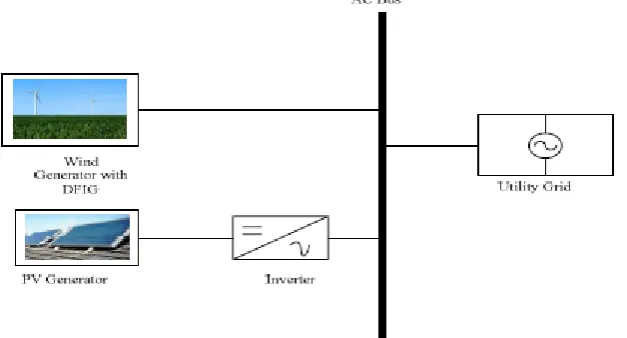
The inverter changes over the DC yield from non-customary vitality into valuable AC control for the associated burden. This cross breed framework works under typical conditions which incorporate ordinary room temperature on account of sun powered vitality and ordinary breeze speed at plain region on account of wind vitality. The reenactment results are exhibited to represent the working guideline, practicality and unwavering quality of this proposed framework.
Fig.4 Proposed Model of Grid Connected wind solar power system
V. SIMULATION RESULTS
ISSN(Online): 2319-8753 ISSN (Print): 2347-6710
I
nternational
J
ournal of
I
nnovative
R
esearch in
S
cience,
E
ngineering and
T
echnology
(A High Impact Factor, Monthly, Peer Reviewed Journal) Visit: www.ijirset.com
Vol. 8, Issue 8, August 2019
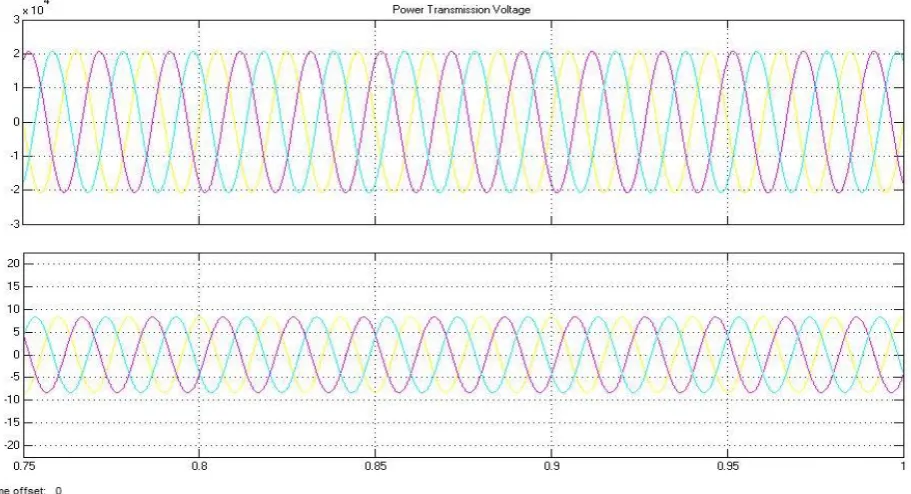
Fig. 5 Power Transmission voltage
VI. CONCLUSION
A model of PV module is created and analysed in changing temperature and irradiation. Design and simulation of boost convertor is done. To alter the pulse from gate comprising high frequency MPPT algorithm with boost convertor is utilized.
The MPPT techniques that is P&O strategies are utilized for most extreme PowerPoint following. The calculations from P&O method is non-complex in function and need few hardware input in comparison to the process of incremental conductance, however the losses in power is big in this process with respect to incremental conductance as
ISSN(Online): 2319-8753 ISSN (Print): 2347-6710
I
nternational
J
ournal of
I
nnovative
R
esearch in
S
cience,
E
ngineering and
T
echnology
(A High Impact Factor, Monthly, Peer Reviewed Journal) Visit: www.ijirset.com
Vol. 8, Issue 8, August 2019
photovoltaic power age, a proficient control strategy that is (P&O) ought to be picked
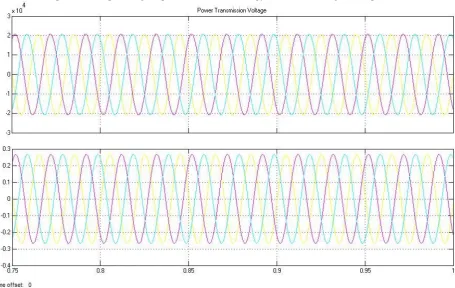
Fig. 6 Power Transmission voltage of distributed generation
VII. CONCLUSION
A model of PV module is created and analysed in changing temperature and irradiation. Design and simulation of boost convertor is done. To alter the pulse from gate comprising high frequency MPPT algorithm with boost convertor is utilized.
The MPPT techniques that is P&O strategies are utilized for most extreme PowerPoint following. The calculations from P&O method is non-complex in function and need few hardware input in comparison to the process of
incremental conductance, however the losses in power is big in this process with respect to incremental conductance as the result parameters from the range of PV fluctuates in the MPP. So as to accomplish most extreme productivity of photovoltaic power age, a proficient control strategy that is (P&O) ought to be picked
REFERENCES
[1.] Abderrahim, T. and Said, B. (2017) ‘Control and Management of Grid Connected PV-Battery Hybrid System Based on Three- level DCI’, pp. 439–444.
[2.] Al-durra, A., Reznik, A. and Muyeen, S. M. (2014) ‘Performance Analysis of a Grid-tied Inverter for Renewable Energy Applications’. [3.] Chen, F. (2012) ‘Modeling Grid Connection for Solar and Wind Energy’, pp. 1–6.
[4.] Dali, M., Belhadj, J. and Roboam, X. (2010) ‘Hybrid solar e wind system with battery storage operating in grid – connected and standalone mode : Control and energy management e Experimental investigation V bat’, Energy. Elsevier Ltd, 35(6), pp. 2587–2595. doi: 10.1016/j.energy.2010.03.005.
[5.] Gupta, P. and Tripathi, S. K. (2014) ‘Analysis of Grid-Tied Hybrid Wind PV Generation System’, (November), pp. 447–451.
ISSN(Online): 2319-8753 ISSN (Print): 2347-6710
I
nternational
J
ournal of
I
nnovative
R
esearch in
S
cience,
E
ngineering and
T
echnology
(A High Impact Factor, Monthly, Peer Reviewed Journal) Visit: www.ijirset.com
Vol. 8, Issue 8, August 2019
[7.] Mahmud, N., Zahedi, A. and Mahmud, A. (2016) ‘Dynamic voltage regulation of grid-tied renewable energy system with ANFIS’. [8.] P, L. R. S. et al. (2014) ‘Design and Simulation of Grid Connected Hybrid Solar-WECS Using SIMULINK / MATLAB’, pp. 241–247. [9.] Patel, S., Prajapati, N. and Patel, T. (2016) ‘Grid Connected Solar and Wind Hybrid System’, 2(12), pp. 300–307.
[10.] Phap, V. M., Yamamura, N. and Ishida, M. (2016) ‘Design of Novel Grid-Tied Solar - Wind Hybrid Power Plant Using Photovoltaic Cell Emulating System’, (1), pp. 186–189.
[11.] Soetedjo, A. et al. (2017) ‘A Hardware Testbed of Grid-Connected Wind-Solar Power System’, 1(2), pp. 52–56.