ISSN: 2319-8753
International Journal of Innovative Research in Science, Engineering and Technology Vol. 2, Issue 7, July 2013
AUTOMATIC WALL PAINTING ROBOT
P.Keerthanaa
1, K.Jeevitha
2, V.Navina
3, G.Indira
4, S.Jayamani
5Student, Department of Electronics and Communication Engineering, K.S.Rangasamy College of Technology,
Tiruchengode, Tamilnadu, India 1,2,3,4
Assistant Professor, Department of Electronics and Communication Engineering, K.S.Rangasamy College of
Technology, Tiruchengode, Tamilnadu, India 5
Abstract: The primary aim of the project is to design, develop and implement Automatic Wall Painting Robot which helps to achieve low cost painting equipment. Despite the advances in robotics and its wide spreading applications, interior wall painting has shared little in research activities. The painting chemicals can cause hazards to the human painters such as eye and respiratory system problems. Also the nature of painting procedure that requires repeated work and hand rising makes it boring, time and effort consuming. When construction workers and robots are properly integrated in building tasks, the whole construction process can be better managed and savings in human labour and timing are obtained as a consequence. In addition, it would offer the opportunity to reduce or eliminate human exposure to difficult and hazardous environments, which would solve most of the problems connected with safety when many activities occur at the same time. These factors motivate the development of an automated robotic painting system.
Keywords: Building automation; Robotics; Construction; Spray Painting; Safety
I. INTRODUCTION
Building and construction is one of the major industries around the world. In this fast moving life construction industry is also growing rapidly. But the labors in the construction industry are not sufficient. This insufficient labors in the construction industry is because of the difficulty in the work. In construction industry, during the work in tall buildings or in the sites where there is more risky situation like interior area in the city. There are some other reasons for the insufficient labor which may be because of the improvement the education level which cause the people to think that these types of work is not as prestigious as the other jobs.
The construction industry is labor-intensive and conducted in dangerous situations; therefore the importance of construction robotics has been realized and is grown rapidly
.
Applications and activities of robotics and automation in this construction industry started in the early 90‟s aiming to optimize equipment operations, improve safety, enhance perception of workspace and furthermore, ensure quality environment for building occupant. After this, the advances in the robotics and automation in the construction industry has grown rapidly.Despite the advances in the robotics and its wide spreading applications, painting is also considered to be the difficult process as it also has to paint the whole building. To make this work easier and safer and also to reduce the number of labors automation in painting was introduced. The automation for painting the exterior wall in buildings has been proposed. Above all these the interior wall painting has shared little in research activities. The painting chemicals can cause hazards to the painters such as eye and respiratory system problems. Also the nature of painting procedure that requires repeated work and hand rising makes it boring, time and effort consuming. These factors motivate the development of an automated robotic painting system. This project aims to develop the interior wall painting robot.
This automatic wall painting robot is not designed using complicated components. This robot is simple and portable. The robot is designed using few steels, conveyor shaft, spray gun and a controller unit to control the entire operation of the robot. This robot is compact because of high speed and pressure capabilities they have. They also have a very small weight to power output ratio and predictable performance ie., losses are minimum due to less number of moving parts and so gives expected performance. Due to elegant and simple control systems it can control noise vibration and does silent operation and no vibration is produced. It has longer life, flexibility and it is efficient and dependable, and the installation is simple and the maintenance is also easy. Some of the conditions that have to be considered while using this robot is that the system is operates in pneumatics, so it needs air tank or compressor and the electric shock is always there, which makes the machines ugly and dust and dirt are adhering to them. The life of the parts like seals, packing and gaskets etc., are very short but, they are essential to prevent leakage so that the system becomes costlier.
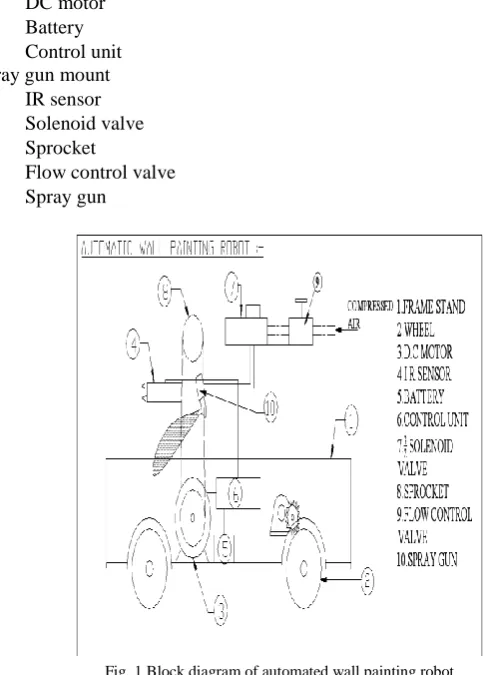
The construction of the automatic wall painting robot consists of two main parts. They are 1. Mobile platform
Frame stand
DC motor
Battery
Control unit 2. Spray gun mount
IR sensor
Solenoid valve
Sprocket
Flow control valve
Spray gun
Fig. 1 Block diagram of automated wall painting robot
II. THE MOBILE PLATFORM DESIGN
A. Frame Stand and Wheel
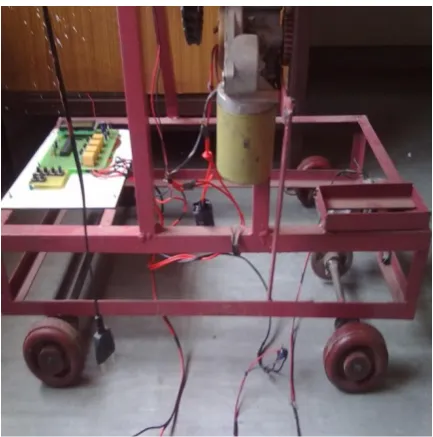
The frame stand is the steel welded in such a way that it can carry the whole equipment. The steels are welded strongly in welding laboratory with an idea to carry the entire robot with the control unit, battery and DC motor in the mobile platform and the IR sensor, solenoid valve and spray gun in the roller shaft .Four wheels are attached to the frame stand in order to move the robot in the direction specified. The movement of these wheels are controlled by the DC motor rotation which is controlled by the microcontroller. Since it is obvious that if either the movement of front or back wheels are controlled automatically the movement of the other one will be controlled. Therefore, in this robot the movement of the back wheels are controlled using the DC motor such that the movement of entire robot is controlled. The arrangement of the frame and wheel is shown in Fig. 2.
B. Dc motor
DC motors are part of the electric motors using DC power as energy source. These devices transform electrical energy into mechanical energy. The basic principle of DC motors is same as electric motors in general, the magnetic interaction between the rotor and the stator that will generate spin.
ISSN: 2319-8753
International Journal of Innovative Research in Science, Engineering and Technology Vol. 2, Issue 7, July 2013
Fig. 2 Frame stand with wheel arrangement
Controlling of DC motor using Microcontroller
1. Microcontroller provides us only digital logic (1 or o) 2. The polarity can‟t be provided from microcontroller
3. The motors can‟t be connected to Controller as mostly motors runs on voltage higher that +5V, and motors demands high current (depends),this can be remove by use of a “H Bridge ”here four transistors are used to change polarity
1) Specification of DC motor: The specification the DC motor used in this project is mentioned as follows:
Voltage -12V
No load speed -810 rpm
Load speed -120rpm
No load current -75mA
Load current -1400mA
Power -17W
C. Battery
In order to provide supply to the controller unit battery is used. Lead acid battery is used in this project. The lead-acid battery is a rechargeable battery. Despite having a very low weight ratio and a low energy-to-volume ratio, their ability to supply high surge currents means that the cells maintain a relatively large power-to-weight ratio. These features, along with their low cost, make them attractive for use in motor vehicles to provide the high current required by automobile starter motors.
D. Control unit
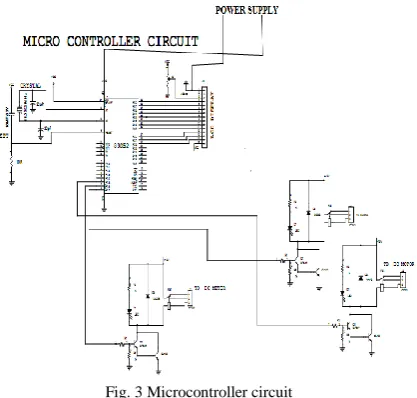
The microcontroller used in the controller unit is AT89c52. The microcontroller unit is used to control the DC motors and the movement of spray gun fitted on the conveyor belt. Microcontroller unit is provided with the 5V signal and as soon as the supply is ON, LCD gets initialized. The controller sets to setting mode and the moving and painting distance are given as input to the microcontroller. The microcontroller controls the rotation of DC motor based on the distances given in order to control the wheel and conveyor belt movement. When IR receiver receives the signal, the conveyor belt moves and the spray gun goes to ON condition and if the conveyor belt stops, the spray gun goes to OFF condition. It contains relays for the control of forward and backward movement of the DC motors.
1) Programming in AT89c52: The Keil Cx51 ANSI C Complier supports all classic and extended 8051 device variants. Compiler extensions provide full access to all CPU resources and support up to 16MB memory. The Keil Cx51 generates code with the efficiency and speed of hand-optimized assembly. New compiler and linker optimizations shrink programs into the smallest single-chip devices. The Keil µVision4 IDE fully integrates Cx51 Version 9 and provides control of the Compiler, Assembler, Real-Time OS, Project Manager and Debugger in a single, intelligent environment. With support for all 8051 devices and full compatibility with emulators and third-party tools, Keil Cx51 is clearly the best choice for your 8051 project.
Fig. 3 Microcontroller circuit
E. Power Supply Unit
The DC level obtained from a sinusoidal input can be improved 100% using a process called full-wave rectification. It used 2 diodes in this configuration. From the basic configuration we see that one diode is conducting while the other one diode is in “off” state during the period t = 0 to T/2 Accordingly for the negative of the input the conducting diodes. Thus the polarity across the load is the same.
The filter circuit used here is the capacitor filter circuit where a capacitor is connected at the rectifier output, and a DC is obtained across it. The filtered waveform is essentially a DC voltage with negligible ripples, which is ultimately fed to the load.
F. Liquid Crystal Display
ISSN: 2319-8753
International Journal of Innovative Research in Science, Engineering and Technology Vol. 2, Issue 7, July 2013
Fig.4 LCD display
G. Relay
Relays are used throughout the automobile. Relays which come in assorted sizes, ratings, and applications, are used as remote control switches. A typical vehicle can have 20 relays or more. The Fig.5 shows the connection of relay with the microcontroller.
Fig.5 Relay connection
H. Bearings
Fig.6 Structure of bearing
I. Gear Wheel Mechanism
The spur gears, which are designed to transmit motion and power between parallel shafts, are the most economical gears in the power transmission industry. The spur gear arrangement is used to move the conveyor in forward and direction. The gear wheel mechanism arrangement is shown in Fig.7 and Fig.8.
ISSN: 2319-8753
International Journal of Innovative Research in Science, Engineering and Technology Vol. 2, Issue 7, July 2013
Fig.8 Structure of gear wheel-2
III. SPRAY GUN MOUNT DESIGN
A. IR sensor
IR sensor is used for this project. IR (Infrared) is the typical light source being used in the sensor for robot to detect opaque object. In this project, no programming, microcontroller and soldering are required. IR Sensor (IR Receiver and IR Emitter) the basic principle of IR sensor is based on an IR emitter and an IR receiver. IR emitter will emit infrared continuously when power is supplied to it. On the other hand, the IR receiver will be connected and perform the task of a voltage divider. IR receiver can be imagined as a transistor with its base current determined by the intensity of IR light received.
1) IR Sensor Features: Input voltage: 5VDC
Sensing Range: 15cm
Output signal: analog voltage
Emitting element: Infrared LED
Fig.9 IR transmitter circuit
Fig.10 IR receiver circuit
The IR transmitting circuit is used in many projects. The IR transmitter sends 40 kHz (frequency can be adjusted) carrier under computer control (computer can turn the IR transmission on and off). IR carriers at around 40 kHz carrier frequencies are widely used in TV remote controlling and ICs for receiving these signals are quite easily available.
At normal condition
The IR transmitter sensor is transmitting the infrared rays with the help of 555 IC timer circuit. These infrared rays are received by the IR receiver sensor. The Transistor T1, T2 and T3 are used as an amplifier section. At normal condition Transistor T5 is OFF condition. At that time relay is OFF, there is no signal given to the microcontroller unit.
Obstacle crossing time
ISSN: 2319-8753
International Journal of Innovative Research in Science, Engineering and Technology Vol. 2, Issue 7, July 2013
Fig.11 Solenoid valve
IV. EXPERIMENTAL SETUP AND PROCEDURE
A. Experimental Setup
The construction of Paint Spraying equipment consists of a frame which is used for mounting the components such as D.C motor, Battery, electronic timer unit, solenoid valves, flow control valve and spur gear arrangement. The stand (or) base is to carry the whole machine. The whole experimental setup is shown in Fig.12. The two conveyor roller is fixed to the two ends of the frame stand with the help of end bearing with bearing cap. The conveyor roller shaft is coupled to the D.C. permanent magnet motor with the help of spur gear mechanism. This total arrangement is used to transfer the material from one place to another place with the help of conveyor.
Fig.12 Experimental setup
B. IR Sensor Setup
Fig.13 IR sensor experimental setup
The zener diode (5.6 Volt) also used to cut off the high voltage signal from the input signal. The sensors are giving the low output signal when there is any object in there conveyor. The experimental setup of IR sensor is shown in Fig.13
C. Spraygun Setup
Fig.14 Spraygun setup
The Fig.14 shows the experimental setup of spraygun in which the silver colored box is the spray gun. The board covered with the plastic box is the IR sensor circuit since it is covered with plastic box in order to avoid unneccessary detection of walls on the sides.
D. Microcontroller Setup
ISSN: 2319-8753
International Journal of Innovative Research in Science, Engineering and Technology Vol. 2, Issue 7, July 2013
Fig.15 Microcontroller Setup
E. Mobile Platform Setup
Fig.16 Mobile platform setup
The Fig.16 shows the experimental setup of mobile platform. The steels welded together to carry the entire robot is considered to be the platform which is fitted with four wheels for the movement of robot such that making it to be mobile platform.
V. RESULTS AND DISCUSSIONS
A. IR Sensor Results
Fig.17 Output at normal condition.
Fig.18 shows the result of IR sensor at the presence of wall. When the robot is at certain distance from the wall it can sense the wall and the LED glows to indicate it. These sensed signals will be sent to the controller to control the solenoid valve.
Fig.18 Output at presence of wall
B. Microcontroller Unit Results
The microcontroller unit is connected to the 12V battery but it requires 5V supply, hence voltage regulator is used to convert 12V to 5V.When supply is given the LCD gets initialized and it displays as „AUTOMATIC WALL PAINTING ROBOT‟. The Fig.19 shows the output of LCD initialization.
ISSN: 2319-8753
International Journal of Innovative Research in Science, Engineering and Technology Vol. 2, Issue 7, July 2013
Fig.19 LCD initialisation
Fig.20 Moving distance input
The Fig.20 and Fig.21 shows the moving distance and painting distance input. For the robot to start painting the start button has to be pressed. The robot continues to paint till the wall ends by having painting distance as its breath of the wall. The Fig.22 shows the indication of painting robot in the diplay.
Fig.22 Robot starts to paint
The Fig.23 shows the indication of the movement of robot in while painting. The movement of the robot wil be in one direction along the wall.
Fig.23 Mobile platform moves
VI. CONCLUSION
ISSN: 2319-8753
International Journal of Innovative Research in Science, Engineering and Technology Vol. 2, Issue 7, July 2013
REFERENCES
[1] Mohamed T. Sorour, Mohamed A. Abdellatif, Ahmed A. Ramadan, and Ahmed A. Abo-Ismail, Development of Roller-Based Interior Wall
Painting Robot, World Academy of Science, Engineering and Technology Vol 59 2011.
[2] S.m.s.Elattar, Automation and robotics in construction: Opportunities and challenges, Emirates journal for engineering research, Vol no 13 (2),
Page no 21-26 2008
[3] Naticchia, A. Giretti, A. Carbonari,Set up of a robotized system for interior wall painting, Proceedings of the 23rd ISARC, October 3-5,Tokyo,
Japan, 2006.
[4] Johan Forsberg Roger AarenstrupAke Wernersson, A Construction Robot for Autonomous Plastering of Walls and Ceilings, Vol 6, 2000.
[5] Jayshree sahu, S.K.Sahu, Jayendra Kumar, Microcontroller Based Dc Motor Control, International Journal of Engineering Research &