Design & Development of a Secure Mechanism to Improve
Location Privacy with Minimum Performance Overhead for
Mobile Devices
T. Shiva Prasad
1; A.Sravanthi
2& Prof.Dr.G.Manoj Someswar
31
M.Tech.(CSE) from Narasimha Reddy Engineering College, Affiliated to JNTUH, Hyderabad,
Telangana, India
2
M.Tech. (CSE), Assistant Professor, Department of CSE, Narasimha Reddy Engineering College,
Affiliated to JNTUH, Hyderabad, Telangana, India
3
B.Tech., M.S.(USA), M.C.A., Ph.D., Principal & Professor, Department Of CSE, Anwar-ul-uloom
College of Engineering & Technology, Affiliated to JNTUH, Vikarabad, Telangana, India
ABSTRACT:
Using geosocial applications, such as FourSquare, millions of people interact with their surroundings
through their friends and their recommendations. Without adequate privacy protection, however, these
systems can be easily misused, for example, to track users or target them for home invasion. In this
research paper, we introduce LocX, a novel alternative that provides significantly improvedlocation
privacy without adding uncertainty into query results or relying on strong assumptions about server
security. Our key insight is to apply secure user-specific, distance-preserving coordinate transformations
to all location data shared with the server. The friends of a user share this user’s secrets so they can apply
the same transformation. This allows all location queries to be evaluated correctly by the server but our
privacy mechanisms guarantee that servers are unable to see or infer the actual location data from the
transformed data or from the data access. We show that LocX provides privacy even against a powerful
adversary model, and we use prototype measurements to show that it provides privacy with very little
performance overhead, making it suitable for today’s mobile devices.
KEYWORDS:
Private Information Retrieval (PIR); Global System for Mobile communications (GSM);
Digital Audio Broadcasting (DAB); Global Positioning System (GPS)
INTRODUCTION
Mobile computing is the discipline for creating an information management platform, which is free from spatial and temporal constraints. The freedom from these constraints allows its users to access and process desired information from anywhere in the space. The state of the user, static or mobile, does not affect the information management capability of the mobile platform. A user can continue to access and manipulate desired data while traveling on plane, in
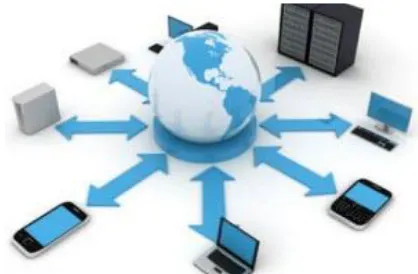
Figure 1: Structure of mobile computing
Different types of devices used for the mobile computing:
1. Personal digital assistant/enterprise digital assistant
2. Smartphones 3. Tablet computers
4. Netbooks
5. Ultra-mobile PCs 6. Wearable computers
7. Palmtops/pocket computers[2] Applications of Mobile Computing:
1. Vehicles:
Tomorrow‟s cars will comprise many wireless communication systems and mobility aware applications. Music, news, road conditions, weather reports, and other broadcast information are received via digital audio broadcasting (DAB) with 1.5 M-bits/s. For personal communication, a global system for mobile communications (GSM) phone might be available offering voice and data connectivity with 384 k-bits/s. For remote areas satellite communication can be used, while the current position of the car is determined via global positioning system (GPS). Additionally, cars driving in the same area build a local ad-hoc network for fast information exchange in emergency situations or to help each other keeping a safe distance. In case of an accident, not only will the airbag be triggered, but also an emergency call to a service provider informing ambulance and police. Cars with this technology are already available. Future cars will also inform other cars about accidents via the ad hoc network to help them slow down in
time, even before a driver can recognize the accident. Buses, trucks, and train are already transmitting maintenance and logistic information to their home base, which helps o improve organization (fleet management), and thus save time and money.
2. Emergency:
Just imagine the possibilities of an ambulance with a high quality wireless connection to a hospital. After an accident, vital information about injured persons can be sent to the hospital immediately. There, all necessary steps for this particular type of accident can be prepared or further specialists can be consulted for an early diagnosis. Furthermore, wireless networks are the only means of communication in the case of natural disasters such as hurricanes or earthquakes.
3. Business:
Today‟s typical traveling salesman needs instant access to the company‟s database: to ensure that the files on his or her laptop reflect the actual state, to enable the company to keep track of all activities of their traveling employees, to keep databases consistent etc., with wireless access, the laptop can be turned into a true mobile office.[3] Benefits of Mobile Computing:
Improve business productivity by streamlining interaction and taking advantage of immediate access
Reduce business operations costs by
increasing supply chain visibility, optimizing logistics and accelerating processes
Strengthen customer relationships by creating more opportunities to connect, providing information at their fingertips when they need it most
Gain competitive advantage by creating brand differentiation and expanding customer experience
Increase work force effectiveness and
capability by providing on-the-go access
Improve business cycle processes by
devices that interface with legacy applications[4]
Advantages of Mobile Computing:
Mobile computing has changed the complete landscape of human being life. Following are the clear advantages of Mobile Computing:
1. Location flexibility:
This has enabled user to work from anywhere as long as there is a connection established. A user can work without being in a fixed position. Their mobility ensures that they are able to carry out numerous tasks at the same time perform their stated jobs.
2. Saves Time:
The time consumed or wasted by travelling from different locations or to the office and back, have been slashed. One can now access all the important documents and files over a secure channel or portal and work as if they were on their computer. It has enhanced telecommuting in many companies. This also reduces unnecessary expenses that might be incurred.
3. Enhanced Productivity:
Productive nature has been boosted by the fact that a worker can simply work efficiently and effectively from which ever location they see comfortable and suitable. Users are able to work with comfortable environments.
4. Ease of research:
Research has been made easier, since users will go to the field and search for facts and feed them back to the system. It has also made it easier for field officer and researchers to collect and feed data from wherever they without making unnecessary trip to and from the office to the field.
5. Entertainment:
Video and audio recordings can now be streamed on the go using mobile computing. It's easy to access a wide variety of movies, educational and informative material. With the improvement and availability of high speed data connections at considerable costs, one is able to get all the entertainment they want as they browser the internet for streamed data. One can be
able to watch news, movies, and documentaries among other entertainment offers over the internet. This was not such before mobile computing dawned on the computing world.
6. Streamlining of Business Processes:
Business processes are now easily available through secured connections. Basing on the factor of security, adequate measures have been put in place to ensure authentication and authorization of the user accessing those services.
Some business functions can be run over secure links and also the sharing of information between business partners. Also it's worth noting that lengthy travelling has been reduced, since there is the use of voice and video conferencing.
Meetings, seminars and other informative services can be conducted using the video and voice conferencing. This cuts down on travel time and expenditure.[5] LITERATURE SURVEY
complexity of computing a KNN query to O(K × 22N/n) and transferring the results to the client in O(K), respectively, where N, the Hilbert curve degree, is a small constant.[7] Our results show that we very closely approximate the result set generated from performing KNN queries in the original space while enforcing our new location privacy metrics termed u-anonymity and a-u-anonymity, which are stronger and more generalized privacy measures than the commonly used K-anonymity and cloaked region size measures.[8]
tutorial article, which has been submitted for publication in a journal or for consideration by the commissioning organization. The report represents the ideas of its author, and should not be taken as the official views of the School or the University. Any discussion of the content of the report should be sent to the author, at the address shown on the cover. Intelligent transportation systems increasingly depend on probe vehicles to monitor traffic: they can automatically report position, travel time, traffic incidents, and road surface problems to a telematics service provider. This kind of traffic-monitoring system could provide good coverage and timely information on many more roadways than is possible with a fixed infrastructure such as cameras and loop detectors. This approach also promises significant reductions in infrastructure cost because the system
can exploit the sensing, computing, and
communications devices already installed in many modern vehicles. This architecture separates data from identities by splitting communication from data analysis. Data suppression techniques can help prevent data mining algorithms from reconstructing private information from anonymous database samples.[9] In a mobile service scenario, users query a server for nearby points of interest but they may not want to disclose their locations to the service. Intuitively, location privacy may be obtained at the cost of query performance and query accuracy. The challenge addressed is how to obtain the best possible performance, subjected to given requirements for
location privacy and query accuracy. Existing privacy solutions that use spatial cloaking employ complex server query processing techniques and entail the transmission of large quantities of intermediate result. Solutions that use transformation-based matching generally fall short in offering practical query accuracy
guarantees. Our proposed framework, called
SpaceTwist, rectifies these shortcomings for k nearest neighbor (kNN) queries.[10] Starting with a location different from the user's actual location, nearest neighbors are retrieved incrementally until the query is answered correctly by the mobile terminal. This approach is flexible, needs no trusted middleware, and requires only well-known incremental NN query processing on the server.[11] The framework also includes a server-side granular search technique that exploits relaxed query accuracy guarantees for obtaining better performance.[12] The paper reports on empirical studies that elicit key properties of Spacetwist and suggest that the framework offers very good performance and high privacy, at low communication cost.[13]
The expanding use of location-based services has profound implications on the privacy of personal information. In this paper, we propose a framework for preserving location privacy based on the idea of sending to the service provider suitably modified
location information. Agents execute data
transformation and the service provider directly processes the transformed dataset.[14] Our technique not only prevents the service provider from knowing the exact locations of users, but also protects information about user movements and locations from being disclosed to other users who are not authorized to access this information. We also define a privacy model to analyze our framework, and examine our approach experimentally.[15]
SYSTEM STUDY FEASIBILITY STUDY
cost estimates. During system analysis the feasibility study of the proposed system is to be carried out. This is to ensure that the proposed system is not a burden to the company. For feasibility analysis, some understanding of the major requirements for the system is essential.
Three key considerations involved in the feasibility analysis are
ECONOMICAL FEASIBILITY
TECHNICAL FEASIBILITY
SOCIAL FEASIBILITY
ECONOMICAL FEASIBILITY
This study is carried out to check the economic impact that the system will have on the organization. The amount of fund that the company can pour into the research and development of the system is limited. The expenditures must be justified. Thus the developed system as well within the budget and this was achieved because most of the technologies used are freely available. Only the customized products had to be purchased.
TECHNICAL FEASIBILITY
This study is carried out to check the technical feasibility, that is, the technical requirements of the system. Any system developed must not have a high demand on the available technical resources. This will lead to high demands on the available technical resources. This will lead to high demands being placed on the client. The developed system must have a modest requirement, as only minimal or null changes are required for implementing this system.
SOCIAL FEASIBILITY
The aspect of study is to check the level of acceptance of the system by the user. This includes the process of training the user to use the system efficiently. The user must not feel threatened by the system, instead must accept it as a necessity. The level of acceptance by the users solely depends on the methods that are employed to educate the user about the system and to make him familiar with it. His level of confidence must be raised so that he is also able to
make some constructive criticism, which is welcomed, as he is the final user of the system.
SYSTEM DESIGN
SYSTEM ARCHITECTURE:
Figure 2: System Architecture DATA FLOW DIAGRAM:
1. The DFD is also called as bubble chart. It is a simple graphical formalism that can be used to represent a system in terms of input data to the system, various processing carried out on this data, and the output data is generated by this system.
2. The data flow diagram (DFD) is one of the most important modeling tools. It is used to
model the system components. These
components are the system process, the data used by the process, an external entity that interacts with the system and the information flows in the system.
3. DFD shows how the information moves
through the system and how it is modified by a series of transformations. It is a graphical technique that depicts information flow and the transformations that are applied as data moves from input to output.
Figure 3: Data flow Diagram UML DIAGRAMS
UML stands for Unified Modeling Language. UML is a standardized general-purpose modeling language in the field of object-oriented software engineering. The standard is managed, and was created by, the Object Management Group.
The goal is for UML to become a common language for creating models of object oriented computer software. In its current form UML is comprised of two major components: a Meta-model and a notation. In the future, some form of method or process may also be added to; or associated with, UML.
The Unified Modeling Language is a standard language for specifying, Visualization, Constructing and documenting the artifacts of software system, as well as for business modeling and other non-software systems.
The UML represents a collection of best engineering practices that have proven successful in the modeling of large and complex systems.
The UML is a very important part of developing objects oriented software and the software development process. The UML uses mostly graphical notations to express the design of software projects. GOALS:
The Primary goals in the design of the UML are as follows:
1. Provide users a ready-to-use, expressive visual modeling Language so that they can develop and exchange meaningful models.
2. Provide extendibility and specialization mechanisms to extend the core concepts. 3. Be independent of particular programming
languages and development process.
4. Provide a formal basis for understanding the modeling language.
5. Encourage the growth of OO tools market. 6. Support higher level development concepts
such as collaborations, frameworks, patterns and components.
7. Integrate best practices. USE CASE DIAGRAM:
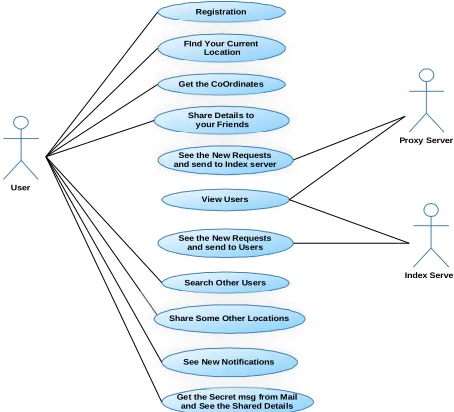
A use case diagram in the Unified Modeling Language (UML) is a type of behavioral diagram defined by and created from a Use-case analysis. Its purpose is to present a graphical overview of the functionality provided by a system in terms of actors, their goals (represented as use cases), and any dependencies between those use cases. The main purpose of a use case diagram is to show what system functions are performed for which actor. Roles of the actors in the system can be depicted.
User
Registration
Get the Secret msg from Mail and See the Shared Details
FInd Your Current Location
Get the CoOrdinates
Share Details to your Friends
See the New Requests and send to Index server
View Users
Search Other Users
Proxy Server
Index Server See the New Requests
and send to Users
Share Some Other Locations
See New Notifications
CLASS DIAGRAM:
In software engineering, a class diagram in the Unified Modeling Language (UML) is a type of static structure diagram that describes the structure of a system by showing the system's classes, their attributes, operations (or methods), and the relationships among the classes. It explains which class contains information.
Figure 5: Class Diagram SEQUENCE DIAGRAM:
A sequence diagram in Unified Modeling Language (UML) is a kind of interaction diagram that shows how processes operate with one another and in what order. It is a construct of a Message Sequence Chart. Sequence diagrams are sometimes called event diagrams, event scenarios, and timing diagrams.
Figure 6: Sequence Diagram
ACTIVITY DIAGRAM:
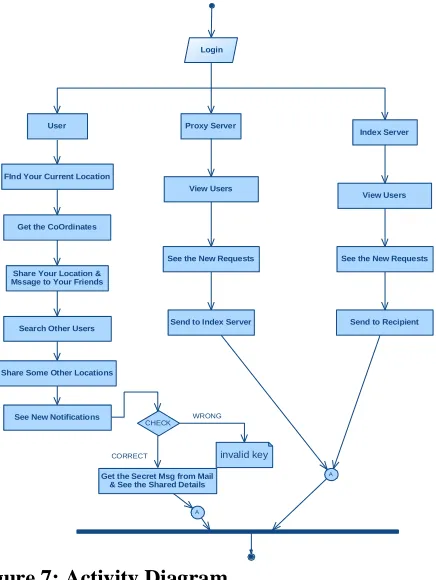
Activity diagrams are graphical representations of workflows of stepwise activities and actions with support for choice, iteration and concurrency. In the Unified Modeling Language, activity diagrams can be used to describe the business and operational step-by-step workflows of components in a system. An activity diagram shows the overall flow of control.
A
Login
Index Server
Share Your Location & Mssage to Your Friends
User
View Users
Get the CoOrdinates
Search Other Users
CHECK
CORRECT
WRONG
See the New Requests
Send to Recipient
invalid key
FInd Your Current Location
A
Proxy Server
View Users
See the New Requests
Send to Index Server
Share Some Other Locations
See New Notifications
Get the Secret Msg from Mail & See the Shared Details
Figure 7: Activity Diagram INPUT DESIGN
The input design is the link between the information system and the user. It comprises the developing specification and procedures for data preparation and those steps are necessary to put transaction data in to a usable form for processing can be achieved by inspecting the computer to read data from a written or printed document or it can occur by having people keying the data directly into the system. The design of input focuses on controlling the amount of input required, controlling the errors, avoiding delay, avoiding extra steps and keeping the process simple. The input is designed in such a way so that it provides
User Proxy Server Index Server
Find Your Current Location
LBSA
Get the CoOrdinates
Share Your Location & Msg to Your Friends
View Users
View Users
See the New Requests See the New Requests
Send to Index Server
Send to Users
Search Other Users Share Some Other Locations
See New Notifications
security and ease of use with retaining the privacy. Input Design considered the following things:
What data should be given as input?
How the data should be arranged or coded?
The dialog to guide the operating personnel in providing input.
Methods for preparing input validations and steps to follow when error occur.
OBJECTIVES
1.Input Design is the process of converting a user-oriented description of the input into a computer-based system. This design is important to avoid errors in the data input process and show the correct direction to the management for getting correct information from the computerized system.
2.It is achieved by creating user-friendly screens for the data entry to handle large volume of data. The goal of designing input is to make data entry easier and to be free from errors. The data entry screen is designed in such a way that all the data manipulates can be performed. It also provides record viewing facilities. 3.When the data is entered it will check for its validity. Data can be entered with the help of screens. Appropriate messages are provided as when needed so that the user
will not be in maize of instant. Thus the objective of input design is to create an input layout that is easy to follow
OUTPUT DESIGN
A quality output is one, which meets the requirements of the end user and presents the information clearly. In any system results of processing are communicated to the users and to other system through outputs. In output design it is determined how the information is to be displaced for immediate need and also the hard copy output. It is the most important and direct source information to the user. Efficient and intelligent output design improves the system‟s relationship to help user decision-making.
1. Designing computer output should proceed in an organized, well thought out manner; the right output must be developed while ensuring that each output
element is designed so that people will find the system can use easily and effectively. When analysis design computer output, they should Identify the specific output that is needed to meet the requirements.
2.Select methods for presenting information.
3.Create document, report, or other formats that contain information produced by the system.
The output form of an information system should accomplish one or more of the following objectives.
Convey information about past activities, current status or projections of the
Future.
Signal important events, opportunities, problems, or warnings.
Trigger an action.
Confirm an action. SYSTEM ANALYSIS EXISTING SYSTEM:
Existing systems have mainly taken three approaches to improving user privacy in geosocial systems:
Introducing uncertainty or error into location data.
Relying on trusted servers or intermediaries to apply anonymization to user identities and private data.
private data can be exposed by either software bugs and configuration errors at the trusted servers or by malicious administrators. Finally, relying on heavy-weight cryptographic mechanisms to obtain provable privacy guarantees are too expensive to deploy on mobile devices and even on the servers in answering queries such as nearest neighbour and range queries. DISADVANTAGES OF EXISTING SYSTEM:
Location data privacy. The servers should not be able to view the content of data stored at a location.
This new functionality comes with
significantly increased risks to personal privacy.
PROPOSED SYSTEM:
In this paper, we propose LocX (short for location to index mapping), a novel approach to achieving user privacy while maintaining full accuracy in location-based social applications (LBSAs from here on ward). Our insight is that many services do not need to resolve distance-based queries between arbitrary pairs of users, but only between friends interested in each other‟s locations and data. Thus, we can partition location data based on users‟ social groups, and then perform transformations on the location coordinates before storing them on untrusted servers. A user knows the transformation keys of all her friends, allowing her to transform her query into the virtual coordinate system that her friends use. Our coordinate transformations preserve distance metrics, allowing an application server to perform both point and nearest-neighbour queries correctly on transformed data. However, the transformation is secure, in that transformed values cannot be easily associated with real-world locations without a secret, which is only available to the members of the social group. Finally, transformations are efficient, in that they incur minimal overhead on the LBSAs. This makes the applications built on LocX lightweight and suitable for running on today‟s mobile devices.
ADVANTAGES OF PROPOSED SYSTEM:
Our goal is to support both query types in an efficient fashion, suitable for today‟s mobile devices.
Flexibility to support point, circular range, and nearest-neighbour queries on location data.
Strong location privacy. The servers
processing the data (and the administrators of these servers) should not be able to learn the history of locations that a user has visited. SYSTEM TESTING
The purpose of testing is to discover errors. Testing is the process of trying to discover every conceivable fault or weakness in a work product. It provides a way to check the functionality of components, sub assemblies, assemblies and/or a finished product It is the process of exercising software with the intent of ensuring that the
Software system meets its requirements and user expectations and does not fail in an unacceptable manner. There are various types of test. Each test type addresses a specific testing requirement.
TYPES OF TESTS Unit testing
Unit testing involves the design of test cases that validate that the internal program logic is functioning properly, and that program inputs produce valid outputs. All decision branches and internal code flow should be validated. It is the testing of individual software units of the application .it is done after the completion of an individual unit before integration. This is a structural testing, that relies on knowledge of its construction and is invasive. Unit tests perform basic tests at component level and test a specific business process, application, and/or system configuration. Unit tests ensure that each unique path of a business process performs accurately to the documented specifications and contains clearly defined inputs and expected results.
Integration testing
as one program. Testing is event driven and is more concerned with the basic outcome of screens or fields. Integration tests demonstrate that although the components were individually satisfaction, as shown by successfully unit testing, the combination of components is correct and consistent. Integration testing is specifically aimed at exposing the problems that arise from the combination of components.
Functional test
Functional tests provide systematic
demonstrations that functions tested are available as specified by the business and technical requirements, system documentation, and user manuals.
Functional testing is centered on the following items: Valid Input : identified classes of valid input must be accepted.
Invalid Input : identified classes of invalid input must be rejected.
Functions : identified functions must be exercised.
Output : identified classes of application outputs must be exercised.
Systems/Procedures: interfacing systems or procedures must be invoked.
Organization and preparation of functional tests is focused on requirements, key functions, or special test cases. In addition, systematic coverage pertaining to identify Business process flows; data fields, predefined processes, and successive processes must be considered for testing. Before functional testing is complete, additional tests are identified and the effective value of current tests is determined.
System Test
System testing ensures that the entire integrated software system meets requirements. It tests a configuration to ensure known and predictable results. An example of system testing is the configuration oriented system integration test. System testing is based on process descriptions and flows, emphasizing pre-driven process links and integration points.
White Box Testing
White Box Testing is a testing in which in which the software tester has knowledge of the inner workings, structure and language of the software, or at least its purpose. It is purpose. It is used to test areas that cannot be reached from a black box level.
Black Box Testing
Black Box Testing is testing the software without any knowledge of the inner workings, structure or language of the module being tested. Black box tests, as most other kinds of tests, must be written from a definitive source document, such as specification or requirements document, such as specification or requirements document. It is a testing in which the software under test is treated, as a black box .you cannot “see” into it. The test provides inputs and responds to outputs without considering how the software works.
Unit Testing:
Unit testing is usually conducted as part of a combined code and unit test phase of the software lifecycle, although it is not uncommon for coding and unit testing to be conducted as two distinct phases. Test strategy and approach
Field testing will be performed manually and functional tests will be written in detail.
Test objectives
All field entries must work properly.
Pages must be activated from the identified link.
The entry screen, messages and responses must not be delayed.
Features to be tested
Verify that the entries are of the correct format No duplicate entries should be allowed
All links should take the user to the correct page.
Integration Testing
The task of the integration test is to check that components or software applications, e.g. components in a software system or – one step up – software applications at the company level – interact without error.
Test Results: All the test cases mentioned above passed successfully. No defects encountered.
Acceptance Testing
User Acceptance Testing is a critical phase of any project and requires significant participation by the end user. It also ensures that the system meets the functional requirements.
Test Results: All the test cases mentioned above passed successfully. No defects encountered.
IMPLEMENTATION MODULES:
1. Locx module 2. Proxy server 3. Index server 4. Data Server
MODULES DESCRIPTION: LocX Module:
Loc X builds on top of the basic design, and introduces two new mechanisms to overcome its limitations. First, in Loc X, we split the mapping between the location and its data into two pairs: a mapping from the transformed location to anencrypted index (called L2I), and a mapping from the index to the encrypted location data (called I2D). This splitting helps in making our system efficient. Second, users store and retrieve the L2Is via untrusted proxies. This redirection of data via proxies, together with splitting, significantly improves privacy in LocX. For efficiency, I2Ds are not proxied, yet privacy is preserved (as explained later).
Proxy Server Module:
Users store their L2Ison the index server via untrusted proxies. These proxies can be any of the following: Planet Lab nodes, corporate NAT sand email servers in a user‟s work places, a user‟s home and office desktops or laptops, or Tor nodes. We only need a
one-hop indirection between the user and the index server. These diverse types of proxies provide tremendous flexibility in proxying L2Is, thus a user can store her L2Is via different proxies without restricting herself to a single proxy. Furthermore, compromising these proxies by an attacker does not break users‟ location privacy, as (a) the proxies also only see transformed location coordinates and hence do not learn the users‟ real locations, and (b) due to the noise added toL2Is (described later). To simplify the description, for now, we assume that the proxies are non-malicious and do not collude with the index server. But we will later describe our solution in detail to even defend against colluding, malicious proxies. With this high-level overview, we now describe our solution to store and query data on the servers in detail. We also explain the challenges we faced, and the tradeoffs we made in making our solution secure and efficient.
Index Server Module:
First consider storing L2I on the index server. This transformation preserves the distances between points1, so circular range and nearest neighbor queries for a friend‟s location data can be processed in the same way on transformed coordinates as on real-world coordinates. Then the user generates a random index (i) using her random number generator and encrypts it with her symmetric key to obtain at the transformed coordinate on the index server via a proxy. The L2I is small in size and is application independent, as it always contains the coordinates and an encrypted random index. Thus the over head due to proxying is very small.
Data Server Module:
The user can directly storeI2Ds (location data) on the data server. This is both secure and efficient.
user is interested in another user‟s data, but not any information about the location of the users, or the content of the I2Ds, or the real-world sites to which the data in the encrypted blob corresponds to.
2)The content of I2Dis application dependent. For example, a location-based video or photo sharing service might share multiple MBs of data at each location. Since this data is not proxied, LocX still maintains the efficiency of today‟s systems.
RESULTS &CONCLUSION
This research paper describes the design, prototype implementation, and evaluation of LocX, a system for building location based social applications (LBSAs) while preserving user location privacy. LocX provides location privacy for users without injecting uncertainty or errors into the system, and does not rely on any trusted servers or components. LocX takes a novel approach to provide location privacy while maintaining overall system efficiency, by leveraging the social data-sharing property of the target applications. In LocX, users efficiently transform all their locations shared with the server and encrypt all location data stored on the server using inexpensive symmetric keys. Only friends with the right keys can query and decrypt a user‟s data. We introduce several mechanisms to achieve both privacy and efficiency in this process, and analyze their privacy properties. Using evaluation based on both synthetic and real-world LBSA traces, we find that LocX adds little computational and communication overhead to existing systems. Our LocX prototype runs efficiently even on resource constrained mobile phones. Overall, we believe that LocX takes a big step toward making location privacy practical for a large class of emerging geosocial applications.
REFERENCES
[1] M. Motani, V. Srinivasan, and P.S. Nuggehalli, “PeopleNet: Engineering a Wireless Virtual Social Network,” Proc. ACM MobiCom, 2005.
[2] M. Hendrickson, “The State of Location-Based
Social Networking on the iPhone,”
http://techcrunch.com/2008/09/28/the-state-oflocation-based-social-networking-on-the-iphone, 2008.
[3] P. Mohan, V.N. Padmanabhan, and R. Ramjee, “Nericell: Rich Monitoring of Road and Traffic Conditions Using Mobile Smartphones,” Proc. Sixth ACM Conf. Embedded Network Sensor Systems, 2008.
[4] G. Ananthanarayanan, V.N. Padmanabhan, L. Ravindranath, and C.A. Thekkath, “Combine: Leveraging the Power of Wireless Peers through Collaborative Downloading,” Proc. Fifth Int‟l Conf. Mobile Systems, Applications Services, 2007.
[5] M. Siegler, “Foodspotting is a Location-Based Game that Will Make Your Mouth Water,” http://techcrunch.com/2010/03/04/foodspotting, 2013.
[6] “SCVNGR,” http://www.scvngr.com, 2013.
[7] B. Schilit, J. Hong, and M. Gruteser, “Wireless Location Privacy Protection,” Computer, vol. 36, no. 12, pp. 135-137, Dec. 2003.
[8] F. Grace, “Stalker Victims Should Check for GPS,” http://www.cbsnews. com, Feb. 2003.
[9] A. Gendar and A. Lisberg, “How Cell Phone Helped Cops Nail Key Murder Suspect. Secret „Pings‟ that Gave Bouncer Away,” New York Daily News, Mar. 2006.
[10] “Police: Thieves Robbed Homes Based on Facebook, Social Media Sites,” WMUR News, http://www.wmur.com/r/24943582/detail.html, Sept. 2010.
[12] M.F. Mokbel, C.-Y. Chow, and W.G. Aref, “The New Casper: A Privacy-Aware Location-Based Database Server,” Proc. IEEE 23rd
Int‟l Conf. Data Eng., 2007.
[13] B. Gedik and L. Liu, “Location Privacy in Mobile Systems: A Personalized Anonymization Model,” Proc. IEEE 25th Int‟l Conf. Distributed Computing Systems, 2005.
[14] T. Jiang, H.J. Wang, and Y.-C. Hu, “Preserving Location Privacy in Wireless Lans,” Proc. Fifth Int‟l Conf. Mobile Systems, Applications Services, 2007.