Attacking Deterministic Signature Schemes using Fault Attacks
Damian Poddebniak∗, Juraj Somorovsky†, Sebastian Schinzel∗, Manfred Lochter‡ and Paul R¨osler†
∗M¨unster University of Applied Sciences
[email protected], [email protected]
†Chair for Network and Data Security, Ruhr University Bochum
[email protected], [email protected]
‡Federal Office for Information Security
Abstract
Many digital signature schemes rely on random numbers that are unique and non-predictable per signature. Failures of random number generators may have catastrophic effects such as com-promising private signature keys. In recent years, many widely-used cryptographic technologies adopted deterministic signature schemes because they are presumed to be safer to implement.
In this paper, we analyze the security of deterministic ECDSA and EdDSA signature schemes and show that the elimination of random number generators in these schemes enables new kinds of fault attacks. We formalize these attacks and introduce practical attack scenarios against EdDSA using the Rowhammer fault attack. EdDSA is used in many widely used protocols such as TLS, SSH and IPSec, and we show that these protocols are not vulnerable to our attack. We formalize the necessary requirements of protocols using these deterministic signature schemes to be vulnerable, and discuss mitigation strategies and their effect on fault attacks against deterministic signature schemes.
1. Introduction
The Digital Signature Standard (DSS) describes a family of cryptographic methods such as the Digital Signature Algorithm (DSA) for digitally signing content. The Elliptic Curve Digital Signature Algorithm (ECDSA) is a variant of DSA using elliptic curve cryptography. Both depend on a crypto-graphic random value r, which must never repeat under different messages. This value is also known as a digital signature’s ephemeral key, session key, or secret nonce to underline the fact that r also needs to be confidential. We focus in this paper on the “number used once” property of r and thus call it noncethroughout the paper, although the different standards have different names for it. RNG failures. Using a given nonce only for one message is crucial: If a nonce is reused for two different messages, an attacker can trivially calculate the private key for generating signatures. This is caused by the fact that the underlying primitive – an interactive zero-knowledge proof [1] – requires distinct nonces in order to be secure. Thus, the developers of cryptographic implementations have to make sure that nonces are never reused. A common way to achieve this is using a high entropy RNG to generate fresh nonces per signature. One prominent example where usage of repeating nonces led to a compromise of signature keys was Sony’s Playstation 3 [2]. The hacker group fail0verflow showed that Sony was reusing the same nonce for every digitally signed game. The members could then calculate the private key and create valid signatures for arbitrary files including pirated games or Linux applications. Another security breach that resulted out of insufficient entropy in the nonce of ECDSA signatures happened in a Bitcoin Android app [3]. As a result, attackers stole Bitcoins worth several thousand Dollar.
Deterministic signature schemes. To cope with this well-known pitfall in implementing DSA and ECDSA, a nonce may be calculated deterministically, as initially proposed by Barwoord1and Wigley.2 The idea is to calculate the nonce from the to-be-signed message M and the private signing key. The
advantage here is that there is no need for generating fresh random numbers per signature. Edwards curve Digital Signature Algorithm (EdDSA) follows a similar approach and uses the hash of the private key and the message M as a nonce. Thus, any change ofM results in a new nonce. A deterministic variant of DSA and ECDSA was described by Pornin in [4].
Fault attacks and the case of Rowhammer.Fault attacks are a well-known technique in cryptanalysis that induces errors during cryptographic computations. Traditionally, fault attacks require physical ac-cess to the hardware to induce faults, for example, by using electrical glitching with power disturbances, thermal fluctuations or emitting radiation to the memory chips. Rowhammer is a recently found attack technique that allows inducing bit-flips in DRAM memory chips on commodity computers without physical access to the device. The idea is to repeatedly read DRAM rows very fast to increase internal cell leakage. When a cell leakage is raised to a level such that a cell can’t keep its charge for a specific time frame, it will lose its data. Due to the fact that read access is sufficient and nearby memory regions are affected, Rowhammer enables an attacker to flip bits in memory areas she should have no access to. This allows for bypassing any memory protection mechanism.
Fault attacks on deterministic signatures. In this paper, we analyze the effects of fault attacks on deterministic cryptographic signature schemes. We analyze signature schemes under the assumption that an attacker can induce semi-targeted bit flips in different intermediate signature values. Our main observation is as follows: Deterministic signatures produce the nonce from a private key and the message M. Thus, the signing application has to read M twice: once for producing the nonce and again for calculating the digital signature. If an attacker is able to changeM toM just after the nonce was calculated but before the actual signing, thenM is signed with a nonce forM. We show that it is possible to achieve such a situation by using bit-flips induced by double-sided as well as single-sided Rowhammer attacks. The evaluation results show that this presents a new attack against EdDSA that allows the attacker to retrieve the private signature key. This stands in contrast to the current state of the art where EdDSA was found to be resilient to fault attacks [5]. Our work shows the importance of considering fault attacks on deterministic signature algorithms in general and specifically on EdDSA. This is underlined by a large number of recent cryptographic protocols implementing these signature algorithms [6], [7], [8], [9], [10].
Contributions. We make the following contributions:
• We describe a new fault attack against deterministic signature schemes that allows the attacker to retrieve the private signature key.
• We formally analyze the properties of cryptographic primitives that are the reason for the vulner-ability. We conclude that our attack is generally applicable to a well-known class of deterministic signatures derived via the Fiat-Shamir transform [11].
• We investigate real-world protocols and find one potentially vulnerable to our attacks: Online Certificate Status Protocol (OCSP).
• We evaluate the practicality of our attack and implement a realistic attack against EdDSA utilizing double-sided and single-sided Rowhammer.
• We propose and discuss possible countermeasures and extensions to EdDSA to counter our attack.
2. Cryptographic background
In this section, we briefly introduce Elliptic Curve Cryptography (ECC), and outline two signature algorithms, ECDSA (both the non-deterministic and the deterministic variant) and EdDSA.
Throughout this paper, we use the following notation:M is a plaintext message.H denotes a hash function.Gdenotes the base point of an elliptic curveE, which is constructed over the finite fieldFp.
f is a function that returns thex-coordinate of a point.[d]P denotes a point multiplication of pointP with a scalar d. If a hash over a value is computed, we assume a correct encoding as described in the relevant standard or literature [12].|| denotes concatenation of bytes. Random sampling from a set or
2.1. Elliptic curve cryptography
We are mainly interested in elliptic curvesE over finite prime fieldsFp withp >3. Such curves
can be described in the short Weierstrass form
E:y2=x3+AWx+BW.
Other representations of elliptic curves exist and are widely used in implementations. One being the Edwards form of elliptic curves.
The set of points on an elliptic curve carries a natural abelian group law which we will write additively. By [d]P we denote the sumP+· · ·+P (dtimes).
We fix a base point G of prime orderq inE(Fp). Typically, cryptographic algorithms based on
elliptic curves compute [d]P for a secret scalard andP ∈ hGi. The security of the ECC algorithm relies on the presumed difficulty of the Elliptic Curve Discrete Logarithm Problem (ECDLP) inhGi. The best-known algorithms to tackle the ECDLP have a complexity ofO(√q).Therefore q(and thus p) should be at least 256bit primes.
In standard applications of ECC, the point multiplication described above is implemented in a randomized way to counter side-channel attacks. For example, one computes [d+λq]P = [d]P such that an attacker cannot recoverdfrom e.g. an electromagnetic trace. This countermeasure is also called blinding.
2.2. ECDSA
The Elliptic Curve Digital Signature Algorithm (ECDSA) is a signature standard building upon elliptic curve cryptography.
Parameters.ECDSA’sdomain parametersare given by(H,Fp, E, q, G)withHbeing a hash function,
E being an elliptic curve over the finite field Fp and Gbeing a point in E(Fp)with prime order q.
The public/private key pair is given by(A, a)with private key a←−$ Fp and public keyA= [a]G.
Signing. To sign a message M the signer generates a random number r ←− {$ 1, . . . , q −1}, and computes:
R=f([r]G) modq (1)
s= (H(M) +aR)/r modq (2)
The pair (R, s)is a signature forM, if bothR andsare non-zero. Verification. (R, s)is accepted as signature forM if
R=f([H(M)/s]G+ [R/s]A), (3)
Note that there are many sophisticated attacks on randomized signatures. An overview of attacks and countermeasures is given in [13].
2.3. Deterministic signature schemes
2.3.1. Deterministic ECDSA. Deterministic ECDSA [4] uses the same parameters and procedure as described in the previous section. The only difference is that instead of generating the nonce r at random, r is derived deterministically from the message M by using a nested HMAC construction with fixed key values (HMAC DRBG). The full description of the algorithm is not needed to state the results of this paper and can be found in sec. 3.2 of [4].
The parameters and algorithms for generation of the pair (R, s)are the same as described in the previous section. For our paper, it is important to note that the signature generation results in equal signature outputs if the same message and private key are used.
Note that [4] explicitly mentions that side-channel attacks are not taken into account. Fault attacks are not mentioned as well.
2.3.2. EdDSA. TheEdwards Digital Signature Algorithm (EdDSA)is a digital signature scheme with a focus on simple implementation and high-performance [17]. The specifics of EdDSA include the choice of anEdwards curve[18] (which facilitates curve arithmetic), a deterministic nonce generation (to avoid forgery due to implementation flaws and eliminate the need for a reliable source of entropy) and avoidance of secret branch-conditions or lookup-indices (to prohibit side-channel attacks like cache-or timing-attacks) [17]. The name Ed25519is used to describe an instance of EdDSA with a specific set of parameters, specifically with a twisted Edwards curve birationally equivalent to Curve25519 [17]. Parameters.EdDSA, as initially proposed in [17], has the following parameters: b∈Nwithb≥10,
a hash function H with2b-bit output, a prime powerp≡1 (mod 4), an encoding of elements of the finite field Fp withb−1bits, a non-square element d∈Fp, a primeqwith2b−4≤q≤2b−3 and an
element G6= (0,1)such that [q]G= (0,1)[17]. The elliptic curveE is given as
E=(x, y)∈Fp×Fp:−x2+y2= 1 +dx2y2 (4)
with the complete addition law being
(x1, y1) + (x2, y2) = (
x1y2+x2y1
1 +dx1x2y1y2
, y1y2+x1x2
1−dx1x2y1y2
) (5)
An EdDSA secret key is a randomly generated string kwith bbits. In order to derive the public key, obtain the hash (h0, h1, . . . , h2b−1) =H(k) and calculate
a= 2b−2+X
3≤i<b−2
2ihi (6)
The public key is A= [a]G.
Signing. The signature of a messageM is a pair(R, s)with
r=H(hb, . . . , h2b−1, M) (7)
R= [r]G (8)
s= (r+H(R, A, M)a) modq (9)
Please note that for the simplicity we omit elliptic curve point encoding in our description. Verification. Given the signature(R, s), the messageM and the public keyA, check if
[s]G=R+ [H(R, A, M)]A (10)
holds. The signature is valid if the equation holds and no errors occurred during encoding/parsing of the values.
3. Fault injection background
The effects of faults on electronic systems have been studied for over 40 years. Since then, various forms of fault injections like varying the voltage supply, casting high temperatures on hardware, using x-rays, etc. have been applied to real hardware [20]. Due to the need of physical access to a device, fault injections were mainly a threat to tamper-proof hardwarelike smart cardsorhardware security modules. This has changed with the appearance of Rowhammer, a hardware fault affecting a computer main memory [21]. In 2014Kim et al. showed that malicious software can utilize main memory hammering to induce bit flips in nearby memory regions, bypassing the hardware’s memory protection [21]. With Rowhammer, faults may be injected remotely and by pure software means making it a novel and very powerful form of fault injection.
While we focus in this paper on Rowhammer, we stress that our findings will work with other “faulting primitives”.
3.1. Rowhammer
Main memory is composed of multiplememory Integrated Circuits (ICs)packed on aDual Inline Memory Module (DIMM). Although the form factor may differ, the used memory technology in each IC is Dynamic Random Access Memory (DRAM). DRAM is used because each cell, i.e. each bit, is made up of a relative simple circuitry mainly containing a transistorand a capacitor (see Fig. 1 (d)).
IC IC IC IC IC IC IC IC
8banks/IC
ro
ws
columns
row buffer bank
bitline
wordline
b)Banks in a single IC. c)Rows in a single bank. d)Single cell. a)One rank of DDR3 DIMM.
Figure 1. Simplified topology of DRAM organization.
3.1.1. Accessing data.DRAM cells are not directly accessible and each access must be served through a bank’srow buffer(Fig. 1 (c)) [21]. Data is accessed in three steps: (1)Openinga row, which transfers the current of the cells in one row into the bank’s row buffer, (2) invoking read- or write operations on the row buffer and (3) closing the row by transferring the row buffer’s current back into the cells [21].
implications: (1) the memory controller must constantly refresh the current in each cell and (2) each cell must be guaranteed to keep its state for at least64 ms in order to avoid data loss.
3.1.3. Disturbance errors. As the proximity between each cell increases,disturbance errorsbecome more likely. As a result, cells may leak charge at an accelerated rate when inferring with other electrical components. When the cell leakage is raised to a level such that a cell can’t keep its charge for 64
ms, it will lose its data [21]. This physical effect is the cause of the Rowhammer bug and probably known since2012[21], [23], [24], [25], [26], [27], [28], [29].
3.2. Hammering
Kim et al. demonstrated how bit flips can be triggered by software means. This is done by repeatedly activating two or more rows in a single bank while bypassing the CPU cache via cache-flush instructions [21]. There are two possible variants of those activations, namely single- and double-sided hammering. For both variants, an attacker must trigger row activation commands to one particular DRAM bank. For double sided hammering, the two selected rows must additionally enclose one victim row to intensify the leakage. Although, memory banks were reported to be vulnerable against both variants, double-sided hammering is more effective and often reported as the only way to trigger bit flips in reasonable time [30].
3.3. Memory optimization techniques
Rowhammer attackers face basically two challenges: (1) bypassing the CPU cache and (2) finding appropriate rows to hammer. The first challenge can be solved by utilizing special CPU instructions, like clflush and non-temporal instructions, or by crafting memory access patterns for fast cache eviction [21], [31], [32]. However, based on the attacker model, it is not immediately clear how the appropriate rows can be found.
With “Flip Feng Shui”, Razavi et al. demonstrated how certain memory optimizations can be exploited for precise Rowhammer attacks [33]. A machine may deploy memory optimization strategies to reduce its memory footprint and increase system performance. Two features facilitating Rowhammer attacks are in particularmemory deduplication(discussed in form of Linux’Kernel Samepage Merging) and huge pages(discussed in form of Linux’ Transparent Huge Pages). Both technologies combined allow for controlled bit flips across virtual machine boundaries [33].
3.3.1. Kernel samepage merging.Memory deduplication is an operating system feature to reduce the overall memory consumption of a system. Deduplication works by identifying and merging memory pages with the same content, such that multiple processes can transparently share the same physical memory. Since a page may be writable a Copy-on-Write (CoW)mechanism is introduced such that a page is unmerged prior to a write operation [34].
The idea behind KSM exploitation is rather simple: if an attacker knows the exact content of a memory page she wants to corrupt, she allocates a page with the same content and waits for the deduplication system to merge her and the victims page. This way, she gets her virtual addresses pointing to the physical page of the victim with little effort. Obviously, a write operation will trigger the CoW-mechanism, such that changes will not propagate to a victim-VM. However, Rowhammer is a physical fault. Thus, the CoW mechanism is not triggered and the bit flip propagates to each application having a page with the same content.
3.3.2. Transparent huge pages. Transparent Huge Pages (THP) are a technology to automate the creation and management of huge pages. Typically, pages have a size of 4096 bytes and allocating a large amount of memory will take multiple pages which must all be tracked by the system and hardware. With huge pages – which are typically 2 MiB in size – the mapping overhead can be reduced. The algorithm does this in the background: it identifies small pages and merges them into huge pages when possible.
KiB of data fall into the same row index (but different bank). With huge pages in place, a single page spans across 512 “small pages” (2 MiB / 4 KiB) and hence covers 32 physical rows independently from the DRAM bank. As such, double-sided Rowhammering becomes possible. Using huge pages for double-sided Rowhammering was first described in [32].
Relationship to KSM. Currently, KSM works with4KiB pages only, but will split a huge page into small pages for deduplication. It is noteworthy, that the physical alignment during the split may not be destroyed. Thus, first allocating a large amount of memory, waiting for THP to merge the pages to huge pages and then utilizing KSM is feasible [33].
3.4. Templating
An attacker can search and “collect” pages vulnerable to bit flips, even with a particular offset. This was coined “templating” in [33]. The idea is to search for bit flips in attacker-controlled memory, adjust the content of a vulnerable page and wait for deduplication. This way, precise bit flips can be induced. For more details refer to [33].
4. Fault-attacking deterministic signatures
In the following, we describe how fault attacks on deterministic signature schemes work in general. Furthermore, we show concrete attacks against Deterministic ECDSA and EdDSA to confirm that the generic attacks work against real algorithms. We also discuss the steps and variables in the signature algorithms for which fault attacks can compromise the security. Finally, we discuss possible countermeasures and note that the type of fault injection heavily influences the choice of effective countermeasures.
4.1. Nonce reuse in deterministic ECDSA
Fault attacks on deterministic signatures require only one faulty signature (R,s ) overM and one correct signature (R,s) overM to recover the secret keya. Note that the attack described below only affects deterministic signature schemes and does not apply to randomized signatures such as ECDSA under usage of correct randomness sources.
We assume a scenario, in which a signing process runsitimes and in which the attacker can read the respective signature (Ri, si). The computation ofRi:=f([(K(a, M)+λiq]G) modqwithKbeing
a pseudorandom function (PRF) is performed multiple times, using blinding values λi. Blinding is a
typical countermeasure for implementations of ECC and the result of this computation is independent from λ. We assume a blinded implementation in order to show that blinding does not prevent fault attacks against deterministic signatures.
First the attacker gets a correct value
s0= (aR0+H(M))K(a, M)−1modq.
Introducing an arbitrary fault in the computation ofRleads to a faultyR , from whichs is computed using theidentical nonceK(a, M). From the signatures(R0, s0)and(R , s )we construct a system of two linear equations overFq:
K(a, M)s0 = aR0+H(M)
K(a, M)s = aR +H(M)
This system of two equations for two unknowns can easily be solved. The point here is that the nonces are identical. For deterministic ECDSA, two types of faults are possible:
• The attacker modifiesM afterK(a, M)has been computed. I.e.s is computed using the correct nonceK(a, M), the correct valueR0 but an incorrect hash. In this case, an internal validation of the signature would be successful.
4.2. Nonce reuse in EdDSA
In contrast to classic ECDSA, EdDSA uses deterministic nonces by design. EdDSA calculates its nonces by hashing a long-term secret concatenated withM (see eq. 7), so that different messages will lead to different, hard-to-predict values of r[17].
In order to demonstrate the effects of a repeating nonce, we will assume for a moment that an attacker can produce two messages M16=M2 that yield identical hash values in the computation with hb, ..., h2b−1, and thus result in an identical noncer:
H(hb, ..., h2b−1, M1) =r=H(hb, ..., h2b−1, M2). (11)
To produce the EdDSA signature forM1, M2, we continue with
s= (r+H(R, A, M1)a) modq (12) s0= (r+H(R, A, M2)a) modq (13)
withs6=s0. It follows that
H(R, A, M1)a−s=−r modq (14)
H(R, A, M2)a−s0=−r modq (15)
and hence
=:Hc1
z }| {
H(R, A, M1)a−s=
=:Hc2
z }| {
H(R, A, M2)a−s0 (16)
⇔ (Hc1−Hc2)a=s−s0 (17)
⇔ a= s−s
0
c
H1−Hc2
(18)
which yields the private keya.3 Note that the values s,s0,
c
H1 andHc2 are all known by an attacker. Contrary to [5],hb, . . . , h2b−1 is notneeded to create forged signatures for different messages.
Of course, crafting two messages M1 6= M2 such that eq. 11 holds is infeasible for secure cryptographic hash functions such as SHA-512. Hence, the only realistic possibility to generate the same nonce twice is using the same two messages M1 = M2. This, however, yields two identical signature pairs – which reveals no further information.
We now observe that M is read twice during the signature process. First, to generate the nonce r and second, M is read again to calculate s. If an attacker is able to change M to M just after the generation of r, then r was calculated fromM but is used to sign M 6=M. Now assume that the attacker can perform the signing process twice: Once with an unchanged M and once with the changed M . If both resulting signatures use the same r then the attacker has just forced the target to reuse a nonce for two different messages.
This attack gets practical when taking fault-injections into account asM can be transformed into M by inducing bit flips inM. In other words, instead of crafting two messages whose hashes collide, we sign the same messageM twice and induce a bit flip during one signing just afterrwas calculated. When looking closely at eq. 12, we see that not only isM used to produce the hash to be signed, but also R andA. If an attacker can change any ofR, A, M, the above attack is possible, see Tab. 1. However, note that depending on the scenario, M can be much larger than R or A. Thus, it may be easiest for an attacker to inject faults into M.
5. Attack strategies on EdDSA via Rowhammer
Traditionally, fault injection attacks required physical access to the targeted machine. With the publication of the Rowhammer attack, it became feasible to perform fault injections remotely, which is highly relevant for the attacks on deterministic signature schemes. This section describes prerequisites
3. As per definition, theb-bit stringkis considered the private key. Butais the secret scalar for the public keyA= [a]G
TABLE 1. THREE FAULT INJECTIONS PROVOKING NONCE REUSE AND REVEALING THE SECRET KEY INEDDSA.
FaultyR FaultyA FaultyM
Step 1 r=H(hb, . . . , h2b−1, M) r=H(hb, . . . , h2b−1, M) r=H(hb, . . . , h2b−1, M)
Step 2 R= [r]G R= [r]G R= [r]G
Step 3 sR= (r+H(R , A, M)a) modq sA= (r+H(R, A , M)a) modq sM= (r+H(R, A, M )a) modq
on both the protocol and machine under attack, and introduces strategies for Rowhammering under different constraints. We concentrate on the analysis of EdDSA since this algorithm is considered for further standardization by NIST and FIPS 186, and it is currently being standardized in several well-used cryptographic protocols [6], [7], [8], [9], [10]. As discussed in the previous section, we see three obvious ways to provoke a nonce reuse in EdDSA: (1) faulting the scalar multiplication, (2) flipping bits in the public key A and (3) flipping bits in the messageM.
5.1. Attacker scenario and prerequisites
We consider a cloud scenario and an attacker whose virtual machine is co-located to a victim’s virtual machine. It was shown in the past that this is feasible [35]. The victim is running a cryptographic application using EdDSA signatures. The attacker can execute Rowhammer attacks as described in sec. 3.4. The goal of our attacker is to recover the victim’s private EdDSA key.
5.1.1. Cryptographic protocol prerequisites. The cryptographic scheme has to meet the following prerequisites:
• Signatures can be observed by an attacker, i.e. the victim serves as a signature oracle. • At least two EdDSA signature generations (Pure- or HashedEdDSA) can be triggered.
• It must be feasible for an attacker to trigger independent signature generations yielding the same result. In other words: No uncontrollable random is incorporated into the signature generation. • The to-be-signed messageM is known to an attacker, but it is not necessary to choose its content.
5.1.2. Prerequisites for Rowhammer. The prerequisites for executing a Rowhammer attack are as follows:
• Rowhammering must be feasible on the machine under attack.
• For the weak attacker scenario, the system needs to be vulnerable to single-sided Rowhammering andM needs to be relatively large compared to the overall available main memory.
• For the stronger cross-VM attack scenario, it is necessary for the host system to support KSM and THP.
Note that THP is a default-on feature in many Linux distributions [33]. Thus most setups differ in the deployment of memory deduplication only, i.e. if a form of memory deduplication is active or not.
5.2. Attack strategies
The success probability of the different Rowhammer attack strategies depends on the setup under attack and the attacker’s choice of the faulted variable. For example, random single-sided hammering is unlikely to flip bits in small public keys A, but has a realistic success chance to flip bits in large messages M. Additionally, with the Flip-Feng-Shui [33] method using KSM and THP, it may even become feasible to flip bits in assembly instructions or the base point Gto inject faults in the scalar multiplication – a scenario typically found in side-channel analysis of smartcards and tamper-proof hardware.
rows in the same bank. Each of those rows will typically have2adjacent rows (corner cases excluded). The probability that at least one of those 4 adjacent rows in total contains a slice of the message is thus 1−(1− 1
4)
4. This yields roughly a probability of 1
24 for randomly choosing an address pair which can potentiallyinject bit flips in a page ofM. The probability is expected to be much lower in practice, because not each row is vulnerable to hammering. However, many hammering attempts are possible and the success rate highly depends on the quality of the deployed DRAM.
Constraints.Single-sided hammering has various constraints on its own:
• Implementations may limit the message size and provide a fallback from PureEdDSA to HashedEd-DSA for bigger messages.
• The corrupted messageM is required to reconstruct the private key and thus the exact bit flips in M must be known. Otherwise, a large message with multiple bit flips will become a combinatorial problem, i.e. with amount of bit flipsamount of bits
possible combinations. In fact, with large messages, more than one bit flip would become infeasible to test for. However, an attacker can observe the first change and test under the assumption that exactly one bit has flipped – which is often the case when conducting less aggressive hammering. Furthermore, optimizations can be applied, for example, when bit flips are known to flip from1 to0 only.
• Many machines are assumed to exhibit bit flips only via double-sided hammering in reasonable time [30]. However, we experienced bit flips in longer test periods and conclude that single-sided hammering is feasible on our testing setup. Typically, we were able to identify randomly induced bit flips within a few hours of hammering. Similar results were also reported on the Rowhammer mailinglist.4
5.2.1. Faulting R.This fault injection was previously discussed in [5]. The authors state that “since the value of k[rusing our notation – ed. note] depends on both msg and an unknown portion of the hash [hb, . . . , h2b−1 using our notation – ed. note] ofd[kusing our notation – ed. note], the attacker will not be able to exploit it to successfully forge a signature for any message different from msg” [5]. Their conclusion was motivated by the fact that a forged signature can be provennot to be generated by the legitimate owner since the determinism of rwill deduce the correct values forhb, . . . , h2b−1.5 However, we find that a signature check will pass. This is because an attacker in possession of the private keyacan simply choose anotherh0b, . . . , h02b−1instead of the original one and generate a valid signature for any M.
We see two ways to induce faults in R via bit flips: by corrupting the calculating code, i.e. by inducing bit flips into the corresponding assembler instructions, or by inducing faults into the base point G. The preferred way depends on the outcome of the templating phase (see sec. 3.4). The base point is expected to have at least32bytes. Hence, there are32exploitable offsets per page. The number of exploitable bit flips in the assembler code depends on the particular implementation.
5.2.2. FaultingA.The authors of [33] implemented a successful attack againstOpenSSH by inducing faults in RSA public keys. Their attack benefits from Linux’ page cache, a consolidated cache used to accelerate file reads from disk. When a file is read for the first time, it is stored in the page cache, so that subsequent reads are served from main memory instead of disk. The whole main memory of a virtual machine is candidate for deduplication. Therefore, an attacker can (1) trigger a signature generation to put the public key file into page cache, (2) wait for KSM to deduplicate the page, (3) induce a bit flip inAand (4) trigger a second signature generation to obtain the required faultys . If a protocol meets the requirements discussed earlier, those four steps are sufficient to obtain the EdDSA private key.
Secret keys are likely protected in a way such that bit flips will cause key loading routines to fail. Public keys, on the other hand, may experience less protection as OpenSSH demonstrates: OpenSSH documentation recommends that the authorized_keys file is not accessible by others, but no integrity checks are used.
5.2.3. Faulting M. Compared to R and A, the message M can be a particular good attack target due to the fact that M can be very large. When large messages are signed, the probability to inject faults into the message increases. Additionally – because whole pages can be filled with known data – deduplication becomes easier to trigger.
Faulting the message is especially useful for applications which read a message twice from disk as is the case for PureEdDSA implementations. Due to the page cache, the same properties as in the public key scenario may apply. Additionally, since the message may fill whole pages, each template becomes exploitable.
However, a fault must be induced in a specific time frame, i.e. after step 1 and before step 3
in Tab. 1. For small pages, the scalar multiplication is the most time-consuming operation. For large messages, the computation is dominated by the hash operations in the first and in the last step of signing. The time window, in which bit flips inM are exploitable, can thus be estimated as the time between two reads at the same offset in the message. To conclude, an approximate time window for hammering is at least 50% of the hashing time, plus the time needed for scalar multiplication.
It is noteworthy, that bit flips may become persistent as long as a file is kept in page cache. Thus, if the time frame was missed by an attacker, subsequent messages will differ from the original by exactly the bit flips induced in the prior attempt. This leads to different messages, but is not problematic, since each bit flip is registered and can easily be taken into account for future attempts. The exact behavior is highly dependent on the application-under-attack, i.e. if files are mmaped orread, etc.
6. Applicability of the attack to other signature schemes
In this section, we introduce the background and explain the general applicability of our results regarding signatures of a form similar to EdDSA. Therefore, we first give the structural connection between interactive zero-knowledge proofs and signatures of this form and thereby the origin of such signatures. More precisely, we concentrate on Σ-protocols as a special class of interactive zero-knowledge proofs since they automatically provide an algorithm for the extraction of the secret key if nonces collide. Subsequently we explain the impact of the issue, caused by fault attacks regarding the set of signatures originated from Σ-protocols.
6.1. From Σ-protocols to signatures
Σ-protocols are a special form of interactive zero-knowledge proofs [1] between a proverP and a verifierV in whichP proofs the knowledge of a witnesswfor a public elementxsuch that(x, w)∈ R
holds for the binary relation R between a public element and its private counterpart. P proves the knowledge towards V without revealing any non-public knowledge toV. Consequently,V is not able to perform a proof of this knowledge after the execution of the protocol towards another party. Σ -protocols are defined asΣ = (KGen,P1,P2,ChSet,Ver)such thatKGengenerates a pair(x, w)∈ R where the possession of the private parameter w is proven for the public parameter x.P1 generates parameters for a session for which the proof is computed with P2. The internal stateStof the prover is handed over from P1 to P2. The verifier’s challenge which is also input to the algorithm P2 is randomly chosen from a challenge set ChSet. Finally, theVer algorithm of V outputs 1 if the proof is correct or0 otherwise. Typically, the proof setting is parameterized by(x, w)but in order to show the connection between zero-knowledge proofs and the respective signatures we add the setup phase to the description.
In the protocol description in Fig. 2, P proofs the possession of the witness w for the public element xin the session specified byR, wherehisV’s challenge. A zero-knowledge protocol of this form must satisfy three main conditions: 1)Completeness: ifP possesses a witnesswforx, thenV is satisfied by the proof, 2)Soundness: ifP does not know a witnesswforx, thenP is able to proof its possession to V only with negligible probability and 3)Zero-Knowledge: by executing the protocol, V learns nothing but the fact thatP possesses a witnesswfor x.
Soundnessis formally shown by fulfillingSpecial Soundness: for two correct transcripts(R, h, s),
ProverP Verifier V
Setup:
(x, w)←−$ KGen()
Protocol:
(R, St)←−$ P1(w)
h←−$ ChSet
s←−$ P2(w, R, h, St) b:= Ver(x, R, h, s) x
R
h
s
Figure 2. GenericΣ-protocol.
Σ-protocols, according to Cramer et al. this restriction is non-serious because “all known proofs of knowledge have this property” [36].
In this sense one can consider the three messages as: R is a unique session identifier, h is the unforeseeable challenge by the verifier, and s is the proof of knowledge in the session R for the challenge h. Nowhis the protection forV thatP cannot cheat and in the light of special soundness, R is the protection for P that nobody can retrieve her secret.
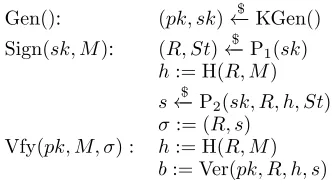
Fiat and Shamir proposed a generic transformation [11] to construct signature schemes (see Fig. 3) from identification schemes, and thereby from zero-knowledge proofs and Σ-protocols. In order to convert the interactive protocol into a non-interactive proof, the unpredictable challenge from V is replaced by the output of a collision resistant hash functionH. The resulting signature schemeSig= (Gen,Sign,Vfy) can be proved to be secure according to the definition of existential unforgeability under chosen message attacks (EUF-CMA) in the random oracle model (ROM).
Gen(): (pk, sk)←−$ KGen()
Sign(sk, M): (R, St)←−$ P1(sk)
h:= H(R, M)
s←−$ P2(sk, R, h, St) σ:= (R, s)
Vfy(pk, M, σ) : h:= H(R, M)
b:= Ver(pk, R, h, s)
Figure 3. Signature scheme derived from the Fiat Schamir transform.
The binary relation from the zero-knowledge proof is the relation between secret keys and public keys in the signature scheme.
In EdDSA, the computation ofhalso includes the signer’s public keyh= H(R, A, M). In contrast to the Fiat Shamir transformation whereR is computed probabilistically, in EdDSA the algorithmP1 is deterministically computed on the message and a secret value.
The proof of the transformation however assumes no collisions of R. Particularly Fiat and Shamir require that ”P uses eachRi only once” during multiple executions of the proof.6
Since EdDSA not only computes the challenge from the verifier with a deterministic function but also the algorithm P1, and the procedure P2 is deterministic, the whole signing algorithm is deterministic. Thereby collisions of R are an intrinsic side effect of the EdDSA construction. This effect is contrary to the original intent of R, which requires R to be randomly chosen and free of collisions.
6.2. General applicability on deterministic signatures from Σ-protocols
The issue presented in this paper applies to all signature schemes that are based on a Fiat Shamir transformed Σ-protocol (e.g. [11], [17], [37], [38], [39], [40]) and more generally zero-knowledge proof that fulfillspecial soundness(e.g. [41], [42], [43]). In fact, many post-quantum secure signature schemes employ Σ-protocols (e.g., [38]). However, as long as the computation of R is probabilistic, the extraction algorithm Extfrom the special soundness condition cannot be used to derive the secret key. As soon as R is computed deterministically and h can be manipulated such that two tuples
(h, s),(h0, s0), h6=h0 are gathered for one R, the secret key can be computed.
Sincehis not computable from the signature(R, s), the fault attack has to be performed carefully (see sec. 5.2). If a similar determinism would be applied to a scheme like the Schnorr signature scheme [37] wherehis part of the signature(h, s), the attack could be much easier. Instead of attacking few bits of the processed message, the input of the second call of H can arbitrarily be manipulated (i.e. any number of bits) in order to compute the secret key.
As a consequence, either the determinism of a scheme is effectively preserved or randomness is inevitable to derive a secure signature scheme from a zero-knowledge proof with special soundness.
7. Application of the attack to real-world protocols
We are not aware of any current cryptographic standards adapting the deterministic ECDSA scheme. On the other hand, there exist several major cryptographic standards and implementations adapting EdDSA. EdDSA is being implemented in TLS [6], SSH [7], IPsec [8], X.509 infrastructures [9], or DNSSEC [10]. In the following, we analyze the major cryptographic standards using EdDSA with respect to the prerequisites described in sec. 5.1.
7.1. On the impossibility of attacking TLS, SSH and IPSec
7.1.1. TLS. Version 1.3 of the Transport Layer Security (TLS) protocol [6] specifies the usage of PureEdDSA for securing the authenticity of server-generated (EC)DH parameters exchanged in the TLS handshake. A typical handshake with server authentication in TLS 1.3 works as follows. The client starts the handshake with the ClientHellomessages. TheClientHellocontains a list of cipher suites, client random and further cryptographic properties of the TLS connection. In addition, it contains a fresh (EC)DH key denoted as ClientKeyShare. The server responds with a list of TLS messages. ServerHellocontains a fresh server random, ServerKeyShare, and further cryptographic properties.Certificatecontains an X.509 certificate possibly with an EdDSA public key. The server signature is constructed over all the previous messages using the PureEdDSA algorithm. At the end, both peers exchange Finished messages to confirm that they are in possession of the secret key established based on the exchanged (EC)DH key shares.
Even though TLS 1.3 uses PureEdDSA, from the perspective of our attacker, a practical attack on EdDSA is infeasible. The reason for this is that the EdDSA signature is always generated over fresh server-generated inputs: server nonce and server key share. Therefore, the attacker is not able to force the server to sign the same message several times. Previous TLS versions do not officially support EdDSA.
7.1.2. SSH. Recent implementations of the Secure Shell (SSH) transport layer protocol [7] support Ed25519 (e.g., OpenSSH since version 6.7). However, the SSH protocol exposes similar behavior as TLS 1.3, and makes the attack infeasible. SSH specifies two key exchange mechanisms: Diffie-Hellmann and RSA key exchange. In both cases, the signature input is derived by incorporating the server’s random cookie, which is sent at the beginning of the protocol flow in theSSH_MSG_KEXINIT
message.
random values: server nonce (N r) and fresh DH key share (KEr). Therefore, similarly to TLS and SSH, our Rowhammer attacks are not applicable.
7.2. Potential dangers in OCSP
Online Certificate Status Protocol (OCSP) allows a client to query a certificate authority about the current status of a certificate [47]. For this purpose, the client sends a certificate identifier in its request. The server responds with a message containing the current certificate status (good, revoked or unknown), the time when the response was generated, and a signature computed across a hash of the response. Both OCSP messages can contain extensions with client- and server nonces. They are not mandatory.
OCSP fulfills the protocol prerequisites described in section 5.1.1 and establishes a valid scenario for our Rowhammer attack: an attacker may be able to force the OCSP responder to generate signatures over equal messages within a short time period without uncontrollable random. This is due to the existence of a client nonce extension which is reflected in the OCSP response. Since any nonce can be send to the server, it is unlikely that equal nonces are cached. Even though we are not aware of EdDSA actively being used in OCSP, given the fast deployment of this signature algorithm in other standards, we can assume its future deployment as well. In that case, we strongly recommend to use server nonce extensions in OCSP responses and refer to sec. 9.
8. Attacking Minisign
In this section, we analyze the feasibility of our attack in a realistic setting using Minisign7 – a tool similar to OpenBSD’s signify – and demonstrate two variants how EdDSA can be faulted in a cross-VM scenario. Minisign utilizeslibsodium8(a fork ofNaCl) for its cryptographic primitives. NaCl itself utilizes the “ref10” reference C-implementation of Ed25519. Minisign supports both variants of EdDSA, Pure- and HashedEdDSA. HashedEdDSA is not used by default, but mandatory for messages above 1 GiB in size. However, if one chooses a message smaller than 1 GiB, Minisign defaults to PureEdDSA.
8.1. Hard- and software setup
Our test device (Arch Linux 4.12.6 x86 64) was equipped with8GiB of DRAM known to be vul-nerable against Rowhammer and deployed two virtual machines (Ubuntu 16.04 LTS) via KVM/QEMU called the attacker- and the victim-VM. On this machine, we typically observed bit flips induced by single-sided hammering (using the probabilistic version ofrowhammer-test9) within some hours of testing. With double-sided hammering, we typically observed bit flips within a few seconds of testing. Attacker-VM.The attacker machine ran a hammering program which could be configured for random (single-sided) and deduplication-based (double-sided) hammering. In order to induce precise bit flips in memory pages, we reproduced the findings of [33] and implemented the templating phase to find vulnerable pages.
Victim-VM.The victim machine repeatedly signs a file and was able to listen for incoming signature requests. Each signature request was passed to Minisign and the resulting signature was sent to the attacker-VM. That is, so the victim-VM becomes a signature oracle.
8.2. Proof of concept with memory deduplication
When memory deduplication is active, a similar attack to [33] can be executed. As stated earlier, a single bit flip in the public key can result in private key compromise. However, in Minisign, the public key is protected by a checksum.10 We thus opted to fault the message. However, the message is not
7. https://github.com/jedisct1/minisign 8. https://download.libsodium.org/doc/ 9. https://github.com/google/rowhammer-test
an optimal target either, because Minisign does not mmap the message, but creates an internal copy viamalloc/fread. This means that KSM must deduplicate the internally created copy. Furthermore, since the message is likely to stay in the page cache, bit flips induced over time will accumulate. Being aware of this pitfall, we designed the hammering program to collect each observed bit flip for later analysis and eventually tested for each permutation. Our hammering program allocated memory pages (e.g., based on file input) and created a backup for each page. The backup pages were “blinded” by XORing with a constant value (or using a random8byte page prefix) so that KSM did not merge the to-be-hammered pages with the backup pages.
The attack was conducted as follows:
1) Directly after bootup allocate a large message in the attacker-VM that is co-located to the victim-VM.
2) Wait for THP in the victim-VM as well as for THP in the host-OS to merge4KiB pages into huge pages (THP). The intuition here is that both merge operations will roughly result in physically continuous huge pages in DRAM [33].
3) Allocate the same message a second time in the attacker-VM and wait for KSM to deduplicate both memory pages. This is so that the pages are added to KSM’s stable tree.
4) Trigger a signature generation with the message in the victim-VM. The obtained signature will be used as a reference.
5) Trigger further signature generations while hammering the deduplicated addresses.
6) If a signature deviates from the reference signature, a bit flip was triggered in the page cache or during signature generation. If it does not, go to step 5.
7) Try to extract the private key as discussed in sec. 4.2. If this is not successful, for example, if R differs from the reference signature, go to step 5.
8.3. Proof of concept without memory deduplication
Executing precise Rowhammer attacks in cloud-scenarios is difficult due to indirections in the mem-ory system. Typically, an attacker with control over the virtual machine is able to access
/proc/<pid>/pagemap which allows for virtual-to-physical address translation. However, the physical addresses obtained in a virtual machine are so called “guest-physical” addresses and its relationship to real physical addresses, i.e. “host-physical” addresses, is typically unknown to an attacker.
Nonetheless, one can opt for random (single-sided) hammering. By using random hammering, no information on virtual-to-physical mapping of addresses (how the operating system maps virtual pages to physical frames) or physical-to-DRAM mapping (how physical addresses are mapped to rank, bank, row, etc.) is needed. Furthermore, no “memory massaging” primitives as used by [33] are needed.
We estimate the feasibility of an attack based on random hammering with two variables: the interleave of attacker- and victim-pages and the amount of vulnerable cells in main memory. We examined the memory of our test machine (via a patched version of KVM to translate guest-physical addresses to host-physical addresses) and evaluated how many attacker-VM rows are adjacent to victim-VM rows. We call these rows “neighboring rows”. We measured the interleave of two1GiB messages allocated in the attacker- and victim-VM over 20reboots of the host machine.
We measured up to 18.83% max neighboring rows on reboot (0.03% min, 8.55% mean, 9.97% median) and up to18.55% max (0.02% min,8.78% mean,10.49% median) after idle for five minutes.
8.3.1. Analysis. In order to extract the private key, we developed an analysis program which takes a list of signatures and encountered bit flips (if available) as input. First, a hash map with R as key and a list of s’ is created. The reason is that we reconstruct the secret key only if two signatures withR1=R2ands16=s2 were found. Afterwards, each bit flip is tested against candidate signature pairs. The test succeeds if the private key is found. This can be verified by calculatingA0= [a0]Gand checking ifA=A0.
8.4. Analysis of single-sided hammering
random hammering and a 700 MiB large message. It is important to note, that these tests are highly specific to the hardware of the machine-under-attack and that the attack outcome may vastly differ among hardware.11 To our knowledge, there are no public studies investigating the vulnerability of off-the-shelf hardware to single-sided hammering and we did no further evaluation of the outcome of the attack, i.e. how likely a key compromise in a specific time frame is.
Nonetheless, our test hardware was vulnerable to random hammering, which shows that weaker attackers with no access to double-sided hammering primitives may be able to perform the presented attack. Furthermore, we expect that optimizations as discussed in [30], [32], [48] may be applied to make single-sided hammering more efficient.
9. Countermeasures
In the following we present several countermeasures and discuss why some of these countermea-sures do not work.
9.1. Signature validation
Our Rowhammer attack on EdDSA leads to the computation of invalid signatures. A typical coun-termeasure against such fault attacks is signature verification. This councoun-termeasure can be successfully applied in the RSA signature generation process with the Chinese Remainder Theorem (CRT) as showed by Lenstra [49], [50]. Lenstra’s attack exploits a random fault injected in a CRT multiplication step during signature generation. Since the signature verification does not include CRT multiplication, a simple signature verification step can detect a fault attack.
However, this countermeasure does not help to prevent our attack on EdDSA. Imagine the attacker managed to induce a bit flip in the messageM, which is located in the memory and used as an input to the signing function (see also Tab. 1):
s = (r+H(R, A, M )a) modl
In that case, the signature verification process would lead to a correct result, because the modified message M is used for the verification:
[s ]G=R+ [H(R, A, M )]A
This interesting property of fault attacks on EdDSA has also been independently discussed by Tony Arcieri.12
9.2. Signature generation
A potential countermeasure against our Rowhammer attack on EdDSA would be to generate the signature twice and compare the outputs of both signature generation functions. However, a more precise Rowhammer attacker might be able to introduce a bit flip on the same position in two or even more messages. Given the recent development in the Rowhammer attacks, this threat should not be overlooked.
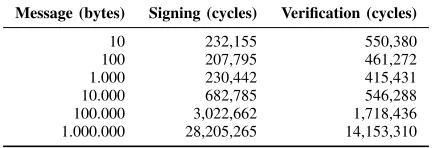
Another important point that needs to be considered is the performance penalty that is introduced by generating signatures. Even though this penalty is not as high as for RSA signatures. Especially for large messages over1 MiB, the signature generation process is slower than signature verification. See also Tab. 2.
11. See the rowhammer-discuss mailinglist (https://groups.google.com/forum/#!forum/rowhammer-discuss) for reportedly failing and surviving machines.
TABLE 2. DURATION OF SIGNING AND VERIFICATION OPERATIONS DEPENDING ON THE MESSAGE SIZE PERFORMED WITH THE LIBSODIUM LIBRARY(METHODSC R Y P T O_S I G N_E D25519_V E R I F Y_D E T A C H E DAND
C R Y P T O_S I G N_E D25519_D E T A C H E D). THE MEASUREMENT RESULTS ARE PROVIDED IN CLOCK CYCLES OBTAINED BY
R D T S C.
Message (bytes) Signing (cycles) Verification (cycles)
10 232,155 550,380
100 207,795 461,272
1.000 230,442 415,431
10.000 682,785 546,288
100.000 3,022,662 1,718,436 1.000.000 28,205,265 14,153,310
9.3. Usage of HashedEdDSA
EdDSA can be used in two variations: PureEdDSA and HashedEdDSA. PureEdDSA uses message M directly as an input. HashedEdDSA hashes M with a hash function H before executing further operations. From a Rowhammer attacker perspective, the PureEdDSA algorithm offers more flexibility by executing the attack since she needs to flip a single bit in a message of arbitrary length. On the other hand, HashedEdDSA forces the attacker to induce a bit flip in the output of a few bytes (depending on the hash algorithm and the internal representation of the hash result). Therefore, HashedEdDSA would be a better choice to counter the Rowhammer attacks.
However, PureEdDSA is recommended because of possible hash collisions [19]. Even if the attack on HashedEdDSA is more complicated than on PureEdDSA, we need to consider a more skilled Rowhammer attacker who can induce precise bit flips in the hashed message input as well.
9.4. Checksum over input values
Another countermeasure for EdDSA would be to introduce checksum computation over input values R,AandM before and after signature generation. If the checksums are equal, no bit has been flipped. Otherwise, a fault attack can be assumed and the signature generation process must be interrupted.
Minisign implements this countermeasure on public keys. The checksums over public keys are verified during the signature generation. This made our Rowhammer attack with public keys infeasible.
9.5. Additional randomness
The main argument for deterministic signatures is the need for strong randomness (e.g., following [51], [52]). One could instead combine a somewhat weaker random number generator with the de-terministic procedure to generate “ephemeral” keys. This construction would have the same security properties as EdDSA, but the signatures over equal messages would always be different.
XEdDSA [53] implements this kind of countermeasure and appends 64 bytes of secure random data Z to the message M while computing r: r = H(hb, . . . , h2b−1, M, Z). This makes our fault attacks infeasible.
10. Related work
10.1. Attacks on cryptographic algorithms
RNG failures. Invalid functionality of RNGs lead to several remarkable attacks on cryptographic implementations. In 2010, the hacker group fail0overflow retrieved Sony’s ECDSA key that could allow them to sign any application for PS3 [2]. The reason was a reused ECDSA nonce. A vulnerability in a Java RNG lead to a further failure by the usage of ECDSA. Reuse of nonces allowed attackers to retrieve private keys from Bitcoin Android apps [3].
authentication key and create arbitrary valid ciphertexts [54]. This attack is also called the Forbidden attack. Therefore, several cryptographers recently described AES-GCM as “fragile” [55], [56]. In 2016 B¨ock et al. showed that about 70.000 servers are potentially vulnerable to this attack [57].
Attacks on elliptic curves.In 2000 Biehl et al. presented an invalid curve attack that allows to extract EC private keys from applications that do not check whether the incoming ECDH share lies on a correct curve [58]. Practical application of this attack to TLS implementations was shown by Brumley et al. [59] and Jager et al. [16].
ECDSA implementations can enable further side-channels. For example, Brumley et al. showed that ECDSA key extraction from TLS servers is possible remotely by measuring timing differences [60], [61]. Genkin et al. showed that the ECDSA key extraction is possible even with magnetic side-channels [62].
Attacks on EdDSA. Very recently two publications pointed out problems in deterministic signature schemes. Romailler and Pelissier presented a practical fault attack on EdDSA [63]. They developed an attack scenario based on the original implementation by Bernstein [64] which was run on Arduino Nano. Samwel et al. presented a differential power analysis (DPA) attack on EdDSA which was able to leak private keys from about 4000 traces. In particular, the attack targeted the ephemeral key generation with the SHA-512 hash function [65] (see the computation ofr in Equation 7). Our paper is a concurrent work and was created independently of these two results.
10.2. Rowhammer attacks
Local attacks. Kim et al. assumed that they can “develop (...) a disturbance attack that (...) perhaps even hijacks control of the system” [21]. Their assumption was proven right by Seaborn et al. as they demonstrated the first kernel privilege escalation under GNU/Linux based on Rowhammer [30]. Govindavajhala et al. presented a similar approach, by utilized a classic fault attack, e.g. by overheating the memory with a light bulb [66]. One of the first cryptographic Rowhammer-based attacks was presented by Bhattacharya et al. [67]. The authors showed how to flip bits in an RSA secret exponent and eventually how to reconstruct it. WithWindows 8.1andWindows 10, memory deduplication is used per default. Bosman et al. demonstrated a JavaScript-based exploit targeted to hijack Microsoft’s Edge browser [68]. The attack involves a memory deduplication side-channel to disclose valuable data (high entropy byte-by-byte disclosure) and utilizes Rowhammer to gain arbitrary read and write capabilities in Microsoft’s Edge browser.
Cross-VM attacks.Xiao et al. introduced a method to get arbitrary access to a paravirtualized Xen host via Rowhammer [69]. Paravirtualization, in contrast to full virtualization solutions, is not transparent for the virtualized operating system and it must be adapted to cooperate with the hypervisor through a specific Hypercall-API. They presented a page table replacement attack to replace page tables via Rowhammer bit flips. Razavi et al. introduced the first cross-VM Rowhammer attack [33]. They were able to preciselyinduce bit flips in deduplicated pages, break OpenSSH’s public key authentication and compromise Ubuntu’s update mechanism.
Remote attacks. Seaborn et al. were able to escape from Google’s Native Client by utilizing the
11. Conclusion
In this paper, we presented practical fault attacks on EdDSA and deterministic ECDSA signatures. Somewhat unexpected, we found EdDSA more susceptible to Rowhammer-based attacks than classic ECDSA. The fault attacks are not only applicable on smartcards, but also on commodity hardware. With the newest developments in the area of Rowhammer, remote fault attacks are becoming a more prevalent threat that needs to be considered.
Even though the presented attacks are only effective in special situations, they show a new fragile side of deterministic signature schemes and their sensitivity to fault attacks in general. Our aim is to raise the awareness regarding recent fault attacks on these signature schemes, given their importance and fast deployment in practice.
We presented several countermeasures that could effectively mitigate our fault attacks. It is recom-mended to extend EdDSA to incorporate a long-term secret as well asadditionalper-signature entropy during nonce generation as already specified in XEdDSA. This hardens EdDSA against Rowhammer-based attacks and does not, under realistic assumptions, decrease its security, even with bad RNGs in place. This countermeasure should be implemented together with a checksum protecting EdDSA’s public keys and messages if not otherwise deployed.
Acknowledgements
We thank Daniel Gruss for countless remarks which helped us to develop the Rowhammer attack. We also thank one of our USENIX Security reviewers who pointed out that OCSP might be vulnerable to our attacks.
References
[1] S. Goldwasser, S. Micali, and C. Rackoff, “The knowledge complexity of interactive proof-systems (extended abstract),” inProceedings of the 17th Annual ACM Symposium on Theory of Computing, May 6-8, 1985, Providence, Rhode Island, USA, 1985, pp. 291–304. [Online]. Available: http://doi.acm.org/10.1145/22145.22178
[2] s. bushing, marcan and sven, “Console hacking 2010 – ps3 epic fail,” in27th Chaos Communication Congress. Chaos Computer Club, 2010.
[3] P. Ducklin. (2013) Android random number flaw implicated in Bitcoin thefts. [Online]. Available: https: //nakedsecurity.sophos.com/2013/08/12/android-random-number-flaw-implicated-in-bitcoin-thefts/
[4] T. Pornin, “RFC 6797 Deterministic Usage of the Digital Signature Algorithm (DSA) and Elliptic Curve Digital Signature Algorithm (ECDSA),” 2013.
[5] A. Barenghi and G. Pelosi,A Note on Fault Attacks Against Deterministic Signature Schemes (Short Paper). Cham: Springer International Publishing, 2016, pp. 182–192. [Online]. Available: http://dx.doi.org/10.1007/978-3-319-44524-3 11
[6] E. Rescorla, “ The Transport Layer Security (TLS) Protocol Version 1.3,” 2017, internet draft, version 19, https://github. com/tlswg/tls13-spec.
[7] T. Ylonen and C. Lonvick, “RFC 4253 The Secure Shell (SSH) Transport Layer Protocol,” 2006.
[8] Y. Nir, “Using Edwards-curve Digital Signature Algorithm (EdDSA) in the Internet Key Exchange (IKEv2),” 2017, internet draft, https://tools.ietf.org/html/draft-ietf-ipsecme-eddsa-00.
[9] S. Josefsson and N. Mavrogiannopoulos, “Using EdDSA with Ed25519/Ed448 in the Internet X.509 Public Key Infras-tructure,” 2017, internet draft, version 4, https://tools.ietf.org/html/draft-josefsson-pkix-eddsa-04.
[10] O. Sury and R. Edmonds, “RFC 8080 Edwards-Curve Digital Security Algorithm (EdDSA) for DNSSEC,” 2017.
[11] A. Fiat and A. Shamir, “How to prove yourself: Practical solutions to identification and signature problems,” inAdvances in Cryptology - CRYPTO ’86, Santa Barbara, California, USA, 1986, Proceedings, 1986, pp. 186–194. [Online]. Available: http://dx.doi.org/10.1007/3-540-47721-7 12
[12] S. Josefsson and I. Liusvaara, “RFC 8032 Edwards-Curve Digital Signature Algorithm (EdDSA),” 2017.
[13] W. K. et al., “Minimum Requirements for Evaluating Side-Channel Attack Resistance of Elliptic Curve Implementations,” Bundesamt f¨ur Sicherheit in der Informationstechnik, 2013. [Online]. Available: http://www.bsi.bund.de/
[14] M. Schmid, “Ecdsa-application and implementation failures,” 2015.
[16] T. Jager, J. Schwenk, and J. Somorovsky, “Practical invalid curve attacks on tls-ecdh,” inEuropean Symposium on Research in Computer Security. Springer, 2015, pp. 407–425.
[17] D. J. Bernstein, N. Duif, T. Lange, P. Schwabe, and B.-Y. Yang, “High-speed high-security signatures,” inInternational Workshop on Cryptographic Hardware and Embedded Systems. Springer, 2011, pp. 124–142.
[18] H. Edwards, “A normal form for elliptic curves,” Bulletin of the American Mathematical Society, vol. 44, no. 3, pp. 393–422, 2007.
[19] D. J. Bernstein, S. Josefsson, T. Lange, P. Schwabe, and B.-Y. Yang, “Eddsa for more curves,” 2015.
[20] H. Bar-El, H. Choukri, D. Naccache, M. Tunstall, and C. Whelan, “The sorcerer’s apprentice guide to fault attacks,”
Proceedings of the IEEE, vol. 94, no. 2, pp. 370–382, 2006.
[21] Y. Kim, R. Daly, J. Kim, C. Fallin, J. H. Lee, D. Lee, C. Wilkerson, K. Lai, and O. Mutlu, “Flipping bits in memory without accessing them: An experimental study of dram disturbance errors,”SIGARCH Comput. Archit. News, vol. 42, no. 3, pp. 361–372, Jun. 2014. [Online]. Available: http://doi.acm.org/10.1145/2678373.2665726
[22] N. A. Ricci, “Rowhammering: a physical approach to gaining unauthorized access,” Scholarly Horizons: University of Minnesota, Morris Undergraduate Journal, vol. 3, no. 1, p. 5, 2016.
[23] J. Crawford, B. Morris, S. Mandava, and R. Ramanujan, “Techniques for probabilistic dynamic random access memory row repair,” Sep. 18 2014, uS Patent App. 14/132,987. [Online]. Available: https://www.google.com/patents/US20140281206
[24] K. Bains, J. Halbert, C. Mozak, T. Schoenborn, and Z. Greenfield, “Row hammer refresh command,” Jan. 2 2014, uS Patent App. 13/539,415. [Online]. Available: https://www.google.com/patents/US20140006703
[25] K. Bains and J. Halbert, “Distributed row hammer tracking,” Mar. 29 2016, uS Patent 9,299,400. [Online]. Available: https://www.google.com/patents/US9299400
[26] K. Bains, J. Halbert, C. Mozak, T. Schoenborn, and Z. Greenfield, “Row hammer refresh command,” Jan. 12 2016, uS Patent 9,236,110. [Online]. Available: https://www.google.com/patents/US9236110
[27] Z. Greenfield and T. LEVY, “Throttling support for row-hammer counters,” Feb. 2 2016, uS Patent 9,251,885. [Online]. Available: https://www.google.com/patents/US9251885
[28] S. Mandava, B. Morris, S. Sah, R. Stevens, T. Rossin, M. Stefaniw, and J. Crawford, “Techniques for determining victim row addresses in a volatile memory,” Feb. 23 2016, uS Patent 9,269,436. [Online]. Available: https://www.google.com/patents/US9269436
[29] J. Halbert and K. Bains, “Method, apparatus and system for responding to a row hammer event,” Mar. 15 2016, uS Patent 9,286,964. [Online]. Available: https://www.google.com/patents/US9286964
[30] M. Seaborn and T. Dullien, “Exploiting the dram rowhammer bug to gain kernel privileges,” 2015. [Online]. Available: https://googleprojectzero.blogspot.de/2015/03/exploiting-dram-rowhammer-bug-to-gain.html
[31] R. Qiao and M. Seaborn, “A new approach for rowhammer attacks,” 2016.
[32] D. Gruss, C. Maurice, and S. Mangard, “Rowhammer.js: A remote software-induced fault attack in javascript,” CoRR, vol. abs/1507.06955, 2015. [Online]. Available: http://arxiv.org/abs/1507.06955
[33] K. Razavi, B. Gras, E. Bosman, B. Preneel, C. Giuffrida, and H. Bos, “Flip feng shui: Hammering a needle in the software stack,” in25th USENIX Security Symposium (USENIX Security 16). Austin, TX: USENIX Association, 2016, pp. 1–18. [Online]. Available: https://www.usenix.org/conference/usenixsecurity16/technical-sessions/presentation/razavi
[34] A. Arcangeli, I. Eidus, and C. Wright, “Increasing memory density by using ksm,” inProceedings of the linux symposium. Citeseer, 2009, pp. 19–28.
[35] T. Ristenpart, E. Tromer, H. Shacham, and S. Savage, “Hey, you, get off of my cloud: exploring information leakage in third-party compute clouds,” inProceedings of the 16th ACM conference on Computer and communications security. ACM, 2009, pp. 199–212.
[36] R. Cramer, I. Damg˚ard, and B. Schoenmakers, “Proofs of partial knowledge and simplified design of witness hiding protocols,” in Advances in Cryptology - CRYPTO ’94, 14th Annual International Cryptology Conference, Santa Barbara, California, USA, August 21-25, 1994, Proceedings, 1994, pp. 174–187. [Online]. Available: http://dx.doi.org/10.1007/3-540-48658-5 19
[37] C. Schnorr, “Efficient identification and signatures for smart cards,” in Advances in Cryptology - CRYPTO ’89, 9th Annual International Cryptology Conference, Santa Barbara, California, USA, August 20-24, 1989, Proceedings, 1989, pp. 239–252. [Online]. Available: http://dx.doi.org/10.1007/0-387-34805-0 22
[38] Y. Yoo, R. Azarderakhsh, A. Jalali, D. Jao, and V. Soukharev, “A post-quantum digital signature scheme based on supersingular isogenies,” inFinancial Cryptography, 2017.
[39] C. F. Kerry, “Digital signature standard (dss),”National Institute of Standards and Technology, 2013.
[40] ANSI,ANSI X9.62, Public Key Cryptography For The Financial Services Industry: The Elliptic Curve Digital Signature Algorithm (ECDSA), November 2005, american National Standards Institute, X9-Financial Services.