An extended abstract of this paper appears in the proceedings of COCOON 2016. This is the full version.
Homomorphic Evaluation of Lattice-Based Symmetric
Encryption Schemes
Pierre-Alain Fouque1,3, Benjamin Hadjibeyli2, and Paul Kirchner3 1
Universit´e de Rennes 1 and Institut Universitaire de France 2 Ecole normale sup´´ erieure de Lyon[email protected] 3 ´
Ecole normale sup´erieure{Pierre-Alain.Fouque,Paul.Kirchner}@ens.fr
Abstract. Optimizing performance of Fully Homomorphic Encryption (FHE) is nowadays an active trend of research in cryptography. One way of improvement is to use a hybrid construction with a classical symmetric encryption scheme to transfer encrypted data to the Cloud. This allows to reduce the bandwidth since the expan-sion factor of symmetric schemes (the ratio between the ciphertext and the plaintext length) is close to one, whereas for FHE schemes it is in the order of 1,000 to 1,000,000. However, such a construction requires the decryption circuit of the symmetric scheme to be easy to evaluate homomorphically. Several works have studied the cost of homo-morphically evaluating classical block ciphers, and some recent works have suggested new homomorphic oriented constructions of block ciphers or stream ciphers. Since the multiplication gate of FHE schemes significantly increases the noise of the ci-phertext, we cannot afford too many multiplication stages in the decryption circuit. Consequently, FHE-friendly symmetric encryption schemes have a decryption circuit with small multiplication depth.
We aim at minimizing the cost of the homomorphic evaluation of the decryption of symmetric encryption schemes. To do so, we focus on schemes based on learning prob-lems: Learning With Errors (LWE), Learning Parity with Noise (LPN) and Learning With Rounding (LWR). We show that they have lower multiplicative depth than usual block ciphers, and hence allow more FHE operations before a heavy bootstrap-ping becomes necessary. Moreover, some of them come with a security proof. Finally, we implement our schemes in HElib. Experimental evidence shows that they achieve lower amortized and total running time than previous performance from the litera-ture: our schemes are from 10 to 10,000 more efficient for the time per bit and the total running time is also reduced by a factor between 20 to 10,000. Of independent interest, the security of our LWR-based scheme is related to LWE and we provide an efficient security proof that allows to take smaller parameters.
1
Introduction
Fully Homomorphic Encryption (FHE) is nowadays one of the most active trend of research in cryptography. In a nutshell, a FHE scheme is an encryption scheme that allows evaluation of arbitrarily complex programs on encrypted data. This idea has been introduced by Rivest, Adleman and Dertouzos [32] in 1978, while the first plausible construction has been given by Gentry [18] in 2009. Since, numerous papers have focused on improving the efficiency of the constructions. Even if there still remains a huge gap to fill before FHE becomes practical, it arouses more and more interest and the scope of application is broad, going from genomics to finance [29]. Recently, the application of FHE techniques to genomics has been highlighted in the iDASH Privacy and Security Workshop with the Secure Genome Analysis Competition4.
One way of improvement has been introduced in [29]. It focuses on minimizing the com-munication complexity of the scheme. The idea is to use a hybrid encryption scheme: some parts of the scheme are replaced by a symmetric encryption scheme. Instead of encrypting the
4
data under the FHE scheme, the client will only encrypt its symmetric key under the FHE scheme, and encrypt its data under the symmetric scheme. The cloud will then homomor-phically evaluate the decryption of the symmetric scheme on the symmetrically encrypted data and the homomorphically encrypted symmetric key, to get a ciphertext corresponding to a homomorphic encryption of the data.
Clearly, such a construction has low communication complexity, since the only online data transfer is made under the symmetric scheme. However, the cloud might pay a huge cost at the homomorphic evaluation of the symmetric decryption. Thus, one can look for the most FHE-friendly symmetric encryption scheme to use in the hybrid construction.
Being FHE-friendly consists in optimizing several criteria. First, as the application we gave suggests, we want a scheme with a small expansion factor, so that the communication complexity stays low. Then, other criteria depend on the FHE construction we are building upon. All current FHE schemes are based on variants of Gentry’s initial idea: ciphertext consists of encryption of data with noise, and homomorphic operations increase this noise. When the upper bound of noise is reached, one has to bootstrap, to reduce the noise to its initial level. Typically, functions are represented as arithmetic circuits and multiplications have a far higher cost than additions in terms of noise. Thus, we will want to minimize the multiplicative depth of the decryption circuit of our symmetric scheme. In addition, we will also take into account the total running time of our homomorphic evaluation step. This metric highly depends on the chosen FHE scheme, but multiplications often happen to be the main bottleneck again.
Our Contributions. In this paper, we focus on symmetric schemes having shallow de-cryption circuits. We study the problem of building secure symmetric ende-cryption scheme with constant or small decryption circuit, namely with small multiplication depth. Con-trary to the direction followed by many recent work, that tweak block ciphers or stream ciphers [3,11], our approach is related to provable security. Indeed, we notice that one can construct lattice-based schemes with very small decryption circuit and then, we evaluate the performances of our schemes using HElib to compare them with other symmetric ciphers. Finally, we try to use HElib features (full packing and parallelization) in order to achieve better performances. We describe two kinds of ciphers: the first family has its security re-lated to the difficulty of solving the LPN problem in specific instances, while the second family has a security proof based on the LWE problem. The first construction is similar to symmetric cryptography since we do not have a clean security proof and consequently, we provide a more thorough security analysis. However, the security seems to be easier to understand than ad-hoc constructions usually used in symmetric cryptography, since the security problem on which the scheme is based can be formally stated. We present a very efficient construction specifically tailored to this problem to secure our construction from Arora-Ge type of attack on LPN. The performance of the schemes from this family can be 10 times more efficient than the most efficient previous cipher. For the second family, we have a rigorous security proof related to LWE, while the scheme is based on LWR. The performance of the second family can be very efficient, about 10,000 times faster, but the caveat is that the decrypted plaintext contains random bits in the least significant bits if we do not compute homomorphically the truncation using the costlyExtractDigitsfunction. Therefore, if we want to remove the erroneous bits, the performances become equivalent to previous ciphers, while being more efficient than AES. In some cases, one can compute with such noise without having to remove it.
We notice that contrary to what is claimed in many works [29], it is not necessary to re-encrypt the symmetrically-encrypted ciphertext using the FHE scheme when the server receives the data. We show in appendix 3.2 that the evaluation of the homomorphic de-cryption procedure gives ciphertexts encrypted with FHE. This improves the performance of the scheme, since we homomorphically evaluate the function that maps the keyKto the Dec(K, c), given the ciphertextc and some multiplications inDec will be simplified once c
Then, we describe our efficient FHE-friendly symmetric schemes. We chose to use schemes based on lattices, and more precisely on learning problems. Our results show that we can get circuits with very small multiplication depth for the decryption algorithms of these schemes. In addition, their security relies on hard problems or on hard instances of lattice problems in the worst cases, as opposed to usual block ciphers.
We first present a scheme whose security is based on the Learning Parity With Noise problem (LPN) introduced in [20]. We have to specify an error correcting code (ECC) for this scheme so that the decryption circuit is small. We choose to use a repetition code in order to simplify the decoding and reduce its circuit in term of multiplications5. However, removing decryption failures makes the scheme vulnerable to the Arora-Ge [6] attack and in order to avoid its most efficient variant [2] using Gr¨obner basis algorithms, we use a very efficient transformation, similar to random local function [5], which increases the algebraic degree of the polynomials system. We provide a detailed analysis of this attack. The function we propose is also very similar to [1] and we can show that our construction achieves better influence parameters, but it has higher complexity class since we need a logarithmic depth circuit.
Then, we introduce another scheme whose security is based on the Learning With Round-ing problem (LWR) and a very similar version whose security relies directly on the LearnRound-ing With Errors (LWE) problem. In order to encrypt many bits using small parameters, we provide a direct proof from LWE to the security of the scheme. We do not rely on any reduction from LWE to LWR since the first reduction given by Banerjee et al. [7] requires exponential parameters and the one by Alwen et al. [4] requires parameter linear in the number of samples. Here, our reduction is only logarithmic in the number of samples.
Furthermore, we extend both schemes to their ring versions. In this case, we optimized the number of multiplications using a FFT algorithm in order to compute the polynomial multiplications. Finally, we extend them to their module versions, which generalizes standard and ring versions.
Along with a theoretical analysis, we provide implementations of the homomorphic eval-uation of our schemes in HElib, in order to make practical comparisons. While the homo-morphic evaluation of AES went down to 11 milliseconds per bit [19] and LowMC, a block cipher designed to be FHE-friendly (and whose security has recently been called into ques-tion [13,14]), went down to 3 milliseconds per bit [3], which was the best so far, we go under a millisecond per bit (with the module version of our LPN scheme). In some scenario, our performance for the scheme based on LWR are drastically better if we allow FHE-encrypted plaintexts to contain noise in the least significant bits. Moreover, our schemes are a lot more flexible, in the sense that they need smaller FHE parameters, and while these performance were amortized over a computation taking several minutes, the evaluation of our schemes takes only from a second to a minute.
Related work. Numerous papers have presented homomorphic evaluations of block ci-phers. It has started in [19], where AES has been chosen as a benchmark for measuring the performance of HElib. Then, performance has been improved in [28]. AES has then been used as benchmark for comparing FHE schemes in [12,15]. Similarly, Simon has been used to compare FHE schemes [26]. Recently, the problem has been taken the other way round, with works trying to find the most FHE-friendly block cipher. First, a lightweight block cipher like Prince has been suggested and evaluated [16]. Then, a new block cipher, LowMC, has been designed specifically for this kind of application [3], as well as for multi-party computations and zero-knowledge proofs. Finally, using stream ciphers has also been proposed [11].
Organization of the paper.In section 2 we recall definitions about symmetric encryp-tion and Lattice problems in Cryptography. Then we introduce in secencryp-tion 4 our symmetric schemes based on learning problems: LPN, LWR and LWE. In App. 3.2, we explain how we
5
use homomorphic operation more efficiently. The security analysis of the schemes are proved in the final version. In this version, we also describe the efficiency of our schemes.
2
Preliminaries
We recall basic definitions about symmetric encryption and lattice assumptions on which the security of our symmetric and homomorphic schemes is based.
2.1 Symmetric Encryption
We will say that a function ofk(from positive integers to positive real numbers) is negligible if it approaches zero faster than any inverse polynomial, and noticeable if it is larger than some inverse polynomial (for infinitely many values ofk).
Definition 1. A symmetric encryption scheme is a tuple (Gen,Enc,Dec) of Probabilistic Polynomial-time (PPT) algorithms as follows:
– Gen(1λ): given a security parameter λ, output a secret key k;
– Enc(k, m): given a keyk and a messagem, output a ciphertext c;
– Dec(k, c): given a key kand a ciphertextc, output a messagem0;
which satisfy the following correctness property: if k :=Gen(1λ), then for all messages m, Pr[Dec(k,Enc(k, m))6=m]is negligible (in λ).
For the sake of clarity, we will often write the key as a subscript and the scheme name as a superscript of our algorithms, like inEncSk.
Definition 2. A symmetric encryption scheme S is said to be semantically secure (or to have indistinguishable encryptions) if for all PPTAand for all messages m, it holds that
Pr[A(Enc
S k(m),1
λ) = 1]−Pr[A(EncS k(0),1
λ) = 1]
is negligible (inλ).
Indeed, semantic security is implied by the following property, which will be satisfied by our schemes.
Definition 3. A symmetric encryption schemeS is said to have pseudo-random ciphertexts (or to have ciphertexts indistinguishable from random) if no PPTAcan distinguish between ciphertexts from the scheme and the uniform distribution, i.e. for all PPT A and for all messagesm, it holds that
Pr[A(Enc
S k(m),1
λ) = 1]−Pr[A(r,1λ) = 1]
is negligible (inλ), wherer is drawn randomly over the ciphertext space.
Most symmetric encryption schemes are based on a construction called block cipher. A block cipher is a keyed permutation working on fixed-length block. Formally, a block cipher
E takes as input a keyK of lengthkand a stringm of lengthnand outputs a stringc of lengthn. It is required that each functionEK :m→E(K, m) is invertible. To construct an encryption scheme from these building blocks, one has to define what is called a mode of operation.
2.2 Learning Problems
Given a finite setS and a probability distribution D onS, s←D denotes the drawing of an element ofS according to Dands←Sdenotes the random drawing of an element ofS
Learning With Errors. The Gaussian distribution with standard deviation σ is defined on Rby the density function √2πσ1 exp(−12(
x σ)
2).
The Learning With Errors problem (LWE) has been introduced in [31]. Fors∈Zkq, the LWE distributionDLW E
s,χ is defined overZkq×Zq and consists in samples (a,ha, si+e) where
a←Zk
q ande←χfor some distributionχoverZq. Typically,χis taken to be some integral Gaussian distribution when assuming that LWE is hard. As in most works [31], we will consider here rounded Gaussian distributions: it basically consists in sampling a Gaussian distribution, reducing the result modulo 1, multiplying it byqand rounding it to the nearest integer. LWE consists, for s chosen according to some distribution over Zkq (typically, the uniform distribution), in distinguishing between any desired number of samples fromDLW E
s,χ and the same number of samples drawn from the uniform distribution over Zkq ×Zq. For rounded Gaussian distributions, LWE is usually considered to be hard when the standard deviationσverifiesσ >√k [31].
LWE can be extended into a ring versionRLWE[27]. LetR=Z[X]/(P(X)) for a monic irreducible polynomialP of degreek, and letRq =R/qR. Generally,P is chosen to be some power-of-two cyclotomic polynomial, which are of the formX2z+ 1. For an elements∈Rq, we define the RLWE distributionDRLW E
s,χ overRq×Rq by samples (a, a.s+e) wherea←Rq ande←χk whereχk consists ink independent samples from χand eis interpreted as an element of Rq. The Ring-LWE problem (RLWE) similarly consists, for s drawn according to some distribution overRq, in distinguishingDRLW Es,χ from the uniform distribution over
Rq×Rq.
We will also use the Module-LWE problem (MLWE). It has been introduced in [10] under the name of GLWE, for General LWE. However, we will call it MLWE as in [25], because it indeed corresponds to introducing a module structure overLWE. For an element
s∈Rk
q, where the underlying ring polynomial has degreed, we define the MLWE distribution
DM LW E
s,χ overRkq×Rq by samples (a,ha.si+e) wherea←Rkq ande←χdis interpreted as an element ofRq. MLWEgeneralizes LWE and RLWE: LWE corresponds to the case where
d= 1 andRLWEcorresponds to the case wherek= 1.
By a standard hybrid argument, LWE can be extended to several secrets. It can be shown that the problem which consists in distinguishing samples (a,ha, s1i+e1, . . . ,ha, sni+
en)∈ Zkq ×Znq from the uniform distribution overZqk ×Znq, where eachsj ∈Zkq is chosen independently for any n = poly(k), is at least as hard as LWE for a single secret s. An analogous statement can be shown forRLWEandMLWE.
Finally, the LWE [31], RLWE [27] and MLWE [25] hardness assumptions have been reduced to standard lattice assumptions. The security of MLWE seems to be intermediate between the security of LWE based on hardness results in arbitrary lattices and the security of RLWE in ideal lattices.
Learning Parity With Noise. We denote by Bη the Bernoulli distribution of parameter
η ∈ [0,1], i.e. a bit b ← Bη is chosen such that Pr[b = 1] = η and Pr[b = 0] = 1−η. The Learning Parity with Noise problem (LPN) basically consists in LWE for q = 2. The distributionχ chosen over Z2 will correspond to a Bernoulli distribution. We extend LPN to RLPN and MPLN. The only difference is that the underlying polynomial will not be cyclotomic anymore, but some irreducible polynomial modulo 2. Similarly, these problems are also extended to a polynomial number of secrets. The main difference betweenLWEand LPN is that the security of LPN remains heuristic because no reduction has been made so far to lattice problems.
Learning With Rounding. The Learning With Rounding problem (LWR) has been introduced in [7] as a derandomization of LWE. The idea is to replace the addition of a random noise by a rounding function.
We extendb.epcomponent-wise to vectors and matrices overZq. LetRdenote the cyclotomic polynomial ringR =Z[z]/(zk+ 1) fork a power of two. For any modulusq, we define the quotient ring Rq =R/qR and extend b.ep coefficient-wise to it. Note that we can use any common rounding method, like the floor or ceiling functions. In our implementations, we will indeed use the floor functions, because it is equivalent to dropping the least-significant digits in base 2 whenqandpare both powers of 2.
For a vector s∈Zkq, the LWR distribution DsLW R is defined overZkq ×Zp by elements (a,bha, siep) witha←Zqk. For a vectors∈Rq, the ring-LWR (RLWR) distributionDRLW Rs is defined overRq ×Rp by elements (a,ba.sep) with a←Rq. And for a vectors∈Rqk, the module-LWR (MLWR) distributionDM LW R
s is defined overRkq×Rpby elements (a,bha.siep) witha←Rk
q.
For a given distribution D over s ∈ Zkq, LWR consists in distinguishing between any desired number of independent samples fromDLW Rs and the same number of samples drawn uniformly and independently fromZkq ×Zp.RLWRandMLWR are defined analogously. All these problems can be extended to several secrets, as stated forLWE.
The security of LWRhas been reduced to the one of LWE whenq/pis exponential in k
by [7], and whenq/pis polynomial ink and linear in the number of samples by [4].
3
Fully-Homomorphic Encryption (FHE)
While classical encryption aims at preserving the privacy of information, homomorphic en-cryption aims, in addition, at making some computation on the encrypted data.
3.1 FHE Definitions
Formally, we have a message spaceM with a set of functionsf we would like to compute on messages, and we want an algorithm which efficiently computes functionsf0on the ciphertext spaceC such that Dec(f0({ci}i)) =f({Dec(ci)}i). Thus, we want the decryption function to be a homomorphism fromC toM for these functionsf. This notion, originally called a privacy homomorphism, was introduced in[32]. Here is a formal definition of a homomorphic scheme, sometimes also referred to as “somewhat homomorphism”.
Definition 4. Let F be a set of functions. A F-homomorphic encryption (HE) scheme is a tuple of PPT algorithms(Gen,Encrypt,Decrypt,Eval)as follows:
– Gen(1λ): given a security parameter λ, output a public key pk, a secret key sk and an
evaluation keyek;
– Enc(pk, m): given the public keypk and a messagem, output a ciphertext c;
– Dec(sk, c): given the secret keysk and a ciphertextc, output a message m0;
– Eval(ek, f, Ψ = (c1, . . . , cl)): given the evaluation key, a function f and a tuple Ψ of l
ciphertexts, wherel is the arity of f, output a ciphertextc0;
and which satisfies the correctness property: for all functionsf ∈ F and messages{mi}i≤l,
where l is the arity of f, if (pk, sk, ek) := Gen(1λ) and c
i := Enc(pk, mi) for all i, then Pr[Dec(sk,Eval(ek, f,(c1, . . . , cl)))6=f(m1, . . . , ml)]is negligible (in λ).
Definition 5. A HE scheme H is said to be semantically secure if for all PPT Aand for all messagesm, it holds that
Pr[A(Enc
H k(m),1
λ) = 1]−Pr[A(EncH k(0),1
λ) = 1]
Full homomorphism is a generalization of this concept: in a nutshell, a fully homomorphic encryption scheme is an encryption scheme that allows evaluation of arbitrarily complex functions on encrypted messages. The first construction of such a scheme appeared in 2009 [18] and was a major breakthrough.
However, being simply homomorphic for all functions is not enough, since it permits the trivial solution, wherec0 consists of (f, Ψ) and Dec decrypts the ciphertexts and then appliesf. A way of excluding the trivial solution is to require that the distribution of the ciphertexts output byEvalis statistically close to the one ofEnc: this notion is called circuit privacy. However, most of the literature aims at achieving a weaker property.
Definition 6. A HE scheme is said to be compact if the length of the output of the algorithm
Evalis polynomial in the security parameterλ.
Definition 7. A Fully Homomorphic Encryption (FHE) scheme is a scheme which is com-pact and F-homomorphic for any classF of functions.
In this work,f will be represented by an arithmetic circuit, as in most of the literature. Even if we will most of the time use circuits overGF(2), we will sometimes use circuits over overZq, for example when dealing with LWR. The following definition is a slight relaxation of FHE.
Definition 8. A Leveled Homomorphic Encryption (LHE) scheme is a compactCL-homomorphic schemeHEwhereGenHE gets an additional input1Land whereCLis the class of all depth-L
arithmetic circuits.
Basically, a homomorphic scheme is leveled if for any depthL, we can fix the parameters so that any circuit of depth at most L can be evaluated. But unlike a FHE scheme, the complexity of the algorithms in a LHE might depend on this maximal depth. The BGV scheme we will present in section 5 is indeed a LHE. It becomes a FHE when considered along with its bootstrapping functionality.
3.2 Homomorphic evaluation of symmetric encryption schemes
We now give a more precise description of the scenario where a symmetric encryption scheme is used to improve FHE performance, as described in [29], and on which we will to rely to analyse the performance of our schemes.
Optimizing communication with the cloud. Consider the setting where a client uploads its data encrypted under a FHE scheme on a cloud service and wants the cloud to compute on this data and return encrypted outputs. Typically, FHE schemes come with an expansion factor of the order of 1,000 to 1,000,000. To mitigate this problem, the client will send its data encrypted under some semantically secure symmetric encryption scheme (which, by itself, is not homomorphic at all) along with the homomorphic encryption of its symmetric key. Then, the steps of symmetric decryption can all be carried out on homomorphically encrypted entries. Thus, the cloud can obtain the data encrypted under the FHE scheme by homomorphically evaluating the decryption circuit.
Here is a formal description of the protocol. Let H = (GenH,EncH,DecH,EvalH) be a FHE scheme and let S = (GenS,EncS,DecS) be a symmetric encryption scheme. Let λ
be the security parameter and m be the data the client wants to send to the cloud. Let (pk, sk, ek) :=GenH(1λ) andk:=GenS(1λ).
– The client first sends the messagesc1:=EncHpk(k) andc2:=EncSk(m) to the cloud.
– Now, the cloud possesses a FHE-encrypted ciphertextc, which means thatDecHsk(c) =m.
Furthermore, it can now homomorphically evaluate any functionf: for allf,DecHsk(EvalHek(f, c)) =
f(c).
Indeed, if the evaluation algorithm allows constant arguments, i.e. arguments which are not homomorphically encrypted, this scenario can be optimized further, simply by noticing that c2 does not have to be homomorphically encrypted. Thus, when receiving c1 and c2, the cloud will just directly computec=Evalek(DecS, c2, c1). It still has to homomorphically evaluate the decryption circuit of the symmetric scheme, but it saves a homomorphic en-cryption, and operations with constants might be faster. This can also be seen as evaluating the functionK7→DecS(K, m), which depends on m.
The total communication complexity of this protocol is the sum of lengths of the public key, homomorphically encrypted symmetric key and symmetrically encrypted data. However, the public key and symmetric key are sent only once, are independent of the data, and can be used for many messages. Therefore, they do not have to be taken into account for the online complexity of the protocol, and only the expansion factor of the symmetric schemes is relevant.
Others usages. Even if we focus on homomorphic encryption, note that the schemes we present could be interesting for some other applications which have the same kind of con-straints, like multi-party computation [3] or encryption schemes secure against side-channel attacks. Indeed, in this latter area, researchers try to reduce the nomber of non-linear oper-ations since these operoper-ations are costly when we use masking. In our schemes, the number of non-linear operations per bits is a small constant.
4
FHE-friendly Symmetric Encryption based on Learning
All the symmetric encryption schemes we will use are based on lattices, and, more precisely, on learning problems. Some of them will rely on theLPNproblem, while the others will rely on theLWRor on theLWE problem.
4.1 An encryption scheme based onMLPN-C
Our first encryption scheme is a generalization of the scheme introduced in [20], under the name of LPN−C by Gilbert et al. Let [n, m, d] be a linear binary (error-correcting) code
C, i.e. a linear subspace ofFn
2 with dimension m such thatd is the minimum `1 distance between two elements of the code. We associate it with an encoding functionE:Fm
2 →C and a decoding function D : C → Fm2. LPN−C is a symmetric encryption scheme whose security can be reduced to the hardness ofLPN. LetE andD be respectively the encoding and decoding functions of a [n, m, d] linear binary code.
Definition 9 (LPN−C).Letkandnbe polynomials inλ. The symmetric encryption scheme LPN−Cis defined in the following way:
– Gen(1λ): output S←Zk×n2 ;
– EncS(x): output (a, E(x)⊕a.S⊕e), wherea←Zk2 ande← Bnη;
– DecS(a, y): output D(y⊕a.S).
For a message of m bits, this scheme produces a ciphertext of n+k bits. Indeed, the expansion factor can tend to the one of the linear code we are using, which isn/m, sincen
is any polynomial ink. Furthermore, one can consider thatadoes not have to be sent, and can be replaced, for example, by the seed used in order to generate it.
is only 1, to which we have to add the depth of the decoding circuit. Furthermore, as explained in subsection 3.2, the vectoracan be considered as a constant, and thus, the level of multiplication corresponding to the scalar product prior to the decoding counts for less than one.
We introduce the ring version of LPN−C. We extend functions E and D over Rm2 by applying them on vectors corresponding to coefficients of same degree.
Definition 10 (RLPN−C). Let k and nbe polynomials in λ. Let consider R chosen as in
RLPN, with underlying polynomialPof degreek. The symmetric encryption schemeRLPN−C is defined in the following way:
– Gen(1λ): output S←Rn 2;
– EncS(x): output (a, E(x)⊕a.S⊕e), where a←R2 and e← Bk×nη is interpreted as an
element ofRn 2;
– DecS(a, y): output D(y⊕a.S).
For a message of m×k bits, the scheme produces a ciphertext ofk+k×n bits. Thus, the expansion factor tends again to the one of the underlying linear code. The decryption depth is also similar to the one of LPN−C(a polynomial multiplication has multiplicative depth 1). The main difference in the ring version is the number of bits encrypted for a key of fixed size: while we were encryptingmbits at once in the standard version, we can now encryptm×kbits at once.
Similarly, we extend the scheme toMLPN.
We describe the more general version of our scheme. Similarly, we can define LPN−C
andRLPN−Cbased on LPNandRLPNproblems.
Definition 11 (MLPN−C). Let d, k and n be polynomials in λ. Let consider F2d a finite
field defined by an irreducible polynomialP of degreed. The symmetric encryption scheme MLPN−C is defined in the following way:
– Gen(1λ): output S← Fk×n2d ;
– EncS(x): output (a, E(x)⊕a.S⊕e), wherea←Fk2d ande← Bd×nη is interpreted as an
element ofFn2d;
– DecS(a, y): output D(y⊕a.S).
For a message of m bits, this scheme produces a ciphertext of n+k bits. Indeed, the expansion factor can tend to the one of the linear code we are using, which isn/m, sincen
is any polynomial ink. Furthermore, one can consider thatadoes not have to be sent, and can be replaced, for example, by the seed used in order to generate it.
We choose the 3-repetition code to have a small multiplication depth circuit of degree 2. We define the encoding scheme fora∈F2d as (a2
d−1
, a2d−1, a2d−1). In order to decode a code word (a, b, c)∈(F2d)3, we computeab+bc+ac. (The normal encoding with would be
(a, a, a) and the decoding (ab+ac+bc)2d−1, but we prefer to incorporate the power 2d−1 in the encoding in order to make the homomorphic part more efficient.)
Proposition 1 ([20]). LPN−C (resp. RLPN−C,MLPN−C) is semantically secure as soon as the correspondingLPN (resp.RLPN,MLPN) problem is hard.
Proof. While theLPNcase is proven in [20], theRLPN andMLPN cases follow similarly from the RLPN and MLPN assumptions. Furthermore, one can notice that as soon that the LPN (or RLPN or MLPN) problem for several secrets is considered to be hard, as we said via a hybrid argument, the ciphertext of our scheme consists in some value added to some sample from this distribution, which is indistinguishable from uniform by assumption, and thus, the
Variant 1. As it stands, if we do not bound the number of errors sent along with a message, this scheme will produce decryption failures. They will happen when the Hamming weight of the noise vector e is greater than the correction capacity of the error-correcting code. We study the probability of decryption failures and we can choose the noise parameter η
so that this probability is very low. However, in this case, more efficient attacks than BKW algorithmO(2k/log(k/−log(1−2η))) can be used to recover the secret in timeO(k3/(1−η)k). To thwart attacks, we will increase their complexity using delinearization steps described later.
Variant 2. A way to prevent decryption failures is to test the Hamming weight of the noise vector before using it. If it is too large, the sender draws a new noise vector. This implies a longer encryption running time, but it is only on the client side and not in the homomorphic part (and in practice, we choose our parameters so that this time remains reasonable). However, such a modification gives a structure to the noise and we cannot reduce the security of the scheme to the one ofLPNanymore. It makes the scheme vulnerable to the Arora-Ge attack, and we will study the security in the following section.
An important point is the choice of the error-correcting code used in the scheme. In our context, we would like a code with shallow decoding circuit, and indeed, codes with shallow decoding circuits are quite rare. For example, linear codes, which have really simple encoding circuits, have complicated decoding circuits. We would like to use a 3-repetition code, which has decoding depth 1. We will keep using such a code in practice as it leads to very efficient homomorphic performance, but the particular structure given to the noise requires a careful analysis of the security, that we will do in the following section. Consequently, in order to also thwart this attack, the delinearization steps can be useful.
Delinearization steps. In order to counter the Arora-Ge attack, we choose to add some noise on our values after computing the scalar product. In practice, the ciphertext we send consists of (a, E(x)⊕F(a.S)⊕e) whereF is some function involving enough layers of multiplication so that the Arora-Ge attack does not work. Of course, this step increases the parameters we have to choose for homomorphically evaluating our scheme, however, a few steps (3 in order to have a sufficient security parameter) are needed in order to prevent the attacks. We admit that such techniques are far away from provable security and come from symmetric cryptography since F is a kind of cheap non-linear operation. However, contrary to the symmetric setting, here the adversary cannot control the inputs to this function and many well-known chosen plaintext attacks are then prohibited and only known plaintext attacks need to be studied. It is easy to see how to adapt the decryption process.
The functionF we choose works as follows: on a vectorV, it consecutively applies several transformationsTi, fori≤d, such that [Ti(V)]j =Vj+Vxij ·Vyij, where the set of indices
xij and yij is chosen so that monomials do not cancel. The degree of F in the inputs is 2d. We estimated the number of applications of such transformations needed in order to counteract the most efficient variant of the Arora-Ge attack and forn= 512, two steps seem reasonable.
Even though, our scheme has a security proof, the parameters we choose do not allow us to use the reduction. Indeed, we pick either a structured noise (and Arora-Ge algorithms must be taken into account) or a very small noise to reduce the decryption failure. Consequently, the delinearization steps we add increase the complexity of these attacks and a thorough security analysis is presented in the next subsection.
4.2 Cryptanalysis ofMLPN−C
which are known in order to determine concrete parameters and [17] is needed for LWR. Second, we saw that in our scheme based onLPN, handling decryption failures precludes any reduction and creates vulnerabilities, so we have to look at the different possible attacks.
In what follows, we assume that the code we choose for our schemes based onLPNis a 3-repetition code. This choice is justified by the performance of our homomorphic evaluation.
Arora-Ge attack against Variant 2.The Arora-Ge attack consists in finding polynomials in the messages which vanishes on the secret key and then to solve the system of equations we get to determine the key. If we want to avoid decryption failures, we will require to have error vectors with at most t positive terms, wheret is the correction capacity of the code, and thus any products oft+ 1 variables in the yi− ha, Sii −[E(x)]i will vanish. From [6], we get that the complexity of such an attack ispoly(nt+1). The performance of the attack can be improved using Gr¨obner basis [2]. For a system of m equations of degree dover n
variables, one defines what is called a “degree of regularity”D, and the complexity becomes
O( k+Dk ω), whereω is the constant of the linear algebra.
Given the complexity of the attack, a simple countermeasure would be to pick a code with higher correcting capacity. However, finding a code with higher capacity and which is easy to evaluate homomorphically proved difficult. In order to prevent this attack, we prefer to use delinearization steps at the end.
Arora-Ge Attack against Variant 1. If we consider that controlling the error during the encryption leads to security holes, one could instead try to diminish the ratio of decryption failures. As we showed, decryption failures when the Hamming weight of the noise vector is greater than the correction capacity of the code. In other words, we can either decrease the ratio of error or increase the minimal distance of the code. We reckoned that modifying the code would worsen our homomorphic performance. On the other hand, we thought that the delinearization steps, introduced to counter the Arora-Ge attack, increased the security against BKW and gave some room for improvement on the error side. BKW works over equations which are linear in the secret variables, but the delinearization steps increase the degree of each term. Thus, in order to work on linear terms, one will have first to introduce new variables for each monomial, leading to an increase of the number of variables and a higher global complexity. Thus, instead of working on vectors of lengthk, BKW would work on vectors of size roughlyk2d, where dis the number of delinearization step.
Now we will study the following attack, which is similar to Arora-Ge:
– Collectm equations (yi−F(ha, Sii)−[E(x)]i) = 0 and try to solve the corresponding system;
– In case of failure, restart.
The first step fails if and only if one of the errors used to generate the values yi is not null. Letη be the probability that an error is not null. Then, the probability that the first step works is (1−η)m(≈e−ηm) and the number of repetitions is (1−η)−m(≈eηm). Now, in order to solve the system, the most efficient method is to use Gr¨obner basis. From [8], we have that the complexity of such a computation isO( k+Dk ω
), whereD is called degree of regularity of the system and depends onm,kanddthe degree of the equations we have in our system. So, for fixed values ofm,kandd, we can determine what probabilityη we need in our scheme forxbits of security: it satisfieseηm k+D
D
ω
= 2x.
For d = 22 and k = 80 with a large field, the degree of regularity 5 is reached for
Linear Cryptanalysis. We need to assess the resistance of our scheme against linear cryptanalysis since it is the most efficient known-plaintext attack. The delinearization steps make the bias constant for this attack, however since the size of the LPN problem is very large, the problem the adversary tries to solve is a LPN problem and we can estimate its complexity. One delinearization step is the following non-linear operation (a, b, c)7→a+bc
where a, b, c are bits. We can assume that each bit a, b and c is uniform under the LPN assumption and then, the best linear approximation isawith bias 1/4. For two such steps, if the inputs are independent, the bias would be around (1/4)21 = 2−4. Using the most efficient algorithm to solve this LPN problem [22], we can estimate that the complexity is at least 280ifn= 512 (it would be 2−80even if the bias was 1/8).
On a fieldFq, the bias is 1/q−1/q2on 0 so for a large field, the noise is quickly negligible.
4.3 An encryption scheme based onLWR
We introduce a symmetric encryption scheme whose security can be reduced to the hardness of theLWE problem. We present the more general formMLWR−SYM, but we can similarly defineLWR−SYMandRLWR−SYM.
Definition 12 (LWR−SYM). Let k and n be polynomials in λ. The symmetric encryption schemeLWR−SYMis defined in the following way:
– Gen(1λ): output S←Zk×nq ;
– EncS(x): output (a, x+ba.Sep), wherea←Zkq;
– DecS(a, y): output y− ba.Sep.
For a message of sizenoverZp, this scheme produces a ciphertext consisting of a random vector of length k over Zq and a vector of length n of Zp. Thus, the expansion factor is 1 + loglogqpkn. Now, for the same reasons as for LPN−C, this expansion factor can basically be considered as 1. The decryption circuit has depth one plus the depth of the rounding function. When using the floor function and ifqandpare power of two, then the rounding consists in dropping the least significant bits of the result.
As forLPN, we introduce its ring and module versions.
Definition 13 (RLWR−SYM).Letkandnbe polynomials inλ. Let considerR as inRLWR, with underlying polynomialP of degreek. The symmetric encryption scheme RLWR−SYMis defined in the following way:
– Gen(1λ): output S←R q;
– EncS(x): output (a, x+ba.Sep), wherea←Rq;
– DecS(a, y): output (y− ba.Sep).
Definition 14 (MLWR−SYM).Let d,k andnbe polynomials in λ. Let considerR, with un-derlying polynomialP of degree d. The symmetric encryption schemeMLWR−SYMis defined in the following way:
– Gen(1λ): output S←Rkq;
– EncS(x): output (a, x+ba.Sep), wherea←Rkq;
– DecS(a, y): output (y− ba.Sep).
Proposition 2. LWR−SYM (resp. RLWR−SYM, MLWR−SYM) is semantically secure as soon as the correspondingLWR (resp.RLWR,MLWR) problem is hard.
Proof. By the LWR assumption, (a,ba.Sep) is produced according to a distribution which is indistinguishable from the uniform distribution. Thus, adding the plaintext to the second term still produces some couple which is indistinguishable from uniform. The argument holds
forRLWRandMLWR. ut
4.4 An encryption scheme based onLWE
We can adapt LWR−SYM so that its security proof relies directly on the LWE assumption. This new scheme will basically be the same as the previous one, except that the vectora
will be chosen according to some biased distributionDS. The distributionDS we will use is defined onZnq and depends on some matrixS∈Zk×nq and a distributionχ.
We will quickly present it in the case wherek= 1. It verifies the property that Pr[Ds=a] is proportional to
Pr
p
q.(ha, si+e)
−p
q.(ha, si+e)
<
1 4
,
where e ← χ and ha, si+e means that ha, si+e is interpreted as an element of Z. This basically means that we want the value (p/q).(ha, si+e) to be close to its rounding for our samplesa. One can efficiently sample according to this distributionDs: sampleauniformly, and output it if and only if, when samplingeaccording toχ, the value (p/q).(ha, si+e) is at distance less than 1/4 from its rounding. Since the distribution ofha, si+eis indistinguishable from uniform, the probability that a vectora gets rejected is (around) 1/2. To extend this distribution to a matrixS, we will take a distance of 1/2−1/4ninstead of 1/4.
Definition 15 (LWE−SYM). Let k and n be polynomials in λ. The symmetric encryption schemeLWE−SYMis defined in the following way:
– Gen(1λ): output S← Zk×nq ;
– EncS(x): output (a, x+ba.Sep), wherea←DS;
– DecS(a, y): output y− ba.Sep.
Our scheme relying onRLWRandMLWRcan also be adapted to schemes calledRLWE−SYM
andMLWE−SYMin a similar way, that we do not explicit here. We now show that the secu-rity ofLWE−SYM(resp.RLWE−SYM,MLWE−SYM) directly reduces to the LWE (resp. RLWE, MLWE) hardness assumption. Our reduction is better than previous ones in the case of one secret. We introduce the problemLWRD (resp.RLWRD,MLWRD) as the same problem as LWR(resp.RLWR,MLWR) except thatais drawn according to the distributionD. To choose secure parameters forLWR, we pickedk= 128 andp <√qaccording to [17].
Proposition 3. LWE−SYM (resp. RLWE−SYM, MLWE−SYM) is semantically secure as soon as the correspondingLWE (resp.RLWE,MLWE) problem is hard.
Proof. We only prove the standard version, the two other versions being very similar. We will prove our statement by reducingLWRDtoLWEfor one secret first, and then explain how to extend it to several secrets. SinceLWE−SYMbasically consists in adding the plaintext to samples fromLWRD, it will prove that our ciphertexts are indistinguishable from uniform.
Consider now an adversary which gets samples from a LWE distribution and has access to an oracle forLWRD with advantage. We explicit how it can solveLWE. Given a sample (a, b), the adversary checks whetherb(p/q).be −(p/q).b
<1/4, and rejects if it is not the
case. It collectsmsamples, and gives them to theLW RD oracle. Clearly, the set of vectors
Now, a sample given to the LW RD oracle is a true LW RD sample if and only bbep = bha, siep, whereb=ha, si+e. If it is not the case, we havebbep−(p/q).(ha, si)
>1/2, and
since all samples satisfy bbep−(p/q).b
<1/4, we get that (p/q).e > 1/4. But, assuming
that χ is a Gaussian distribution with standard deviation σ, as in LWE, we have that Pr[(p/q).e >1/4]≤exp(−π(q/4pσ)2). Thus, by taking q/p >4σp
log(2m/), we get that the probability that a sample for our oracle is wrong is less than/2m. Thus, the probability that all the samples are good is at least (1−/2m)m > 1−/2 (by the union bound). Therefore,LWEis solved with advantage−/2.
Now, in order to extend to a matrixS containingnsecret vectors, we assume that the error is a bit smaller, chosen according to a Gaussian with standard deviationσ0=σ/n. We will check whether samples (a, b) verify b(p/q).bie −(p/q).bi
<1/2−1/4n for all i ≤n,
which happens with probability (1−1/2n)n > e−1
2. Then, any wrong sample will verify
that (p/q).ei >1/4nfor some i and we have Pr[(p/q).ei >1/4n] ≤exp(−π(q/4npσ0)2) = exp(−π(q/4pσ)2). Then, we get again that the probability that a sample for our oracle is wrong is less than/2m, and the result follows similarly. ut
Since σ is usually chosen to be at least √k in LWE, our modulus-to-error ratio q/p
verifies q/p > O(n√klogm), which is an improvement compared to previous reductions which depend onmrather than logm.
The schemes LWR−SYM and LWE−SYM are similar, except that LWE−SYM involves some checking when generating vectors a. Thus, LWE−SYM has exactly the same efficiency as
LWR−SYMfor the homomorphic part. The only difference of performance lies in the sym-metric encryption, because the generation of the vectorsais a constant factor longer. Thus, we only present the implementation of LWR−SYM, because we are only interested in the homomorphic part.
To conclude the presentation of our schemes, we sum up the depth of the decryption circuits in the table 4.4. We count a depth of 0.5 for a multiplication by a constant, con-sistently with [19]. Our schemes based on LPN require a scalar product with a constant and then decoding. In practice, we will use a 3-repetition code (depth 1), and control the error, requiring 2 additional steps of multiplications, which gives a total depth of 4. For our schemes based on LWR or LWE, there is again a scalar product, followed by some extraction step, which returns the most significant bits of the values.
Scheme Depth LPN-C 0.5+decoding depth LWR-SYM 0.5+extraction step
Table 1.Depths of our schemes
5
Implementing in HElib
HElib is a software library that implements homomorphic encryption. This library is written in C++ and uses the NTL mathematical library. It is based on the BGV FHE scheme introduced by Brakerski, Gentry and Vaikuntanathan in [9].
5.1 Structure of ciphertexts
Z[X]/(φm(X)), whereφm(X) is the m-th cyclotomic polynomial. For an arbitrary integer modulusN, we denote the ringRN =R/N R.
As implemented in HElib, the native plaintext space of the BGV cryptosystem is Rpr
for a prime power pr. The scheme is parametrized by a sequence of decreasing moduli
qL, . . . , q0, and an “i-th level ciphertext” in the scheme is a vector c ∈(Rqi)
2. Secret keys are elements s0 ∈ R with small coefficients, and we denote s = (1, s0) ∈ R2. A level-i ciphertext c = (c0, c1) encrypts a plaintext elementm ∈ Rpr with respect to sif we have
[hs, ci]qi = [c0+s·c1]qi =m+p
r·e in R, for small error term e. This error term grows with homomorphic operations of the cryptosystem, and switching fromqi+1 toqi is used to decrease the error term. In practice, HElib provides a routine for finding the smallest value ofmallowingL levels of multiplication.
As observed by Smart and Vercauteren [34], an element of the native plaintext space
α∈Rpr can be viewed as encoding a vector of “plaintext slots” containing elements from
some smaller ring extension ofZpr via Chinese remaindering. In this way, a single arithmetic
operation onαcorresponds to the same operation applied component-wise to all the slots. The number and the size of these slots depends on the factorization ofφm(X) modulo pr (this size is the same for all slots). Addition and multiplications of ciphertexts act on the slots of the corresponding plaintext in parallel.
5.2 Available functionalities
HElib provides the following ciphertext arithmetic functionalities:
– addition, subtraction and multiplication by another ciphertext,
– automorphisms (applyF(X)→F(Xk)),
– addition and multiplication by a constant.
However, these functionalities do not have the same cost in time, as well as in noise. Additions are fast compared to automorphisms or multiplications and operations with con-stants are fast compared to operations with ciphertexts. Concerning the noise management, multiplications are expensive compared to the other operations, except multiplication with constants whose cost is roughly half the one of a multiplication with a ciphertext. Thus, choices of implementation may have huge impact on the performance and the design of the implementation has to be made specifically for a homomorphic application.
We also used the functionExtractDigits, which performs the extraction of the modpdigits from a mod pr ciphertext, in our implementation of the LWR−SYMscheme. This function has a quite long running time compared to the previously mentioned functionalities.
6
Implementation Description
We have implemented the homomorphic evaluation of the decryption of schemesLPN−C,
RLPN−C,MLPN−C,LWR−SYMandRLWR−SYMusing the homomorphic library HElib [23,24], which has already been used in several works about homomorphic evaluations of symmetric schemes [19,28,3].
It is important to understand that moving values which are in a HE ciphertext is costly. Thus, when one wants to do operations on some values, it is better to put them into different HE ciphertexts. He can then pack several similar values in parallel in each ciphertext, and do several times the same computation at once.
In more details, we had to put the bits of the vectoraand of the columns of the matrix
S in different HE ciphertexts to compute the scalar product efficiently (and the same for polynomialsaandS in ring versions). But packing allowed us to put one row ofS in each HE ciphertext. Basically, there is a direct relation between packing and the fact that we can use the same vectorafor several secrets in learning problems: we highly use this fact when parallelizing our computations.
In the bit-sliced version, each HE ciphertext contains a row of S, and the resulting symmetric ciphertexty is contained in only one HE ciphertext. In the fully-packed version, several vectorsaare generated and encoded together in HE ciphertexts, one by slot, while each row of the symmetric key is encoded in only one slot. Again, the symmetric ciphertext
yis contained in one HE ciphertext. Finally, ring versions are quite similar, except that the resulting ciphertexty is bigger and encoded in several HE ciphertexts.
One important optimization is that the symmetric ciphertext does not have to be en-crypted as a HE ciphertext, as explained in subsection 3.2. One can just consider it as a constant. This approach reduces the computation time, since multiplication by a constant is less costly than a multiplication between two ciphertexts.
6.1 Implementation ofLPN−C
In our implementation ofLPN−C, we choosek= 512 andη= 10−7, as suggested in subsec-tion 4.2, as concrete parameters, in order to get 80 bits of security. The blocksize, i.e. the number of secrets we can use for a single random vectora, depends on the HElib parame-ters. In the bit-sliced version, the block size is bounded by the number of slots, and in the fully-packed version, by the size of the slots.
As explained in subsection 4.2, we used a 3-repetition code, preceded by three iterations of the delinearization steps. These transformations basically consist in multiplying ciphertexts between themself. We generated the indexesxandyused in the transformations randomly (this way, the degree of the values we get is high enough with high probability).
Bit-sliced. As we said, as soon as we want to combine bits together homomorphically, it is more efficient to encrypt them in different HE ciphertexts. Hence, since we basically want to compute a scalar product, we will encrypt each bit of the involved vectors in different HE ciphertexts. So, we havek ciphertexts to representaand kciphertexts to represent S. The parallel nature of HElib allows us to encrypt all the columns of S at the same time: each slot will correspond to a column (and will contain one bit). Thus, when computing the scalar product, we will get only one HE ciphertext containing the result, and each slot of this ciphertext will contain one computed scalar product.
Then, we want to decode a 3-repetition code on 3 repetitions of theLPN−Cencryption. We have 3 HE ciphertexts and we compute a majority circuit on them. For each slot, it basically consists in computing the operationc1c2+c1c3+c2c3. At the end, we get only one HE ciphertext, which contains one bit per slot.
Fully-packed. In the fully-packed version, we take advantage of the fact that each slot of our HE ciphertexts contains elements inF2r. Thus, instead of having only one bit in each slot,
we can put as much asrbits into them. However, the main difficulty is that the values in the slots are considered as polynomials and operations on these values are not made bit-by-bit. There, we use the fact thatLPNcan be extended to several secrets.
However, the computation of the majority circuit on fully-packed HE ciphertexts does not work similarly, because multiplications will not be bit-by-bit. Thus, we use some un-packing technique described in [24]. In a nutshell, it consists in going through a normal basis representation and to consider the applications which give back a coefficient from a polynomial as linear functions. There, any of these linear functions is the composition of one of these linear function with a Frobenius automorphism. Since computing these Frobenius automorphisms is more efficient than directly applying all the linear functions, we improved a bit our performance.
This technique gives us back HE ciphertexts encrypted with only one bit by slot, so that we can compute our majority circuit on them. However, unpacking has a high cost, making the fully-packed version not so efficient.
6.2 Implementation ofLWR−SYM
The implementation is very similar to the one ofLPN−C, except that no majority circuit is needed. We could have implemented the schemes with binary circuits, representing values in Zq bit by bit, but we choose to use the fact that HElib can handle plaintext space modulo
mr: in our case,m= 2. Thus, the values modulopare encoded directly modulopand not bit by bit. The trickiest part is the rounding operation: since the values contained in the slots are already inZq, we have to extract the most significant bits of all the values contained in the ciphertexts.
Fortunately, HElib already contains such a functionality, calledExtractDigits, but it has a huge cost. The function ExtractDigits returns r ciphertexts, where the i-th ciphertext contains the i-th digit of the integers contained in each slot of the input. The way this function works is described in [24].
In our implementation ofLWR−SYM, we choosek= 128. Based on parameters suggested in [17], we always took p <√q. If we do not consider the extraction procedure, then best performances are given for the biggest values ofq (which depend on the HElib parameters, a bit less than 232 in general). But the extraction procedure highly depends onq, and we give the best performance for smallest values ofq.
6.3 Implementation of ring operations
We implemented polynomial multiplications in two different ways: in a naive way, doingn2
multiplications for two polynomials of degree n, and via a Fourier transform, leading to a
O(nlogn) number of multiplications.
Naive implementation The naive implementation of the ring version is quite similar to the standard version.aand S are still contained in kciphertexts. The main difference is that, when multiplying a and S, the result is contained in k ciphertexts again. Thus, even if the ring version allows to encrypt more bits at the same time, the fact that the product
a.S is encrypted in k ciphertexts leads to a high complexity. Furthermore, the number of multiplications is still n per bit, so the amortized running time is not really improved compared to the standard version.
Fourier tranform We present in Appendix A the Sch¨onhage algorithm [33] we used in order to compute the multiplication of polynomials in fields of characteristic 2 via Fourier transform (for more details, see [30]).
a better asymptotic complexity. For example, forRLWRwith polynomialX128+ 1, instead of 128*128=16384 multiplications in the usual method, we get 27*54*54=78732 multiplica-tions, because we make 27 “small products”. In the case ofRLPN, instead of 512*512=262144 multiplications, we get 81*54*54=236196 multiplications, which should be a bit more effi-cient. However, the massive use of homomorphic additions seems to compensate for this gain. We believe that the performance could be improved via Fourier transform, for example by computing small products also via Fourier transform, recursively.
6.4 Implementation of the module version
We implemented the module version, i.e. MLPN−Cscheme. The idea of using the module version was indeed an answer to the fact that the majority circuit does not work in the fully-packed version. In the module version, since the multiplications are seen as polynomial multiplications, the operations can be made on fully-packed ciphertexts.
More precisely, d is fixed by the size of the slots. Vectors a and S are encrypted in k
ciphertexts, where each slot is full. Then, the result of a scalar product is a fully-packed ciphertext. The majority circuit is directly evaluated on fully-packed ciphertexts.
We remark that our operations are operated with underlying polynomials fixed by HElib. However, since these polynomials are irreducible modulo 2 and there is a homomorphism between all fieldsGF(2d), we can pick any of these polynomials, while preserving the secu-rity.
7
Performance Analysis
In this section, we provide the performance we got from our implementation and compare to the literature. We run our test on a 4 years-old Mac, with Intel Core i7 running at 2.4GHz.
7.1 HElib parameters and running times
We start by recalling the parameters that we used in HElib. These parameters follow from the number of levels needed by the computation and are directly computed by HElib routines, except L, that we have to provide, but we did several tests to find the smallest accepted value (the number of levels needed by HElib can differ from the theoretical one). They fix the number of slots and values in each slot that HE ciphertexts contain.
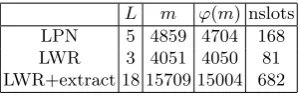
L m ϕ(m) nslots LPN 5 4859 4704 168 LWR 3 4051 4050 81 LWR+extract 18 15709 15004 682
Table 2.HElib parameters:L=number of levels,m=index of the underlying cyclotomic polynomial, ϕ(m)=dimension of the underlying ring, nslots=number of slots by ciphertext
We see in Table 2 that there are three kind of sets of parameters: those for LWR which are very low, those for LPN which are a bit higher, and those used for LWR with extraction, which are a lot higher. Indeed, the two steps of multiplications we do in LPN to add noise do not require bigger HElib parameters. Our schemes are a lot more flexible than other schemes from the literature, in the sense that they require drastically lower parameters.
Implementations total running time (s) time (ms) per bit
LPN−C 28 2.2
LPN−Cfully-packed 24* 5*
RLPN−C 1300 15
RLPN−Cfully-packed 14500* 6*
MLPN−C 53 0.15
LWR−SYM 0.07 0.1 (8/25)
LWR−SYM+ extraction 7.3 5.3 (2/8)
LWR−SYMfully-packed 0.05 0.0008 (16/32)
LWR−SYMfully-packed + extraction 160 5.3 (2/8)
RLWR−SYM 28 0.3 (8/22)
RLWR−SYM+ extraction 1100 6.3(2/8)
RLWR−SYMfully-packed 31 0.0075 (8/22) *
Running time without additional multiplication steps
Table 3.Total running time and running time by encoded bit of the homomorphic evaluation of the decryption circuit of our schemes (in parenthesis, forLWR, values of logpand logq)
why we also provide the running time of the extracted version of the LWR scheme, achieving a total processing of the data.
The schemes based on LWR can have running time down to less than a microsecond per bit. Their total running time is less than a second for standard version and around 25 seconds for ring versions. However, when used with an additional extraction phase, the running time is of the order of few milliseconds per bit and few seconds in total. The LPN-based have running times similar to the one of LWR with extraction. But the best performance is achieved byMLPN−C, with around 0.15 millisecond per bit and less than a minute in total as running time.
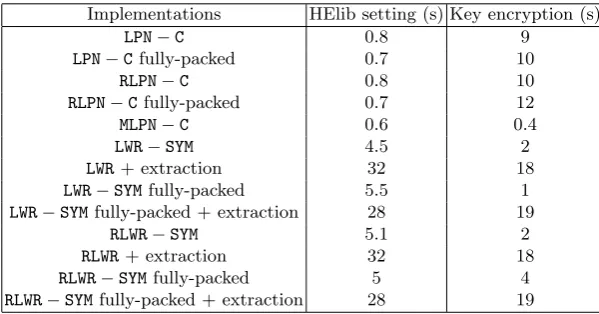
For completeness, we also provide in Table 4 the setting performance we got. In the context of the application we presented in subsection 3.2, there is first a (public and offline) phase where the parameters are fixed and the key is homomorphically encrypted. Then, there is a second (online) phase performed by the cloud when receiving the messages, and consisting in the evaluation of the decryption circuit. We do not consider here client side operations, since they are not homomorphic (and thus a lot faster).
Implementations HElib setting (s) Key encryption (s)
LPN−C 0.8 9
LPN−Cfully-packed 0.7 10
RLPN−C 0.8 10
RLPN−Cfully-packed 0.7 12
MLPN−C 0.6 0.4
LWR−SYM 4.5 2
LWR+ extraction 32 18
LWR−SYMfully-packed 5.5 1
LWR−SYMfully-packed + extraction 28 19
RLWR−SYM 5.1 2
RLWR+ extraction 32 18
RLWR−SYMfully-packed 5 4
RLWR−SYMfully-packed + extraction 28 19
Performance of these steps are quite rare in the literature. [19] announces a setting time of around 1.5 minutes. Our setting time is a lot smaller, since our parameters are. The less efficient step in our approach is the homomorphic encryption of the symmetric key, which is usually quite big for lattices, but this step can be done offline, before sending any data. Finally, as we already noticed, the random vectoradoes not have to be considered as a part of the symmetric ciphertext and does not have to be homomorphically encrypted, which leads to very low online running time.
7.2 Comparison to other works
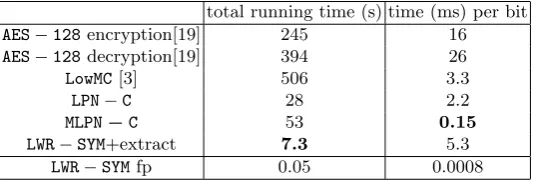
We give in Table 5 a comparison of the performance of our different schemes with the literature. The symmetric schemes we compare with areAES[19] and LowMC [3]. We chose to compare with the results of [19,3] because they are the most efficient so far and also implemented in HElib. We do not include the performance of [11] since the ciphers are very slow. In addition, both performance are really recent:AESperformance has been updated in 2015, andLowMChas been presented in 2015. We chose a homomorphic encryption security level of 80 for compatibility with these works.
While both encryption and decryption were performed forAES, only encryption perfor-mance were given concerningLowMC(decryption performance might be slower, as explained in [19]). However, evaluating encryption could also be meaningful, depending on the mode of operation used (for example in counter mode). We believe that the performance of the en-cryption of our schemes should be very similar to the one of deen-cryption, since the operations which are computed are basically the same.
LowMC had so far achieved the best performance for our problem (around 3 millisec-onds per bit). However, it is a very recent block cipher, whose security has already been questioned [13,14]. We believe that the fact that our schemes come with a proof is another advantage compared to usual block ciphers.
total running time (s) time (ms) per bit
AES−128encryption[19] 245 16
AES−128decryption[19] 394 26
LowMC[3] 506 3.3
LPN−C 28 2.2
MLPN−C 53 0.15
LWR−SYM+extract 7.3 5.3
LWR−SYMfp 0.05 0.0008
Table 5.Comparison of our performance with the literature
One can see that our schemes are a lot more flexible: the total running time of a ho-momorphic evaluation is roughly one order of magnitude faster. The parameters required by our scheme are very small, because their multiplicative depth is very small. Further-more, their good performance can extend to bigger parameters: since increasing the size of the parameters allows to pack more bits into the ciphertext, the per bit running time does not grow very fast. As en example, evaluatingLPN−C with a maximum given level of 18 in HElib (which is bigger than for example, the bound used for LowMC) instead of 5, i.e. leaving 13 levels of multiplications before bootstrapping gets necessary, leads to a per bite running time of 5.3ms. Thus, we considered that measuring performance with the smallest parameters allowed by our schemes was relevant.
ciphertext after the evaluation would often need to do this step. We see that even with the additional step of extraction, our scheme is still competitive with the best schemes in the literature. Still, as the extraction step could be included in the bootstrapping that most real-world application would make after the homomorphic evaluation, we consider that our timings without extraction are meaningful.
Finally, as we said, we would suggest to use the scheme MLPN−C, which has the short-est amortized running time, has reasonable total running time and returns ciphertexts on which we can directly compute. These results clearly show the interest of using lattice-based symmetric schemes in order to get efficient homomorphic evaluation.
8
Conclusion
Designing FHE-friendly symmetric encryption scheme is an interesting question when trying to make homomorphic encryption practical. Our work provides a new approach, based on lattices, which appears to be the most efficient so far.
Our experiments show that the schemes we presented are competitive with previous propositions. Contrary to other works, which consider block ciphers or stream ciphers, our schemes are provably secure, under some hardness hypotheses. In addition, they are a lot more flexible, in the sense that they require smaller parameters and thus, have drastically lower total running time. We have also shown that encryption schemes with arbitrary shallow decryption circuits are possible, since our LWR scheme has arguably depth zero.
Nonetheless, there is still room for improvement. First, the way the schemes have been implemented in HElib might be optimized, especially the Fourier transform used in the ring versions of the schemes. Parallel computation, which seems a natural assumption for a cloud service, would also lead to drastically faster performance, since the main computation contained in our schemes is a scalar product. Furthermore, one could also design a FHE scheme more “LWR-friendly”, which would in particular allow an easy extraction of the most significant bits, which is the main bottleneck to the performance of our LWR scheme in HElib.
References
1. Akavia, A., Bogdanov, A., Guo, S., Kamath, A., Rosen, A.: Candidate weak pseudorandom functions in AC0◦MOD2. In: Innovations in Theoretical Computer Science, ITCS’14, Princeton, NJ, USA, January 12-14, 2014. (2014) 251–260
2. Albrecht, M.R., Cid, C., Faug`ere, J., Fitzpatrick, R., Perret, L.: Algebraic algorithms for LWE problems. IACR Cryptology ePrint Archive2014(2014) 1018
3. Albrecht, M.R., Rechberger, C., Schneider, T., Tiessen, T., Zohner, M.: Ciphers for MPC and FHE. In Oswald, E., Fischlin, M., eds.: EUROCRYPT 2015, Part I. Volume 9056 of LNCS., Springer, Heidelberg (April 2015) 430–454
4. Alwen, J., Krenn, S., Pietrzak, K., Wichs, D.: Learning with rounding, revisited - new reduction, properties and applications. In Canetti, R., Garay, J.A., eds.: CRYPTO 2013, Part I. Volume 8042 of LNCS., Springer, Heidelberg (August 2013) 57–74
5. Applebaum, B.: Cryptographic hardness of random local functions - survey. Electronic Collo-quium on Computational Complexity (ECCC)22(2015) 27
6. Arora, S., Ge, R.: New algorithms for learning in presence of errors. In Aceto, L., Henzinger, M., Sgall, J., eds.: ICALP 2011, Part I. Volume 6755 of LNCS., Springer, Heidelberg (July 2011) 403–415
7. Banerjee, A., Peikert, C., Rosen, A.: Pseudorandom functions and lattices. In Pointcheval, D., Johansson, T., eds.: EUROCRYPT 2012. Volume 7237 of LNCS., Springer, Heidelberg (April 2012) 719–737