and Overwrites, with Applications to CCA
Secure Commitments
Ivan Damg˚ard1?, Tomasz Kazana2??, Maciej Obremski1?, Varun Raj3, Luisa Siniscalchi4? ? ?
1 Aarhus University 2
University of Warsaw, Institute of Informatics 3 Oracle America Inc., Redwood City
4
University of Salerno
Abstract. Non-Malleable Codes (NMC) were introduced by Dziem-bowski, Pietrzak and Wichs in ICS 2010 as a relaxation of error correcting codes and error detecting codes. Faust, Mukherjee, Nielsen, and Venturi in TCC 2014 introduced an even stronger notion of non-malleable codes called continuous non-malleable codes where security is achieved against continuous tampering of a single codewordwithoutre-encoding. We construct information theoretically secure CNMC resilient to bit per-mutations and overwrites, this is the first Continuous NMC constructed outside of the split-state model.
In this work we also study relations between the CNMC and parallel CCA commitments. We show that the CNMC can be used to bootstrap a self-destruct parallel CCA bit commitment to a self-destruct parallel CCA string commitment, where self-destruct parallel CCA is a weak form of parallel CCA security. Then we can get rid of the self-destruct limitation obtaining a parallel CCA commitment, requiring only one-way functions.
1
Introduction
In this paper, we study the interesting relationship between the notions of non-malleable codes and non-non-malleable commitments, and advance state of art for both of them. Before giving our results, we introduce the notions.
1.1 Introduction to Non-Malleable Codes
Non-Malleable Codes (NMC) were introduced by Dziembowski, Pietrzak and Wichs [DPW10] as a relaxation of error correcting codes and error detecting
?This work was supported by MPCPRO, ERC project nr. 669255. ??
Supported by Polish National Science Centre (NCN) SONATA GRANT UMO-2014/13/D/ST6/03252.
? ? ?
codes. An NMC takes a message m and encodes it as a possibly longer and randomized codeword c←Enc(m). The adversary chooses and submits a tam-pering functionTamper, that is applied to the code word to yieldc0 =Tamper(c). Applying the decoding algorithm yields a message m0 =Dec(c0). The security guarantee for an NMC now is that the decoded messagem0is either identical to the original messagemor, in case of a decoding error, a messageunrelated tom. Correspondingly, the adversary is given eitherm0 or a symbol “same” indicating that decoding was successful. Technically, we require that ifm06=m, thenm0can be simulated using just the tampering function Tamper, but without knowing anything about the tampered codewordc0.
It is generally impossible to give any meaningful guarantees if the tampering function is unrestricted (the tamper function could decode, and then encode a modified message). Therefore, the tampering functionTamperis always assumed to come from some class T of functions. An immediate example application of NM codes is for tamper resilient cryptography: if a secret key is stored in a hardware device, the adversary could try to tamper with the device and observe its behavior after the modification. But if the key is encoded with an NM code, the security guarantees immediately imply that either the tampering had no effect or the effect can be simulated without the device.
Continuous Non-Malleable Codes (CNMC) As mentioned in [JW15], non-malleable codes can provide protection against these kind of attacks if the device is allowed to freshly re-encode its state after each invocation to make sure that the tam-pering is applied to a fresh codeword at each step. After each execution the entire content of the memory is erased. While such perfect erasures may be fea-sible in some settings, they are rather problematic in the presence of tampering. Due to this reason, Faust et al. [FMNV14] introduced an even stronger notion of non-malleable codes called continuous non-malleable codes where security is achieved against continuous tampering of a single codewordwithoutre-encoding. In this model the adversary can iteratively submit tampering functionsTamperi
and learnmi =Dec(Tamperi(c)). We call this thecontinuous tampering model. This stronger security notion is needed in many setting, for instance when using NMCs to make tamper resilient computations on von Neumann architectures [FMNV15].
Some additional restrictions are, however, necessary in the continuous tam-pering model. If the adversary was given an unlimited budget of tamtam-pering queries, then, given that the class of tampering functions is sufficiently expres-sive (e.g. it allows to overwrite single bits of the codeword), the adversary can efficiently learn the entire message just by observing whether tampering queries leave the codeword unmodified or lead to decoding errors, see e.g. [GLM+04].
– Whether tampering is persistentin the sense that the tampering is always applied to the current version of the tampered codeword, and all previous versions of the codeword are lost. The alternative definition considers non-persistent tampering where the device resets after each tampering, and the tampering always occurs on the original codeword.
– Whether tampering to an invalid codeword (i.e., when the decoder outputs
⊥) causes a“self-destruct”and the experiment stops and the attacker cannot gain any additional information, or alternatively whether the attacker can always continue to tamper and gain information.
A long line of research has tried to optimize the performance of NM codes with respect to the number of allowed tampering queries and the class of allowed tampering functions (see the related work section for details). In this paper we will be concerned with the case of CNMCs where there is no a priori bound on the number of queries. This model must include a self-destruct mechanism.Further we will be concerned with information theoretic NM codes where security holds for an unbounded adversary, and we will look at the single state model, where the tampering function is allowed to access the entire codeword. This is in contrast to the split-state model where the tamper function must consider disjoint parts of the codeword separately.
1.2 NMC- Our result
We give a construction of a self-destruct, non-persistent continuous NMC (see Corollary 1 of Theorem 1) unconditionally secure against bit permutations com-posed with bit overwrites. [AGM+15] gives aone time Non-Malleable Code re-silient againstbit permutations composed withbit-wise tampering. In [CMTV15] they construct a CNMC secure againstbitwise tampering (but permutations are not allowed).
Unconditionally secure Continuous Non-Malleable Codes are notoriously hard to construct. Very little progress was made since CNMC were proposed in 2015:
– [CMTV15] authors construct a CNMC secure against bitwise tampering which is the simplest variant of split-state model.
– [CGL16] authors achieve a so-called many-many non-malleable code in the 2-split state model. Their construction achieves non-malleability as long as the number of rounds of tampering is at mostnγ for some constant γ <1, wherenis the length of the codeword.
– [AKO17] authors give thepersistentcontinuous NMC construction for 2−split state.
– [ADN+16] gives Continuous NMC against 8−split state tampering (optimal number of states would be 3).
1.3 NMC- Related work
In [DPW10] the authors construct an efficient code which is non-malleable with respect to bit-wise tampering, i.e., tampering functions that modify each bit of the codeword arbitrarily but independently of the value of the other bits of the codeword. Later works [DKO13, ADL14, CZ14, CG14, Li17] provided stronger results by considering a model where the codeword is split into s parts called states, which can each be tampered arbitrarily but independently of the other states. Other works considered tampering via permutations and perturbations [AGM+14], which are not captured in the split-state model. In [BDSKM16] authors show how to construct efficient, unconditionally secure non-malleable codes for bounded output locality (i.e. when every bit of tampering output can depend on at most somenδ bits of input forδ <1).
The definition in [DPW10] allows the adversary to be computationally un-bounded. We call this aninformation theoretic NMC. Later works considered a notion ofcomputational NMC where the adversary and tampering functions are restricted to efficient computations, see for instance [CKM11, LL12, AAnHKM+16, BDSKM17].
The definition in [DPW10] allows the adversary to tamper the codeword only once. We call this one-shot tampering. Faust et al.[FMNV14] consider a stronger model where the adversary can iteratively submit tampering functions
Tamperiand learnmi=Dec(Tamperi(c)). We call this thecontinuous tampering model. This stronger security notion is needed in many setting, for instance when using NMCs to make tamper resilient computations on von Neumann architectures [FMNV15]. Some additional restrictions are, however, necessary in the continuous tampering model. If the adversary was given an unlimited budget of tampering queries, then, given that the class of tampering functions is sufficiently expressive (e.g. it allows to overwrite single bits of the codeword), the adversary can efficiently learn the entire message just by observing whether tampering queries leave the codeword unmodified or lead to decoding errors, see e.g. [GLM+04].
To overcome this general issue, [FMNV14] assume aself-destruct mechanism which is triggered by decoding errors. In particular, once the decoder outputs a special symbol⊥the deviceself-destructs and the adversary loses access to his tampering oracle. This model still allows an adversary many tamper attempts, as long as his attack remains covert. Jafargholi and Wichs [JW15] provide a general study of when CNMCs can be built assuming a self-destruct mechanism. Faust et al. [FMNV14] constructed a CNMC in the 2-state model which is secure against computationally bounded adversaries. It was shown in the same work that it is impossible to construct an information theoretic CNMC for the 2-state model.
the first information theoretic construction of CNMC in 8− split state. Before [ADN+16] the only known result that achieves some sort of non-malleable codes secure againstnon-persistentcontinuous tampering was the result by Chattopad-hyay, Goyal, and Li [CGL16]. They achieve this by constructing a so-called many-many non-malleable code in the 2-split state model. Their construction achieves non-malleability as long as the number of rounds of tampering is at mostnγ for some constantγ <1, wherenis the length of the codeword.
1.4 Application to Commitment Schemes
Commitment schemes. The notion of commitment is perhaps the most funda-mental concept in cryptographic protocol design. The idea is that a sender binds herself to a choice of a message m by exchanging some information with a re-ceiver. The commitment should be hiding, i.e., the verifier does not learn the committed message. Later, the sender can choose to open the commitment, i.e., release more information allowing the receiver to determinem. The commitment should be binding, i.e., the sender cannot make the receiver output a message different from the one she had in mind at commit time.
The strongest possible security notion for commitment schemes is UC secu-rity, which intuitively asks that using the scheme is equivalent to giving m to a trusted party who will only release it on request from the committer. This is much stronger than simply asking for hiding and binding, e.g., we get security under general composition. But unfortunately, we know that UC security can-not be achieved without set-up assumptions. So a long line of research has been aimed at achieving weaker but meaningful security guarantees without set-up.
An important example of this is the notion of non-malleable (NM) commit-ments [DDN91]. Here we consider an adversarial Man-in-the-middle (MiM), who on side receives a commitment from an honest sender to message m (the “left session”) and on the other side sends a commitment to an honest receiver (the “right session”), containing m0. The MiM wins if he succeeds in forming a new commitment on the right such that m0 has some non-trivial relation to m. The NM property does not follow from hiding and binding and is very important, for instance in making auctions where committed bid is fair, or towards implement-ing secure coin-flippimplement-ing. Technically the NM property is captured by requirimplement-ing a simulator that will simulate the left session without knowing m and still the MiM wins with essentially the same probability.
An even stronger notion of commitment security is CCA security([CLP10]): we consider again a MiM, but he is now given an oracle that he can query on input a commitment from (one of) the right session(s), as long as it is not a copy of something from a left session. The requirement is that hiding holds for the left session(s), even in presence of the oracle. Intuitively, a CCA secure commitment is also NM secure, all other things being equal: if the MiM could break NM security and come up with a new commitment on the right side that is related to one from the left, he could submit it to the oracle in the CCA game and use the reply to break hiding on the left side. One restriction on CCA commitments that has been considered is parallel CCA security, where the MiM can ask only one query that may, however, contain an unbounded number of commitments. Another restriction is that of self-destruct (SD)-CCA, where the oracle stops working if the MiM submits an invalid commitment.
Parallel CCA commitments from CNMC. In this second part we investigate possible applications our CNMC. In particular, we will show a bridge between (unconditionally secure) CNMC and (computational) cryptographic primitives secure in the concurrent setting.
For the stand-alone setting the result of [AGM+15] shows how to use a bit parallel CCA commitment5to construct a1-1string non-malleable commitment relying on stand-alone NM code. In particular, constructing string commitment from the corresponding 1-bit primitive, they first encode the input message with an NM code and then apply a 1-bit commitment scheme.
Following the same approach of [AGM+15] but using a CNMC (resilient to the same class of tampering functions of [AGM+15]) we are asking which flavor of non-malleability w.r.t. commitment we can achieve. In particular, is it enough to plug-in our CNMC in the construction of [AGM+15] to obtain a concurrent NM string commitment? The answer is only partial yes, due to the self-destruct limitation of CNMC. Indeed, a MiM adversary of NM commitments can compute multiple invalid commitments. Then, we show how to bypass this limitations requiring only OWFs.
In more details, we obtain a compiler that takes a CCA bit commitment and constructs an SD concurrent NM commitment. Due to the adaptiveness of our NM code we actually achieve a stronger security notion, namely a string SD-CCA commitment scheme. Furthermore we can relax the requirements on the CCA bit commitment: it just needs to be SD-CCA-secure instead of CCA-secure.
5
Summarizing, we show a compiler that on input a (non-tag based) SD-CCA bit commitment scheme and a continuous non-malleable code resilient against permutations and bit overwrites, outputs a (non-tag based) SD-CCA string com-mitment scheme. Our construction, like the one of [AGM+15], preserves the round complexity of the bit commitment scheme and does not require any addi-tional assumption. Finally , we show that a SD-parallel CCA string commitment scheme can be upgraded to a parallel string commitment scheme without self-destruct, assuming only one-way functions. The construction is non-trivial (it requires very recent developed tecniques) and adds only two rounds of interac-tion.
Together with our compiler described above, this implies the first construc-tion that exploit the CNMC property to obtain a parallel CCA commitment. Fur-thermore, parallel CCA commitment founds multiple applications like [Kiy15, BDH+17]. Observe that parallel CCA commitment is not implied by parallel NM commitment (see [BFMR18]).
Previous work on NMCs and NM commitments. The literature presents works that exploit the properties of the non-malleable code to construct non-malleable commitments. Goyal et al. [GPR16] use non-malleable codes in the split-state model to realize a 3-round one-one non-malleable commitment relying on one way permutations secure against a quasi-polynomial time adversary. Chandran et al. [CGM+16] show that block non-malleable codes withtblocks imply non-malleable commitments oft−1 rounds. As we discuss above, Agrawal et al. [AGM+15] showed that is possible to construct a one-one non-malleable commitment relying on a non-malleable code and a bounded parallel CCA bit commitment. However, no one before uses non-malleable codes to construct a parallel CCA commitment scheme.
The aim of this second part is to build bridges between different notions of non-malleability, and to not construct a new NM commitment or a CCA commitment that are already available in literature. Indeed, there is a long line of research that tries to reduce the round complexity of NM commitment (e.g. [DDN91, Bar02, PR05, Wee10, PW10, LP11, Goy11, GLOV12, GRRV14, GPR16, COSV16, COSV17b, KS17, Khu17, LPS17]). Several constructions of CCA commitment are also available in literature (e.g. [CLP10, LP12, Kiy14, GLP+15]).
1.5 Technical overview of our CNMC secure against permutations-and-overwrites
Construction of Continuous Non-Malleable Code. Our code consists of an amal-gamation of two different layers of encoding schemes.
The top layer is a Reed-Solomon code used here as a sharing scheme. We take a messagem, append a random suffix and then encode it using Reed-Solomon to receive a codeword consisting ofN blocks that may be seen as shares ofbN
3c -out-of-N secret sharing scheme. The intuition behind this scheme is that the adversary needs to learn at least N
3 shares to learn anything about the initial message.
The bottom layer is using a Two-Split State Super Strong Non-Malleable Code (instantiated either by [AKO17] or [Li17]). Each sharesi from the above secret sharing scheme is converted into (si||i) and then encoded using the two-split state code to get two shares (Li, Ri) (We also expect the bit-parity of Li to be 0 and the bit-parity ofRi to be 1). The final code is (L1, R1, ..., RN, LN). To prove that the just described code is actually continuous non-malleable code, we first redefine the experiment in the definition of continuous codes. The new definition is obviously stronger, so it is sufficient to work with it. In the new definition, whenever an adversary tampers with a blocks (Li, Ri) with non-constant functions and succeeds in creating valid (from the point of view of Super Strong NMC decoder) output blocks (L0i, R0i) (In particular, the parities of all (L0i, R0i) must be correct), we will reveal blocks (Li, Ri) to the adversary.
As observed earlier, the adversary’s necesary task is to learn at leastbN 3c blocks of the underlying si shares.
Since the adversary can only tamper bitwise and permute bits we can prove that if the adversary doesn’t know N3 blocks and he tries to modify the code he will either get detected with probability exponentially close to 1, or he can attempt to learn some small amount information about the codeword (i.e. tamper with few blocks Li, Ri with non-constant function). However, using the bottom layer, we show that every attempt to learn even the smallest information about the codeword (i.e. by overwriting all but only few bits) yields some probability of detection which amplifies with amount of information adversary is trying to learn. We will therefore show that adversary can not (i.e. the probability is negligable) breachbN
3cblocks threshold.
The argument consists of two main technical lemmata:
– [lemma 8]If the adversary applies any non- constant functionsf, gto single block Li, Ri then, due to combination of super strong nmc properties and parity requirements we have placed on Li, Ri, adversary risks close to 12 detection probability.
proof of this fact is more involved because we have to deal with minute cases. For example if we prove that mixing of bits will make the parity unpredictable for each block it still may happen that the events of error are correlated so not obviously amplify the error rate.
Example 1. Assume adversary tampers only with L1 and L2, if he permutes bits in a way that output L01 contains first halfs of vectors L1, L2, L02 contains second halfs ofL1, L2. Then parity ofL01 is correct if and only if parity ofL02 is correct. We handle this by picking only largest possible subset of independent parity checks (see lemma 9) in this case we would focus only on parity ofL01and discard any other checks generated byL1, L2, R1, R2.
Example 2. Consider a tampering function which takes one bit from some blocks (Li, Ri) and permutes them to the last block (L0N, R0N) while fixing all other (Li, Ri) to some constants. If (L0N, R0N) has a correct parity and valid Super-Strong NMC decoding then we will reveal, to adversary, all blocks that ’donated’ bits to (L0N, R0N). Notice however that this will not reveal more bits then|LN|+
|RN|blocks.
Above examples illustrate how we bound number of blocks adversary can learn for each independent validity check he has to create.
Technical overview of our self-destruct CCA commitment and par-allel CCA commitment.
The self-destruct CCA commitment scheme.We want to show that given a self-destruct CCA bit commitment scheme (non-tag based), committing to each bit of the codeword individually, results in a self-destruct CCA string commit-ment scheme. The security proof is based on the following high-level idea: if the adversary of the self-destruct CCA string commitment is mauling, then, the attack on the commitment level can be ”translated” into an attack on the non-malleable code. In other word, we can show an adversary ANMCode that breaks the security of the non-malleable code using the adversary A on the commit-ment level that distinguish a commitcommit-ment of messagem0from a commitment of message m1. ANMCode will act as the sender in the left session withA. Instead in thek-th right session (for k= 1, . . . ,poly(λ))ANMCode will act as a receiver of the string commitment. Then he needs to emulate the oracleOof the string commitment computing the following steps: 1) define a tamper functionfkbased on value v committed in the right session (note that he can obtain v querying the oracle of the bit commitment Obit6) 2) send back to A the decoding of fk(encmb), where encmb is an encoding of mb (received from the challenger of
the non-malleable code game). At the end, ANMCode will output what A out-puts. However we notice that the adversary that we described is not yet an adversary against the non-malleable code since the tamper functions can be de-pendent on what is committed on the left. We can demonstrate that the hiding of the self-destruct CCA bit commitment ensures that the distribution of the
6
tamper functions is computational independent from the message committed by the sender. Therefore the final adversary against the non-malleable code will simply commits to a random message on the left session. Finally, we crucially need that the non-malleable code is information theoretic secure since we have no guarantee thatObit works in polynomial time.
Upgrade SD-PCCA commitment scheme to PCCA commitment scheme.At a very high level our PCCA string commitment scheme works as follows. The sender interacts with the receiver in order to compute a commitmentτofmusing a self-destruct PCCA string commitment. Furthermore, the receiver engages with the sender a protocol to allow the extraction of a trapdoor. We use the ”trapdoor protocol” described in [COSV17b] where the trapdoor is represented by the knowledge of two signatures under a verification key sent by receiver in the 4th last round. In order to allow the extraction of the trapdoor, the receiver sends a signature of a randomly chosen message in the 3rd last round by the sender. Then, the sender executes a special witness-indistinguishable proof of knowledge (WIPoK) with the receiver in order to prove that he computed a valid commitment ofmor that he knows a trapdoor.
Observe that if we use a 3-round WIPoK it is not clear how the proof of security will proceed. In particular, in the security proof there are some hybrids were we simulate the oracle of the parallel CCA commitment in polynomial time extracting the committed messages from the WIPoKs. Let us consider the hybrid were we switch the witness in one of the WIPoK. In the reduction to the WI we have to emulate the oracle of the parallel CCA commitments, since the reduction has to work in polynomial time. As we said, our hope to emulate the oracle is to extract the committed messages from the WIPoKs, however the extraction procedure rewinds also the challenger of the WI.
To overcome this problem we adopt the approach proposed in [COSV17b] relying on non-interactive primitives instead of 3-rounds WIPoK.
Therefore, similarly to [COSV17b], we construct this WIPoK relying on: instance-dependent trapdoor commitments (IDTC) and special honest-verifier zero knowledge (SHVZK).
In more details, let (ls1trap,ls2trap,ls3trap,ls4trap) be the transcript of a 4-round spe-cial HVZK delayed-input7proof of knowledge (PoK). The transcript (ls1
trap,ls 2 trap,ls
3 trap,ls
4 trap) is used to prove knowledge of two signatures of two different message w.r.t. a
verification key sent by the reaciver. The transcript (ls1trap,ls2trap,ls3trap,ls4trap) is used to prove the knowledge of the trapdoor.
At the 4th last round the sender sends an equivocalcom obtained running IDTC. At last round the sender will equivocatecomin order to send as opening (dec,ls2trap). In the last round alsols4trapis sent. The instance used for the IDTC is τ, this means that the commitmentcom(computed using IDTC) can be opened to any value because τ is a well-formed commitment.
In the opening phase the sender sends the opening of the self-destruct PCCA string commitment.
7
Note that the first two rounds of the ”trapdoor protocol” can be run with the last two rounds of the self-destruct commitment. Therefore the described construction hast+2 rounds (wheretis the number of rounds of the self-destruct PCCA string commitment).
Overview of the security proof.In the 1st experiment (the real game RG0) the sender commits tom0. We observe that due to the security of the signature scheme we can demonstrate that in the real game A is committing to a well-formed commitments in all parallel right sessions with non-negligible probability. Symmetrically there is the experimentRG1where the sender commits tom1and
Ais committing to a well-formed commitment in all parallel right sessions. Then we consider a hybrid game H0
b, for b∈ {0,1}, where the sender commits to mb and the oracle is emulated extracting the committed values from the special WIPoK. Note that H0
b is distributed statistically close toRGb until Areceives the committed values, therefore we are ensured that we can extract the values committed in the right sessions. The 2nd hybrid game that we consider is H1 b in which we switch the witness used to compute the transcript of the special WIPoK in the left sessions (i.e. we are using the trapdoor that is extracted by rewinding A in the left session). Using techniques that are similar to the one showed in [COSV17b] we are able to demonstrate that also inH1
b we can extract the committed values in all parallel right sessions with non-negligible probability. Moreover, we can demonstrate that the distribution of the commitment values along with the view ofAis indistinguishable betweenH0
b andH 1
b, forb∈ {0,1}. Indeed, both inH1
0and inH11we are guaranteed thatAis committing to a well-formed commitment in all parallel right sessions with non-negligible probability. Summing up, a detectable deviation from H1
0 and H11 implies a contradiction of the self-destruct PCCA security of the underlining commitment. Finally we observe that the extraction procedure of the signatures does not interfere with the reductions since in the parallel right sessions the commitment phase made by A ends in the third last round. This observation concludes the high-level overview of the security proof.
2
Preliminaries
We denote the security parameter byλand use “||” as concatenation operator (i.e., ifaandbare two strings then bya||bwe denote the concatenation ofaand b). We use the abbreviationpptthat stands for probabilistic polynomial time. We use poly(·) to indicate a generic polynomial function andNto denote the set of positive integer.
Land all well formed instances that do not have a witness. Moreover we require that membership in ˆL can be tested in polynomial time. We implicitly assume that a PPT algorithm that is supposed to receive an instance in ˆL will abort immediately if the instance does not belong to ˆL. LetAandBbe two interactive probabilistic algorithms. We denote byhA(α), B(β)i(γ) the distribution of B’s output after running on private input β with A using private input α, both running on common inputγ. Typically, one of the two algorithms receives 1λ as input. AtranscriptofhA(α), B(β)i(γ) consists of the messages exchanged during an execution whereAreceives a private inputα,Breceives a private inputβand bothAandB receive a common inputγ. Moreover, we will refer to theviewof A(resp.B) as the messages it received during the execution ofhA(α), B(β)i(γ), along with its randomness and its input. We say that a protocol (A, B) is public coin ifB sends to Arandom bits only.
IfZ is a set then Z ← Z will denote a random variable sampled uniformly from Z. We start with some standard definitions and lemmas about the statis-tical distance. Recall that ifX and X0 are random variables over the same set
X then the statistical distance between X andX0 is denoted by∆(X;X0), and defined as∆(X;X0) = 12P
x∈X|PrX =x−PrX0=x|. If the variablesX and
X0 are such that ∆(X;X0)≤then we say that X is-close toX0, and write X ≈ X0. IfE,E0 are some events then by∆(X|E ; X0|E0) we will denote the distance between variables Xe and Xe0, distributed according to the conditional
distributions PX|E andPX0|E0.
If UX is the uniform distribution over X then d(X|E) := ∆(X|E;UX) is
called statistical distance ofX from uniform given the event E. Moreover, ifY is independent from X then d(X|Y) := ∆((X, Y); (UX, Y)) is calledstatistical
distance ofX from uniform given the variableY. More generally, ifEis an event thend(X|Y,E) :=∆((X, Y)|E; (UX, Y)|E). It is easy to see thatd(X|Y) is equal
to the averageP
yPr(Y =y)·d(X|Y =y) =Ey(d(X|Y =y)).
Definition 1 ((Average-) Min-Entropy). LetX have finite supportX. The min-entropyH∞(X)of X is defined by
H∞(X) =−log max
x∈XPr(X =x).
For an event E, the conditional min-entropy H∞(X|E)of X given E is defined
by
H∞(X|E) =−log max
x∈XPr(X =x|E).
For an event E and a random variable Y with finite support Y, the average min-entropyHe∞(X|Y,E) ofX givenY andE is defined by
e
H∞(X|Y,E) =−logEymax
x∈XPr(X =x|Y =y,E).
Definition 2 (Flexible Two-Source Extractors). A function Ext : X1×
X2 → Z is called a flexible (, δ)-two-source extractor, if it holds for all tuples ((X1, Y1),(X2.Y2))for which(X1, Y1)is independent of(X2, Y2)andHe∞(X1|Y1)+
e
H∞(X2|Y2)≥log(|X |) + log(|Y|)−δ that
d(Ext(X1, X2)|Y1, Y2)≤.
A well known example of a flexible two-source extractor is the Hadamard extractor or inner-product-extractor.
Lemma 1 (Hadamard Extractor [ADL14]).The functionExt:Fnq×Fnq → Fq given byExt(x, y) =hx, yiis a flexible(, δ)extractor forδ≤(n−1) log(q)− 2 log(1/).
Lemma 2 (Entropy-preservation of inner-product for correlated dis-tributions). Let X be random variable overXl, let C be random variable such that for everycwe haveH∞(X|C=c)≥l·log|X | −d, whered <log|X |. Then for any non-zero v∈ Xl
H∞(hX, viX |C=c)≥log|X | −d
for every cin supp(C).
We will now assemble a few basic technical lemmata that we will need for our proofs.
Lemma 3 (Bayes’ rule for statistical distance [DKO13]). Let (X, Y) ∈ X × Y be a random variables, such that d(X|Y)≤. Then for everyx∈ X we have
∆(Y|X=x; Y)≤2|X |.
Also ifA is a random event such thatd(X|Y,A)≤, we have: ∆(Y|X =x,A; Y|A)≤2|X |.
Lemma 4 ([DNO16]).LetX, T be any arbitrarily correlated random variables and letE be random event then
e
H∞(X|T,E)≥He∞(X|T)−log
1 Pr(E).
In the Appendix A the reader can find a series of standard definitions used in the rest of the paper.
2.1 Commitment Schemes
Self-Destruct CCA Secure Commitment Schemes. Let Π = (Sen,Rec) be a commitment scheme. The self-destruct CCA-oracleOsdccaforΠ = (Sen,Rec) acts as follows in an interaction with an adversary A: it participates withAin polynomially many sessions of the commit phase of Π as an honest receiver. At the end of each session, if the session is valid, the oracle returns the unique valuemcommitted in the interaction. The oracle outputs⊥and implements the self-destruct mode, (i.e. the oracle will respond with⊥for all subsequent com-mitment queries) if one of the following cases happen: 1) a session has multiple valid committed values8; 2) the commitment is invalid; 3) if the committed value mis equal to a special self-destruct symbol ⊥.
More precisely, let us consider the following probabilistic experimentINDsdccab (Π = (Sen,Rec), λ, z,A) Let Osdcca be the SD CCA-oracle for Π. The adversary has access to Osdcca during the entire course of the experiment. On input 1λ, and z∈ {0,1}?the adversaryAOsdcca
sends two stringsm0 andm1 with|m0|=|m1|
to the experiment. The experiment randomly selects a bit b← {0,1} and com-mits to mb to AO
sdcca
. Note that if A queries the oracle with a commitment of ms.t.m∈ {m0, m1}9then, the oracle returns the special symbolsame. Finally
AOsdcca
sends a bityto the experiment. The output of the experiment is replaced by ⊥ if AOsdcca
sends a commitment to Osdcca whose transcript is identical to the one computed on the left. Otherwise, the output of the experiment isy. Let
INDsdccab (Π = (Sen,Rec), λ, z,A) denote the output of the experiment described above.
Definition 3 (Self-destruct CCA (SD-CCA) secure string commitment scheme). Let Π(Sen,Rec) be a commitment scheme and Osdcca be the self-destruct CCA-oracle for Πsdcca. We say that Πsdcca is self-destruct CCA-secure (w.r.t. the committed-value oracle), if for every ppt-adversary A and all z ∈ {0,1}? it holds that:
{INDsdcca0 (Π= (Sen,Rec), λ, z,A)} ≈ {IND sdcca
1 (Π = (Sen,Rec), λ, z,A)}
Definition 4 (Self-destruct parallel CCA (SD-PCCA) secure string commitment scheme). The self-destruct parallel CCA oracle is defined like the self-destruct CCA-oracle, except that the adversary is restricted to a parallel query, i.e., the adversary can only send a single query that may contain multiple commitments sent in parallel. Let INDsdpccab (Π = (Sen,Rec), λ, z,A) define the output of the security game for self-destruct parallel CCA security. The formal definition is then analogous to the definition of SD-CCA security.
Note that any SD-CCA commitment scheme is also a SD-PCCA commitment scheme.
8
The statistical binding property guarantees that this happens with only negligible probability.
9
Definition 5 (Parallel CCA secure (PCCA) string commitment scheme[BFMR18, Kiy15]). The parallel CCA oracle is defined like self-destruct parallel
CCA-oracle, except that the oracle does not implement the self-destruct mode. In more details, when a commitment is not valid, or a session has multiple valid commit-ted values the oracle returns⊥, and the committed messages (or the symbolsame) in all the other cases. Let INDsdpccab (Π = (Sen,Rec), λ, z,A)define the output of the security game for parallel CCA security (PCCA). The formal definition is then analogous to the definition of SD-PCCA security.
In this paper we also consider a self-destruct (parallel) CCA secure bit com-mitment scheme that is defined as in Def. 3 ( 4), except that the message space is{0,1} and the oracle never returnssame.
In all the paper we denote by ˜δ a value associated with the right session (where the adversary A plays with the oracle) where δ is the corresponding value in the left session. For example, the sender commits tovin the left session whileAcommits to ˜v in the right session.
3
Definitions related to Non-Malleable Codes
Definition 6 (Coding Schemes).A coding scheme is a pair(Enc,Dec), where
Enc:M → Cis a randomized function andDec:C → M∪{⊥}is a deterministic
function, such that it holds for allM ∈ Mthat Dec(Enc(M)) =M.
Definition 7 (Two-State Code).A coding scheme(Enc,Dec)where the coun-terdomain of Enchas the form C={0,1}k× {0,1}k is called a two-statecode.
Definition 8 (Paritied Two-State Code).Let(Enc,Dec)(whereEnc:M → C =C1× C2 ={0,1}k× {0,1}k) be a two-state code. Now let Encpar :M → C be a randomized function restricted to a condition thatparity(Enc(m)1) = 0and parity(Enc(m)2) = 1, whereparityis a function calculating the parity of number of ones in a given vector (i.e. parity(0101011) = 0andparity(011111) = 1).
More formally, the procedure computing Encpar(m) can be described as fol-lows: we run in a loop the encoding procudure(c1, c2)←Enc(m)untilparity(c1) = 0 andparity(c2) = 1.
Similarily, letDecpar :C → M ∪ {⊥}be defined as follows: forc= (c1, c2)∈ C, ifparity(c1)6= 0orparity(c2)= 16 thenDecpar(c) :=⊥, otherwiseDecpar(c) :=
Dec(c).
Now, the coding scheme(Encpar,Decpar)is called a paritiedtwo-state code. We will now define the continuous tampering experiment. Our definition is a weaker version of [JW15]: instead of Super Strong Tampering experiment we will use the standard tamper experiment from [DPW10].
(Enc,Dec) with message space M and codeword space C. Also fix a family of functions F : C → C. Let D = {DfC}f∈F,C∈C be some family of distributions
over {0,1}, indexed by tampering function f and a codeword C. We will first define the tampering oracleTamperstateC,D(f), for which initiallystate=alive. For a tampering function f ∈ F and a codeword C∈ C define the tampering oracle by
TamperstateC,D(f) :
If state=dead output⊥
C0←f(C)
If Dec(C0) =Dec(C)andDfC= 0output same
M0 ←Dec(C0)
If M0=⊥setstate←dead and output⊥
Otherwise output C0
Fix a tampering adversaryAand a codewordC∈ C. We define the continuous tampering experimentCTC,D(A)by
CTC,D(A) :
state←alive
v← ATamperstateC,D(·) Outputv
Definition 10. Let (Enc,Dec)be a coding scheme andCTbe its corresponding continuous tampering experiment for a classF of tampering functions. We say that(Enc,Dec)is an-secure continuously non-malleable code againstF, if there exists a family of distributions D ={DfC}f∈F,C∈C over {0,1} such that for all
tampering adversaries Aand all pairs of messagesM0, M1∈ Mthat
CTC0,D(A)≈CTC1,D(A), whereC0←Enc(M0)andC1←Enc(M1).
4
Continuous Non-Malleable Code against
Permutations-With-Overwrites
In this section we define a coding scheme (Encc,Decc) and prove it is a continuous non-malleable code against a class PermOver of permutations-with-overwrites (the actual definition will follow).
4.1 Coding scheme
LetM={0,1}n andC=C
and hN denote a bN/3c-out-of-N secret sharing scheme (again, the specific in-stantiation will be given later). Now we are ready to introduce the (randomized) function (procedure)Encc:M → C:
Form ∈ M and a randomr ∈ {0,1}n, let (d
1, . . . , dN) ←hN(m||r) where (d1, . . . , dN)∈({0,1}k2)N are shares for (m||r). Now, for eachdi let (Li, Ri)←
Encpar2 (di||i).
Finally, we stateci ←(Li, Ri) andEncs(m) outputs (c1, . . . , cN).
The definition ofDeccis simple and straightforward (forced by the definition of a coding scheme).
Remark 1. The above construction is not tight for a given message length n since it also depends on the choice of parameters (N, k1, k2) and the specific definitions of both: the two-state code (Enc2,Dec2) and the secret sharing scheme hN. However, before we pick adequate parameters and schemes, we need one definition more:
Definition 11. We call a two-split code(Enc2,Dec2)-admissibleif the scheme (Encpar2 ,Decpar2 ) fulfills the following requirements:
1. [Canonical encoding procedure:]Encpar2 (m)is uniform in{c:Decpar2 (c) =m}. 2. [Detection of close to bijective tampering:]For any messagem, ifEncpar2 (m) =
(X, Y)then for any functionsf, g:{0,1}k1→ {0,1}k1 such thatH∞(f(X)),H∞(g(Y))≥ 2/3·k1−1and (for any xory)f(x)6=xor g(y)6=y it holds:
Pr(Decpar2 (f(X), g(Y)) =⊥)≥1−.
3. [Detection of complete overwrite of one part:]For any constant c∈ {0,1}k1, and any uniformX, Y ∈ {0,1}k1, such that parity of X is0and parity ofY is1we get,
Pr(Dec2(X, c) =⊥)≥1−, Pr(Dec2(c, Y) =⊥)≥1−
4. [Leakage resilient storage:]For any message m, if Encpar2 (m) = (X, Y) then for any functionsf, g:{0,1}k1 → {0,1}k1 such thatHe
∞(X|f(X))≥1/3·k1 andHe∞(Y|f(Y))≥1/3·k1 we get
∆[(f(X), Y) ; (f(U0), U1)]≤ , ∆[(X, g(Y)) ; (U0, g(U1))]≤ ,
whereU0, U1 are independent uniformly distributed over {0,1}k1, such that parity ofUi is equali.
4.2 Definition of the class of tampering functions
Here we define the class PermOver of tampering functions. Through this paper functions from this classPermOver are called permutations-with-overwrites.
Let us consider a set{0,1}q of vectors ofqbits (q-vectors, for short). Now, let denoteΠq the class of permutations of bits ofq-vectors. Denote alsoOq the class of functionsf :{0,1}q→ {0,1}q, such that:
for alli, eitherf(x)i=xi or f(x)i=bi for a fixedbi.
Loosly speaking: any function from Oq, independently for each bit, either leaves it unchanged or sets it into a fixed value (i.e. overwrites it).
Now we simply define the classPermOverq =Oq◦Πq. For our application we will equateC= ({0,1}k1× {0,1}k1)N with{0,1}2k1N and considerPermOver=
PermOver2k1N as a tampering class forC.
The above description of course finishes the definition of our class of tamper-ing functions, however we want a few further related definitions.
Related definitions. Let us fix a tampering functiont∈PermOver. As mentioned above we will think oftas a function fromC1× · · · × CN toC1× · · · × CN. Now, for eachi∈ {1, . . . , N}we say thatteither leaves oroverwrites ormodifies the i-thblock. These phrases stand for the following:
Ift(c)i=ci thentleaves thei-th block. Ift(c)i=afor someaindependent ofcthentoverwrites thei-th block. Finally, if none of the previous occurs, then we say thatt modifies thei-th block.
Iftoverwritesi-th block, two cases are possible. Eitherci is independent of f(c) or some bits ofciare moved to some modified blocks. In the first case we say that tstrong-overwritesi-th block and in the second case, it weak-overwrites.
Touched blocks are blocks either modified or weak-overwritten. In that case we say thatt touches these blocks.
For a functiont∈PermOverand a codewordc∈ C we denotetouch(t, c) the
set of all touched blocks and its indices, more formally:touch(t, c) ={(ci, i)|t touches ci}. Example. The above definitions may look a little bit obscure at first sight, so –
to make things clearer – we give an example.
LetN = 4 and eachCi={0,1}6. Now let us consider:
t(b11, b12, b13, b14, b15, b16),(b21, b22, b32, b24, b25, b26),(b31, b32, b33, b34, b35, b36),(b41, b42, b43, b44, b45, b46)=
(0,0,0,1,1,1),(b12, b22, b23, b24, b25, b26),(0,1,0,1,0,1),(0, b15, b44,1, b42, b11).
Obviously t∈PermOver and we have that: t leaves the second block, over-writes the first and the 3-rd block and modifies the 4-th block. The first block is weak-overwritten (because the 5-th block gets one bit from the first block) and the 3-rd block is strongly overwritten. Function ttouches the blocks of the indices 1 and 4 so, for exemplary
c= ((0,0,1,1,0,0),(0,0,1,1,1,1),(1,1,1,1,0,0),(1,0,0,0,0,1)), we have:
touch(t, c) ={ (0,0,1,1,0,0),1
4.3 Statement and Proof
The main statements for the whole Section 4 are the following:
Theorem 1. The coding scheme (Encc,Decc) is an (α+ 2c)bN/3c-secure con-tinuous non-malleable code againstPermOver forα= (0.5)8·1k1.
Corollary 1. Instantiation for the above code with(N, k2, k1) = (6dn2/3e,dn1/3e, cdn1/3elogdn1/3e), with (Enc2,Dec2) = (EncLi,DecLi) (see Appendix B) and hN = RSN (see
Ap-pendix C) gives us a continuous non-malleable code againstPermOver such that:
– the code rate isO(logn), and
– the error rate isO(2−O(n1/3) ).
Proof. The message length isnand the codeword length isN·2·k1≈
6n2/3·2·cn1/3 13logn= 4cnlogn, so the code rate is approximately 4clogn= O(logn). (Remark:cis a constant fromEncLirate.) The error rate is:
(α+2c)bN/3c= ((0.5) 1
8·k1+2c)bN/3c≤(2
−O
1
n1/3 logn
+2−O(n))n2/3+1= 2−O(n1/3). Before the actual proof of Theorem 1 we want to introduce a slightly modified version of continuous tampering experiment for (Encc,Decc) andPermOver and a definition of a specific type of distribution that we call block-wise distribution. The described below experiment is obviously stronger (from adversary’s point of view) then the original one so it is sufficient to prove that our coding scheme is secure againstPermOverfor the modified experiment:
Definition 12 ((Modified) Continuous Tampering Experiment).Let us consider a tampering oracle ModTampstateC (t), for which initiallystate=alive. For a tampering function t∈PermOver and a codeword C ∈ C define the tam-pering oracle by
ModTampstateC (t) :
If state=dead output⊥
C0←t(C)
If Decc(C0) =Decc(C)output (same, touch(t, c)) M0 ←Decc(C0)
If M0=⊥setstate←dead and output⊥
Otherwise output C0
Fix a tampering adversaryAand a codewordC∈ C. We define the (modified) continuous tampering experiment MCTC(A)by
MCTC(A) :
state←alive
Remark 2. The main difference of the above experiment and the original one is the output of the oracle whenDecc(C0) =Decc(C). In this case in our definition we give the adversary additionally all touched blocks.
Definition 13 (Block-wise Distribution). ForC=C1×. . .× CN the distri-bution D overC is a block-wise distribution if (informally speaking) each block
Ci is either fixed or uniform and independent of the other blocks.
Formally, we say that D is a block-wise distribution if there exists a set of indices I⊂[1,2, . . . , N] such that for alli∈I there existsci ∈ Ci such that:
PD(Ci=ci) = 1, and
the conditional distribution(D|Ci=ci for all i)is uniform.
Remark 3. If|I|=l in the above definition, then we will sometimes say thatD has l constant blocks or that the adversaryknows l blocks.
Proof skeleton for Theorem 1. Our key observation is that after each oracle call in the tampering experiment, the distribution of the codewords (from the per-spective of the adversary) is almost always block-wise. Moreover, to increase the number of known (constant) blocks, the adversary must take a risk of receiving
⊥. This idea is expressed in the following Lemma 5. Notice, that from basic properties of secret sharing schemes, the tampering experiment is independent from the messagem while the number of known blocks is smaller then bN/3c. So, the only way for the adversary to distinguish between two different messages is to learn at least bN/3cblocks. However (from Lemma 5) this happens with probability at most (α+ 2c)bN/3c (forα= (0.5)8·1k1) so this observation finishes
the proof for Theorem 1. ut
Before the statement of the key Lemma 5, we need one definition more:
Definition 14. For a block-wise distribution D and a tampering function t ∈
PermOver we say thatt freshly-touches the i-th block ift touches this block and this block is not known in context of D.
Lemma 5. Letα= (0.5)8·1k1, letl1, l2∈
Nsuch thatl1+l2<bN/3c, and letD be a block-wise distribution overC with l1 constant blocks and let t∈PermOver
be a tampering function freshly-touchingl2blocks. Then, with probability at least (1−(α+2c)l2) a callModTampstate
C (t)will return⊥. Moreover – with probability at least(1−2−n)– the distributionDconditioned on the answer from the oracle will be block-wise with l1+l2 constant blocks.
Proof. The proof for the first part of the statement is moved to the Lemma 6. (Notice that in that lemma we do not consider distributions with constant blocks and the concept of freshly-touched blocked, but we only work with uniform dis-tribution ofC. However this is not a real limitation since we can easily translate a tampering function t ∈ PermOver into an equivalent function t0 ∈PermOver
To prove the second part we will consider three cases (dependent on the properties of the tampering function t):
case 1: t overwrites at least one block and leaves at least one block. In this case we claim that the adversary gets⊥with probability at least (1−2−n). Here is the argument:
The total number of either overwritten or left blocks is at least 23N. It means that at least one type of these blocks is a set of size at leastbN/3c. Without loss of generality we can assume that the number of left blocks is at leastbN/3c. This means that (from properties of secret sharing), if the adversary does not get⊥, all other blocks must be consistent with the shared value (m||r). However for the adversary the value of r∈ {0,1}n is completely random so the probability of setting a proper value for a single overwritten block is exactly 2−n.
case 2:tdoes not overwrite any block.In this case most (at least 23N) of blocks are left. So, if the adversary does not receive bottom then (from properties of secret sharing) she receivessameso she learns alll2 freshly modified blocks and the new distribution of the codeword is as described.
case 3:tdoes not leave any block.In this case most (at least23N) of blocks are overwritten. If the adversary does not receive bottom she will simply learn alll2 not overwritten blocks and nothing more. The new distribution of the codeword is obviously as described.
4.4 Technical lemmata
The main result for this section is the following lemma:
Lemma 6. Lett∈PermOvertouchlblocks. Then, for a random encodingC∈ C
of any fixed message m, the probability that the oracle ModTampaliveC (t)will not return ⊥is at mostαmax{1,l}+ 2c, for α= (0.5)8·1k1.
Before the proof, we need a bunch of auxiliary technical lemmata and defi-nitions:
Lemma 7. IfX is uniform over{0,1}k1, such that parity of X is fixed to0(or 1), andh∈PermOver is such that givenh(X) at least one bit ofX is unknown then, parity ofh(X) is unknown (i.e. is uniform).
Proof of above is trivial and we omit it.
Lemma 8 (Single Block Attack).For any fixedcletEncpar2 (c) = (X, Y). For any deterministic function h∈PermOver2k1 if h6≡id andh6≡const. following is true
Pr(Dec2(h(X, Y))=6 ⊥)≤0.5 +c. Proof of above can be found in Appendix D.
Definition 15. LetTransferi→j be a vector of bits that were permuted from block Ciinto blockCj(if bit was permuted and then overwrote we do not include him). Let Si ={j | |Transferi→j| 6= 0} is a set that keeps track of blocks to which bits fromCi were distributed.
Definition 16. We will say that touchedblock Ci is:
TouchedSpread if|Si| ≥8
TouchedPermuted if|Si|= 1and tampering function preserves blockCi and moves it toj−th position, i.e. alwaysCj0 =Ci,
TouchedConcentrated it is notTouchedSpread orTouchedPermuted.
Notice that above cases exhaust all possibilities in which the block can betouched.
Lemma 9. If Ci isTouchedSpread then there exists set S˜i⊂Si such that: 1. |S˜i| ≥ b|S4i|c ≥ |S8i|,
2. all together {Cj0}j∈S˜i contain at most half of bits ofLi and at most half of
bits ofRi.
Lemma 10. Let Ci be TouchedSpread and let S˜i be as in lemma 9. Then for any evaluation of C1, . . . , Ci−1, Ci+1, . . . , CN, and for any value di we get that parities of all blocks{Cj0}j∈S˜
i are c-close to uniform under the randomness of
Ci.
Proof. Since {Cj0}j∈S˜i together contain at most half of bits of Li and at most half of bits ofRi, by Definition 11.4 we get
Transferi→j1||...||Transferi→j|Si˜| ≈c U
where U is uniformly distributed over{0,1}|S˜i|
. Notice that onced1, ..., dN are all fixed, the random variablesC1, ..., CN are independent. Thus every blockCj forj ∈S˜i got some uniformly random, independent bits, which ends the proof that parity of these blocks is independent and unpredictable.
Lemma 11. Let d1, ..., dN be fixed, and let C = (C1, ..., CN) be a codeword encoding (d1, ..., dN). If tampering function t is such that there is at least one block Ci which isTouchedPermuted then
ModTampaliveC (t) =⊥
Proof. Let j ∈ Si then Cj0 = Ci, but after decodingCj0 will hold an position indexi instead ofj thus decoder will detect this tampering.
Finally, we are for the proof of Lemma 6:
Proof (of Lemma 6). First let us observe that once d1, ..., dN are all fixed, the random variablesC1, ..., CN are independent. Let us notice that if there are any
When adversary touchesl blocks, he risks getting detected (i.e. creating invalid codeword). He has to fulfill at least l of such checks. If they were independent and probability of detection were 0.4 for each of them, then easily we would get that probability of whole bundle being valid is at most 0.6l. Sadly the checks are not independent10. However below we argue that many checks are indeed independent and we count their number. We proceed with following procedure, letr= 0 let at startC={1, ..., N}we will pick smallest i∈ C and :
blockCi was TouchedConcentrated: let j ∈ Si. By lemma 8 we know that prob-ability that block Cj0 is valid is at most 0.5 +c and this probability is independent of all other blocks.
RemoveifromC.
Remove from C all j such that |Sj ∩Si| 6= 0. By removing all j we obtain independence between all validity checks which we are counting. Notice that we removed at mostk1· |Si| ≤8·k1elements from C.
Increaser=r+ 1.
blockCi was TouchedSpread: by lemma 10 we know that probability that all block {C0
j}j∈S˜i will be valid is at most (0.6)
|S˜i|, which by lemma 9 can be
bounded by (0.5)|Si8| +c.
RemoveifromC, also remove allj such that|Sj∩Si| 6= 0. By removing all jwe obtain independence between all validity checks which we are counting. Notice that we removed at mostk1· |Si|elements fromC.
Increaser=r+b|S4i|c(mind thatb|S4i|c ≥ |S8i|≥1) .
blockCi was not touched: Remove ifromC.
Notice that every time we increase counterr we also remove from C all blocks that could have created correlated validity checks. Also notice that whenever we removed k1·xtouched elements from C we increased the counterr by at least max{1,x
8}, thusr≥ l
8·k1. Notice that we have at leastrindependent checks, each passing with probability at most 12+c. By simple induction we can show that (12+c)r≤(1
2) r+ 2
cas long asc< 14. Thus we get our thesis forα= (0.5) 1 8·k1.
5
SD-CCA Commitment Scheme from NMCode
In this section we describe our Πsdcca = (Sensdcca,Recsdcca) a t-round (non-tag based) self-destruct CCA string commitment scheme, that makes use of the following tools.
1. Πbit
sdcca= (Com
bit
sdcca,Decbitsdcca) is a t-round (non-tag based) self-destruct CCA bit commitment scheme.
2. ΠNMCode = (Enc,Dec) is a continuos non-malleable code resilient against
PermOver. The procedureEnc outputs a codeword that isn-bits long. 10Imagine that adversary touches onlyC1, C2 puts first half of bits fromL1, L2 into
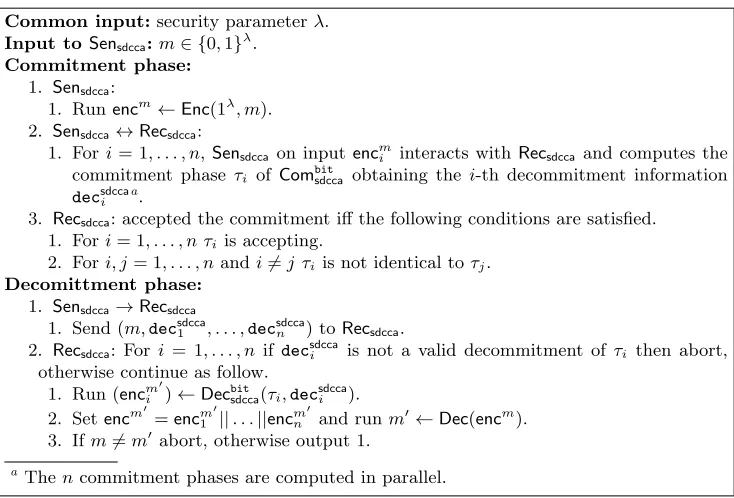
Informal description ofΠsdcca.At a very high level our self-destruct CCA string commitment scheme works as follow. The senderSensdccaencodes the mes-sage mto commit usingEnc and obtainsencm. Then he interacts withRec
sdcca in order to commit to every single bit ofencm=encm
1||. . .||encmn usingCom
bit
sdcca. In the opening phase Sensdcca sends the opening of the bit commitments along withm0.Recsdcca accepts the commitment iffm=m0, wheremis the output of the decoding functionDecon input the codeword obtained from the opening of bit commitment.
This constructions preserves the number of rounds of the bit commitment Πbit
sdcca and does not add any other computational assumptions.
Our SD-CCA commitment scheme is described in more details in Fig 1.
Common input:security parameterλ. Input to Sensdcca:m∈ {0,1}λ.
Commitment phase: 1. Sensdcca:
1. Runencm←Enc(1λ, m). 2. Sensdcca↔Recsdcca:
1. Fori= 1, . . . , n,Sensdccaon inputencmi interacts withRecsdccaand computes the commitment phase τi of Combitsdcca obtaining the i-th decommitment information
decsdccai a.
3. Recsdcca: accepted the commitment iff the following conditions are satisfied. 1. Fori= 1, . . . , n τiis accepting.
2. Fori, j= 1, . . . , nandi6=j τi is not identical toτj.
Decomittment phase: 1. Sensdcca→Recsdcca
1. Send (m,decsdcca1 , . . . ,dec sdcca
n ) toRecsdcca.
2. Recsdcca: Fori = 1, . . . , n if decsdccai is not a valid decommitment of τi then abort,
otherwise continue as follow. 1. Run (encm0
i )←Decbitsdcca(τi,decsdccai ).
2. Setencm0 =encm10||. . .||encm 0
n and runm0←Dec(encm).
3. Ifm6=m0abort, otherwise output 1.
a
Thencommitment phases are computed in parallel.
Fig. 1: Description of our SD-CCA string commitment scheme.
Theorem 2. If Πbit
sdcca = (Com
bit
sdcca,Dec
bit
sdcca) is a t-round (non-tag based) self-destruct CCA bit commitment scheme andΠNMCode= (Enc,Dec)is a continuous non-malleable code resilient againstPermOver, then Πsdcca = (Sensdcca,Recsdcca) is a a t-round (non-tag based) self-destruct CCA string commitment scheme.
Proof. Correctness.The correctness follows from the correctness ofΠbit
sdcca and the definition of code satisfied byΠNMCode.
Statistically Binding. The statistical binding property follows from the statistical binding ofΠbit
Self-destruct CCA. In order to prove that Πsdpcca is a SD-CCA string commitment scheme we have to show that the distribution of the output of A
in the experimentIND0is computational indistinguishable from the distribution of the output ofAin the experimentIND1(see Def. 3).
We proceed through a series of hybrid experiments where we will demon-strate that the view of Acombined with the committed values that he queries in the experiment IND0 along with his output in IND0 ( that we denote with
{viewAIND0(1λ, z)}
λ∈N,z∈{0,1}∗) is computational indistinguishable from{viewAIND1(1 λ, z)}
λ∈N,z∈{0,1}∗.
We considering the following hybrid experiments.
- INDbis the real game experiment as defined in the Definition 3, where in the left sessionsSensdcca is committing toencmb that is the codeword obtained run-ningEnc(1λ, mb), and the adversaryA interacts with the oracle inpoly(λ) concurrent right sessions.
- Hi b(1
λ, z). Letencmb be the codeword obtained runningEnc(1λ, mb).
In the left session interact withA as the Sensdcca does except that the firsti commitments τ1, . . . , τi of the first i bits of encmb are replaced by a commitments of a random and independent bitsr1, . . . , ri.
In theright sessionsact asRecsdcca does. Furthermore when a commit-ment query ˜τ1, . . . ,τ˜nink-th right sessions (k= 1, . . . ,poly(λ)) is completed outputs a tamperingk-th functionsfb
k defined as follow. 1. Ifτi is identical to ˜τj set thei-th position offkb toj.
2. Otherwise forward ˜τi to Obit and obtains the committed bit ˆb. Set the i-th bit offb
k tosetif ˆb= 0 and toresetotherwise. IfObitimplements the self-destruct mode write⊥in all the positions offb
k.
After that each ˜τi is processed, the hybrid experiment use the function fkb to answer thek-th query made byA. In more details, the hybrid runs ˜m←
Dec(fb
k(encmb)), and based on the value of ˜m he takes one of the following
choice: a) if ˜m = mb he outputs same; b) if ˜m = ⊥ he implements the self-destruct mode; c) if ˜m /∈ {mb,⊥}he forwards ˜mtoA.
Let{viewAHi b
(1λ, z)}
λ∈N,z∈{0,1}∗11be the random variable describing the view of the adversaryA combined with the committed values that Aqueries in the
poly(λ) right sessions along with the output ofAin hybrid experimentHi b(1
λ, z), i= 0, . . . , n b∈ {0,1}.
We are now ready to argue that, due to the self-destruct CCA of Πbit
sdcca,
{viewA
Hi−1
b
(1λ, z)} ≈ {
viewAHi b
(1λ, z)} for i = 1, . . . , n. In more details we are going to prove the following lemma.
Lemma 12. For allmb ∈ {0,1}λ for alli= 1, . . . , nandb∈ {0,1}it holds that
{viewA
Hi−1
b (1λ,z)
} ≈ {viewAHi b
(1λ, z)}.
Suppose by contradiction that the lemma does not hold for somei, then it is possible to show an adversary AObit
sdcca that breaks the self-destruct CCA of Πbit
sdccaas follows. LetCsdcca be the challenger of the bit self-destruct CCA game. 11
In order to not overburden the notation in the rest of the proof we will write
viewAHi b
AObit
sdcca interacts with Sensdcca and Recsdcca according to the steps described in
Hi−1
b (and in H i
b) except for the i-th commitment τi of the left session. For the commitment τi he acts as a proxy betweenCsdcca and Sensdcca. In the end,
AObit
sdcca runs a distinguisher D (that exists by contradiction) on input the view of A combined with the committed values that A queries in the the poly(λ) right sessions and the output of A in the execution with AObit
sdcca and outputs whatDoutputs. W.l.o.g. we assume that thei-th ofencmb is 1 and the random
chosen bit ri committend in τi in Hbi is 0, then if Csdcca commits to 1 AO
bit
sdcca is acting as in Hib−1, otherwise he is acting as in Hi
b. This observation con-clude the proof. We observe that{viewAH0
b
(1λ, z)} ≡ {viewAIND
b(1
λ, z)}, It follows from the definition of H0
b. Therefore we can conclude that {viewAINDb(1
λ, z)} ≡
{viewAH0
b
(1λ, z)} ≈ · · · ≈ {viewAHn b(1
λ, z)} for b ∈ {0,1}. It remains to argue that{viewAHn
0(1
λ, z)} ≡
s{viewAHn
1(1
λ, z)}. For this last part of the proof we will rely on continuos non-malleability ofΠNMCode. We notice that bothHn
1 andH n 0 define the same distribution of tampering functionsF = (F1, . . . , Fpoly(λ)) and F ∈PermOver since that there are no repeated transcripts. Furthermore, both hybrid experimentsHn
1 andHn0 answer to a query ofAwithsamewhen the tam-pering function does not change the codeword (the codeword can correspond to different messages). We also notice that if the tampering function outputs ⊥
then both the hybrids implement the self-destruct mode. We can conclude that for allm0, m1∈ {0,1}λ{viewAHn
0(1
λ, z)} ≡
s{viewAHn
1(1
λ, z)}, which implies that for allm0, m1∈ {0,1}λ it holds that{viewA
IND0(1
λ, z)} ≈ {viewA
IND1(1 λ, z)}.
6
Parallel CCA Commitment Scheme from SD-PCCA
Commitment Scheme
In this section we describe ourΠpcca= (Senpcca,Recpcca) at+ 2-round (non-tag based) PCCA string commitment scheme, that makes use of the following tools. 1. Πsdpcca = (Sensdcca,Recsdcca) is a t-round (non-tag based) SD-PCCA string
commitment scheme.
2. a 2-round IDTC schemeΠ= (Sen,Rec,TFake) for the followingN P-language L={τsdcca : (m,decsdcca) s.t.Recsdcca on input (m,decsdcca) accepts mas a decommitment ofτsdcca}.
3. Πsign= (Gen,Sign,Verify) is a signature scheme.
4. A 4-round delayed-input public coinLStrap= (Ptrap,Vtrap) with SHVZK sim-ulatorStrap.LStrap= (Ptrap,Vtrap) is adaptive-input PoK for theN P-relation
RelLtrap whereLtrap={(vk:∃ (σ1,msg1, σ2,msg2) s.t. Verify(vk,msg1, σ1) = 1 AND Verify(vk,msg2, σ2) = 1 AND msg1 6= msg2}. We denote with `trap the dimension of the instances belonging toLStrap.
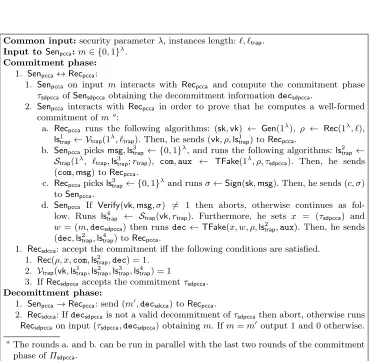
extraction of a trapdoor. We adopt the one described in [COSV17b] in which the trapdoor is represented by the knowledge of two signatures under a verification key sent byRecpcca in the 4th last round. In order to allow the extraction of the trapdoor,Recpccasends a signature of a message randomly chosen in the 3rd last round by theSenpcca.
FurthermoreSenpccaengagesRecpccaa special WIPoK that proves thatτsdcca is a well-formed commitment or the knowledge of two signatures for two different messages w.r.t. a verification key.
In more details, the special WIPoK works as follows. In the 3rd last round
Senpcca, computes and sends a trapdoor commitment com w.r.t. the instance τsdcca using the equivocal commitment procedure ofΠ.
In the 4th last round and in the 2nd last roundSenpccareceives, respectively, from Recpcca 1st and the 3rd round (ls1trap,ls
3
trap) of LStrap. Then,Senpcca in the last round has to complete the LStrap transcript. The LStrap transcript proves the knowledge of two signatures for two different messages w.r.t. a verification keyvk. Since, the honest committerSenpcca has no such knowledge he runs the SHVZK simulator of LStrap on input ls1trap,ls
3
trap,vk in order to obtain the 2nd and the 4th round (ls2trap,ls4trap) ofLStrap.
Moreover, in the last roundSenpccaruns the equivocal procedure ofΠ (using as equivocal secret the decommitment informations of τsdcca) and obtains an opening (dec,ls2trap) w.r.t. ofcom.Senpcca sends toRecpcca (ls2trap,ls
4
trap,dec). In the opening phaseSenpcca sends the opening ofΠsdpcca.
Our PCCA commitment scheme is described in more details in Fig 2.
Theorem 3. IfΠsdpcca= (Sensdpcca,Recsdpcca)is a t-round (non-tag based) self-destruct PCCA string commitment scheme and OWFs exists, then Πsdcca = (Senpcca,Recpcca) is a a t+ 2-round (non-tag based) PCCA string commitment scheme.
Before we start the security proof we recall thatLStrap(see [COSV17a, LS90]) andΠ(see [COSV17b]) as well asΠsign(using [Rom90]) can be instantiated from OWFs.
Proof. Correctness. The correctness follows from the correctness of Πsdpcca and the completeness of ΠOR. Statistically Binding. The statistical bind-ing property follows from the statistical bindbind-ing of Πsdpcca. Parallel CCA. In order to prove that Πpcca is a PCCA string commitment scheme we have to show that the distribution of the output of A in IND0 is computational in-distinguishable from the distribution of the output of A in IND1 (see Def. 5). We proceed through a series of hybrid experiments where we will demonstrate that the view of A combined with the committed values that he queries in the experiment IND0 along with the output of A in IND0 (that we will de-note with{viewAIND
0(1 λ, z)}
λ∈N,z∈{0,1}∗) is computational indistinguishable from
{viewAIND
1(1 λ, z)}
λ∈N,z∈{0,1}∗. - H0
Common input:security parameterλ, instances length:`, `trap. Input to Senpcca:m∈ {0,1}λ.
Commitment phase: 1. Senpcca↔Recpcca:
1. Senpcca on input m interacts with Recpcca and compute the commitment phase τsdpccaofSensdpccaobtaining the decommitment informationdecsdpcca.
2. Senpcca interacts with Recpcca in order to prove that he computes a well-formed commitment ofma:
a. Recpcca runs the following algorithms: (sk,vk) ← Gen(1λ), ρ ← Rec(1λ, `),
ls1trap← Vtrap(1λ, `trap). Then, he sends (vk, ρ,ls1trap) toRecpcca.
b. Senpcca picksmsg,lstrap3 ← {0,1}λ, and runs the following algorithms:ls2trap ← Strap(1λ
, `trap,ls3trap;rtrap), com,aux ← TFake(1λ, ρ, τsdpcca). Then, he sends (com,msg) toRecpcca.
c. Recpccapicksls3trap← {0,1}λand runsσ←Sign(sk,msg). Then, he sends (c, σ) toSenpcca.
d. Senpcca If Verify(vk,msg, σ) 6= 1 then aborts, otherwise continues as fol-low. Runs ls4trap ← Strap(vk, rtrap). Furthermore, he sets x = (τsdpcca) and w = (m,decsdpcca) then runsdec←TFake(x, w, ρ,ls2
trap,aux). Then, he sends (dec,ls2trap,ls4trap) toRecpcca.
1. Recsdcca: accept the commitment iff the following conditions are satisfied. 1. Rec(ρ, x,com,ls2trap,dec) = 1.
2. Vtrap(vk,ls1
trap,ls2trap,ls3trap,ls4trap) = 1
3. IfRecsdpccaaccepts the commitmentτsdpcca. Decomittment phase:
1. Senpcca→Recpcca: send (m0,decsdcca) toRecpcca.
2. Recsdcca: Ifdecsdpccais not a valid decommitment ofτsdpccathen abort, otherwise runs
Recsdpccaon input (τsdpcca,decsdpcca) obtainingm. Ifm=m0output 1 and 0 otherwise.
a
The rounds a. and b. can be run in parallel with the last two rounds of the commitment phase ofΠsdpcca.