Trust Views for the Web PKI
Johannes Braun, Florian Volk, Johannes Buchmann and Max M¨uhlh¨auser
Technische Universit¨at Darmstadt/CASED Hochschulstraße 10, 64283 Darmstadt, Germany {jbraun|buchmann}@cdc.informatik.tu-darmstadt.de, [email protected],[email protected]
Abstract. The steadily growing number of certification authorities (CAs) assigned to the Web Public Key Infrastructure (Web PKI) and trusted by current browsers imposes severe security issues. Apart from being impossible for relying entities to assess whom they actually trust, the current binary trust model implemented with the Web PKI makes each CA a single point of failure. In this paper, we present the concept of trust views to manage variable trust levels for exactly those CAs actu-ally required by a relying entity. This reduces the set of trusted CAs and minimizes the risk to rely on malicious certificates issued due to CA failures or compromises.
1
Introduction
The Web PKI is one of the largest and most important cryptographic systems. The core of the Web PKI is the ecosystem of CAs that are responsible for the issuance and the maintenance of SSL certificates. These certificates are issued to web service providers and are used in the SSL/TLS protocols. Thus, the Web PKI enables authentication of web servers and subsequently the establishment of secure connections between web browsers and services like banking or e-commerce, where privacy, confidentiality, and integrity are often indispensable.
Blacklisting CAs or revoking malicious certificates are the reactions to secu-rity incidents. However, as these mechanisms are reactive, they have an inherent delay exposing the users at risk until the detection of the threat. As explained, the risk grows proportional to the number of CAs a user trusts.
In this paper, we propose a new approach to reduce this risk by reducing the number of trusted CAs to those that are really required by the users. Recent experiments with browser histories of different users have shown that on average, a user only depends on a small subset of CAs. The size of which lies in the range of 10% of the CAs available and trusted by default in the Web PKI [1]. Additionally, among the trusted CAs, we introduce variable trust levels to enable more fine grained trust decisions. According to the value-at-stake, a trust level might be sufficient or not to consider a connection to a web service as secure.
To achieve this, we present the concept oftrust viewsthat serve as a local and user dependent knowledge base for trust decisions. We present the mechanisms for the establishment and the management of the trust view. We implement learning processes and define decision rules by employing computational trust models. The real trustworthiness of CAs is approximated by a subjective proba-bilistic trust value. Our approach allows an adaptation to the requirements of the user and automated trust decisions based on defined decision rules. Our system focuses on applicability, thus it only uses data which is already available or is collected over time. However, our system is open to be extended with additional information sources.
The paper is organized as follows. Section 2 describes the Web PKI and our security model. In Section 3 we introduce computational trust and present related work. Afterward, in Section 4 we present the trust view concept. We describe challenges and how a trust view is modeled. Then we describe the initialization mechanisms for trust views and give the relevant algorithms for trust validation and the update of the trust views. In Section 5 we evaluate our approach and discuss limitations. We end with a conclusion and future work in Section 6.
2
Web PKI & Security Model
2.1 The Web PKI
the public one. As the certificate binds the public key to an identity, the relying entity can be sure about the authenticity of the web server.
As it is impossible to exchange certificates directly between all web servers and all browser users (the relying entities), the Web PKI uses a hierarchical but tightly interwoven structure of CAs that digitally sign certificates. If a certificate is signed by a trusted CA, the authenticity of a web server that employs the cer-tificate is transitively trusted. The Web PKI has a set ofRoot CAs. Their public keys are usually distributed within trusted lists called root stores, along with operating systems and browsers. The Root CAs act as basis for the whole PKI. Root CAs sign certificates forsubordinate CAs(Sub CAs) which themselves sign certificates for other Sub CAs and web servers. This way, a hierarchical struc-ture is created. The chain of certificates starting with a Root CA’s certificate and ending with a web server’s certificate is called certification path. The pro-cess of checking the certification path for correctness and validity is called path validation [4].
For a relying entity, in order to be convinced of the key legitimacy of a public key k, namely to be convinced whether a public key k in a certificate belongs to the identity contained in the subject field of the certificate, two things are required [20, 23, 33]. First, the relying entity must be convinced of the key legitimacy of the CA’s key that was used to sign the certificate. Second, the relying entity must trust the CA to issue trustworthy certificates which is called
issuer trust in the CA.
In the Web PKI, issuer trust and key legitimacy are binary. Any certificate signature that can be verified using the root store is absolutely trusted. Although CAs achieve different qualities of service, this is currently not reflected within trust decisions. Different CAs implement different schemes to verify identities of the key owners they sign certificates for and employ different security mechanism. But, for example, a certificate containing a superficially verified identity appears to be as trustworthy as a certificate where the contained identity was checked thoroughly.
2.2 Security Model
In the model exist two entitiese1ande2.e1establishes an SSL/TLS connection
toe2. The problem is to decide if the connection is trustworthy fore1.
A connection is trustworthy fore1if the public keyk ofe2that was used in
the SSL/TLS connection establishment is trusted bye1to be a valid public key
ofe2. This requires:
1. e1has a valid certificateC that bindsk toe2.
2. e1trusts in the issuer of C.
Requirement 1 is a standard PKI issue. To fulfill requirement 1,e1 needs to
have a certification pathp= (C1, ..., Cn) such that
1. Cn=C
Requirement 2 is fulfilled ifpadditionally passestrust validation. Explicit trust validation is not incorporated in the current deployment of the Web PKI. We show how this can be realized with the concept oftrust views and explain how this enables to reduce the number of actually trusted CAs and therewith the risk of relying on maliciously issued certificates. We first introduce computational trust and present related work.
3
Computational Trust & Related Work
3.1 Computational Trust
Computational trust is a means to support users in making decisions under uncertainty, e.g., under incomplete information. Jøsang defines decision trust
in [19]:
Decision trust is the extent to which a given party is willing to depend on something or somebody in a given situation with a feeling of relative security, even though negative consequences are possible.
Starting from recommendations, experiences from previous interactions, and context-related indicators of trustworthiness, computational trust models cal-culate an approximation for the quality of future interactions. For this paper, the CertainTrust trust model by Ries [26] is used. CertainTrust was extended with CertainLogic, a set of operators to combine CertainTrust opinions. These operators are similar to those of propositional logic, but consider the inherent uncertainty of CertainTrust opinions.
CertainTrust can handle two ways of expressing trust-related information:
– Theexperience spacecollects results from interactions as binary experiences, i.e., an interaction was either positive or negative.
– The opinion space uses a triple (t, c, f) to express an opinion oS about a statement S. The value t ∈ [0; 1] represents the trust in the correctness of the statement, while the certainty c ∈ [0; 1] represents the probability that t is a correct approximation. c scales with the amount of information (for example, the number of collected experiences): the more information available, the more reliable is the approximation. Finally,f ∈[0; 1] defines a context-specific, initial trust value in case no information was collected, yet. This parameter serves as a baseline and representssystemic trust.
into the experience space, adding the new experience to either the number of positive or negative experiences and mapping those back to the opinion space.
There are several operators to combine different opinions. From two opinions about two independent statements a combined opinion about the statement re-garding the truth of both input statements is computed with the AND-Operator of CertainLogic [26]:
Definition 1 (CertainLogic AND-Operator). LetA andB be independent statements and the opinions about these statements be given asoA= (tA, cA, fA)
and oB = (tB, cB, fB). Then, the combined opinion on the statement regarding
both AandB is defined as follows:
oA∧oB = (tA∧tB, cA∧cB, fA∧fB) with
cA∧B =cA+cB−cAcB−
(1−cA)cB(1−fA)tB+cA(1−cB) (1−fB)tA 1−fAfB
ifcA∧B= 0: tA∧B = 0.5
ifcA∧B6= 0: tA∧B = 1 cA∧B
(cAcBtAtB+
cA(1−cB)(1−fA)fBtA+ (1−cA)cBfA(1−fB)tB
1−fAfB )
fA∧B =fAfB
The CertainLogic AND-Operator is commutative.
From opinions, an expectation can be computed. It represents the expectation for future behavior. In CertainTrust, the expectation of an opinionoAis defined as
E(oA) =tA·cA+fA(1−cA)
Herein, with increasing certainty (which means that a larger amount of experi-ences is available), the influence of the initial trustf ceases.
3.2 Related Work
and when to allow pinned certificates to be exchanged (e.g. due to certificate expiry). Notarial solutions [2, 16, 21] maintain databases containing formerly ob-served certificates and can be queried to reconfirm the authenticity of a specific certificate, sometimes also involving consensus decisions of several independent notary servers. In this approach, trust is deferred from the CAs to a majority of notaries. Central instances come with availability and scalability problems. Also, privacy protection issues and delays due to the communication overhead are clear disadvantages.
The enhancement of PKI with trust computation has been proposed by many researchers. The CertainTrust model and CertainLogic [26] used by us are equiv-alent to the Beta Reputation System and Subjective Logic, both by Jøsang et al. [17, 18], as these models both rely on binary experiences that are combined using a Bayesian approach with beta probability density functions. A survey on different trust models that rely on this computational approach and similar ones can be found in the surveys by Jøsang et al. [19] and Ruohomaa et al. [27]. Jøsang proposes an algebra for trust assessment in certification chains in [20] but mainly addresses trust networks similar to PGP [33]. Huang and Nicol [15] also define another trust model for trust assessment in PKI. Both approaches require trust values recommended by the intermediates to evaluate trust chains. Such recommendations are in general not included within commercial certificates and we do not expect any entity to pay for a certificate that includes a low trust value. Different certificate classes like domain validated (DV) or extended vali-dation (EV) can be indicators for such trust values, but in our opinion these are not sufficient for trust evaluation.
Other researchers base trust evaluation in CAs on their policies and the adherence to those [3, 29]. This requires policy formalization [3, 29, 31] for au-tomated processing. Such formalized policies are not provided by the CAs, and are in general far to complex to be evaluated by the relying entities. Therefore, such approaches require technical and legal experts to process policies [30].
the user from malfunctions of CAs that in general follow good security practices but are actually irrelevant for the user.
4
Trust View and Trust Validation
The purpose of establishing a trust view is to enable explicit trust validation thereby locally reducing the number of trusted CAs on a per-user level. The differences in the trust needed for different applications are considered during trust validation. For example, there is a difference in the trust needed to visit a search engine and the trust needed to supply an online-shopping web site with your credit card information.
4.1 Challenges
The set of CAs required by a user is not fixed but changes over time. The challenge herein is to establish and manage a trust view in a dynamic way. We identified the following constraints for dynamically updating the set of trusted CAs as well as assigning trust levels to them:
1. Minimal user involvement: an informed assessment of the quality of a CA’s certification processes is beyond the capabilities of the average Internet user [13, 28].
2. Incomplete information on CA processes: data on the quality of a CA’s certification process might be incomprehensible or not available at all. 3. Incomplete information on user requirements: in general, the web
services that a user will contact in the future are unknown and therefore also the required CAs to verify the certificates of such web services.
4.2 The Trust View
For trust validation, entitye1 has atrust view View. The trust view is the local
knowledge base of e1 and contains all previously collected information about
other entities and their keys. It is built incrementally during its use for trust validation. The trust view ofe1 consists of:
– a set of trusted certificates
– a set of untrusted certificates
– a set of public key trust assessments
The trusted certificates are all certificates that have previously been used to es-tablish a trustworthy connection to another entity. The untrusted certificates are those certificates, for which the connection was evaluated untrustworthy. Fur-thermore, there is one public key trust assessments for each pair of (public key,
CA name) that was contained in a previously evaluated certification path. A trust assessment represents all information collected for the respective pair dur-ing prior trust validations.
– kis a public key.
– cais the name of a certification authority.
– S is a set of certificates for k. The subject of these certificates is ca. This set contains all the certificates with subjectca and public key kthat have previously been verified bye1.
– okl is an opinion. It represents the opinion of e1 whether k belongs to ca
(key legitimacy ofk).
– oit is an opinion. It represents the trust of e1 in ca to issue trustworthy
certificates (issuer trust inca, when usingk).
In order to decide whether the connection to entitye2 is trustworthy, entitye1
runs the trust validation algorithm (cf. Section 4.4).
4.3 Initialization of Trust Assessments
A trust assessmentTA= (k,ca, S, okl, oit) is initialized whenever a pair
(public key,CA name), for which there is no trust assessment in the trust view
View, is observed within a CA certificate C. We assume that a root store is available during initialization. Then,TAis initialized as follows:
– k=public key
– ca=CA name
– S={C}
– okl= (1,1,1) if the CA is a Root CA, elseokl=unknown.
– oit = (0.5,0,0.5) if no prior information is available about the issuer trust of the CA. Else if for 1≤i≤nthere are trust assessmentsTAi ∈Viewwith Ci ∈ Si, where the issuing CA of Ci is equal to the issuing CA ofC, then f = (Pn
i=1E(oit,i))/n andoit= (0.5,0, f).
The key legitimacy is set to complete (okl = (1,1,1)) for Root CA keys as these keys are confirmed via the root store. For other CA keys, key legitimacy is computed during trust validation as long as key legitimacy isunknown. During the evolution of the trust view, key legitimacy may be changed to complete as soon as enough evidence has been collected. We discuss this in Section 4.5.
The issuer trust oit = (0.5,0,0.5) reflects that no experiences have been collected and that the CA may either be trustworthy or not. If the new CA is certified by a CA that certified several other CAs, for which experiences have already been collected, we use the average over the expectations of the respective issuer trusts for initialization. The reason is that a CA evaluates a Sub CA before signing its key, and thus these Sub CAs are assumed to achieve a similar level of issuer trust, like a stereotype.
Bootstrapping
Despite the fact that an entity will often access the same services and see the same CAs repeatedly [1], it takes a certain time until enough experiences are collected such that the system may operate autonomously. Therefore, a boot-strapping procedure is required to face possible delays and usability problems due to the involvement of additional validation services (cf. Section 4.4 for de-tails). A possibility for such a bootstrapping procedure is to scan the browsing history. From the history, the services that are accessed viahttps can be iden-tified and the respective certification paths can be downloaded. The paths can then be used to bootstrap the trust view. This initial bootstrapping is only to be performed once and afterward, the system can mainly fall back on the collected experiences.
4.4 Trust Validation
We now describe the trust validation algorithm. It takes a trust view of entity e1 and a certification path for the certificate of entitye2 as input and computes
the key legitimacy of e2’s key to decide whether a connection established with
e2’s key is to be considered trustworthy. The decision depends on the security
criticality of the application that is to be secured by the connection from e1 to
e2. The information available in the trust view may not be sufficient to complete
the trust validation. In such a case, validation services are used as a fall back mechanism. We present the detailed algorithm in the following:
Input:
– The certification pathp= (C1, ..., Cn)
– The trust viewView ofe1
– A security levell∈[0; 1] forCn.lis selected bye1and represents the security
criticality of the application that is to be secured by the connection frome1
toe2.
– A required certaintyrc ∈[0; 1]. rc is selected bye1 and represents on how
much previous information the decision must be based to be accepted.
– A list of validation servicesVS= (vs1, ...,vsj) with outputs
Ri = vsi(C) ∈ {trusted, untrusted, unknown},1 ≤ i ≤ j on input of a certificateC.
Output:R∈ {trusted, untrusted, unknown}
The algorithm proceeds as follows:
1. IfCn is a trusted certificate in ViewthenR←trusted
2. If pcontains a certificate that is an untrusted certificate in View thenR← untrusted
3. IfCn is not a certificate in Viewthen
(b) Initialize the trust assessments for pairs (ki,cai) for which there is no trust assessment in View (as described in Section 4.3). Store the new trust assessments in the listTL.
(c) For 1 ≤i ≤n−1 setokl,i to the key legitimacy of ki and oit,i to the issuer trust assigned toki in View.
(d) Seth={max(i) :okl,i= (1,1,1)}
(e) Computeokl,n= (t, c, f) =oit,h∧oit,h−1∧ · · · ∧oit,n−1
(f) Compute the expectationexp =E(okl,n) (g) Ifexp≥l thenR←trusted
(h) Ifexp< l andc≥rc thenR←untrusted (i) Ifexp< l andc <rc then
i. For 1 ≤ i ≤ j query validation service vsi for Cn and set Ri =
vsi(Cn).
ii. SetRc =cons(R1, ..., Rj) to the consensus on (R1, ..., Rj), thenR← Rc.
(j) UpdateView. (See Section 4.5 for details.) 4. ReturnR
According to previous works [20, 23, 33], the key legitimacy of a key is computed as the key legitimacy of the CA’s key in conjunction with the issuer trust in the CA :okl=okl,CA∧oit,CA. The computation of the key legitimacy based on
a certification path with length greater than one follows directly from chaining this rule and the fact that the key legitimacy of the first key kh in the path is okl,h= (1,1,1). Such a key always exists as this holds at least for Root CA keys. Thus,okl,n= (t, c, f) =oit,h∧oit,h−1∧ · · · ∧oit,n−1as for the CertainLogic AND
operator holds ifoA= (1,1,1) thenoA∧oB =oB.
Security Levels
e1 assigns security levels to classes of applications according to their
value-at-stake (cf. [29] for a similar approach). A security level is a real number between 0 and 1. The higher the security level is, the higher is the required key legitimacy for a connection to be evaluated trustworthy. The assignment of security levels is a subjective process and relies on the risk profile ofe1, which is out of scope of
this paper. General examples for security levels could be 0.99 for online banking, 0.9 for e-government applications, and 0.6 for social networks. Note, that as the trust validation requires the security level as input, the determination of the class of application is required. While an automated solution, for example, one based on content filtering (as also used to detect phishing sites [32]) or based on analyzing the type of entered data (cf. [22]) is desirable, this is out of scope of this work. In any case, the security level can be indicated by the entity, e.g., by using a visual slide control as part of the browser’s user interface.
Validation Services
behavior, but due to the lack of information. Thus, whenever the key legitimacy is too low to consider a connection trustworthy, and the certainty is below a thresholdrcwhich is set bye1, validation services like notary servers (cf. Section
3.2) are queried to reconfirm a certificate. If a certificate is reconfirmed to be authentic, the connection is considered trustworthy. If the validation services reply withunknown, i.e., it is unclear if the certificate is trustworthy or not, the algorithm outputsunknown. Only in this case, the user is asked for a decision. As the lack of expertise makes user involvement problematic, the ’unknown´ case needs to be avoided whenever possible by the use of an adequate set of validation services. Further research on additional information sources and the optimization of the use of validation services is due to future work. Yet, given sufficiently support, involving the user for decision making might be a viable approach, for example, when a bank provides his customers with further infor-mation about their certificates.
4.5 Trust View Update
New information needs to be incorporated into the trust view to be available during future trust validations. Based on the output of the trust validation, either positive or negative experiences are collected for the involved trust assessments. Herein, it is important that only strictly new information is collected. Therefore, it is checked if a certificate, which is contained in the considered certification path, is evaluated for the first time based on the state of the trust view. We present the detailed algorithm in the following:
Input:
– A certification pathp= (C1, ..., Cn)
– A trust viewView
– An output of the trust validationR
– A list of new trust assessmentsTL
– A list of validation servicesVS= (vs1, ...,vsj) with outputs
Ri = vsi(C) ∈ {trusted, untrusted, unknown},1 ≤ i ≤ j on input of a certificateC.
Output:The updated trust view.
The algorithm proceeds as follows:
1. IfR=unknownthen returnView
2. For 1≤i≤n−1 setki to the public key inCi, setcai to the subject inCi and setTAi= (ki,cai, Si, okl,i, oit,i) to the corresponding trust assessments. 3. IfR=trustedthen for 1≤i≤n−1 do
(a) IfCi∈/ Si addCi toSi
(b) IfTAi∈TLthen addTAi toView
(a) Set h={max(i) :TAi∈/ TLor the consensuscons(vs1(Ci), ...,vsj(Ci)) =trusted}.
(b) For 1≤i≤h−1 do i. IfCi∈/Si addCi toSi
ii. IfT Ai∈TLthen addT Ai toView
iii. If T Ai+1 ∈ TL or Ci+1 ∈/ Si+1 then update oit,i with a positive experience.
(c) IfTAh∈TLthen addTAh toView
(d) IfCh+1 is not an untrusted certificate inView then update oit,i with a
negative experience.
(e) AddCh+1 to Viewas untrusted certificate.
5. ReturnView
Example
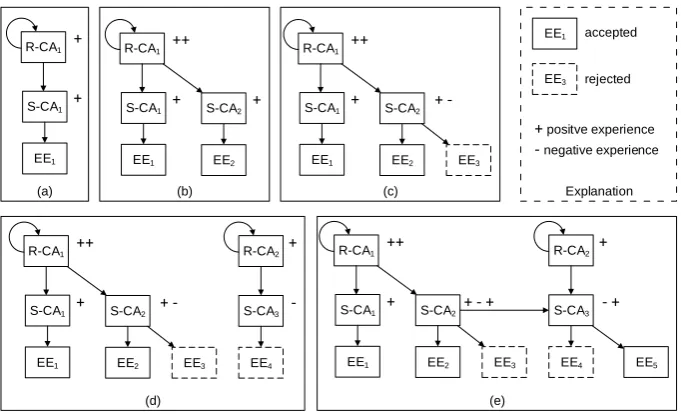
An exemplary evolution of the trust view is shown in Figure 1. It visualizes the experience collection process. Root CAs are denoted with R-CA, Sub CAs with S-CA. The arrows represent observed certificates.
(a) The system obtains the chain R-CA1 → S-CA1 → EE1. The certificate of
EE1 is accepted. A positive experience is added to each involved CA.
(b) The chain R-CA1 → S-CA2 → EE2 is obtained. The certificate of EE2 is
accepted. A positive experiences is added to each involved CA.
(c) The chain R-CA1 → S-CA2 → EE3 is obtained. The certificate of EE3 is
rejected. A negative experience is added to S-CA2. However, the certification
R-CA1→S-CA2 was approved during prior observations, thus no negative
experience is added to R-CA1.
(d) The chain R-CA2 → S-CA3 → EE4 is obtained. The certificate of EE4 is
rejected. Thus, the certificate R-CA2→S-CA3 must be checked. Assuming
its reconfirmation, a negative experience is added to S-CA3, while a positive
experience is added to R-CA2.
(e) The chain R-CA1 → S-CA2 → S-CA3 → EE5 is obtained. The certificate
of EE5is accepted. A positive experience is added to S-CA2 and S-CA3.
R-CA1→ S-CA2 was evaluated during prior observations, no new experience
is added.
Fixing the Key Legitimacy
R-CA2 S-CA3 EE4 R-CA1 S-CA2 EE2 ++ + -S-CA1 EE1 + EE3 -+ (d) R-CA1 S-CA2 EE2 ++ + S-CA1 EE1 + (b) R-CA1 +
S-CA1 EE1 + (a) accepted rejected
+ positve experience - negative experience
Explanation EE5 R-CA2 S-CA3 EE4 R-CA1 S-CA2 EE2 ++ + - + S-CA1 EE1 + EE3 - + + (e) EE3 R-CA1 S-CA2 EE2 ++ + -S-CA1 EE1 + EE3 (c) EE1
Fig. 1.Evolution of the trust view
Cleaning the Trust View
To prevent a continuous growth of the trust view and to allow the adaptation to current requirements (e.g., changing browsing behavior), a removal mechanism is integrated. A trust assessmentTAis removed from the local trust view after a fixed time period has been passed sinceTAwas last used within trust validation. The length of this time period can be implemented as a system parameter, e.g., one year. The determination of the optimal parameter setting is due to future work.
5
Evaluation
To evaluate our concept, we first summarize the attacker model: First, we assume the user system not to be compromised in the sense, that an attacker cannot manipulate the trust view. Attacking user systems is out of scope of this paper. Second, we assume, that CAs themselves are in general not malicious on purpose. However, a CA’s key can be used by an attacker to issue malicious certificates by compromising the CA’s key, compelling the CA or by a CA failure, i.e. when the CA issues a certificate to an entity without properly checking the entity’s identity. We further assume that once the malicious certificate is detected, coun-termeasures are taken like revocation and blacklisting of the certificate.
5.1 PKI Attacks
There are two cases, when a user obtains a certificate. Either, trust validation succeeds. In this case, the user solely relies on the CA system. Yet it implies, that the user has seen the certificate before, or the user has sufficiently many good experiences with the involved CAs. The requirements thereby increase with the security criticality of the application. Or, trust validation fails, in this case the validation services are queried to reconfirm the certificate. Given the certificate is trustworthy, the first case will occur most of the times (users in general stick to a limited set of CAs [1] as they repeatedly access the same services, and mostly web servers stick to the same CA when renewing their certificates). Thus, it is acceptable to have costly reconfirmation procedures as e.g. querying several independent notaries, and we may assume, that the validation services do not jointly provide false reconfirmations. This implies, that the attacker must com-promise a CA which has a high reputation in order to be successful. However, this leads to several disadvantages for the attacker:
If he wants to attack a specific user group he must compromise a CA, with a high trust level in each of the user’s trust views, otherwise the attack will be detected as the certificate is checked with the validation services by those users where trust validation fails. As the trust views are user-specific and not publicly visible, it is hard to identify such a CA trusted by all the users and it is questionable if the attacker can even manage to compromise that CA. Thus, the group of users where an attacker would be successful is reduced to a smaller group, which is unknown to the attacker and furthermore, the time span where a successful attack is possible is reduced due to the increased probability of being detected. The disadvantages for the attacker thereby grow with the number of the applications he tries to attack and their respective security levels. An attacker might also try to attack several CAs, but besides the increased difficulty to attack more than one CA at a time, he is not able to distinguish which user is to be attacked with which malicious certificate.
If the attacker aims at a specific service, he has the same problem of iden-tifying a CA which is sufficiently trusted by all attacked users in order not to trigger the validation services and thus risking a fast detection. Besides that, users that used the service before have pinned the web server’s certificate, which further increases the probability of a detection. The CA with which the attacker certainly has the highest success probability, is the CA that issued the certifi-cates for the web server in the past. Again, it is in question, if the attacker can manage to compromise a specific CA.
5.2 Attacks on Computational Trust
The trust views of the users govern when validation services are to be queried. Thus, attackers can try to attack the computational trust model in order to improve their success probability when employing a malicious certificate. The aim in this case is to disturb the correct functioning of the trust based decision processes. We discuss the standard attacks on computational trust, and how they apply to our system.
Whitewashing: This means, an entity (in our case a CA) re-appears in a sys-tem under a new identity to get rid of negative reputation. In our scenario this implies a CA that issued many incorrect certificates in the past. However, for a CA to re-appear in the system under a new identity and with a new key, there are significant hurdles. The CA’s key needs to be certified by another CA which is already part of the Web PKI, or the CA needs to be incorporated into trusted root stores in order to pass path validation. Thus, whitewashing is prevented by standard mechanisms like audits or the required approval by a non-malicious CA, which a malicious CA is not likely to pass without essential changes in its processes and structure. This on the other hand can then justify such a white-washing of the trust values. After re-appearing, before being trusted by users, the CA needs to demonstrate trustworthiness by correctly issuing certificates, which also requires to be chosen as a CA by web page operators.
Sybil attacks: A sybil attack means, that an attacker of a reputation system forges or controls other entities to produce many good ratings for a certain entity. Yet, such an attack has only limited relevance to our system as there are no unauthenticated entities that provide recommendations. An adversary could mount a sybil-like attack by attacking the underlying validation services in order to maliciously reconfirm certificates by a certain malicious CA and thus falsely improve the reputation of that CA. Yet, in this case, the attacker can directly exploit the malicious reconfirmation and therewith annul the trust evaluation. This shows the importance of the security of the underlying validation services. However, a successful attack requires both, the compromise of a CA and of the several validation services.
Exploiting slow trust adaptation: Such an attack means, that the good rep-utation of a CA can be exploited by an attacker, as it takes some time before the CA’s good reputation is adapted when a sudden incident changes the CA’s trustworthiness. Our system does not prevent such attacks. Thus, a CA that is used by many web pages and that built up a good reputation is a major goal for attackers. However, the possible loss of the good reputation and their pub-lic visibility provides strong incentives to such heavyweight CAs to put strong protection mechanisms in place.
5.3 Limitations
While trust views can significantly lower the risk of relying on a malicious CA, local experiences are no guarantee for correctness. Trust views do not protect CAs from being compromised. If a CA, for which many positive experiences were collected, suddenly fails, the relying entity may still falsely rely on a malicious certificate issued by such a CA. Yet, a CA compromise only threatens those entities, that trusted in the CA before the compromise, which limits the benefit for attackers. On the other hand it is also possible, that a connection is falsely evaluated not to be trustworthy, which relies in the nature of basing decisions on incomplete information.
Furthermore, trust in the key legitimacy of a service provider’s key is differ-ent from the trustworthiness of the service provider itself (which, for example, comprises the quality of the web page and its contents provided by the service provider). The latter is not addressed by the trust view concept and requires additional mechanisms like the Web of Trust1or commercial web page ratings2.
However, such mechanisms require authentication, which is achieved via authen-tic public keys.
6
Conclusion & Future Work
We have presented the concept of trust views. The trust view maintains a min-imal set of trusted CAs and furthermore assigns different ratings to each CA, such that trust decisions can be made depending on the context. Thus, the risk of relying on a malicious certificate can be governed by the assignment of adequate security levels to the applications. This enables more restrictive trust decisions for critical applications like e-banking, where security is more important and less restrictive rules for less security critical applications. These rules can be adapted to the relying entity’s risk profile.
Due to the user-specific reduction of the total number of trusted CAs, the possible attack surface for CA attacks that threaten the respective entity is reduced. Compromises and misbehavior of CAs that are not included in the trust view have no effect as such certificates always require additional reconfirmation and are untrusted when in doubt. CAs that have often been observed—and most probably will also often be observed in the future—achieve higher issuer trusts than CAs that are barely observed. This provides a trade-off between trusting in (a limited set of) CAs and the costly reconfirmation of certificates. Additionally, privacy problems are mitigated as validation services are only queried in rare cases and not for every connection establishment, which allows user profiling in the long run. Furthermore, the load for validation services such as notary servers is reduced. The application of certificate pinning, i.e. storing trusted certificates, further mitigates the threat of relying on malicious certificates for previously
1
https://www.mywot.com/
2 e.g., Norton SafeWebhttps://safeweb.norton.com/or McAfee SiteAdvisorhttp:
accessed services and prevents repeated reconfirmations. On the other hand, trust validation allows the automated exchange of stored certificates. Considering the user involvement, which is known to be problematic, the trust view concept also allows a fine grained steering: the user is only involved when the local knowledge and the data of the validation services is not sufficient for a decision. Thus, the total number of warnings is reduced and mainly limited to highly security sensitive services, which addresses the problem of warning fatigue.
Currently, we are working on the implementation of the presented concept. Challenges follow from the configuration adjustment to adapt an individual trust view to the needs of it’s owner and to balance the system parameters. Thereby, the reduction of false decisions plays an important role. Furthermore, we will realize possible extensions. The model allows to combine local information with expert recommendations based on different indicators of trustworthiness or rec-ommendations from other users. Challenges are the prevention of false or mali-cious recommendations and the authentication of the recommenders.
Besides that, a trust view allows to detect anomalies, like the unanticipated exchange of a locally stored certificate. We aim at making this local knowledge applicable for compromise detection.
References
1. J. Braun and G. Rynkowski. The potential of individualized trusted root stores: Minimizing the attack surface in the light of ca failures. Cryptology ePrint Archive, Report 2013/275, 2013. http://eprint.iacr.org/.
2. Carnegie Mellon University. Perspectives Project. http:// perspectives-project.org//, visited July 2012.
3. D. W. Chadwick and A. Basden. Evaluating trust in a public key certification authority. Computers & Security, 20(7):592–611, 2001.
4. D. Cooper, S. Santesson, S. Farrell, S. Boeyen, R. Housley, and W. Polk. RFC 5280 – Internet X.509 Public Key Infrastructure Certificate and Certificate Revocation List (CRL) Profile. RFC 5280 (Proposed Standard), 2008.
5. P. Eckersley and J. Burns. The (Decentralized) SSL Observatory. Invited talk at 20th USENIX Security Symposium, August 2011.
6. The EFF SSL Observatory. https://www.eff.org/observatory.
7. C. Ellison and B. Schneier. Ten Risks of PKI: What You’re Not Being Told About Public Key Infrastructure. Computer Security Journal, 16(1):1–7, 2000.
8. C. Evans, C. Palmer, and R. Sleevi. Public Key Pinning Extension for HTTP. Internet-Draft, 2013.
9. P. Gutmann. Pki: it’s not dead, just resting. Computer, 35(8):41 – 49, aug 2002. 10. P. Gutmann. Engineering Security. 2013. Book draft available online at http:
//www.cs.auckland.ac.nz/~pgut001/pubs/book.pdf.
11. h online. Flame – oversights and expertise made for Windows Update worst case scenario. http://h-online.com/-1614234, visited July 2012.
12. h online. Fake Google certificate is the result of a hack. http://h-online.com/ -1333728, visited Nov. 2011.
14. R. Holz, L. Braun, N. Kammenhuber, and G. Carle. The ssl landscape: a thorough analysis of the x.509 pki using active and passive measurements. InProceedings of the 2011 ACM SIGCOMM conference on Internet measurement conference, IMC ’11, pages 427–444, New York, NY, USA, 2011. ACM.
15. J. Huang and D. Nicol. A calculus of trust and its application to pki and identity management. InIDTrust ’09, pages 23–37, New York, NY, USA, 2009. ACM. 16. ICSI. The ICSI Certificate Notary, 2013. http://notary.icsi.berkeley.edu/. 17. A. Jøsang. A logic for uncertain probabilities.International Journal of Uncertainty,
Fuzziness and Knowledge-Based Systems, 9:279–311, 2001.
18. A. Jøsang and R. Ismail. The beta reputation system. InProceedings of the 15th Bled Electronic Commerce Conference, 2002.
19. A. Jøsang, R. Ismail, and C. Boyd. A survey of trust and reputation systems for online service provision. Decision Support Systems, 43:618–644, 2007.
20. A. Jøsang. An algebra for assessing trust in certification chains. InProceedings of the Network and Distributed Systems Security Symposium (NDSS’99). The Internet Society, 1999.
21. M. Marlinspike. Convergence. http://convergence.io/, visited July 2012. 22. M.-E. Maurer, A. D. Luca, and S. Kempe. Using data type based security alert
dialogs to raise online security awareness. InSOUPS, page 2, 2011.
23. U. M. Maurer. Modelling a Public-Key Infrastructure. In Proceedings of the 4th European Symposium on Research in Computer Security: Computer Security, ES-ORICS’96, pages 325–350. Springer, 1996.
24. PSYC. Certificate Patrol. http://patrol.psyced.org/.
25. S. Ries. Extending bayesian trust models regarding context-dependence and user friendly representation. In Proceedings of the 2009 ACM symposium on Applied Computing, pages 1294–1301, New York, NY, USA, 2009. ACM.
26. S. Ries, S. M. Habib, M. M¨uhlh¨auser, and V. Varadharajan. Certainlogic: A logic for modeling trust and uncertainty (short paper). InTRUST 2011, pages 254–261. Springer, 2011.
27. S. Ruohomaa, L. Kutvonen, and E. Koutrouli. Reputation management survey. In Seventh International Conference on Availability, Reliability and Security (ARES 2007), pages 103–111, 2007.
28. J. Sunshine, S. Egelman, H. Almuhimedi, N. Atri, and L. F. Cranor. Crying wolf: An empirical study of ssl warning effectiveness. 2009. available online at http://static.usenix.org/event/sec09/tech/full_papers/sunshine.pdf. 29. A. S. Wazan, R. Laborde, F. Barr`ere, and A. Benzekri. A formal model of trust for
calculating the quality of x.509 certificate. Security and Communication Networks, 4(6):651–665, 2011.
30. A. S. Wazan, R. Laborde, F. Barr`ere, and A. Benzekri. The x.509 trust model needs a technical and legal expert. InICC, pages 6895–6900, 2012.
31. G. A. Weaver, S. Rea, and S. W. Smith. A computational framework for cer-tificate policy operations. In F. Martinelli and B. Preneel, editors, Public Key Infrastructures, Services and Applications, volume 6391 ofLecture Notes in Com-puter Science, pages 17–33. Springer Berlin Heidelberg, 2010.
32. Y. Zhang, J. I. Hong, and L. F. Cranor. Cantina: a content-based approach to detecting phishing web sites. InWWW ’07: Proceedings of the 16th international conference on World Wide Web, pages 639–648, New York, NY, USA, 2007. ACM. 33. P. R. Zimmermann. The official PGP user’s guide. MIT Press, Cambridge, MA,