Authenticated Encryption
Nilanjan Datta and Mridul Nandi
Cryptology Research Group Applied Statistics Unit Indian Statistical Institute 203, B.T. Road, Kolkata, India 700108
nilanjan isi [email protected],[email protected]
Abstract. The authenticated encryptions which resist misuse of initial value (or nonce) at some desired level of privacy are two-pass or Mac-then-Encrypt constructions (inherently inefficient but provide full pri-vacy) and online constructions, e.g., McOE, sponge-type authenticated encryptions (such as duplex, AEGIS) and COPA. Only the last one is almost parallelizable with some bottleneck in processing associated data. In this paper, we design a new online secure authenticated encryption, called ELmE or Encrypt-Linear mix-Encrypt, which is completely (two-stage)parallel(even in associated data) andpipeline implementable. It also provides full privacy when associated data (which includes initial value) is not repeated. The basic idea of our construction and COPA are based on EME, an Encrypt-Mix-Encrypt type SPRP constructions (se-cure against chosen plaintext and ciphertext). Unlike EME, we consider online computable efficientlinear mixing. Our construction optionally supportsintermediate tags, which can be verified faster with less buffer size to provide security against block-wise adversaries which is meaning-ful in low-end device implementation.
Keywords:Authenticated Encryption, Privacy, Misuse Resistant,EME.
1
Introduction
the transmitted message M or the ciphertext C) resulting a tag T. An authen-ticated encryption or AE is an integrated scheme which provides both privacy of plaintext and authenticity or data integrity of message or ciphertext. An au-thenticated encryption scheme FK takes associated data D (which may include
initial value or nonce) and message M and produces tagged-ciphertext (C, T). Its inverse FK−1 returns ⊥ for all those (D, C, T) for which no such M exists, otherwise it returnsM. Note that the associated dataDmust be sent along with tagged-ciphertext to decrypt correctly. In case of IV (or nonce) based authenti-cated encryption schemes [32, 5], the IV must be distinct for every invocation of the tagged-encryption. Failure to do so, leads several critical attacks on the schemes. Usually, we apply a counter or we choose it randomly (then repetition can happen with negligible probability) to ensure distinct IV have been used in tagged-encryption. In this paper we do not need to have distinct IV and it still provides some amount of privacy, called online privacy.
1.1 Examples of Authenticated Encryptions
So far, cryptography community put a lot of effort of designing different authen-ticated encryptions. CAESAR [1], a competition for Authenticated Encryption is going on, which will identify a portfolio of authenticated ciphers that offer advantages over AES-GCM and are suitable for widespread adoption. We have submitted a variant of our proposed constructionELmE in the competition and believe that it would be a strong candidate for this competition.
Now, we quickly mention some of the popularly known competitive construc-tions putting into different categories based on construction types.
Encrypt-and-MAC and Encrypt-then-MAC. It relies on non-repeating IV (or nonce), e.g. CCM [16], EAX [4], GCM [36], CHM [17], CWC [22], Sarkar’s generic construction [35] and dedicated Stream Ciphers like Grain [15], He-lix [10], Zuc [2] etc. All these constructions combine counter type encryption and a Mac.
MAC-then-Encrypt. It is a two-pass IV misuse resistant category e.g., SIV [34], BTM [19], HBS [18]. These compute a tag first and then based on this tag, counter type encryption is used to encrypt.
Online Feed Back Encryption. It uses feedback type encryption, e.g. IACBC [21], XCBC [7], CCFB [25], McOE [11], sponge-type constructions (Duplex [6], AEGIS [29] etc). These constructions have a bottleneck that they are not fully parallelizable. Our construction ELmE and COPA [3] also fall in this category which use basic structure of completely parallel EME, Encrypt-Mix-Encrypt constructions [14] with linear mixing in the middle layer, and hence parallelizable.
1.2 Encrypt Mix Encrypt
Encrypt Mix Encrypt orEME[14] is a block-cipher mode of operation, that turns a block cipher into a tweakable enciphering scheme. The mode is parallelizable, and as serial-efficient as the non-parallelizable mode CMC [13]. EME algorithm entails two layers of ECB encryption and a non-linear mixing in between. In the non-linear mixing, the blockcipher is again used. EME is proved to provide SPRP [24] security in the standard, provable security model assuming that the underlying block cipher is SPRP secure. Moreover, the designers of EMEshowed a CCA-distinguisher if non-linear mixing is replaced by a binary linear mixing.
1.3 Our Contribution
In this paper, we have observed that replacing non-linear mixing by an efficient online linear mixing actually helps to have faster and parallel implementation of the construction and gives online prp [24] security. (We know that, an online function is a function whoseithblock output is determined by the firstiblocks of input) the Based on this observation, we have designed an online authenticated cipher ELmE based on Encrypt Mix Encrypt structure where the non-linear mixing is replaced by efficient online linear mix. ELmE has the following advan-tages over other popular authenticated schemes :
Nonce Misuse Resistant. Most of the IV based authenticated encryption schemes [32] like all the versions of OCB [5], GCM [36] needed to ensure that nonce must be distinct for every invocation of the tagged-encryption. Failure to do so, leads easy attacks on the privacy of the scheme. In practice, it is chal-lenging to ensure that the nonce is never reused. For example, in lightweight applications, it is quite challenging to generate distinct nonce as it either needs to store a non-tamperable state or require some hardware source of randomness. Apart from that, there are various issues like flawed implementations or bad management by the user, for example where users with same key uses the same nonce. Our construction ELmE does not have the distinct nonce requirement, instead it generates an IV from the associated data. In section 4, we prove that,
ELmE providesonline privacy under IV repeation and full privacywhen dis-tinct IVs are used.
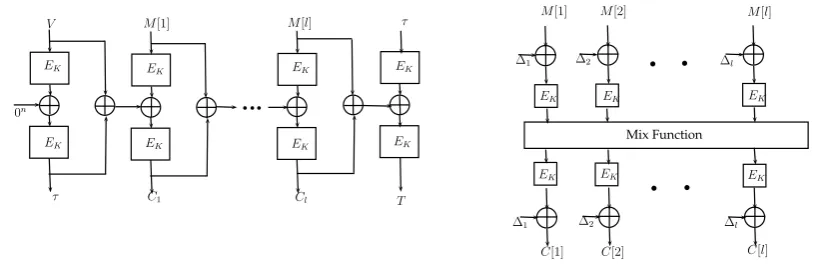
Fully Pipeline Implementable. Most of the popular online constructions like McOE [11] (uses MHCBC [26], later generalized and called TC3 [33]) has a hardware bottleneck of not being fully pipelined (see the bottom layer of McOE in Figure 1.1. It has CBC like structure, which is sequential and hence can not be pipelined). Our construction ELmE has a Encrypt-Linear mix-Decrypt type structure, making it fully parallel and pipeline implementable.
bbb EK
EK
EK
EK
EK
EK
V
τ
M[1] M[l]
C1 Cl
0n
EK
EK
T τ
EK EK EK
EK EK EK
M[l] M[2]
M[1]
∆1
Mix Function
C[1] C[2]
∆2 ∆l
∆1 ∆2 ∆l b b
b b
C[l]
Fig. 1.1. (1) McOE-D construction : cannot be pipelined. (2) Encrypt-Mix-Encrypt : completely parallel and pipeline implementable.
tuples but such constructions are two passed, and hence not efficient. Having Encrypt- Linear mix-Encrypt type layered design, makes our construction single pass and efficient.
Minimized Area in Combined Implementation. The construction of ELmE
ensures that encryption and decryption behave almost in a similar fashion (see figure 3.1 and remark 2 in section 3). This helps us to implement both encryp-tion and decrypencryp-tion in hardware with a smaller area. Nowadays in all applicaencryp-tion environment, both encryption and decryption of blockciphers to be implemented and hence we can share the architectures to have a compact combined hardware implementation of it.
Secure against Block-wise Adaptive Adversaries. Due to limited mem-ory in some environment such as low end devices the decryption oracle has to release a part of the plaintext before it authenticates. That raises some attacks on popular constructions [20]. We consider similar advantages such as privacy and authenticity, however the adversaries (called blockwise adaptive adversary) would have access of partial decryption oracles for authenticity security. To re-sist such attacks, intermediate tags can be used. In section 5, we have shown thatELmE can be extended to incorporates intermediate tags, hence it provides security against Block-wise adaptive adversaries.
2
Preliminaries
Definitions and Notation. By convention, B = {0,1}n where n is the block
size of the underlying blockcipher. An`-tuplex ∈B` is denoted by (x[1],x[2],. . .,
x[`]). We call` :=kxk block-length ofx. For 0≤a≤b < ` we denote x[a..b] := (x[a], x[a+ 1], . . . , x[b]),x[..b] =x[1..b]. Let us fixq message and associate data pairsP1 = (D1, M1), . . . , Pq = (Dq, Mq) with kDik=di,kMik=ei,`i =di+ei. We denote (P1, . . . , Pq) by τin. We assume that all Pi’s are distinct and in case
tupleτout = (C1, T1, . . . , Cq, Tq) (also the complete viewτ = (τin, τout)) is called
online view if for all i, kCik=ei andCi[..j] =Ci0[..j] whenever Di =Di0 and Mi[..j] =Mi0[..j].
2.1 Full and Online Privacy
We give a particularly strong definition of privacy, one asserting indistinguisha-bility from random strings. Consider an adversary A who has access of one of two types of oracles: a “real” encryption oracle or an “ideal” authenticated encryption oracle. A real authenticated encryption oracle, FK, takes as input (D, M) and returns (C, T) = FK(D, M). Whereas an ideal authenticated
en-cryption oracle $ returns a random stringRwith kRk=kMk+ 1 for every fresh pair (D, M). Given an adversary A (w.o.l.g. throughout the paper we assume a deterministic adversary) and an authenticated encryption scheme F, we define the (full)privacy-advantage of A by the distinguishing advantage ofA
distinguishing F from $. More formally,
AdvprivF (A) :=Adv$F(A) =PrK[AFK = 1]−Pr
$[A$ = 1].
We include initial value IV as a part of associated data D and so for nonce-respecting adversary A (never repeats a nonce or initial value and hence the view obtained by the adversary is nonce-respecting) the response of ideal oracle for every query is random as all queries are fresh. Similarly, we define online pri-vacy for which the the ideal online authenticated encryption oracle $ol responses
random string keeping the online property. The online privacy advantage of an adversary A against F is defined asAdvoprivF (A) :=Adv$ol
F (A).
View and A-realizable. We define view of a deterministic adversary A in-teracting with an oracle O by a tuple τ(AO) := (Q1, R1, . . . , Qq, Rq) where Qi
is the ith query and Ri is the response by O. It is also called O-view. A tuple
τ = (Q1, R1, . . . , Qq, Rq) is calledA-realizable if it makes queryQi after
obtain-ing all previous responses R1, . . . , Ri−1. As A is assumed to be deterministic, given R1, . . . , Rq, there is an unique q-tupleQ1, . . . , Qq for which the combined tuple isA-realizable. Now we describe the popular coefficient H-technique which can be used to bound distinguish advantage. Suppose f and g are two oracles andV denotes all possible A-realizable views whileA interacts withf org(they have same input and output space).
Lemma 1 (Coefficient H Technique). If ∀v∈Vgood ⊆V (as defined above), Pr[τ(Ag(·)) = v] ≥ (1−)Pr[τ(Af(·)) = v], then the distinguishing advantage
Advfg(A) of A is at most +Pr[τ(Af(·))6∈Vgood].
We skip the proof as it can be found in many papers, e.g. [28].
2.2 Authenticity
A made no earlier query (D, M) for which theF-response is (C, T). It can make
s attempts to forge after making q queries. We define that A forges if it makes at least one forges in all s attempts and the authenticity-advantage of A by
AdvauthF (A) =PrK[AFK forges].
Suppose for any valid tuple of associate data and tagged ciphertext (D, C, T), the tag T can be computed from (D, C). We write T =TK(D, C). So (D, C, T) is a valid tagged ciphertext if and only if TK(D, C) =T. Almost all known authen-ticated encryptions F (including those following encrypt-then-mac paradigm) have this property for a suitably defined ciphertext C and tag function T. We know that PRF implies Mac. We use similar concept to bound authenticity. More formally, for any forgery B, there is a distinguisher A such that
AdvFauth(B)≤Adv(OF,T,$ )(A) + s
2n (1)
whereO and $ are independent oracles and $ is a random function. This can be easily seen by defining A as follows:
- A first makes the q many F-queries (Di, Mi) which are made by B and
obtains responses (Ci, Ti), 1≤i≤q.
- Then it makessmanyT-queries (Dj, Cj),q < j ≤q+s where (Dj, Cj, Tj)’s
are returned by B.
-Areturns 1 (interpreting that interacting with real) if and only ifT(Dj, Cj) =
Tj0 for some j.
The distinguishing advantage ofA is clearly at leastPr[B forges]− s
2n and hence
our claim follows.
Trivial Queries. As F(D, M) = (C, T) implies that T(D, C) = T, we call such T-query (D, C) trivial (after obtaining response (C, T) response of the F -query (D, M)). The repetition of queries are also called trivial. Without loss of generality, we assume that all adversaries A is deterministic and does not make any trivial query. This assumptions are useful to simplify the analysis.
3
ELmE
: An Online Authenticated Encryption Algorithm
In this section, we demonstrate our new construction ELmE. It is an online authenticated encryption which takes an associated dataD ∈Bd and a messages
simple linear mixing (see in Algorithm 1) and a keyed block cipherEk :B→Bfor
the ECB layers. The ECB layers are masked by separate keys L1 (for associated data),L2 (for the message) andL3 (for the ciphertext) chosen uniformly fromB.
However, L1, L2, L3 can be simply computed from Ek as EK(0) =L1,EK(1) =
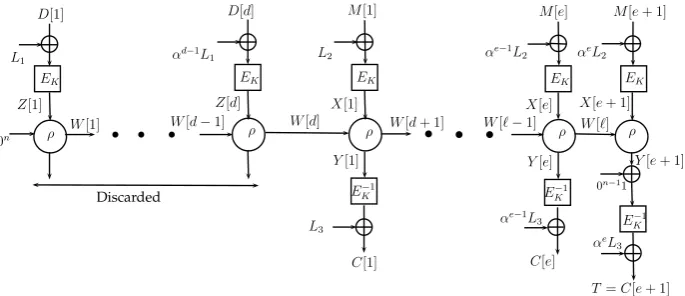
L2, Ek(2) = L3 and can be preprocessed. Thus, for notational simplicity and simplifying security analysis, we demonstrate our constructions for complete block messages and with three independent keys L1, L2 and L3. The complete construction is described below in Algorithm 1 and illustrated in Fig. 3 below.
b
b b
EK EK
ρ ρ
D[1] D[d]
C[1]
L1 αd−1L1
W[d−1]
Z[1] Z[d]
EK
E−1
K
ρ
E−1
K
M[e]
C[e]
T=C[e+ 1]
αe−1L2
W[ℓ−1]
X[e]
Y[e]
W[ℓ]
b
EK
E−1
K ρ M[1] L2 X[1] Y[1] Discarded
W[d+ 1]
W[d]
b
0n W[1]
L3 α
e−1L3
αeL3
ρ M[e+ 1]
αeL2
X[e+ 1]
EK
Y[e+ 1]
0n−11
b
Fig. 3.1. Construction ofELmE Authenticated Encryption
Remark 1 (Case when Associated data is empty).Here we consider the case when the associated data is non empty, using the initial value of the sequenceW[0] = 0, one can have a trivial attack against the privacy of the construction : Query any message M1 with M1[1] = 0. It produces the ciphertext with C1[1] =L2 +L3. Now querying any message M2 with M2[1] = C1[1] will produce C2[1] = 0 with probability 1.
Note that, Algorithm 1 is defined for non-empty associated data. One can en-sure associated data to be non-empty by including a non-empty public message number, in the first block of the associated data. Still, if we want to incorporate empty associated data in our algorithm, we make a small modification and ini-tialize the value W[0] to 1, to resist against any attack. The rest computations, to generate the tagged ciphertext, are identical to the above algorithm.
3.1 Underlying Layered Construction :
Input: (D, M)∈Bd×
Be
Output: Z = (C, T)∈Be×B
Algorithm ELmE(D, M) (Key: (L1, L2, L3, K))
parse D andM inton-length blocks.
1 D=D[1]k · · · kD[d]
2 M =M[1]kM[2]k · · · kM[e] 3 W[0] = 0
4 M[e+ 1] = D[1] +· · ·+D[d] +M[1] +· · ·+M[e] (checksum) process D
5 For all j = 1 to d
6 DD[j] = D[j] +αj−1.L1 (Masking the associate data blocks) 7 Z[j] =EK(DD[j]) (Layer-I Encryption)
8 (Y0[j], W[j]) ←ρ(Z[j], W[j−1]) (Linear Mixing)
process M
9 For all j = 1 to e
10 M M[j] =M[j] +αj−1.L2 (Masking the message blocks) 11 X[j] = EK(M M[j]) (Layer-I Encryption)
12 (Y[j], W[d+j]) ←ρ(X[j], W[d+j−1]) (Linear Mixing) 13 CC[j] = EK−1(Y[j]) (Layer-II Encryption)
14 C[j] = CC[j] +αj−1.L3 (Masking the ciphertext blocks)
Tag generation
15 M M[e+ 1] = M[e+ 1] +αe.L2 16 X[e+ 1] =EK(M M[e+ 1])
17 (Y[e+ 1], W[d+e+ 1]) ←ρ(X[d+e+ 1],W[d+e])
18 T T = EK−1(Y[e+ 1] + 0n−11) 19 T = T T+αe.L3
20 Return(C =C[1]kC[2]k · · · kC[e], T)
Subroutine ρ(x, w) Onlinear Linear Mixing Function
21 y =x + (α+ 1)·w 22 w= x +α·w 23 Return(y, w)
that gj(i,·) is a permutation (we denote the inverse by gj−1(i,·)). We take the usual masking functions gj(i, x) =αi−1·Lj ⊕x, j = 1,2,3. Letα is a primitive element of the field and L1 = Ek(0), L2 = EK(1) and L3 = EK(2) (here we
assume for simplicity that Li’s are uniform and independent to the underlying blockcipher).
• Layer-1: DD[j] = g1(j, D[j]), 1 ≤ j ≤ d, M M[j] = g2(j, M[j]), 1 ≤ j ≤ e+ 1.
• Layer-2: Z[i] =π(D[i]), 1≤i≤d, X[j] =π(M M[j]), 1≤j ≤e+ 1. • Layer-3: Y =mix(Z, X).
• Layer-4: CC[j] =π−1(Y[j]), 1≤j ≤e. T T =π−1(Y[e+ 1] + 0n−11). • Layer-5: C[j] =g3−1(j, CC[j]), 1≤j ≤e. T =g3−1(e+ 1, T T).
mix Function : The mix function, we use is following :
Y = B1 B2.
Z[..d]
X[..e+ 1]
where B1 is a ((e+ 1) ×d) full matrix and B2 is a ((e+ 1)×(e + 1)) lower triangular invertible matrix. In particular, we choose a mix function as defined below for 1≤i≤e+ 1.
When d 6= 0 :
Y[i] =αd+i−2(α+ 1)Z[1] +· · ·+αi−1(α+ 1)Z[d]
+αi−2(α+ 1)X[1] +αi−3(α+ 1)X[2] +· · ·+ (α+ 1)X[i−1] +X[i]
When d = 0 :
Y[i] =αi−2(α+ 1)X[1] +αi−3(α+ 1)X[2] +· · ·+ (α+ 1)X[i−1] +X[i] +αi−1(α+ 1)
3.2 Design Rationale
The main goal of the cipher is to be efficient, provide high performance and able to perform well in low end devices. For efficiency, we want our the cipher to be one pass, nonce misuse resistant. To obtain high performance, we want our cipher efficient as well as fully pipeline implementable. To perform well in low end devices, we require that our cipher to be secure against blockwise adaptive adversaries.
We know that, Encrypt Mix Encrypt or EME [14] is a block-cipher mode of operation, that turns a block cipher into a tweakable enciphering scheme. The mode is parallelizable, but as serial-efficient as the non-parallelizable mode CMC [13].EMEalgorithm entails two layers of ECB encryption and a non-linear mixing in between. In the non-linear mixing, the blockcipher is again used.EME
faster and parallel implementation of the construction and gives online prp [24] security, which is good enough to construct an authenticated encryption scheme, if tags are properly generated.
We use online linear mixing to make the construction online and efficiently implemented in low end device or any platform with limited memory. More-over, we choose ρ as our online linear mixing, as it is lightweight, efficiently computable and at the same time, intermediate tags can be incorporated very efficiently (descried in details in section 5). Note that, we could have used more lightweight mixing like simple xor operation in the linear mixing, but then gen-erating intermediate tags wouldn’t have been efficient.
We replace the second layer encryption by decryption which makes authen-ticated encryption and verified decryption almost identical. This helps us to minimize the combined implementd area when both encryption and decryption is implemented in the same device. Nowadays in all application environment, both encryption and decryption of blockciphers are needed to be implemented and hence we can share the architectures to have a compact combined hardware implementation of it.
4
Security of
ELmE
Authenticated Encryption
4.1 Privacy of ELmE
In this subsection, we prove online privacy ofELmE. Thus it provides full privacy against all nonce-respecting adversaries. Let A be an adversary which makes q
queries (Di, Mi) and obtains responses (Ci, Ti), 1≤i≤q. We denotekDik=di, kMik = kCik = ei and kTik = 1. Let `i = di +ei and σpriv = Pq
i=1(`i + 1)
(the total number of blocks in queries in addition with the checksum block). Let us fix an adversary A. Let $perm denotes the random n-bit permutation
and ηpriv := maxBAdv
$perm,$−perm1
E,E−1 (B) denotes the maximum advantage over all
adversaries B making at most σpriv queries and running in time T0 which is about time of the adversary A plus some overhead which can be determined from the hybrid technique.
Theorem 1.
AdvoprivELmE
Π,L(A) ≤
5σ2priv
2n , Adv
opriv
ELmEEK ,L(A) ≤ ηpriv +
5σpriv2
2n .
Proof. The second part of the theorem is the standard hybrid argument. The first part follows directly from the coefficient H technique (see Lemma 1) and following Propositions 1 and 2. For this, we first need to define a set of good views Vgood which would be applied in the proposition. Let us fixq message and
ei, `i = di+ei and σ = P
i`i. We denote (P1, . . . , Pq) by τin. We assume that
all Pi’s are distinct.
Definition 1 (Good views). A tagged ciphertext tuple τout = (C1, . . . , Cq)
(also the complete view τ = (τin, τout)) is called good online view (belongs to
τgood) w.r.t. τin if (τin, τout) is an online view (i.e., it must be realized by an online cipher, see section 2) and the following conditions hold:
1. Ci[j] =Ci0[j] implies that Di =Di0, Mi[..j] =Mi0[..j] and
2. ∀ (i, li+ 1)6= (i0, j0), Ti 6=Ci0[j0].
The first condition says that we can have collision of ciphertext blocks in a position only if they are ciphertexts of two messages with same prefixes up to that block. The second conditions says that all tag blocks are fresh as if these are independently generated. The following result says that in case of ideal online cipher, generating a bad view (i.e. not a god view) has negligible probability.
Proposition 1 (Obtaining a Good view has high probability).
Pr[τ(A$ol)∈/ V
good] ≤
σpriv2
2n .
Proof.According to the definition, an online view is not a good view if∃i, j, i0, j0
with Ci[j] = Ci0[j0], where (Di, Mi[..j]) 6= (Di0, Mi0[..j0]). Suppose i < i0 or i=i0, j < j0. Then Ci[j] is computed by (Di, Mi[..j]) before the computation of
Ci0[j0]. As (Di, Mi[..j]) 6= (Di0, Mi0[..j0]), the outcome of Ci0[j0] is random and
fresh from Ci[j]. So, the probability that Ci[j] takes the previously computed fixed value Ci[j] is 21n. As at most σpriv2
pairs are there, the probability that
τ(A$OL)∈/ Vgood is at most σ 2 priv
2n . ut
We now fix a good viewτ = (τin, τout) as mentioned above. The tagged ciphertext ofPi is given byCi which hasei+ 1 blocks where the last blockTi:=
Ci[ei+ 1] denotes the tag. In the following result, we compute the interpolation
probability, i.e. Pr[τ(AF) =τ].
Proposition 2 (High interpolation probability of ELmE). ∀τ ∈Vgood,
Pr[τ(AELmEΠ,L) =τ]≥(1− 4σ
2 priv
2n )×Pr[τ(A$ ol
) =τ].
Note that Pr[τ(A$ol) = τ] = 2−nP where P denotes the number of non-empty prefixes of (Di, Mi), 1 ≤ i ≤ q as for every different prefixes, $ol assigns an
independent and uniform ciphertext blocks.
Remark 2. If associated datas are distinct for all theq messages, thenP =σpriv
and hence, we’ll have full privacy i.e. the construction becomes indistinguishable from a random cipher with same domain and range.
Proof of Proposition 2. As adversary is deterministic, we restrict to those good views which can be obtained byA. Hence the probabilityPr[τ(AELmE) =τ] is same as
Pr[ELmEΠ,L(Di, Mi) =Zi,1≤i≤q].
Before computing interpolation probability we denote all intermediate variables while computing ELmEL1,L2,L3,π(Di, Mi) = Ci. Let for all i and j whenever
defined
1. DDi[j] =L1·αj−1+Di[j], M Mi[j] =L2·αj−1+Mi[j] 2. Π(DDi[j]) =Zi[j], Π(M Mi[j]) =Xi[j],
3. mix(Zi, Xi) =Yi
4. CCi[j] =L3·αj−1+Ci[j] and finally T Ti =L3·αe+Ti.
Note that CC and T T have been defined through tagged-ciphertext and L3
instead of applying Π on Y blocks. Let DD = (DD1, . . . , DDq) and similarly we defineMM,Z,X,YandCC. So, we havemix(Z,X) =Ywith the extended definition of mix which applies mix function for each (Zi, Xi).
Collision Relation. Now we define a collision relation of a vector (x1, . . . , xt) by the equivalence relationcoll(x) for whichiis related tojif and only ifxi =xj. We call (L1, L2, L3) valid if it computes (DD,MM,CC,TT) for which only equality among the blocks occurs in SSi[j] = SSi0[j] where Si[j] = Si0[j] (in
case of S =T, we only have j = 1.
Lemma 2. Pr[(L1, L2, L3) is valid]≥(1−1) where 1 = 2σ
2 priv
2n .
Proof. We prove it by using union bound applied to all equality (which violates that (L1, L2, L3) is valid). Because of primitiveness ofαand uniform independent choice ofL1, L2 andL3each equality violating valid has probability 2−n. As there
are at most 2σpriv
2
equality the result follows. ut
Consistent collision relations for a linear function. SupposeX =X[1..r1] be ar1-tuple of variables ofBandL:Br1 →Br2 be a linear function. We denote Y = L(X) which is an r2-tuple of variables from B. Let γ1 and γ2 are two equivalence relations defined on the sets respectively [1..r1] and [1..r2]. Let Xγ1
denote the tuple of variables which satisfies the collision relationγ1 by replacing identical variables by the variable which occurred with minimum index. We say that (γ1, γ2) is consistent with L if Li(Xγ) ≡ Lj(Xγ1) if and only if i and j
are related in γ2. Clearly, given any γ1 and L there is exactly one γ2 for which (γ1, γ2) is consistent with L. We write γ1 ⇒L γ2.
Example 1. Ifγ1 ={{1,3},{2},{4,6},{5}}forr1 = 6, then we writeXγ1 = (X
1,
X2, X1, X4, X5, X4). Let L map into three variables (i.e., r2 = 3 such that
L1 = X1 + X2 + X3 +X6, L2 = X4 + X5 + X6 and L3 = X2 + X4 then
Lemma 3. [Number of Solutions for Consistent relations] Let (γ1, γ2) be con-sistent with L:Br1 →Br2 then
|{X :Coll(X) =γ1, Coll(L(X)) =γ2}| ≥2ns1 ×(1−
s2
2n+1)
wheres1 ands2denote the number of equivalence classes ofγ1 andγ2 respectively and s=s1+s2.
Proof. Let Y =L(X). Because of consistency, for all relatedi, j inγ2,Yi =Yj. There may be additional equality which must be avoided. For all unrelated pair (i, j) in γ2 we must choose X in a manner such that Yi 6= Yj and similarly for all unrelated pair (i, j) in γ1 we haveXi 6=Xj. Due to consistency, any one can happen for at most 2n(s1−1) manyX’s asL
i(Xγ1) =Lj(Xγ1) gives a non-trivial
equation. So the result follows as we have at most s2
such equalities. ut
Now we establish two collision relations γ1 and γ2 which are consistent with the linear mix function. These relations are defined based on a good view τ. Let γ1 be the collision relation defined on the set {(i, j, M) : i ≤ q, j ≤ li+
1}S
{(i, j, D) : i ≤ q, j ≤ di}. A pair ((i, j, S),(i0, j0, S0)) is related if S = S0,
j = j0 and Si[j] = Si0[j]. All other pairs are unrelated. Let γ2 be the a collision
relation defined on the set {(i, j, C) : i ≤ q, j ≤ li + 1} for which only pairs ((i, j, C),(i0, j0, C)) ifj =j0 andCi[j] =Ci0[j]. Let the no. of equivalence class of γi besi,i= 1,2. Note thats2 =P, the number of prefixes of (Di, Mi) containing at least one message block.
Lemma 4. The collision relations defined as above is consistent with mix.
Proof. Let Y = (Y1 := mix(Z1, X1), . . . , Yq := mix(Zq.Xq)). Since the view is good, Ci[j] = Ci0[j] can happen if Di =Di0 and Mi[..j] =Mi0[..j]. In this case,
clearly,Yi[j] =Yi0[j]. Now for any other pair ((i, j),(i0, j0)), it is easy to see that
mix function leads to a non-trivial equation mixj(Xiγ1) =mixj0(Xγ1
i0 ). ut
Corollary 1. #{(Z, X) :coll(Z, X) =γ1,coll(Y) =γ2} ≥2ns1(1− 2σ
2 priv
2n )
Now, for a fixed valid-L triple (L1, L2, L3), the conditional interpolation prob-ability is
X
(Z,X)
#π :π(M M) =X, π(DD) =Z, π(CC) =Y
#π ≥(1−
2σpriv2
2n )×2− nP.
So by multiplying the probability for validness of (L1, L2, L3) the proof of the proposition completes.
4.2 Authenticity of ELmE
queries (Di, Mi) and obtains responses (Ci, Ti), 1≤i≤qand attempts to forges
times with the ciphertext queries (Ci, Ti),q+1≤i ≤q+s. We denotekDik=di,
kMik = kCik = ei and kTik = 1. Let `i = di +ei and σauth = Pq+s
i=1(`i + 1) (the total number of blocks in queries in addition with the checksum block). Let us fix an adversary A. Let $perm denotes the random n-bit permutation
andηauth := maxBAdv
$perm,$−perm1
E,E−1 (B) denotes the maximum advantage over all
adversaries B making at most σauth queries and running in time T0 which is about time of the adversary A plus some overhead which can be determined from the hybrid technique.
Theorem 2.
AdvforgeELmE
Π,L(A) ≤
9σauth2
2n +
s
2n, Adv
forge
ELmEEK ,L(A) ≤ ηauth+
9σ2auth
2n +
s
2n.
Proof.Let L= (L1, L2, L3) be the triple of masking keys andΠ be the uniform random permutation. For notational simplicity, we write ELmEΠ,L by F. Note
that for a valid tuple of associate data and tagged ciphertext (D, C, T), the tag
T can be computed from C and the key. We write T =TΠ,L(D, C) :=T(D, C).
So (D, C, T) is a valid tagged ciphertext if and only ifT(D, C) =T. As we have observed in Eq. 1, we only need to show indistinguishability for which we apply the coefficient H technique again. For this, we need to identify set of good views for which we have high interpolation probability.
Good View. A (F, T)-view of a distinguisher A is the pair v = (τF, τT) where
τF = (Di, Mi, Ci, Ti)1≤i≤qis anq-tuple ofF-online view andτF = (Dj, Cj, Tj)q<j≤q+s
is an s-tuple non-trivial T-view. It is called good if τF is good (as defined in Definition 1) and for all q < j ≤ q +s, Tj’s are fresh - distinct and different from all other Ti’s and Ci[j]’s. We recall the notation |Mi| =ei, |Di| = di and
`i = di +ei. Let σauth = Pq+s
i=1(`i+ 1). Since F is online function we consider pair of independent oracles ($ol,$) where $oldenotes the random online function
and $ is simply a random function.
Proposition 3 (Realizing good view while interacting with random function has high probability). For all adversary A,
Pr[τ(A$ol,$) is not good ]≤ (q+
Pq i=1ei)2
2n+1 +
s(q+s+Pq+s i=1 ei)
2n ≤
2σauth2
2n .
As in Proposition 1, we can similarly prove the above. The first summand takes care the collisions in Ci[j]’s (i.e., the bad view for τF as in Proposition 1) and the second summand takes care the collision between Ti’s (q < i≤q+s) and all other Ci[j]’s. Now we fix a good view τ = (τF, τT) as defined above (following same notations). Now it is easy to see that obtaining τ interacting with ($ol,$)
has probability 2−ns×2−nσpf = 2−n(s+σpf) where σ
pf denotes the number of
Proposition 4 (Good view has high interpolation probability). For any good (F, T)-view τ and 0 = 7σauth2 /2n, we have
Pr[F(Di, Mi) = (Ci, Ti),1≤i ≤q, T(Dj, Cj) =Tj, q < j ≤q+s] ≥ (1−0)2−n(σpf+s).
Assuming the proposition, the pair (F, T) is-indistinguishable from ($ol,$) with
=0+ 2σ2auth
2n , the result follows. The proof of the proposition is given below.
Proof of Proposition 4. We chooseX1, . . . , Xq and thenYq+1, . . . , Ys+q which
fix all internal X and Y values except the last block for the s many T-queries. We explicitly provide counting steps by steps. We choose valid L which fixes
M M’s for the firstq messages and, CC’s and DD’s for all s+q queries. We can then choose M M for these s queries so that checksums are all fresh and for all these fresh checksums we can ensure last Y blocks fresh by choosing X blocks appropriately. Now we make these choices one by one more formally :
(i) Choices of ValidL-triples.We first define validL-triples as defined in pri-vacy. A triple (L1, L2, L3) is called valid w.r.t. the fixed good (F, T)-viewτ if the computedM M,DD,CC andT T values satisfy the collision relations described below and whenever Cj,j > q, is a strictly prefix of Ci,i ≤q andDi =Dj then
M Mi[ei]6=M Mj[ej], i.e., equivalentlyMi[ej+1]+. . . Mi[ei]+L2(αej+. . . αei)6=
0. To define the collision (equivalence) relation, we mention those places where equivalence occurs. In all other places these are not related. SSi[j] ≡ SSi0[j] if Si[j] = Si0[j] where S represents any one of the four symbols M, D, C and T.
So they can be identical only if their positions as well as symbols (or types of the input) match. The simple counting argument with union bound applied to all individual bad events proves the following result.
Lemma 5. Pr[(L1, L2, L3) is a L-valid triple] ≥ (1− 2σauth2
2n )
.
(ii) Choices of validZ, X, Y except the last blocks for the lasts queries.
As in section 4, τF induces consistent collision relations of (Z,X) := (Z1, . . .,
Zq,X1, . . . ,Xq) and Y := (Y1, . . . ,Yq). Now we extend this collision relation to (Zq+1,Yq+1, . . . ,Zq+s, Yq+s) as follows for j < i≤q+s:
1. Zi[j]≡Zi0[j0] if j =j0 and Di[j]≡Di0[j].
2. Yi[j]≡Yi0[j0] if j =j0 and Ci[j]≡Ci0[j].
The collision relation on (Z,Y) induces a collision relation onXf := (Xq+1, . . .,
Xq+s) through the linear mix−1 function. That is, (Z,Y)⇒mix−1 Xf. Let γ10 be
the extended collision relation on (Z,X) and γ20 be that of Y. We denote the number of equivalence classes by s01 and s02. By using the counting on consis-tency relations (see Lemma 3) the number of (Z, X, Y) withmix(Z, X) =Y and
coll(Z, X) =γ10, coll(Y) =γ20 is at least
2n(s1+s3)(1− (s
0
1+s02)2 2n+1 )≥2
n(s1+s3)(1− 2σ
where s3 denotes the number of additional equivalence classes in Yf which are not present in (Y1, . . . ,Yq). Thus,sis the number of blocks we can choose freely
which determines all other blocks. Now we state an important property of these collision relations γ10 and γ20.
Lemma 6. If for some j > q, ∀k ≤ `j, Xj[k] ≡ Xrk[k], rk ≤ q then ∀k ≤ `j, Xj[k] ≡ Xi[k] for some i ≤ q. This means the message corresponding to a
forged ciphertext is the prefix of some other messages, queried previously by the adversary.
Proof. Let us fix j =q+ 1 (for all other j, the argument is similar) and denote
`j by `. Now we have the following identities: Xq+1[k] ≡ Xrk[k] for all k. This
can happen only if Yq+1[j] ≡ Ytj[j] for some tj ≤ q, otherwise Xq+1[j] would get completely new variable which is not present in all firstq queries. Now if we write Xq+1[j] in terms of these Xtj’s variable one can obtain the desired result.
(iii) Choices of M M for forging s queries. Given the choices of valid L
and those of X, Y, Z as described above we can now choose remaining M M
values satisfying same collision relation as (Xq+1, . . . , Xq+s). More precisely, we can choose all those M M values for which Xj[i]’s are fresh. Let s4 denote the number of additional distinct blocks in (Xq+1, . . . , Xq+s) which are not present in (X1, . . . , Xq). The number of these s4 blocks M M different from all other defined M M, DD andCC blocks such the all last blocks ofM Mj’s (j > q) are fresh is at least 2ns4(1−2σ
2 auth
2n ). Note thatM Mi[ei+ 1] =M Mi0[ei0+ 1] induces
a restriction on choices ofM M.
(iv) Choices of last block of X for these s queries. For any such pre-vious choices, we now choose the blocks of Xj[ej + 1], j > q so that the last
block of Yj’s are fresh. This can be chosen in 2ns(1− σauth2
2n ) ways.
Armed with all these counting, the interpolation probability is at least
(1− 7σ 2 auth
2n )×2−
n(σpf+s).
This completes the proof.
5
Our Construction incorporating Intermediate Tags
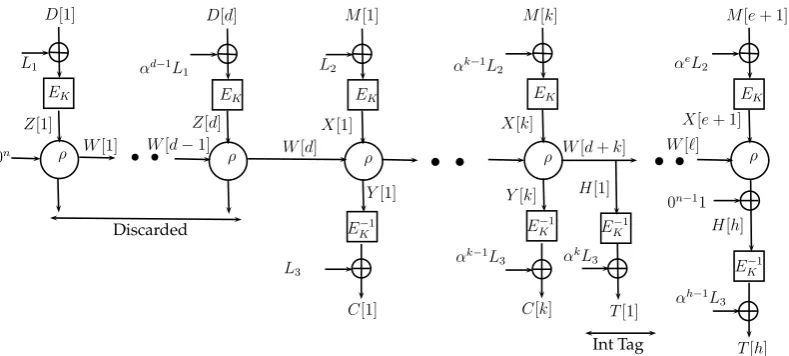
Suppose, we want ELmE with intermediate tags generated after each it blocks. In this case, for a message M ∈ Be, ELmE generates a ciphertext C ∈ Be and
T ∈ Bh where h = dkee. Processing of D remains same. For Processing of M, the calculation of C[j] is changed to CC[j] +αj−1+bj−k1c.L3. ∀ j < e s.t. k|j,
the intermediate tags are generated byT[jk] =EK−1(W[d+j]) +αj−1+dj−k1e.L3.
Final tag T[h] is generated similar to the generation of T in the case of ELmE
byT[1]||T[2]|| · · · ||T[h]. For verification during decryption, eachT[i] is verified and as soon as, aT[i] doesn’t matched with it’s calculated value, the ciphertext gets rejected.
b
b
EK EK
ρ ρ
D[1] D[d]
C[1]
L1 αd−1L 1
W[d−1]
Z[1] Z[d]
EK
E−1
K ρ M[e+ 1]
T[h]
αeL
2
W[ℓ]
X[e+ 1]
H[h]
b
αh−1L 3
b
EK
E−1
K ρ M[1] L2 X[1] Y[1]
0n−11
Discarded
W[d]
0n W[1]
L3
EK
E−1
K ρ M[k]
αk−1L 2
X[k]
Y[k]
W[d+k]
C[k]
αk−1L 3
b
b
E−1
K
T[1]
αkL
3
Int Tag
H[1]
Fig. 5.1. ELmEwith intermediate tags
Intermediate tags can be used in authenticated encryption to provide quick rejection of invalid decryption queries. This also helps in low-end implementa-tion where the message has to be released depending on buffer size. If we have an intermediate tag in appropriate positions so that we can reject before we release some message blocks. Our construction can be easily extended to pro-duce intermediate tags also, as described in the figure below. Here, we have used intermediate tags after processing of each k < nblocks of message.
Remark 4. Consider an authenticated encryption construction with intermedi-ate tag verification is done after each k blocks. Before each intermediate tag verification, the device where it is implemented, has to hold thek blocks of mes-sage as well as some intermediate computations, required for the verification. So, the device required to have appropriate amount of buffer. As intermediate tags are used in low end devices, one needs ensure that the buffer size is minimized. The choice ofρhelpsELmEto verify after one layer which makes the verification is faster and it requires to store only 10 blocks of intermediate computation for the next 10 subsequent ciphertext.
LetFis our construction incorporating intermediate tags after eachk blocks. In the following subsections, we prove the security ofF
5.1 Online Privacy of F.
`i = di +ei and σpriv = Pq
i=1(`i +hi) (the total number of ciphertext blocks with the tag blocks). The online Privacy of F is given by:
Theorem 3.
AdvoprivF
Π,L(A) ≤
5σpriv2
2n , Adv
opriv
FEK ,L(A) ≤ ηpriv+
5σpriv2
2n .
Proof. Similar to the previous proof, we fix q message and associate data pairs
P1 = (D1, M1), . . . , Pq = (Dq, Mq) with kDik= di,kMik= ei, `i = di +ei and
denote (P1, . . . , Pq) by τin. We modify the definition of Good views as follows : τout = (C1, . . . , Cq) is called good online view (belongs to τgood) w.r.t. τin if
(τin, τout) is an online view if the following conditions hold:
1. Ci[j] =Ci0[j] implies that Di =Di0, Mi[..j] =Mi0[..j]
2. Ti[j] =Ti0[j] implies thatDi =Di0, Mi[..kj] =Mi0[..kj] and
3. ∀ (i, j)6= (i0, j0), Ti[j]6=Ci0[j0].
It is easy to see that, obtaining such a Good view has high probability :
Pr[τ(A$ol)∈/ V
good] ≤
σpriv2
2n .
We now fix a good view τ = (τin, τout) as mentioned above, where the tagged
ciphertext of Pi is given by (Ci, Ti) which has (ei +hi) blocks where Ti[j] de-notes the jth intermediate tag of the message i and Ti[hi] denotes the final tag of message i. We set up the notations of DD, MM, Z, X,Y as defined in the proof of . We redefine CC, TTand define H as follows :
CCi[j] =L3.αj−1+b
j−1
k c+Ci[j]
T Ti[j] =L3.αjk−1+d
jk−1
k e+Ti[j]
∀j < hi, Hi[j] =Wi[d+jk], Hi[hi] =Wi[`i].
It is easy to check that,
Pr[(L1, L2, L3) is valid]≥(1−1) where 1 = 2σ
2
priv
2n .
The proof is exactly similar to the proof of Lemma 2
Now we look at the collision relationsγ1 andγ2. We modify the collision relation
γ2 s.t. it is defined on the set {(i, j, C) :i≤q, j ≤li}S
{(i, j, T) :i≤q, j ≤hi}
for which a pair ((i, j, S),(i0, j0, S0)) is related ifS =S0,j =j0 andSi[j] =Si0[j].
All other pairs are unrelated. Let the no. of equivalence class of γ2 becomes s02.
Now let (Y,H) = ((Y1, H1) := mix(Z1, X1), . . . ,(Yq, Hq) :=mix(Zq.Xq)). Since the view is good, Ci[j] = Ci0[j] can happen if Di = Di0 and Mi[..j] = Mi0[..j].
Vi[j] +αj−2(α+ 1)Xi[1] +· · ·+ (α+ 1)Xi[j−1] +Xi[j] =
Vi0[j0] +αj 0
−2(α+ 1)X
i0[1] +· · ·+ (α+ 1)X[j−1] +Xi0[j0]
where Vi[j] =αdi+j−2(α+ 1)Z[1] +· · ·+αj−1(α+ 1)Z[di].
Similarly we have, Ti[j] = Ti0[j] if Di = Di0 and Mi[..jk] = Mi0[..jk] and
for any other pairs, Ci[j] = Ci0[j0], leads to the nontrivial equation. Moreover, Ci[j] = Ti0[j0] is a non-trivial equation. This proves that, the collision relations
defined as above is consistent with mix. Now, applying Lemma 3, we have the result
#{(Z, X) :coll(Z, X) =γ1,coll(Y, H) =γ2} ≥2ns1(1− 2σ 2
priv
2n )
Now, for a fixed valid-L triple (L1, L2, L3), the conditional interpolation proba-bility is
X
(Z,X)
#π :π(M M) =X, π(DD) =Z, π(CC) =Y, π(T T) =H
#π ≥(1−
2σpriv2
2n )×2− ns0
2.
So by multiplying the probability for validness of (L1, L2, L3) we obtain the High interpolation probability of F :
∀τ ∈Vgood, Pr[τ(AFΠ,L) =τ]≥(1− 4σ
2
priv
2n )×Pr[τ(A$ ol
) =τ].
Now applying Patarin’s H-coefficient techinique, the result follows.
5.2 Attack against the Authenticity of the construction when k ≥ n
Here is an demo example of how the construction works when n= 4. We have shown it fork ≥4 with a degree 4 primitive polynomialx4+x3+1. For simplicity we take empty associated data. The attack is described below. The associated data part is considered as null for all the queries however the attack works for any fixed associated data.
1. query-1: FK(M[1..6]) = (C[1..5], T[1], C[6], T[2]).
2. query-2: FK(M0[1], M[2..6]) =C0[..5], T0[1], C0[6], T0[2]).
3. forged ciphertext: (C[1], C0[2..4], C[5], T0[1]· · ·).
This follows from the following equality for the input of the blockcipher invoca-tion which computes the intermediate tag:
WF[5] =X2[5] +αX2[4] +α2X2[3] +α3X2[2] + ((α4+α3+ 1)X1[1] + (α3+ 1)X2[1]) =X2[5] +αX2[4] +α2X2[3] +α3X2[2] +α4X2[1] (As α4+α3+ 1 = 0)
=W2[5]
Main Idea: Suppose the forged ciphertext is Ci1[1] · · · Ci5[5]Ti[1]· · · where
αXi[4] +α2Xi[3] +α3Xi[2] +α4Xi[1], we make jth blocks of all the messages
i1,· · · , i5, i to be same for all j ≥ 2. Using the fact that α is a root of the primitive polynomial of degree 4, we will assign Xj[1], Xi1[1],· · ·, Xi5[1] one of two valuesX1[1], X2[1] such that (assigning all the values to one particular is not allowed) regardless of the exact values of the two, the following equation become trivial :α4Xj[1] = (α4+α3)Xi5[1]+(α
3+α2)X
i4[1]+· · ·+(α+1)Xi2[1]+Xi1[1].
Assigning Xi5[1] = Xi1[1] and Xi4[1] = Xi3[1] =Xi2[1] = Xi[1] we obtain that. It is easy to see that the equality of the X values ensures that, i5 = i1 and
i4 = i3 = i2 = i. Hence, we have just two queries. This idea can be similarly extended to have an attack against the construction when k ≥ n using the primitive polynomial of degree n.
5.3 Authenticity of the construction F with k < n
Let A be an adversary which makes q queries (Di, Mi) and obtains responses (Ci, Ti), 1 ≤ i ≤ q and then tries to forge s queries (Ci, Ti), q ≤ i ≤ q +s.
We denote kDik = di, kMik = kCik = ei and kTik = hi. Let `i = di +ei
and σauth = Piq=1+s(`i+hi) (the total number of ciphertext blocks with the tag
blocks). The forging advantage of A is given by:
Theorem 4.
AdvforgeF
Π,L(A) ≤
10 σ2auth
2n +
s
2n, Adv
forge
FEK ,L(A) ≤ ηauth+
10 σ2auth
2n +
s
2n
Proof. A (F, T)-view of a distinguisher A is the pair τ = (τF, τT) where τF = (Di, Mi, Ci, Ti)1≤i≤qis anq-tuple ofF-online view andτT = (Dj, Cj, Tj)q<j≤q+s
is an s-tuple non-trivial Tview. Note, there are two types of forging queries -some with intermediate tag forging and others that forges the final tag (in case forging query’s length is less thant or the length is long but upto last generated intermediate tag, the ciphertext is a prefix of some previous queried message). Let qt and qit denotes the no. of attempted forging queries against the final tag and intermediate tag respectively. Clearlys =qt+qit. W.l.o.g assume that, all the
forging queries against final tags are performed first and then the queries against the intermediate tag forgings are done. It is calledgoodonline intermediate tag forge view, if τF is Good Online view (as defined in the privacy prove) and for all q < j ≤ q+qt, Cj[ej + 1]’s are fresh and for all q+qt < j < q+s, Tj[ej]’s
are fresh - distinct and different from all other Ci[j]’s and Ti[j]’s. Suppose, ∀i≤q+s, |Di|=di |Ci|=ei. Let σauth =Pqi=1+s(di+ei+hi). Since F is online
function we consider pair of independent oracles ($ol,$) where $ol denotes the
random online function and $ is simply a random function. It is easy to see from the previous proof that,
Proposition 5 (Realizing good view while interacting with random function has high probability). For all adversary A,
Pr[τ(A$ol,$) is not good ]≤ (q+
Pq i=1ei)2 2n+1 +
s(q+s+Pq+s i=1 ei)
2n ≤
2σauth2
Now we fix a good viewτ = (τF, τT) as defined above (following same notations). Now it is easy to see that obtaining τ interacting with ($ol,$) has probability
2−ns×2−nσpf = 2−n(s+σpf) whereσ
pf denotes the number of non-empty prefixes
of (Ci, Ti), 1≤i≤q (at those blocks random online function returns randomly).
Proposition 6 (Good view has high interpolation probability). For any good (F, T)-view τ and 0 = 8σauth2 /2n, we have
Pr[F(Di, Mi) = (Ci, Ti),1≤i ≤q, T(Dj, Cj) =Tj, q < j ≤q+s] ≥ (1−0)2−n(σpf+s).
Assuming this proposition, the pair (F, T) is -indistinguishable from ($ol,$)
with =0+ 2σ2auth
2n . Hence the theorem is proved using equation 1. ut
Proof of Proposition 6. We chooseX1, . . . , Xq and thenYq+1, . . . , Ys+q which
fix all internal X and Y values except the last block for the s many T-queries. We explicitly provide counting steps by steps. We choose valid L which fixes
M M’s for the firstq messages and, CC’s and DD’s for all s+q queries. We can then choose M M for these s queries so that checksums are all fresh and for all these fresh checksums we can ensure last Y blocks fresh by choosing X blocks appropriately. Now we make these choices one by one more formally :
(i) Choices of ValidL-triples.We first define validL-triples as defined in pri-vacy. A triple (L1, L2, L3) is called valid w.r.t. the fixed good (F, T)-viewτ if the computedM M,DD,CC andT T values satisfy the collision relations described below and whenever Cj,j > q, is a strictly prefix of Ci,i ≤q andDi =Dj then
M Mi[ei]6=M Mj[ej], i.e., equivalentlyMi[ej+1]+. . . Mi[ei]+L2(αej+. . . αei)6=
0. To define the collision (equivalence) relation, we mention those places where equivalence occurs. In all other places these are not related. SSi[j] ≡ SSi0[j] if Si[j] = Si0[j] where S represents any one of the four symbols M, D, C and T.
So they can be identical only if their positions as well as symbols (or types of the input) match. The simple counting argument with union bound applied to all individual bad events proves the following result.
Lemma 7. Pr[(L1, L2, L3) is a L-valid triple] ≥ (1− 2σauth2
2n ).
(ii) Choices of valid Z, X, Y, H except the last blocks of the qt queries.
As in section 4, τF induces consistent collision relations of (Z,X) := (Z1, . . .,
Zq,X1, . . . ,Xq) and Y := (Y1, . . . ,Yq). Now we extend this collision relation to (Zq+1,Yq+1, . . . ,Zq+s, Yq+s) as follows for j < i≤q+s:
1. Zi[j]≡Zi0[j0] if j =j0 and Di[j]≡Di0[j].
2. Yi[j]≡Yi0[j0] if j =j0 and Ci[j]≡Ci0[j].
The collision relation on (Z,Y) induces a collision relation onXf := (Xq+1, . . .,
Xq+s) through the linear mix−1 function. That is, (Z,Y)⇒mix−1 Xf. Let γ10 be
number of equivalence classes by s01 and s02. By using the counting on consis-tency relations (see Lemma 3) the number of (Z, X, Y) withmix(Z, X) =Y and
coll(Z, X) =γ10, coll(Y) =γ20 is at least
2n(s1+s3)(1− (s
0
1+s02)2 2n+1 )≥2
n(s1+s3)(1− 2σ
2 auth 2n )
where s3 denotes the number of additional equivalence classes in Yf which are not present in (Y1, . . . ,Yq). Thus,sis the number of blocks we can choose freely which determines all other blocks. Now we state an important property of these collision relations γ10 and γ20.
Lemma 8. If for some j > q, ∀k ≤ `j, Xj[k] ≡ Xrk[k], rk ≤ q then ∀k ≤ `j, Xj[k] ≡ Xi[k] for some i ≤ q. This means the message corresponding to a
forged ciphertext is the prefix of some other messages, queried previously by the adversary.
Proof. Let us fix j =q+ 1 (for all other j, the argument is similar) and denote
`j by `. Now we have the following identities: Xq+1[k] ≡ Xrk[k] for all k. This
can happen only ifYq+1[j]≡Ytj[j] for sometj ≤q, otherwiseXq+1[j] would get completely new variable which is not present in all firstq queries. For the firstqt
forging queries, if we write Xq+1[j] in terms of these Xtj’s variable one can ob-tain the desired result and for the lastqitforging queries it follows from Lemma 9.
(iii) Choices of M M for forging s queries. Given the choices of valid L
and those of X, Y, Z as described above we can now choose remaining M M
values satisfying same collision relation as (Xq+1, . . . , Xq+s). More precisely, we can choose all those M M values for which Xj[i]’s are fresh. Let s4 denote the number of additional distinct blocks in (Xq+1, . . . , Xq+s) which are not present in (X1, . . . , Xq). The number of these s4 blocks M M different from all other defined M M, DD andCC blocks such the all last blocks ofM Mj’s (j > q) are fresh is at least 2ns4(1−2σ
2 auth
2n ). Note thatM Mi[ei+ 1] =M Mi0[ei0+ 1] induces
a restriction on choices ofM M.
(iv) Choices of last block of X for these qt queries For any such
pre-vious choices, we choose the blocks of Xj[ej+ 1],q < j ≤q+qt, so that the last block of Yj’s are fresh. This can be chosen in 2ns(1− σ
2 auth
2n ) ways.
(v) Choices of last block of X for these qit queries For this, we
simi-larly choose the blocks of Xj[ej+ 1], q+qt < j < q+s so that the last block of
Yj’s are fresh. This can be chosen in 2ns(1− σ2auth
2n ) ways.
Armed with all these counting, the interpolation probability is at least
(1− 8σ 2 auth
2n )×2−
n(σpf+s).
Lemma 9. A forged ciphertext uptocth intermediate tag is valid, if it is a prefix of a ciphertext produced by some previous forward query.
Proof. First we consider the case where c= 1. Then will generalize for any c. One can check that, if any of the blocks in the forged ciphertext is not identical to a previous response, then Ti[1] will not be valid due to the randomness of Y
value corresponding to that block. Similarly takingTi[1] as some final tag output will give some non-trivial equations. Hence, assume the forged Ciphertext be (Ci1[1] Ci2[2]· · ·Cik[k] Ti[1]), where Cij[j] is the j
th block of the ciphertext of
(Dij, Mij) andTi[1] is the first intermediate tag block of message (Di, Mi). If the forged intermediate tagTi[1] is valid, then we have the following set of equalities
in the X blocks : ∀j ≤k,
αt−jXi[j]≡(α+1)·αt−j−1Xik[j]+(α+1)·αk−j−2Xik−1[j]+· · ·+(α+1)Xij+1[j]+Xij[j]
For k < n, this equation is trivial only if ∀j ≤k, Xik[j]≡ · · · ≡ Xij[j]≡Xi[j], otherwise we have an polynomial of α with degree ≤ k−j < n, whose value is 0, which contradicts the primitivity of α in GF(2n). Now, we have to consider
the equalities in the Z blocks. Let dz denotes the no. of associated data blocks
in the message Mz. There are two cases :
• di1 = · · · = dik = di = df : In this case, we has the following equalities in
the Z blocks : ∀j ≤di,
αkZi[j]≡(α+1)·αk−1Zik[j]+(α+1)·αk−2Zik−1[j]+· · ·+(α+1)Zi1[j]+Zf[j]
For k < n, this equation is trivial only if ∀j ≤ k, Zik[j] ≡ · · · ≡ Zij[j] ≡
Zf[j], otherwise again we have an polynomial of α with degree ≤ k −j <
n, whose value would be 0. Hence, the forged ciphertext is a prefix of the ciphertext corresponding to the ith message. Note that, assigning k ≥ n, vialotes this claim.
• Otherwise, Let dmax = max{di1,· · · , dik, di, df}. For Ti[1] to be valid, the equality in the block Z[dmax], violates the primitivity of α. Note, that as for some message, there is no contribution to this block, assigning same value in this block for the remaining messages also gives a polynomial of α, with degree less than n, whose value is 0. So, this case doesn’t occur.
This makes ∀j ≤ k, Xik[j] ≡ Xi[j] meaning that the forged ciphertext block
Cf[1..k] =Ci[1..k], ith ciphertext response.
Now we prove this for general c using induction. Suppose, our claim is true for c intermediate tag blocks. We have to show it for ciphertexts upto (c+ 1)th
block. Consider the forged Ciphertext is (Zi, Ci[1]· · ·Ci[ck] Ti[c] Cick+1[ck +
1] Cick+2[ck+ 2]· · ·Ti0[c+ 1]). If the ciphertext is valid, we have the following
set of equalities for all ck < j ≤(c+ 1)k,
αck+k−jXi[j]≡(α+1)·αck+k−1−jXi(c+1)k[j]+· · ·+(α+1)·α
ck−jX
ick+1[j]+α ck−jX
i[j]
5.4 Efficient Intermediate tag Generation : Comparison with COPA
Intermediate tags are used to provide block-wise security. Suppose we consider a construction with intermediate tag size of k blocks. At each k blocks, we check the intermediate tag, hold the k block message and finally release the
k blocks of the message if the tag is verified. For that, we need to store all the intermediate computations and the already computed messages in order to perform the verification. As we are using low end device, we need to minimize the buffer size.
Now, generating intermediate tags for COPA is not as straight forward as
ELmE as similar approach won’t provide any security because identical last two blocks will produce same intermediate tag.
Moreover, we claim that even if intermediate tags is produced for COPA as if the final tag, then it also has the disadvantage of requiring additional buffer storage. Now we compare the 20 round pipeline implementations which is keeping computing the messages even after intermediate tag to keep the pipeline full. For eachk block of intermediate tags, the pipelined implementation of 20 round AES for COPA requires to store k block messages and in addition 20 blocks of intermediate values for the subsequent ciphertext blocks. On the other hand
ELmE requires k blocks messages and 10 blocks of intermediate computation for next 10 next subsequent ciphertext. We save 10 blocks in buffer mainly due to faster verification (ELmE verifies after one layer, whereas COPA verifies after two layers). It has great advantage for low-end devices (keeping in mind that, block-wise adversaries are considered only when buffer size is limited implying low-end device).
Keeping the above benefits into consideration, we opt for the linear mix ρ
function rather than using a simple xor operation, as used in COPA.
5.5 Provision for Skipping Intermediate Tags during Decryption
ELmE generates intermediate tags in a such a manner that during decryption, the plaintext computation is independent of the intermediate tag computations. Hence, if intermediate verifications are not required, the extra computations required for verifying the intermediate tags, can be skipped. Note that, Sponge duplex [6], is another authenticated encryption that incorporates intermediate tags but doesn’t have this advantage.
6
Discussion on Performances and Future Work
Construction #BC AD #BC M #BC T speed up Misuse Bottleneck Resistance
OCB 1 1 1 p No Nonce
Processing
McOE-D 1 2 2 2 Yes Lower level
Processing
CoPA 1 2 2 p Yes Associated data
Processing
ELmE 1 2 1 p Yes None
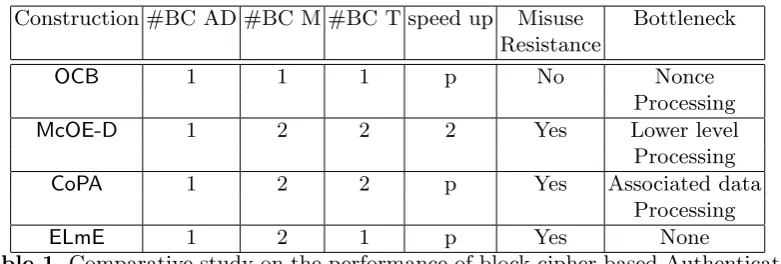
Table 1.Comparative study on the performance of block-cipher based Authenticated Encryptions. Here #BC AD, #BC M and #BC T denotes no. of block-cipher call per associated data, message and tag block respectively.
execution. Due to the sequential nature of the lower level ofMcOE-D, the speed up factor can be at most 2.
Now, we briefly discuss bottlenecks issues of the other constructions. COPA has bottleneck in associated data and hence it requires additional waiting for obtaining intermediate values from associated data. M cOE uses T C3 type en-cryption and it’s lower level has aCBC type structure which can not be executed in parallel implying the construction can not be pipelined. Hence it has a hard-ware bottleneck. OCB3 (which has minimum bottleneck among all versions) also has a bottleneck in the nonce processing. As the encryption of the IV is needed in the masking of the messages, hence the encryption of the messages can start only after the encryption of IV, hence has the bottleneck of having additional clock cycles required for one block encryption. Our construction is completely parallel with no such bottleneck as described above. Moreover the construction treats the additional data and message exactly in a similar way (except with different masking keys). The encryption and decryption also be-have similarly and hence ensures less chip area in hardware implementation. Moreover our construction can incorporate intermediate tags (with intermediate tag length less than or equal to 128), which provides quick rejection of invalid decryption queries ensuring the construction’s security even against block-wise adaptive adversaries.
Note that, the above comparison is given from theoretical point of view. Ex-perimental measurements to support these claim is a possible future scope. We’ve planned to implement a portable reference software implementation of our cipher as well as include a reference hardware design in verilog.
References
[2] — (no editor),Specification of the 3GPP Confidentiality and Integrity Algorithms 128-EEA3 and 128-EIA3. Document 2: ZUC Specification. ETSI/SAGE Specifi-cation, Version: 1.5 (2011). Citations in this document: §1.1.
[3] Elena Andreeva, Andrey Bogdanov, Atul Luykx, Bart Mennink, Elmar W. Tis-chhauser and Kan Yasuda, Parallelizable (authenticated) online ciphers (2013),
Asiacrypt (to be published), 2013. Citations in this document:§1.1.
[4] M.Bellare, P.Rogaway and D.Wagner,The EAX Mode of Operation ( A Two-Pass Authenticated Encryption Scheme Optimized for Simplicity and Efficiency)3017 (2004), 389–407, Fast Software Encryption, Lecture Notes in Computer Science, 2004. Citations in this document:§1.1.
[5] M.Bellare, J.Blake and P.Rogaway,OCB : A Block-Cipher Mode of Operation for Efficient Authenticated Encryption6(2005), 365–403. Citations in this document:
§1.3.
[6] G.Bertoni, J.Daeman, M.Peeters and G.V.Assche, Duplexing the Sponge : Single Pass Authenticated Encryption and Other Applications7118(2011), 320–337, Se-lected Areas in Cryptography, Lecture Notes in Computer Science, 2011. Citations in this document: §1.1,§5.5.
[7] Pompiliu Donescu and Virgil D. Gligor, Fast Encryption and Authentication : XCBC Encryption and XECB Authentication Modes 2355 (2001), 92–108, Fast Software Encryption, Lecture Notes in Computer Science, 2001. Citations in this document:§1.1.
[8] M. Dworkin, Recommendation for block cipher modes of operation: three vari-ants of ciphertext stealing for CBC mode. Addendum to NIST Special Publication 80038A. (2010). Citations in this document: §3.
[9] Dengguo Feng, Peng Wang and Wenling Wu, HCTR : A Variable-Input-Length Enciphering Mode 3822(2005), 175–188,CISC, Lecture Notes in Computer Sci-ence, 2005. Citations in this document: §3.
[10] N. Ferguson, D. Whiting, B. Schneier, J. Kelsey, S. Lucks and T. Kohno,Helix, Fast Encryption and Authentication in a Single Cryptographic Primitive (2003),
Fast Software Encryption, 2003. Citations in this document:§1.1.
[11] E. Fleischmann, C. Forler, S. Lucks,McOE: A Family of Almost Foolproof On-Line Authenticated Encryption Schemes7549(2012), 196–215,Fast Software En-cryption, Lecture Notes in Computer Science, 2012. Citations in this document:
§1.1,§1.3.
[12] Pierre-Alain Fouque, Antoine Joux, Gwenaelle Martinet, and Frederic Valette.,
Authenticated On-Line Encryption3006(2003), 145–159,Selected Areas in Cryp-tology, Lecture Notes in Computer Science, 2003.
[13] Shai Halevi and Phillip Rogaway, A Tweakable Enciphering Mode 2729 (2003), 482–499, CRYPTO, Lecture Notes in Computer Science, 2003. Citations in this document:§1.2,§3.2.
[14] Shai Halevi and Phillip Rogaway,A parallelizable enciphering mode2964(2004), 292–304, CTRSA, Lecture Notes in Computer Science, 2004. Citations in this document:§1.1,§1.2,§3.2.
[15] Martin Hell, Thomas Johansson, Alexander Maximov and Willi Meier,A Stream Cipher Proposal: Grain-128(2005),eSTREAM, ECRYPT Stream Cipher Project, Report 2006/071, 2005. URL: http://www.ecrypt.eu.org/stream. Citations in this document: §1.1.
[16] Russ Housley, Doug Whiting and Niels Ferguson, Counter with CBC-MAC (CCM). (2003), RFC 3610 (Informational), 2003. Citations in this document: