Cryptography with One-Way Communication
Sanjam Garg∗ Yuval Ishai† Eyal Kushilevitz‡ Rafail Ostrovsky§ Amit Sahai¶
Abstract
There is a large body of work on using noisy communication channels for realizing different crypto-graphic tasks. In particular, it is known that secure message transmission can be achieved uncondition-ally using onlyone-waycommunication from the sender to the receiver. In contrast, known solutions for more general secure computation tasks inherently require interaction, even when the entire input originates from the sender.
We initiate a general study of cryptographic protocols over noisy channels in a setting where only one party speaks. In this setting, we show that the landscape of what a channel is useful for is much richer. Concretely, we obtain the following results.
• Relationships between channels. The binary erasure channel (BEC) and the binary symmetric channel (BSC), which are known to be securely reducible to each other in the interactive setting, turn out to be qualitatively different in the setting of one-way communication. In particular, a BEC cannot be implemented from a BSC, and while the erasure probability of a BEC can be manipulated in both directions, the crossover probability of a BSC can only be manipulated in one direction.
• Zero-knowledge proofs and secure computation of deterministic functions.One-way commu-nication over BEC or BSC is sufficient for securely realizing any deterministic (possibly reactive) functionality which takes its inputs from a sender and delivers its outputs to a receiver. This pro-vides the first truly non-interactive solutions to the problem of zero-knowledge proofs.
• Secure computation of randomized functions.One-way communication over BEC or BSC can-notbe used for realizing general randomized functionalities which take input from a sender and deliver output to a receiver. On the other hand, one-way communication over other natural chan-nels, such as bursty erasure chanchan-nels, can be used to realize such functionalities. This type of protocols can be used for distributing certified cryptographic keys without revealing the keys to the certification authority.
∗
UC Berkeley. Supported in part by NSF CRII Award 1464397.
†
Technion. Supported by BSF grant 2012378 and by the European Union’s Tenth Framework Programme (FP10/2010-2016) under grant agreement no. 259426 ERC-CaC.
‡
Technion. Supported by ISF grant 1709/14 and BSF grant 2012378.
§
UCLA. Work supported in part by NSF grants 09165174, 1065276, 1118126 and 1136174, US-Israel BSF grant 2008411, OKAWA Foundation Research Award, IBM Faculty Research Award, Xerox Faculty Research Award, B. John Garrick Foundation Award, Teradata Research Award, and Lockheed-Martin Corporation Research Award. This material is based upon work supported by the Defense Advanced Research Projects Agency through the U.S. Office of Naval Research under Contract N00014 -11 -1-0392. The views expressed are those of the author and do not reflect the official policy or position of the Department of Defense or the U.S. Government.
¶
1
Introduction
The seminal work of Wyner [Wyn75] demonstrated the usefulness of noise for secure communication. Since then, there has been a large body of work on basing various cryptographic primitives, such as key agreement and commitment [BBCM95, BBR88, Mau91, DKS99, WNI03, Wul09, RTWW11], on different types of noisy communication channels.
In 1988, Cr´epeau and Kilian [CK88] showed that noise in a communication channel can be used to realize essentially everything a cryptographer could wish for. In particular, they showed that any non-trivialbinary-symmetric channel (BSC) can be used to realizeoblivious transfer (OT) which is sufficient for realizing two-party secure computation. (More efficient construction were later considered in [KM01, SW02, IKO+11b].) Finally, Cr´epeau, Morozov and Wolf [CMW04] generalized these results to arbitrary discrete memory-lesschannels. Other results towards characterizing the types of channels on which OT can be based appeared in [Kil88, DKS99, DFMS04, Wul07, Wul09].
Following the work of Cr´epeau and Kilian [CK88], the entire body of research on secure two-party computation over noisy channels requires parties to interact. In contrast, the present paper considers cryp-tographic protocols which only useone-way communication, namely ones in which only one party speaks. There has been a considerable amount of work on realizing information-theoretic secure message trans-mission in this setting. These works are motivated not only by the goal of achieving information-theoretic security, but also by the goal of efficiency; see [BTV12] for discussion. Our goal is to extend this study to more general cryptographic tasks, including useful special cases of secure two-party computation in which the input originates from only one party.
1.1 Our Model
We model a channel as an ideal functionalityC. This is done in order to capture the security properties of the channel in a clean way and in order to facilitate the use of composition theorems. A channel provides a communication medium between asenderand areceiver. The sender can invoke the channelCon an input of its choice. The channel “based on its nature” processes the input and outputs the processed value to the receiver. The correctness and secrecy requirements of a channel and the protocols we build on top of it can be specified in terms of UC security. For example, consider a binary erasure channel (BEC) parameterized by a probabilityp∈(0,1). For this channel, the sender inputs a bitx∈ {0,1}and the channel outputs (for the receiver)x with a probabilitypand⊥with a probability1−p.1 Even for this basic channel, stating the correctness and security properties is non-trivial. Correctness requires that if the sender sendsx then the receiver outputs eitherxor⊥with the right probability distribution. Security is a bit more involved; it requires that no malicious sender can figure out whether the receiver actually received the sent bit or not, and that a malicious receiver does not learn any partial information about the sent bit in the case of an erasure.
In this work, we consider various such channels. Two other channels that would be of great interest to us are thebinary symmetric channel(BSC) and therandom oblivious transfer(ROT) channel. A BSC is parameterized by a probability p ∈ (12,1). For this channel, the sent bit is transmitted correctly with probabilitypand is flipped with probability1−p. An ROT channel takes as input two stringsm0andm1
from the sender and outputs either(m0,⊥)or(⊥, m1)to the receiver, with equal probability.
When considering protocols built on top of such channels, we distinguish between the weaker semi-honest model, where the sender follows the protocol but tries to learn information about the receiver’s output from its random coins, and themalicious model, where the sender may send arbitrary information over the channel. When the sender follows the protocol, the receiver’s output should be as specified by the functionality. When the sender deviates from the protocol, the security requirement uses the standard real-ideal paradigm, asserting that the sender’s strategy can be simulated by a distribution over honest strategies.
1
It is important to note, however, that in this case the standard definition of “security with abort” also allows the sender to make the protocol fail, as long as the receiver can detect this failure. By default, the term “secure” refers to the malicious model, though most of our negative results apply also to the semi-honest model.
Deterministic Functionalities
BSC BEC Erasure Channel
Bursty Channel ROT Red–Blue Channel
Randomized Functionalities
Figure 1: Relationships among different kinds of channels and their applications. Solid arrows are used to denote a positive reduction, i.e. A → B implies that B can be constructed givenA. On the other hand, dashed arrows indicate negative results, i.e. A99KB implies thatB cannot be constructed givenA. Solid self-edge of BEC indicates that the transmission probability of a BEC can be manipulated in both directions. On the other hand, the solid and dashed self-edges of BSC respectively indicate that the probability of correct transmission of a BSC can be diminished (and brought closer to 12) but cannot be amplified.
1.2 Our Results
We initiate a general study of one-way secure computation (OWSC) protocols over noisy channels in a setting where only one party speaks. Surprisingly, the one-way setting is strikingly different from the in-teractive setting. In the inin-teractive setting, all finite channels are either trivial, equivalent to secure message transmission, or equivalent to oblivious transfer. On the other hand, in the setting of OWSC, the landscape of what a channel is useful for is much richer. Specifically, we obtain the following results. All the implications have been summarized in Figure 1.
• Relationships between channels. Binary erasure channel (BEC) and binary symmetric channel (BSC), which are known to be securely reducible to each other in the interactive setting, turn out to be qualitatively very different in the setting of one-way communication. In particular, we show that a BEC cannot be implemented given a BSC. Also, somewhat surprisingly, we show that while the era-sure probability of a BEC can be manipulated in both directions the probability of correct transmission of a BSC can only be manipulated in one direction.
• Randomized functions. We show that neither BEC nor BSC can be used (even assuming compu-tational assumptions) for the task of realizing randomized functionalities which take input from a sender and deliver output to a receiver, in the setting of way communication. Nonetheless, one-way communications over natural channels, such as bursty erasure channels, can be used to realize such functionalities. This result is obtained by first constructing a random oblivious-transfer channel (ROT) and building on the techniques from [IPS08, IKO+11a]. This provides the first non-trivial feasibility result for secure-computation in a setting where only one party speaks.
1.3 Applications
One-way secure computation (OWSC) both for deterministic and randomized functionalities enable a num-ber of applications for which there are no known solutions.
Truly non-interactive zero-knowledge. Non-interactive zero-knowledge proof systems (NIZKs) [BFM90, FLS99] are a fundamental tool in cryptography with widespread applications. However, all known construc-tions rely on a common random string (or a random oracle)2and inherently fail to achieve useful features such as non-transferability or deniability [Pas03]. OWSC for deterministic functions provides thefirsttruly non-interactive solution to the problem of zero-knowledge. This solution does not rely on a shared string between parties or a random oracle and achieves non-transferability and deniability properties. Furthermore, this solution achieves information theoretic and composable security.
Oblivious certification of cryptographic keys. Public-key cryptography relies on the existence of certi-fication authorities (like Verisign) who sign the public keys of different parties. All known implementations of this certification procedure rely on interaction. Our OWSC for randomized functionalities provides for thefirstcandidate to realize this procedure with just one-way communication. More specifically, our pro-tocol allows the certification authority to send a public-key secret-key pair along with a certificate on the public key with just one-way communication. We stress that in this setting the certification authority itself does not learn the secret key of the recipient party, as the randomness used in its generation is derived from the channel. However, if the certificate authority deviates from the protocol, the recipient may detect failure rather than output a pair of keys.
Fair puzzle distribution. Consider a Sudoku Puzzle competition where the organizer of the competition would like to generate signed puzzles for all the participants. However the participants do not trust the organizer and would like their challenge Sudoku puzzles to be of the same difficulty. More specifically, we would like to have a mechanism that allows the competition organizer to provide independent puzzles of a pre-specified difficulty level (along with a signature on this puzzle) to each of the participants. The participants should be assured not only that the puzzles were generated independently from the correct distribution, but also that the organizers do not have an edge in solving the puzzles they generated (e.g., by generating random solved puzzles). There are no known solutions for this problem in a setting with just one-way communication. Our OWSC protocol for randomized functions gives the first such solution.
2
Preliminaries
Letλdenote a security parameter. We say that a function is negligibleinλif it is asymptotically smaller than the inverse of any fixed polynomial inλ. Otherwise, the function is said to benon-negligibleinλ. We
2The result of Barak and Pass [BP04] is an exception to this. However they only achieve a weaker notion where security is only
say that an event happens withoverwhelmingprobability if it happens with probability p(λ) = 1−ν(λ), whereν(λ)is a negligible function inλ. We use[n]to denote the set{1, . . . , n}.
Monotone Sets. LetX1, X2. . . Xnbe independent Bernoulli variables withPr[Xi = 1] =pi. We define
Qn = {0,1}n (the n-cube) and identify each elementa ∈ Qnwith the corresponding subset of [n]; i.e.,
{i|ai = 1}. We define a probability measurePronQnby:
Pr(a) =Y i∈a
pi Y
i6∈a
(1−pi).
A setA⊆Qnis said to be amonotoneifa∈Aanda⊆bimplies thatb∈A.
Lemma 1 (Harris [Har60], Kleitman [Kle66]) IfAandBare two monotone subsets ofQnthenAandB arepositively correlated; namely,
Pr[A∩B]≥Pr[A] Pr[B].
Chernoff bounds. LetX1, X2. . . Xn be independent Bernoulli variables with Pr[Xi = 1] = pi. Let
X=Pn
i=1Xiandµbe the expectation ofX. Then,
Pr(X ≥(1 +δ)µ)≤e−δ 2µ
3 , for0< δ <1.
Pr(X ≤(1−δ)µ)≤e−δ 2µ
2 , for0< δ <1.
3
Oblivious ZK-PCP
An NP-relation R ⊆ {0,1}∗ × {0,1}∗ is given by a deterministic algorithm W(·,·) that runs in time
polynomial in the length of its first input. The relation is
R={(x, w) :W(x, w) = 1}.
The associated NP-languageLR={x:∃wsuch thatW(x, w) = 1}. The witness set for anx∈ {0,1}∗is
R(x) ={w:W(x, w) = 1}.
Consider the setting in which a prover wants to prove to a verifier the knowledge of a witness inR(x), in zero-knowledge. The prover’s algorithmPoZK(λ, x, w)takes as input the security parameterλ, a statement xand a witnessw ∈R(x)and generates ann-bit long (n =poly(λ,|x|)) PCP proofπ. The verifierVoZK
takes as inputxand a partial proofπ0 and outputs1or0, whereπ0 is obtained fromπby replacing some of the bits ofπwith⊥. We call the ZK-PCPobliviousbecause in our setting the verifier does not get to decide the subset of the bits ofπthat it receives (intuitively, those are determined by the “channel”).
Definition 1 [Oblivious ZK-PCP] We say that(PoZK, VoZK)is a(c, ν)-oblivious ZK-PCP with knowledge
soundnessκfor the relationRif:
Perfect Completeness:∀x, w, such that(x, w)∈Randπ ←PoZK(λ, x, w), we have thatVoZK(x, π0) = 1
over all choices ofπ0obtained by replacingπat arbitrary locations with⊥.
c-Soundness (Proof of Knowledge): There exists aPPTextractorE such that, for allx and purported proofsπ∗, ifE(x, π∗)∈/ R(x)then
P r[VoZK(x, g(π∗)) = 0]≥κ,
where the probability is taken over the random choices ofg, andgis a random function that replaces
ν-Zero-Knowledge:There exists aPPTsimulatorSsuch that, for allx∈LR, the following distributions are statistically indistinguishable:
• Sampleπ ←PoZK(λ, x, w). Replace each bit ofπwith⊥with probability1−νand output the
resultant value.
• S(λ, x).
The construction of oblivious ZK-PCP was implicit in [ISW03, Ajt10]. The following formal claim is implied by the construction of Ajtai [Ajt10].
Proposition 1 For any constantν ∈(0,1), there exists a(3, ν)-oblivious ZK-PCP with a knowledge error
κ= 1− 1
ξ(λ), whereξ(λ)is some polynomial inλ.
We will sketch how the above proposition is directly implied by the construction of Ajtai. Ajtai [Ajt10] shows that given a circuit C, we can obtain a functionally-equivalent circuit C0 of size O(|C|m4) (for appropriate parameterm) such that, even if the value of each wire of the circuitC0 (obtained by evaluating
C0on a certain inputx) is independently revealed to the adversary with probabilityν, then the input of the circuit (namelyx) remains hidden (except with probabilitye−αm|C|, for some appropriate constantα).
Applying Ajtai’s transformation to the verification circuitV(x,·), we obtain a functionally-equivalent circuit V0 of size O(|V|m4) such that, even if each wire of the circuit (obtained by computing V0 on a valid witness) is independently revealed to the adversary with a probabilityν, the witness remains hidden (except with probabilitye−αm|V|). In our case, concatenation of the bit values that each wire of the circuit
V0 gets assigned gives the PCP proof string. The verification procedureVoZKlooks at bits at three random
locations in the PCP proof. It always outputs1except if the three wires correspond to the input/output wires of a specific gate and are found to not satisfy the gate relationship. Furthermore, if the output wire of the gate is also the output of the entire circuit then it also checks that this value is1. Completeness follows immediately. Soundness follows from the fact that exitance of an inconsistency will be caught with some noticeable probability. In fact, if there are no inconsistencies in the proof, then the PCP can be used to extract the witness used to generate the PCP. The zero-knowledge property, on the other hand, follows directly from the security of Ajtai’s construction.
4
Different kinds of channels
In this work, we model a channel as an ideal functionalityC. This is done in order to capture the security properties of a channel in a clean way. A channel provides a (one-way) communication medium between a senderand areceiver. The sender can invoke the channelCon an input of its choice. The channel “based on its nature”, processes the input and outputs the processed value to the receiver. The correctness and secrecy requirements of a channel can be specified by a two-party functionality, which takes an input from the sender, generates some internal randomness, and delivers an output to the receiver. Our formulation of channel functionalities, as well as the security definition of protocols that build on top of them, follow the standard UC framework [Can05]. All of our positive results hold with statistical security, and some of our negative results apply also to the case of computational security. We will consider the following types of channels.
Binary Symmetric Channel. The binary symmetric channel (BSC) denoted byCBSCp (forp > 12) is a channel in which the sender inputs a bit x ∈ {0,1} and the channel outputs (for the receiver) x with a probabilitypand1−xwith a probability1−p.
Generalized Erasure Channel. The generalized erasure channel (GEC) is a generalization of the BEC, wherekstrings are sent by the sender and some subset of them, determined by a probability distributionD, is erased. We denote this channel byCGECk,`,D. Formally, the functionality takes as inputkstringsx1, . . . , xk∈
{0,1}` from the sender. It samples a strings ∈ {0,1}k (which we call the randomness of the channel) according to the distributionD. Ifsi= 1then setyi =xiand, otherwise,yi=⊥. The functionality outputs
y1, . . . , ykto the receiver. We will consider the following special cases of the generalized erasure channel.
• `-Bit Random Oblivious Transfer. The`-bit random oblivious transfer channel (`-ROT) denoted by
C`
ROT corresponds to the channelC
2,`,D2,OT
GEC , whereD2,OT is the distribution that outputs a uniformly random value in{01,10}. We also consider ap-biased`-bit ROT channel denoted byCROT`,p corre-sponds to the channelC2,`,D2,p,OT
GEC , whereD2,p,OT is the distribution that outputs10with probability
pand01with a probability1−p.
• (k, `, p)-Erasure Channel. The(k, `, p)-erasure channel corresponds to the channelCk,`,Dk,p
GEC , where
Dk,pis the distribution that outputs akbit stringssuch that, for everyi∈[k], we havesi = 1with probabilitypandsi= 0with probability1−p.
• (k, `)-Perfect Red-Blue Channel. The (k, `)-Perfect Red-Blue channel corresponds to the channel
Ck,`,Dk,RB
GEC , whereDk,RBis any distribution such that each string in its output space (namely{0,1}k) may be labeled eitherRedorBlue(or none) in a way thatPr[Red∪Blue] = 1,Pr[Red] = Pr[Blue] and∀r∈Redand∀s⊆rwe have thats /∈Blueand, similarly,∀b∈Blueand∀c⊆bwe have that
c /∈Red.3
• (k, `, µ, ν, η)-Statistical Red-Blue Channel. The (k, `, µ, ν, η)-Statistical Red-Blue channel is a re-laxed version of the Perfect Red-Blue Channel, that corresponds to the channelCk,`,Dk,µ,ν,η
GEC , where
Dk,µ,ν,ηis any distribution whose output space can be labelledRedandBluesuch that (i)Pr[Red∪
Blue]≥1−µ, (ii)|Pr[Red]−Pr[Blue]| ≤ ν, (iii)Prr∈Red[∃s ⊆rsuch thats∈Blue]≤ η, and
(iv)Prb∈Blue[∃c⊆bsuch thatc∈Red]≤η.
• (k, `, b)-Perfect Bursty Channel. This is an erasure channel where allberasures appear in a “burst”. Formally, the(k, `, b)-Perfect bursty channel corresponds to the channelCk,`,Dk,b
GEC , whereDk,bis the distribution that outputs akbit string such that all the bits are set to 1besides the bits in locations
x+ 1, x+ 2, . . . , x+bwherexis chosen uniformly from{0, . . . , k−b}.
• (k, `, b, σ)-Noisy Bursty Channel. This is an erasure channel where erasures still appear in a “burst” but their numberb0 is normally distributed aroundb. Formally, the(k, `, b, σ)-noisy bursty channel corresponds to the channelCk,`,Dk,b,σ
GEC for typicalk b, whereDk,b,σis the distribution that outputs akbit string such that all the bits are set to1besides the bits in locationsx+ 1, x+ 2, . . . , x+b0
whereb0is sampled from a gaussian and rounded to the closest non-negative integer≤kwith meanb
and standard deviationσand thenxis chosen uniformly from{0, . . . , k−b0}.
3Here, again, we identify eacha∈ {0,1}k
5
Classification of functionalities
Below we define the notion of one-way secure computation (OWSC) over a channel C (thought of as a non-reactive ideal functionality). We shall refer to such a OWSC scheme asOW SC/C.
AnOWSCf/Cscheme for a functionf :X →Y is a two-party protocol between Sender and Receiver and it follows the following format:
- Sender gets an inputx∈X.
- Sender invokes the channelC (possibly multiple instances of the channel) with inputs of its choice. The channel, based on its nature, processes the input value and outputs it to the Receiver.
- Receiver carries out a local computation and outputsf(x)or an error message.
Similarly, we can consider reactive functionality specified by astatefulfunctionf : Σ×X → Σ×Y. The Sender of aOWSCf/Cscheme for a stateful functionfobtains multiple inputs on the fly. On obtaining an inputx∈X, Sender can invoke the channelCmultiple times and in each execution the Receiver should either outputy where(σ0, y) ← f(σ, x) (whereσ ∈ Σis the current state andσ0 is the state for the next execution) or an error message. The first execution of the protocol sets the state to.
The correctness and secrecy requirements of an OWSC scheme can be specified in terms of an ideal functionality. AnOWSCf/Cscheme forf is required to be a secure realization of the following function
Ff in theC-hybrid model.
- Ff acceptsx ∈ X from the Sender and outputsf(x)to the receiver. Ifxis a special inputerror, then it outputserrorto the Receiver.
We shall denote the security parameter byλand require that the sender and the receiver in any scheme run in time polynomial in λand the size of the circuit computing the functionf. Further, for a scheme to be considered secure, we require that the simulation error be at most2−Ω(λ).
Definition 2 (Completeness for deterministic functionalities) A channelCis said to beOWSCcomplete for deterministic functionalities, if for every deterministic functionf : X → Y there exists a OWSCf/C
scheme that is a UC-secure realization of the functionalityFf in theC-hybrid model.
Definition 3 (Completeness for randomized functionalities) A channelC is said to beOWSCcomplete for randomized functionalities, if for every randomized functionf : X → Y there exists a OWSCf/C
scheme that is a UC-secure realization of the functionalityFf in theC-hybrid model.
6
Reductions among channels
In this section, we study the relationships between different kinds of channels. Specifically:
• Impossibility results for CROT. One of the key channels of interest to us is the random oblivious transfer channel. We start by establishing (in Section 6.1) that this channel cannot be securely realized out of the most basic channels such asCBEC (in fact, from anyCk,`,Dk,p
GEC , whereDk,pis the distribution that outputs a k bit string ssuch that, for every i ∈ [k], we have si = 1 with probability p and
• Positive results forCROT. We consider a variety of more structured channels, such as the Red-Blue channel and the bursty channel, and give constructions of random oblivious transfer channel from such channels (Section 6.2).
• Self-transformations forCBEC andCBSC. We move back to the basic channels (CBEC andCBSC) and study additional properties of them. Although both these channels do not implyC1
ROT, they are of a very different nature. We show (in Section 6.3) that erasure probabilities of theCBEC can be easily manipulated but the flipping probability ofCBSCis harder to manipulate. In particular, we show that, given aCBEC, we can construct anotherCBEC with amplified or diminished erasure probabilities. On the other hand, given aCBSC, we can only construct anotherCBSCwith amplified flipping probability. In fact, diminishing the flipping probability turns out to be is impossible.
We remark that all the impossibility results (in this section) are stated in terms of the simulation based notion but hold even for a weaker game-based security notion. These stronger impossibility results are implied by the proofs and are not spelled out explicitly.
6.1 Impossibility results forCROT
In this subsection, we rule out the construction ofC1
ROT (random oblivious transfer) from the most basic channels such asCBEC andCBSC. In particular, we show:
• C`0
ROT (and, in fact, even biased-ROT) cannot be non-interactively securely realized fromC k,`,Dk,p
GEC .
• CpBEC0 cannot be non-interactively securely realized fromCBSCp . It is easy to realizeC
1 2
BEC fromC`
0
ROT. Hence, combining with the above result, we also conclude thatC`0
ROT cannot be non-interactively securely realized fromCBSCp .
The following theorem and its proof can be adapted to rule out evenCROT`0,q for any constantq. We state the result and the proof in the simpler setting whereq= 12.
Theorem 1 ∃ε∈(0,1)and`0 ∈Z+such that∀k, `, p, the channelC`0
ROT cannot beε-securely realized in theCk,`,Dk,p
GEC hybrid model even againstsemi-honestadversaries.
We start by giving some intuition for the case of binary erasure channel. The intuition extends to(k, `, p )-erasure channels in a natural way. In any protocol for non-interactively realizingC1
ROT the sender will need to encode both its inputs m0, m1 into its first message. Whether the receiver obtains m0 or m1 should
depend solely on the random coins of the channel. In other words, erasure of certain bits (or more generally one combination from a list of possible choices) allows the receiver to obtainm0 while erasure of another
combination allows the receiver to learnm1. The key issue is that a binary erasure channel erases each bit
sent by the sender independently with a probability1−p. Consider the scenario in which a receiver can obtainm0 from the received bits. In this scenario, since each bit sent by the sender is treated independently
we have that the receiver also obtainsm1with a large enough probability, contradicting the security of the
protocol. Arguing the last step formally is tricky and we rely on the Harris-Kleitman inequality for our argument. The full proof appears next.
Proof of Theorem 1. For the sake of contradiction, lets start by fixing someε > 0 and assuming that there exists a protocol π = hS, Ri that ε-securely realizes C`0
ROT in the C k,`,Dk,p
GEC hybrid model. More specifically, π proceeds as follows: S on input two strings m0, m1 ∈ {0,1}`
0
(x1, x2, . . . , xk)which are provided as input to the functionality C k,`,Dk,p
GEC . The functionality then outputs strings y = (y1, y2, . . . , yk) to the receiver R. R processes these values and outputs either(m0,⊥) or
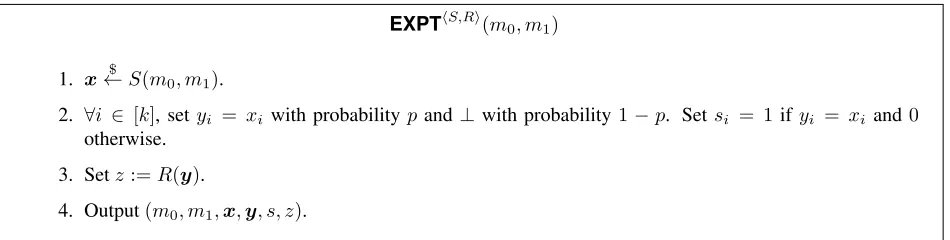
(⊥, m1). More formally, consider the experimentEXPThS,Ri(m0, m1)in Figure 2.
EXPThS,Ri(m0, m1)
1. x←$ S(m0, m1).
2. ∀i∈[k], setyi=xiwith probabilitypand⊥with probability1−p.
3. Setz:=R(y).
4. Output(m0, m1,x,y, z).
Figure 2: Execution of thehS, Riprotocol
Properties of the experiment. LetAbe the event thatz= (m0,⊥)and similarly letBbe the event that z= (⊥, m1). Then, for the above experiment, we have:
Correctness: It implies that,
Pr[A∪B]≥1−ε.
LetX0 be the set ofxsuch thatPr[A∪B|x]≥1−√ε. By a counting argument,Pr[x∈X0]≥1−√ε. Otherwise, ifPr[x∈X0]<1−√ε, thenPr[A∪B]<1·(1−√ε) + (1−√ε)·√ε= 1−ε, which is a contradiction.
Receiver privacy: It implies that,
|Pr[A]−Pr[B]| ≤ε.
The above condition is very weak and, in fact, receiver privacy implies something stronger: for a fixedxwe have thatAandB happen with roughly the same probability. More formally, receiver privacy implies that for large enough setX00such thatPr[X00]≥1−2√ε, we have that for everyx∈X00,
|Pr[A|x]−Pr[B|x]| ≤√ε.
The parameters in the stronger condition above are derived as follows. Assume thatPr[x∈X00]<1−2√ε, then a cheating sender (withX00 hardcoded in it) can figure out whetherAhappened orB happened with probability>(1−2√ε)·12 + 2√ε·(12 +
√
ε
2 ) = 1
2 +ε, which is a contradiction.
Sender privacy: It implies that, no machineM can output bothm0, m1correctly using justy,
Pr[M(y) = (m0, m1)]≤ε .
Our proof will proceed by using correctness and receiver privacy to prove Lemma 2 which will then be used to reach a contradiction with sender privacy.
Lemma 2 There exists a setXwithPr[x∈X]≥1−3√εsuch that:
Pr[A|x]≥ 1
2 −
√
ε,
Pr[B|x]≥ 1
2−
√
PROOF: Consider the set X = X0 ∩X00. By union bound, we have that Pr[x ∈ X] ≥ 1−3√ε. Furthermore, for allx∈Xwe havePr[A∪B|x]≥1−√εand|Pr[A|x]−Pr[B|x]| ≤√ε. This implies that∀x∈X,Pr[A|x]≥ 12 −√εandPr[B|x]≥ 12 −√ε, as needed.
Contradicting sender privacy. To reach a contradiction, we will construct a machine M that, giveny, outputs(m0, m1)with probability greater thanε.
Some notation. We useyrfor anyr ∈ {0,1}kto denote the vector constructed as follows: ∀i∈[k], set yri =yiifriis1and⊥otherwise. Consider the following:
• y∈CifPr[A|y]≥ 14.
• y∈DifPr[B|y]≥ 1 4.
• y∈C0if there existsrsuch thatPr[A|yr]≥ 1 4.
• y∈D0if there existsrsuch thatPr[B|yr]≥ 14.
Now we make the following three observations:
1. Ify∈Ctheny∈C0and, similarly, ify∈Dtheny∈D0.
2. If y ∈ C0, with respect to somer, then anyy0 such thatyr = y0r satisfiesy0 ∈ C0. An analogous condition holds for the eventD0.
3. Pr[A|x] = Pr[A|C]·Pr[C|x] + Pr[A|¬C]·Pr[¬C|x]≤Pr[C|x] + Pr[A|¬C]which implies that,
Pr[C|x]≥Pr[A|x]− 1
4, (1)
and similarly,
Pr[D|x]≥Pr[B|x]− 1
4. (2)
Pr[C0∩D0] =X x
Pr[C0∩D0|x]·Pr[x]
≥ X
x∈X
Pr[C0∩D0|x]·Pr[x]
≥ X
x∈X
Pr[C0|x]·Pr[D0|x]·Pr[x] (Observation 2 from above applied to Lemma 1.)
≥ X
x∈X
Pr[C|x]·Pr[D|x]·Pr[x] (Pr[C0|x]≥Pr[C|x] & Pr[D0|x]≥Pr[D|x].)
≥ X
x∈X
Pr[A|x]− 1
4
·
Pr[B|x]−1
4
·Pr[x] (By Equations 1 and 2.)
≥
1 4 −
√
ε
2
· X
x∈X
Pr[x] (By Lemma 2.)
≥
1 4 −
√
ε
2
·(1−3√ε)
= (1−4
√
Machine M. M waits for the case in which y ∈ C0 ∩D0. In this case, there exist r1, r2 such that
Pr[A|yr1]≥ 1
4 andPr[B|yr2]≥ 1
4. MachineMproceeds by executingRon inputsyr1 andyr2, obtaining
bothm0andm1with probability 161.
Observe that forε= 0.0004, we have thatM succeeds in outputting bothm0 andm1 with probability
0.003107875. Hence, protocolπdoes not haveε-sender security, leading to a contradiction.
Theorem 2 ∀p∈(12,1),p0∈(0,1)and protocolπ,∃εsuch thatπdoes notε-securely realizeCBECp0 in the
CBSCp -hybrid model even againstsemi-honestadversaries.
We start by giving some intuition. Any protocol for non-interactively securely realizing CBEC will need the sender to encode its inputminto its first message. Whether the receiver obtainsmor not should depend solely on the random coins of the channel. In other words when certain bits (or, more generally, one combination from a list of possible choices) is flipped then the receiver loses all information aboutmwhile flipping another combination allows the receiver to learn m completely. Consider a sequence of hybrid strings between a pair of strings on which the receiver outputsm and⊥respectively. Among the hybrid strings there must exist two strings that differ in exactly one bit but are such that the receiver’s output on the two differs completely. At this point, we argue that a change of just one bit cannot affect the receiver’s best guess about the sent bit very dramatically, contradicting the security of the protocol. The key technical challenge of the proof lies in proving that this happens with a noticeable probability. The full proof appears next.
Proof of Theorem 2. For the sake of contradiction, fixp ∈ (12,1)andp0 ∈(0,1)and assume that there exists a protocolπ =hS, Rithatε-securely realizesCBECp0 in theCBSCp hybrid model, for an appropriateε
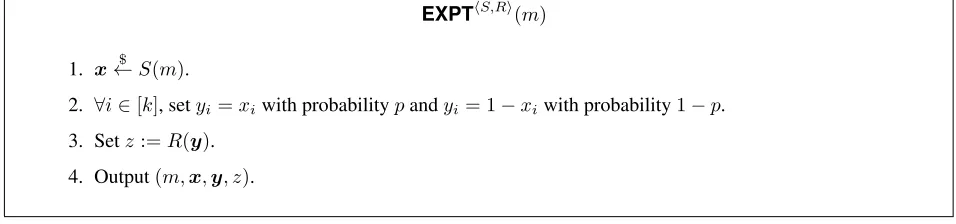
(to be decided later). More specifically,S on input a bitm ∈ {0,1}generateskbitsx= (x1, x2, . . . , xk) which are provided as input to the functionalityCBSCp . The functionality outputs bitsy = (y1, y2, . . . , yk) to the receiver R, that processes these values and outputs z ∈ {0,1,⊥}. More formally, consider the experimentEXPThS,Ri(m)in Figure 3.
EXPThS,Ri(m)
1. x←$ S(m).
2. ∀i∈[k], setyi=xiwith probabilitypandyi= 1−xiwith probability1−p.
3. Setz:=R(y).
4. Output(m,x,y, z).
Figure 3: Execution of thehS, Riprotocol
Without loss of generality, assume that the receiverRis deterministic at the cost of increasing the error by a constant factor. If the receiverRof the protocolhS, Rithatε-securely realizesCBECp0 is not determinis-tic then we usehS, Riand construct a protocolhS0, R0ithatε-securely realizesCBECp0 and furthermore has a deterministic receiver.hS0, R0iis essentially the same ashS, Riexcept howR0works.R0on inputyoutputs the most likely (breaking ties arbitrarily) output generated byRon inputy.
We start by observing that for a large fraction of the inputs y, the receiver R must output the same value with high probability. More specifically, letBbe the set for which this is not true. For this set, either (1)Pr[R(y) = 1−m]≥α, for some small constantα(sayα= 1001 ). Then, we claim thatPr[B]≤ ε
andPr[R(y)∈ {m,⊥}]>1−α. Therefore, again, we must have thatPr[B]≤ ε
α otherwise contradicting sender privacy.
Properties of the experiment. LetAbe the event thatz=mand, similarly, letBbe the event thatz=⊥. Then for the above experiment we have:
Correctness: It implies that,
Pr[A∪B]≥1−ε.
LetX0be a set such that∀x∈X0we have thatPr[A∪B|x]≥1−√ε. By a counting argument (argument follows) it follows thatPr[x∈X0]≥1−√ε. Lets start by assuming thatPr[x∈X0]<1−√ε. Then we have thatPr[A∪B]<1·(1−√ε) + (1−√ε)·√ε= 1−ε, which is a contradiction.
Receiver privacy: Next given the setX0, using receiver privacy we claim that there exists a setX ⊆X0
such that for allx∈Xwe have
Pr[A|x]≥p0−√ε,
Pr[B|x]≥1−p0−√ε,
and
Pr[X]≥1−3√ε.
The parameters in the above condition above are derived as follows. Lets assume thatPr[x∈X]<1−3√ε, then we have that a cheating sender (with X hardcoded in it) can figure out whether A happened with (ignoring the case whenx∈/X0, that is probability√ε) probability>(1−2√ε)·p0+2√ε·(p0+
√
ε
2 ) =p 0+ε,
which is a contradiction.
Towards Contradiction. Define a setBadof vectors. Roughly speaking, a vectorb∈Badif
• R(b)∈ {/ m,⊥}, or
• Pr[R(b) = 1−m|y=b]> 12, or
• Pr[∃c∈ {0,1}such thatm=c ∧ R(b) =⊥|y=b]≥ 12−pp.
Observe that all we are left to argue is that thatPr[Bad]> 16−pεp. Because ifPr[Bad]> 16−pεp, then at least one of the above three conditions happens with probability at least 12−pεp contradicting correctness, receiver guarantee or receiver guarantee, respectively.
Probability ofBad. Lets restrict ourselves to the case in whichx∈X. This happens with probability at least1−3√ε. Consider any two vectorsyandy0such thatR(y) =mandR(y0) =⊥. Now considerk+ 1 hybrid-vectorsh0,h1, . . . ,hk wherehi = (y01, y02, . . . , yi0, yi+1, . . . , yk). Note that h0 =yandhk = y0. Note thatR(h0) =mandR(hk) =⊥. We will show that at least one of these hybrid-vectors is inBad.
IfRon any one of these hybrid-vectors outputs a value not in{m,⊥}then that vector is clearly inBad. On the other hand, ifRon each of these hybrid-vectors outputs a value in{m,⊥}then that implies a switch at some hybrid-vector. In other words∃j ∈ {0,1. . . , k−1}such that R(hj) = m andR(hj+1) = ⊥.
Namely, the output ofRwas switched when just one of the input bits toRwas flipped. Next, we argue that
If Pr[R(hj) = 1−m|y = hj] > 12 then we are done. Otherwise, we have thathj+1 differs from
hj in only one bit therefore we can conclude that R’s guess about the sent bit can decrease at most by a factor of 1−pp (recall that p ∈ (12,1)). In other words, Pr[R(hj) = m|y = hj+1] ≥ 12 · 1−pp where
(m,x,y, z) ← EXPThS,Ri(m). However,R(hj+1) =⊥. In other wordsRoutputs⊥even though it can
guess the sent value correctly with a probability at least 12−pp. In summary, we claim that for every two vectorsyandy0 such thatR(y) =mandR(y0) =⊥there exists a hybrid vector (as defined above) that is inBad.
EXPT’hS,Ri(m)
1. x←$ S(m).
2. ∀i∈[k], setyi=xiwith probabilitypandyi= 1−xiwith probability1−p.
3. ∀i∈[k], setyi0=xiwith probabilitypandy0i= 1−xiwith probability1−p.
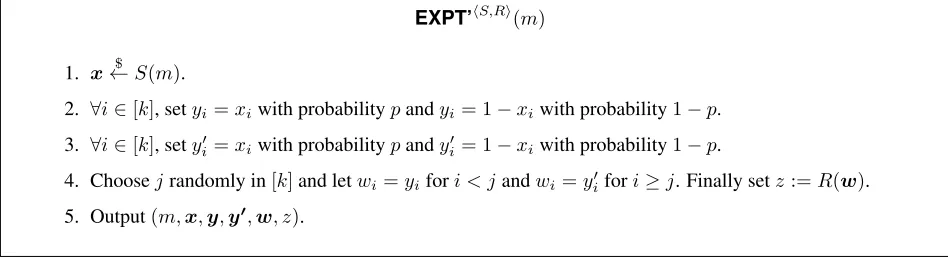
4. Choosejrandomly in[k]and letwi=yifori < jandwi=yi0fori≥j. Finally setz:=R(w).
5. Output(m,x,y,y0,w, z).
Figure 4: Modified Execution of thehS, Riprotocol
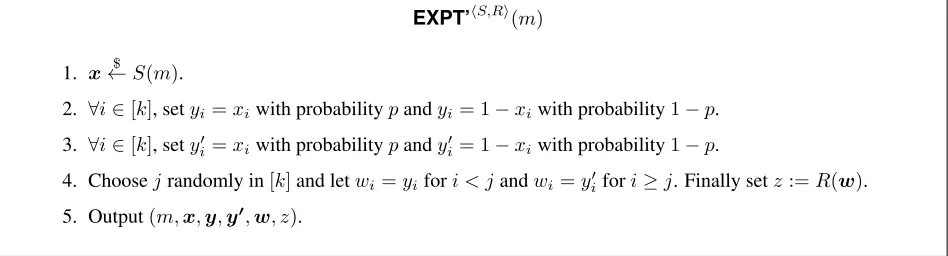
Now we are left to argue that R receives the elements in Bad with noticeable probability. We argue this by considering a modified experimentEXPT’hS,Ri(m). We start by noting that, in this experiment, the distribution of each of the outputsy,y0,windividually is identical to the distribution of theyin the output ofEXPThS,Ri(m). This, along with conditions proved earlier, implies thatPr[R(y) =mV
R(y0) =⊥]≥
(1−3√ε)·(1−p0−√ε)·(p0−√ε), where(m,x,y,y0,w, z)←EXPT’hS,Ri(m).
Finally, observe that in the experiment EXPT’hS,Ri(m), given thatR(y) = mandR(y0) = ⊥, there exists a hybrid vector (as defined above) such that it is in Bad. Furthermore, w takes this value with probability 1k. In other words,w∈Badwith probability at least(1−3√ε)·(1−p0−√ε)·(p0−√ε)·1
k. Since the distribution ofwin the output ofEXPT’hS,Ri(m)is identical to the distribution ofyin the output ofEXPThS,Ri(m), we can conclude that y in the output of EXPThS,Ri(m)is in Badwith probability at least(1−3√ε)·(1−p0−√ε)·(p0−√ε)· 1
k ≥
1 2 ·
1−p0
2 ·
p0
2 · 1
k >
6pε
1−p (whenεis at most
1 36,
1−p0
2
2
,
p0
2
2
andp0(1−48p0pk)(1−p)). This is a contradiction when we setε <min
1−p0
2
2
,p202,p0(1−48p0pk)(1−p)
.
6.2 Positive constructions forCROT
We start by presenting a construction of a random oblivious transfer channel in Red-Blue channel hybrid model. Our construction provides a solution for any arbitrary Red-Blue channel and is inefficient. Further-more, such a channel in its generality is not very natural. Therefore, we study natural examples of Red-Blue channels (and their approximate variants) and attempt at more efficient solutions.
We start by considering the basic setting of an arbitrary Red-Blue Channel and prove that it is sufficient to realize a random oblivious transfer channel.
Theorem 3 C`
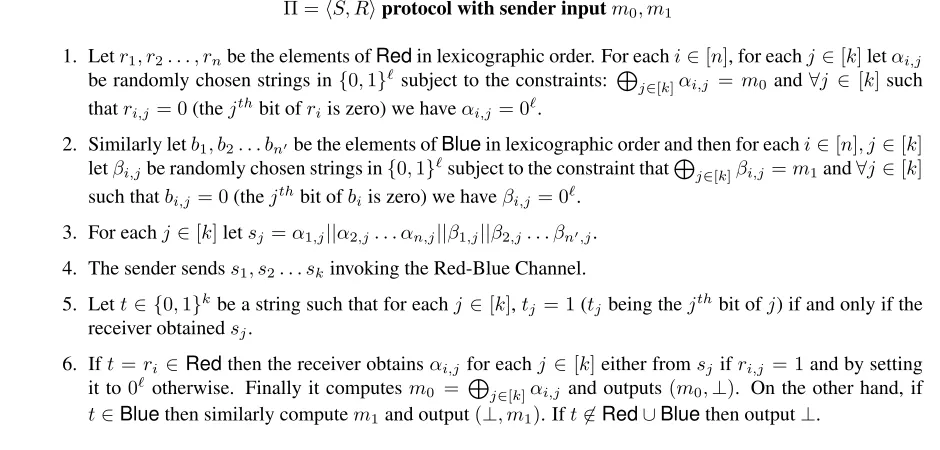
Proof of Theorem 3. We start by giving our construction ofC`
ROT in the(k, `0, µ, ν, η)-Red-Blue Channel hybrid model. Recall that for a red blue channelCk,`,Dk,µ,ν,η
GEC the distributionDk,µ,ν,ηis such that its output space (namely {0,1}k) can be partitioned into two events Red and Bluesuch that Pr[Red ∪Blue] ≥ 1 −µ,|Pr[Red]−Pr[Blue]| ≤ ν and Prr∈Red[∃s ⊆ rsuch thats ∈ Blue] ≤ η and Prb∈Blue[∃c ⊆ bsuch thatc∈Red]≤η.
Π =hS, Riprotocol with sender inputm0, m1
1. Letr1, r2. . . , rnbe the elements ofRedin lexicographic order. For eachi∈[n], for eachj ∈[k]letαi,j be randomly chosen strings in{0,1}`subject to the constraints: L
j∈[k]αi,j =m0and∀j ∈ [k]such
thatri,j= 0(thejthbit ofriis zero) we haveαi,j= 0`.
2. Similarly letb1, b2. . . bn0be the elements ofBluein lexicographic order and then for eachi∈[n], j∈[k]
letβi,jbe randomly chosen strings in{0,1}`subject to the constraint thatLj∈[k]βi,j=m1and∀j∈[k]
such thatbi,j = 0(thejthbit ofbiis zero) we haveβi,j= 0`.
3. For eachj∈[k]letsj =α1,j||α2,j. . . αn,j||β1,j||β2,j. . . βn0,j.
4. The sender sendss1, s2. . . skinvoking the Red-Blue Channel.
5. Lett∈ {0,1}kbe a string such that for eachj ∈[k],t
j = 1(tj being thejthbit ofj) if and only if the receiver obtainedsj.
6. Ift=ri ∈Redthen the receiver obtainsαi,jfor eachj ∈[k]either fromsjifri,j = 1and by setting it to0`otherwise. Finally it computesm0 = Lj∈[k]αi,j and outputs(m0,⊥). On the other hand, if
t∈Bluethen similarly computem1and output(⊥, m1). Ift6∈Red∪Bluethen output⊥.
Figure 5:C`
ROT in the(k, `
0, µ, ν, η)-Red-Blue Channel hybrid model
Correctness. Using the fact thatPr[Red∪Blue]≥1−µ, it follows that the receiver always (except with probabilityµ) outputs either(m0,⊥)or(⊥, m1). This proves correctness of our protocol.
Simulating Cheating Receiver. The simulator for a cheating receiver proceeds as follows. Obtain that value that needs to be forced upon the cheating receiver from the ideal functionality. If the value provided by the ideal functionality is(m0,⊥) then proceed as follows. Using rejection sampling, sample a string t∈RedfromDk,µ,ν,η. Now generate the messages generated by an honest sender on input(m0, m1)for a
random value ofm1. The output generated consists ofkstrings. For eachi∈[k], replace theithstring with
⊥ifti = 0. Provide the generated string for the receiver. It is straightforward to see that this simulation generates a perfectly indistinguishable transcript. We skip the full proof.
Simulating Cheating Sender. Now we provide the simulator for the cheating sender. From the sender’s message s we can obtain bothm0 and m1, which can then be passed on to the ideal functionality. The
problem with this strategy is that a malicious sender could generatesmaliciously and in doing so embed different messages causing the receiver to output different outputs depending on the random coins of the channel. However note this is easy to handle by having the simulator sample two random stringst, t0from
Dk,µ,ν,η such thatt ∈ Redandt0 ∈ Blue. It could then obtain the messagesm0 (using the string t) and m1 (using the stringt0) which it could then forward to the ideal functionality. This ensures that the output
distributions in the real world and the ideal world are identical. Note that for the case of perfect Red-Blue Channel, we have that µ = ν = η = 0, and hence C`
Efficient construction for ROT. We will start by considering the case of perfect bursty channel and show that it can be used to realize ROT. Recall that a(k, `, b)-perfect bursty channel corresponds to the channel
Ck,`,Dk,b
GEC , where Dk,b is the distribution that outputs akbit string such that all the bits are set to1besides the “burst” of bits in locationsx+ 1, x+ 2, . . . , x+bwhich are set to0, wherexis chosen uniformly from
{0, . . . , k−b}. In this setting we claim that:
Theorem 4 C`
ROT can be UC-securely realized (even against malicious adversaries) in the(k, `, b)-perfect bursty channel hybrid model whenb > k2 or whenbis odd.
PROOF: We start by giving the intuition. The key idea is to use Shamir’s secret sharing (with shares of length `) and secret share the first string in the first half and the second string in the second half (with some appropriate threshold). Both whenb > k2 or when bis odd we will have an asymmetry in terms of the deletion pattern. If more terms from the first half are erased then the first string is deleted and, on the other hand, if more terms from the second half get erased then the second string is deleted. If k is odd then our construction will only give a biased-ROT but this bias can be corrected using the transformation from Section 8. Similarly, we note that in our construction we do not need the distribution over where the burst happens to be uniform. Our protocol can be very easily modified so that this restriction is not crucial. This would however only give biased ROT protocols and this bias will need to be corrected using the transformation from Section 8.
Next we give the construction for the case whenbis odd. We assume, for simplicity, thatkis even and
t = k2. The construction for the setting when kis odd or whenb is not necessarily odd butk > b/2are identical except that the parameters should be adjusted appropriately.
Π =hS, Riprotocol with sender inputm0, m1
1. Let θ = t− bb/2c. Let {α1, . . . , αt} be aθ-out-of-t Shamir’s secret sharing of m0. Similarly, let {αt+1, . . . , αk}be aθ-out-of-tShamir’s secret sharing ofm1.
2. Send(α1, . . . , αk)to the receiver.
3. Let the starting point of the burst in the symbols received by the receiver bei∗. Ifi∗ > θcomputem 0
using the sharesα1, . . . , αθand output(m0,⊥); otherwise, output(⊥, m1)wherem1is computed using
the sharesαk−θ+1, . . . , αk.
Figure 6:C`
ROT in the(k, `, b)-perfect bursty channel hybrid model, for oddb
The construction appears in Figure 6. Sincebis odd, either in the first half or in the second half at least
db/2eof the strings are erased and hence that value remains hidden. On the other hand, in the other half the value can always be computed since at mostbb/2cstrings are deleted. The proof is identical to the case of
Red-Blue Channel (proved earlier) and is therefore omitted.
Channel with Imprecise Burst. Finally, we consider a bursty erasure channel where the size of burst is not precisely known but comes from roughly a discrete gaussian distribution. Recall that(k, `, b, σ)-noisy bursty channel corresponds to the channelCk,`,Dk,b,σ
Theorem 5 C`
ROT can be
(1−α)b k−(1+α)b +
σ2
α2b2-UC-securely realized in the (k, `, b, σ)-noisy bursty channel
hybrid model for any constantα∈(0,1).
PROOF: We use the same construction as in Figure 6 except the threshold parameterθof the Shamir secret sharing. We set it up in a way so that it is possible to obtainm0if less than(1−α)b/2symbols are erased
from the first half. Similarly secret sharing is done for the second half. By Chebyshev’s inequality, the probability that the size of the burst,b0, lies outside the range{(1−α)b, . . . ,(1 +α)b}is at most ασ22b2 (ifb0
is too big the receiver may not learn any value, while ifb0 is too small it may learn both values). Assuming this does not happen, then the receiver gets only one of the sent values as long as the burst does not happen “in the middle” (i.e.,(1−α)b/2symbols are erased from each half). The probability that the burst happens
in the middle is at most k−(1(1+−α)αb)b.
6.3 Self-transformations forCBEC andCBSC
In this subsection, we show that any erasure channel can be used to construct a binary erasure channel with any desired erasure probability. On the other hand, the case of BSC is very different. The probability of correct transmission in a BSC channel can be reduced but cannot be increased. Formally,
Theorem 6 ∀ CGECk,`,D such that D is not a constant distribution, ∃ p such that CBECp can be (perfectly) UC-securely realized (even against malicious adversaries) in theCGECk,`,D-hybrid model.
Proof of Theorem 6. This construction is very straightforward. For every channelCGECk,`,D we claim that there existsi∈[k]such thatPr[ri = 1|r ← D]is bounded away from both0and1. This follows from the fact thatDis not a constant distribution. Let the probability that this bit is1bep. It is easy to implement a binary erasure channel by embedding the bit that we want to transmit in theithstring sent toCGECk,`,D. As argued above this string (and hence the desired bit) will be received with probabilityp. The security of the constructed BEC channel follows in a straight forward manner from the security of the underlyingCGEC
channel and the full proof for the same is therefore skipped.
Theorem 7 ∀p, p0 ∈ (0,1)and > 1, ∃p00 ∈ [p0, p0], such that CpBEC00 can be (perfectly) UC-securely realized (even against malicious adversaries) in theCBECp -hybrid model.
Proof of Theorem 7. We will start by giving protocols for boosting and diminishing the probabilities with which the BEC channel transmits. We will then use these transformations repeated to obtain a BEC with the desired transmission probability.
Boosting. The protocol for boosting the transmission probability of BEC is provided in Figure 7. It is easy to see that the protocol transmits the bit with probability1−(1−p1)(1−p2). Also, arguing security against
cheating receivers is straight forward. However, proving security against cheating senders requires some care. More specifically, given an message of the sender for the ideal functionalitiesCp1
BEC andC p2
BEC, our simulation we will need to generate a message for the functionalityC1−(1−p1)(1−p2)
BEC . If the cheating sender sends00then the simulator sends0toC1−(1−p1)(1−p2)
BEC . Similarly if the cheating sender sends11then the simulator sends1toC1−(1−p1)(1−p2)
BEC . The complication arises in simulation when the cheating sender sends different bits. In particular if it sends the bits01or10. In this case our simulator simulates by sending the first bit with probability p1
p1+p2−p1p2 and the second one with probability
p2−p1p2
p1+p2−p1p2. This will ensure that
CBEC1−(1−p1)(1−p2)/Cp1 BEC,C
p2
BECprotocol
Sender’s Input:b∈ {0,1}.
• Ssends two copies of the bitbvia independent invocations ofCp1
BECandC p2 BEC.
• Letb1andb2be the valuesRobtains fromCBECp1 andC p2
BEC respectively. Ifb16=⊥then outputb1else
outputb2.
Figure 7: Boosting transmission probability in Binary Erasure Channel
Diminishing. The protocol for diminishing the transmission probability of BEC is provided in Figure 8. The basic idea is that the bit sent by the sender remains completely hidden from the receiver as long as at least one of the bits sent by the receiver is not obtained. We skip a formal argument.
Cp1p2 BEC/C
p1 BEC,C
p2
BEC protocol
Sender’s Input:b∈ {0,1}.
• S samples a uniformly random bitaand sendsaanda⊕bvia independent invocations ofCp1 BEC and Cp2
BEC respectively.
• Letb1 andb2be the valuesRobtains fromC p1
BEC andC p2
BEC respectively. Ifb1 6=⊥andb2 6=⊥then
outputb1⊕b2else output⊥.
Figure 8: Diminishing transmission probability in Binary Erasure Channel
Putting things together. Now we will describe how to use the above transformations to obtain aCBECp00
fromCBECp for some p00 such that p00 ∈ [p0, p0]. First we will proceed by repeatedly using the boosting transformation and boost the transmission probability of the channel to be just above the desired value of
p0 and then we will diminish it slowly to the desired level. Letr be the smallest positive integer such that
p0 = 1−(1−p)r ≥p0. (Note that ifp0 < pthenrwill be1andp0 =p.) We note that constant positive
integer r exists because values (1−p)r tends to0 asr becomes large. Similarly, repeated applying the boosting transforation we obtained a BEC with transmission probabilityf such thatf > 1.
Now step by step we need to diminish the probabilityp0and bring it closer to the valuep0. In particular,
lettbe a positive integer such thatp0·ft+1 ≤p0 ≤p0·ft. Exitance of such atis guaranteed by the fact
thatfttends to0astbecomes large. Finally note thatp0·ft∈[p0, p0].
Theorem 8 ∀p ∈ (12,1)and t ∈ Z+, the channel Cp0
BSC can be (perfectly) UC-securely realized (even against malicious adversaries) in theCBSCp -hybrid model wherep0 = 12 + 2t−1 p−12t
.
Proof of Theorem 8. We will start by giving a protocol for diminishing the probability with which the BSC channel transmits correctly. We will then use this transformation repeated to obtain a BSC channel with the desired transmission probability.
exclusive or of the received bits. The key idea is that received bit matches the senders input if both bits are transmitted as such or if both bits are flipped. This happens with probabilityp1p2+ (1−p1)(1−p2)which
evaluates to 12 + 2 p1−12
p2−12
. Security follows immediately and we skip the formal argument.
C 1
2+2(p1−12)(p2−12) BSC /C
p1 BSC,C
p2
BSCprotocol
Sender’s Input:b∈ {0,1}.
• S samples a uniformly random bitaand sendsaanda⊕bvia independent invocations ofCp1 BSC and Cp2
BEC respectively.
• Letb1andb2be the valuesRobtains fromCBSCp1 andCBECp2 respectively. Outputb1⊕b2.
Figure 9: Diminishing transmission probability in Binary Symmetric Channel
Now we can repeated use the above transformations to obtain a CBSCp0 from CBSCp for p0 = 12 + 2t−1 12 −ptfor any non-negative integert.
Theorem 9 ∀p, p0 ∈(12,1), p0 > pand protocolπ,∃εsuch thatπdoes notε-securely realizeCBSCp0 in the
CBSCp -hybrid model even againstsemi-honestadversaries.
Proof of Theorem 9. The proof is very similar to the proof of Theorem 2. We start by giving some intuition. Any protocol for non-interactively securely realizing CBSCp0 will need the sender to encode its input m into its first message. Whether the receiver obtains m or 1 −m should depend solely on the random coins of the channel. In other words when certain bits (or more generally one combination from a list of possible choices) is flipped then the receiver outputsmwhile on the other hand flipping of another combination makes the receiver output 1−m. Consider a sequence of hybrid strings between a pair of strings on which the receiver outputs mand1−m respectively. Among these hybrid strings there must exist two strings such that they differ in exactly one bit but are such that the receiver’s output on the two are different. At this point we argue that change of just one bit cannot affect the receiver’s best guess about the received bit very dramatically contradicting security of the protocol. The key technical challenge of the proof then lies in proving that this happens with a noticeable probability.
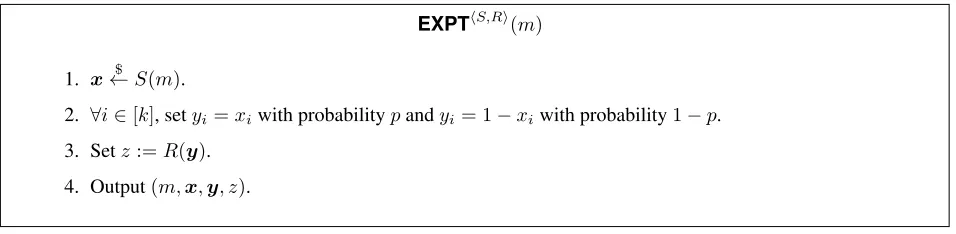
For the sake of contradiction lets start by fixingp, p0 ∈(12,1)forp0> pand assuming that there exists a protocolπ=hS, Rithatε-securely realizesCBSCp0 in theCBSCp hybrid model for appropriateε, to be decided later. More specifically,Son input a bitm∈ {0,1}generateskbitsx= (x1, x2. . . xk)which are provided as input to the functionalityCBSCp . The functionality outputs bits y = (y1, y2. . . yk) to the receiverR. R processes these values and outputsz ∈ {0,1}. More formally, consider the experimentEXPThS,Ri(m)in Figure 10.
Without loss of generality we assume that the receiver of the protocol is deterministic at the cost of increasing the error by a constant factor. If the receiver R of the protocolhS, Ri thatε-securely realizes
CBSCp0 is not deterministic then we usehS, Riand construct a protocolhS0, R0ithatε-securely realizesCBSCp0
and furthermore has a deterministic receiver.hS0, R0iis essentially the same ashS, Riexcept howR0works.
R0on inputyoutputs the best guess (breaking ties arbitrarily) about the bit sent byS0.
We argue that thatRandR0output the same value for a large fraction of inputsywith probability1−α. LetCbe the set of choices ofyfor which this is not true. We claim thatPr[C]≤ αε for some large constant
α. Because if this were not the case then we will have that sender privacy is violated with probability> ε
EXPThS,Ri(m)
1. x←$ S(m).
2. ∀i∈[k], setyi=xiwith probabilitypandyi= 1−xiwith probability1−p.
3. Setz:=R(y).
4. Output(m,x,y, z).
Figure 10: Execution of thehS, Riprotocol
Properties about the experiment. LetAbe the event thatz = m and similarly letB be the event that
z= 1−m. Then for the above experiment wee have:
Correctness: It implies that,
Pr[A∪B]≥1−ε.
LetX0be a set such that∀x∈X0we have thatPr[A∪B|x]≥1−√ε. By a counting argument (argument follows) it follows thatPr[x∈X0]≥1−√ε. Lets start by assuming thatPr[x∈X0]<1−√ε. Then we have thatPr[A∪B]<1·(1−√ε) + (1−√ε)·√ε= 1−ε, which is a contradiction.
Receiver privacy: Next given the setX0, using receiver privacy we claim that there exists a setX ⊆X0
such that for allx∈Xwe have
Pr[A|x]≥p0−√ε,
Pr[B|x]≥1−p0−√ε,
and
Pr[X]≥1−3√ε.
The parameters in the above condition above are derived as follows. Lets assume thatPr[x∈X]<1−3√ε, then we have that a cheating sender (with X hardcoded in it) can figure out whether A happened with (ignoring the case whenx∈/X0, that is probability√ε) probability>(1−2√ε)·p0+2√ε·(p0+
√
ε
2 ) =p 0+ε,
which is a contradiction.
Towards Contradiction. Now we define a setBadof vectors. Roughly speaking a vectorb∈Badif
• R(b)∈ {/ m,1−m}, or
• Pr[R(b) =m|y=b]< p0−√ε, or
• Pr[R(b) = 1−m|y=b]>1−p0+√ε.
Probability ofBad. Lets restrict ourselves to the case in whichx∈X. This happens with probability at least1−3√ε. Now consider any two vectorsyandy0such thatR(y) =mandR(y0) =⊥. Now consider
khybrid-vectors h0,h1. . .hk where hi = (y10, y20 . . . , yi0, yi+1, . . . yk). Note thath0 = yandhk = y0. Note thatR(h0)∈mandR(hk) =⊥. We will show that at least one of these hybrid-vectors is inBad.
IfRon any one of these hybrid-vectors outputs a value not in{0,1}then that vector is clearly inBad. On the other hand ifRon each of these hybrid-vectors outputs a value in{m,1}then that implies a switch at some hybrid-vector. In other words∃j ∈ {0,1. . . k−1}such thatR(hj) =mandR(hj+1) =⊥. Now
observe that the output ofRwas switched when just one of bits of the input toRwas flipped. Next we will argue thatR’s best guess about the sent bit cannot have changed substantially with this one bit flip. In other words we will show that eitherhjorhj+1is inBad.
IfPr[R(hj) = m|y = hj] < p0 −
√
εthen we are done. Otherwise we have thathj+1 differs from
hj in only one bit therefore we can conclude that theR’s guess about the sent bit can decrease at most by a factor of 1−pp (recall thatp ∈ (12,1)). In other wordsPr[R(hj) = m|y = hj+1]≥ (p0−
√
ε)· 1−pp = p0−√ε
p −p
0 +√ε > 1−p0+√εwhen p < p0 −√εwhere(m,x,y, z) ← EXPThS,Ri
(m). However,
R(hj+1) = ⊥. In other words R outputs 1−m even though it can guess the sent value correctly with
a probability at least 1−p0 +√ε. In summary we claim that for every two vectors yand y0 such that
R(y) =mandR(y0) =⊥there exists a hybrid vector (as defined above) that is inBad.
Now we are left to argue that R receives the elements in Bad with noticeable probability. We argue this by considering a modified experimentEXPT’hS,Ri(m). We start by noting that in this experiment
EXPT’hS,Ri(m)
1. x←$ S(m).
2. ∀i∈[k], setyi=xiwith probabilitypandyi= 1−xiwith probability1−p.
3. ∀i∈[k], setyi0=xiwith probabilitypandy0i= 1−xiwith probability1−p.
4. Choosejrandomly in[k]and letwi=yifori < jandwi=yi0fori≥j. Finally setz:=R(w).
5. Output(m,x,y,y0,w, z).
Figure 11: Modified Execution of thehS, Riprotocol
EXPT’hS,Ri(m)the distribution of each of the outputsy,y0,windividually is identical to the distribution of theyin the output ofEXPThS,Ri(m). This along with conditions prover earlier, implies that the probability Pr[R(y) = mV
R(y0) = 1−m]≥(1−3√ε)·(1−p0−√ε)·(p0 −√ε)where(m,x,y,y0,w, z) ←
EXPT’hS,Ri(m).
Finally observe that in the experimentEXPT’hS,Ri(m)given thatR(y) =mandR(y0) = 1−mwe have that there exists a hybrid vector (as defined above) such that it is inBad. Furthermorewtakes this value with probability1k. In other wordsw∈Badwith probability at least(1−3√ε)·(1−p0−√ε)·(p0−√ε)·1k. Since the distribution ofw in the output ofEXPT’hS,Ri(m) is identical to the distribution ofyin the output of
EXPThS,Ri(m), therefore we can conclude thatyin the output ofEXPThS,Ri(m)is inBadwith probability
at least(1−3√ε)·(1−p0−√ε)·(p0−√ε)·k1 ≥ 12·1−2p0 ·p20 ·1k >3√ε(whenε≤ 361,
1−p0 2
2
,
p0
2
2
and (p0(124−2pk0))2). This is a contradiction when we setε <min
1−p0
2
2
,p202,(p0(124−2pk0))2
7
OWSC scheme for Deterministic Functionalities
OWSCf/Cis a meaningful notion only for those deterministic functionsf such that given a valuey iden-tifying if there exists an inputx such that y = f(x) is non-trivial (cannot be done in efficiently). This, in particular, rules out all functions with polynomial sized input domains. Furthermore, this notion is use-ful only in the setting of malicious adversaries because it is trivial to realize this notion in the setting of semi-honest adversaries.
We start by noting that aOWSCf/Cscheme, for any deterministic functionf, can be realized by using a OWSCzk/C scheme for the zero-knowledge functionality. This can be achieved simply by having the sender send the output to the receiver and along with it prove in zero-knowledge, knowledge of an inputx
for whichf(x)yields the provided output. Here we implicitly assume that besides the channelCthe sender also has access to an error free channel which can be implemented usingC itself (with a negligible error). Formally,
Theorem 10 For every deterministic function f, there exists a OWSCf/C scheme that is a UC-secure realization (even against malicious adversaries) of the functionalityFf in theC-hybrid model whereC ∈ {CGECk,`,D,CBSCp }.
As already mentioned, proving the above theorem reduces to the task of realizing aOWSCzk/Cscheme. In our construction, we will make use of oblivious ZK-PCPs (see Definition 1).
Lemma 3 There exists aOWSCzk/Cscheme that is a UC-secure realization (even against malicious ad-versaries) of the zero-knowledge functionality in theC-hybrid model whereC ∈ {CGECk,`,D,CpBSC}.
We start by giving some intuition. The key idea is to use an erasure channel or a binary symmetric channel to send over multiple instances of independently chosen ZK-PCPs and observe the statistical gap that can be created only if valid proofs were sent. However, a number of difficulties arise in realizing this intuition, particularly in our construction from BSC. Below, we provide our construction from erasure channels. The more involved construction from binary symmetric channel is given next.
Erasure Channels. We start by considering the case of binary erasure channels with error probability 12;
i.e., when C = C
1 2
BEC. It follows from Theorem 6 and Theorem 7 that anyC k,`,D
GEC can be used to realize
C
1 2
BEC.4We give the protocol in Figure 12.
Completeness. For everyi∈[k], using Chernoff bound, we have that:
PrhΥ(πi0)≤ n
4
i
≤e−16n,
whereΥ(πi0)denotes the number of occurrences of⊥inπ0i.
Hence, except with negligible probability for eachi ∈ [k], Rreceives at leastc. Given this the com-pleteness of the protocol follows from the comcom-pleteness of the oblivious ZK-PCP.
4
Theorem 7 only guarantees a channelCpBEC0 withp 0
OWSCzk/CBECp protocol for languageL
Common Input:x∈ {0,1}λ.
Auxiliary Input for proverP:wsuch that(x, w)∈RL.
Parameters: Let(PoZK, VoZK)be any(c, ν)-oblivious ZK-PCP system (withc≤ n4 andν ≥ 3
4) with knowledge
soundnessκ. Let`=λκ.
• P samples proofsπ1, . . . , π` fromPoZK(λ, x, w)and sends (π1, . . . , π`)toV via the erasure channel CBECp .
• V receivesπ01, . . . , π`0 and for alli∈[`]checks ifVoZK(πi0). It outputsacceptif all the checks pass and
rejectotherwise.
Figure 12: Realizing zero-knowledge from Binary Erasure Channel
Soundness. We will construct an extractorE0, that extracts valid witnesses from any cheating proverP∗
that makes the honest verifier accept with non-negligible probability. We will first describe our extractorE0
and then argue that it indeed works (with overwhelming probability).
Our extractorE0proceeds as follows. Let(π1, π2, . . . , π`)be the proofs generated by the cheating prover
P∗. For everyi∈[`],E0 obtainsyi =E(x, πi). If∃i∗ ∈[`]such thatyi∗ ∈R(x)then outputyi∗(breaking
ties arbitrarily). If no suchi∗exists then output⊥.
Note that since our extractorE0failed to extract witness out ofπifor anyi∈[`]we have (by soundness of the ZK-PCP) thatPr[VoZK(x, π0i) = 0] ≥ κ, for everyi ∈ [`], where the probability is taken over the random choices of obtainingπi0 fromπi. Hence, ifE0 outputs⊥then the verifier must also always reject, except with probability at most≤(1−κ)`, which is negligible for`= λκ.
Zero-Knowledge. We need to construct a simulatorS0for our protocol. This construction follows
imme-diately from theν-zero-knowledge property of the oblivious ZK-PCP.
Proof for the BSC case. We now provide the proof for the more involved case of binary symmetric channel.
Binary Symmetric Channel. Next we consider the case of binary symmetric channel, i.e. whenC =
CBSCp . We give the protocol in Figure 13. We start by giving the intuition. The key idea is to send over multiple independently chosen ZK-PCPs over the BSC channel and observe the statistical gap that can be observed only if valid proofs were sent.
Notation, Observations and Intuition. We start by making some observations. We start by observing that we can use BSC to get a sort of a partial erasure channel. In particular if we repeat and send a bit2τ
times over BSC and the receiver takes majority of the received bits then this suffices as a sort of erroneous binary erasure channel. We will choose the parameterτ to be such that the probability that a sent value is
correctly received isP
0≤i<τ
2τ i
pn−i·(1−p)i ≥q3 2
3. We argue this by using Chernoff bound. LetXbe
the random variable denoting the number of bits among the2τ bits transmitted that get flipped when each bit is flipped with a probability 1−p. Now note that expected number of flips is 2(1−p)τ. Now by a
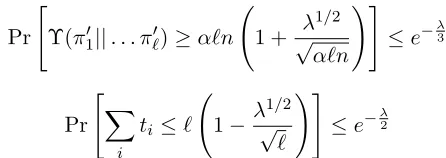
Chernoff bound,Pr[X ≥τ] = Pr[X≥2(1−p)τ(1 +(22(1p−−1)p))]≤e− (2p−1)2τ
6(1−p) (note thatp > 1
2). Hence the
desired probability is at least1−e− (2p−1)2τ
6(1−p) >q3 2
3 whenτ =
l
−(26(1p−−1)p)2 ln
1−q3 2 3
m