
Optimal Proximity Proofs
⋆Ioana Boureanu1and Serge Vaudenay2 1 Akamai Technologies Limited
EMEA HQ, UK http://people.itcarlson.com/ioana
2 EPFL Lausanne, Switzerland
http://lasec.epfl.ch
Abstract. Provably secure distance-bounding is a rising subject, yet an unsettled one; indeed, very few distance-bounding protocols, with formal security proofs, have been proposed. In fact, so far only two protocols, namely SKI (by Boureanuet al.) and FO (by Fischlin and Onete), offer all-encompassing security guaranties, i.e., resistance to distance-fraud, mafia-fraud, and terrorist-fraud. Matters like security, alongside with soundness, or added tolerance to noise do not always coexist in the (new) distance-bounding designs. Moreover, as we will show in this paper,efficiencyandsimultaneousprotection against all frauds seem to be rather conflicting matters, leading to proposed solutions which were/are sub-optimal. In fact, in this recent quest for provable security, efficiency has been left in the shadow. Notably, the tradeoffs between the security and efficiency have not been studied. In this paper, we will address these limitations, setting the “security vs. efficiency” record straight.
Concretely, by combining ideas from SKI and FO, we propose symmetric protocols that are efficient, noise-tolerant and—at the same time—provably secure against all known frauds. Indeed, our new distance-bounding solutions outperform the two aforementioned provably secure distance-distance-bounding protocols. For instance, with a noise level of 5%, we obtain the same level of security as those of the pre-existent protocols, but we reduce the number of rounds needed from 181 to 54.
1 Introduction
As wireless technologies become more and more pervasive, being used daily in access control, remote unlocking credit-card payments and beyond, relay attacks also become a growing threat to the social acceptance of these techniques. It seems likely that nearly all wireless devices will eventually have to implement solutions to thwart these types of fraud. To defeat relay attacks, Brands and Chaum [12] introduced the notion of distance-bounding protocols. Distance bounding is a special problem of position-based cryptography [13]. Although there are many challenges to implement it, this can be achieved [11]. These protocols rely on information being local and incapable of travelling faster than the speed of light. So, in distance-bounding, an RFID reader can assess when participants are close enough because the round-trip communication time must have been short enough. The whole idea of distance-bounding is that a prover, holding a keyx, demonstrates that he is close to averifier(who also knows this keyx). The literature on distance-bounding considers several threat models.
– Distance fraud(DF): a far-away malicious prover tries to illicitly pass the protocol.
– Mafia fraud[16] (MF): a man-in-the-middle (MiM) adversary between a far-away honest prover and a verifier tries to exploit the prover’s insights to make the verifier accept. (This generalizes relay attacks as not only does this adversary relay, but he may also modify the messages involved.) – Terrorist fraud [16] (TF): a far-away malicious prover colludes with an adversary to make the verifier accept the adversary’s rounds on behalf of this far-away prover, in such a way that the adversary gains no advantage to later pass the protocol on his own.
– Impersonation fraud[3]: An adversary tries to impersonate the prover to the verifier.
– Distance hijacking [15]: A far-away prover takes advantage of some honest, active provers (of which one is close) to make the verifier grant privileges for the far-away prover.
Avoineet al.[1] proposed one of the very first (semi-formal) model. Later, D¨urholzet al.[17] pro-posed a formal model (herein called theDFKO model) based on exhaustive lists of impossible traces in protocols. Boureanuet al.[7,9,30] proposed a more complete model (herein called theBMV model) including the notion of time. Based on all these models, there were several variants and generaliza-tions of these threats. The model in [7,9] factors all the previously enumerated common frauds into three possible threats:
– Distance fraud. This is the classical notion, but concurrent runs with many participants is ad-ditionally considered. I.e., it includes other possible provers (with other secrets) and verifiers. Consequently, this generalized distance fraud also includes distance hijacking.
– Man-in-the-middle. This formalization considers an adversary working in two phases. During a
learning phase, this adversary can interact with many honest provers and verifiers. Then, theattack phasecontains a far away honest prover of given ID and possibly many other honest provers and other verifiers. The goal of the adversary is to make the verifier accept the proof with ID. Clearly, this generalizes mafia fraud (capturing relay attacks) and includes impersonation fraud.
– Collusion fraud. This formalization considers a far-away prover holdingxwho helps an adversary to make the verifier accept. This might be in the presence of many other honest participants. However, there should be no man-in-the-middle attack stemming from this malicious prover. I.e., one should not extract from this prover any advantage to (later) run a man-in-the-middle attack. In Vaudenay [30], the last threat model is replaced by a notion coming from interactive proofs:
– Soundness. For all experiment with a verifier
V
, there exists an extractor such that the following holds: if this extractor is given as input several views of all participants which were close toV
in several executions and which made him accept therein, then this extractor reconstructs the secretx. This was further shown to generalize collusion-fraud resistance [30].
In Section 2, we refine these models in a more natural way, including at its basis a stronger, inner sense of interactive proofs. Indeed, distance-bounding (DB) should ideally behave like a traditional interactive proof system as it really is aproof of proximity. In this sense, it must satisfy: 1. complete-ness(i.e., an honest prover close to the verifier will certainly pass the protocol); 2.soundness(i.e., if the verifier accepts the protocol, then we could extract from close-by participants the information to define a successful prover); 3.security(i.e., no participant shall be able to extract some information from the honest prover to make the verifier accept). These properties are similar to what is required in
identification protocols. They differ in that in DB we face the introduction of the notion of proximity. More precisely, in the above approach, distance fraud (as in Def. 6) does not capture distance hijacking anymore, distance hijacking being now captured by soundness. This makes proofs simpler. To this end, we also formalize in Def. 8 security without a learning phase, and we extend in Def. 10 the definition of soundness in such a way that the extraction of the secret is no longer necessary.
incorrect by constructing instances satisfying the assumptions by the authors and trivially insecure. Finally, Hancke [20] observed that noisy-resilience in nearly all protocols (including SwissKnife [24]) allowed to mount a TF. So, the problem of making provably secure distance bounding is of utmost importance. So far, only the SKI protocol [6,7,8,9] (built on the BMV model) and the Fischlin-Onete (FO) protocol [18] (built on the DFKO model) provide an all-encompassing proven security, i.e., they protect against all the above threats.
Organization. In Section 2, we advance revised security definitions for distance-bounding, rendering a more intuitive model, whilst maintaining backward compatibility; we also prove the latter preservation of results. In Section 3, we propose new, secure DB protocols DB1, DB2, and DB3. Section 3.5 considers the tradeoffs between security and efficiency, and presents the comparisons made in this sense. Results for SKI and FO are recalled and revisited in Appendix.
Contribution. The contribution of this paper is threefold:
– We build up on SKI [6,7,8,9] and FO [18,30] to propose DB1, DB2, and DB3, three new distance-bounding protocols which outperform both the SKI and the FO protocols.
For instance, to offer a false acceptance rate of under 1‰ and false rejection rate of under 1%, at a noise level of 5% during the rapid bit-exchange, DB1 (with parameterq=3) requires 14/14/54 rounds for resistance to distance fraud / mafia fraud / terrorist fraud, respectively. For the same performance, SKI and FO require 84/48/181 and 84/84/? rounds3, respectively. So, DB1 represents asubstantial improvementin terms of efficiency, whilst maintaining provable security.
– When considering optimality amongst protocols requiring at least τout ofn correct rounds, no clock for the proer, and a challenge/response set of sizeq, we show security as follows:
DF-resistance MF-resistance TF-resistance DB1 (q>2) secure, optimal secure, optimal secure DB2 (q=2) secure, suboptimal secure, optimal secure DB3 (q=2) secure, optimal secure, optimal insecure
– For our security proofs, we build on the BMV model [7,9,30]. In doing so, we revisit the definition of mafia fraud / man-in-the-middle and the definition of terrorist fraud / collusion fraud. Thus, we provide a complete set of security definitions for distance-bounding, capturing the previous notions, but being in line with the established theory behind interactive proofs.
Useful bounds for noisy communications. Following [7,9], to assert security in noisy communications, we will make use of the tail of the binomial distribution:
Tail(n,τ,ρ) =
n
∑
i=τ
n
i
ρi(1−ρ)n−i,
We recall that for anyε,n,τ,ρsuch that nτ <ρ−ε, we haveTail(n,τ,ρ)>1−e−2ε2n. For τn >ρ+ε, we haveTail(n,τ,ρ)<e−2ε2n. This comes from the Chernoff-Hoeffding bound [14,22].
2 Revised DB Security Model and Proofs
We now refine the security definitions and other tools from the BMV security model [7,9,30]. In this section, we also discuss the links with the original notions.
In this paper, we concentrate on distance-bounding protocols based on symmetric cryptography (which is the overwhelmingly prevalent approach in DB).4
Definition 1. A (symmetric)distance-bounding protocolis a tuple(
K
,P,V,B), constructed of the fol-lowing: a key domainK
; a two-party probabilistic polynomial-time (PPT) protocol (P(x),V(x)), where P is the proving algorithm, V is the verifying algorithm, and x is taken fromK
; a distance bound B. At the end of the protocol, the verifier V(x)sends a final messageOutV. This output denotesthat the verifieraccepts(OutV =1) orrejects(OutV =0).
Informally, a distance-bounding protocol is complete if executingP(x)↔V(x)on locations within a distance bounded byBmakesV(x)accept with overwhelming probability. The formalism is straight-forward with the settings below.
We compare our protocols toanyDB protocol that follows what we call thecommon structure.
Definition 2 (Common structure).A DB protocol with thecommon structurebased on parameters
(n,τ,numc,numr)has some initialization and verification phases which do not depend on
communi-cation times.5 These phases are separated by n rounds of timed challenge/response exchanges. This is calledthe distance bounding phase. A response ison timeif the elapsed time between sending the challenge and receiving the response is at most 2B. Provers don’t measure time.6 Challenges and responses are in sets of cardinalitynumcandnumr, respectively.
When the protocol follows the specified algorithms but messages during the distance bounding phase can be corrupted during transmission, we say that the protocol is τ-complete if the verifier accepts if and only if at leastτrounds have a correct and on-time response.
One can easily see that nearlyalldistance-bounding protocols in the literature fit this definition. In practice, when the timed phase is subject tonoise, we assume that there is a probability ofpnoise
that one round of challenge/response is corrupted. The probability that an honest prover, close to the verifier, passes the protocol is thusTail(n,τ,1−pnoise). So, with nτ <1−pnoise with a constant gap, the probability to fail is negligible, due to the Chernoff-Hoeffding bound [14,22].
Participants, Instances, Setup and Locations.
– In a DB protocol, participants can be aprover, averifier, oradversaries. The prover and the verifier receive a key x which is randomly selected from the key space. We adopt a static adversarial model: i.e., at the beginning of the experiment, it is decided whether the prover is malicious or not. Participants have severalinstances. An instance has alocation. It corresponds to the execution of a protocol during one session.
– A honest prover runs instances of the algorithmPdenoted by P(x). An instance of a malicious prover runs an arbitrary algorithm denoted byP∗(x).Pdenotes the set of instances of the prover. – The verifier is honest without loss of generality.7He runs instances of the algorithmV denoted by
V(x).Vdenotes the set of instances of the verifier.
– Other participants are (without loss of generality) malicious and may run whatever algorithm, but with no initialized key. The set of such malicious participants is denoted A. By contrast, a designated, one such instance is denoted
A
.– Locations are elements of a metric space.
4Our model was recently extended to cover public-key distance-bounding [31,32]. 5The verification phase can be interactive or not.
Why a Single Identity? Our definition uses a single identity, without loss of generality. This is because provers or verifiers running the protocol with other identities (and keys independent ofx) could be considered as elements ofA.
Definition 3 (DB Experiment).Anexperimentexpfor a distance-bounding protocol(
K
,P,V,B)is a setting(P,V,A)with several instances ofparticipants, at somelocations, set up as above, and running an overall PPT sequence.In the above definition, the notion of experiment implies simultaneously severaldifferent entities: participants, physical locations, algorithms to be run by these participants and corruption states. As such, when used inside further definitions, the notion of experiment will implicitly or explicitly, upon the case, quantify over these entities.
We further assume that communicating from a location to another takes time equal to the distance. Indeed, no one can violate the fact that communication is limited by the speed of light. Adversaries can intercept some messages and replace them by others, but must adhere to the fact that computation is local.
Ideally, one should develop a formal model to define all these. This has actually been done in the BMV model [7,9]. In this paper, we keep the notions at the intuitive level, mainly due to space limitations, and since such a formal model would only be needed to prove the fundamental Lemma 4 below (which is proven in and adapted from [9, Lemma 1]). We rather take it axiomatically herein.
Lemma 4 (Fundamental Lemma). Assume an experiment in which at some point a participant
V
broadcasts a message c, then waits for a response r. We let E be the event that the elapsed time between sending c and receiving r is at most2B. In the experiment,Closeis the set of all participants (except
V
) which are within a distance of up to B fromV
, andFaris the set of all participants at a larger distance. For each user U , we consider his view ViewUjust before the time when U can see thebroadcast message c.
We say that a message by U isindependent8from c if it was sent before U could see c, i.e., if it is the result of applying algorithm U on ViewU, or on a prefix of it.
There exists an algorithm Algo with the following property. If E holds and r was sent from a participant in Close, we have r =Algo((ViewU)U∈Close,c,w), where w is the list of all messages independent from c which are not already in(ViewU)U∈Close but seen9 by any U∈Close. If E holds and r was sent from a participant inFar, then the message r is independent from c.
This lemma can be summarized as follows: a close-by participant cannot get online help from far away to answer correctly and in time to the challengec.
Definition 5 (Distinguished Experiment).We denote by exp(
V
) an experiment in which we fix averifier instance
V
=V(x)fromV, which we calldistinguished verifier. Participants which are within a distance of at most B from a distinguished verifierV
are called close-by participants. Others are calledfar-away participants.Participants can move during the experiment, but not faster than the transmission of information. For simplicity, we assume that far-away participants remain far away during the experiment.
Definition 6 (α-resistance to distance fraud).We say that a distance-bounding protocolα-resists to distance fraudif for any distinguished experimentexp(
V
)where there is no participant close toV
, the probability thatV
accepts is bounded byα.Compared to [9], this definition is simplified and does not capture the notion of distance hijacking; therein, a far-away maliciousP∗(x)can make
V
accept by taking advantage of several honest provers which do not holdxbut are close toV
. In [9], some close-by honest participants are allowed in the definition of distance fraud resistance. However, distance hijacking could generalize to the presence of any close-by honest participant who is running a protocol (for whatever honest reason) which could match (by some weird coincidence) the response function of the malicious prover. This is not captured by the definition of [9]. Nonetheless, in most of the cases, this bizarre situation can be ignored and we can concentrate on regular distance frauds. So, we simplified on purpose our Def. 6, excluding the more corner-case fraud of distance hijacking, as this simplifies the proofs quite a lot. Nonetheless, distance hijacking and other extensions of classical frauds will be captured by the notion of soundness, which we introduce below. Overall, we will treat all threats.Theorem 7. A DB protocol following the common structure with parameters(n,τ,numc,numr)
can-notα-resist to distance fraud forαlower thanTailn,τ,max
1 numc,
1 numr
.10
Proof. We construct a DF followingthe early-reply strategy: a malicious prover guesses with prob-ability numc1 the challengeci before it is emitted, and then he sends the response so that it arrives on
time. The rest of the protocol is correctly simulated (with delay) after receiving the challenges. An incorrect guess would look like a round which was the victim of noise. So, the attack succeeds with probabilityTailn,τ,numc1 . We can have a similar attack guessing the responser and succeeding
with probabilityTailn,τ,numr1 . ⊓⊔
While the above definition protects verifiers against malicious provers, we need an extra notion to protect the honest prover against men-in-the-middle. This is as follows.
Definition 8 (β-secure distance-bounding protocol). We say that a distance-bounding protocol is
β-secure if for any distinguished experimentexp(
V
)where the prover is honest, and the prover in-stances are all far-away fromV
, the probability thatV
accepts is bounded byβ.Intuitively, this notion protects honest provers from identity theft. It implies thatxcannot be extracted by a malicious participant; this is along the same lines as in zero-knowledge interactive protocols. This notion of security also captures resistance to relay attacks, mafia fraud, and man-in-the-middle attacks. The advantage of Def. 8 over the resistance to man-in-the-middle attacks, as it was defined in [7,9, Def. 4], is that we no longer need to formalize alearning phase, although we can easily show we capture these notions as well. Our definition is therefore simpler.
Theorem 9. A DB protocol following the common structure with parameters(n,τ,numc,numr)
can-not beβ-secure forβlower thanTailn,τ,maxnumc1 ,numr1 .11
Proof. We consider
V
and a far-away instance of the proverP, and a close-by MiMA
. In the ini-tialization phase and the verification phase,A
passively relays messages betweenV
andP. During the challenge phase, and in the pre-ask strategy,A
guesses the challenge before it is released and asks for the response to Pon time so that he can later on answer toV
. Clearly, the attack succeeds with probability Tailn,τ,numc1 . We can have a similar attack with a post-ask strategy whereA
10In [33], a protocol with two bits of challenges and one bit of response achievingα=Tail(n,τ,1
3)is proposed. But it actually works withnumr=3 as it allows response 0, response 1, and no response.
guesses the response at the same time he forwards the challenge toP. This succeeds with probability
Tailn,τ,numr1 .12 ⊓⊔
The definition below is adapted from [30]. One difference is thatγ′ is no longer necessarily 1−
negl. It also considers extractors just passing the protocol, instead of having to produce the secret; this is clearly more general. Our protocols herein will make the secret extractable though.
Definition 10 ((γ,γ′,m)-soundness). We say that a distance-bounding protocol is(γ,γ′,m)-soundif
for any distinguished experimentexp(
V
)in whichV
accepts with probability at leastγ, there exists a PPT algorithmE
called extractor, with the following property. ByE
running experimentexp(V
)several times, in some executions denotedexpi(
V
), i=1, . . . ,M, for M of expected value bounded by m, we have thatPrOutV =1 :
E
(View1, . . . ,ViewM)↔V
Succ1, . . . ,SuccM
≥γ′,
whereViewidenotes the view of all close-by participants (except
V
) and the transcript seen byV
inthe runexpi(
V
), andSucciis the event thatV
accepts in the runexpi(V
).In other words, the extractor impersonates the prover to
V
.13In more details, this means that havingV
accept in runexpi(V
)implies the following: a piece ofxwas given to the close-by participants and it is stored inViewi, and thatmsuch independent pieces, on average, could allowE
to impersonateP(x)to
V
. This notion is pretty strong as it could offer a guaranty against distance hijacking: a prover making such attack would implicitly leak his credentials.3 New Highly Efficient, Symmetric Distance-Bounding Protocols
In the idea to outperform SKI and FO, we now advance a family of provably secure symmetric distance-bounding protocols, called DBopt. It includes DB1, DB2, and DB3. Indeed, we will see herein that DB1 is in fact optimal in terms of distance-fraud resistance and security with non-binary challenges. The DB2 and DB3 variants are motivated by the use of binary challenges, which is cus-tomary in distance-bounding designs. Whilst DB2 is suboptimal, it still performs well, almost always, i.e., better than SKI and FO. DB3 is optimal but not TF-resistant. The eager reader can directly in-spect the performance/security graphs on Fig. 6, page 16, where we plot the (logs of) fraud-resistance thresholds, i.e.,−log2α,−log2β, and−log2γ.
3.1 DBopt
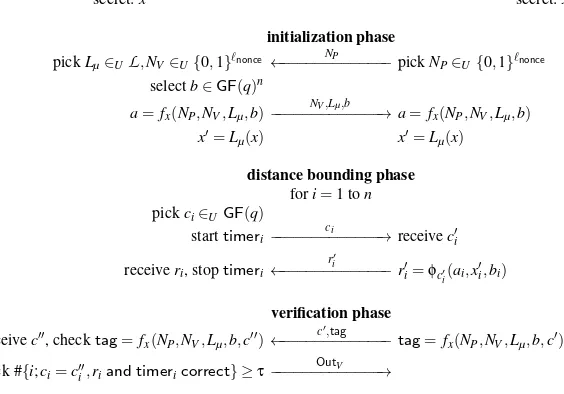
We proposeDBopt, a new family of symmetric distance-bounding protocols, as depicted on Fig. 1. It combines ideas taken from SKI [6,7,8,9] and the Swiss-Knife protocol [24] (as used by FO [18]). We use a security parameters(the length of the secretx, i.e.,x∈
K
=Zs2) and the following parameters based ons: the number of roundsn, the lengthℓtagoftag, a thresholdτ, the nonce lengthℓnonce, and aconstantqwhich is a prime power, e.g.,q=2,q=3, orq=4.DBoptfollows thecommon structure
with parametersn,τ, andnumc=numr=q.
As in SKI, we assumeLµ(x) = (µ(x), . . . ,µ(x))for some functionx7→µ(x), butµis not necessarily
linear. Concretely, µ is a vector in Zs2 andmap a fixed injection from Z2 toGF(q). Hence, µ(x) =
map(µ·x)maps a bitstringxto aGF(q)-representation of the bit obtained by the scalar productµ·x. 12Since provers loose the notion of time in the challenge phase, pre-ask and post-ask attacks cannot be detected.
We let
L
denote the set of all such possibleLµ mappings (mapbeing fixed). The function fxmaps todifferent codomains, depending on its inputs: given two noncesNPandNV,Lµ∈
L
, andb,c∈GF(q)n,fx(NP,NV,Lµ,b)∈GF(q)nand fx(NP,NV,Lµ,b,c)∈GF(q)ℓtag.
Verifier Prover
secret:x secret:x
initialization phase
pickLµ∈UL,NV∈U{0,1}ℓnonce
NP
←−−−−−−−−−−−−−pickNP∈U{0,1}ℓnonce selectb∈GF(q)n
a=fx(NP,NV,Lµ,b)
NV,Lµ,b
−−−−−−−−−−−−−→a=fx(NP,NV,Lµ,b)
x′=Lµ(x) x′=Lµ(x)
distance bounding phase fori=1 ton
pickci∈UGF(q)
starttimeri−−−−−−−−−−−−−→ci receivec′ i
receiveri, stoptimeri
r′i
←−−−−−−−−−−−−−r′i=φc′i(ai,x′i,bi)
verification phase
receivec′′, checktag=fx(NP,NV,Lµ,b,c′′)
c′,tag
←−−−−−−−−−−−−−tag=fx(NP,NV,Lµ,b,c′)
check #{i;ci=c′′i,riand timericorrect} ≥τ
OutV
−−−−−−−−−−−−−→
Fig. 1.TheDBoptDistance-Bounding Protocols
During the initialization, the participants exchange some nonces NP, NV, some Lµ ∈
L
, and avectorb. The vectorb could be fixed in the protocol, but is subject to some constraints as detailed below.V andP compute a= fx(NP,NV,Lµ,b) and x′ =Lµ(x). In the distance bounding phase, the
response function is a linear functionri =φci(ai,x
′
i,bi) defined by the challengeci. The verification
checks that the participants have seen the same challenges (based on the tag computed by tag=
fx(NP,NV,Lµ,b,c)), counts the number of rounds with a correct and timely response, and accepts if
there are at leastτof them.
Clearly, theDBoptfamily is quite open to specific choices forq,map,b, andφc. We propose the instances DB1, DB2, and DB3. There are some specificities in each protocol which are summarized in the following table:
protocol q map b φci
DB1 q>2 map(u)6=0 nobused φci(ai,x
′
i,bi) =ai+cix′i
DB2 q=2 map(u) =u Hamming weight n2 φci(ai,x
′
i,bi) =ai+cix′i+cibi
DB3 q≥2 nomapused Hamming weightn φci(ai,x
′
i,bi) =ai+cibi
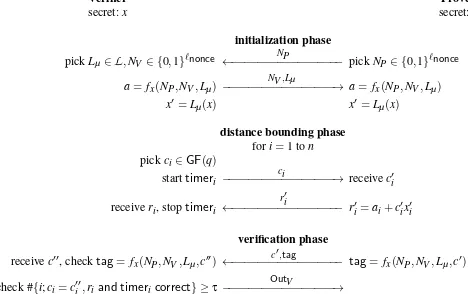
Specifically, DB3 is the simplest protocol and is optimal, but it offers no soundness. DB2 works with binary challenges and responses, but it is not optimal. DB1 is optimal but needsq≥3 since it requires thatmapis injective fromZ2toGF(q)∗. They are depicted on Fig. 2–4.
Verifier Prover
secret:x secret:x
initialization phase
pickLµ∈L,NV∈ {0,1}ℓnonce ←−−−−−−−−−−−−−−−−−NP pickNP∈ {0,1}ℓnonce
a=fx(NP,NV,Lµ) NV
,Lµ
−−−−−−−−−−−−−−−−−→a=fx(NP,NV,Lµ)
x′=L
µ(x) x′=Lµ(x)
distance bounding phase
fori=1 ton pickci∈GF(q)
starttimeri−−−−−−−−−−−−−−−−−→ci receivec′i
receiveri, stoptimeri
r′i
←−−−−−−−−−−−−−−−−−ri′=ai+c′ix′i
verification phase
receivec′′, checktag=f
x(NP,NV,Lµ,c′′) c
′,tag
←−−−−−−−−−−−−−−−−−tag=fx(NP,NV,Lµ,c′)
check #{i;ci=ci′′,riand timericorrect} ≥τ
OutV
−−−−−−−−−−−−−−−−−→
Fig. 2.The DB1 Distance-Bounding Protocol
Verifier Prover
secret:x secret:x
initialization phase
pickb∈Zn
2,Lµ∈L,NV∈ {0,1}ℓnonce ←−−−−−−−−−−−−−−−−−NP pickNP∈ {0,1}ℓnonce
(bmust have weightn 2)
a=fx(NP,NV,Lµ,b)−−−−−−−−−−−−−−−−−→NV,Lµ,b a=fx(NP,NV,Lµ,b) x′=L
µ(x) x′=Lµ(x)
distance bounding phase
fori=1 ton pickci∈ {0,1}
starttimeri−−−−−−−−−−−−−−−−−→ci receivec′i
receiveri, stoptimeri
r′i
←−−−−−−−−−−−−−−−−−ri′=ai⊕ci′x′i⊕c′ibi
verification phase
receivec′′, checktag=f
x(NP,NV,Lµ,b,c′′) c
′,tag
←−−−−−−−−−−−−−−−−−tag=fx(NP,NV,Lµ,b,c′)
check #{i;ci=ci′′,riand timericorrect} ≥τ
OutV
−−−−−−−−−−−−−−−−−→
Fig. 3.The DB2 Distance-Bounding Protocol
Verifier Prover
secret:x secret:x
initialization phase
pickNV∈ {0,1}ℓnonce ←−−−−−−−−−−−−−−−−−NP pickNP∈ {0,1}ℓnonce
a=fx(NP,NV)−−−−−−−−−−−−−−−−−→NV a=fx(NP,NV)
distance bounding phase
fori=1 ton pickci∈ {0,1}
starttimeri−−−−−−−−−−−−−−−−−→ci receivec′i
receiveci, stoptimeri
ri′
←−−−−−−−−−−−−−−−−−r′i=ai⊕c′i
verification phase
receivec′′, checktag=fx(NP,NV,c′′)←−−−−−−−−−−−−−−−−−c′,tag tag=fx(NP,NV,c)
check #{i;ci=c′′i,timericorrect} ≥τ
OutV
−−−−−−−−−−−−−−−−−→
resist men-in-the-middle playing with different challenges on the sides ofPandV, as it was the case in [2,4]. One particularity is that DB1 mandates x′i 6=0 so cannot accommodateq=2. If we want
q=2, we need for DF-resistance to make sure thatri really depends onci, by introducing the vector
bin which exactly half of the coordinates are 0. DB2 can be optimized into DB3 by usingri=ai+ci
(sox′unused andbi=1 for alli) by sacrificing soundness.
DBoptis clearlyτ-complete following Def. 2.
3.2 DF-Resistance of DB1, DB2, and DB3
Theorem 11 (DF-resistance).TheDBoptprotocolsα-resists to distance fraud for
– (DB1 and DB3)α=Tail(n,τ,q1)which is negligible for τn>1q+cte;
– (DB2)α=Tail(n
2,τ−
n
2, 1
2)which is negligible for
τ n >
3 4+cte.
Due to Th. 7, DB1 and DB3 are optimal for DF-resistance. DB2 is clearly not optimal (as DB3 is better with the sameq=2). However, the bound is tight for DB2 as the DF guessing the response matches theαbound: the malicious prover always wins the rounds for whichx′=bi (that is: exactly
half of the rounds due to the Hamming weight ofb) by sending the response in advance and passes with probabilityα=Tail(n
2,τ−
n
2, 1 2).
Proof. We consider a distinguished experimentexp(
V
)with no close-by participant. Due to the dis-tance, the answerritoV
comes from far away. Thanks to Lemma 4,riis independent (in the sense ofLemma 4) from ci. Sinceci is randomly selected when it is sent,ri is statistically independent from
ci. For DB1, sincexi′6=0 by construction,ri equalsai+cix′i with probability
1
q. The same goes for
DB3. For DB2, thanks to the selection ofb, this holds for exactly half of the rounds: those such that
x′i+bi6=0. So, the probability to succeed in the experiment is bounded as stated. ⊓⊔
3.3 Security of DB1, DB2, and DB3
As shown in [5], we cannot rely on the PRF assumption alone for DB1 or DB2, since the secret is used as a key of fx and also outside fx inx′. The circular-PRF assumption guarantees the PRF-ness
of f, even when we encrypt a function Lµ(x) of the key. We new recall and extend the notion, to
accommodate DB1 and DB2.
Definition 12 (Circular PRF). We consider some parameters s, n1, n2, and q. Given x˜∈ {0,1}s, a function L from {0,1}s to GF(q)n1, and a function F from{0,1}∗ toGF(q)n2, we define an oracle
O
x˜,F byO
x˜,F(y,L,A,B) =A·L(x˜) +B·F(y), using the dot product over GF(q). We assume that L istaken from a set of functions with polynomially bounded representation. Let(fx)x∈{0,1}s be a family of functions from {0,1}∗ to {0,1}n2. We say that the family f is a (ε,T)-circular-PRF if for any distinguisher limited to a complexity T , the advantage for distinguishing
O
x,fx, x ∈U {0,1}s, from
O
x˜,F,x˜∈U {0,1}s, where F is uniformly distributed, is bounded byε. We require two conditions onthe list of queries:
– for any pair of queries(y,L,A,B)and(y′,L′,A′,B′), if y=y′, then L=L′;
– for any y∈ {0,1}∗, if(y,L,A
i,Bi), i=1, . . . , ℓis the list of queries using this value y, then ∀λ1, . . . ,λℓ∈GF(q)
ℓ
∑
i=1
λiBi=0 =⇒
ℓ
∑
i=1
λiAi=0 (1)
This definition extends the one from [7,9] in the following sense: 1. the functionL(the leak ofx) is arbitrary instead of being linear; 2. this arbitrary functionLnow requires the first condition i.e., the sameF-input implies the same leak functionL. In [7,9], it was shown that the natural construction
fx(y) =H(x,y)is circular-PRF in the random oracle model, with the definition from [7,9]. We can
easily see that the same proof holds with Def. 12. It would be interesting to make other constructions without random oracles.
Theorem 13 (Security).TheDBoptprotocols areβ-secure for
– (DB1 and DB2)β=Tail(n,τ,1
q) + r2
22−ℓnonce+ (r+1)ε+r2−ℓtag when f is a(ε,T)-circular-PRF
(as defined by Def. 12);
– (DB3)β=Tail(n,τ,1
q) + r2
22−ℓnonce+ε+2−ℓtagwhen f is a(ε,T)-PRF.
There, r is the number of honest instances (of P or V ) and T is a complexity bound on the experiment.
βis negligible fornτ >1q+cte, r and T polynomially bounded, andεnegligible.
Based on that r222−ℓnonce+ (r+1)ε+r2−ℓtag (or the similar term for DB3) can be made negligible
againstβ, DB1, DB2, and DB3 areoptimalfor security due to Th. 9.
Proof. We consider a distinguished experimentexp(
V
)with no close-byP(x), noP∗(x), and whereV
accepts with probabilityp. We consider a gameΓ0in which we simulate the execution ofexp(V
)and succeed if and only ifOutV by
V
is an acceptance message.Γ0succeeds with probabilityp.First of all, we reduce to the same game Γ1 whose success additionally requires that for every
(NP,NV,Lµ)triplet, there is no more than one instanceP(x)and one instanceV(x)using this triplet.
SinceP(x)is honest and selecting theℓnonce-bit nonceNPat random and the same forV(x)selecting
NV, by looking at the up to r
2
2 pairs ofP(x)’s or ofV(x)’s and the probability that one selection of a
nonce repeats, this new game succeeds with probability at least p−r222−ℓnonce.
Then, for DB1 and DB2, we outsource the computation of everyai+cx′ito the oracle
O
x,fx(y,Lµ,A,B) = (A·Lµ(x)) + (B·fx(y))as in Def. 12, withy= (NP,NV,Lµ,b),A·Lµ(x) =c(Lµ(x))i, andB·fx(y) = (fx(y))i. I.e.,Ai=ceiand
Bi=ei, whereeiis the vector having a 1 on itsith component and 0 elsewhere. This can be used with
c=c′ibyP(x)(for computingri′) or withc=cibyV(x)(for verifyingri). Similarly, the computation
(byP(x)orV(x)) oftag=fx(y)can be made by several calls of form
O
x,fx(y,Lµ,0,B). (We note thatthey in this case has incompatible form with the y in the ri computation.) So, every computation
requiringx is outsourced. Note that queries to the samey must use the sameLµ since this is part of
y. So, the first condition in Def. 12 to apply the circular-PRF assumption is satisfied. We consider the eventEthat there exists in the game some sequence(y,Lµ,Aj,Bj)of queries to
O
x,fxsharing the same(y,Lµ) and someλj’s such that∑jλjBj=0 and∑jλjAj6=0. We need to restrict to the event¬E to
apply Def. 12. We consider the event E′ that one instance inVreceives a valid tagwhich was not computed by the proverP(i.e., it was forged).
Letc′′i be the value received byV(x)in the verification phase. We assume thatV checks thattag
is correct,timeri is correct, andci=c′′i, then queries
O
x,fx(y,Lµ,ciei,ei)only if these are correct. IfEhappens for some(y,Lµ), due to the property ofΓ1, eachihas at most two queries. SinceBj =eij,
∑jλjBj=0 yields pairs of values jand j′such thatij=ij′ =i,Aj=ciei,Aj′=c′iei,Bj =Bj′ =ei,
must have accepted sometagwhich was not computed byP(x). So,EimpliesE′. We now show that Pr[E′]is negligible.
We defineΓ2, the variant ofΓ1, which in turn requires thatE′does not occur as an extra condition
for success. We letE′j be the event that tagj, the jth valuetagreceived by anyV(x)inVis forged. LetΓ1,j be the hybrid ofΓ1stopping right aftertagj is received and succeeding ifE′j occurs but not
E1′, . . . ,E′j−1.
Clearly, sinceE1′∪ · · · ∪E′j−1 does not occur and we stop right after reception oftagj,E cannot occur. (Remember that forE to occur for the first time upon a query to
O
x,fx, there must be a priortag which was forged.) So, the conditions to apply the circular-PRF security reduction in Def. 12 is satisfied inΓ1,j. We apply the circular-PRF assumption and replace
O
x,fx byO
x˜,F, loosing someprobabilityε. We obtain a gameΓ2,j. Clearly,Γ2,jsucceeds with probability bounded by 2−ℓtagbecause
Fis random. So, PrΓ1,j[success]≤ε+2
−ℓtaginΓ
1,j.
So, Pr[E′]is bounded by the sum of all PrΓ1,j[success], i.e. PrΓ1[E
′]≤rε+r2−ℓtagsince the number
of hybrids is bounded byr. Hence, PrΓ2[success]≥p−
r2
22−ℓnonce−rε−r2−ℓtag.
Now, in the whole gameΓ2 where E′ does not occur, we replace
O
x,fx byO
x˜,F and obtain thesimplified gameΓ3. We have PrΓ3[success]≥p−
r2
22−ℓnonce−(r+1)ε−r2−ℓtag.
It is now easy to analyze the protocolΓ3. Thanks to Lemma 4, the response is computed based
on information fromP(x)(win Lemma 4) which is independent (in the sense of Lemma 4) from the challenge. EitherP(x)was queried with a challenge before, but this could only match the correct one with probability1q and the adversary would fail withtagotherwise. Or,P(x)leaked nothing about the response to this challenge, and the answer by the adversary can only be correct with probability 1q. In any case, his answer is correct with probability 1q. So,Γ3succeeds with probability up toTail(n,τ,1q).
To sum up, we have p≤Tail(n,τ,1q) +r222−ℓnonce+ (r+1)ε+r2−ℓtag for DB1 and DB2.
For DB3, we loose r222−ℓnonce fromΓ
0 toΓ1. InΓ1, we apply the full PRF reduction and looseε
to obtainΓ2with a random function. We loose 2−ℓtag more to assume thattagreceived by
V
was notforged in someΓ3. Then, it is easy to see that either the prover was queried beforeciwas known, but
this will only succeed if ci was correctly guessed, or it was queries after, but this will only succeed
if the answer ri was correctly guessed. So, Γ3 succeeds with a probability bounded byTail(n,τ,1q).
(Note that DB3 is insecure without the authenticating tag: the man-in-the-middle can just run the DB phase with the prover, deducea, then answer all challenges from the verifier.) ⊓⊔
3.4 Soundness of DB1 and DB2
Theorem 14 (Soundness of DB1). The DB1 scheme is(γ,γ′,s+2)-sound for anyγ≥ q
q−1pB andγ′ such thatγ′= (1−γ−1p
B)s, where pB=maxa+b≤npB(a,b)and
pB(a,b) =
∑
u+v≥τ−a
n−a−b u
b
v 1−
1
q
b+u−v
1
q
n−a−b−u+v
More precisely, any collusion fraud with a success probabilityγ≥ pB 1−1
q−ε
leaks one random(µ,µ·x)
pair with probability at least 1q+ε. Assuming pB=pB(0,0),14this comparesγtoq−q1Tail(n,τ,
q−1
q ).
For instance, forγ=spBandnτ >q−q1+cte,γis negligible andγ′is greater than a constant.
If we applied the same proof as for SKI from [30, Th.14], we would not get such a good result. We would rather obtainTail(n
2,τ−n2,
q−1
q ). So, our proof of Th. 14 is substantially improved.
Proof. We consider a distinguished experimentexp(
V
)whereV
accepts with probability p≥γ. The verifierV
has computed somea andx′. We apply Lemma 4. We letRespi(c) be the value of the response ri arriving toV
when ci is replaced to c in the simulation. We show below thatwe can always computeRespi(c)−Respi(c′)for any(c,c′) pair from a straightline simulation (i.e., without rewinding). Let Viewi be the view of close-by participants
A
until the time before ciar-rives, and wi be the extra information (independent from ci, in the sense of Lemma 4) arriving
from far-away. Due to Lemma 4, we have Respi(c) =Algo(Viewi,c,wi). So, we can easily compute Respi(c)−Respi(c′)without rewinding. The answer by a far-away participant is independent fromci,
soRespi(c)−Respi(c′) =0: we can computeRespi(c)−Respi(c′)as well.
We say thatcis correct in theith round ifRespi(c) =ai+cx′i. We letCi be the set of correctc’s
for theith round. We letSbe the set of alli’s such thatci∈Ci. Finally, we letR(resp.R′) be the set of
alli’s for which #Ci=q(resp. #Ci≤1). I.e., allc’s are correct in theith round fori∈Rand at most
one is correct fori∈R′.
By definition, the probability that #S≥τis p≥γ. We see that Respi(c)−Respi(c′)
c−c′ =x′i ifi∈R, for
anyc6=c′. If the left-hand side leads to the same valueξifor eachc6=c′, we say that the roundivotes
forx′i=ξi. If the(c,c′)pairs do not lead to the same value inGF(q), we say that the roundidoes not vote. So, we can always compute the voteξifrom the views of close-by participants. The majority of
the availablemap−1(ξi)shall decodeµ·x.
For DB1, we can prove that if the round i votes for some ξi such that ξi 6=x′i, then we must havei∈R′. Indeed, if roundivotes for someξi and #Ci ≥2, it means that there exist two different
challengescandc′such that the responsesRespi(c)andRespi(c′)are correct. So,Respi(c) =ai+cx′i
andRespi(c′) =ai+c′x′i. The voteξiis
Respi(c)−Respi(c′)
c−c′ which is thus equal tox′i. So, an incorrect vote
cannot have two correct challenges: it must be for i∈R′. The majority of the votes does not givex′i
only when #R≤#R′. So, we shall bound Pr[#R≤#R′].
LetI,I′⊆ {1, . . . ,n}such that #I≤#I′ andI∩I′ is empty. Let pB(a,b)be the probability that at
least τ rounds succeed, when we know thata rounds succeed with probability 1, brounds succeed with probability1q, and the other succeed with probability 1−1
q. We have Pr[#S≥τ,R=I,R′=I′] =
Pr[#S≥τ|R=I,R′=I′]Pr[R=I,R′=I′]and Pr[#S≥τ|R=I,R′=I′]≤pB(#I,#I′)≤pB since we
have #I correct rounds for sure and it remains to pick u correct challenges (out of at most q−1) among thei6∈I∪I′ rounds, and v correct challenges (out of at most 1) among the i∈I′ rounds, for all u andv such that u+v≥τ−#I. By summing over all choices for I and I′, we obtain that Pr[#S≥τ,#R≤#R′]≤pB So, Pr[#R>#R′|#S≥τ]≥1−γ−1pB. So, when the experiment succeeds,
the extracting algorithm gets a random pair(µ,µ·x)with probability at least 1−γ−1p
B. This is better
than just guessingµ·xwhenγ> q−q1pB.
We can doMmany such accepting experiments, collect some (µ,µ·x)until we haves vectorµ
spanningGF(q)s, and reconstructxwith probability at leastγ′= 1−γ−1p
B
s
. The probability thatm
samples in GF(q)sdo not generate this space is p
m≤qs−m (the number of hyperplane,qs−1 times
the probability that the msamples are all in this hyperplane, which isq−1 to the powerm). So, the expected Muntil we generate the space is bounded bys+∑m≥sqs−m≤s+2. Hence, after at most
s+2 iterations on average, we can recoverxby solving a linear system. This defines the extractor. We can also push the extraction further when 1−γ−1p
B>1q by solving an instance of the
Learn-ing Parity with Noise problem (LPN), which would still be feasible by the practical parameters s. Extraction can also work with a complexity overhead bounded by
O
(sj)and a probability of at leastγ′=Tail(s,s−j,1−γ−1p
B), by finding at most jerrors by exhaustive search or LPN solving
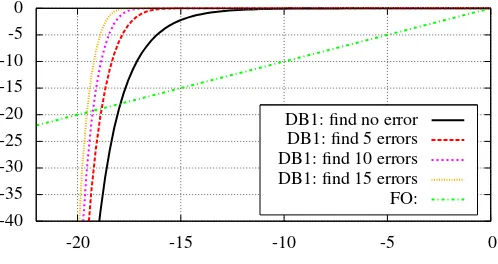
algo-rithms. On Fig. 5 we plot−log2γ′ in terms of−log
2γfor an instance of DB1 and j∈ {0,5,10,15}.
-40 -35 -30 -25 -20 -15 -10 -5 0
-20 -15 -10 -5 0
DB1: find no error DB1: find 5 errors DB1: find 10 errors DB1: find 15 errors FO:
Fig. 5.log2γ′in terms of log
2γfor FO and DB1 withq=3,s=80,n=92,τ=82.
The maximumpB=pB(a,b)is always reached fora=b. Indeed, for all the values plotted on Fig. 6
withn≥6, we saw it was reached fora=b=0. In this case, we havepB=pB(0,0) =Tail(n,τ,q−q1). ⊓ ⊔
Below, we prove that the result is tight for DB1 usingq=3. Whether this it tight for otherqis an open question. Whether it is optimal for protocols following the common structure is also open.
DB1’s tightness of the soundness proof. To show that the result is tight for DB1 withq=3, we mount a (non-leaking) terrorist fraud succeeding with probabilityγ=Tail(n,τ,q−q1): let the malicious prover give to the adversary the tables forci7→ri+ei(ci)for every roundi. For each suchi, randomly pick
one entry for whichei(ci)is a randomnonzerovalue and let it be 0 for other, two entries. With such
tables as a response function, the adversary passes the DB phase with probabilityγ. (Other phases are done by relaying messages.) Since the verifier accepts with negligible probabilityγ, the adversary learns as much as ifOutV was always set to 0.
Forq=3 and eachi, based on randomai∈GF(q),xi′∈GF(q)∗, andc7→ei(c)as distributed above,
we can easily see that the distribution of the transmitted table is independent fromx′i: forx′i=1, the table ofc7→ai+cx′idefined by a randomaiis randomly picked from
07→0 17→1 27→2
,
07→1 17→2 27→0
,
07→2 17→0 27→1
.
When adding the random tableei(c), it becomes a uniformly distributed random table among those
with an output set of cardinality 2. Forx′i=2, the table ofai+cx′iis randomly picked from
07→0 17→2 27→1
,
07→2 17→1 27→0
,
07→1 17→0 27→2
,
but addingei(c)leads to the same distribution as forx′i=1. So, the above attack does not leak and is
a valid terrorist fraud. Th. 14 essentially says that there is no valid terrorist fraud with a largerγ. So, the result is tight for DB1 withq=3.
The same proof technique leads to the following result for DB2.
Theorem 15 (Soundness of DB2). For nτ > 34, the DB2 scheme is (γ,γ′,s+2)-sound for any γ≥ 2Tail(n
2,τ−n2, 1
Again, it is open whether this is optimal for a protocol with binary challenges. The bound is pretty tight for DB2: a malicious adversary could leak theci7→ritables for a random selection of half of the
rounds, and leak the table with one bit flipped for the others. This will not leakx′i and will pass with probabilityγ=Tail(n
2,τ−n2, 1 2).
3.5 Performance Comparisons
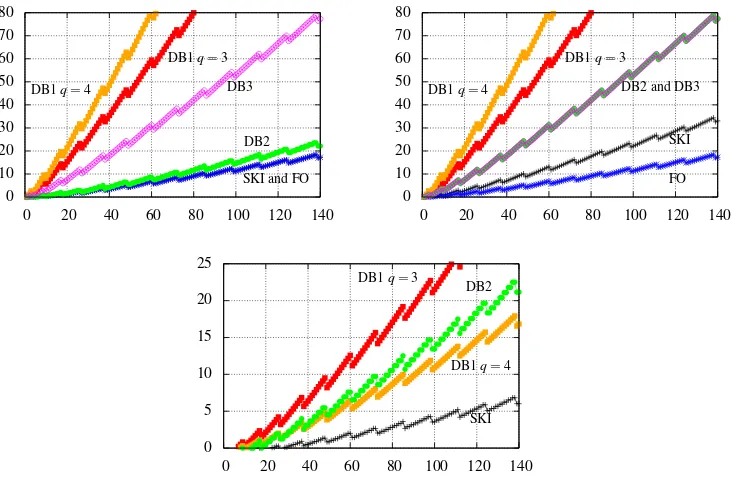
Fig. 6 plots the resistance of DB1, DB2, and DB3 compared with the protocols SKI [6,7,8,9] and FO [18].15 The results for SKI and FO are revisited in our framework in Appendix A–B. In these figures, we assume a noise level of pnoise=5% and we adjustτin terms of the number of roundsn
such thatTail(n,τ,1−pnoise)≈99%, forτ-completeness; i.e., we admit a false rejection rate if below 1%. We plot then−log2α,−log2β, and−log2γin terms ofn, assuming that the residual terms (such asε and 2−ℓtag from the PRF and 2−ℓnonce from the nonce) can be neglected. We used the following
dominant security parameters:
protocol α β γ
SKI Tail(n,τ,3/4) Tail(n,τ,2/3) Tail(n
2,τ−
n
2,2/3)
FO Tail(n,τ,3/4) Tail(n,τ,3/4) n/a
DB1 Tail(n,τ,1/q) Tail(n,τ,1/q) q−q1Tail(n,τ,1−1/q) DB2 Tail(n
2,τ−
n
2,1/2) Tail(n,τ,1/2) Tail(
n
2,τ−
n
2,1/2)
DB3 Tail(n,τ,1/2) Tail(n,τ,1/2) n/a As we can see, our protocols are better than SKI and FO onallcurves.
DB3 is not plotted on the third graph since it is not sound. FO has an incomparable TF-resistance notion and is not plotted either. Indeed, the FO curve cannot identify any thresholdγlike other proto-cols (see Fig. 5). TF-resistance therein follows another philosophy: in order to pass a DB run, the FO protocol always leaks with a probabilityγ′=γ, no matter the number of rounds. Although this is an interesting idea, the price to pay is a much lower resistance to man-in-the-middle, as observed in [30]. Since we consider online attacks, security levels of 2−10or 2−20should suffice, i.e., better (online) security may be ambitious. We now report the minimal number of rounds to attain such security:
security level 2−10 security level 2−20
DF security soundness DF security soundness
SKI 84 48 181 SKI 151 91 315
FO 84 84 n/a FO 151 151 n/a
DB1q=3 14 14 54 DB1q=3 24 24 92
DB1q=4 12 12 91 DB1q=4 20 20 152
DB2 69 24 79 DB2 123 43 131
DB3 24 24 n/a DB3 43 43 n/a
Interpretation of results. As we can see in the table above, DB1 with q=4 is the best choice for distance fraud and security. Unfortunately, its (non-tightly) proven soundness requires more rounds. DB1 withq=3 seems to be the best compromise. But if we want to use binary challenges, we shall choose between DB2 (suboptimal for DF-resistance) and DB3 (not sound).
0 10 20 30 40 50 60 70 80
0 20 40 60 80 100 120 140
SKI and FO DB1q=3
DB1q=4
DB2 DB3
0 10 20 30 40 50 60 70 80
0 20 40 60 80 100 120 140
SKI FO DB1q=3
DB1q=4 DB2 and DB3
0 5 10 15 20 25
0 20 40 60 80 100 120 140
SKI DB1q=3
DB1q=4 DB2
Fig. 6.Distance fraud resistance (top left) and security (top right), in equivalent bitlength, with respect to the number of roundsn. This assumes aτ-completeness level of 99% andpnoise=5%. The bottom curve gives the soundness level. (Note
that DB3 is not sound and that FO follows another TF-resistance philosophy.)
4 Conclusion
We provided the provably secure symmetric protocols DB1, DB2, and DB3 which require fewer rounds than the only two existing, provably secure protocols, SKI and FO. Prior to this, we have revised the formal model for distance-bounding protocols in a way which is closer to (the state of the art of) interactive proofs. We also studied optimality of all provably secure DB protocols, existing and advanced herein. Some open challenges remain: 1. identify an optimal andsound protocol for
numc=numr=2; 2. study the optimality of soundness; 3. implement these protocols.
References
1. G. Avoine, M. Bing¨ol, S. Kardas, C. Lauradoux, B. Martin. A Framework for Analyzing RFID Distance Bounding Protocols.Journal of Computer Security, vol. 19(2), pp. 289–317, 2011.
2. G. Avoine, C. Lauradoux, B. Martin. How Secret-Sharing can Defeat Terrorist Fraud. InACM Conference on Wireless Network Security WISEC’11, Hamburg, Germany, pp. 145–156, ACM, 2011.
3. G. Avoine, A. Tchamkerten. An Efficient Distance Bounding RFID Authentication Protocol: Balancing False-Acceptance Rate and Memory Requirement. InInformation Security ISC’09, Pisa, Italy, Lecture Notes in Computer Science 5735, pp. 250–261, Springer-Verlag, 2009.
4. A. Bay, I. Boureanu, A. Mitrokotsa, I. Spulber, S. Vaudenay. The Bussard-Bagga and Other Distance-Bounding Proto-cols under Attacks. InINSCRYPT’12, Beijing, China, Lecture Notes in Computer Science 7763, pp. 371–391, Springer-Verlag, 2012.
6. I. Boureanu, A. Mitrokotsa, S. Vaudenay. Secure & Lightweight Distance-Bounding. InLightweight Cryptography for Security and Privacy LightSec’13, Gebze, Turkey, Lecture Notes in Computer Science 8162, pp. 97–113, Springer-Verlag, 2013.
7. I. Boureanu, A. Mitrokotsa, S. Vaudenay. Practical & Provably Secure Distance-Bounding. To appear in the Journal of Computer Security (JCS), IOS Press. Available as IACR Eprint 2013/465 report, 2013. http://eprint.iacr.org/2013/465.pdf
8. I. Boureanu, A. Mitrokotsa, S. Vaudenay. Towards Secure Distance Bounding. InFast Software Encryption’13, Singa-pore, Lecture Notes in Computer Science 8424, pp. 55–67, Springer-Verlag, 2013.
9. I. Boureanu, A. Mitrokotsa, S. Vaudenay. Practical & Provably Secure Distance-Bounding. To appear in the proceedings of ISC’13.
10. I. Boureanu, S. Vaudenay. Optimal Proximity Proofs. To appear in the Proceedings of Inscrypt’14.
11. I. Boureanu, S. Vaudenay. Challenges in Distance-Bounding. To appear in the IEEE Security & Privacy Magazine, 2015.
12. S. Brands, D. Chaum. Distance-Bounding Protocols (Extended Abstract). InAdvances in Cryptology EUROCRYPT’93, Lofthus, Norway, Lecture Notes in Computer Science 765, pp. 344–359, Springer-Verlag, 1994.
13. N. Chandran, V. Goyal, R. Moriarty, R. Ostrovsky. Position Based Cryptography. In Advances in Cryptology CRYPTO’09, Santa Barbara, California, U.S.A., Lecture Notes in Computer Science 5677, pp. 391–407, Springer-Verlag, 2009.
14. H. Chernoff. A Measure of Asymptotic Efficiency for Tests of a Hypothesis Based on the sum of Observations.Annals of Mathematical Statistics, vol. 23 (4), pp. 493-507, 1952.
15. C.J. F. Cremers, K.B. Rasmussen, B. Schmidt, S. ˇCapkun. Distance Hijacking Attacks on Distance Bounding Protocols. InIEEE Symposium on Security and Privacy S&P’12, San Francisco, California, USA, pp. 113–127, IEEE Computer Society, 2012.
16. Y. Desmedt. Major Security Problems with the “Unforgeable” (Feige-)Fiat-Shamir Proofs of Identity and How to Overcome Them. InCongress on Computer and Communication Security and Protection Securicom’88, Paris, France, pp. 147–159, SEDEP Paris France, 1988.
17. U. D¨urholz, M. Fischlin, M. Kasper, C. Onete. A Formal Approach to Distance-Bounding RFID Protocols. In Informa-tion Security ISC’11, Xi’an, China, Lecture Notes in Computer Science 7001, pp. 47–62, Springer-Verlag, 2011. 18. M. Fischlin, C. Onete. Terrorism in Distance Bounding: Modelling Terrorist-Fraud Resistance. InApplied
Cryptog-raphy and Network Security ACNS’13, Banff AB, Canada, Lecture Notes in Computer Science 7954, pp. 414–431, Springer-Verlag, 2013.
19. A. ¨O. G¨urel, A. Arslan, M. Akg¨un. Non-Uniform Stepping Approach to RFID Distance Bounding Problem. InData Privacy Management and Autonomous Spontaneous Security DPM/SETOP’10, Athens, Greece, Lecture Notes in Com-puter Science 6514, pp. 64–78, Springer-Verlag, 2011.
20. G.P. Hancke. Distance Bounding for RFID: Effectiveness of Terrorist Fraud. InConference on RFID-Technologies and Applications RFID-TA’12, Nice, France, pp. 91–96, IEEE, 2012.
21. G.P. Hancke, M.G. Kuhn. An RFID Distance Bounding Protocol. InConference on Security and Privacy for Emerging Areas in Communications Networks SecureComm’05, Athens, Greece, pp. 67–73, IEEE, 2005.
22. W. Hoeffding. Probability Inequalities for Sums of Bounded Random Variables.Journal of the American Statistical Association, vol. 58, pp. 13–30, 1963.
23. C.H. Kim, G. Avoine. RFID Distance Bounding Protocol with Mixed Challenges to Prevent Relay Attacks. In Cryp-tology and Network Security, 8th International Conference CANS 2009, Kanazawa, Japan, Lecture Notes in Computer Science 5888, pp. 119–133, Springer-Verlag, 2009.
24. C.H. Kim, G. Avoine, F. Koeune, F.-X. Standaert, O. Pereira. The Swiss-Knife RFID Distance Bounding Protocol. In
Information Security and Cryptology ICISC’08, Seoul, Korea, Lecture Notes in Computer Science 5461, pp. 98–115, Springer-Verlag, 2009.
25. J. Munilla, A. Peinado. Distance Bounding Protocols for RFID Enhanced by Using Void-challenges and Analysis in Noisy Channels.Wireless Communications and Mobile Computing, vol. 8, pp. 1227–1232, 2008.
26. V. Nikov, M. Vauclair. Yet Another Secure Distance-Bounding Protocol. InProceedings of SECRYPT’08, Porto, Por-tugal, pp. 218–221, INSTICC Press, 2008.
27. J. Reid, J.M.G. Nieto, T. Tang, B. Senadji. Detecting Relay Attacks with Timing-Based Protocols. InACM Symposium on Information, Computer and Communications Security ASIACCS’07, Singapore, pp. 204–213, ACM, 2007. 28. D. Singel´ee, B. Preneel. Distance Bounding in Noisy Environments. InSecurity and Privacy in Ad-hoc and Sensor
Networks ESAS 2007, Cambridge, UK, Lecture Notes in Computer Science 4572, pp. 101–115, Springer-Verlag, 2007. 29. Y.-J. Tu, S. Piramuthu. RFID Distance Bounding Protocols. InWorkshop on RFID Technology RFID’07, Vienna,
Aus-tria, EURASIP, 2007. http://www.eurasip.org/Proceedings/Ext/RFID2007
31. S. Vaudenay. Proof of Proximity of Knowledge. IACR Eprint 2014/695 report, 2014. http://eprint.iacr.org/2014/695.pdf 32. S. Vaudenay. Private and Secure Public-Key Distance Bounding: Application to NFC Payment. To appear in the
pro-ceedings of Financial Cryptography’15.
33. T.-Y. Youn, D. Hong. Authenticated Distance Bounding Protocol with Improved FAR: Beyond the Minimal Bound of FAR.IEICE Transactions on Communications, vol. E97-B (5), pp. 930–935, 2014.
A The SKI Protocol: Proofs Recasted in the Model Herein
The SKI protocol [7,9] is reminded in Fig. 7. A secret x∈ {0,1}s is considered, given a security
parameter s. There, the function f must be a PRF with circular-PRF security. It uses some other parameters based ons: the number of roundsn, a thresholdτ, and the nonce lengthℓnonce.
Given a vectorµ, the linear functionLµis defined by
Lµ(x) = (µ·x, . . . ,µ·x)
Namely, all bits are set to the dot product between µ and x. With x′ =Lµ(x), Hancke’s terrorist
fraud [20] would reveal a majority of the bits of x′ thus leaking Lµ(x). Since Lµ is not chosen by
the prover, by repeating the attack, we can collect enough information aboutxto reconstructx. So, Hancke’s terrorist fraud is prevented.
Verifier Prover
secret:x secret:x
initialization phase NP
←−−−−−−−−−−−−−pickNP
picka,Lµ,NV
M,Lµ,NV
−−−−−−−−−−−−−→
M=a+fx(NP,NV,Lµ) a=M−fx(NP,NV,Lµ)
x′=Lµ(x) x′=Lµ(x)
distance bounding phase fori=1 ton
pickci∈ {1,2,3}
starttimeri−−−−−−−−−−−−−→ci
stoptimeri←−−−−−−−−−−−−−ri ri=
a1,i ifci=1
a2,i ifci=2
x′i+a1,i+a2,iifci=3 check #{i;riand timericorrect} ≥τ
OutV
−−−−−−−−−−−−−→
Fig. 7.The SKI Distance-Bounding Protocol [6,7,8,9]
There exists several variants of SKI with different properties. Namely, secret sharing schemes other than the one in Fig. 7 can be considered. Other leakage schemesLµcan also be considered. We
refer to [6,7,9] for details.
To study thecompleteness, we assume that there is a probability of pnoisethat one round is incor-rectly executed by honest players. The probability that an honest prover, close to the verifier, passes the protocol isTail(n,τ,1−pnoise). So, we need
τ
n <1−pnoise−ε (2)
Theorem 16 (DF-resistance of SKI).Let α=Tail(n,τ,34). The SKI protocol α-resists to distance fraud. The valueαis negligible for nτ >3
4+cte.
Proof. The proof goes like for Th. 11. Since
V
selects a, the answer is correct with a probability bounded by 1 if (a1)i = (a2)i =xi (this occurs with probability 14), and bounded by 23 in the othercases. So, it is bounded by 14×1+34×23=34. ⊓⊔
Theorem 17 (Security of SKI). Assuming that f is a (ε,T)-circular-PRF (as defined by Def. 12), the SKI protocol isβ-secure for β=Tail(n,τ,23) +r2
22−ℓnonce+ε where r is the number of honest
participants in the experiment and T is a complexity bound on the experiment. For τn >2
3+cte,βis negligible.
Proof. The proof goes like for Th. 13.
When applying the circular-PRF reduction, we now have to count on two queries on round i:
O
x,fx(y,Lµ,Ai,Bi)byP(x)andO
x,fx(y,Lµ,A′
i,B′i)byV(x), with
Ai=1ci=3ei A
′
i=1c′
i=3ei Bi=1ci=1,3e1,i+1ci=2,3e2,i B
′
i=1c′
i=1,3e1,i+1c′i=2,3e2,i
where ec,i is the vector having 1 on its (c,i) position and 0 elsewhere. If∑iαiBi+∑iβiB′i =0, due
to the structure of the Bi and B′i vectors, we obtain that, for eachi, we have αi1ci=1,3=βi1c′i=1,3
and αi1ci=2,3=βi1c′i=2,3. In the ci=c
′
i case, we obtain αi1ci=3 =βi1c′i=3. In the ci 6=c
′
i case, we
obtain αi =βi =0 which also impliesαi1ci=3 =βi1c′i=3. So, we always have αiAi =βiA′i. Finally, ∑iαiAi+∑iβiA′i=0. The condition (1) to apply the circular-PRF security reduction is satisfied.
It is now easy to see that for each round i of the constructed game Γ3, the adversary has no
time to askP(x)for the correct answer, he may have asked it before by accident, with probability 13. Otherwise, his answer is correct with probability 12. So, it is overall correct with probability 13+23×
1 2 =
2
3. So,p≤Tail(n,τ, 2 3) +
r2
22
−ℓnonce+ε. ⊓⊔
Theorem 18 (Soundness of SKI [30]16).Letγbe such thatγ≥32Tail(n
2,τ−n2, 2
3)and letγ′ = (1−
γ−1Tail(n
2,τ−n2, 2
3))s. Fornτ >
5
6+cte, we can selectγnegligible andγ′constant. The SKI protocol is
(γ,γ′,s+2)-sound.
The proof is the same as for Th. 14.
B The FO Protocol: Proofs Recasted in the Model Herein
The FO protocol is depicted on Fig. 8. It is as specified in [30], since the value of pe from [18] is
incorrect and the specification in [18] uses two specific thresholds (namely, for incorrect responses and for rounds with a time out) instead of a singleτ, making the comparison with other protocols harder. (See [30].)
The protocol builds up on the Swiss-Knife protocol [24] and uses a specialescapestrategyb=1. Normal users shall only use b=0. Forb=1, the verifier expect a simple echo on challenges (i.e.,
ri=ci), does not verify the tagt, and has a probabilistic behavior: it accepts with probabilitypewhere
eis the Hamming distance betweenIand the secrety.
Theorem 19 (DF-resistance of FO).The FO schemeα-resists to distance frauds, forα=Tail(w,τ− n+w,12), where w is the Hamming weight of y. On average over y, this is α=Tail(n,τ,34). For
τ n >
3
4+cte, this is negligible.
16Actually, the result in [30] wasγ= 1
negl(n)Tail(
n
Verifier Prover secret:x,y secret:x,y
initialization phase
pickNV
NV
−−−−−−−−−−−→setb=0
b,I,NP
←−−−−−−−−−−−pickNP
I′ka1=fx(NP,NV) Ika1=fx(NP,NV)
a2=a1⊕y a2=a1⊕y
distance bounding phase fori=1 ton
pickci∈ {1,2}
starttimeri
ci
−−−−−−−−−−−→
stoptimeri
ri
←−−−−−−−−−−−ri=
a1,iifci=1
a2,iifci=2
verification phase
checkb,I,t,←−−−−−−−−−−−t t= fx(transcript)
#{i:riand timericorrect} ≥τ−−−−−−−−−−−→OutV
pe=Tail
e,e−n+τ,1 2
correctness conditions forb=0 correctness conditions forb=1
I′=I correct with probabilitypdH(I,y)
t= fx(transcript) —
ri=aci,i ri=ci
timeri≤B timeri≤B
Clearly, this bound is tight for FO.
Proof. We consider a distinguished experimentexp(
V
) with no close-by adversary and no close-by secret.Due to the distance, the answerrito
V
must come from far away, and is so independent fromci.Clearly, the escape strategy is not optimal since each round can only be correct with probability 12. Using the regular strategy withb=0, the malicious prover can always win whenyi=0. Overall, ifw
is the Hamming weight ofy, he needs to be correct inτ−n+wmore rounds. So, the probability is
Tail(w,τ−n+w,1
2). ⊓⊔
Theorem 20 (Security of FO).Assuming that f is a PRF, for τn >3
4, the FO scheme isβ-secure for
β=Tail(n,τ,34) +negl(n).
This bound is tight for FO, as this was shown in [30]. The attack consists in impersonating the prover by guessingyand using the escape strategy.
Proof. We consider a distinguished experimentexp(
V
)with no close-byP(x), noP∗(x), and whereV
accepts with probability p.The proof goes like the one of Th. 13. We reduce to a game where only oneP(x)is running and fx
is replaced by a random function. In theb=0 strategy, the adversary can only win with probability12 in each round: if he plays withP(x)first, he can only win if he could predict the challenge, due to the tag, but he must guess all challenges correctly to get the correct tag. If he does not, he can only win if he could guess the answer. In the escape strategyb=1, he can just guess someIclose toy. In [30], it was shown that this succeeds with probabilityTail(n,τ,3
4). ⊓⊔
The FO protocol offers some form of terrorist-fraud.
Theorem 21 (TF-resistance of FO [18,30]).The FO scheme on Fig. 8 isstrSimTF-secure. I.e., for
any experiment made of a verifier
V
=V(x), an adversaryA
, and a malicious far-away prover P∗(x), there exists an experiment made of an adversary S(z)with auxiliary input z and a verifierV
′=V(x)such thatPr[
![Fig. 6 plots the resistance of DB1, DB2, and DB3 compared with the protocols SKI [6,7,8,9] andFO [18].asfigures, we assume a noise level of15 The results for SKI and FO are revisited in our framework in Appendix A–B](https://thumb-us.123doks.com/thumbv2/123dok_us/7908251.1313144/15.612.148.454.308.394/resistance-compared-protocols-asgures-results-revisited-framework-appendix.webp)
![Fig. 7. The SKI Distance-Bounding Protocol [6,7,8,9]](https://thumb-us.123doks.com/thumbv2/123dok_us/7908251.1313144/18.612.156.432.356.540/fig-the-ski-distance-bounding-protocol.webp)
![Fig. 8. The Fischlin-Onete (FO) distance-bounding protocol (as described in [30]).](https://thumb-us.123doks.com/thumbv2/123dok_us/7908251.1313144/20.612.155.424.251.578/fig-fischlin-onete-fo-distance-bounding-protocol-described.webp)
