Functional Encryption:
Decentralized and Delegatable
Nishanth Chandran∗ Vipul Goyal† Aayush Jain‡ Amit Sahai§
Abstract
Recent advances in encryption schemes have allowed us to go far beyond point to point encryption, the scenario typically envisioned in public key encryption. In particular, Functional Encryption (FE) allows an authority to provide users with keys corresponding to various func-tions, such that a user with a secret key corresponding to a functionf, can computef(m) (and only that) from a cipher-text that encryptsm.
While FE is a very powerful primitive, a key downside is the requirement of a central point of trust. FE requires the assumption of a central trusted authority which performs the system setup as well as manages the credentials of every party in the system on an ongoing basis. This is in contrast to public key infrastructure which may have multiple certificate authorities and allows a party to have different (and varying) level of trust in them.
In this work, we address this issue of trust in two ways:
◦ First, we ask how realistic it is to have a central authority that manages all credentials and is trusted by everyone? For example, one may need to either obtain the permission of an income tax official or the permission of the police department and a court judge in order to be able to obtain specific financial information of a user from encrypted finan-cial data. Towards that end, we introduce a new primitive that we call Multi-Authority Functional Encryption (MAFE) as a generalization of both Functional Encryption and Multi-Authority Attribute-Based Encryption (MABE). We show how to obtain MAFE for arbitrary polynomial-time computations based on subexponentially secure indistinguisha-bility obfuscation and injective one-way functions.
◦ Second, we consider the notion ofdelegatable functional encryption where any user in the system may independently act as a key generation authority. In delegatable FE, any user may derive a decryption key for a policy which is “more restrictive” than its own. Thus, in delegatable functional encryption, keys can be generated in a hierarchical way, instead of directly by a central authority. In contrast to MAFE, however, in a delegatable FE scheme, the trust still “flows” outward from the central authority.
Finally, we remark that our techniques are of independent interest: we construct FE in arguably a more natural way where a decryption key for a functionf is simply a signature onf. Such a direct approach allows us to obtain a construction with interesting properties enabling multiple authorities as well as delegation.
∗
Microsoft Research, India. Email: [email protected]. †
Microsoft Research, India. Email: [email protected]. ‡
UCLA, USA. Email: [email protected]. Work done in part while at Microsoft Research, India. §
1
Introduction
Functional Encryption. Functional encryption (FE) [GGH+13, GKP+13,BSW11], is a pow-erful form of public-key encryption that allows users to learn a function of the underlying message from a ciphertext. In FE there is an authority which performs the setup and issues “function keys” to any decryptor. This decryptor can now learn those functions of the encrypted data for which he has been issued keys. This differs from the traditional view point of secrecy where an encryption scheme provides all or nothing confidentiality of data.
As an example, suppose Alice wants to allow users to encrypt and store datax, meant for her, on a cloud provider. Now, suppose she wants the cloud provider to learn the output of some functionf
on the data. FE provides a solution to this problem. Whenever Alice wants the cloud provider to learnf(x), she “authorizes” the release of functionf to the cloud provider, who can then “decrypt” the cipher-text to obtain onlyf(x). The security of the FE scheme requires that the cloud provider learns onlyf(x) and no other information.
Some variants of functional encryption include multi-input functional encryption [GGG+14] and attribute-based encryption [SW05,GPSW06].
Comparison with Public-Key Encryption. Functional encryption (and its variants stated above) requires the assumption of a central trusted authority which manages all the credentials for every party. Furthermore, every party is required to place trust in this central authority. In contrast, public-key encryption allows for the simultaneous co-existence of multiple authorities (examples include DigiCert, Comodo, etc). Each party may get certificates from any subset of these authorities, and, each party could trust any subset of these authorities (placing eve varying levels of trust in different ones). One could argue that this has significantly helped in the adoption of public-key encryption.
1.1 Multi-Authority Functional Encryption
Inspired by the distributed trust offered by public-key encryption, we consider a similar model for functional encryption and introduce the notion of Multi-Authority Functional Encryption (MAFE). In MAFE, we have multiple authorities in the system. Any authority can “certify” a function (or credential) of its choice for a given user. For example, an authority could provide the key for a function which can only read and compute on data which is labelled with confidentiality level 3 or lower. A user may choose to get decryption keys (for potentially different functions) from any subset of the authorities of its choice. Finally, the data owner (or the encrypter) could also choose which of these authorities to trust, and, to “what extent”. If (and only if) the trust placed by the data owner in the authorities from which the user got the keys is “sufficient”, the user would be able to compute on the encrypted data and get the output determined by its credentials (or decryption keys).
be made available to either, an income tax official who has been granted a warrant by the Income Tax Commission, or to a police officer with a subpoena signed by a Supreme Court Judge. The question that we ask here is: Can the bank encrypt and store its data in such a way that only properly authorized individuals (who satisfy an access policy) learn the output of a specific function
f on its data?
One trivial way to solve this problem is to involve the bank in every step of the procedure — the income tax official can approach the bank with the right credentials to compute the function f on the bank’s data, and then the bank can simply decrypt the stored data, compute f and return back the function output to the tax official. However, this procedure is cumbersome and has to be repeated every time an official wishes to learn some function of the data. Ideally the bank would like to allow the authorities involved (Income Tax Commission, Police officer, or Judge) to independently issue “secret function keys” for any decryptor. Anyone who satisfies the right policy, should, with the help of the stored encrypted data, be able to learn the output of the function
f on the data. The policies could be arbitrary monotone functions (such as “Bank” OR “I.T. Commission” OR (“Police officer” AND “Supreme Court Judge”)) and the functions f could be arbitrary polynomial-time computable functions. Naturally, security requires that if two decryptors do not have the required credentials to decrypt a function individually, then they should also not be able to compute the function value jointly.
Our notion of MAFE is natural. The multiple authorities can “independently” generate their private and public keys (note that there is no setup or common reference string required). An encryptor, should be able to encrypt a message m along with a policy F over the various authorities. Any authority i, should be able to generate a token for a user with identity U ID and property Ui. A user with identity U ID with tokens for Ui from authority i ∈ [n], should be able to decrypt the cipher-text to recover F(U1, .., Un, m). We require that colluding users, say U ID1 and U ID2,
(possibly, in collusion with some corrupt authorities) should not jointly learn anything more from the ciphertext than what they are authorized to.1
1.2 Our Results
In this work, we introduce the notion of Multi-Authority Functional Encryption (MAFE). We show that MAFE for all polynomial-size circuits can be constructed assuming sub-exponentially secure indistinguishability obfuscation. More specifically, we use only the following primitives: (1) sub-exponentially secure indistinguishability obfuscation; and (2) sub-exponentially secure injective one way function 2. Here “sub-exponential security” refers to the fact that the advantage of any (efficient) adversary should be sub-exponentially small. For primitive (2), this should furthermore hold against adversaries running in sub-exponential time.
Examining the question of trust in a different way, we also consider the notion of delegatable
functional encryption where any user in the system may independently act as a key generation authority. In delegatable FE, any user may derive a decryption key for a policy which is “more
1Note that, while previous works on functional encryption considered security against malicious receivers, no
security was guaranteed if the authority itself is malicious. The definition we propose allows an encryptor to protect his data with respect to a policyF. Even if the authority is malicious, a receiver will not be able to learn anything that is not allowed by the policy.
2
restrictive” than its own. In other words, delegatable FE allows a user to compute a key for a function g given a key for a function f if and only if the output of g can be computed given the output off. We note that delegatable FE is complementary to MAFE, in that while delegatable FE allows users to generate restricted versions of their own keys without needing to involve the central authority, for delegatable FE trust still “flows” down from the central authority. We show how to construct delegatable FE based on (sub-exponentially secure) indistinguishability obfuscation and hierarchical identity-based encryption.
We believe our techniques to be of independent interest: we construct FE in arguably a more natural way where a decryption key for a functionf is simply a signature on f. Such a direct approach to constructing decryption keys allows us to obtain a construction with interesting properties enabling multiple authorities as well as delegation.
1.3 Challenges and Techniques
At first glance, the rich notions of functional encryption and multi-authority attribute-based en-cryption may seem to help us solve the problem of MAFE described above. In a Functional Encryption (FE) [GGH+13, GKP+13, BSW11] scheme, decryption keys are provided by the au-thority for specific functions. A user, who has obtainedskf, can decryptEncpk(m) and then learn
f(m). However, FE schemes require the existence of a single authority who issues the decryption keys and hence are not applicable in our scenario. In our example, we cannot have the bank give its secret keys to all the officials as a corrupted police officer (say) could, without the cooperation of the Judge, learn arbitrary information about the bank’s financial data! In a Multi-Authority Attribute-based Encryption (MA-ABE) scheme [Cha07, CC09, LW11], multiple authorities issue decryption credentials to users and only someone who satisfies the right access policy (that could depend on attributes specified by different authorities) can learn the contents of the encrypted data. However, like attribute-based encryption, MA-ABE schemes allow the authorized user to learn the plain-text data in its entirety (and not some function of the data).
One proposal to combine the two of the above may be the following. Let there be one special authority that has a functional encryption key (P K, SK). All the authorities have their keys for the multi-authority ABE scheme. Now the encryptor just encrypts m with P K and then this ciphertext is encrypted again with respect to the policy A and keys of the MA-ABE scheme. In
order to generate tokens for a function f, all authorities give out tokens for ID = (U ID, f) and the special authority also gives out functional encryption key forf. The decryptor then just uses the MABE keys to recover the functional encryption ciphertext which is then decrypted using the functional encryption token for f. Unfortunately, the above approach is flawed and is in fact insecure. Consider a user who has obtained valid decryption keys forf (that allows him to decrypt
Similar to MIFE, we show that multi-authority functional encryption, even when the user receives a single token query per authority, implies indistinguishability obfuscation. Additionally, we also show that a simulation secure variant implies black box obfuscation, and is hence, impossible for arbitrary functions [BGI+01].
Our Techniques. Let us first analyze the problem in a single authority scenario. The starting point of our construction is a construction of a functional encryption scheme due to [BCP14] based on differing-inputs obfuscation, which we now believe is implausible [GGHW14]. In their construction, a ciphertext was an obfuscated circuit that checks the signature for a function f and computes f if the signature is valid. The security proof relied on the fact that if the adversary distinguishes the cipher-text (or rather an obfuscated circuit) encryptingm0 from that ofm1, then
one must be able to extract out a signature on a function g such that g(m0) 6= g(m1) thereby
producing a forgery. While techniques based on this idea would work for us if we were willing to work with differing-inputs obfuscation, obtaining MAFE under indistinguishability obfuscation [GGH+13] is a much harder problem. One of the crucial ideas in the work of [BCP14], is that indistinguishability obfuscation behaves like a differing-inputs obfuscator for the setting where the circuits in question differ on bounded number of points. Unfortunately, even with subexponentially secure iO, there are simply too many points on which these functions would differ for this strategy to work.
Our first idea is that we make the “signatures” unique, in the sense, that for every message there exists only one signature that verifies. In order to achieve this, we initialize it using puncturable PRF’s, indistinguishability obfuscation and an injective one way function as done in [SW14]. The main idea of the security proof is that we can build exponentially many hybrids corresponding to the function space. We index each hybrid with a functionx. In hybridx, the cipher-text takes as input function and a signature (f, σ) and checks iff < x. If that is the case, it outputsf(m0) otherwise
f(m1). We argue indistinguishability between hybridsx and x+ 1 by intermediate hybrids where
we puncture the PRF atxand plant the PRF evaluations with a random sample. Then we further note that if the adversary now distinguishes these hybrids then it can be used to invert an injective one way function in sub-exponential time. This idea now can be scaled in multi-authority scenario. For technical purposes, that is, in order to handle key corruptions the signing key is an obfuscation of a circuit that evaluates a PRF on the input. While these are the core ideas in our construction, proving the construction secure is tricky.
We also show that MAFE immediately implies multi-authority attribute based encryption (without setup or random oracle; to the best of our knowledge all known constructions [LW11,CC09,Cha07] either rely on a trusted setup or on random oracles or both). As an interesting observation, we also show that MAFE (in fact, even MAFE secure against single key query and specific policy functions) implies (computational) broadcast non interactive functional secret sharing [BBDK00] for monotone P and polynomial sized circuits in a black box manner, which was previously not known.
mathematical composition. Precisely, f1·f2 on input xcomputes f1(f2(x)).
We call such an encryption scheme as Delegatable Functional Encryption (DFE). In order to con-struct this primitive, we make use of the exponential hybrid approach and make interesting use of hierarchical identity based encryption (HIBE). The main idea behind this construction is that the cipher-text encrypting m is an obfuscated program which on input f computes an HIBE encryp-tion of f(m) on identity f using randomness generated from a PRF applied on f. Any decryptor can than decrypt this cipher-text using a HIBE key for identity f or its prefix. While for prov-ing security any sub-exponential IBE suffices, HIBE however gives delegation for free. So far, in obfuscation based FE schemes, delegation could have been done by re-obfuscating the key with a composition function wrapper. Due to efficiency issues this could be done at most log(k) number of times; however our construction supports delegation up to any (apriori bounded) polynomial number of times.
1.4 Organization.
The rest of this paper is organized as follows: In Section 2, we recall some definitions and primitives used in the rest of the paper. In Section 3 we formally define MAFE and DFE. In Section 4, we provide a construction, proof and applications for MAFE. Section 5 gives a construction for DFE.
2
Preliminaries
In this section we recall various concepts on which the paper is built upon. For the rest of the paper, we denote by N the set of natural numbers {1,2,3, ..}. For the purpose of this paper by
· operator on two functions we mean a mathematical composition. Precisely, f1·f2 on input x
computes f1(f2(x)). Now we describe some of the primitives used in the paper.
2.1 Injective One Way Function
A one way function with security (s, ) is an efficiently evaluable functionP :{0,1}∗ → {0,1}∗ and
P r
x←−${0,1}n[P(A(P(x))) =P(x)]< (n) for all circuits A of size bounded by s(n). It is called an
injective one way function if it is injective in the domain {0,1}nfor all sufficiently large n.
In this work we require that thereexists3 (s, ) injective one way function withs(n) = 2ncowp1 and
= 2−ncowp2 for some constants 0< cowp1, cowp2 <1. [Hol06,Wee07] have used (2cn,1/2cn) secure
one way functions and permutations for some constant c, while here we require our injective one way function to be (s(n) = 2ncowp1, = 2−ncowp2) secure for some constants 0< cowp1, cowp2<1.
This is a reasonable assumption due to following result from [GGKT05]
Lemma 1. Fix s(n) = 2n/5. For all sufficiently large n, a random permutation π is(s(n),1/2n/5)
secure with probability at least1−2−2n/2.
Such assumptions have been made and discussed in works of [Hol06,Wee05,Wee07]. In particular, we require the following assumption:
3
Assumption 1: For any adversary A with running time bounded by s(n) = O(2ncowp1 ), for any apriori bounded polynomialp(n) there exists an injective one way functionP such that,
P r[ri
$
←− {0,1}n∀i∈[p],AO(P(r1), .., P(rp)) = (r1, .., rp)]< O(2−n
cowp2 )
for some constant 0 < cowp1, cowp2 < 1 . Here, oracle O can reveal at most p−1 values out of
r1, .., rp. Note that this assumption follows from the assumption described above with a lossp in the security gap.
2.2 Indistinguisability Obfuscation
Below we present the formal definition following the syntax of [GGH+13]:
Definition 1. A uniform PPT machine iO is an indistinguishability obfuscator for a class of circuits {Cn}n∈N if the following properties are satisfied.
Correctness: For every k∈N, for all {Ck}k∈N, we have
P r[C0 ←iO(1k, C) :∀x, C0(x) =C(x)] = 1
Security: For any pair of functionally equivalent equi-sized circuitsC0, C1 ∈ Ck we have that: For
every non uniform PPT adversary A there exists a negligible functionsuch that for all k∈N,
|P r[A(1n, iO(1k, C0), C0, C1, z) = 1]−P r[A(1k, iO(1k, C1), C0, C1, z) = 1]|≤δ(k)
We additionally say that iO is sub-exponentially secure if there exists some constant α > 0 such that for every non uniform PPTA the above indistinguishability gap is bounded byδ(k) =O(2−kα)
Definition 2 (Indistinguishability obfuscation for P/poly). iO is a secure indistinguishability ob-fuscator for P/Poly, if it is an indistinguishability obob-fuscator for the family of circuits {Ck}k∈N
where Ck is the set of all circuits of size k.
2.3 Puncturable Psuedorandom Functions
A PRF F :Kk∈N× X → Yk∈N is a puncturable pseudorandom function if there is an additional
key spaceKp and three polynomial time algorithms (F.setup, F.eval, F.puncture) as follows:
◦ F.setup(1k) a randomized algorithm that takes the security parameterkas input and outputs a description of the key spaceK, the punctured key space Kp and the PRFF.
◦ F.puncture(K, x) is a randomized algorithm that takes as input a PRF key K∈ Kand x∈ X
, and outputs a keyK{x} ∈ Kp.
◦ F.Eval(K, x0) is a deterministic algorithm that takes as input a punctured key K{x} ∈ Kp and x0 ∈ X. LetK ∈ K,x∈ X and K{x} ←F.puncture(K, x).
1. Functionality is preserved under puncturing: For everyx∗∈ X,
P r[F.eval(K{x∗}, x) =F(K, x)] = 1
here probability is taken over randomness in sampling K and puncturing it.
2. Psuedo-randomness at punctured point: For any poly size distinguisherD, there exists a negligible functionµ(·), such that for all k∈Nand x∗ ∈ X,
|P r[D(x∗, K{x∗}, F(K, x∗)) = 1]−P r[D(x∗, K{x∗}, u) = 1]|≤µ(k)
whereK ←F.Setup(1k),K{x∗} ←F.puncture(K, x∗) and u←− Y$ k
We say that the primitive is sub-exponentially secure if µ is bounded by O(2−kcP RF), for some constant 0 < cP RF < 1. We also abuse the notation slightly and use F(K,·) and F.Eval(K,·) to mean one and same thing irrespective of whether key is punctured or not. Puncturable PRFs have been extensively used, such as in the work of [SW14] and were constructed in [BW13]. They can be based on the existence of a one way function.
2.4 Hierarchical Identity Based Encryption
Hierarchical Identity Based Encryption (HIBE) [BBG05,GH08,GS02] consists of following algo-rithms: (Setup,KeyGen,Encrypt,Decrypt). Setup takes in the security parameter and produces a master secret key M SK and a master public key M P K. Identities are vectors. A k dimensional identity vector is treated as identity at depth k. We refer to the master secret key as the private key at depth 0 and note that an IBE system is a HIBE where all identities are at depth 1. Algo-rithm KeyGen takes as input an identity ID = (I1, ..., Ik) at depth k and the private key dID|k−1
of the parent identity IDk−1 = (I1, .., Ik−1) at depth k−1, and then outputs the private key dID for identity ID. The encryption algorithm encrypts messages for an identity usingM P K and the decryption algorithm decrypts cipher-texts using the private key.
We now describe the game defining security for anyHIBE scheme.
Setup: The challenger runs theSetupalgorithm and gives adversaryAthe resulting system, keep-ing the master-key M SK to itself.
Phase 1: A adaptively issues queriesq1, .., qm where query qi is a private key query for < IDi >. Challenger responds by running algorithm KeyGento generate the private keydi corresponding to the identity IDi and sends di toA.
Challenge Phase Once A decides that Phase 1 is over, it outputs an identity ID∗ and two equal length plain-textsM0, M1 ∈ Mon which it wishes to be challenged. The only restriction is
thatA did not previously issue a private key query forID∗ or a prefix ofID∗. Challenger picks a random bit b∈ {0,1} and sets the challenge ciphertext to CT = Encrypt(M P K, ID∗, Mb), which is sent to A.
Guess The attacker submits a guess b0 for b. The attacker wins if b0 = b. The attacker’s ad-vantage in this game is defined to be µ=|P r[b=b0]−1/2|
We say that HIBE is secure if µ is a negligible function of the security parameter. Further it is sub-exponentially secure if there exists a constantcHIBE such thatµ < O(2−kcHIBE).
2.5 (d, δ) Weak Extractability Obfuscator
The concept of weak extractability obfuscator was first introduced in [BCP14] where they claimed that if there is an adversary that can distinguish between indistinguishability obfuscations of two circuits that differ on polynomial number of inputs with noticable probability, then there is a PPT extractor that extracts a differing input with overwhelming probability. We generalise the notion to what we call (d, δ) weak extractability obfuscator, where we require that if there is any PPT adversary that can distinguish between obfuscations of two circuits ( that differ on at most d inputs ) with atleast > δ probability, then there is a extractor that extracts a differing input with overwhelming probability and runs in time poly(1/, d, k) time. Such a primitive can be constructed from a sub-exponentially secure indistinguishability obfuscation. (1,2−k) weak extractability obfuscation will be crucially used in our construction for our MAFE scheme. We believe that in various applications of differing inputs obfuscation, it may suffice to use this primitive along with other sub-exponentially secure primitives.
Definition 3. A uniform transformation weO is a(d, δ) weak extractability obfuscator for a class of circuits C = {Ck} if the following holds. For every PPT adversary A running in time tA and 1≥(k)> δ, there exists a algorithm E for which the following holds. For all sufficiently large k, and every pair of circuits on n bit inputs, C0, C1 ∈ Ck differing on at most d(k) inputs, and every
auxiliary input z,
|P r[A(1k, weO(1k, C0), C0, C1, z) = 1]−P r[A(1k, weO(1k, C1), C0, C1, z) = 1]|≥
⇒P r[x←E(1k, C0, C1, z) :C0(x)6=C1(x)≥1−negl(k)
and the expected runtime of E isO(pE(1/, d, tA, n, k)) for some fixed polynomialpE. In addition,
we also require the obfuscator to satisfy correctness.
Correctness: For every n∈N, for all{Cn}n∈N, we have
P r[C0 ←weO(1n, C) :∀x, C0(x) =C(x)] = 1
We now construct a (1,2−k) input weak extractability obfuscator from sub-exponentially secure indistinguishability obfuscation. Following algorithm describes the obfuscation procedure.
weO(1k, C) : The procedure outputs C0 ← iO(1k1/α, C). Here, α > 0 is a constant chosen such that any polynomial time adversary against indistinguishability obfuscation has security gap upper bounded by 2−k/4.
Theorem 1. Assuming sub-exponentially secure indistinguishability obfuscation, there exists (1, δ)
weak obfuscator forP/poly for any δ >2−k, where k is the size of the circuit.
In general, assuming sub-exponential security one can construct (d, δ) extractability obfuscator for any δ >2−k. Our construction is as follows:
weO(C) : Letα be the security constant such thatiOwith parameter 1k1/α has security gap upper bounded by O(2−3k). This can be found due to sub exponential security of indistinguishability obfuscation. The procedure outputsC0 ←iO(1k1/α, C).
We cite [BCP14] for the proof of the following theorem.
Theorem 2 ([BCP14]). Assuming sub-exponentially secure indistinguishability obfuscation, there exists (d, δ) weak extractability obfuscator for P/poly for anyδ >2−k.
3
Definitions
In this section, we define syntax and security notions of Multi-Authority Functional Encryption scheme and a Delgeatable Functional Encryption scheme.
3.1 Multi-Authority Functional Encryption
In this section, we describe syntax and security notions of a Multi-Authority Functional Encryption (MAFE) scheme. Each authority has its own identity id ∈ I. Our scheme allows addition of a new authority at any given point of time and each authority can be set up independently and without any interaction with any other authority. Multi-authority Functional Encryption system is comprised of following algorithms:
◦ Authority Setup(id,1k) → (M P Kid, M SKid). Each authority id runs the authority setup algorithm to produce its own public key and secret key pair, (M SKid, M P Kid).
◦ KeyGen(M SKid, U ID, U)→KU ID,id,U. The key generation takes as input an identityU ID, a property U and secret key M SKid for any authority with identity idand outputs a token
KU ID,id,U.
◦ Encrypt({M P Kid}i∈S, F, ρ, m) → CT. The encryption algorithm takes in a message M, a | S |+1< O(poly(k)) variate policy functionF (each component is in{0,1}k) , a permutation
ρ that maps identities in S to index of the input to F, the set of public keys for authorities in some set S ⊂ I. It outputs a cipher-text (F, CT). F takes as input upto| S |properties and a message and outputs a value.
◦ Decrypt({KU ID,id,Uid}id∈S, CT) → F(< {Uid}id∈S >, M) or ⊥. The decryption algorithm
takes as input a ciphertext CT encrypting a message M and a collection of tokens from authorities id ∈ S for a identity U ID and properties Uid. The algorithms outputs F(<
{Uid}id∈S >, M) or ⊥. <> denoted the permutation that usesρ and mapsUid to the index
Definition 4. A Multi-Authority Functional Encryption (MAFE) system is said to be correct if whenever CT is obtained from the encryption algorithm on the message M and policy F, and
{KU ID,id,Uid}i∈S is a set of tokens obtained from the key generation algorithm for the same identity
U ID and properties Uid for a set of token issuing authorities id∈ S ⊂ I,
Decrypt(CT,{KU ID,id,Uid}id∈S) =F(<{Uid}id∈S >, M)
Remark: Note, that we require that there is no trusted or global setup algorithm in the syntax.
3.1.1 Security Definition
We now present the security definition for MAFE scheme. Note that, previous works on func-tional encryption considered security against malicious receivers. No security was guaranteed if the authority itself is malicious and let’s say completely leaks out the secret key. The definition we propose allows an encryptor to protect his data with respect to a policyF. Even if the authority is malicious a receiver will not be able to learn anything that is not allowed by the policy. We define security notion of the scheme by the following game between a challenger and an attacker. For ease of notation let us assume the chosen set of authorities by the adversary is [N] for a polynomial N.
Setup: The adversary outputs [N]. The challenger does setup for authorities labelled in [N] and hands over the public keys of all the authorities to the adversary.
Key Query Phase 1 The attacker makes token queries by submitting tuples (U ID, i, Ui,j) to the challenger where iis a non corrupt authority and U ID is an identity andj is the query num-ber. The challenger responds by giving the attacker the corresponding key KU ID,i,Ui,j. Adversary
can also corrupt an authority by asking forM SKi for anyi∈[N]. These queries can be made adap-tively and in any fashion. LetSdenote the set of all authoritiesifor whichM SKihas been released.
Challenge Phase The attacker selects two messages M0, M1 and a policy (F, ρ). The policy
and the message queries satisfy the following constraint. LetKU ID,i,Ui,ji denote a token queried by attacker for i∈ [N]\S for identity U ID. Then it must hold that, F(< {Ui,ji}i∈[N]\S,{xi}i∈S >
, M0) =F(<{Ui,ji}i∈[N]\S,
{xi}i∈S >, M1)∀xi∀i ∈ S. Here <> denotes the permutation that maps Ui or xi using ρ to the indexρ(i) for input toF. The challenger flips a random coinb∈ {0,1} and sends an encryption of
Mb under the policyF.
Key Query Phase 2The attacker may submit additional token queries (U ID, i,
Ui,j) and queries for master secret keyM SKi as long as they do not violate the constraint on the challenge messages and the policyF.
Guess The attacker submits a guess b0 for b. The attacker wins if b0 = b. The attacker’s ad-vantage in this game is defined to be |P r[b=b0]−1/2|
We call the game described above as IND security game. We say the MAFE scheme is IND se-cure if the advantage described above is negligible.
Proof. We assume that there exists a scheme MAFE with desired properties. Let the size of the circuitC to be obfuscated be k. Now, we describe our candidate obfuscator that works as follows:
1. Perform MAFE.Authority Setup(1k,1)→(P K, SK). This authority is just labelled as 1.
2. Output the obfuscation as iO(C) ← (CT = MAFE.Encrypt(P K, U, id, C), SK). Here, U is the policy that on input (x, C) computes C(x) and idis the identity permutation.
Evaluation at x, works by using SK to compute a token for (U ID, x) for any identity U ID and then decrypting CT using this token.
To argue security, note that when two circuits (C0, C1) are two equivalent circuits, then due to
the security of MAFE scheme it holds that{iO(C0) = (CT =MAFE.Encrypt(P K, U, id, C0), SK)}
and {iO(C1) = (CT =MAFE.Encrypt(P K, U,
id, C1), SK)} are computationally indistinguishable. Correctness of obfuscation follows from the
correctness of the scheme.
It takes similar techniques to prove the following result.
Theorem 4. IND secure multi-authority functional encryption for n authorities, secure against zero corruptions and two token queries per authority imply indistinguishability obfuscation fornbit inputs.
Proof. Assume that there exists a schemeMAFEwith desired properties. To obfuscateCthat takes
nbit inputs, obfuscator iO(C) does the following:
1. Performs setup MAFE.Authority Setup(i,1k) → (M P Ki, M SKi) for i ∈ [n] (authorities la-belled in [n]).
2. Selects an identity randomlyU ID, and from each authority gets tokens
{Ki,b ←MAFE.KeyGen(M SKi, U ID, b)∀i∈[n], b∈ {0,1}}.
3. Finally encrypts C as, CT ← MAFE.Encrypt({M P Ki}i∈[n], U, id, C). Here U is the policy
that on input (x1, .., xn, C) forxi ∈ {0,1}∀i∈[n] outputs C(x1, .., xn) and id is the identity
permutation.
4. Output as (CT,{Ki,0, Ki,1}i∈[n]).
In order to evaluate the obfuscation on inputx, the evaluator outputsC(x) =MAFE.Decrypt({Ki,xi}i∈[n]
, CT). Note that correctness of obfuscation follows from the correctness of the scheme.
For proving indistinguishability, we note that due to IND security of multi-authority functional encryption scheme obfuscations of the two circuits are computationally indistinguishable
(O(C0) ={M P Ki, Ki,0, Ki,1∀i∈[n]},MAFE.Encrypt({M P Ki}i∈[n], U, id, C0))≈c
3.1.2 Simulation based definition
Previous works on functional encryption have also considered a simulation based definition [GKP+13,
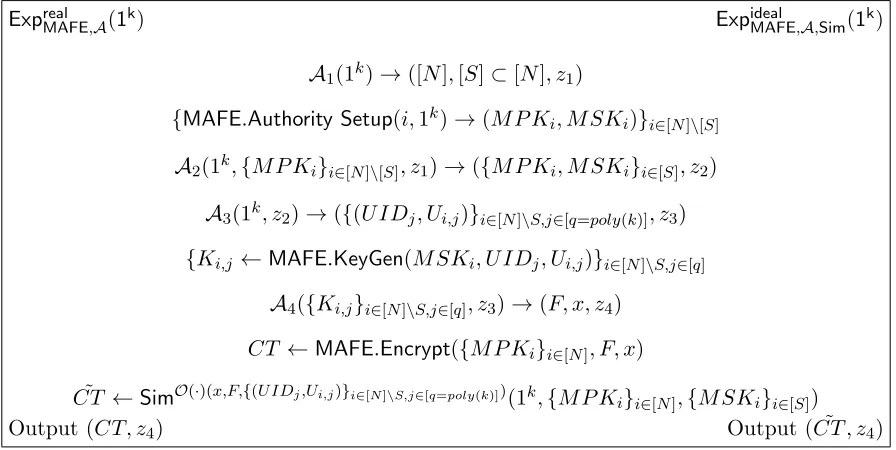
GGG+14] for functional encryption. It was proved in [AGVW13] that it in general it is impossible to achieve simulation based security for functional encryption for general circuits and arbitrary many key queries. Our primitive with simulation security even for corruption of one authority and zero token queries imply black box obfuscation, which has been shown to be impossible to exist [BGI+01]. The key notion in the security definition is that there exist a p.p.t. simulatorSim that given the tokens, corrupted authority secret keys and the public keys and access to an oracle that outputs what is learnable in the “real world” should be able to produce a simulated cipher-text for any chosen message and policy.
For ease of notation, let us assume that the authorities are labelled in [N] and the permutation given to the encryption algorithm is implicitly assumed to be the identity permutation.
ExprealMAFE,A(1k) ExpidealMAFE,A,Sim(1k)
A1(1k)→([N],[S]⊂[N], z1)
{MAFE.Authority Setup(i,1k)→(M P Ki, M SKi)}i∈[N]\[S]
A2(1k,{M P Ki}i∈[N]\[S], z1)→({M P Ki, M SKi}i∈[S], z2)
A3(1k, z2)→({(U IDj, Ui,j)}i∈[N]\S,j∈[q=poly(k)], z3)
{Ki,j ←MAFE.KeyGen(M SKi, U IDj, Ui,j)}i∈[N]\S,j∈[q]
A4({Ki,j}i∈[N]\S,j∈[q], z3)→(F, x, z4)
CT ←MAFE.Encrypt({M P Ki}i∈[N], F, x)
˜
CT ←SimO(·)(x,F,{(U IDj,Ui,j)}i∈[N]\S,j∈[q=poly(k)])(1k,{M P K
i}i∈[N],{M SKi}i∈[S])
Output (CT, z4) Output ( ˜CT , z4)
Figure 1: Simulation security
Definition 5. The scheme is said to be(q) SIM-secure againstS corruptions if there exists a p.p.t. simulator Sim such that for all of p.p.t. adversaries (A1,A2,A3,A4), the outcomes of the two experiments are computationally indistinguishable:
{ExprealMAFE,A(1k)}k∈N≈c{ExpidealMAFE,A,Sim(1k)}k∈N
The oracle O on a query (U1, .., UN) checks that there exists some U ID ∈ {U IDj}j∈[q] such that
key for (U ID, Ui) was issued by all authorities i ∈[N]\[S] in step 5. If this happens the oracle
outputs F(U1, .., UN, x), otherwise it outputs⊥.
Theorem 5. (0) SIM-secure multi-authority functional encryption for circuits secure against cor-ruption of one authority imply black box obfuscation.
1. Perform MAFE.Authority Setup(1,1k)→(P K, SK). This authority is just labelled as 1.
2. Output the obfuscation asO(C)←(CT =MAFE.Encrypt(P K, U, id, C), SK). Here,U is the policy, that on inputx, C computes C(x) and id is the identity permutation.
Evaluation atx, works by usingSK to compute a token forU ID, xfor any identityU IDand then decrypting the encryption using this token.
To argue security, we need to show that there exists a polynomial time simulatorS such that for all polynomial sized strings aux, (O(C), aux)≈c(SC(·)(1k), aux). We describe our simulator below:
1. RunsMAFE.Authority Setup(1,1k)→(P K, SK).
2. Then runs the simulator MAFE.Sim as: CT˜ ← MAFE.SimU(·,C)(P K, SK). Queries to the oracleU(·, C) can be answered by forwarding the query to the oracleC(·) and forwarding its response as it is.
3. Output ( ˜CT , SK)
If there is an adversary B that breaks the security of the obfuscation scheme, then there is an adversaryA that attacks the security of the underlying scheme. This reduction is straightforward hence we omit the details.
Theorem 6. (2)SIM-secure multi-authority functional encryption scheme forn=n(k)authorities secure against corruption of zero authorities imply black box obfuscation for nbit inputs.
Proof. Assume that there exists a schemeMAFEwith desired properties. To obfuscateC, obfuscator
O(C) does the following:
1. Performs setup MAFE.Authority Setup(i,1k) → (M P Ki, M SKi) for i ∈ [n] (authorities la-belled in [n]).
2. Selects an identity randomlyU ID, and from each authority gets tokens
{Ki,b ←MAFE.KeyGen(M SKi, U ID, b)∀i∈[n], b∈ {0,1}}.
3. Finally encrypts C as, CT ← MAFE.Encrypt({M P Ki}i∈[n], U, id, C). Here U is the policy
that on input (x1, .., xn, C) for x∈{0,1}∀i ∈ [n] outputs C(x1, .., xn) and id is the identity
permutation.
4. Output obfuscated circuit as (CT,{Ki,0, Ki,1}i∈[n]).
In order to evaluate the obfuscation on inputx, evaluator outputsC(x) =MAFE.Decrypt({Ki,xi}i∈[n], CT).
Note that correctness of obfuscation follows from the correctness of the scheme.
To argue security, we need to show that there exists a polynomial time simulator S such that for all strings aux, (O(C), aux)≈c(SC(·)(1k), aux). We describe our simulator as follows:
2. Selects an identity randomlyU ID, and from each authority gets tokens:
{Ki,b ←MAFE.KeyGen(M SKi, U ID, b)∀i∈[n], b∈ {0,1}}.
3. Then runs the simulator of the multi-authority functional encryption scheme and computes: ˜
CT ←MAFE.SimU({0,1},{0,1},..,{0,1},C)(M P K1, .., M P Kn). Queries to the oracleU({0,1},{0,1},
..,{0,1}, C) can be answered by forwarding the query x= (x1, .., xn) to the oracle C(·) and forwarding its response as it is.
4. Output ( ˜CT ,{Ki,0, Ki,1}i∈[n])
If there is an adversary B that breaks the security of the obfuscation scheme, then there is an adversaryAthat attacks the security of the underlying scheme. This reduction is straightforward; hence we omit the details.
3.2 Delegatable Functional Encryption
In this section we describe the syntax and the security definition of a key delegatable functional encryption (DFE) scheme. A DFE scheme for a class of function Fk is a tuple of five algorithms: (Setup,Enc,KeyGen,Del,Dec).
◦ Setup(1k, n) → (M P K, M SK). The setup algorithm takes the security parameter 1k and a parametern(k) which is the number of times a function key can be delegated.
◦ Enc(M P K, m) →CT. The encryption algorithm takes in a message in Mk and the master public key and outputs a cipher-text.
◦ KeyGen(M SK, f)→SKf. The key generation algorithm takes in the master secret key and a function f and outputs a keySKf
◦ Del(SKf, f0) → SKf0·f. The delegation algorithm takes a key SKf (which may have been
delegated by at most n−1 times) and a functionf0 and outputs a key for the functionf0·f
(f composed withf0).
◦ Dec(SKf, CT) → f(m). The decryption algorithm takes a cipher-text CT and a function key for f and outputs f(m).
We require the scheme to satisfy correctness informally defined as follows.
Correctness: We require that for honestly generated setup (M P K, M SK), for keys SKf of a function f, generated or delegated at most n times, and any honestly generated cipher-text CT
encryptingm, the decryption should returnf(m) with over-whelming probability.
3.2.1 Security Notion
We now present the security definition for DFE scheme. We define security notion of the scheme by the following game between a challenger and an attacker.
M P K to the adversary.
Key Query Phase 1The attacker can submit queries of two kinds
1. Submitf and get back SKf ←KeyGen(M SK, f).
2. Submit a tuple (f1, .., fn+1). In this case the challenger computes a key for f1 and then runs
the delegation algorithm to compute a key forfn+1·...·f1. The adversary can setfi+1, .., fn+1
for somei≥1 as empty in the query, in which case the delegation is done i−1 times.
Challenge PhaseThe attacker selects two messages (m0, m1) in which case it should satisfy that
f(m0) =f(m1) andfn+1·..·f1(m0) = fn+1·..·f1(m1) for function queries of both kinds above.
Challenger encryptsmb asCT whereb∈ {0,1}is randomly chosen and hands it over to the adver-sary.
Key Query Phase 2 : The adversary may make queries as in phase 1 as long as they sat-isfy the constraint with the challenge message as described in the challenge phase description.
Guess The attacker submits a guess b0 for b. The attacker wins if b0 = b. The attacker’s ad-vantage in this game is defined to be |P r[b=b0]−1/2|
We call the game described above asINDsecurity game.
Definition 6. A DFE system is (IND) secure if all polynomial time adversaries have at most a negligible advantage in the (IND) security game.
4
Our Construction for
MAFE
Notation: Let k denote the security parameter and n denote the bound on the number of au-thorities used while encrypting the cipher-text. Let O denote a (1,2−2(n+1)k) weak extractability obfuscator for general circuits. F = (setup,puncture,eval) be a sub exponential puncturable psuedo random function (slightly abusing notation, we refer F(K, x) as evaluation of PRF at x even if the key is punctured) with constant cP RF. Let P be a sub-exponentially secure injective one way function with security constantscowp1 andcowp2. In this section, while giving (a1, .., an) as an input
to a circuit or a PRF F, we mean that the input is given as a concatenation ofa1||..||an.
◦ MAFE.Authorithy Setup(i,1k): Each authorityirunsF.setup(1µ)→Ki and obfuscates (using the obfuscator O) the following circuit as V K. On input (x, σ), the circuit checks that
P(σ) = P(F(Ki, x)), if the check passes it outputs 1 otherwise it outputs 0. Then it sets
M P Ki =V K
It generatesM SKi as an obfuscation of the circuit (using the obfuscatorO) that on inputx outputsF(Ki, x).
Here µ is set such that it is greater than (nk+ 2k)1/cP RF and the output length is greater
◦ MAFE.KeyGen(M SKi, U ID, U): KU ID,i,U ←M SKid(U ID, U). On input user identityU ID, property U and secret key for authority i, KeyGen outputs a PRF evaluation on (U ID, U) using the circuitM SKi.
◦ MAFE.Encrypt({M P Ki}i∈I, G, ρ, m): Let C be the circuit described in figureFigure 2 (ini-tialised with hard-wiringsm, G, ρ). Output (G, ρ,O(C)).
◦ MAFE.Decrypt({KU ID,i,Ui}i∈I, G, CT). The decryption algorithm gets a policy, an obfuscated
circuit and some tokens for authorities in I as input (if the decryptor does not receive a token from an authority its treated as null) and just evaluates the circuit using the tokens. Specifically it computes and outputs,CT(U ID,{Ui}i∈I,{KU ID,i,Ui}i∈I).
Remark. Although we instantiate scheme with a sub-exponentially secure injective one way func-tion P, in practice we can instantiate it with any one-one function. For the security proof, we see that the input output behaviour ofM P Ki do not change when it is instantiated with any one-one function, hence we can switch to a hybrid when it is instantiated by sub-exponentially injective secure one way function and due to the security of obfuscation these two hybrids are close.
A quick inspection of the algorithms shows that the scheme described above is correct and we omit details of the proof here.
Constants: m, G, ρ,{M P Ki}i∈I.
Input: U ID,{Ui}i∈I,{KU ID,i,Ui}i∈I. (some of Ui’s can be null in which case KU ID,i,Ui is
also empty)
For alli∈ I perform the following checks and output⊥if any of the check fails.
◦ Check that eitherUi is null, (in which caseKU ID,i,Ui is also null), or
◦ Check thatM P Ki(U ID, Ui, KU ID,i,Ui) = 1
OutputG(<{Ui}i∈I >, m).
Figure 2: Program Encrypt
4.1 Security Proof
Theorem 7. Assuming existence of a subexponentially secure indistinguishability obfuscator and a subexponentially secure injective one way function there exist a IND secure multi-authority func-tional encryption.
Proof. We now prove that the construction described in section 4 is a IND secure multi-authority functional encryption scheme.
Notation: For ease of notation, we label authorities in [n] for some polynomial n(k). We use µ
one way function. For ease of notation, we also assume thatρ i.e. the permutation associated with the policy function is an identity function on [n]. We now present a sequence of hybrids and prove indistinguishability.
H0: The standardIND game for multi-authority functional encryption while encryptingm0.
1. The adversary A receives the security parameter and outputs [n] as the set of authorities. The challenger does the setup for all authorities in [n].
2. A can adaptively query for tokens and can corrupt authorities. WhenA asks for the secret key for authorityi, the challenger releasesM SKi.
3. A now queries tuples of the form (U ID, i, U), interpreting to issue a token for a user with identityU ID and property U by authority i.
4. Challenger generates corresponding tokens KU ID,i,U ← M SKi(U ID, U) and gives them to
A.
5. Adversary then declares (m0, m1, G), these messages satisfy the constraint as outlined in the
definition.
6. Challenger encrypts m0 with policyG and gives (G, CT) to theA.
7. A can adaptively query for tokens and can corrupt authorities. WhenA asks for the secret key for authorityi, the challenger releasesM SKi.
8. A now queries tuples of the form (U ID, i, U,), interpreting to issue a token for a user with identityU ID and property U by authority i.
9. Aoutputs a guess b0
Hx: Forx∈[1,2(n+1)k+ 1], this hybrid is similar to the previous hybrid except that the challenger outputs an obfuscation of Figure 3 (initialised with m0, m1, x, G,{M P Ki}i∈[n]) along with G as
the challenge cipher-text.
H2(n+1)k+2 : This hybrid corresponds to the actual IND game when the challenger encryptsm1.
Let us now denote byγ the supremum of the quantity |P r[D(O(C0)) = 1]−P r[D(O(C1)) = 1]|,
whereDis a polynomial time non uniform distinguisher andC0, C1be polynomially sized arbritary
functionally equivalent circuits. In our instantiation,γ <2−(n+2)k(Otherwise, there is an extractor which will be able to extract a differing point with overwhelming probability; a contradiction).
Lemma 2. H0 is indistinguishable from hybrid H1.
Proof. Only thing to show here is that the circuits whose obfuscation is given out in these hy-brids are equivalent. It is easy to see that the circuit described in Figure 2 when initialised with (m0, G,{M P Ki}i∈[n]) and the circuit inFigure 3initialised with (m0, m1m0, m1, x, G,{M P Ki}i∈[n])
Constants: m0, m1, x, G,{M P Ki}i∈[n].
Input: (U ID, U1, .., Un,{KU ID,i,Ui}i∈[n]). (some of Ui’s can be null in which case KU IDi,Ui
is also empty)
For alli∈[n] perform the following checks and output⊥if any of the check fails.
◦ Check that eitherUi is null, (in which caseKU ID,i,Ui is also null), or
◦ Check thatM P Ki(U ID, Ui, KU ID,i,Ui) = 1
IfU ID, U1, .., Un< x−1 output G(U1, .., Un, m1) else G(U1, .., Un, m0).
Figure 3: Program Encryptx
Lemma 3. H2(n+1)k+1 is indistinguishable from hybrid H2(n+1)k+2.
Proof. The proof of this statement is similar to the proof described for lemma 2. Only thing to show here is that the circuits whose obfuscation is given out in these hybrid are equivalent. It is easy to see that the circuit described inFigure 2when initialised withm1, G,{M P Ki}i∈[n]and the
circuit described in Figure 3 when initialised with m0, m1, x, G,{M P Ki}i∈[n] and x = 2nk+k+ 1
are equivalent. Hence, |P r[D(H2(n+1)k+1) = 1]− |P r[D(H2(n+1)k+2) = 1]|< γ.
Lemma 4. For any x ∈ [1,2(n+1)k+ 1], |P r[A(Hx) = 1]−P r[A(Hx+1) = 1]|< O(n·2−(n+2)k)
for any polynomial time adversary A.
Proof. For this lemma, let us denote x−1 = (U ID0, U10, U20, .., Un0) i.e. concatenation of n+ 1 strings. We now list down the following sub hybrids:
Hx,1 : This hybrid is similar to hybrid Hx except that M SKi for any authority i is generated differently. Challenger first samples a PRF key Ki. It parsesx−1 = (U ID0, U10, U20, .., Un0). Then, it computes a punctured key Ki0 ← F.Puncture(Ki, U ID0, Ui0) and αi ← F(Ki, U ID0, Ui0). M SKi is now given out as a weak extractability obfuscation of circuit described inFigure 4. Informally,
Hx and Hx,1 are indistinguishable due to the security of obfuscation and the correctness of the puncturable PRF.
Hx,2 : This hybrid is similar to hybrid Hx,1 except that M P Ki for any authority i is
gener-Hard-wired: Ki0, αi, U ID0, Ui0.
Input: x
◦ Ifx6= (U ID0, Ui0) output F(Ki0, x) else outputαi
Figure 4: Secret* circuit
M SKiis now given out as a weak extractability obfuscation of circuit described inFigure 5. Infor-mally,Hx,1 and Hx,2 are indistinguishable due to the security of obfuscation and the correctness of the puncturable PRF.
Hx,3 : This hybrid is the same as the previous hybrid except that for all i ∈ [n], αi is chosen
Hard-wired: Ki0, P(αi), U ID0, Ui0.
Input: x, σ
◦ Ifx 6= (U ID0, Ui0) check that P(F(Ki0, x)) =P(σ) and output 1 if the check passes; 0 otherwise.
◦ Else check thatP(αi) =P(σ) and output 1 if the check passes; 0 otherwise.
Figure 5: Verifier* circuit
randomly. Informally, Hx,2 and Hx,3 are indistinguishable due to the security of the puncturable
PRF.
Hx,4 : This hybrid is the same as the previous hybrid except that the challenge cipher-text is
computed as an obfuscation of circuit in 3 hard-wired with x+ 1.. Informally, Hx,3 and Hx,4 are
indistinguishable due to the security of the injective one way function P.
Hx,5 : This hybrid is the same as the previous hybrid except that for all i ∈ [n], αi is com-puted as an actual PRF evaluation. . Informally, Hx,4 and Hx,5 are indistinguishable due to the security of the puncturable PRF.
Hx,6 : This hybrid is the same as the previous hybrid except that for any authority i, M SKi is computed as an obfuscation of circuit described in the Authority Setup algorithm. Informally,
Hx,5 and Hx,6 are indistinguishable due to the security of obfuscation and the correctness of the
puncturable PRF.
Hx,7 : This hybrid is the same as the previous hybrid except that for any authority i, M P Ki is computed as an obfuscation of circuit described in Authority Setup algorithm. Informally, Hx,6
and Hx,7 are indistinguishable due to the security of obfuscation and the correctness of the
punc-turable PRF. This hybrid is same as the hybridHx+1.
Claim 1. For any p.p.t. distinguisher D, |P r[D(Hx) = 1]−P r[D(Hx,1) = 1]|≤O(n·2−nk−2k).
Proof. The difference between hybrids Hx and Hx,1 is the generation of public keysM SKi for all authoritiesi∈[n]. Note that inHxit is generated honestly as described in theAuthority Setupusing the PRF keyK. InHx,1 it is generated as an obfuscation of circuit described inFigure 4(initialised
overall|P r[D(Hx) = 1]−P r[D(Hx,1) = 1]|≤O(n·2−nk−2k). The reduction between these hybrids is straight forward and we omit the details.
Claim 2. For any p.p.t. distinguisherD, |P r[D(Hx,1) = 1]−P r[D(Hx,2) = 1]|≤O(n·2−nk−2k).
Proof. The difference between hybridsHx,1 andHx,2 is the generation of public keysM P Ki for all authorities i∈[n]. Note that in Hx,1 it is generated honestly as described in the Authority Setup
using the PRF key K. In Hx,2 it is generated as an obfuscation of circuit described in Figure 5
(initialised with punctured key Ki0 and P(F(Ki, U ID, Ui))). These two circuits are functionally equivalent. We can hence define a sequence of | [n]\S | hybrids where we replace one by one
M P Ki from being genuinely constructed to one constructed as in Hx,2. Since O is (1,2−(2n+2)k)
weak extractability obfuscator the differing advantage between each of these hybrids is less than 2−(n+2)k. Hence, overall |P r[D(Hx,1) = 1]−P r[D(Hx,2) = 1] |≤ O(n·2−nk−2k). The reduction between these hybrids is straight forward and we omit the details.
Claim 3. For any p.p.t. distinguisherD, |P r[D(Hx,2) = 1]−P r[D(Hx,3) = 1]|≤O(n·2−nk−2k).
Proof. This lemma follows from the property that puncturable PRF’s output is psuedo-random at punctured point given the punctured key (sub-exponential security of the puncturable PRF). We parse x−1 = (U ID0, U10, .., Un0).
This proof goes through by a sequence of n hybrids where for each authority i ∈ [n], (Ki0, αi ←
F(Ki, U ID0, Ui0)) is replaced with (Ki0, αi ←− R$ for all i∈[n] (Here Ki is the PRF key and Ki0 is the punctured key at point (U ID0, Ui0)). This can be done because in both these hybrids,M SKi and the encryption keys M P Ki use only the punctured keys and a the value of the PRF at the punctured point. Here,Ris the co-domain of the PRF, which is equal to the domain of the injective one way function P. Since, PRF is sub exponentially secure with parameter cP RF (cP RF be the security constant of the PRF ) when PRF is initialised with parameter greater than (nk+2k)1/cP RF,
distinguishing advantage between each intermediate hybrid is bounded byO(2nk−2k). The reduction is straight forward and we omit the details.
Claim 4. For any p.p.t. distinguisher A, |P r[A(Hx,3) = 1]−P r[A(Hx,4) = 1]|≤O(2−nk−2k).
Proof. Let Q denote a random variable that is defined as follows: Q = 0 when in any hybrid
Hx,2, (m0, m1, G) is given out by the adversary such that G(x−1, m0) =G(x−1, m1) and Q= 1
otherwise. We now make two observations:
1. For any PPT A,|P r[A(Hx,2) = 1/Q= 0]−P r[A(Hx,3) = 1/Q= 0]|<2−(n+2)k.
For any adversaryAand a hybrid challengerCsuch thatQ= 0, IfAhas an advantage greater than 2−(n+2)k, then there exists an algorithm B that breaks indistinguishability obfuscation property ofO with the same advantage.
B interacts with the obfuscation challenger as follows. B invokes A and the challenger of the hybrid. The hybrid challenger runs the setup for corresponding authorities. Then A
queries for some tokens and the challenger replies to the query by giving out the tokens for those authorities as done in the hybrid Hx,3. Finally,A outputs (m0, m1, G). Now,
Now,BsetsC0as the program described inFigure 3initialised with hard-wirings (m0, m1, G, x,
{M P Ki}i∈[n]) and C1 as the program described in Figure 3 initialised with (m0, m1, G, x+
1,{M P Ki}i∈[n]). Obfuscation challenger randomly picks up b∈ {0,1}. Ifb= 0, it obfuscates
C0 otherwise it obfuscatesC1. Bdirectly sends this obfuscation toAas the challenge
cipher-text. If b = 0, view of A is simulated as Hx otherwise it is simulated as Hx+1. B finally
outputs whateverAdoes. Hence, advantage ofBis at least as much as the advantage ofAin distinguishing the hybrids. Since,O is a secure indistinguishability obfuscator with security upper gap bounded by 2−(nk+2k), the claim holds.
2.
P r[Q= 1]· |P r[A(Hx,2) = 1/Q= 1]−P r[A(Hx,3) = 1/Q= 1]|<
max{O(2−(nk−2k)), O(1/2µcowp1−n−1), O(2−µcowp2/2+n+1)}
Herecowp1 >0 andcowp2 >0 are constants for the sub-exponential injective one way function.
Let us now assume that P r[Q = 1]Q=1/2n+1 > 2−nk−2k/2n+1 as otherwise the claim
triv-ially holds. Now, if such a condition is true then we construct an inverter that inverts the injective one way function with probability p = P r[Q = 1]Q=1/2n+1 and takes time
t = O(22n/2Q=1·poly(k, n)). Again we assume that, p > Ω(2−µcowp2) or otherwise there is nothing to prove and the observation trivially holds. If this assumption is true then it must mean that t >Ω(2µcowp1) (due to the security of injective one way function), which gives us our desired result on some manipulation.
We now assume P r[Q= 1]Q=1/2n+1 >2−nk−2k−n−1 and describe our inverter B. B works
as follows:
(a) InvokesAand gets [n]. It sends nto the injective one way function challenger and gets (P(r1), .., P(rn)) as the challenge.
(b) B samples the punctured PRF keys Ki0 for all i ∈ [n] (Punctured at (U ID0, Ui0)) and usesP(ri) along with the key to generate the public keyM P Ki as per circuit described inFigure 5.
(c) WhenA asks for anyM SKi it asks the injective one way function challenger forri and uses this value along with Ki0 to generate M SKi.
(d) WhenA asks for tokens by querying (U ID, i, U) it computes and sendsF(Ki0, U ID, U) ifU ID, U 6=U ID0, Ui0, otherwise it asks injective one way function challenger forri and sends it over toA.
(e) Adeclares (m0, m1, G). If G(x−1, m0) =G(x−1, m1),B aborts.
(f) LetC0 be the program described in Figure 3initialised with (m0, m1, x, G,
{M P Ki}i∈[n]) andC1 as the program described inFigure 3initialised with (m0, m1, x+
1, G,{M P Ki}i∈[n]). LetS denote the set andi∈S for which either M SKi was queried till this point or (U ID0, i, Ui0) was submitted as a token query.
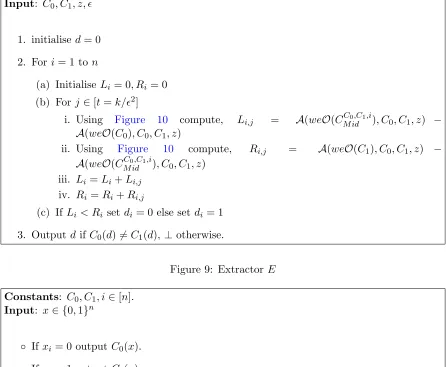
(g) B now selects a set t ( [n] such that t∪S 6= [n] and gets ri for all i ∈ t. Our extractor now computes ri for all i ∈ [n], using these values. B runs an extractor (r1, .., rn)←E(C0, C1, z) on the following distinguisherL wherezis the auxiliary input
i. Luses z to invokeA till the previous point. ii. Anow gets an obfuscation ofC0 orC1.
iii. A can query for M SKi and tokens by querying (U ID, i, U). These are generated usingz. If the response cannot be generated (whenrineeds to be known fori /∈t∪S ) it outputs 0.
iv. Aoutputsb0. If for all i∈t∪S,ri’s were required byL, outputb0 otherwise output 0.
Note that any valid A does not ask to invert all ri∀i∈[n]. This is becauseG(x−1, m0)6=
G(x−1, m1) hence it does not form a valid query set.
Let us now analyse the running time and probability of success for B. B breaks the as-sumption on the injective one way function with probability at least P[Q = 1]Q=1/2n+1.
Following is the argument:
Letτ1 denote the transcript betweenA(along withKi0∀i∈[n] and queriedM SKi’s) and the hybrid challenger before the cipher-text is given out when Q = 1. We say that τ1 is good
if the advantage conditioned on this transcript, Q=1,τ1 > Q=1/2. Then, one can show that
P r[τ1 is good ]> Q=1/2. This follows from the fact that,Q=1 > Q=1,τ1is goodP r[τ1 is good]+
Q=1,τ1is not goodP r[τ1 is not good]. Assuming, P r[τ1 is not good] < Q=1/2 gives us a con-tradiction.
Now we denote by T the set of ri’s asked by A (either by querying M SKi or querying (U ID0, i, Ui0) for a token).
|P r[A(Hx,3) = 1/Q= 1, τ1]−P r[A(Hx,4) = 1/Q= 1, τ1]> Q=1/2|
For allt([n],
Σt|P r[A(Hx,3) = 1∩T =t/Q= 1, τ1−P r[A(Hx,4) = 1∩T =t/Q= 1, τ1]|
> Q=1/2
Since number of such subsets is bounded by 2n, there exists a sett∗ such that
|P r[A(Hx,3) = 1∩T =t∗/Q= 1, τ1−P r[A(Hx,4) = 1∩T =t∗/Q= 1, τ1]|
> Q=1/2n+1
We note that B runs extractor on distinguisherL using apriori fixed sett. If tis guessed as
t∗ (which occurs with probability at least 1/2n)
|P r[L(C0, C1,O(C0), z) = 1]−P r[L(C0, C1,O(C1), z) = 1]|>
|P r[A(Hx,3∩T =t∗/Q= 1, τ1) = 1]−P r[A(Hx,4∩T =t∗/Q= 1, τ1) = 1]|
> Q=1/2n+1
Hence, probability that B extracts a point (x−1, r1, .., rn) is at least P r[Q = 1]·P[t =
t∗]·P r[τ1 is good] > P r[Q = 1]Q=1/2n+1. Assuming the advantage of L, Q=1/2n+1 >
2−2nk−2k(or else the observation trivially holds), we can run the extractor which runs in time
From the two observations above if µ is set greater thanmax{(nk+ 2k)1/cowp2,(nk+ 2k)2/cowp2}, we prove the claim.
Claim 5. For any p.p.t. distinguisher D, |P r[D(Hx,4) = 1]−P r[D(Hx,5) = 1]|≤O(n.2−nk−2k).
Proof. This claim follows from the property that puncturable PRF’s value is psuedo-random at punctured point given the punctured key (sub-exponential security of the puncturable PRF). The proof is similar to the proof of indistinguishability between Hx,2 and Hx,3. Hence, we omit the
details to avoid repetition.
Claim 6. For any p.p.t. distinguisher D, |P r[D(Hx,5) = 1]−P r[D(Hx,6) = 1]|≤O(n.2−nk−2k).
Proof. This claim follows from the security of the obfuscation and correctness of the puncturable PRF. The proof is similar to the proof of indistinguishability between Hx,1 and Hx,2. Hence, we
omit the details to avoid repetition.
Claim 7. For any p.p.t. distinguisher D, |P r[D(Hx,6) = 1]−P r[D(Hx,7) = 1]|≤O(n.2−nk−2k).
Proof. This claim follows from the security of the obfuscation and correctness of the puncturable PRF. The proof is similar to the proof of indistinguishability between Hx and Hx,1. Hence, we
omit the details to avoid repetition.
From the claims above we get that for any PPT distinguisherD,P r[A(Hx) = 1]−P r[A(Hx+1) =
1]≤O(n.2−(n+2)k)
From the lemmas above, we get that,|P r[A(H0) = 1]−P r[A(H2(n+1)k+2) = 1]|≤Σx|P r[A(Hx) =
1]−P r[A(Hx+1) = 1]≤2(n+1)k·O(n·2−(n+2)k) +negl(k)< O(n·2−k) +negl(k). This concludes the proof.
4.2 Applications
In this section, we list a few applications of multi-authority functional encryption.
1. Multi-Authority ABE: [LW11] constructs a multi-authority attribute based encryption scheme where any authority can be set up independently and without any interaction with any other authority. Their work was the state of art on this topic and handles access policies in monotoneN C1. It required a global parameter generation and a random oracle.
Our work immediately results in a multi-authority attribute based encryption scheme: En-cryptor encrypts the message along with a policy F that on input (U1, .., Un) checks that it
satisfies the required access structure A on attributes. If it does, outputs m otherwise ⊥.
2. Functional Secret Sharing for monotoneP: [BBDK00] coined a primitive called as func-tional secret sharing for t-out-of- n access structures. Informally, a dealer can secret share a secret s among n players. Any subset [B] ⊂[n] of size greater than t can run a protocol
FB,f using their sharessi and some randomnessri fori∈B to learn the valuef(s). Security property is with respect so a subsetC ⊂[n] of size less than tand is two fold: before evalu-ation security and after evaluevalu-ation security. In before evaluevalu-ation security, one requires that given the view of the C (shares of parties in C) an (computationally bounded/information theoretic) adversary should not be able to distinguish whether it is a sharing of sor s0 6=s. In after evaluation security, for a priory chosenf, given the view ofC when a setB runsFB,f (shares and randomness of the parties inC, messages sent to and fro from the parties inCto parties in B while performing this computation), it should happen that any (computation-ally/bounded) adversary should not be able to distinguish whether the sharing corresponds tosors06=sfor which f(s) =f(s0).
[BBDK00] defines both non interactive and interactive functional secret sharing (depending if the protocol FB,f has one or more rounds). The more interesting case is of achieving non interactive functional secret sharing using only broadcast channel (assuming no private channel between parties). They present information theoretic constructions only for linear functions and t-out-ofn threshold access structures. Using a multi-authority functional en-cryption scheme, one can construct computational functional secret sharing scheme for any access structure in monotone P that can allow evaluation for any polynomial sized circuit. For details, refer appendixB.
5
Constructing Delegatable Functional Encryption
Let HIBE be a sub-exponentially secure hierarchical identity based encryption. iO be a sub-exponentially secure indistinguishability obfuscation and F = (Setup,
Puncture,Eval) (slightly abusing notation, we refer F(K, x) as evaluation of PRF at x even if the key is punctured) be a sub-exponentially secure puncturable psuedo-random function. We now describe our construction. Let 0< cio, cP RF, cHIBE <1 be the respective security constants. For syntax and security definition of HIBE refer section2.4.
◦ Setup(1k, n): On input the security parameter 1kandnthe setup algorithm runsHIBE.Setup(1λ, n, k) → (P K, SK). Here nk+k denote the length of the identity and n denotes the max-imum level of delegation. The algorithm sets M SK = SK and M P K =P K and outputs (M P K, M SK). λis set greater than (nk+ 2k)1/cHIBE.
◦ Enc(M P K, m) The algorithm samples a puncturable PRF key F.Setup(1µ) →K and obfus-cates the circuit described in Figure 6 with security parameter 1γ (γ can be set more than (nk+ 2k)1/cio). µcan be set such that it maps to the space of randomness of HIBE encryption
algorithm and greater than (nk+ 2k)1/cP RF
◦ KeyGen(M SK, f) : On input a functionf of size at mostk, the algorithm computes anHIBE
key for identity vector (−, ...,−, f) and outputs it asSKf.
◦ Del(SKf, f0): The delegation algorithm takes as input anHIBEkey for identityf = (−, ..,−, fi
Hard-wired: M P K, K, m.
Input: f ∈ {0,1}nk+k
– Parsef = (fn+1, .., f1)∈({0,1}k)n+1 and computea=fn+1·...·f1(m)
– Output HIBE.Enc(M P K, f, a;F(K, f)) (HIBE encryption using the identity vector (fn+1, .., f1))
Figure 6: Encryption circuit
◦ Dec(SKfi·...·f1, CT) : The decryption algorithm first computes CT(id, .., id, fi, .., f1) = c (in-put to the circuit is the concatenation id||, .., id||fi||...||f1) to recover an HIBE cipher-text
for identity vector (id, id, .., id, fi, .., f1) and then usesSKfi,..,f1 to decrypt it using HIBE de-cryption algorithm and outputs whatever it outputs. Hereid is akbit representation of the identity function.
5.1 Security Proof
Theorem 8. Assuming existence of a sub-exponentially secure indistinguishability obfuscator and a sub-exponential hierarchical identity based encryption there exists a secure delegatable functional encryption scheme.
Proof. We now prove that the scheme described above is secure. We begin by listing down indistin-guishable hybrids where the first hybrid corresponds to the challenge game in which the adversary is given an encryption ofm0 and the final hybrid corresponds to the case in which the adversary is
given an encryption ofm1.
Hybrid0: In this hybrid the challenger does the setup to compute HIBE keys (M P K, M SK) as the master setup keys for FE scheme. Any key query and delegation query is responded as done in the algorithms. Upon receiving the challenge message vector (m0, m1), the challenger encrypts
m0 using the encryption algorithm.
Hybridu∈[1,2nk+k+1] : This hybrid is the same as the previous one except that the cipher-text
is now an encryption of circuit inFigure 7.
Hybrid2nk+k+2: In this hybrid the challenger does the setup to compute HIBE keys (M P K, M SK)
as the master setup keys for FE scheme. Any key query and delegation query is responded as done in the algorithms. Upon receiving the challenge message vector (m0, m1), the challenger encrypts
m1 using the encryption algorithm.
Lemma 5. For any ppt algorithmD,|P r[D(Hybrid0) = 1]−P r[D(Hybrid1) = 1]|< O(2−nk−2k).
Hard-wired: M P K, K, m0, m1, u.
Input: f ∈ {0,1}nk+k
◦ Parsef = (fn+1, .., f1). If f ≥u−1 compute a=fn+1·...·f1(m0) otherwise compute
a=fn+1·...·f1(m1).
◦ Output HIBE.Enc(M P K, f, a;F(K, f)) (HIBE encryption using the identity vector (fn+1, .., f1))
Figure 7: Encryption circuit*
hybrids differ only in the way the cipher-text is produced. In hybrid 0, the cipher-text is produced as an obfuscation of circuit described inFigure 6 and in hybrid 1 it is produced as an obfuscation of circuit in Figure 7 initialised with (M P K, K, m0, m1, u= 1). These two circuits are equivalent
hence by the sub-exponential security of indistinguishability obfuscation, the lemma follows.
Lemma 6. For any ppt algorithm D, | P r[D(Hybrid2nk+k+1) = 1]−P r[D(Hybrid2nk+k+2) =
1]|< O(2−nk−2k).
Proof. This lemma follows from the security of indistinguishability obfuscation. Note that the hybrids differ only in the way the cipher-text is produced. In hybrid 2nk+k+ 1, the cipher-text is produced as an obfuscation of circuit in Figure 7withu= 2nk+k+ 1 and in hybrid 2nk+k+ 2 it is produced as an obfuscation of circuit in Figure 6. These two circuits are equivalent hence by the sub-exponential security of indistinguishability obfuscation, the lemma follows.
Lemma 7. For anyu∈[1,2nk+k]ppt algorithmD,|P r[D(Hybridu) = 1]−P r[D(Hybridu+1) = 1]|< O(2−nk−2k).
Proof. Let Q denote a random variable that is defined as follows. Q = 0, when in Hybridu or
Hybridu+1, (m0, m1) released is such that foru= (fn+1, .., f1),fn+1·...·f1(m0) =fn+1·...·f1(m1).
We say that Q= 1 otherwise. Now, we make following claims:
Claim 8. Conditioned toQ= 0, for any ppt algorithmD,|P r[D(Hybridu) = 1]−P r[D(Hybridu+1) = 1]|< O(2−nk−2k).
Proof. This claim is straight forward and follows from the security of indistinguishability obfus-cation. This is because when Q = 0, in hybrid u and u+ 1 the cipher-text is generated as an obfuscation of circuit in Figure 7 initialised with u and u+ 1 respectively. These two circuits are equivalent whenQ= 0.
Let us now assume Q = 1. We now define sub hybrids between Hybridu and Hybridu+1 as follows:
Hybridu,1 : This hybrid is same as Hybridu except that generation of the cipher-text is done as follows. The challenger samples a puncturable PRF keyK and setsα=F(K, u). The PRF keyK
is now punctured at u asK0. It parses u= (fn+1, .., f1) and computes a=fn+1·..·f1(m0). Then