ENZYME SUB-FUNCTIONAL CLASS PREDICTION USING MULTI-BIOLOGICAL KNOWLEDGE FEATURE RESPRESENTATION AND TWIN
SUPPORT VECTOR MACHINE
SHARON KAUR A/P GURAMAD SINGH
A thesis submitted in fulfillment of the requirements for the award of the degree of
Master of Science (Computer Science)
Faculty of Computing Universiti Teknologi Malaysia
To my beloved late father…
ACKNOWLEDGEMENT
First and foremost, praises to God. With the strength, patience and determination given by Him, I finally completed my thesis for Masters Degree. I would like to express my greatest gratitude to my supervisor, Dr. Rohayanti binti Hassan for her time, continuous guidance and encouragement throughout this research also her patience, kindness, and for her healthier supports for the past a year and 5 months. Not forgetting my co-supervisor, Dr. Muhamad Razib Bin Othman who had allocated plenty of his time in reviewing the research conducted in ensuring efficiency and consistency. Their continued motivation had ensured the success of this research at all levels. A sincere appreciation to all of my fellow friends for being supportive and leading a helping hand.
ABSTRACT
ABSTRAK
Bidang pengkomputeran dalam struktur biologi telah berkembang pesat melalui kaedah pemprosesan berteknologi tinggi terutamanya dalam bentuk ramalan. Pengetahuan tentang kelas sub-fungsi enzim digunakan dalam pelbagai tugasan ramalan bagi menangani ciri-ciri struktur dan fungsi enzim. Walau bagaimanapun, isu tentang pengetahuan urutan struktur yang tidak mencukupi, kekurangan dalam kelas sub-fungsi enzim yang telah diramalkan, jujukan identiti rendah telah menyebabkan perwakilan ciri-ciri yang tidak tepat dan ketidakseimbangan kelas sub-fungsi enzim yang menyumbang kepada keputusan ramalan yang rendah. Oleh itu, kajian ini mencadangkan kaedah yang menggunakan ciri-ciri vektor terbitan melalui penyatuan komposisi asid amino; komposisi dipeptide; hydrophobicity dan hydrophilicity dinamakan APH yang berasaskan pengetahuan pelbagai sumber
biologi. Support Vector Machine mewakil dan mengelaskan setiap urutan protein ke dalam vektor masing-masing. Proses ini akan meningkatkan pengetahuan urutan struktur dan mengatasi perwakilan ciri-ciri yang tidak tepat. Selain itu, Twin Support Vector Machine mengklasifikasikan kelas sub-fungsi enzim dan menyelesaikan
TABLE OF CONTENTS
CHAPTER TITLE PAGE
DECLARATION ii
DEDICATION iii
ACKNOWLEDGEMENTS iv
ABSTRACT v
ABSTRAK vi
TABLE OF CONTENTS vii
LIST OF TABLES xi
LIST OF FIGURES xiii
LIST OF ABBREVIATIONS xv
1 INTRODUCTION
1.1 Overview 1
1.2 Background 2
1.3 Challenges of Enzyme Sub-functional Class Prediction
5 1.4 Current Methods in Enzyme Sub-functional
Class Prediction
6
1.5 Problem Statement 6
1.6 Objectives of the Study 8
1.7 1.8
Scope of the Study Significance of the Study
8 9
1.9 Organization of the Thesis 10
2.1 Introduction 11
2.2 Protein Sequence 13
2.3 Enzyme Sub-Functional Class Prediction 16 2.4 Sequence-based Knowledge Representation
in Enzyme Sub-functional Class Prediction 21 2.5 Significant Features Vector for Amino Acid
Representation 25
2.6 Multiclass Classifier to Solve Imbalance
Class Distribution Problem 28
2.7 Trends and Direction 31
2.8 Summary 32
3 RESEARCH METHODOLOGY
3.1 Introduction 33
3.2 Research Framework 35
3.3 Data Sources and Preparation 36
3.3.1 Protein Sequences 36
3.3.2 Features Vector Quantification 37 3.3.3 Enzyme Functional and Sub-Functional
Classes 39
3.4 Instrumentation and Results Analysis 39 3.4.1 Hardware and Software Requirements 39
3.4.2 Testing and Analysis 40
3.4.3 Evaluation Metrics 40
3.5 Summary 42
4 ENZYME SUB-FUNCTIONAL CLASS
PREDICTION BASED ON SINGLE FEATURE SELECTION
4.1 Introduction 43
4.2 Materials and Methods 44
4.2.1 Dataset Preparation 44
4.2.2 Input Feature: The Conjoint Triad Feature (CTF)
4.3.2 Analysis of Single Feature Selection
Towards Prediction 49
4.3.3 Comparison to Other Classification
Methods 51
4.3.4 Comparison to Other Related Works 52
4.4 Summary 54
5 MULTI-BIOLOGICAL BASED KNOWLEDGE FEATURES WITH SUPPORT VECTOR
MACHINES FOR ENZYME SUB-FUNCTIONAL CLASS PREDICTION
5.1 Introduction 55
5.2 Materials and Methods 56
5.2.1 Dataset Preparation 56
5.2.2 Generation of AAC 57
5.2.3 Composition of Dipeptide 58 5.2.4 Generation of Pse-AAC Features 58 5.2.5 APH with SVM Classification 59
5.2.6 Evaluation Measurement 60
5.3 Results and Discussion 61
5.3.1 Assessment of the Most Significant
Feature 61
5.3.2 Assessment on the Optimal Number of CV 63 5.3.3 Prediction on the Subclasses using the
Best Classification Method 63 5.3.4 Prediction of Unidentified Enzyme Sub-
functional Classes 65
5.3.5 Comparison to Other Related Works 65
5.4 Summary 68
6.1 Introduction 70
6.2 Materials and Methods 71
6.2.1 Extraction of Amino Acid Sequences 72 6.2.2 Quantification of Datasets with Various
Sequence Identities (IDs) 73
6.2.3 Generation of Input Features 73
6.2.4 Prediction by TWSVM 74
6.2.5 Kernel Selection 75
6.2.6 Evaluation Measures 77
6.3 Results and Discussion 78
6.3.1 Assessment on the Most Significant Feature using Different Rate of Sequence
Similarities 78
6.3.2 Assessment on the Effects of Classifiers by using Different Rate of Sequence
Similarities 82
6.3.3 Assessment on the Effect of Bio-inspired
Kernels on TWSVM 83
6.3.4 Validation on the Unclassified Enzyme
Subclasses using Gene Ontology (GO) 85 6.3.5 Comparison to Other Related Works 86
6.4 Summary 89
7 CONCLUSION
7.1 Concluding Remarks 91
7.2 Research Contributions 93
7.3 Future Works 94
7.4 Closing Remarks 95
REFERENCES 96
LIST OF TABLES
TABLE NO. TITLE PAGE
2.1 2.2
Examples of publicly accessible protein databases Enzyme sub-functional class prediction methods
17 27 3.1 Analysis with different testing parameter 41 4.1 Inconsistent enzyme sub-functional class
assignment between two datasets for 10
sub-functional class protein sequences from EC.3 46 4.2 An increment of accuracy (%) presented by
SVM-CTF compared to Pse-AAC
classification method (Chou, 2005) using DSI 49
4.3 An increment of accuracy (%) presented by SVM-CTF compared to Pse-AAC
classification method (Chou, 2005) using DSII 49
4.4 Performance of different feature representations
using SVM for DSII 50
4.5 Comparison amongst classification methods 52
4.6 Comparison with other related works 53
5.1 Evaluation results on enzyme classes using
different feature vectors 66
5.2 Performance comparison using various
computational approaches 66
5.3 The biological validation of enzyme sub-
functional class prediction 67
5.4 Performance comparison with other related
works 68
6.2 Samples of sequence structure from EC.3.2 in different sequence similarities
represented by three input features 81 6.3 Examples of classification between previous
and this study based on Gene Ontology (GO) 87 6.4 Performance comparison with other methods
LIST OF FIGURES
FIGURE NO. TITLE PAGE
1.1 The differentiation in enzyme sub-functional
class prediction 4
2.1 The content structure of Chapter 2 11
2.2 The characterization of enzyme sub-functional
class prediction 12
2.3 Hierarchical structure of enzymes sub-functional
class 13
2.4 The hierarchical structure of enzymes consist
of the main and sub-functional classes 20
3.1 An overview of the research framework 34
3.2 The process of sequence extraction and features
vector quantification 38
4.1 The sub-functional assignment/prediction for Nitrogenase Molybdenum-iron protein (UniProt ID: Q57118) using Chou’s Pse-AAC classification method (Chou,
2005) and repeated method termed as SVM-CTF 45 4.2 The intensity of features vector content for
Putative Thiosulfate Sulfurtransferase
protein (UniProt/Swiss-Prot ID: P91247) from
EC.2.8 using DSI 51
4.3 The intensity of features vector content for Putative Thiosulfate Sulfurtransferase
protein (UniProt/Swiss-Prot ID: P91247) from
EC.2.8 using DSII 51
5.1 Steps of dataset preprocessing 57
5.2 Overview on prediction of enzyme
5.3 Performance comparison across different
method in terms of acc 62
5.4 Performance comparison across different
method in terms of MCC 62
5.5 The trends of feature representation for different number of CVs ranging from 5 to 15 across different main functional classes where
(1) - (6) represents EC.1- EC.6 respectively 64 6.1 The Bio-TWSVM embodies steps of preparation
of datasets and features (top), determination of the most significant feature (best feature and classifier) and the optimal sequence identities
(bottom) 71
6.2 Quantification of datasets with different
similarities using BLAST 73
6.3 Three different feature vector representation
used in this study 74
6.4 Comparison in separation of hyperplanes
using (i) TWSVM and (ii) SVM 75
6.5 Two nonlinear kernels generated based
on Bio–TWSVM 77
6.6 Results for enzyme subclasses prediction using
different rate of sequence similarities 79 6.7 Results based on classifiers in terms of acc for
various rate of sequence similarities 83 6.8 The difference in classification process using
(i) ANN, (ii) KNN, (iii) SVM and (iv)
TWSVM classifier based on sequence from EC.3.2 84 6.9 Performance comparison in terms of sensitivity
and specificity for selected subclasses using
LIST OF ABBREVIATIONS
AAC – Amino Acid Composition
AFKNN – Adaptive Fuzzy K-Nearest Neighbor
APH – Hybrid of Amino Acid Composition, Dipeptide Composition, Hydrophobicity and Hydrophilicity
CD – Circular Dichroism
CDA – Covariant Discriminant Algorithm CTF – Conjoint Triad Feature
DNA – Deoxyribonucleic Acid DPC – Dipeptide Composition
DT – Decision Trees
EC – Enzyme Commission
HH – Hydrophobicity and Hydrophilicity
IUBMB – International Union of Biochemistry and Molecular Biology KNN – K-Nearest Neighbor
NB – Naïve Bayesian
NMR – Nuclear Magnetic Resonance
NN – Neural Network
PC – Personal Computer PDB – Protein Data Bank
PPI – Protein-protein Interaction Pse-AAC – Pseudo Amino Acid Composition RAM – Random Access Memory
RNA – Ribonucleic Acid
CHAPTER 1
INTRODUCTION
1.1 Overview
Enzyme sub-functional class plays an important role in the foundation of enzyme structure information and hence leading to the determination of enzyme function in field of biomedicine. In finding the structure and function of an enzyme, a useful first step is predicting the functional class of enzymes and thereafter its sub-functional classes. Since enzymes are made up of proteins, the protein three dimensional structures can also be identified and utilized in identifying the details of interaction of protein with other biomolecules and finally providing guidelines to infer protein function. Chou and Elrod (2003) stated that the sequence-structure gap is widening rapidly due to the unavailability of protein sequences. Therefore, by predicting enzyme sub-functional class and assigning those into corresponding structures and functions may reduce this gap.
machine learning technique gives a remarkable improvement of more than 80% in prediction quality as well as generalization capability in managing nonlinear classification.
The remainder of the chapter will provide a basic concepts regarding enzyme sub-functional class prediction using biological based knowledge. This is crucial as the thorough understanding on the fundamental information that is related to this research is needed. The following few sections will discuss the background and challenges as well as current respective solutions, toward achieving precise enzyme sub-functional class prediction. Research goal, objectives, scopes and significance ensue thereafter. The chapter ends with thesis organization.
1.2 Background
Enzymes are made up of proteins which are the fundamental components of all living cells. They are made up of a combination of varying amounts of the same 20 amino acids in sequence linked by peptide bonds. Enzymes cater most of the important functions, such as catalysis of biochemical reactions, transcription factors to guide the differentiation of the cell and its later responsiveness to signals, transport of materials in body fluids, receptors for hormones and other signaling molecules, and formation of tissues and muscular fiber. It is widely believed that the protein enzyme structures play key roles in determining its functions. However, it is extremely labor-expensive and sometimes even impossible to experimentally determine the structures for every protein sequence.
enzyme main and sub-functional classes is significant as it exemplify essential information that can be used to infer enzyme structures related in understanding the biological function of an enzyme used vastly as therapeutic strategy. Other than that, the knowledge of sub-functional class of enzyme can be applied to identify a sickle protein (Drotar, 2010) in which the enzyme sub-functional class can be discerned using amino acids content. In early study, Chou and Elrod (2003) have catalogued the enzyme functional class into six common classes namely oxidoreductases, transferases, hydrolases, lyases, isomerases, and ligases abbreviated as EC.1, EC.2, EC.3, EC.4, EC.5, and EC.6 respectively.
In enzyme sub-functional class prediction, computational methods have been gaining widespread attention due to the laborious and time-consuming constraints in experimental wet lab or also known as in vivo methods. Enzyme sub-functional class is represented either based on knowledge-based method (Chou, 2005; Cai and Chou, 2005; Chou and Elrod, 2003; Shi and Hu, 2010) or chemical atomic-based potentials (Szefczyk, 2008; Calzada et al., 2009; Lin and Oliver, 2008).The former approach is highly complicated in which it needs to determine the enzyme sub-functional class by calculating the detailed amino acids coordinates that traversed a vast number of accessible polypeptide conformations. In contrast, knowledge-based method exploits the structures information of enzymes from in vivo analysis. However, both methods rely upon tedious visual inspection or statistical inference from the sequence.
beneficial than the ones based on the information of protein sequences (Huang et al., 2007).
Several computational classification methods have been introduced. Support Vector Machine (SVM, NN, Bayesian classification (Green and Karp, 2004; Borro et al., 2006), Random Forest and Decision Trees (Syed and Yona, 2009; Syed and Yona, 2003) are amongst many classification methods, which are able to exploit the latent pattern within the identified structures of enzyme. However, there is still the challenge of representing the underlying pattern with significant features vector; from a simple features vector to represent the known enzyme structures such as amino acid composition (Chou and Elrod, 2003), pseudo amino acid composition (Chou, 2005; Chou and Cai, 2004; Cai and Chou, 2005), polypeptide composition (Shi and Hu, 2010), conjoint triad feature based on protein-protein interaction (PPI: Wang et al., 2010; Wang et al., 2011), to a more complex hybrid features vector that considers evolutionary information encoded in PSI-Blast profiles (Liu et al., 2010; Tung et al., 2007). In addition, some features vector exhibit inferior prediction performance when it lack in sequence identity.
1.3 Challenges of Enzyme Sub-functional Class Prediction
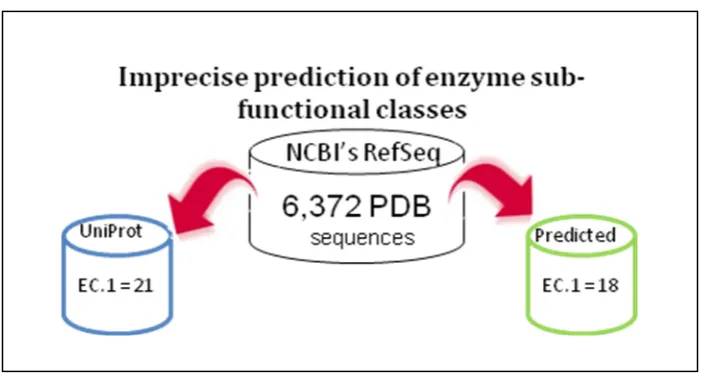
Although ENZYME and UniProt/ Swiss-Prot are examples of well-established databases that contain more reliable information of enzyme sub-functional class, yet the lack of known sub-sub-functional class of enzyme due to the laborious wet-lab experimental routine limits the high throughput enzyme sub-functional assignment. As a consequence, the assignment of enzyme sub-sub-functional class by computational method suffers from the low prediction accuracy. In turn, the first challenge belongs to the unclassified enzyme sub-functional class prediction which limits the sequence-structure class assignment.
In order to produce an accurate sequence-structure assignment, the second challenge must be tackled, which is pertaining to the investigation of heterogeneous physiochemical characteristics of amino acids in specified sequence of protein. These physiochemical characteristics are transformed into numerical value and used to represent the input features vector for the enzyme sub-functional class prediction method. Unfortunately, the prediction performance is often poor because of the inaccurate features vector is used to signify the heterogeneous characteristics (Costantini et al., 2010; Chou, 2005). The situation is aggravated in the presence of low-identity sequences (Tian and Skolnick, 2003).
categorized into two: experimental based and computational based (the details are presented in Chapter 2):
(i) Experimental based method predicts the enzyme sub-functional class of protein from physical characterization of the functional class when in vivo analysis is employed. It can be identified either from the primary protein structure using X-ray crystallography (Palioura et al., 2009; Joosten et al., 2008) and nuclear magnetic resonance (NMR) spectroscopy (Sudhamsu et al., 2010; Liras and Demain, 2009; Cámara et al., 2009), or from the enzyme structure using circular dichroism (CD) spectroscopy (Dodsworth and Leigh, 2007; Kim and Mrksich, 2010; Shi et al., 2002) and Raman spectroscopy (Leadbeater and Schmink, 2008; Aki et al., 2010; Malo et al., 2008).
(ii) Computational based method upon input of the protein sequence predicts the enzyme sub-functional class of enzyme by utilizing mathematical inference and/or computational algorithms. It can be broadened into two categories: knowledge-based method and chemical atomic-based potentials method. Consecutively, knowledge-based method is branched into four major categories: pseudo amino acid composition (Chou, 2005; Cai and Chou, 2005; Cai et al., 2005), amino acid composition (Chou and Elrod, 2003; Esmaeili et al., 2010), functional domain composition (Cai and Chou, 2004; Cai and Chou, 2005; Cai and Chou, 2006; Chou and Cai, 2004) and polypeptides/peptides composition (Costantini et al., 2010; Shi and Hu, 2010; Ding and Zhang, 2008; Zhang and Luo, 2003).
1.5 Problem Statement
and has been gaining various attentions. The enzyme sequence-structure gap is growing tremendously at a rapid pace. Generally, due to the numerous active genomes and sequencing projects, there exist more protein sequences to be classified within a certain period of time as compared to solving enzyme structures and functions. Hence, to reduce the distance of the gap, efficient computational approach has been introduced to predict enzyme sub-functional class. Based on the above mentioned challenges (Section 1.2), some factors will need to be addressed by the possible solution.
The first factor is related to the insufficient knowledge of known enzyme sub-functional captured during in vivo. It is observed that the quantities of known sequences are growing exponentially with respect to the quantity of known enzyme sub-functional (Chou and Elrod, 2003). The wide sequence-structure gap has a direct effect on the enzyme sub-functional class prediction. Thus, this study aims to provide an enzyme sub-functional class prediction method that can acquire the biological based knowledge, derived from known excessive protein sequences, in order to produce high-throughput sequence-structure class assignment instead of the laborious experimental based method.
The second factor is pertaining to the inaccurate feature representation of the protein sequences. Recently, large quantity and high-identity of sequences hold the key to achieve higher accuracy in enzyme sub-functional class prediction. In contrast, this study aims to generate alternative features vector that is more robust without degrading the prediction performance. In this study, the biological based features carried on sequence level were introduced in the predictive of enzyme sub-functional classification. The additional sequence order and sequence length knowledge is expected to avoid the inconsistency of enzyme sub-functional class prediction.
1.6 Objectives of the Study
The goal of this study is to predict the enzyme sub-functional class from the protein sequences using the multi-biological features and multi-class classifier as computational method. This can be objectified into:
(i) To construct the optimum single feature with the incorporation of SVM algorithm in order to bridge the sequence-structure knowledge.
(ii) To develop the multi-biological knowledge based feature representation in order to improve the accuracy of the enzyme sub-functional class prediction. (iii) To optimize the multi-class classifier algorithm by exploiting the newly
designed features vector in (ii) to resolve the imbalance classification issue in enzyme sub-functional class prediction.
1.7 Scope of the Study
(i) This research uses dataset obtained from ENZYME and UniProt/ Swiss-Prot database (Borgwardt et al., 2005).
(ii) International Commission on Enzymes to annotate the function of enzymes by the Enzyme Commission (EC) number (Bairoch, 2000). (iii) The use of amino acid composition (AAC), dipeptide composition and
hydrophilic and hydrophobic properties to attain the sequence order and sequence level information.
properties as an efficient sequence encoding methods for representing given protein sequence.
(v) Twin SVM by incorporating the bio-inspired kernel function machine learning technique is used in order to solve the multiclass classification problem.
(vi) The prediction performances are assessed: (i) computationally: in terms of accuracy, sensitivity as well as specificity; and (ii) biologically: by cross-checking against ENZYME database and Gene Ontology. Finally, t-test is employed for statistical validation.
1.8 Significance of the Study
content of each chapter is given below:
(i) Chapter 1 defines the challenges, problems, current methods, objectives, scopes and significance of the study.
(ii) Chapter 2 reviews the main subjects of interest, which are enzyme functional class prediction, computational based method for enzyme sub-functional class prediction, imbalance classification rules, biological based knowledge structure and significant features vector.
(iii) Chapter 3 presents the research methodology of the computational method that supports the objectives of the study. This includes data sources, instrumentations and analyses.
(iv) Chapter 4 lays out the development of the SVM-CTF that is resilient towards insufficient sequence-structure knowledge of known enzyme sub-functional class. The prediction result is validated and compared against experimentally-determined enzyme sub-functional class from Wang et al. (2010). SVM-CTF is an abbreviation of SVM with Conjoint Triad Feature for enzyme sub-functional class prediction.
(v) Chapter 5 describes the APH feature that addresses the problem of heterogeneous characteristics of amino acids as well as low-identity sequences and uncertain feature representation by integrating significant features vector using the biological based knowledge. APH is an abbreviation of consolidation between (a) amino acids, (b) dipeptide composition, (c) hydrophobicity and hydrophilicity properties of protein sequence.
(vi) Chapter 6 proposes an extension to the baseline method, namely the Bio-TWSVM introduces an additional bio-inspired kernel component represented by Twin SVM classification, so as to overcome the imbalance class distribution in enzyme sub-functional class of particular sequence.
REFERENCES
Aki, Y., Nagai, M., Nagai, Y., Imai, K., Aki, M., Sato, A., Kubo, M., Nagatomo, S., Kitagawa, T., 2010. Differences in Coordination States of Substituted Tyrosine Residues and Quaternary Structures among Hemoglobin M Probed by Resonance Raman Spectroscopy. Journal of Biological Inorganic Chemistry, 15(2), pp.147–158.
Anfinsen, C.B., 1973. Principles That Govern the Folding of Protein Chains. Science, 181(4096), pp.223–230.
Arjunan, S.P., Kumar, D.K., Naik, G.R., 2010. A Machine Learning Based Method For Classification Of Fractal Features Of Forearm Semg Using Twin Support Vector Machines. Proceedings of the Annual International Conference on IEEE Engineering in Medicine and Biology Society, (Buenos Aires,
Argentina), pp.4821–4824.
Bairoch, A., 2000. The ENZYME Database in 2000. Nucleic Acids Research, 28(1), pp.304–305.
Barthel, D., Hirst, J.D., Blaewicz, J., Burke, E.K., Krasnogor, N., 2007. ProCKSI: A Decision Support System for Protein (Structure) Comparison, Knowledge, Similarity and Information. BMC Bioinformatics, 8(1), p.416.
Berman, H.M., Westbrook, J., Feng, Z., Gilliland, G., Bhat, T.N., Weissig, H., Shindyalov, I.N., Bourne, P.E., 2000. The Protein Data Bank. Nucleic Acids Research, 28(1), pp.235–242.
Cholera Toxin Treatment. Veterinary Immunology and Immunopathology, 134(3-4), pp.239–248.
Borgwardt, K.M., Ong, C.S., Schonauer, S., Vishwanathan, S.V.N., Smola, A.J., Kriegel, H.P., 2005. Protein Function Prediction via Graph Kernels. Bioinformatics, 21(Suppl. 1), pp.i47–i56.
Borro, L.C., Oliveira, S.R., Yamagishi, M.E., Mancini, A.L., Jardine, J.G., Mazoni, I., Santos, E.H., Higa, R.H., Kuser, P.R., Neshich, G., 2006. Predicting Enzyme Class From Protein Structure Using Bayesian Classification. Genetics and Molecular Research, 5(1), pp.193–202.
Boutet, E., Lieberherr, D., Tognolli, M., Schneider, M., Bairoch, A., 2007. UniProtKB/Swiss-Prot. Methods in Molecular Biology, 406(1), pp.89–112. Brown, D.P., Krishnamurthy, N., Sjolander, K., 2007. Automated Protein Subfamily
Identification and Classification. PLoS Computational Biology, 3(8), pp.1526–1538.
Cai, Y.D., Chou, K.C., 2005. Predicting Enzyme Subclass by Functional Domain Composition and Pseudo Amino Acid Composition. Journal of Proteome Research, 4(3), pp.967–971.
Cai, Y.D., Chou, K.C., 2006. Predicting Membrane Protein Type by Functional Domain Composition and Pseudo-amino Acid Composition. Journal of Theoretical Biology, 238(2), pp.395–400.
Cai, Y.D., Liu, X.J., Xu, X.B., Chou, K.C., 2002. Artificial Neural Network Method for Predicting Protein Secondary Structure Content. Computers and Chemistry, 26(4), pp.347–350.
Calzada, J., Zamarro, M.T., Alcón, A., Santos, V.E., Díaz, E., García, J.L., Garcia-Ochoa, F., 2009. Analysis of Dibenzothiophene Desulfurization in a Recombinant Pseudomonas Putida Strain. Applied and Environmental Microbiology, 75(3), pp.875–877.
by Pseudomonas Reinekei MT1. Journal of Bacteriology, 191(15), pp.4905– 4915.
Chang, C.C., Lin, C.J., 2011. LIBSVM : A Library for Support Vector Machines. ACM Transactions on Intelligent Systems and Technology, 2(27), pp.1–27.
Chen, C., Chen, L.X., Zou, X.Y., Cai, P.X., 2008. Predicting Enzyme Subclass based on Multi-Features Fusion. Journal of Theoretical Biology, 253(2), pp.388– 392.
Chen, C., Zhou, X., Tian, Y., Zou, X., Cai. P., 2006. Predicting Enzyme Subclass with Pseudo-Amino Acid Composition and Support Vector Machine Fusion Network. Analytical Biochemistry, 357(1), pp.116–121.
Chen, W., Wang, J., Wang, E., Lu, Y., Lau, S.K., Lawrence, M., Huang, Q., 2010. Detection of Clonal Lymphoid Receptor Gene Rearrangements in Langerhans Cell Histiocytosis. American Journal of Surgical Pathology, 34(7), pp.1049– 1057.
Chinnasamy, A., Sung, W.K. , Mittal, A., 2005. Protein Structure and Fold Prediction Using Tree-augmented Naive Bayesian Classifier. Journal of Bioinformatics and Computational Biology, 3(4), pp.803–819.
Chou, K.C., 1989. Low-frequency Resonance and Cooperativity of Hemoglobin. Trends in Biochemical Sciences, 14(6), pp.212–213.
Chou, K.C., 2005. Using Amphiphilic Pseudo Amino Acid Composition to Predict Enzyme Subfamily Classes. BMC Bioinformatics, 21(1), pp.10–19.
Chou, K.C., Cai, Y.D., 2004. Using GO-PseAA Predictor to Predict Enzyme Sub-class. Biochemical and Biophysical Research Communications, 325(2), pp.506–509.
Chou, K.C., Elrod, D.W., 2003. Prediction of Enzyme Family Classes. Journal of Proteome Research, (2)2, pp.183–190.
Chou, W.Y., Pai, T.W., Jiang, T.Y., Chou, W.I., Tang, C.Y., Chang, M.D.T., 2011. Hydrophilic Aromatic Residue and In Silico Structure for Carbohydrate Binding Module. PLoS ONE, 6(9), p.e24814.
Crammer, K., Singer, Y., 2001. On the Algorithmic Implementation of Multiclass Kernel-Based Vector Machines. Journal of Machine Learning Research, 2, pp.265–292.
Dessailly, B.H., Adam, A.J., Yeats, C., Lees, J.G., Cuff, A., Orengo, C.A., 2009. The Evolution of Protein Functions and Networks: A Family-centric Approach. Biochemical Society Transactions, 37(Part 4), pp.745–750.
Ding, S., Yu, J., Qi, B., Huang, H., 2012. An Overview on Twin Support Vector Machines. Artificial Intelligence Review.
Ding, Y.S., Zhang, T.L., 2008. Using Chou's Pseudo Amino Acid Composition to Predict Subcellular Localization of Apoptosis Proteins: An Approach with Immune Genetic Algorithm-based Ensemble Classifier. Pattern Recognition Letters, 29(13), pp.1887–1892.
Dodsworth, J.A., Leigh, J.A., 2007. Nifi Inhibits Nitrogenase by Competing with Fe Protein for Binding to the MoFe Protein. Biochemical and Biophysical Research Communications, 364(2), pp.378–382.
Drotar, D., 2010. Treatment Adherence in Patients with Sickle Cell Anemia. Journal of Pediatrics, 156(3), pp.415–419.
Esmaeili, M., Mohabatkar, H., Mohsenzadeh, S., 2009. Using the Concept of Chou's Pseudo Amino Acid Composition for Risk Type Prediction of Human Papillomaviruses. Journal of Theoretical Biology, 263(2), pp.203–209. Fetrow, J.S., 2006. Active Site Profiling to Identify Protein Functional Sites in
Sequences and Structures Using the Deacon Active Site Profiler (DASP). Current Protocols in Bioinformatics, 14(8), p.10.1–8.10.16.
Fogle, E.J., van der Donk, W.A., 2007. Pre-Steady-State Studies of Phosphite Dehydrogenase Demonstrate that Hydride Transfer is Fully Rate Limiting. Biochemistry, 46(45), pp.13101–13108.
Gao, Q.B., Ye, X.F., Jin, Z.C., He, J., 2010. Improving Discrimination of Outer Membrane Proteins by Fusing Different Forms of Pseudo Amino Acid Composition. Analytical Biochemistry, 398(1), pp.52–59.
Garg, A., Raghava, G.P.S., 2008. A Machine Learning based Method for the Prediction of Secretory Proteins using Amino Acid Composition, their Order and Similarity-Search. In Silico Biology, 8(2), pp.129–140.
Gasteiger, E., Gattiker, A., Hoogland, C., Ivanyi, I., Appel, R.D., Bairoch, A., 2003. ExPASy: The Proteomics Server for In-Depth Protein Knowledge and Analysis. Nucleic Acids Research, 31(13), pp.3784 – 3788.
Getreuer, P., 2011. Linear methods for image interpolation. Image Processing On Line.
Glaser, F., Morris, R.J., Najmanovich, R.J., Laskowski, R.A. Thornton, J.M., 2006. A Method for Localizing Ligand Binding Pockets in Protein Structures. Proteins, 62(2), pp.479–488.
Gronwald, W., Hohm, T., Hoffman, D., 2008. Evolutionary Pareto-optimization of Stably Folding Peptides. BMC Bioinformatics, 9(1), p.109.
Haykin, S.S., 1999. Neural Networks: A Comprehensive Foundation, (New Jersey, USA).
Hermes, M., Osswald, H., Riehle, R., Piesch, C., Kloor, D., 2008. S-Adenosylhomocysteine Hydrolase Overexpression in HEK-293 Cells: Effect on Intracellular Adenosine Levels, Cell Viability, and DNA Methylation. Cellular Physiology and Biochemistry, 22(1-4), pp.223–236.
Hu, X., Wang, T., 2011. Prediction of Enzyme Subclass by using Support Vector Machine based on Improved Parameters. Proceedings of 7th International Conference in Natural Computation, pp.593–598.
Huang, B., Schroeder, M., 2006. LIGSITEcsc: Predicting Ligand Binding Sites Using the Connolly Surface and Degree of Conservation. BMC Structural Biology, 6(1), p.9.
Inbar, Y., Benyamini, H., Nussinov, R., Wolfson, H. J., 2003. Protein Structure Prediction via Combinatorial Assembly of Sub-structural Unit. Bioinformatics, 19(1), pp.i158–i168.
Jayadeva, Khemchandni, R., Chandra, S., 2007. Twin Support Vector Machines for Pattern Classification. IEEE Transactions on Pattern Analysis and Machine Intelligence, 29(5), pp.905–910.
Joosten, H.J., Han, Y., Niu, W., Vervoort, J., Dunaway-Mariano, D., Schaap, P.J., 2008. Identification of Fungal Oxaloacetate Hydrolyase within the Isocitrate Lyase/PEP Mutase Enzyme Superfamily using a Sequence Marker-Based Method. Proteins, 70(1), pp.157–166.
Juncker, A.S., Jensen, L.J., Pierleoni, A., Bernsel, A., Tress, M.L., Bork, P., Heijne, G.V., Valencia, A., Ouzounis, C.A., Casadio, R., Brunak, S., 2009. Sequence-based Feature Prediction and Annotation of Proteins. Genome Biology, 10(2), p.206.
Karplus, M., Shakhnovich, E., 1992. Theoretical Studies of Thermodynamics and Dynamics. In Creighton, T.E. (Ed.) Protein Folding, pp.127–195, (New York, USA).
Kearns, M., Valiant, L.G., 1994. Cryptographic Limitations on Learning Boolean Formulae and Finite Automata. Journal of the ACM, 41(1), pp.67–95.
Khemchandani, R., Jayadeva, Chandra, S., 2008. Optimal Kernel Selection in Twin Support Vector Machines. Optimization Letters, 3(1), pp.77–88.
Kim, J., Mrksich, M., 2010. Profiling the Selectivity of DNA Ligases in an Array Format with Mass Spectrometry. Nucleic Acids Research, 38(1), p.e2.
Kumar, C., Choudhary, A., 2012. A top-down approach to classify enzyme functional classes and sub-classes using random forest. EURASIP Journal on Bioinformatics and Systems Biology, 2012(1), pp.1–14.
Leadbeater, N.E., Schmink, J.R., 2008. Use of Raman Spectroscopy as a Tool for In Situ Monitoring of Microwave-promoted Reactions. Natures Protocol, 3(1), pp.1–7.
Lee, B.J., Lee, H.G., Lee, J.Y., Ryu, K.H., 2007. Classification of Enzyme Function from Protein Sequence based on Feature Representation. Proceedings of the 7th IEEE International Conference on Bioinformatics and Bioengineering,
(Boston, USA), pp.741–747.
Leslie, C., Eskin, E., Cohen, A., Weston, J., Noble, W.S., 2004. Mismatch String Kernels for Discriminative Protein Classification. Bioinformatics, 20(4), pp.467–476.
Leslie, C., Eskin, E., Noble, W.S., 2002. The Spectrum Kernel: A String Kernel for SVM Protein Classification. Proceedings of the 7th Pacific Symposium on Biocomputing, (Hawaii, USA), pp.564–575.
Li, B., Hu, J., Hirasawa, K., 2008. Support Vector Machine Classifier with WHM Offset for Unbalanced Data. Journal of Advanced Computational Intelligence and Intelligent Informatics, 12(1), pp.94–101.
Li, B., Hu, J., Hirasawa, K., Sun, P., Marko, K., 2006. Support Vector Machine with Fuzzy Decision-Making for Real-World Data Classification. In IEEE World Congres on Computational Intelligence International Joint Conference on
Neural Networks, pp.587–592.
Li, X.C., Wang, L., Sung, E., 2008. AdaBoost with SVM-based Component Classifiers. Applications of Artificial Intelligence, 21(5), pp.785–795.
Liang, J., 2007. Computation of Protein Geometry and Its Applications: Packing and Function Prediction. In Xu, Y., Xu, D., Liang, J. (Eds.) Physics and Astronomy, pp.181–206, (Berlin, Germany).
Lin, M., Oliver, D.J., 2008. The Role of Acetyl-coenzyme a Synthetase in Arabidopsis. Plant Physiol, 147(4), pp.1822–1829.
Liras, P., Demain, A.L., 2009. Chapter 16: Enzymology Of Beta-Lactam Compounds with Cephem Structure Produced by Actinomycete. Methods in Enzymology, 458, pp.401–429.
Quadratic Discriminant Analysis - An Efficient Tool for Sequence Pattern Recognition in Bioinformatics. Open Access Bioinformatics, 2010(2), pp.89– 96.
Lundqvist. J., Elmlund, H., Wulff, R.P., Berglund, L., Elmlund, D., Emanuelsson, C., Hebert, H., Willows, R.D., Hansson, M., Lindahl, M., Al-Karadaghi, S., 2010. ATP-induced Conformational Dynamics in the AAA+ Motor Unit of Magnesium Chelatase. Structure, 18(3), pp.354–365.
Mackay, D.H.J., Cross, A.J., Hagler, A.T., 1989. The Role of Energy Minimization in Simulation Strategies of Biomolecular Systems. In Fasman, G.D. (Ed.) Prediction of Protein Structure and the Principles of Protein Conformation, pp.317–4358, (New York, USA).
Malo, G.D., Wang, M., Wu, D., Stelling, A.L., Tonge, P.J., Wachter, R.M., 2008. Crystal Structure and Raman Studies of Dsfp483, a Cyan Fluorescent Protein from Discosoma Striata. Journal of Molecular Biology, 378(4), pp.871–886. McCammon, J.A., Wong, C.F., Lybrand, T.P., 1989. Protein Stability and Function.
In Fasman, G.D. (Ed.) Prediction of Protein Structure and the Principles of Protein Conformation, pp.149–4159, (New York, USA).
McDonald, A.G., Boyce, S., Moss, G.P., Dixon, H.B.F., Tipton, K.F., 2007. ExplorEnz: A MySQL Database of the IUBMB Enzyme Nomenclature. BMC Biochemistry, 8, p.14.
Mohammed, A., Guda, C., 2011. Computational Approaches for Automated Classification of Enzyme Sequences. Journal of Proteomics and Bioinformatics, 4(8), pp.147–152.
Naik, P.K., Mishra, V.S., Gupta, M., Jaiswal, K., 2007. Prediction of Enzymes and Non-enzymes from Protein Sequences based on Sequence Derived Features and PSSM Matrix using Artificial Neural Network. Bioinformation, 2(3), pp.107–112.
Nigsch, F., Bender, A., Jenkins, J.L., Mitchell, J.B., 2008. Ligand-target Prediction Using Window and Naive Bayesian Algorithms and the Implications of Overall Performance Statistics. Journal of Chemical Information Model, 48(12), pp.2313–2325.
Pál, C., Papp, B., Lercher, M.J., 2006. An Integrated View of Protein Evolution. Nature Reviews. Genetics, 7(5), pp.337–348.
Palioura, S., Sherrer, R.L., Steitz, T.A., Söll, D., Simonovic, M., 2009. The Human Sepsecs-Trnasec Complex Reveals the Mechanism of Selenocysteine Formation. Science, 325(5938), pp.321–325.
Pisal, D.S., Koloski, M.P., Balu-Iyer, S.V., 2010. Delivery on Therapeutic Proteins. Journal of Pharmaceutical Sciences, 99(6), pp.2557–2575.
Prudnikova, T., Mozga, T., Rezacova, P., Chaloupkova, R., Sato, Y., Nagata, Y., Brynda, J., Kuty, M., Damborsky, J., Smatanova, I.K., 2009. Crystallization and Preliminary X-ray Analysis of a Novel Haloalkane Dehalogenase DbeA from Bradyrhizobium Elkani USDA94. Structural Biology and Crystallization Community, 65(Part 4), pp.353–356.
Pruittt, K.D., Tatusova, T., Maglott, D.R., 2007. NCBI Reference Sequences (Refseq): A Curated Non-redundant Sequence Database of Genomes, Transcripts and Proteins. Nucleic Acids Research, 35(Database Issue), pp.D61–D65.
Pugalenthi, G., Tang, K., Suganthan, P.N., Chakrabarti, S., 2009. Identification of Structurally Conserved Residues of Proteins in Absence of Structural Homologs Using Neural Network Ensemble. Bioinformatics, 25(2), pp.204– 210.
Punta, M., Ofran, Y., 2008. The Rough Guide to In Silico Function Prediction, or How to Use Sequence and Structure Information to Predict Protein Function. PLoS Computational Biology, 4(10), p.e1000160.
Qiu, J.D., Huang, J.H., Shi, S.P., Liang, R.P, 2010. Using the Concept of Chou's Pseudo Amino Acid Composition to Predict Enzyme Family Classes: An Approach with Support Vector Machine based on Discrete Wavelet Transform. Protein and Peptide Letters, 17(6), pp.715–722.
pp.7379–7384.
Scheer, M., Grote, A., Chang, A., Schomburg, I., Munaretto, C., Rother, M., Söhngen, C., Stelzer, M., Thiele, J., Schomburg, D., 2011. BRENDA, the Enzyme Information System in 2011. Nucleic Acids Research, 39(Database issue), pp.D670–D676.
Schoelkopf, B., Smola, A.J., 2002. Learning with Kernels. MIT Press, (Cambridge, USA).
Shao, Z., Zhao, H., Zhao, H., 2009. DNA Assembler, an in vivo Genetic Method for Rapid Construction of Biochemical Pathways. Nucleic Acids Research, 37(2), p.e16.
Shen, H.B., Chou, K.C., 2007. EzyPred: A Top-down Approach for Predicting Enzyme Functional Classes and Subclasses. Biochemical and Biophysical Research Communications, 364(1), pp.53–59.
Shi, R., Hu, X., 2010. Predicting Enzyme Subclasses by using Support Vector Machine with Composite Vectors. Protein and Peptide Letters, 17(5), pp.599–604.
Shi, Z., Woody, R.W., Kallenbach, N.R., 2002. Is Polyproline II a Major Backbone Conformation in Unfolded Protein? Advances in Protein Chemistry, 62(1), pp.163–240.
Singh, N.P., Tyagi, V.P., Ratnam, B., 2010. Synthesis and Spectroscopic Studies of Tetradentate Schiff Base Complexes of Cu(II), Ni(II), Mn(II) and Co(II). Journal of Chemical and Pharmaceutical Research, 2(1), pp.473–477.
Söhngen C., Chang A., Schomburg D., 2011. Development of a Classification Scheme for Disease-Related Enzyme Information. BMC Bioinformatics, 12, p.329.
Sonnenburg, S., Zien, A., Philips, P., Ratsch, G., 2008. POIMs: Positional Oligomer Importance Matrices–understanding Support Vector Machine-based Signal Detectors. Bioinformatics, 24(13), pp.i6–i14.
Sudhamsu, J., Kabir, M., Airola, M.V., Patel, B.A., Yeh, S.R., Rousseau, D.L., Crane, B.R., 2010. Co-Expression of Ferrochelatase Allows for Complete Heme Incorporation Into Recombinant Proteins Produced In E. Coli. Protein Expression and Purification, 73(1), pp.78–82.
Syed, U., Yona, G., 2009. Enzyme Function Prediction with Interpretable Models. Methods in Molecular Biology, 541, pp.373–420.
Szefczyk, B., 2008. Towards Understanding Phosphonoacetaldehyde Hydrolase: An Alternative Mechanism involving Proton Transfer that Triggers P-C Bond Cleavage. Chemical Communications, 35, pp.4162–4164.
Tian, W., Skolnick, J., 2003. How Well is Enzyme Function Conserved as a Function of Pairwise Sequence Identity? Journal of Molecular Biology, 333(4), pp.863–882.
Tsochantaridis, I., Joachims, T., Hofmann, T., Altun, Y., 2005. Large Margin Methods for Structured and Interdependent Output Variables. Journal of Machine Learning Research, 6(1), pp.1453–1484.
Tsuda, K., Akaho, S., Kawanabe, M., Muller, K.R., 2004. Asymptotic Properties of the Fisher Kernel. Neural Computation, 16(1), pp.115–137.
Tung, C.H., Huang, J.W., Yang, J.M., 2007. Kappa-alpha Plot Derived Structural Alphabet and BLOSUM-like Substitution Matrix for Rapid Search of Protein Structure Database. Genome Biology, 8(1), p.R31.
Tyagi, N., Givvimani, S., Qipshidze, N., Kundu, S., Kapoor, S., Vacek, J.C., Tyagi, S.C., 2010. Hydrogen Sulfide Mitigates Matrix Metalloproteinase-9 activity and Neurovascular Permeability in Hyperhomocysteinemic Mice. Neurochemistry International, 56(2), pp.301–307.
Voss, N.R., Gerstein, M., 2010. 3V: Cavity, Channel and Cleft Volume Calculator and Extractor. Nucleic Acids Research, 38(2), pp.W555–W562.
Walder, C., Kim, K.I., Schölkopf, B., 2008. Sparse Multiscale Gaussian Process Regression. Proceedings of the 25th International Conference on Machine Learning. (New York, USA), pp.1112–1119.
Wang, Y.C., Wang, X.B., Yang, Z.X., Deng, N.Y., 2010. Prediction of Enzyme Subfamily Class via Pseudo Amino Acid Composition by Incorporating the Conjoint Triad Feature. Protein and Peptide Letters, 17(11), pp.1441–1439. Wang, Y.C., Wang, Y., Yang, Z.X., Deng, N.Y., 2011. Support Vector Machine
Prediction of Enzyme Function with Conjoint Triad Feature and Hierarchical Context. BMC Systems Biology, 5(Suppl. 1), p.S6.
Wang, Y., Hu, X., 2011. Predicting of Oxidoreductase and Lyase Subclasses by using Support Vector Machine. Computer and Information Science 10th International Conference, (Sanya, China), pp. 27–31.
Webb, E.C., 1992. Enzyme Nomenclature. Academic Press, (San Diego, USA). Available at: http://www.chem.qmul.ac.uk/iubmb/enzyme [Accessed January 07, 2012].
Webb, G.I., Janice, R., Wang, B.Z., 2005. Not So Naive Bayes: Aggregatin One-dependence Estimators. Machine Learning, 58(1), pp.5–24.
Wroblewska, L., Jagielska, A., Skolnick, J., 2008. Development of a Physics-based Force Field for the Scoring and Refinement of Protein Models. Biophysical Journal, 94(8), pp.3227–3240.
Wu, G., Chang, E.Y., 2005. KBA: Kernel Boundary Alignment Considering Imbalanced Data Distribution. IEEE Transactions on Knowledge and Data Engineering, 17(6), pp.786–795.
Wuthrich, K., 2002. NMR Studies of Structure and Function of Biological Macromolecules. Journal of Biomolecular NMR, 27(1), pp.13–39.
Xie, D., Li, A., Wang, M., Fan, Z., Feng, H., 2005. LOCSVMPSI: A Web Server for Subcellular Localization of Eukaryotic Proteins Using SVM and Profile of PSI-BLAST. Nucleic Acids Research, 33(2), pp.W105–W110.
Ye, J., Coulouris, G., Zaretskaya, I., Cutcutache, I., Rozen, S., Madden, T., 2012. Primer-BLAST: A Tool to Design Target-specific Primers for Polymerase Chain Reaction. BMC Bioinformatics, 13(1), p.134.
Zeczycki, T.N., St Maurice, M., Jitrapakdee, S., Wallace, J.C., Attwood, P.V., Cleland, W.W., 2009. Insight into the Carboxyl Transferase Domain Mechanism of Pyruvate Carboxylase from Rhizobium Etli. Biochemistry, 48(20), pp.4305–4313.
Zhang, T.L., Ding, Y.S., Chou, K.C., 2008. Prediction Protein Structural Classes with Pseudo-Amino Acid Composition: Approximate Entropy and Hydrophobicity Pattern. Journal of Theoretical Biology, 250(1), pp.186–193. Zhang, L.R., Luo, L.F., 2003. Splice Site Prediction with Quadratic Discriminate
analysis using Diversity Measure. Nucleic Acids Research, 31(21), pp.6214– 6220
LIST OF RELATED PUBLICATIONS
NO.
1.
2.
PUBLICATIONS
Journal (Author)
Guramad S., Sharon K., Hassan, R., Othman, R. M., Asmuni, H. (2012). Incorporating Multiple Biology based Knowledge to Amplify the Prophecy of Enzyme Sub-functional Classes. Protein and Peptide Letters. Under Review. Impact Factor 2013: 1.942.
Guramad S., Sharon K., Hassan, R., Othman, R. M., Asmuni, H. (2012). Twin Support Vector Machine With Bio-Inspired Optimization And Multi-Biological Based Knowledge For Enzyme Sub-Functional Classes Prediction. Computers in Biology and Medicine. Under Review. Impact Factor 2012: 1.089
RELATED CHAPTERS
5
6
Proceeding (Author)
1. Guramad S., Sharon K., Hassan, R. (2012). Classification of Enzyme Subfamily Class based on Feature Representation. Postgraduate Annual Research Seminar (PARS’12). 27-29 Novermber, Johor, Malaysia: UTM.