Hardware Implementations of SVM on FPGA:
A State-of-the-Art Review of Current Practice
Shereen Moataz Afifi, Hamid GholamHosseini and Roopak Sinha
School of Engineering, Computer and Mathematical Sciences, Auckland University of Technology, Auckland 1142, New Zealand
Abstract
The Support Vector Machine (SVM) is a common machine learning tool that is widely used because of its high classification accuracy. Implementing SVM for embedded real-time applications is very challenging because of the intensive computations required. This increases the attractiveness of implementing SVM on hardware platforms for reaching high performance computing with low cost and power consumption. This paper provides the first comprehensive survey of current literature (2010-2015) of different hardware implementations of SVM classifier on Field-Programmable Gate Array (FPGA). A classification of existing techniques is presented, along with a critical analysis and discussion. A challenging trade-off between meeting embedded real-time systems constraints and high classification accuracy has been observed. Finally, some key future research directions are suggested.
Keywords: 26TSVM, FPGA, Hardware Implementation, Embedded Systems, Image Processing.
1. Introduction
Support Vector Machine (SVM) model is a powerful supervised machine learning method that is used for efficient classification with high accuracy in various applications like object detection, speech recognition, bioinformatics, image classification, medical diagnosis and others [1]. Supervised learning methods are normally composed of two main phases: training/learning, and classification. The SVM training phase builds a model for classifying any future data based on the Support Vectors (SVs) identified from a training dataset. The SVs are then used in the classification phase to predict the appropriate class of an input test data. Interestingly, SVMs have shown high classification accuracy rates outperforming other popular classification algorithms in numerous cases and applications [2-5].
A growing interest exists for exploiting SVMs in many embedded detection systems and various image processing applications. SVM model is computationally expensive and time-consuming especially for large-scale problems, which raises a vital need for acceleration. While software implementations of SVM produce high accuracy rates, they cannot efficiently meet real-time embedded systems
constraints. In such embedded real-time applications, special dedicated hardware architectures are required to meet constraints like limited resources utilization and low power consumption. This has motivated plethora of research towards implementing and accelerating SVM in hardware such as using parallel computing platforms.
Special purpose hardware such as reconfigurable hardware is promising for speeding up computations, and provides High Performance Computing (HPC) at low cost and low power consumption [6]. Field-Programmable Gate Arrays (FPGAs) are powerful and highly parallel processing reconfigurable devices which are used for achieving HPC in embedded systems with efficient utilization of hardware resources. Interestingly, FPGAs have recently shown significant performance gains outperforming General-Purpose-Processors (GPPs) for many applications in a growing range of areas such as image processing, digital signal processing, pattern recognition, computer vision, bioinformatics, machine learning algorithms, etc. [7-11].
Accordingly, implementations on power hungry GPUs are difficult to be deployed in embedded environments, and this has motivated a move towards FPGA implementations.
Recent FPGA technology makes it possible to include processor cores and various useful Intellectual Property (IP) blocks onto a single chip, which ensures more flexibility for designing high performance embedded systems and Multi- Processor Systems on Chip (SoC) [21]. Also, modern development tools that have been recently released allow simplified embedded systems design by using high-level languages that decrease hardware development effort and shorten time-to-market with no need for expert hardware designers (e.g. Xilinx Vivado HLS tool [22]). Accordingly, FPGA has become a good choice for substantially accelerating intensive computations like SVM to achieve HPC with more flexibility at low cost, while meeting hard constraints of embedded real-time systems.
Some existing research work aims to implement and speed up the SVM model (training or classification phase) using FPGAs by exploiting the inherent parallelism of the SVM algorithm. Various hardware architectures and designs have been introduced achieving high level of parallelization as well as high performance. This paper reviews existing literature for hardware implementations of the SVM classifiers on FPGAs, as to the best of our knowledge no survey or review paper on this topic currently exists in literature. This paper reviews a total of 53 current papers published within the period 2010-2015. These papers are grouped into two main groups. The first group considers FPGA-based implementations of the SVM training phase, while implementations regarding the classification phase are presented in group two. An additional third group is presented that contains application-specific implementations that use hardware implementation of SVM as part of a larger algorithm. Group three is narrowed to concern SVM-based applications that target classification or analysis of images only, due to the common use of SVM in image processing applications.
This survey paper aids hardware designers to understand this area and possibly choose the best-fit solution for their context. In addition to simply presenting and collecting various techniques, we also provide a critical analysis and discussion on the strengths and limitations of existing works as well as future research directions in the area.
This paper is organized in five sections. Section 2 provides a brief background of SVM. The research methodology used is presented in section 3. Different hardware techniques assembled into the three groups mentioned above are presented in section 4 followed by critical
analysis for each group. Finally, this article ends with a discussion and concluding remarks in section 5.
2. SVM Background
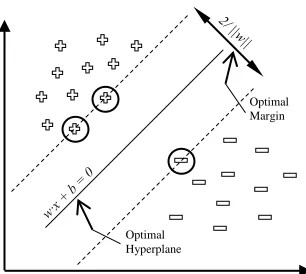
Support Vector Machine was first introduced by Cortes and Vapnik in 1995, and is based on the concept of a decision boundary that separates two different classes of data in order to discriminate classes with high accuracy [23]. A separating hyperplane is constructed in the training phase by using an input training data set containing data samples. The hyperplane that best separates the samples belonging to the two classes is called a maximum-margin hyperplane that forms the decision boundary. The class samples that are on the boundary are called Support Vectors (SVs) as depicted in Fig.1, where SVs are encircled. These SVs obtained from training phase are then used in the classification phase to classify new data [24].
Consider training data labelled as (xRi R, yRiR), i = 1, 2,..., N,
yRi Rϵ {-1, +1}, and xRi Rϵ RP
d
P
. The hyperplane is the plane that separates the two classes of positive and negative samples as shown in Fig.1. The pattern x lies on the hyperplane in the feature space can be described by Eq. (1), where w is a normal vector to the hyperplane and b is a constant:
w·x + b = 0 (1)
By selecting the two hyperplanes described in Eq. (2) and (3), the data points are separated in the margin region, and the aim is to maximize the distance between them.
w·x + b = +1 (2)
w·x + b = -1 (3)
The Euclidian distance between these two hyperplanes is given as 2/||w|| (see Fig.1), and so the distance ||w|| needs to be minimized. The optimum separation hyperplane conditions can be formulated into the following expression that represents a linear SVM, minimize ||w||P
2
P
/2 under the following constraints, which are added for all the training samples to prevent from falling into the margin:
w·xRiR + b ≥ +1 , for yRiR = +1 (4)
w·xRiR + b ≤ -1 , for yRiR = -1 (5)
This can be rewritten in the following equivalent form:
yRiR ( w·xRiR + b) ≥ 1 , i=1,…N (6)
function, where a Lagrange multiplier αRiR is assigned to each training pattern via the constraints represented in Eq. (6). Solving the SVM training problem by using the QP techniques is computationally expensive, especially for large high-dimensional datasets. Hence, numerous algorithms have been proposed in literature for solving the QP problem like the Sequential Minimal Optimization (SMO) decomposition method [25]. The most important aspect of these solutions is that the complicated computation of the dot-products calculation is required for each iteration.
In many real-world classification problems, it is not possible to linearly separate the training data in the original space. So, the input space is mapped to a higher-dimensional one where a linear separation is feasible, which is a computationally expensive task, especially in large-scale problems. Therefore, SVMs go towards utilizing kernel tricks/functions K(xRiR, xRjR) replacing the inner products in the optimization problem in Eq. (6) as in Eq. (7).
yRiR (K(xRiR , xRjR )+ b) ≥ 1 , i=1,…N (7)
The SVM computational requirements depend on the used Kernel function. The most common kernel designs which are widely used because of their efficiency in mapping data to higher dimensional space are illustrated as follows (X and Z are vectors) [26]:
1. Linear: K(X ,Z)= (X·Z)
2. Polynomial: K(X ,Z)= (1+(X·Z))P
d
3. Sigmoid:PPK(X ,Z)= tan ((X·Z)+θ)
4. Gaussian Radial Basis Function (RBF): K(X ,Z)=
exp( ||(X-Z)||P
2
P
/ (2σP
2
P
))
On the SVM classification phase, the classification function is universal and straightforward. A new data sample x is classified according to the output (sign) of the main decision function in Eq. (8). For large datasets, a massive number of complicated dot-product calculations is needed, which offers significant parallelization potential that could be exploited by parallel hardware resources as FPGAs.
F(x) = sign ( ∑ αRiR yRiR K(xRiR , x) + b)
(8)
Fig. 1 SVM separating hyperplane.
SVM is originally designed for binary classification and the use for multiclass classification is more problematic, either several binary classifiers have to be built or a larger optimization problem is required. As multiclass problems are commonly encountered, many multiclass SVM classification strategies have been proposed in literature like “one-against-all”, “one-against-one” and other methods [27].
3. Research Methodology
In order to review literature that deals with “Hardware Implementations of SVM Classifiers on FPGAs”, some keywords were used to cross-search for thousands related papers in five databases of scientific publications: Google Scholar, IEEE Xplore, ScienceDirect, Scopus and ACM Digital Library. The search keywords include FPGA, hardware implementation, embedded systems, Support Vector Machine, SVM classification/classifier, and SVM training/learning.
This review is confined to conference papers and journal articles published within the period 2010-2015 in order to explore and analyze the current state-of-the-art of hardware implementations of SVM classifiers on FPGAs. Many recent works highlight the importance of real-time embedded applications in different areas like bioengineering, healthcare, digital signal processing, wireless sensor networks, multimedia, and others. Therefore, demonstrating the importance of boosting SVM classifier to meet embedded systems constraints is required to be considered and added to the current literature. There already exist a recent survey shows SVM in data mining tasks [1], regarding applications only and some of the challenges. Some of the considerable limitations of implementing the SVM model that are stated in [1] are the processing speed for the training and testing phase as well as large memory space requirements, which prove the necessity of an efficient implementation of SVM. To the
Optimal Hyperplane
best of our knowledge, there is currently no review or survey paper on FPGA-based hardware implementations of SVM targeted towards various embedded applications. Consequently, this review examines current and recent techniques in hardware implementations targeting efficient implementations of the SVM model on FPGA.
The methodological framework of this research is defined by analyzing a variety of techniques in hardware implementations on FPGA for implementing SVM classifiers. Thus, a total of 53 articles is classified into two main groups regarding hardware implementations on FPGA for the training/learning phase of the SVM as the first group (12 papers) and for the classification phase as the second group (28 papers), where training is performed offline in the software. In addition, a third group (13 papers) is also included to gather a miscellany of hardware implementations for applications that barely use the SVM classification as a part of a larger implemented algorithms covering different domains and areas. We restrict group 3 to image analysis algorithms only, as it results in a compact but robust set of techniques that can be qualitatively compared.
4. FPGA Implementations of SVM
Existing literature for the hardware implementations of SVM model on FPGA was reviewed and roughly subdivided into two main groups according to the implemented phase of the SVM; training phase and classification phase. In this section, different techniques for FPGA-based hardware implementations were presented for the two groups and followed by critical analysis for each group. In addition, a third group is added regarding SVM classification-based application-specific implementations, which is considered part of the second group but from an application point of view and so analyzed with group two at the end of the section.
4.1 Group 1: SVM Training Phase Implementations
The training/learning phase of the SVM model has motivated many researchers to use hardware accelerators targeting a reduction in total training time. In this section, a variety of different FPGA-based architectures is presented in a systematic manner for the first group with a total number of 12 papers.
Many SVM implementations were presented in literature that were based on the common SMO decomposition method [25]. T. Kuan et al. [28] proposed a fully functional circuit design for accelerating the SVM learning phase based on SMO algorithm. The proposed architecture consists of three main circuit modules functioning for the
SMO process with a memory block and a cache block that were controlled by a designed Finite-State Machine (FSM) based controller. Experimental results showed that lesser processing time was recorded from using the cache, and the recognition performance of the proposed fixed-point design (FPGA) was similar to that of the floating-point SMO running on MATLAB.
K. Cao et al. [29] proposed a parallel scalable digital architecture for training SVM based on SMO algorithm, aiming to overcome the lack of necessary flexibility in previous implemented embedded applications in literature. A modified version of the traditional SMO algorithm [30] (to improve the efficiency of the working set selection method) was adopted in the proposed digital system, where a multiple processing units working in parallel was mapped to the error cache updating task in the algorithm. The memory size of the hardware and the number of processing units are adjustable, aiming to achieve scalable architecture for handling different sizes of the training problems. The synthesizable Verilog code adopted for FPGA synthesis was generated automatically from the Simulink Stateflow using Simulink HDL Coder. Experiment results based on two different datasets demonstrated that SVM training problems could be solved effectively with inexpensive fixed-point arithmetic offering better flexibility and scalability results.
J. Filho et al. [31] presented a dynamically reconfigurable SVM architecture for general purpose training that supports different sizes of training sets. Based on the SMO algorithm, a modular architecture was designed reaching interchanging modules by dynamic reconfiguration. The hardware-friendly kernel function proposed in [32] was adopted for the system and so the Coordinate Rotation Digital Computer (CORDIC) algorithm [33] based on shift and add operations was employed for kernel implementation. The proposed reconfigurable architecture achieved 22.38% area saving with acceptable reconfiguration time penalty. The effect of fixed-point data representation on precision and classification error was studied on three different learning benchmarks. Based on simulation results, the hardware implementations of the three benchmarks achieved acceleration factors of more than 12.53 times faster than the software implementation for the total training time.
parallel and pipeline computing capabilities, while the second method offered a schedule for efficient reconfiguration. Compared to the baseline design, simulation results demonstrated that the proposed design achieved improvements in area size (50% less memory usage from removing the kernel cache and 31% fewer gate counts), power consumption (17-fold improvement), and training speed (16-fold improvement) with satisfactory recognition accuracy (85%).
L. Martinez et al. [35] proposed a hardware/software architecture to accelerate SVM training phase based on SMO algorithm. The high time-consuming dot-product computation in the SMO algorithm was executed on the hardware coprocessor in parallel, while the heuristic hierarchy of SMO was implemented in software on the GPP. The bottleneck dot-product calculation was mapped to a logical AND operation and a counter to be executed in three clock cycles. The proposed coprocessor architecture achieved a speedup of 178.7x compared to a software-only implementation on a GPP.
Another hardware-software co-design system for fast SVM training based on SMO algorithm was proposed for embedded speaker identification system [36]. The modular design proposed in [28] was exploited and improved for realizing the computational bottleneck SMO training on hardware, whilst other processes including pre-processing, feature extraction and SVM-based voting analysis were implemented in software on an ARM processor (embedded C code). Also, a data-packed/unpacked mechanism was proposed to improve the efficiency of communication and data transmission between software and hardware (around 5% reduction in delivery time). Compared to an ARM embedded C code, the proposed system achieved 90% decline in training time with a slight decrease in identification rate, where about 89.9% identification rate was achieved.
A. Patel et al. [37] proposed also a hardware/software co-design system to speedup SVM training based on SMO algorithm. A fully scalable co-processor architecture was implemented on Xilinx Virtex-7 FPGA for handling kernel computations based on a proposed SMO algorithm which effectively designed for exploiting the parallel computing power of the proposed co-processor and caching kernel columns through a grid of processing units. A speedup of 20-25x was achieved for the kernel computations on the designed co-processor, while an application speed-up of up to 15x was achieved by comparing results of experiments of the proposed system on the ADULT dataset with LIBSVM.
Other researchers implemented SVM based on different decomposition algorithms replacing the traditional SMO.
A hardware-software co-design system for accelerating the SVM learning phase was presented based on another decomposition algorithm instead of the common SMO algorithm [38]. A Hybrid Working Set (HWS) algorithm was proposed based on the extended working set decomposition algorithm [39], taking advantage of cached kernel values and the fast convergence nature in order to decrease the number of iterations. A fully scalable coprocessor architecture consisting of a grid of cores was proposed to achieve parallelism for kernel computations similar to their previous proposed architecture [37]. A speed-up for kernel computations of up to 25x was achieved from the implemented coprocessor (32 cores) over a single threaded core i5 CPU. A reduction in iterations of 50% and 60% was achieved compared to LIBSVM and SVMLight software programs due to the implemented HWS algorithm. Finally, the proposed coprocessor with the HWS algorithm achieved an application speedup of up to 15x and 23x compared to software implementations of LIBSVM and SVMLight respectively.
M. Papadonikolakis et al. [40] proposed a fully scalable heterogeneous FPGA architecture for boosting the SVM learning, which fully exploits the device parallel processing power and the dynamic range diversities of the precision requirements among training problem features. The proposed design fully utilized the custom-precision arithmetic and heterogeneous components supported by the FPGA device for handling kernel computations. The proposed architecture used parallel custom precision multipliers feeding a pipelined adder tree for the fixed-point inner products which are then interpreted into floating point format for further calculations. Experimental results demonstrated the efficiency of the proposed heterogeneous architecture which increased with the precision diversities of the homogenous/heterogeneous datasets attributes. Also, the proposed design showed a speedup of more than 6x compared to other proposed designs.
running the solution update in parallel. The proposed FPGA system achieved significant speedups compared to other CPU and GPU-based implementations across three different datasets with acceptable accuracy and lower power consumption.
M. Ning et al. [43] used a different design methodology from the previous works presented; High-Level Synthesis (HLS) for developing the hardware accelerator. A demonstration was presented to show that the hardware development time for an embedded system could be reduced by applying the HLS method using C language instead of traditional Hardware Description Language (HDL). A SOPC (System on Programmable Chip) system was designed to implement the Least Square SVM (LS-SVM) on the recent Xilinx Zynq platform using Vivado HLS tool with C language. The LS-SVM has lower computational complexity as it solves a set of linear equations instead of a quadratic programming for standard SVM [44]. The proposed algorithm was divided into three parts; a generating Kernel Matrix module, a solving linear equations module (SOLE), and a forecasting module. The first and third modules were realized in ARM processor which also controls computing modules and data path, whilst the compute-intensive second module was implemented in programmable logic utilizing HLS method. A speed up factor of 2-8x was achieved with 0.06% maximum relative error for trained data, compared to a Matlab based CPU implementation for experiments with a real dataset.
S. Wang et al. [45] exploited the Run Time Reconfiguration (RTR) technology of the FPGA for boosting the online training of the LS-SVM. The proposed design was divided into two parts to be swapped using RTR and applying pipeline in the modules design, reaching high parallelization. The first part is the kernel matrix formulation where a piecewise linear interpolation method was applied. The second part is the least-square problem solving, where a modified Cholesky Decomposition was proposed improving large memory requirements and the long latency caused by square roots operations. Experimental results illustrated speed up from 6 to 218x compared to a Xeon CPU implementation. Regarding time cost percentage analysis, the proposed architecture was shown to be suitable for large-scale problems with more than 1000 samples, due to the large reconfiguration time.
4.1.1 Critical Analysis of group 1
The total training time is considered the main bottleneck of the overall SVM performance in real-time applications, which motivates many researchers for speeding-up this consuming task through implementation on parallel FPGA
devices. This section presents a critical analysis for the previous FPGA implementations of the SVM classifier that were introduced in the previous section and summarized in Table 1.
Most of the proposed hardware architectures for implementing the SVM learning were based on the common SMO decomposition algorithm [28, 29, 31, 34-37], whilst an alternative algorithm was employed by one work in [38] and another simpler algorithm was implemented in [41]. Two research papers implemented the improved SVM; LS-SVM instead of the standard SVM due to its low computational complexity [43, 45], but generally most previous work focused on boosting the whole training process including complicated kernel computations.
Various parallel digital designs were presented where the common pipelining approach was mostly applied, reaching a high level of parallelization. Additionally, some studies employed the dynamic reconfiguration technique for the designs aiming speed improvement with more flexibility [31, 45], and dynamic scheduling was exploited as well for efficient reconfiguration in [34]. Moreover, the hardware-friendly kernel was used in [31] and implemented by common CORDIC algorithm based on shifters and adders replacing expensive multipliers, which led to a remarkable reduction in resources utilization.
Many implemented systems employed the hardware/software co-design method for running the compute intensive task of the algorithm on the FPGA as a hardware accelerator (co-processor) aiming to reach real-time SVM training [35-38, 43]. In addition, researchers in [43] used different design methodology; HLS for developing the hardware co-processor instead of using the traditional HDL, where an outstanding reduction in hardware development time and effort for realizing an embedded system was emphasized.
Concerning scalability, some proposed architectures were designed to meet scalability issue, offering more flexibility for efficient usage in embedded environment [29, 37, 38, 40]. Interestingly, a unique heterogeneous FPGA architecture for fully exploiting custom-precision arithmetic and heterogeneous components of the device was proposed [40, 41], offering scalability and adaptability to the classification problem nature.
implementations gained remarkable speedup improvement compared to previous hardware designs [34, 40]. Furthermore, great area saving results were realized in [31, 34] and an improvement in power consumption was shown by [34, 41], which could meet some important embedded systems constraints.
4.2 Groups 2 and 3
4.2.1 Group 2: SVM Classification Phase Implementations
Regarding the second group, various techniques for hardware implementations have been developed for boosting the online classification process on different FPGA boards. The SVM model was trained first offline on software (mostly using Matlab), then the trained data were extracted to be used for online classification on hardware.
In this section, different hardware techniques used in implementations are presented in an organized manner for 28 papers in group two.
Systolic array architecture was widely implemented on FPGA for achieving high levels of parallelism, which was exploited by numerous SVM implementations. R. Patil et al. [46] used the systolic array architecture to implement a multiclass SVM classifier on Xilinx Virtex-6 FPGA for facial expression recognition system after performing training phase in Matlab. In addition, difference-based partial reconfiguration technique was utilized in order to achieve power optimization of the FPGA design. Power reduction up to 3 to 5 percent was achieved after applying reconfiguration by using Xilinx EDA tool.
Table 1. Group 1: SVM Training Phase Implementations
Ref.
Training Implementation
Method
Platform/FPGA
board and tools SVM Type
Kernel Function
Type
Application
Domain / dataset Important Results
[28] Functional circuit design
Altera Cyclone II DE2-70 Quartus II 7.2 sp3
Multiclass Linear
Speaker recognition,
SMD and FMMD speech
datasets
Fully functional prototype
[29] Parallel scalable digital architecture
Xilinx Virtex-4 (XC4VLX100)
Simulink Stateflow +HDL
Coder
Binary Gaussian
Sonar dataset, Telecommunicatio
n problem dataset
-
[31]
General-purpose DR architecture,
CORDIC
Xilinx Virtex-IV
(XC4VLX25) Binary
Hardware friendly
kernel
Breast Cancer, Dermatology, Tic
Tac Toe benchmarks
22.38% area saving Speedup > 12.53x
[34]
Reconfigurable architecture with dynamic scheduling
Spartan c3s4000 Multiclass Linear
Speaker recognition,
SMD and FMMD speech
datasets
Improvements in power, area, memory
efficiency
[35] Co-processor
XtremeDSP Virtex- IV Development Kit
Xilinx ISE 9.2 ModelSIM SE 6.5
Binary Linear ADULT dataset Speedup 178.7x GPP
[36] Co-processor
Xilinx Spartan-c3s4000 Xilinx ISE 10.1
Multiclass Linear
NIST 2010 speaker recognition
database
90% less training time
[37] Co-processor Xilinx Virtex-7
(VC707) Binary Gaussian ADULT dataset
Speedup 20-25x App speedup 15x
[38] Co-processor
Xilinx Virtex-7 (XC7VX485T) Xilinx PlanAhead
Binary Gaussian Different datasets
Speedup 25x CPU App speedup 15x
LIBSVM, 23x SVMLight
[40]
Heterogeneous
architecture(custom-arithmetic)
Altera’s Stratix III
(EP3SE260) Binary
Linear Gaussian polynomial
sigmoid
[41]
Heterogeneous
architecture(custom-arithmetic)
Xilinx board ML605 (Virtex-6 XC6VLX240T
Binary RBF
ADULT, Forest covertype,
MNIST datasets
Speedup >1 order
[43] SOPC (HLS)
Xilinx XC7Z020 Vivado HLS
LS-SVM RBF Electricity
Demand dataset Speedup 2-8x CPU
[45] RTR
Xilinx ML510 (XC5VFX130T) Xilinx PlanAhead
LS-SVM RBF
mobile communication
traffic dataset
Speedup 6-218x CPU
Dynamic Partially Reconfigurable (DPR) technique was exploited by H. Hussain et al. [47] to implement an SVM classifier for classifying microarray data for bioinformatics applications. That SVM classifier was also implemented using the systolic array architecture (4 main blocks), but on an old FPGA board; Xilinx ML403, where the kernel computation was implemented using 2-pipelined stages. A speed-up of up to 85x was achieved over an equivalent GPP software implementation based on Matlab bioinformatics toolbox. For changing the SVM core with different parameters, DPR was applied which was 8x faster than reconfiguring the whole FPGA device.
H. Hussain et al. [48] extended their work lately based on their previous work [47] by proposing another systolic array architecture for different dataset sizes (number of SVs is greater than the dimension), where more computation was required. The two architectures were compared with an equivalent Matlab based implementations on GPP and a speedup of ~61x and ~49x were achieved for both respectively. Moreover, DPR was applied for a multi-core SVM architecture based on their previous architecture [47], providing flexibility for microarray based applications.
C. Kyrkou et al. proposed an optimized parallel array architecture [49] targeting real-time SVM-based object detection, by finalizing their initial work of implementing a systolic chain of processing elements [50]. They also showed that the proposed array processing engine is scalable and flexible that could be extended and adapted to meet multiclass classification and different applications demands. The implemented array architecture was evaluated using three different object detection applications; face, pedestrian, and car side view detection. The results demonstrated a high performance of 40, 46, 122 fps for the three applications, with no accuracy loss regarding the software detection accuracy of the SVM model implemented in Matlab (77, 76, 78%).
Many implementations adopted the multiplier-less
approach for optimizing hardware complexity. A hardware implementation for boosting SVM classification was developed on the modern Xilinx Virtex-7 FPGA, that was also based on parallel pipelined systolic array architecture
[51]. The researchers were targeting a reduction in hardware complexity and power consumption by implementing simplified multiplier-less kernel using shifts and adds operations instead of traditional vector product kernel for classification. They presented a different approach of applying the CSD (Canonic Signed Digit) and CSE (Common Subexpression Elimination) representation methods for vectors data in order to reduce the number of required adders leading to hardware complexity reduction [52]. A comparative analysis was performed regarding resources utilization for three implemented classifiers; binary linear, binary non-linear and multiclass classifiers using the proposed CSD-based multiplier-less kernel versus the vector product kernel [51]. Also, power reductions of 1, 2.7, and 3.5% were achieved from the three implemented classifiers than that using the conventional vector product kernel.
M. Ruiz-Llata et al. [53] presented an FPGA-based hardware design of SVM for classification as well as regression (regression out of our scope). The proposed system adopted the hardware friendly kernel function presented in [32], which significantly simplifies the hardware design of the feed-forward SVM classification phase by avoiding the use of computationally intensive multiplications, providing good classification performance compared to the traditional Gaussian kernel. The proposed architecture employed the CORDIC iterative algorithm [33], based on using only shift and add operations instead of multiplications required by the kernel computation. The implemented SVM classification system utilized 75% of the FPGA logic (Cyclone II) and an external memory was used for storing support vectors leading to 2ms limitation in the classification speed, with an error rate of 4%.
An embedded hardware SVM implementation on FPGA was proposed [54], which was based also on exploiting the hardware friendly Kernel [32] to simplify the hardware design targeting satellite onboard applications. Similarly, the resource consuming multiplications were replaced by simple shift operations, which demonstrated lower resources utilization of 167 slices.
following the design of the proposed hardware friendly Kernel. The proposed system consists of three sub-circuits (data preparation, CORDIC, and classification circuits) to implement the kernel calculations that was based on a proposed iterative algorithm which is a simplification of the CORDIC method through adders and shifters (without multiplications and exponentials). The implemented system achieved speed improvement over their previous CORDIC circuit implemented in [56] with a factor of 6, with limited hardware resources utilization.
Another hardware design for the SVM decision function was presented for classification and regression problems [57], that was based also on adopting the hardware friendly Kernel [32]. A tree structure based on common Sum of Absolute Differences (SAD) module was exploited for decreasing clock cycles of the 1-norm computation between vectors [58]. Preliminary simulation study was performed on the precision of input parameters by choosing fixed-point arithmetic, keeping the same classification accuracy level with no loss.
D. Anguita et al. [59] proposed an FPGA core generator tool for automatically generating an optimized hardware description of a digital architecture for implementing SVM, according to the user requirements and the constraints of the target FPGA device. The proposed architecture for the feedforward phase of the SVM was based on the hardware-friendly kernel [32] [60], where the bottleneck 1-norm (Manhattan norm) computation was implemented using the parallel tree structure of the common SAD modules [58]. Three architectures was presented for implementing the kernel computation. The first kernel architecture exploited the polynomial approximation method (parabolic and linear piecewise approximations) that was computed by multiple cascade pipelined stages of Multiply-and-Accumulate (MAC) blocks. The second architecture was based on CORDIC-like iterative algorithm with no multipliers implementation [32]. The third architecture was based on the Look-Up Tables (LUTs (memory blocks)) based approach, where kernel values were stored. The tool was tested for an automotive application, showing results with trade-off among latency, hardware resources and maximum clock frequency for the three architectures on low-cost, intermediate-class and high-end FPGAs. The LUT-based and CORDIC-like approaches achieved higher classification rates.
V. Vranjkovic et al. [61] presented a digital architecture for SVM classification with a kernel that avoids multiplication, which is similar to the previous hardware-friendly kernel [32] and looks like the common radial kernel. In the proposed architecture, the expensive exponential function was realized by CORDIC algorithm and the multiplications were implemented using shifters. The results showed that the proposed kernel had
comparable classification performance with the similar original radial kernel (No hardware implementation of the proposed digital architecture on FPGA was presented).
Other implementations aimed to exploit the common
pipelined fashion for reaching efficient designs. V. Vranjkovic et al. [62] proposed a universal coarse-grained reconfigurable architecture for implementing various types of machine learning including SVM, decision trees and artificial neural networks. The proposed architecture was organized as 1D or 2D array of simple reconfigurable blocks in a pipelined structure for implementing one of the three classifiers. Concerning the SVM implementation, the classification function was divided into partial sums to be implemented by the reconfigurable blocks using multipliers and adders (and a subtractor in the case of a radial kernel), which was controlled by FSM model. Experimental results showed that the implemented architecture achieved significant classification speedup of 1-2 orders of magnitude, compared with R project-based software implementation, with modest hardware resources utilization.
A high performance unified circuit supporting both linear and non-linear SVM classification was designed, based on sharing most of the resources required for both types, leading to a reduction in circuit size [63]. The proposed unified circuit was designed using a parallel architecture with two-stage pipeline providing shared multipliers and adders required for inner product calculation to support both linear and non-linear SVM classification. For the nonlinear case, the table-driven algorithm proposed in [64] was adopted for the RBF kernel computation, which accelerates the operating speed for an exponential function (fixed-point arithmetic operation) as well as increasing the accuracy. The proposed circuit was synthesized using 65nm standard cell library, demonstrating 661,261 gates with 152 MHz maximum operating frequency. Also, high performance was achieved from processing up to 33.8 640x480 image frames per second.
A hardware design of SVM-based type identification module in a CAD system was presented for colorectal endoscopic images with narrow band imaging (NBI) magnification [66, 67]. A 2-step identifier based on binary SVM was proposed to develop a 3-class identifier using one-versus-one technique targeting real-time processing of full HD images. The SVM identification module was implemented by a fixed-point number and evaluated with different bit length, showing the tradeoff between hardware size and accuracy. A customized architecture was first introduced based on combining 2-class classifiers, which was implemented in their previous work [68], resulted in increasing the inner-product process by 18% due to the overlap of input data. Then, an improved architecture was presented preventing the duplication in the inner-product computation that was structured in two pipeline stages, where common inner-products were computed at the first stage (similar to the approach in above paper described [63]). Accordingly, the hardware size was decreased and the system throughput was increased (>21.2 fps at 100 MHz [66]), with sufficient identification accuracy for CAD system.
An FPGA implementation of multi-class SVM classifier based on posterior probability was introduced that implemented Lin’s second improved classification algorithm [69]. The proposed simplified algorithm was implemented in a pipelined design that used a LUT-based method to produce the sigmoid function output, in addition to adders, multipliers and dividers used for the other computations. Experimental results showed that the mean absolute error is 10-4 order of magnitude between the implemented simplified algorithm on FPGA and the C-based implementation, with a slight loss in recognition rate. Also, a decrease in computation complexity was achieved from implementing the simplified algorithm with 0.7 ms time delay, which meet the real-time requirements.
Y. Ago et al. [70] presented a new approach of effectively using cascaded DSP slices and block RAMs embedded in FPGA to design a fully pipelined DSP architecture for accelerating SVM classification. The proposed processor core utilizing 768 DSPs and 800 block RAMs was implemented in Xilinx Virtex-6 FPGA, for the SVM classifier with 760 support vectors that supported three types of kernel functions; sigmoid, polynomial, and RBF kernels. The experimental results showed high throughput of 2.89x10⁶ times per second for classifying 128-dimension feature space running at 370.096 MHZ.
Beside using FPGA, a hardware architecture for accelerating SVM classification phase was realized in ASIC exploiting pipelined adder for the accumulation process in the main processing unit instead of common
adders [71]. As a result, speedups of 1.44x and 1.21x were achieved using pipelined adder in compare to using RCA and KS adders respectively, with slightly area overhead. Additionally, the implemented architecture offered 3.5x GMACs compared to other FPGA-based architectures in literature.
Some work in the surveyed literature targeted comparisons between FPGA and GPU implementations. Hardware architectures for FPGA and GPU implementing a human skin SVM classifier and comparing their performance with the software was presented [7, 17]. For FPGA implementation, the critical hardware components were designed using HDL in a fully pipelined structure, whilst other standard components (interfaces, FIFO, FSMs) were implemented in HLL (Impulse C). The preliminary implementation results illustrated that the implemented fully pipelined FPGA architecture outperformed GPU and CPU for a small number of image pixels, while the GPU implementation was the fastest for a large number of pixels. But, GPU implementation consumed significantly higher power than the FPGA implementation, which reduces the use of GPUs in power-constrained embedded systems [17].
Apart from using the traditional HDL approach in many research work for designing hardware implementations, some other work used available powerful tools on the market which simplified the process of hardware designs. One of the common tools is the Xilinx System Generator
that offers high-performance system modelling and automatic code generation from Matlab/Simulink. D. Mahmoodi et al. [72] used the System Generator to design and implement a simple hardware architecture of a 3-class pairwise SVM classifier for Persian handwritten digits dataset. The training phase was performed using LIBSVM model in Matlab, then testing phase was implemented using a combination of serial and parallel designs of simple blocks and functions of System Generator reaching a parallel simultaneously hardware architecture of the classifier. Also, the CORDIC block in System Generator was exploited for implementing the exponential function. The FPGA simulation results demonstrated 202.840 MHz maximum frequency for linear classification and 98.67% classification accuracy for nonlinear classification, with considerable computation time compared to software implementation in Matlab.
to produce the three most likely phonemes at the output (first, second and third possible phoneme representations), targeting an increase in the accuracy. The implemented hardware system was faster than the software implementation by about 2.53 times, with 16.2% reduction in accuracy.
Some researchers considered the cascaded classification
scheme as an alternative approach for accelerating the SVM classification process. In this scheme, the majority of data are rejected in the early classification stages with less computationally demanding, leaving small amounts of data to be classified at the latter stages with higher accuracy and computational complexity. Accordingly, the usage of the cascaded classification structure could achieve great speedups over a single SVM classifier. Therefore, many researchers were motivated towards hardware implementations for the cascaded structure, in order to reach online real-time classification meeting embedded systems constraints of high performance and low cost.
M. Papadonikolakis et al. [74] presented the first FPGA-based cascaded SVM classifier that exploited custom-arithmetic characteristic (bit-precision) of the device heterogeneous nature, targeting SVM classification acceleration (following their previous proposed architecture in [40] for training acceleration). A fully scalable heterogeneous architecture was proposed that effectively utilized the parallel processing power of the device heterogeneous resources and dynamic range diversities among the classification problem’s features. The proposed heterogeneous architecture achieved a speed-up of 2-3 orders of magnitude compared to the CPU classification execution time, and a speed-up over 7x other previous implementations on FPGAs and GPUs.
Later, M. Papadonikolakis et al. [75] applied the FPGA reconfigurability approach to their previous proposed architecture [74] for the cascaded classifier in order to switch from low- to high-precision classification. As a result, an increase in the performance was achieved, as well as gaining an expansion of the potential design space for implementing large-scale cascaded classifiers.
C. Kyrkou et al. [76, 77] presented an optimized architecture for the cascaded SVM classifier based on a proposed hardware reduction method to implement additional stages in the cascade, resulting in reducing hardware resources utilization and power consumption for embedded applications. The proposed method replaced all multiplication operations of the early cascade stages with shift operations by rounding off the training data to the nearest power of two values, with classification accuracy savings. A hybrid architecture was implemented (Virtex 5 FPGA) using the cascaded structure for sequential and
parallel processing of input data, after training in Matlab targeting face detection on 640x480 images. As a result, an average performance of 70 fps was achieved, reaching a speed-up of 5x over a single parallel SVM classifier implementation. The employment of the proposed hardware reduction method achieved 43% fewer hardware resources utilization and 20% saving in power, with only 0.7% reduction in classification accuracy.
Next, C. Kyrkou et al. [78] extended their previous work for accelerating the cascaded SVM classifier [76] by proposing an optimized hybrid architecture with the proposed hardware reduction method and an additional novel response evaluation method. The proposed response evaluation process was developed by using the Neural Network (NN) model to classify the responses of the preceding simple stages in the cascade in order to remove samples before the final complicated classification stage, leading to classification speed improvement. In addition, the architecture employed local binary pattern (LBP) descriptors for applying feature extraction prior to the final stage in order to improve detection accuracy. The presented architecture was implemented on Spartan-6 FPGA (replacing the old one used before), targeting embedded face detection using higher resolution of 800x600 images than that in their previous work and other hardware implementations. The implemented hybrid architecture achieved real-time processing of 40 fps with 80% detection accuracy, as well as 25% and 20% reduction in area and peak power respectively, with only 1% reduction in classification accuracy. But compared to their previous work, it seems that lower figures were achieved for both area and accuracy. This is because they are evaluating a big test set of higher resolution images, targeting real-time processing of online video classification as an embedded benchmark application.
4.2.2 Group 3: SVM-based Applications Implementations
This group was constructed to demonstrate the usage of the SVM classification in a wide range of applications, in which the research papers are focused more on the main application’s implementation, rather than the classification purpose implementation as in group two. Different hardware architectures have been introduced in literature for implementing algorithms including classification task targeting particular applications. This group consists of 13 papers to introduce some research work of different applications that deal with images.
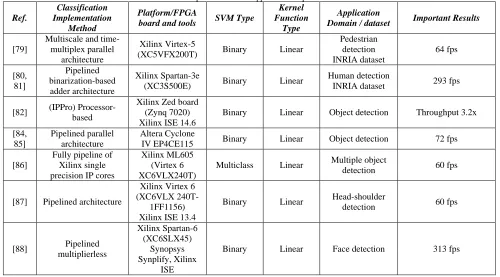
twice the pixel frequency [79]. The proposed design of the detection system was based on a time-multiplex method to construct multiscale detection, with a simply designed SVM that consists of a module for the dot product calculation, an address decoder controlling the memory accesses, an adder for the intermediary summation, and an adder for the bias. Experimental results showed high performance of processing HD resolution images at 64 fps, which outperformed existing FPGA implementations by a factor of 4 with good resources utilization.
A real-time human detection using HOG algorithm with linear SVM classifier was implemented that based on adopting a binarization process [80, 81]. As a result of the binarization process, all multiplication operations in the classifier were replaced with addition operations, which decreased hardware complexity. The proposed pipelined architecture achieved a processing rate of 293 fps with a detection accuracy of 1.97% miss rate and 1% false positive rate, in addition to a low power consumption rate of 353mW.
A processor based approach was employed for implementing SVM-based HOG algorithm [82], which was based on a developed IPPro (Image Processing Processor) from Rathlin research project [83]. The designed multi-core IPPro system (coded by the help of Matlab Simulink model) achieved throughput of 2.6x compared to a handed coded design targeting Xilinx Zed board, and 3.2x compared to relevant recent work in literature.
An object detection processor was presented that based on a proposed simplified HOG algorithm which employed a simultaneous SVM calculation, targeting a reduction in amount of required computations [84, 85]. The proposed simultaneous SVM calculation architecture was designed as 15 parallel classification cores, where each managed 7 blocks of MAC operations and allowed the reuse of intermediate results. Accordingly, experimental results showed 99% reduction of cycle counts for the proposed SVM module compared to architecture without parallelization and pipeline. The proposed system achieved objects detection for SVGA resolution video at 72 fps with 40MHz. Also, the proposed simplified algorithm reduced required computation (from 89.2 to 2.25 GOPS) with minimal memory usage and 3% decline in accuracy.
An embedded design using the HOG-SVM combination was presented for multiple object detection [86]. Single precision 32-bit floating point representation was used in the proposed implementation without making any simplification of the algorithm design in order not to reduce the detection accuracy as occurred in some previous work. Xilinx single precision IP cores (adders
and multipliers) were exploited to be designed with the longest latency in a fully pipelined structure with no need of external memory storage. Multiple binary SVM classifiers were instantiated in the proposed system to be capable of detecting multiple objects. The implemented system was capable of detecting three different objects in 640x480 images at 60 fps (outperformed the speed of the software implementation), with a computational performance of 9.47 Giga Floating Point Operations per Second (GFLOPS).
An FPGA-based hardware design for head-shoulder detection was presented [87], which was based on Local Binary Patterns (LBPs) for feature extraction and SVM for classification. In addition, foreground object detection was exploited for improving detection accuracy. A different scheme of unrolling loops required by SVM computations was used for the implementation to meet the sequential flow of data in the FPGA. And so, the SVM computation module was designed based on a FIFO, multiple multipliers, and a pipelined adder tree. The integrated system was implemented on Xilinx Virtex 6 FPGA, demonstrating real-time video stream processing of 640x480 images at 60 fps, with a 15% drop of detection accuracy.
A digital hardware architecture was presented for face detection in IR images based on LBP, SVM algorithms, and generating bounding boxes of detected faces [88]. Concerning SVM module implementation, the dot product calculation was implemented as a pipelined sum using integer adders replacing multipliers (no DSP slices) and buffers were exploited for decreasing memory requirements. The implemented system outperformed software implementation with processing 640x480-pixels video at 313 fps with a false positive rate between 4.5 and 7.2%. Also, low resources utilization were achieved of less than 25% with 266 mW power consumed.
A hardware implementation for pedestrian detection algorithm was presented that was based on a sliding window- based SVM classifier using feature covariance matrices as descriptors [89]. The SVM classifier was designed as 15 units processing in parallel, where 147 scalar products and accumulations were computed that are proportional to the number of the descriptor features. The implemented detection system showed encouraging results for hardware implementation with a maximum frequency of 213 MHz and 9% loss in accuracy.
Regarding SVM implementation, the proposed architecture of the SVM module was designed by using multipliers and accumulators, exploiting parallelism in computing the RBF kernel to accelerate the processing time. Also, the Xilinx IP core CORDIC block was used for implementing the exponential function (sum of sin and cos). Two different challenging datasets with high image variation were used to evaluate the proposed hardware system in which 85% and 78% classification accuracy were achieved for Caltech-256 and KUL Belgium traffic sign datasets respectively, with less than 3% loss in accuracy from the software implementation. In addition, a speedup of 5.7x was achieved for classifying 640x480 images compared to software implementation, with reasonable hardware resources utilization compared to related implementations.
C. Kyrkou et al. [91] presented a hardware architecture for real-time SVM-based object detection using a proposed depth and edge accelerated search method targeting improvement in speedup and detection accuracy. The proposed architecture exploited the proposed SVM processing architecture in their previous work that was based on an array of processing elements [49], and the reduced set method was employed to decrease the number of support vectors used for reducing memory utilization and increasing classification accuracy. The implemented system achieved real-time frame rates of 271, 42, and 23 fps for 320x240, 640x480 and 800x600 image sizes respectively, with a 52% decline reached for the false-positive rate.
An FPGA implementation of a CAD system for skin cancer was introduced that was based on feature extraction and SVM classification for histo-pathological images [92]. A block diagram of hardware architecture of the CAD system flow was presented, which used the RAM memory for storing input image (no hardware design details). Simulation results of the proposed system implemented on Xilinx Virtex-7 FPGA was presented for applying CAD system phases on an input test image.
4.2.3 Critical Analysis of Group 2 and 3
Regarding parallel architectures targeting acceleration of the SVM classification phase, both group two and three are analyzed in this section and summarized in Table 2 and Table 3 respectively.
Many works exploited the FPGA-based parallel systolic array architecture in their implementations [46-49, 51], resulting in good results of classification speedups that mostly outperformed software implementations on GPPs/CPUs. In addition, other works employed the DPR technique [46-48, 75], achieving more flexibility and design space expansion besides gaining speedups. Also, the hardware implementation in [46] achieved a significant reduction in power consumption as a result of applying the difference-based partial reconfiguration technique.
Interestingly, many studies adopted the multiplier-less approach [51, 76-78, 80, 81, 88], where computational intensive multipliers required for computations are replaced with conventional adders and/or shifters in order to decrease the hardware complexity. Similarly, others [53-55, 57, 59, 61] utilized the hardware friendly kernel function for simplifying the hardware design by using the simple shift and add operations instead of resource consuming multiplications. Some of them employed the common CORDIC iterative algorithm for implementing the hardware friendly kernel computations, which is also based on using only shifters and adders [53, 55, 59], while other implementations used the CORDIC algorithm for solving the exponential function of the kernel [61, 65, 72, 90]. As a result of multiplier-less implementation, significant reduction in hardware resources utilization was achieved by [51, 54, 55, 76-78], in addition to remarkable power consumption decrease was demonstrated in [31, 51, 76-78, 80, 81, 88].
Moreover, the common pipelining technique was exploited by most previous hardware designs, taking advantage of the parallel processing capabilities of the FPGA that led to throughput increase of the implemented classification process. Some researchers designed a pipeline stage for common and shared multipliers required for computations to decrease usage of duplicate multiplications [63, 66, 67], achieving lower hardware resources utilization. Additionally, some pipelined designs like in [65, 70, 86] were based on exploiting the embedded IP cores in the FPGA device for efficient resources utilization. Furthermore, the parallel pipelined (adder) tree structure was used by various designs aiming to reach processing speed improvement [57, 59, 65, 74-78].
Table 2. Group 2: SVM Classification Phase Implementations
Ref.
Classification Implementation
Method
Platform/FPGA
board and tools SVM Type
Kernel Function
Type
Application
Domain / dataset Important Results
[46]
Systolic array architecture, difference-based PR
Xilinx Virtex-6 (6vlx240tff1156-2) Xilinx ISE +
Multiclass Polynomial
Facial expression recognition
system
EDA
[47] Systolic array architecture, DPR
Xilinx ML 403(XC4VSX35)
Xilinx ISE
Binary Linear
Classifying microarray (biomedical)data
Speedup 85x GPP DPR 8x faster
[48] Systolic array architecture, DPR
Xilinx ML 403(XC4VSX35)
Xilinx ISE + PlanAhead + ChipScope 12.2
Binary Linear
Classifying microarray (biomedical)data
Speedup ~61x, ~49x GPP DPR 8x faster
[49] Parallel systolic array architecture
Xilinx ML505 (Virtex 5-LX110T)
Binary Polynomial
RBF Object detection
40-122 fps 76-78% accuracy [51] Systolic array architecture, multiplierless kernel Xilinx Virtex-7 Xilinx XPE 14.1
Binary and multiclass
Linear
Polynomial Fisheriris dataset
Power reduction 1, 2.7, 3.5% [53] Multiplierless kernel, CORDIC, external memory Cyclone II
(EP2C20) Multiclass
Hardware friendly
kernel
Image recognition
COIL dataset 75% logic
[54] Multiplierless kernel
Xilinx Virtex-5, Spartan-3E Modelsim Binary Hardware friendly kernel Satellite onboard application/ NASA database
167 slices < others
[55] Multiplierless
architecture, CORDIC - Binary
Hardware friendly
kernel
- Speedup 6x previous circuit
[57] SAD-based tree Altera Cyclone III
ModelSim Binary
Hardware friendly
kernel
UCI standard data set Breast
Cancer - [59] Pipelined MAC/CORDIC/LUT-based Xilinx Spartan-IIE, Spartan-3, Virtex-II Pro, Virtex-4 Binary Hardware friendly kernel Automotive application/pedest rian detection Daimler-Chrysler dataset -
[61] Multiplierless
architecture, CORDIC - Binary
Digital
kernel 4 UCI datasets -
[62] 1D, 2D pipelined streams
Xilinx Virtex-7
Vivado 2014.2 Binary
Polynomial
RBF 18 UCI datasets Speedup 1-2 orders
[63] 2-stage pipelined
parallel architecture - Binary RBF - 33.8 fps
[65]
Pipelined Structure (CORDIC and
MACs)
Xilinx ML505
(XC5VLX110T) Binary
Linear Polynomial
RBF
Pedestrian
detection -
[66,
67] 2-stage pipelined
Altera Stratix-IV (EP4SE360F35C2
)
Multiclass Linear Colorectal cancer
detection > 21.2 fps
[69] Pipelined Xilinx Virtex-5
ISE 10.1 Multiclass
Linear Sigmoid
Language
Recognition -
[70] Fully pipelined DSP-based architecture
Xilinx Virtex-6
(6VLX240T-FF1156) Xilinx ISE 14.1
Binary
Sigmoid Polynomial
RBF
- 768 DSPs
2.89x10P 6
P
throughput
[71] Pipelined adder-based architecture
ASIC
Synopsys tools Binary Linear MNIST dataset
Speedup 1.44x,1.21x other adders usage
[7, 17] Fully Pipelined architecture Xilinx Virtex-5 (LX220), Xilinx Spartan 6
(XC6SLX75)
Binary Gaussian Human skin
classification Performance >> CPU
[72] System Generator blocks-based design
Xilinx Virtex4 (xc4vsx35) System Generator
Multiclass Linear Gaussian
Persian handwritten digits
dataset
202.840 MHz Freq. 98.67% accuracy
blocks-based (XC2V3000) Synopsys SPW, Xilinx Simulator
phoneme recognition, TIMIT corpus
[74, 75]
Heterogeneous
architecture(custom-arithmetic), DR
Altera’s Stratix III (EP3SE260)
Altera tools
Cascaded (Binary)
Gaussian polynomial
sigmoid
MNIST dataset Speedup 2-3 CPU Speed-up >7x others
[76, 77]
Hybrid processing architecture, hardware
reduction method
Xilinx ML505 (Virtex 5-LX110T)
Cascaded (Binary)
Linear
polynomial Face detection
70 fps performance Speedup 5× 43% less resources
20% less power
[78]
Hybrid processing architecture, hardware
reduction method, novel response evaluation method
Xilinx Spartan-6 XC6SLX150T
Cascaded (Binary)
Linear
polynomial Face detection
40 fps performance 80% accuracy 25% less resources
20% less power
One research group is discriminated with implementing the novel cascaded SVM classifier on FPGA [74-78]. The researches started with using the custom-arithmetic potential of the heterogeneous architecture to design low- and high-precision classification modules. Then, they proposed a hardware reduction method to be used in an optimized hybrid architecture. Finally, they achieved remarkable results of high performance, low resources utilization and less power consumption despite a slight loss in classification accuracy rate.
Some research work studied the quantization effect of using the fixed-point number representation in the hardware implementation on the classification accuracy, aiming to reach the optimal number representation (minimum number of bits) that reduces hardware resources
and increases speed with minimal reduction in overall classification accuracy [57, 62, 66, 67]. Accordingly, some hardware implementations recorded relatively loss in classification accuracy as in [69, 73, 76-78, 80, 81, 84, 85, 87, 89-91].
Many of the previous various hardware implementations achieved relatively significant results of accelerating SVM classification process that outperformed similar software implementations [47, 62, 72-75, 79, 84, 86, 88, 90]. However, some researchers were interested to present fair comparison with selected hardware implementations in literature like in [74, 75, 78, 79, 82], demonstrating better performance achievement.
Table 3. Group 3: SVM-based Applications Implementations
Ref.
Classification Implementation
Method
Platform/FPGA
board and tools SVM Type
Kernel Function
Type
Application
Domain / dataset Important Results
[79]
Multiscale and time-multiplex parallel
architecture
Xilinx Virtex-5
(XC5VFX200T) Binary Linear
Pedestrian detection INRIA dataset
64 fps
[80, 81]
Pipelined binarization-based adder architecture
Xilinx Spartan-3e
(XC3S500E) Binary Linear
Human detection
INRIA dataset 293 fps
[82] (IPPro) Processor-based
Xilinx Zed board (Zynq 7020) Xilinx ISE 14.6
Binary Linear Object detection Throughput 3.2x
[84, 85]
Pipelined parallel architecture
Altera Cyclone
IV EP4CE115 Binary Linear Object detection 72 fps
[86]
Fully pipeline of Xilinx single precision IP cores
Xilinx ML605 (Virtex 6 XC6VLX240T)
Multiclass Linear Multiple object
detection 60 fps
[87] Pipelined architecture
Xilinx Virtex 6 (XC6VLX
240T-1FF1156) Xilinx ISE 13.4
Binary Linear Head-shoulder
detection 60 fps
[88] Pipelined multiplierless
Xilinx Spartan-6 (XC6SLX45)
Synopsys Synplify, Xilinx
ISE
[89] Parallel processing units
Xilinx Virtex-4
LX80 Binary Linear
Pedestrian detection, INRIA dataset
9% accuracy loss
[90] Parallel architecture
Xilinx ML509 (Virtex 5 LX110T) Xilinx ISE
Multiclass RBF
Caltech-256 dataset, Belgium Traffic
Sign dataset
Speedup 5.7x 3% accuracy loss
[91] Parallel systolic array architecture
Xilinx ML505 (Virtex 5-LX110T)
Binary Polynomial
RBF Object detection 271, 42, 23 fps
[92] Block diagram
Xilinx Virtex-7 (XC7VX980) Xilinx ISE 14.2
Binary Linear Skin cancer
detection -
5.
Discussion and Concluding Remarks
Various FPGA-based hardware techniques have been used for implementing the SVM classifier. These techniques exploit the inherent parallel capability of the device for reaching efficient parallel pipelined designs. It is clear that most of existing research works are focused on implementing the SVM classification phase online on FPGA after executing the training phase in software (mostly using Matlab), and limited research aims at implementing the training phase online.
The main trend used for implementing the SVM training phase is the hardware/software co-design approach, where FPGA acts as a hardware coprocessor for accelerating the most computationally intensive parts in the training process. Numerous designs for implementing and boosting SVM classification phase use the parallel pipelined systolic array architecture of processing elements. This provides a configurable modular platform for parallel processing with efficient memory management and data flow, allowing for scalable design and reduced complexity [49].
Most previous research works agree that the main bottleneck of implementing the SVM classifier (for both training and classification phases) is the complicated kernel computation. So, numerous designs have been proposed for mainly implementing these most time and resource consuming computations on FPGA aiming to achieve high performance. The kernel functions basically require a dot-product calculation to process large vectors using expensive multipliers. Accordingly, a lot of research has been focused on replacing complex multipliers by simple shift and add operations, introducing the multiplier-less approach that was widely implemented. In addition, the proposed hardware-friendly kernel was commonly adopted by many implementations targeting simple hardware designs without multiplications. Furthermore, the CORDIC iterative algorithm was employed in many
designs for implementing the hardware-friendly kernel as well as the complicated exponential function of the kernel. Therefore, significant area and power savings are achieved by using these simplified methods for reducing hardware complexity.
Furthermore, some researchers have studied the bit-width precision and quantization impacts on the classification accuracy, where some loss in accuracy rating occurs. This emphasizes a trade-off between hardware resources and classification rate. Additionally, meeting embedded systems constraints is considered the main challenging goal of the majority of previous implementations. Consequently, the main trade-off that exists is between classification accuracy and meeting real-time embedded systems constraints of high performance, flexibility, scalability and low levels of area, cost and power consumption.