1
The Study of the Method of the Direct
Torque Control Based On Space Vector
Pulse Width Modulation
Ruan Shihao, LIU Weiting,Wei Haifeng,Yan Pengyu,Yao Jinyi,Chen Jiaqi
School of Electrical and Information, Jiangsu University of Science and Technology, Zhenjiang 212003, China
Abstract:The paper expounds the mathematical
model of permanent magnet synchronous motor,
which introduces the general principle of the direct
torque control and the space vector pulse width
modulation. In the MATLAB/simulink environment,
the mathematical model of permanent magnet
synchronous motor sets up a simulation model of the
direct torque control which based on the theory of
SVPWM. Each step and process of the simulation
model is introduced in detail and finally the
simulation result is obtained. The simulation result
shows that the direct torque control system which
based on the theory of SVPWM has a constant switch
frequency, can reduce the torque ripple greatly, and
improves the current waveform and flux linkage
waveform. So it makes the system have a better
dynamic and static performance and also verify the
feasibility and effectiveness of the plan.
Key words: Permanent magnet synchronous motor;
Direct torque control; SVPWM
0
INTRODUCTIONWith the rapid development of power
electronics technology, motor speed regulation
theory and microelectronics technology, as
well as the continuous change and update of
permanent magnet material, the frequency
control technology of Permanent Magnet
Synchronous Motor has been into the rapid
development stage. Permanent Magnet
Synchronous Motor are attaining more and
more attention due to its simple structure, high
moment of inertia ratio, high energy density,
high efficiency, high power, low loss, good
maintainability and so on. Simultaneously,
PMSM has been widely applied into areas of
industrial robots, machining centers, electric
traction, CNC machine tools and aerospaceP
[1]
P
.
The traditional direct torque control
method takes advantage of the hysteresis
control. The width is restricted by the
frequency of inverter switching, which
requires that during one control cycle time,
there is only one basic voltage vector working,
so it will result in the flux and torque ripple
and other issues. Meanwhile, for the SVPWM
control, it can synthesize any desired voltage
vector, which is able to reduce flux linkage
and torque ripple obviously, in order to
improve the system's dynamic static
performance. This paper introduces the direct
torque control program of PMSM on the base
of SVPWM, and makes a stimulation study on
SIMLINK.
1 Mathematical model of PMSM
Make the following assumptions for
convenient analysis before building
mathematical model:
①Ignore the effect of core saturation,
eddy current and hysteresis;
2 damping winding;
③The three-phase stator winding is
completely symmetrical, and the axes of the
winding of each phase are spatially different
from each other by 120 °. The armature
resistances and inductance of the stator
winding are equal;
④Induced electromotive force (EMF)
and air gap magnetic field are distributed
along the sine, and regardless of the impact of
higher harmonics of the magnetic field.
There are A, B and C three-phase
winding on the stator. There are excitation winding f and direct-axis damping winding D
on the straight shaft of the rotor, and cross-axis damping winding Q on the cross shaftP
[2]
P
. The schematic diagram is shown in
Figure1.1.
Figure 1.1 synchronous motor schematic
Based on the above assumptions, mathematical model of three-phase a, b, c
stationary coordinate system of PMSM rotor magnetic field:
Stator voltage equation is:
+ =
+ =
+ =
c
c
s
ca
b
b
s
b
a
a
s
a
p i R u
p i R u
p i R u
ψ ψ
ψ
(1-1) a
u
,
u
b,u
c are instantaneous value of statorwinding voltage;
i
a ,i
b ,i
c areinstantaneous value of stator winding phase
current;
ψ
a ,ψ
b ,ψ
c are instantaneousflux value;
p
is differential operator,;
R
s is stator armature phaseresistance.
Electromagnetic torque equation:
− +
− =
3 4 sin sinθ θ π
ψf a b
p
e n i i T
(1-2)
e
T
refers to permanent magnet
synchronous motor electromagnetic torque;
Stator flux equation:
− + + +
=
− + +
+ =
+ +
+ =
f c
cc b cb a ca c
f c
bc b bb a ba b
f c
abc b ab a aa a
i L i M i M
i M i L i M
i M i M i L
ψ π θ ψ
ψ π θ ψ
θψ ψ
3 4 cos
3 2 cos
cos
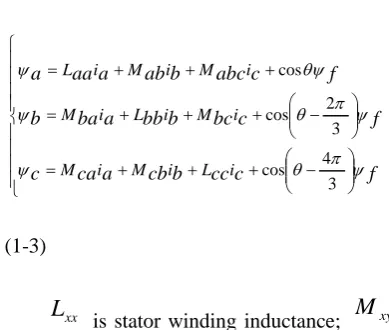
(1-3)
xx
L
is stator winding inductance;
M
xyis mutual inductance between stator winding;
xy represents one of abc's;
ψ
f is rotor fluxlinkage;
θ
is the electrical angle between therotor axis and the a-axis.
Based on the above assumptions, the
mathematical model of PMSM rotor magnetic field in two-phase stationary coordinate
3 system:
Stator voltage equation:
+ +
+ =
− +
+ =
θ ωψ
θ ωψ
α
αβ
β
β
β
β
β
αβ
α
α
α
α
sin sin
f
s
f
s
pi L pi L i R u
pi L pi L i R u
(1-4)
Stator flux equation:
(
)
(
)
− =
− =
∫
∫
dt i R u
dt i R u
s
s
β
β
β
α
α
α
ψ ψ
(1-5)
Electromagnetic torque equation:
(
ψα
iβ
ψβ
iα
)
nTe = p −
2 3
(1-6)
α
u
,
u
β are theαβ
axis componentof the stator voltage vector;
R
s is statorarmature phase resistance;
θ
is electricalangle of the rotor axis to the a axis;
i
α,i
βare the
αβ
axis component of the statorcurrent vector;
p
is differential operator,dt
d
p
=
;
ψ
f is rotor flux linkage;L
xx isstator winding inductance;
T
e refers to thepermanent magnet synchronous motor
electromagnetic torque;
n
p is number ofpole pairs;
ψ
α,ψ
β are theαβ
axis ofthe stator fluxP
[3]
P
.
2 Traditional DTC control strategy
2.1 The basic principle of direct torque control
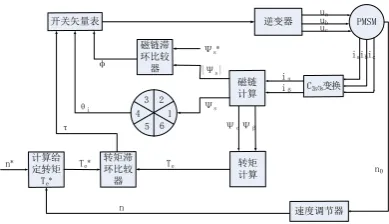
The principle of the traditional DTC
control scheme is shown in Figure 2.1.1
逆变器 ua
ub
uc
iaibic
ΨαΨβ
iα
iβ
n0
n Te
PMSM
计算给 定转矩 Te*
-n*
C2s/3s变换
转矩 计算 Te*
磁链 计算 Ψs*
|Ψs|
Ψs
速度调节器 1
2 3 4
5 6 φ
θi
τ
磁链滞 环比较 器
转矩滞 环比较 器 开关矢量表
Figure 2.1.1 PMSM direct torque control system
schematic
The traditional idea of DTC control is to select the appropriate voltage vector by
querying the way of vector switch table to realize the direct control of flux linkage and torque. (The switch voltage vector table
shown in Table 1.) Traditional direct torque control scheme is established in the two-phase
stationary coordinates
αβ
. First of all,measure the terminal voltage and the terminal
current of the motor; then the transform the coordinate; that is to say, switch the
three-phase stationary coordinate system into the two-phase stationary coordinate system. Use formula (1-5) to calculate the stator flux
s
ψ
, and use formula (1-6) to calculate the
electromagnetic torque
T
e, and determine thesector in which the flux is located, as shown in
Figure 2.1.2 stator flux vector trajectory.
Compare the given flux linkage
*
s
4 torque
*
e
T
with the calculated flux linkage
s
ψ
and torque
T
e respectively. Get intothe hysteresis comparator to control the error. Through the two quantities of the error value
and the sector value , you can choose the appropriate voltage space vector, in order to
achieve the motor flux and torque direct
controlP
[4]
P
.
Table 1 switch voltage vector selection table
ψ
∆
∆
T
Ⅰ Ⅱ Ⅲ Ⅳ Ⅴ Ⅵ
1
1 U6 U2 U3 U1 U5 U4
0 U5 U4 U6 U2 U3 U1
0
1 U2 U3 U1 U5 U4 U6
0 U1 U5 U4 U6 U2 U3
2.2 Direct Torque Control Simulation Experiment
Motor direct torque control is divided into coordinate transformation module, torque,
flux estimation module, and hysteresis comparison and switching voltage meter selection module. Under the Simulink
simulation environment of MATLAB, the system simulation model of DTC-based
permanent magnet synchronous motor is established according to the control principle of DTC, as shown in Figure 2.2.1.
In the simulation experiment, the parameters of permanent magnet synchronous motor are set as follows: the given motor
speed is 100r/min, the sampling period
T
s=1e-005s, the simulation time of MATLAB is 0.2s, the DC bus voltage is Udc=310V. At 0.05s plus step load 1N·m, pole pairs number
p
=2, stator resistanceR
s =20.51Ω, thegiven value of stator flux
*
s
ψ
=0.8wb,cross-axis inductance
L
d =0.168H,direct-axis inductance
L
q =0.168H, torqueinertia J=0.0008kg·m2
100 w
Discrete, Ts = 1e-005 s.
powergui
fluxalpha fluxbeta angle ||
figure out angle angleSn figure out Sn
XY Graph1
U_abc U_a U_b V3/2 g A B C + -Universal Bridge
Vabc Iabc A B C a b c Three-Phase V-I Measurement w*
w Te* Te* caculator
ia cia ib cib Te Te caculator
Sector SF STe
pulse Sa Sb Sc
ia ua ib ub cia
cib Subsystem
Step
Scope6
Scope2
Scope1
Scope 0.8
Q* Tm
m A B C Permanent Magnet Synchronous Machine
I_abc I_a I_b I3/2
2 Gain3
DC
<Stator current is_a (A)> <Stator current is_b (A)> <Stator current is_c (A)> <Electromagnetic torque Te (N*m)> <Rotor speed wm (rad/s)>
is_abc
Figure 2.2.1 Permanent Magnet Synchronous Motor
Direct Torque System Simulation Model
3 SVM-DTC control strategy
3.1 SVM-DTC control principle
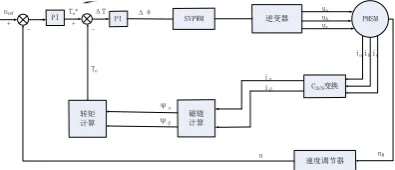
The principle of SVM-DTC control
scheme is shown in Figure 3.1.1
PI PI SVPWM
C2s/3s变换
磁链 计算 转矩
计算
逆变器
速度调节器
nref ua
ub uc +
- +
-iaibic
Ψα Ψβ
iα iβ
n0 n
Te
PMSM
t
Te* ΔT Δθ
Figure 3.1.1 SVM-DTC control schematic
Compared with the traditional direct torque control scheme, SVM-DTC scheme uses the PI regulator instead of the traditional
scheme of torque hysteresis comparator and flux hysteresis comparator. In addition,
SVPWM module instead of the query switch table. In the control strategy of SVM-DTC, the motor will issue multiple voltage vectors
according to the error of torque and flux linkage in arbitrary control cycle, so as to
5 flux linkage, reduce the torque ripple, and let
the output waveform become smoother, which in order to obtain better dynamic performance
and static performanceP
[5]
P
.
α
U1 U2
U3 U4
U5 U6
β
Ⅲ
Ⅱ
Ⅰ
Ⅵ
Ⅴ Ⅳ
Uref
θ T6 TsU6
T4 TsU4
Figure 3.1.3 Basic space voltage vector diagram
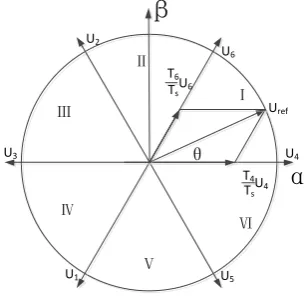
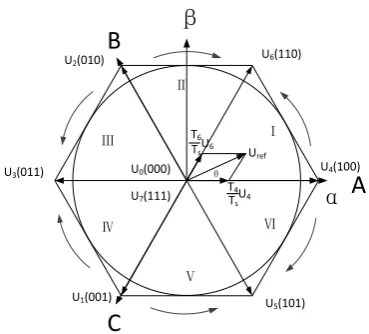
Space vector pulse width modulation technology works by using the adjacent two
basic voltage space vector of different action time, as shown in Figure 3.1.3. In the figure, I, II, III, IV, V, VI indicate the sector number
where the reference voltage vector
U
ref islocated.
U
0,U
7 is zero voltage vector,U
1~
U
6 is the effective basic voltage vector.And these eight basic voltage space vector can
be any number of different voltage space vector synthesis, so that each cycle can choose a reasonable voltage space vector to
compensate for the error of motor torque and stator flux between the observations and
reference valuesP
[6]
P
. In order to be able to
compensate for the error
∆
T
e between theobserved torque value
T
e and the torquereference output
T
ref of the speed regulator,it can take advantage of the PI regulator to
calculate the phase angle
∆
θ
, the referencevector
ψ
ref of the flux linkage, the fluxobservation value
ψ
s and the phase angles ψ
θ
of the observation value, which stator
flux required to be added, and then get into the flux compensation module to calculate the flux component of the compensation value
α
ψ
S∆
and
∆
ψ
Sβ. Afterwards,∆
ψ
Sα andβ
ψ
S∆
, in the voltage space vector calculation
module, they can get the stator voltage
components
U
αref andU
βref , and finallymake use of the SVM algorithm module to output inverter control signal.
SVPM module control schematic
diagram shown in Figure 3.1.2
磁链补偿值 分量的计算
电压空间 矢量计算
θ
∆ s
ψ
θ
re f
ψ
sψ
ref
Uα
ref
Uβ SVM 驱动 信号 PI
e
T +
-e
T ∆ *
e
T
α
ψ
S∆
∆ψSβFigure 3.1.2 SVPM module schematic
6
β
α
θ
Δθ
re fψ
∆
ψ
ss
ψ
Figure 3.2.1 Stator flux vector
Permanent magnet synchronous motor stator flux vector diagram in Figure 3.2.1, in
which
ψ
s is the reference value of statorflux vector,
ψ
ref is the reference value ofstator flux vector ,
∆
ψ
s is the compensationvalue of stator flux ,
ψ
f is the flux vector ofrotor permanent magnet,
θ
is the angle ofthe stator flux vector observations and
∆
θ
isthe increased angle of stator flux vector phase angle.
The calculation process of reference
voltage vector is as follows:
Magnetic chain compensation equation:
(
)
(
)
−
∆
+
=
∆
−
∆
+
=
∆
θ
ψ
θ
θ
ψ
ψ
θ
ψ
θ
θ
ψ
ψ
β α
sin
sin
sin
sin
s ref
S
s ref
S
(3-1)
Reference voltage space vector equation:
+ ∆ =
+ ∆
=
β β
β
α α
α
ψ ψ
i R T U
i R T
U
s s S ref
s s S ref
(3-2)
Stator flux vector equation:
+ =
+ =
β
β
α
α
θ ψ
ψ
θ ψ
ψ
i L
i L
s
ref
S
s
ref
S
sin cos
(3-3)
In the three-phase inverter circuit, it is assumed that the conduction of the power
switch is 1 and the cutoff is 0, we can get the 8
switch status (000 ~ 111) of power switchP
[7]
P
. And the corresponding inverter will output 6
motion voltage vectors
U
1U
2U
3U
4U
56
U
and 2 zero voltage vectors
U
0U
7, asshown in Figure 3.2.2. Each vector size is
dc
U
3
2
, the angle of each adjacent 2 voltage
vector is 60°, and the diameter of a hexagon inscribed circle consisting of vector vertices is
dc
U
3
1
.
α
U1(001)
U2(010)
U3(011) U4(100)
U5(101)
U6(110)
β
A
B
U0(000)
U7(111)
C
Ⅲ
Ⅱ
Ⅰ
Ⅵ
Ⅴ Ⅳ
Uref
θ
T6
TsU6
T4
TsU4
Figure 3.2.2 Reference voltage space vector synthesis
diagram
As shown in the above figure, take the
the reference voltage vector
U
ref in the first7
ref
U
≤
1
3
U
dc, thenU
ref is within theinscribed circle. Therefore,
U
ref can besynthesized by voltage vector
U
4 and zerovector
U
6. At the same time, defineT
4,6
T
,T
0 as the operating time ofU
4,U
6and zero voltage vector in a cycle period,
T
sis the sampling period of system.
In a sampling period, the calculation process of the reference voltage vector in the adjacent two basic voltage vector of the action
time
T
4,T
6is shown as follows:Take Ⅰ sector as an example, according
to the principle of volt-second balance, the relationship between the reference voltage
vector
U
ref and the basic voltage vector4
U
is:(
4 4 6 6)
1 T U T U
T U
s
ref = + (3-4)
0 0 6 6 4
4U T U T U T
Ts = + + (3-5)
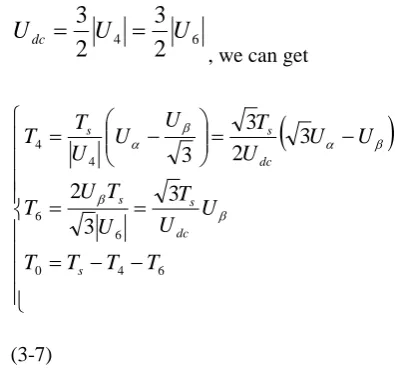
Map the voltage vector to
α
,β
axis,shown in figure 3.2.2, and according to the formula (3-4)(3-5), we can get
= + = 3 sin 3 cos
6
6
6
6
4
4
π πβ
α
U T T U U T U T T Us
s
(3-6)according to formula (3-5) (3-6), and
6 4
2
3
2
3
U
U
U
dc=
=
, we can get
(
)
− − = = = − = − = 6 4 0 6 6 4 4 3 3 2 3 2 3 3 T T T T U U T U T U T U U U T U U U T T s dc s s dc s s β β β α β α (3-7)Among them, when T4 + T6> T, that is
saturated status, then 4 6
4 4
T
T
T
T
T
s+
∗
=
, 6 4 6 6T
T
T
T
T
s+
∗
=
.Through the previously calculated size of
ref
U
α,
U
βref, you can determine the sectorposition of spatial voltage reference vector, the operating process is as follows:
Obtained from figure 3.2.2,
θ
α
U
refcos
U
=
,
U
β=
U
refsin
θ
, Whenref
U
is in sector I, the condition is true
0
>
βU
,3
tan
π
α β<
U
U
,that is,
> − > 0 3 0
β
α
β
U U U (3-8)In other sectors,we can get three
intermediate variables
M
1,M
2,M
3through8
of the same method, and
M
1,M
2,M
3are:
− −
=
−
= =
β
α
β
α
β
U U U
T M
U U U
T M
U U
T M
dc
s
dc
s
dc
s
3 2
3 3 2
3 3
3
2
1
(3-9)
Defining variable a, b, c. If
M
1>0,thena=1,or a=0;if
M
2>0 , then b=1,or b=0;if
M
3>0,then c=1,or c=0. Afterwards,defining N=4c+2b+a,then N=1~7,We
need to define them one by one,thus, we can
judge the sector position due to N value, and
then get the table 3-1.
Tab.3-1 The relationship between sector position
and N.
N 1 2 3 4 5 6
sectors Ⅱ Ⅵ Ⅰ Ⅳ Ⅲ Ⅴ
After determine the sector position of
ref
U
, we need to Use equation (3-7) to
calculate the individual action time
T
4,T
6P
[8]
P
.
The following section describes the
relationship between sector position and action time:
Define variable X,Y,Z;
− +
=
+
= =
β
α
β
α
β
U U U
T Z
U U U
T Y
U U
T X
dc s dc s dc s
3 2
3 3 2
3 3
(3-10)
According to equation (3-7), we can get the relationship between T4, T6 and the
sectors, as shown in Table 3-2:
Tab.3-2 Duration of voltage vectors in each sector
sect
ors Ⅰ Ⅱ Ⅲ Ⅳ Ⅴ Ⅵ
T4 -Z Z X -X -Y Y
T6 X Y -Y Z -Z -X
After determining the operating time of a sector and the corresponding space voltage
vector, We can calculate the value of each corresponding comparator according to PWM modulation principle, and the operation
process is as follows:
Defining the the comparison points of
trigger pulse PWM1,PWM3,PWM5 as
1
cmp
T
,
T
cmp2,T
cmp3. At the same time, definethree intermediate variables
T
a,T
b,T
c, andtheir values is
(
)
+ =
+ =
− − =
6
4
6
4
2 1 2 1 4 1
T T T
T T
T
T T T T
b
c
a
b
a
(3-11)
9 sectors and comparison points, as shown in
Table 3-3.
Tab. 3-3 Computation of Switch Switching Point
Values
sect
ors Ⅰ Ⅱ Ⅲ Ⅳ Ⅴ Ⅵ
1
cmp
T
a
T
T
bT
cT
cT
bT
a2
cmp
T
b
T
T
aT
aT
bT
cT
c3
cmp
T
c
T
T
cT
bT
aT
aT
bFinally, we can compare the switching
times
T
cmp1,T
cmp2,T
cmp3, and the triangularwave to get the SVPWM output timing.
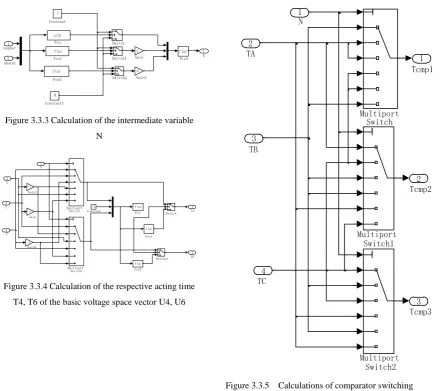
3.3 SVPWM control simulation experiment
Under the Simulink simulation environment of MATLAB, the system
simulation model of permanent magnet synchronous motor based on SVM-DTC is established according to the control principle
of SVPWM, as shown in Figure 3.3.1. The main structure of SVM-DTC control system
of permanent magnet synchronous motor includes the calculation of reference voltage
vector
U
ref , the module simulation model isshown in Figure 3.3.2; The judgment of sector
ref
U
, the module simulation model is shown
in Figure 3.3.3. The operating time of effective voltage vector and zero voltage vector, the module simulation model shown in
Figure 3.3.4. Time allocation of changing
switch, the module simulation model shown in
Figure 3.3.5.
In the simulation experiment, the
parameters of permanent magnet synchronous motor are set as follows: the given motor
speed is 100r/min, the sampling period is
T
s=1e-005s, the simulation time of MATLAB is
0.2s, the bus voltage of DC is Udc=310V, In 0.05s, plus step load is 1N·m, the number of
pole pairs is
p
=2, the stator resistance iss
R
=20.51Ω, the set point of Stator flux isref
ψ
=0.8wb, the cross-axis inductance is
d
L
=0.168H, the direct-axis inductance is
L
q=0.168H, the torque inertia is J=0.0008kg·m2.
U_abc u_ahpa u_beta u3/2
Discrete, Ts = 2e-005 s.
powergui
Iabc I_ahpa I_beta i3/2 ialpha ibeta ualpha ubeta Rs fluxalpha fluxbeta |flux| jiao figure out fluxalpha fluxbeta ialpha
ibeta fluxalpha fluxbeta Np Te
figure out Te
g A B C + -Universal Bridge
Vabc Iabc A B C a b c Three-Phase V-I Measurement Deta
flux* theta_s flux i_beta i_alpha g Sa Sb Sc Subsystem
Step1 Scope4
Scope2
Scope1
Scope Tm
m A B C Permanent Magnet Synchronous Machine I O
PI1 I O PI
2 Gain3 0.8
Flux*
DC 100
Constant3
10 Constant2 2
Constant1
<Stator current is_a> <Stator current is_b> <Stator current is_c > <Rotor speed wm >
is_abc <Electromagnetic torque Te>
Figure 3.3.1 Permanent magnet synchronous motor
SVM-DTC simulation model
beta *
4Sc
3Sb
2Sa
1g
sin
Trigonometric Function3
cos Trigonometric
Function2 cos Trigonometric
Function1 sin Trigonometric
Function
u_beta
u_alfa pulse
Sa
Sb
Sc
Subsystem
10 Rs
Product7 Product6 Product3
Product2
Product1 Product
Divide1 Divide
0.0002 Constant3
0.0002 Constant2
Add4 Add3 Add2
Add1 Add
|u| Abs1 |u|
Abs 6
i_alpha 5 i_beta
4 flux 3 theta_s
2 flux* 1 Deta
Figure 3.3.2 Calculation of voltage space reference
10
1 N
Switch2 Switch1 Switch
4 Gain1 2 Gain
f(u) Fcn3 f(u)
Fcn2 f(u) Fcn1 u(2) Fcn
0 Constant1
1 Constant
2 ubetar
1 uaphar
Figure 3.3.3 Calculation of the intermediate variable
N
2 T6 1
Switch1 Switch
Multiport Switch1 Multiport Switch
-1 Gain2 -1 Gain1
-1 Gain
f(u) Fcn2
f(u) Fcn1 Fcn -C
Constant
4 Z 3 Y 2 X
1 N
f(u)
T4
Figure 3.3.4 Calculation of the respective acting time
T4, T6 of the basic voltage space vector U4, U6 3
Tcmp3 2 Tcmp2
1 Tcmp1
Multiport Switch2 Multiport Switch1 Multiport
Switch
4 TC 3 TB 2 TA
1 N
Figure 3.3.5 Calculations of comparator switching
points Tcpm1,Tcmp2,Tcmp3
4 Simulation results of DTC and
SVM-DTC control strategy
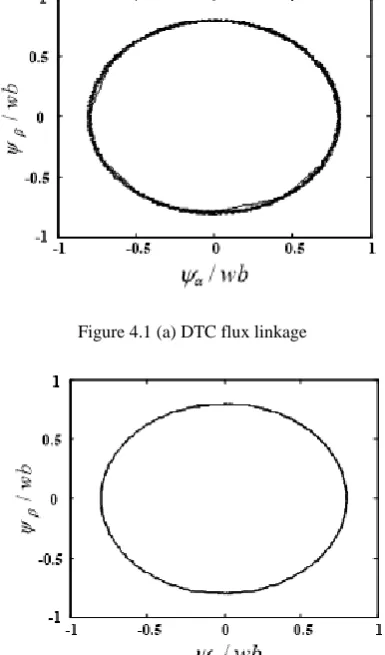
Simulation and experimental results are shown in Figure 4.1 ~ Figure 4.4. Figure 4.1 shows the stator flux trajectory under two
control schemes. Observing Fig. 4.1 (a) and Fig. 4.1 (b), in both cases the flux trajectories
are approximately circular, but in comparison, the flux trajectory under the SVM-DTC scheme is smoother and the flux linkage
Fluctuations are obviously small. This shows that the use of SVM-DTC program greatly
enhances the overall system steady-state
performanceP
[9]
P
11 Figure 4.1 (a) DTC flux linkage
Figure 4.1 (b) SVM-DTC flux trajectory
Figure 4.2 shows the stator phase current
waveform. By comparing Fig. 4.1 (a) and Fig. 4.1 (b), it can be concluded that the start-up current is large and the steady state time is
long when the traditional DTC scheme is adopted. However, the stator current of the
motor adopting SVM-DTC scheme starts smoothly, the amount of modulation is small , the time achieving steady state is short, and
the waveform is closer to the sine wave. And in the SVM-DTC scheme, the stator current is
sinusoidal and the current ripple is less than 0.1A.
is_abc/A
-6 -4 -2 0 2 4 6
0 0.02 0.04 0.06 0.08 0.1 0.12 0.14 0.16 0.18 0.2 t/s
Figure 4.2 (a) DTC stator three-phase current
is_abc/A
-3 -2 -1 0 1 2 3 4
0.2 0 0.02 0.04 0.06 0.08 0.1 0.12 0.14 0.16 0.18
t/s
Figure 4.2 (b) SVM DTC stator three-phase current
Figure 4.3 (a) and Figure 4.3 (b) show
the electromagnetic torque waveform at steady state. Under the two schemes, the speed of the motor is 0 N·m, at the beginning, and the step
load torque is increased by 1N·m at 0.05s. Comparing Figure 4.3 (a) with Figure 4.3 (b),
we can see that when the motor is started, the torque waveform of the traditional DTC scheme fluctuates greatly and the torque
waveform response time is longer. In the SVM-DTC control scheme, the torque quickly responds to the change of the load torque, that
is, the dynamic response of the system is rapid and the overshoot is small with no static error
in the steady stateP
[10]
P
.
This shows that the motor has good
system performance under SVM-DTC control strategy and the motor can output more stable
and accurate torque.
Te/(N*m)
-10 -5 0 5 10 15
0 0.02 0.04 0.06 0.08 0.1 0.12 0.14 0.16 0.18 t/s
Figure 4.3 (a) DTC torque waveform
-4 -2 0 2 4 6 8
Te /(N*m)
0.2 0 0.02 0.04 0.06 0.08t/s 0.1 0.12 0.14 0.16 0.18
Figure 4.3 (b) SVM-DTC torque waveform
Figure 4.4 shows the motor speed
12 Comparing Figure 4.4 (a) and Figure 4.4 (b),
we can find that the speed response time of the system adopting SVM-DTC control scheme is
shorter. When the load changes from zero to 1N.m at 0.05s, the speed is controlled by a certain overshoot, but it quickly stabilizes well.
The system using the traditional DTC control scheme, the speed response time is longer, and
when the load torque changes, the speed will
fluctuate significantlyP
[11]
P
.
-100 -50 0 50 100
0 0.02 0.04 0.06 0.08 0.1 0.12 0.14 0.16 0.18 0.2 t/s
ω/(rad/s)
Figure 4.4 (a) DTC speed waveform
ω/(rad/s)
0 10 20 30 40 50 60
0.2 0 0.02 0.04 0.06 0.08 t/s 0.1 0.12 0.14 0.16 0.18
Figure 4.4 (b) SVM-DTC speed waveform
5 Conclusion
From the simulation results in this paper, we can see that in the traditional DTC control strategy, the current, torque and flux ripple are
large, and the static dynamic performance is not particularly stable. But the space voltage
vector modulation technology, which takes advantage of SVM, use voltage vector to completely compensate the stator flux error,
and make use of the PI regulator to replace the traditional hysteresis comparator in order to
achieve steady-state flux-free no-static control. Thus it can reduce the flux ripple and torque ripple of the motor, which is able to make the
flux locus smoother and the electromagnetic torque tracking faster. Also, the advantage of
fast response in the traditional DTC control
scheme is maintained.
References and Notes
[1] Steimel A. Direct self-control and
synchronous pulse techniques for
high-power traction inverters in comparison[J].
IEEE Trans Ind Electro,2004,51(4):810-820.
[2] Giuseppe S,Buja Marian,P Kazmierkowski.
Direct Torque Control of PWM Inverter-Fed AC
Motors-A Survey[J]. IEEE Trans Ind
Electronics,2004,51(4):744-757.
[3] Song Jianguo,Chen Quanshi. Research of
Electric Vehicle IM Controller Based On Space
Vector Modulation Direct Torque Control. 8th
ICEMS 2005:1617-1620.
[4] Jin Mengjia,Shi Cenwei,Qiu Jianqi,et
al. Stator Flux Estimation for Direct
Torque Controlled Surface Mounted
Permanent Magnet Synchronous Motor
Drives over Wide Speed Region. ICEMS,
2005:350-354.
[5] Tripathi A , Khambadkone A M ,
Panda S K. Torque ripple analysis
and dynamic performance of a space vector
modulation based control method for AC-drives.
IEEE Trans Power Electronics,2005:485-492.
[6] Parsa L,Toliyat H A. Sensorless direct
torque control of five-phase interior
permanent magnet motor drives. 39th IAS,
13
[7] Dan Sun,Yikang He,Zhu J G.
Sensorless direct torque control for
permanent magnet synchronous motor based on
fuzzy logic. 4th IPEMC,2004,3:1286-1291.
[8] Linni Jian,Liming Shi. Stability Analysis for
Direct Torque Control of Permanent Magnet
Synchronous Motors. 8th ICEMS 2005
1672-1675.
[9] Linni Jian,Liming Shi. Stability Analysis for
Direct Torque Control of Permanent Magnet
Synchronous Motors. 8th ICEMS 2005
1672-1675.
[10] Yen-Shin Lai , Fu-San shyu , Yung-Hsin
Chang. Novel Loss Reduction
Pulsewidth Modulation Technique for
Brushless dc Motor Drives Fed by
MOSFET Inverter[J]. IEEE Trans on Power
Electronics,2004,19(6):1646-1652.
[11] Yong Liu,Z Q Zhu,David Howe.
Direct Torque Control of Brushless DC
Drives With Reduced Torque Ripple[J]. IEEE