www.ijiset.com
A study on Consumer Evaluations of Continued Group-Buying
Intentions
Shu-Mei Tseng, Jia-Rong Wu, Chao-Wei Chou, Hsien-Leing Tsai*
Department of Information Management, I-Shou University, Kaohsiung, 84001, Taiwan
*Corresponding author
Abstract
This study examines the effects of the group-buying website performance and retailer performance on consumer satisfaction and continued group-buying intention. Specifically, this study focuses on two purchase processes, namely online transactions and the retailer experience. After the customers complete their transaction on the online group-buying website (OGW) and receive their vouchers, they are able to book an appointment with the physical retailers to redeem their vouchers. There are few studies that simultaneously consider the performance of the OGW and retailer, this study thus adopts the experience-dissonance process that integrates cognitive consistency theory and expectation confirmation theory to investigate the formation of consumer satisfaction in online group-buying. Based on the results, specific recommendations are provided for electronic commerce business operators to enhance online group-buying intention, so that they can improve their marketing strategies. Keywords: Performance, Experience-Dissonance Process; Satisfaction, Continued Group-Buying Intention
1. Introduction
Due to advances in the Internet and mobile devices, along with the booming electronic commerce market, consumption patterns have gradually shifted to an online context, with online group-buying (OGB) being one popular form of such commerce. OGB is defined as when a number of consumers join together via the Internet for the purpose of buying a certain product/service at a discount (Cheng and Huang, 2013). The early pioneers of OGB, such as Mercata.com and Accompany.com (now MobShop.com), developed a new type of dynamic pricing mechanism, and launched group-buying websites in May 1999 and March 1999, respectively. Using this method consumers are able to pool their purchasing power in order to bargain and get a better price, assisted by the market-making efforts of the online retailer itself (Kauffman and Bin, 2001; Pelaez, Yu and Lang, 2013).
The practice of OGB originated from the use of Bulletin Board Systems (BBS), Post Text Table (PTT, a kind of BBS), websites and blogs, which made it possible for groups members to buy the desired products/services at discount prices when enough buyers had been gathered together. The current model of OGB is based on an OGB operator negotiating with the supplier and then providing a
fixed amount of available products/services at the agreed discounted price, which consumers can then purchase on the OGB. After consumers have placed their orders the supplier receives a notification from the OGB, and then provides the service or ships the product. The OGB vendor then calculates the share of revenue with the supplier based on their agreement (Chen, Hsu, Chang and Liang, 2012). Over the last two decades various types of OGB have started business, with some of the most popular listed as follows: CoShopper.com (operating in seven European countries and Japan), LetsBuyIt.com (operating in the UK, Germany, Sweden and France), and kr.Groupbuy.Yahoo.com (operating in South Korea), Yabuy.com and Coolbid.com.cn (both operating in China), StockBuzz (based in Thailand), and Chennai Online (operating in India-based market) (Anand and Aron, 2003; Chen, 2002; Rha and Widdows, 2002). Groupon was established back in November 2008 and first launched in Chicago, where a daily deal is featured for people who are looking for the best things to do, eat, see and buy offered by more than 250 markets worldwide (http://www.groupon.com.tw).
Gomaji had its initial public offering on January 14, 2015, with the ticker “8472-tw” and a price of 125 TWD, thus becoming the first OGB operator to on the Taiwanese stock market (http://www.ttv.com.tw).
Gomaji was the first to offer a full-refund guarantee and group-buying booking system. Its suppliers include theme restaurants, spas, massage centers, cinemas, KTVs (Karaoke Television rooms) and certain food stores (Chang, 2015). Moreover, the increasing power and popularity of smartphones enable consumers to browse products/services anywhere at any time, and thus Gomaji uses location-based services (LBS) to find the current locations of users and thus provide customized discounts of local retailers for users. However, since it is not possible to fully see or handle a physical product online, many consumers are worried that may be significant differences in quality between what is offered and what is received. Moreover, if such discrepancies do exist, then this will negatively affect consumer repurchase intentions. The following example allows a useful insight into understanding how a consumer establishes his/her satisfaction of the service given by an OGB.
When a consumer sees a delicious Italian meal on the website, they can reserve it online and use the related voucher by following the instructions they are given. Furthermore, since the voucher can be used on any day, the restaurant is well located and users can get up to a 40% discount, the consumer buys two vouchers. After the user pays online with a credit card, the group-buying website immediately sends them the voucher redemption numbers via SMS and e-mail. The consumer was very pleasantly surprised by the rapid service, and also expected that the services provided by the restaurant would live up to their expectations. However, when the consumer tried to reserve a table online they found that it was not possible to do so for a weekend, or when they went to the restaurant the staff were not friendly, or perhaps there was a discrepancy between the pictures of the meals shown on the website and the actual meals that were received. Such adverse situations would not only make consumers unwilling to visit this restaurant again, but would also affect their repurchase intention with regard to the group-buying website.
This example shows that the service encounters experienced by a consumer occurred at two different points in the process of ordering the voucher: pre-services (the performance of OGB) and post-services (the performance of restaurant). In other words, even though the consumer may have had a pleasant experience on the OGB, if they have had an unpleasant experience in the physical retailer then this can discourage them from ever using that OGB again. Therefore, a consumer experienced cognitive inconsistency between the OGB and the retailer aspects.
These aspects of OGB suggest an important consideration: it is important to understand whether pre-services (the performance of OGB) and post-services (the performance of retailer) affect the consumer's satisfaction formation in different ways.
Even though the number of studies examining OGB has increased significantly in recent years, most of the previous works focus on price discounts (Liao, Chu, Chen and Chang, 2012; Zhang, Zhang, Wang, Law and Li, 2013), the technology acceptance model (Lim and Ting, 2014; Tsai, Cheng and Chen, 2011), website quality (Cheng and Huang, 2013; Hsu, Chang, Chu and Lee, 2014; Hsu, Chang and Chuang, 2015), trust (Hsu, Chang, Chu and Lee, 2014; Hsu, Chang and Chuang, 2015), perceived risk (Lim and Ting, 2014), or word of mouth (Cheng and Huang, 2013) as antecedent variables to investigate consumer satisfaction and repurchase intention. There are still few studies that simultaneously consider the influence of the performance of the OGB and retailer on consumer satisfaction with the OGB. Therefore, this study investigated the impact of the performance of OGB and retailer on consumer satisfaction and continued OGB intention. Specifically, this study focuses on two main issues. First, based upon expectation– confirmation theory, this study examines how the performance of OGB and retailer affects consumer satisfaction for OGB. This study then examines how the performance of OGB and retailer influences consumer satisfaction via dissonance. Furthermore, this study will propose specific recommendations for OGB operators regarding how to enhance OGB intention, so that they can improve their marketing strategies.
2. Theoretical Background and Hypotheses
2.1 Expectation-confirmation process
www.ijiset.com
disconfirmation occurs. Conversely, if a consumer evaluates the product/service as of a higher quality than his/her expectations, then positive disconfirmation transpires.
2.2 Experience–dissonance process
After the consumers complete their transaction on the OGB and receive their vouchers, they are able to book an appointment with the physical retailers to redeem their vouchers. This means that OGB includes two purchase processes, namely the online transaction and the retailer performance. This can lead to consumers experiencing inconsistent attitudes with regard to the online transaction and retailer, and in this study such an inconsistency is termed the experience–dissonance process. The focus of the comparison in the experience–dissonance process is on two distinct and consecutive performances, those of the OGB and the retailer. Such feelings of dissonance are explained by cognitive dissonance theory (Festinger, 1957). Within an OGB context, when a consumer experiences conflicting attitudes or feelings toward the physical retailers in the transaction process, they would have inconsistent attitudes (i.e., dissonance) toward the OGB and retailer. They can then resolve this dissonance through a process of evaluating overall satisfaction, and, if satisfied, then they are more likely to repurchase from the same OGB website. In other words, positive dissonance is recorded when the consumer’s expectation performances are lower than the perceived quality, whilst negative dissonance occurs when the expectations are higher than the perceived quality. That is, consumers appraise their satisfaction towards the service based on the dissonance derived from a comparison between OGB’s performance and retailer’s performance. In this context, positive dissonance (OGB’s performance < retailer’s performance) will lead to feelings of high satisfaction, whereas negative dissonance (OGB’s performance > retailer’s performance) will cause feelings of dissatisfaction.
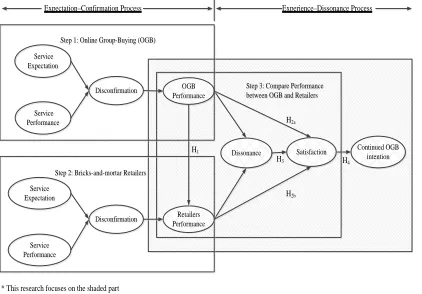
Figure 1 shows the expectation-disconfirmation and experience–dissonance processes in OGB contexts. As shown in the Figure 1, this study argues that the satisfaction formation process consists of three steps in an OGB context: assessing the OGB’s performance (step 1), assessing the retailer’s performance (step 2), and comparing and integrating the OGB’s and retailer’s performance (step 3). In addition, assessing the OGB’s and retailer’s performance separately is part of the expectation-confirmation process, while comparing and integrating the OGB’s and retailer’s performance is part of the experience-dissonance process, and this study focuses on the latter (the shaded part in Figure 1).
Steps 1 and 2 are typical cases of the expectation– confirmation model. In Step 1, consumers assess the performance of OGB through the expectation– confirmation process that results from comparing their expectations with perceived performance, in terms of factors such as clarity of information and the charges statement, ease of finding the desired item, product variety, look and design, order status inquiry and tracking, and consumer service support (Hausman and Siekpe, 2009; Chiou, Lin and Perng, 2011; Park, Cho and Rao, 2012). In this step, if consumers are not satisfied with the performance of the OGB they are more likely to end their engagement in the process.
In Step 2, the consumers assess the retailer’s performance based on their experience of the focal product/service, based on factors such as the store layout, service or product quality, and so on. In this situation, the OGB’s performance could affect service expectations by serving as a baseline that has already been experienced, thus affecting the assessment of retailer’s performance. For example, if consumers experienced good service from the OGB, they would thus expect that the retailer would also offer good service. In other words, the performance of the OGB anticipates and provides a comparative referent for the evaluation of the retailer’s performance. Accordingly, this study proposes that OGB’s performance positively affects retailer’s performance. This leads to Hypothesis 1, as follows:
Hypothesis 1. OGB’s performance will positively affect the retailer’s performance.
2.3 Satisfaction
contexts, with the theory proposed by Oliver (1980) neglecting the fact that both the consumer’s original and actual expectations would change over time. Furthermore, consumers can simultaneously measure their original and actual expectations during the confirmation phase, while the expected and perceived performance can be also concurrently considered in the expectation-confirmation dimension. In other words, consumers will compare the expected and actual performance of the product/service, and thus obtain the degree of the expectation confirmation, with confirmation being positively related to satisfaction (Hsu and Lin, 2015). Eveleth, Baker-Eveleth and Stone (2015) also applied the expectation confirmation theory to explore how job-seekers’ experiences on a website affect their satisfaction toward the company, and they found that users’ expectation-confirmation after using the website has a significant and positive influence on their satisfaction with it.
Due to the fact that consumers actually appraise each experience and then aggregate their appraisals into one perception regarding the service vendor, multiple experiences can occur in multiple service chapters, as well as multiple discrete components, when a consumer and vendor interact with each other (Park et al., 2012). The OGB’s performance and retailer’s performance can be clarified using the example in Section 1. If the consumer had not been satisfied with the OGB, regardless of ease of use, clarity of product, or website design, they would not have chosen the OGB again. In other words, if the consumer had not been satisfied with the restaurant services they received, regardless of product/service quality, they would also not have chosen this restaurant again. Therefore, if a consumer was satisfied with the OGB, and this was followed by a satisfying retailer service encounter, then they would have a high level of overall satisfaction. That is, the performances of the OGB and retailer are used in the satisfaction formation process in order to assess overall satisfaction, and thus this study proposes Hypothesis 2a and Hypothesis 2b, as follows: Hypothesis 2a. Consumer satisfaction will be more
affected by the OGB’s performance.
Hypothesis 2b. Consumer satisfaction will be more affected by the retailer’s performance.
In Step 3, the consumers compare two different attitudes resulting from the OGB vs. retailer service attributes. In doing so, the consumer evaluate their overall satisfaction in terms of performance disconfirmation based on their experiences with the OGB and retailer (Steps 1 and 2) (Oliver, 1993; Westbrook, 1987). Due to a time lag between the performances of the OGB and retailer, consumers are able to evaluate several attributes regarding a product/service given by the OGB and retailer. They are
then more likely to integrate these attributes to form a feeling of overall satisfaction based on both the OGB and retailer performance stages. Since each stage has a different focus, the consumer deals with and evaluates different kinds of attributes in each process. Huang and Dubinsky (2014) also stated that consumers may evaluate their satisfaction vis-a-vis the product, service, store, salespeople, or consumption during any stage of the decision making process. That is, the direction of consumer satisfaction will depend upon the kind of the dissonance that is felt. Therefore, this study proposes Hypothesis 3:
Hypothesis 3. A high degree of positive dissonance will positively affect consumer satisfaction.
2.4 Online group-buying intentions
OGB intention refers to consumers’ intention and subjective tendency to purchase an item on a OGB (Schiffman and Kanuk, 2009). Kauffman and Bin (2001) listed the following elements as influencing OGB markets: demand externalities, price, and price-level effect. Demand externalities means that the utility acquired after a consumer purchases a product will increase along with the number of buyers. Price in this context refers to the degree to which consumers focus on prices. The price-level effect refers to the degree to which consumers perceive and react to changes in the price of the focal products/services. Cheng and Huang (2013) used the theory of planned behavior, electronic word-of-mouth, network embeddedness, and website quality attitude to explore the antecedents of intention to participate in OGB. Hsu, Chang, Chu and Lee (2014) proposed a theoretical model to examine the antecedents of repurchase intention in OGB by integrating the DeLone and McLean’s ISS model. The results showed that satisfaction with the website, satisfaction with sellers, and the perceived quality of website have positive influences on repurchase intention.
Picazo-www.ijiset.com
Vela, Chou, Melcher and Pearson (2010) used “I intend to provide”, “I will try to provide”, and “I will make an effort to provide” to measure online review intentions. Hsu, Chang, Chu and Lee (2014) measured the degree of repurchase intention based on “I would like to continue purchasing”, “I plan to continue purchasing”, and “it is likely that I will continue purchasing”.
Scholars working in the field of marketing have investigated the relationship between consumer satisfaction and behavioral intentions. Previous empirical studies have verified that there is a positive correlation between high levels of satisfaction and increased purchase intention (Zhang, Zhang, Wang, Law and Li, 2013; Alegre and Cladera, 2009; Qin and Prybutok, 2009). For example, Alegre and Cladera (2009) analyzed the determinants of tourist intentions to revisit a destination, and found satisfaction has a positive effect on these. Qin and Prybutok (2009) examined the relationship between consumer satisfaction and behavioral intentions in fast-food restaurants, and reported that consumer satisfaction directly and positively influences return intentions. Likewise, Zhang, Zhang, Wang, Law and Li (2013) explored what factors influence the effectiveness of an online group buying promotion in the restaurant industry, and showed that greater satisfaction has a positive effect on the return intentions of such consumers. Shin, Chung, Oh and Lee (2013) and Tsao (2013) also provide empirical evidence to support the link between satisfaction and repeat purchase intention. In other words, consumers’ repeat purchase intention is determined by the level of satisfaction (Liu, Guo and Lee, 2011). Therefore, satisfied consumers usually have stronger repeat purchase intentions, while dissatisfied consumers are more likely to switch to a rival provider (Lin and Wang, 2006). That is, the level of satisfaction with the OGB and retailer will determine the consumer’s continued OGB intention, as stated in the following hypothesis:
Hypothesis 4. Consumer satisfaction has a positive effect on continued OGB intention.
OGB Performance
Dissonance
Figure 1.
A consumer satisfaction formation process in OGB contexts.
Service Expectation
Service Expectation
Service Performance
Service Performance
Service Expectation
Service Expectation
Service Performance
Service Performance
Step 2: Bricks-and-mortar Retailers
Step 2: Bricks-and-mortar Retailers
Step 1: Online Group-Buying (OGB)
Step 1: Online Group-Buying (OGB)
Disconfirmation
Disconfirmation
Disconfirmation
Disconfirmation Retailers Performance
Satisfaction Continued OGB intention
Experience–Dissonance Process Expectation–Confirmation Process
* This research focuses on the shaded part
Step 3: Compare Performance between OGB and Retailers
Step 3: Compare Performance between OGB and Retailers
H1
H2a
H2b
H3 H4
3. Methodology
3.1 Sampling
This study distributed electronic questionnaires to consumers who had already purchased products/services through Gomaji in order to investigate and compare the performance of OGB and retailers using the experience-dissonance processes, as well as how this will affect consumer satisfaction and continued purchase intention. When collecting the data this research applied the purposive and snowball sampling methods, and the questionnaire was mainly distributed online. The questionnaire was distributed via email or messaged on social networks, which contained the URL to the survey, and people who had purchased a product/service through Gomaji were invited to participate in this research. A total of 154 valid questionnaires were collected and analyzed in this manner.
3.2 Measurements and instruments
The measurements and instruments used in this research are as follows.
(1). OGB performance and retailer performance: The expectation-confirmation theory was used to compare the performances of OGB and retailers. To measure the former this study compared the prepurchase expectations with regard to the OGB and the perceived performance after experiencing the service provided by the website, then evaluated whether they were consistent or not (degree of confirmation). As for the retailer’s performance, this study compared the prepurchase expectation with regard to the retailer and the perceived performance after were the service provided by the retailer, and then evaluated whether they were consistent or not (degree of confirmation), as well as using this as a reference for measuring the retailer’s performance. The questionnaire items used to assess this were based on those used in Park, Cho and Rao (2012) and Hsu, Chang and Chuang (2015). (2). Dissonance: This study measured the degree of
disconfirmation by evaluating the expectations of consumers who purchased a product/service on an OGB and then experienced it in the retailer. This study based the related questionnaire items on those in Park, Cho and Rao (2012).
and McKinney, Kanghyun and Zahedi (2002) when designing the questionnaire.
(4). Continued OGB intentions: This study examined the subjective probability or possibility that consumers would be willing to continue making purchases on the OGB (Schiffman and Kanuk, 2009). Dodds, Momoe and Grewal (1991) and Bhattacherjee (2001) were used as references to design the related questionnaire items in order to measure the respondents’ continued OGB intentions.
3.3 Data analysis procedures
This study first used the SPSS statistical software to conduct the descriptive data analysis. It then applied Partial Least Squares (PLS) path modelling (variance-based structural equation modelling) to conduct the model analysis. This technique is less stringent with regard to the data distribution and sample size requirements compared to covariance-based structural equation modeling. The minimal demands on distributional assumptions and sample size make PLS an appropriate analysis technique for this study (Fornell and Cha, 1994; Chin, 1998).
4. Results
This study referred to previous related works in order to refine the operational definitions of the focal constructs and then develop the questionnaire items. Based on discussions with many experts the wording of some items in the questionnaire was changed, thus ensuring that the instrument had good content and face validities.
4.1 Descriptive statistics
A total of 154 valid questionnaires were obtained, with most of the respondents being women (63.6%), and the main age group was 31-40 years old (32.5%), the main length of using Gomaji was less than three months (33.8%), and the average monthly purchase at Gomaji was less than 999 TWD (64.9%). This study also analyzed which products the respondents purchased using multiple-choice questionnaire items. The majority of respondents bought meal vouchers most often (60.4%), followed by daily living and entertainment vouchers (15.9%), travel vouchers (10.6%) and beauty vouchers (10.6%).
4.2 Model analysis
This study applied PLS modeling to validate the constructs of OGB website performance, retailer performance, experience-dissonance process, consumer
satisfaction, and continued OGB intention, and to test the hypotheses. The psychometric properties of the constructs were tested using confirmatory factor analysis (CFA) and Smart PLS 2.0 M3 (Ringle, Wende and Will, 2005). This process had two stages: (1) assessment of the measurement model; and (2) testing of the structural model.
4.2.1. The measurement model
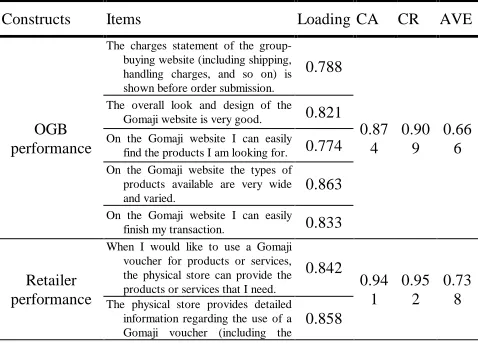
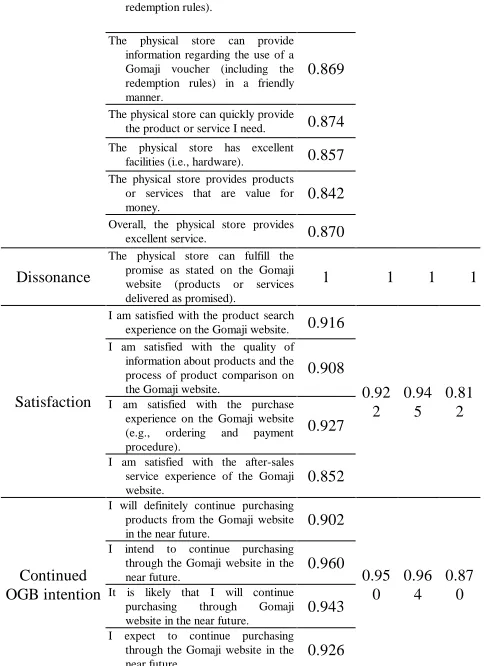
This study assessed the quality of the measurement model by examining the construct reliability, convergent validity, discriminant validity, and standardized factor loadings of the latent variables (Henseler, Ringle and Sinkovics, 2009). Reliability is used to evaluate the internal consistency of a construct. The CFA of PLS provides the values for Cronbach’s alpha and composite reliability (CR) for each construct. As can be seen from Table I, all the constructs in the model possessed adequate internal reliability, as the Cronbach’s alpha and CR values of each construct are greater than 0.70 (Nunnally and Bernstein, 1994). The five scales thus demonstrate adequate reliability. In addition, the analysis of the factor loadings of each item for all the constructs in the model shows that all the measurement items are significant at p < 0.001 (Hair Jr., Anderson, Tatham and Black, 1998; Bradley, Pridmore and Byrd, 2006). Furthermore, this study found that the average variance extracted (AVE) value for all the latent variables in the model is greater than 0.5 (Chin, 1998), which demonstrates that the constructs possess adequate convergent validity. The discriminant validity was assessed by calculating the square root of the AVE for each construct. The results show that all the square root values are greater than the correlation values with all other constructs (see the values on the diagonal in Table II), which confirms the constructs possess adequate discriminant validity (Fornell and Larcker, 1981).
Table I.
Psychometric properties in the null model (n = 154).
Constructs Items Loading CA CR AVE
OGB performance
The charges statement of the group-buying website (including shipping, handling charges, and so on) is shown before order submission.
0.788
0.87 4
0.90 9
0.66 6
The overall look and design of the
Gomaji website is very good. 0.821
On the Gomaji website I can easily find the products I am looking for. 0.774 On the Gomaji website the types of
products available are very wide
and varied. 0.863
On the Gomaji website I can easily
finish my transaction. 0.833
Retailer performance
When I would like to use a Gomaji voucher for products or services, the physical store can provide the products or services that I need.
0.842 0.94
1 0.95
2 0.73
8
The physical store provides detailed information regarding the use of a
www.ijiset.com
redemption rules).
The physical store can provide information regarding the use of a Gomaji voucher (including the redemption rules) in a friendly manner.
0.869
The physical store can quickly provide
the product or service I need. 0.874
The physical store has excellent
facilities (i.e., hardware). 0.857
The physical store provides products or services that are value for money.
0.842
Overall, the physical store provides
excellent service. 0.870
Dissonance
The physical store can fulfill the promise as stated on the Gomaji website (products or services delivered as promised).
1 1 1 1
Satisfaction
I am satisfied with the product search experience on the Gomaji website. 0.916
0.92 2 0.94 5 0.81 2
I am satisfied with the quality of information about products and the process of product comparison on the Gomaji website.
0.908
I am satisfied with the purchase experience on the Gomaji website (e.g., ordering and payment procedure).
0.927
I am satisfied with the after-sales service experience of the Gomaji website.
0.852
Continued OGB intention
I will definitely continue purchasing products from the Gomaji website
in the near future. 0.902
0.95 0 0.96 4 0.87 0
I intend to continue purchasing through the Gomaji website in the near future.
0.960
It is likely that I will continue purchasing through Gomaji website in the near future.
0.943
I expect to continue purchasing through the Gomaji website in the
near future. 0.926
†α = Cronbach’s alpha; CR = Composite Reliability; AVE = Average Variance Extracted
** All standardized factor loadings are significant at p < 0.001.
Table II.
Means, S.D., and intercorrelations of the latent variables.
Construct Mea
n S.D. 1. 2. 3. 4. 5.
1. OGB performance 5.34
8 0.96
7 0.81
6
2. Retailer performance 5.22 0 1.11 2 0.67 9 0.85 9
3. Dissonance 5.30
5 1.23 8 0.71 4 0.79 9 1.00 0
4. Satisfaction 5.29
4 1.16 9 0.76 3 0.84 6 0.80 0 0.90 1 5.Continued OGB intention 5.29 1 1.29 7 0.62 1 0.76 6 0.69 8 0.77 9 0.93 3
†Square root of the AVE on the diagonal.
4.2.2 The structural model
After confirming that the psychometric properties in the measurement model are valid, it is necessary to evaluate the structural model to measure the explanatory power and the significance of the paths via a PLS test, which is an implementation of structural equation modeling. Since PLS does not generate an overall
goodness-of-fit index, the primary assessment of validity is by examining R2 and the structural paths (Chwelos et al., 2001). R2 measures the relationship between a latent variable’s explained variance and its total variance. Values of approximately 0.670 are considered substantial, while those around 0.333 are considered average, and those around 0.190 are seen as weak (Chin, 1998).
The results of the PLS analysis of the research model are presented in Figure 2. Approximately 60.7% of the variance in the continued OGB intention towards the OGB was accounted for by the variables in the model (R2=0.607). The results also support all the hypotheses at the p < 0.05 level. The T-values for all path coefficients are statistically significant at the α = 0.05 level, as shown in Table III. The path coefficients ranged from 0.210 to 0.779, exceeding the suggested minimum standard of significance, which is 0.20 (Chin, 1998). In short, the fit of the overall model seemed good.
OGB Performance
Dissonance R2=0.693
Retailer Performance
R2=0.461
Satisfaction R2=0.795
Continued OGB intention R2=0.607 0.679 (11.504***) 0.319 (3.597***) 0.582 (7.106***) 0.282 (3.763***) 0.486 (4.932***) 0.210 (2.218*) 0.779 (17.701***)
1. * and *** denote path coefficients significant at the p<0.05, and p<0.001 levels, respectively.
2. The values in bold are R2 values of the factors in the structural model.
Figure 2.
Betas for the paths and R2 for the variables
Table III
Results of hypotheses testing
Hypothesis (path) Path
coefficient (b)
t-Value Supporte d
H1 OGB performance →
Retailer performance
0.679 11.504** *
Yes
H2a OGB performance →
Satisfaction
0.282 3.763*** Yes
H2 b
Retailer performance
→ Satisfaction 0.486 4.932*** Yes
H3 Dissonance →
Satisfaction
0.210 2.218* Yes
H4
Satisfaction →
Continued OGB
intention
0.779 17.701** *
Yes
5. Discussion
First of all, the results of the analysis indicated that the performance of the OGB has a significantly positive influence on the performance of the physical retailer (t = 11.504***). This implies that the higher the perceived performance of the OGB, the higher the perceived performance of the physical retailer will be. Therefore, this study concluded that OGB vendors should attempt to enhance the performance of the website performance so that the physical retailer can also improve its performance. This study thus suggests that such vendors should provide consumers with an easy payment platform and clear descriptions regarding all fees (e.g., shipping or administration fees). Furthermore, there should be a wide range of product types that consumers can choose from and they should be well designed, and consumers should also be able to easily find the products they would like to purchase.
Moreover, the results indicated that the performances of both the OGB and the physical retailer have a significantly positive influence on experience dissonance (t = 3.597*** and 7.106***, respectively). This implies that the better the perceived performances of the OGB and physical retailer, the greater the positive experience dissonance would be. Therefore, this study concluded that OGB vendors should attempt to enhance the performances of both the OGB and physical retailer. Moreover, this research also further found out that the beta value of the physical retailer’s performance (0.582) is higher than that of OGB’s performance (0.319), indicating that the physical retailer’s performance has a greater influence on the experience dissonance than the OGB’s performance. As such, this research recommends that OGB vendors should not only work to improve website performance, but should also carefully choose the physical retailers they work with, as well as encourage them to improve their performance in order to enhance customer’ positive experience dissonance. More specifically, OGB vendors should not only require the physical retailers to provide the products/services immediately when consumers would like to redeem their vouchers, but should also require them to provide friendly and detailed explanations regarding the redemption of vouchers, including details of the redeemable products/services. Moreover, when consumer visits the physical retailer the staff should be friendly, the facilities should be of high quality and their products/services should also be exceptional, as this can also increase consumers’ positive experience dissonance.
Moreover, the results show that experience dissonance and the performances of both the OGB and physical retailers have a significantly positive influences on customer satisfaction (t = 3.763***, 4.932***, and
2.218*, respectively). This indicates that the higher the level of experience dissonance, OGB’s performance, and physical retailer’s performance, the greater the customer satisfaction towards the OGB. The results also showed that the beta value of the physical retailer’s performance (0.486) is larger than those for the OGB’s performance and experience dissonance (0.282 and 0.210, respectively), indicating that the physical retailer’s performance has a much stronger influence on customer satisfaction than either of the other two factors. This research thus suggests that OGB vendors should not only work to enhance the performances of their own websites and physical retailers, but should also guarantee that the product/service described on the website will be identical to the product/service that will be received by the consumer at the physical retailer. At the same time, the OGB vendors should make sure that the physical retailers can keep the promises they have made on website. Such actions could effectively enhance customer satisfaction.
Finally, this study assumed that there is a positive relationship between consumer satisfaction and continued OGB intention. The results of the analysis showed that customer satisfaction has a significantly positive influence on continued OGB intention (t = 17.701***). This implies that the higher the customer satisfaction towards the OGB, the higher the continued OGB intention. Previous research has consistently shown that consumer satisfaction is an important factor in such intentions (Park, Cho and Rao, 2012; Bolton, 1998, Park, Bhatnagar and Rao, 2010) , because consumers tend to depend more upon their actual experience after conducting an initial transaction than on reputation or brand. This research thus suggests that OGB vendors should not only work to enhance customer satisfaction with their websites, but should also work to enhance customer satisfaction with the physical retailers. In other words, the OGB vendors should improve functions for online searches, browsing products, finding discount information, and the order experience itself (including the payment process). It is also important to supervise the process of how physical retailers provide products and services, so that consumers will be satisfied with these, as this can enhance continued OGB intentions, as well as help attract new customer to participate in OGB activities.
6. Conclusions
www.ijiset.com
related literature was first conducted in order to design the research framework and constructs. An online questionnaire was then used to collect data, and a total of 154 valid questionnaires were received. Descriptive statistical analysis was then applied to these responses, and SEM was used to measure the reliability and validity of the data, as well as to verify the research model. Finally, concrete suggestions regarding how to increase continued OGB intentions were proposed based on the results of these analyses, thus providing references for OGB vendors seeking to improve their marketing strategies.
This research chose the Gomaji website as its focal OGB vendor, and the questionnaire results showed that the majority of users had used this website for less than a year, and this short time might influence this study’s generalizability. Therefore, it is suggested that future researchers should include more OGB in order to conduct deeper comparisons among them. Moreover, future studies should also include users with longer experience of using OGB in order to understand continued OGB intentions of different user groups.
References
[1] Alegre, J. and Cladera, M. (2009), “Analysing the effect of satisfaction and previous visits on tourist intentions to return”, European Journal of Marketing, Vol. 43 No. 5/6, pp. 670-685.
[2] Anand, K.S. and Aron, R. (2003), “Group buying on the web: a comparison of price-discovery mechanisms”, Management Science, Vol. 49 No. 11, pp. 1546-1562. [3] Bhattacherjee, A. (2001), “Understanding information
systems continuance: an expectation-confirmation model”, MIS Quarterly, Vol. 25 No. 3, pp. 351-370.
[4] Bolton, R.N. (1998), “A dynamic model of the duration of the customer's relationship with a continuous service provider: the role of satisfaction”, Marketing Science, Vol. 17 No. 1, pp. 45-65.
[5] Bradley, R.V., Pridmore, J.L. and Byrd, T.A. (2006), “Information systems success in the context of different corporate cultural types: an empirical investigation”, Journal of Management Information Systems, Vol. 23 No. 2, pp. 267-294.
[6] Chen, H.J., Hsu, H.P., Chang, H.I. and Liang, C.T. (2012), “Social Marketing Employed by Group-Buying Sites”, Journal of information communication, Vol. 3 No. 1, pp. 23-41.
[7] Chen, J. (2002), “Bidder's strategy under group-buying auction on the Internet”, IEEE transactions on systems, man and cybernetics—Part A: systems and humans, Vol. 32 No. 6, pp. 680-690.
[8] Cheng, H.H. and Huang, S.W. (2013), “Exploring antecedents and consequence of online group-buying intention: An extended perspective on theory of planned behavior”, International Journal of Information Management, Vol. 33 No.1, pp. 185-198.
[9] Chin, W. W. (1998), “The Partial Least Squares Approach to Structural Equation Modeling”, Modern Methods for Business Research, G. A. Marcoulides, ed., Lawrence Erlbaum Associates, New Jersey.
[10] Chiou, W.C., Lin, C.C. and Perng, C. (2011), “A strategic website evaluation of online travel agencies”, Tourism Management, Vol. 32 No. 6, pp. 1463-1473.
[11] Chiu, C.M., Sun, S.Y., Sun, P.C. and Ju, T.L. (2007), “An empirical analysis of the antecedents of web-based learning continuance”, Computers & Education, Vol. 49 No. 4, pp. 1224-1245.
[12] Crespo, Á. H. and del Bosque, I. R. (2008), “The effect of innovativeness on the adoption of B2C e-commerce: a model based on the theory of planned behaviour”, Computers in Human Behavior, Vol. 24 No. 6, pp. 2830-2847.
[13] Day, R.L. (1977), “Toward a process model of consumer satisfaction. Conceptualization and Measurement of Consumer Satisfaction and Dissatisfaction”, H. K. Hunt. Cambridge, Massachusetts: Marketing Science Institute. [14] DeLone, W.H. and McLean, E.R. (2004), “Measuring
e-commerce success: applying the DeLone & McLean information systems success model”, International Journal of Electronic Commerce, Vol. 9 No. 1, pp. 31-47. [15] Dodds, W.B., Momoe, K.B. and Grewal, D. (1991), “The
effects of price, brand, and store information on buyers' product evaluations”, Journal of Marketing Research, Vol. 28 No. 3, pp. 307-319.
[16] Eveleth, D.M., Baker-Eveleth, L.J. and Stone, R.W. (2015), “Potential applicants’ expectation-confirmation and intentions”, Computers in Human Behavior, Vol. 44, pp. 183-190.
[17] Festinger, L. (1957). A Theory of Cognitive Dissonance, Stanford University Press, Stanford, California. [18] Fornell, C. (1992), “A National Customer Satisfaction
Barometer: The Swedish Experience”, Journal of Marketing, Vol. 56 No. 1, pp. 6-21.
[19] Fornell, C. and Cha, J. (1994), “Partial Least Squares”, Advanced Methods of Marketing Research, R. P. Bagozzi, ed., Blackwell Publisher, UK.
[20] Fornell, C. and Larcker, D.F. (1981), “Evaluating structural equation models with unobservable variables and measurement error”, Journal of Marketing Research, Vol. 18 No. 1, pp. 39-50.
[21] Hair Jr., J.F., Anderson, R.E., Tatham, R.L. and Black, W.C. (1998). Multivariate Data Analysis, Prentice Hall, Englewood Cliffs, NJ.
[22] Hausman, A.V. and Siekpe, J.S. (2009), “The effect of web interface features on consumer online purchase intentions”, Journal of Business Research, Vol. 62 No. 1, pp. 5-13.
[23] Henseler, J., Ringle, C. and Sinkovics, R. (2009), “The use of partial least squares path modeling in international marketing”, Advances in International Marketing, Vol. 20, pp. 277-319.
[25] Hsu, M.H., Chang, C.M. and Chuang, L.W. (2015), “Understanding the determinants of online repeat purchase intention and moderating role of habit: The case of online group-buying in Taiwan”, International Journal of Information Management, Vol. 35 No. 1, pp. 45-56. [26] Hsu, M.H., Chang, C.M., Chu, K.K. and Lee, Y.J. (2014),
“Determinants of repurchase intention in online group-buying: The perspectives of DeLone & McLean IS success model and trust”, Computers in Human Behavior, Vol. 36, 234-245.
[27] Kauffman, R. J. and Bin, W. (2001), “New buyers' arrival under dynamic pricing market microstructure: the case of group-buying discounts on the internet”, Journal of Management Information Systems, Vol. 18 No. 2, pp. 157-188.
[28] LaTour, S.A. and Peat, N.C. (1979), “Conceptual and methodological issues in satisfaction research”, Advances in Consumer Research, W. L. Wilkie, ed., Association for Consumer Research, Ann Arbor, Michigan.
[29] Liao, S.h., Chu, P.h., Chen, Y.j. and Chang, C.C. (2012), “Mining customer knowledge for exploring online group buying behavior”, Expert Systems with Applications, Vol. 39 No. 3, pp. 3708-3716.
[30] Lim, W.M. and Ting, D.H. (2014), “Consumer acceptance and continuance of online group buying”, The Journal of Computer Information Systems, Vol. 54 No. 3, pp. 87-96. [31] Lin, H.H. and Wang, Y.S. (2006), “An examination of the
determinants of customer loyalty in mobile commerce contexts”, Information & Management, Vol. 43 No. 3, pp. 271-282.
[32] Liu, C.T., Guo, Y.M. and Lee, C.H. (2011), “The effects of relationship quality and switching barriers on customer loyalty”, International Journal of Information
Management, Vol. 31 No. 1, pp. 71-79.
[33] McKinney, V., Kanghyun, Y. and Zahedi, F. M. (2002), “The Measurement of Web-Customer Satisfaction: An Expectation and Disconfirmation Approach”, Information Systems Research, Vol. 13 No. 3, pp. 296-315.
[34] Nunnally, J.C. and Bernstein, I.H. (1994). Psychometric Theory, McGraw-Hill, New York.
[35] Olander, F. (1977), “Consumer satisfaction-a skeptic's view”, Conceptualization and Measurement of Consumer Satisfaction and Dissatisfaction, H. Keith, and H. K. Hunt, eds., Marketing Science Institute, Cambridge,
Massachusetts.
[36] Oliver, R.L. (1977), “Effect of expectation and
disconfirmation on postexposure product evaluations: an alternative interpretation”, Journal of Applied Psychology, Vol. 62 No. 4, pp. 480-488.
[37] Oliver, R.L. (1980), “A cognitive model of the antecedents and consequences of satisfaction decisions”, Journal of Marketing Research (JMR), Vol. 17 No. 4, pp. 460-469. [38] Park, I., Bhatnagar, A. and Rao, H. R. (2010), “Assurance
seals, on-line customer satisfaction, and repurchase intention”, International Journal of Electronic Commerce, Vol. 14 No. 3, pp. 11-34.
[39] Park, I., Cho, J. and Rao, H.R. (2012), “The effect of pre- and post-service performance on consumer evaluation of online retailers”, Decision Support Systems, Vol. 52 No. 2, pp. 415-426.
[40] Pelaez, A., Yu, M.Y. and Lang, K.R. (2013), “Social Buying: The Effects of Group Size and Communication on Buyer Performance”, International Journal of Electronic Commerce, Vol. 18 No. 2, pp. 127-157.
[41] Picazo-Vela, S., Chou, S.Y., Melcher, A.J. and Pearson, J.M. (2010), “Why provide an online review? An extended theory of planned behavior and the role of Big-Five personality traits”, Computers in Human Behavior, Vol. 26 No. 4, pp. 685-696.
[42] Qin, H. and Prybutok, V.R. (2009), “Service quality, customer satisfaction, and behavioral intentions in fast‐
food restaurants”, International Journal of Quality and Service Sciences, Vol. 1 No. 1, pp. 78-95.
[43] Rha, J.Y. and Widdows, R. (2002), “The Internet and the Consumer: Countervailing Power Revisited”, Prometheus, Vol. 20 No. 2, pp. 107-118.
[44] Ringle, C. M., Wende, S. and Will, A. (2005). Smart PLS, University of Hamburg, Hamburg, Germany.
[45] Schiffman, L.G. and Kanuk, L.L. (2009), Consumer Behavior prentice Hall International, Inc., New Jersey. [46] Shin, J.I., Chung, K.H., Oh, J.S. and Lee, C.W. (2013),
“The effect of site quality on repurchase intention in Internet shopping through mediating variables: The case of university students in South Korea”, International Journal of Information Management, Vol. 33 No. 3, pp. 453-463.
[47] Tsai, M.T., Cheng, N.C. and Chen, K.S. (2011),
“Understanding online group buying intention: the roles of sense of virtual community and technology acceptance factors”, Total Quality Management & Business Excellence, Vol. 22 No. 10, 1091-1104.
[48] Tsao, W.Y. (2013), “The fitness of product information: Evidence from online recommendations”, International Journal of Information Management, Vol. 33 No. 1, pp. 1-9.
[49] Zeithaml, V.A. (1988), “Consumer perceptions of price, quality, and value: A means-end model and synthesis of evidence”, Journal of Marketing Research, Vol. 52 No. 3, pp. 2-22.
[50] Zhang, Z., Zhang, Z., Wang, F., Law, R. and Li, D. (2013), “Factors influencing the effectiveness of online group buying in the restaurant industry”, International Journal of Hospitality Management, Vol. 35, pp. 237-245.
Shu-Mei Tseng is a professor in the Department of Information Management at I-Shou University, Taiwan. She received her Ph.D. in the Department of Industrial and Information Management at National Cheng Kung University, Taiwan. Her works have been published in International Journal of Information Management, International Journal of Production Economics, Journal of Knowledge Management, Expert Systems with Applications, Industrial Management and Data Systems, Journal of Enterprise Information Management, International Journal of Quality and Service Sciences, Journal of Retailing and Consumer Services, and Management Research News. Her current research interests include knowledge management, information technology management, customer relationship management, and service quality.
www.ijiset.com
Chao-Wei Chou is an assistant professor in the Department of Information Management at I-Shou University, Taiwan. He received his Ph.D. in the Department of Applied Mathematics at Sun Yat - sen University, Taiwan. His works have been published in Sankhya, The Indian Journal Of Statistics, Journal of the Chinese Statistical Association, Statistics & Probability Letters, Journal of Statistical Planning and Inference, International Journal of Business Intelligence and Data Mining, International Journal of Innovative Computing, Information and Control, Journal of Computer and Information Technology, International Journal on Soft Computing, International Journal of Emerging Trends & Technology in Computer Science. His current research interests include artificial intelligence, data mining.