Suppression of Synchronization Errors in OFDM CR
Networks Based Carrier Aggregation with Sensing Time
and Power Optimization
S.Sharmila P
1
P
, S.Arul selviP
2
P
, M.SundararajanP
3
P
.
P
1
P
Department of Electronics and Communication Engineering, Bharath University, Chennai, Tamil nadu
P
2
P
Assistant professor ,Department of Electronics and Communication Engineering, Bharath University, Chennai, Tamil nadu
P
3
P
Head Of the Department, Department of Electronics and Communication Engineering, Bharath University, Chennai, Tamil nadu.
Abstract
Wireless systems are evolving to support the increasing traffic demands and it is achieved by higher rate of energy consumption. Aim of this paper is to maximize CR data rates, reduce the energy consumption and satisfy interference constraints at the primary user (PU) receiver(s) and also increase convergence and optimality. In this paper, we have considered jointly energy-optimal time allocation and pre coding in MIMO CR networks. The problem formulations turn out to be non-convex optimization problems. We tackle the non-convexity by applying an optimization decomposition technique. The average interference power from the SUs to the primary receivers measured by the interference-to-noise ratio (in dB), and in the “max-rate” scheme, the average interference-to-noise ratio is thus reduced. While considering optimal time & multiple streams”, The optimal time allocation and transmit covariance matrices can be found in polynomial time. In the “max-rate” scheme, each SU uses the minimum time resource and the transmit covariance matrix. . In this paper, a proportional rate-adaptive resource allocation algorithm for TDMA is presented. Subcarrier and power allocation are carried out sequentially to reduce the complexity. Further this paper includes reduction of PAPR,BER,and STO using various algorithm to achieve performance gains.
Keywords: energy efficiency, interference, optimality, TDMA, MIMO, joint optimization.
1.
Introduction
Cognitive Radio (CR) networks is one of the new long term developments taking place in communication technology. Cognitive radio networks is an innovative approach of wireless communications in which a special kind of radios are designed with un predictive level of
intelligence, cognitive radios able to monitor, sense, detect the conditions of their operating environment, and dynamically reconfigure their own characteristics to best match those conditions. It enables radio devices to use spectrum in entirely new ways. This paper proposes the use of cognitive radio networks in an efficient way, especially we investigate energy efficient communications for TDMA (Time division multiple access) MIMO (Multi-Input Multi-Output) CR networks that is operated in underlay mode. The main aim of this paper is to increase CR data rates and satisfy interference constraints. Here we particularly consider the joint optimization of time resource and transmit pre coding matrices to minimize the energy consumption of the entire single cell secondary network with multiple secondary users, while ensuring their quality of service(QoS). Cognitive radio allows the secondary users to use the spectrum allocated to the primary users(PUs) in order to reduce the spectrum scarcity. The usage of MIMO techniques causes the SUs to coexist with
PUs without any harmful interference. A closely
related problem to energy minimization is rate maximization, hence this paper shows that rate maximization for a single secondary link under perfect CSI and no interference from the primary system to the secondary system is a convex optimization problem. Here, mathematical formulations turn out to be non-convex, and thus highly complex to solve. We tackle the non-convexity by applying a proper optimization decomposition technique that allows the overall problem to be solved efficiently. Particularly, we could prove that when the SUs only have statistical CSI, the optimal solution is found in polynomial time. however, according to the requirement of
practical wireless system, if we consider the additional integer constraints on the time variable the overall problem becomes a mixed-integer non-convex optimization that is more complicated. By finding a special structure of this particular problem, we could prove that the optimal integer time solution can be achieved in polynomial time with a simple greedy algorithm. With the perfect CSI of SUs, the decomposition based algorithm is guaranteed to find the optimal solution when the secondary system is under-utilized. Simulation results show that the energy-optimal transmission scheme adapts to the traffic load of the secondary system to create a situation where the SUs are able to decrease the energy consumption and the PUs experience less interference from the secondary system. The effect is particularly pronounced when the secondary system is under-utilized
This paper also proposes, synchronization problem in non-continuous CA scenario and propose a block type pilot based synchronization algorithm that is used to suppress the STO (Sampling Timing Offset). The pilot pattern used is CAZAC (Constant Amplitude Zero Autocorrelation) sequence. As the proposed method is a parallel processing, different bands could experience different synchronization errors but the proposed method can significantly improve system performance and has smooth performance on variation of synchronization. Simulation results show that the developed algorithms closely approach the global optimal performance and achieve significant performance gain.
2.
System Model
We consider a CR network with Sus K and PUs J.
The primary links are active and needs to be
protected always. The primary network composes J
pairs of transmitters and receivers and the
secondary system is a single cell network, where
the SUs send uplink traffic to the same secondary
BS via TDMA. To avoid interference the uplink
transmissions are synchronised by secondary BS.
We use SRkR to denote the kth SU and MRSkR denotes
number of transmit antennas of SRkR similarly, NRBSR
denotes total number of receiver antennas at the
secondary BS. Let HRBSR,RSkR∈ CP
N
PRBSRP
*M
PRSkR denotes the
channel matrix between SRkR and secondary BS.
While jth primary transmitter-receiver pair is
denoted by PRj Ras well, Let MRPjR and NRPjR denote the
number of transmit antennas and receiver
antennas respectively. Since the SUs coexist with
the PUs signal interference may takes place. Let
HRPj,Sk ∈ RCP
N
PRPjRP
*M
PRSkR and HRBS,Pj ∈CP
N
PRBSRP
*N
PRPjRPPdenote the
channel matrix between SRk Rand receiver PRjR and the
channel matrix between transmitter Pj to the
secondary BS respectively. We could make 2 main
assumptions to make the channel realizations
uncorrelated in different frames, firstly frequency
flat fading channel which makes the channel same
for considered bandwidth and secondly, block
fading channels that makes the channel matrices
not to change during TDMA frameP
1
P
. As the
secondary system is centralized, the secondary BS
estimates HRBS,Sk Rand feedback it to each SRkR with a
separate control channel.
There are three main cognitive radio network
paradigms: underlay, overlay, and interweave. The
secondary users of underlay paradigm operates if
the interference caused by them is below a given
threshold or meets a given bound on primary user
performance degradation. In overlay systems the
secondary users over hear the transmissions of the
primary users, and then use this information along
with sophisticated signal processing and coding
techniques to maintain or improve the performance
of primary users, with some additional bandwidth
for their own communication. In ideal conditions,
sophisticated encoding and decoding strategies
allow the secondary and primary users to remove
either all or part of the interference caused by the
users. In interweave systems the secondary users
detect the absence of primary user signals in space,
time, or frequency, and then establish
communication. For all three paradigms, if there
are multiple secondary users then these users must
share bandwidth amongst themselves as well as
with the primary users, subject to their given
cognitive paradigm. This gives rise to the medium
access control (MAC) problem among secondary
users similar to that which arises among users in
conventional wireless networks. Given this
similarity, MAC protocols that have been proposed
for secondary users within a particular paradigm
are often derived from conventional MAC
protocols. In addition, multiple secondary users
may transmit to a single secondary receiver, as in
the uplink of a cellular or satellite system, and one
secondary user may transmit to multiple secondary
receivers, as in the corresponding downlink.
3.
TDMA Technology
It is proposed that primary users makes use of
TDMA to access the channel while the secondary
users use slotted TDMA to sense the time slots of
TDMA and transmission takes place during idle
time slots. Here, TDMA based protocol uses a
single transceiver and in-band signaling. This
protocol ensures coexistence among the CR users
and the PUs by adapting the transmission power
and rate of the CR network.
The cellular radio network considered has n
arbitrary cells. It is assumed that channels are
evenly spaced in the radio frequency spectrum.
Using an appropriate mapping, channels are
represented by consecutive positive integers.
With traditional TDMA scheme, the primary user
transmits the packets after its respective time slots.
Under the wireless fading channel environment, the
number of packets sent in a time slot depends on
the number of buffered packets and the channel
condition. In some time slot, the number of sent
packets is small because either the number of
buffered packets is small or the channel condition
is poor. In this condition, those time slots are not
utilized efficiently and the wireless resource is
wasted. Thus it can be utilized by the secondary
users if we carefully design the TDMA scheduling
scheme for the primary network. TDMA will
evaluate the performance of the primary user with
single frequency channel. The fundamental
requirement for the sensing based spectrum usage
is to protect the PU. So as to ensure, each PU has to
specify a maximum interference time (tRmaxR) that
specifies the maximum time a reoccurring PU can
tolerate from an SU before the interference limit.
After this period the PU should make sure that no
interference takes place from secondary units.
The TDMA signal is made up of a series of IFFTs,
At each symbol period boundary, there is a signal
discontinuity, these discontinuities causes high
frequency spectral noise, to avoid this a window
function may be applied to each symbol period.
Thus the window function depreciate the time
waveform at the starting point and the ending point
of each period, which could reduce the
discontinuities, and so high frequency noise is
reduced. Moreover, this depreciation distorts the
signal and some of the desired frequency content is
lost.
We consider a coexistence scenario with a SU
operating in close geographical proximity of a PU
and show how imperfect channel state information
(CSI) in null space based SU transmission in
cognitive radio networks can affect the
performance of PU. SU possess M transmit
antennas and similarly PU possess NR receiver
antennas. if x(t) is the signal transmitted from SU,
then the received signal at PU receiver can be
written as y(t).
Where,
y(t) = HRNRR*M x(t) + n(t),
HRNRR*M is the interference channel matrix between
SU and PU and n(t) denotes channel noise. SU
maps its signals onto the null space of H. SU and
PU are operating at the same frequency band,
therefore we assume reciprocity of wireless channel
H. Primary system can periodically inform the SU
about its status, through a cognitive pilot channel
(CPC). Despite, in the non-cooperative scenario,
SU has to estimate the interference channel in order
to shape its waveform in a way that does not
interfere with PU. An adaptive null space based
coexistence of PU with multiple SUs for a MIMO
OFDMA uplink CRN is proposed. SUs transmit
signals through the null-space of the channels seen
between SUs and the PU base station.
TDMA demodulation must be synchronized with
the start and end of the transmitted symbol period.
If not, then ISI and ICI will occur and so
orthogonality will be lost.
In order to avoid ISI and ICI, the guard period must
be formed by a cyclic extension of the symbol
period, which is done by taking symbol period
samples from the end of the period and adding
them to the front of the period. The concept of
being able to do this, and its meaning, comes from
the nature of the IFFT/FFT process. When the
IFFT is taken for a symbol period that is during
OFDM modulation, the resulting time sample
sequence is periodic. This is because the IFFT/FFT
is an extension of the Fourier Transform which is
an extension of the Fourier Series for periodic
waveforms. For the IFFT/FFT, the period is the
number of samples used. Thus with the cyclic
extension, the symbol period is longer, but exactly
represents the frequency spectrum. Since the
complete period could be integrated, orthogonality
is maintained efficiently. Therefore, both ISI and
ICI are removed.
4.
Simulation and Results
The performance of the proposed algorithm is
evaluated in terms of energy consumption,
interference to primary system, convergence, and
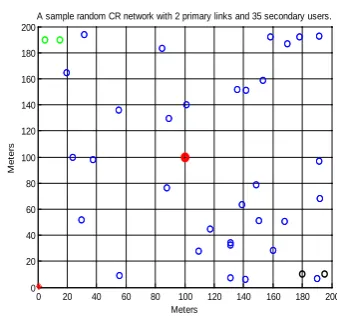
optimality. A sample random CR network with 2
primary links with 10m distance and 35 secondary
users uniformly distributed in 200x200m square
area shown in Fig 1. Each node in the network
possess 4 antenna and for each network 1000
independent simulation runs are executed.
Fig 1 A Sample random CR network
A. Energy consumption
Average energy consumption per bit of the
secondary system in the statistical scenario is
shown in Fig 2, Here, maximum rate of
transmission is shown. The simulation results
shows that if the secondary system is under-utilized
or experiences some interference from primary
system, each SU performs transmit pre-coding of
single data stream. Similarly if the secondary
system possess SUs less than 8 then, “optimal time
& single stream” and “optimal time & multi
stream” perform same results.
Fig 2: Average energy consumption per bit of the
secondary system
B. Interference
The average interference power at primary receiver
vs. the number of SUs in the statistical CSI
0 20 40 60 80 100 120 140 160 180 200 0
20 40 60 80 100 120 140 160 180 200
Meters
M
et
er
s
A sample random CR network with 2 primary links and 35 secondary users.
scenario is shown in the fig 3, it is measured by
interference to noise ratio (in db). The simulation
result of interference shows that the interference
power increases slowly in the “optimal time &
multiple streams” compared to the “optimal time
and single stream”
Fig 3 The average interference power at primary
receiver vs. the number of SUs
C. Channel Utility
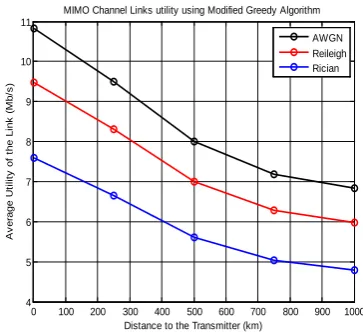
MIMO channel links utility is shown in the Fig 4 ,
This is performed using modified greedy algorithm.
The simulation results shows the performance of
the factors such as AWGN, Reileigh, and Rician
with respect to average utility of the link (Mb/s)
that is measured in distance to the transmitter.
Fig 4. MIMO Channel links utility using
modified Greedy algorithm.
Similarly various output factors with respect to its
are showed in the simulation
Fig 5 shows the energy consumption with energy
ratio algorithm. Thus the amount of energy
consumed is reduced using this algorithm.
The fig 6 shows the simulation result of career
frequency of various components with respect to
MSE that is measured in SNR (db) per sample.
Fig 7 gives the channel utilities achieved by
primary and secondary units.
Fig 8 shows the simulation result of PAPR (peak to
average power ratio) reduction performance which
is satisfied using all pass filter algorithm for PAPR
reduction.
Fig 9 shows the result of reducing BER (bit error
rate) , ICI and ISI cancellation is done with BER
reduction in this simulation
Fig 10 and 11 shows the performance and
minimisation of CFO using CAZAC algorithm and
STO performance and minimization using OML
(optimal maximum likelihood ) algorithm
respectively.
Fig 5 Average energy consumption per bit of the
secondary system
0 10 20 30 40 50 60 70
0 5 10 15 20 25
the number of SUs
Int
er
fer
enc
e t
o noi
s
e r
at
io (
dB
)
Average interference power at primary receiver vs. the number of SUs in the statistical CSI scenar
max rate transmission optimal time multiple streams max rate transmission Without Greedy (Krushal algorithm)
0 100 200 300 400 500 600 700 800 900 1000 4
5 6 7 8 9 10 11
MIMO Channel Links utility using Modified Greedy Algorithm
Distance to the Transmitter (km)
A
v
er
age U
ti
li
ty
of
t
he Li
nk
(
M
b/
s
)
AWGN Reileigh Rician
Fig 6 Maximum ratio combining MIMO CR
network
Fig 7 Utilities achieved by PUs and SUs.
Fig 8 PAPR reduction
Fig 9 Estimation of BER
Fig 10 Occurance and minimization of CFO
Fig 11 Occurance and minimization of STO
5.
Conclusion
The main objective of this paper is to maximize the
CR data rates and satisfy the interference
constraints at the primary receivers which is
achieved effectively. The non -convexity arised due
to mathematical formulation is also solved by
decomposition technique. Energy efficient
transmission is done successfully with reduction of
BER, synchronization errors, and with reduced
noise in the system. Various algorithms are
proposed to reduce PAPR,and to perform ICI and
ISI cancellation. CFO occurance and minimization
is done using CAZAC algorithm Similarly,STO
minimization is achieved using OML algoritm. The
optimal time allocation, the optimal transmit
covariance matrix is obtained by greedy algorithm
Finding the optimal transmit covariance matrices
for SUs is much more challenging , with the help of
trade-off between diversity gain and spatial
multiplexing gain we could achieve it and that
would be the future improvisation of this paper.
6.
References
[1] “Report of the spectrum efficiency working
group,” Federal Communications Commission,
Washington, DC, Tech. Rep., Nov. 2002.
[2] S. Haykin, “Cognitive radio: Brain-empowered
wireless communications,” IEEE J. Sel. Areas
Commun., vol. 23, no. 2, pp. 201–220, Feb. 2005.
[3] Q. Zhao and B. M. Sadler, “A survey of
dynamic spectrum access,” IEEE
Signal Process. Mag., vol. 24, no. 3, pp. 79–89,
May 2007.
[4] I. F. Akyildiz, W.-Y. Lee, M. C. Vuran, and S.
Mohanty, “A survey on spectrum management in
cognitive radio networks,” IEEE Commun.Mag.,
vol. 46, no. 4, pp. 40–48, Apr. 2008.
[5] A. Ghasemi and E. S. Sousa, “Spectrum sensing
in cognitive radio networks: Requirements,
challenges and design trade-offs,” IEEE Commun.
Mag., vol. 46, no. 4, pp. 32–39, Apr. 2008.
[6] Y.-C. Liang, Y. Zeng, E. C. Y. Peh, and A. T.
Hoang, “Sensing-throughput tradeoff for cognitive
radio networks,” IEEE Trans. Wireless Commun.,
vol. 7, no. 4, pp. 1326–1337, Apr. 2008.
[7] D. Cabric, S. M. Mishra, and R. W. Brodersen,
“Implementation issues in spectrum sensing for
cognitive radios,” in Proc. IEEE Asilomar Conf.
Signal., Syst. Comp., Pacific Grove, CA, Nov.
2004, pp. 772–776.
[8] T. Yucek and H. Arslan, “A survey of spectrum
sensing algorithms for cognitive radio
applications,” IEEE Commun. Surveys Tuts., vol.
11, no. 1, pp. 116–130, First Quarter, 2009.
[9] A. Sahai, N. Hoven, and R. Tandra, “Some
fundamental limits on cognitive radio,” in Proc.
Allerton Conf. Commun. Control Comp.,
Monticello, IL, Oct. 2004, pp. 1662–1671.
[10] M. B. H. Weiss, S. Delaere, and W. H. Lehr,
“Sensing as a service: An exploration into practical
implementations of DSA,” in Proc. IEEE DySPAN,
Singapore, Apr. 2010, pp. 1–8.
[11] S. M. Mishra, A. Sahai, and R. Brodersen,
“Cooperative sensing among cognitive radios,” in
Proc. IEEE ICC, Istanbul, Turkey, Jun. 2006, pp.
1658–1663.
[12] S. Maharjan, C. Yuen, Y. H. Chew, Y. Zhang,
and S. Gjessing, “Distributed spectrum sensing for
cognitive radio networks with heterogeneous users:
A game theoretical framework,” in Proc. IEEE
CogART, Rome, Italy, Nov. 2010, pp. 1–5.
[13] A. Ghasemi and E. S. Sousa, “Collaborative
spectrum sensing for opportunistic access in fading
environments,” in Proc. IEEE DySPAN, Baltimore,
ML, Nov. 2005, pp. 131–136.
[14] H. Nakayama, Z. Fadlullah, N. Ansari, and N.
Kato, “A novel scheme for wsan sink mobility
based on clustering and set packing techniques,”
IEEE Trans. Autom. Control., vol. 56, no. 10, pp.
2381–2389, Oct. 2011.
[15] V. Krishnamurthy, M. Maskery, and G. Yin,
“Decentralized adaptive filtering algorithms for
sensor activation in an unattended ground sensor
network,” IEEE Trans. Signal. Process., vol. 56,
no. 12, pp. 6086–6101, Dec. 2008.