Interactive Video Coding and Transmission
over Heterogeneous Wired-to-Wireless
IP Networks Using an Edge Proxy
Yong Pei
Computer Science and Engineering Department, Wright State University, Dayton, OH 45435, USA Email:[email protected]
James W. Modestino
Electrical and Computer Engineering Department, University of Miami, Coral Gables, FL 33124, USA Email:[email protected]
Received 26 November 2002; Revised 19 June 2003
Digital video delivered over wired-to-wireless networks is expected to suffer quality degradation from both packet loss and bit errors in the payload. In this paper, the quality degradation due to packet loss and bit errors in the payload are quantitatively evalu-ated and their effects are assessed. We propose the use of a concatenevalu-ated forward error correction (FEC) coding scheme employing Reed-Solomon (RS) codes and rate-compatible punctured convolutional (RCPC) codes to protect the video data from packet loss and bit errors, respectively. Furthermore, the performance of a joint source-channel coding (JSCC) approach employing this con-catenated FEC coding scheme for video transmission is studied. Finally, we describe an improved end-to-end architecture using an edge proxy in a mobile support station to implement differential error protection for the corresponding channel impairments expected on the two networks. Results indicate that with an appropriate JSCC approach and the use of an edge proxy, FEC-based error-control techniques together with passive error-recovery techniques can significantly improve the effective video throughput and lead to acceptable video delivery quality over time-varying heterogeneous wired-to-wireless IP networks.
Keywords and phrases:video transmission, RTP/UDP/IP, RS codes, RCPC codes, JSCC, edge proxy.
1. INTRODUCTION
With the emergence of broadband wireless networks and the increasing demand for multimedia transport over the Inter-net, wireless multimedia services are expected to be widely deployed in the near future. Many multimedia applications will require video transmission over links with a wireless first and/or last hop as illustrated inFigure 1. However, many ex-isting wired and/or wireless networks cannot provide guar-anteed quality of service (QoS), either because of conges-tion, or because temporally high bit-error rates cannot be avoided during fading periods. Channel-induced losses, in-cluding packet losses due to congestion over wired networks as well as packet losses and/or bit errors due to transmission errors on a wireless network, require customized error re-silience and channel coding strategies that add redundancy to the coded video stream at the expense of reduced source coding efficiency or effective source coding rates, resulting in compromised video quality.
In this paper we quantitatively investigate the effects of packet losses on reconstructed video quality caused by bit
errors anywhere in the packet in a wireless network if only error-free packets are accepted, as well as the effects of resid-ual bit errors in the payload if errored packets are accepted instead of being discarded in the transport layer. The for-mer corresponds to the use of the user datagram protocol (UDP) employing a checksum mechanism while the latter corresponds to the use of a transparent transport protocol, such as UDP-Lite [1], together with forward error correction (FEC) to attempt to correct transmission errors.
This work represents an extension of previous works [2, 3]. In particular, in [2] we described an approach using edge proxies which did not address the unique FEC requirements on the wired networks. This was followed by work reported in [3] where a concatenated channel coding approach was employed, but without an edge proxy, which attempted to address the distinct FEC requirements of both the wired and wireless networks.
Cellular networks Wireless LAN
Internet
Figure1: Illustration of heterogeneous wired-to-wireless networks.
networks. In this paper, we extend the work in [3] and provide a quantitative evaluation of a proposed JSCC ap-proach used with a concatenated FEC coding scheme em-ploying Reed-Solomon (RS) block codes and RCPC codes to actively protect the video data from the different channel-induced impairments associated with transmission over tan-dem wired and wireless networks. However, we tan-demonstrate that this approach is not optimal since the coding overhead required on the wired link must also be carried on the wire-less link which can have a serious negative effect on the abil-ity of the bandwidth-limited wireless link to support high-quality video transport.
Finally, we will present a framework for an end-to-end solution for packet video over heterogeneous wired-to-wireless networks using an edge proxy. Specifically, the edge proxy serves as an agent to enable and implement selective packet relay, error-correction transcoding, JSCC, and inter-operation between different transport protocols for the wired and wireless networks. Through the use of the edge proxy lo-cated at the boundary of the wired and wireless networks, we demonstrate the ability to avoid the serious compromise in efficiency on the wireless link associated with the con-catenated approach. More specifically, we employ RS codes only on the wired network to protect against packet losses while the RCPC codes are employed only on the wireless network to protect against bit errors. The edge proxy pro-vides the appropriate FEC transcoding resulting in improved bandwidth efficiencies on the wireless network. We believe that the value of the proposed approach, employing an edge proxy with appropriate functionalities, lies in the fact that lit-tle or no change needs to be provided on the existing wired network while at the same time it addresses the distinctly dif-ferent transport requirements for the wireless network. Fur-thermore, it uses fairly standard FEC approaches in order to support reliable multimedia services over the Internet with a wireless first and/or last hop.
The remainder of this paper is organized as follows. In Section 2, we provide some technical preliminaries
describ-ing an application level framdescrib-ing (ALF) approach employ-ing RTP-H.263+ packetization. In Section 3, we briefly de-scribe the background for packet video over wireless net-works and provide a quantitative study of packet video per-formance over wireless networks based on the two diff er-ent transport-layer strategies as discussed above. We also de-scribe the RCPC codes, the channel-loss model, and the as-sumed physical channel model for the wireless networks un-der study. In Section 4, we introduce a concatenated FEC coding scheme for packet video transport over heteroge-neous wired-to-wireless networks, and briefly describe the interlaced RS codes and packetization scheme employed. In Section 5, we present a framework for an end-to-end solu-tion for packet video over heterogeneous wired-to-wireless network using edge proxies and provide a comparison of the performance achievable compared to the concatenated ap-proach. Finally, Section 6provides a summary and conclu-sions.
2. PRELIMINARIES
2.1. Application-layer framing
To provide effective multimedia services over networks lack-ing guaranteed QoS, such as IP-based wired as well as wire-less networks, it is necessary to build network-aware appli-cations which incorporate the varying network conditions into the application layer instead of using the conventional layered architecture to design network-based applications. A possible solution is through ALF as proposed in [12]. The principal concept of ALF is that most of the functionalities necessary for network communications will be implemented as part of the application. As a result, the underlying network infrastructure provides only minimal needed functionalities. The application is then responsible for assembling data pack-ets, FEC coding and error recovery, as well as flow control. The protocol of choice for IP-based packet video applica-tions is the real-time transport protocol (RTP) [13], which is an implementation of ALF by the internet engineering task force (IETF). Likewise, UDP-Lite [1] is a specific instance of ALF in the sense that the degree of transparency at the transport layer can be tailored to the application by allow-ing the checksum coverage to be variable, includallow-ing only the header or portions of the packet payload as well. In this pa-per, we will consider the use of ALF-based RTP-H.263+ for video transmission over wired and wireless IP networks with a simplified transparent transport layer that does not require all the functionalities of UDP-Lite.
2.2. RTP-H.263+
or more complete GOBs. Since every packet begins with a picture or GOB start code, the leading 16 zeros are omitted in accordance with RFC 2429 [14]. The packetization over-head then consists only of the RTP/UDP/IP over-headers, which are typically 40 bytes per packet. This overhead can be signif-icant at low bit rates for wireless network-based applications. It is important to improve the packetization efficiency in such cases [15]. To minimize the packetization header overhead, each RTP packet should be as large as possible. On the other hand, in the presence of channel impairments, the packet size should be kept small to minimize the effects of lost packets on reconstructed video quality.
3. PACKET VIDEO OVER WIRELESS NETWORKS
Knowledge of the radio propagation characteristics is usually a prerequisite for effective design and operation of a com-munication system operating in a wireless environment. The fading characteristics of different radio channels and their associated effect on communication performance have been studied extensively in the past [16]. Despite the fact that Rayleigh fading is the most popular model, Rician fading is observed in mobile radio channels as well as in indoor cord-less telecommunication (CT) systems [16]. In a cellular sys-tem, Rayleigh fading is often a feature of large cells, while for cells of smaller diameter, the envelope fluctuations of a received signal are observed to be closer to Rician fading. A slow and flat Rician fading model is assumed here,1 where
the duration of a symbol waveform is sufficiently short so that the fading variations cause negligible loss of coherence within each received symbol. At the same time, the symbol waveform is assumed to be sufficiently narrowband (suffi -ciently long in duration) so that frequency selectivity is negli-gible in the fading of its spectral components. As a result, the receiver can be designed and analyzed on the basis of optimal symbol-by-symbol processing of the received waveform, for example, by a sampled matched filter or other appropriate substitute in the same manner used in the nonfading case.
3.1. Channel-induced loss models
In this work, we restrict our attention to a random loss model, that is, the wireless channel is characterized by un-correlated bit errors. This is a reasonable model for a fairly benign wireless channel under the assumption of sufficient interleaving to randomize the burst errors produced in the decoder.
By means of FEC, some of these bit errors can be cor-rected. Depending on the FEC code parameters and the channel conditions, there will be residual bit errors. Gener-ally, over existing wired IP networks, UDP is configured to discard any packet with even a single error detected in the entire packet including the header, although UDP itself need
1The slow and flat Rician channel model is completely described in terms of the single parameterζ2representing the ratio of specular-to-diffuse en-ergy.
not implement this error-detecting functionality. In the wire-less video telephony system described by Cherriman et al. [17], such packets are also discarded without further process-ing. In this paper, we will define two channel-induced loss models. For the first model, we assume the same loss model as used in wired IP networks; that is, a packet is accepted only if there is no error in the entire packet including the header as well as the payload, otherwise, it is considered lost. This model corresponds to a transport scheme allowing only error-free packets (denoted as scheme 1 in this paper). So, for an interference-limited wireless channel, like the CDMA radio interface, the packet losses are primarily the results of frequent bit errors instead of congestion as in a wired net-work. The channel-induced impairment to the video qual-ity is in the form of these packet losses. If a packet is con-sidered lost, the RTP sequence number enables the decoder to identify the lost packets so that locations of the missing GOBs are known. The missing blocks can then be concealed by motion-compensated interpolation using the motion vec-tor of the macroblock (MB) immediately above the lost MB in the same frame, or else the motion vector is assumed to be zero if this MB is missing. However, if too many packets are lost, concealment itself is no longer effective in improving the reconstructed video quality.
For the second model, we assume that the transport layer is transparent to the application layer; that is, a packet with errors only in the payload is not simply discarded in the transport layer. Such a transparent transport layer can be achieved by using, for example, UDP-Lite as proposed in [1]. However, UDP-Lite provides other functionalities not neces-sary for the work here and is not widely deployed. As a result, we employ a simplified transparent transport protocol which limits the use of the checksum only on the RTP/UDP/IP header and discards a packet only if there is an error detected in the header. In this case the application layer should be able to access the received data although such data may have one or more bit errors. This model corresponds to a transport scheme allowing bit errors in the payload (denoted as scheme 2 in this paper). The channel-induced impairment to the video quality is then in the form of residual bit errors in the video stream. It is the responsibility of the application layer to deal with these possible bit errors. Specifically, here we make use of the H.263+ coding scheme where, based on syntax vi-olations, certain error patterns may be detected by the video decoder and the use of the corresponding errored data can be avoided by employing passive error-recovery (PER) tech-niques.
Our intention is to quantitatively compare these two channel-induced loss models, identify the different video data protection requirements for wired and wireless net-works, and describe the corresponding appropriate transport schemes for packet video delivery over such networks.
3.2. Physical channel model
Gaussian noise (AWGN) and/or fading. At the receiver side, the received waveforms are demodulated, channel decoded, and then source decoded to form the reconstructed video sequence. The reconstructed sequence may differ from the original sequence due to both source coding errors and pos-sible channel-error effects.
In this paper, the symbol transmission rate for the wire-less links is set to berS =64 Ksps, such that the overall bit
rate employing QPSK modulation is constrained as Rtot =
128 Kbps. This in turn sets the upper limit for the bit rate over the wired networks to beRtot=128 Kbps as well. Since
the total bit rate is limited by the wireless links, the use of RS and/or RCPC codes will result in a decrease of source coded bit rate proportional to the overall channel coding rates.
The transmission channel is modelled as a flat-flat Rician channel with ratio of specular-to-diffuse energyζ2=7 dB.
3.3. RCPC channel codes
The class of FEC codes employed for the wireless IP net-work in this net-work is the set of binary RCPC codes described in [18]. WithP representing the puncturing period of the code, the rates of the codes that may be generated by punc-turing a rate Rc = 1/n mother code areRc = P/(P + j),
j = 1, 2,. . ., (n−1)P. Thus, it is easy to obtain a family of codes with unequal error correcting capabilities. In this work, a set of RCPC codes are obtained by making use of anRc=1/4 mother code with memoryM=10 and a
corre-sponding puncturing periodP=8. Then the available RCPC codes are of rates,Rc=8/9, 8/10,. . ., 8/32.
3.4. Passive error recovery
If a packet is considered lost, the RTP sequence number en-ables the decoder to identify the lost packets so that locations of the missing data are known. The affected blocks can then be concealed by PER techniques. In this work, we make use of the error-detecting and recovery scheme described in Test Model 8 [19]. The major objective of this PER scheme is to detect the severe error patterns and prevent the use of such errors which may substantially degrade the video quality. The remaining undetected error patterns in the payload which are not detected by the H.263+ decoder will result in the use of incorrectly decoded image data which can cause quality degradation of the reconstructed video.
3.5. Selected simulation results
We present some selected results for a representative quar-ter common inquar-termediate format (QCIF) video conferencing sequence, Susie at 7.5 frames per second (fps). These results were obtained using a single-layer H.263+ coder in conjunc-tion with RCPC channel codes [18] together with quadrature phase shift keyed (QPSK) modulation. To decrease the sen-sitivity of our results to the location of bit errors, a sequence ofNf =30 input frames is encoded, channel errors are
sim-ulated and the resulting distortion is averaged. Furthermore, each simulation was run Nt times. By taking empirical
av-erages withNtsufficiently large (i.e.,Nt =1000), statistical
confidence in the resulting distortion can be achieved.
40 39 38 37 36 35 34 33 32 31 30
PSNR
(dB)
30 35 40 45 50 55 60
ES/NI(dB)
9 GOBs/packet 1 GOB/packet
Figure 2: Performance of RTP-H.263+ packet video with 1 or 9 GOBs/packet over a wireless channel without channel coding and employing loss model 1; Rician channel withζ2=7 dB.
Figure 2demonstrates results for a system without
chan-nel coding under the assumption of the first loss model. Here, we plot the reconstructed peak signal-to-noise ratio (PSNR) versus the channel SNR,ES/NI.2InFigure 2, we
pro-vide results for two packetization choices which packetize either 1 or 9 GOBs (i.e., 1 frame for QCIF) into a single packet. It should be obvious that in the absence of chan-nel impairments, the more GOBs contained in one packet, the better the quality should be as a result of the reduced overheads. This is clearly demonstrated inFigure 2where for largeES/NI, the larger number of GOBs/packet results in
im-proved PSNR performance. However, as the channel condi-tions degrade (i.e., the value ofES/NI decreases), a
packeti-zation scheme with fewer GOBs/packet can be expected to be more robust in the presence of the increasing channel im-pairments. This is because of the dependence of packet-loss rate upon the corresponding packet size. Although the bit-error rate remains the same, a larger packet size results in larger packet-loss rate. This is also demonstrated inFigure 2. It should also be noticed that under the first loss model, the video quality is extremely sensitive to packet losses due to the channel variation inES/NI.
Next, we demonstrate the performance of the system with a transparent transport layer; that is, channel-loss model 2. We provide corresponding results in Figure 3for both loss models for two packetization choices which again packetize 1 or 9 GOBs (i.e., 1 frame for QCIF) into a sin-gle packet. If a sinsin-gle GOB is packetized into a packet, the quality of the second transport scheme degrades somewhat
2The qualityE
S/NIrepresents the ratio of energy per symbol to the
40
35
30
25
PSNR
(dB)
30 35 40 45 50 55 60
ES/NI(dB)
9 GOBs/packet 1 GOB/packet
Channel loss model 1 Channel loss model 2
Uncoded system Rician channel ζ2=7 dB
Figure 3: Performance of RTP-H.263+ packet video with 1 or 9 GOBs/packet over a wireless channel without channel coding for the two loss models.
more gracefully compared to the first scheme as the channel ES/NIdecreases. The relative disadvantage of the first scheme
in this case is the result of discarding packets with even a single bit error in the payload. Instead, the second scheme makes use of the received data by selectively decoding those data without severely degrading the video quality. Since the packet size in this case is relatively small, as the bit error rate increases as a result of decreasingES/NI, there is some
ad-vantage of the first scheme in the regionES/NI <31 dB
be-cause it avoids the use of error-prone packets. For scheme 2, on the other hand, the remaining undetected errors in the payload begin to overwhelm the PER capabilities of the de-coder asES/NIdecreases and substantially degrade the
recon-structed video quality. This is also demonstrated inFigure 3. However, it should be noticed that in this region the video quality is already sufficiently degraded that the relative ad-vantage of scheme 1 in this region does not make a signif-icant difference for video users. Furthermore, as illustrated
inFigure 3, if 9 GOBs are packetized into a packet, the
qual-ity of the second transport scheme substantially outperforms the first scheme as the channelES/NIbecomes smaller. As the
packet size increases, the disadvantage of the first scheme is even more significant as a result of discarding packets with even single bit error in the payload. Based on these observa-tions, it would appear that it is necessary to provide a trans-parent transport scheme for packet video over wireless net-works. More specifically, packet video over wired and wire-less IP networks may have to employ different transport-layer protocols.
FEC can be used to protect the video data against chan-nel errors to improve the video delivery performance in the range of lowerES/NI, although, as we demonstrate, the
37 36 35 34 33 32 31 30 29 28 27
PSNR
(dB)
3 3.5 4 4.5 5 5.5 6
ES/NI(dB)
9 GOBs/packet 1 GOB/packet
Channel loss model 1 Channel loss model 2
Rician channel ζ2=7 dB
Rc=1/2 with perfect CSI
Figure 4: Performance of RTP-H.263+ packet video with 1 or 9 GOBs/packet over a wireless channel with a fixed Rc = 1/2, M=10 convolutional code for the two loss models.
choice of channel coding rate must be carefully made. For ex-ample, the corresponding results for the previous two pack-etization choices are illustrated inFigure 4for the two loss models where we somewhat arbitrarily employ anRc=1/2,
M =10 convolutional code to protect the packetized video data. In this case, the additional channel coding overheads force a decrease in the available source coding bit rate,3and
this results in a corresponding decrease in the video quality in the absence of channel impairments. This can be seen if we compare the results inFigure 4to the corresponding values
inFigure 3for largeES/NI. However, it should be noted that
the coded cases can maintain the video quality at acceptable levels for considerably smaller values ofES/NI compared to
the uncoded system. This is a good indication of the neces-sity of employing FEC coding in wireless networks.
It should also be observed inFigure 4, compared to the uncoded case illustrated in Figure 3, that the second loss model consistently and substantially outperforms the first loss model. For example, there is over 6 dB performance gain of the second model over the first model atES/NI=4 dB for
the case of 9 GOBs/packet. This suggests the advisability of using FEC coding to constrain the bit-error rate in wireless networks together with the use of a transparent transport-layer scheme to provide acceptable packet video services. This provides further illustration that packet video transport over wireless IP networks may require a different transport-layer protocol from conventional wired networks in order to obtain more desirable error-resilient quality.
Joint encoder Rsbits/s Router Rinner
Concatenated codes Rc=RouterRinnerbits/c.u.
Rs+c=RRscc.u./s
Figure5: Illustration of concatenated coding scheme.
4. PACKET VIDEO OVER WIRED-TO-WIRELESS IP NETWORKS
Many evolving multimedia applications will require video transmission over a wired-to-wireless link such as in wire-less IP applications where a mobile terminal communicates with an IP server through a wired IP network in tandem with a wireless network as illustrated inFigure 1. We intend to ad-dress an end-to-end solution for video transmission over a heterogeneous network such as the UMTS third-generation (3G) wireless system, which provides the flexibility at the physical layer to introduce service-specific channel coding as well as the necessary bit rate required for high-quality video up to 384 Kbps.
Video quality should degrade gracefully in the presence of either packet losses due to congestion on the wired net-work, or bit errors due to fading conditions on the wireless channel. Due to the difference in channel conditions and loss patterns between the wired and wireless networks, to be ef-ficient and effective the error-control schemes should be tai-lored to the specific characteristics of the loss patterns asso-ciated with each network. Furthermore, the corresponding error-control schemes for each network should not be de-signed and implemented separately, but jointly in order to optimize the quality of the delivered video.
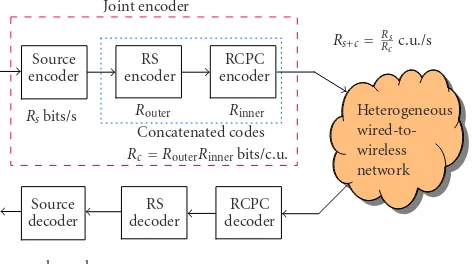
Here, we present a possible end-to-end solution which employs an adaptive concatenated FEC coding scheme to provide error-resilient video service over tandem wired-to-wireless IP networks as illustrated in Figure 5. An H.263+ source coder encodes the input video which is applied to a concatenated channel encoder employing an RS block outer encoder and an RCPC inner encoder. The RS outer code op-erates in an erasure-decoding mode and provides protection against packet loss due to congestion in the wired IP net-work while the RCPC inner code provides protection against bit errors due to fading and interference on the wireless net-work. The RS coding rates can be selected adaptively accord-ing to the prevailaccord-ing network conditions, specifically, packet-loss rate for the wired IP network. This channel rate match-ing is achieved by employmatch-ing a set of RS codes with different erasure-correcting capabilities. The RCPC coding rates can also be selected adaptively to provide different levels of
bit-error-correcting capability according to the prevailing wire-less network conditions, specifically, ES/NI for the wireless
channels.4This end-to-end approach avoids the system
com-plexities associated with transcoding in edge proxies located at the boundaries between the wired and wireless networks as treated in [2], for example. However, we will see that this reduction in complexity is at the expense of a considerable performance penalty.
4.1. Packet-level FEC scheme for wired IP networks Packet loss is inevitable even in wired IP networks, and can substantially degrade reconstructed video quality which is annoying for users. Thus, it is desirable that a video stream be robust to packet loss. Regarding the tight delay con-straints for real-time video applications, FEC should be ap-plied to achieve error recovery when packet losses occur. For a wired IP network, packet loss is caused primarily by con-gestion, and channel coding is typically used at the packet-level [20,21] to recover from such losses. Specifically, a video stream is first chopped into segments each of which is pack-etized into k packets, and then for each segment, a block code is applied to the k packets to generate an n-packet block, where n > k. To perfectly recover a segment, a user only needs to receive anykpackets in then-packet block. To avoid additional congestion problems due to channel-coding overheads, a JSCC approach to optimize the rate allocation between source and channel coding is necessary. One such approach employing interlaced RS coding with packet-loss-recovery capability has been described in [22].
In this paper, we will apply a form of concatenated FEC coding employing interlaced RS codes as illustrated in Figure 6, where FEC codes are applied across IP packets. Specifically, each packet is partitioned into successivem-bit symbols to form an encoding array, and individual symbols are aligned vertically to form RS codewords of block length nover GF(2m). As illustrated inFigure 6, each IP packet
con-sists ofwsuccessive rows ofm-bit symbols, then, the decoded packet-loss probabilities can be readily determined assuming erasure-only decoding.
4.2. Packetization for the interlaced RS coded video data
To quantitatively compare the performance between a coded system and an uncoded system, we have to maintain the same packet-generation rate. Specifically, for the QCIF video stud-ied in this paper, in the uncoded system, each GOB is pack-etized into a single packet, resulting in 9 packets per video frame. For the coded system, network packets are obtained by concatenating successive rows of the encoding array illus-trated in Figure 6. We maintain identical packet rate in the coded system as in the uncoded system. Specifically, with the use of RS(63,k) codes, this results in packing 7 (i.e.,w =7
inFigure 6) coded symbols from the same RS codeword into
the same packet together with other RS coded symbols from
Data input
kdata rows
n−kparity rows
w rows
w rows
Packet 1
Packet 9
Symbol Symbol Symbol
Symbol Symbol Symbol
RS
co
de
RS
co
de
RS
co
de
Figure6: Illustration of interlaced RS codes.
the same video frame. As a result, both systems will generate 9 packets per frame.
4.3. Packet-loss correction using RS codes
Consider an RS(n,k) code over GF(2m) applied in an
inter-laced fashion across the IP packets as described above and illustrated inFigure 6. Here,ksymbols ofmbits each are en-coded inton m-bit symbols withdthe minimum distance of the RS code given by
d=n−k+ 1. (1)
For the proposed concatenated FEC scheme, it is possi-ble that there are residual bit errors that cannot be corrected through the use of the inner RCPC codes. These residual bit errors may degrade the erasure-correction capability of the RS codes employing erasure decoding which attempts to cor-rect the packet-loss-induced symbol erasures over the wired IP network. However, the probability of symbol errors for the RS coded symbols resulting from such residual bit er-rors will be very small compared to the symbol-erasure rate with appropriate choices of inner RCPC codes which main-tain the residual bit-error rate low. For example, consider-ing an RS(63,k) code with a symbol size of 6 bits, a resid-ual bit-error rate of 10−5 will result in a symbol-error rate
of 6×10⁻⁵which will have a negligible effect on the erasure
correcting performance of the RS codes in a system where packet-loss-induced erasures are dominant. So, in this paper we assume the use of erasure-only decoding of RS codes with full erasure-correcting capability.
For an RS code with erasure decoding,e ≤ d−1 era-sures can be corrected. Consider thatw m-bit symbols from an RS codeword are packed into the same packet. A packet loss under this packetization scheme will result inwerasures for the corresponding RS coded symbols. Assume the symbol erasures are independent. For the coded system, the resulting packet-loss rate for the above specified packetization scheme then becomes
PL= 9
i=W
9 i
λi(1−λ)9−i, (2)
whereλis the corresponding uncoded packet-loss rate, and W is the maximum number of allowable packet losses that can be recovered through the use of RS codes, and is given by
W= e/w. (3)
It should be noted that a lost packet in the uncoded sys-tem as described above will result in a loss of 1 GOB. How-ever, for the coded system, if there is a packet loss that cannot be recovered through the erasure-correcting capability of the corresponding RS codes, the whole frame, that is 9 GOBs, will be affected due to the interlaced RS coding scheme. In such a situation, PER, as will be described inSection 4.4, will be applied to conceal the errors.
4.4. Channel-induced loss models
40
Figure7: Performance of RTP-H.263+ packet video over wired IP networks using RS coding alone.
the transport layer is transparent to the application layer, that is, a packet with errors in the payload is not simply discarded in the transport layer. Instead, the application layer should be able to access the received data although such data may have one or more bit errors. It is the responsibility of the ap-plication layer to deal with the possible residual bit errors as described previously inSection 3.1.
4.5. JSCC approach
As has been demonstrated in the previous section, in order to protect against the channel impairments, some form of FEC coding must be employed. Since an arbitrarily chosen FEC design can lead to a prohibitive amount of overhead for highly time-varying error conditions over wireless channels, a JSCC approach for image or video transmission is neces-sary. The objective of JSCC is to jointly select the source and channel coding rates to optimize the overall performance due to both source coding loss and channel-error effects subject to a constraint on the overall transmission bit rate budget.
In [9,10], it was shown that much of the computational complexity involved in solving this optimal rate allocation problem may be avoided through the use of universal tortion rate characteristics. Given a family of universal dis-tortion rate characteristics for a specified source coder, to-gether with appropriate bounds on bit-error probabilityPb
for a particular modulation/coding scheme as a function of channel parameters, the corresponding optimal distortion rate characteristics for a video sequence can be determined through the following procedure: for a specified channel SNR,ES/NI, we can find the associatedPbthrough the
corre-sponding bit-error probability bounds for a selected mod-ulation/coding scheme as discussed earlier. Then, for each choice of source coding rateRsof interest, use the resulting
Pbto find the corresponding overall PSNR from the universal
distortion rate characteristics. This procedure is described in more detail in [9,10].
40
Figure8: Performance of H.263+ coded video delivery over a wire-less Rician fading channel withζ2=7 dB using JSCC approach with RCPC coding only and employing perfect CSI. Performance results for a set of fixed channel coding rate schemes are also shown.
4.6. Selected simulation results
We first consider the case where no channel error is intro-duced over the wireless links; that is, only the packet loss over the wired network will degrade the video quality. Figure 7 demonstrates the performance using a family of RS(63,k) codes5with JSCC for RTP-H.263+ packet video over wired
IP networks experiencing random packet loss. Here we illus-trate PSNR results as a function of packet-loss rateλfor dif-ferent values of source coding rate with the RS codes chosen to achieve the overall bit rate budgetRtot=128 Kbps. In
par-ticular, the smaller values ofRsallow the use of more
power-ful low-rate RS codes resulting in improved performance for larger loss rate. On the other hand, for small packet-loss rate performance, improvements can be obtained using larger values ofRstogether with less powerful high-rate RS
codes. The optimum JSCC procedure selects the convex hull of all such operating points as illustrated schematically in Figure 7. Clearly, compared to the system without using RS coding where video quality is substantially degraded with in-creasing packet-loss rate, the JSCC approach with RS coding provides an effective means to maintain the video quality as network-induced packet-loss rate increases.
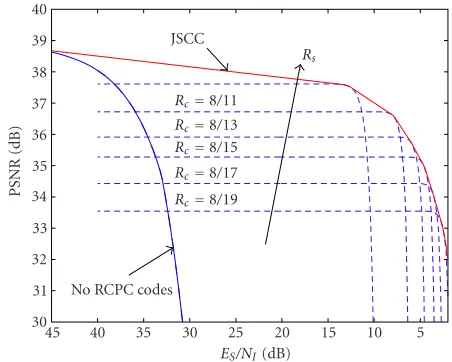
Consider another case where now bit errors over the wireless links instead of packet loss over the wired network are dominant, and a JSCC approach using RCPC codes is em-ployed. The results are illustrated inFigure 8where we now plot PSNR versusES/NI.6Again, as can be observed, the JSCC
approach with RCPC coding alone clearly demonstrates sig-nificant performance improvements over either the uncoded case or the case where the channel coding rate is fixed at
5RS(63,k) codes are used throughout the remainder of this paper. 6Observe the decreasing values ofE
39 38 37 36 35 34 33 32
PSNR
(dB)
50 45 40 35 30 25 20 15 10 5
ES/NI(dB) λ=0 λ=1% λ=2% λ=5% λ
No RCPC
JSCC
Rician channel ζ2=7 dB
RCPC codes with perfect CSI Rc=1/4,M=10,P=8
Figure9: Performance of H.263+ coded video delivery over het-erogeneous wired-to-wireless IP networks using JSCC employing concatenated RS and RCPC coding.
an arbitrarily chosen value.7The use of JSCC can provide a
more graceful pattern of quality degradation by keeping the video quality at an acceptable level for a much wider range of ES/NI. This is achieved by jointly selecting the channel and
source coding rates based on the prevailing channel condi-tions, here represented byES/NI.
In more general cases, packet loss due to congestion in the wired network and bit errors due to fading effects on the wireless networks coexist. We propose to jointly select the source coding rate, the RS coding rate, and the RCPC coding rate such that optimal end-to-end performance can be achieved with this concatenated coding scheme. Here, we demonstrate PSNR results for reconstructed video as a function of the wireless channel ES/NI for a set of
packet-loss rates over the wired IP network with the RS codes and RCPC codes chosen to achieve the overall bit rate budget Rtot = Rs/(RcRCPC·RRSc ) = 128 Kbps [3]. In Figure 9, for
a given packet-loss rate λ in the wired network, the opti-mal performance obtainable is demonstrated under the con-straint of a fixed wireless transmission rate. It is clear that the RS coding rate has to be adaptively selected with the variation in the corresponding packet-loss rate. Meanwhile, the RCPC coding has to adapt to the change in the wireless link con-ditions,ES/NIin this case. Clearly, as shown by the dashed
lines inFigure 9, for the system employing only adaptive RS codes selected according to the packet-loss rate on the wired network but no RCPC codes on the wireless network, video quality is substantially degraded with increasing bit errors as ES/NI decreases. In contrast, the JSCC approach with
con-catenated RS and RCPC coding provides an effective means
7For example, the arbitrary choice ofR
c =1/2 illustrated inFigure 4
would fall between the curves labelledRc=8/15 andRc=8/17 inFigure 8.
Internet Wireless LAN
Edge proxy
Figure10: An end-to-end approach using an edge proxy.
to maintain the video quality as network-induced packet-loss and/or bit-error rate increase.
5. PACKET VIDEO OVER WIRED-TO-WIRELESS IP NETWORK USING AN EDGE PROXY
In the previous section, we investigated a JSCC approach used with a concatenated FEC coding scheme employing in-terlaced RS block codes and RCPC codes to actively protect the video data from different channel-induced impairments over tandem wired and wireless networks. However, this ap-proach is not optimal since, as noted previously, the coding overhead required on the wired link must also be carried on the wireless link.
As an alternative to the concatenated approach, we present an end-to-end solution with the use of an edge proxy operating at the boundary of the two networks as demon-strated in Figure 10. This end-to-end solution employs the edge proxy to enable the use of distinctly different error-control schemes on the wired and wireless networks. Specif-ically, we employ the interlaced RS codes alone on the wired network and the RCPC codes alone on the wireless network to provide error-resilient video service over tandem wired-to-wireless IP networks. As a result, under the constraint of a total bitrate budgetRtot, the effective video data
through-put is given as Rs = min{Rtot·RRSc ,Rtot ·RRCPCc }, where
RRS
c andRRCPCc are the channel coding rates for the RS and
RCPC codes, respectively. In contrast, without the use of an edge proxy, these two codes have to work as a concatenated FEC scheme as described in the preceding section in order to provide sufficient protection against both congestion-caused packet loss in the wired network and fading-caused bit errors in the wireless network. The corresponding effective video data throughput in this case is thenRs= Rtot·RRSc ·RRCPCc
5.1. Edge proxy
To accommodate the differential error-control schemes as well as differential transport protocols for packet video over wired and wireless networks, appropriate middleware has to be employed to operate between the wired and wireless net-work to support the application layer solutions for video ap-plications. Thus, we define an edge proxy here to accom-plish these functionalities. The edge proxy should be imple-mented as part of a mobile support station. Furthermore, it should be application-specific; in our case it is video-oriented.
The use of edge proxies at the boundaries of dissimilar networks for a variety of functions have been used extensively in the networking community [23]. The uniqueness of the approach proposed here using edge proxies at the boundary between wired and wireless networks for video transport ap-plications lies in its specific functionalities as defined above. Specifically, it serves as an agent to enable and implement
(1) selective packet relay, (2) error-control transcoding, (3) JSCC control,
(4) interoperation between different possible transport protocols for the wired and wireless network.
For the interactive applications we consider here, there exists two-way traffic including wired-to-wireless as well as wireless-to-wired. We assume that RS codes are employed to combat packet loss due to congestion in a wired network, and RCPC codes are used on the wireless network to combat bit errors. It is necessary for the edge proxy to do error-control transcoding if such a scheme is used.
Furthermore, the edge proxy should support the JSCC control scheme to adaptively adjust the source and chan-nel coding rates. To avoid computation and time-expensive video transcoding in the edge proxy, an end-to-end adaptive coding control strategy is suggested here. The channel con-ditions including those for both the wired and wireless net-works are collected in the edge proxy, and based on the pre-vailing channel conditions, video coding rates are adjusted accordingly using JSCC. For the wired network, the major channel condition parameter is the packet-loss rate, while for the wireless network, channel SNR as well as the fading pa-rameters are used.
The edge proxy is also responsible for the interoperation between different possible transport protocols for the wired and wireless network. For a wireless network, the error-control scheme is implemented in the application layer, and erroneous packets should be delivered to the end user. How-ever, for conventional wired networks, such as existing IP networks, no error is allowed. In this case, to achieve interop-eration, the edge proxy has to repacketize the packet accord-ing to the appropriate transport protocol before relayaccord-ing the packet in either direction.
5.2. Selected simulation results
Now we consider the system with the use of an edge proxy between the wired and wireless IP networks, such that
error-39
RCPC codes with perfect CSI Rc=1/4,M=10,P=8
Figure11: Performance of H.263+ coded video delivery over het-erogeneous wired-to-wireless IP networks using JSCC with an edge proxy.
RCPC codes with perfect CSI Rc=1/4,M=10,P=8
With edge proxy
Without edge proxy
Figure 12: Relative performance improvement with and without the use of an edge proxy.
control transcoding can be done between the two heteroge-neous networks each supporting different error-control ap-proaches as described previously. With the use of an edge proxy, the corresponding optimal performance obtainable is demonstrated inFigure 11under the constraint of the same fixed wireless transmission rate of 128 Kbps.
demonstrates the substantial improvement using an edge proxy. For example, in the case that packet-loss rate over the wired IP network is λ = 5%, there is a gain of over 6 dB in wireless channelES/NI for a specified video quality
of PSNR = 34 dB. This improvement is primarily due to the increase of effective video data throughput due to the error-control transcoding in the edge proxy. As a result, to meet the same error protection requirement for both wired and wireless network conditions, a larger effective video data throughput can be achieved through the use of an edge proxy compared to the case without an edge proxy.
6. SUMMARY AND CONCLUSIONS
We quantitatively demonstrate the requirements for diff er-ent transport-layer schemes for packet video over wireless networks from the requirements for conventional wired net-works. Then we described the possible end-to-end solutions with and without an edge proxy operating between the wired and wireless network for packetized H.263+ video over het-erogeneous wired-to-wireless IP networks. A JSCC approach employing RS block codes and RCPC codes is studied for the two proposed architectures. The results quantitatively demonstrate the requirement for a joint design approach to address the special needs of error recovery for packet video over the wireless and wired network for acceptable end-to-end quality while exhibiting a graceful pattern of quality degradation in the face of dynamically changing network conditions. Furthermore, the results clearly demonstrate the advantage of using an edge proxy with clearly defined func-tionalities in heterogeneous wired-to-wireless IP networks for improved video quality.
REFERENCES
[1] L.- ˚A. Larzon, M. Degermark, and S. Pink, “UDP Lite for real time multimedia applications,” inProc. IEEE International Conference of Communications, Vancouver, BC, Canada, June 1999.
[2] Y. Pei and J. W. Modestino, “Robust packet video transmis-sion over heterogeneous wired-to-wireless IP networks using ALF together with edge proxies,” inProc. European Wireless Conference, Florence, Italy, February 2002.
[3] Y. Pei and J. W. Modestino, “Use of concatenated FEC cod-ing for real time packet video over heterogeneous wired-to-wireless IP networks,” inProc. IEEE Int. Symp. Circuits and Systems, pp. 840–843, Bangkok, Thailand, May 2003. [4] M. J. Ruf and J. W. Modestino, “Operational rate-distortion
performance for joint source and channel coding of images,” IEEE Trans. Image Processing, vol. 8, no. 3, pp. 305–320, 1999. [5] P. C. Cosman, J. K. Rogers, P. G. Sherwood, and K. Zeger, “Combined forward error control and packetized zerotree wavelet encoding for transmission of images over varying channels,”IEEE Trans. Image Processing, vol. 9, no. 6, pp. 982– 993, 2000.
[6] P. G. Sherwood, X. Tian, and K. Zeger, “Efficient image and channel coding for wireless packet networks,” inProc. IEEE International Conference on Image Processing, pp. 132–135, Vancouver, BC, Canada, September 2000.
[7] J. Hua and Z. Xiong, “Optimal rate allocation in scalable joint source-channel coding for image transmission over CDMA networks,” inProc. International Conference on Multimedia and Expo, Baltimore, Md, USA, July 2003.
[8] V. Stankovic, R. Hamzaoui, and Z. Xiong, “Joint product code optimization for scalable multimedia transmission over wire-less channels,” inProc. International Conference on Multime-dia and Expo, Lausanne, Switzerland, August 2002.
[9] M. Bystrom and J. W. Modestino, “Combined source-channel coding schemes for video transmission over an additive white Gaussian noise channel,” IEEE Journal on Selected Areas in Communications, vol. 18, no. 6, pp. 880–890, 2000.
[10] M. Bystrom and J. W. Modestino, “Combined source-channel coding for transmission of H.263 coded video with trellis-coded modulation over a slow-fading Rician channel,” inProc. IEEE International Symposium on Information Theory, MIT, Cambridge, Mass, USA, August 1998.
[11] T. Chu and Z. Xiong, “Combined wavelet video coding and error control for Internet streaming and multicast,”EURASIP Journal on Applied Signal Processing, vol. 2003, no. 1, pp. 66– 80, 2003.
[12] D. D. Clark and D. L. Tennenhouse, “Architectural consid-erations for a new generation of protocols,” ACM Computer Communication Review, vol. 20, no. 4, pp. 200–208, 1990. [13] H. Schulzrinne, S. Casner, R. Frederick, and V. Jacobson,RTP:
A transport protocol for real-time applications, RFC 1889, Jan-uary 1996.
[14] C. Bormann, L. Cline, G. Deisher, et al., RTP payload format for the 1998 version of ITU-T Rec. H.263 video (H.263+), RFC 2429, October 1998.
[15] Y. Pei and J. W. Modestino, “A joint source-channel coding ap-proach for packet video transport over wireless IP networks,” inProc. 11th International Packet Video Workshop, pp. 41–50, Kyongju, Korea, April 2001.
[16] S. Stein, “Fading channel issues in system engineering,”IEEE Journal on Selected Areas in Communications, vol. 5, no. 2, pp. 68–89, 1987.
[17] P. Cherriman, C. H. Wong, and L. Hanzo, “Turbo-and BCH-coded wide-b“Turbo-and burst-by-burst adaptive H.263-assisted wireless video telephony,” IEEE Trans. Circuits and Systems for Video Technology, vol. 10, no. 8, pp. 1355–1363, 2000.
[18] J. Hagenauer, “Rate-compatible punctured convolutional codes (RCPC codes) and their applications,” IEEE Trans. Communications, vol. 36, no. 4, pp. 389–400, 1988.
[19] Intel Corporation, “Video Codec Test Model, TMN8,” June 1997, ftp://standard.pictel.com/video-site/h263plus/ draft13.doc.
[20] D. Wu, T. Hou, and Y.-Q. Zhang, “Scalable video coding and transport over broadband wireless networks,” Proceedings of the IEEE, vol. 89, no. 1, pp. 6–20, 2001.
[21] D. Wu, Y. T. Hou, W. Zhu, Y.-Q. Zhang, and J. M. Peha, “Streaming video over the internet: Approaches and direc-tions,” IEEE Trans. Circuits and Systems for Video Technology, vol. 11, no. 3, pp. 282–300, 2001.
[22] R. Kurceren and J. W. Modestino, “A joint source-channel coding approach to scalable delivery of digital video over ATM networks,” in Proc. IEEE International Conference on Im-age Processing, vol. 1, pp. 1599–1603, Vancouver, BC, Canada, September 2000.
Yong Peiis currently a tenure-track Assis-tant Professor in the Computer Science and Engineering Department, Wright State Uni-versity. Previously he was a Visiting Assis-tant Professor in the Electrical and Com-puter Engineering Department, University of Miami. He received his B.S. degree in electrical power engineering from Tsinghua University, Beijing, in 1996, and M.S. and Ph.D. degrees in electrical engineering from
Rensselaer Polytechnic Institute in 1999 and 2002, respectively. His research interests include information theory, wireless communi-cation systems and networks, and image/video compression and communications. He is a member of IEEE and Association for Computing Machinery (ACM).
James W. Modestinoreceived the B.S. de-gree from Northeastern University, Boston, Mass, in 1962, and the M.S. degree from the University of Pennsylvania, Philadel-phia, Pa, in 1964, both in electrical en-gineering. He also received the M.A. and Ph.D. degrees from Princeton University, Princeton, NJ, in 1968 and 1969, respec-tively. From 1970 to 1972, he was an Assis-tant Professor in the Department of