Volume 4, No. 3, March 2013 (Special Issue)
International Journal of Advanced Research in Computer Science
RESEARCH PAPER
Available Online at www.ijarcs.info
Adaptive Resonance Theory - Counter Propagation Neural Network for Iris
Matching under Artifacts
Swati Pandey
University College of Engineering, Rajasthan Technical University Kota
Rajeev Gupta
University College of Engineering, Rajasthan Technical University Kota
Abstract: A Biometric system is an automatic identification of an individual based on a unique feature or characteristic. Iris recognition has great advantage such as variability, stability and security. Neural network have been shown to be technologically powerful and flexible tool, ideally suited to perform identification analysis. Iris recognition system has include two steps : iris localization and iris pattern matching .This paper present a Circular Hough transform method for iris localization which gives 99.8 % accuracy in presence of artifacts like shadow, noise. Adaptive resonance theory - counter propagation network a fused version of ART and CPN neural network is used for iris matching. It is based on concept of ART and CPN learning process. This network improves the initial weight problem and the adaptive nodes of the cluster layer (Kohonen layer) over the other existing neural network like back propagation, cascading feed forward network. The proposed algorithm improves the matching performance, learning speed and save computation time.
Keywords: Iris; localization; normalization; Rubber sheet model; CPN; ART.
I. INTRODUCTION
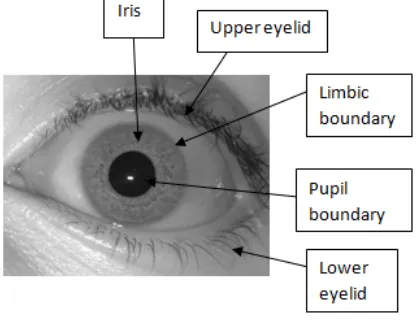
Biometric refers to the identification & verification of human identity based on certain physiological trait of a person. The commonly used biometric feature includes speech fingerprint, face, handwriting, hand geometry etc, in these methods iris recognition is regarded as a high accuracy verification technology, so that many country have idea of adopting iris recognition to improve safety of their key departments. The iris is the pigmented colored part of the eye behind the eyelids and in front of lens. It is the only internal organ of the body which is normally externally visible. These visible patterns are unique to individuals and it has been found that the probability of finding similar pattern is almost 'ZERO'.
A generalized iris recognition system consists of an image acquisition, iris segmentation and localization (preprocessing), feature extraction and feature comparison (matching) stages. For feature extraction and matching Iris recognition methods are classified into four categories; the Phase based method( Daughman[8]) the zero crossing representation based method( boles & boan hash,1998), the texture based method (wildes[3]) & local intensity variation( Ma et al,[4]). Daughman's[1] developed the first integrated iris recognition algorithm. He use Gabor filter to extract iris features and matched two iris codes by the hamming distances. Lim et al[2] also use the wavelet transform to extract feature from the iris region. Zero crossing method represents the One-Dimensional wavelet transform at different resolution of concentric circles. In this method, measures the energy difference between two zero crossing representation of iris image. Boles and Boashash [9] make use of 1D wavelets for encoding iris pattern data. During last decade, numerous attempts have been made to apply artificial neural networks for iris feature extraction and matching. The self adaptive neural networks, SOM-NN and ICA, LSOM, HSOM,
[image:1.612.324.533.563.724.2]Feed-Forward back propagation, cascade forward back propagation, feed forward multi-layer perceptron artificial network etc. Lu1, Wu and Wang[6] proposed an iris recognition algorithm based on ICA and SOM neural network almost remove the redundancy of feature space. It has stronger adaptive capacity and robustness. Two variant [LSOM and HSOM] of SOM comes into picture. Levensthein self organizing map (LSOM) uses the weighted symbols with different lengths while Hamming Self-organizing map(HSOM)uses the specific hamming distance in the competition phase but trained SOM is not to accurately represent the input space. Zheng and Wang[7] used SANN model to overcome this limitation but these model would be more suitable when there is a need to include the magnitude information in measuring the shape similarity. Some other network like Feed forward back propagation network (FFBPN), Cascade forward back propagation network (CFFBPN) are also used by Gopikrishnan and Santhanam[5] for the iris recognition. In these algorithms, error signal is calculated between output layer and the target value and this error -
signal will move back to hidden layers to improve the performance.
In this paper, section II discusses the Hough transform method for iris localization and its accuracy and limitation. Section III, gives the modified algorithm based on fusion of Adaptive Resonance theory-Counter Propagation Neural Network for iris pattern matching with its architecture and learning algorithm. Section IV gives the experimental results and Conclusion is given in Section V followed by references.
II. PREPOROCESSING
A. Image Acquisition:
The objective iris image may have undesired portion of eyes like sclera, eyelid, pupil, the area of this is also a dependent parameters on eye to camera distance & angle of camera. To improve the quality of iris images, normalization is required.
B. Iris Localization:
To detect the iris image, which is an annular portion between the pupil (inner boundary) and the scalera (outer boundary) localization is required. Pupil is the black circular part surrounded by iris tissues. Outer radius of the iris Pattern can be detected with the help of the center of the pupil.
The process of localization requires detection a. inner boundaries (limiting part between
iris and pupil) &
b. outer boundary (limiting edge of iris & sclera)
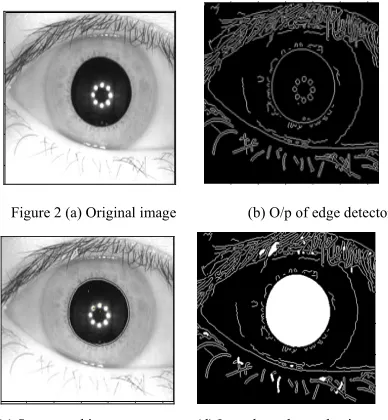
Firstly, convert the iris image into grey scale image to remove the illumination effect. In this paper, circular Hough transform is employed for detecting the iris and Pupil boundaries. Hough transform perform better when image muddled with artifacts like shadows and noise. This transform find the intensity image gradient in the given image at all the locations by convolving with the Sobel filters. Sobel filter are used 3*3 Kernels to calculate the gradient (intensity variation) of image in vertical direction Gver and horizontal direction Ghor.
Figure 2 (a) Original image (b) O/p of edge detector
(c) Segmented image (d) Inner boundary selection
(e) Outer boundary selection
The Sobel filter kernels are:
Cver ={-1 -2 -1;0 0 0; 1 2 1} ………1 Chor ={-1 0 1;-2 0 2; -1 0 1} ……….2 The absolute value of gradient images along horizontal and vertical direction is by following equation;
Gabs = Gver + Ghor ………3 Where Gver is the convolution of the image with Cver and Ghor is the convolution of the image with Chor. The edge map of absolute gradient is obtained using canny edge detection. Center of the edge image is determined with the following equation:
xc = x - r*cos(θ) ………4 yc = y - r*sin(θ) …..…..5 Where x,y are the coordinates at pixel P and r is the possible range of radius values, θ(theta) ranges [0;π] A maximum point in the Hough space will correspond of the radius r and center coordinates xc & yc of the circle. If using all gradient data Hough transform is performs firstly for iris/ sclera boundary then apply for iris/pupil boundary. After the completion, the radius, x-y center coordinates for both circles are obtained. The image eyelid and eyelashes are integral part of captured image which affect the effective information of iris, to filter out the undesired part (eyelid, eyelashes, sclera) we use the linear Hough transform. To isolate the eyelid first fitting a line to the upper and lower eyelid with linear Hough transforms. A second horizontal line is drawn, which intersects with the first line at the iris edge that is closest to the pupil. For horizontal gradient information canny edge detector is used & only horizontal component information is taken.
C. Normalization:
[image:2.612.82.276.506.716.2]Figure.3 Rubber Sheet Model
The remapping of the iris region from (x,y) Cartesian coordinates to the normalized non-concentric polar representation is modelled as
I(x((r,θ),y(r,θ)) I(r,θ) ...(6) with
x(r,θ) = (1-r)xp(θ) + rxl(θ) ...(7) y(r,θ) = (1-r)yp(θ) + ryl(θ) ...(8)
Where I(x,y) is the iris region image, (x,y) are the original Cartesian coordinates, (r,θ) are the corresponding normalized polar coordinates and the coordinates of the pupil and iris boundaries along the θ
direction.
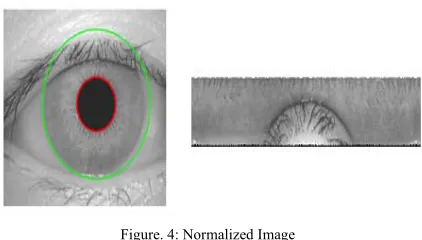
Figure. 4: Normalized Image
The rubber sheet model takes into account pupil dilation and size inconsistencies in order to produce a normalized representation with constant dimensions. In this way the iris region is modeled as a flexible rubber sheet anchored at the iris boundary with the pupil centre as the reference point.
III. PATTERN MATCHING
For matching the two iris encode features a trained neural network is required. In this paper proposed a new prediction model - Adaptive resonance theory - Counter propagation Network (ART-CPN).
A. Counter propagation network(CPN):
Counter propagation network combine an unsupervised Kohonen layer with a teachable output layer. CPN consists of an input layer or hamming layer, a hidden Kohonen layer and a Grossberg output layer. The competitive units in hidden layer do unsupervised learning whereas the O/P unit does supervised learning which is fully connected to the hidden layer. Here the patterns are bipolar & the neurons are unipolar to neutralize the influence of other neurons. The inputs and output is also binary. This model eliminates the need for back propagation thereby reducing training time. The training process consist two steps, (i) an input vector presents at input node. The nodes at kohonen
layer compete for the right to learn the input vector. During the learning process weights of the network are automatically adjust. Unsupervised learning is used in this step to cluster the input vector to separate distinct cluster of input data. (ii) Reduce the error between the CPN output and the corresponding desired target outputs by calculate the weight vector between the cluster and output layer.
CPN Training algorithm:
Step 0: Initialize weights, learning rates etc.
Step1: While stopping condition for phase 1 is false, perform steps 2-7
Step2: For each training input x perform step3-5. Step3: Set x input layer activation to vector x. Step4: Find winning cluster unit.
Step5: Update weights on winning cluster unit vijnew = vijold +α (xi- vijold ), i= 1 to n Step6: Reduce learning rate α.
Step7: Test stopping condition for phase 1 training. Step8: While stopping condition is false for phase 2 training, do step9-15.
Step9: For each training input pair x:y, perform step10-13.
Step10: Set x input layer activation to vector x. Set y output layer activation to vector y. Step11: Complete the winning cluster unit.
Step12: Update weights in to unit z; here the value of infinity is a small constant value.
vijnew = vijold +α (xi- vijold ), i= 1 to n Step13: : Update weights from cluster unit to the
output unit .
wJknew = wIkold + β(yk - wJkold ); k=1to m. Step14: Reduce learning rate α.
Step15: Test stopping condition for phase 1 training. The activation of the cluster unit is,
1 if j=J, J is winning zj=
0 otherwise
The output node k is given by: Yk = wjk zj
B. Adaptive resonance theory:
ART network are controlled by the degree of similarity of patterns place on the same cluster unit. The system is sufficiently stable against noise to enable learning and is sufficiently plastic to learn new input iris without affecting already learned rules. The vigilance parameters make the network automatically generate the nodes of the cluster layer and adaptive initial weight between the input layer, cluster layer and output layer
C. ART-CPN network:
The ART-CPN algorithm redesigns the relative similarity between the inputs vector (input iris) and weight vector for a cluster node. The vigilance parameter make the network automatically generate the node of the cluster layer and adaptive initial weights between the input layer, cluster layer and output layer. The ART_CPN gives the Kohonen and Grossberg learning rule for weight updation of winning nodes.
Σ
[image:3.612.79.290.308.428.2]Figure 5: Architecture of ART-CPN
D. The ART-CPN Algorithm:
The training procedure for the forward-only counter-propagation net includes two steps in learning process. The ART-CPN simultaneously trains the weights of the input layer, cluster layer and output layer. An input vector (X) presents to the cluster node that the Vs(Xj) of the weight vector (vij) is calculated. Each training vector is presented to the input layer, and the associated target vector is presented to the output layer. The nodes in the cluster layer compete (winner-take-all) for the right to learn the input vector. The maximum Vs(Xj) is the winning node (call its index J). The winning node sends a signal of 1 to the output layer. Each output node k has a calculated input signal wJk and target vector. The learning rule updates the weights of the winning nodes. Meanwhile, the learning rule updates the weights from the input layer to the cluster nodes:
vijnew = vijold +α (xi- vijold ) j denotes the winning node.
The learning rule updates the weights from the cluster nodes to the output layer:
wJknew = wiIold + β(yk - wJkold )
The competitive signal of cluster layer zj is computed by:
1 if j=J, J is winning zj=
0 otherwise
The learning rule for the weights from the cluster nodes to the output nodes can be expressed using the delta rule:
wJknew = wiIold + β zj(yk - wJkold )
The training of the weights from the input nodes to the cluster nodes continues at a low learning rate with gradually reducing learning rate for the weights from the cluster nodes to the output nodes. The nomenclature used is as follows:
X(x1,.,xn) input vector. Y(y1,.,yk) target vector.
Vs(Xj) similarity of vector between the input and weight vectors of cluster node j.
ρX vigilance parameter of input vector (0.8–0.9).
C learning epochs. α, β learning rate (0.04–0.1).
vxJ, wJk weights of the winner cluster nodes (J).
The vigilance is set to be high, and then it gathers a large number of cluster nodes. After training, the
weights of the cluster nodes are distributed in a statistically optimal manner that improves the accuracy performance. The learning speed of ART-CPN is extremely fast due to the one step learning process and the efficient learning algorithm.
In the testing process, only input data is required for the network model to operate when the ART-CPN is used for the matching. The application procedure for ART-CPN is as follows:
Step 1. Present input vector X. Step 2. Compute Vs(Xj) ;
Find the node J that is maximum Vs(Xj) : Step 3. Set the activations of output nodes (Yk ) : The competitive signal of cluster layer zj is Computed by
1 if j=J, J is winning node zj =
0 otherwise
Yk = zj wjk
IV. EXPERIMENTAL RESULT
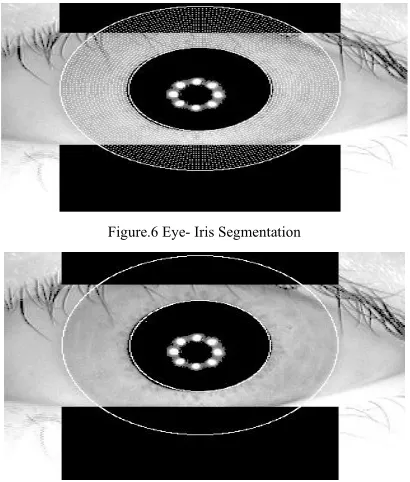
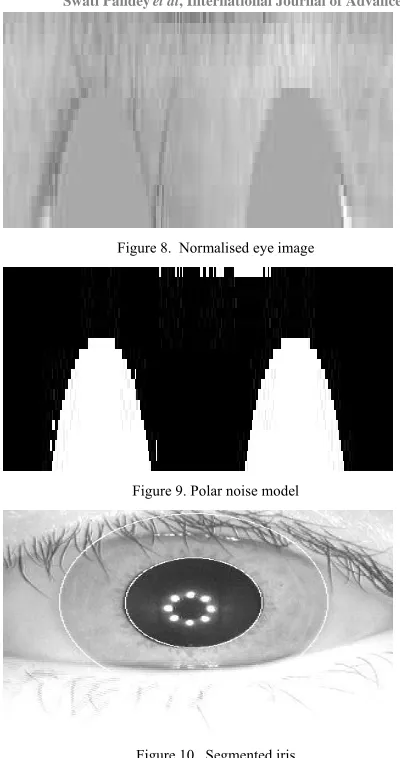
[image:4.612.327.532.480.721.2]CASIA Iris Database [12] is adopted to evaluate the performance of the Circular Hough transform algorithm. This database includes 1200, 640*480 iris images from 60 different eyes, with the diameter of the iris ranging from 180 to 260 pixels. The Hough transform algorithm gives better results than other techniques in presence of artifacts like shadow and noise. In iris recognition system proper detection of inner and outer boundaries of iris texture is important. Circular Hough transform method separates the iris region from human eye with 99.8 % accuracy and isolates eyelid, eyelash & reflection areas. Then, Normalization is performed to eliminate the inconsistencies between iris regions. For matching of the iris pattern ART-CPN is used which improved the matching performance of the system and also provided high speed system.
Figure.6 Eye- Iris Segmentation
Figure. 7 Upper and lower eyelid detection
Σ
Figure 8. Normalised eye image
Figure 9. Polar noise model
Figure 10. Segmented iris
V. CONCLUSION
In this paper ,circulaer Hough transform used to localize the iris boundary and segmentation. A new algorithm fusion of ART-CPN neural network is proposed for iris matching. This algorithm uses the viligance parameter (px) to generate the cluster layer nodes. The adaptive cluster nodes can enhance the performance of the matching system.This netwok requires the one step learning process, so it is faster than the other neural network used for the pattern matching (like Back Propagation Network,Cascaded feed forward network etc.).
VI. REFERENCES
[1]. J. G. Daugman, “How Iris Recognition Works,” Proceeding of 2002 International conference on image Processing. Vol 1, 2002.
[2]. Lim, S., Lee, K., Kim, T., “Efficient Iris Recognition through Improvement of Feature Vector and Classifier,” ETRIJ., vol.23, issue 2, pp. 61-70, 2001
[3]. R. Wildes, J. Asmuth, G. Green, S. Hsu, R. Kolczynski, J. Matey, S. McBride, “ A Machine-vision System for Iris Recognition,” Machine Vision and Applications Vol. 9, pp. 1-8, 1996. [4]. L. Ma, T. Tan, Y. Wang, and D. Zhang, “Personal
Identification Based on Iris Texture Analysis”, IEEE Transactions on Pattern Analysis and Machine Intelligence, vol. 25, no. 12, pp.1519-1533, , December 2003
[5]. M. Gopikrishnan, T.Santhanam, "Effect of different neural network on the accuracy in iris patterns recognition", International Journal of Reviews in Computing, Vol. 7,September 2011. [6]. Bo Lu1,Jing-jing Wu, Yu Wang, "A Iris
Recognition Algorithm Based on ICA and SOM Neural Network", CISP2010,pp 2246- 2448. [7]. Huiru Zheng , Haiying Wang," Improving pattern
discovery and visualisation with self-adaptive neural networks through data transformations", Springer september 2011.
[8]. Daugman, J.,” High confidence visual recognition of persons by a test of statistical independence,” IEEE Trans. Pattern Anal. Mach. Intell., Vol. 15, No. 11, pp. 1148-1161, 1993.
[9]. Boles,W.& Boashash,B.,”A human identification technique using images of the iris and wavelet transform.,” IEEE Trans. Signal Process., Vol. 46, No. 4, pp. 1185-1188, 1998.
[10].Nakamura, K.; Miyamoto, S. & Morisada, K,”Characteristics of spatial spreading associative neural network in simultaneous recognition of object orientation and shape,” IEICE Trans. Inf. & Syst., Vol. J81-D-II, No. 6, pp. 1194-1204, 1998.
[11].Yoshikawa, T. & Nakamura, K ,”Evaluation of recognition ability and inside parameters for spreading associative neural network. IEICE Trans. Inf. & Syst., Vol. J83-D-II, No.5, pp. 1332-1343.