Volume 2, No. 5, Sept-Oct 2011
International Journal of Advanced Research in Computer Science
RESEARCH PAPER
Available Online at www.ijarcs.info
Hybrid Routing Protocol with Unicast Reply Simulation for Mobile Ad hoc Network
*
1Mr. Makarand R. Shahade and
2Prof. R. M. Tugnayat
1Asst. Prof, Depatment of I.T.2
Asso. Prof, Depatment of I.T.
1,2
J.D. Institute of Engg. & Technology, Yavatmal, INDIA
Abstract - MaNet has emerged as one of the most focused and thrust research areas in the field of wireless networks and mobile computing. In ad hoc mobile networks, routes are mainly multi hop because of the limited radio propagation range and topology changes frequently and unpredictably since each network host moves randomly. Therefore, routing is an integral part of ad hoc communications. Many routing protocols are proposed for MaNet. The protocols are mainly classified in to three categories: Proactive, Reactive and Hybrid. Proactive routing protocols attempt to maintain consistent, up-to-date routing information from each node to every other node in the network. Reactive routing protocols creates routes only when desired by the source node. Once a route has been established, it is maintained by a route maintenance procedure. In this paper, we propose Routing Protocol which combines the merits of proactive and reactive approach and overcome their demerits. We propose variation of this proposed Hybrid Routing Protocol (HRP), the propose protocol creates route only when desired by the source node as in case of reactive routing protocols. The propose protocols maintain routing table at each node as in case of proactive routing protocols. Hence called hybrid routing protocol.
The propose protocol takes advantage of broadcast nature of MaNet to discover route and store maximum information in the routing tables at each node. HRP-Unicast Reply is compared with existing routing protocol AODV using simulation result. The results of Data packets sent and dropped in the Network shows significant reduction in routing overhead, end- to-end delay and increases packet delivery ratio over AODV.
Key words - Mobile ad hoc network, Hybrid Routing Protocol, Proactive Routing Protocols, Reactive Routing Protocols, AODV, Unicast Reply (UR)
I. INTRODUCTION
MaNet [1] has emerged as one of the most focused and thrust research areas in the field of wireless networks and mobile computing. Mobile ad hoc networks consist of hosts communicating one another with portable radios. These networks can be deployed impromptu without any wired base station or infrastructure support. In ad hoc mobile networks, routes are mainly multi hop because of the limited radio propagation range and topology changes frequently and unpredictably since each network host moves randomly. Therefore, routing is an integral part of ad hoc communications, and has received interests from many researchers. Many routing protocols are proposed for MaNet. The protocols are mainly classified into three types, Proactive, Reactive and Hybrid [2,4]. In Proactive [2, 5] i.e.
Table-driven routing protocols attempt to maintain consistent, up-to-date routing information from each node to every other node in the network. These protocols require each node to maintain one or more tables to store routing information, and they respond to changes in network topology by propagating hello messages throughout the network in order to maintain a consistent network view.
Reactive routing protocol [6,8]creates routes only when desired by the source node. When a node requires a route to a destination, it initiates a route discovery process within the network. This process is completed once a route is found or all possible route permutations have been examined. Once a route has been established, it is maintained by a route maintenance procedure until either the destination becomes inaccessible along every path from the source or until the route is no longer desired. The Ad hoc On-demand Distance Vector (AODV) [6, 8, 9] protocol, one of the reactive
routing protocol that has receive the most attention, however, does not utilize multiple paths. In AODV [2, 6], at
Every instance, route discovery is done for fresh communication which consumes more bandwidth and causes more routing overhead. The data packets will be lost during path break which occurs due to node mobility. When the network traffic requires real time delivery (voice, for instance), dropping data packets at the intermediate nodes can be costly. Likewise, if the session is a best effort, TCP connection, packet drops may lead to slow start, timeout, and throughput degradation.
This paper proposes Hybrid Routing Protocol which combines the features of proactive and reactive routing protocol approaches [2]. This paper propose Hybrid Routing Protocol (HRP), The propose protocol creates route only when desired by the source node as in case of reactive routing protocols. The propose protocols maintain routing table at each node as in case of proactive routing protocols. Hence called hybrid routing protocol. The proposed protocol takes advantage of broadcast nature of MaNet which is used to gain maximum routing information at the nodes in the network. HRP-UR with AODV, a highly used reactive routing protocol in Ad hoc network. The simulation Results of Data packets sent and dropped in the Network shows significant reduction in routing overhead, End-To-End delay as well as increase packet delivery ratio.
II. PROACTIVE ROUTING PROTOCOLS
respond to changes in network topology by propagating hello messages [20] throughout the network in order to maintain a consistent network view.
A. Destination-Sequenced-Distance-Vector Routing:
Destination- Sequenced-Distance-Vector Routing [5] is the table driven routing based on classical Bellman-ford routing mechanism. Every mobile node in the network maintains routing table in which all of the possible destinations within the network and the number of hops to each destination are recorded.
B. Cluster Head Gateway Switch Routing:
Cluster head gateway switch routing [21] uses hierarchical network topology. The nodes are organized into small clusters. Each cluster is having cluster-head which coordinate the communication among members of each cluster head. Cluster-head also handles issues like channel access ,bandwidth allocation in the network.
C. Wireless Routing Protocol:
Wireless Routing Protocol is one of the table driven routing protocol [22]. Each node is responsible for maintaining four tables i.e. Distance table(DT), Routing table(RT), Link cost table(LCT) and Message Transmission List table(MRL).
[image:2.595.38.299.387.681.2]The comparison of proactive routing protocol [19] is summarized in Table I.
Table I : Comparison of Proactive Routing Protocol
Parameter DSDV CGSR WRP
Time Complexity (Link Addition/Failure)
O(d) O(d) O(h)
Communication complexity (Link
Addition/Failure)
O(x=N) O(x=N) O(x=N)
Routing Philosophy Flat Hierarchical Flat
Loop Free Yes Yes Yes but not
instantaneous
Multicast Capability No No No
Number of Required Tables
Two Two Four
Frequency of Update Transmission
Periodically & as Needed
Periodically Periodically & as Needed Updates Transmission
to
Neighbor Neighbor and Cluster Head
Neighbor
Utilizes Sequence Numbers
Yes Yes Yes but not
instantaneous Utilizes "Hello"
messages
Yes No Yes but not
instantaneous Routing Metric Shortest Path Shortest Path Shortest Path Abbreviations:
N=No. of nodes in the network h=Height of Routing Tree
d=Network Diameter x=No. of nodes affected by topological change
III. REACTIVE ROUTING PROTOCOLS
Another approach used for routing is reactive approach [6,7]. This type of routing creates routes only when desired by the source node. When a node requires a route to a destination, it initiates a route discovery process within the network. This process is completed once a route is found or all possible route permutations have been examined. Once a route has been established, it is maintained by a route
maintenance procedure until either the destination becomes inaccessible along every path from the source or until the route is no longer desired.
A. Ad hoc On-Demand Distance Vector (AODV):
The Ad hoc On-demand Distance Vector (AODV) [6, 8, 9] protocol, one of the on-demand routing algorithms that has receive the most attention, however, does not utilize multiple paths. It joins the mechanisms of DSDV and DSR. The periodic beacons, hop-by-hop routing and the sequence numbers of DSDV and the pure on-demand mechanism of Route Discovery and Route Maintenance of DSR are combined. In AODV [6], at Every instance, route discovery is done for fresh communication which consumes more bandwidth and causes more routing over-head. The source prepares RREQ packet which is broadcast to it's neighboring nodes. If neighboring node will keep backward path towards source. As soon as destination receives the RREQ packet, it sends RREP packet on received path.
This RREP packet is unicast to the next node on RREP path. The intermediate node on receiving the RREP packet make reversal of path set by the RREQ packet. As soon as RREP packet is received by the source, it starts data transmission on the forward path set by RREP packet. Sometimes while data transmission is going on, if path break occurs due to mobility of node out of coverage area of nodes on the active path, data packets will be lost. When the network traffic requires real time delivery (voice, for instance), dropping data packets at the intermediate nodes can be costly. Likewise, if the session is a best effort, TCP connection, packet drops may lead to slow start, timeout, and throughput degradation.
B. Dynamic Source Routing (DSR):
Dynamic Source Routing, DSR [2,14,16], is a reactive routing protocol that uses source routing to send packets. It is reactive protocol like AODV which means that it only requests a route when it needs one and does not require that the nodes maintain routes to destinations that are not communicating. It uses source routing which means that the source must know the complete hop sequence to the destination. Each node maintains a route cache, where all routes it knows are stored. The route discovery process is initiated only if the desired route cannot be found in the route cache. to limit the number of route requests propagated, a node processes the route request message only if it has not already received the message and its address is not present in the route record of the message.
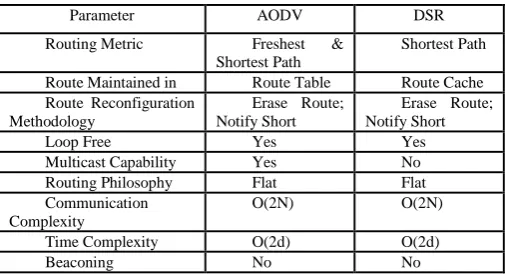
[image:2.595.311.564.643.780.2]The comparison of reactive routing protocol [19] is given in Table II.
Table II: Comparison of Reactive Routing Protocol
Parameter AODV DSR
Routing Metric Freshest & Shortest Path
Shortest Path
Route Maintained in Route Table Route Cache Route Reconfiguration Methodology Erase Route; Notify Short Erase Route; Notify Short
Loop Free Yes Yes
Multicast Capability Yes No
Routing Philosophy Flat Flat
Communication Complexity
O(2N) O(2N)
Time Complexity O(2d) O(2d)
Requirement
Abbreviations:
N=No. of nodes in the network h=Height of Routing Tree
d=Network Diameter x=No. of nodes affected by topological change
IV. HYBRID ROUTING PROTOCOLS
Hybrid Routing Protocols combines the merits of proactive and reactive routing protocols by overcoming their demerits. In this section we put some light on existing hybrid routing protocol.
A. Zone Routing Protocol(ZRP):
Zone routing protocol is a hybrid routing protocol which effectively combines the best features of proactive and reactive routing protocol [2, 17]. The key concept is to use a proactive routing scheme within a limited zone in the r-hop neighborhood of every node, and use reactive routing scheme for nodes beyond this zone. An Intra-zone routing protocol(IARP) is used in the zone where particular node employs proactive routing whereas inter-zone routing protocol(IERP) is used outside the zone. The routing zone of a given nodes is a subset of the network, within which all nodes are reachable within less than or equal to the zone radius hops. The IERP is responsible for finding paths to the nodes which are not within the routing zone. When a node S want to send data to node D, it checks whether node D is within its zone. If yes packet is delivered directly using IARP. If not then it broadcasts (uses unicast to deliver the packet directly to border nodes) the RREQ packet to its peripherals nodes. If any peripheral nodes find D in its zone, it sends RREP packet; otherwise the node re broadcasts the RREQ packet to the peripherals nodes. This procedure is repeated until node D is located.
V. HYBRID ROUTING PROTOCOL WITH UNICAST REPLY
In this paper, we proposed hybrid routing protocol with unicast reply scheme (HRP-UR). The proposed protocol takes the advantages of both proactive and reactive routing protocol hence called Hybrid Routing Protocol(HRP).
Table III: Structure of Routing Table
Dest Next hop Hop count
• Dest : Source address on received packet.
• Next Hop : Next hop address on the path towards source node.
• Hop Count : Hop distance to reach to source node.
A. Analytic Study of HRP-UR:
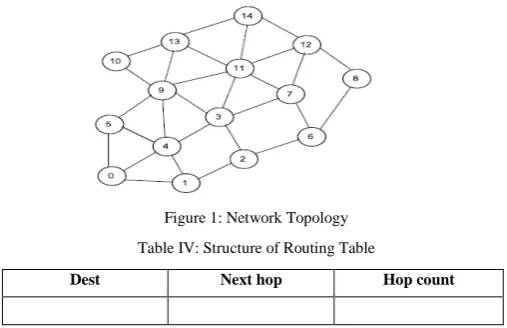
[image:3.595.309.563.54.218.2]Hybrid Routing Protocol with unicast reply scheme, HRP-UR combines the features of proactive and reactive routing protocols, overcoming their demerits. The propos protocol maintains routing table as that of table driven (proactive) routing protocol scheme. Initially, all the nodes in the network will have empty routing table. The structure of routing table is as shown in Table IV. Updating in routing table takes place in on demand manner (reactive). The proposed routing
Figure 1: Network Topology
Table IV: Structure of Routing Table
Dest Next hop Hop count
protocol, HRP-UR operates in two different phases: Route Discovery and Route Maintenance.
a. Route Discovery in HRP-UR:
A source, on receiving a data packet first checks, whether route to the destination exists in it's routing table. If route exists then it sends data packets to the destination. If no route exists then source node first stores the data packet in queue, prepares route request packet(RREQ) and broadcast it. The source generate broadcast id. Broadcast id is the unique id which will identify the unique communication over the network. The hop count field is set to one. After sending RREQ packet, the source waits for a route reply packet (RREP).
If it did not receive within a certain time called request timeout, it broadcast another RREQ packet. If the maximum number of retries has been reached, all data packets for this destination are dropped since destination is unreachable. Destination on receiving the RREQ packet, sends RREP packet to the source on the same path RREQ packet has followed. In the propose HRP-UR scheme, it is assumed that the RREP packet is unicast to the node on the path. The destination set hop count field of RREP packet to 1. In HRP-UR, RREP packet contain id of the node from which it has received RREQ packet hereafter it is named as intended node. This RREP packet is received by intended node. On receiving, intended node first make an entry in its own routing table for destination in received RREP packet. Then
intended node search its own routing table for the destination. If found then intended node retrieves next hop information from routing table and unicast RREP packet. The next hop will becomes next intended node. As soon as source node receives the RREP packet, it makes an entry in its own routing table about source of RREP packet. Then source node finds the next hop information towards the destination node using its own routing table. It then dequeues all the data packets one by one from QUEUE and sends to the next hop. Next hop will search destination in its routing table and repeat the same procedure.
Consider the example of network given in Figure 1. The process of route discovery is shown in Figure 2. Source node(say 0) having Constant Bit Rate (CBR) traffic, want to communicate with destination node (say 14). Let us assume this CBR traffic as CBR0 which starts at time 1.0 and ends at time 3.0. Initially no route is available at any of the node in the network, so routing tables at all the nodes are empty.
it. This RREQ packet is received by immediate neighbors i.e. node 5,1 and 4 . On receiving RREQ, they first store route information for source node 0 in there own routing table. So node 5,1 and 4 will enter route to node 0 in there routing table along with corresponding hop count which is 1. The details of routing table entries is summarized in Tables V, VI and VII.
Table V: Routing Table at Node 5
Dest Next hop Hop count
0 0 1
Table VI : Routing Table at Node 4
Dest Next hop Hop count
0 0 1
Table VII : Routing Table at Node 1
Dest Next hop Hop count
0 0 1
After making an entry for node 0 , node 5,1 and 4 search their routing table for destination node 14. If any of them will find the entry in their own routing table, it creates RREP packet and sends back to the source node 0. If not then increase the hop count received in RREQ packet by 1 and rebroadcast it. This process is repeated till destination node 14 is reached or TTL field of RREQ packet becomes 0.
Figure 2: RREQ Transmission in the Network
As soon as node 14 receives the RREQ packet, it sends RREP packet. Assume that the node 14 received RREQ packet from node 11. So node 14 finds entry for node 0 in its own routing table. Node 14 retrieves the next hop towards node 0 which is node 11. So node 11 becomes intended node. On receiving RREQ by node 11, it searches node 0 in its own routing table, finds next node towards source node 0
which is node 3 called new intended node. Then new
intended node 3 unicast RREP packet to node 4. This process is repeated until RREP packet is reached to destination node 0 which is source of RREQ packet. The process of RREP transmission is summarized in the Figure 3.
Figure 3: RREP Transmission in the Network
As soon as node 0 receives RREP packet, it first make an entry for node 14 in it's routing table. Then node search its routing table for node 14 and finds next hop towards destination node 14 which is node 4. Then node 0 first dequeues all data packets from queue one by one, which were enqueued during route discovery process and sends to the destination node 14. Then source node 0 starts receiving data packets from higher layers and send it to the destination node14. The Data packets are unicast to next hop from routing table i.e. node 4. Node 4 search it's own routing table and finds the next hop towards node 14 which is node
3. This procedure is repeated until data is successfully received at destination node 14. The higher layer at destination node 14 will send acknowledgment of data received at destination node14. The updated routing table along active path (0-4-3-11-14) is given in Tables VIII, IX, X, XI, XII.
Table VIII : Routing Table at Node 0
Dest Next hop Hop count
14 4 4
Table IX : Routing Table at Node 4
Dest Next hop Hop count
0 0 1
14 3 3
11 3 2
3 3 1
Table X : Routing Table at Node 3
Dest Next hop Hop count
0 4 2
14 11 2
11 11 1
Table XI : Routing Table at Node 11
Dest Next hop Hop count
0 3 3
14 14 1
Table XII : Routing Table at Node 14
Dest Next hop Hop count
0 14 4
b. Simulation Result of HRP-UR:
In this section, we evaluate the performance of HRP-UR. We select parameters to evaluate the performance
We consider 14 node network examples shown in Figure 1. We simulate the new propose routing protocol, HRP-UR using NS2. We considered 5 CBR data traffic running in the network as explained in Section V. Total simulation time for the following scenario is considered to be 12 seconds. The details of data traffic running in the network are as follows:
c. Data packets sent and dropped in the Network:
Figure 4: Data Packets Sent and Dropped in the Network
From the graph shown in Figure 4, the number of packets received and number of packet dropped in the network is same in proposed HRP-UR protocol and AODV protocol. There exist four reasons for dropping packet
i.packets will be dropped by interface queue (IFQ) when IFQ overflow occurs in the MAC layer
ii.packets will be dropped by Address Resolution Protocol (ARP), if ARP is already processing address converting request for other packets at MAC layer. iii.packets will be dropped by MAC layer due to
collision.
iv.packets will be dropped at network layer if MAC layer is not ready to accept packets.
d. End-to-End Delay Analysis:
Figure 5: End to End delay for CBR0
End-to-End delay is defined as the difference between time at which source node send data packets and the time at which destination node receives the same data packet. We compute the delay information for CBR 0 which runs between node 0 to node 14. Total number of packets transmitted from source node 0 to destination node 14 is 133. We plot the graph of End-to-End delay versus packet id as shown in Figure 5. Graph shows that the End-To-End delay incorporated in proposed HRP-UR is quite low as compare to AODV protocol.
VI. CONCLUSION
The Proactive and Reactive approach for routing in ad hoc network have their merits and demerits. The Proposed
routing protocol will have an advantage of both proactive and reactive approach. Backup routing in proposed scheme will helpful in path break up to some extent. Here we want to conclude by saying that the analytic study of the new hybrid approach will result in less routing overhead than most of the routing algorithm such as AODV and DSDV. The simulation results of Data packets sent and dropped in the network is related with the efficient routing issue, which is most demanding and thrust area of ad hoc network. We have a hybrid routing protocol scheme with unicast reply.
VII. REFERENCES
[1]. Mobile Adhoc Network (MaNet).
[2]. C. Siva Ram Murthy and B.S. Manoj. Ad Hoc Wireless
Networks Architectures and Protocol, volume ISBN:81-297-0945-7. Pearson Education, first indian reprint,2005 edition, 2005.
[3]. Santa Barbara Elizabeth M. Royer and Chai Keong Toh. A Review of Current Routing Protocols for Adhoc Mobile Wireless Networks. IEEE Personal Communications, pages 46-55, April 1999.
[4]. Y. Zhang V. Kawadia and B. Gupta. System Services for
Implementing Ad-hoc Routing: Architecture,
Implementation & Experiments. In First Inter-national Conference on Mobile System, Application and Services(Mobisys), pages 99{114. San Francisco ,CA., June 2003.
[5]. C. P. P. Bhagwat. Highly Dynamic Destination Sequenced Distance Vector DSDV Routing for Mobile Computers. Proceeding of ACM SIGCOM, pages 234 - 244, September 1994.
[6]. E. Royer C. Perkins and S. Das. Ad hoc On-demand Distance Vector (aodv) routing. (RFC 3561), July 2003. [7]. C. K. Toh. Ad Hoc Mobile Wireless Networks-Protocols
and Systems, chapter 6, pages 79-94. Prentice Hall, 2002. [8]. Cenker Demir and Cristina Comanicia. An Auction Based
AODV Protocol for Mobile Ad hoc Network with Selfish Nodes. IEEE International Conference ICC'07, pages 3351-3356, June 2007.
[9]. Rendong Bai and M. Singhal. DOA: DSR over AODV protocol for mobile ad hoc network. IEEE Transaction on Mobile Computing, 5:1403-1416, Oct 2006.
[10]. P. K. Pattanaik and R. Mall. Challenges in ad hoc networks. Sidhanth Journal, pages 153-160, 2007.
[11]. M. Woo S. Singh and C. S. Raghvendra. Power Aware Routing in Mobile Ad-Hoc Networks. In Proceedings of ACM/IEEE MOBICOM, pages 181-190. Dallas, Texas, October 1998.
[12]. K. Y. Wang R. Dube, C. D. Rais and S. K. Tripathi. Signal Stability Based Adoptive Routing SSA for Ad hoc Mobile Network. IEEE Personal Communication, 4:36-45, Feb 1997.
[13]. J. H. Chang and L. Tassiulas. Energy Conserving Routing in Wireless Ad hoc Network. In IEEE Conference on Computer Communications INFOCOM, pages 22-31, Tel Aviv Israel, March 2000.
[14]. S. R. Das C.E. Perkins, E. M. Royer and M.K. Marina. Performance Comparison of Two On-demand Routing Protocols for Ad hoc Networks. IEEE Personal Communications Magazine Special Issue on Ad hoc Networking, pages 16-28, Feb 2001.
[15]. David B. Johnson. Routing in Ad hoc Networks of Hmobile Hosts. IEEE Workshop on Mobile Computing Systems and Applications, pages 158-163, Dec 1994. [16]. D. B. Johnson and D. A. Maltz. Dynamic Source Routing
in Ad hoc Wireless Network. In the Book, Mobile Computing, pages 153-181, 1996.
ZRP Performance. 10th IEEE Conference ,ETFA 2005, 1(ISBN:0-7803-9401-1), Sept 2005.
[18]. L. Wang and S. Olariu. A Two Zone Hybrid Routing Protocol for Mobile Ad hoc Network. IEEE Transaction on Parallel and Distributed Systems, 12:1105-1116, Dec 2004. [19]. Ankur Khetrapal. Routing Techniques for Mobile Ad hoc
Networks Classification and Qualitative/Quantitative Analysis. In ICWN, pages 251-257, 2006.
[20]. Ian D. Chakeres and Elizabeth M. Belding-Royer. The Utility of Hello Messages for Determining Link
Connectivity. In Fifth International Symposium on Wireless Personal Multimedia Communication WPMC, pages 504-508. Honolulu,Hawaii, October 2002.
[21]. C.C. Chiang. Routing in Clustered Multihop, Mobile Wireless Networks with Fading Cchannel. In In IEEE Proceeding, Sicon'97, pages 197-211, April 1997.