Available Online at www.ijcsmc.com
International Journal of Computer Science and Mobile Computing
A Monthly Journal of Computer Science and Information Technology
ISSN 2320–088X
IMPACT FACTOR: 6.199
IJCSMC, Vol. 8, Issue. 4, April 2019, pg.150 – 156
Analysis of Various Plant
Disease Detection Techniques
Er. Ranish Kumar
Research Scholar, Baddi University of Emerging Sciences and Technology, Punjab, India
Er. Renuka Rattan
Assistant Professor, Baddi University of Emerging Sciences and Technology, Punjab, India
Abstract: The image processing is the technique which can process the digital information stored in the form of pixels. This research work is related to plant disease detection. The plant disease detection has the various phases like pre-processing, segmentation, feature extraction and classification. In this paper, various techniques of plant disease detection are reviewed in terms of certain parameters. It is analyzed that classification methods are most efficient techniques for the disease detection.
Keywords: Feature extraction, segmentation, classification
Introduction
processed with various operations in order to extract the useful information from an image. Therefore, it is sometimes are refereed as the digital image processing but also provide functionality on the optical and analog image [4].
Figure 1: Digital Image processing
There are wide varieties of applications on which the operation are performed such as in computer graphics for the creation of images, for the analysis of an image, and manipulation and enhancement of an image in the image processing. With the development of new technologies, the field of agriculture becomes more prominent as it not only used as food feeding to major population but also used in many applications. Plants are very essential in our life as they provide source of energy and overcome the issue of global warming [5]. Plants nowadays are affected by many diseases such as they cause devastating economic, social and ecological losses and many more. Hence, it is most important to identify plants disease in an accurate and timely way. In today’s modern era, agriculture has become one of the most important part of the population. Energy is the fundament part of the global warming and major source of plants also. Number of diseases is there which badly affected ecological, economical and society losses. To detect plant pathologies there are many ways. A quantity of diseases does not have any detectable symptoms associated and display very late. For the complicated analysis, powerful microscopes have been used. It is used, as it is not possible for a human eye to identify or visible such small sign of an image, hence for this electromagnetic spectrum is utilized to detect all the sign in a part. Remote sensing techniques are used, in order to explore the captured multi and hyper spectral image [6]. Digital image processing tools are employed by the used method to obtain the desired output. It is not possible for a human eye to identify the disease extent accurately, as the resultants are subjective in nature. The observations done by the naked eye are usually used to decide diseases severity in the area of production. The significant development has done by the image processing in the field of agriculture. For the identification of the fungi disease, several techniques have been utilized such as back propagation, PCA and SVD techniques of neural network [7].
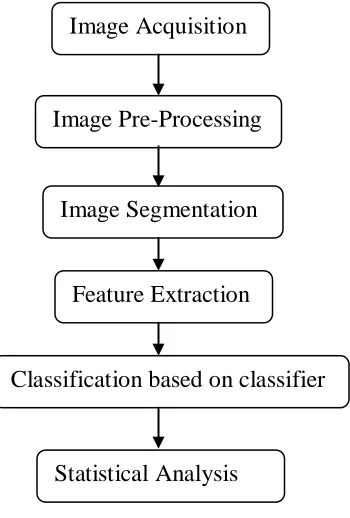
Image Acquisition
Image Pre-Processing
Image Segmentation
Feature Extraction
Classification based on classifier
The neural structure of the brain that is based on the electronic models to perform various functions is known as the artificial neural networks. The learning process of the brain is from experience. There are so many issues that cannot be resolved by the computer; therefore for this purpose small energy efficient packages are utilized. Less technical way is used by this model in order to develop all the machine solutions [8]. Here are some situations where a BP NN is a good idea:
A large amount of input/output data is available, but you're not sure how to relate it to the output. The problem appears to have overwhelming complexity, but there is clearly a solution.
It is easy to create a number of examples of the correct behavior.
The solution to the problem may change over time, within the bounds of the given input and output parameters (i.e., today 2+2=4, but in the future we may find that 2+2=3.8).
Outputs can be fuzzy, or non-numeric.
Image processing is the most common application of neural network. There are some examples, such as to remove the face spoofing by matching the original image in the database, compression of an image to extract information or minimize loss. Voice recognition, RADAR signature analysis, stock market predictions are the other major application involved in the image processing [9]. There is complex relationship between different involved parameters and problem in handling large amount of data.
The widely used dimensionality reduction technique in data analysis is principal component analysis (PCA). For the linear projection of high dimensional data into a lower dimensional subspace, PCA has been utilized that provide the maximum retained variance. It is also used to minimize the error occurred in the reconstruction of the least square. The widely used dimensionality reduction technique in data analysis is principal component analysis (PCA). It is embedded with three essential properties. First, in order to compress a set of high dimensional vectors into a set of lower dimensional vectors a linear scheme is considered as the best solution, further reconstruction is done [10]. Second, within the data various involved parameters are calculated directly such as in case of sample diagnolizing. In order to perform easy operations on model parameters, two techniques compression and decompression are utilized in the third step. They require only matrix multiplications.
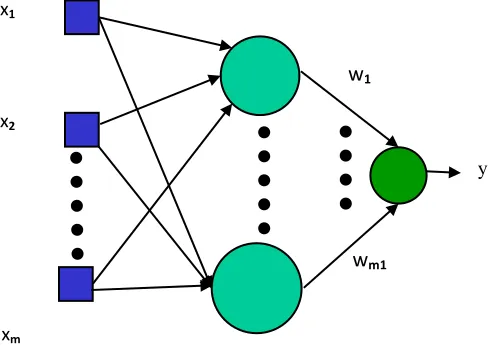
x2
xm x1
y
wm1
There are two types of layers are embedded in the Radial basis functions which is also known as the feed-forward networks. Two layers in this network are a hidden layer of radial kernels and an output layer of linear neurons. Different roles are played by both the two RBF layers such as a non-linear transformation of input space is performed by the hidden layer. As compared to input space, the resulting hidden layer has high dimensions. In order to predict the desired output, a linear regression is performed by the output layer. All the obtained output is the real-valued function whose value depends only on the distance from the origin.
Literature Review
Prof. Sanjay B. Dhaygude, et.al, (2013) proposed methodology to identify the plant disease using various detection techniques [11]. It becomes a crucial topic for many researchers as proper techniques are required to identify the disease. After various experiments, the reason and type of diseases are identifies, comparison between the texture parameters of a normal leaf and typical leaf was made. New algorithms are developed in order to achieve the increase in the classification process.
Anjali Chandavale, et.al, (2016) proposed a approach that is utilized to detect disease in the monocot and dicot plant and also treatments and precautions are suggested using image processing and advanced cell [12]. The precautions measures are proposed by the 'Agri-Guide v1.0', it also provides treatment to plants with the response time 1ms. 83 % of accuracy precision is provided by the 'Agri-manage v1.0' and 73 % accuracy to the unknown patterns of monocot and dicot plant diseases.
E. Borges, et.al, (2012) proposed a technique that is utilized to control the quality of the fruits and vegetables and specifying their botanical tissues [13]. This proposed technique is Electrical Impedance Spectroscopy that is used to study the structure of botanical tissues and their electrical properties. Obtained results are compared with the existing results, show that the proposed technique is superior to others and provide netter performance in the detection of the plant disease.
Ms. Kiran R. Gavhale, et.al, (2014) proposed in today’s world the quality and quantity of the agricultural products are degraded day by day due to present infectious disease in plants [14]. In this paper the need of simple plant leaves disease detection system that would facilitate advancements in agribusiness was reviewed. Author concluded that the proposed techniques provide the better performance in the detection of the plant disease still further improvement is required for the future.
Deepak J. Dange et.al, (2015) proposed that every original image are a RGB image as it includes the mixture of primary colors such as red, green and blue [15]. Advanced image processing is a technique utilized for enhancement of the image. To improve agricultural products automatic detection of symptoms is beneficial. There is fundamental a characteristic of disease detection is system can identify the affected part of a leaf spot by utilizing the image processing technique. In Color model CIELAB color model is accurately identified disease and results are not affected by background, type of leaf, type of disease spot and camera flash.
it. This work will likewise give % of region in which diseases are available and give us the name of disease. As in the results of one image diseased region is 5.56%.
Sachin D. Khirade, et.al, (2015) proposed prevention of the plant diseases as it leads to economical growth of the overall nation, as infectious disease degrades the quality of the food and yield losses in the agricultural field [17]. For the successful cultivation of the crop an important and unique accurately detection and classification of the plant detection technique is required. For the segmentation of the parts of the plants various methods are discussed. ANN method has been utilized in order to classify the disease in the plants such as self-sorting out feature map, back propagation algorithm, SVMs and so on.
DipteshMajumdar, et.al, (2015) discussed various techniques used for the detection of the rust in the plants an early detection and recognition techniques [18]. Timely administration choices are facilitated for proper evaluation. For the prevention of the rust disease in wheat leaves, author proposed an effective and efficient approach of the image processing. The main purpose of this paper is to provide this technique in every area or region to overcome this issue completely. It involves various improvements in the architecture of system, for the proper implementation.
Problem Formulation
The plant disease detection is the technique which is applied to detect disease from the input plant leaf. The properties of the input image can be analysed into color and textural form. The color properties of the image represent the color intensities of the input in terms of red, green and blue. The textural features of the image represent color features of the bunch of the pixels. The plant disease detection process consists of the three phases. In the first phase, the segmentation technique is applied which will segment the similar and dissimilar part of the input image. In the second phase the textural features of the input image are analysed. In the last phase, the classification technique is applied which will classify the image into certain classes according to their properties. In the base paper the region based segmentation is applied to segment the leaf. The GLCM algorithm is applied to analyze the text features and multiclass SVM classifier is used to classify the diseases. The basic GLCM algorithm does not construct the co-occurrence matrix in the efficient manner due to which textual features are not analysed accurately. In this research work Law’s textural measures will be improved to increase the efficiency of the texture feature analysis. The multiclass SVM will be replaced with naïve bayes to increase accuracy of classification.
Dataset Description
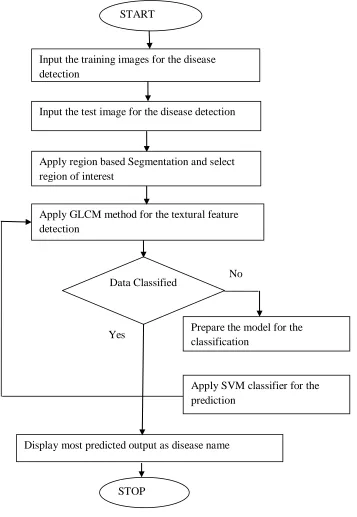
Fig 3: SVM based Prediction Model
Conclusion
The plant disease detection is the approach which is applied to detect the disease from the input image. The plant disease detection can be applied with the technique of feature extraction, segmentation and classification. In this paper, various classification based methods are reviewed for the plant disease detection. In future novel approach will be designed for the plant disease detection based on classification.
START
Input the training images for the disease detection
Input the test image for the disease detection
Apply region based Segmentation and select region of interest
Apply GLCM method for the textural feature detection
Data Classified
Prepare the model for the classification
Apply SVM classifier for the prediction
Display most predicted output as disease name
STOP
No
References
[1] Anand.H.Kulkarni and AshwinPatil R. K, “Applying image processing technique to detect plant diseases”, International Journal of Modern Engineering Research (IJMER), Vol.2, Issue.5, Sep-Oct. 2012 pp-3661-3664 ISSN: 2249-6645 2012.
[2] Haiguang Wang, Guanlin Li, Zhanhong Ma, Xiaolong Li, “Image Recognition of Plant Diseases Based on Backpropagation Networks”, 5th International Congress on Image and Signal Processing (CISP 2012) 2012. [3] PiyushChaudharyAnand K. Chaudhari Dr. A. N. CheeranandShardaGodara “Color Transform Based Approach for Disease Spot Detection on Plant Leaf”, International Journal of Computer Science and Telecommunications [Volume 3, Issue 6, June 2012].
[4] KrystianMikolajczyk and CordeliaSchmid “ A performance evaluation of local descriptors”, Pattern Analysis and Machine Intelligence”, IEEE Transactions on Pattern Analysis and Machine Intelligence ,Volume 27 , Issue 10 ,2005, pp 1615 – 1630.
[5] R. Yusnita, FarizaNorbaya, and NorazwinawatiBasharuddin, “Intelligent Parking Space Detection System Based on Image Processing”,International Journal of Innovation, Management and Technology, Vol. 3, No. 3, June 2012.
[6] KarstenBemsRiidigerDillmann Roland Hofstetter “An Application of a Backpropagation Network for the Control of a Tracking Behavior “Proceedings of the 1991 BEE Intematid Conference. on Robotics and Automatim Sacramento, California - April 1991.
[7] Mark Weber, Paul B. Crilly, Senior Member, IEEE, and William E. Blass “Adaptive Noise Filtering Using an Error- Backpropagation Neural Network” IEEE TRANSACTIONS ON INSTRUMENTATION AND MEASUREMENT, VOL 40, NO 5. OCTOBER 1991.
[8] Muhammad Faisal Zafar, DzulkifliMohamad, Muhammad MasoodAnwar “Recognition of Online Isolated Handwritten Characters by Backpropagation Neural Nets Using Sub-Character Primitive Features”,InformaticsComplex,FSKSM, UniversitiTeknologi Malaysia, ©2006 IEEE.
[9] PranabMohanty, SudeepSarkar, RangacharKasturi, Fellow, IEEE, and P. Jonathon Phillips “Subspace Approximation of Face Recognition Algorithms: An Empirical Study” IEEE TRANSACTIONS ON INFORMATION FORENSICS AND SECURITY, VOL. 3, NO. 4, DECEMBER 2008.
[10] Akira Hirai", Satoshi Yamane, Masaki Miyazawa, and Kenji Ohshima “Application of Multi-layered Fuzzy Inference Based on Back Propagation Method to the Robotic Welding”, IEEE 2005.
[11] Prof. Sanjay B. Dhaygude, Mr. Nitin P. Kumbhar,” Agricultural plant Leaf Disease Detection Using Image Processing”, 2013, International Journal of Advanced Research in Electrical, Electronics and Instrumentation Engineering, Vol. 2, Issue 1.
[12] Anjali Chandavale, SurajPatil and Ashok Sapkal,” Agri-Guide: An Integrated Approach for Plant Disease Precaution, Detection, and Treatment”, 2016, Springer Science+Business Media Singapore, 78-981-10-1678-3. [13] E. Borges, A. P. Matos, J. M. Cardoso, and C. Correia,” Early Detection and Monitoring of Plant Diseases by Bioelectric Impedance Spectroscopy”, 2012, springer, volume 5, issue 8.
[14] Ms. Kiran R. Gavhale, Prof. UjwallaGawande,” An Overview of the Research on Plant Leaves Disease detection using Image Processing Techniques”, 2014, IOSR Journal of Computer Engineering (IOSR-JCE), 2278-8727Volume 16, Issue 1.
[15] Deepak J. Dange and Prof. M. A. Sayyad,” Computer Vision image Enhancement and Plant Leaves Disease Detection”, International Journal of Modern Trends in Engineering and Research (IJMTER), Volume 02, Issue 06.
[16] RajleenKaur, Dr. Sandeep Singh Kang,” An Enhancement in Classifier Support Vector Machine to Improve Plant Disease Detection”, 2015, IEEE, 978-1-4673-6747-9.
[17] Sachin D. Khirade, A. B. Patil,” Plant Disease Detection Using Image Processing”, 2015, IEEE, 978-1-4799-6892-3.