Twisted Polynomials and Forgery Attacks on
GCM
Mohamed Ahmed Abdelraheem, Peter Beelen, Andrey Bogdanov, and Elmar Tischhauser?
Department of Mathematics and Computer Science Technical University of Denmark
{mohab,pabe,anbog,ewti}@dtu.dk
Abstract. Polynomial hashing as an instantiation of universal hashing is a widely employed method for the construction of MACs and authenti-cated encryption (AE) schemes, the ubiquitous GCM being a prominent example. It is also used in recent AE proposals within the CAESAR com-petition which aim at providing nonce misuse resistance, such as POET. The algebraic structure of polynomial hashing has given rise to security concerns: At CRYPTO 2008, Handschuh and Preneel describe key recov-ery attacks, and at FSE 2013, Procter and Cid provide a comprehensive framework for forgery attacks. Both approaches rely heavily on the abil-ity to constructforgery polynomials having disjoint sets of roots, with many roots (“weak keys”) each. Constructing such polynomials beyond na¨ıve approaches is crucial for these attacks, but still an open problem. In this paper, we comprehensively address this issue. We propose to usetwisted polynomialsfrom Ore rings as forgery polynomials. We show how to construct sparse forgery polynomials with full control over the sets of roots. We also achieve complete and explicit disjoint coverage of the key space by these polynomials. We furthermore leverage this new construction in an improved key recovery algorithm.
As cryptanalytic applications of our twisted polynomials, we develop the first universal forgery attacks on GCM in the weak-key model that do not require nonce reuse. Moreover, we present universal weak-key forgery attacks for the recently proposed nonce-misuse resistant AE schemes POET, Julius, and COBRA.
Keywords: Authenticated encryption, polynomial hashing, twisted polynomial ring (Ore ring), weak keys, GCM, POET, Julius, COBRA
1 Introduction
Authenticated encryption (AE) schemes are symmetric cryptographic primitives combining the security goals of confidentiality and integrity.
? ©IACR 2015. This article is the full version of the paper that appeared at the
proceedings of Eurocrypt 2015 published by Springer-Verlag and available athttp:
Providing both ciphertext and an authentication tag on input of a plain-text message, they allow two parties sharing a secret key to exchange messages in privacy and with the assurance that they have not been tam-pered with.
Approaches to construct AE schemes range from generic composition of a symmetric block or stream cipher for confidentiality and a message authentication code (MAC) for integrity to dedicated designs. An impor-tant method for constructing both stand-alone MACs and the authenti-cation tag generation part of dedicated AE algorithms is based on univer-sal hash functions, typically following the Carter-Wegman paradigm [22]. This construction enjoys information-theoretic security and is usually in-stantiated bypolynomial hashing, that is, the evaluation of a polynomial inH (the authentication key) over a finite field with the message blocks as coefficients.
One of the most widely adopted AE schemes is the Galois Counter Mode (GCM) [6], which has been integrated into important protocols such as TLS, SSH and IPsec; and furthermore has been standardized by among others NIST and ISO/IEC. It combines a 128-bit block cipher in CTR mode of operation for encryption with a polynomial hash in F1282
over the ciphertexts to generate an authentication tag. The security of GCM relies crucially on the uniqueness of its nonce parameter [7, 10, 11]. As a field, authenticated encryption has recently become a major focus of the cryptographic community due to the ongoing CAESAR competi-tion for a portfolio of recommended AE algorithms [1]. A large number of diverse designs has been submitted to this competition, and a number of the submissions feature polynomial hashing as part of their authentica-tion funcauthentica-tionality. Among these, the new AE schemes POET [2], Julius [5] and COBRA [4] feature stronger security claims about preserving con-fidentiality and/or integrity under nonce reuse (so-called nonce misuse
resistance [13]).
Background. The usual method to build a MAC or the authentica-tion component of an AE scheme from universal hash funcauthentica-tions is to
use polynomial hashing, in other words, to evaluate a polynomial in the
authentication key with the message or ciphertext blocks as coefficients:
Definition 1 (Polynomial-based Authentication Scheme).A poly-nomial hash-based authentication scheme processes an input consisting of
Mi ∈Fn2, by evaluating the polynomial
hH(M) := l
X
i=1
MiHi∈Fn2.
To produce an authentication tag, the valuehH(M) is often processed
further, for example by encryption, or additive combination with another pseudorandom function. For a survey of existing constructions, we refer the reader to [10]. Out of these schemes, GCM [6, 14] is by far the most important and widespread algorithm. We therefore recapitulate existing security results about polynomial hashing at the example of GCM.
The Galois Counter Mode. GCM is defined as follows. It takes as input
the plaintext M =M1||M2|| · · · ||Ml, a keyk and a nonce N. It outputs
corresponding ciphertext C =C1||C2|| · · · ||Cl and an authentication tag
T. The ciphertext blocks are generated using a block cipherEk (usually
AES) in counter mode: Ci = Ek(Ji)⊕Mi, with J0 an initial counter
value derived fromN, and theJ1, J2, . . . successive increments ofJ0. The
ciphertexts are then processed with polynomial hashing to generate the tag
T =Ek(J0)⊕hH(C)
with H = Ek(0) as the authentication (hash) key. GCM is typically
in-stantiated with a 128-bit block cipher, uses 128-bit keys and 96-bit nonces and produces 128-bit tags.
Joux’ “forbidden” attack. Soon after the proposal of GCM, Joux [11]
pointed out that the security of GCM breaks down completely if nonces are re-used with the same key. Since GCM is built upon the assumption of nonce uniqueness, his attack is referred to as the “forbidden” attack against GCM. It recovers the hashing keyH using pairs of different mes-sages M and M0 that are authenticated using the same nonce N. This leads to the following equation in one unknownH:
T ⊕T0 =hH(C)⊕EK(N)⊕hH(C0)⊕EK(N) =hH(C⊕C0),
whereC/C0 andT /T0 are the ciphertext/tag ofM/M0. This is equivalent to saying that the polynomial T ⊕T0 ⊕hH(C ⊕C0) has a root at H.
Ferguson’s forgery and key recovery attacks. Ferguson [7] makes use of so-called error polynomials
l
X
i=1
EiHi = l
X
i=1
(Ci−Ci0)Hi,
with theCi the original and theCi0 the modified ciphertext blocks. Since
GCM operates in a field or characteristic two, squaring is a linear oper-ation, and this allows Ferguson to consider linearized error polynomials, i.e. where only the coefficients of H2i are nonzero. Due to this linear be-havior, Ferguson shows that an attacker can force some bits inEi to zero.
This increases the forgery probability to more than 2−s where s is the length of the authentication tag. Every successful forgery leads to linear equations on the bits of H and thus reveals information about H. This would eventually lead to recovering all the bits of H with complexity dominated by the first successful forgery which requires approximately 2s−l forgery attempts [12]. In case of a short tag length (e.g. s≤32-bit) such an attack will be very practical. For more details about Ferguson attacks, we refer the reader to [7, 12].
Handschuh and Preneel’s Key Recovery Attacks. Handschuh and
Pre-neel [10] propose various methods for recovering the hash key of poly-nomial hashing-based MACs, among them GCM. The main idea is to obtain a valid ciphertext-tag pair C, T and then to attempt verification with a different messageC0 but the same tag; hereC0 is chosen such that C−C0 has many distinct roots. If verification is not successful, another C00is used which is chosen such thatC−C00has no roots in common with C−C0, and so on. Once a verification succeeds, this indicates that the authentication key is among the roots of this polynomial. Further queries can then be made to subsequently reduce the search space until the key is identified. When using polynomials of degree d in each step, the total number of verification queries needed is 2n/d. Knowing the authentication
key then allows the adversary to produce forgeries for any given combina-tion of nonce and corresponding ciphertext blocks. The attack of [10] does not require nonce reuse, however is limited to ciphertexts as it does not allow the adversary to create universal forgeries for any desired plaintext
message.
called weak if membership in this class requires less than |D| key tests and verification queries.
Saarinen’s Cycling Weak Key Forgery Attacks. This concept of weak keys
for polynomial authentication was taken a step further by Saarinen in [21], where a forgery attack for GCM is described for the case where the order of the hash key H in F×2128 is small. If the hash key belongs to a cyclic subgroup of ordert, i.e. Ht+1 =H, then the attacker can create a blind forgery by simply swapping any two ciphertext blocksCiandCi+jt. Such
hash keys with short cycles (small value oft) can be labelled asweak keys. In other words, Saarinen identifies all elements with less than maximal order in F×2128 as weak keys. Since constructing a corresponding forgery requires a message length of at least 2tblocks, and GCM limits the mes-sage to 232 blocks, this means that all keys with order less than 232 are weak keys for GCM. We finally note that cycling attacks depend on the factorisation of 2n−1, since any subgroup order is a divisor of the order of F×2128.
Procter and Cid’s General Weak-Key Forgery Framework. The idea
be-hind cycling attacks was extended and formalized by Procter and Cid [16] by introducing the notion of so-calledforgery polynomials: LetH be the (unknown) hash key. A polynomial q(X) = Pl
i=1qiXi is then called a
forgery polynomial if it has H as a root, i.e. q(H) = 0. This designa-tion is explained by noting that for C = (C1||C2|| · · · ||Cl) and writing
Q=q1|| · · · ||ql, we have
hH(C) =hH(C+Q),
that is, adding the coefficients of q yields the same authentication tag, i.e. a forgery.1 More concretely, for GCM, we have that (N, C+Q, T) is a
forgery for (N, C, T) whenever q(H) = 0. This also means that all roots of q can be considered weak keys in the sense of [10]. In order to obtain forgeries with high probability, Procter and Cid note that a concrete choice for q should have a high degree and preferably no repeated roots. Since any choice of q is a forgery polynomial for its roots as the key, Procter and Cid establish the interesting fact that any set of keys in polynomial hashing can be considered weak: membership to a weak key class D can namely be tested by one or two verification queries using
1 Note that forgery polynomials are conceptually different from Ferguson’s error
the forgery polynomial q(X) = Q
d∈D(X−d) regardless of the size of
D. They also note that such a forgery polynomial can be combined with the key recovery technique of [10], namely by using the polynomial q(X) =Q
H∈Fn2,Hn=0(X−H) and then subsequently fixing more bits ofH according to the results of the verification queries. This only requires two queries for a first forgery, and at most n+ 1 for complete key recvoery. Note however that this requires messages lengths up to 2n blocks, which is clearly infeasible for GCM (wheren= 128).
We also note that all previously described attacks can be seen as special cases of Procter and Cid’s general forgery framework [16, 17].
Our problem. We start by noting that besides the attacks of Joux and Ferguson, which apply to the special cases where the nonce is reused or tags are truncated, only Saarinen’s cycling attack gives a concrete secu-rity result on GCM and similar authentication schemes. In the formalism of [16], it uses the forgery polynomials Xt−X witht <232 the subgroup
order. To the best of our knowledge, no other explicit forgery polynomials have been devised. In [16], two generic classes of forgery polynomials are discussed: random polynomials of degreedinF2n[X] or na¨ıve multiplica-tion of linear factors (x−H1)·· · ··(x−Hd). The latter construction requires
dmultiplications already for the construction of the forgery polynomial, which quickly becomes impractical. We also note that in both cases, the coefficients will be “dense”, i.e. almost all of them will be nonzero. This means that all of the ciphertext blocks have to be modified by the adver-sary to submit each verification query. In the same sense, the observation of [16] that any key is weak is essentially a certificational result only since |D| multiplications are needed to produce q for a weak key class of size |D|. The construction of explicit forgery polynomials is left as an important open problem in [16].
Similarly, the key recovery technique of [10] does not deal with the im-portant question of how to construct new polynomials of degreedhaving distinct roots from all previously chosen ones, especially without the need to store all droots from each of the 2n/d iterations. These observations lead to the following questions:
Can we efficiently construct explicit forgery polynomials having
prescribed sets of roots, ideally having few nonzero coefficients? Moreover, can we disjointly cover the entire key space using these explicit forgery polynomials?
polynomial hashing can be considered weak. It would also improve the key recovery algorithm of Handschuh and Preneel [10]. On the applica-tion side, we ask whether plaintext-universal forgeries for GCM can be constructed in the nonce-respecting adversarial model.
Our results. In this paper, we answer the above-mentioned questions in the affirmative. We comprehensively address the issue of polynomial construction and selection in forgery and key recovery attacks on au-thentication and AE schemes based on polynomial hashing. In detail, the contributions of this paper are as follows.
Explicit construction of sparse forgery polynomials. In contrast to the
existing generic methods to construct forgery polynomials, we propose a construction based on so-called twisted polynomial rings that allows us to explicitly describe polynomials of degree 2d in any finite field Fn2
which have as roots precisely the elements of an arbitraryd-dimensional subspace of Fn2, independent of n or the factorisation of 2n −1. While
achieving this, our polynomials are very sparse, having at most d+ 1 nonzero coefficients.
Complete disjoint coverage of the key space by forgery polynomials. In
or-der to recover the authentication key (as opposed to blind forgeries), the attacks of Handschuh and Preneel [10] and Procter and Cid [16] need to construct polynomials having a certain set of roots, being disjoint from the roots of all previous polynomials. We propose an explicit algebraic construction achieving the partitioning of the whole key space Fn2 into
roots of structured and sparse polynomials. This substantiates the certi-ficational observation of [16] that any key is weak, in a concrete way. We give an informal overview of our construction of twisted forgery polyno-mials in the following proposition.
Proposition (informal). Let q =re and let V be a subspace of Fq of
over the field Fr of dimension d. Then there exists a twisted polynomial
φ from the Ore ringFq{τ} with the following properties:
1. φcan be written as φ(X) =c0+Pdi=1ciX2
i
, i.e. φ has at most d+ 1
nonzero coefficients;
2. For anya∈Fq, the polynomial φ(X)−φ(a) has exactly a+V as set
of roots;
3. The sets of roots of the polynomials φ(X)−b withb∈Imφ partition
Improved key recovery algorithm. We then leverage the construction of sparse forgery polynomials from the twisted polynomial ring to propose an improved key recovery algorithm, which exploits the particular structure of the root spaces of our forgery polynomials. In contrast to the key recovery techniques of [10] or [16], it only requires the modification of a logarithmic number of message blocks in each iteration (i.e., dblocks for a 2d-block message). It also allows arbitrary trade-offs between message lengths and number of queries.
New universal forgery attacks on GCM. Turning to applications, we
de-velop the first universal forgery attacks on GCM in the weak-key model that do not require nonce reuse. We first use tailored twisted forgery poly-nomials to recover the authentication key. Depending on the length of the nonce, we then either use a sliding technique on the counter encryptions or exploit an interaction between the processing of different nonce lengths to obtain valid ciphertext-tag pairs for any given combination of nonce and plaintext.
Analysis of POET, Julius, and COBRA. Using our framework, we finally
present further universal forgery attacks in the weak-key model also for the recently proposed nonce-misuse resistant AE schemes POET, Julius, and COBRA.
Our results on POET prompted the designers to formally withdraw the variant with finite field multiplications as universal hashing from the CAESAR competition. Previously, an error in an earlier specification of POET had been exploited for constant-time blind forgeries [9]. This at-tack however does not apply to the corrected specification of POET. Likewise, for COBRA, a previous efficient attack by Nandi [15] does not yield universal forgeries.
Organization. The remainder of the paper is organized as follows. We introduce some common notation in Sect. 2. In Sect. 3, we describe our method to construct explicit and sparse forgery polynomials. Sect. 4 pro-poses two approaches to construct a set of explicit forgery polynomials whose roots partition the whole finite field F1282 . In Sect. 5, we describe
2 Preliminaries
Throughout the paper, we denote by Fpn the finite field of orderpn and characteristicp, and writeFnp for the correspondingn-dimensional vector
space overFp. We use + and⊕interchangeably to denote addition inF2n and Fn2.
Forgery polynomials. We formally define forgery polynomials [16] as
poly-nomialsq(X) =Pr
i=1qiXi with the property that thatq(H) = 0 for the
authentication key H. Assume that M = (M1||M2|| · · · ||Ml) and that
l≤r. Then
hH(M) = r
X
i=1
MiHi = l
X
i=1
MiHi+ r
X
i=1
qiHi= r
X
i=1
(Mi+qi)Hi =hH(M+Q)
whereQ=q1|| · · · ||qr. Ifl < r, we simply padM with zeros. Throughout
the paper, we will refer to Q as the binary coefficient string of a forgery polynomial q(X).
Usingqas a forgery polynomial in a blind forgery gives a success prob-ability p= #roots of2n q(X). Therefore, in order to have a forgery using the polynomial q(X) with high probability, q(X) should have a high degree and preferably no repeated roots.
In the next section, we will present methods to construct explicit sparse forgery polynomials q(X) with distinct roots and high forgery probability.
3 Explicit construction of twisted forgery polynomials
When applying either the key recovery attack of [10] or any of the forgery or key recovery attacks of [16], a crucial issue lies in the selection of polynomials that have a certain number`of roots inFn2, and additionally
being able to select each polynomial to have no common roots with the previous ones. Ideally, these polynomials should both be described by explicit constructive formulas, and they should be sparse, i.e. have few nonzero coefficients.
likely have common roots, which rules out the key recovery attacks of both [10] and [17].
The only proposed explicit construction of forgery polynomials so far are the polynomialsXt−1 with t|(2128−1), due to Saarinen [21]. Their roots correspond precisely to the cyclic subgroups of F1282 , which also
limits their usefulness in the key recovery attacks.
In this section, we propose a new method which yields explicit con-structions for polynomials with the desired number of roots. At the same time, the resulting polynomials are sparse in the sense that a polynomial with 2droots will have at most d+ 1 nonzero coefficients.
For this, we use the fact thatF2128 can be seen as a vector space (of dimension 128) overF2. More precisely, given a subvector spaceV ofF2128 of dimensiondwith basis{b1, . . . , bd}, we describe a fast procedure to find
a polynomial pV(X) ∈ F2128[X] whose roots are exactly all elements of V. Note that this implies that degPV(X) = 2d. We will also see that the
pV(X) is sparse, more precisely that the only coefficients ofpV(X) that
may be distinct from zero are the coefficients of the monomialsX2i with 0 ≤ i ≤ d. In particular this will imply that pV(X) has at most d+ 1
non-zero coefficients despite the fact that it has degree 2d.
To explain the above, we introduce the concept of a twisted polynomial ring, also called an Ore ring.
Definition 2. Let Fq be a field of characteristic p. The twisted
polyno-mial or Ore ring Fq{τ} is defined as the set of polynomials in the
in-determinate τ having coefficients in Fq with the usual addition, but with
multiplication defined by the relation τ α=αpτ for all α∈Fq.
polynomials have possibly non-zero coefficients fromF2128 only for those monomials Xe, such that eis a power of 2. Such polynomials are called linearized and are just yet another way to describe linear maps fromF2128 to itself. The advantage of this description is that the null space of a lin-ear map represented by a linlin-earized polynomialp(X) just consists of the roots ofp(X) in F2128.
Now we describe how to find a polynomial pV(X) having precisely
the elements of a subspaceV ofF2128 as roots. The idea is to construct a linear map fromF2128 to itself havingV as null space recursively. We will assume that we are given a basis {β1, . . . , βd} of V. For convenience we
defineVi to be the subspace generated by{β1, . . . , βi}. Note thatV0=∅
and Vd =V. Then we proceed recursively for 0≤i≤dby constructing
a linear mapφi (expressed as an element of the Ore ring) with null space
equal to Vi. For i = 0 we define φ0 := 1, while for i > 0 we define
φi := (τ+φi−1(βi))φi−1. For d= 2, we obtain for example
φ0 = 1, φ1 =τ +β1
and
φ2 = (τ + (β22+β1β2))(τ +β1) =τ2+ (β22+β1β2+β12)τ +β1β22+β12β2.
The null spaces of these linear maps are the roots of the polynomials
X, X2+β1X
and
X4+ (β22+β1β2+β12)X2+ (β1β22+β12β2)X.
It is easy to see directly that the null spaces ofφ0, φ1, φ2 have respective
bases ∅,{β1} and {β1, β2}. More general, a basis for the null space of φi
is given by {β1, . . . , βi}: indeed, sinceφi := (τ+φi−1(βi))φi−1, it is clear
that the null space ofφi−1is contained in that ofφi. Moreover, evaluating
φi in βi, we find that
φi(βi) = (τ +φi−1(βi))(φi−1(βi)) =φi−1(βi)2+φi−1(βi)φi−1(βi) = 0.
This means that the null space of φi at least contains Vi (and therefore
at least 2i elements). On the other hand, the null space of φi can be
expressed as the set of roots of the linearized polynomial φi(X), which
is a polynomial of degree 2i. Therefore the null space of φi equals Vi.
For i=d, we obtain that the null space of φd is V. In other words: the
above claim about the sparseness of pV(X) now also follows. It is not
hard to convert the above recursive description to compute pV(X) into
an algorithm (see Alg. 5.1). In a step of the recursion, the multiplication (τ+φi−1(βi))φi−1 needs to be carried out in the Ore ring. Since the left
term has degree one in τ, this is easy to do. To compute the coefficients inφi of all powers ofτ one needs the commutation relationτ α=α2τ for
α∈F2128.Computing a coefficient of a power of τ in a step of the recur-sion, therefore takes one multiplication, one squaring and one addition. The computation ofφdcan therefore be carried out without further
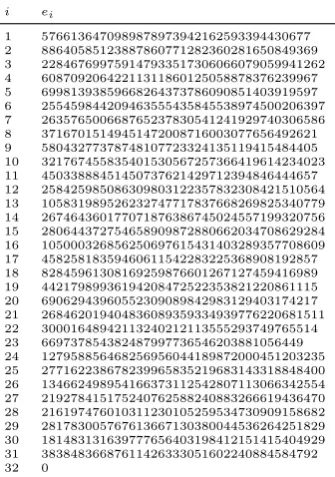
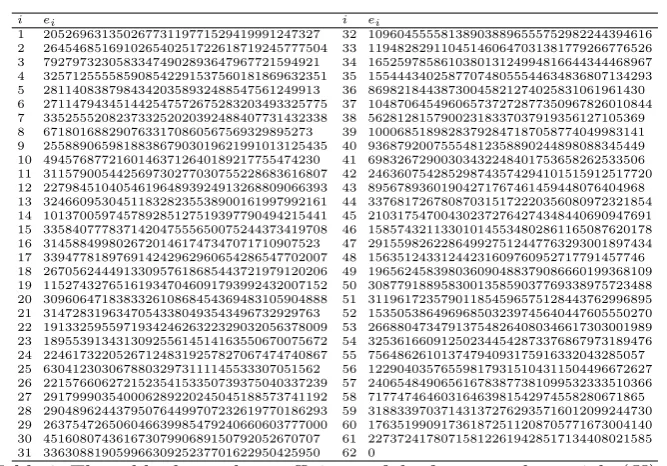
opti-mization in quadratic complexity ind. A straightforward implementation can therefore be used to compute examples. Two examples are given in Appendix A with d = 31 and d = 61 needed for attacking GCM and POET.
Note that the above theory can easily be generalized to the setting of a finite fieldFre andFr-subspacesV over the fieldFre. In the corresponding Ore ringFre{τ}the commutation relation isτ α=αrτ. Similarly as above, for any subspace of a given dimensiondone can find a polynomialpV(X)
of degree rd having as set of roots precisely the elements of V. It may have non-zero coefficients only for monomials of the form Xri. In the program given in Appendix A, r and e can be chosen freely. See [8] for a more detailed overview of properties of linearized polynomials and the associated Ore ring.
4 Disjoint coverage of the key space with roots of structured polynomials
The purpose of this section is to describe how one can cover the elements of a finite fieldFqby sets of roots of families of explicitly given
polynomi-als. We will focus our attention to the case that q = 2128, but the given
constructions can directly be generalized to other values of q = re. We denote byγ a primitive element ofFq. Two approaches will be described.
The first one exploits the multiplicative structure of Fq\{0}, while the
second one exploits the additive structure of Fq seen as a vector space
overF2. We will in fact describe a way to partition the elements ofFq as
4.1 Using the multiplicative structure
We first consider the group G = Fq\{0} with group operation ∗ the
multiplication inFq. For any factorizationq−1 =n·mwe find a subgroup
Hm:={γnj|0≤j≤m−1}consisting ofm elements. This gives rise to
the following proposition:
Proposition 1. Let γ be a primitive element of the field Fq and suppose
thatq−1 =n·m for positive integersnandm. Foribetween0andn−1
define
Ai:={γi+nj |0≤j≤m−1}.
Then the sets A0, . . . , An−1 partition Fq\{0}. Moreover, the set Ai
con-sists exactly of the roots of the polynomial Xm−γim.
Proof. As mentioned we work in the multiplicative groupFq\{0}and let
Hm be the subgroup of G of order m. Note that A0 =Hm and thatHm
is the kernel of the group homomorphism φ :G → G sending x to xm. In particular, Hm is precisely the set of roots of the polynomialXm−1.
Any element from the coset gHm is sent by φ to gm. This means that
gHm is precisely the set of roots of the polynomialXm−gm. Note that
gm = γim for some i between 0 and n−1, so that the set of roots of Xm−gm equals γiHm = Ai for some i between 0 and n−1. Varying i
we obtain all cosets of Hm, so the result follows.
If q = re for some prime power r, one can choose n = r −1 and m =re−1 +· · ·+r+ 1. For any elementα ∈
Fq we then haveαm ∈ Fr,
since αm is just the so-called Fq/Fr-norm of α. Therefore the family of
polynomials in the above lemma in this case take the particularly simple form xm −a, with a ∈
Fr\{0}. In case q = 2128, Proposition 1 gives
rise to a family of polynomials whose roots partitionF2128\{0}. For more details about the explicit form of these polynomials, we refer the reader to Appendix F.
4.2 Using the additive structure
Now we use a completely different approach to partition the elements from Fq in disjoint sets where we exploit the additive structure. Suppose
again thatq=re, then we can viewFq as a vector space overFr. Now let
V ⊂Fq be any linear subspace (still over the fieldFr). IfV has dimension
d, then the number of elements inV equals rd. For anya∈Fq, we define
a+V, the translate ofV bya, as
Of coursea+V can also be seen as a coset of the subgroupV ⊂Fq with
addition as group operation. Any translate a+V has rd elements and moreover, it holds that two translatesa+V and b+V are either disjoint or the same. This means that one can choose n:=re/rd=re−dvalues of a, saya1, . . . , an such that the setsa1+V, . . . , an+V partitionFq.
The next task is to describe for a given subspace V of dimension d, the n := rd−e polynomials with a1+V, . . . , an+V as sets of roots. As
a first step, we can just as before, construct an Fr-linear mapφ from Fq
to itself, that can be described using a linearized polynomial of the form pV(X) = Xr
d
+cd−1Xr
d−1
+· · ·+c1Xr+c0X. The linear map φ then
simply sendsx topV(x) and has as image
W :={pV(x) | x∈Fq}.
A coset a+V of V is then sent to the elementpV(a) byφ. This means
that any coset ofV can be described as the set of roots of the polynomial pV(X)−pV(a), that is to say of the form pV(X)−b with b ∈ W (the
image of the map φ). Combining this, we obtain that we can partition the elements of Fq as sets of roots of polynomials of the formpV(X)−b
withb∈W. Note that these polynomials still are very structured: just a constant term is added to the already very sparse polynomialpV(X). Note
thatpV(X)−pV(a) =pV(X−a), sincepV(X) is a linearized polynomial.
This makes it easy to confirm that indeed the set of roots of a polynomial of the formpV(X)−pV(a) is just the coseta+V. The number of elements
inW is easily calculated: since it is the image of the linear mapφand the dimension of the null space ofφisd(the dimension ofV), the dimension of its image is e−d. This implies that W contains re−d elements. We
collect some of this in the following proposition:
Proposition 2. Let q =re and let V be a linear subspace of Fq of over
the field Fr of dimension d. Moreover denote by pV(x) be the linearized
polynomial associated to V and defineW :={pV(x) | x∈Fq}.
Then for anya∈Fq, the polynomialpV(x)−pV(a)has as sets of roots
exactly a+V. Moreover, the sets of roots of the polynomials pV(x)−b
with b∈W partition Fq.
A possible description of a basis of W can be obtained in a fairly straightforward way. If {β1, . . . , βd} is a basis of V, one can extend this
to a basis of Fq, say by adding the elements βd+1, . . . , βe. Then a basis
of the image W of φ is simply given by the set {pV(βd+1), . . . , pV(βe)}
polynomials whose roots partitionFq are given by
pV(X) + e
X
i=d+1
aipV(βi), withai∈Fr.
The set of roots of a polynomial of this form is given byPe
i=d+1aiβi+V.
In the appendix, we give examples for re = 2128 and d= 31 ord= 61.
5 Improved key recovery algorithm
Suppose that we have observed a polynomial hash collision for some forgery polynomial pV(X) of degree d, i.e. some observed message M
and M+pV have the same image underhH with the unknown
authenti-cation keyH. This means thatHmust be among the roots ofpV(X), and
we can submit further verification queries using specially chosen forgery polynomials to recover the key.
5.1 An explicit key recovery algorithm using twisted polynomials
Being constructed in a twisted polynomial ring, our polynomials pV(X)
are linearized polynomials, so that all roots are contained in a d-dimensional linear spaceV ⊂Fn
2. This enables an explicit and particularly
efficient key recovery algorithm which recovers the key H by writing it as H = Pd
i=1biβi with respect to (w.r.t.) a basis B = {β1, . . . , βd} for
V overF2 and determining itsdbinary coordinates w.r.t. B one by one.
Shortening the basis by the last element, we can test if bd = 0 by using
the forgery polynomial corresponding to V0 = span{β1, . . . , βd−1}. If this
query was not successful, we deducebd= 1. We then proceed recursively
for the next bit.
Unless allbi= 0, the search space will be restricted to an affine instead
of a linear subspace at some point. It is easy to see, however, that the corresponding polynomial for A = V +a with V a linear subspace, can always be determined as pA(X) =pV(X−a) =pV(X)−pV(a) since the
pV(X) are linearized polynomials.
Algorithm 5.1 Construction of twisted polynomials
Input: basisB ={β1, . . . , βd}ofV ⊂
Fn2
Output: polynomialspV(i)(X) having
span{β1, . . . , βi}as set of roots
1: Seta1←1
2: Setai←0 for 2≤i≤d+ 1
3: fori= 1 toddo 4: v←Pd
k=1akβ2 k i
5: c1←v·a1
6: forj= 2 tod+ 1do 7: cj←a2j−1+v·aj
8: end for
9: pV(i)←Pdk+1=1ckX2 k−1
10: end for
11: return polynomials
pV(1)(X), . . . , pV(d)(X)
Algorithm 5.2 Key recovery using twisted polynomials
Input: messageM, polynomialpV(X)
s.t.hH(M) = hH(M +PV),basis
B = {β1, . . . , βd}ofd-dimensional
linear subspaceV ⊂Fn2.
Output: authentication keyH. 1: bi←0, 1≤i≤d
2: Call Alg. 5.1 onV, obtain
pV(1), . . . , pV(d)
3: fori=ddownto 1do
4: DenoteU(i) = span{β1, . . . , βi−1},
so thatpU(i) =pV(i−1)
5: α←pU(i)(Pdj=ibjβj)
6: if hH(M) = hH(M +PU(i)+α)
then 7: bi←0
8: else 9: bi←1
10: end if 11: end for
12: return keyH=Pd i=1biβi
pU(i)(X) have at most d+ 1 nonzero coefficients, they are very sparse and only very few additions to M are required to compute the message M+PU(i) for the forgery attempt.
We emphasize that this algorithm can be readily generalized to deal with input polynomials pA(X) having affine root spaces A = V +a by
operating with the corresponding linear space V and adding pV(i)(a) to all verification queries. This especially allows to combine this algorithm with the key space covering strategy of Sect. 4.2.
5.2 Comparison to previous work
The idea of using a binary search-type algorithm to recover authentica-tion keys has previously been applied to various universal hashing-based MAC constructions by Handschuh and Preneel [10]. Their attack algo-rithm however does not deal with the (important) questions of determin-ing new polynomials havdetermin-ing distinct roots from all previously used ones, and also requires the calculation and storage of the 2d roots during the key search phase. Also, the required polynomials will not be sparse and re-quire up to 2d nonzero coefficients. By contrast, our algorithm leverages
the twisted polynomial ring to explicitly construct sparse polynomials with exactly the necessary roots for restricting the search space in each iteration.
A different approach for binary-search type key recovery is given in Sect. 7.3 of [16], suggesting the use of forgery polynomial q(X) = Q
H∈Fn2,Hn=0(X−H) and then subsequently fixing more bits ofH accord-ing to the results of the verification queries. While this is clearly optimal with respect to the number of queries (which is n), the resulting mes-sages are up to 2nblocks long, which typically exceeds the limits imposed
by the specifications. Additionally, the polynomials will have almost no zero coefficients, which requires up to 2n+1 additions for the verification queries. By contrast, when combined with the keyspace covering strategy outlined in Sect. 4.2, our algorithm requires 2n/d·dqueries, each of them being maximally 2d blocks long. This not only allows staying within the specified limits, but also allows choosing any desired trade-off between the number and length of the queries. Our explicit polynomials also have a maximum of d+ 1 nonzero coefficients each, which limits the number of additions to 2n/d·(d+ 1).
6 Nonce-respecting universal forgeries for GCM
In this section, we describe two nonce-respecting universal forgery attacks against GCM [6] under weak keys. Before describing the attacks we de-scribe the GCM authenticated encryption scheme and the GCM counter values generation procedure as defined in the NIST standard [6].
6.1 More details on GCM
We recall the GCM ciphertext/tag generation:
with T denoting the tag, with M = M1||M2|| · · · ||Ml the plaintext and
C = C1||C2|| · · · ||Cl the ciphertext blocks produced using a block
ci-pher Ek in counter mode, i.e. Ci =EK(Ji)⊕Mi. The Ji’s are successive
counters with the initial J0 generated from the nonce N; furthermore
H =Ek(0) withk the secret key.
We now focus on the detailed generation of the counter values in GCM. We have
J0=
(
N||031||1 if|N|= 96, hH(N||0s+64||[|N|]64) if|N| 6= 96,
whereJi= inc32(Ji−1), wheres= 128d|N|/128e − |N|, [X]64is the 64-bit
binary representation of X and inc32(X) increments the right-most 32
bits of the binary string X modulo 232; the other left-most |X| −32 bits remain unchanged.
6.2 Universal Forgery Attacks on GCM
Our universal forgery attacks are possible if the hash key H is weak. Therefore, our attack starts by detecting whether the hashing key H is weak or not using our forgery polynomial q(X) = pV(X) of degree
231 explicitly described in Appendix A.1. In other words, we make a blind forgery for an observed ciphertext/tag pair (C;T) by asking for the verification of the forged ciphertext (C+Q);T whereQ=q1||...||ql.
Now if H is a weak key according to our forgery polynomial – is a root of q(X) = pV(X) – then the verification succeeds and the GCM scheme
outputs a random plaintext.
Once we know that H is a weak-key, then we can recover it using Algorithm 5.2 over the roots ofq(X) =pV(X) (see Appendix A.1) where
at each query we can choose different nonces.
Now, the only hurdle for generating a nonce-respecting forgery is com-puting the value ofEK(J0) since we do not know the secret keyK(we have
only recoveredH=EK(0)). However, since GCM is using a counter mode
encryption where the successive counter valuesJi, are generated from the
nonce, we can easily get the encryption of the counter values EK(Ji) by
Slide universal forgeries using chosen nonce N with |N| 6= 96 Suppose that we have observed an l-block plaintext/ciphertext with tag T, M = M1|| · · · ||Ml and C = C1|| · · · ||Cl, where Ci = Mi ⊕EK(Ji),
Ji = inc32(Ji−1) and T =EK(J0)⊕hH(C). Our goal now is to generate
a valid ciphertext/tag for a different messageM0 using a different chosen nonce N0 where|N0| 6= 96.
As mentioned above, the counter mode of operation enables us to find the encryption of the counter values
EK(J0), EK(J1),· · · , EK(Jv),· · ·, EK(Jl).
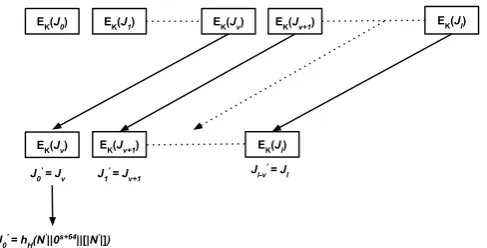
The idea of the attack is to slide these encrypted counter values v posi-tions to the left in order to re-use the (l−v) encrypted counter values EK(Jv),· · · , EK(Jl) to generate valid ciphertext/tag for any new
mes-sage M0 with a new chosen nonce N0 that gives us an initial counter valueJ00 =Jv. This will enable us to make slide universal forgeries for an
(l−v)-block message. See Fig. 1.
One can see that usingJv, v >0, it is possible to choose a nonceN0
that gives J00 =Jv by solving the following equation forN0
J00 =Jv =hH(N0||0s+64||[|N0|]64)
Note that when|N0|= 128 (i.e.s= 0), we have only one solution for N0 and more than one solution for|N0|>128. However, when|N0|<128 we might have no solution. Therefore we assume that|N0| ≥128.
Once we find the nonceN0 that yieldsJ00 =Jv, then one can see that
we have the following ‘slid’ identities:
EK(J00) =EK(Jv), EK(J10) =EK(Jv+1),· · ·, EK(Jl0−v) =EK(Jl)
Consequently, we are able to computeCi0 =Mi0⊕EK(Ji0) for 1≤i≤
l−v and T0 = EK(J00)⊕hH(C0). Thus observing the encryption of an
l-block message and settingJ00 =Jv as shown above enable us to generate
EK(J0) EK(J1) EK(Jv) EK(Jl)
EK(Jv+1)
EK(Jv+1)
J0 ’ = J
v J1 ’ = J
v+1 Jl-v
’ = J l
J0 ’
= hH(N ’
||0s+64
||[|N’
|])
EK(Jv) EK(Jl)
Fig. 1: Forgeries for GCM via sliding the counter encryptions
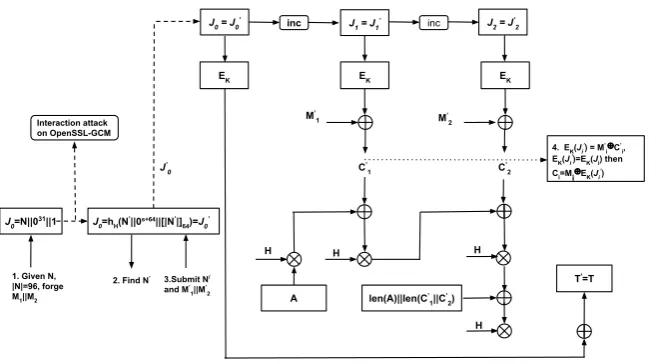
Universal forgeries using arbitrary nonces N with |N| = 96 Assume that we are using a GCM implementation that supports variable nonce lengths. For example, the implementation of GCM in the latest version of OpenSSL [18,19] makes the choice of the nonce length optional, i.e. one can use different nonce sizes under the same secret key. Now, suppose that using such a GCM oracle with the secret keyK, we need to find the ciphertext/tag of a message M = M1|| · · · ||Ml with a nonce N
where|N|= 96, soJ0=N||031||1. In order to generate the ciphertext/tag
we need to findEK(Ji) whereJi = inc32(Ji−1). We do not know the secret
key K. However, since we know the secret hash key H, we can solve for N0 the following equation
J0=hH(N0||0s+64||[|N0|]64) where |N0| 6= 96
Note that we assume that |N0| ≥ 128 as otherwise we might not get a solution. After finding N0, we can query the same GCM oracle (that has been queried for encrypting M with the nonce N where |N|= 96) with a new nonce N0 that has a different size|N0| ≥1282 for the encryption of some plaintextM =M10|| · · · ||Ml0. Now, |N0| 6= 96 means that the ini-tial counter value J00 =hH(N0||0s+64||[|N0|]64) =J0. Therefore, from the
corresponding ciphertext blocksC10,· · · , Cl0, we find EK(Ji) =EK(Ji0) =
Mi0⊕Ci0. Consequently the corresponding ith ciphertext block of Mi is
Ci=EK(Ji0)⊕Mi and the corresponding tag isT =EK(J00)⊕hH(C). It
2 Two of the test vectors (Test Case 3 and Test Case 6, see Appendix D) for the GCM
is worthy to note, that this interaction possibility between two different nonce lengths on GCM had been listed in [20] as one of the undesirable characteristics of GCM. Fig. 2 demonstrates the interaction attack.
J0 = J0’ inc J inc
1 = J1’ J2 = J ’ 2
EK EK EK
M’ 1
C’ 1
H
C’ 2
H M’
2
A H
len(A)||len(C’ 1||C
’ 2)
H
T'=T J0=N||031||1
1. Given N, |N|=96, forge M1||M2
J0=hH(N’||0 s+64||[|N’|]
64)=J0’
2. Find N’ J’
0
3.Submit N/ and M’
1||M ’ 2 Interaction attack
on OpenSSL-GCM
4. EK(Ji ’) = M’
i⊕C ’ i, EK(Ji
’)=E
K(Ji) then Ci=Mi⊕EK(Ji
’)
Fig. 2: Forgeries for GCM via cross-nonce interaction
7 Analysis of POET
In this section, we present a detailed weak key analysis of the online authentication cipher POET when instantiated with Galois-Field multi-plication. More specifically, we create universal forgery attacks once we recover the hashing weak key. Before this we give a brief description of POET.
7.1 Description of POET
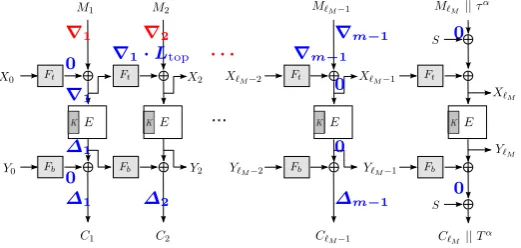
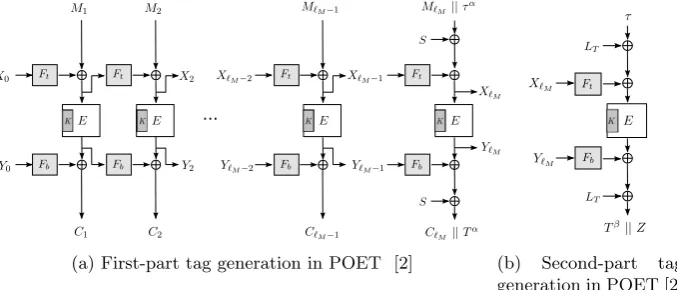
A schematic description of POET [2] is given in Fig. 3a. Five keys L, K, Ltop, Lbot and LT are derived from a user key as encryptions of the
constants 1, . . . ,5.K denotes the block cipher key,Lis used as the mask in the AD processing, and LT is used as a mask for computing the tag.
H encompasses the associated data (if present) and includes the nonce in its last block. S denotes the encryption of the bit length of the message M, i.e. S = EK(|M|). The inputs and outputs of the i-th block cipher
call during message processing are denoted by Xi and Yi, respectively.
One of the variants of POET instantiates the functionsFt andFb by
Ft(x) =Ltop·xandFb(x) =Lbot·x, with the multiplication taken inF1282 .
This is also the variant that we consider in this paper. The top AXU hash chain then corresponds to the evaluation of a polynomial hash inF1282 :
gt(X) =τ Ltopm+ m
X
i=1
XiLtopm−i,
withgt being evaluated atX =M1, . . . , Mm−1, Mm⊕S.
For integral messages (i.e., with a length a multiple of the block size), the authentication tag T then generated as T = Tβ with empty Z, as shown in Fig. 3b. Otherwise, the tag T is the concatenation of the two partsTα and Tβ, see Fig. 3a and 3b.
...
Ft
Ft Ft Ft
Fb
Fb Fb Fb
S S
E E E
E
X0 X2 XℓM−2 XℓM−1
XℓM
Y0 Y2 YℓM−2 YℓM−1
YℓM
M1 M2 MℓM−1 MℓM||τ
α
C1 C2 CℓM−1 CℓM||Tα
Figure 6.1.:Schematic illustration of the encryption process withPOETfor an (ℓM)-block message
M=M1, . . . , MℓM, whereSdenotes the encrypted message length, i.e.,S=EK(|M|),Fis an
ǫ-AXU family of hash functions, andταis taken from the most significant bits of the header
processing to pad the final message block. Note that the functionsFtandFbuse the keysLtopF
andLbot
F, respectively.
6.1. Definition of POET
Definition 6.1 (POET).Letm, n, k≥1be three integers. LetPOET= (K,E,D)be an AE scheme as defined in Definition 4.9,E:{0,1}k× {0,1}n→ {0,1}na block cipher and
F:{0,1}k× {0,1}n→ {0,1}nbe a family of keyedǫ-AXU hash functions. Furthermore, letHbe the header (including the public message numberN appended to its end),M
the message,T the authentication tag, andCthe ciphertext, withH, M, C∈ {0,1}∗and T∈ {0,1}n. Then,Eis given by procedureEncryptAndAuthenticate,Dby procedure
DecryptAndVerify, andKby procedureGenerateKeys, as shown in Algorithms 6.1
and 6.2, respectively.
Algorithm 6.1 EncryptAndAuthenticateandDecryptAndVerify.
EncryptAndAuthenticate(H, M)
101:ℓM← ⌈|M|/n⌉
102:τ←ProcessHeader(H)
103:(C, XℓM, YℓM)←Encrypt(M, τ) 104:(CℓM, Tα)←Split(CℓM,|M|modn) 105:Tβ←GenerateTag(τ, Xℓ
M, YℓM) 106:T←Tα||Tβ
107:return (C1||. . .||CℓM, T)
DecryptAndVerify(H, C, T)
201:ℓC← ⌈|C|/n⌉
202:τ←ProcessHeader(H)
203:(M, XℓC, YℓC)←Decrypt(C, τ) 204:(MℓC, τ′)←Split(MℓC,|C|modn) 205:if VerifyTag(T, XℓC, YℓC, τ, τ′)then 206: return M
207:end if 208:return ⊥
17
(a) First-part tag generation in POET [2]
Ft Fb E LT LT XℓM YℓM τ
Tβ||Z
Figure 6.3.:Schematic illustration of the tag-generation procedure inPOET.
significant bits ofC∗
ℓC+1are compared to the|MℓC|least significant bits ofT. If both
checks are valid, the decrypted ciphertext is output; otherwise, the decryption fails (cf. lines 205 to 208 of Algorithm 6.1).
6.2. Instantiations for theǫ-AXU Family of Hash Functions
We highly recommend to instantiatePOETwith AES-128 as a block cipher. For theǫ-AXU
families of hash functionsF, we propose three different instantiations in the following:
1.POETwith Galois-Field multiplications inGF(2128),
2.POETwith 4-round AES, and 3.POETwith full-round AES.
POET with Galois-Field Multiplications. We recommend multiplications inGF(2128),
similar to the multiplication in AES-GCM [36] as universal hash function with anǫ≈ 2−128. The family of hash functionsF is then defined byFt(X) =X·Ltop
F orFb(X) =
X·Lbot
F , depending on whether it is applied to the top or the bottom row.
When using multiplications inGF(2128), one has to consider the risk of weak keys. As
stressed by Saarinen in [48], 2128−1 is not prime, so it produces some smooth-order
multiplicative groups. Thus, one can explore a weak key with a probability about 2−96.
To avoid the risk of having weak multiplication keys (one for processing the header and two hash-function keys for processing the message), we propose to perform a checking on the keysL,LtopF , andLbotF right after their generation phase. For each weak key, we choose
a fresh unique constantconstiwith 1≤i≤3, depending on which key is weak, re-generate
the corresponding key, and check it again. This procedure can be repeated until none of the keys is weak. In addition, one can add a test function to assure that all keys are pairwise independent, and none of them represents a multiple of another one. Since this additional security measurement must be applied only at the time of key setup, and since only a small fraction of keys are weak, the effort for this can be considered negligible in
(b) Second-part tag generation in POET [2]
Fig. 3: Schematic description of POET
7.2 Universal weak-key forgeries for POET
We start by the following observations.
Observation 1 (Collisions in gt imply tag collisions). Let M =
M1, . . . , Mm andM0 =M10, . . . , Mm0 be two distinct messages ofm blocks length such that gt(M) = gt(M0) or gt(M1, . . . , M`) = gt(M10, . . . , M`0)
with ` < m and Mi =Mi0 for i > `. This implies a collision on POET’s
internal state Xi, Yi for i= m or i =` respectively, and therefore equal
tags for M andM0.
We note that such a collision also allows the recovery of Ltop by Algo-rithm 5.2.
Observation 2 (KnowingLtopimplies knowingLbot).Once the first
hash key Ltop is known, the second hash key Lbot can be determined with
only two 2-block queries: Choose arbitrary M1, M2,∇1 with ∇1 6= 0 and
obtain the encryptions of the two 2-block messages M1, M2 and M10, M20
with M10 =M1⊕ ∇1, M20 = M2⊕ ∇1·Ltop. Denote ∆i =Ci⊕Ci0. Then
we have the relation ∆1·Lbot =∆2, soLbot =∆
−1 1 ·∆2.
It is worth noting that this procedure works for arbitraryLbot, and is in particular not limited toLbot being another root of the polynomialq.
A generic forgery. In the setting of [16], consider an arbitrarily chosen polynomial q(X) = Pm−1
i=1 qiXi = pV(X) of degree m− 1 and some
message M = M1k · · · kMm−1kMm. Write Q = q1k · · · kqm−1 and define
M0 def= M +Q with Q zero-padded as necessary. For a constant nonce (1-block header) H, denote ciphertext and tag corresponding to M by C = C1, . . . , Cm and T, and ciphertext and tag corresponding to M0 =
M+Qby C0 =C10, . . . , Cm0 and T0, respectively.
If some root of q is used as the key Ltop, we have a collision between M andM0=M+Qin the polynomial hash evaluation afterm−1 blocks:
τ Ltopm+
m−1
X
i=1
MiLtopm−i =τ0Ltopm+ m−1
X
i=1
Mi0Ltopm−i
This implies Xm−1 =Xm0 −1 and therefore Ym−1 =Ym0−1. Since the
mes-sages are of equal length, S=S0 and we also have a collision in Xm and
Ym. It follows that Cm = Cm0 . Furthermore, since τ = τ0, the tag T is
colliding as well. Since then M and M +Q have the same tag, M +Q is a valid forgery whenever some root of q(X) = pV(X) is used as Ltop.
Note that both M and the forged message will be mblocks long.
Using the class of weak keys represented by the roots of the forgery polynomial q(X) = pV(X) explicitly described in Appendix A and
once we recovered τ, we will be able to recover the secret value L and consequently we can make forgeries without nonce-reuse.
More specifically, we show that weak keys enable universal forgeries for POET under the condition that the order of the weak key is smaller than the maximal message length in blocks. For obtaining universal forgeries, we first use the polynomial hash collision described above to recover the weak keys Ltop and Lbot, and then recoverτ, which is equal to the initial states X0 and Y0, under the weak key assumption.
Recovering τ Suppose that we have recovered the weak keys Ltopand Lbot. Now our goal is to recover the secret X0 = Y0 =τ. We know that
Xi=τ Litop+M1L
i−1
top +M2L
i−2
top +· · ·+Mi andXi+j =τ L
i+j
top +M1Litop+j−1+ M2Ltopi+j−2+· · ·+Mi+j.
Now if Ltop has order j , i.e. Ljtop = Identity, then we get Xi =Xi+j
by constructing Mi+1,· · · , Mi+j such thatMi+1Ltopj−1+Mi+2Ljtop−2+...+ Mi+j = 0. The easiest choice is to set Mi+1 =Mi+2 =· · · =Mi+j = 0.
This gives us Yi = Yi+j. Now equating the following two equations and
assuming that Ljbot 6= Identity, Yi =τ Libot+C1L
i−1
bot +C2L
i−2
bot +· · ·+Ci and Yi+j =τ Libot+j +C1L
i+j−1
bot +C2L
i+j−2
bot +· · ·+Ci+j. We get
τ = C1L i−1 bot +C2L
i−2
bot +· · ·+Ci+C1Li+ j−1
bot +C2Li+ j−2
bot +· · ·+Ci+j
·(Libot+Libot+j) −1
,
which means that we now know the initial values of the cipher state.
Querying POET’s block cipher EK. One can see from Fig. 3a that
once we know Ltop, Lbot and τ, we can directly query POET’s internal block cipher without knowing its secret keyK. internal block cipher, i.e. we want to computeEK(x). Now from Fig. 3a, we see that the following
equation holds: EK(τ Ltop⊕M1) =C1 ⊕τ Lbot, therefore EK(x) =C1⊕
τ Lbot. If M1 was the last message block, however, we would need the
encryption S = EK(|M|). Therefore we have to extend the auxiliary
message for the block cipher queries by one block, yielding the following:
Observation 3 (Querying POET’s block cipher). Knowing Ltop,
Lbot and τ enables us to query POET’s internal block cipher without the
knowledge of its secret keyK. To computeEK(x)for arbitraryx, we form
a two-block auxiliary message M10 = (x⊕τ Ltop, M20) for arbitrary M20 and
obtain its POET encryption as C10, C20. Computing EK(x) :=C10 ⊕τ Lbot
then yields the required block cipher output.
Ltop, Lbot, τ and querying POET with the appropriate auxiliary messages whenever we need to execute an encryption EK. Note that this also
in-cludes the computation of S=EK(|M|).
Generating the final tag. In order to generate the second part of the tagTβ (see Fig. 3b), which is the full tagT for integral messages, we use the following procedure.
We know the value ofX`M for our target message M from the com-putation of C`M. If we query the tag for an auxiliary message M
0 with
the same X`0
M0, the tag forM
0 will be the valid tag for M as well, since
having X`0
M0 =X`M means that Y 0
`M0 =Y`M and consequently T
β0 =Tβ.
Therefore, we construct an auxiliary one-block messageM0 = (X`M⊕ EK(|M0|)⊕τ Ltop and obtain its tag as T0 (computing the encryption of
the one-block message length by queryingEK as above). By construction
X10 =X`M, soT
0 is the correct tag for our target message M as well.
By this, we have computed valid ciphertext blocks and tag for an arbitrary messageM by only querying some one- or two-block auxiliary messages. This constitutes a universal forgery.
We finish by noting that in case a one- or two-block universal forgery is requested, we artificially extend our auxiliary messages in either the final tag generation (for one-block targets) or the block cipher queries (for two-block messages) with one arbitrary block to avoid having queried the target message as one of our auxiliary message queries.
7.3 Further forgery strategies
8 Conclusion
Polynomial hashing is used in a large number of MAC and AE schemes to derive authentication tags, including the widely deployed and standard-ized GCM, and recent nonce misuse-resistant proposals such as POET, Julius, and COBRA. While a substantial number of works has pointed out weaknesses stemming from its algebraic structure [10, 16, 21], a cru-cial part of the proposed attacks, the construction of appropriate forgery polynomials, had not been satisfactorily addressed.
In this paper, we deal with this open problem of polynomial construc-tion and selecconstruc-tion in forgery and key recovery attacks on such schemes. We describe explicit constructions of such forgery polynomials with con-trolled sets of roots that have the additional advantage of being very sparse. Based upon this, we propose two strategies to achieve complete disjoint coverage of the key space by means of such polynomials, again in an explicit and efficiently computable construction. We also saw that this yields an improved strategy for key recovery in such attacks.
We then apply our framework to GCM in the weak-key model and describe, to the best of our knowledge, the first universal forgeries without nonce reuse. We also describe such universal forgeries for the recent AE schemes POET, Julius, and COBRA.
References
1. CAESAR: Competition for Authenticated Encryption: Security, Applicability, and Robustness, March 2014. http://competitions.cr.yp.to/caesar.html. 2. Farzaneh Abed, Scott Fluhrer, John Foley, Christian Forler, Eik List, Stefan Lucks,
David McGrew, and Jakob Wenzel. The POET Family of On-Line Authenticated Encryption Schemes. Submission to the CAESAR competition, 03 2014.
3. Elena Andreeva, Andrey Bogdanov, Martin M. Lauridsen, Atul Luykx, Bart Men-nink, Elmar Tischhauser, and Kan Yasuda. COBRA: A Parallelizable Authenti-cated Online Cipher Without Block Cipher Inverse. Submission to the CAESAR competition, 03 2014.
4. Elena Andreeva, Atul Luykx, Bart Mennink, and Kan Yasuda. COBRA: A Paral-lelizable Authenticated Online Cipher Without Block Cipher Inverse. In Carlos Cid and Christian Rechberger, editors,Fast Software Encryption, FSE 2014, Lecture Notes in Computer Science, page 24. Springer-Verlag, 2014. to appear.
5. Lear Bahack. Julius: Secure Mode of Operation for Authenticated Encryption Based on ECB and Finite Field Multiplications. Submission to the CAESAR competition, 03 2014. http://competitions.cr.yp.to/round1/juliusv10.pdf. 6. Morris Doworkin. Recommendation for Block Cipher Modes of Operation:
Galois/Counter Mode (GCM) and GMAC, November, 2007. csrc.nist.gov/
publications/nistpubs/800-38D/SP-800-38D.pdf.
8. David Goss.Basic structures of function field arithmetic, volume 35 ofErgebnisse der Mathematik und ihrer Grenzgebiete (3) [Results in Mathematics and Related Areas (3)]. Springer-Verlag, Berlin, 1996.
9. Jian Guo, Jrmy Jean, Thomas Peyrin, and Wang Lei. Breaking POET Authen-tication with a Single Query. Cryptology ePrint Archive, Report 2014/197, 2014.
http://eprint.iacr.org/.
10. Helena Handschuh and Bart Preneel. Key-Recovery Attacks on Universal Hash Function Based MAC Algorithms. In David Wagner, editor, CRYPTO, volume 5157 ofLecture Notes in Computer Science, pages 144–161. Springer, 2008. 11. Antoine Joux. Authentication Failures in NIST version of GCM. Comments
sub-mitted to NIST Modes of Operation Process, 2006.
12. John Mattsson and Magnus Westerlund. Authentication key recovery on galois/-counter mode (gcm). InInternational Conference on Cryptology in Africa, pages 127–143. Springer, 2016.
13. David McGrew, Scott Fluhrer, Stefan Lucks, Christian Forler, Jakob Wenzel, Farzaneh Abed, and Eik List. Pipelineable On-Line Encryption. In Carlos Cid and Christian Rechberger, editors,Fast Software Encryption, FSE 2014, Lecture Notes in Computer Science, page 24. Springer-Verlag, 2014. to appear.
14. David McGrew and John Viega. The galois/counter mode of operation (gcm). Submission to NIST. http://csrc. nist. gov/CryptoToolkit/modes/proposedmodes/gcm/gcm-spec. pdf, 2004.
15. Mridul Nandi. Forging attacks on two authenticated encryptions cobra and poet. Cryptology ePrint Archive, Report 2014/363, 2014. https://eprint.iacr.org/ 2014/363.
16. Gordon Procter and Carlos Cid. On Weak Keys and Forgery Attacks against Polynomial-based MAC Schemes. In Shiho Moriai, editor,Fast Software Encryp-tion, FSE 2013, Lecture Notes in Computer Science, page 14. Springer-Verlag, 2013. to appear.
17. Gordon Procter and Carlos Cid. On weak keys and forgery attacks against polynomial-based mac schemes. Cryptology ePrint Archive, Report 2013/144, 2013. http://eprint.iacr.org/.
18. OpenSSL Project. https://www.openssl.org/.
19. OpenSSL Project. GCM Implementation: crypto/modes/gcm128.c.https://www. openssl.org/source/, Latest release: 7 April 2014, openssl-1.0.1g.
20. Phillip Rogaway. Evaluation of some blockcipher modes of operation. Evaluation carried out for the Cryptography Research and Evaluation Committees (CRYP-TREC) for the Government of Japan, 2011.
21. Markku-Juhani Olavi Saarinen. Cycling Attacks on GCM, GHASH and Other Polynomial MACs and Hashes. In Anne Canteaut, editor, FSE, volume 7549 of Lecture Notes in Computer Science, pages 216–225. Springer, 2012.
22. Mark N Wegman and J Lawrence Carter. New hash functions and their use in au-thentication and set equality.Journal of computer and system sciences, 22(3):265– 279, 1981.
A Appendix: Forgery polynomial suggestions for GCM
and POET
spaceVdwe have chosen the space spanned by the elements 1, γ,· · ·, γd−1,
withγ a primitive elements ofF2128 satisfyingγ128=γ7+γ2+γ+ 1. The following MAGMA-program produces such polynomials:
Fig. 4: Magma source code generating forgery polynomial of degree 2d on F1282 (here d= 61)
The calculated polynomial will have the form cd+1X2
d
+cdX2
d−1 +
· · ·+c1X2
0
and it is sufficient to simply state the coefficients ci, which
can be expressed in the formaei with 0≤e
i ≤2128−2. To save space we
only list the exponents ei for each polynomial in the following tables.
A.1 Forgery polynomial with degree 231 for attacking GCM
i ei
1 5766136470989878973942162593394430677 2 88640585123887860771282360281650849369 3 228467699759147933517306066079059941262 4 60870920642211311860125058878376239967 5 69981393859668264373786090851403919597 6 255459844209463555435845538974500206397 7 263576500668765237830541241929740306586 8 37167015149451472008716003077656492621 9 58043277378748107723324135119415484405 10 321767455835401530567257366419614234023 11 45033888451450737621429712394846444657 12 258425985086309803122357832308421510564 13 105831989526232747717837668269825340779 14 267464360177071876386745024557199320756 15 280644372754658909872880662034708629284 16 105000326856250697615431403289357708609 17 45825818359460611542283225368908192857 18 82845961308169259876601267127459416989 19 44217989936194208472522353821220861115 20 69062943960552309089842983129403174217 21 268462019404836089359334939776220681511 22 30001648942113240212113555293749765514 23 669737854382487997736546203881056449 24 127958856468256956044189872000451203235 25 277162238678239965835219683143318848400 26 134662498954166373112542807113066342554 27 219278415175240762588240883266619436470 28 216197476010311230105259534730909158682 29 281783005767613667130380044536264251829 30 181483131639777656403198412151415404929 31 38384836687611426333051602240884584792 32 0
A.2 Forgery polynomial with degree 261 for attacking POET
Similarly for d= 61 one obtains the following coefficients:
i ei i ei
1 20526963135026773119771529419991247327 32 109604555581389038896555752982244394616 2 264546851691026540251722618719245777504 33 119482829110451460647031381779266776526 3 79279732305833474902893647967721594921 34 165259785861038013124994816644344468967 4 325712555585908542291537560181869632351 35 155444340258770748055544634836807134293 5 28114083879843420358932488547561249913 36 86982184438730045821274025831061961430 6 271147943451442547572675283203493325775 37 104870645496065737272877350967826010844 7 335255520823733252020392488407731432338 38 56281281579002318337037919356127105369 8 6718016882907633170860567569329895273 39 10006851898283792847187058774049983141 9 255889065981883867903019621991013125435 40 93687920075554812358890244898088345449 10 49457687721601463712640189217755474230 41 69832672900303432248401753658262533506 11 311579005442569730277030755228683616807 42 246360754285298743574294101515912517720 12 227984510405461964893924913268809066393 43 89567893601904271767461459448076404968 13 324660953045118328235538900161997992161 44 337681726780870315172220356080972321854 14 101370059745789285127519397790494215441 45 210317547004302372764274348440690947691 15 335840777837142047555650075244373419708 46 158574321133010145534802861165087620178 16 31458849980267201461747347071710907523 47 291559826228649927512447763293001897434 17 339477818976914242962960654286547702007 48 15635124331244231609760952717791457746 18 267056244491330957618685443721979120206 49 196562458398036090488379086660199368109 19 115274327651619347046091793992432007152 50 308779188958300135859037769338975723488 20 309606471838332610868454369483105904888 51 311961723579011854596575128443762996895 21 31472831963470543380493543496732929763 52 153505386496968503239745640447605550270 22 191332595597193424626322329032056378009 53 266880473479137548264080346617303001989 23 189553913431309255614514163550670075672 54 325361660912502344542873376867973189476 24 224617322052671248319257827067474740867 55 75648626101374794093175916332043285057 25 63041230306788032973111145533307051562 56 122904035765598179315104311504496672627 26 221576606272152354153350739375040337239 57 240654849065616783877381099532333510366 27 291799903540006289220245045188573741192 58 71774746460316463981542974558280671865 28 290489624437950764499707232619770186293 59 318833970371431372762935716012099244730 29 263754726506046639985479240660603777000 60 176351990917361872511208705771673004140 30 45160807436167307990689150792052670707 61 227372417807158122619428517134408021585 31 33630881905996630925237701622950425950 62 0
Table 2: The table shows the coefficients of the forgery polynomialq(X) = pV(X) for attacking POET
Let us denote the found polynomials by pd(X) (with d= 31 or d=
61). From pd(X), we can obtain a family of 2128−d polynomials whose
root sets partition F1282 . The polynomials have the formpd(X) +b, with
b∈ Wd:= {pd(a) | a∈ F1282 }.Since in the above examples Vd has basis {1, γ, . . . , γd−1}A basis ofWdis given by{pd(γi) | d≤i≤127}, making
it straightforward to describe all possibilities for b.
B Universal forgeries for Julius under weak keys
All Julius modes use polynomial hashing to generate aseed which is then encrypted to produce a value µ = EK(seed). This µ serves either
directly as tag (CTR) or is encrypted once more (ECB) to form the tag. We exploit weak keys in polynomial hashing to describe universal forgery strategies for Julius.
B.1 Description of regular Julius-ECB and Julius-CTR
Both Julius-ECB and Julius-CTR use mode-specific padding rules. For simplicity, we describe the algorithms when the message length |M|is a multiple of the block length n= 128 bits, and when no associated data A is used.
For Julius-CTR, a message M is padded as follows, where brackets denote full 128-bit blocks:
P = 0· · ·01 IV 0|M| M 0· · ·0
For Julius-ECB, the padded message P is formed as follows:
P = 0· · ·01 IV 0|M| 0· · ·0 M (1)
The padded messageP =P1|| · · · ||Pl is then used to generate a seed
using polynomial hashing with keyδ def= EK(0):
seed=P1δl−1⊕P2δl−2⊕ · · · ⊕Pl−1δ⊕Pl.
Both Julius-CTR and Julius-ECB then encrypt the seed to produce a value µ = EK(seed). In Julius-CTR, the i-th ciphertext block, 1 ≤
i ≤ l, is given by Ci = Mi ⊕EK(µ⊕i), with Cl+1 = µ serving as the
authentication tag. In Julius-ECB, we have C1 = EK(µ) serving as the
tag, and Ci+1=EK(µδi⊕Mi) for 1≤i≤l.
The Julius scheme is designed to provide resistance against nonce misuse [5].
B.2 Universal forgeries for Julius-ECB and CTR
![Fig. 2: Processing plaintext. Note that L′ is defined in Fig. 3 below.Fig. 5: Schematic description of COBRA’s encryption process [4]](https://thumb-us.123doks.com/thumbv2/123dok_us/7918154.1314754/34.595.153.466.495.634/processing-plaintext-dened-schematic-description-cobra-encryption-process.webp)
![Fig. 2: Processing plaintext. Note thatA[1]A[2] L′ is defined in Fig. 3 below.A[3]A[4]10∗](https://thumb-us.123doks.com/thumbv2/123dok_us/7918154.1314754/35.595.162.454.117.274/fig-processing-plaintext-note-thata-l-dened-fig.webp)
![Fig. 7: Test Case 3 [19]](https://thumb-us.123doks.com/thumbv2/123dok_us/7918154.1314754/39.595.152.466.266.607/fig-test-case.webp)
![Fig. 10: Generation of τ in POET [2]](https://thumb-us.123doks.com/thumbv2/123dok_us/7918154.1314754/40.595.170.447.463.606/fig-generation-of-t-in-poet.webp)