Flavour Violating Axions
LucaDi Luzio1,∗
1Deutsches Elektronen-Synchrotron DESY, Notkestraße 85, D-22607 Hamburg, Germany
Abstract.I review the physics case for flavour violating axions. In particular, I argue that relaxing the assump-tion of the universality of the Peccei-Quinn current opens up new pathways, including: the relaxaassump-tion of the Supernova bound on the axion mass, a possible connection with the Standard Model flavour puzzle and the experimental opportunity of discovering the axion via flavoured axion searches.
1 Introduction
Axion physics has entered a new, experimentally driven phase. In the recent years we have witnessed the emer-gence of several new experimental proposals, which (in different stages of development) promise to open for ex-ploration regions of parameter space considered unreach-able until few years ago (for recent overviews see Refs. [1, 2]). It is hence timely, on the theory side, to reassess axion properties beyond standard scenarios. In this contribution, I first review some basics aspects of axion physics. The emphasis is put on the fact that axion couplings are in-herently UV dependent, so that a wide experimental pro-gram should keep this into account, regardless of theo-retical prejudice. In particular, I will focus on a com-monly adopted, although not strongly motivated, assump-tion which consists in the universality of the Peccei-Quinn (PQ) current. I will argue, both with old examples and more recent ones, that relaxing the latter assumption is motivated by various phenomenological and theoretical ar-guments. Most importantly, it offers a unique experimen-tal handle which consists in flavour-violating (FV) axion transitions. The latter turn out to be complementary to standard axion searches and potentially competitive with astrophysical bounds.
2 Axion couplings: model-independent
vs. model-dependent
The essence of the axion solution of the strong CP prob-lem is a new spin-0 fielda(x), the axion, endowed with a pseudo-shift symmetrya→a+αfathat is broken only by the operator
a fa
αs
8πGG˜. (1)
While the QCD θ term can be rotated away via an ap-propriate choice ofα, a Vafa-Witten theorem [3] ensures that in a vector-like theory such as QCD, E(hai = 0) ≤
∗e-mail: [email protected]
E(hai ,0), thus solving the strong CP problem. The ori-gin of theaGG˜ operator in Eq. (1) can be traced back in the existence of a QCD-anomalous, global U(1)PQ sym-metry, whose spontaneous breaking delivers the axion as a pseudo-Nambu-Goldstone boson.
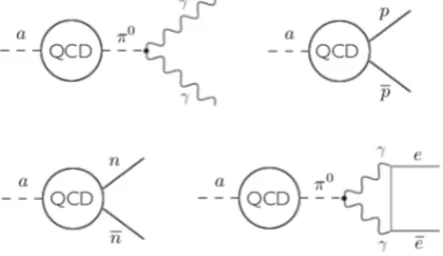
TheaGG˜ operator represents the smoking-gun signa-ture of the PQ mechanism and determines the so-called model-independent properties of the axion field, which are given solely in terms of the axion decay constant fa. These are the axion massma=5.691(51)µeV (1012GeV/fa) [4], and the axion couplings to photons, nucleons and electrons (here we focus on the most relevant ones for astrophysical limits), arising from the diagrams in Fig. (1).
Figure 1.Model-independent axion couplings. The blob stands for non-perturbative QCD dynamics.
Given the effective axion Lagrangian
La⊃ α 8π
Cγ fa
aFF˜+ Cf 2fa
∂µaf¯γµγ5f, (f =p,n,e), (2)
the numerical values of the coefficientsCγ,p,n,ecan be de-termined via chiral Lagrangian techniques, as well as in-puts from Lattice QCD, and they are found to be [5–7]
Cγ=−1.92(4), Cp=−0.47(3), Cn=−0.02(3),
Ce=−7.8(2)×10−6log
fa
me
!
However, being the description of the effective operator in Eq. (1) valid only until energies of the order of fa, the theory must be UV completed. Remarkably, the UV com-pletion of the axion effective Lagrangian can drastically affect the low-energy properties of the axion, and hence the way to experimentally probe it.
There are basically two main ways in which this can happen, as depicted schematically in the diagrams of Fig. (2).
Figure 2.Model-dependent axion couplings to photons and SM quarks and leptons.
In the left diagram of Fig. (2), the PQ-charged col-ored fermions responsible for generating the aGG˜ oper-ator can also lead to a direct QED-anomalous contribu-tion toaFF˜, if the new fermions they are charged under U(1)EM. Then the axion coupling to photons gets modi-fied intoCγ =E/N−1.92(4), whereE/Nis a group the-ory factor which depends on the quantum numbers of the fermions running in the loop (see e.g. Refs. [8,9] for phe-nomenologically motivated ranges ofE/N).
The other possibility, depicted in the right diagram of Fig. (2), is that the axion interacts directly with the Stan-dard Model (SM) fermions, which are charged under the U(1)PQ. In this case, the axion effective interaction can be written as (keeping for the sake of illustration only SM quarks)
∂µa
vPQ
JPQµ = ∂µa vPQ
(4)
×h−Q¯LXQLγµQL−u¯RXuRγµuR−d¯RXdLγµdR
i
,
where JµPQ is the conserved (up to anomalies) PQ cur-rent, depending on the U(1)PQ charges. The latter are de-noted by XQL,uR,dR, which are diagonal (in general, non-universal) matrices. After going to the mass basis: uL →
VuLuL, etc., and using the relation fa =vPQ/(2N) between the axion decay constant and the PQ-breaking order pa-rameter, we can recast Eq. (4) as
∂µa 2fa ¯
ψi(CψiψjV +CψiψA jγ5)γ µψ
j, (5)
where mass eigenstates are denoted asψi={ui,di}and we have introduced the vector1and axial couplings
CVui,uAj = 1 2N
Vu†LXQLVuL±V † uRXuRVuR
i j , (6)
CVd,A idj =
1 2N
Vd†
LXQLVdL±V † dRXdRVdR
i j . (7)
1The diagonal vector couplings do not contribute to on-shell
physi-cal processes, as it can be seen upon integrating by parts and using the equations of motion.
Note that the unitary flavour matrices are only subject to the constraintVCKM=Vu†LVdL.
A common assumption, as e.g. in the original Peccei-Quinn-Weinberg-Wilczek (PQWW) [10–13] and the Dine-Fischler-Srednicki-Zhitnitsky (DFSZ) [14, 15] axion models, consists in the universality of the PQ cur-rent, i.e.XQL,uR,dR ∝I3.2 This implies flavour blind axion interactions: the axion interacts in the same way with SM fermions having the same gauge quantum numbers and, moreover, off-diagonal entries in Eq. (5) trivially vanish.
3 A lesson from flavour
The simplest axion model featuring only two Higgs dou-blets for the breaking of the U(1)PQ, also known as PQWW model, was ruled out quite soon after its conception, due to a combination of beam dump experiments and rare meson decays such asK → πa[18] and Quarkonia → γa[19]. For instance, radiative decays of Quarkonia toγa normal-ized to leptonic modes can be written at the leading order as [19]
B(J/ψ→γa) B(J/ψ→µµ) =
g2 c 2πα,
B(Υ→γa) B(Υ→µµ) =
g2 b 2πα, (8)
wheregc=mcCccA/fa(in the notation of Eq. (5)) and simi-larly forgb. In the PQWW model one has
gc=
mc
v
1
tanβ, gb= mb
v tanβ , (9)
with v = 246 GeV and tanβ = hHui/hHdi. Since the couplings in Eq. (9) cannot be simultaneously suppressed, bounds from Quarkonia alone would have been sufficient to rule out the PQWW model (for a historical account see Sect. 3 in Ref. [20]).
However, a main assumption behind the PQWW model consisted in the universality of the PQ current. At the beginning of the 80’s it seemed more natural to keep this assumption, and extend the model by adding a SM-singlet field in order to decouple the PQ break-ing from the electroweak scale.3 Models of these type became known as invisible axion models and led to the standard KSVZ/DFSZ benchmarks. In the same years, the GSI anomaly [21–23] (a sharp peak in the e+ spec-trum of heavy ion collisions) which could be interpreted in terms of anO(MeV) axion with dominant decay mode a → e+e−, triggered a lot of interest in trying to explain that in terms ofvariantaxion models, with a non-universal axion mainly coupled to first generation fermions in order to avoid bounds from Quarkonia decays. It actually took almost a decade, starting from the original PQWW pro-posal, to rule out non-universal PQWW variants, by com-bining informations from rareπandKdecays [24]. Even nowadays, there is an interesting claim that under certain
2We remind the reader that instead in
Kim-Shifman-Vainshtein-Zakharov (KSVZ) [16,17] type of models the SM fields are not charged under the U(1)PQ.
3On the contrary, it can be argued that imposingfavleads to two
conditions (among which the non-universality of the PQ current) anO(MeV) axion is not obviously ruled out [25].4
4 Non-universal Peccei-Quinn axion
models
We explore now some consequences of non-universal PQ axion models, focussing on some recent developments such as the possibility of suppressing the axion coupling to protons and neutrons (nucleophobia), which allows in turn to relax the Supernova (SN) bound on the axion mass. We next make some considerations on possible connections of non-universal PQ scenarios with the SM flavour puzzle and summarize the status of flavoured axion searches.
4.1 Nucleophobia
The axion coupling to nucleons (cf. Eq. (2)) can be com-puted using a non-relativistic effective field theory where nucleons are at rest and the axion is treated as an external current (see [5] for details). In particular, one obtains
Cp+Cn=(cu+cd)(∆u+ ∆d)−2δs, (10)
Cp−Cn=(cu−cd)(∆u−∆d), (11)
wherecu,dare derivative axion couplings to the axial cur-rent of valence quarks in the nucleon, defined in the ba-sis where theaGG˜ has been rotated away (cf. Eq. (13)),
δs ≈ 5% encodes effects from sea quarks in the nu-cleon, and∆u,dare nucleon matrix elements which are ex-tracted from experiments and/or the Lattice. Hence, if we want to simultaneously suppress both the axion-nucleon couplings, say at the level of 10%, we need to impose cu+cd = 0 and cu−cd = 0, regardless of the specific value of∆u,d.
It is instructive to see why achieving such cancellation is not possible in standard KSVZ and DFSZ models. Let us consider the axion Lagrangian in Eq. (4), restricted to first generation up and down quarks, and ignoring for the moment flavour mixing. Including also theaGG˜term, the latter reads
La ⊃ a
fa
αa 8πGG˜+
∂µa vPQ
h
Xuu¯γµγ5u+Xdd¯γµγ5d
i
, (12)
where 2Xu ≡ XQ1 − Xu1 and 2Xd ≡ XQ1 − Xd1 are the PQ charges expressed in terms of the chiral ones (for no-tational simplicity, we have suppressed the chirality in-dices in the right-hand sides). TheaGG˜ term can be ro-tated away via a field-dependent 2-flavour quark transfor-mation:q→exp (iγ5Qaa(x)/(2fa))q, withq=(u,d)Tand
Qa=diag(md/(mu+md),mu/(mu+md)). The latter choice ensures that the axion has no mass mixing with the neutral
4This is not in contradiction with the previous statement, since the
UV completion of this axion is not of the PQWW type.
pion [26]. In the new basis, Eq. (12) reads
La⊃ ∂µa 2fa
"
Xu
N −
md
mu+md
!
| {z }
cu
¯ uγµγ5u
+ Xd
N −
mu
mu+md
!
| {z }
cu
¯ dγµγ5d
#
. (13)
Hence, the nucleophobic conditions can be recast as
0=cu+cd =
Xu+Xd
N −1, (14)
0=cp−cn =
Xu− Xd
N −
md−mu
mu+md
. (15)
While the second condition can always be implemented via a tuning (see below), the real bottleneck is the first one, sinceXu =Xd =0 in KSVZ models, while in DFSZ models one hasN=12nf(2XQ1−Xu1−Xd1)=nf(Xu+Xd), withnf =3 denoting the number of families.
The above no-go theorem for standard axion models suggests itself a possible way out [27]: if the total anomaly factor were equal to that of the first family, i.e.N =N1= Xu+Xd, the first condition would be automatically satis-fied. To simplify the discussion, let us assume a 2+1 struc-ture such that the PQ charges of the first two generations the same. Then the condition we would like to impose, N≡N1+N2+N3 =N1, simply impliesN1=N2=−N3. It is remarkably simple to obtain the latter in terms of a renormalizable Yukawa Lagrangian featuring two Higgs doubletsH1,2∼(1,2,−1/2). For instance,
LY=Q¯3u3H1+Q¯3d3H˜2+. . .+Q¯2u2H2+Q¯2d2H˜1+. . .
+Q¯1u1H2+Q¯1d1H˜1+. . . , (16)
where we have suppressed Yukawa couplings and the dots stand for off-diagonal operators which are neces-sary in order to obtain a realistic CKM mixing, com-patibly the overall PQ charge assignments.5 Denoting by X1,2 the PQ charges of H1,2, from Eq. (16) we have
N3 = 12(2XQ3 − Xu3 − Xd3) = 1
2(X1 − X2) and N2 = 1
2(2XQ2− Xu2− Xd2)= 1
2(X2− X1)=−N3, having swapped the role ofH1andH2for the third and second/first gener-ations. Hence,N=N1 =12(2XQ1− Xu1− Xd1)=Xu+Xd and Eq. (14) is automatically satisfied in terms of charge assignments.
Coming to the second nucleophobic condition in Eq. (15), this can be expressed as a condition on tanβ= hH2i/hH1i. In order to see that, let us first impose the orthogonality between the PQ and hypercharge currents: Y(H1)X1v21+Y(H2)X2v22=0, and henceX1/X2=−tan2β, implying no kinetic mixing between the axion and theZ boson. UsingXu− Xd = 12(Xd1− Xu1)= 12(X2+X1) and
5This include as well a scalar potential communicating the PQ
N=N1 =12(2XQ1−Xu1−Xd1)= 1
2(X2−X1), we can recast Eq. (15) as (X2+X1)/(X2− X1)=cos2β−sin2β=(md−
mu)/(mu+md)≈1/3, which is satisfied for tanβ≈1/ √
2. To sum up, with a single O(10%) tuning,6 tanβ ≈ 1/
√
2, one can simultaneously suppress both the axion coupling to neutrons and protons, which allows in turn to relax the SN bound by one order of magnitude compared to standard KSVZ/DFSZ scenarios, e.g. in KSVZ models the often quoted bound readsma .0.02 eV [29]. How-ever, recent analyses of the axion emissivity from the SN core hint to a weakening of the bound by a factor of a few [30,31].
It should be noted that in the construction above the axion-electron coupling, gae, turns out to be generically sizeable,7and additional strong bounds onmaare obtained from white-dwarf cooling rates and red giants evolution in globular clusters. Hence, in order to effectively relax astrophysical bounds onma, alsogae must be somewhat suppressed. This can be done at the cost of an extra tun-ing with flavour mixtun-ing in the leptonic sector [27], or, more elegantly, by introducing a leptonic Higgs doublet H3 which allows for a correlated cancellation of the ax-ion coupling to nucleons and electrons via a single tuning [33]. This kind of scenarios have been dubbed astropho-bic, in the sense that all the main astrophysical constraints can be relaxed up to one order of magnitude, allowing for axions as heavy as ma ∼ 0.2 eV. On the other hand, the axion coupling to photons remains generically size-able, e.g. E/N = {−4/3,2/3,8/3,14/3}in the models of Ref. [27], so that the next generation of helioscopes, such as IAXO [34], will be able to probe their parameter space.
4.2 Connections with the Standard Model flavour puzzle
We have seen in the previous section that nucleophobia provides a clear case for the non-universality of the PQ current, but it does not fix the size of flavour mixing enter-ing into the axion couplenter-ings to SM fermions when goenter-ing to the mass basis (cf. Eqs. (6)–(7)). The diagonalizing flavour matrices, subject only to the constraint VCKM = V
† uLVdL, are in principle free parameters which can be measured in flavour violating (FV) processes involving the axion. Ex-tra theoretical bias, possibly in connection with the SM flavour puzzle, can help in providing an organizing princi-ple for the flavour structure. A particularly natural realiza-tion is to identify the U(1)PQwith the horizontal U(1) sym-metry responsible for the Yukawa hierarchies [35–38].8 Models of Froggatt-Nielsen [43] type have recently re-gained some attention (see e.g. [44,45]), and they typ-ically predict axion flavour transitions controlled by the
6The level of tuning useful for nucleophobia is limited by the
remain-der 2δs ≈ 10% in Eq. (10), which sets an irreducible contribution to
nucleon couplings. In principle, flavour mixing (neglected in the present simplified discussion) also enters diagonal axion couplings when going to the mass basis (cf. Eqs. (6)–(7)), and it can be used to further cancel theδscontribution [27].
7Having a sizeableg
aewith a somewhat relaxed SN bound improves
the fit of the cooling anomalies [32].
8Gauging the horizontal flavour group can also lead to an accidental
global U(1) whose spontaneous breaking delivers a flavoured arion [39] or a flavoured axion [40–42].
CKM matrix, although subject to irreducibleO(1) uncer-tainties common also to other flavour models. A different kind of approach [28,46], based on requiring the maximal number of textures zeros (compatibly with SM fermion masses and mixings) that can be enforced via a family de-pendent U(1)PQat the renormalizable level, allows instead to completely fix9the axion couplings to SM fermions, in-cluding off-diagonal ones, in terms of a fit to SM fermion masses and mixings.
4.3 Flavoured axion searches
Rare FV decays with invisible and light final states al-low to probe the off-diagonal axion couplings CψA,V
iψj in Eq. (5). A collection of bounds can be found for in-stance in Refs. [47–49]. The strongest limits on FV ax-ion couplings to quarks come fromK+ → π+a. Compar-ing the theoretical prediction with the current limit from E949/E787 [50] givesma <2·10−5eV/|CVsd|, which for maximal mixing (i.e. CV
sd = O(1)) is about three orders of magnitude stronger than typical astrophysical bounds. Hence, K+ → π+a clearly provides a golden channel for FV axion searches.10 NA62 is expected to improve the limit on B(K+ → π+a) by a factor of∼70 [51,52], thus strengthening the axion mass bound by a factor∼8. The next most sensitive process in the quark sector is B+ → K+a, whose present limit from CLEO [53] cor-responds to ma < 9·10−2 eV/|CVbs|, close to astrophys-ical limits for maximal mixing. This latter bound could be presumably strengthened by a factor∼10 at BELLE II [54]. A similar, but slightly weaker bound, is obtained for B+ → π+a, which involves the couplingCV
bd. On the other hand, bounds on processes involving other quark transitions are about three orders of magnitude smaller (see Table 2 in Ref. [48]), and hence not competitive with astrophysical limits, even for maximal mixing. In the charged lepton sector, the strongest limits come from (30 years old) searches for µ → eγa [55, 56]. They yield ma <3·10−3 eV/(|(CVµe)2+|(CAµe)2|)1/2, competitive with astrophysical bounds in the case of sizeable flavour mix-ing. This bound is likely to be improved by one order of magnitude at the MEG [57] and Mu3e [58] experiments at PSI. On the other hand, bounds onτ-µandτ-e transitions from ARGUS [59] yield axion mass limits which are still well-below astrophysical ones.
5 Conclusions
Relaxing the assumption of the universality of the PQ cur-rent opens up the parameters space of DFSZ models, by
9Up to the usual dependence fromfaand tanβ, as in universal DFSZ
models.
10It should be noted that pseudo-scalar meson decays such asK → πaare sensitive only to the vectorial part of the quark current, since
hπ|s¯γµγ5d|Ki=0 by the Wigner-Eckart theorem. In order to set bounds
onCA
sdone has to resort to other FV processes, as for exampleK0−K¯0
mixing, which however are much weaker compared to the limits on the vectorial counterpart from meson decays. In principle, this would leave open a possibility in order to evade the strong constraints fromK→πa
in the presence of large mixing, if one could cook up a model with
CV sdC
introducing 34 new real parameters only in the quark sec-tor (most of which are related to the diagonalizing U(3) matrices in Eqs. (6)–(7)). These new parameters arise, in some sense, within the SM (since they come from the di-agonalization of the Yukawas that we write in the SM La-grangian), but the SM is “blind” to them. By extending the SM with the axion at low-energy, it is somewhat artificial to require that flavour mixing beyond the CKM is unphys-ical and we should rather let experiments to decide. In the meanwhile, it is worth to speculate about the possible con-sequences of the non-universality of the PQ current, as I have done in the present contribution.
To conclude, I cannot resist from making an unfortu-nate analogy: “DFSZ=cMSSM”. The DFSZ model cor-responds, in some sense, to the constrained version of the MSSM with universal soft terms. There is however an important difference, while large flavour violating ef-fects in low-energy SUSY were often considered as a curse (flavour problem), in the case of the axion they rather come as a blessing (flavour opportunity).
Acknowledgments
I thank the organizers of the FCCP19 workshop, and in particular Giancarlo D’Ambrosio, for the warm hospital-ity. I also thank Fred Björkeroth, Federico Mescia, En-rico Nardi, Paolo Panci and Robert Ziegler for an enjoy-able collaboration on flavoured axions. This work is sup-ported by the Marie Skłodowska-Curie Individual Fellow-ship grant AXIONRUSH (GA 840791).
References
[1] L. Di Luzio, M. Giannotti, E. Nardi, L. Visinelli (2020),2003.01100
[2] I.G. Irastorza, J. Redondo, Prog. Part. Nucl. Phys. 102, 89 (2018),1801.08127
[3] C. Vafa, E. Witten, Phys. Rev. Lett.53, 535 (1984) [4] M. Gorghetto, G. Villadoro, JHEP03, 033 (2019),
1812.01008
[5] G. Grilli di Cortona, E. Hardy, J. Pardo Vega, G. Vil-ladoro, JHEP01, 034 (2016),1511.02867
[6] M. Srednicki, Nucl. Phys.B260, 689 (1985)
[7] S. Chang, K. Choi, Phys. Lett. B316, 51 (1993), hep-ph/9306216
[8] L. Di Luzio, F. Mescia, E. Nardi, Phys. Rev. Lett. 118, 031801 (2017),1610.07593
[9] L. Di Luzio, F. Mescia, E. Nardi, Phys. Rev.D96, 075003 (2017),1705.05370
[10] R.D. Peccei, H.R. Quinn, Phys. Rev. Lett.38, 1440 (1977)
[11] R.D. Peccei, H.R. Quinn, Phys. Rev. D16, 1791 (1977)
[12] S. Weinberg, Phys. Rev. Lett.40, 223 (1978) [13] F. Wilczek, Phys. Rev. Lett.40, 279 (1978)
[14] A.R. Zhitnitsky, Sov. J. Nucl. Phys.31, 260 (1980), [Yad. Fiz.31,497(1980)]
[15] M. Dine, W. Fischler, M. Srednicki, Phys. Lett. B104, 199 (1981)
[16] J.E. Kim, Phys. Rev. Lett.43, 103 (1979)
[17] M.A. Shifman, A.I. Vainshtein, V.I. Zakharov, Nucl. Phys.B166, 493 (1980)
[18] L.J. Hall, M.B. Wise, Nucl. Phys.B187, 397 (1981) [19] F. Wilczek, Phys. Rev. Lett.39, 1304 (1977) [20] M. Davier, Searches for New Particles, in
Pro-ceedings, 23RD International Conference on High Energy Physics, JULY 16-23, 1986, Berkeley, CA (1986)
[21] J. Schweppe et al., Phys. Rev. Lett.51, 2261 (1983) [22] M. Clemente, E. Berdermann, P. Kienle, H.
Tser-tos, W. Wagner, C. Kozhuharov, F. Bosch, W. Konig, Phys. Lett.137B, 41 (1984)
[23] T. Cowan et al., Phys. Rev. Lett.54, 1761 (1985) [24] W.A. Bardeen, R.D. Peccei, T. Yanagida, Nucl. Phys.
B279, 401 (1987)
[25] D.S.M. Alves, N. Weiner, JHEP 07, 092 (2018), 1710.03764
[26] H. Georgi, D.B. Kaplan, L. Randall, Phys. Lett. 169B, 73 (1986)
[27] L. Di Luzio, F. Mescia, E. Nardi, P. Panci, R. Ziegler, Phys. Rev. Lett.120, 261803 (2018),1712.04940 [28] F. Bjorkeroth, L. Di Luzio, F. Mescia, E. Nardi,
JHEP02, 133 (2019),1811.09637
[29] M. Tanabashi et al. (Particle Data Group), Phys. Rev. D98, 030001 (2018)
[30] J.H. Chang, R. Essig, S.D. McDermott, JHEP 09, 051 (2018),1803.00993
[31] P. Carenza, T. Fischer, M. Giannotti, G. Guo, G. Martinez-Pinedo, A. Mirizzi, JCAP 1910, 016 (2019),1906.11844
[32] M. Giannotti, I.G. Irastorza, J. Redondo, A. Ring-wald, K. Saikawa, JCAP 1710, 010 (2017), 1708.02111
[33] F. Bjorkeroth, L. Di Luzio, F. Mescia, E. Nardi, P. Panci, R. Ziegler (2019),1907.06575
[34] E. Armengaud et al. (IAXO), JCAP 1906, 047 (2019),1904.09155
[35] A. Davidson, K.C. Wali, Phys. Rev. Lett. 48, 11 (1982)
[36] F. Wilczek, Phys. Rev. Lett.49, 1549 (1982) [37] A. Davidson, V.P. Nair, K.C. Wali, Phys. Rev.D29,
1504 (1984)
[38] A. Davidson, M.A.H. Vozmediano, Nucl. Phys. B248, 647 (1984)
[39] Z.G. Berezhiani, Phys. Lett.129B, 99 (1983) [40] Z.G. Berezhiani, Phys. Lett.150B, 177 (1985) [41] Z.G. Berezhiani, M.Yu. Khlopov, R.R.
Khome-riki, Sov. J. Nucl. Phys. 52, 344 (1990), [Yad. Fiz.52,538(1990)]
[42] Z.G. Berezhiani, M.Yu. Khlopov, Z. Phys.C49, 73 (1991)
[43] C.D. Froggatt, H.B. Nielsen, Nucl. Phys.B147, 277 (1979)
[45] L. Calibbi, F. Goertz, D. Redigolo, R. Ziegler, J. Zu-pan, Phys. Rev.D95, 095009 (2017),1612.08040 [46] F. Bjorkeroth, L. Di Luzio, F. Mescia, E. Nardi
(2019),1910.00576
[47] J.L. Feng, T. Moroi, H. Murayama, E. Schnapka, Phys. Rev.D57, 5875 (1998),hep-ph/9709411 [48] F. Bjorkeroth, E.J. Chun, S.F. King, JHEP 08, 117
(2018),1806.00660
[49] R. Ziegler, PoS CORFU2018, 035 (2019), 1905.01084
[50] S. Adler et al. (E949, E787), Phys. Rev.D77, 052003 (2008),0709.1000
[51] G. Anelli et al. (2005)
[52] R. Fantechi (NA62),The NA62 experiment at CERN: status and perspectives, in12th Conference on Fla-vor Physics and CP Violation (FPCP 2014) Mar-seille, France, May 26-30, 2014(2014),1407.8213 [53] R. Ammar et al. (CLEO), Phys. Rev. Lett.87, 271801
(2001),hep-ex/0106038
[54] T. Abe et al. (Belle-II) (2010),1011.0352 [55] R.D. Bolton et al., Phys. Rev.D38, 2077 (1988) [56] J.T. Goldman et al., Phys. Rev.D36, 1543 (1987) [57] F. Renga (MEG), Hyperfine Interact.239, 58 (2018),
1811.05921
[58] A. Blondel et al. (2013),1301.6113