© 2014, IJCSMC All Rights Reserved 867
Available Online atwww.ijcsmc.com
International Journal of Computer Science and Mobile Computing
A Monthly Journal of Computer Science and Information Technology
ISSN 2320–088X
IJCSMC, Vol. 3, Issue. 3, March 2014, pg.867 – 872
RESEARCH ARTICLE
Secured Energy Optimization for Wireless
Multimedia Sensor Networks using Fuzzy logic
Sindhu Duraisamy
1, R. Priya
2, Vinu Raja VijayaKumar
3¹PG Student, Sri Eshwar College of Engineering, Anna University, India
²Assistant Professor, Department of ECE, Sri Eshwar College Of Engineering, Coimbatore, India
3
Assistant Professor, Department of ECE, Sri Eshwar College Of Engineering, Coimbatore, India
Abstract -Network congestion, data accuracy and network lifespan founds to play a major decisive concern for resource restraint in Wireless Multimedia Sensor Networks (WMSNs). Multimedia data comprises larger volume of information which is needed to be transmitted over the network. Since these multimedia collection may comprise of audio, video and scalar data. The utilization of memory and resource for transmission of multimedia data results in outsized contrast that consequences congestion, packet drop, buffer spill over declension of throughput and quality of service. To trounce this out stress in this paper the network is designed to be deployed with heterogeneous sensor networks. A new way of Fuzzy logic scheme is introduced in this paper which involves two phases, assortment phase and dispatching phase. In first phase fuzzy logic assortment technique enforces the classification of inward multimedia stream. Segregated facts are routed through designated path by using ant based routing scheme in second phase. Security litigation is accomplished by one-way hash function. Finally we compared the proposed protocol with the existing distributed predictive and verification algorithm, were the results shows that proposed scheme has a greater QoS merits.
Keywords— Congestion overhead; Data accuracy; Energy efficiency; Quality of Service; Wireless sensor networks; Fuzzy logic and Ant based routing
1. INTRODUCTION
© 2014, IJCSMC All Rights Reserved 868
Various energy optimizing techniques has been proposed [2, 3] in past few decades. But this founds to be insufficient for sensor nodes in multimedia infrastructure. In this paper, we present a fuzzy logic scheme for energy efficient and congestion aware routing of multimedia data in wireless multimedia sensor networks. In the existing routing protocols that are developed for Wireless Sensor Networks (WSNs) such as [1] reflects on fixed (crisp) metrics for building routing pronouncements. Fuzzy logic technique is utilized for assortment of sensor nodes on the basis of predefined metrics. Then based on the criteria the sensor nodes are placed in cluster structure.. Fuzzy logic also founds its applications in signal processing, embedded systems, controllers, robotics, speech recognition etc [5]. Fuzzy inference mechanism derives the postulates of the goal by combining the fuzzy rules into a mapping routine from input to output of the system. Defuzzifier performs the inverse operation of fuzzifier that converts the fuzzy sets into crisp values. The block diagram of the fuzzy logic system is shown in Figure 1.
FIGURE 1: Block Diagram of Fuzzy Logic System
In this paper we propose ant based routing technique for exploring the routing path and transmitting the incoming data streams according to their demand requirements. Finally data security is achieved by using the hash function by sharing the secrete key from source node to destination node.
2. RELATED WORK
Tarique et al (2009) proposed a cluster based environment for WSN. In this gateway node plays the innermost responsibility where all the other nodes are placed in a cluster and they communicate directly with the gateway node. If the sensor nodes are not closer to gateway node then they can communicate in the course of various routes through multi-hop sensor nodes in network. Gateway sporadically calls upon fuzzy routine to determine the link cost between the sensor nodes [7].
3. FUZZY MODEL
© 2014, IJCSMC All Rights Reserved 869 FIGURE 2: Fuzzy Rule Based System
After the sensor nodes are classified and deployed in their corresponding location, the neighboring nodes are grouped together to form cluster. Inside each cluster the nodes that have the uppermost energy level act as cluster head node. On the basis of capability of sensor nodes the color assignment is made which is shown in Table 1.
© 2014, IJCSMC All Rights Reserved 870
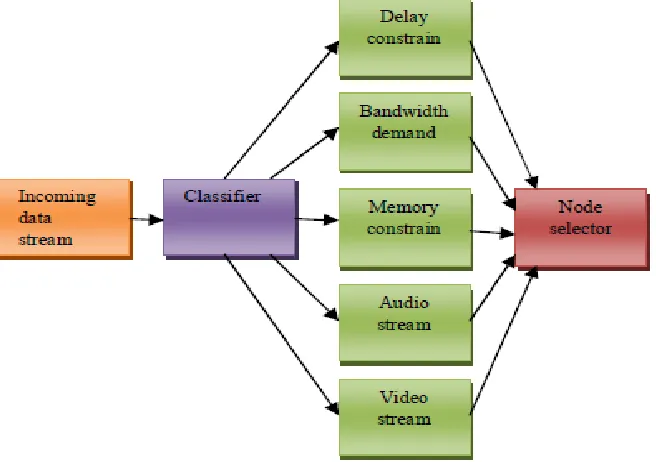
This algorithm classifies the inward data streams on the center of data which is demanding for bandwidth, delay constraint, memory constraint, energy requirement, audio data and video stream. This classification of multimedia data by antsent algorithm is shown in Figure 3.
FIGURE 3: Antsent based Segregation of incoming Data Stream
4. SECURITY
To ensure the security of the data being transmitted, one-way hash security scheme is used in this work hashing operation is performed on the receiving elevation to guarantee data integrity and make sure that the packets are un-altered by intruders during its transmission. Its operation is defined below.
1. E(ID||RN, PKBS)
At first the concatenation of source sensor ID and the random number (RN) is performed and then it is encrypted with public key of base station (PKBS).
2. E(MDATA, SKSR)
Second the sensed multimedia data (MDATA) is encrypted with the symmetric key that is shared between sender and receiver (SKSR) to improve confidentiality. Then one-way hash function is applied on the sensed data and again encrypted with SKSR to improve the data security. The cipher text obtained is then concatenated with the previous result.
3. E(H(MDATA, SKSR)
4. E(MDATA, SKSR)|| E(H(MDATA, SKSR)
At the receiver side decryption is performed and the original data is obtained.
5. D(ID||RN,KBS).
5. SIMULATION WORK
© 2014, IJCSMC All Rights Reserved 871
metrics for the parameters such as network lifetime, congestion overhead and data security. Simulations were performed by using Network Simulator (NS2) environment which is a powerful platform for network research process and it is a discrete event simulator tool. In the
environment, 100 nodes are randomly deployed in a 1000m 1000m area. The performance of
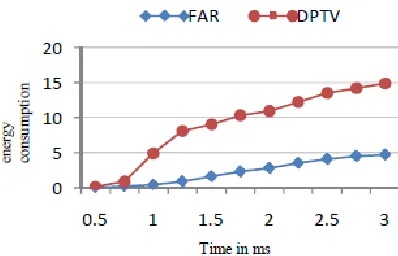
FAR algorithm is compared with existing DPTV algorithm by considering the terms such as the total number of received packets at the BS without delay and congestion, network lifetime and
the security level of the received packets. The graphicalresults shown in Figure 3, Figure 4 and
Figure 5 prove that proposed technique is more efficient than the existing technique.
FIGURE 3: Congestion Overhead vs Time FIGURE 4: Data accuracy vs Time
FIGURE 5: Energy Consumption vs Time
6. CONCLUSION
© 2014, IJCSMC All Rights Reserved 872
provides scope for source coding. Thus the sensor data’s are associated and transmitted with higher-ranking security by one-way hash function which comes as a result of cryptographic and symmetric key encryption techniques.
REFERENCES
[1] Akkaya k., ypunis M., A survey on routing protocols for wireless sensor networks, Ad Hoc Networks 3(3) (2005) 325-349.
[2] Akyildiz I.F., Su W., Sankarasubramaniam Y., Cayirci E., Wireless Sensor networks: a survey, Computer Networks 38 (4) (2002) 393-422.
[3] Chipara O., He Z., Xing G., Chen Q., Wang X., Lu C., Stankovic J., and Abdelzaher T., “Real Time Power Aware Routing in Sensor Networks,” in Proceedings of IEEE International Workshop on Quality of
Service (IWQOS’06), USA, pp. 83-91,2006.
[4] Dorigo D., Caro G.D., Antnet: distribution stigmergetic control for communication networks, Journal of Artificial Intelligence Research 9 (1998) 317-365.
[5] Ghosh S., Razouqi Q., Schunmacher H., and Celmins A. “A Survey of Recent Advances in Fuzzy Logic in Telecommunications Networks and New Challenges,” Computer Journal of IEEE Transactions on Fuzzy System, vol. 6, no. 3, pp. 443-447, 1998.
[6] Liyang Yu, Neng Wang, Wei Zhang, Chunlei Zheng, “Deploying a Heterogeneous Wireless Sensor Network,” in Research on key technologies of wireless sensor networks and application in road transportation of IEEE, 2007.
[7] Akkaya K. and Younis M., “A Survey of Routing Protocols in Wireless Sensor Networks,” Computer Journal of Elsevier Ad Hoc Network Journal, vol. 3, no. 3, pp. 325-349, 2005.
[8] Rajeshwar Singh, Singh D.K. and Lalan Kumar, “A review on security issues in wireless sensor network,”
in Journsl of Information Systems and Communication, ISSN: 0976-8742 & E-ISSN: 0976-8750, vol. 1, issue 1, 2010, pp-01-07.