Non-Malleable Codes from Average-Case Hardness:
AC
0, Decision Trees, and Streaming Space-Bounded Tampering
Marshall Ball1, Dana Dachman-Soled2, Mukul Kulkarni2, and Tal Malkin1
1 Columbia University
{marshall,tal}@cs.columbia.edu 2 University of Maryland [email protected], [email protected]
Abstract. We show a general framework for constructing non-malleable codes against tampering families with average-case hardness bounds. Our framework adapts ideas from the Naor-Yung double encryption paradigm such that to protect against tampering in a classF, it suffices to have average-case hard distributions for the class, and underlying primitives (encryption and non-interactive, simulatable proof systems) satisfying certain properties with respect to the class.
We instantiate our scheme in a variety of contexts, yielding efficient, non-malleable codes (NMC) against the following tampering classes:
– Computational NMC against AC0 tampering, in the CRS model, assuming a PKE scheme with decryption inAC0and NIZK.
– Computational NMC against bounded-depth decision trees (of deptht, wheretis the number of input variables and constant 0< < 1), in the CRS model and under the same computational assumptions as above.
– Information theoretic NMC (with no CRS) against a streaming, space-bounded adversary, namely an adversary modeled as a read-once branching program with bounded width.
Ours are the first constructions that achieve each of the above in an efficient way, under the standard notion of non-malleability.
1
Introduction
Non-malleable codes, introduced in the seminal work of Dziembowski, Pietrzak and Wichs [DPW10], are an extension of error-correcting codes. Whereas error-correcting codes provide the guarantee that (if not too many errors occur) the receiver can recover the original message from a corrupted codeword, non-malleable codes are essentially concerned with security. In other words, correct decoding of corrupted codewords is not guaranteed (nor required), but it is instead guaranteed that adversarial corruptions cannot influence the output of the decoding in a way that depends on the original message: the decoding is either correct or
independentof the original message
The main application of non-malleable codes is in the setting of tamper-resilient computation (although non-malleable codes have also found connections in other areas of cryptography [CMTV15,CDTV16,GPR16] and theoretical computer science [CZ16]). Indeed, as suggested in the initial work of Dziembowski et al. [DPW10], non-malleable codes can be used to encode a secret state in the memory of a device such that a tampering adversary interacting with the device does not learn anything more than the input-output behavior. Unfortunately, it is impossible to construct non-malleable codes secure against arbitrary tampering, since the adversary can always apply the tampering function that decodes the entire codeword to recover the message mand then re-encodes a related message m0. Thus, non-malleable codes are typically constructed
Exploring rich classes of tampering functions. Several works construct non-malleable codes (NMC) against general tampering classes of bounded size, but with non-explicit, existential, or inefficient constructions (cf. [DPW10,CG14a,FMVW14]). For efficient and explicit constructions, a large body of works construct NMC against bit-wise tampering (cf. [DPW10,CKM11,CCFP11]), and more generally split-state tampering (cf. [LL12,DKO13,ADL14,CG14a,CG14b,ADKO15a,AAG+16,CGL16,Li16,KOS17a,KOS17b]), where the adversary can tamper each part of the codeword independently of other parts, as well as NMC against permutations, flipping, and setting bits [AGM+15a].
A recent line of works is shifting towards considering the construction of NMC against tampering classesF
that correspond to well-studied complexity-theoretic classes, and may also better correspond to tampering attacks in practice. Specifically, Ball et al. [BDKM16] construct NMC against local tampering functions includingNC0, and Chattopadhyay and Li [CL17] construct NMC againstAC0 tampering, but inefficiently (with super-poly size codewords). Additionally, NMC with weaker notions of security are constructed by Faust et al. [FHMV17] against space-bounded tampering (in the random-oracle model), and by Chandran et al. [CGM+16] for block-wise tampering (where the adversary receives the message in a streaming fashion, block-by-block). We discuss these works in Section1.3.
In this work, we continue this line of research and consider constructing non-malleable codes against various complexity classes, including: (1) AC0 tampering, where the tampering function is represented by a polynomial size constant-depth, unbounded fan-in/fan-out circuit, (2) tampering with bounded-depth decision trees, where the tampering function is represented by a decision tree with n variables and depth nε for ε < 1, (3) streaming tampering with quadratic space, where the tampering function is represented by a read-once, bounded-width (2o(n2)
) branching program, (4) small threshold circuits: depthdcircuits of majority gates with a quasilinear number of wires, (5) fixed polynomial time tampering: randomized turing machines running in timeO(nk) for any fixedk. Constructing non-malleable codes against a wide array of complexity classes is desirable since in practice, the capabilities of a tampering adversary are uniquely tied to the computational setting under consideration and/or the physical device being used. For example, our motivation for studying AC0 stems from a setting wherein an attacker has limited time to tamper, since the tampering function must complete before race conditions take effect (e.g. before the end of a clock-cycle in a synchronous circuit). AC0 circuits, which are constant-depth circuits, model such attackers since the propagation delay of a circuit is proportional to the length of the longest path from input to output.
1.1 Our Results
We present general frameworks for constructing non-malleable codes for encoding one and multi-bits against various tampering classes F for which average case hardness results are known. Our frameworks (one for single-bit and one for multi-bit) include both a generic construction, which requires that certain underlying primitives are instantiated in a suitable way, as well as a proof “template.” Our frameworks are inspired by the well-known double-encryption paradigm for constructing CCA2-secure public key encryption schemes [NY90,Sah99,Lin03]. And although we rely on techniques that are typically used in the cryptographic setting, we instantiate our framework for particular tampering classes F in both the computational setting and in the information theoretic one. For the computational setting, our results rely on computational assumptions, and require a common-reference string (CRS), which the adversary can see before selecting the tampering function (as typical in other NMC works using CRS or random oracles). For the information theoretic setting, our results do not require CRS nor any computational assumption (as the primitives in our framework can be instantiated information theoretically). Our general theorem statements provide sufficient conditions for achieving NMC against a classF. Somewhat informally, the main such condition, especially for the one-bit framework, is that there are sufficiently strong average-case hardness results known for the classF. In particular, we obtain the following results, where all the constructions are efficient and, for the multi-bit NMC, the achieved rate is 1/poly(m) wheremis the length of the message being encoded.
can be constructed e.g. from exponential hardness of learning parity with noise [BL16], as well as non-interactive zero knowledge (NIZK), which can be constructed in the CRS model from enhanced trapdoor permutations.
Previous results by Chattopadhyay and Li [CL17] achieve NMC for AC0 with information theoretic security (with no CRS), but are inefficient, with super-polynomial rate.
– Constructions for bounded-depth decision trees:We obtain computational NMC in the CRS model against tampering with bounded-depth decision trees. Our construction requires the same computational assumptions as the AC0 construction above. The depth of the decision tree we can handle is m, where m is the number of bits being encoded, andis any constant.
No results for this class were previously known.
– Constructions for streaming, space-bounded tampering:We obtainunconditional non-malleable codes against streaming, space-bounded tampering, where the tampering function is represented by a read-once, bounded-width branching program. Our construction does not require CRS or computational assumptions.
No NMC results for this standard complexity theoretic class were previously known. However, this tampering class can be viewed as a subset (or the intersection) of the space bounded class considered by Faust et al. [FHMV17] (who don’t limit the adversary to be streaming), and the block-wise tampering class considered by Chandran et al. [CGM+16] (who don’t bound the adversary’s space, but don’t give security in the event that decoding fails). In both cases there cannot be NMC with the standard notion of security, and so those previous works must relax the security requirement (and [FHMV17] also relies on a random oracle). In contrast, we achieve standard (in fact, even stronger) notion of NMC, without random oracle (nor CRS, nor any computational assumption) for our class.
– Additional Constructions: We also briefly note two additional applications of our paradigm as proof of concept. Both complexity classes can be represented circuits of size O(nc) for some fixed c, a class which [FMVW14] provide non-malleable codes for in the CRS model, without computational assumptions. We include these results here, merely to show the applicability of our framework to general correlation bounds; for example strong correlation bounds againstACC0[p] orTC0are likely immediately lead to non-malleable codes against the same classes using our framework.
1. Under the same assumptions invoked in the constructions againstAC0 and bounded-depth decision trees we obtain computational NMC in the CRS model against tampering with small threshold circuits: threshold circuits with depthdandn1+ wires.
2. Assuming any public key encryption scheme and zk-SNARKs, we obtain computational NMC in the CRS model against tampering by Turing Machines running in time O(nk), where k is a constant. However, we should note that these codes have weak tampering guarantees: tampering experiments with respect to different messages are only polynomially close to one another.
1.2 Technical Overview
We begin by describing our computational NMC construction (in the CRS model) for one-bit messages secure against tampering inAC0, which will give the starting point intuition for our results. We then show how the AC0 construction can be modified to derive a general template for constructing NMC for one-bit messages secure against a wider range of tampering classesF, and discuss various classesFfor which the template can be instantiated. We then discuss how the template can be extended to achieve NMC for multi-bit messages secure against a wide range of tampering classes F. Finally, we discuss some particular instantiations of our multi-bit template, including our constructions of computational NMC (in the CRS model) against tampering in AC0 and against bounded-depth decision trees, as well as our unconditional NMC (with no CRS) against streaming tampering adversaries with bounded memory.
using the tableaua method, we can convertany NIZK proof system with polynomial verification into a NIZK proof system with a verifier inAC0.
We also need a PKE scheme with perfect correctness and decryption inAC0(this can be constructed using the transformation of Dwork et al. [DNR04] on top of the scheme of Bogdanov and Lee [BL16]).
We now sketch (a slightly simplified version of) the NM encoding scheme:
The CRS will contain a public key pk for an encryption schemeE = (Gen,Encrypt,Decrypt) as above, and a CRS for a NIZK. For b ∈ {0,1}, LetDb denote the distribution over x1, . . . , xn ∈ {0,1}n such that x1, . . . , xn are uniform random, conditioned on the parity of the bits being equal tob.
To encode a bit b:
1. Randomly choose bitsx1, . . . , xn fromDb
2. Computec1←Encryptpk(x1), . . . , cn←Encryptpk(xn) andc←Encryptpk(b).
3. ComputenNIZK proofsπ1, . . . , πn that c1, . . . , cn are encryptions of bitsx1, . . . , xn.
4. Compute a NIZK proof πthat there exists a bitb0 such that the plaintexts underlyingc1, . . . , cn are in the support ofDb0 andb0 is the plaintext underlyingc.
5. Compute tableausT1, . . . , Tn of the computation of the NIZK verifier onπ1, . . . , πn. 6. Compute a tableau T of the computation of the NIZK verifier on proofπ.
7. Output (c1, . . . , cn, c, T,(x1, T1), . . . ,(xn, Tn)).
To decode (c1, . . . , cn, c, T,(x1, T1), . . . ,(xn, Tn)): 1. Check the tableausT1, . . . , Tn, T.
2. If they all accept, output the parity ofx1, . . . , xn.
In the proof we will switch from an honest encoding of b to a simulated encoding and from an honest decoding algorithm to a simulated decoding algorithm. At each point we will show that the decodings of tampered encodings stay the same. Moreover, if, in the final hybrid, decodings of tampered encodings depend onb, we will use this fact to build a circuit inAC0, whose output is correlated with the parity of its input, reaching a contradiction. In more detail, in the first hybrid we switch to simulated proofs. Then we switch c1, . . . , cn, c, in the ”challenge” encoding to encryptions of garbage c01, . . . , c0n, c0, and next we switch to an alternative decoding algorithminAC0 , which requires the trapdoorsk(corresponding to the public keypk
which is contained in the CRS). Alternative Decoding Algorithm:
To decode (c1, . . . , cn, c, T,(x1, T1), . . . ,(xn, Tn)): 1. check the tableausT1, . . . , Tn, T
2. If it accepts, output the decryption ofcusing trapdoor sk.
In the final hybrid, the simulator will not know the parity of x1, . . . , xn in the challenge encoding and will have received precomputedT0
1, T11, . . . , Tn0, Tn1, T as non-uniform advice, whereT is a simulated proof of the statement “the plaintexts underlying c01, . . . , c0n and the plaintext underlying c0 have the same parity” and fori∈[n], β∈ {0,1}, Tiβ is a simulated proof of the statement “c0i is an encryption of the bitβ”.
We will argue by contradiction that if the decoding of the tampered encoding is correlated with the parity of x1, . . . , xn then we can create a circuit whose output is correlated with the parity of its input in AC0 . Specifically, the AC0 circuit will have thecrs, sk, precomputed c01, . . . , c0n, c0, T, T0
1, T11, . . . , Tn0, Tn1 and adversarial tampering function f hardwired in it. It will take x1, . . . , xn as input. It will compute the simulated encoding in AC0 by selecting the correct tableaus: Tx1
1 , . . . , T xn
A general template for one-bit NMC. The above argument can be used to derive a template for the construction/security proof of NMC against more general classes F. The idea is to derive a high-level sequence of hybrid distributions and correspondingminimalrequirements for proving the indistinguishability of consecutive hybrids. We can now instantiate the tampering class F, “hard distributions” (D0,D1), encryption scheme and NIZK proof in any way that satisfies these minimal requirements. Note that each hybrid distribution is a distribution over the output of the tampering experiment. Therefore, public key encryption and NIZK against arbitrary PPT adversaries may be too strong of a requirement. Indeed, it is by analyzing the exact security requirements needed to go from one hybrid to the other that (looking ahead) we are able to remove the CRS and all computational assumptions from our construction of NMC against streaming adversaries with bounded memory. In addition, we can also use our template to obtain constructions (in the CRS model and under computational assumptions) against other tampering classesF.
Extending the template to multi-bit NMC. The construction forAC0 given above and the general template do not immediately extend to multi-bit messages. In particular, encoding m bits by applying the parity-based construction bit-by-bit fails, even if we use the final proof T to “wrap together” the encodings of multiple individual bits. The problem is that the proof strategy is to entirely decode the tampered codeword and decide, based on the results, whether to output 0 or 1 as the guess for the parity of some x1, . . . , xn. But if we encode many bits, b1, . . . , bm, then the adversary could maul in such a way that the tampered codeword decodes tob01, . . . , b0mwhere each ofb0iisindividuallyindependent of the parity of the corresponding xi1, . . . , xin, but taken as a whole, the entire output may be correlated. As a simple example, the attacker might maul the codeword so that it decodes tob01, . . . , b0mthat are uniform subject to satisfyingb01⊕· · ·⊕b0m= b1⊕ · · · ⊕bm. Clearly, there is a correlation here between the input and output, but we cannot detect this correlation inAC0, since detecting the correlation itself seems to require computing parity!
In the case of parity (and the classAC0), the above issue can be solved by settingmsufficiently small (but still polynomial) compared ton. We discuss more details about the special case of parity below. However, we would first like to explain how the general template must be modified for the multi-bit case, given the above counterexample. Specifically, note that the difficulty above comes into play only in the final hybrid. Thus, we only need to modify the final hybrid slightly and require that for any Boolean functionF overmvariables, it must be the case that the composition ofF with the simulated decoding algorithm is in a computational class that still cannot distinguish between draws x1, . . . , xn from D0 or D1. While the above seems like a strong requirement, we show that by settingmmuch smaller thann, we can still obtain meaningful results for classes such asAC0and bounded-depth decision trees.
Multi-bit NMC against AC0. If we want to encodembits, for each of the underlying encodingsi∈[m], we will usen:≈m3 bits:xi =xi1, . . . , xin. To see why this works, we set up a Hybrid argument, where in each step we will fix all the underlying encodings except for a single one: x=x1, . . . , xn, which we will switch from having parity 0 to having parity 1. Therefore, we can viewC—the function computing the output of the tampering experiment in this hybrid—to be a function of variablesx=x1, . . . , xn only (everything else is constant and “hardwired”). Fori∈[m], letCi denote thei-th output bit ofC. We usePAR(x) to denote the parity ofx.
Now, for any Boolean function F over m variables, consider F(C1(x), C2(x), . . . , Cm(x)), where we are simply taking an arbitrary Boolean function F of the decodings of the individual bits. Our goal is to show that F(C1(x), C2(x), . . . , Cm(x)) is not correlated with parity of x. Consider the Fourier representation of F(y1, . . . , ym). This is a linear combination of parities of the input variables y1, . . . , ym, denotedχS(y1, . . . , ym), for all subsetsS ∈ {0,1}m. (See here [DW08]).
On the other hand, F(C1(x), C2(x), . . . , Cm(x)) is a Boolean function over n ≈ m3 variables (i.e. a linear combination over parities of the input variables x1, . . . , xn, denoted χS0(x1, . . . , xn), for all subsets
S0 ∈ {0,1}n). A representation of F(C1(x), C2(x), . . . , Cm(x)) can be obtained by taking each term ˆ
F(S)χS(y1, . . . , ym) in the Fourier representation ofF and composing withC1, . . . , Cmto obtain the term ˆ
the correlations of each functionχS(C1(x), C2(x), . . . , Cm(x)) andPAR(x). Recall that the correlation of a Boolean functiongwithPAR(x) is by definition, exactly the Fourier coefficient of gcorresponding to parity function χ[n]. Thus, to prove that the correlation of χS(C1(x), C2(x), . . . , Cm(x)) and PAR(x) is low, we use the fact that χS(C1(x), C2(x), . . . , Cm(x)) can be computed by a (relatively) low depth circuit. To see this, note that each Ci is in AC0 and so has low depth, moreover, since S has size at most m, we only need to compute parity overmvariables, which can be done in relatively low depth when mn. We now combine the above with Fourier concentration bounds for low-depth circuits [Tal17]. Ultimately, we prove that for eachS, the correlation ofχS(C1(x), C2(x), . . . , Cm(x)) andPAR(x), is less than 1/2m(1+δ), where δ is a constant between 0 and 1. This means that we can afford to sum over all 2m terms in the Fourier representation ofF and still obtain negligible correlation.
Multi-bit NMC against bounded-depth decision trees. Our result above extends to bounded-depth decision trees by noting that (1) If we apply a random restriction (with appropriate parameters) to inputx1, . . . , xn then, w.h.p. theAC0circuit used to compute the output of the tampering experiment collapses to a bounded-depth decision tree of bounded-depthmε−1; (2) on the other hand, again choosing parameters of the random restriction appropriately,PAR(x1, . . . , xn) collapses to parity over at leastm1+εvariables; (3) any Boolean function over mvariables can be computed by a decision tree of depthm; (4) the composition of a depth-mε−1 decision tree and depth-m decision tree yields a decision tree of depth at most (mε−1)(m) < m1+ε. Finally, we obtain our result by noting that decision trees of depth less than m1+ε are uncorrelated with parity over m1+ε variables.
Unconditional NMC (with no CRS) against bounded, streaming tampering. Recently, Raz [Raz16] proved that learning parity is hard for bounded, streaming adversaries. In particular, this gives rise to hard distributions
Db, b∈ {0,1}such that no bounded, streaming adversary can distinguish between the two. Db corresponds to choosing a random parityχS, outputting random examples (x, χS(x)) and then outputtingx∗ such that χS(x∗) is equal to b. The above also yields an unconditional, “parity-based” encryption scheme against bounded, streaming adversaries. Note, however, that in order to decrypt (without knowledge of the secret key), we require space beyond the allowed bound of the adversary. Given the above, we useDb, b∈ {0,1} as the hard distributions in our construction and use the parity-based encryption scheme as the “public key encryption scheme” in our construction. Thus, we get rid of the public key in the CRS (and the computational assumptions associated with the public key encryption scheme).
To see why this works, note that in the hybrid where we require semantic security of the encryption scheme, the decryption algorithm is not needed for decoding (at this point the honest decoding algorithm is still used). So essentially we can set the parameters for the encryption scheme such that the output of the Tampering experiment in that hybrid (which outputs the decoded value based on whetherx1, .., xnis in the support ofD0orD1) can be computed in a complexity class that is too weak to run the decryption algorithm. On the other hand, we must also consider the later hybrid where we show that the output of the Tampering experiment can be computed in a complexity class that is too weak to distinguishD0fromD1. In this hybrid, we do use the alternate decoding procedure. But now it seems that we need decryption to be contained in a complexity class that is too weak to decide whether x1, . . . , xn is in the support of D0 or D1, while previously we required exactly the opposite! The key insight is that since we are in the streaming model and since (1) the simulated ciphertexts (c01, . . . , c0n, c0) in this hybrid contain no information aboutx1, . . . , xn and (2) the simulated ciphertexts precedex1, . . . , xn, the output of the tampering function in blocks containing ciphertextsdoes not depend onx1, . . . , xn at all. So the decryption of the tampered ciphertexts can be given as non-uniform advice, instead of being computed on the fly, and we avoid contradiction.
“encrypt” each view of each party in the MPC protocol, using the parity-based encryption scheme described above and output this as the proof. This is then repeated λ times (where λ is security parameter). The Verifier will then randomly select two parties from each of theλsets, decrypt the views and check that the views correspond to the output of 1 and are consistent internally and with each other.
We next note that in our setting, the NIZK simulator can actually know the randomness used by the Verifier. This is because the simulated codeword and the decoding are done by the same party in the NMC security experiment. Therefore, the level of “zero-knowledge” needed from the simulation of the NIZK is in-between honest verifier and malicious. This is because the adversary can still use the tampering function to “leak” information from the unchecked slots of the proof to the checked slots, while a completely honest verifier would learn absolutely nothing about the unchecked slots. In order to switch from a real proof to a simulated proof, we fill in unchecked slots one-by-one with parity-based encryptions of garbage. We must rely on the fact that a bounded, streaming adversary cannot distinguish real encryptions from garbage encryptions in order to argue security. Specifically, since we are in the bounded streaming model, we can argue that the adversary can only “leak” a small amount of information from the unchecked slots to the checked slots. This means that the entire output of the experiment can be simulated by a bounded, streaming adversary, which in turn means that the output of the experiment must be indistinguishable when real, unchecked encodings are replaced with encodings of garbage. Arguing simulation soundness, requires a similar argument, but more slots are added to the proof and slots in an honest proof are only filled if the corresponding position in the bit-string corresponding to the statement to be proven is set to 1. We encode the statement in such a way that if the statement changes, the adversary must switch an unfilled slot to a filled slot. Intuitively, since the bounded streaming attacker can only carry over a small amount of information from previous slots, this will be as difficult as constructing a new proof from scratch.
1.3 Related Work
The notion of NMC was formalized by Dziembowski, Pietrzak and Wichs [DPW10]. Split state classes of tampering functions introduced by Liu and Lysyanskaya [LL12], have subsequently received much attention with a sequence of improvements achieving reduced number of states, improved rate, or other desirable fea-tures [DKO13,ADL14,CZ14,ADKO15a], [AGM+15c,AAG+16,KLT16,CGL16,Li16,KOS17a,KOS17b]. . Re-cently [AGM+15b,BDKM16] gave efficient constructions of non-malleable codes for “non-compartmentalized” tampering function classes.
Faust et.al [FMVW14] presented a construction of efficient NMC in CRS model, for tampering function families F with size|F | ≤2poly(n), wheren is the length of codeword. The construction is based ont-wise independent hashing fortproportional to log|F |. This gives information-theoretically secure NMC resilient to tampering classes which can be represented as poly-size circuits. While [FMVW14] construction allows adaptive selection of tampering functionf ∈ Fafter thet-wise independent hash functionh(CRS) is chosen, the bound on the size ofFneeds to be fixedbeforehis chosen. In particular, this means that the construction does not achieve security against the tampering functionsf ∈AC0 in general, sinceAC0 containsall poly -size and constant depth circuit families, but rather provides tamper resilience against specific families in AC0 (ACC0, etc.) Cheraghchi and Guruswami [CG14a] in an independent work showed the existence of information theoretically secure NMC against tampering families F of size |F | ≤ 22αn with optimal rate 1−α. This paper gave the first characterization of the rate of NMC, however the construction of [CG14a] is inefficient for negligible error.
Ball et.al [BDKM16] gave a construction of efficient NMC againstnδ-local tampering functions, for any constant δ >0. Notably, this class includesNC0 tampering functions, namely constant depth circuits with bounded fan-in. It should be noted however, that the results of [BDKM16] do not extend to tampering adversaries inAC0, since even for a low depth circuit inAC0, any single output bit can depend onall input bits, thus violating thenδ-locality constraint.
has randomized decoding). The locality parameters of the NMC in [CL17] are not as good as the one in [BDKM16], but better than the deterministic-decoding construction given in the appendix of the full version of [BDKM16]. Additionally, [CL17] also present a NMC against AC0 tampering functions. However, this NMC results in a codeword that is super-polynomial in the message length, namely inefficient.
A recent work by Faust et.al [FHMV17] considered larger tampering classes by considering space bounded tampering adversaries in random oracle model. The construction achieves a new notion ofleaky continuous non-malleable codes, where the adversary is assumed to learn some bounded log(|m|) bits of information about the underlying messagem. However, this result is not directly comparable to ours as the adversarial model we consider is a that of standard non-malleability (without leakage), and for a subset of this tampering class (streaming space-bounded adversary) we achieve information theoretic security without random oracles.
Chandran et.al [CGM+16] considered another variant of non-malleable codes, called block-wise non-malleable codes. In this model, the codeword consists of number of blocks and the adversary receives the codeword block-by-block. The tampering function also consists of various function fis, where each fi can depend on codeword blocksc1, . . . , ciand modifiescitoc0i. It can be observed that standard non-malleability cannot be achieved in this model since, the adversary can simply wait to receive all the blocks of the codeword and then decode the codeword as part of last tampering function. Therefore, [CGM+16] define a new notion called non-malleability with replacement which relaxes the non-malleability requirement and considers the attack to be successful only if the tampered codeword isvalid and related to the original message.
Other works on non-malleable codes include [FMNV14,CG14b,CKO14,ADKO15b,JW15,CGM+15], [DLSZ15,FMNV15,ADKO15a,CKR16,KLT16,DSKS17,DNO17]. We guide the interested reader to [KKS11] and [LL12] for a discussion of various models for tamper and leakage resilience.
2
Definitions
Where appropriate, we interpret functions f : S → {±1} as boolean functions (and vice-versa) via the mapping: 0↔1 and 1↔ −1. The support of vectorxis the set of indices i such thatxi 6= 0. Abipartite
graph is an undirected graphG= (V, E) in which V can be partitioned into two sets V1 andV2 such that (u, v)∈E implies that eitheru∈V1and v∈V2 orv∈V1 andu∈V2.
2.1 Non-Malleable Codes
In this section we define the notion of non-malleable codes and its variants. In this work, we assume that the decoding algorithm of the non-malleable code may be randomized and all of our generic theorems are stated for this case. Nevertheless, only our instantiation in Section 7 requires a randomized decoding algorithm, while our other instantiations enjoy deterministic decoding. We note that the original definition of non-malleable codes, given in [DPW10], required a deterministic decoding algorithm. Subsequently, in [BDKM16], an alternative definition that allows for randomized decoding was introduced. We follow here the definition of [BDKM16]. Please see [BDKM16] for a discussion on why deterministic decoding is not necessarily without loss of generality in the non-malleable codes setting and for additional motivation for allowing randomized decoding.
Definition 1 (Coding Scheme). Let Σ,Σb be sets of strings, andκ,bκ∈Nbe some parameters. A coding
scheme consists of two algorithms(E,D)with the following syntax:
– The encoding algorithm (perhaps randomized)takes input a block of message inΣand outputs a codeword in Σˆ.
– The decoding algorithm (perhaps randomized)takes input a codeword inΣˆ and outputs a block of message in Σ.
We require that for any messagem∈Σ,Pr[D(E(m)) =m] = 1, where the probability is taken over the choice of the encoding algorithm. In binary settings, we often setΣ={0,1}κ and
b
We next provide definitions of non-malleable codes of varying levels of security. We present general, game-based definitions that are applicable even for NMC that are in a model with a crs, or that require computational assumptions. The corresponding original definitions of non-malleability, appropriate for an unconditional setting without a CRS, can be obtained as a special case of our definitions when setting crs =⊥and taking G to include all computable functions. These original definitions are also presented in AppendixA.1.
Definition 2 (Non-malleability). Let Π = (CRSGen,E,D)be a coding scheme. Let F be some family of functions. For each attackerA,m∈Σ, define the tampering experimentTamperΠ,A,mF(n):
1. Challenger samplescrs←CRSGen(1n) and sendscrstoA. 2. AttackerAsends the tampering functionf∈ F to the challenger. 3. Challenger computesc←E(crs, m).
4. Challenger computes the tampered codeword ˜c=f(c) and computes ˜m=D(crs,˜c). 5. Experiment outputs ˜m.
Fig. 1.Non-Malleability Experiment TamperΠ,A,mF(n)
We say the coding scheme Π= (CRSGen,E,D)is non-malleable against tampering classF and attackers
A∈ G, if for every A∈ G there exists a PPT simulatorSimsuch that for any messagem∈Σ we have,
TamperΠ,A,mF(n)≈IdealSim,m(n)
whereIdealSim,m(n)is an experiment defined as follows,
1. SimulatorSimhas oracle access to adversaryAand outputs ˜m∪ {same∗} ←SimA(·)(n). 2. Experiment outputsmifSimoutputssame∗and outputs ˜motherwise.
Fig. 2.Non-Malleability ExperimentIdealSim,m(n)
Definition 3 (Strong Non-malleability). Let Π = (CRSGen,E,D) be a coding scheme. Let F be some family of functions. For each attackerA,m∈Σ, define the tampering experimentStrongTamperΠ,A,mF(n):
1. Challenger samplescrs←CRSGen(1n) and sendscrstoA. 2. AttackerAsends the tampering functionf∈ F to the challenger. 3. Challenger computesc←E(crs, m).
4. Challenger computes the tampered codeword ˜c=f(c). 5. Compute ˜m=D(crs,˜c).
6. Experiment outputssame∗ if ˜c=c, and ˜motherwise.
We say the coding scheme Π = (CRSGen,E,D) is strong non-malleable against tampering class F and attackers A∈ G if we have
StrongTamperΠ,A,mF
0(n)≈StrongTamper Π,F
A,m1(n)
for any A∈ G,m0, m1∈Σ.
We now introduce an intermediate variant of non-malleability, called Medium Non-malleability, which informally gives security guarantees “in-between” strong and regular non-malleability. Specifically, the difference is that the experiment is allowed to outputsame∗only when some predicate gevaluated on (c,˜c) is set to true. Thus, strong non-malleability can be viewed as a special case of medium non-malleability, by settinggto be the identity function. On the other hand, regular non-malleability does not impose restrictions on when the experiment is allowed to outputsame∗. Note thatg cannot be just any predicate in order for the definition to make sense.gmust be a predicate such that ifgevaluated on (c,c˜) is set to true, then (with overwhelming probability over the random coins ofD)D(˜c) =D(c).
Definition 4 (Medium Non-malleability). Let Π = (CRSGen,E,D)be a coding scheme. LetF be some family of functions.
Let g(·,·,·,·) be a predicate such that, for each attacker A ∈ G, m ∈ Σ, the output of the following experiment, ExptΠ,A,m,gF (n)is1 with at most negligible probability:
1. Challenger samplescrs←CRSGen(1n) and sendscrstoA. 2. AttackerAsends the tampering functionf∈ F to the challenger. 3. Challenger computesc←E(crs, m).
4. Challenger computes the tampered codeword ˜c=f(c). 5. Challenger samplesr←U`.
6. Experiment outputs 1 ifg(crs, c,c, r) = 1]˜ ∧D(crs,˜c;r)6=m).
Fig. 4.The experiment corresponding to the special predicateg.
Forg as above, each m∈Σ, and attackerA∈ G, define the tampering experiment
MediumTamperΠ,A,m,gF (n)as shown in figure 5:
1. Challenger samplescrs←CRSGen(1n) and sendscrstoA. 2. AttackerAsends the tampering functionf∈ F to the challenger. 3. Challenger computesc←E(crs, m).
4. Challenger computes the tampered codeword ˜c=f(c). 5. Challenger samplesr←U`and computes ˜m=D(crs,c, r).˜ 6. Experiment outputssame∗ ifg(crs, c,˜c, r) = 1, and ˜motherwise.
Fig. 5.Medium Non-Malleability ExperimentMediumTamperΠ,A,m,gF (n)
We say the coding scheme Π = (CRSGen,E,D)is medium non-malleable against tampering class F and attackers A∈ G if we have
MediumTamperΠ,A,mF
0,g(n)≈MediumTamper Π,F
A,m1,g(n)
We next recall some standard definitions of public-key encryption (PKE), pseudorandom generator (PRG), and non-interactive zero knowledge proof systems with simulation soundness.
2.2 Public Key Encryption Scheme and PRG
In this section, we present the definitions of well known cryptographic primitives such as public key encryption scheme and pseudorandom generator which are used as building blocks for particular instantiations. A public key encryption schemeE consists of three algorithms: (Gen,Encrypt,Decrypt).
– Gen(1n)→(
pk,sk). The key generation algorithm takes in the security parameter and outputs a public
keypkand a secret keysk.
– Encrypt(pk, m)→c. The encryption algorithm takes in a public key pkand a message m. It outputs a ciphertextc.
– Decrypt(sk, c)→m. The decryption algorithm takes in a ciphertext cand a secret key sk. It outputs a message m.
Correctness. The PKE scheme satisfies correctness ifDecrypt(sk, c) =mwith all but negligible probability wheneverpk,skis produced byGen andcis produced byEncrypt(pk, m).
Security. We define IND-CPA security for PKE schemes in terms of the following game between a challenger and an attacker. We letndenote the security parameter.
Setup Phase. The game begins with a setup phase. The challenger calls Gen(1n) to create the initial secret keysk and public keypk.
Challenge Phase. The attacker receives pkfrom the challenger. The attacker chooses two messages m0,m1 which it gives to the challenger. The challenger chooses a random bit b∈ {0,1}, encryptsmb, and gives the resulting ciphertext to the attacker. The attacker then outputs a guess b0 for b. The attacker wins the game if b=b0. We define the advantage of the attacker in this game as
1 2−Pr[b
0=b] .
Definition 5 (IND-CPA security).We say a Public Key Encryption schemeE= (Gen,Encrypt,Decrypt)
is IND-CPA secure if any probabilistic polynomial time attacker only has a negligible advantage (negligible inn) in the above game.
Definition 6 (α-correctness [DNR04]).
For any function α:N→[0,1], a public-key encryption schemeE = (Gen,Encrypt,Decrypt)is α-correct
if Pr [Decrypt(sk,(Encrypt(pk, m))6=m] ≤ 1−α(n), where the probability is taken over the random coins of Gen used to generate(pk,sk)←Gen(1n), for uniform random messagem∈ {0,1}n, and for all possible
random coins ofEncrypt.
Definition 7 (Almost-all-keys Perfect Decryption [DNR04]).
A public-key encryption scheme E = (Gen,Encrypt,Decrypt) is almost-all-keys perfectly correct if with all but negligible probability over the random coins of Gen used to generate (pk,sk) ← Gen(1n),
for uniform random message m ∈ {0,1}n, and for all possible random coins of Encrypt, it holds that Pr [Decrypt(sk,(Encrypt(pk, m))6=m] = 0.
Definition 8 (Pseudorandom Generator).Apseudorandom generatoris an efficient, deterministic map
2.3 Non-Interactive Zero Knowledge
Another important cryptographic primitive used in the constructions of non-malleable codes in this paper is non-interactive zero knowledge proof systems.
Definition 9 (Non-Interactive Zero Knowledge [Sah99]). Π = (`,P,V,Sim = (Sim1,Sim2)) is an efficient adaptive single-theorem non-interactive zero knowledge proof system for language L ∈ NP with witness relationW, if `is a polynomial and the following are true:
– Completeness: For all x∈ L, and all w such that W(x, w) = 1, for all strings crs of length `(|x|), we have V(x,P(x, w,crs),crs)) = 1
– Soundness: For all adversaries A, if crs ∈ {0,1}`(k) is chosen randomly, then Pr[V(x, π,crs) = 1] ≤ negl(k). Where,(x, π)←A(crs)andx /∈L.
– Single-Theorem Zero Knowledge: For all non-uniform polynomial-time adversariesA= (A1, A2)we have
that|Pr[ExptA(k) = 1]−Pr[ExptSimA (k) = 1]| ≤negl(k)for following experimentsExptA(k)andExptSimA (k)
ExptA(k):
crs← {0,1}`(k) (x, w, τ)←A1(crs) π←P(x, w,crs) returnA2(π, τ)
ExptSimA (k):
(crs, κ)←Sim1(1k) (x, w, τ)←A1(crs) π←Sim2(x, κ) returnA2(π, τ)
Definition 10 (Weak Simulation Soundness [Sah99]). Let Π = (`,P,V,Sim = (Sim1,Sim2)) be
an efficient adaptive single-theorem non-interactive zero knowledge proof system for language L. We say that Π is simulation-sound if for all non-uniform probabilistic polynomial-time adversaries A = (A1, A2), Pr[ExptSimA,Π(k) = 1]≤negl(k), whereExptSimA,Π(k)is the following experiment:
ExptSimA,Π(k):
(crs, κ)←Sim1(1k) (x, τ)←A1(crs) π←Sim2(x,crs, κ) (x∗, π∗)←A2(x, π,crs, τ)
Output1 iff (π∗6=π) and (x∗∈/ L) and (V(x∗, π∗,crs) = 1)
We say Π is one-time weak simulation sound if the above holds for any probabilistic polynomial time A
only allowed a single query to Sim.
Sahai [Sah99] constructed one-time simulation sound NIZK proof system from any given efficient non-interactive single-theorem adaptive zero knowledge proof system, and strong one-time signature schemes (which was built from one-way functions in the same work).
Definition 11 (Same-String NIZK [DDO+01]). A NIZK argument system is called same-string NIZK
if it satisfies the following property for all k:
– (Same-String Zero Knowledge): For all non-uniform probabilistic polynomial-time adversaries A, we have that
|Pr[X= 1]−Pr[Y = 1]| ≤negl(k)
where X and Y are as defined in (and all probabilities are taken over) the experimentExpt(k)below:
Expt(k):
1. (crs, τ)←Sim1(1k)
2. X←AP(·,·,crs)(crs) 3. Y ←ASim0(·,·,crs,τ)(crs)
– (Same-String Zero Knowledge,cont.): The distribution oncrs produced bySim1(1k)is the uniform distribution over{0,1}`(k).
Definition 12 (Non-Interactive Simulatable Proof System).A tuple of probabilistic polynomial time algorithms ΠNI = (CRSGenNI
,PNI,VNI,SimNI
) is a non-interactive simulatable proof system for language
L∈N P with witness relation W if (CRSGenNI,PNI,VNI,SimNI) have the following syntax:
– CRSGenNI is a randomized algorithm that outputs(crsNI, τsim).
– On input crs,x∈Land witness wsuch that W(x, w) = 1,PNI(crs, x, w) outputs proofπ.
– On input crs,x, π,VNI(crs, x, π)outputs either 0or 1.
– On input crs,τsimandx∈L,SimNI(crs, τsim, x)outputs simulated proof π0.
Completeness: We require the following completeness property: For allx∈L, and allwsuch thatW(x, w) = 1, for all stringscrsNI of lengthpoly(|x|), and for all adversaries Awe have
Pr
"
(crsNI, τSim)←CRSGenNI(1n); (x, w)← A(crsNI);
π←PNI(crsNI, x, w) :VNI(crsNI, x, π) = 1
#
≥1−negl(n)
Soundness: We say thatΠNIenjoys soundness against adversariesA ∈ Gif: For allx /∈L, and all adversaries
A ∈ G:
Pr
"
(crsNI, τSim)←CRSGenNI(1n);
(x, π)← A(crsNI) :VNI(crsNI, x, π) = 0
#
≥1−negl(n)
The security properties that we require of ΠNI will depend on our particular non-malleable code
construction as well as the particular class,F, of tampering functions that we consider. The exact properties needed are those that will arise from Theorems4and10. In subsequent sections, we will show how to construct non-interactive simulatable proof systems satisfying these properties.
2.4 Proof Systems for Circuit SAT
We now consider proof of knowledge systems for Circuit SAT, where the prover and/or verifier have limited computational resources.
Definition 13 (Proof of Knowledge Systems for Circuit SAT with Computationally Bounded Prover/Verifier). For a circuit C, letL(C)denote the set of strings xsuch that there exists a witness w
such that C(x, w) = 1. For a classC, letL(C) denote the set{L(C)|C∈ C}.Π = (P,V) is a Circuit SAT proof system for the class L(C)with prover complexity Dand verifier complexity E if the following are true:
– For all C∈ C and all valid inputs(x, w)such that C(x, w) = 1,P(C,·,·)can be computed in complexity classD.
– For all C∈ C,V(C,·,·)can be computed in complexity classE.
– Completeness: For all C∈ C and all(x, w) such thatC(x, w) = 1, we have V(C, x,P(C, x, w)) = 1 – Extractability: For all(C, x, π), ifPrr[V(C, x, π;r) = 1]is non-negligible, then given(C, x, π)it is possible
to efficiently extract wsuch that C(x, w) = 1.
Circuit SAT proof system for the classL(C) with prover complexity D and verifier complexity AC0 .
– P(C, x, w) the prover simply outputs a tableauT of the computationC(x, w) = 1. – V(C, x, T) the verifier computes an AND of all the local checks.
Completeness clearly holds. To show extractability, note that the inputs to the tableau T correspond to x, w. Thus if tableauT accepts then the extractor can simply output those inputs corresponding tow.
Given the above, we have the following theorem:
Theorem 1. Assuming the existence of same-string, weak one-time simulation sound NIZK with determin-istic verifier, there exists same-string, weak one-time simulation sound NIZK with verifier inAC0 .
Circuit SAT proof system for the classL(C) with prover complexityD and streaming verifier. – P(C, x, w) the prover computes a tableauT of the computation C(x, w) = 1. Letddenote the depth of the tableauT. For each leveli∈[d], thei-th level,Ti, consisting of`gates is the following ordered tuple:
[(Gji, inj,ai , inj,bi , outji)]j∈`,
whereGji denotes thej-th gate at that level, (inj,ai , inj,bi ) denote thej-th pair of input wires at that level andoutji denotes thej-th output wire at that level. For simplicity of notation, we assume that the input wires to the first level, T1 consist only of x, and that wires corresponding to the inputw will occur as outputs of levelT1. ThePoutputs (T1, . . . , Td).
– V(C, x, T1, . . . , Td) the verifier chooses k at random and computes h0 = hk(x), where h is a universal hash function. For each level i∈[d], the verifier then does the following:
• ParseTi= [(Gji, in j,a i , in
j,b i , out
j i)]j∈`.
• Forj ∈[`], (1) Check consistency of the gate’s computation, (2) Add (inj,ai , inj,bi ) to the streaming computation of the hash hk([(in
j,a i , in
j,b
i )]j∈`), (3) Add out j
i to the streaming computation of the hashhk([out
j i]j∈`).
• Check thathk([(in j,a i , in
j,b
i )]j∈`) =hi−1.
• Sethi:=hk([out j i]j∈`).
• If any of the above checks fail, abort and output 0. If all checks succeed, the verifier outputs 1.
Completeness clearly holds. To show extractability, note that the only way the inputs/outputs of level T1 do not correspond to x, w such that C(x, w) = 1 and yet all checks pass is if the proof ouputted by the prover consists of consecutive levels Ti, Ti+1 such that hk([(inj,ai+1, in
j,b
i+1)]j∈`) = hk([outji]j∈2`) but
[(inj,ai+1, inj,bi+1)]j∈`6= [out j
i]j∈2`. The probability over choice ofkthat this occurs for a single pair of consecutive levels is 1/22`, sincehis universal. So the probability it occurs for any pair of consecutive levels is at most d/22`, which is negligible.
We also recall some definitions and results related to boolean analysis and present them next.
2.5 Definitons related to Boolean Analysis
Definition 14. A functionf :{0,1}n→ {0,1} has correlationc with a functiong:{0,1}n→ {0,1} if
| Pr x←Un
[f(x) = 1|g(x) = 1|]− Pr x←Un
[f(x) = 1|g(x) = 0|]| ≤c.
Note that this is equivalent up to absolute value for a more common definition of correlation in the literature wheng is taken to be balanced (Pr[g(x) = 1] = 1/2)
Definition 15. A functionf :{0,1}n→ {0,1} has correlation c with a functiong:{0,1}n → {0,1} if
Pr x←Un
[f(x) =g(x)] =1 +c 2 .
Where, Un is the uniform random distribution over {0,1}n.
The correlationccan also be expressed as follows: Let Pr[f(x) =g(x)] =1+c 2 . Then,
c= 2 Pr[f(x) =g(x)]]−1
= 2 Pr[f(x) = 1|g(x) = 1] Pr[g(x) = 1] + 2 Pr[f(x) = 0|g(x) = 0] Pr[g(x) = 0]−1
= Pr[f(x) = 1|g(x) = 1] + (1−Pr[f(x) = 1|g(x) = 0]−1
= Pr[f(x) = 1|g(x) = 1]−Pr[f(x) = 1|g(x) = 0]
Theorem 2 ([H˚as14,IMP12]). Let f :{0,1}n→ {0,1} be computed by a depth-dcircuit of size S. Then
the correlation off with parity is bounded by
2−cdn/logd−1(S),
wherecd is a positive constant dependent only ond.
Definition 16 (Random Restriction [H˚as87]).Arandom restrictionρparameterized by a small positive real numberpis mapping which sets the elementsxiof a vectorxindependently as follows:Pr [xi= 0] = 1−2p, Pr [xi= 1] = 1−2p, andPr [xi=?] =p.
Lemma 1 ([H˚as87,Vio14]).Let f :{0,1}`→ {0,1} be a function computable by a depth-dAC0 circuit of
sizes. Letρbe a random restriction with Pr[?] =q <1/9d. The probability overρthatf
ρ cannot be written
as a decision tree of deptht is≤s(9q1/dt)t.
Theorem 3 ([Raz16]). For any c < 201, there exists α > 0, such that the the following holds: Let x ←u {0,1}n. Letm≤2αn. LetAbe an algorithm that is given as input a stream of samples,(a
1, b1), . . . ,(am, bm),
where eachat is uniformly distributed over{0,1}n and for every t,bt=at·x. AssumeA uses at mostcn2
memory bits and outputs a stringx˜∈ {0,1}n. Then, Pr[˜x=x]≤O(2−αn).
Lemma 2 (Inner Product is a strong extractor [Rao07]). Let X, Y be random variables over{0,1}n
such that H∞(X)≥kX andH∞(Y)≥kY. Let u≤kX
d(hX, Yi|X :U)≤2(2u−kX + 2(n+1−u−kY)/2),
whered(X|Y) :P
yPr[Y =y]∆(X|Y =y;U)forU the uniform distribution (independent ofX).
2.6 Computational Model for Streaming Adversaries
In this section we discuss the computational model used for analysis of the streaming adversaries. This model is similar to the one used in [Raz16].
General Streaming Adversaries. The input is represented as a stream S1, . . . , S`, where for i ∈ [`], each Si ∈ {0,1}B, where B is the block length. We model the adversary by abranching program. A branching program of length` and widthw, is a directed acyclic graph with the vertices arranged in`+ 1 layers such that no layer contains more than w vertices. Intuitively, each layer represents a time step of computation whereas, each vertex in the graph corresponds to the potential memory state learned by the adversary. The first layer (layer 0) contains a single vertex, called thestart vertex, which represents the input. A vertex is called leaf if it has out-degree 0, and represents the output (the learned value ofx) of the program. Every non-leaf vertex in the program has exactly 2n+1 outgoing edges, labeled by elements S ∈ {0,1}B, with exactly one edge labeled by each such S, and all the edges from layer j −1 going to vertices in layer j. Intuitively, these edges represent the computation on readingSi as streaming input. The streamS1, . . . , S`, therefore, define a computation-path in the branching program.
We discuss the streaming branching program adversaries, and streaming adversaries for learning parity next.
Definition 17 (Streaming Branching Program Adversaries). A branching program of length mand widthwis a directed acyclic graph with vertices arranged inm+ 1layers containing at mostwvertices each. In the first layer, that we call layer0, there is only one vertex, called the start vertex. A vertex of out-degree
0 is called a leaf. All the vertices in the layermare leaves. Every non-leaf vertex in the program has exactly
2n+1 outgoing edges, labeled by elements S ∈ {0,1}B, with exactly one edge labeled by each suchS, and all
the edges from layerj−1going to vertices in layer j.
Computation Path:The streamS1, . . . , S`∈ {0,1}B that are given as input, define a computation-path
in the branching program, by starting form the start vertex and following at step i the edge labeled by Si,
until reaching a leaf.
Streaming Adversaries for Learning Parity. Recall, that in the Parity Learning setting, the adversary aims to learn a uniform random stringx∈ {0,1}n, from a stream of samples, (a
1, b1),(a2, b2), . . . ,(am, bm), where eachaiis uniformly distributed over{0,1}n and for everyi,bi=ai·x.
Definition 18 (Streaming Branching Program for Parity Learning). [Raz16] A branching program of lengthmand widthw, for parity learning is a directed acyclic graph with vertices arranged inm+ 1layers containing at most w vertices each. In the first layer, that we call layer0, there is only one vertex, called the start vertex. A vertex of out-degree 0 is called a leaf. All the vertices in the layer m are leaves. Every non-leaf vertex in the program has exactly 2n+1 outgoing edges, labeled by elements(a, b)∈ {0,1}n× {0,1},
with exactly one edge labeled by each such(a, b), and all the edges from layerj−1 going to vertices in layer
j.
Computation Path: The samples (a1, b1),(a2, b2), . . . ,(am, bm) ∈ {0,1}n × {0,1} that are given as
input, define a computation-path in the branching program, by starting form the start vertex and following at stepithe edge labeled by (ai, bi), until reaching a leaf.
Streaming Tampering Functions. The input is represented as a stream S1, . . . , S`, where for i ∈ [`], each Si ∈ {0,1}B, whereB is the block length. We model the adversary by a branching program, which reads in
a block of length B and writes out a block of length B in each step. A branching program of length ` and width w, is a directed acyclic graph with the vertices arranged in `+ 1 layers such that no layer contains more than w vertices. Intuitively, each layer represents a time step of computation whereas, each vertex in the graph corresponds to the potential memory state learned by the adversary. The first layer (layer 0) contains a single vertex, called thestart vertex, which represents the input. A vertex is calledleaf if it has out-degree 0, and represents the output (the learned value of x) of the program. Every non-leaf vertex in the program has exactly 2n+1 outgoing edges, labeled by pairs of elementsS
in, Sout ∈ {0,1}B, with exactly
one edge labeled by each suchSin, and all the edges from layerj−1 going to vertices in layerj. Intuitively,
Definition 19 (Streaming Tampering Functions). A branching program of length m and width w is a directed acyclic graph with vertices arranged in m+ 1 layers containing at most w vertices each. In the first layer, that we call layer 0, there is only one vertex, called the start vertex. A vertex of out-degree 0 is called a leaf. All the vertices in the layermare leaves. Every non-leaf vertex in the program has exactly2n+1
outgoing edges, labeled by pairs of elements Sin, Sout ∈ {0,1}B, with exactly one edge labeled by each such
Sin, and all the edges from layer j−1 going to vertices in layerj.
Computation Path:The streamS1, . . . , S`∈ {0,1}B that are given as input, define a computation-path
in the branching program, by starting form the start vertex and following at step i the edge labeled by Si,
until reaching a leaf.
In this work we consider the Polynomial-time uniform family of branching programs which can be informally defined as follows:
A family of branching programs of size s (number of nodes in the branching program), denoted by BP={BPs:s∈N}isPolynomial-time uniformif there exists a deterministic Turing machineM, such that
– M runs in polynomial time (i.e. poly(s)), and
– For alls∈N,M outputs the description (nodes and corresponding labels) ofBPson input 1s
3
Generic Construction for One-Bit Messages
LetE = (Gen,Encrypt,Decrypt) be a public key encryption scheme with perfect correctness (see Definition7). Let ΠNI = (CRSGenNI,PNI,VNI,SimNI) be a non-interactive simulatable proof system with soundness against adversariesA ∈ G (see Definition12). Note that in the CRS model, we implicitly assume that all algorithms take the CRS as input, and for simplicity of notation, sometimes do not list the CRS as an explicit input.
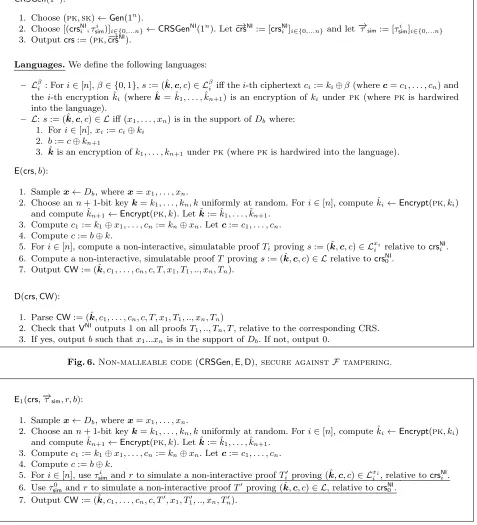
CRSGen(1n):
1. Choose (pk,sk)←Gen(1n). 2. Choose [(crsNIi , τ
i
sim)]i∈{0,...n}←CRSGenNI(1n). Let−crs→NI:= [crsiNI]i∈{0,...n}and let−→τsim:= [τsimi ]i∈{0,...n}
3. Outputcrs:= (pk,−crs→NI).
Languages.We define the following languages:
– Lβi : Fori∈[n],β∈ {0,1},s:= (ˆk,c, c)∈ L β
i iff thei-th ciphertextci:=ki⊕β(wherec=c1, . . . , cn) and the i-th encryption ˆki (where ˆk= ˆk1, . . . ,kˆn+1) is an encryption of ki underpk(where pkis hardwired into the language).
– L:s:= (ˆk,c, c)∈ Liff (x1, . . . , xn) is in the support ofDbwhere: 1. Fori∈[n],xi:=ci⊕ki
2. b:=c⊕kn+1
3. ˆk is an encryption ofk1, . . . , kn+1 underpk(wherepkis hardwired into the language).
E(crs, b):
1. Samplex←Db, wherex=x1, . . . , xn.
2. Choose ann+ 1-bit keyk=k1, . . . , kn, k uniformly at random. Fori∈[n], compute ˆki←Encrypt(pk, ki) and compute ˆkn+1←Encrypt(pk, k). Let ˆk:= ˆk1, . . . ,ˆkn+1.
3. Computec1:=k1⊕x1, . . . , cn:=kn⊕xn. Letc:=c1, . . . , cn. 4. Computec:=b⊕k.
5. Fori∈[n], compute a non-interactive, simulatable proofTiprovings:= (ˆk,c, c)∈ Lxii relative tocrs
NI
i . 6. Compute a non-interactive, simulatable proofT provings:= (ˆk,c, c)∈ Lrelative tocrsNI0.
7. OutputCW:= (ˆk, c1, . . . , cn, c, T, x1, T1, .., xn, Tn).
D(crs,CW):
1. ParseCW:= (ˆk, c1, . . . , cn, c, T, x1, T1, .., xn, Tn) 2. Check thatVNI outputs 1 on all proofsT
1, .., Tn, T, relative to the corresponding CRS. 3. If yes, outputbsuch thatx1...xnis in the support ofDb. If not, output 0.
Fig. 6.Non-malleable code(CRSGen,E,D), secure againstF tampering.
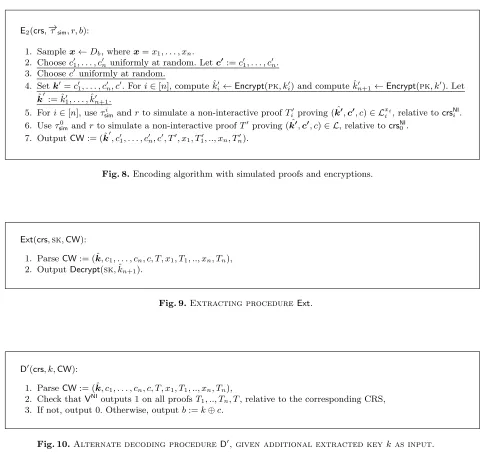
E1(crs,−→τsim, r, b):
1. Samplex←Db, wherex=x1, . . . , xn.
2. Choose ann+ 1-bit keyk=k1, . . . , kn, k uniformly at random. Fori∈[n], compute ˆki←Encrypt(pk, ki) and compute ˆkn+1←Encrypt(pk, k). Let ˆk:= ˆk1, . . . ,ˆkn+1.
3. Computec1:=k1⊕x1, . . . , cn:=kn⊕xn. Letc:=c1, . . . , cn. 4. Computec:=b⊕k.
5. Fori∈[n], useτi
sim andrto simulate a non-interactive proofT 0
i proving (ˆk,c, c)∈ L xi
i , relative tocrs
NI
i . 6. Useτ0
sim andr to simulate a non-interactive proofT 0
proving (ˆk,c, c)∈ L, relative tocrsNI 0 .
7. OutputCW:= (ˆk, c1, . . . , cn, c, T0, x1, T10, .., xn, Tn0).
E2(crs,−→τsim, r, b):
1. Samplex←Db, wherex=x1, . . . , xn. 2. Choosec01, . . . , c
0
nuniformly at random. Letc
0
:=c01, . . . , c 0
n. 3. Choosec0 uniformly at random.
4. Setk0=c01, . . . , cn0, c0. Fori∈[n], compute ˆk0i←Encrypt(pk, k0i) and compute ˆkn0+1←Encrypt(pk, k0). Let
ˆ
k0:= ˆk01, . . . ,ˆkn0+1.
5. Fori∈[n], useτsimi andrto simulate a non-interactive proofT 0
i proving ( ˆk0,c0, c)∈ L xi
i , relative tocrs
NI
i . 6. Useτ0
sim andr to simulate a non-interactive proofT 0
proving ( ˆk0,c0, c)∈ L, relative tocrsNI 0.
7. OutputCW:= (ˆk0, c01, . . . , c 0
n, c
0
, T0, x1, T10, .., xn, Tn0).
Fig. 8.Encoding algorithm with simulated proofs and encryptions.
Ext(crs,sk,CW):
1. ParseCW:= (ˆk, c1, . . . , cn, c, T, x1, T1, .., xn, Tn), 2. OutputDecrypt(sk,ˆkn+1).
Fig. 9.Extracting procedureExt.
D0(crs, k,CW):
1. ParseCW:= (ˆk, c1, . . . , cn, c, T, x1, T1, .., xn, Tn), 2. Check thatVNI outputs 1 on all proofsT
1, .., Tn, T, relative to the corresponding CRS, 3. If not, output 0. Otherwise, outputb:=k⊕c.
Fig. 10.Alternate decoding procedureD0, given additional extracted keyk as input.
g(crs,CW,CW∗, r):
1. ParseCW= (ˆk,c, c, T, x1, T1, .., xn, Tn),CW∗= (ˆk
∗
,c∗, c∗, T∗, x∗1, T ∗ 1, .., x
∗
n, T
∗
n). 2. If (1) VNI outputs 1 on all proofs T∗, T1∗, .., T
∗
n, relative to the corresponding CRS; and (2) (ˆk,c, c) = (ˆk∗,c∗, c∗), then output 1. Otherwise output 0.
Let Ψ(p, c, x, y, r, z) be defined as a function that takes as input a predicatep, and variablesc, x, y, r, z. Ifp(c, x, y, r) = 1, then Ψ outputs 0. Otherwise, Ψ outputsz.
Theorem 4. Let (E,D), E1,E2,Ext,D0 and g be as defined in Figures 6, 7, 8,9, 10 and 11. Let F be a
computational class. If, for every adversaryA ∈ Goutputting tampering functionsf ∈ F, all of the following hold:
Simulation of proofs.
1. Pr[g(crs,CW0, f(CW0), r0) = 1]≈Pr[g(crs,CW1, f(CW1), r1) = 1],
2. Ψ(g,crs,CW0, f(CW0), r0,D(crs, f(CW0);r0))≈Ψ(g,crs,CW1, f(CW1), r1,D(crs, f(CW1);r1)),
where (crs,sk,−→τsim)←CRSGen(1n),f ← A(crs),r0, r1 are sampled uniformly at random, CW0←E(crs,0) andCW1←E1(crs,−→τsim, r1,0).
Simulation of Encryptions.
1. Pr[g(crs,CW1, f(CW1), r1) = 1]≈Pr[g(crs,CW2, f(CW2), r2) = 1],
2. Ψ(g,crs,CW1, f(CW1), r1,D(crs, f(CW1);r1))≈Ψ(g,crs,CW2, f(CW2), r2,D(crs, f(CW2);r2)),
where (crs,sk,−→τsim)←CRSGen(1n),f ← A(crs),r1, r2 are sampled uniformly at random, CW1←E1(crs,−→τsim, r1,0) andCW2←E2(crs,−→τsim, r2,0).
Simulation Soundness.
Pr
"
D(crs, f(CW2);r2)6=D0(crs,Ext(crs,sk, f(CW2)), f(CW2);r2)
∧g(crs,CW2, f(CW2), r2) = 0
#
≤negl(n),
where (crs,sk,−→τsim)←CRSGen(1n),f ← A(crs),r2 is sampled uniformly at random and CW2←E2(crs,−→τsim, r,0).
Hardness of Db relative to Alternate Decoding.
1. Pr[g(crs,CW2, f(CW2), r2) = 1]≈Pr[g(crs,CW3, f(CW3), r3) = 1],
2. D0(crs,Ext(sk, f(CW2)), f(CW2);r2)≈D0(crs,Ext(sk, f(CW3)), f(CW3);r3),
where (crs,sk,−→τsim)←CRSGen(1n),f ← A(crs),r2, r3 are sampled uniformly at random, CW2←E2(crs,−→τsim, r2,0) andCW3←E2(crs,−→τsim, r3,1).
Then the construction presented in Figure 6 is a non-malleable code for class F against adversaries
A ∈ G.
3.1 Proof of Theorem 4
In this subsection we prove Theorem4.
We takegto be the predicate that is used in theMediumTamperΠ,A,m,gF (n) tampering experiment. We must
argue that for every m∈ {0,1} and every attackerA ∈ G the output of the experiment ExptΠ,A,m,gF (n) is 1 with at most negligible probability.
Assume towards contradiction that for some A ∈ G the output of the experiment is 1 with non-negligible probability. Then this means that the probability in the last line of experiment ExptΠ,A,m,gF (n)
that g(crs,CW,CW∗, r) = 1∧D(crs,CW∗;r)6=mis non-negligible. Parse CW= (ˆk,c, c, T, x1, T1, .., xn, Tn), CW∗= (ˆk∗,c∗, c∗, T∗, x∗
1, T1∗, .., x∗n, Tn∗).
and (ˆk,c, c) = (ˆk∗,c∗, c∗).
This, in turn, means that there must be some bit xi, x∗i that CW and CW
∗ differ on. But note that by
assumption ci = c∗i. Due to the fact that CW is well-formed and perfect correctness of the encryption scheme, it must mean thatc∗
i ∈ L/ x∗
i
i . But recall that by assumption, proof Ti∗ verifies correctly. This means that soundness is broken byA∈ G. This contradicts the security of the proof systemΠNI.
Next, recall that we wish to show that for any adversary A ∈ G outputting tampering function
{MediumTamperΠ,A,0,gF }k∈N≈ {MediumTamper
Π,F
A,1,g}k∈N
To do so we consider the following hybrid argument:
Hybrid 0: The real game,MediumTamperΠ,A,0,gF , relative tog, where the real encodingCW0←E(crs,0) and the real decoding oracleDare used.
Hybrid 1:Replace the encoding from the previous game with
CW1←E1(crs,−→τsim, r1,0) wherer1 is chosen uniformly at random andg,Duse random coinsr1. Hybrid 2: Replace the encoding from the previous game with CW2←E2(crs,→−τsim, r2,0), where r2 is chosen uniformly at random and g,Duse random coinsr2.
Hybrid 3:Replace the decoding from the previous game, with
D0(crs,Ext(crs,sk, f(CW2)), f(CW2);r2). wherer2 is chosen uniformly at random andg,E2use random coins r2.
Hybrid 4: Same as Hybrid 3, but replace the encoding with CW3 ← E2(crs,→−τsim, r3,1), where r3 is chosen uniformly at random and g,D0 use random coinsr3.
Now, we prove our hybrids are indistinguishable.
Claim. Hybrid 0 is computationally indistinguishable from Hybrid 1.
Proof. The claim follows immediately from theSimulation of proofsproperty in Theorem4.
Claim. Hybrid 1 is computationally indistinguishable from Hybrid 2.
Proof. The claim follows immediately from theSimulation of Encryptionsproperty in Theorem4.
Claim. Hybrid 2 is computationally indistinguishable from Hybrid 3.
Proof. This claim follows from the fact that (1) ifg(crs,CW,CW∗, r) = 1, then the experiment outputssame∗ in both Hybrid 2 and Hybrid 3; and (2) the probability that g(crs,CW,CW∗, r) = 0 and the output of the experiment is different in Hybrid 2 and Hybrid 3 is at most negligible, due to theSimulation Soundness property in Theorem4.
Claim. Hybrid 3 is computationally indistinguishable from Hybrid 4.
Proof. This follows from the fact that (1) forγ∈ {2,3}ifg(crs,CW2, f(CW2), r2) = 1 then D0(crs,Ext(crs,sk, f(CWγ)), f(CWγ);rγ) always outputs 0 and so
D0(crs,Ext(crs,sk, f(CWγ)), f(CWγ);rγ)
≡Ψ(g,crs,CWγ, f(CWγ), rγ,D0(crs,Ext(crs,sk, f(CWγ)), f(CWγ);rγ));
and (2) theHardness of Db relative to Alternate Decodingproperty in Theorem4.
4
One-Bit NMC for
AC
0and beyond
Theorem 5. Π = (CRSGen,E,D)(presented in Figure 6) is a one-bit, computational, non-malleable code in the CRS model, secure against tampering byAC0 circuits, if the underlying components are instantiated in the following way:
– E := (Gen,Encrypt,Decrypt)is a public key encryption scheme with perfect correctness and decryption in
AC0 .
– ΠNI:= (CRSGenNI,PNI,VNI,SimNI)is a same-string, weak one-time simulation-sound NIZK with verifier
in AC0 .
– For b ∈ {0,1}, Db is the distribution that samples bits x1. . . xn uniformly at random, conditioned on x1⊕ · · · ⊕xn=b.
Note that given Theorem 1, proof systemsΠNI as above exist, under the assumption that same-string,
weak one-time simulation-sound NIZK with (arbitrary polynomial-time) deterministic verifier exists. Such NIZK can be constructed in the CRS model from enhanced trapdoor permutations [Sah99]. Public key encryption with perfect correctness and decryption inAC0can be constructed by applying the low-decryption-error transformation of Dwork et al. [DNR04] to the (reduced decryption error) encryption scheme of Bogdanov and Lee [BL16]. We now provide an instantiation of the public key encryption scheme.
Public key encryption in AC0 . We now present the result presented by Bogdanov and Lee in [BL16] which showed that the encryption scheme given by Applebaum et al. in [ABW10] can be implemented by circuit with constant depth and size polynomial in the security parameter.
PKE Scheme based on Bipartite Graphs [ABW10]
– Gen(1n): The key generation algorithm takes security parameter n as input and outputs a random bipartite graphG= ((U1, U2), E) as the public keypk, where|U1|=nand|U2|=r=n0.9 generated in the following way. First choose the random subsets S1⊆U1andS2⊆U2 of sizessands/3 respectively fors=O(logn). Each vertex inS1is connected tod(possibly repeated) random vertices inS2and each vertex outsideS1 is connected todrandom vertices inU2. The secret keysk is an odd size subset ofS1 such that each vertex in S2 has an even number of neighbors insk.
– Encrypt(pk, b): To encrypt bitb∈ {0,1}, choose a random subsetS02⊂U2and outputc=y+e+b·1, where each coordinate ofy∈ {0,1}nis the degree of corresponding vertex inS
1 restricted toS02mod 2, e∈ {0,1}n is a vector with each coordinate (e
i: i∈[n]) sampled from distribution ˆηwith Pr [ei= 0] =η independently, and1∈ {0,1}n is the vector of all 1s.
– Decrypt(sk,c): Outputb=P
i∈skcimod 2.
Refer [ABW10] for the security of the scheme presented above. We next present theAC0implementation of the PKE presented above as shown in [BL16].
AC0 Implementation of [ABW10] PKE Scheme based on Bipartite Graphs [BL16]
– Gen:
1. Sample y1, y2, . . . , ys from [n] and w1, w2, . . . , ws/3 from [r] to represent the subsets S1 ⊆ U1 and S2⊆U2respectively.
2. Samplevi,1, vi,2, . . . , vi,dfrom [r] for alli∈[n]. These represent the random neighbors of each vertex inU1\S1.
3. Sample ˆvi,1,vˆi,2, . . .vˆi,dfrom [s/3] for alli∈[s]. These become the random neighbors of the vertices in S1 after being mapped to thewi’s by the index function ι: [s/3]→[r] such thatι(i) =wi. This is written as:
ι(i) = s/3
_
j=1
[(i=j)∧wj]
![Fig. 16. Alternate decoding procedure D′, given additional extracted key [ki]i∈[m] as input.](https://thumb-us.123doks.com/thumbv2/123dok_us/7961055.1320643/29.612.73.551.60.713/fig-alternate-decoding-procedure-given-additional-extracted-input.webp)