
PROCESS MINING ALGORITHMS
Asst. Prof. Esmita Gupta
M.E. Student, Vidyalankar Institute of Technology, Mumbai University, (India).
ABSTRACT
The systems that support today’s globally distributed and agile businesses are steadily growing in size and
generating numerous events. Business Intelligence aims to support and improve decision making processes by
providing methods and tools for analyzing the data. Process mining is a new research technology that sits
between computational intelligence and data mining on the one hand, and process modelling and analysis on
the other hand. Its primary objective is the discovery of process models based on available event log data.
Various process mining algorithms have been proposed recently, but there does not exist a widely-accepted
benchmark to evaluate and compare these process mining algorithms. As a result, it can be difficult to choose a
suitable process mining algorithm for a given enterprise or application domain.
This paper proposes a solution to evaluate and compare these process mining algorithms efficiently, so that
businesses can select the process mining algorithms that are most suitable for a given model set to take good
decisions for their organization.
Keywords: Process Mining; Heuristic Miner; Genetic Miner; Fuzzy Miner
I.
INTRODUCTION
Companies use information systems to enhance the processing of their business transactions. Business processes
cannot be evaluated without the integration of information systems that support and monitor relevant activities
in modern companies. The increasing integration of information systems does not only provide the means to
increase effectiveness and efficiency. It also opens up new possibilities of data access and analysis. When
information systems are used for supporting and automating the processing of business transactions they
generate data. These data need to be evaluated and processed in a proper manner in order to make good decision
for the growth of organization.
The idea of process mining is to discover, monitor and improve real processes by extracting knowledge from the
extracted data and generate event logs. The main benefit of process mining techniques is that information is
objectively compiled. In other words, process mining techniques are helpful because they gather information
about what is actually happening according to an event log of an organization, and not what people think that is
happening in the organization.
Process mining algorithm helps in processing the required data and different types of models can be extracted
that describe underlying processes. A business process model shows a specific ordering of work activities with a
beginning, an end, and clearly defined inputs and outputs.
Here, we provide a short introduction to process mining, including the working of three established
process-mining algorithms. Different process process-mining algorithms have different properties (e.g., some perform better on
algorithm (i.e. the one that produces mined models that are semantically similar to the original models and
structurally equal to or better than the original models) for the models from a given enterprise is a big advantage
[5].
The organization of the rest of this paper is as follows. Section 2 discusses why process mining. Section 3
discusses about the working of heuristic, genetic and fuzzy miner algorithm each with an illustration in order to
understand the concept.
II
WHY
PROCESS
MINING
The emergence of semi-structured processes, combined with improvements in computing power and the speed
of data transmission, have fueled the need for mining algorithms to address new challenges.
In addition to discovering process models from logs and examining the level of conformance of an actual
process to its modeled counterpart, process mining should find, merge, and clean event data; handle changes in a
process that occur while its being mined; and provide operational support to process users in an online
manner.[1]
1.The first challenge is that numerous uncorrelated events (with possible noise) are gathered from disparate
heterogeneous
and distributed systems.
2. The second challenge is the Dramatic variation in execution behavior.
3. The third challenge is parallel and repeated task execution.
Thus this topic includes a method for systematic comparison, and a body of experimental data describing the
behavior of three algorithms i.e. Heuristic Miner, Fuzzy miner and Genetic Miner with typical process structures
and how it can handle the above challenges.
The primary aim of process mining is to investigate a scalable solution that can evaluate, compare and rank
these process mining algorithms efficiently. In particular, it attempts to investigate how we can choose an
effective process mining algorithm for an enterprise without evaluating different process mining algorithms.
III
PROCESS
MINING
ALGORITHM
There are many different approaches to process mining. Local methods look at local relations between activities
in logs( Heuristics Miner), while global approaches build and refine a model based on the whole log (Genetic
Mining, Fuzzy Miner) Different algorithms have their own specialism. Heuristics Miner uses frequencies and
parameterization to handle noise; while Genetic Process Mining can mine complex and noisy logs, but is
resource intensive. More recent approaches focus on managing complex real world models or noisy logs using
clustering and abstraction, e.g. at the trace or activity level.
In this paper we are going to objectively differentiate the most used algorithms with examples.
1. Heuristic miner
2. Genetic miner
3.1. Heuristic Miner
Heuristics Miner is a practical applicable mining algorithm that can deal with noise, and can be used to express
the main behavior that is not all details and exceptions, registered in an event log. This technique extends alpha
algorithm by considering the frequency of traces in the log. The Heuristics Miner Plug-in mines the control flow
perspective of a process model. To do so, it only considers the order of the events within a case. For instance for
the log in the log file only the fields case id, time stamp and activity are considered during the mining. The
timestamp of an activity is used to calculate these orderings [9].
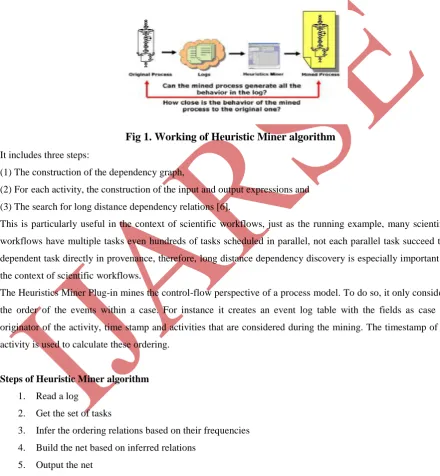
Fig 1. Working of Heuristic Miner algorithm
It includes three steps:
(1) The construction of the dependency graph,
(2) For each activity, the construction of the input and output expressions and
(3) The search for long distance dependency relations [6].
This is particularly useful in the context of scientific workflows, just as the running example, many scientific
workflows have multiple tasks even hundreds of tasks scheduled in parallel, not each parallel task succeed the
dependent task directly in provenance, therefore, long distance dependency discovery is especially important in
the context of scientific workflows.
The Heuristics Miner Plug-in mines the control-flow perspective of a process model. To do so, it only considers
the order of the events within a case. For instance it creates an event log table with the fields as case id,
originator of the activity, time stamp and activities that are considered during the mining. The timestamp of an
activity is used to calculate these ordering.
Steps of Heuristic Miner algorithm
1. Read a log
2. Get the set of tasks
3. Infer the ordering relations based on their frequencies
4. Build the net based on inferred relations
5. Output the net
As we know, Process mining techniques are able to extract knowledge from event logs. To find a process model
on the basis of an event log, the log should be analysed for causal dependencies, e.g., if an activity is always
followed by another activity it is likely that there is a dependency relation between both activities. To analyse
arbitrary sequence of activity identifiers. W Ɛ T is an event log, i.e., a multiset that is bag of event traces. Note
that since W is a multiset, every event trace can appear more than once in a log [9].Lets analyse these relations
by introducing the following notations. Let W be an event log over T, i.e., W Ɛ T. Let a,b ƐT
1. a >W b if and only if there is a trace S = t1,t2,t3 : : : tn and i Ɛ {1; : : : ; n -1} such that S ƐW and ti = a and
ti+1 = b,
2. a →W b if and only if a >W b and b > not equal W a,
3. a ≠ W b if and only if a > not equal W b and b > not equal W a, and 4. a ║ W b if and only if a >W b and b >W a.
5. a>>W b if and only if there is a trace S = t1,t2,t3 ….. tn And i Ɛ {1; : : : ; n - 2} such that S ϵ W andti = a and
ti+1 = b and
ti + 2 = a
6.a >>>W b if and only if there is a trace S = t1, t2, t3….tn and i < j and i, j ϵ {1……n} such that S Ɛ W and ti =
a and tj = b.
Basic ordering relations:
Direct succession: x>y iff for some case x is directly followed by y.
Causality: xy iff x>y and not y>x.
Parallel: x||y iff x>y and y>x
Unrelated: x#y iff not x>y and not y>x.
After inferring the relation according to the frequencies we start with the construction of a so called dependency
graph. A frequency based metric is used to indicate how certain we are that there is truly a dependency relation
between two events „a‟ and „b‟ (notation a Wb).The calculated W values between the events of an event log
are used in a heuristic search for the correct dependency relations.
1. Let W be an event log over T, and a, b ϵ T. Then |a >W b |is the number of times a >W b occurs in W,
and,
(1)
Where a Wb is always between 1 and -1.
2. For short loops, the dependency is measured as follows, Let W be an event log over T, and a, b ϵ T
Then |a >W a| is the number of times a >W a occurs in W, and |a >>W a| is the number of times a >>W
b occurs in W.
(2)
2W b= (3)
The event log W is a bag, the same trace can appear more than once in the log and patterns can appears more
times in a trace. If, for instance, the pattern „ab‟ appears twice in a trace (e.g., cabefgcabefh), and this trace
appears three times in W (i.e. W (cabefgcabefh) =3) then these appearances count as 6 in the a >W b
measurement. After calculating the dependency value for the given log, the dependency table is as follows:
L=[(a,e)5, (a,b,c,e)10, (a,c,b,e)10, (a,b,e)1, (a,c,e)1, (a,d,e)10, (a,d,d,e)2, (a,d,d,d,e)1]
Table 1: Log table with frequencies Table 2: Dependency relation matrix
|>L| a b c d
a 0 11 11 13
b 0 0 10 0
c 0 10 0 4
d 0 0 0 0
e 0 0 0 0
Thus the heuristic graph is
Fig 2: Heuristic graph [12]
The process mining is the process of generating new process model for the benefit of business processing
system. Heuristics Miner is used to generate a new model without noise that is with exception, frequent failure
or partial failure, life time of the model, etc. Hence, Heuristics Miner is a most practical applicable mining
algorithm that can deal with noise, and can be used to express the main behaviour that is not all details and
exceptions, registered in an event logs.
3.2.
Genetic Miner
The process mining has attracted the attention of both researchers and tool vendors in the Business Process
Management (BPM) space. The goal of process mining is to discover process models from event logs, i.e.,
events logged by some information system are used to extract information about activities and their causal
relations. But these models were not able to tackle with noise, incompleteness, duplicate activities, hidden
activities, non-free-choice constructs, etc. To tackle these problems we propose a completely new approach
based on genetic algorithms. As can be expected, a genetic approach is able to deal with noise and
incompleteness.
Genetic miner uses a genetic algorithm to mine a petri net representation of the process model from execution
traces. Genetic mining algorithms use an evolutionary approach that mimics the process of natural evolution [2].
A genetic search is an example of a global search strategy because the quality or fitness of a candidate model is
calculated by comparing the process model with all traces in the event log the search process takes place at a
global level. For a local strategy there is no guarantee that the outcome of the locally optimal steps (at the level
|>L| a b c d e
a 0 0.92 0.92 0.93 0.83
b -0.92 0 10 0 0.92
c -0.92 0 0 0 0.92
d -0.93 0 0 0.80 0.93
of binary event relations) will result in a globally optimal process model. Hence, the performance of such local
mining techniques can be seriously hampered when the necessary information is not locally available because
one erroneous example can completely mess up the derivation of a right model. Therefore, we started to use
genetic algorithms.
Genetic algorithm is used to discover a Petri net given a set of event traces. Genetic algorithms are adaptive
search methods that try to mimic the process of evolution [9].
These algorithms start with an initial population of individuals (in this case process models). Populations evolve
by selecting the fittest individuals and generating new individuals using genetic operators such as crossover
(combining parts of two of more individuals) and mutation (random modification of an individual) [8].
The goal of using genetic algorithms is to tackle problems such as duplicate activities, hidden activities,
non-free-choice constructs, noise, and incompleteness, i.e., overcome the problems of some of the traditional
approaches.
Fig 3. Genetic Process Mining [12]
3.2.1Genetic Miner Algorithm:
When using genetic algorithms to mine process models, there are three main concerns.
The first is to define the internal representation. The internal representation defines the search space of a genetic
algorithm.
The second concern is to define the fitness measure. In our case, the fitness measure evaluates the quality of a
point (individual or process model) in the search space against the event log.
The third concern relates to the genetic operators (crossover and mutation) because they should ensure that all
points in the search space defined by the internal representation may be reached when the genetic algorithm runs.
1. Read event log
2. Build the initial population
3. Calculate fitness of the individuals in the population
4. Stop and return the fittest individuals
5. Create next population – use elitism and genetic operators
Table 3: Event log for Genetic process mining
CaseId ActivityId Originator Timestamp CaseId ActivityId Originator Timestamp
1 A John 09-03-04 3 E Peter 10-03-04
2 A John 09-03-04 3 F Carol 11-03-04
3 A Sue 09-03-04 4 D Peter 11-03-04
3 D Carol 09-0304 3 G Sue 11-03-04
1 B Mike 09-03-04 3 H Peter 11-03-04
1 H John 10-03-04 4 F Sue 11-03-04
2 C Mike 10-03-04 4 E Clare 11-03-04
4 A Sue 10-03-04 4 G Mike 11-03-04
2 H John 10-03-04 4 H Clare 11-03-04
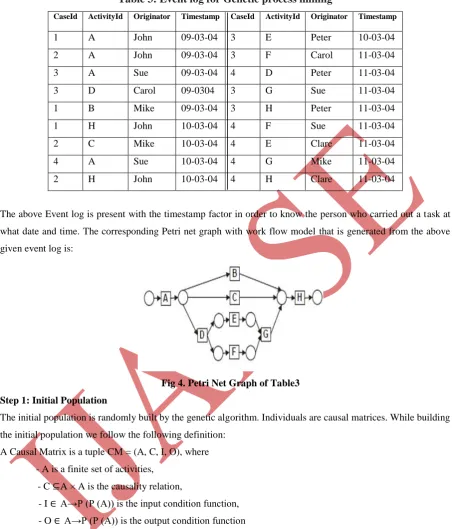
The above Event log is present with the timestamp factor in order to know the person who carried out a task at
what date and time. The corresponding Petri net graph with work flow model that is generated from the above
given event log is:
Fig 4. Petri Net Graph of Table3
Step 1: Initial Population
The initial population is randomly built by the genetic algorithm. Individuals are causal matrices. While building
the initial population we follow the following definition:
A Causal Matrix is a tuple CM = (A, C, I, O), where
- A is a finite set of activities,
- C ⊆A × A is the causality relation,
- I ∈ A→P (P (A)) is the input condition function, - O ∈ A→P (P (A)) is the output condition function
Given a log, all individuals in any population of the genetic algorithm have the same set of activities (or tasks) A.
This set contains the tasks that appear in the log. However, the causality relation C and the condition functions I
and O may be different for every individual in the population. The initial population can have any individual in
the search space defined by a set of activities A. The higher the amount of tasks that a log contains, the bigger is
the search space.
Table 4: Two randomly created individuals for the log in Table 3
Individual 1 Individual 2
Activity Input Output Activity Input Output
A {} {{B,C,D}} A {} {{B,C,D}}
B {{A}} {{H}} B {{A}} {{H}}
C {{A}} {{H}} C {{A}} {{H}}
D {{A}} {{E}} D {{A}} {{E,F}}
E {{D}} {{G}} E {{D}} {{G}}
F {} {{G}} F {{D}} {{G}}
G {{E},{F}} {{H}} G {{E},{F}} {{H}}
H {{C,B,C}} {} H {{C},{B},{C}} {}
Step 2: Fitness calculation
If an individual in the genetic population correctly describes the registered behavior in the event log, the fitness
of that individual will be high. In our approach the fitness is strongly related to the number of correctly parsed
traces from the event log.
We make use of parsing semantics because it is more robust to noisy logs and it gives more information about
the fitness of the complete process models (i.e not biased to only the first part of the process model). In a
noise-free situation, the fitness of a model can be 1 (or 100%) (i.e. all traces can be parsed). In practical situations, the
fitness value ranges from 0 to 1. The exact fitness of an individual to a given log is given by the formula:
Fitness =0.40 * allParsedActivities + 0 .60 * allProperlyCompletedLog Traces
NumberOfActivitiesAtLog NumberOfTracesAtLog
where: numberOfActivitiesAtLogin the number of activities in the log. For instance, the log shown in Table 4
has 18 activities. numberOfTracesAtLogin the number of log traces, e.g., in Table 4 there are 4.
allParsedActivities is the sum of parsed activities (i.e. activities that could fire without the artificial addition of
tokens) for all log traces. allProperlyCompletedLogTraces is the number of log traces that were properly parsed
(i.e. after the parsing the end place is the only one to be marked).
Step 3: Genetic operation
We use elitism, crossover and mutation to build the population elements of the next genetic generation.
Elitism means that a percentage of the fittest individuals in the current generation is copied into the next generation.
Crossover and mutation are the basic genetic operators. Crossover creates new individuals (offsprings) based on the fittest individuals (parents) in the current population. So, crossover recombines the fittest
material in the current population in the hope that the recombination of useful material in one of the
parents will generate an even fitter population element. The mutation operation will change some minor
details of a population element. The hope is that the mutation operator will insert new useful material in
The genetic algorithm (GA) stops when: (i) It finds an individual whose fitness is 1; or
(ii) It computes n generations, where n is the maximum number of generation that is allowed; or
(iii) The fittest individual has not changed for n/2 generations in a row.
If none of these conditions hold, the GA creates a new population as follows:
Input: current population, elitism rate, crossover rate and mutation rate
Output: new population
1. Copy “elitism rate × population size” of the best individuals in the current population to the next population.
2. While there are individuals to be created do:
(a) Use tournament selection to select parent1.
(b) Use tournament selection to select parent2.
(c) Select a random number r between 0 (inclusive) and 1 (exclusive).
(d) If r is less than the crossover rate:
Then do crossover with parent1 and parent2. This operation generates two offsprings: offspring1 and
offspring2.else offspring1 equals parent1 and offspring2 equals parent2.
(e) Mutate offspring1 and offspring2. (This step is only needed if the mutation rate is non-zero.)
(f) Copy offspring1 and offspring2 to the new population.
3. Return the new population.
Tournament Selection To select a parent the tournament selection algorithm randomly selects 5 individuals
and returns the fittest individual among the five ones.
Crossover The most important and complex genetic operation in our genetic approach is the crossover
operation. Starting point of the crossover operation are the two parents (i.e. parent1 and parent2). The result of
applying the crossover operation is two offsprings (offspring1 and offspring2).
The mutation works on the INPUT and OUTPUT boolean expressions of an activity. For every activity t in an
individual, a new random number r is selected. Whenever r is less than the “mutation rate” 7, the subsets in
INPUT (t) are randomly merged or split. The same happens to OUTPUT (t). As an example, consider
Offspring1 in Table 5. Assume that the random number r was less than the mutation rate for activity D. After
applying the mutation, OUTPUT (D) changes from {{E, F}} to {{E}, {F}}. Note that this mutation does not
change an individual‟s causal relations, only its AND-OR/join-split may change.
3.3.
Fuzzy miner
Process Mining is a technique for extracting process models from execution logs. This is particularly useful in
situations where people have an idealized view of reality. Real-life processes turn out to be less structured than
people tend to believe. Unfortunately, traditional process mining approaches have problems dealing with
unstructured processes. The discovered models are often “spaghetti-like”, showing all details without
distinguishing what is important and what is not. This topic proposes a new process mining approach to
overcome this problem. The approach is configurable and allows for different faithfully simplified views of a
Fuzzy Miner is suitable for mining less structured processes which exhibit a large amount of unstructured and
conflicting behaviour i.e. spaghetti-like models into more concise models. It applies a variety of techniques,
such as removing unimportant edges, clustering highly correlated nodes in to a single node, and removing
isolated node clusters. [2]
Fig 5. Fuzzy model and Fuzzy instance [7]
An Adaptive Approach for Process Simplification:
Process mining techniques which are suitable for less-structured environments need to be able to provide a high-level view on the process, abstracting from undesired details.
Activities in a process can be related to locations in a topology (e.g. towns or road crossings) and
Precedence relations to traffic connections between them (e.g., railways or motorways).When one takes a closer look at maps, the solution cartography has come up with to simplify and present
complex topologies; one can derive a number of valuable concepts from them.
Aggregation: To limit the number of information items displayed, maps often show coherent clusters of low-level detail information in an aggregated manner. One example are cities in road maps, where
particular houses and streets are combined within the city‟s transitive closure.
Abstraction: Lower-level information which is insignificant in the chosen context is simply omitted from the visualization. Examples are bicycle paths, which are of no interest in a motorist‟s map.
Emphasis: More significant information is highlighted by visual means such as colour, contrast, saturation, and size. For example, maps emphasize more important roads by displaying them as thicker, more colorful
and contrasting lines.
Customization: There is no one single map for the world. Maps are specialized on a defined local context, have a specific level of detail (city maps vs. highway maps), and a dedicated purpose.
3.3.1 Fuzzy miner algorithm:
Input
A set of N transactions, each with n attribute, fuzzy linguistic terms for quantitative attributes, The
Output
Phase I: Fuse similar behaving attributes;
Phase II: Generate Meta rules;
Phase III: Generate frequent fuzzy itemsets;
Phase IV: Make fuzzy association rules.
The Fuzzy Miner is a process miner that mines an event log for a family of process models using a “map" metaphor.
Let‟s assume a single map as fuzzy instance whereas we call a family of maps as fuzzy model.
Like high-level maps only show major objects of interest and major streets, high-level fuzzy instances also show only major elements (nodes and edges).
For this purpose, the Fuzzy Miner computes from the log a significance weight for every element and an additional correlation weight for every edge.
The higher these weights are, the more major the element is considered to be.
Furthermore, the Fuzzy Miner uses a number of thresholds: Only elements that meet these thresholds are shown.
Fuzzy Miner first attempts to cluster minor nodes into major cluster nodes, and only if that does not work it will remove the minor node from the map.
The Fuzzy Miner has been enhanced to utilize the availability of sub-logs obtained from the Pattern
Abstractions plugin for the chosen abstractions. Fuzzy models are discovered for each of the sub-logs and are
displayed upon zooming in on its corresponding abstract activity. Abstract activities are differentiated from
other activities by means of a distinct color.
Thus we can say that fuzzy miner successfully gives the changed part and unchanged part, giving the most
dependency correctly.
IV
C
ONCLUSION AND FUTURE WORKThe significance of process mining increases with the growing integration of information systems.
Many process mining techniques have been proposed. It is difficult to know which algorithms are better.
Thus here we have carried out a comparative study to identify which algorithm to be used and when. After the
study we can say that
Heuristic miner can be used when we have real-life data with not too many different events or when you need a Petri net model for further analysis
Genetic Miner can be used when we need to mine logs with noise, handling of duplicate task names, local and nonlocal nonfree choice constructs and invisible task.
Fuzzy miner can be used when we have seen various algorithms (i) depict desired traits, (ii) eliminate irrelevant details, (iii) reduce complexity, and (iv) improve comprehensibility.
Process mining is still a young research discipline. Although a model mined by a process-mining algorithm can
present a picture of a process‟s execution at a particular point in time, as the process changes and evolves, the
mined model might no longer maintain fidelity to the process. This leads to the challenge of handling changes in
to have runtime changes in the process model with the help of these algorithms with monitoring, verification of
requirements, and compliance enforcement.
REFERENCES
[1] IEEE Taskforce “Process mining manifesto”, 2012
[2] Geetika T. Lakshmanan and Rania Khalaf, “Leveraging Process mining techniques”, IBM T.J. Watson
Research Center , IT Pro September/October 2013
[3] StB Prof. Dr. Nick Gehrke, Michael Werner, Dipl.-Wirt.-Inf. “Process Mining”, WISU - die Zeitschrift für
den Wirtschaftsstudenten 7/13
[4] Philip Weber, BehzadBordbar, Peter Tino, BasimMajeed “A Framework for comparing Process Mining
Algorithm”
[5] Jianmin Wang, Raymond K. Wong, Jianwei Ding, QinlongGuo and Lijie Wen “Efficient selection of
mining algorithm”, IEEE Transactions on Services Computing 01/2013
[6] RengZeng, Xudong He, Jiafei Li, Zheng Liu, W.M.P. van der Aalst “A Method to Build and Analyze
Scientific Workflows from Provenance through Process Mining”, Proceedings of the 3rd USENIX
Workshop on the Theory and Practice of Provenance (TaPP'11); 01/2011
[7] R.P. Jagadeesh Chandra Bose, Eric H.M.W. Verbeek1 and Wil M.P. van der Aalst1 “Discovering
Hierarchical Process Models Using ProM”, Department of Mathematics and Computer Science, University
of Technology, Eindhoven, The Netherlands, Conference: Proceedings of the CAiSE Forum 2011.
[8] W.M.P. van der Aalst, A.K. Alves de Medeiros, and A.J.M.M. Weijters “Genetic Process Mining”,
Department of Technology Management, Eindhoven University of Technology, 26th International
Conference, ICATPN 2005
[9] Saravanan .M.S, Rama Sree .R.J “A Role of Heuristics Miner Algorithm in the Business Process System”,
Comp. Tech. Appl., Vol 2 (2), 340-344
[10] W.M.P. van der Aalst*, A.J.M.M. Weijters “Process mining: a research agenda”, Department of
Technology Management, Eindhoven University of Technology,2004.
[11] Fabrizio Maria Maggi “Process Mining-Control flow process discovery”, Springer 2011
[12] Ana Karla Alves de Medeiros,”Process Mining-Control flow mining algorithm”, Eindhoven University of
Technology
[13] Christian W. Gunther and Wil M.P. van der Aalst “Fuzzy Mining – Adaptive Process Simplification Based
on Multi-Perspective Metrics”, Eindhoven University of Technology.
[14] Dr. Anne Rozinat and Dr. Christian W. Günther “The Added Value of Process Mining”, 2014.
[15] “Introduction to Process Mining, turning big data in real value.mp4”, www.processmining.org, 04 Aug
2014.
[16] “Fuzzy miner”, www.fluxicon.com, 13 Sept 2014.
[17] “Which mining algorithm should you use”, www.processmining.org, 04 Aug 2014.
![Fig 2: Heuristic graph [12]](https://thumb-us.123doks.com/thumbv2/123dok_us/7756890.1272298/5.595.76.539.114.702/fig-heuristic-graph.webp)
![Fig 3. Genetic Process Mining [12]](https://thumb-us.123doks.com/thumbv2/123dok_us/7756890.1272298/6.595.67.524.144.692/fig-genetic-process-mining.webp)

![Fig 5. Fuzzy model and Fuzzy instance [7]](https://thumb-us.123doks.com/thumbv2/123dok_us/7756890.1272298/10.595.72.523.165.677/fig-fuzzy-model-and-fuzzy-instance.webp)
