Western University Western University
Scholarship@Western
Scholarship@Western
Electronic Thesis and Dissertation Repository
8-9-2018 2:00 PM
Next to a River: Mobility, Mapping, and Hand Embroidery
Next to a River: Mobility, Mapping, and Hand Embroidery
Sharmistha Kar
The University of Western Ontario
Supervisor Mahon, Patrick
The University of Western Ontario Graduate Program in Visual Arts
A thesis submitted in partial fulfillment of the requirements for the degree in Master of Fine Arts © Sharmistha Kar 2018
Follow this and additional works at: https://ir.lib.uwo.ca/etd
Part of the Art Practice Commons
Recommended Citation Recommended Citation
Kar, Sharmistha, "Next to a River: Mobility, Mapping, and Hand Embroidery" (2018). Electronic Thesis and Dissertation Repository. 5508.
https://ir.lib.uwo.ca/etd/5508
Abstract
This MFA project explores identity, mapping, and embroidery as broadly considered
regarding ideas of place and landscape. Concepts such as travel, the familiar, the temporary, the
known, and the unknown are motivating notions that I examine through academic study
alongside techniques of hand embroidery. Throughout my MFA project, a series of material and
technical choices were crucial to my reflecting on ideas of resemblance, mapping, migration, and
archiving in order to further understand my identity.
A series of texts on resemblance, archiving, and mapping by Michel Foucault, Arjun
Appadurai, and Tom Vanderbilt, along with references to the art practices and thought processes
of artists Mrinalini Mukherjee, Ghada Amer, Anne Wilson, and Britta Marakatt-Labba are
shown to be vital in helping to articulate my thematic and materialistic interests.
The thesis can be considered further both in relation to the concept of mapping and to
hand embroidery in light of broader experiences of encounters with “place.” I anticipate the
potential of this work to relate to other disciplinary contexts, including the Sciences.
Acknowledgements
First, I would like to express my sincere gratitude to my supervisor Prof. Patrick Mahon for his
guidance and continuous support towards my practice and research, and also for his patience,
motivation, and enthusiasm. His supervision is central to the direction my ongoing practice has
taken.
Besides my supervisor, I would like to thank Prof. David Merritt, Prof. Christof Migone, Prof.
Kim Moodie, Prof. Kelly Wood, Prof. Kelly Jazvac, Prof. Sky Glabush, Prof. Tricia Johnson,
Prof. Kristy Robertson, and Prof. Daniela Sneppova for their encouragement and insightful
comments on my studio practice.
I am grateful to artist Jamelie Hassan for being an essential part of my thesis, providing me an
insightful interview on her artistic practice. It was always a pleasure to listen and get suggestions
on my writing from her partner and artist Ron Benner as well.
I thank my all classmates specially Rah, Matt, Tyler, Claire, Joy, Graham, Kate, Lydia, and
Zhizi, Jony who filled my journey in London with much excitement. A special thanks goes to
Helen Gregory for welcoming me to Canada and sharing her suggestions about this new place
and the study program. My friends from India Anindita and Rajarshi continued their support by
providing art supplies and many discussions, which helped me to continue my art work.
I cannot forget to thank Paula Dias, Meghan Edmiston, Marlene Jones, Julia Beltrano, Troy
Ouellette, Kim Neudorf , Andrew Silk, and Theresa Janik for all their administrative and
technical support in these two years. My sincere thanks to Ivan for keeping our studio and the
building clean and habitable.
I am truly grateful to Derek Lattimer and Stefanie Horsley for extremely helpful guidance on
completing this writing effectively.
Last but not the least, I would like to thank my family for their continuous support and trust in
my journey which always strengthens me inside.
Table of Contents
Abstract ... i
Acknowledgements ... ii
Table of Contents ... iii
List of Figures ... v
Preface ... vii
Introduction ... 1
Preamble: Background to My Embroidery Practice ... 1
Thesis Structure ... 3
Concluding remarks ... 4
Part 1: Extended Artist’s Statement ... 5
My Work ... 5
Embroidery History and Related Background ... 6
Theoretical and Textual Interests ... 8
Michel Foucault’s The Order of Things: An Archaeology of The Human Science ... 8
Arjun Appadurai’s “Archive and Aspiration” ... 10
Tom Vanderbilt’s “Cerebral Cities” ... 12
Artists of Interest ... 14
Mrinalini Mukherjee (1949-2015, India) ... 15
Ghada Amer (b. 1963, Cairo, Egypt; currently living and working in New York City) ... 17
Anne Wilson (b. 1949, United States) ... 19
Britta Marakatt-Labba (b. 1951, Idivuoma, Sweden) ... 21
Studio Practice ... 22
A First Experiment—A Meditation ... 23
Thematic Developments and My Working Method ... 24
Conclusion ... 26
Part 3: Interview with Artist Jamelie Hassan (London, Ontario, Canada) ... 44
A Short Background on the Artist ... 44
Interview transcript ... 45
Summary and Conclusion ... 53
Bibliography ... 54
List of Figures
Figure 1: Mrinalini Mukherjee with her jute sculpture Woman on a Swing in 1989 ... 15
Figure 2: Ghada Amer, “Julia's Pink”, acrylic, embroidery and gel on canvas, 162.8 x 193.3 cm. 2005. . 17
Figure 3: Anne Wilson, Topologies photos: Severo Barreras, George Bouret, Merrill Mason, Stephen Pitkin, Daniel Torrente, Christopher Wiley, Wilson studio. ... 19
Figure 4: Britta Marakatt-Labba, “History 2003-2007” (details), Embroidery, 2003-2007 ... 21
Figure 5: “Map of London” image reference from St George-Grosvenor Heritage Conservation District Study. Volume II Appendix A. 2016. City of London, Ontario, Canada.), 105 cm x 95 cm, Hand embroidery on layered fabric, 2016-17 ... 28
Figure 6: “Binary gaze,” 27 cm x 39 cm, Hand embroidery layered fabric, 2017 ... 29
Figure 7: “Knowing John Harris and Amelia Harris,” 31 cm x 39 cm, Hand embroidery on layered fabric, 2017 ... 30
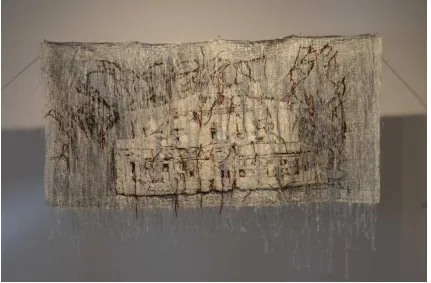
Figure 8: “Next to a River,”122 cm X 46 cm, Hand embroidery on layered fabric, 2017 ... 31
Figure 9: “Next to a River” (detail) 122 cm X 46 cm, Hand embroidery on layered fabric, 2017 ... 32
Figure 10: “The Journey of Three Hundred Meters,” 31 cm x 36 cm (approx), hand embroidery on layered fabric, 2018 ... 32
Figure 11: “Anticipation,” 190 cm X 135 cm, Hand embroidery on layered fabric, 2017 ... 33
Figure 12: “…who walks always beside you,” 190 cm x 135 cm, Hand embroidery on layered fabric, 2017 ... 35
Figure 13: “…who walks always beside you,” (Installation shot), 190 cm x 135 cm, Hand embroidery on layered fabric, 2017 ... 36
Figure 14: “What are the roots that clutch,” 147 cm X 99 cm, Hand embroidery on fabric, 2017 ... 37
Figure 15: “What are the roots that clutch,” (detail), 147 cm X 99 cm, Hand embroidery on fabric, 2017 ... ... 38
Figure 16: “What are the roots that clutch,” (detail), 147 cm X 99 cm, Hand embroidery on fabric, 201739
Figure 17: “Soft Shelter II,” 274 cm x 365 cm, Needlework on tarpaulin, 2018 ... 40
Figure 18: “Soft Shelter II,”(Details), 274 cm x 365 cm, Needlework on tarpaulin, 2018 ... 41
Figure 19: “Soft Shelter II,” (details from a different display), 274 cm x 365 cm, Needlework on
Preface
My artwork and the written documents are two parts of my master’s thesis, which focuses
on how I am looking at identity in context of my very personal experience of a temporary stay in
a new place. I have become more aware of the role of my studio practice as a way to articulate
my social position. Culture, mapping, personal identity, labour, landscapes are some frameworks
around which where my artistic practice developed during the past two years. Indeed,
resemblance, memory, archives, and mapping, play vital roles in shaping my thematic interest.
The materialistic execution of my practice is fundamental to my research, as it makes me
aware of the historical significance and contemporary concern with material adaptation as an
approach in my art practice. Recycling fabric from thrift stores in London, using discarded fabric
from my family and others in India, and employing tarpaulins provided the surfaces for my
embroidery work. Single and layered fabric added significance and resemblance regarding the
embroidered surfaces of the hand-embroidered quilts from Bengal, India.
My interview with artist Jamelie Hassan was a crucial contribution to my thesis as an
opportunity to see my own position, to peruse my artistic research a new, and to perceive her
artistic and critical experiences. They involve ideas about identity regarding personal and
political history, colonial and postcolonial conditions, problems of translation, and a wide range
of analysis of the affects of material practices.
This overall research has an impact on shaping certain experiments I have undertaken to
see and question how the approach to display activates the two dimensionality of an embroidered
artwork. Showing the recto and verso of the embroidered artwork raises the question of how I
understand duality or a binary opposition of any kind. These works enhance and provide
opportunities to explore certain sculptural possibilities, by activating the work within a space
through its installation.
My research journey took a very important turn when I came to join the program at
Western in 2016. At that time, I had a certain understanding and approach to my existing art
I needed to unlearn and to learn a lot about almost every aspect of living here. That
created for me an experience where the feeling of being in a new place started seeping into my
artwork, and it began to raise questions about identity, local and personal history, memory,
archives, mapping and many more concepts. However, I know that these areas are well studied
and researched in many academic domains; my personal interest became wrapped up with
wanting to see how the particular medium of embroidery can link with our fundamental
understanding of the previously mentioned concepts.
Having completed my research and study for now, I acknowledge that my introduction to
different theories and texts through the two years-long coursework gave conceptual and
analytical perspective to my studio practice. My research brought forward awareness that my
studio practice is related to the wider field of studies in cultural identity. I have tried to reflect
and articulate that reality through Michel Foucault, Arjun Appaduari, and Tim Vanderbuilt’s
texts in my thesis. However, I also know that Homi K. Bhabha’s “The Location of Culture” is a
well-suited text and will offer me insights for my further research. Edward Said’s theory on Post
colonialism, Walter D. Mignolo’s theories on historiography, cartography, and culture, and
Arjun Appadurai’s theories on globalization and modernity are future areas to consider, in order
for me to see how my artistic practice can take shape in other ways and further reflect my own
ideas.
I sometimes feel that the approach to research I have used– making with my hands and
reading and looking at the works of others – is a prototype of a larger project. I hope to continue
Introduction
Preamble: Background to My Embroidery Practice
A major motivation for my pursuit of embroidery as an artistic form is my curiosity about
practices such as embroidery becoming ‘cultures’ in their own right. My primary education in
the culture of embroidery first started at my high school, which was one of the first schools for
girls’ education in British India in Calcutta (now Kolkata). Different embroidery techniques were
taught as examples of Indian embroidery, but now I see that they have been widely practiced in
Middle Eastern countries as well. For example, I can see that the use of cross-stitch in Palestine
closely parallels the use of the technique in Bengal, India, where cross-stitch is used to create
ashan, a mat for sitting on the floor made from jute. My educational experiences provided an
opportunity to look at the history and possible origins of different embroidery techniques from
various geographical locations. I have begun discerning the many influences of these
embroidered forms through history, observing movements through spaces that blur the lines
between distinct styles.
Growing up in rural India always imprinted on me a sense of tradition; customs were
passed through many lived, social and ritualized practices. I have seen women from my family
doing embroidery individually or as a collective. The practice has a utility and a function in their
lives because it allows them to produce needed items like mats and clothing. Indeed, even in my
own education, the utility of embroidery was emphasized because I learned embroidery as a
mandatory subject until the eighth standard in my school.
After that education, I moved to Calcutta for high school and completed my
undergraduate education there as well. I spent my early adulthood in that city, watching the
Bengalis adapt to a hybridized life informed by the many British influences layered within the
culture of that city: I started to realize the British influences in the breakfast I most often ate, the
streets I walked, and the buildings in which I studied. I see these experiences as a remaining
effect of the colonial past of India, even after its seventy years of independence from British
power. My identity became more nebulous and yet more shaped by that environment, now that I
reflect on it.
During my undergraduate studies, from 2003 to 2007, I learned different artistic media,
moved to the Deccan Plateau for the first time in 2007 to do my first postgraduate degree (MFA)
at the University of Hyderabad. I chose embroidery again as my artistic practice, but with an
intricate blend influenced by traditional European oil painting.
Now, living in Canada has introduced me to new, quite different cultural experiences in
many facets of my life. Nonetheless, my previous experience in the globalized culture of modern
India has helped me to transition with some semblance of familiarity. My current practice
reconnects with my Indian roots through embroidery, allowing me to reflect on my journey to
this point. For this reason, my embroidery negotiates the ways in which culture, both traditional
and modern, or globalized culture, is conveyed. This definitely brings together the relationship
between the embroidery practice of my family and the political history where embroidery played
an important role in the West. Given the utilitarian or practical functional most people
understand embroidery to provide, I need to navigate how my practice, as art and/or as labour,
Thesis Structure
My written thesis is divided into three linked parts, (1) Extended Artist’s Statements, (2)
Studio Practice Documentation, and (3) Interview with Artist Jamelie Hassan.
Part 1: Extended Artist’s Statement. In this section, I describe how embroidery plays an
important role in my art practice and highlight some historical facts about embroidery. I also
discuss a number of theories that have helped me to articulate my studio practice from the
viewpoint of resemblance, archive, and mapping. Several artists who have motivated me to think
and visualize my own studio practice from a more focused perspective are discussed in relation
to my current thematic and material explorations.
Part 2: Studio Practice Documentation. This section of my thesis is dedicated to documenting
my studio practice: it contains a brief statement about my art production and images of different
projects undertaken in the past two years. The documentation of my studio pieces reveals
personal, theoretical, and medium-related interests across a range of projects. A sense of
narrative flows through each of my art pieces and raises significant questions about my personal
aspirations and social commitments.
Part 3: An Interview with Artist Jamelie Hassan. The interview with Jamelie Hassan, a
London, Ontario based artist plays an essential role in my thesis. My conversation with her was
focused on her practice and where I could connect it with my own. Her conceptual explorations,
alongside material concerns, were fascinating to me. Personal history, traveling, identity, and
theoretical approaches have added different layers to her four decades-long multidisciplinary art
practice. Her evolving relationship with land and geography is an area where I see similarities
with my studio practice, whereas, I could not connect with Hassan regarding the effects of war
and how it reflects on an artist’s practice. Experiencing war was unfamiliar for me, unlike my
friends and their family members who have closely experienced this. The partition between India
and Bangladesh affected numerous families and still how they look at the partition in the
twenty-first century, through memories and across generations – this is important for me.
My own experience of growing up in different places in India and traveling outside India
has fostered a conversation about attachment and detachment at the same time. The complex
this, Hassan’s detailed research-based projects motivate me to look more into my own practice
through a personal and social perspective.
Concluding remarks
The content of this thesis proceeds from and reflects on my studio practice over the last two
years. This research has brought forward important perspectives for me, whereby I have looked
at different theoretical conception in the area of resemblance, knowledge, mapping, archiving,
and at renowned artists’ multidisciplinary art practices.
The thesis is meant to capture the transformation of my material practice, producing hand
embroidered images –the development of which are most often process based. They connect with
my thematic interest in mapping, and with other schematic approaches linked with individual and
personal perceptions developed from attempting to articulate history, culture, and knowledge,
Part 1: Extended Artist’s Statement
My current studio research involves a deep engagement with developing a thematic
and/or conceptual awareness of several domains such as culture, mapping, personal identity,
labour, and space as it relates to my own experiences in a new land. Accompanying these
concerns, hand embroidery plays a vital role as medium of my artistic expression.
I consider that the whole process of a life experience is like the slow formation of an
image on the surface of fabric. The journey of my mind, linked as it is to my hands as they
weave and overlap the thread in each of my pieces of art, recalls the many different layers of
culture, of artistic focus, and of labour that make me what I am as an artist.
My Work
Throughout my early life, I developed a sense of attachment, detachment, and sense of
the relationship between time, architecture, and memory each time we lived in and left a
government flat, always after eliminating the traces of ourselves and of previous families.
Travelling and temporary settlement have been regular occurrences in most of my life so far.
Therefore, a quality of “being in relation” is important to me, and I think about it on different
levels, including with regard to, for example, my relation to a space, to people, or with a text.
The constant shifts and surprises that come with being here now, in London, Ontario, is the
challenge that I decided to consider more deeply and use as the foundation of my work. And,
indeed, the conceptual framework of the MFA program provides me an opportunity to articulate
my relationship with history and contemporary art practices within different geographical
locations, and so London, and Canada generally, is a particularly fitting place for me, given that I
have not experienced this before.
My research for this thesis investigates my studio practice and how it has developed
different trajectories alongside material consciousness with respect to travel, history, memory,
land, culture, mapping, identity, and labour, specifically focusing on hand embroidery. This
important medium that I work with has led me to considerations of the concerns I mentioned
above. And in addition, I should add that there are some texts mentioned in my thesis that have
Embroidery History and Related Background
I understand that the techniques and cultural associations of certain practices, influenced over
time in different cultures and through other factors, have determined the possible origins of
various forms of embroidery. According to historian Stella Kramrisch, printed and painted
calicoes (Palampore) from South India, embroidered cottons from Bengal and Gujarat, and twill
tapestry woven woolen shawls from Kashmir were eventually produced in response to Western
demands, and thus came to be exported in the sixteenth and seventeenth centuries onward.1This
makes me think of the ‘when’ and ‘how’ of art and craft, as well as ideas of commodity culture’s
respective associations with the development of a practice. In the North American context, a
book entitled Needlework through History: An Encyclopedia, by Catherine Amroso Leslie in
addition to an online article on American needlework from the Metropolitan Museum (both
discussed below) have given me a historical background concerning North American
needlework, and I am now able to distinguish two different kinds of practices: (1) a Native
American style and (2) a settler-influenced style.
My embroidery practice has always looked for the most suitable conceptual approach
through which to blend the most appropriate medium and material regarding my intentions to
connect with my immediate surroundings. When I began my embroidery practice, around 2008, I
chose Khadi (a hand-woven cotton textile from India) as my surface for embroidery, and
gradually I looked for a way to treat the surface as meaningfully as possible. Now, I use recycled
fabrics collected from local thrift shops, plastic tarpaulins, and new fabric as well. In my work,
there has always been an attempt to look at this traditional medium and determine how I can
possibly bring a different notion to the ideas already associated with it through my art practice.
Admittedly, I still use hand embroidery mainly on fabric, but I challenge tradition through my
choices about size, the surface to treat with embroidery (the front or back, or both), and the type
of embroidery.
“Embroidery” is a word I use very frequently while talking about my current art practice. In
this part of my thesis, I am attempting to focus on how and why the history of embroidery has
captured my artistic interests and has informed so much of my current practice.
1Stella Kramrisch, “Two Indian Embroideries,” Philadelphia Museum of Art Bulletin52, no. 251 (Autumn, 1956):
The word embroidery comes from the French word broderie, which means
embellishment. As far as my research has shown me, it appears that the possible place of origin
of embroidery is China and the Middle East.2Embroidery appears to have been something which
has traveled across geographies, cultures and peoples, irrespective of the religion, class, or colour
of its practitioners.
According to an essay titled “Textile Production in Europe: Embroidery, 1600–
1800,”published by the Metropolitan Museum, “the term embroidery generally refers to any
textile foundation that is decorated with needle and thread, although embroidery can be worked
on other foundations such as leather.”3I would like to point out another important point that
significantly differentiates embroidery history from that of other textiles: Embroidery is “not
bound by a geometric foundation as on a loom.”4It requires the attempt to make a pattern-based
or pictorial composition, and it involves a needle and thread, which may be used variably, with
cotton or strong grass, for example. This shows the breadth of possibility of the medium. Thread
and needle and fabric, or any soft pliable surface, are the primary materials for an embroidery art
practitioner, like paint and canvas for a painter. In recent times, we see embroidery practice
within various domains, informing individual or social identity across a spectrum of cultures.
According to scholar Avinash Tripathy, human beings probably practiced needlework
before they had been exposed to the use of fire.5 As they migrated into new environments, early
modern humans would have stitched together the skins of their pets and animals to protect their
naked bodies from the cold and rain. In this respect, the origins of needlework are rooted in a
very necessary utility: protection from the elements. Yet needlework, and more specifically
embroidery, did not remain entirely utilitarian for long. By the time of the first major human
civilizations, embroidery had become a common practice for decorating royal clothing. In other
words, by at least 6500 B.C.E., needlework had progressed from a practice intended to create
objects of practical value to an aesthetic practice that produced objects whose value was based
2. Catherine Amoroso Leslie, Needlework through History: An Encyclopedia. Westport, Connecticut, London:
Greenwood Press, 2007).
3
. Melinda Watt, “Textile Production in Europe: Embroidery, 1600–1800,”Heilbrunn Timeline of Art History, The
Metropolitan Museum of Art, October
2003,https://www.google.com/url?sa=t&rct=j&q=&esrc=s&source=web&cd=1&cad=rja&uact=8&ved=0ahUKEwj Vn4HW3ZzcAhUk54MKHUC0Cx0QFggnMAA&url=https%3A%2F%2Fwww.metmuseum.org%2Ftoah%2Fhd%2 Ftxt_e%2Fhd_txt_e.htm&usg=AOvVaw0M58PFK9stcD9abXhhSdZA
on appeal rather than function. This distinction between the practical and artistic dimensions of
embroidery as a practice is one of the major concerns of my thesis work.
This introduction to the historical existence of different types of embroidery techniques
has raised a few concerns, such as the need to understand the transmission of different techniques
to various geographical locations and the difficulties in identifying embroidery’s origins. There
is a strong need to acknowledge embroidery histories and how new approaches can make a
positive impact on pre-existing methods. Such knowledge has helped me to determine my chosen
embroidery style, which suits my current thematic concern best and has motivated me to look at
other contemporary artists who use embroidery as their main medium of art practice and why
they do so.
Theoretical and Textual Interests
My primary chosen texts serve to narrate a story of my thinking processes regarding how
I am trying to understand my studio practice in order to connect with different experiences,
places, and people. Therefore, in the following brief study, I focus my theoretical interests
initially through a text titled “The Four Similitudes,” fromThe Order of Things: An Archaeology
of the Human Sciences, by Michel Foucault,6 where he examines knowledge, cognition, and
resemblance in the universe. I note his four different resemblances between diverse entities in the
universe, or in nature, as the main focus of the text. The next material I unpack is from scholar
Arjun Appadurai’s article titled, “Archive and Aspiration,” wherein he discusses social memory,
the gap between neuro-memory and social memory and how this gap is negotiated. The archive
and its role are crucial to my thinking and I see them as similar to a space, which is fragile but
strong enough to provide a fact, like a soft shelter. A further reading on the idea of mapping is
also important. I therefore write about the text entitled, “Cerebral Cities” by Tom Vanderbilt,
wherein he writes about people’s experience of locations and maps, invoking the concept of the
cognitive map/cognitive collage, which enables us to understand how people remember their
own experiences in order to locate things in place.
Michel Foucault’s The Order of Things: An Archaeology of The Human Science
‘Line’ is the word that stuck in my mind while reading this text. A line here can be with
or without an entity existing in nature or can even exist within the self. It can suggest the way I
feel connected with things and people around me and beyond my reach. Prior to reading this
book The Order of Things: An Archaeology of The Human Science, I did not have a very clear
idea as to how to express this feeling of connection—a feeling that persists when I think of
people I know and objects that I connect and live with. Focusing on Foucault’s ideas of
resemblance, I can see direct connections between myself and the people and places that inform
my sense of personal identity, as well as some forgotten ones, which I now remember.
All of these thoughts might not be directly relevant to my work; nonetheless, I went
through a phase of remembrance and connection within myself while reading “The Four
Similitudes,” within the section entitled, “The Prose of the World.” I became interested in
understanding what the four similitudes referred to and in Foucault’s discussion of “resemblance
that organizes the play of symbols, made possible knowledge of things visible and invisible, and
controlled the art of representing them.”7Resemblance and knowledge are some key aspects to
understanding the four similitudes. Here the author makes references to the universe, earth, sky,
plants and paintings in order to define space. Foucault mainly draws upon references to sixteenth
century Western culture and how resemblance played a constructive role in the knowledge of
what was considered extremely valuable. Out of many possible similitudes, he chooses here to
talk about four, which are: Convenientia (convenient: which is sufficiently close to one
another);Aemulatio (emulation: a sort of ‘convenience’ that has been freed from the law of place
and is able to function, without motion, from a distance); Analogy (where convenientia and
aemulatio are superimposed); and Sympathies (sympathy: here no path has been determined in
advance, no distance laid down, no links prescribed). Each and all of these four similitudes made
me think a lot about myself and of my preconceived notion of relationship, in general. From the
very beginning of my encounter with this text, I loved the way the author tried to show the links
between different entities, including between the universe and the earth. The visible, invisible,
touch, reflection, attachment, detachment, closeness, distance, “natural twinship,”“immediately
opposite to one another,” and “the fundamental duplication of the world”… all these concepts
fascinated me!
This part of my study brings to mind my role as an artist and how I am trying to reflect all
my concerns through my art practice while being situated within a new geographical domain.
7
How can I visualize or create a language that reflects these themes? How does my medium
reflect or enhance ideas of temporality and attachment and detachment at the same time?
Arjun Appadurai’s “Archive and Aspiration”
The journey of my mind, linked as it is to my hands as they weave and overlap the
threads in each of my pieces of art, recalls the many different layers of culture, of artistic focus,
and of labour, that make me what I am as an artist. The Appadurai text focuses on social memory
and the gap between externalities and internalities of our memory. He also acknowledges that
there is much excellent research concerning this type of thinking within other academic
disciplines. This includes an explanation of the “Cartesian gap,” in which biochemistry describes
memory and its social location and its functions.8 Of particular interest to me is that a gap exists
between the accuracy of our memories of an event and how exactly that event actually
transpired. An archive, such as a piece of art, allows us to trace our way through to the past
without relying entirely on memory.
But what about anticipation of future events rather than memories of the past? For
example, when I first planned on coming to Canada, my attempts to “know” this place by
reading about it and studying its culture, presumably a “vital space,” did not adequately prepare
me for what I experienced when arrived here in the actual, physical space. In this respect, the
archive gave me an “incomplete experience” of knowing a place. This suggests to me a question
about how I, as an artist, could possibly map an experience of both physical and virtual space
through my practice, to link the social and geographical proximity of “Canada” to myself.
Appadurai’s article helped me to understand and question what an archive is and what the role of
accidental traces might be. He explains that Foucault wanted us to see the archive according to
its panoptical function, but the archive is also a “product of the anticipation of collective
memory.” 9
I feel that this description connects well with a Marxist notion concerning labour that I
see as important to my work. Specifically, the way in which average people have used media like
embroidery (which is often seemingly attached to industrial labour practices) to instead tell their
own stories and enhance their own collective memories disrupts Foucault’s notion that all
8.Arjun Appadurai, “Archive and Aspiration,” in Information is Alive, ed. Joke Brouwer and Arjen Mulder
(Rotterdam: V2_Publishing/NAI Publishers, 2003), 14-25.
archives might be instruments of state control. I think that artists wrest that control from the state
when they create work that prioritizes their own viewpoints and values.
In the chapter titled “Migration, Memory and Archival,”Appadurai refers to his 1996
book Modernity at Large to suggest how, in this time of globalization, “the circulation of media
images and the movement of migrants [has] created new disjunctures between location,
imagination and identity.”10 To explain these disjunctures, he talks about how “moving images
meet mobile audiences” to highlight the destabilization of sender-receiver models of mass
communication whenever the media exerts its influence on migrant populations.11 This condition
potentially creates an increased number of imagined worlds and imagined selves. “The capacity
to aspire” is the important phrase he mentions in talking about both current migrants and those
from a historical perspective.”12 What are the expectations migrants might have when they move,
either to escape from a horrible life, to seek a better life elsewhere, or, in some cases, due to both
of those motivations? Appadurai’s point is that, thanks to social media, migrants can access other
people’s stories and experiences to inform their own journeys and their constitutions of their
possible selves.
Memory is very important for a migrant in many ways, and media always plays a crucial
role in revealing “accidental” traces that lead to the archive. According to Appadurai, diasporic
stories always suggest breaks or gaps, which is why migrants always look for images or
narratives of their own stories to build diasporic or migrant archives. Later, he argues that, “the
migrant archive cannot afford the illusion that traces are accidents, …and that archives are
repositories of the luck of material survival” because the stories are, themselves, more powerful
and a greater influence on how migrants situate themselves in their “new world.”13because the
stories are, themselves, more powerful and a greater influence on how migrants situate
themselves in their “new world”. And, as Appadurai further explains, “collective memory [is] an
ethical basis for the sustainable reproduction of cultural identities in the new society. For
migrants, more than for others, the archive is a map.”14
An expansion of the idea of a map in my studio practice considers that same term as a
verb that refers to making. The idea of mapping suggests various ways of understanding a
“place” more than providing spatial information. This could point to a complete or incomplete
understanding or a gap between two ideas or experiences of a setting or location. The concept of
mapping need not have any cartographic reference, as it could be purely cerebral and
experientially based.15 Imagery or mark making in a work may vary between images that
reference and images developed out of the process of embroidery on the fabric. Because
embroidery, as a medium, requires somewhat slow and deliberate movements to continually
draw the thread through the fabric, it allows the artist to deliberate on how it is a unique act of
making that involves both physical and cerebral movements across a space. As an artist and
researcher, I consider the incompleteness of all these experiences and the gap in my
understanding of these different concepts an area of interest.
In the very last part of this article, Appadurai mentions that the archive is always a
meta-intervention because all archives are collections of documents. He further elaborates, saying that
the archive is “not only about memory but about the work of the imagination, about some sort of
social project.”16 An archive is a conscious site of debate and desire through migrants’
perspectives and, through the lens of electronic forms of mediation, “collective memory is
interactively designed and socially produced.”17At the end, he talks about two locations of
memory—neuro-memory and social memory—and their possible different immaterialities and
architectures. But the gap between these two terrains is negotiated by building archives: bodily,
electronically, and institutionally.
In response to the foregoing, I ask, “Can I consider a work of art as an archive?” I feel
through my studio practice, I am trying to capture a transitional phase of portraying cognitive
knowledge, lived experience, and memory as layered information.
Tom Vanderbilt’s “Cerebral Cities”
Vanderbilt’s work expresses the idea that individuals create their own, unique paths through this
world as per their need. I am interested in how Vanderbilt proposes the idea of the imaginary
cognitive map and the perceptions produced by cartography through some interesting examples.
15
. Tom Vanderbilt, “Cerebral Cities,” in Else/Where: New Cartographies of Networks and Territories, ed. Janet Abrams and Peter Hall (University of Minnesota: Design Institute, 2006), 176.
16. Appadurai, “Archive and Aspiration,” 24. 17
One example refers to the activity of giving direction to a stranger to reach a particular spot;
another is from the famous movie Memento, where its main character remembers and overcomes
his disease (called anterograde amnesia), which “prevents people from having short term
memory.”18 Another example involves a survey of taxi drivers where “they were asked to
provide the shortest route between two points without a map.”19 For me, the condition whereby
“a person had formed an internal awareness of a familiar environment, but was unable to render
that knowledge into anything resembling a map: is especially important.20 Vanderbilt mentions
that psychologists and geographers use the terms “cognitive map” and “cognitive collage,”
though the latter one is considered a more “fitting phrase” by Barbara Tversky, a professor of
cognitive studies at Stanford University.21 Many different ways of looking at the relationship
between knowledge and space and how one navigates the two are explored in Vanderbilt’s text.
The effectiveness of this navigation varies according to certain functions of the human brain,
many of which determine gender and knowledge. One term I would like to retain in the context
of my studio practice is the “hippocampus,”which is the place in the human brain where memory
and spatial navigation occur.”22
Reflecting on Vanderbilt, and knitting together ideas from the foregoing texts, I recognize
that my work always starts developing either from my knowledge, spatial experience, or
memory. I lose direct connection with my current state whenever I connect with a different
locus; then I start feeling incomplete because I am not actually in that other place, and so I
suspect I have visualized the connection incompletely through my imagination! It has been said
by cartographers “most cognitive maps not only fail to reflect all the details from environment
they represent, but they also have systematic errors caused by the processes that encode them
into memory.”23 If I believe in this, then I find that it causes me to cast doubt on all the maps
already represented and instead to strongly believe in their changing, illusive qualities.
I wonder how important it is to focus on the idea of the “gap” while navigating a place
through memory and losing its spatial details. Is it possible to navigate the process of
18. Tom Vanderbilt, “Cerebral Cities: An Overview of the Article on Cerebral Cities,” accessed May 27, 2018.
https://cct370-w07.wikispaces.com/Vanderbilt%2C+Tom+%282006%29%2C+Cerebral+Cities
19.Ibid.
20. Vanderbilt, “Cerebral Cities,” 176. 21
. Vanderbilt, “Cerebral Cities,” 177.
understanding a place only through knowledge and imagination? Is it attainable to portray this
idea through an artistic medium? I am exploring navigation as it affects identity in my studio
practice and through witnessing; reflecting on my process and on the products of my work, I try
to understand the possible encounters between technique and ideas and memories.
Artists of Interest
My selections of these artists is informed by my current studio practice and its growing
interests and preoccupations because I feel I can connect my thoughts and interests with their
approaches in some way. Sometimes it is the thematic interest of the artist or their material
exploration that inspires me to think critically about my own approach. In the following
passages, I liberally weave together my observation about my chosen artists with references to
Mrinalini Mukherjee (1949-2015, India)
Figure 1: Mrinalini Mukherjee with her jute sculpture Woman on a Swing in 198924
I will start by describing the life and work of one of my all-time greatest inspirations,
whose art practice compelled me, despite my hesitation, to pursue embroidery as sculpture or
installation medium. Mrinalini Mukherjee (1949-2015, born in Mumbai, India) is one of the
pioneering sculptors working with organic material, weaving in three-dimensional forms
beginning in the 1970s. Coming from an artist family background, Mukherjee’s institutional
education in painting and sculpture is clearly reflected in her practice. In 1978, she went to
continue her studies in the United Kingdom with a British Council scholarship, at West Surrey
Collage of Art and Design in Farnham. She continued her exploration of material with dyed
hemp and sculpture. It is believed that she was interested in this area because she felt she lacked
skill in these processes and so hoped to turn that weakness into a strength.
I am interested in her approach to know how materials such as hem can transform into a
medium of expression. Hemp probably encouraged her confidence, given its familiarity, and also
brought different challenges in terms of its employment on a large scale and in free-standing
sculptural form.
Most of her free-standing soft sculptures represent particular cultural beliefs associated
with nature. In an overview of her practice, I will attempt to sew a connecting thread between her
artistic fears, confidence, cultural roots, and positive challenges to reveal a socially relevant
material that has been embedded (or embedded?), through Mukherjee’s practice, within an
avant-garde vantage point from which to understand her identity. I hope to achieve this same type of
amalgamation in my embroidery practice.
I have always questioned my own material choices reflecting my very personal
experiences, even though I was trained to accept and use different media beyond what I learned
in my institutional education. Her practice gave me the courage to adopt a material that is
culturally rooted and to try executing beyond its preconceived orientation while keeping a
connection to its origin. Indeed, I was introduced to thread as an artistic medium indirectly by
one of my professors Rakhi Peswani in 2008 through her work, but I could not use it
immediately in my own work. It took four years and the life-experience of travelling and living
in different places in India to prepare me for this type of art practice. Nonetheless, Mukherjee’s
Ghada Amer (b. 1963, Cairo, Egypt; currently living and working in New York City)
Figure 2: Ghada Amer, “Julia's Pink,” acrylic, embroidery and gel on canvas, 162.8 x 193.3 cm. 2005.
Ghada Amer (b. 1963) is an inspiration for my material choice and my questions as to how
to “represent” culture in a different location from where I originated through art practice. Her
personal experience of living in different places, from Cairo, Egypt to France and then the USA,
has greatly impacted her art practice in terms of how she understands herself. She says “I did
everything to look like others” to fit into a new culture.25
According to Fereshteh Daftarri, former curator in the Department of Painting and
Sculpture at The Museum of Modern Art, New York (1988 -2009), what we should try to
understand about Amer’s practice is where she is anchored and where she is really “break[ing]
25. FereshtehDaftarri, “Beyond Islamic Roots: Beyond Modernism,”RES: Anthropology and Aesthetics, 43(Spring,
loose and wander[ing] free.”26 Her main practice deals with femininity, colonial identity, and the
Islamic culture she grew up in, intersected materially with an approach to layering embroidery
on canvas. Her particular way of handling thread and imagery builds a language of abstraction
and expressionism.
I am personally drawn to her remarkable materialistic execution, the way she uses hand
embroidery such that her images are intentionally extended, as well as her use of entangled
thread to generate an abstraction for viewers that reveals more than her thematic concerns. Her
technique forms as pectaculer effect or creates a veil over the embroidered overlapped linear
images on the fabric. Forthis, she has been criticized several times in her career.
Ghada Amer’s subject matter is different from mine, but I connect with her and her work
because she confronts many of the same themes, such as identity, migration, and labour.
Anne Wilson (b. 1949, United States)
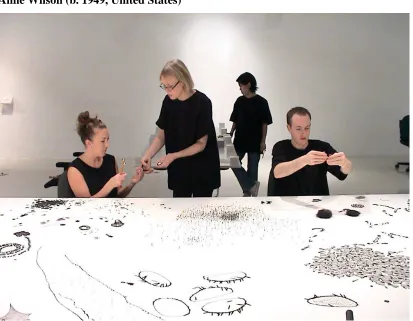
Figure 3: Anne Wilson, Topologies photos: Severo Barreras, George Bouret, Merrill Mason, Stephen Pitkin, Daniel Torrente, Christopher Wiley, Wilson studio27.
As a further influence on my work, I have chosen to discuss artist Anne Wilson, whose
practice deals with many different media of art practice, such as sculpture, drawing,
performance, and video animation. Her projects are research-based and developed from mundane
materials like table linen, bed sheets, human hair, lace, thread, glass, and wire.
I will discuss one of her research-based series called Topologies, which is an important
example that relates to my current interest in the area of mapping. Wilson talks about the scale of
her work and how she reached Topologies through different steps in the development of her
larger art practice.
27
Anne Wilson, “Topologies photos: SeveroBarreras, George Bouret, Merrill Mason, Stephen Pitkin, Daniel
Feast was one of her stitched installation pieces for her solo exhibition at the Museum of
Contemporary Art Chicago in the Fall of 2000. Found clothes and hair were the materials used
for this project, executed on a huge horizontal table 22 feet in length. She addressed themes like
mapping, navigation, architecture, and landscape in this work. The project suggested both micro
and macro worlds through its overall size and the intricate detailed employment of stitching.
Topologies extended from Feast, where Wilson focused on woven structures produced
with damaged clothes and also works with a study of historical lace. How this precious
traditional form became cheap commercial fishnet is also addressed in this project. This piece
was displayed several times after its first execution in 2002. Regarding it, Anne Wilson states,
I set about working within a conceptual structure in creating Topologies that allowed three
references to exist simultaneously: relationships between traditional systems of materiality
(textile networks) and newer systems (Internet and web); microscopic, specimen-like
images of biology and the internal body; and macro views of urban sprawl—systems of
organization of city structures, interdependent or parasitic process of expansion.28
As part of her further research for the project, Wilson focused on ideas of interconnectivity
and relational concepts from recent architectural theory, new media studies, and philosophy. She
thought of the metaphor of landscape, too, in the broadest sense.
Anne Wilson refers to a curatorial statement by the Chicago-based architect Douglas
Garafalo concerning an exhibition he curated. Her thought process for her own series has
similarities with Garafalo’s comment on ideas of alienation and entangled networks present
within given systems and spaces. She also noticed that she has common concerns and interests
with architects, artists, and designers, which definitely connect with and widen her realms of
research.
Speaking as an artist, I may think the same way in terms of my studio practice when I talk
about mapping and my interest in the experience of knowing something. In the series, I am
referring to, Wilson talks about materiality (in regard to textile), newer systems of
communication (Internet and the web), and internal structure of a body, and all of these ideas are
important to my thinking.
28
. Caroline Picard, “Center Field |Threading Infrastructure: An Interview with Anne Wilson,”art21 magazine, last modified May 31, 2011.
Wilson’s material concerns made me consider when she draws attention to the way
traditional lace led to the development of a commoditized object—fishnet—regarding what
happens when lace is used in fragmented ways as part of an artwork. Does it elevate the already
associated history or suggest a new way to look at that material?
In this regard, I see my tarps, with their own associated history as industrial products, as
having more “personal resonance” when they have been used in the way they were intended.
This sort of association between material, daily use, and art is important to me and accounts for
my interest in the work of Anne Wilson.
Britta Marakatt-Labba (b. 1951, Idivuoma, Sweden)
Figure 4: Britta Marakatt-Labba, “History 2003-2007” (details), Embroidery, 2003-200729
Britta Marakatt-Labba is an artist of interest to me, and I have conducted a brief study of
how her art practice is culturally rooted in the history of her birthplace, people, beliefs, and in her
personal upbringing in a large reindeer herding family in Sweden.30
Her early career introduced her to experiences of illustrating books, designing costumes,
and working as a performer. Accordingly, Maine, USA-based freelance writer and editor Katy
29. “Britta Marakatt-Labba,” Textile Forum Blog, October 1st, 2017.
http://www.textile-forum-blog.org/2017/10/britta-marakatt-laba/
Kelleher describes the general content of Marakatt-Labba’s work as, “abstract yet precise images
of her northern landscape.”31
The everyday life of the indigenous Sami people involves the modern and the traditional,
combining “elements of twenty-first century technology with ancient customs, beliefs, and
practices.”32In that spirit, Britta’s practice derives from the very core of her life, people, and the
place she has been living for years. The natural world, changing of seasons, history, culture,
mythology, and political reflection of the Sami people are subjects for her long embroidered
narrative art works.33About her art practice she states, “It is a journey in time and space in which
every stitch breathes experiences and reflection, and creates stories.”34
Britta explains how storytelling was an important part of her life as it was typically
considered a form of relaxation after the hard grind of a working day. This helped her as an
artist, not only offering relaxation, but motivating her to share her own story through her images.
I admire the transparency and capacity to articulate her own life that Britta demonstrates
through her art practice, which is so lucid. I can also connect my interests with her emphasis on
narration and with the slowness of embroidery in the way she uses it. The slowness of
embroidery gives birth to many thoughts, producing moments unconsciously that I can use in my
practice. Britta’s extremely expressive compositions with colour enrich with drawings of human
and animal figures, as well as the sense of vastness, which is ultimately fascinating. As well,
large void areas of fabric draw attention to the embroidered figures in her pieces and produce a
complementary relationship between people and space.
Studio Practice
As an artist, the theories I have encountered and the subsequent thoughts that have
populated my mind have compelled me to challenge myself. Over the time of my MFA, I have
thought about myself and my current studio practice along with the thematic areas I am
exploring, and I have recognized that my concerns about medium, technique, and my interest in
embroidery as a practice have coalesced into a more focused praxis over time. For example, I
now better appreciate how the idea of line as both continuous and broken can be seen in drawing
31
. Katy Kelleher, “Britta Marakatt-Labba’s embroidered scenes of Sami life.”Katy Kelleher, last modified March 16th, 2017. https://katykelleher.com/tag/britta-marakatt-laba/.
32. Ibid.
33. Britta MarakattLabba, “Britta MarakattLabba,”Caught by [UMEÄ] Sweden, accessed DATE,
as well as in hand embroidery. In relation to this, I have considered that the 5th century B.C.E.
philosopher Zeno’s paradox of motion, which, although complicated for me, has led me to
understand the larger ideas of motion, and of movement from one place to another, as applicable
to my own moving from India to Canada. I have also thought of the process of making a line on
a surface with a pencil as similar to following a visible or invisible line on fabric by piercing a
needle and, too, about weaving using the warp and weft. I wonder what is happening when this
third line is traveling back and forth through the existing thread. Sometimes it passes smoothly,
but sometimes it tears the previous two. How does this relate to my experience of immigrating?
A First Experiment—A Meditation
Cutting a thread based on necessity is fundamental. But when making my work, my idea
was to question that notion. It occurred to me that we generally encounter a given length of
thread/rope/wool as a product of industry. I thought of using one whole roll of found thread to
create a form without any cuts as a strategy for my process of embroidery.
The journey of a certain length of thread without any breaks was an important part of one
of my first projects, which used the Japanese embroidery technique Bunka. The work wastitled,
The Journey of Three Hundred Meters. I thought of dyeing the roll of thread with a pigment I
consume everyday when having tea. I also knew I needed a certain needle that would allow the
thread to remain uncut. I chose to use a USA-made cotton thread roll that was 320 metres long. I
immersed it in a brew of Tetley Gold tea bags for four days to infuse the thread with the brown
tint. I also prepared the surface for the embroidery by using two different fabrics from India and
from Canada. Once I began the work, the needle eventually pierced and overlapped with another
needle, which caused two unintentional breaks in my thread, and therefore in my journey. I
consoled myself, however, with the realization that “detachment is an eternal desire for
closeness” and so, in the same respect, I can say (perhaps) that “continuity is the eternal desire
for interruption” because no journey is without complications. (I saw these texts on one of my
friend’s personal posts on social media a while ago, so I cannot attribute them beyond that.)
In making the work I am describing, I simultaneously experienced my own thinking
process and the technique of embroidering the long thread without any separation. I should say
that the thread separated three times—due to the overlapped piercing I mentioned and also an
finger. Small, visible embroidered threads come to look like contiguous dots, which create a
continuous line. The process of making this work started from a dot, and the needle travelled
across the fabric and slowly expanded the developing form of a circle on the fabric’s surface.
When I began, I was not sure how this particular process of needlework would develop a form on
the surface of the fabric. I started from the approximate centre of the fabric and the form slowly
grew and spread out to a circular form, which connected the layers of the two fabrics I was
bringing together. Making the work, my eyes were stuck on to the “point” where the needle was
piercing the fabric. I slowly developed the “dot,” with many dots becoming a bigger form. This
entire dot holds both fabrics together as a result of my journey. In the process, I feel happy and
proud both to use my hand and with the labour involved in this method.
I grew up with limited infrastructure and resources. I prefer to work as an artist with a
minimum of required resources. I am not yet sure how to fully understand or analyze the amount
of time and labour involved in the method of working I just described. But, I know that the
articulation between thinking and producing a work of art is an area with which I increasingly
am interested in working. At this point, I am certain that I must consider thread as any other
formal material such as paint, clay, or wood in art practice in order to move beyond any essential
idea of a genre.
Thematic Developments and My Working Method
This first work with the new method motivated me to try to carefully articulate my
embroidery method in a way that connects toeach thematic interest. Indeed, I started
incorporating this thinking alongside my experience of unfamiliarity and newness when I arrived
in Canada. My initial experienceof being here was fresh and challenging, and my work
developed slowly. It was challenging to portray these thoughts through my studio practiceas it
overlaps and compares with my other experiences of traveling and living in places like India and
the United Kingdom.
I always enjoy the process of remembering: I started making notes about my expectations
before coming here to Canada.
In the beginning of my studio practice here, I bought fabric from thrift stores to address my
interest, including the materialistic touch like cloths of local people within my projects as part of
my new experience. Fusing this local used material from thrift store with new fresh fabric from
used fabric from a thrift store in London to allude to my sensitivity about being“welcome.” The
technique Bunka, and the use of recto and verso, which invokes the binary opposition on each
side of the fabric, enhanced my commitment to linking known and unknown factors visually.
This method unexpectedly conferred the visual effect of a reference to land due to the tactile
development of the surface of the fabric. This was not done to represent any particular
cartographic image, but rather provided a sense of one unintentionally. Ultimately, anonymous
embroidered landscapes became the base motif of most of the pieces.
A sense of “temporary presence” was an inevitable thought in my mind, and I needed a
way to reflect this in my work. But living for two years in Canada wasn’t a misplacement or
displacement for me; rather, it was a chosen or earned placement, which I cherish.
The tent became an important idea for me, more than as an architectural form. This form
changed and has become more simplified or minimal in my recent pieces. Using the geometric
form of a parallelogram or rumbas to represent one roof of a tent became vital for me. I wanted
to experience repeatedly embroidering one form hundreds of times, with different compositions,
on tarpaulin. I wonder whether this process enhances the importance of the idea of tent or if it
dissolves its significance.
The tarpaulin is a new material for me to explore with hand embroidery. The series of my
three embroidered works on tarpaulin brought together the idea a commodity product and care.
Tents are generally made of tarpaulin, and tarpaulin has many more uses as well. Tents, of
course, have different cultural connotations. For me, a tent may be a temporary shelter of hope
and optimism. The scale of each tarpaulin certainly presented a challenge to me in how to handle
it while doing the needlework. I had to stand to embroider rather than having the surface on my
lap. I enjoyed seeing my developing images appear on the surface through the process of
embroidery. I came to believe that both the given material of the tarpaulin and its size become an
important part of each work.
The display of the embroidered pieces was an area I really wanted to work on to activate
the surrounding space. I wanted to work on the display of certain pieces to convey curiosity
when the viewer looks at the workin order to emulate an incomplete experience. Two
dimensional embroidered pieces also activate the space when I put them close to the wall while
translucency and opacity of the surface acts as a key factor to emphasis interesting visual and
tactile effects, with the help of various sources of light.
Conclusion
This chapter is dedicated to understanding a “known” medium with more clarity. The
conceptual supports I investigated opened up my relationship with history, theoretical ideas, and
related contemporary art practices that I have investigated over the course of the past two years.
Conceptual aspects of resemblance, archiving, and mapping have enabled me to explore certain
possibilities in order to understand mapping and related strategies through traditional embroidery
techniques. These understandings reveal the interdependency between the medium and the
image. Additionally, the thinking processes and various media used by the chosen artists helped
me to investigate my own practice technically in order to reflect on my inspirations and then
articulate them. This enhanced my understanding of the critical quality inherent to the technical
adaptations within my studio practice. These aspects of my studio practice are discussed further
Part 2: Studio Practice Documentation
Material choices have been a major part of my two-year long studio practice at Western. I
have used new fabric from India and Canada, and I have used fabric from Canada bought at the
thrift store, too. Some of my embroidered pieces have used material from a sari belonging to my
mother. I always use these fabrics in layers in order to bring these different places and emotions
to the surface in order to create a new image of my current experience. Layering fabric comes
from the Kantha technique, but I add my personal interpretations when using this technique.
Another major technique I have used is kind of Japanese needlework called Bunka,which
originated in the beginning of the twentieth century in Japan, along with running and back stitch.
Bunka is not a popular technique for most of the embroiderers I have met because of the delicate
handling it requires. I, however, appreciate its fragile quality, which signifies my sense of the
impermanence of my identity, since the thread can easily pull away from the surface, erasing the
image but leaving the needle hole on the surface of the fabric.
I experience many different feelings while working on my pieces using Bunka, as it creates
a very significant sound quality during each piercing. Attention to this could contribute to
something meditative in that my conscious mind “dissolves” and reaches a “saturation point,”
but I am always brought suddenly back to physical reality when the needle pierces my fingertip
instead of the material. Despite the occasional pain of the process, I enjoy creating these images
on the fabric’s surface while at the same time using the image to bind together several layers of
different materials, which, though in some cases unseen, nevertheless contribute to each piece’s
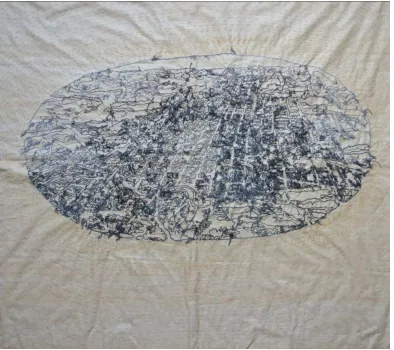
Figure 5: “Map of London” (image reference from St George-Grosvenor Heritage Conservation District Study. Volume II Appendix A. 2016. City of London, Ontario, Canada.), 105 cm x 95 cm, Hand embroidery on layered fabric, 2016-17
The work displayed in Figure 2, “Map of London,” is the result of a newcomer’s desire to
see the Forest City, London, from a historical perspective. The work is based on the image of a
1893 “bird’s eye view” of the city from a lithograph printed by the Toronto Lithographing
Company.1I have used two layers of fabric, one from India and one from Canada. I have used a
1 . St George-Grosvenor Heritage Conservation District Study. Volume II Appendix A. 2016. City of London,
Ontario, Canada.
https://www.google.com/url?sa=t&rct=j&q=&esrc=s&source=web&cd=1&cad=rja&uact=8&ved=0ahUKEwj-
ofeGjZXcAhVIiqwKHY1VCRwQFggoMAA&url=https%3A%2F%2Fwww.london.ca%2FAbout-
running stitch to bind the layers of fabric in a style similar to Kantha, the handmade quilt
approach from Bengal, India that is famous for capturing different images of mundane
life.Bunka is used for the map and, in the process of making the image, the approach brought
both pieces of the fabric together.
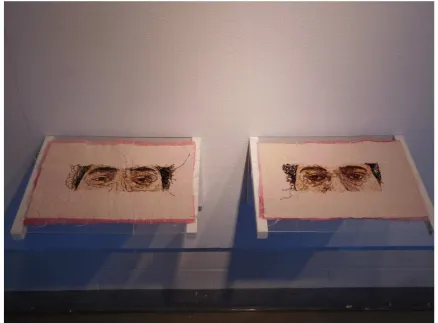
Figure 6: “Binary gaze,” 27 cm x 39 cm, Hand embroidery layered fabric, 2017
This piece, titled “Binary Gaze” (fig 6), further enhances the idea of the gaze and depicts
both clear and blurred gazes together. This juxtaposition reflects my simultaneous feelings of the
known and the unknown. Both the pieces have three layers of fabric from India, Canada, and my
mother’s sari in order to emulate Kantha and to share my history. For each piece, I stitched one
eye from the recto side and one from the verso side, with the result that each piece has both a
clearly defined eye and a more indistinct eye. In one piece of embroidery, a viewer focuses on
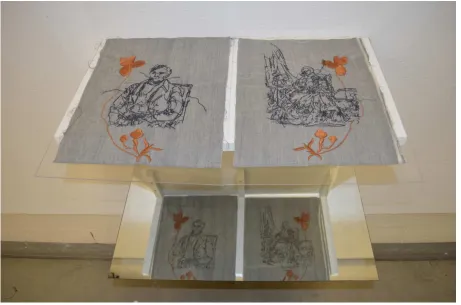
Figure 7: “Knowing John Harris and Amelia Harris,” 31 cm x 39 cm, Hand embroidery on layered fabric, 2017
One of the important and widely known families from the city of London is the Harris
family. The first occupants of Eldon House, John Harris (1782-1850) and Amelia Harris
(1798-1882) are the subjects for “Knowing John Harris and Amelia Harris” (fig. 7), which
demonstrates my developing knowledge of their contributions to the local political scene from
the early to mid-19th century. Seeing the other side of the work through the reflection on the
mirror brings the two-dimensional work into the realm of installation. Looking through a mirror
has many different readings in academic texts, but I wanted to reveal the other half of my