USE OF COMPUTER ASSISTED INSTRUCTION FOR TEACHING AND LEARNING IN PUBLIC SECONDARY SCHOOLS IN
KIRINYAGA COUNTY, KENYA
BY
KIROGO ROSEMARY WANGATHU E55/20095/2012
A THESIS SUBMITTED IN PARTIAL FULFILLMENT OF THE
REQUIREMENTS FOR THE AWARD OF THE DEGREE OF
MASTER OF EDUCATION (EDUCATION TECHNOLOGY)
IN THE SCHOOL OF EDUCATION,
KENYATTA UNIVERSITY.
DECLARATION
This thesis is my original work and has not been presented for a degree in any other university.
Signature……….. Date…………..…. Kirogo Rosemary Wangathu -E55/20095/2012
Department of Educational Communication and Technology Kenyatta University.
SUPERVISORS
We confirm that the work reported in this thesis was carried out by this candidate under our supervision.
Signature……… Date……… Prof. Nicholas Twoli
Department of Educational Communication and Technology Kenyatta University.
Signature………..…. Date:……….. Dr. David Khatete
DEDICATION
ACKNOWLEDGEMENT
I wish to thank the Almighty God for sustaining and keeping me up to this moment and granting me peace, knowledge, wisdom and a chance to get this far.
I also take this opportunity to express my profound gratitude and deep regards to my supervisors, Professor Nicholas Twoli, Dr. David Khatete and the late Dr. Ndichu Gitau (May his soul rest in eternal peace) for their guidance and friendly advice during this work. I would also wish to express my warm thanks to all my lecturers who taught and guided me in coursework and to my colleague students for their moral support.
The completion of this thesis could not have been possible without the unwavering support of my loving husband. I also thank my three children for their understanding when I had to be away from the family to do this work. Deep appreciation also goes to all those who assisted me in typesetting and editing this thesis.
TABLE OF CONTENTS
Declaration ... ii
Dedication ... iii
Acknowledgements ... iv
Table of Contents ... v
List of Tables ... viii
List of Figures ... ix
Abbreviations and Acronyms ... x
Abstract ... xi
CHAPTER ONE: INTRODUCTION 1.0 Background of the study ... 1
1.1 Statement of the Problem ... 7
1.2 Purpose of the Study ... 8
1.3 Objectives of the Study ... 8
1.4 Research Question ... 9
1.5 Significance of the Study ... 9
1.6 Limitations of the Study ... 10
1.7 Basic Assumptions ... 10
1.8 Theoretical framework... 10
1.9 Conceptual framework... 16
1.10 Operational Definitions of terms ... 18
CHAPTER TWO: LITERATURE REVIEW 2.0 Introduction ... 20
2.1 Review of related Literature outside Kenya ... 21
2.2 Review of related literature in Kenya ... 24
2.2.1 Availability of computers in schools in Kenya ... 24
2.2.2 Accessibility of computers for use by teachers and students ... 26
2.2.4 Teachers and students’ perception towards the use of computers in teaching and
learning……….………...………...28
2.2.5 Computer Assisted Instruction support from stakeholders ... 29
2.3 Chapter summary ... 30
CHAPTER THREE: METHODOLOGY 3.0 Introduction ... 33
3.1 Research design ... 33
3.1.1 Study variables ... 35
3.2 Locale of the study ... 35
3.3 Target population ... 36
3.4 Sampling techniques and sample size ... 36
3.4.1Sample techniques ... 36
3.4.2 Sample size ... 36
3.5 Construction of the research instruments ... 37
3.5.1 Interview schedules for principals ... 38
3.5.2 Questionnaires for teachers and students ... 38
3.5.3 Observation checklist... 39
3.6 Pilot study ... 39
3.6.1 Validity ... 39
3.6.2 Reliability ... 40
3.7 Data collection procedures ... 40
3.8 Data analysis ... 41
3.9 Logistical and ethical considerations... 41
3.10 Chapter summary ... 42
CHAPTER FOUR: DATA ANALYSIS, PRESENTATION AND DISCUSSION 4.1 Introduction ... 43
4.2 Demographic information of the study respondents ... 44
4.3 Availability of CAI resources in schools ... 46
4.4 Accessibility of computers for use by teachers and students ... 50
4.5 Knowledge and skills on the use of technologies by teachers and students ... 55
4.6 Perceptions towards use of CAI in teaching and learning ... 60
CHAPTER FIVE: SUMMARY, CONCLUSION AND RECOMMENDATION
5.1 Introduction ... 67
5 .2 Summary of the findings... 67
5.3 Conclusions ... 70
5.4 Recommendations of the study ... 71
5.5 Areas for further research ... 72
REFERENCES ... 73
APPENDICES ... 77
Appendix I: Consent form ... 77
Appendix II: Questionnaire for teachers ... 78
Appendix III: Questionnaire for students ... 84
Appendix IV: Interview schedule for principals ... 88
Appendix V: Observation checklist ... 94
Appendix VI: Research authorization from the university ... 95
Appendix VII: Research authorization from NACOSTI ... 96
Appendix VIII: Research permit ... 97
LIST OF TABLES
Table 1.1: The Actions model ... 15
Table 3.1: Sample grid for schools ... 37
Table 3.2: Sample grid for students, teachers and principals ... 37
Table 4.1: Demographic characteristics of the teachers ... 44
Table 4.2: Teachers responses on availability of CAI resources in schools... 47
Table 4.3: Computer-learner ratio ... 48
Table 4.4: Availability of CAI resources ... 49
Table 4.5: Students’ accessibility to computers for learning ... 50
Table 4.6: Students responses on CAI resources accessibility ... 51
Table 4.7: Teachers response on the accessibility of CAI resources for use ... 54
Table 4.8: Students and teachers rating on their ability to use computers ... 56
Table 4.9: Teachers and students responses on alternatives taken when a computer problem is experienced ... 59
Table 4.10: Teachers and students rating on their experience with computers ... 60
LIST OF FIGURES
Figure 1.1: Conceptual Framework... 17
Figure 3.1: Research design and process of the study... 34
Figure 4.1: Students demographic information ... 46
Figure 4.2: Students’ accessibility to DVDs, VCDs, CDs, Flash discs and online resources ... 53
Figure 4.3: Teachers training on computer use ... 57
Figure 4.4: Teachers level of computer training ... 58
Figure 4.5: Computer adequacies to support CAI use in schools ... 64
LIST OF ABBREVIATIONS AND ACRONYMS
CAI-Computer Assisted Instruction
CD-Compact Disc
CDE-County Director of Education
CFSK-Computer for Schools Kenya
CIT-Conventional Instructional Techniques
DVD-Digital Versatile Disc
EFA-Education for All
GOK-Government of Kenya
ICT-Information Communication Technology
IT- Information Technology
KCSE-Kenya Certificate of Secondary Education
KESSP-Kenya Education Sector Support Programme
MOE-Ministry of Education
MoEST-Ministry of Education Science and Technology
NACOSTI-National Council for Science and Technology
NGO- Non Governmental Organization
NI3C-National ICT Innovation and Integration Centre
PA- Parents Association
SPSS-Statistical Package for Social Sciences
ABSTRACT
CHAPTER ONE
INTRODUCTION
1.0Background of the study
Education is a key pillar in the economic, political as well as social growth of any nation. On the whole, the success of the government’s overall development strategy will depend on the provision of education and training to all Kenyans. (Republic of Kenya, (2004)). This is why the Kenyan government embraced the EFA movement and took up the cause of providing basic education for all learners. It’s paramount to note that the world in which we live has greatly changed. Our learners have moved into the digital age. Meanwhile our learning institutions continue to function on the ideas and theories from the past. This leads to a disconnect between students and the institutions they attend. Instruction is primarily based on teacher talking in classrooms, textbooks, memorization, and content-based tests; schools are becoming increasingly out of touch with the world around them (Kelly, McCain and Jukes, (2009)). Learning needs to reflect the latest digital reality as well as instructional methods. It ought to incorporate the most recent technological tools to maximize the learning experience for the learners. Online technology together with computers that can perform tasks will change the learning setting with powerful tools for discovery learning in the very near future.
divide, they then will be able to lead students over the bridge (Kobus, (2009)). Efforts to integrate ICT in education in many countries have called for massive injection of funds into the education sector. This is upon realization that the world has become a global village due to the overwhelming changes in technology. This has led to changes in the labour market. In order to fit in this global village and meet this labour demands, the Kenyan education system is compelled to make certain changes in the curriculum content and most importantly in the delivery methods. Stakeholders in the education system ought to understand and embrace the 21st Century skills within the framework of its academic standards. Learning institutions must also become accustomed to these changes and fully bridge the gap between how the students live and the way they learn (MOEST, (2013)).The challenge is to rise above traditional methods of teaching and change instructional practices in ways which mirror the changing social, political as well as economic setting in which 21st Century learner will be taught. Kenyans are now aware of the valuable role of technology in teaching as well as learning effectively. All the same the country has not managed to make noteworthy progress in improving education by use of Computer Assisted Instruction.
information. Access to computers in schools expose the young and growing population to ICT that they can use to expand their knowledge to meet their training requirements as well as global competitiveness (MOEST and NACST, (2010)). Important to note is that developing capacity to ICT use contributes to lifelong learning skills which support the country’s knowledge information and skills. The worrying trend is that most learners to date are still being taught in a similar way as their parents were, using, text book based learning and teaching that is teacher centered. The computer definitely holds greater promise in the instructional process in comparison to other media for instance books and chalkboard that have been used for instructional practices for a long time. Audio visual materials usually increase the children’s interest (Ayot and Patel, (1992)). The computer not only activates the sense of sight, touch and hearing of the users but also provides elevated interactive possibility for the users to develop individual academic and creative abilities. Reforms in the way we teach at all levels and all disciplines is needed.
Most schools are restructuring to accommodate computer as an instructional resource. Schools also acknowledge that computers enhance administrative functions. Computerizing schools requires investment in equipment, professional development and teacher training, technical support, internet connectivity and digital learning process or content. Highly relevant content for Kenyan schools is important if we are to effectively tap into the potential of CAI. Previously the computer was thought of as an expensive device suitable only for mathematicians and scientists. It is believed that in the near future, computers will be part and parcel of every lesson. Teachers need to embrace this technology and exploit its potential. Parents on the other hand should encourage their children to use computers for a variety of activities which promote learning. When used properly, the computer is actually a very powerful tool for supporting teaching and learning in both the home and the school. (Griffin and Bash, (1995)).
The potential of CAI is definitely great. It serves to create efficiency and effectiveness in learning at the same time encouraging students to be more actively involved in their own education. Research plus experience has acknowledged that CAI if properly used in the classroom can be of great worth in various ways:
a. Improving students’ retention. It’s interesting and sustains attention.
b. Increasing their motivation to learn. It has been revealed that students get more motivated when the learning activities used are authentic, challenging, at the same time multi-disciplinary and multi-sensorial. It stimulates sensory and cognitive curiosity.
d. Enable learners to access both local and worldwide information from the internet and World Wide Web.
e. Offer an opportunity to communicate, share research, at the same time join projects across geographical boarders.
f. The fact that computer is an interactive media allows learners and teachers to progress at different speeds depending on the existing circumstances.
One vital step to bridge the digital gap is introducing computers and related infrastructure as medium of instruction in schools. From as far back as the 1980s, developed nations have made integration of ICTs in education obligatory. This is not the case in developing countries such as Kenya. In Kenya ICT integration in education is by far more recent, in small scale and rather preliminary. Not in doubt however, is the fact that ICT has potential to play a very powerful role in upgrading resources at the same time improving the learning environment. ICTs can also play a part in preparing students for acquisition of skills, competencies as well as socio skills that are essential for competing in the up-and-coming global “knowledge economies” (MOE, (2006)).
utilization of ICT in the classroom in countries such as Rwanda, Singapore and Malaysia. He also recognized the significance of ICT use in education. He described it as a language that can be utilized to teach a range of subjects in the classroom. (www.vvob.be/kenya/content/nationalICT). There is no doubt therefore that technology especially computer has a critical role to play in helping education deliver its mandate. This hence makes CAI an indispensable tool in the education sector.
1.1 Statement of the Problem
In Kenya, the ministry of education through the Kenya Education Sector Support Programme (KESSP) feature ICT as one of the priority areas with the intention of mainstreaming computers into the teaching and learning process. The country is also rapidly and heavily investing in computer technology for use in digital content and curriculum delivery in schools. Despite these numerous investments, preferred learning outcomes are yet to be realized.
The computer is considered to be an influential learning resource and when used alongside the traditional instructional method it has positive effects on the teaching and learning process such as focusing on subject specific content, better critical thinking skills coupled with scientific enquiry.
Cain and Jukes, (2009)).Majority of teachers also don’t make real use of computers in instruction despite its numerous benefits.
It is upon the realization that use of CAI in Kenya has not yet yielded adequate results that the study sought to look into whether CAI is being used in secondary schools in Kirinyaga County. The study therefore intended to investigate the challenges faced and efforts made to address them in a bid to create a dynamic learning experience that directly benefits students.
1.2 Purpose of the Study
The purpose of this study was to assess the use of computer assisted instruction in teaching and learning in selected public secondary schools in Kirinyaga County, Kenya.
1.3 Objectives of the Study
CAI in the teaching and learning process should be the norm rather than the exception, the key objective of the study was to assess the use of computer assisted instruction in teaching and learning in selected public secondary schools in Kirinyaga County, Kenya.
This study was guided by the objectives below;
a. To establish availability of computers in the schools for use by teachers and students in teaching and learning.
b. To examine accessibility of computers for use by the teachers and students. c. To ascertain the extent of knowledge and skills on the use of these
d. To determine the perception of teachers and students’ towards the use of CAI in teaching and learning.
e. To establish whether the use of CAI has support from other stakeholders in the schools.
1.4Research Questions
Below are the research questions that guided the researcher in order to achieve the stated objectives;
a. What is the computer-learner ratio in the school?
b. Are these computers always available /accessible for use any time there is need to use them for teaching and learning?
c. To what level are the teachers and students prepared in terms of training in embracing use of CAI?
d. Is it necessary to use CAI for the teaching and learning of different subjects in the school?
e. How ready/willing are the stakeholders in as far as supporting CAI in schools is concerned?
1.5Significance of the Study
Secondly, it will enable the teachers inculcate within themselves a result oriented culture producing students who will compete favorably in the global job market. The findings will also be helpful to the MOEST for the purpose of formulating and effectively implementing ICT Policy of 2006. Moreover, the findings of the study will be of benefit to the curriculum developers in developing ICT curriculum that would maximize the potential of CAI in Education. The study will also attempt to contribute to the research in this area by reporting on the challenges of using CAI in secondary schools with a view to having them addressed and hence establish best practice in education.
1.6 Limitations of the Study
Financial constraints were experienced especially during data collection while time constraints limited the researcher to Kirinyaga County. Another limitation was that the study was confined to public secondary schools only. Consequently, the findings of the study may not be a reflection of a true picture of the whole country and may be difficult to generalize. The study involved form three (3) students, teachers and principals. Other stakeholders were not involved.
1.7 Basic Assumptions
The study was based on the basic assumptions that:
a. The respondents were willing to participate in the study freely without fear. b. The respondents were co-operative in providing reliable responses.
c. That the respondents were honest and responded to the research instruments truthfully so that the findings were objective.
1.8 Theoretical framework
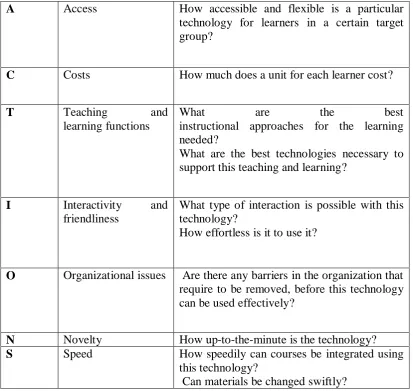
statement of the problem and enhance the development of explanation. This study was be guided by Bates’ 1995 model on learning – The ‘ACTIONS’ Model.
‘ACTIONS’ stand for:
A- Access: Refers to how a particular technology is accessible for learners. C-Costs: How much does each technology cost?
T- Teaching and learning functions: Considers some of the best teaching
applications for this technology.
I- Interactivity and user friendliness: Is the technology easy to use?
O- Organizational issues: Are there changes in organization that require to be made?
N- Novelty: Is the technology the latest in the market?
S – Speed: With what speed can courses be integrated with this technology?
It’s important to note that technologies ought to be adopted only if they contribute positively to students’ learning.
1.8.1 Access
1.8.2 Costs
The cost connected with using CAI normally includes principal cost for buying the equipment. Operational costs together with instructional development costs, staff costs and cost of maintenance also need to be factored in. It is imperative to address how funds will be raised for sustenance of systems and services. The main recurrent cost elements which need to be considered are cost of internet connections; cost of maintaining the equipment and applications coupled with cost of replacement of equipment bearing in mind that a computer which is bought today has to be replaced in either three to four years time. Allowances for ICT professionals must also be considered. According to Bates, (1995) cost is a strong discriminator between technologies and is normally the first issue considered by institutional decision- makers. Differentiating between the costs of one – way and two – way technologies is therefore necessary. Generally, one – way technologies for instance print and audio have high initial production costs but on the other hand lower on- going costs while technologies that are two – way for instance conferencing which is computer based are relatively less expensive to set up but may have higher ongoing costs. 1.8.3 Teaching and learning functions
1.8.4 Interaction and user friendliness
It’s imperative for the learners and learning materials, other learners and the teacher to interact for the learning process to go on. It’s necessary that learning resources and activities are made as interactive as possible in order to achieve quality in teaching and learning. The degree and type of interaction differs to a great extent between technologies. Online conferencing generally encourages learner-learner exchanges and two-way learning while websites produced by simply repackaging the existing paper based-resources simply offer negligible interactivity and produce slight effect on learning outcomes.
1.8.5 Organizational issues
The extent of support offered by the organization to a technology is a major determiner of its long- term success. Besides insufficient training, educators frequently note that lack of computer support prohibits their use of technology (Ivers, (2003)). In order to ensure effective adoption of technologies it is necessary to consider additional staff development and training, changes in administrative structures and procedures together with improving technical support for staff and students. Eventually, schools will have to go through considerable structural adjustments to keep at the same pace with technological advances.
technologies to help meet the needs of the twenty- first century are needed. (Bates, (1997)).
1.8.6 Novelty
The newness of a technology may be an essential factor in attracting initial funding or obtaining new equipment. Students tend to react excitedly to the use of new technologies in instruction which may then lead to improved performance. This improvement is bound to be short lived unless the technology is able to deliver more effective learning in a sustainable and consistent way.
1.8.7 Speed
Table I.1: The ACTIONS Model used for selecting educational technologies
A Access How accessible and flexible is a particular technology for learners in a certain target group?
C Costs How much does a unit for each learner cost?
T Teaching and
learning functions
What are the best instructional approaches for the learning
needed?
What are the best technologies necessary to support this teaching and learning?
I Interactivity and
friendliness
What type of interaction is possible with this technology?
How effortless is it to use it?
O Organizational issues Are there any barriers in the organization that require to be removed, before this technology can be used effectively?
N Novelty How up-to-the-minute is the technology?
S Speed How speedily can courses be integrated using
this technology?
Can materials be changed swiftly? Source: Bates (1995)
1.8.8. Summary of the theory
Bates’ model on learning argues that in order to meet secondary and workplace
use for the design of e-instruction and is also useful in the development of classroom learning.
1.9 Conceptual framework
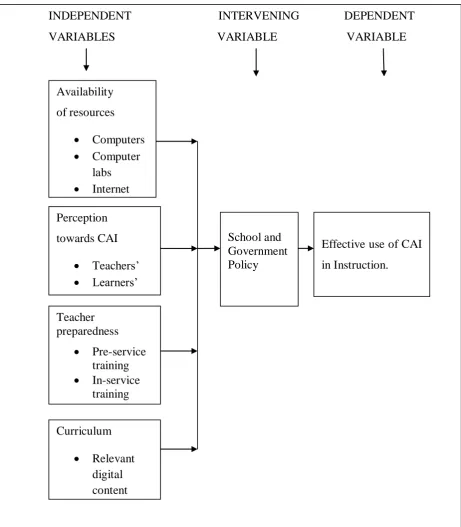
A conceptual framework basically uses drawings and diagrams to explain the interrelationships between the main variables. These variables together with other related factors are put in boxes and arrows are used to indicate the interconnections between them (Orodho,(2009)). The conceptual framework for this study was developed from the reviewed related literature and the theoretical framework. The conceptual framework below (figure 1) shows how dependent and independent variables relate. The independent variables for this study included:
a. Availability of resources.
b. Teacher/student perception towards use of CAI. c. Teacher preparedness.
d. Availability of relevant digital content.
INDEPENDENT INTERVENING DEPENDENT
VARIABLES VARIABLE VARIABLE
Figure 1.1. Conceptual Framework
Adapted from: Maina, P.N. Unpublished M.Ed Thesis (2015)
INDEPENDENT INTERVENING DEPENDENT VARIABLES VARIABLE VARIABLE
Perception towards CAI Teachers’ Learners’ Teacher preparedness Pre-service training In-service training Curriculum Relevant digital content School and Government Policy Availability of resources Computers Computer labs Internet
1.10 Operational Definitions of terms
Blue print: A guide for making something- It’s a design or pattern that can be
followed.
Computer Assisted Instruction (CAI): This is a teaching process whereby the
education of learners is enhanced using a computer often in a way that requires the learners to interact with it.
Digital age: A time in the final quarter of the 20th century when information became easy to get to through publications and management of information by computers and computer networks.
Digital divide: This is the inequality of access to ICT services such as telephone,
computer and internet.
Discovery learning: This refers to a powerful instructional approach used to guide
and motivate learners to search information and concepts, while embracing new knowledge and applying new behaviors back on the job.
Effective use of CAI: Adequate use of CAI in order to produce the intended result.
e-Learning :( electronic learning) this is learning where ICT resources, tools and
applications are used to focus on interactions among teachers, learners and online environment.
Globalization: This is the idea that the world is developing a single economy as a
result of better technology and communications.
ICT Infrastructure: This is the physical equipment/hardware and software that
makes it possible for a network to function.
Information Communication Technologies: ICT includes traditional technologies
Innovation: An idea, practice or object that is regarded as new by an individual.
Internet: This is a communication network which enables computers to share
information in an electronic form.
Intranet: Refers to a local or restricted computer communications network, particularly a private network created using World Wide Web.
Knowledge economy: A financial system in which growth depends on the quantity,
quality, and accessibility of the information available rather than on the means of production.
Learning society: An educational philosophy that positions education as the means
to a nation’s economic progress, and holds that education should broaden beyond formal learning (based on traditional educational institutions- schools, universities etc) into informal learning centers to support a knowledge economy.
Software: Computer programmes that provide instructions that enable tasks to be
performed by the computer.
Technical support: These are the basic skills required to overcome technical
CHAPTER TWO
LITERATURE REVIEW
2.0 Introduction
A literature review is can be defined as an account of what has been published on a topic by recognized scholars and researchers. It critically looks at the existing research that is significant to the work that the researcher will be carrying out. In order to achieve growth and empowerment in education, our curriculum delivery methods must change and improve.
Advantages of CAI
a. Big motivator.
b. Gives liberty to experiment with different options.
c. Provides immediate response/instant feedback to the answers elicited. d. Self pacing by allowing students to progress at their own pace.
e. Allows teacher to dedicate more time to individual learners. f. Time alone helps the shy and slow learner to learn.
g. Provides for individual attention.
h. Students can study more and more rapidly.
i. Multimedia aids in understanding difficult concepts through a rather multi sensory approach.
j. Since learning is self directed – students can make decision when, where, and what to learn. (www.educator.org/computer assisted instruction CAI). Limitations of CAI
a. The information and resources available may overwhelm the students. b. Over use of multimedia may divert some students’ attention from the
content.
c. Good CAI packages are not available. d. Lack of infrastructure to support CAI use.
when complementing each other. Throughout the world, computers are changing the face of education. It has been argued that the transformation of education may be the most important of the various practical revolutions sparked by computer technology. We are living in the digital age and hardly any aspect of human endeavour can be carried out effectively without computers.
It’s equally important to the note that the ICT projects in the Ministry of Education have not been fully implemented in Kenya. This chapter will therefore present a review of Literature related to the study.
2.1 Review of related Literature outside Kenya.
Lee (2002) carried out a study entitled: Creating ICT- Enriched Learner- Centered Environment; Myths, Gaps and Challenges in Hong Kong. In the study Lee paid attention to the most important issues confronted by teachers in the creation of ICT-enriched learner-centered environment. Lee used Hong Kong as an example to draw attention to the challenges. The researcher found pieces of evidence suggesting that ICT makes a difference in school education. Lee found that in the schools where ICT have been used, teachers have been able to push beyond the four walls of the classroom thereby successfully shaping the students to become lifelong learners. This helps cater for the different individual learning styles of students and in achieving different levels and dimensions of impact on student attainment.
understanding of the problems and issues of enhancing teaching and learning with the support of ICT. He noted that to a great extent, such an understanding is essential in helping teachers realize the benefits of ICT driven learner centered education. Some of the obstacles affecting use of ICT in learning and teaching were lack of teacher skills in the application of IT to enhance the effectiveness of teaching and learning, access to ICT coupled with effective management of ICT resources. Lack of appropriate training in ICT skills and ongoing support to encourage progression beyond initial teacher education also hinder effective ICT use. The recommendations were to make internet widely accessible and user-friendly, addressing affordability of web servers and setting up of intranet at all schools. Teachers also need to be supported by parents, administrators and policy makers to make leaner-centered learning a reality.
and assist them understand the impact that technology can have on learning environments and processes.
2.2 Review of related literature in Kenya
In Kenya the Ministry of Education developed the Kenya Education Sector Support Programme (KESSP) in 2005. KESSP featured ICT as one of the priority areas with the intention of mainstreaming computers into the teaching and learning process. That an ICT literate workforce is the foundation on which Kenya can acquire the status of a knowledge economy is a fact that the government recognizes and appreciates. The key objective of ICT in education is to expand learning opportunities, facilities and channels of curriculum delivery in schools. All the same, only about 2% of schools have computer laboratory, some desktop computers and or limited connectivity to the internet. The MOEST policy on ICT is to integrate ICT education and training into education and training systems in a bid to prepare the learners and staff of today for the Kenyan economy of tomorrow through the use of CAI. Insufficient ICT resources in the schools make it difficult even for teachers who have had some ICT training to be able to use CAI.
2.2.1 Availability of computers in schools in Kenya
computer textbooks. Even when the computers are available there is need for timetabling and booking the computer laboratories.
Elisha (2011) posted an article in a BlogSpot in the internet (Elisha’s CIMA, November 12/2011).The article highlighted several challenges facing ICT integration in schools. Among the challenges include lack of computers. Although government agencies, NGOs, corporate organizations and individuals have continued to donate computers to schools, there is still a big percentage of the schools unable to purchase computers for use by the students and teachers since computers are still very expensive. He further noted that since computers are still very expensive in Kenya, majority of individuals and schools cannot afford to buy a computer and hence consider it a luxury item. Furthermore, maintenance and repair calls for a substantial amount of money.
2.2.2 Accessibility of computers for use by teachers and students
Elisha (2011) in an article in a BlogSpot in the internet on Saturday November 12, 2011 highlighted challenges facing ICT integration in schools in Kenya. He noted that lack of electricity or even frequent power disruptions affect access to the use of computers. Kenya is yet to have all parts of the country connected to the national electricity grid; as a result, those schools that fall under such areas are left handicapped. He adds that lack of internet or high connectivity charges also does frustrate the efforts of teachers and students to use the internet. It’s important to note that ICT integration in teaching and learning can play a significant role in equalizing opportunities for marginalized groups and communities. Paradoxically, for those groups that are unable to cross the technology divide, ICT is yet another means to further marginalize them.
In a recent study, Kiptalam (2010) observed that access to ICT facilities is a major drawback for most African countries with a computer ratio of 1:150 students against the ratio of 1:15 students in developed countries. This continues to widen the digital divide as well as the knowledge divide. These ratios have hindered penetration of use of CAI in the education system even when we know that computers are being used in other sectors including banking, communication and medical services.
2.2.3 Teacher and student’s knowledge and skills on computer use.
Odera (2011) carried out a study on Emerging Issues in the Implementation of Computer Technology into Kenyan Secondary School Classrooms in Nyanza province.
Mwangi, Nchunge and Sakwa (2012) in their study User’s Perception on ICT Adoption for Education Support in Schools: A survey of secondary school teachers in Thika District Kenya, recommended an increased investment strategy for improving the schools with ICT literacy facilities and resources for both teachers and students in Kenya. This is in a bid to address psychological as well as technical skill readiness for ICT integration. They also recommend that there is need for mass training and retraining of teachers on e-learning skills through computer training sessions, workshops and conferences. This training can impart the needed skills for teachers.
Nyaga (2011) carried out a research comparing CAI and Conventional Instruction Techniques (CIT) in Science among Selected Secondary Schools in Embu District Kenya. He found out that majority of teachers and learners lack computer skills which is a demotivating factor. Lack of instructional programmes complicated matters further.
2.2.4 Teachers’ and students’ perception towards the use of computers in
teaching and learning.
through positive attitudes of teachers that the benefits of computer integration into the curriculum instruction could be realized.
Elisha (2011) noted that teachers may fear being rendered irrelevant by the introduction of computers in their classes. They feel that if the learning process takes the student centered approach they may lose their authority in class, something that they really cherish. Obsolete computers can still be found in some schools – very old computers some running on windows 98 or even Windows 95. This lowers the morale of both the teacher and the student. Computers can also increase moral degradation whereby unsupervised students access internet pornography, cyber bullying and other anti-social behavior. This is an emerging problem which is worrying and affecting teachers’ attitude towards computer integration in teaching and learning.
Mwangi Nchunge and Sakwa (2012) also found out that insufficient psychological preparedness has delayed perception change which has in turn hampered technology acceptance and usefulness in secondary schools. This has created fear of sustainability of ICT programmes.
2.2.5 Computer Assisted Instruction support from stakeholders
Research has found out that using CAI makes lessons not only more interesting and easier but also fun for the teachers and the students. It makes learning more diverse and motivating for the students and definitely more enjoyable. Some of the benefits include:
c. Allows greater access to computers for personal use. d. Makes teachers’ administration more efficient.
Odera (2011) in the study on Emerging Issues in the Implementation of Computer Technology into Kenyan Secondary School Classrooms found out that lack of technical support hampered computer integration in teaching and learning. The issue of technical support and maintenance of educational equipment is one of the major factors hindering integration of computers into the school curriculum in countries like Kenya which are still developing. The researcher also argued that support provided by technical assistants is very valuable to teachers as it serves as an ideal help for integration of computers in secondary schools. The research recommended technical support for effective use of computers in schools. This, together with maintenance of educational technology equipment is essential. The administration also needs to support ICT integration. It’s obvious the principals of schools need to encourage teachers to use computers in teaching and learning in order to improve the quality of education, motivate students and provide quality in lesson presentation. 2.3 Chapter summary
Kenya is rapidly and heavily investing in computer technology for use in curriculum delivery in schools. Although efforts are being made, the country still faces major challenges such as teachers’ attitude to change. Anxiety about using computers has been found to be a major cause of resistance to use them. Hannafin and Sevenye (1993) reported several possible explanations as to why teachers resist the use of computers. These include;
a. Doubt that computers can improve learning outcomes.
c. Lack of support from administrators.
d. More time and effort required for teachers to integrate computers.
Teachers also fear losing control of center stage as well as looking stupid in front of the class.
Teachers need to be confident and familiar with the use of computers since they are the main gatekeepers in allowing innovation to diffuse into the classroom. Intensive professional development and up-skilling of the teachers is necessary as bringing computers into the school system certainly requires a careful and deliberate planning. High computer-student ratio, lack of access to the computers, lack of electricity especially in the rural areas coupled with frequent power disruptions, poor and unreliable internet connectivity, lack of technical support, failure to allocate funds for maintenance of the computers and purchase of software as well as lack of relevant digital content are some of the challenges which together aid in creating a digital divide between the developed and the developing countries. A more recent challenge occasioned by the Kenyan government’s pledge to issue laptops to all pupils joining standard one in the year 2014 in the public primary schools as part of the fulfillment of their manifesto is the e-waste management as a result of broken down computers which are beyond repair and must be disposed off. John Dewey a philosopher and education reformer once said, that `if we teach today’s students as we taught yesterdays’, we rob them of tomorrow’. (Dewey, (1994)).
secondary schools in Kirinyaga County as they try to bring CAI on board is quite elusive. The current study therefore seeks to investigate and report these challenges in order to fully exploit the potential of CAI in schools. This is a research gap that this study wishes to bridge.
CHAPTER THREE
METHODOLOGY
3.0 Introduction
This chapter describes the research methodology that was used to carry out the study. The main focus of this chapter was on the research design, locale of the study, target population, sampling techniques and sample size, research instruments, pilot study, reliability and validity of research instruments, data collection techniques, data analysis and logistical and ethical considerations.
3.1 Research design
Research design refers to the blue print for collection, measurement and analysis of data. It’s the plan and structure of investigation so conceived as to obtain answers to research questions (Kothari, (2004)). The research used a descriptive survey research design which enabled the researcher to look at the problem at hand thoroughly, define it, clarify it and obtain relevant information that could be of use to policy makers in basic education especially at a time when computerization of schools in Kenya is underway.
Fig 3.1 Research design and process of the study
Adapted from: Ituma, M. Unpublished M.Ed Thesis (2012). Research Population
Public Secondary Schools in Kirinyaga County
Stratified and Purposive Sampling Purposive Sampling Study
Subjects
Teachers Students Principals
Pilot Sample
Research Instruments
Questionnaires
Observation Schedules Interview Guides
Piloting Data Collection
Data Analysis
Descriptive Statistics Tables, Graphs, Notes.
Summary Discussion Conclusion
Sample
3.1.1 Study Variables
The study focused on the interaction between the variables that influence the use of Computer Assisted Instruction in secondary schools in Kirinyaga County. The independent variables are the variables believed to affect the dependent variable.
They can be manipulated by the researcher or by nature. The researcher can therefore handle or manipulate these variables in order to ascertain whether or not the result he/she obtains is due to it. The independent variables in this research included: Availability of resources, teacher/student, perception towards use of CAI, teacher preparedness and the availability of relevant digital content. On the other hand dependent variables are the ones a researcher measures in order to establish the change of effect created on them. In the case of this research, the dependent variable was the effective use of CAI in instruction.
3.2. Locale of the study
3.3. Target population
The target populations for this study were all the 105 public secondary schools in Kirinyaga County. The participants targeted were the students, teachers and principals of these schools.
3.4. Sampling techniques and sample size
3.4.1. Sampling techniques
The researcher used a sample population, which is a small part of a large population. The researcher made use of a list of all public secondary schools in Kirinyaga County to derive the sampling frame. All the secondary schools in the County were stratified into two categories: One category for public day schools and the other for public boarding. All public day secondary schools in the County are mixed. Purposive sampling was used to select schools that had computers to allow the researcher to use cases that had the required information in order to meet the objectives of the study. Five schools were purposively selected from the public day schools. The public boarding secondary school category was further stratified into boys’ and girls’ boarding. Three schools were purposively selected from each stratum to come up with six public boarding schools; three for boys and three for girls. A total of eleven schools were sampled; five day schools and six boarding schools.
3.4.2. Sample size
have had enough experience with CA.I use in learning and teaching, the form one students were still transiting from primary school life. The researcher thus considered the form three class the most suitable for participation in the study. Forty (40) form three students from each school constituted the study sample size. This made a total of four hundred and forty (440) students. Eleven (11) principals and eleven (11) teachers also participated in the study. Mugenda and Mugenda (1999) suggest that one may use a sample size of at least 10% but for better results, a higher percentage is better.
Table 3.1: Sample Grid for Schools
School category Total number Sample size
Public day (mixed) 71 5
Public boarding (Boys’) 15 3
Public boarding (Girls’) 19 3
TOTAL 105 11
Source: CDE’s Office Kirinyaga County
Table 3.2: Sample Grid for Students, Teachers and Principals
School category Students Teachers Principals
Public day (mixed) 200 5 5
Public boarding (Boys’) 120 3 3
Public boarding (Girls’) 120 3 3
TOTAL 440 11 11
3.5. Construction of the Research instruments
For the principals, the researcher used an interview schedule (Appendix IV). These instruments were all constructed by the researcher.
3.5.1. Interview schedule for Principals
Personal interviews as a method of collecting information are usually carried out in a structured way. (Kothari, (2004)). Merits of these systems are that;
a. More information and in greater depth can be obtained from the respondents. b. There is always an opportunity to restructure questions for the interviewee. c. Interviewer can observe reactions to questions and answers to various
questions.
d. Unlike questionnaires where some might not be returned, with interview schedules there is no difficulty of missing returns.
e. Using his/her own skills, the interviewer can overcome respondents’ resistance to respond to questions.
The interview schedule (Appendix IV) was constructed and administered to the respondents by the researcher.
3.5.2. The questionnaires for teachers and students
Using questionnaires, one can:
a. Collect information from a large sample and from diverse regions. b. Uphold confidentiality since they’re presented in paper format. c. There is no opportunity of interviewer bias.
3.5.3 Observation Checklist
This instrument was used to record observable information during the researcher’s visit to the schools. It is an important instrument which the researcher utilizes to record what he/she observes during data collection. The observation checklist had guidelines seeking information such as availability of computers, computer software, connection to the internet and availability of electricity or standby generators.
Observation checklist helps to gather crucial information first hand. The researcher witnesses situations and issues personally without relying on other people. The observation was conducted in the computer lab where the researcher observed the resources in the lab. The checklist (Appendix V) was constructed by the researcher. 3.6. Pilot study
The researcher carried out a pilot study prior to visiting the schools for actual data collection in order to establish validity and reliability of the research instruments. Two schools which did not participate in the actual study were used for the pilot study. The questionnaires were refined before being administered to check for ambiguity.
3.6.1. Validity
3.6.2. Reliability
Reliability refers to a measure of the extent to which a research instrument yields steady results after repeated trial.(Mugenda and Mugenda, (1999)). A research instrument ought to be consistent, stable, and dependable to enable the researcher obtain the correct information. The researcher submitted the instruments to her university supervisors for their opinion and expert advice. A test- retest method was conducted using the pilot sample to ensure the reliability of the measuring instruments. Respondents were the students, teachers and principals. During the first instance, questionnaires were administered and responses recorded. After two weeks, the same instruments were administered to the same respondents. The first and second sets of responses were compared in order to establish the consistency of the measuring instrument in yielding similar responses. The results were compared using Pearson’s Product Moment Correlation co-efficient. A correlation coefficient of (0.6976) was obtained for teachers’ questionnaire, (0.6778) for students’ questionnaires and that of (0.6892) for principals’ questionnaires. According to Gay (1992), any research instrument with a correlation coefficient between 0.7 and above is accepted as reliable enough.
3.7 Data collection procedures
This was done when the respondents were free. All the respondents were assured of confidentiality of the information they gave before filling in the questionnaires. The interviews for the principals were also conducted when these principals were free. This was in a bid to ensure that the school programmes and routines were not interfered with. The researcher filled in the observation checklist from the computer labs where the observations were made.
3.8. Data analysis
The study depended largely on the data collected. These data were generated from the filled in questionnaires of the teachers and students and the completed interview schedules for the principals. The researcher examined all the questionnaires for completeness. The raw data in the questionnaires was edited so that errors and omissions were corrected. Editing also helped ensure that the data collected was accurate and consistent for ease of coding and analysis. The questionnaires were serially numbered and these numbers were used to identify each case or individual respondent. The edited data was then coded. This entailed assigning numerals to answers gotten so that responses were put into a limited number of categories for analysis. The data was then analyzed using Statistical Package for Social Sciences (SPSS) and presented in pie charts, bar charts and graphs. To present the characteristics of the data, descriptive statistics such as frequency distribution and percentages were used.
3.9. Logistical and ethical considerations
After the proposal was approved by the supervisors, the researcher collected a letter of introduction from the Department of Educational Communication and Technology, Kenyatta University. It’s equally important for the researcher to obtain authorization to conduct research by obtaining a permit from administrative authorities. The researcher therefore visited the Ministry of Education to get a permit. An introductory letter to the schools where the research was to be carried out was obtained from the County Director of Education, Kirinyaga County. After this, the researcher proceeded to the schools where the research was done to book for appointments with the principals of the schools on when to administer the research instruments. The piloted and modified questionnaires were administered to the respective sample population. The researcher clarified to the respondents what was expected of them before they filled in the questionnaires and responded to the interview schedules and they were assured of confidentiality of all the information that they gave.
3.10 Chapter summary
Data collection is a vital component in research. The information collected forms a basis for major research findings, recommendations and way forward, either with the view to generating light of knowledge about the problem or solving the problem. This chapter has therefore highlighted the methodology that was used in collecting data, sampling techniques, and the research instruments that the researcher employed in the actual data collection process.
CHAPTER FOUR
DATA ANALYSIS, PRESENTATION AND DISCUSSION
4.1 Introduction
This chapter presents data analysis and discussion of the study findings. The purpose of the study was to assess the use of Computer Assisted Instruction in teaching and learning in selected public secondary schools in Kirinyaga County, Kenya. The chapter is organized into seven sections. The first section covers the demographic information of the study respondents. The other six sections are organized based on the study objectives listed below:
a. To establish the availability of computers in schools for use by teachers and students in teaching and learning
b. To examine accessibility of computers for use by the teachers and students. c. To ascertain the extent of knowledge and skills on the use of technologies for
both the teachers and the students.
d. To determine teachers and students’ perception towards the use of CAI in teaching and learning.
e. To ascertain whether the use of CAI has support from other stakeholders in the schools.
4.2 Demographic information of the study respondents
This section presents the demographic information of the study respondents. It consists information on the gender of students, age, and level of education and teaching experiences of the teachers. Such description is important as it helps the researcher and the reader better understand the study respondents and therefore creates a good foundation for a detailed discussion of the specific objectives of the study.
4.2.1 Teachers demographic information
The 11 teachers who participated in the study were required to indicate their gender, level of education and teaching experience as a source of information for their background information. The analyses of their responses are shown in table 4.1. Table 4.1: Demographic characteristics of the teachers
Gender F %
Male 9 81.8
Female 2 18.2
Total 11 100.0
Age category in years F %
Under 30 years 3 27.3
31-40 years 5 45.5
41-50years 0 0
51 and above 3 27.3
Total 11 100.0
Level of education F %
Post graduate degree 3 27.3
Bachelors degree 6 54.5
Diploma 2 18.2
Total 11 100.0
Teaching experience F %
Below 5 years 2 18.2
5-9 years 1 9.1
10-14 years 4 36.4
15 years and above 4 36.4
Total 11 100.0
4.2.2 Students demographic information
This section describes the gender categories of the 440 students who participated in the study. Figure 4.1 presents this information.
Figure 4.1: Students gender
As shown in figure 4.1 that out of the 440 students who took part in the study, 226 (51.4%) of them were male while 214 (48.6%) were female. This indicates a slightly higher proportion of male participants than female participants. This shows that gender equality in the selected public secondary schools in Kirinyaga County was almost achieved as noted by Wango (2011) that in Kenya, gender parity at primary and secondary level is being realized.
4.3 Availability of CAI resources in schools
Table 4.2: Teachers responses on availability of CAI resources in schools
From Table 4.2 it can be seen that all the 11 teachers indicated that computer laboratories, computers and LCD projectors were available in their schools. More than 90% of the teachers also said that there was availability of DVDs/VCDs, flash discs and CD ROMs that were used as CAI resources in teaching and learning in their schools. The least available CAI resource that was mentioned by the teachers was internet access, where 8 (72.7%) teachers acknowledged its availability. The results therefore implies that majority of the schools had a variety of CAI resources available to aid in teaching and learning. The availability of computers as one of the most available CAI resource in the schools sampled contradicted with Elisha (2011) who said in his Blog-post article that among the challenges facing ICT integration in schools was lack of computers.
The researcher further sought to determine the computer-learner ratio in the sampled schools. Principals were asked to indicate the number of student populations in their
Resource Availability
Available Not available
F % f %
Computer laboratories 11 100.0 0.0 0.0
Computers 11 100.0 0.0 0.0
LCD projector 11 100.0 0.0 0.0
DVDs/VCDs 10 90.9 1 9.1
Flash discs 10 90.9 1 9.1
CD ROMs 10 90.9 1 9.1
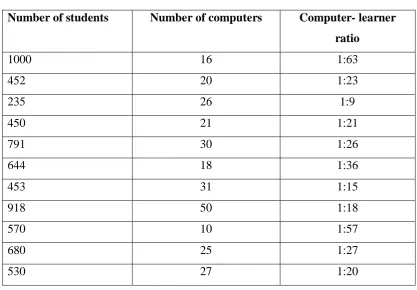
schools and the available computers, in a bid to deduce the computer-learner ratio. Table 4.3 illustrates the information that they gave.
Table 4.3: Computer-learner ratio
Number of students Number of computers Computer- learner
ratio
1000 16 1:63
452 20 1:23
235 26 1:9
450 21 1:21
791 30 1:26
644 18 1:36
453 31 1:15
918 50 1:18
570 10 1:57
680 25 1:27
530 27 1:20
the one to four (1:4) student-computer ratio recommended by the ministry of education (MOE 2006). The results also agrees with the findings of Tanui et al (2008) that, although computers may be present in Kenyan secondary schools they are hardly enough for pedagogical purposes. This finding implies that most schools had inadequate number of computers in their schools to meet the learning and teaching needs of both the teachers and the students, thus hindering the use of CAI in these schools.
4.3.1 Observation checklist
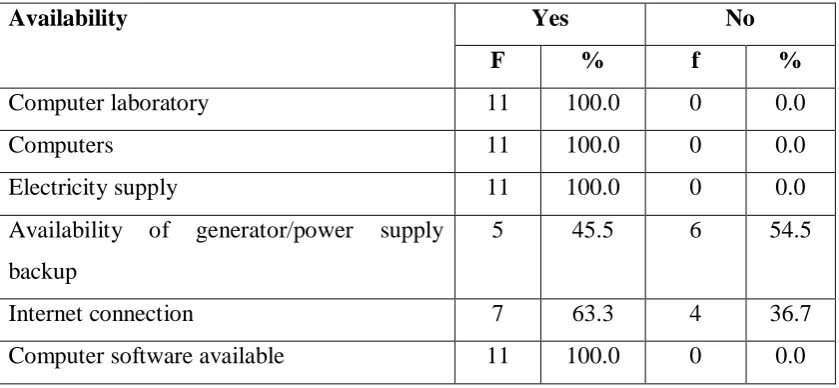
During the fieldwork, the researcher also sought to confirm the information that the teachers, students and principals had provided concerning the availability of various CAI resources. The researcher therefore clearly stated the availability of resources in the observation checklist carried along as shown in Table 4.4.
Table 4.4: Availability of CAI resources
Availability Yes No
F % f %
Computer laboratory 11 100.0 0 0.0
Computers 11 100.0 0 0.0
Electricity supply 11 100.0 0 0.0
Availability of generator/power supply backup
5 45.5 6 54.5
Internet connection 7 63.3 4 36.7
Computer software available 11 100.0 0 0.0
and in 5 (45.5%) schools where there was generators/ power supply back up available.
4.4 Accessibility of computers for use by teachers and students
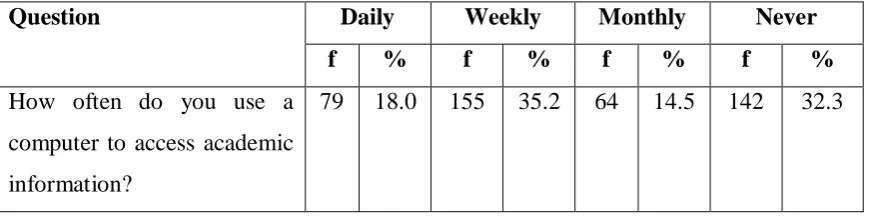
Computers can be available in a school but their accessibility both by the teachers and the learners determines their effective use as a teaching and learning tool. To establish the accessibility of CAI resources in the sampled schools, the study first presented both the students and teachers with a question to indicate whether they accessed academic information using computers on either a daily, weekly or monthly basis or whether they never had any access to computers. Table 4.5 indicates the responses that were given by the students and teachers.
Table 4.5: Students’ accessibility to computers for learning
Question Daily Weekly Monthly Never
f % f % f % f %
How often do you use a computer to access academic information?
79 18.0 155 35.2 64 14.5 142 32.3
by use of computers. The remaining 64 (14.5%) students used computers once in a month. This therefore means that computers in the sampled schools were accessible which was backed up by 7 (63.6%) out of the 11 sampled principals who agreed that computers were always available for use by the teachers and students any time they needed to use them .To further establish whether CAI resources were accessible for use in learning, the researcher provided the students with statements that rated the accessibility of CAI resources on a four point likert scale. From the scale, 1 denoted strongly agree, 2 agree, 3 disagree and 4 was for strongly disagree. Using the scale, a midpoint of 2.5 was achieved. Any mean score below the midpoint meant that the respondents agreed with the statements while a midpoint of 2.5 and above denoted that the respondent disagreed with the statements. Table 4.6 highlights the information
Table 4.6: Students responses on CAI resources accessibility
Statement SA A D SD Mean Std.
Dev.
f % f % f % f %
It is easy to
access a
computer in this school
148 33.6 139 31.6 60 13.6 93 21.1 2.22 1.128
It is easy to access computer software in this school
100 22.7 154 35.0 77 17.5 109 24.8 2.44 1.095
Internet is easily accessible in this school
Figure 4.2: Students’ accessibility to DVDs, VCDs, CDs, Flash discs and online
resources
From figure 4.2 above the highest percentage of 139 (31.6%) students never accessed the CAI resources mentioned while at least more than 25% could access the resources at times. The least number of students 60 (13.6%) said that they often accessed the mentioned resources. These results could be interpreted to mean that the most available CAI resource in the sampled school was the computer while the other available resources were not very accessible to students for their learning.
The study further provided the teachers with statements to establish the extent to which they agreed or disagreed on the accessibility of CAI recourses for use. Table 4.7 shows responses to thesis statements made on a four point likert scale where 1 represented strongly agree, 2 agree, 3 disagree and 4 strongly disagree
.
Num
b
er
of
lear
n
er
Table 4.7: Teachers response on the accessibility of CAI resources for use
Statement Strongly
Agree
Agree Disagree Strongly disagree
Mean Std. Dev
f % f % f % f %
It is easy to access a computer in this school
5 45.5 4 36.4 2 18.2 0 0.0 1.73 .786 The computers in this
school are adequate for
my teaching and
learning
3 27.3 4 36.4 3 27.3 1 9.1 2.18 .982
The computer software is accessible any time I need for teaching and learning
1 9.1 6 54.5 2 18.2 2 18.2 2.45 .820
Internet in this school is accessible
1 9.1 4 36.4 5 45.5 1 9.1 2.55 0.0
The mean scores obtained by teachers on the accessibility of CAI resources for use ranged from 1.73 to 2.55. Most teachers agreed to the following statements, with mean scores of below 2.5: It is easy to access a computer in this school (1.73), the computers in this school are adequate for my teaching and learning (2.18) and that the computer software is accessible any time I need for teaching and learning (2.45). The statement to which teachers agreed, with a mean score of 2.55 was: internet in this school is accessible.