International Journal of Research
eISSN: 2348-6848 & pISSN:
2348-795X Vol-5 Special Issue-13
International Conference on Innovation and Research in
Engineering, Science & Technology
Held on 23rd & 24th February 2018, Organized by Tulsiramji Gaikwad Patil College of Engineering & Technology, Nagpur,
441108, Maharastra, India.
Analysis Of Multi-Storieyed Irregular RC
Building Under Influence Of Wind Load
Neha P. Ghormade
1, Amey Khedikar
21
M-Tech Research Scholar (Structure), Civil Engineering Department, Tulsiramji Gaikwad-Patil
College of Engineering and Technology, Mohgaon, Nagpur, MH.
2
Asst. Professor Civil Engineering Department, Tulsiramji Gaikwad-Patil College of Engineering and
Technology, Mohgaon, Nagpur, MH.
[email protected]
Abstract:
In this paper a detailed study on the behavior of structural irregularities in high rise building. Now a days , In designing the multi-storied buildings irregularities in structures are inevitable due to functional requirements of the building. It is very essential to consider the effect of lateral loads induced from wind pressure. The present study describes the effect of wind speed 55 m/s on three buildings of G+20 multi storied frame structure for different irregularities. The three structure considered as regular building, stiffness irregular & vertical irregular. The results were tabulated by performing analysis by using STAAD Pro in the form of Bending Moment, Shear Force, Axial Force in the irregular buildings.
Keywords
Lateral Load, Wind pressure, STAAD Pro, Bending Moment, Shear Force, Axial Force.
1.
Introduction
In modern world the new materials and construction techniques resulted in structures. In this modern world the different types of structure are use most important structures like; high rise structures like; towers, chimney, buildings etc, . Because of the height of structure is greater than 6 m therefore the intensity of wind load is acting on the structure. Due to this load the swaying effect are taken into structure. The structure height is more than 12 m the intensity of wind load is more. The recent world the population in cities are increase. Therefore we need a tall buildings to establish a peoples living. The height of the building are increases therefore building become more flexible, low in damping and light in weight. Such structure is highly influence under the wind pressure. Wind forms the predominant source of loads, in tall free standing structures. The structure experiences aerodynamic forces due to wind on tall structure are divided into two categories as shown in the Fig 1.:
1. Along-wind effect : The drag force acting in the direction of the mean wind.
2. Across-wind effect : The lift force acting perpendicular to the direction.
The wind load is the most important factor that determined design of all building over 10 storey's. The building taller than 10 stories would generally require additional steel and lateral system. Under the action of natural wind, gusts and other aerodynamic forces will act continuously affect a tall building. The structure will deflect about a mean position and will oscillate continuously.
Buildings should have a two types of building structures according their use. They are following
1. Regular Structure: It has all the load, mass, stiffness, etc, distributed equally along column, beam, slab. The chances of collapse of regular building is less.
International Journal of Research
eISSN: 2348-6848 & pISSN:
2348-795X Vol-5 Special Issue-13
International Conference on Innovation and Research in
Engineering, Science & Technology
Held on 23rd & 24th February 2018, Organized by Tulsiramji Gaikwad Patil College of Engineering & Technology, Nagpur,
441108, Maharastra, India.
Papers presented in ICIREST-2018Conference can be accessed from
https://edupediapublications.org/journals/index.php/IJR/issue/archive P a g e | 114 Fig. 1. Along & Across wind effect
2.
Method Of Analysis
Based on electrical-mechanical transformation, piez Code-based procedure for wind analysis:
Basic wind speed can be obtained by IS 875 (Part III) : 2015 ANNEX A (Clause 6.2) & shall be modified by including the effect of following factors to get design wind velocity at any height for the chosen structure:
a) Risk level
b) Terrain roughness & height of structure c) Local topography
Wind Speed = Vz = Vb X K1 X K2 X K3 Wind Pressure = Pz = 0.6 Vz
Where;
V = Design wind speed at any height z in m/s
K1 = Probability Factor (Risk Coefficient) K2 = terrain, height & structure size factor K3 = Topography factor
Pz = Design wind speed in N/m2 at any height z
NOTE: Design wind speed up to 10 m height from mean ground level shall be consider constant.
3. MODELING & ANALYSIS
An RCC framed structure is basically an assembly of slabs, beams, columns & foundation inter-connected to each other as a unit. The load transfer mechanism in these structures is from slabs to beams, from beams to columns, and then ultimately from columns to the foundation, which is turn passes the load to the soil. In this analysis we adopted 4 case by considering different irregularities for the same structure, as explained below.
1. Regular
2. Stiffness Irregularity 3. Vertical Irregularity
Design characteristic : The following design characteristic are consider for the analysis of multi-storied RC frames.
Table 1. Design Data
Sr.
No.
Particulars
Dimensions/Size
1
Model G+202
Wind Speed 55 m/s3
Floor Height 3 m4
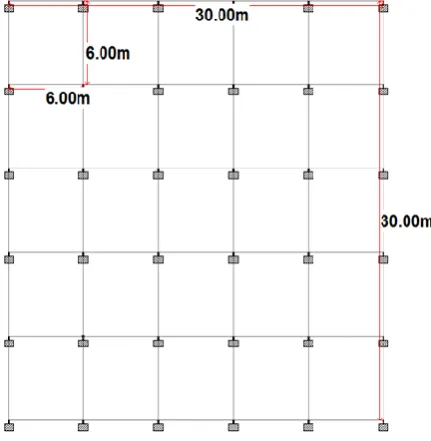
Plan Size 30 X 30 m5
Size Column of 0.5 X 0.23 m6
Size of Beams 0.45 X 0.23 m7
Wall 1. External wall = 0.23 m 2. Internal wall = 0.15 m8
Thickness Slab of 150 mm9
Material used M 20 & Fe 41510
Place Darbhanga11
Software
used
International Journal of Research
eISSN: 2348-6848 & pISSN:
2348-795X Vol-5 Special Issue-13
International Conference on Innovation and Research in
Engineering, Science & Technology
Held on 23rd & 24th February 2018, Organized by Tulsiramji Gaikwad Patil College of Engineering & Technology, Nagpur,
441108, Maharastra, India.
International Journal of Research
eISSN: 2348-6848 & pISSN:
2348-795X Vol-5 Special Issue-13
International Conference on Innovation and Research in
Engineering, Science & Technology
Held on 23rd & 24th February 2018, Organized by Tulsiramji Gaikwad Patil College of Engineering & Technology, Nagpur,
441108, Maharastra, India.
Papers presented in ICIREST-2018Conference can be accessed from
International Journal of Research
eISSN: 2348-6848 & pISSN:
2348-795X Vol-5 Special Issue-13
International Conference on Innovation and Research in
Engineering, Science & Technology
Held on 23rd & 24th February 2018, Organized by Tulsiramji Gaikwad Patil College of Engineering & Technology, Nagpur,
441108, Maharastra, India.
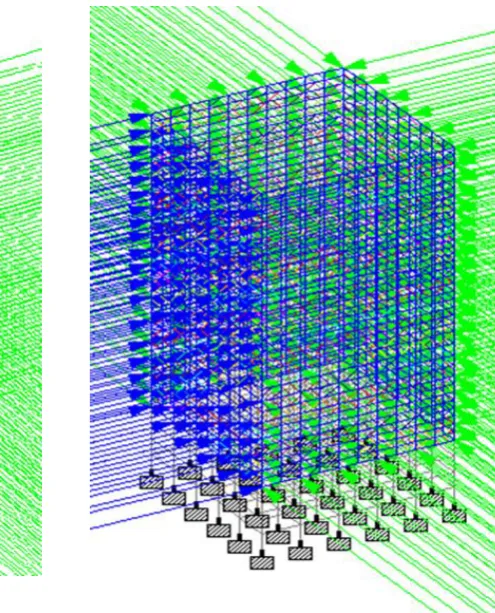
Fig. 6. Wind Loading in X-direction for Regular Building
International Journal of Research
eISSN: 2348-6848 & pISSN:
2348-795X Vol-5 Special Issue-13
International Conference on Innovation and Research in
Engineering, Science & Technology
Held on 23rd & 24th February 2018, Organized by Tulsiramji Gaikwad Patil College of Engineering & Technology, Nagpur,
441108, Maharastra, India.
Papers presented in ICIREST-2018Conference can be accessed from
https://edupediapublications.org/journals/index.php/IJR/issue/archive P a g e | 118 Fig. 8. Wind Loading in X-direction for Vertical
Irregular Building
3.
Results
Bending Moment: 1.2(DL+LL+WL)
Table 2. Maximum Bending Moment (KN-m) of Beams at different Floors
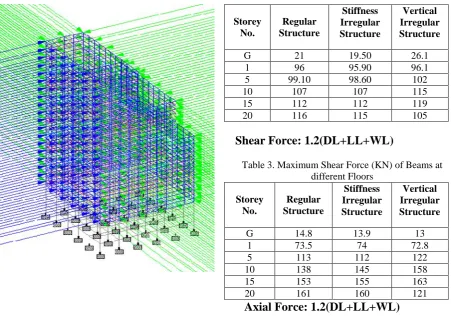
Shear Force: 1.2(DL+LL+WL)
Table 3. Maximum Shear Force (KN) of Beams at different Floors
Axial Force: 1.2(DL+LL+WL)
Table 6. Maximum Axial Force (KN) of Column at different Floors
4.
Conclusion
1. Bending Moment & Shear Force in beams increases as the height of the structure increase in regular & stiffness irregular structure due to the wind load as well as due to the floor load.
2. In vertical irregular structure the bending moment & shear force increase in certain limit & after that it decreases.
3. Axial force in the column increases as the height of the structure is decreases.
4. Axial force is maximum in stiffness irregular structure as compare to regular & vertical irregular structure.
5. Shear force in column is more in stiffness irregular building. Storey No. Regular Structure Stiffness Irregular Structure Vertical Irregular Structure
G 21 19.50 26.1
1 96 95.90 96.1
5 99.10 98.60 102
10 107 107 115
15 112 112 119
20 116 115 105
Storey No. Regular Structure Stiffness Irregular Structure Vertical Irregular Structure
G 14.8 13.9 13
1 73.5 74 72.8
5 113 112 122
10 138 145 158
15 153 155 163
20 161 160 121
Storey No. Regular Structure Stiffness Irregular Structure Vertical Irregular Structure
G 7999 8082 7992
1 7842 7929 7835
5 6428 6519 6407
10 4564 5420 4500
15 2633 5617 2523
International Journal of Research
eISSN: 2348-6848 & pISSN:
2348-795X Vol-5 Special Issue-13
International Conference on Innovation and Research in
Engineering, Science & Technology
Held on 23rd & 24th February 2018, Organized by Tulsiramji Gaikwad Patil College of Engineering & Technology, Nagpur,
441108, Maharastra, India.
6. Bending moment, shear force & axial force is maximum in loading combination 1.2(DL+LL+WL).
5.
References
1. K. Divya, S. Sai Harsha, "Comparative Study On Structures Having Vertical and Stiffness Irregularities Under Wind Load", International Research Journal of Engineering and Technology e-ISSN:2395-0056, p-ISSN:2395-0072, volume 03 issue 08, August 2016.
2. Kintali Sai Nanda Kishore, K. Staya Narasimha Rao, "Comparative Study of Wind Analysis with Horizontal Irregularities in Multi-Storeyed Buildings Using STAAD PRO", International Journal odf Science Technology & Engineering, volume 2, Issuue 1, July 2015, ISSN (Online):2349:734X.
3. V. Guruprassad, Arunkumar B. N., "Study of Structural Irregularities in High Rise Buildings with P-∆ Effect"' International Journal of Research in Engineering and Technology, e-ISSN:2319-1163, p-ISSN:2321-7308, volume 05, Issue 08 September 2016.
4. S. Vijaya Bhaskar Reddy, Yugandhara Sagar A., Shrinivas Vasam, P. Srinivas Rao, "Effect of Wind Forces on Multistoreyed Structures", International Journal of Innovative Research in Advanced Engineering, ISSN:2349-2163, Issue 6, Volume 2 (June 2015).
5. K. Rama Raju, M.I. Sheref, Nagesh R. Iyer, S. Gopalakrishnan , "Analysis and Design of RC Tall Building subjected to Wind and Earthquake Load", The Eighth Asia-Pacific Conferance on Wind Engineering, Dec 10-14, 2013, Chennai, India.
6. Azlan Adnan, Suhana Suradi, "Comparison on the Effect of Earthquake and Wind Load on the Performance of Reinforced Concrete Buildings", The 14th World Conference on Earthquake Engineering October 12-17, 2008, Beijing, China.
7. IS 456-2000, Plain & Reinforced Concrete Code of Practice (Fourth Revision).