Available Online atwww.ijcsmc.com
International Journal of Computer Science and Mobile Computing
A Monthly Journal of Computer Science and Information Technology
ISSN 2320–088X
IJCSMC, Vol. 3, Issue. 6, June 2014, pg.451 – 457
RESEARCH ARTICLE
A Study on Routing Protocols
Classification in Sensor Network
Seema Balhara
1, Ms. Kavita Khanna
21
M.Tech (CSE) 4
thSem, PDM College of Engineering for Women
2
Vice Principal, PDM College of Engineering for Women
Sector-3A, Bahadurgarh-124507 (Haryana)
[email protected], [email protected]
Abstract: A Sensor Network is one of congested network defined under the sensing range and energy
limitations. To provide energy effective communication, there are different network architectures to control
the network communication. These architectures are defined under the rules of relative protocols. In this
paper, studies on different associated classes to the routing protocols in sensor network are defined. Paper
explored these protocols along with their utility and application area.
Keywords: WSN, Routing Protocols, LEACH, PEGASIS
I. INTRODUCTION
Sensor network is one of the networks defined under energy constraints and range limitations. The sensor nodes can perform the low distance communication because of this, generally the network is congested and low distance communication is performed over the network. The communication performed in sensor network is a multi hop communication because of limited sensing range. These nodes are connected through the wireless medium such as infrared, optical medium or the radio communication. A sensor network is capable to perform the different kind of global communication on small scale and large scale network. In many critical applications, these kinds of network architecture are adopted. The common application areas of sensor network are the scientific, medical and the industrial communication. There are different frequency bands at which, the communication is carried out in sensor network. In some cases, the sensor network is integrated with mobile network to enhance with the communication features.
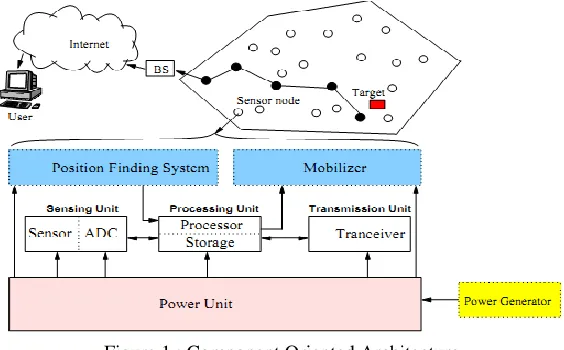
Figure 1 : Component Oriented Architecture
The main challenge in sensor network is to perform the power saving communication. To perform this communication, there are number of constraints and the limitations are defined in sensor network. These sensor networks are defined under different frequency bands to control the communication and to obtain the actual circuit design. The outcome of these communication networks depend on different factors such as the frequency range, kind of device, spectrum type etc.
Another improvement to the sensor network is in terms of intelligent sensing devices. These devices are called smart sensor devices. The network composed from these sensing devices is called smart dust network. In critical application areas such as medical network, these kinds of communication architectures are being used.
In this paper, the communication architecture and the communication dependencies are discussed in sensor network. These architectures and protocols are discussed under different constraints and requirements. In section I, the basic requirement of communication sensor network is defined along with requirement specification. In section II, the work done by the earlier researchers is discussed. In section III, the available protocols in sensor network are discussed as well divided them in different classes. These protocols are divided in application area specific classes.
II. EXISTING WORK
In this section, the work done by the earlier researchers in the area of Data classification is discussed and presented. In year 2000, a work on energy effective sensor network was defined by W. Heinzelman. Author defined the clustering algorithm along with protocol specification. Author introduced the LEACH protocol. LEACH protocol includes the cluster formation based architecture so that the hierarchical communication will be carried on over the network. This proposed protocol divided the complete network in smaller segments called clusters and each cluster communication is control by the cluster head. The algorithmic approach is defined on the selection of this cluster head. This cluster head selection is performed under the energy and load based analysis. LEACH protocol is able to provide the effective communication in effective time frame. It also defined the communication under the assumptions and the constraints. The drawback of the protocol is the random selection of cluster head. It gives the equal probability of a node to set as cluster head. But this gives the unequal distribution of clusters over the network. There are the chances that a particular protocol is congested and some cluster is not having the enough nodes. It also gives the problem of orphan nodes i.e. the nodes that not covered by any cluster. Another drawback of this protocol is the election of cluster heads with each communicating round that gives the communication delay. Because of these reasons there was the requirement of certain improvement over the clustering architecture so that reliable and balanced communication will be performed over the network [1][2][3][4].
comparison on nodes. Another improvement to the protocol is done in terms of multi hop communication. It improves the network communication. Authors discussed the comparative analysis between the energy LEACH and multi-hop LEACH[5][6].
Some authors also provided the communication over the network under different routing protocols. A lot of work has been done to identify the effective routes in network. Authors discussed different constraints while performing the route identification in sensor network. These parameters include the layered based communication, data centricity, path redundancy, location information analysis, QoS parameters evaluation etc. The type of network i.e. homogeneous or heterogeneous networks also affects the network architecture and the communication. The main objective behind the formation of this clustering architecture is to improve the network life time and to provide the energy effective communication. The work also controls the energy consumption and provides the dominated transmission and reception. The routing protocol designed here is energy effective as well as provide the network architecture so that the network life time is improved[7][8].
The energy criticality in case of LEACH protocol is discussed and resolved by many researchers under the energy restricted resources available in the sensor network. These sensor networks are defined under the energy source specification so that the effective design will be performed along with communication control. The author discussed the operative time span so that the restricted power supply over the network will be obtained. These protocols are dependent on the network layers. The communication in such network is based on the probabilistic estimation on the cluster head selection and to perform the communication based on network coordination. The network is defined with initial energy specification and to discuss the certainty in LEACH. Author discussed different aspects of these protocols so that the life time of the network will be improved. The communication is performed for N number of rounds and is based on the energy effectiveness of network as well as the communication is measured. Simulated results shows the improvement to the network life upto 20% with the modification on the cluster head selection process[8][9].
An improvement to the clustering routing protocol is defined that reduces and controls the network deficiencies. Different authors discussed different ideas to provide the improvement to the network communication and the clustering process. These improvements are defined in the form of cluster selection process. One of such improvement is presented in the form of N-LEACH protocol. This improvement protocol has restricted the number of clusters over the network so that the equalized distribution of network nodes will be obtained. The root node collects data from the base station and improves the network energy effectiveness and the life time. N-LEACH algorithm is discussed to provide the energy balanced communication. This communication protocol is also effective to provide the long distance communication[9] Another improvement to LEACH protocol was presented by Khamayesh in year 2009. This improvement is presented in the form of a new protocol called V-LEACH protocol. This protocol reduces the energy consumption over the network and provides the effectiveness of clustering architecture. According to this new protocol, each cluster has two cluster heads called, Main Cluster head and Vice Cluster head. As the main cluster head dies, the vice-cluster head takes its position so that the process of cluster selection is reduced. Author defined this protocol to reduce the communication between the cluster head and the base station. The obtained results from the system shows that the defined protocol reduced the network communication and improved the network life. In VLEACH protocol, the number of messages generated by the cluster head is lesser than the traditional LEACH protocol[10].
Some modifications to the existing protocols are done by different authors. These protocols provided the energy adaptive communication in sensor network as well as provided a balanced communication over the network. The balanced network communication is controlled under the residual energy based communication so that the network communication and performance will be improved. The comparative analysis over the network is performed to provide the reliable communication[11][12].
These available protocols in sensor network are effective under different parameters as well as the architecture. Based on the application areas these network architectures are applied as well as according to the type of application area, the respective protocols are applied. In next section, the classification of these protocols is defined.
III. WSN PROTOCOL CLASSIFICATION
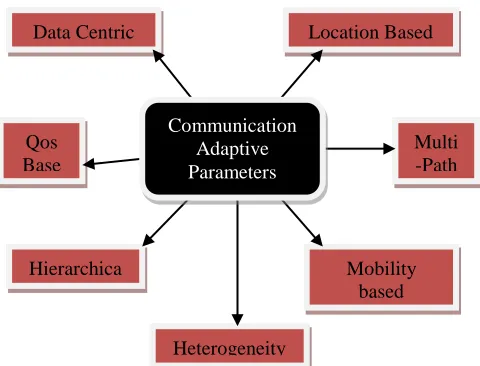
reliability of the communication is performed. A sensor network is applied in different application areas and based on the same discussion. The routing algorithm adapted by the communication includes the energy saving communication. There are number of protocols available that provide the communication under different categories or the parameters. These parameters are shown in figure 2.
Figure 2 : Communication Adaptive Parameters
These all categories are represents the different application areas as well as communication architectures. These protocols are discussed in this section. The protocols that comes under these different categories are shown in table 1.
A) Data Centric Protocols
Data centric protocol is different from traditional data centric protocols. These protocols provide the effective network communication. The protocol defined in this category is based on the source and sink specification. The data centric communication is defined so that the network aggregation will be performed as well as the aggregative communication will be directed to the base station. The energy adaptive communication in such network also reduced the communication so that the effectiveness of network is improved. This communication architecture form reduces the network communication and provides the energy effective and reliable communication over the network. The data centric routing adapted in the communication is effective to increase the network life.
B) Location-Based Protocols
The location oriented protocols are used in the application area where the nodes are distributed over different location in the network architecture. The communication is here performed based on the location of the network nodes. The distance effective communication is performed in such network. The energy consumption is estimated so that the energy effective communication is performed over the network. The long distance communication is location based communication. The location based criticality to the communication architecture is adopted so that the communication reliability is achieved. The prioritization based on the location identification is done. Some of these protocols require the pre-specification of the node location and some perform the location identification to provide reliable communication.
Data Centric Location Based
Hierarchica l
Mobility based Qos
Base d
Multi -Path
Heterogeneity Communication
Table 1 : Classification of Protocols
Category Representative Protocols
Data-centric Protocol SPIN, Directed Diffusion, Rumor Routing, COUGAR, ACQUIRE, EAD, Information-Directed Routing, Gradient-Based Routing, Energy-aware Routing, Quorum-Based Information Dissemination, Home Agent Based Information Dissemination
Location-based Protocols MECN, SMECN, GAF, GEAR, Span, TBF, BVGF, GeRaF Hierarchical Protocols LEACH, PEGASIS,HEED,TEEN,APTEEN
Mobility-based Protocols SEAD, TTDD, Joint Mobility and Routing, Data MULES, Dynamic Proxy Tree-Base Data Dissemination
Multipath-based Protocols Sensor-Disjoint Multipath, Braided Multipath, N-to-1 Multipath Discovery Heterogeneity-based Protocols IDSQ, CADR, CHR
QoS-based Protocols SAR, SPEED, Energy-aware routing
C) Hierarchical Protocols
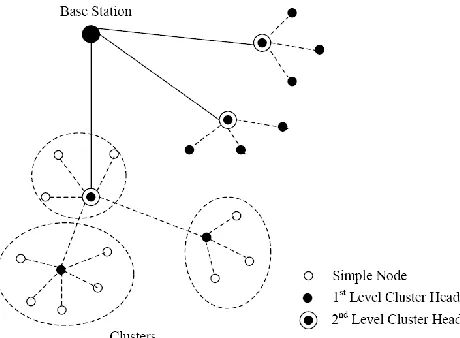
In the clustered network architecture, the complete network is divided in small area segments called clusters and each cluster is controlled by cluster head. All the cluster nodes perform the communication with cluster heads and cluster head perform the communication with base station. These cluster head based communication can be hierarchical. This communication type is helpful for short range sensing devices as well as it reduces the network communication. As the communication is performed in different network areas simultaneously so that the collision over the communication will not be performed.
Figure 3 : Hierarchical clustering in WSN
D) Mobility-Based Protocols:
The mobility in sensor network is a crucial communication form in sensor network. The type of mobility in network also affects the network communication. The mobility affects the communication type. Such as if the mobility is random, motion tracking is required but if the motion is linear, the motion can be expected.
E) Multipath-Based Protocols:
communication will be drawn over the network. In some cases, different kind of data is also directed to different network path so that the effective load distribution will be obtained.
F) Heterogeneity-Based Protocols
Heterogeneity is sensor network is based on the node types in the sensor network. These nodes are different respective to the type of sensor or the type of energy supply attached with the network. The type of nodes also depends on the utility as well as the responsibility. These features also affect the energy consumption over that nodes and well as restrict the communication.
G) QoS-Based Protocols
QoS in sensor network is defined under different parameters such as delay, congestion, fault tolerance, reliability etc. Based on these parameters the protocol selection is performed.
IV. CONCLUSION
In this paper, a classification on routing protocols of Sensor Network is defined. The paper has discussed different aspects of sensor network architecture under the requirements and limitations. Finally, the discussion on the routing protocols is done and these available protocols are divided in different classes and based on this classification the protocols are categorized.
REFERENCES