RECENT TRENDS IN SINGLE BOARD MICRO
CONTROLLER UNITS (SBMCUS)
Tariq Ahmed
University Women’s Polytechnic, Aligarh Muslim University, Aligarh -202002, (India)
ABSTRACT
With the advancement in computing technology we have moved ahead in the new era of network of devices i.e Internet of Things (IoT) , robots, drones home automation systems, security systems , smart cities, smart health care, vehicular network and many more. IoT is the idea to connect devices to transfer and collect information and utilize collected data for many real world interesting applications and services. These innovative ideas can be first realized using Single board microcontrollers (SBMCUs) basically used for IoT (Internet of Things) prototyping that enables the developer to build or test electronic devices based projects. In the present scenario large PCs have lost the market and the trend has moved towards miniature credit card sized single board microcontrollers like Omega2+,CHIP, LoRaONE, ESLOV, Arduino , Raspberry Pi and Beaglebone etc. This paper provides the up do date information about the technical specifications and features of wide variety of single board micro controller units. This paper also provides comparison of various boards and also highlights the applications where the development boards could be used to develop efficient & effective, low cost and easily deployable products.
Keywords:
Omega2+, CHIP, Arduino, Raspberry Pi, Beaglebone, IoT,
I.
INTRODUCTION
Basically SBMCUs is a single PC development kit which comprises processor, memory, set of ports (input/output, UART etc.) and communication interfaces. Today, SBMCUs can be placed into two main sub divisions- proprietary and open source [1]. The proprietary SBMCUs are built for ready to use hardware and implemented with some important functions that are not easy to achieve. In contrast the open source SBMCUs provides flexibility to the designer to work with the hardware and software level. To meet their end product requirements designer can easily operates on hardware and modify the source code accordingly. Open source SBMCU is generally a user friendly environment. The development boards can be added to the wide variety of compatible expansion devices that can serve as the foundation for large number of new applications includes smart wearables, smart health care units and smart cities etc.
associated with the board. The researchers, designers, developers and start up users should look into the following basic characteristics before they make a final choice of any controller.
1) Processor and Clock-Processor is the heart of development board. It decides the performance of your device and types of applications it handle. Before deciding the best CPU you should know your workloads. For applications such as web browsing, listening music, word processing, video streaming requires processor with higher clock speed. Clock speed measured in Hz and defines how many instructions per clock could be executed. Generally higher clock rate is the better.
2) User friendly working environment-These developments kits should get easily plugged with other hardware directly or using printed circuit boards (PCBs). It should be easy to program and debug. These kits should not only avoid complicated designs components but also have user friendly Integrated Development Environment interface.
3) Ports-Companies may offer complex ports assembly to attract and target buyers it might land the buyer to do a bad selection. For a start up user development board should be with less components and GPIO pins such that external devices and connections could be directly interfaced. You should clearly examine the architectural design of your application and point out all the communication interfaces or ports required. Generally most of the microcontrollers are integrated with USB, UART, HDMI, Ethernet, audio connectors, general purpose input/output pins, analog to digital converters and digital to analog converters.
4) Microcontroller‟s Architecture-This characteristic declares how the internal implementations of the microcontroller are achieved. This chip controls the function of embedded systems. Generally Harvard architecture of microcontrollers with different word lengths such as 8-bit, 16-bit, 32-bit and 64-bit exists. Just have a best choice that fits your project.
5) Flash and RAM-It is very important to know the amount of memory available with development kit because memory units store program and data While designing the product you should make sure that the development kit provides you enough of Flash and RAM to run your application.
6) Power- It is necessary to know the power requirement of the development board. This factor is necessary to examine because it helps to make the right choice of the development kit that best suits your application. These boards could be powered from an external adapter or a battery.
7) Price-You could easily purchase these development kits online directly from manufactures or third party vendors. Here you have to make a smart move as it will directly increase the price of end product development. Not necessarily cheaper is better. This may happen you might loose certain features required for your project if you go for cheap option.
II.
BRIEF
HISTORY
OF
DEVELOPMENT
BOARDS
[2]. Arduino enables the developers or start up users to do innovative things in electronic anything you could imagine. It was first prototyping board that offers simple design, low cost and easy to program module at that time. After its launch soon it became the first choice of the users. Due to the advance technology in place full featured boards integrate more processor features and applications in a single chip. There is a huge range of development boards from Arduino to deal with different applications and level of users like entry level, enhanced features, Internet of Things, wearable smart devices. Till now, a wide range of development boards are classified by Arduino like Arduino-Uno, Leonardo, 101, Robot, Esplora, Mega, Zero, Due, Mega ADK, Pro, MO, MO Pro, Yun, Ethernet, Tian, Industrial 101, Leonardo ETH, MKRFOX1200,Gemma, LilyPad Arduino USB, LilyPad Arduino Main Board, LilyPad Arduino Simple and LilyPad Arduino Simple Snap.
On July 28, 2008 a new major development occurred with the launch of low power and low cost single board computer called “Beagle” [3]. It was designed by Texas Instrument in collaboration with Network Element14 and Digi Key [3].As it was open source micro controller so was taken hand in hand from community of open source to design optimized full featured end products .Till date, a wide variety of development kits are launched like BeagleBone Green, BeagleBone Black, BeagleBoard-xM, and BeagleBoard-X 15.
Beagle boards are small, affordable, open source, feature rich and flexible enough to meet the requirements of IoT projects.
The penetration of Raspberry Pi in the world of development boards disrupts the market of existing platforms Arduino and BeagleBone. Raspberry Pi is the big name in the field of development board. It was designed by Raspberry Pi Foundation in February 2012 [4]. It was originally created to teach students and kids. It allows the developer to design projects ranging from simpler to complex. Raspberry Pi is favorite among users due to its affordable price range $25- $35. It comes with its own operating system called Raspbian and easy to program and modify projects. Some of the designs launched by Raspberry Pi Foundation are Raspberry Pi 3 Model B, Raspberry Pi Zero W, Raspberry Pi Zero, Raspberry Pi 2 Model B, Raspberry Pi 1 Model B+ and Raspberry Pi 1 Model A+. All Raspberry Pi units are different and each delivers specific specifications and features required to develop wide variety of projects.
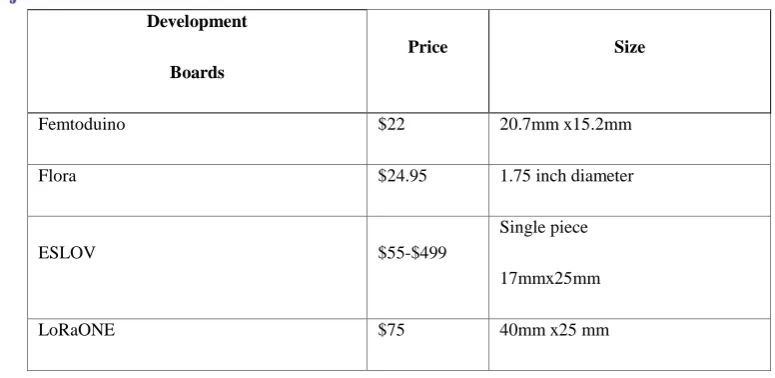
Today we have large number of manufacturers of tiny size single board microcontrollers. The most recent small size and economical boards are listed below in TABLE I [6, 7, 8, 9, 10, 11 & 12].
TABLE I.
TINY
ECONOMICAL
DEVELOPMENT
BOARDS
WITH
THEIR
PRICE
RANGE
AND
SIZE
Development
Boards
Price Size
Digispark $8.68 17.5mm x 19mm
Omega 2 plus $9 42mm x 28mm x 10mm
CHIP $9 11.9x7.5x1.7 cm
Development
Boards
Price Size
Femtoduino $22 20.7mm x15.2mm
Flora $24.95 1.75 inch diameter
ESLOV $55-$499
Single piece
17mmx25mm
LoRaONE $75 40mm x25 mm
III.
TECHNICAL
SPECIFICATIONS
AND
FEATURES
OF
RECENT
SINGLE
BOARD
MICROCONTROLLERS
UNITS
3.1ARDUINODUE
Arduino boards are easy to setup, user friendly and consumes less power to develop challenging applications. Arduino Due as shown in Fig.1 [13] has following technical specifications:
Processor of Arduino Due is based on Atmel SAM3X8E ARM Cortex- M3 CPU. It is 32-bit core and offers clock speed 84MHz.It is equipped with 512KB of flash memory for user applications and 96KB of SRAM divided into two contiguous slots of 64KB and 32 KB. Arduino Due recommends 7 to 12 volts power from the DC power jack and 5 volts power via USB connector. It is provided with 54 digital input and output pins. In Circuit Serial Programming (ICSP) header integrated on Arduino Board to support SPI communication. It also offers an USB OTG connection. It has 12 analog inputs to support 12 bits resolution. LEDs indicate power on, CPU activation and flash memory handling activities. Reset button reboots the board. The SAM3X is equipped with a UART and three USART. It allows TTL serial communication. This feature facilitates the interaction with a computer and other hardware like smart phones, digital cameras etc. Here programs are referred as sketches. With the help of Arduino (IDE) sketches can be uploaded on flash memory. Through the Atmega 16U2 microcontroller programming is written on the board. The typical length and width of Arduino Due is 101.52 mm and width 53.3 mm respectively. Arduino boards are relatively inexpensive to other microcontroller platforms1599 Rs.
Features of Arduino Due: High performance due to 32 ARM processor operates at 84MHz.Other boards like Uno, Leonardo theoretically offer Analog to Digital Converter speeds of 15 kilo samples per second (kbps) whereas the Arduino Due sampling speed is multiplied to 1000kbps. This increase in sampling speed is due to availability of 12 bit analog inputs and 12 bit analog outputs. Arduino Due can support the ADK 2.0 protocol that enables it to work with sample code and libraries. It consumes less power as it operates at 3.3V.Compatible with other basic Arduino kits like Uno or Leonardo. Prgrammers can write programs for Arduino using C or C++ language. Arduino Integrated Development Environment is user friendly, easy to use for naive and quite adjusting for skilled users. Arduino hardware specifications are fully documented and extensible. Arduino software specifications are fully documented or otherwise available and extensible. The Arduino software supports Windows, Macintosh OS X and Linux operating system.
3.2 Beagle Board Black and Raspberry Pi 3
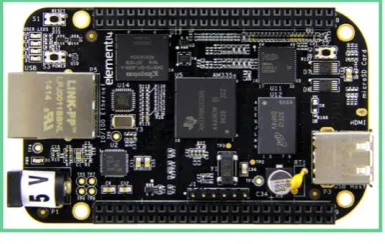
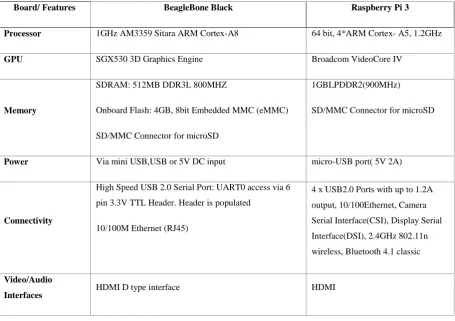
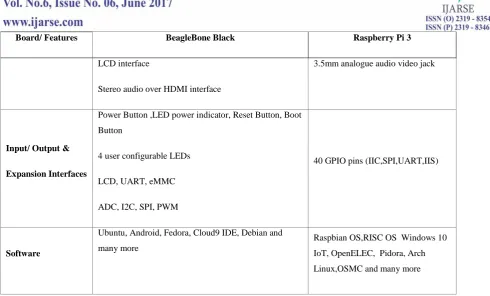
BeagleBone Black as shown in Fig. 2 [14] is the current inclusion to BeagleBoard family. It is inexpensive ARM Cortex-A8 based processor. It is designed to experiment, learn and teach students how to write programs for the processor, interface peripherals and access them. It is not a complete package to perform each and every project. The improved technical specifications of the board are highlighted in the Table II.
Fig. 2. Beagle Bone Black 3.3 Key Features of BeagleBoard Black
It comes preinstalled with Linux distribution so ready to use hardware and also equipped with Sitara AM3358AZCZ100 microprocessor based on ARM CortexA8 core. Supplemented with improved image, graphics processing, peripherals and industrial interfaces. GPIO allows users to program real time units. A switch is provided to handle boot mode options. The BeagleBone Black can boot via four boot options comprise eMMC boot, microSD boot, serial boot, and USB boot. Easily extensible- upto four add on boards can be placed over one another onto the expansion headers. It provides software compatibility to Cloud9 IDE, Debian, Fedora, Android, Ubuntu, and many more.
The main objective of Raspberry Pi foundation is to design inexpensive boards. The latest board launched by Raspberry Pi foundation is Raspberry Pi 3 as shown in Fig. 3 [15]. It comes with loads of enhanced features like a new upgraded CPU, a Broadcom BCM2837 quad-core 64-bit ARM Cortex A53 running at 1.2 GHz, 802.11n WiFi, Bluetooth 4.0. It is genuinely a credit card sized computer. The advance and detailed technical specifications of the board are provided in the TABLE II.
Raspberry Pi 3 is more powerful and efficient board due to upgrade in the clock speed of CPU and GPU.Built-in 802.11n WiFi and Bluetooth 4.0 technology allows wireless keyboards and wireless mice directly. Great potential to stream 60Hz Full High Definition videos. Great capability to support video streaming and gaming. Supports IIC (Inter-Integrated Circuit), SPI (Serial Peripheral Interface) and UART (Universal Asynchronous Receiver-Transmitter) communication protocols. SPI enables to interact with more than one target device. UART provides serial communication. GPIO allows connecting more peripherals. Installation of Raspberry Pi 3 is joyful and easy. It comes with Raspbian OS that could be easily installed by following official documentation. It not only runs python on the small size machine even device can run NEO and Java platforms. It supports Debian, GNU/Linux, Fedora, Arch Linux ARM, RISC Operating System.
Fig. 3. Raspberry Pi 3
TABLE II.
TECHNICAL SPECIFICATIONS OF BEAGLEBONE BLACK AND RASPBERRY PI
3
Board/ Features BeagleBone Black Raspberry Pi 3
Processor 1GHz AM3359 Sitara ARM Cortex-A8 64 bit, 4*ARM Cortex- A5, 1.2GHz
GPU SGX530 3D Graphics Engine Broadcom VideoCore IV
Memory
SDRAM: 512MB DDR3L 800MHZ
Onboard Flash: 4GB, 8bit Embedded MMC (eMMC)
SD/MMC Connector for microSD
1GBLPDDR2(900MHz)
SD/MMC Connector for microSD
Power Via mini USB,USB or 5V DC input micro-USB port( 5V 2A)
Connectivity
High Speed USB 2.0 Serial Port: UART0 access via 6
pin 3.3V TTL Header. Header is populated
10/100M Ethernet (RJ45)
4 x USB2.0 Ports with up to 1.2A
output, 10/100Ethernet, Camera
Serial Interface(CSI), Display Serial
Interface(DSI), 2.4GHz 802.11n
wireless, Bluetooth 4.1 classic
Video/Audio
Interfaces
Board/ Features BeagleBone Black Raspberry Pi 3
LCD interface
Stereo audio over HDMI interface
3.5mm analogue audio video jack
Input/ Output &
Expansion Interfaces
Power Button ,LED power indicator, Reset Button, Boot
Button
4 user configurable LEDs
LCD, UART, eMMC
ADC, I2C, SPI, PWM
40 GPIO pins (IIC,SPI,UART,IIS)
Software
Ubuntu, Android, Fedora, Cloud9 IDE, Debian and
many more
Raspbian OS,RISC OS Windows 10
IoT, OpenELEC, Pidora, Arch
Linux,OSMC and many more
3.4OMEGA2+ AND CHIP
Omega2+ as demonstrated in Fig. 4 [16] is the current small size computer bundled with 580 MHz CPU, 128MB of memory, and 16MB of storage.Omega2 is developed by the company name Onion in 2016.
Fig. 4. Omega2+
It is very cost efficient board and reach in your pocket in just $5.Omega2 Plus is another version of Omega enabled with extra RAM and memory and a microSD slot for extra storage and could be bought for $9. Omega 2 plus is easy to use, affordable and expandable board. It is quarter the size of the Raspberry Pi 3 and BeagleBone Board Black and one third less size of Arduino Due. Onion cloud feature allow user to access and administer the Omega2 remotely through web user interface. Omega2 supports a variety of tools such as Git & Curl and programming languages like NodeJS PHP, C, C++, and Python. It supports Linux operating system.I2C, I2S, SPI UART busses are used to connect various peripheral devices.I2C interfaces provides serial communication for display device and analog to digital converters and other add on modules. I2S (Inter-IC Sound) is an audio interface to connect standard compatible audio devices. SPI is acronym for Serial Peripheral Interface to interact serial devices like digital camera at very high speed. It supports various expansion modules like Arduino UNO, Ethernet, Cellular (2G/3G), GPS and OLED display. [6]
work with any program given to it. It comes with built in Wi-Fi b/g/n standard facility and also Bluetooth 4.0 compatible to go wireless with devices like keyboards & other devices. It supports 4GB on board storage. It is easy to handle displays using VGA, HDMI adapters or any screen using built-in composite output. You can perform many activities using CHIP like create spreadsheets or word documents with the aid of Gnumeric and Abiword programs. It also allows access to web with the help of IceWeasel program. The detailed description of technical specifications of Omega2+ and CHIP is provided in TABLE III.
TABLE III.
TECHNICAL SPECIFICATIONS OF OMEGA2+
AND CHIPBoard/ Specifications Omega2 plus CHIP
CPU
580MHz
MediaTek MT7688
GPU-no
1GHz
Allwinner R8 Cortex A8
GPU:Mali-400
Memory
RAM-128 MB RAM-512 MB
Storage-32 MB Storage-4GB NAND flash
USB 1* USB 2.0 1x USB host port, 1x micro USB OTG
port
SD Slot Yes upto 16GB no
WiFi b/g/n
802.11 b/g/n,
Bluetooth 4.0
Input/Output pins
GPIO-15
,PWM-2
UART-2
I2C-2
SPI-2
I2S-1
GPIO-12
PWM-1
UART-1
I2C-1
SPI-1
I2S-no
Power 5V through the Micro-USB
connector 5V via micro USB OTG or battery
Size 42mm x 28mm x 10mm 60mm x 40mm x 12mm
Board/ Specifications Omega2 plus CHIP
Operating System Linux Debian-based Linux with OTA facility
3.5 ESLOVANDLORAONE
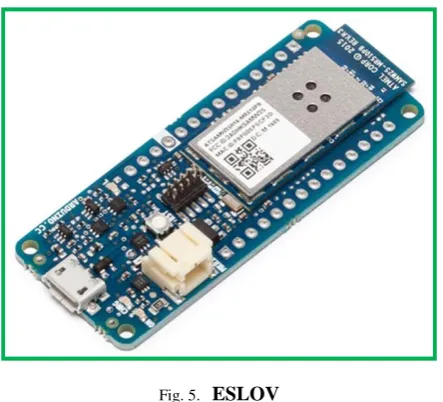
The newest Arduino board is ESLOV as shown in Fig. 5 [17]. It allows creating number of IoT based applications because it is quite easy to handle and modular module. It supports plug and play feature. It comes with MCU SAMD21 ARM Cortex-M0+ micro-controller loaded with clock speed 48 MHz, 32KB RAM 256 KB flash. It has 802.11 b/g/n Wi-Fi feature to go wireless. ESLOV has single USB interface for programming and power requirement. It comprises on motion sensor and 5 pin expansion connector based on I2C interface and one pin for status identification like sleep status, interrupt request and discovery. It is basically a central controller to which 25 different modules of different features and functionality can be attached in any order and amount and plug ESLOV module in to your system. It allows developer or beginner to do work with it without soldering and programming skills. ESLOV is simplest development board because it„s visual code editor IDE displays attached modules instantly and interact & make connections graphically. It can be programmed using Arduino Editor.ESLOV with their modules costs within range of $55 to $499.
Fig. 5. ESLOV
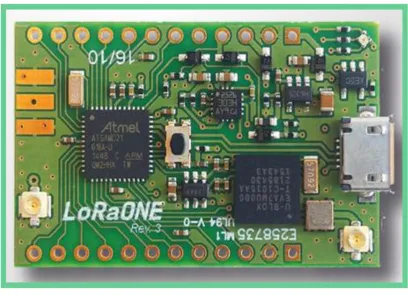
a solar panel connector. LoRaONE uses new u –blox EVA GPS module that consumes less power than any other GPS module. To dectect movememnt and magnetic fields, LSM303D (accelerometer and magnetometer) chip is used. Micro USB is provided to get connected with your computer. Input and output pins enables to connect other modules. LiPo battery connector allows designer to connect rechargeable LiPo battery to LoRaONE if you are concerned about the power back plan for your project than 500mW solar panel could be attached to solar panel connector. It is programmable through Arduino environment.
Fig. 6. LorRaONE
IV.
COMPARISON
OF
ARDUINO
DUE,
RASPBERRY
PI
3,
BEAGLEBONE
BLACK,
OMEGA2+,
CHIP,
ESLOV
AND
LORAONE
BOARDS
projects. With help of Raspberry Pi 3 you could build game center, Home automation system. VoIP based GSM/ PSTN gateway etc.
BeagleBoard Black is designed for skilled programmers and advance level users. As it comes preinstalled with Linux distribution so it is ready to run as soon as you receive you don‟t have to do extra job as you do perquisites to work with raspberry pi 3 like download and install operating system on SD card. It has large number of interface options for making external connections whereas Raspberry Pi 3 has limited number of interfacing. BeagleBone Black is best suited for project which requires external interfacing. It does not provide powerful graphic support or video capability as Raspberry Pi 3 does.
Omega2+ and CHIP are low cost and small size microcontrollers.Omega2+ can work without SD card as it has small buit in memor but has small form factor.. It is not suited for complex applications limited for developing basic and simple IoT projects. A wide variety of expansion boards to play around. One major drawback is less help and resources are available than other boards like Arduino, raspberry pi, beaglebone black etc. CHIP surprisingly cheap module comes with built in memory, Bluetooth, Wi Fi features which cut down the cost of project design. It is easy to configure and requires less wires. You don‟t have to purchase extra SD card because it is provided with 4GB of storage. It has the capability to replace the raspberry pi but where it fails is on the GPU performance. It can work well where multimedia projects are not involved.
For beginners it is better to start with $9.ESLOV is quite a new development board and easy to work on than any other board discussed above. It is plug and play device could be used where rapid prototyping is required because it simply connects modules using wires or wireless. The visual editor is an added advantage with this board and no technical expertise is prerequisite to program this kit. It not best suited for the projects when high performance is required as it provides low form factor. It has compatibly issues with other modules. Some of the applications where ESLOV could be used like fitness check device, seismic detectors, pet feeders, a smart thermostat, and many more [19]. LoRaONE is specialized in developing projects with low power requirements. The built in GPS, accelerometer and magnetometer features extend wide range of possibilities like parking sensors, weather station, child monitoring system, control street lights etc. The major disadvantage is new technology LoraWAN because most of the developers are not familiar with it.
Because of the availability of resources, projects, easy debugging features I will suggest Arduino for beginners and for advance users Raspberry Pi 3 will be the good choice. In contrast BeagleBone Black is also a new board so less help is available online or offline. If your projects require high portability, tiny size and cost effective module than Omega2+ or CHIP modules could be the choice. If you are eager to work with the very latest technologies, power efficient and simple modules for prototyping projects you can go for ESLOV or LoRaONE boards.
V.
APPLICATIONS
TABLE IV.
APPLICATIONS
OFSBMCU
S Smart Home and Cities
Automated transportation
Automated Vehicles
Survelliance system
Enegry Management System
UAVs and robots
Garbage management system
Home and office automation
Health care system to provide healthier life
Environmental monitoring
Controlling home appliances
Smart Parking system
Smart and Intelligent Agriculture
Light control
Security systems
Automated water distribution
Emergencies Indicators and Management systems
Wearable Gears for health and entertainment.
Automobile industries for autonomous vehicles
Education Organizational
VI.
CONCLUSION
In this paper, a detailed review of a wide variety of development boards is being carried out with technical specifications and their features. These development kits provide flexible platforms to implement end system design. Due to ARM based technology these development boards enables hobbyist, researchers, students to develop smart, reliable and low cost real and ready to use products. Day by day communities, forums, tutorials and projects related with these development kits contributing new ideas and at regular intervals new configuration settings and technical expertise are launched providing options to develop high performance and full-fledged products. It is the need of the hour to develop smart modules so that it will bring up new opportunities and technologies for the society welfare.
REFERENCES
[1] http://www.newark.com/wcsstore/ExtendedSitesCatalogAssetStore/cms/asset/pdf/americas/common/NE14-ElectronicDesignUncovered-Dec14.pdf accessed on 2.06.2017
[2] http://creativityprojects.blogspot.in/2013/03/history-of-arduino_4195.html accessed on 2.06.2017
[3] Anand Nayyar1 and Vikram Puri2 , “A Comprehensive Review of BeagleBone Technology: Smart Board
Powered by ARM “, International Journal of Smart Home Vol. 10, No. 4 (2016), pp. 95-108.
[4] Harshada Chaudhari, ”Raspberry Pi Technology: A Review”, International Journal of Innovative and
Emerging Research in Engineering Volume 2 , Issue 3, 2015p-ISSN: 2394 -5494
[5] http://www.eetimes.com/document.asp?doc_id=1319070
[6] https://potentiallabs.com/cart/onion-omega2-plus-iot-board
[7] https://s3.amazonaws.com/mcmelectronics/WC57/S05.pdf
[9] https://www.adafruit.com/product/1044
[10] http://hackaday.com/2013/02/11/hands-on-with-the-super-tiny-arudino-femtoduino/
[11] https://blog.arduino.cc/2016/09/28/eslov-is-the-amazing-new-iot-invention-kit-from-arduino/
[12] http://www.cnx-software.com/2016/04/18/loraone-is-a-tiny-lora-iot-development-board-based-on-atmel-samd21-mcu-microchip-lorawan-module-crowdfunding/
[13] https://www.wired.com/wpcontent/uploads/images_blogs/design/2012/10/8056907462_0f78f7ef36_o.jpg
[14] https://statics3.seeedstudio.com/product/BeagleBone%20Black%20Rev.C_02.jpg
[15] https://upload.wikimedia.org/wikipedia/commons/e/e6/Raspberry-Pi-3-Flat-Top.jpg
[16] http://www.cnx-software.com/wp-content/uploads/2017/01/Onion-Omega2-Plus.jpg
[17] https://www.board-db.org/news/wp
content/uploads/2016/09/4c820f6724f2b87e2f146b49f740d3f0_original.jpg
[18] https://www.kickstarter.com/projects/sodaq/loraone-the-lora-iot-development-board