190 | P a g e
PERFORMANCE EVALUATION OF RADIAL BASIS
FUNCTION NETWORK AND NAIVE BAYES FOR
FILTERING OF UNWANTED MESSAGES FROM OSN
USER WALLS
Rupal B. Jain
1, D. R. Patil
21,2
Department of Computer Engineering, R.C.P.I.T., Shirpur, (India)
ABSTRACT
On-line Social Network s (OSNs) are one of the most popular interactive medium to share and communicate
among the internet user. In OSN user may post or commenting on others wall. Up to now, OSN give very little
support to avoid unwanted messages displaying on user walls. There is no support for content -based
preferences. So to fill this gap, in this paper we have used a flexible rule-based system in which we have applied
different filtering rules to filter incoming messages on user’s wall and classifier to automatically label the
messages in support of content based filtering. In this paper, we have used Radial Basis Function Network and
Naive Bayes classifier for text classification. We have compared the performance of this two classifier,
experimental result shows that Naive Bayes tak e less learning time as compare to Radial Basis Function
Network .
Keywords : On-line Social Networks, Information Filtering.
I. INTRODUCTION
On-line Soc ial Networks (OSNs) gives a platform to commun icate, share human life informat ion. Now a day’s
popularity of OSN increases day by day. Daily and continuous communication may include different type of
data like te xt, audio, video etc [1]. Soc ial netwo rk services consist of each user having his/her own profile,
his/her social lin k or diffe rent types of services. It is web -based service which allows user to create own profile,
to connect with diffe rent user to communicate with each other. They may post different messages on other
private/public wa ll. There fore in OSN, there is chance of posting unwanted content on others wall. Up to now
OSNs provide very little support to avoid unwanted message displaying on the users wall. Existing system does
not support content-based preferences, so it is not possible to avoid unwanted messages, such as vulgar, polit ical
or etc. Our ma in a im is to provide ability to user to automatically control the messages written on their own wa ll
by avoiding unwanted messages. But generally this wall messages are very short i.e. they do not give sufficient
word occurrence and traditional classificat ion method gives limitatio n for short text. So weanalyze two methods
191 | P a g e
each text messages based on its content.With the classification facilities, the system also provides powerful Filtering rules (FRs) with fle xible language
by which user can state which content should not displayed on the user wall. According to the user need FRs can
have different filtering criteria. In addition with FRs system also gives user-defined Blac kLists (BLs) i.e. it g ives
the list of user which a re te mporarily banned to post messages within particula r t ime period.
The aim of the pres ent work is to give a automated system, called Filtered Wall (FW), wh ich is able to filter
unwanted messages from OSN user walls. And by using classifie r automatically assign a set of categories bas ed
on its content to each text. Also we have compared two classifier Radia l Basis Function Network and Na ive
Bayes, experimental result shows that Naive Bayes take less learning time as compare to Radial Basis Function
Network.
II. RELATED WORK
M.Chau et al. proposed a machine-learning-based approach that combines Web structure analysis and Web
content analysis. They represent each web page with a set of link-based and content-based features, which is
used as the input for diffe rent types of machine lea rning algorithms. Their approach was imple mented using
both support vector machine and feedforward/backpropagation neural network. The neural network approach
(NN-W EB) and support vector mach ine approach (SVM -W EB) was co mpared against two benchmark
approaches:
1) a le xicon-based approach (LEXICON), and
2) a keyword-based support vector mach ine approach (SVMWORD).
They conclude that the given approach performed better than the benchmark approaches, especially when the
number of train ing documents was small [2].
R. J. Mooney et al. described a content-based book recommending system which improves access to relevant
informat ion and product by giving suggestion on the previous exa mple of users like or dislike. Most of the
e xisting recommender system do not recommend based on the users like or dislike. Most existing recommender
systems use collaborative filte ring methods that base recommendations on other users preferences. By contrast,
content-based methods use informat ion about an item itself to ma ke suggestions. This approach has the
advantage of being able to recommend previou sly unrated items to users with unique interests and to provide
e xplanations for its recommendations. They have described a content -based book recommending system that
utilizes informat ion e xtraction and a machine-learn ing algorith m for te xt categorization [3].
F. Sebastiani has described the automated categorization (or classificat ion) of texts into predefined categories
has witnessed a booming interest in the last 10 years, due to the increased availability of docu ments in digital
form and the ensuing need to organize them. In the research community the dominant approach to this problem
is based on machine learn ing techniques: a general inductive process automatically builds a classifier by
learning, fro m a set of pre-classified documents, the characteris tics of the categories. The advantages of this
192 | P a g e
domain e xperts) are a very good effectiveness, considerable savings in terms of expert labor power, andstraightforward portability to different doma ins. He has discussed the main approaches to text categorization
that fall within the mach ine learn ing paradig m. He has given in detail issues pertaining to three different
problems, na me ly, docu ment representation, classifie r construction, and classifier evaluation [4].
Sarah Ze likovit z et a l. have described a method for improve ment of short te xt c lassification using a co mbination
of labe led train ing data and secondary unlabeled documents. They have presented a method to reduce error rates
in text classificat ion by using a large body of potentially uncoordinated background knowledge. They used
WHIRL tool which is an informat ion integration tool that is specially designed to query and integrate varied
textual sources from the Web. They have tested their system on four d istinct text -categorization task that have
taken fro m the World Wide Web. In these all of four tasks substantial reduction in error rate particu larly when
the set of labeled e xa mple was sma ll. But effic iency of queries will be an issue to this work [5].
B. Srira m et al. proposed an approach to classify tweets into general but important categories by using author
informat ion and features within the tweets. This system provides ability to user to view certain types of tweets
based on their interest. Traditional classification methods such as Bag -Of-Words have limitations because short
texts do not provide sufficient word occurrences. They addressed this problem by using a small set of domain
-specific features extracted fro m the authors profile and text. So that their approach effectively classifies the text
to a predefined set of generic classes such as News, Op inions, Event, Private Messages and Deals. They
e xtracted 8 feature (8f) wh ich consist of one nominal (author) and seven binary features. Experiments are
conducted with the available imple mentation of Naive Bayes classifier in WEKA using 5-fo ld cross validation.
Expe rimental results show that BOW approach performs decently but 8F performs significantly better with this
set of generic classes [6].
III. SYSTEM ARCHITECTURE
The architecture of OSN services is three-tier architecture (Figure 1)
These 3 layers are
A) Social Network Manager:- It provide the basic OSN Functionalities i.e . profile and relat ionship
manage ment.
B) Social Network Applications:- It provides exte rnal support for Social Netwo rk Applications. The core
components of this architecture are
Short Te xt Classifier (STC):- Used to classify messages according to a set of categories.
Content-Based Messages Filtering (CBMF):- It e xp loits the message categorization provided by the STC
module to enforce the FRs specified by the user.
C) Graphical User Interfaces:- It p rovide user interaction with the system to setup and control filtering rule s
193 | P a g e
Fig 1: Syste m Architec ture [1]
As shown in Fig 1, the path follo wed by a message, from its writing to the possible final publicat ion can be
summarized as follows:
1) Once the user tried to post message on the wall of h is/her friend, then message/post is interrupted by
FW.
2) A ML-based text c lassifie r e xt racts metadata fro m the content of the message and provide to the FW.
3) FW uses metadata provided by the classifier with the data extracted fro m the social graph and user
profiles, to enforce the filtering and BL rules.
4) Depending on the result of the previous step, the message will be published or filtered by FW.
The core components of our system are Short te xt Classifier (STC) and Content-based Message Filtering
(CBM F).
IV. TEXT CLASSIFIER
Te xt classification sorts documents into a fixed number of predefined categories. Handling a large number of
documents can become comp licated. Thus, a text c lassifier p laces these documents into groups which are
relevant to their content and ma kes it easier to sort them when a search for a specific document is carried out.
Existing techniques used for text classification work we ll on large data set such as newswires, corpora[7], but
does not very well when the document in the corpus are short. So we analyze two methods for text
classification, first is Machine learning based classifier Radia l Basis Fun ction Network and second is Naive
Bayes classifier. Genera lly classificat ion can be done in 4 steps
194 | P a g e
2) Inde xing3) Feature Se lection
4) Apply Classifier
In Preprocessing stop words and special words are re moved fro m document, because this word does not have
importance in the te xt categorization.
4.1
Radial Basis Function Network
Radia l Basis Function Network is a type of Artificia l Neural Network for supervised learning. It uses RBF as a
function which is usually Gaussian and the outputs are inversely proportional to the distance from the center of
the neuron.
RBFN typically have three layers: an input layer, a h idden layer with a non -linear activation function and a
linear output layer. RBFN’s has hidden layer of processing unit with local activation function as Gaussian
Function:
(1)
All input are connected to each hidden neuron, then size or length of each vector can be calculated by Euclid ian
distance:
(2)
At the input layer, each input is scaled by input weight which represents weight connection between the input
unit to the hidden unit. The input layer is just a fan-out layer, do not perform any processing. The Second layer
performs non-linear mapping fro m input space into higher dimensional space in which pattern become linearly
separable. The output of the hidden unit is calculated by Euclid ian distance. The third layer performs a simple
weight sum fro m h idden unit [8].
The Short text categorizat ion is a hierarchical two-level c lassification process. The first-level classifie r does a
binary classificat ion that labels messages as Neutral and No n-Neutral. The first-level filtering task enables the
subsequent second level task in which a finer -grained classificat ion is performed. The second-level classifier
carries out a soft-partition of Non-neutral messages assigning a given message a gradual me mbership to each of
the non-neutral classes. Such a list of grades is then used by the subsequent phases of the filtering process.
In the case of filtering of unwanted message from OSN user wa ll, preprocessing can be done first of all, after
that RBFN can be applied to preprocessed data so that we get categorized data. This categorized data can be
used by filtering ru le to re move unwanted message.
4.2
Naive Bayes
Naive Bayes classifie rs are a fa mily of simp le probabilistic classifie r. It is based on Bayes t heorem with strong
independence assumption between features. It uses Bayes theorem to calculate the probability of the message
whether it is neutral or non-neutral. Each word has probability of occurring in neutral message (good messages)
)
2
)
(
exp(
1 2 2
n i ij i jw
x
n i ij ij
x
w
r
1
195 | P a g e
or non-neutral message (bad messages). Initially system doesn’t know probability of that word. So it musttrained to calculate probability of each word. So in the trained set, user must manually indicate whether new
message fro m which category. For all word in each tra inin g message this classifier adjust the probability of each
word will appear in which category in database. We want to know given massage x is fro m which categor y c,
that is we want to know P(C|X) and wh ich is can be co mputed by using Bayes rule [9] as:
P (c/x) = P (x/c) * P (c) / P (x) (3)
P (c/ x) is posterior probability of class (target) given predictor (attribute).
P (x/c) is likelihood which is the probability of predictor given class.
P (c ) is prior p robability of the class.
P (x) is prior probability of p redictor.
In this way message probability is computed over all the word, if it e xceeds certain threshold then filtering will
ma rk message as neutral and non-neutral in first level. After that non-neutral message are sub categorized into
five categories as Vio lence, Vu lgar, Offensive, Hate and Se x.
In the case of filtering of unwanted message fro m OSN user wall, preprocessing can be done first of all, a fter
that Naive Bayes classifier can be applied to preprocessed data so that we get categorized data. This categorized
data can be used by filtering rule to re move unwanted message.
V. MANAGEMENT OF FILTERING RULES AND BLACKLIST
We model social network as a directed graph in which each node represent to network user and link represent
relationship between them.
5.1
Filtering Rules
The same message on OSNs may have different meanings and relevance based on who writes it. It is necessary
to apply constraints on messages. Constraints can be selected on several different criteria ’s. User can state what
contents should be blocked or displayed on filtered wa ll by means of Filtering rules. Filtering rules are specified
on the basis of users profile as we ll as user social re lationship. FR is dependent on following factors.
1) Author
2) Creator Spec
3) Content Spec
4) Action
An author is a person who defines the rules . creatorSpec denotes the set of OSN user and their relat ionship and
contentSpec is a boolean expression defined on content in form of (C,ml), where C is class of the first or second
level and ml is the threshold of minimu m me mbership level required for class C to make constraint satisfied.
Action denotes the action to be performed by the system on the message whether publish, delete, shuffle or null.
196 | P a g e
action as delete, in the case of hate we have used action as shuffle and in case of violence we have used action asnull. Filtering rule FR can be in the form of tuple as (author, creatorSpec, contentSpec, action). We have used
following filtering rule to provide restriction to unwanted messages displaying on user walls. So me of filtering
rules e xa mp les are:
Example 1 of filtering Ru le:
Bob is user, and he want to block the user who is in his friendliest, if he tries to post vulgar a message having
threshold of certain a mount then filtering criteria can be easily specified as
(Bob, friendof,(Vu lgar,0.80),delete)
If friend of Bob tried to post “U are stupid” then if suppose stupid is vulgar word who have threshold 0.80 then
the whole message can’t display on the wall.
But if message contains important data but having few hate or violence word then if user want to display
message on wall so we add new actions like nulling, or shuffling. Exa mp les of these are as follows.
Example 2
(Bob, friendof,(Vio lence,0.80),null)
If friend of Bob tried to post “U are stupid” then if suppose stupid is Violence words who have threshold 0.80
then only that violence word are getting null and rema ining message is display as it is. In this case it display
message as “U are null”.
Example 3
(Bob, friendof,(Hate,0.80),shuffle)
If friend of Bob tried to post “U are stupid” then if suppose stupid is Hate word who have threshold 0.80 then
only that hate words are getting shuffle and remain ing message is display as it is. In this case it display message
as “U are tuipsd”.
5.2
Blacklist
BL users are those users whose messages are prevented independent from their contents. BL ru les enable the
wall owner to determine users to be blocked on the basis of their profiles and relationship with wall owner. This
banning can be done for a specified period or fo rever according wall o wner’s desire. Like FR, BL is also
dependent on author, creator specification and creator behavior. For denoting users bad behavior, we have
considered this measure. For the blac klist manage ment, we have considered Relat ive Frequency (RF), it detect
those users whose messages continue to fail the FRs. If threshold or relative frequency is greater than 80%, then
the user directly inserted into blacklist and it can ’t post message on wall until it is unblocked by any of his
friend.
VI. EXPRIMENTAL RESULTS
6.1
Dataset
We have used available WmSnSec dataset. WmSnSec dataset consist of 1266 messages from publica lly
197 | P a g e
classes considered Ω={neutral, v iolence, vulgar, offensive, hate, se x} where Ω -neutral are the second levelclasses [10].
6.2
Result Evaluation
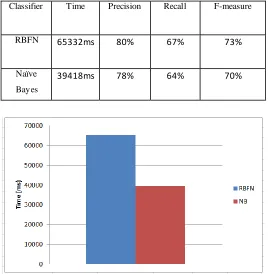
We have measured the time, prec ision, recall and F-measure to evaluate the effectiveness of both classifiers
which are shown in Table I.
Table I-Time, Precision (P) ,Recall (R ) , F-measure(F1) value for RBFN and Naive Bayes with Filtering Rules
Classifier Time Precision Recall F-measure
RBFN 65332ms 80% 67% 73%
Naïve
Bayes
39418ms 78% 64% 70%
Fig 2: Comparison of RB FN and Nai ve Bayes in terms of Le arning Ti me for
WmSnSec Dataset
Table I shows that, RBFN c lassifying filtering approach is better to classify and categorize te xt but it take more
learning time as compa rative to Na ive Bayes classifier.
VII. CONCLUSION
This paper presents the comparative performance evaluation of Rad ia l basis function network and Naive Bayes
for te xt classification and design of system to filter undesired messages from Online Social Networking user
wall. Additionally the fle xib ility of a system can be enhanced through filtering ru les and blacklist manage ment.
We have used WmSnSec dataset and after evaluating performance we conclude that RBFN classifying filtering
198 | P a g e
REFERENCES
[1] Marco Vanetti, Elisabetta Binaghi, Elena Ferrari, Barbara Carminati, and Moreno Carullo, “A System to
Filter Unwanted Messages from OSN User Walls,” IEEE Transactions on Knowledge and data engineering
,vol. 25, no. 2, Feb 2013.
[2] M. Chau and H. Chen, “A machine learn ing approach to web page filtering using c ontent and structure
analysis,” Decision Support Systems, vol. 44, no. 2, pp. 482–494, 2008.
[3] R. J. Mooney and L. Roy, “Content-based book recommending using learning for text categorization,” in
Proceedings of the Fifth ACM Conference on Digital Libraries. New York: A CM Press, 2000, pp. 195–204.
[4] F. Sebastiani, “Machine learn ing in automated text categorization,” ACM Co mputing Surveys, vol. 34, no.
1, pp. 1–47, 2002.
[5] Zelikovitz and H. Hirsh, “Improving short text classification using unlabeled background knowledge,” in
Proceedings of 17th International Conference on Machine Learning (ICML-00), P. Langley, Ed. Stanford,
US: Morgan Kaufmann Publishers, San Francisco, US, 2000, pp. 1183– 1190.
[6] B. Srira m, D. Fuhry, E. De mir, H. Fe rhatosmanoglu, and M. Demirbas, “Short text classificat ion in twitter
to imp rove information filtering,” in Proceeding of the 33rd International ACM SIGIR Conference on
Research and Development in Information Retrieval, SIGIR 2010, 2010, pp. 841–842.
[7] D. D. Lewis, Y. Yang, T. G. Rose, and F. Li, “ Rcv1: A new benchmark co llect ion for te xt categorization
research,” Journal of Machine Learning Research, 2004.
[8] J. Moody and C. Darken, “Fast learning in networks of loca lly-tuned processing units,” Neural
Co mputation, vol. 1, p. 281, 1989.
[9] Saurabh Kr. Srivastava1 and Sandeep Kr. Singh “Multi-Para meter Based Performance Eva luation of
Classification Algorith ms ” in proceeding of International Journal of Co mputer Science Information
Technology (IJCSIT), Vo l 7, No 3, June 2015.
![Fig 1: System Architecture [1]](https://thumb-us.123doks.com/thumbv2/123dok_us/7765234.1276396/4.596.172.426.109.388/fig-system-architecture.webp)