762 | P a g e
COMPARATIVE STUDY OF STEPPED AND WEIR
TYPE CASCADE SOLAR STILL
Mahesh Kumar
1,
Himanshu Manchanda
21
Assistant Professor, Department of Mechanical Engineering
2
Research Scholar, Department of Mechanical Engineering
Guru Jambheshwar University of Science and Technology, Hisar, Haryana, (India)
ABSTRACT
In this communication comparison of stepped and weir type cascade solar still have been made under the hot and humid climatic conditions of Hisar, India. Two solar stills of similar dimensions have been designed, fabricated and tested. Thermal performance of both the still has been analyzed using Dunkle’s correlation and various heat transfer coefficients were evaluated. Productivity of weir-type cascade solar still was observed to be 2.1 l/m2 which were nearly 20% higher than stepped solar still. Average values of heat transfer coefficients (convective, evaporative and radiative) for stepped solar still were found as 1.25, 11.4 and 7.06 W/m2 oC respectively and for weir type cascade solar still they were observed as 1.43, 12.8 and 7.0 W/m2 oC respectively. Efficiency of weir type cascade still was found 22% higher than stepped solar still.
Keywords:
Dunkle’s Correlation, Heat Transfer Coefficients, Productivity, Stepped Solar Still,
Weir Type Cascade Solar Still
I. INTRODUCTION
Water scarcity and environment degradation are the major concern of today globally. From the last decade, main focus in the world is to save environment and using renewable energy for different activities of life. Solar distillation is one of the thermal technique in which contaminated water is evaporated and condensed to collect potable water. It is a free, clean, simple, and low cost water purification method. Main disadvantage of this technique is its lower distillate output. To meet the water demand different designs of solar stills along with different parameters are studied and tested all over the world [1-3].
763 | P a g e
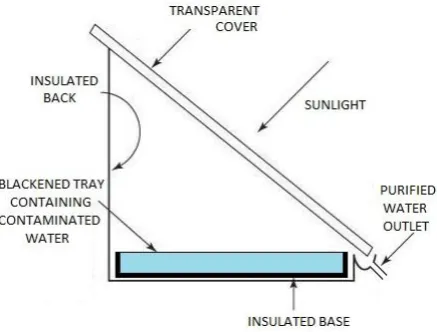
condensed in the inclined transparent glass/plastic cover and gets collected in the collection chamber. Solar distillation process easily removes the salt and other impurities such as water borne pathogens, heavy metals, microbiological organism etc. from the contaminated water [4].Figure 1. Schematic view of conventional solar still
There are three important parameters which affect the performance of solar still viz., design, operational and meteorological parameters respectively. Numbers of solar still designs like hemispherical, conical, wick type, inclined, double basin double slope, spherical, stepped type, weir type cascade solar still etc. gives the distillate higher than the conventional solar still. Water depth, salinity, internal and external reflector, condensing cover material and its inclination angle, energy storage materials etc. are some operational parameters which improves the distillate output. Meteorological parameters include wind speed, ambient temperature, solar intensity, latitude of the place etc. [2, 4]
Stepped and weir type cascade solar stills are improved designs of conventional still. Efficiency and distillate output of these designs of solar stills were found comparative with other designs. Some of the research work carried out on stepped and weir type solar stills with different parameters are discussed below.
764 | P a g e
tested using Pebble, baffle plate, fins and sponges for improvement in distillate output. An increase of 78% in productivity was observed with fin and sponges in stepped solar still. Velmurugan et al., [10] tested the performance of stepped solar still integrated with settling tank for effluent desalination. Effect of sponges, fins, pebbles and their combinations were also studied with stepped solar still. An overall increase of 98% in productivity was observed when fins, sponges and pebbles were used in stepped solar still. Saravanan and Manikandan [11] studied the effect of flow rate and phase change material on the performance of single slope stepped solar still. Productivity of the stepped solar still was observed to increase with low flow rate and using phase change material. A weir type cascade solar still with and without phase change material (PCM) was studied by Tabrizi et al., [12]. Performance of designed still was highly increased using PCM in cloudy days. Maximum distillate output of 4.85 and 5.14 kg/m2 was observed at minimum flow rate of 0.055 kg/min for still with and without PCM in sunny days. Further, effect of water level on the absorber plate and air gap between water surface and glass plate on the performance of weir type cascade solar still was studied by Dashtban and Tabrizi [13]. It was concluded that productivity of the still was increased by reducing the water level and air gap in the still. With the use of PCM, still shows 31% higher yield than the still without PCM. Effect of water flow rate on thermal performance of weir type cascade solar still was investigated by Tabrizi et al., [14]. Distillate output of 7.4 kg/m2 day was collected at minimum flow rate of 0.065 kg/min. In further investigation, Ziabari et al., [15] modeled a cascade type solar still system. Various characteristic and drawbacks of initial systems was studied and the performance of modified system was investigated. Average distillate of the proposed still was found to be around 6.7 l/m2. Zoori et al., [16] studied the effect of various parameters on energy and exergy efficiency of cascade weir type solar still. Efficiency of the system was reduced by increasing brine flow rate and with increase of water thickness over absorber plate. Maximum energy and exergy efficiency of 83.3% and 10.5% were observed at 0.065 kg/min of brine flow rate. Hansen et al. [17] investigated the performance of inclined solar still with different wick materials. 4.28 l/day distillate was collected with water coral fleece wick with wire-mesh stepped absorber plate. Recently, Kabeel et al., [18] reviewed various performance improvement techniques for stepped solar still.In this paper, comparative study of stepped and weir type solar still have been made under the climatic condition of Hisar, India. Two solar stills of same basin area have been fabricated and tested and their performance has been thermally evaluated using Dunkle’s correlation.
II. EXPERIMENTAL SET-UP DETAIL AND THERMAL ANALYSIS
765 | P a g e
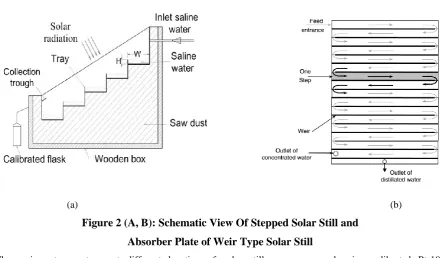
(a) (b)
Figure 2 (A, B): Schematic View Of Stepped Solar Still and
Absorber Plate of Weir Type Solar Still
The various temperatures at different location of solar still were measured using calibrated Pt-100 thermocouples with a digital temperature indicator of 0.1 oC least count. The solar intensity was measured by using solar power meter (MECO). The mass of distilled water collected was measured with an electronic weighing balance (Capacity of 6 kg; Smartech) having a least count of 0.1 kg. The essential data of temperatures, sun radiations and distilled output was recorded at 7 a.m. to 6 p.m. The experimental data was recorded after every 1 hour time interval. The amount of distilled water collected for each hour reading was obtained by subtracting two consecutive reading in a given time interval. Dunkle’s correlation was used to evaluate the thermal performance of stepped and weir type solar still using experimental data. Tiwari and Tiwari [19] gives the Dunkle’s correlation as
hcg = 0.884 (1)
Evaporative and radiative heat transfer coefficient is evaluated using Eq. (2) and Eq. (3)
heg = 0.01623× hcwg. (2)
hrg = εeff × σ [(Tw + 273) 2
+ ( Tg + 273) 2
]( Tw + Tg + 546) (3)
where,
εeff = 1/ ( 1/εw + 1/εg - 1)
The efficiency of solar still is given by
766 | P a g e
III. RESULTS AND DISCUSSION
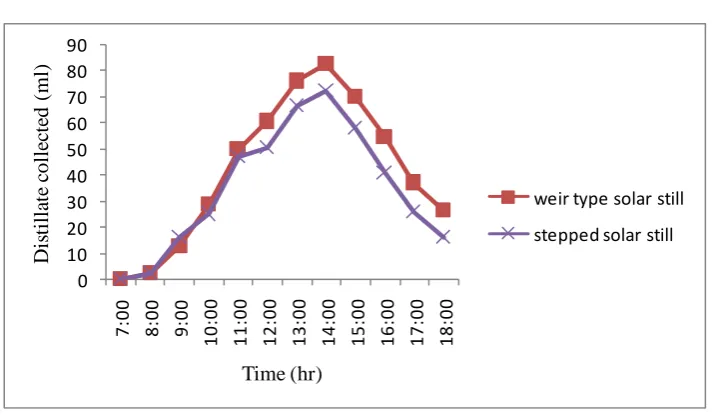
Various heat transfer coefficient were evaluated using measured temperature at different location of solar stills. Basin area, solar intensity and distillate output were used to calculate efficiency of solar stills. Cumulative distillate output for stepped and weir type solar still was observed to be 1.65 l/m2and 2.1 l/m2respectively. Higher basin water temperature and distillate output was observed at higher solar intensity period i.e. during afternoon hours (12 noon to 3:00 p.m.). Solar intensity, basin water temperature and distillate output of stepped and weir type solar still is shown in Figure 3 to 5.
Figure3. Solar Intensity during day of experiment
767 | P a g e
0 5 10 15 20 25 7:00 AM 8:00 AM 9:00 AM 10:00 AM 11:00 AM 12:00 N 1:00 PM 2:00 PM 3:00 PM 4:00 PM 5:00 PM 6:00 PMhcwg hewg hrwg
0 10 20 30 40 50 60 70 80 90 7
:00 8:00 9:00
10 :00 11 :00 12 :00 13 :00 14 :00 15 :00 16 :00 1 7 :0 0 18 :00 D is ti ll at e col le ct ed (m l) Time (hr)
weir type solar still
stepped solar still
Figure5. Distillate output of stepped and weir type solar still
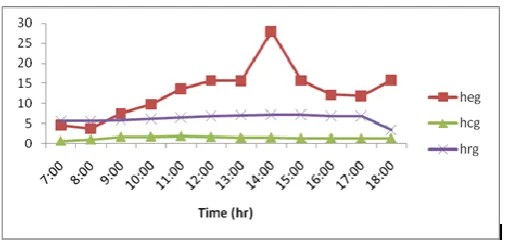
Average values of various heat transfer coefficients (convective, evaporative and radiative) for stepped solar still were found as 1.25, 11.4 and 7.06 W/m2 oC respectively and for weir type cascade solar still they were observed as 1.43, 12.8 and 7.0 W/m2 oC respectively. Values of evaporative heat transfer coefficient were observed to increase with increase of solar radiation and it decreases in late hours. Thermal efficiency of stepped and weir type solar still was observed as 16.7 and 21.4% respectively. Figure 6 and Figure 7 shows the variation of convective, evaporative and radiative heat transfer coefficients for stepped and weir type solar stills.
768 | P a g e
Figure 7: Variation of Various Heat Transfer Coefficients For Weir Type Stepped Solar Still
IV. CONCLUSION
Stepped and weir type cascade solar still is one of the simplest design modification of conventional solar still. The steps on still basin increase evaporative area which helps in more heat absorption and better efficiency. In this paper comparison of both the still has been made under the hot and humid climatic conditions. The following conclusions have been made from the present study:
Distillate output of the weir type cascade solar still was observed 20% higher than stepped solar still.
Productivity of both the still increase with increase of solar radiation and ambient temperature.
Average values of heat transfer coefficients (convective, evaporative and radiative) for stepped solar still
were found as 1.25, 11.4 and 7.06 W/m2 oC respectively and for weir type cascade solar still they were observed as 1.43, 12.8 and 7.0 W/m2 oC respectively.
Thermal efficiency of stepped and weir type solar still was observed as 16.7 and 21.4% respectively.
Nomenclature
Ap basin area (m2)
hcg convective heat transfer coefficient (W/m
2 o
C) heg evaporative heat transfer coefficient (W/m2 oC)
hrg radiative heat transfer coefficient (W/m2 oC)
I(t) solar intensity (W/m2)
L latent heat (J/kg)
m′ hourly productivity (kg/h)
p partial vapor pressure (N/m2)
t passed time from starting
Tw Water temperature (
o
C)
Tg inner glass cover temperature (
o
C) εeff effective emissivity, dimensionless
εg emissivity of glass cover, dimensionless
εw emissivity of water, dimensionless
σ Stefan–Boltzmann's constant (5.6697×10⁻⁸ W/m2 K4)
769 | P a g e
REFERENCES
1. G.N. Tiwari, Solar Energy- Fundamentals, design, modeling and applications, (Narosa Publishing House, 2013). 2. G.N. Tiwari, and A.K. Tiwari, Solar distillation practice for water desalination systems, (Anamaya Publications,
2007).
3. K. Sampathkumar, T.V. Arjunan, P. Pitchandi, P. Senthilkumar, Active solar distillation- A detailed review, Renewable and Sustainable Energy Reviews 14, 2010, 1503–1526.
4. H. Manchanda, M. Kumar, A comprehensive decade review and analysis on designs and performance parameters
of passive solar still, Renewables: Wind, Water and Solar 2:17, 2015, 1-24.
5. A.E. Kabeel, A. Khalil1, Z.M. Omara, M.M. Younes, Theoretical and experimental parametric study of modified stepped solar still, 289, 2012, 12–20.
6. Z.M. Omara, A.E. Kabeel, M.M. Younes, Enhancing the stepped solar still performance using internal reflectors, Desalination 314, 2013, 67–72.
7. Z.M. Omara, A.E. Kabeel, M.M. Younes, Enhancing the stepped solar still performance using internal and external reflectors, Energy Conversion and Management 78, 2014, 876–881.
8. A.S. Abdullah, Improving the performance of stepped solar still. Desalination 319, 2013, 60–65.
9. V. Velmurugan, S. Senthil, V. Niranjan , K. Srithar, ‘Productivity enhancement of stepped solar still— performance analysis’. Thermal Science 12, 2008, 153–163.
10. V. Velmurugan, K.J. Naveen, H.T. Noorul, K. Srithar, Performance analysis in stepped solar still for effluent desalination. Energy 34, 2009, 1179–1186
11. M. Saravanan, and K. Manikandan, Experimental analysis of single slope stepped solar still with and without latent heat thermal energy storage system (LHTESS), International Journal of Research in Environmental Science and Technology, 2(4), 2012, 92-95.
12. F.F. Tabrizi, M. Dashtban, H. Moghaddam, Experimental investigation of weir-type cascade solar still with built in latent heat thermal energy storage system, Desalination 260, 2010, 248-253.
13. M. Dashtban and F.F. Tabrizi, Thermal analysis of a weir-type cascade solar still integrated with PCM storage, Desalination 279, 2011, 415-422.
14. F.F. Tabrizi, M. Dashtban, H. Moghaddam, K. Razzaghi, Effect of water flow rate on internal heat and mass transfer and daily productivity of a weir-type cascade solar still, Desalination 260, 2010, 239-247
15. F.B. Ziabari, A.Z. Sharak, H. Moghadam, F.F. Tabrizi, Theoretical and experimental study of cascade solar stills, Solar Energy 90, 2013, 205-211.
16. H.A. Zoori, F.F. Tabrizi, F. Sarhaddi, Comparison between energy and exergy efficiencies in a weir type cascade solar still, Desalination, 325, 2013, 113-121.
17. R.S. Hansen, C. S. Narayanan, K.K. Murugavel, Performance analysis on inclined solar still with different new wick materials and wire mesh. Desalination, 358, 2015, 1–8.
18. Z.M. Omara, A.E. Kabeel, M.M. Younes. (2015). Techniques used to improve the performance of the stepped solar still—A review. Renewable and Sustainable Energy Reviews, 46, 178–188.