Automatic Determination of a Domain Adaptation Method for Word
Sense Disambiguation Using Decision Tree Learning
Kanako Komiya
Tokyo University of Agriculture and Technology 2-24-16 Naka-cho, Koganei
Tokyo, 184-8588 Japan [email protected]
Manabu Okumura
Tokyo Institute of Technology 4259 Nagatsuta Modori-ku Yokohama 226-8503 Japan [email protected]
Abstract
Domain adaptation (DA), which involves adapting a classifier developed from source to target data, has been studied intensively in recent years. However, when DA for word sense disambiguation (WSD) was carried out, the optimal DA method varied according to the properties of the source and target data. This pa-per describes how the optimal method for DA was determined depending on these properties using decision tree learning, given a triple of the target word type of WSD, the source data, and the target data, and discusses what properties affected the determination of the best method when Japanese WSD was performed.
1 Introduction
Classifiers in standard supervised machine learn-ing have been trained for data in domain A uslearn-ing manually annotated data in domain A, e.g., to train classifiers for newswires using newswires. How-ever, classifiers for data in domain B have some-times been necessary when there have been no or few manually annotated data, and there have only been manually annotated data in domain A, which have been related to domain B. Domain adapta-tion (DA) involves adapting the classifier that have been trained from data in domain A (source do-main) to data in domain B (target dodo-main). This has been studied intensively in recent years.
However, the optimal method of DA varied ac-cording to the properties of the data in the source domain (the source data) and the data in the target domain (the target data) when DA for word sense disambiguation (WSD) was carried out. (We will show it in Section 4.)
We define a case as a triple of the target word type of WSD, the source data, and the target data.
This paper describes how the optimal method for DA was determined depending on these properties using decision tree learning given a case and dis-cusses what properties affected the determination of the best method when Japanese WSD was per-formed.
This paper is organized as follows. Section 2 reviews related works on DA and Section 3 ex-plains how a DA method is automatically deter-mined. Section 4 describes the data we used. How to label the data and how to train the classifiers us-ing these are explained in Section 5. We present the results in Section 6 and discuss them in Sec-tion 7. Finally, we conclude the paper in SecSec-tion 8.
2 Related Work
The DA problem can be categorized into three types depending on the information for learning, i.e., supervised, semi-supervised, and unsuper-vised approaches. A classifier in a superunsuper-vised ap-proach is developed from a large amount of la-beled source data and a small amount of lala-beled target data with the aim of classifying target data better than a classifier developed only from the target data. A classifier in a semi-supervised ap-proach is developed from large amounts of labeled source data and unlabeled target data with the aim of classifying target data better than a classifier de-veloped only from the source data. Finally, a clas-sifier is developed from a large amount of labeled source data with the aim of classifying target data accurately in the unsupervised approach. We fo-cused on the supervised DA of WSD in this paper. Many researchers have investigated DA within or outside the area of natural language process-ing. Chan and Ng (2006) carried out the DA of WSD by estimating class priors using an EM al-gorithm. Chan and Ng (2007) also conducted the DA of WSD by estimating class priors using the EM algorithm, but this was supervised DA using
active learning.
In addition, Daum´e III (2007) worked on the supervised DA. He augmented an input space and made triple length features that were gen-eral, source-specific, and target-specific. This was easy to implement, could be used with various DA methods, and could easily be extended to multi-domain adaptation problems. Daum´e III et al. (2010) extended the work in (Daum´e III, 2007) to semi-supervised DA. It inherited the advantages of the supervised version and outperformed it by us-ing unlabeled target data.
Agirre and de Lacalle (2008) worked on the semi-supervised DA of WSD. They applied sin-gular value decomposition (SVD) to a matrix of unlabeled target data and a large amount of un-labeled source data, and trained a classifier with them. Agirre and de Lacalle (2009) worked on the supervised DA using almost the same method, but they used a small amount of labeled source data in-stead of the large amount of unlabeled source data. Jiang and Zhai (2007) demonstrated that perfor-mance increased as examples were weighted when DA was applied. This method could be used with various other supervised or semi-supervised DA methods. In addition, they tried to identify and remove source data that misled DA, but they con-cluded that it was only effective if examples were not weighted.
Zhong et al. (2009) proposed an adaptive kernel approach that mapped the marginal distribution of source and target data into a common kernel space. They also conducted sample selection to make the conditional probabilities between the two domains closer.
Raina et al. (2007) proposed self-taught learn-ing that utilized sparse codlearn-ing to construct higher level features from the unlabeled data collected from the Web. This method was based on unsu-pervised learning.
Tur (2009) proposed a co-adaptation algorithm where both co-training and DA techniques were used to improve the performance of the model.
The research by Blitzer et al. (2006) involved work on semi-supervised DA, where they calcu-lated the weight of words around the pivot features (words that frequently appeared both in source and target data and behaved similarly in both) to model some words in one domain that behaved similarly in another. They applied SVD to the matrix of the weights, generated a new feature space, and used
the new features with the original features. The closest work to ours is that by McClosky et al. (2010) who focused on the problem where the best model for each document is not obvious when parsing a document collection of heteroge-neous domains. They studied it as a new task of
multiple source parser adaptation. They proposed a method of parsing a sentence that first predicts accuracies for various parsing models using a re-gression model, and then uses the parsing model with the highest predicted accuracy. The main dif-ference is that their work was about parsing but ours discussed here is about Japanese WSD. They also assumed that they had labeled corpora in het-erogeneous domains but we have not. We de-termined the best DA method using the decision tree learning given a triple of the target word type of WSD, the source data, and the target data and found what features affected the determination of the best method.
Harimoto et al. (2010) measured the distance between domains to conduct DA using a suitable corpus in parsing. In addition, van Asch and Daelemans (2010) reported that performance in DA could be predicted depending on the similar-ity between source and target data using automat-ically annotated corpus in parsing. They focused on how corpora were selected for use as source data according to the distance between domains, but here we focus on how to select a method of DA depending on properties such as the distance between domains.
3 Automatic determination of DA method
We expected the average accuracy of WSD, when DA methods that were determined automatically were used for all cases, to be higher than when the original methods were used collectively. Hence, we would be able to determine the best DA method automatically using decision tree learning. A de-cision tree would indicate what features affect the determination of the optimal method of DA.
3.1 DA methods for WSD
Two methods were used as the DA methods for WSD in this study.
• Target Only: Train a classifier with a small
• Random Sampling: Train a classifier with
source data and a small amount of target data that are randomly selected and manually la-beled.
Ten word tokens of the target data were ran-domly selected and manually labeled in all the ex-periments.
Libsvm (Chang and Lin, 2001), which supports multi-class classification, was used as the classi-fier for WSD. A linear kernel was used according to the results obtained from preliminary experi-ments. Seventeen features were introduced to train the classifier.
• Morphological features
– Bag-of-words 4 features
– Part-of-speech (POS) 4 features
– Finer subcategory of POS 4 features
• Syntactic feature 1 feature
– If the POS of a target word is a noun, the verb which the target word modifies
– If the POS of a target word is a verb, the case element of “ ” (wo, objective) for the verb
• Semantic features
– Semantic classification code 4 fea-tures
Morphological features and semantic features were extracted from the surrounding words (two words to the right and left) of the target word. POS and finer subcategory of POS can be obtained us-ing a morphological analyzer. We used ChaSen 1 as a morphological analyzer, the Bunruigoihyo thesaurus (National Institute for Japanese Lan-guage and Linguistics, 1964) for semantic classifi-cation codes, and CaboCha2as a syntactic parser. Five-fold cross validation was used in the experi-ments.
3.2 Labels of Decision Tree
One of the following labels was given to every case depending on the most accurate method and as we shall explain later, two labels (TO and RS) or three labels (TO, RS, and SA) were used for classification. Note that the decision tree deter-mines which DA method should be used,Random
1http://sourceforge.net/projects/masayu-a/ 2http://sourceforge.net/projects/cabocha/
Sampling orTarget Only, given the properties of the source and target data for each case.
• TO: The cases in which Target Only had higher accuracy thanRandom Sampling.
• RS: The cases in which Random Sampling
had higher accuracy thanTarget Only.
• SA: The cases in which Random Sampling
andTarget Onlyhad the same accuracy.
3.3 Features of Decision Tree
We think the optimal method for DA varies de-pending on the distribution of the source data and the target data, the distance between them, and so on. The following 40 features (consisting of 24 types) in total were used for decision tree learn-ing.
1. Simulation accuracy oftheOther: The accu-racy of WSD when a classifier was trained with the source data and tested with ten la-beled word tokens of the target data.
2. Simulation accuracy ofTarget Only: The ac-curacy of WSD when a classifier was trained with ten labeled word tokens of the target data and tested using a leave-one-out cross-validation method.
3. Ratio of two simulation accuracies: (1) / (2).
4. Number of source data: The number of word tokens in the whole source data.
5. Number of target data: The number of word tokens in the whole target data.
6. Number of source data / target data: (4) / (5).
7. The number of word senses that appeared in the whole source data set.
8. The number of word senses that appeared in ten word tokens of the target data.
9. The number of word senses of the WSD tar-get words in the dictionary.
10. The number of word tokens of the most fre-quent sense (MFS) of the whole source data.
12. Whether the MFS of the whole source data and the ten labeled word tokens of the target data were the same or not.
13. Percentage of MFS in source data: (10) / (4).
14. Percentage of MFS in ten word tokens of tar-get data: (11) / the number of word tokens in the labeled target data (=10).
15. Percentage of MFS in ten word tokens of tar-get data in source data: The number of source data word tokens with MFS in ten labeled word tokens of the target data / (4).
16. Percentage of MFS of source data in ten word tokens of target data: The number of word tokens with MFS in the source data in ten la-beled word tokens of the target data / the ten word tokens.
17. The JS divergence between the distribution of word sense IDs of 4/5 of the whole source data and the distribution of word sense IDs of ten labeled word tokens of target data. Ab-breviated as “JSD (word sense)”.
18. The JS divergence between the feature distri-butions for WSD of the whole source and the whole target data (17 kinds, cf. Section 3.1 Abbreviated as “JSD (*)” *is a feature name in Section 3.1.
19. The summation of 17 kinds of JS divergences (18). Abbreviated as “JSD (Feature plus)”.
20. The JS divergence between the distribution of the whole source data and the whole target data feature units, when a unit is the sequence of 17 kinds of WSD features. Abbreviated as “JSD (Feature all)”.
21. The number of word senses that did not ap-pear in ten labeled word tokens of the target data but did in the whole source data.
22. The number of common word senses be-tween the whole source data and ten labeled word tokens of the target data.
23. Percentage of common word senses between whole source data and ten word tokens of tar-get data in ten word tokens: the number of word tokens whose word senses appeared in both the whole source data and ten labeled
word tokens of the target data in the ten word tokens / the ten word tokens.
24. Percentage of common word senses between whole source data and ten word tokens of tar-get data in source data: the number of word tokens whose word senses appeared in both the whole source data and ten labeled word tokens of the target data in the source data/ (4).
The C4.5 of Quinlan (1993) was used as the algo-rithm for decision tree learning and a binary tree was generated. The experiments were conducted with five-fold cross validation. The threshold val-ues for pruning were optimized with preliminary experiments using 1/4 of the training data set as a development data set. Here, the entropy of a node was tuned as the threshold value in 0.1 increments. The value of a smaller tree was used when more than one threshold value gave the same accuracy.
4 Data
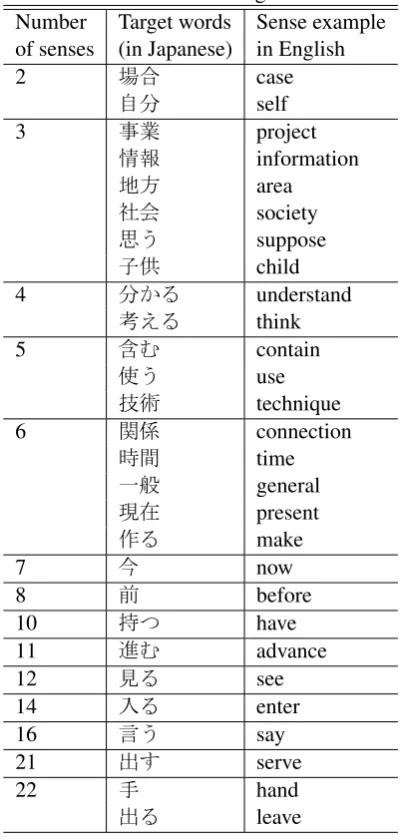
Three data were used for the experiments: (1) the sub-corpus of white papers in the Balanced Corpus of Contemporary Japanese (BCCWJ) (Maekawa, 2008), (2) the sub-corpus of documents from a Q&A site on the WWW of BCCWJ, and (3) Real World Computing (RWC) text databases (news-paper articles) (Hashida et al., 1998). DAs were conducted in six directions according to various source and target data. Word senses were anno-tated in these corpora according to a Japanese dic-tionary, i.e., the Iwanami Kokugo Jiten (Nishio et al., 1994). It has three levels for sense IDs, and we used the fine-level sense in the experi-ments. Multi-sense words that appeared equal or more than 50 times in both source and target data were selected as the target words in the experi-ment. There were 24 word types for white papers Q&A site, 22 for white papers newspaper ar-ticles, and 26 for Q&A site newspaper articles. Twenty-eight word types and 144 cases were used in the experiments in total. Table 1 lists the mini-mum, maximini-mum, and average number of word to-kens in each case. Table 2 shows the list of target words.
Table 1: Minimum, maximum, and average num-ber of word tokens in each case
Genre Min. Max. Ave.
BCCWJ white papers 58 7,610 2074.50 BCCWJ Q&A site 82 13,976 2300.43 RWC newspaper 50 374 164.46
erage accuracies of all the target words of WSD.
Self, which is standard supervised learning with the target data, assuming that fully annotated data were obtained and could be used for learning and
theOther, which is standard supervised learning only with the source data, were tested as refer-ences. We found that the optimal method of DA varied depending on the corpora that were used as the source and target data.
5 Labeling of data and learning of decision tree
We tried to generate decision trees in various ways and compared their accuracies to find the most ef-fective way of generating the best decision tree.
5.1 Labeling of data
TO, RS, or SA was given to every case depend-ing on the most accurate method. SA was partic-ularly given to cases in which Random Sampling
andTarget Onlyhad the same accuracy.
The difference between accuracies and the def-inition of SA was treated in two ways.
• Equal: The SA label was assigned when the WSD accuracies ofTarget OnlyandRandom Samplingwere totally equal.
• Chi-square: The SA label was assigned when the WSD accuracies ofTarget Onlyand
Random Samplingwere not significantly dif-ferent according to a chi-square test. The level of significance in the test was 0.05.
Table 4 indicates the number of cases and the total word types given TO or RS labels according toEqualandChi-square.
5.2 Treatment of SA in decision tree learning
The third label, SA, was assigned to cases with no difference between the accuracies of Random SamplingandTarget Onlyand was treated in two ways in the experiments.
experiment of this figure.
Table 2: The list of target words Number Target words Sense example of senses (in Japanese) in English
2 case
self
3 project
information area society suppose child
4 understand
think
5 contain
use technique
6 connection
time general present make
7 now
8 before
10 have
11 advance
12 see
14 enter
16 say
21 serve
22 hand
leave
• Ternary classification with SA: Perform
ternary classification of TO, RS, and SA in training and the testing.
• Binary classification without SA: Remove cases with SA labels from training data set and perform binary classification of TO and RS. All the cases are used for the testing.
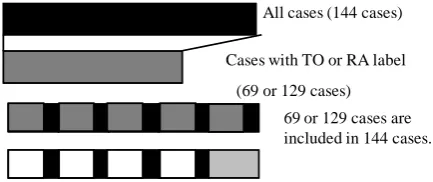
Figure 1 shows the frame format for five-fold cross validation of decision tree learning when Bi-nary classification without SA was used. There was a total of 144 cases, and only data with TA or RS labels were used as a training data set for de-cision tree learning. There were 129 cases when
Equal was used and 69 cases when Chi-square
Table 3: Results from DA experiments when source and target data were swapped
DA method Accuracy
Source data Q&A site white papers Target data white papers Q&A site
theOther 79.65% 83.35%
Random sampling 85.40% 83.86%
Target Only 88.20% 77.74%
self 95.97% 91.65%
Table 4: Number of cases and total word types given TO or RS labels according toEqualand Chi-square
Source data Target data Equal Chi
white papers Q&A site 21 13 white papers newspaper 18 9
Q&A site newspaper 25 12 Q&A site white papers 25 12 newspaper white papers 20 11 newspaper Q&A site 20 12
Total cases 129 69
Total word types 27 20
parts) and tested using 1/5 of the whole cases (light gray part) in one execution of five-fold cross val-idation. (Three-quarter of the training data (3/5 of the whole data set) and 1/4 of the training data (1/5 of the whole data set) was used for the train-ing data and the test data of the parameter tuntrain-ing respectively.)
We calculated the accuracies of WSD using the DA method for the labels (Target Onlyfor TO and
Random Samplingfor RS). We usedRandom Sam-plingfor cases with SA labels whenTernary clas-sification with SA was used. When Binary clas-sification without SAwas used, we had no correct answers for the cases of SA in the test phase. How-ever, either label could be given to them because they were cases in which Random Sampling and
Target Onlyhad the same accuracy. Therefore, we assigned TO or RS to them depending on the de-cision tree that was generated.
5.3 Classification
As Table 1 indicates, some cases had many word tokens and some had few. For example, a case had 58 word tokens when the source data were from the RWC newspaper articles, the target data were from the BCCWJ white papers, and the target
Cases with TO or RA label
(69 or 129 cases) All cases (144 cases)
69 or 129 cases are included in 144 cases.
Figure 1: Five-fold cross validation of decision tree learning when Binary classification without SAwas used
word type was “ ”. (This case had 58 word to-kens because the word appeared 58 times). There-fore, the average accuracy of WSD could be im-proved if cases that had more word tokens could be predicted more precisely. We also classified cases with weighted word tokens, as well as just classified cases, in two ways.
• Case classification: Perform decision tree
learning on the assumption that every case has the same weight.
• Classification with weighting of word tokens:
Perform decision tree learning with weight-ing on the assumption that every case has the weight of the number of word tokens in the case.
The weights of the cases were used to calculate entropy.
6 Results
Table 5 lists the average accuracies of WSD when the original methods were used collectively. The average accuracies were calculated from 232,116 word tokens in 144 cases. (They were micro-averaged over the word tokens.) Table 5 indi-cates thatTarget OnlyoutperformedRandom Sam-plingand its accuracy was 81.23%. Here,Selected Source Onlyis a DA method where train a classi-fier with only selected source data that are simi-lar to the target data. We used 0.8 of cosine dis-tance as a threshold value. We did not include this method as a DA method that is automatically de-termined but showed as reference.
Table 5: Average accuracy of WSD when methods were used collectively
DA method Accuracy of WSD
Target Only 81.23 %
Random Sampling 80.28 %
Selected Source Only 82.27 %
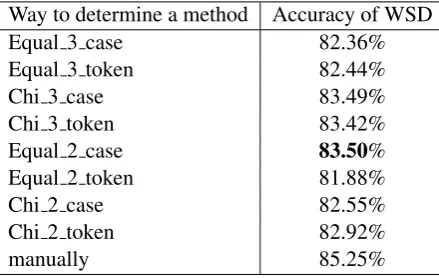
Table 6: Average accuracy of WSD when methods that were determined automatically were used
Way to determine a method Accuracy of WSD
Equal 3 case 82.36%
Equal 3 token 82.44%
Chi 3 case 83.49%
Chi 3 token 83.42%
Equal 2 case 83.50%
Equal 2 token 81.88%
Chi 2 case 82.55%
Chi 2 token 82.92%
manually 85.25%
were all combinations of the two choices in Sec-tions 5.1, 5.2, and 5.3. AbbreviaSec-tions of the ways in Table 6 are in the format of a b c where a is the choice for Section 5.1, b is that for Section 5.2 and c is that for Section 5.3. The “3” and “2” represent
Ternary classification with SA andBinary classi-fication without SA, and “case” and “token” rep-resent Case classificationandClassification with weighting of word tokens, respectively. When the manual approach was used, the DA method with the highest accuracy was chosen manually for ev-ery case. Its average accuracy was in the upper bound for our proposed method.
Table 6 shows that the automatic way with the highest average accuracy was Equal 2 case. The accuracy was 83.50%, and it significantly outper-formed Target Only andSelected Source Only in Table 5 (81.23% and 82.27%) . This means that the average accuracy of WSD when DA methods that were determined automatically were used was higher than when the original methods were used collectively.
7 Discussion
7.1 Comparison of ways of determining DA methods
We compare the results for ways of determining DA methods in this section. First, usually
Chi-square was better for labeling of data, butEqual
was better when Binary classification without SA
andCase classificationwere used simultaneously. Second, usually Ternary classification with SA
was better for treating SA in decision tree learn-ing, butBinary classification without SAwas bet-ter whenEqualandCase classificationwere used simultaneously. Finally, we could not find any pat-terns of the results forCase classificationor Clas-sification with weighting of word tokens.
The approach with the highest accuracy in the eight automatic ways was where SA la-bels were applied when the accuracies of WSD for the two methods were totally equal, binary classification was performed without SA, and cases were classified without weighted word to-kens (Equal 2 case) Significant differences were found in the three comparisons above when they were evaluated with a Chi-square test when the other conditions were the same.
The accuracy of decision tree learning was 60.42% when the Equal 2 case was used. This value was not very high, which may be due to the optimizing threshold value of pruning with a development data set. We think the reason low classification accuracy with decision trees did not critically influence the average accuracy of WSD was that most errors were for cases whereRandom SamplingandTarget Onlyhad almost the same ac-curacy.
7.2 Discussion on learned decision tree
We present the decision tree with the highest accu-racy in an appendix in five executions of five-fold cross validation in the decision tree learning of the Equal 2 case, whose average WSD accuracy was the highest in the eight automatic ways of learn-ing, and we discuss the features and their values that contributed to the generation of the tree.
First, TO was assigned when the “ratio of two simulation accuracies >=0.40” was false in the
word tokens of the target data. In other words, this indicates that the simulation using ten manually labeled word tokens of the target data was an im-portant clue in predicting the optimal DA method. Next, TO was selected when JSD (bag-of-words of one word to the left of the target word) was equal to or more than 0.61 in the node with level one. This indicated that a classifier should only be trained with ten labeled word tokens of target data, without source data, when the distributions of the feature of bag-of-words of one word to the left of the WSD target word differed between the source and target data.
Moreover, TO was selected when JSD (seman-tic classification code of one word to the right of the target word) was equal to or more than 1.00 in the node with level two. This indicated that a classifier should only be trained with ten labeled word tokens of target data, without source data, when the distributions of the semantic classifica-tion code features of one word to the right of the WSD target word differed between the source and target data.
The decision tree in the appendix is small and simple, but the second best tree (there is a differ-ence in only one case) consists of 13 questions. According to the tree, TO tends to be assigned when JS divergences such as JSD (word sense), JSD (Feature plus), and JSD (Syntactic feature) are large, and RS tends to be assigned when they are small. Large JS divergence indicates that the distributions of a feature are different, and small JS divergence indicates that the distributions of a feature are close. This indicates that when the dis-tributions of the important feature for WSD are different and the source data are not sufficiently close to the target data, the source data should not be used.
8 Conclusion
We described how the optimal method of DA could be determined depending on the properties of the source and target data using decision tree learning and found what properties affected the determination of the best method when Japanese WSD was performed. We defined a case as a triple of the target word type of WSD, the source data, and the target data, all of which were classified into two labels (TO and RS) or three labels (TO, RS, and SA). Here, the case with TO should only be trained with a small amount of target data, the
case with RS should be trained with source data and a small amount of target data, and SA repre-sents a case with no difference between the accu-racies for the two methods. The average accuracy of WSD when the DA methods that were deter-mined automatically were used was significantly higher than when the original methods were used collectively. We automatically generated a deci-sion tree in eight ways, the most accurate of which was with SA label when the WSD accuracies of the two methods were totally equal, performed bi-nary classification without SA, and classified cases without weighted word tokens. The top node in the tree that was generated indicated that simula-tion using ten manually labeled word tokens of the target data was an important clue enabling the op-timal DA method to be predicted.
Acknowledgments
We would like to thank the reviewers for very con-structive and detailed comments. This research is supported by Grants-in-Aid for Scientific Re-search, Priority Area ”Japanese Corpus”.
A Generated decision tree
Upper edge represents true and lower edge repre-sents false.
TO: 3 cases
JSD bag-of-words of one word to the left of the target word >=0.61
TO: 3 cases
JSD semantic classification code of one word to the right of the target word)>=1.00
TO: 28 cases RS: 62 cases Ratio of two simulation accuracies>=0.40
References
Eneko Agirre and Oier Lopez de Lacalle. 2008. On robustness and domain adaptation using svd for
word sense disambiguation. InProceedings of the
22nd International Conference on Computational Linguistics, pages 17–24.
Eneko Agirre and Oier Lopez de Lacalle. 2009.
Su-pervised domain adaption for wsd. InProceedings
of the 12th Conference of the European Chapter of the Association of Computational Linguistics, pages 42–50.
John Blitzer, Ryan McDonald, and Fernando Pereira. 2006. Domain adaptation with structural
coppe-spondence learning. In Proceedings of the 2006
Conference on Empirical Methods in Natural Lan-guage Processing, pages 120–128.
Yee Seng Chan and Hwee Tou Ng. 2006. Estimat-ing class priors in domain adaptation for word sense disambiguation. InProceedings of the 21st Interna-tional Conference on ComputaInterna-tional Linguistics and 44th Annual Meeting of the Association for Compu-tational Linguistics, pages 89–96.
Yee Seng Chan and Hwee Tou Ng. 2007. Domain adaptation with active learning for word sense
dis-ambiguation. In Proceedings of the 45th Annual
Meeting of the Association of Computational Lin-guistics, pages 49–56.
Chih-Chung Chang and Chih-Jen Lin,
2001. LIBSVM: a library for support
vector machines. Software available at
http://www.csie.ntu.edu.tw/ cjlin/libsvm.
Hal Daum´e III, Abhishek Kumar, and Avishek Saha. 2010. Frustratingly easy semi-supervised domain
adaptation. InProceedings of the 2010 Workshop
on Domain Adaptation for Natural Language Pro-cessing, ACL 2010, pages 23–59.
Hal Daum´e III. 2007. Frustratingly easy domain adap-tation. InProceedings of the 45th Annual Meeting of the Association of Computational Linguistics, pages 256–263.
Keiko Harimoto, Yusuke Miyao, and Jun’ichi
Tsu-jii. 2010. Kobunkaiseki no bunyatekiou ni okeru seido teika youin no bunseki oyobi bunyakan kyori
no sokutei syuhou, in japanese. InProceedings of
NLP2010, pages 27–30.
Koichi Hashida, Hitoshi Isahara, Takenobu Tokunaga, Minako Hashimoto, Shiho Ogino, and Wakako
Kashino. 1998. The rwc text databases. In
Proceed-ings of the First International Conference on Lan-guage Resource and Evaluation, pages 457–461.
Jing Jiang and ChengXiang Zhai. 2007. Instance weighting for domain adaptation in nlp. In Proceed-ings of the 45th Annual Meeting of the Association of Computational Linguistics, pages 264–271.
Kikuo Maekawa. 2008. Balanced corpus of
con-temporary written japanese. InProceedings of the
6th Workshop on Asian Language Resources (ALR), pages 101–102.
David McClosky, Eugene Charniak, and Mark John-son. 2010. Automatic domain adaptation for
pars-ing. InProceedings of the 2010 Annual Conference
of the North American Chapter of the Association for Computational Linguistics, pages 28–36.
National Institute for Japanese Language and
Linguis-tics. 1964. Bunruigoihyo. Shuuei Shuppan, In
Japanese.
Minoru Nishio, Etsutaro Iwabuchi, and Shizuo
Mizu-tani. 1994. Iwanami Kokugo Jiten Dai Go Han.
Iwanami Publisher, In Japanese.
John Ross Quinlan. 1993. C4.5: Programs for
Ma-chine Learning. Morgan Kaufmann Publishers. Rajat Raina, Alexis Battle, Honglak Lee, Benjamin
Packer, and Andrew Y. Ng. 2007. Self-taught learn-ing: Transfer learning from unlabeled data. InICML ’07: Proceedings of the 24th international confer-ence on Machine learning, pages 759–766.
Gokhan Tur. 2009. Co-adaptation: Adaptive
co-training for semi-supervised learning. In
Proceed-ings of the IEEE International Conference on Acous-tics, Speech and Signal Processing, 2009. ICASSP 2009., pages 3721–3724.
Vincent van Asch and Walter Daelemans. 2010. Us-ing domain similarity for performance estimation. In Proceedings of the 2010 Workshop on Domain Adaptation for Natural Language Processing, ACL 2010, pages 31–36.
Erheng Zhong, Wei Fan, Jing Peng, Kun Zhang, Jiang-tao Ren, Deepak Turaga, and Olivier Verscheure. 2009. Cross domain distribution adaptation via
ker-nel mapping. In Proceedings of the 15th ACM