A Machine Learning Approach to Acronym Generation
Yoshimasa Tsuruoka
CREST
Japan Science and Technology Agency Japan
Sophia Ananiadou School of Computing
Salford University United Kingdom
[email protected] [email protected] [email protected]
Jun’ichi Tsujii
Department of Computer Science The University of Tokyo
Japan
Abstract
This paper presents a machine learning approach to acronym generation. We for-malize the generation process as a se-quence labeling problem on the letters in the definition (expanded form) so that a variety of Markov modeling approaches can be applied to this task. To con-struct the data for training and testing, we extracted acronym-definition pairs from MEDLINE abstracts and manually anno-tated each pair with positional informa-tion about the letters in the acronym. We have built an MEMM-based tagger using this training data set and evaluated the performance of acronym generation. Ex-perimental results show that our machine learning method gives significantly bet-ter performance than that achieved by the standard heuristic rule for acronym gen-eration and enables us to obtain multi-ple candidate acronyms together with their likelihoods represented in probability val-ues.
1 Introduction
Technical terms and named-entities play important roles in knowledge integration and information re-trieval in the biomedical domain. However, spelling variations make it difficult to identify the terms con-veying the same concept because they are written in different manners. Acronyms constitute a major
part of spelling variations (Nenadic et al., 2002), so proper management of acronyms leads to improved performance of the information systems in this do-main.
As for the methods for recognizing acronym-definition pairs from running text, there are many studies reporting high performance (e.g. over 96% accuracy and 82% recall) (Yoshida et al., 2000; Ne-nadic et al., 2002; Schwartz and Hearst, 2003; Za-hariev, 2003; Adar, 2004). However, another aspect that we have to consider for efficient acronym man-agement is to generate acronyms from the given def-inition (expanded form).
One obvious application of acronym generation is to expand the keywords in information retrieval. As reported in (Wren et al., 2005), for example, you can retrieve only 25% of the documents con-cerning the concept of “JNK” by using the key-word “c-jun N-terminal kinase”. In more than 33% of the documents the concept is written with its acronym “JNK”. To alleviate this problem, some research efforts have been devoted to constructing a database containing a large number of acronym-definition pairs from running text of biomedical doc-uments (Adar, 2004).
However, the major problem of this database-building approach is that database-building the database offer-ing complete coverage is nearly impossible because not all the biomedical documents are publicly avail-able. Although most of the abstracts of biomedical papers are publicly available on MEDLINE, there is still a large number of full-papers which are not available.
to providing acronyms from their definitions so that we can obtain acronyms without consulting acronym-definition databases.
One of the simplest way to generate acronyms from definitions would be to choose the letters at the beginning of each word and capitalize them. How-ever, there are a lot of exceptions in the acronyms appearing in biomedical documents. The followings are some real examples of the definition-acronym pairs that cannot be created with the simple heuristic method.
RNA polymerase (RNAP) antithrombin (AT)
melanoma cell adhesion molecule (Mel-CAM) the xenoestrogen 4-tert-octylphenol (t-OP)
In this paper we present a machine learning ap-proach to automatic generation of acronyms in order to capture a variety of mechanisms of acronym gen-eration. We formalize this problem as a sequence labeling task such as part-of-speech tagging, chunk-ing and other natural language taggchunk-ing tasks so that common Markov modeling approaches can be ap-plied to this task.
2 Acronym Generation as a Sequence Labeling Problem
Given the definition (expanded form), the mecha-nism of acronym generation can be regarded as the task of selecting the appropriate action on each letter in the definition.
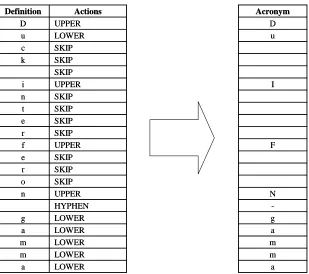
Figure 1 illustrates an example, where the defini-tion is “Duck interferon gamma” and the generated acronym is “DuIFN-gamma”. The generation pro-ceeds as follows:
The acronym generator outputs the first two letters unchanged and skips the fol-lowing three letters. Then the generator capitalizes ‘i’ and skip the following four letters...
By assuming that an acronym is made up of alpha-numeric letters, spaces and hyphens, the actions be-ing taken by the generator are classified into the fol-lowing five classes.
SKIP
The generator skips the letter.
UPPER
If the target letter is uppercase, the generator outputs the same letter. If the target letter is lowercase, the generator coverts the letter into the corresponding upper letter.
LOWER
If the target letter is lowercase, the generator outputs the same letter. If the target letter is uppercase, the generator coverts the letter into the corresponding lowercase letter.
SPACE
The generator convert the letter into a space.
HYPHEN
The generator convert the letter into a hyphen.
From the probabilistic modeling point of view, this task is to find the sequence of actions
that maximizes the following probability given the observation
(1)
Observations are the letters in the definition and various types of features derived from them. We de-compose the probability in a left-to-right manner.
(2)
By making a first-order markov assumption, the equation becomes
!
"#
$
(3)
If we have the training data containing a large number of definition-acronym pairs where the defi-nition is annotated with the labels for actions, we can estimate the parameters of this probabilistic model and the best action sequence can be efficiently com-puted by using a Viterbi decoding algorithm.
In this paper we adopt a maximum entropy model (Berger et al., 1996) to estimate the local probabili-ties
LOWER LOWER LOWER LOWER LOWER HYPHEN UPPER SKIP SKIP SKIP UPPER SKIP SKIP SKIP SKIP UPPER SKIP SKIP SKIP LOWER UPPER Actions m m m m a a e r o N n -g g a a I i n t e r F f u u k c D D Acronym Definition LOWER LOWER LOWER LOWER LOWER HYPHEN UPPER SKIP SKIP SKIP UPPER SKIP SKIP SKIP SKIP UPPER SKIP SKIP SKIP LOWER UPPER Actions m m m m a a e r o N n -g g a a I i n t e r F f u u k c D D Acronym Definition
Figure 1: Acronym generation as a sequence labeling problem. The definition is “Duck interferon gamma” and the acronym is “DuIFN-gamma”. Each letter in the acronym is generated from a letter in the definition following the action for the letter.
Regularization is important in maximum entropy modeling to avoid overfitting to the training data. For this purpose, we use the maximum entropy modeling with inequality constraints (Kazama and Tsujii, 2003). The model gives equally good per-formance as the maximum entropy modeling with Gaussian priors (Chen and Rosenfeld, 1999), and the size of the resulting model is much smaller than that of Gaussian priors because most of the param-eters become zero. This characteristic enables us to easily handle the model data and carry out quick decoding, which is convenient when we repetitively perform experiments. This modeling has one param-eter to tune, which is called width factor. We set this parameter to be 1.0 throughout the experiments.
3 The Data for Training and Testing
Since there is no training data available for the ma-chine learning task described in the previous section, we manually created the data. First, we extracted definition-acronym pairs from MEDLINE abstracts using the acronym acquisition method proposed by
(Schwartz and Hearst, 2003). The abstracts used for constructing the data were randomly selected from the abstracts published in the year of 2001. Dupli-cated pairs were removed from the set.
In acquiring the pairs from the documents, we fo-cused only on the pairs that appear in the form of
... expanded form (acronym) ...
We then manually removed misrecognized pairs and annotated each pair with positional informa-tion. The positional information tells which letter in the definition should correspond to a letter in the acronym. Table 1 lists a portion of the data. For example, the positional information in the first pair indicates that the first letter ‘i’ in the definition cor-responds to ‘I’ in the acronym, and the 12th letter ‘m’ corresponds to ‘M’.
ap-Positional Definition Acronym Information intestinal metaplasia IM 1, 12 lactate dehydrogenase LDH 1, 9, 11
cytokeratin CK 1, 5 cytokeratins CKs 1, 5, 12 Epstein-Barr virus EBV 1, 9, 14
30-base pairs bp 4, 9 in-situ hybridization ISH 1, 4, 9
[image:4.612.345.507.51.221.2]: : :
Table 1: Curated data containing definitions, their acronyms and the positional information.
propriate action for each letter in the definition by comparing the letter with the corresponding letter in the acronym.
4 Features
Maximum entropy modeling allows us to incorpo-rate diverse types of features. In this paper we use the following types of features in local classification. As an example, consider the situation where we are going to determine the action at the letter ‘f’ in the definition “Duck interferon gamma”.
Letter unigram (UNI)
The unigrams of the neighboring letters. (i.e. “
r”, “
f”, and “
e”)
Letter bigram (BI)
The bigrams of the neighboring letters. (i.e. “
er”, “
rf”, “
fe”, and “
er”)
Letter trigram (TRI)
The trigrams of the neighboring letters. (i.e. “
ter”, “
erf”, “
rfe”, “
fer”, and “
ero”)
Action history (HIS)
The preceding action (i.e. SKIP)
Orthographic features (ORT)
Whether the target letter is uppercase or not (i.e. false)
Definition Length (LEN)
Rank Probability String
1 0.779 TBI
2 0.062 TUBI
3 0.028 TB
4 0.019 TbI 5 0.015 TB-I 6 0.009 tBI
7 0.008 TI
8 0.007 TBi
9 0.002 TUB
10 0.002 TUbI
[image:4.612.74.301.54.191.2]ANSWER TBI
Table 2: Generated acronyms for “traumatic brain injury”.
The number of the words in the definition (i.e. “len=3”)
Letter sequence (SEQ)
1. The sequence of the letters ranging from the beginning of the word to the target let-ter. (i.e. “ interf”)
2. The sequence of the letters ranging from the target letter to the end of the word. (i.e. “
feron”)
3. The word containing the target letter. (i.e. “ "!$# interferon”)
Distance (DIS)
1. The distance between the target letter and the beginning of the word. (i.e. “%
6”)
2. The distance between the target letter and the tail of the word. (i.e. “%
5”)
5 Experiments
To evaluate the performance of the acronym gener-ation method presented in the previous section, we ran five-fold cross validation experiments using the manually curated data set. The data set consists of 1,901 definition-acronym pairs.
Rank Probability String 1 0.423 ORF1
2 0.096 OR1
3 0.085 ORF-1
4 0.070 RF1
5 0.047 OrF1
6 0.036 OF1
7 0.025 ORf1 8 0.019 OR-1
9 0.016 R1
10 0.014 RF-1
[image:5.612.102.269.51.220.2]ANSWER ORF-1
Table 3: Generated acronyms for “open reading frame 1”.
Rank Probability String 1 0.163 RNA-P
2 0.147 RP
3 0.118 RNP
4 0.110 RNAP
5 0.064 RA-P
6 0.051 R-P
7 0.043 RAP
8 0.041 RN-P 9 0.034 RNA-PM 10 0.030 RPM
[image:5.612.341.511.58.226.2]ANSWER RNAP
Table 4: Generated acronyms for “RNA polymerase”.
5.1 Generated Acronyms
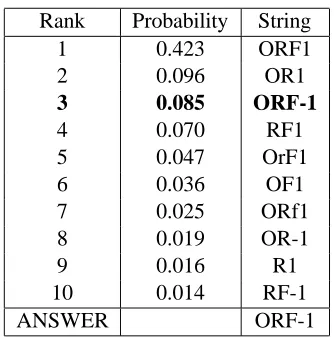
Tables 2 to 5 show some examples of generated acronyms together with their probabilities. They are sorted with their probabilities and the top ten acronyms are shown. The correct acronym given in the training data is described in the bottom row in each table.
In Table 2, the definition is “traumatic brain in-jury” and the correct acronym is “TBI”. This is the simplest case in acronym generation, where the first letter of each word in the definition is to be capital-ized. Our acronym generator gives a high probabil-ity to the correct acronym and it is ranked at the top. Table 3 shows a slightly more complex case, where the generator needs to convert the space
be-Rank Probability String 1 0.405 MCPP
2 0.149 MCP
3 0.056 MCP
4 0.031 MPP
5 0.028 McPP 6 0.024 MchPP
7 0.020 MC
8 0.011 MP
9 0.011 mCPP
10 0.010 MCRPP
ANSWER mCPP
Table 5: Generated acronyms for “meta-chlorophenylpiperazine”.
Rank Probability String
1 0.811 TV
2 0.034 TSV
3 0.030 TCV
4 0.021 Tv
5 0.019 TVs
6 0.013 T-V
7 0.008 TOV
8 0.004 TSCV 9 0.002 T-v
10 0.001 TOSV
[image:5.612.99.273.267.436.2]ANSWER TOSV
Table 6: Generated acronyms for “Toscana virus”.
Rank Coverage (%)
1 55.2
2 65.8
3 70.4
4 73.2
5 75.4
6 76.7
7 78.3
8 79.8
9 81.1
10 82.2
BASELINE 47.3
[image:5.612.357.496.491.660.2]tween ‘F’ and ‘1’ into a hyphen. The correct answer is located at the third rank.
The definition in Table 4 is “RNA polymerase” and the correct acronym is “RNAP”, so the gener-ator needs to the first three letters unchanged. The correct answer is located at the fourth rank, and the probability given the correct answer does not have a large gap with the top-ranked acronym.
Table 5 shows a more difficult case, where you need to output the first letter in lowercase and choose appropriate letters from the string having no delim-iters (e.g. spaces and hyphens). Our acronym gener-ator outputs the correct acronym at the nine-th rank but the probability given this acronym is very low compared to that given to the top-ranked string.
Table 6 shows a similar case. The probability given to the correct acronym is very low.
5.2 Coverage
Table 7 shows how much percentage of the cor-rect acronyms are covered if we take top N can-didates from the outputs of the acronym generator. The bottom line (BASELINE) shows the coverage achieved by generating one acronym using the stan-dard heuristic rule for acronym generation. Note that the coverage achieved with a single candidate (Rank 1) is better that of BASELINE.
If we take top five candidates, we can have a cov-erage of 75.4%, which is considerably better than that achieved by the heuristic rule. This suggests that the acronym generator could be used to signif-icantly improve the performance of the systems for information retrieval and information integration.
5.3 Features
To evaluate how much individual types of features affect the generation performance, we ran experi-ments using different feature types. Table 8 shows the results. Overall, the results show that various types of features have been successfully incorpo-rated in the MEMM modeling and individual types of features contribute to improving performance.
The performance achieved with only unigram fea-tures is almost the same as that achieved by the heuristic rule. Note that the features on the previous state improve the performance, which suggests that our selection of the states in the Markov modeling is a reasonable choice for this task.
40 50 60 70 80 90 100
100 1000
Coverage (%)
Number of Training Samples Top 1
[image:6.612.317.528.60.215.2]Top 5 Top 10
Figure 2: Learning curve.
5.4 Learning Curve
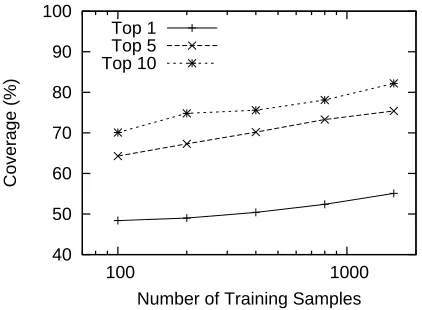
Figure 2 shows a learning curve of our acronym generator, which shows the relationship between the number of the training samples and the performance of the system. The graph clearly indicates that the performance consistently improves as the training data increases and still continues to improve even when the size of the training data reaches the max-imum. This suggests that we can achieve improved performance by increasing the annotated data for training.
6 Conclusion
We presented a machine learning approach to acronym generation. In this approach, we regarded the generation process as a sequence labeling prob-lem, and we manually created the data for training and testing.
Experimental results using 1901 definition-acronym pairs, we achieved a coverage of 55.1%, which is significantly bettern than that achieved by the standard heuristic rule for acronym generation. The algorithm also enables us to have other acronym candidates together with the probabilities represent-ing their likelihood.
6.1 Future work
Top 1 Top 5 Top 10 Feature Templates Coverage (%) Coverage (%) Coverage (%)
UNI 48.2 66.2 74.2
UNI, BI 50.1 71.2 78.3
UNI, BI, TRI 50.4 72.3 80.1
UNI, BI, TRI, HIS 50.6 73.6 81.2
[image:7.612.100.513.54.196.2]UNI, BI, TRI, HIS, ORT 51.0 73.9 80.9 UNI, BI, TRI, HIS, ORT, LEN 53.9 74.6 81.3 UNI, BI, TRI, HIS, ORT, LEN, DIS 54.4 75.0 81.8 UNI, BI, TRI, HIS, ORT, LEN, DIS, SEQ 55.1 75.4 82.2
Table 8: Performance with Different Feature Sets.
might further improve performance by considering such permutation of letters.
As the learning curve (Fig 2) suggested, one ob-vious way to improve the performance is to increase the training data. The size of the training data used in the experiments is fairly small compared to those in other sequence tagging tasks such POS tagging and chunking. We plan to increase the size of the training data with a semi-automatic way that could reduce the human effort for annotation.
References
Eytan Adar. 2004. Sarad: A simple and robust abbrevia-tion dicabbrevia-tionary. Bioinformatics, 20(4):527–533.
Adam L. Berger, Stephen A. Della Pietra, and Vincent J. Della Pietra. 1996. A maximum entropy approach to natural language processing. Computational
Lin-guistics, 22(1):39–71.
Stanley F. Chen and Ronald Rosenfeld. 1999. A gaus-sian prior for smoothing maximum entropy models.
Technical Report CMUCS -99-108, Carnegie Mellon University.
Jun’ichi Kazama and Jun’ichi Tsujii. 2003. Evaluation and extension of maximum entropy models with in-equality constraints. In Proceedings of EMNLP 2003.
Goran Nenadic, Irena Spasic, and Sophia Ananiadou. 2002. Automatic acronym acquisition and term vari-ation management within domain-specific texts. In
Proceedings of the LREC-3, pages 2155–2162.
Ariel Schwartz and Marti Hearst. 2003. A simple algorithm for identifying abbreviation definitions in biomedical texts,. In Proceedings of the Pacific
Sym-posium on Biocomputing (PSB 2003).
Jonathan D. Wren, Jeffrey T. Chang, James Pustejovsky, Eytan Adar, Harold R. Garner, and Russ B. Altman. 2005. Biomedical term mapping databases. Nucleic
Acid Research, 33.
M. Yoshida, K. Fukuda, and T. Takagi. 2000. Pnad-css: a workbench for constructing a protein name abbrevi-ation dictionary. Bioinformatics, 16(2):169–175.
Manuel Zahariev. 2003. An efficient methodology for acronym-expansion matching. In Proceedings of the