Diacritics Restoration Using Neural Networks
Jakub Náplava, Milan Straka, Pavel Straňák, Jan Hajič
Institute of Formal and Applied LinguisticsCharles University, Faculty of Mathematics and Physics Malostranské náměstí 25, Prague, Czech Republic
{naplava,straka,stranak,hajic}@ufal.mff.cuni.cz
Abstract
In this paper, we describe a novel combination of a character-level recurrent neural-network based model and a language model applied to diacritics restoration. In many cases in the past and still at present, people often replace characters with diacritics with their ASCII counterparts. Despite the fact that the resulting text is usually easy to understand for humans, it is much harder for further computational processing. This paper opens with a discussion of applicability of restoration of diacritics in selected languages. Next, we present a neural network-based approach to diacritics generation. The core component of our model is a bidirectional recurrent neural network operating at a character level. We evaluate the model on two existing datasets consisting of four European languages. When combined with a language model, our model reduces the error of current best systems by 20% to 64%. Finally, we propose a pipeline for obtaining consistent diacritics restoration datasets for twelve languages and evaluate our model on it. All the code is available under open source license on
https://github.com/arahusky/diacritics_restoration.
Keywords:neural networks, diacritics, diacritics generation, error correction
1.
Introduction
When writing emails, tweets or texts in certain languages, people for various reasons sometimes write without diacrit-ics. When using Latin script, they replace characters with diacritics (e.g. c with acute or caron) by the underlying ba-sic character without diacritics. Practically speaking, they write in ASCII. We offer several possible reasons for this phenomenon:
• Historically, many devices offered only an English key-board and/or ASCII encoding (for example older mobile phones and SMS).
• Before Unicode became widespread, there were encod-ing problems among platforms and even among pro-grams on the same platform, and many people still have this in mind.
• Even though text encoding is rarely a problem any more and all modern devices offer native keyboards, some problems persist. In situations of frequent code switch-ing between English and a language with a substantially different keyboard layout, it is very hard to touch type in both layouts. It is much easier to type both languages using the same layout, although one of them without proper diacritics.
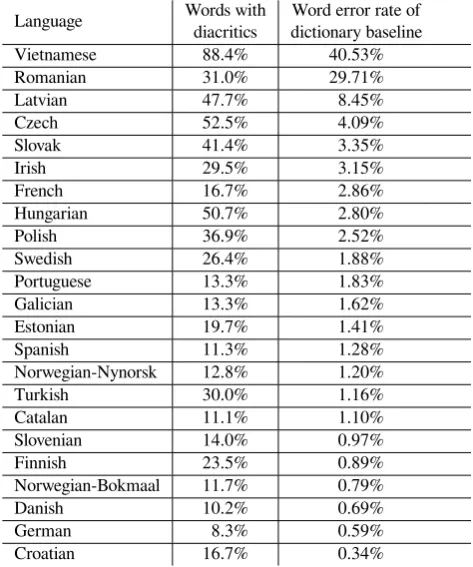
• In some circumstances typing with diacritical marks is significantly slower than using just basic latin char-acters. The most common example is on-screen key-boards on mobile devices. These keykey-boards do not in-clude the top row (numerical on US English), so lan-guages that use that row for accented characters are much slower to type. Naturally, users type without ex-plicit accents and rely on the auto-completion systems. However, these systems are usually simple, unigram-based, and based on the word form ambiguity for a given language (cf. Table 1), which introduces many errors. Postponing the step of diacritics generation would be beneficial both for typing speed and accuracy.
• For example in Vietnamese, the language with most
dia-critics in our data (cf. Table 1), both the above problems are very pronounced: Because Vietnamese uses diacrit-ical marks to distinguish both tones (6) and quality of vowels (up to 3), a vowel can have (and often has) 2 marks. This need to provide efficient typing of very many accented characters led to the invention of sys-tems like unikey.org that allow a user to type all the ac-cented characters using sequences of basic letters. For instance to typeset “đường” a user types “dduwowngf”. While this system elegantly solves the problems above with switching keyboard layouts and missing top row of keys, it requires a special software package and it still results in 9 keystrokes to type 5 characters. That is why typing without accents in informal situations like emails or text messages is still common and system for efficient generation of diacritics would be very useful.
Typical languages where approximately half of the words contain diacritics are Czech, Hungarian or Latvian. Never-theless, as we discuss in Sections 2 and 3, diacritics restora-tion (also known as diacritics generarestora-tion or diacritizarestora-tion) is an active problem also in many languages with substantially lower diacritics appearance.
Current approaches to restoration of diacritics (see Section 3) are mostly based on traditional statistical methods. However, in recent years, deep neural networks have shown remark-able results in many areas. To explore their capabilities, we propose a neural based model in Section 4 and evaluate its performance on two datasets in Section 5.
Language Words with Word error rate of diacritics dictionary baseline
Vietnamese 88.4% 40.53%
Romanian 31.0% 29.71%
Latvian 47.7% 8.45%
Czech 52.5% 4.09%
Slovak 41.4% 3.35%
Irish 29.5% 3.15%
French 16.7% 2.86%
Hungarian 50.7% 2.80%
Polish 36.9% 2.52%
Swedish 26.4% 1.88%
Portuguese 13.3% 1.83%
Galician 13.3% 1.62%
Estonian 19.7% 1.41%
Spanish 11.3% 1.28%
Norwegian-Nynorsk 12.8% 1.20%
Turkish 30.0% 1.16%
Catalan 11.1% 1.10%
Slovenian 14.0% 0.97%
Finnish 23.5% 0.89%
Norwegian-Bokmaal 11.7% 0.79%
Danish 10.2% 0.69%
German 8.3% 0.59%
[image:2.595.305.542.67.162.2]Croatian 16.7% 0.34%
Table 1: Analysis of percentage of words with diacritics and the word error rate of a dictionary baseline. Measured on UD 2.0 data, using the uninames method, and CoNLL 17 UD shared task raw data for dictionary. Only words containing at least one alphabetical character are considered.
2. Diacritics Restoration in Languages using
Latin Script
Table 1 presents languages using (usually some extended ver-sion of) a Latin script. Employing UD 2.0 (Nivre et al., 2017) plain text data, we measure the ratio of words with diacritics, omitting languages with less than 5% of words with diacritics. In eleven of the languages, at least every fifth word contains diacritics; in another eleven languages, at least every tenth word does.
Naturally, high occurrence of words with diacritics does not imply that generating diacritics is an ambiguous task. Con-sequently, we also evaluate word error rate of a simple dic-tionary baseline to diacritics restoration: according to a large raw text corpora we construct a dictionary of the most fre-quent variant with diacritics for a given word without diacrit-ics, and use the dictionary to perform the diacritics restora-tion.
Table 1 presents the results. We utilized the raw corpora by Ginter et al. (2017) released as supplementary material of CoNLL 2017 UD Shared task (Zeman et al., 2017), which contain circa a gigaword for each language, therefore provid-ing a strong baseline. For nine languages, the word error rate is larger than 2%, and eight more languages have word error rate still above 1%. We conclude that even with a very large dictionary, the diacritics restoration is a challenging task for many languages, and better method is needed.
Letter Hex Unicode name code
ø 00F8 LATIN SMALL LETTER OWITH STROKE
ł 0142 LATIN SMALL LETTER LWITH STROKE
đ 0111 LATIN SMALL LETTER DWITH STROKE
ʂ 0282 LATIN SMALL LETTER SWITH HOOK
ç 00E7 LATIN SMALL LETTER CWITH CEDILLA
š 0161 LATIN SMALL LETTER SWITH CARON
Table 2: Unicode characters that cannot be decomposed us-ing NFD (first 4 lines), and those that can. The suffix of the name removed by theuninamesmethod is show in italics. As we can see, the strucutre of names is identical, so the method works for all of these characters.
2.1. Methods of Diacritics Stripping
Although there is no standard way of stripping diacritics, a commonly used method is to convert input word to NFD (The Unicode Consortium, 2017, Normalization Form D) which decomposes composite characters into a base character and a sequence of combining marks, then remove the combining marks, and convert the result back to NFC (Unicode Nor-malization Form C). We dub this methoduninorms. We however noted that this method does not strip diacritics for some characters (e.g. for đ and ł).1 We therefore pro-pose a new methoduninames, which operates as follows: In order to remove diacritics from a given character, we inspect its name in the Unicode Character Database (The Unicode Consortium, 2017). If it contains a wordWITH, we remove the longest suffix starting with it, try looking up a character with the remaining name and yield the character if it exists. The method is illustrated in Table 2, which presents four characters that do not decompose under NFD, but whose di-acritics can be stripped by the proposed method.
As shown in Table 3, the proposed uninames method rec-ognizes all characters theuninormsmethod does, and some additional ones. Therefore, we employ theuninamesmethod to strip diacritics in the paper.
3. Related Work
One of the first papers to describe systems for automatic di-acritics restoration is a seminal work by Yarowsky (1999), who compares several algorithms for restoration of diacrit-ics in French and Spanish. Later, models for diacrization in Vietnamese (Nguyen and Ock, 2010), Czech (Richter et al., 2012), Turkish (Adali and Eryiğit, 2014),
Ara-1What constitutes a “diacritic mark” is a bit of a problem. On
[image:2.595.51.288.69.353.2]Lowercased letters with diacritics
í 15.7% ů 2.5% ș ī ņ ō
á 11.7% ú 1.6% ā ē ū ŕ
é 9.8% ö 1.5% ñ ą ï ĺ
ě 6.6% ă 1.3% ł ò ļ ţ
ä 6.0% ø 1.1% ć ż ń ì
č 5.5% à 0.9% ň ğ ù ό
ř 5.2% ç 0.9% â ś û ḥ
ž 4.9% ü 0.8% õ ď ű ǎ
ý 4.5% ã 0.8% ť ô ķ ί
š 4.4% è 0.6% ê đ ģ έ
ó 3.2% î 0.5% ę ő ź ά
[image:3.595.327.510.67.222.2]å 2.9% ț 0.5% ş ľ ë ʂ
Table 3: Most frequent characters with diacritics from data listed in Table 1, together with their relative frequency. The bold characters are recognized only using theuninames method.
bic (Azmi and Almajed, 2015) Croatian, Slovenian, Ser-bian (Ljubešic et al., 2016), and many other languages were published. The system complexity ranges from simplest models, that for each word apply its most frequent transla-tion as observed in the training data, to models that incor-porate language models, part-of-speech tags, morphological and many other features. One of the most similar model to ours is a system by Belinkov and Glass (2015) who used re-current neural networks for Arabic diacritization.
4.
Model Architecture
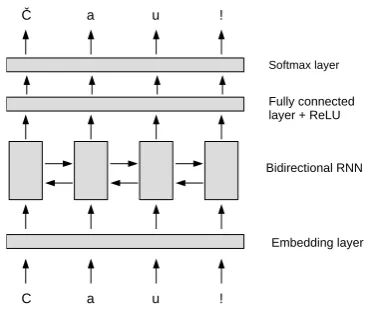
The core of our model (see Figure 1) is a bidirectional re-current neural network, which for each input character out-puts its correct label (e.g. its variant with diacritics). The in-put and outin-put vocabularies contain a special out-of-alphabet symbol.
The input characters are embedded, i.e. each character in the input sentence is represented by a vector ofdreal num-bers. The character embeddings are initialized randomly and updated during training.
The embeddings are fed to a bidirectional RNN (Graves and Schmidhuber, 2005). The bidirectional RNN consists of two unidirectional RNNs, one reading the inputs in standard or-der (forward RNN) and the other in reverse oror-der (backward RNN). The output is then a sum of forward and backward RNN outputs. This way, bidirectional RNN is processing in-formation from both preceding and following context. The model allows an arbitrary number of stacked bidirectional RNN layers.
The output of the (possibly multilayer) bidirectional RNN is at each time step reduced by an identical fully connected layer to ano-dimensional vector, whereois the size of the output alphabet. A nonlinearity is then applied to these re-duced vectors.
Finally, we use a softmax layer to produce a probability dis-tribution over output alphabet at each time step.
[image:3.595.52.288.70.218.2]The loss function is the cross-entropy loss summed over all outputs.
Figure 1: Visualisation of our model.
4.1. Residual connections
The proposed model allows an arbitrary number of stacked RNN layers. The model with multiple layers allows each stacked layer to process more complex representation of cur-rent input. This naturally brings potential to improve accu-racy of the model.
As stated by (Wu et al., 2016), simple stacking of more RNN layers works only up to a certain number of layers. Beyond this limit, the model becomes too difficult to train, which is most likely caused by vanishing and exploding gradient problems (Pascanu et al., 2013). To improve the gradient flow, (Wu et al., 2016) incorporate residual connections to the model. To formalize this idea, letRNNibe thei-th RNN layer in a stack andx0= (inp1,inp2, . . . ,inpN)input to the first stacked RNN layerRNN0. The model we have proposed so far works as follows:
oi, ci=RNNi(xi)
xi+1=oi
oi+1, ci+1=RNNi+1(xi+1),
whereoiis the output ofi-th stacked RNN layer andciis a sequence of its hidden states. The model with residual con-nections between stacked RNN layers then works as follows:
oi, ci=RNNi(xi) xi+1=oi+xi
oi+1, ci+1=RNNi+1(xi+1)
4.2. Decoding
For inference we use a left-to-right beam search decoder combining the neural network and the language model like-lihoods. The process is a modified version of standard beam search used by Xie et al. (2016) for decoding sequence-to-sequence models.
probabilities and language model probabilities. The hypoth-esis probability in stepkcan be computed as:
P(y1:k|x) = (1−α)logPN N(y1:k|x) +αlogPLM(y1:k),
wherexdenotes the input sequence,ystands for the decoded symbols contained within current hypothesis,PN NandPLM are neural network and language model probabilities and the hyper-parameter αdetermines the weight of the language model. To keep both logPN N and logPLM terms within a similar range in the decoding, we compute the logPN N as the mean of output token log probabilities and additionally normalizePLMby the number of words in the sequence. To train the language model as well as to run it, we use the open-source KenLM toolkit (Heafield, 2011).
5.
Experiments
To compare performance of our model with current ap-proaches, we perform experiments using two existing datasets. The first one, created by Ljubešic et al. (2016), consists of Croatian, Serbian and Slovenian sentences from three sources: Wikipedia texts, general Web texts and texts from Twitter. Since Web data are assumed to be the noisi-est, they are used only for training. Wikipedia and Twitter testing sets should then cover both standard and non-standard language. The second evaluation dataset we utilize consists of Czech sentences collected mainly from newspapers, thus it covers mostly standard Czech.
5.1. Training and Decoding Details
We used the same model configuration for all experiments. The bidirectional RNN has 2 stacked layers with resid-ual connections and utilizes LSTM units (Hochreiter and Schmidhuber, 1997) of dimension 300. Dropout (Srivastava et al., 2014) at a rate of 0.2 is used both on the embedded inputs and after each bidirectional layer. All weights are ini-tialized using Xavier uniform initializer (Glorot and Bengio, 2010).
The vocabulary of each experiment consists of top 200 most occurring characters in a training set and a special symbol (<UNK>) for unknown characters.
To train the model, we use the Adam optimizer (Kingma and Ba, 2014) with learning rate 0.0003 and a minibatch size of 200. Each model was trained on a single GeForce GTX 1080 Ti for approximately 4 days. After training, the model with the highest accuracy on the corresponding development set was selected.
To estimate the decoding parameterα, we performed an ex-haustive search over [0,1] with a step size of 0.1. The pa-rameter was selected to maximize model performance on a particular development set. All results were obtained using a beam width of 8.
5.2. Croatian, Serbian and Slovenian
The original dataset contains training files divided into Web, Twitter and Wikipedia subsets. However, Ljubešic et al. (2016) showed that concatenating all these language-specific sets for training yields best results. Therefore, we used only concatenated files for training the models for each of three languages in our experiments. The training files contain
17 968 828 sentences for Croatian, 11 223 924 sentences for Slovenian and 8 376 810 sentences for Serbian.2 All letters in the dataset are lowercased.
To remove diacritics from the collected texts, Ljubešic et al. (2016) used a simple script that replaced four letters (ž, ć, č, š) with their ASCII counterparts (z, c, c, s), and one let-ter (đ) with its phonetic transcription (dj). This results in the input and target sentences having different length. Since our model requires both input and target sentences to have the same length, additional data preprocessing was required before feeding the data into the model: we replace all occur-rences of thedjsequence in both input and target sentences by a special token, and replace it back todjafter decoding. The results of the experiment with comparison to previ-ous best system (Lexicon,Corpus) are presented in Table 4. The Lexicon method replaces each word by its most fre-quent translation as observed in the training data. TheCorpus method extends it via log-linear model with context probabil-ity. These methods were evaluated by Ljubešic et al. (2016) and theCorpusmethod is to the best of our knowledge state-of-the-art system for all three languages. System accuracy is measured, similarly to the original paper, on all words which have at least one alphanumerical character.
We incorporated the same language models as used by the authors of the original paper. There are two points in the results we would like to stress:
• Our system with language model reduces error by more than 30% on wiki data and by more than 20% on tweet data. Moreover, our model outperforms the current best system on wiki data even if it does not incorporate the additional language model, which makes the model much smaller (˜30MB instead of several gigabytes of the language model).
• Diacritics restoration problem is easier on standard lan-guage (wiki) than on non-standard data (tweets). This has, in our opinion, two reasons. First, the amount of wiki data in the training sets is substantially higher than the amount of non-standard data (tweets). This makes the model fit more standard data. Second, due to lower language quality in Twitter data, we suppose that the amount of errors in the gold data is higher.
5.3. Czech
The second experiment we conducted is devoted to diacritics restoration in Czech texts. To train both the neural network and language models, we used the SYN2010 corpus (Křen et al., 2010), which contains 8 182 870 sentences collected from Czech literature and newspapers. To evaluate the model, PDT3.0 (Hajič et al., 2018) testing set with 13 136 sentences originating from Czech newspapers is used. Both the train-ing and testtrain-ing set, thus, contain mainly standard Czech. For language model training, we consider only those {2,3,4,5}-grams that occurred at least twice, and use default KenLM options.
Table 5 presents a comparison of our model performance with Microsoft Office Word 2010, ASpell, CZACCENT (Rychlý, 2012) and Korektor (Richter et al., 2012), the lat-ter being the state-of-the-art system of diacritics restoration
System wiki tweet
hr sr sl hr sr sl
[image:5.595.141.454.68.148.2]Lexicon 0.9936 0.9924 0.9933 0.9917 0.9893 0.9820 Corpus 0.9957 0.9947 0.9962 0.9938 0.9917 0.9912 Our model 0.9967 0.9961 0.9970 0.9932 0.9939 0.9882 Our model + LM 0.9973 0.9968 0.9974 0.9951 0.9944 0.9930 Error reduction 36.81% 39.74% 30.45% 21.62% 32.14% 20.77%
Table 4: Results obtained on Crotian (HR), Serbian (SR) and Slovenian (SL) Wikipedia and Twitter testing sets. Note that the word accuracy presented in the table is not measured on all words, but only on words having at least one alphanumerical character.
System Word accuracy
Microsoft Office Word 2010 (*) 0.8910
ASpell (*) 0.8839
Lexicon 0.9527
CZACCENT 0.9607
Corpus 0.9713
Korektor 0.9861
Our model 0.9887
Our model + LM 0.9951
[image:5.595.54.288.219.330.2]Error reduction 64.75%
Table 5: Comparison of several models of restoration of di-acritics for Czech. The (*) denotes reduced test data (see text).
for Czech. Note that evaluation using Microsoft Office Word 2010 and ASpell was performed only on the first 746 (636) sentences, because it requires user interaction (confirming the suggested alternatives).
As the results show, models that are not tuned to the task of diacritics restoration perform poorly. Our model com-bined with a language model reduces the error of the pre-vious state-of-the-art system by more than 60%; our model achieves slightly higher accuracy than Korektor even if no language model is utilized.
5.3.1. Ablation Experiments
One of the reasons why deep learning works so well is the availability of large training corpora. This motivates us to explore the amount of data our model needs to perform well. As Figure 2 shows, the RNN model trained on 50 000 ran-dom sentences from SYN2010 corpus performs better on the PDT3.0 testing set than theLexiconbaseline trained on full SYN2010 corpus. Further, up to 5M sentences the perfor-mance of the RNN model increases with the growing train-ing set size. We do not observe any performance difference between the RNN model trained on 5M and 8M sentences. The second ablation experiment examines the effect of resid-ual connections. We trained models with 2, 3, 4 and 5 stacked layers each with and without residual connections. We also trained a simple model with 1 bidirectional layer without residual connections. The results of this experiment are pre-sented in Figure 3. Apart from the big difference in word accuracy between the model with 1 layer and other models, we can see that models with residual connections perform generally better than when no residual connections are incor-porated. It is also evident that when more layers are added
10
4
10
5
10
6
10
7
Train sentences
8486 88 90 92 94 96 98
Word accuracy
[image:5.595.312.532.224.387.2]RNN
Lexicon
Figure 2: Comparison of RNN and Lexicon performance with varrying training data size.
1 2 3 4 5
Number of stacked layers
96.096.4 96.8 97.2 97.6 98.0 98.4 98.8 99.2
Word accuracy
96.64
98.8298.87 98.7998.89 98.7298.91 98.6398.91
With residuals
Without residuals
Figure 3: Effect of using residual connections with respect to the number of stacked layers.
in stack, performance of models without residual connec-tions deteriorates while performance of models with addi-tional residual connections does not.
6. New Multilingual Dataset
[image:5.595.310.534.451.614.2]sys-tem is published, a new dataset is typically created both for training and testing. This makes it difficult to compare per-formance across systems. We thus propose a new pipeline for obtaining consistent multilingual datasets for the task of diacritics restoration.
6.1. Dataset
As the data for diacritics restoration need to be clean, we decided to utilize Wikipedia for both development and test-ing sets. Because there may be not enough data to train po-tential diacritics restoration systems on Wikipedia texts only, we further decided to create training sets from the (general) Web. We chose two corpora for this task: the W2C cor-pus (Majliš, 2011) with texts from Wikipedia and the general Web in 120 languages, and the CommonCrawl corpus with language annotations generated by Buck et al. (2014) with a substantially larger amount of general Web texts in more than 150 languages.
To create training, development and testing data from the Wikipedia part of the W2C corpus, its data are first seg-mented into sentences, these are then converted to lowercase and finally split into disjoint training, development and test-ing set. The split was performed in such a way that all three sets consist of sentences collected from whole articles rather then being randomly sampled across all articles. Each test-ing set consists of 30 000 sentences, development set of ap-proximatelly 15 000 sentences and the rest of the data are preserved for training set.
The pipeline for creating additional training data from the CommonCrawl corpus starts with the removal of invalid UTF8 data and Wikipedia data. These filtered data are then segmented into sentences and converted to lowercase. Since these data come from general Web and may be noisy (e.g. contain sentences with missing diacritics), only those sen-tences that have at least 100 characters and contain at least a certain amount of diacritics are preserved. The constant determining the minimum amount of diacritics is language specific and is derived from Table 1. Finally, sentence in-tersection with existing development and testing set is re-moved and maximally ten similar sentences are preserved in the training data. Since both baseline methods (Lexiconand Corpus) require data to be word tokenized, all texts are also word tokenized.
The dataset was created for 12 languages (see Table 6), where the additional training sets were generated from the2017_17 web crawl. Complete dataset can be downloaded fromhttp:
//hdl.handle.net/11234/1-2607.
6.2. Experiments
We train and evaluate our model on the created dataset and compare its performance to two baseline methods. The same model hyperparameters as described in Section 5.1 are used, except for the RNN cell dimension, which is 500.
Training was performed in two phases. First, each lan-guage specific model was trained on particular Common-Crawl (Web) training set for approximately four days. Then, each model was fine-tuned with a smaller learning rate 0.0001 on respective Wikipedia training set for three more days. Fi-nally, as all models seemed to be continuously improving on the development sets, we took the last model checkpoints for
evaluating.
Both baseline methods and language models were trained on concatenation of Wikipedia and CommonCrawl training data. For language model training, we considered only those {2,3,4,5}-grams that occurred at least twice, and used default KenLM options.
To measure model performance, modified word error accu-racy is used. The alpha-word accuaccu-racy considers only words that consist of at least one alphabetical character, because only these can be potentially diacritized. The testing set re-sults ofLexiconandCorpusbaselines, as well as of our models before and after fine-tuning, and with a language model are presented in Table 6.
As results show, our model outperforms both baselines even if no language model is used. Moreover, incorporation of the language model helps the model perform better as well as does model fine-tuning. Without fine-tuning, all models but the Romanian outperform baselines. We suspect that the reason why the Romanian model before fine-tuning performs worse than theCorpusmethod is that non-standard Web data differ too much from standard data from Wikipedia. It is also an interesting fact that the biggest error reduction is at Vietnamese and Romanian which seem to be most difficult for both baseline methods.
7.
Conclusion
In this work, we propose a novel combination of recurrent neural network and a language model for performing diacrit-ics restoration. The proposed system is language agnostic as it is trained solely from parallel corpora of texts without dia-critics and diacritized texts. We test our system on two exist-ing datasets comprisexist-ing of four languages, and we show that it outperforms previous state-of-the-art systems. Moreover, we propose a pipeline for generating consistent multilingual dia-critics restoration datasets, run it on twelve languages, publish the created dataset, evaluate our system on it and provide a comparison with two baseline methods. Our method outper-forms even the stronger contextual baseline method on the new dataset by a big margin.
Future work includes detailed error analysis, which could re-veal types of errors made by our system. Since certain words may be correctly diacritized in several ways given the context of the whole sentence, such error analysis could also set the language specific limit on the accuracy that can be achieved. Further, when designing our multilingual dataset we decided to use testing sets with sentences from Wikipedia articles. This was well motivated as we wanted it to contain sentences with proper diacritics. However, such testing sets contain mainly standard language and are thus worse for comparison of models aiming to generate diacritics for non-standard lan-guage. Therefore, we plan to create additional development and testing sets in the future work.
While experimenting with the model on Czech we found out that when it is trained to output instructions (e.g. add caron) instead of letters, it performs better. Future work thus also includes thorough inspection of this behavior when applied to all languages.
Language Wiki Web Words with Lexicon Corpus Our model Our model Our model Error sentences sentences diacritics w/o finetuning + LM reduction Vietnamese 819 918 25 932 077 73.63% 0.7164 0.8639 0.9622 0.9755 0.9773 83.33% Romanian 837 647 16 560 534 24.33% 0.8533 0.9046 0.9018 0.9799 0.9837 82.96% Latvian 315 807 3 827 443 39.39% 0.9101 0.9457 0.9608 0.9657 0.9749 53.81% Czech 952 909 52 639 067 41.52% 0.9590 0.9814 0.9852 0.9871 0.9906 49.20% Polish 1 069 841 36 449 109 27.09% 0.9708 0.9841 0.9891 0.9903 0.9955 71.64% Slovak 613 727 12 687 699 35.60% 0.9734 0.9837 0.9868 0.9884 0.9909 44.21% Irish 50 825 279 266 26.30% 0.9735 0.9800 0.9842 0.9846 0.9871 35.55% Hungarian 1 294 605 46 399 979 40.33% 0.9749 0.9832 0.9888 0.9902 0.9929 58.04% French 1 818 618 78 600 777 14.65% 0.9793 0.9931 0.9948 0.9954 0.9971 58.11% Turkish 875 781 72 179 352 25.34% 0.9878 0.9905 0.9912 0.9918 0.9928 24.14% Spanish 1 735 516 80 031 113 10.41% 0.9911 0.9953 0.9956 0.9958 0.9965 25.57% Croatian 802 610 7 254 410 12.39% 0.9931 0.9947 0.9951 0.9951 0.9967 36.92%
Table 6: Results obtained on new multilingual dataset. Note that the alpha-word accuracy presented in the table is measured only on those words that have at least one alphabetical character. The last column presents errror reduction of our model combined with language model compared to the Corpus method.
requires significantly more memory, it would be desirable to train the model in such way that no additional language model is needed. We suspect that multitask learning (e.g. training the model also to predict next/previous letter) may compen-sate for the absence of a language model.
8. Acknowledgements
The research described herein has been supported by the Grant No. DG16P02R019 of the Ministry of Culture of the Czech Republic. Data has been used from and stored into the repository of LINDAT/CLARIN, a large research infras-tructure supported by the Ministry of Education, Youth and Sports of the Czech Republic under projects LM2015071 and CZ.02.1.01/0.0/0.0/16_013/0001781.
Thanks to NGỤY Giang Linh for the information and exam-ples on Vietnamese.
9. Bibliographical References
Adali, K. and Eryiğit, G. (2014). Vowel and diacritic restoration for social media texts. InProceedings of the 5th Workshop on Language Analysis for Social Media (LASM), pages 53–61.
Azmi, A. M. and Almajed, R. S. (2015). A survey of auto-matic arabic diacritization techniques. Natural Language Engineering, 21(3):477–495.
Belinkov, Y. and Glass, J. (2015). Arabic diacritization with recurrent neural networks. InProceedings of the 2015 Conference on Empirical Methods in Natural Language Processing, pages 2281–2285.
Buck, C., Heafield, K., and Van Ooyen, B. (2014). N-gram counts and language models from the common crawl. In LREC, volume 2, page 4.
Ginter, F., Hajič, J., Luotolahti, J., Straka, M., and Ze-man, D. (2017). CoNLL 2017 shared task - automat-ically annotated raw texts and word embeddings. LIN-DAT/CLARIN digital library at the Institute of Formal and Applied Linguistics, Charles University.
Glorot, X. and Bengio, Y. (2010). Understanding the dif-ficulty of training deep feedforward neural networks. In Proceedings of the Thirteenth International Conference on Artificial Intelligence and Statistics, pages 249–256.
Graves, A. and Schmidhuber, J. (2005). Framewise phoneme classification with bidirectional LSTM and other neural network architectures.Neural Networks, pages 5–6. Hajič, Jan and Bejček, Eduard and Bémová, Alevtina and Buráňová, Eva and Hajičová, Eva and Havelka, Jiří and Homola, Petr and Kárník, Jiří and Kettnerová, Vá-clava and Klyueva, Natalia and Kolářová, Veronika and Kučová, Lucie and Lopatková, Markéta and Mikulová, Marie and Mírovský, Jiří and Nedoluzhko, Anna and Pajas, Petr and Panevová, Jarmila and Poláková, Lu-cie and Rysová, Magdaléna and Sgall, Petr and Spous-tová, Johanka and Straňák, Pavel and Synková, Pavlína and Ševčíková, Magda and Štěpánek, Jan and Urešová, Zdeňka and Vidová Hladká, Barbora and Zeman, Daniel and Zikánová, Šárka and Žabokrtský, Zdeněk. (2018). Prague Dependency Treebank 3.5. Institute of Formal and Applied Linguistics, LINDAT/CLARIN, Charles Univer-sity.
Heafield, K. (2011). Kenlm: Faster and smaller language model queries. In Proceedings of the Sixth Workshop on Statistical Machine Translation, pages 187–197. Associa-tion for ComputaAssocia-tional Linguistics.
Hochreiter, S. and Schmidhuber, J. (1997). Long short-term memory.Neural computation, 9(8):1735–1780.
Kingma, D. and Ba, J. (2014). Adam: A method for stochas-tic optimization.arXiv preprint arXiv:1412.6980. Křen, M., Bartoň, T., Cvrček, V., Hnátková, M., Jelínek,
T., Kocek, J., Novotná, R., Petkevič, V., Procházka, P., Schmiedtová, V., et al. (2010). Syn2010: žánrově vyváženỳ korpus psané češtiny. Ústav Českého národního korpusu FF UK, Praha.
Ljubešic, N., Erjavec, T., and Fišer, D. (2016). Corpus-based diacritic restoration for south slavic languages. In Proceedings of the Tenth International Conference on Lan-guage Resources and Evaluation (LREC 2016). European Language Resources Association (ELRA)(may 2016). Majliš, M. (2011). W2c–web to corpus–corpora.
636.
Nivre, J., Agić, Ž., Ahrenberg, L., et al. (2017). Univer-sal Dependencies 2.0. LINDAT/CLARIN digital library at the Institute of Formal and Applied Linguistics, Charles University, Prague.
Pascanu, R., Mikolov, T., and Bengio, Y. (2013). On the difficulty of training recurrent neural networks. ICML (3), 28:1310–1318.
Richter, M., Straňák, P., and Rosen, A. (2012). Korektor-a system for contextual spell-checking and diacritics com-pletion. InCOLING (Posters), pages 1019–1028.
Rychlý, P. (2012). Czaccent–simple tool for restoring ac-cents in czech texts. RASLAN 2012 Recent Advances in Slavonic Natural Language Processing, page 85.
Srivastava, N., Hinton, G. E., Krizhevsky, A., Sutskever, I., and Salakhutdinov, R. (2014). Dropout: a simple way to prevent neural networks from overfitting. Journal of ma-chine learning research, 15(1):1929–1958.
The Unicode Consortium. (2017). The Unicode Stan-dard, Version 10.0.0. The Unicode Consortium, Mountain View, CA.
Wu, Y., Schuster, M., Chen, Z., Le, Q. V., Norouzi, M., Macherey, W., Krikun, M., Cao, Y., Gao, Q., Macherey, K., et al. (2016). Google’s neural machine translation sys-tem: Bridging the gap between human and machine trans-lation.arXiv preprint arXiv:1609.08144.
Xie, Z., Avati, A., Arivazhagan, N., Jurafsky, D., and Ng, A. Y. (2016). Neural language correction with character-based attention. arXiv preprint arXiv:1603.09727. Yarowsky, D. (1999). A comparison of corpus-based
tech-niques for restoring accents in spanish and french text. In Natural language processing using very large corpora, pages 99–120. Springer.