Extracting Important Sentences with Support Vector Machines
Tsutomu HIRAO and Hideki ISOZAKI and Eisaku MAEDA
NTT Communication Science Laboratories
2-4, Hikaridai, Seika-cho, Soraku-gun, Kyoto 619-0237 Japan {hirao,isozaki,maeda}@cslab.kecl.ntt.co.jp
Yuji MATSUMOTO
Graduate School of Information and Science, Nara Institute of Science and Technology 8516-9, Takayama, Ikoma, Nara 630-0101 Japan
Abstract
Extracting sentences that contain important in-formation from a document is a form of text summarization. The technique is the key to the automatic generation of summaries similar to those written by humans. To achieve such ex-traction, it is important to be able to integrate heterogeneous pieces of information. One ap-proach, parameter tuning by machine learning, has been attracting a lot of attention. This pa-per proposes a method of sentence extraction based on Support Vector Machines (SVMs). To confirm the method’s performance, we conduct experiments that compare our method to three existing methods. Results on the Text Summa-rization Challenge (TSC) corpus show that our method offers the highest accuracy. Moreover, we clarify the different features effective for ex-tracting different document genres.
1 Introduction
Extracting important sentences means extract-ing from a document only those sentences that have important information. Since some sen-tences are lost, the result may lack coherence, but important sentence extraction is one of the basic technologies for generating summaries that are useful for humans to browse. There-fore, this technique plays an important role in automatic text summarization.
Many researchers have been studied impor-tant sentence extraction since the late 1950’s (Luhn, 1958). Conventional methods focus on sentence features and define significance scores. The features include key words, sentence posi-tion, and certain linguistic clues. Edmundson (1969) and Nobata et al. (2001) have proposed scoring functions to integrate heterogeneous fea-tures. However, we can not tune the parameter values by hand when the number of features is
large.
When a large quantity of training data is available, tuning can be effectively realized by machine learning. In recent years, machine learning has attracted attention in the field of automatic text summarization. Aone et al. (1998) and Kupiec et al. (1995) employed Bayesian classifiers, Mani et al. (1998), Nomoto et al. (1997), Lin (1999), and Okumura et al. (1999) used decision tree learning. How-ever, most machine learning methods overfit the training data when many features are given. Therefore, we need to select features carefully.
Support Vector Machines (SVMs) (Vapnik, 1995) is robust even when the number of features is large. Therefore, SVMs have shown good performance for text categoriza-tion (Joachims, 1998), chunking (Kudo and Matsumoto, 2001), and dependency structure analysis (Kudo and Matsumoto, 2000).
In this paper, we present an important sen-tence extraction technique based on SVMs. We verified the technique against the Text Summa-rization Challenge (TSC) (Fukushima and Oku-mura, 2001) corpus.
2 Important Sentence Extraction based on Support Vector Machines
2.1 Support Vector Machines (SVMs) SVM is a supervised learning algorithm for 2-class problems.
Training data is given by
(x1, y1),· · ·,(xu, yu), xj∈Rn, yj ∈ {+1,−1}.
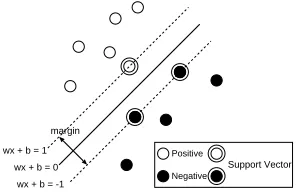
Here, xj is a feature vector of the j-th sample; yj is its class label, positive(+1) or negative(−1). SVM separates positive and neg-ative examples by a hyperplane defined by
Positive
Negative
margin
wx + b = 0 wx + b = 1
wx + b = -1
Support Vector
Figure 1: Support Vector Machines.
where “·” represents the inner product. In general, such a hyperplane is not unique. Figure 1 shows a linearly separable case. The SVM determines the optimal hyperplane by maximizing the margin. A margin is the dis-tance between negative examples and positive examples.
Since training data is not necessarily linearly separable, slack variables (ξj) are introduced for all xj. These ξj incur misclassification error, and should satisfy the following inequalities:
w·xj+b ≥ 1−ξj
w·xj+b ≤ −1 +ξj. (2)
Under these constraints, the following objective function is to be minimized.
1 2||w||
2+Cu
j=1
ξj. (3)
The first term in (3) corresponds to the size of the margin and the second term represents misclassification.
By solving a quadratic programming prob-lem, the decision functionf(x) = sgn(g(x)) can be derived where
g(x) =
i=1
λiyixi·x+b
. (4)
The decision function depends on only sup-port vectors (xi). Training examples, except for support vectors, have no influence on the decision function.
Non-linear decision surfaces can be realized by replacing the inner product of (4) with a ker-nel functionK(x·xi) :
g(x) =
i=1
λiyiK(xi,x) +b
. (5)
In this paper, we use polynomial kernel func-tions that have been very effective when applied to other tasks, such as natural language pro-cessing (Joachims, 1998; Kudo and Matsumoto, 2001; Kudo and Matsumoto, 2000):
K(x,y) = (x·y+ 1)d. (6)
2.2 Sentence Ranking by using Support Vector Machines
Important sentence extraction can be regarded as a two-class problem: important or unimpor-tant. However, the proportion of important sen-tences in training data will differ from that in the test data. The number of important sen-tences in a document is determined by a sum-marization rate that is given at run-time. A simple solution for this problem is to rank sen-tences in a document. We useg(x) the distance from the hyperplane toxto rank the sentences. 2.3 Features
We define the boolean features discussed below that are associated with sentence Si by taking past studies into account (Zechner, 1996; No-bata et al., 2001; Hirao et al., 2001; Nomoto and Matsumoto, 1997).
We use 410 boolean variables for each Si. Wherex= (x[1],· · ·, x[410]). A real-valued fea-ture normalized between 0 and 1 is represented by 10 boolean variables. Each variable corre-sponds to an internal [i/10,(i+ 1)/10) where
i = 0 to 9. For example, Posd = 0.75 is rep-resented by “0000000100” because 0.75 belongs to [7/10,8/10).
Position of sentences
We define three feature functions for the posi-tion of Si. First, Lead is a boolean that corre-sponds to the output of the lead-based method described below1 . Second,PosdisSi’s position in a document. Third,P ospisSi’s position in a paragraph. The first sentence obtains the high-est score, the last obtains the lowhigh-est score:
P osd(Si) = 1−BD(Si)/|D(Si)| the number of characters before Si in the para-graph.
Length of sentences
We define a feature function that addresses the length of sentence as
Len(Si) =|Si|/ max
Sz∈D(Si)| Sz|.
Here, |Si| is the number of characters of sen-tence Si, and maxSz∈D|Sz| is the maximum number of characters in a sentence that belongs toD(Si).
In addition, the length of a previous sentence
Len−1(Si) =Len(Si−1) and the length of a next sentence Len+1(Si) = Len(Si+1) are also fea-tures of sentence Si.
Weight of sentences
We defined the feature function that weights sentences based on frequency-based word weighting as only nouns. In addition, we define word weight
w(t, D(Si)) based on aspecific field(Hara et al.,
Here, T is the number of sentence in a docu-ment, andVzis the number of words in sentence
Sz ∈D(Si) (repetitions are ignored). Also,εz is a boolean value: that is 1 whentappearsinSz. The first term of the equation above is the weighting of a word in a specific field. The sec-ond term is the occurrence probability of word
t.
We set parameters α and β as 0.8, 0.2, re-spectively. The weight of a previous sentence Wf−1(Si)=Wf(Si−1), and the weight of a next sentenceWf+1(Si)=Wf(Si+1) are also features of sentenceSi.
Density of key words
We define the feature function Den(Si) that represents density of key words in a sentence by using Hanning Window function (fH(k, m)): Also, m is the center position of the window, Win=|Si|/2. In addition,a(k, Si) is defined as
0 kis not the beginning position of a word inKW.
Named Entities
x[r]=1 (1≤r≤8) indicates that a certain Named Entity class appears in Si. The number of Named Entity classes is 8 (Sekine and Eriguchi, 2000), e.g., PERSON, LOCATION. We use Isozaki’s NE recognizer (Isozaki, 2001).
Conjunctions
x[r]=1 (9≤r≤61) if and only if a certain con-junction is used in the sentence. The number of conjunctions is 53.
Functional words
x[r]=1 (62≤r≤234) if and only if a certain func-tional word such as ga, ha, and ta is used in the sentence. The number of functional words is 173.
Part of speech
Semantical depth of nouns
x[r]=1 (301≤r≤311) if and only if Si contains a noun at a certain semantical depth according to a Japanese lexicon, Goi-Taikei (Ikehara et al., 1997). The number of depth levels is 11. For instance, Semdep=2 means that a noun in Si
belongs to the second depth level. Document genre
x[r]=1 (312≤r≤315) if and only if the docu-ment belongs to a certain genre. The genre is explicitly written in the header of each docu-ment. The number of genres is four: General, National, Editorial, and Commentary.
Symbols
x[r]=1 (r=316) if and only if sentence includes a certain symbol (for example: •,&,).
Conversation
x[r]=1 (r=317) if and only ifSi includes a con-versation style expression.
Assertive expressions
x[r]=1 (r=318) if and only ifSi includes an as-sertive expression.
3 Experimental settings
3.1 Corpus
We used the data set of TSC (Fukushima and Okumura, 2001) summarization collection for our evaluation. TSC was established as a sub-task of NTCIR-2 (NII-NACSIS Test Collection for IR Systems). The corpus consists of 180 Japanese documents2 from the Mainichi News-papers of 1994, 1995, and 1998. In each doc-ument, important sentences were manually ex-tracted at summarization rates of 10%, 30%, and 50%. Note that the summarization rates depend on the number of sentences in a doc-ument not the number of characters. Table 1 shows the statistics.
3.2 Evaluated methods
We compared four methods: decision tree learn-ing, boostlearn-ing, lead, and SVM. At each summa-rization rate, we trained classifiers and classified test documents.
Decision tree learning method
We used C4.5 (Quinlan, 1993) for our experi-ments with the default settings. We used the 2 Each document is presented in SGML style with
sen-tence and paragraph separators attached.
features described in section 2. Sentences were ranked according to their certainty factors given by C4.5.
Boosting method
We used C5.0, which applies boosting to deci-sion tree learning. The number of rounds was set to 10. Sentences were ranked according to their certainty factors given by C5.0.
Lead-based method
The first N sentences of a document were se-lected. Nwas determined according to the sum-marization rates.
SVM method
This is our method as outlined in section 2. We used the second-order polynomial kernel, and set C (in equation (3)) as 0.0001. We used TinySVM3 .
3.3 Measures for evaluation
In the TSC corpus, the number of sentences to be extracted was explicitly given by the TSC committee. When we extract sentences accord-ing to that number, Precision, Recall, and F-measure become the same value. We call this value Accuracy. Accuracy is defined as follows:
Accuracy =b/a×100,
whereais the specified number of important sentences, and b is the number of true impor-tant sentences that were contained in system’s output.
4 Results
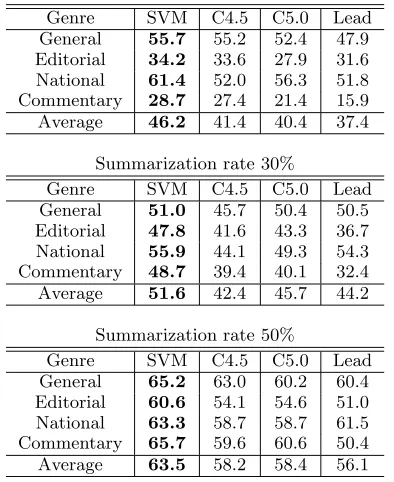
Table 2 shows the results of five-fold cross vali-dation by using all 180 documents.
For all summarization rates and all genres, SVM achieved the highest accuracy, the lead-based method the lowest. Let the null hypoth-esis be “There are no differences among the scores of the four methods”. We tested this null hypothesis at a significance level of 1% by using Tukey’s method. Although the SVM’s perfor-mance was best, the differences were not sta-tistically significant at 10%. At 30% and 50%, SVM performed better than the other methods with a statistical significance.
Table 1: Details of data sets.
General National Editorial Commentary
# of documents 16 76 41 47
# of sentences 342 1721 1362 1096
# of important sentences (10%) 34 172 143 112 # of important sentences (30%) 103 523 414 330 # of important sentences (50%) 174 899 693 555
Table 2: Evaluation results of cross validation. Summarization rate 10%
Genre SVM C4.5 C5.0 Lead General 55.7 55.2 52.4 47.9 Editorial 34.2 33.6 27.9 31.6 National 61.4 52.0 56.3 51.8 Commentary 28.7 27.4 21.4 15.9 Average 46.2 41.4 40.4 37.4
Summarization rate 30%
Genre SVM C4.5 C5.0 Lead General 51.0 45.7 50.4 50.5 Editorial 47.8 41.6 43.3 36.7 National 55.9 44.1 49.3 54.3 Commentary 48.7 39.4 40.1 32.4 Average 51.6 42.4 45.7 44.2
Summarization rate 50%
Genre SVM C4.5 C5.0 Lead General 65.2 63.0 60.2 60.4 Editorial 60.6 54.1 54.6 51.0 National 63.3 58.7 58.7 61.5 Commentary 65.7 59.6 60.6 50.4 Average 63.5 58.2 58.4 56.1
5 Discussion
Table 2 shows that Editorial and Commentary are more difficult than the other genres. We can consider two reasons for the poor scores of Editorial and Commentary:
• These genres have no feature useful for dis-crimination.
• Non-standard features are useful in these genres.
Accordingly, we conduct an experiment to clarify genre dependency4 .
4 We did not use General because the number of
doc-uments in this genre was insufficient.
1 Extract 36 documents at random from genre ifor training.
2 Extract 4 documents at random from genre
j for test.
3 Repeat this 10 times for all combinations of (i, j).
Table 3 shows that the result implies that non-standard features are useful in Editorial and Commentary documents.
Now, we examine effective features in each genre. Since we used the second order polyno-mial kernel, we can expandg(x) as follows:
g(x) = b+
i=1
wi+ 2
i=1
wi
u
k=1
xi[k]x[k] +
i=1
wi
u
h=1 u
k=1
xi[h]xi[k]x[h]x[k], (7)
where ) is the number of support vectors, and
wi equalsλiyi.
We can rewrite it as follows when all vectors are boolean:
g(x) = W0+
u
k=1
W1[k]x[k] +
u−1
h=1
u
k=h+1
W2[k, h]x[h]x[k] (8)
where
W0 =b+i=1wi,W1[k] = 3i=1wixi[k], and
W2[h, k] = 2i=1wixi[h]xi[k].
Therefore, W1[k] indicates the significance of an individual feature andW2[h, k] indicates the significance of a feature pair. When|W1[k]|or
Table 3: Evaluation results for three genres.
Training\Test 10% National30% 50% 10% Editorial30% 50% 10%Commentary30% 50%
National 63.4 57.6 65.5 32.8 39.4 53.6 24.0 39.5 60.8 Editorial 49.3 46.8 58.4 33.9 49.1 64.4 24.9 43.6 62.1 Commentary 37.4 43.3 61.1 18.4 41.8 57.8 30.6 49.6 67.0
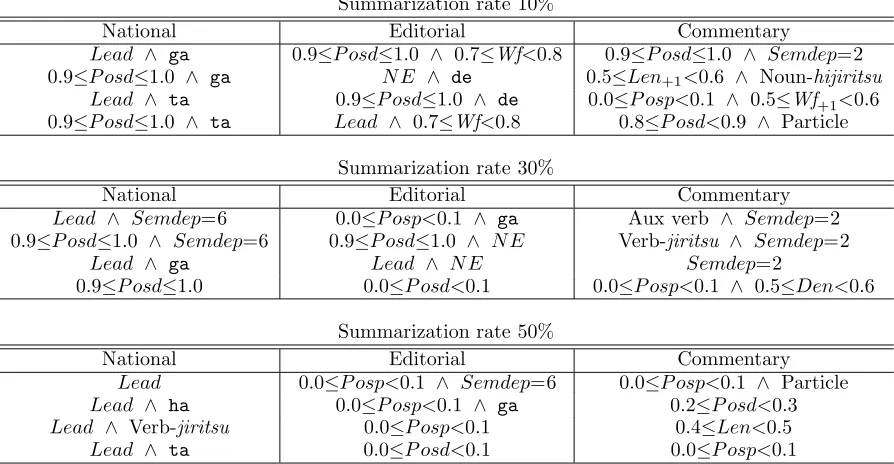
Table 4: Effective features and their pairs
Summarization rate 10%
National Editorial Commentary
Lead ∧ ga 0.9≤P osd≤1.0 ∧ 0.7≤Wf<0.8 0.9≤P osd≤1.0 ∧ Semdep=2 0.9≤P osd≤1.0 ∧ ga N E ∧ de 0.5≤Len+1<0.6 ∧ Noun-hijiritsu
Lead ∧ ta 0.9≤P osd≤1.0 ∧ de 0.0≤P osp<0.1 ∧ 0.5≤Wf+1<0.6 0.9≤P osd≤1.0 ∧ ta Lead ∧ 0.7≤Wf<0.8 0.8≤P osd<0.9 ∧ Particle
Summarization rate 30%
National Editorial Commentary
Lead ∧ Semdep=6 0.0≤P osp<0.1 ∧ ga Aux verb ∧ Semdep=2 0.9≤P osd≤1.0 ∧ Semdep=6 0.9≤P osd≤1.0 ∧ N E Verb-jiritsu ∧ Semdep=2
Lead ∧ ga Lead ∧ N E Semdep=2
0.9≤P osd≤1.0 0.0≤P osd<0.1 0.0≤P osp<0.1 ∧ 0.5≤Den<0.6
Summarization rate 50%
National Editorial Commentary
Lead 0.0≤P osp<0.1 ∧ Semdep=6 0.0≤P osp<0.1 ∧ Particle
Lead ∧ ha 0.0≤P osp<0.1 ∧ ga 0.2≤P osd<0.3
Lead ∧ Verb-jiritsu 0.0≤P osp<0.1 0.4≤Len<0.5
Lead ∧ ta 0.0≤P osd<0.1 0.0≤P osp<0.1
Table 4 shows some of the effective features that had large weights W1[k], W2[h, k] for each genre.
Effective features common to three genres at three rates were sentence positions. Since Na-tional has a typical newspaper style, the begin-ning of the document was important. More-over, “ga” and “ta” were important. These functional words are used when a new event is introduced.
In Editorial and Commentary, the end of a paragraph and that of a document were impor-tant. The reason for this result is that subtopic or main topic conclusions are common in those positions. This implies that National has a dif-ferent text structure from Editorial and Com-mentary.
Moreover, in Editorial, “de” and sentence weight was important. In Commentary, seman-tically shallow words, sentence weight and the length of a next sentence were important.
In short, we confirmed that the feature(s) ef-fective for discriminating a genre differ with the genre.
6 Conclusion
gen-res, and showed that the important features vary with the genre.
In our future work, we would like to apply our method to trainable Question Answering Sys-tem SAIQA-II developed in our group.
Acknowledgement
We would like to thank all the members of the Knowledge Processing Research Group for valu-able comments and discussions.
References
C. Aone, M. Okurowski, and J. Gorlinsky. 1998. Trainable Scalable Summarization Using Ro-bust NLP and Machine Learning. Proc. of the 17th COLING and 36th ACL, pages 62–66. H. Edmundson. 1969. New methods in
automatic abstracting. Journal of ACM, 16(2):246–285.
T. Fukushima and M. Okumura. 2001. Text Summarization Challenge Text summariza-tion evaluasummariza-tion in Japan. Proc. of the NAACL2001 Workshop on Automatic sum-marization, pages 51–59.
M. Hara, H. Nakajima, and T. Kitani. 1997. Keyword Extraction Using a Text Format and Word Importance in a Specific Filed (in Japanese). Transactions of Information Pro-cessing Society of Japan, 38(2):299–309. T. Hirao, M. Hatayama, S. Yamada, and
K. Takeuchi. 2001. Text Summarization based on Hanning Window and Dependency structure analysis. Proc. of the 2nd NTCIR Workshop, pages 349–354.
S. Ikehara, M. Miyazaki, S. Shirai, A. Yokoo, H. Nakaiwa, K. Ogura, Y. Ooyama, and Y. Hayashi. 1997. Goi-Taikei – A Japanese Lexicon (in Japanese). Iwanami Shoten. H. Isozaki. 2001. Japanese Named Entity
Recognition based on Simple Rule Generator and Decision Tree Learning. Proc. of the 39th ACL, pages 306–313.
T. Joachims. 1998. Text Categorization with Support Vector Machines: Learning with Many Relevant Features. Proc. of ECML, pages 137–142.
T. Kudo and Y. Matsumoto. 2000. Japane De-pendency Structure Analysis Based on Su-port Vector Machines. Proc. of EMNLP and VLC, pages 18–25.
T. Kudo and Y. Matsumoto. 2001. Chunking
with Support Vector Machine. Proc. of the 2nd NAACL, pages 192–199.
J. Kupiec, J. Pedersen, and F. Chen. 1995. A Trainable Document Summarizer. Proc. of the 18th ACM-SIGIR, pages 68–73.
Chin-Yew Lin. 1999. Training a Selection Func-tion for ExtracFunc-tion. Proc. of the 18th ACM-CIKM, pages 55–62.
H. Luhn. 1958. The Automatic Creation of Lit-erature Abstracts. IBM Journal of Research and Development, 2(2):159–165.
I. Mani and E. Bloedorn. 1998. Machine Learn-ing of Generic and User-Focused Summariza-tion. Proc. of the 15th AAAI, pages 821–826. C. Nobata, S. Sekine, M. Murata, K. Uchimoto, M. Utiyama, and H. Isahara. 2001. Sentence Extraction System Assembling Multiple Ev-idence. Proc. of the 2nd NTCIR Workshop, pages 319–324.
T. Nomoto and Y. Matsumoto. 1997. The Reli-ability of Human Coding and Effects on Auto-matic Abstracting (in Japanese). The Special Interest Group Notes of IPSJ (NL-120-11), pages 71–76.
M. Okumura, Y. Haraguchi, and H. Mochizuki. 1999. Some Observations on Automatic Text Summarization Based on Decision Tree Learning (in Japanese). Proc. of the 59th Na-tional Convention of IPSJ (5N-2), pages 393– 394.
J. Quinlan. 1993. C4.5: Programs for Machine Learning. Morgan Kaufmann.
S. Sekine and Y. Eriguchi. 2000. Japanese Named Entity Extraction Evaluation - Anal-ysis of Results -. Proc. of the 18th COLING, pages 1106–1110.
V. Vapnik. 1995. The Nature of Statistical Learning Theory. New York.