THE MODIFIED DIALLEL TABLE WITH PARTIAL INBREEDING AND INTERACTIONS WITH ENVIRONMENT’
D. F. MATZINGER AND 0. KEMPTHORNE
Iowa State College, Ames
Received June 2 2 , 1956
H E reasons for considering the covariances of relatives are firstly that they secondly that they lead to the estimation of genetic parameters which are useful as a description of a genetic population and in the formulation of breeding procedures. Various methods of obtaining theoretical covariances between relatives have been developed, each with a specific set of assumptions. The problem was first considered for random mating populations in equilibrium by FISHER (1918). Correlations were obtained for parent-offspring, full-sib, half-sib, uncle-nephew, cousin, and double- first-cousin relationships for any degree of dominance. The general solution included an arbitrary number of alleles with two-factor epistacy considered for parent-off- spring and full-sib correlations. WRIGHT (1921) proposed the method of path coeffi- cients for the study of correlations between relatives with respect to genes which are strictly additive in their effects.
The analysis of diallel crosses presented by HAYMAN (1954a, 1954b) considered an arbitrary degree of dominance for the case where the parents in the diallel table are completely homozygous. Only two alleles per locus were considered and the assumption of no epistacy was imposed. JINKS (1954) applied this method to a study
of height, flowering time, and leaf length in Nicotiana rusticu to estimate the average degree of dominance. The regression of array covariance on variance was plotted to obtain evidence of non-additive gene effects. Deviations from unit slope indicated non-allelic gene interaction might be responsible for the observed heterosis in some F1 hybrids. Further applications of this method to actual data were given by JINKS
(1955). DICKINSON and JINKS (1956) extended the methods of HAYMAN and JINKS
to include inbreeding of the parental material in the diallel table.
COCKERHAM (1954) has considered the covariances between relatives under ran- dom mating of an inbred population for the case of two alleles per locus. These co- variances are expressible in terms of the components of genotypic variance of the random mating population which was the origin of the inbred population.
GRIFFING (1956) considered diallel crosses of homozygous individuals obtained from a random mating population and presented the genetic parameters in terms of additive, dominance, and epistatic effects for an arbitrary number of loci with arbitrary alleles. The term “modified diallel” was suggested to designate the diallel table where the parents are not included. The variances of specific and general com- bining ability were given in terms of additive, dominance, and epistatic variances. ALLARD (1956) has given some procedures for evaluating genotype-environment Contribution from the Departments of Agronomy and Statistics, Journal Paper No. J-30.53
T
will be of interest per se in indicating the regression of offspring on parent etc., andinteractions in the diallel table. His procedures are a development of the work by
HAYMAN and JINKS.
KEMPTHORNE (1956a) removed the assumptions of no epistacy and of only two
alleles per locus as given by HAYMAN (1954b) and presented the analysis of diallel
crosses for arbitrary alleles, arbitrary loci, and arbitrary epistacy. The parents in the diallel table were homozygous lines obtained by inbreeding without selection from a random mating population. Estimates of the mean and variance of both the random mating and homozygous populations, and the parent-offspring covariance were obtained from the variances and covariances of the diallel table. Evidence was given to show that previous methods of analysis of diallel crosses are of questionable validity.
I n the present discussion the previous methods will be extended to include the case of arbitrary inbreeding for the parents in the modified diallel table and the
analysis of variance is presented for obtaining estimates of the interactions of geno-
typic components of variance with environments as represented by locations and years.
COVARIANCES BETWEEN RELATIVES
As a method of determining what happens to the additive, dominance, and epi-
static deviations under a random mating system when individuals are inbred and then
crossed in all possible crosses, the covariance of full-sibs, Cov(FS), and the covariance
of half-sibs, Cov(HS), must be obtained for an arbitrary degree of inbreeding assum-
ing any number of loci with an arbitrary number of alleles.
If two individuals are mated which are more closely related than the average of
the population, the resulting progeny are inbred. The two genes a t a locus of an individual can be alike because they descend from one gene or because of random sampling from a population. The probability of two genes being identical by descent is F , the inbreeding coefficient, which varies in the range from zero in a random mating population to one in an inbred population. Inbreeding and gene frequency are completely independent, with inbreeding changing the association of the alleles in pairs while gene frequency is the proportion of each allele in the population. Under inbreeding the genotypic array for a single locus with arbitrary alleles is
The genotypic value of an individual y i j i 2 considering two loci can be written as
y i j n - 2 = p
+
a:+
CY:.+
(a1a')ij+
a:+
a;+
(a2a2)lil+
(a1a2)ik+
( a 1 a 2 ) j k+
(a'a2)iil+
(da2)jil+
( a 1 a 2 a 2 ) i k l+
( a 1 d a 2 ) j k l+
(cy'ol'Cu2)ijk+
(a'a'a2)ijl+
(a'a'a2a2)ijkz(1)
where the superscripts indicate the locus (KEMPTHORNE 195613, 1956c), and for
example, a: is the average effect of the ith allele a t locus 1, (a2a2)k1 is the dominance
824 D. F. MATZINGER AND 0. XEMPTHORNE
locus 1 with the additive effect of the Kth allele a t locus 2, and the other terms have similar meaning.
The detailed derivation of the covariances was given by MATZINGER (1956). Since it is quite lengthy and tedious it will be indicated only for the case of two loci, and the general results will be presented. Linkage is assumed to be absent.
Variance between family means
Consider a cross of AiAjBkBl X A A , B , B , where A and B are two independent loci, and the subscripts indicate the allele a t that locus. Let the frequencies of A J j ,
BkBz, A A , , and B,B, be designated as P i ? , P l l , P,,
,
and P i s respectively, where for examplePij = (1
-
F)p@j+
SijFPiand
The variance between family means is obtained as
in which each genotype symbol is replaced by the corresponding genotypic value and p is replaced by zero. To solve this expression the terms are written in the form of additive, dominance, and interaction effects of the type in equation (1).
After obtaining the simplification of this equation into components of genotypic variance as given by KEMPTHORNE (1954, 1955) and COCKERHAM (1954), the vari-
ance between family means can be written down and extended to the case of any number of loci. In the present case this variance is the covariance of full-sibs and is given by
+
(yy
f f i A D+
(T>’
1 + F U i D D+
(
l + F7
u ; D D)
+
etc.Variance between sire means
Let the genotype of an arbitrary sire be AJjBkB1 with frequency PijPLl. The dam gametic array is
and the sire gametic array is
Substitution in terms of the genotypic values of formula (1) and simplifying leads to the variance between sires for two loci which can easily be extended to arbitrary loci.
Since each sire is mated to dams obtained a t random from a random mating popu- lation the variance of sire means is the covariance of half-sibs which is given by the equation
These values for Cov(FS) and Cov(HS) are equivalent to those obtained by COCK- ERHAM (1954) for the case of only two alleles per locus.
STRUCTURE OP MODIFIED DIALLEL TABLE
The experiment to be considered involves all possible crosses between
p
parents with a given degree of inbreeding, or if one assumes the absence of maternal effects, reciprocal crosses need not be obtained and one hasp ( p
-
1)/2 families. The analy- sis discussed below assumes there are no maternal effects.The analysis of variance of diallel crosses was presented by YATES (1947) and in various other forms by other workers. A model used to analyze the variation of a
single experiment is
where
y i j k = P
+
gi+
gj+
sij+
rk+
e i j k (4)i , j = 1, 2,
,
p i
<
j k = 1, 2, **e,
Tand y i j k is the yield resulting from a cross of the ith line with the j t h line grown in the Kth replicate; EL is a common mean for all crosses in all replicates; gi is a measure of the average effect of the ith line to all progeny; sij is a measure of the average effect
of a cross of the ith line and t h e j t h line; rk is the average effect of all crosses grown
in the kth replicate; and e i j k is the experimental error associated with the y i j k ob- servation. The gi components measure general combining ability, while the sii)s
measure deviations from an additive genetic model, frequently referred to as spe- cific combining ability. All variable components in the model (4) are assumed to have zero expectation, to be uncorrelated, and to have their particular variances.
826 D. F. MATZINGER AND 0. XEMPTHORNE
TABLE 1
Analysis of variance and expected mean squares of modified diallel crosses
Source
Replicates
gi's
S i i ' S
Error Total
S.S.
I
E.M.S.'1 z T I
(I
-
1) kn
0
0
n
* Expectations obtained by ROJAS (1951) above; expectations in terms of concepts of present paper below.
The expected mean squares obtained by ROJAS in relation to variances of general
and specific combining ability are presented in table 1. These variances were ob-
tained for the original definitions of general and specific combining ability given by
SPRAGUE and TATUM (1942). I n the present study the expected mean squares are derived in terms of variances and covariances of relatives with respect to a random
mating population by again taking the expectation of the sums of squares in table 1.
Consider a diallel table where a plot is the progeny of a mating of two parents with a known amount of inbreeding. Variances and covariances of plot totals are obtained
for a constant number,
f,
plants per plot. The case of unequal numbers of plants perplot presents a slight complication and is given by KEMPTHORNE (1956~).
All of the individuals in a plot have the same sire and dam so the plot total con-
tains
f
plants which are full-sibs. The expected value of a plot total is f p G where pGis the mean of the genotypic portion of the individuals. Then
E(plot total)2 =
f
'
&
+
/ U ;+
f(f
-
l)Cov(FS)where U: is the genotypic variance. The genotypic variance of a plat total is ob-
tained by the usual method as
V(P1ot total) = E (plot total)' - (E(p1ot total)}'
( 5 )
= fu2a
+
f(f - l)Cov(FS) = U ; .It is assumed that environment within the experiment is additive with variance
U:, so that the total variance of a plot total equals a i
+
ut.Next consider the covariance of two plots, both with the same sire and dam, but
in diflerent replicates. If the parents are not homozygous the individuals in one repli-
cate are not a true duplication of the genotypic value of individuals in the same
entry in another replicate. I n fact, the individuals are full-sibs. With
f
plants perplot, the covariance between two plots with the same parents, in different replicates, is
The covariance between plots with one parent in common is a function of the half- sib covariance. With f individuals per plot this covariance will be
f 2 C o v ( H S ) = U:. ( 7 )
The expected mean squares are derived in terms of a?, U:, and U:. The mean is coded as zero so it will not enter into the derivation. Replicates are orthogonal to crosses and their effects can be ignored in most of the computations which follow. Terms involving both the mean and replications will cancel out if carried along. The experimental error will contribute U: to each expected mean square and is omitted
in the following derivations.
The Yi.. term, a sire total, contains r ( p
-
1) plots, and Y:.. will involve r ( p - 1) U ; terms. Each of the( p
-
1) plot totals is a full-sib to r(r-
1) plot totals in other replicates. Each of( p
- 1) plot totals in one replication is a half-sib with( p
-
2) plots in r replicates, over the total of r replicates. ThenE(Y:.. ) = r ( p
-
1)d+
r(r - l)(p-
l)ai+
+ ( p
-
1)(p
-
2)&.The grand total, Y...
,
contains a total of rn plots. The square of this term will contain rn terms of a?. The full-sib comparisons will be p / 2 times those for Yi.. since all of the dams are also included. Each of n plot totals in one replicate is a half- sib of 2 ( p - 2) plots over r replicates, andE@.) = r m ;
+
r(r - 1)mi+
2 r y p - 2)na:.Each Yij. term contains r plots, so Y4j. has r terms of U?. The full-sib covariances
will enter between the replicates r(r
-
1) times, and there are no half-sib covariances. ThenE(Yi2j.) = ra;
+
r(r-
1)ai.A total of n plots are contained in each Y . . k term. In U!.., there will be n terms of
U;, and no terms in U: because there are no comparisons between replicates. Each
of n plot totals will involve half-sib covariances with 2 ( p - 2) plots resulting in E(Y2.k) = nu:
+
2 n ( p-
2)ai+
n2rk".The genotypic part of the expected values of the sums of squares in table 1 are as follows:
E(C) = a;
+
(r-
l)ai+
2r(p-
2)a:828 D. F. MATZINGER AND 0. KEMPTHORNE
Dividing the expected sums of squares by degrees of freedom gives the expected mean squares in table 1 after slight rearrangement. Each component of variation also contains a term for plot error (os) as indicated in table 1.
The similarity between the expected mean squares of ROJAS and those obtained in this paper is very evident in table 1. After substitution for U:, U:, and U: from equa- tions ( 5 ) , ( 6 ) , and (7) the equality is
U' = a:
+
f ( o : - COV(FS))U: = f"{Cov(FS)
-
2Cov(HS))U: =
f"
Cov(HS). (9)Estimates of these variance components are obtained by equating the expected mean squares to the corresponding observed mean squares and solving for the de- sired component as follows:
n
o2 = E'.
Cov(FS) and Cov(HS) can be obtained from these estimates as
From the theoretical derivation of Cov(FS) and Cov(HS) in equations ( 2 ) and (3), estimates of the components of genotypic variance may be obtained. The values of U: and U: may be expressed in terms of additive, dominance, and epistatic vari- ances to observe the type of epistatic deviations which contribute to each of these variances. The estimates obtained from equations (8) and (9) and equations (1) and (2) are
+
(?>'
+
etc.1
.
obtained only under the assumption of no epistacy. Estimates of U:, U:, and I Y ~ are then obtained a s
A 2 4CoZES)
l + F IJA =
2 4 ( C G F S )
-
2Co2B.Y)1
(1+
F12 ug =and
A A
-bQ 2 = (TA 2
+
U:.For the case of F = 1, GRIFFING (1956) showed that the following relationship existed with c i and U: defined in terms of plot means:
2 2
a: = 2a,
+
U,.It can be seen that this result is applicable only to the case of F = 1. From the expectations in the present paper the general relationship would be
2 4
+
U: = COV(FS)and only for the specific case of F = 1 would it be the case that
2
C O V ( F s ) = UQ.
The value of F to be used in the formulae depends upon the source of the material used as parents in the diallel table. Normally diallel crosses are made between fam- ilies and not single individuals. Families which arise from inbreeding without selec- tion in a random mating population in equilibrium will reconstitute the original random mating population when crossed, because the gametic array, and hence the gene frequency, will not change with different levels of inbreeding. The appropriate procedure is to obtain the inbred population by whatever means are most suitable and then to choose individuals a t random from this population to serve as parents. Each parent is then selfed to give a sufficient number of plants to enable the crosses to be made. The appropriate F value is that holding before the aforementioned mul- tiplication. I n the case of inbred lines in animals one could obtain sufficient indi- viduals by full-sibbing.
ANALYSIS O F EXPERIMENTS COMBINED OVER LOCATIONS AND YEARS
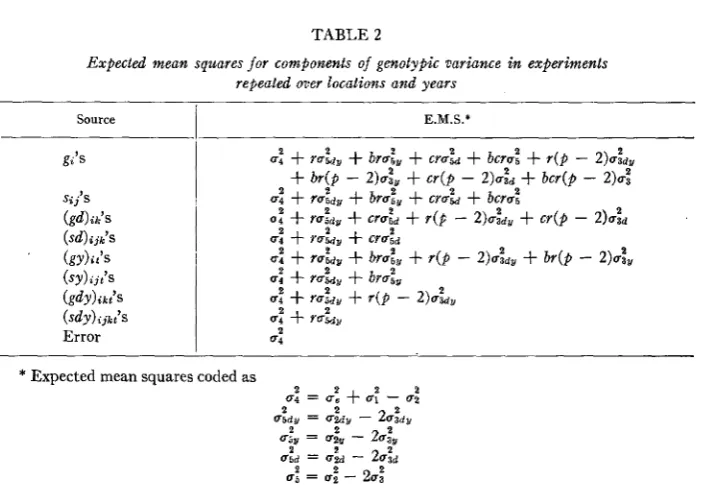
Of major interest in assessing the role of the different types of gene effect and in a practical breeding program is the estimation of the components of genotypic vari- ance over locations and years, and the components of variance due to possible inter- actions of genotypes with each. An extension of the model for a single experiment to include locations and years is
830 D. F. MATZINGER AND 0. KEMPTHORNE
TABLE 2
Expected mean squares f o r components of genotypic variance in experiments rebeated over locations and Years
Source
* Expected mean squares coded as
2 2
U: =
x
+
0.1-
U2U& = U&
-
2 U f d ,af = U&
-
2&B i d = U& - 2 4 d
U: = 0:
-
2 2where Y i j k t q is the yield of a cross of the ith a n d j t h lines in the qth replicate in the
kth location in the tth year; p is a common mean for all crosses in Y replicates, b
locations, and c years; gi is a measure of the average effect of the ith line to all prog-
eny; s i j is a measure of the average effect of a cross of the ith line with t h e j t h line;
d k is the average effect of the Kth location; y t is the average effect of the tth year; ( g d ) < k is the average interaction of the ith line with the kth location; and the other
interactions have the appropriate meaning designated by the subscripts. I n all cases the averages are over the populations of other factors. All parameters in the model
except M and r k t q are considered random with expectation zero and zero correlation.
The components of variance of general and specific combining ability over loca-
tions and years were presented by ROJAS and SPRAGUE (1952). The expected mean
squares in terms of genotypic components can be extended over locations and years,
because crosses and hence comparisons of the g,’s or s,j’s are orthogonal to locations
and years. These are presented in table 2.
The values of U:, U:, and U: have the same meanings as in the individual experi-
ments except that they are defined as variances or covariances of averages over the population of environments which is assumed to be indefinitely large. The addition
of d or y to these terms indicates the corresponding interactions. For example, uidy
is the 3-way interaction of locations and years with a pseudo-factor x, say, which
gives rise to the variance U:.
Because of the relationships between the expected mean squares in table 2 and
those of ROJAS and SPRAGUE, estimates of Cov(HS), Cov(FS), and all interaction
ui = ai = j2Cov(HS)
a: = ui = f ( C o v ( F S )
-
2 C o v ( H S ) ) c i d = aid = J2COV(HS)d0:d = ( T i d = f 2 { c O V ( F s ) d
-
2 C O V ( H s ) d ) ui, = ui, = f V o v ( H S ) ,u:, = U:,, = ~ ~ ( C O V ( F S ) ,
-
~ C O V ( H S ) , }= a$, = f 2 C O V ( H S ) d ,
F:dv = C&g = f 2 { C O V ( F S ) d ,
-
2 c o v ( H S ) d , } u2 = cr: = dZ1+
j { u E-
C o v ( F S ) )The term cov(HS)d, for example, is the component for the interaction of the like- ness of half-sibs with locations. Estimates of the components of variance are obtained by equating the expected mean squares to the observed mean squares and solving for the desired components.
Obtaining estimates of additive, dominance, and epistatic components and inter- actions with locations and years depends upon the number of levels of inbreeding. For example, for modified diallel crosses of one level of inbreeding in experiments repeated over locations and years only additive and dominance variances and cor- responding interactions can be estimated assuming no epistacy by the following equations :
2 4COv(HS)
= (1
+
F )2 4 { C O V ( F S )
-
zcoo(HS)](1
+
F12uD =
2 ~ C O V ( H S ) ,
(1
+
F ) U A y =2 4 { C O V ( F S ) ,
-
2Cov(BS),j(1
+
F ) 2u D y =
2 4cov(HS)d
(1
+
F ) U A d =2 4 { c O V ( F S ) d
-
2 C a v ( H S ) d )(1
I-
F ) 2U D d =
2 c o v ( H S ) d , (1
+
F )C A d y =
2 4 { C O V ( F S ) d ,
-
2cOv(HS)d,) (1+
PI2u D d y =
2
'Ji
= C A+
Ui, = u;,
+
a b2
b i d = U A d -k a i d
832 D. F. MATZINGER AND 0. KEMPTHORNE
If the original population had two equally frequent alleles a t each variable locus,
one could estimate the average squared degree of dominance by 2>:/::.
EXTENSION TO OTHER EXPERIMENTS
With more complete data estimates can be obtained on epistatic parameters and all possible interactions with environment. Estimates from diallel crosses within a given level of inbreeding of the parents can be combined to give information on these components.
The present discussion has been for the analysis of plot totals. Additional informa- tion can be obtained from the modified diallel table if individual plant data are ob- tained. The procedure then is an analysis of variance between and within plots. The expectation of the mean square within plots is
U;
+
( U : - Cov(FS)jwhere U; is the error attributed to each individual within the plot.
LINKAGE BIAS
I n this discussion the genotypic frequencies were assumed to be in linkage equi- librium. However, even if the population is in linkage equilibrium these linkages will
affect the covariances, as shown by COCKERHAM (1956) for the case when F equals
zero. Assuming no position effects, the covariances between relatives where one is an ancestor of the other are not affected by linkage. However, for full-sibs and half- sibs, linkage causes a bias in the epistatic components of variance, but not in the additive or dominance components. A formulation of the general effects of linkage is one of the outstanding problems in the whole area of quantitative inheritance.
SUMMARY
The theoretical covariances between full-sibs and half-sibs under random mating
in an arbitrarily inbred population are presented for the case of arbitrary numbers of
alleles and loci, and arbitrary epistacy.
The results are applied to the modified diallel cross table in which the parents are of the same known degree of inbreeding. The theoretical relationships between general combining ability and specific combining ability variances, and the compo- nents of genotypic variance in the random mating population are obtained.
The procedures for analysis and interpretation of modified diallel crosses repli- cated over locations and years are presented.
LITERATURE CITED
ALLARD, R. W., 1956 The analysis of genetic-environmental interactions by means of diallel Cocmm~hl, C. C., 1954 An extension of the concept of partitioning hereditary variance for
crosses. Genetics 41: 305-318.
analysis of covariances among relatives when epistasis is present. Genetics 39: 859-882. 1956 Effects of linkage on the covariances between relatives. Genetics 41: 138-141.
DICKINSON, A. G., and J. L. JINKS, 1956 A generalised analysis of diallel crosses. Genetics 41:
FISHER, R. A., 1918 The correlation between relatives on the supposition of Mendelian inheritanre 65-78.
GRIFFING, B., 1956 HAYMAN, B. I., 1954a
JINKS, J. L., 1954 The analysis of continuous variation in a diallel cross of Nicotiana rustica varieties. 1955 A survey of the genetical basis of heterosis in a variety of diallel crosses. Heredity 9: 223-
KEWTHORNE, O., 1954 The correlation between relatives in a random mating population. Proc.
1955 The theoretical values of correlations between relatives in random mating populations.
1956a The theory of the diallel cross. Genetics 41: 451459.
19561, The correlations between relatives in random mating populations. Cold Spring Harbor
1956c An Introduction to Genetic Statistics. New York: John Wiley & Sons. (in press).
A generalised treatment of the use of diallel crosses in quantitative inheritance. Heredity 10: 31-50.
The analysis of variance of diallel tables. Biometrics 10: 235-244. 1954b The theory and analysis of diallel crosses. Genetics 39: 789-809.
Genetics 39: 767-788.
238.
Roy. Soc. London B 143: 103-113. Genetics 40: 153-167.
Symposia Quant. Biol. 20 (in press).
MATZINGER, D. F., 1956 Components of variance of diallel crosses of maize in experiments re- peated over locations and years. Unpublished Ph.D. Thesis. Iowa State College Library. Ames, Iowa.
Analysis of a group of experiments on combining ability in corn. Unpublished
M. S. Thesis. Iowa State College Library. Ames, Iowa.
A comparison of variance components in corn yield trials. 111. General and specific combining ability and their interaction with locations and years. Agron. J. 44: 462466.
General vs. specific combining ability in single crosses of corn. J. Am. Soc. Agron. 34: 923-932.
ROJAS, B. A., 1951
ROJAS, B. A., and G. F. SPRAGUE, 1952
SPRAGUE, G. F., and L. A. TAW, 1942 WRIGHT, S., 1921
YATES, F. 1947
Systems of mating, I-V. Genetics 6: 111-178.