Sn,
a
Light-Dependent and Tissue-Specific Gene
of Maize: the Genetic Basis
of Its Instability
Giuseppe Gavazzi, Mariangela Mereghetti, Gabriella Consonni and Chiara Tonelli
Dipartimento di Genetica e di Biologia dei Microrganismi, Universita Degli Studi di Milano, via Celoria 26, 20133 Milano, Italy Manuscript received October 3 1, 1988
Accepted for publication January 15, 1990
ABSTRACT
The genetic system under investigation is defined by three major components: a gene, Sn, conferring tissue specific anthocyanin accumulation in different plant regions, light, required for color develop- ment in competent tissues, and another gene, P1, substituting for light in its capacity to elicit pigment production. Attention is given in this paper to an Sn allele, symbolized Sn:bol3, capable of some constitutive pigmentation in seedlings and seed integuments. Sn:bol3 confers a higher pigment potential than the other alleles and is unstable. Its instability relates to its frequent changes from an original condition, indicated as Sn-s, to Sn-w, where -s and -w stand for strong and weak and refer to the two levels of seedling pigmentation. Weak derivatives arise spontaneously at a high frequency in homo- and heterozygous Sn:bol3 genotypes. In the latter, weak derivatives are also recovered on the chromosome originally devoid of S n as if the heterozygous association had promoted “contamination” of one chromosome (recipient) with Sn coming from the other (donor). If the two chromosomes in the heterozygote are marked with contrasting alleles of R , a gene lying about two crossover units proximal to S n , it appears that the R constitution of the recipient chromosome affects their constitu- tion. Presence of R-r in fact leads to changes of both chromosomes in terms of Sn constitution, resulting in a majority of nonparental chromosomes, R-r S n and r Sn-w or r sn, while replacement of R-r with R-g, a mutant derivative of R-r, leads to a drastic reduction in the yield of nonparental chromosomes. T h i s unexpected result could suggest a transactive effect of R-r upon the rate of passage of Sn from one chromosome to the other or, alternatively, it could be explained by assuming that i n heterozygous S n / s n plants S n activates a cryptic S n residing on the other homologue and that the presence of R-r is instrumental in inciting this activation process.
F
L A V O N O I D biosynthesis presents unique fea-tures that make it an appealing model system for t h e analysis of gene regulation as well as for studies in developmental biology. T h i s process in fact requires many genes whose gene action has been identified
(COE a n d NEUFFER 1977) and is modulated by exog- enous factors such as light and hormones (NAGY, KAY
a n d CHUA 1988). In addition, besides the genes di-
rectly involved in the pathway, other known genes play a regulatory role by controlling the amount of
pigment and its distribution.
An example of these is Sn, a gene accounting for tissue specific accumulation of anthocyanin in maize
(CAVAZZI et al. 1986).
Several Sn sources have been identified. They all
map on the long arm of chromosome 10, about two map units distal t o R ( R being one of several genes required for pigment accumulation in different plant tissues) and appear distinguishable by differences in the rate of accumulation and in the level of pigmen- tation. Sn is light dependent in its expression. Tissues devoid of pigment, but developing color in the pres- ence of Sn, are the scutellar node, mesocotyl, leaf base and midrib and ovary integuments (glumes and peri-
carp). T h e latter tissues, however, show constitutive
(;rtrctlc\ 125: l ~ l ? - l ~ l 9 ( ~ l ~ 1 ~ , 1990)
pigment production if
P1,
an unlinked factor lying on chromosome 6 , is present in their genome.Previous studies on the activity of different enzymes of flavonoid biosynthesis in young seedlings differing in their Sn constitution and grown either in darkness o r in continuous light, have shown that Sn increases t h e level of these enzymes in a coordinate, light de-
pendent manner suggesting a transactive regulatory
role of this gene on the activity of the structural genes involved in flavonoid biosynthesis (GAVAZZI et al.
198513). In addition, irradiation with light of different qualities of tissues (pericarp or mesocotyl) of Sn lines where the gene is expressed has indicated that blue light elicits the strongest effect in terms of pigment quantity, thus suggesting a link between Sn a n d t h e presence of a photoreceptor activated by blue light
(GAVAZZI et al. 1985a).
Among the R snlr Sn:bol3 heterozygotes differing in their R constitution, those carrying R-r (a compound allele consisting of two adjacent genes, symbolized P and S , that control color distribution in plant and seed respectively) yield, on testcrossing, a large majority of nonparental progeny seedlings showing loss of Sn from the parental r Sn chromosome and gain of Sn in the R marked chromosome. These results are not observed in heterozygotes carrying R-g or R-st. Thus R-r specifically confers Sn instability presumably through a trans-active signal leading to passage of Sn from one homolog to the other or alternatively through activation of a silent Sn gene residing on the
R-r marked chromosome.
MATERIALS AND METHODS
Description of chromosome 10 markers: T h e R locus: detailed description o f t h e origin, phenotype and structural characteristics of the R alleles used in this study can be found i n DOONER and KERMICLE (1974, 1976). Properties of the R alleles that are pertinent to this presentation are outlined below.
R-r:standard: purple aleurone, red plant parts. A gene complex, consisting of two gene components, symbolized
( P ) and (S) controlling plant and seed color, respectively.
R-g: purple aleurone, green plant. An (S) derivative of R -
r that molecularly appears devoid of the ( P ) component (C. TONELLI, S. CONSONNI, S. DELLA PORTA and G. GAVAZZI, unpublished data).
R-st: stippled aleurone, green plant. A pattern allele of R
consisting of dark spots in the aleurone-Paramutagenic. Component constitution is consistent with the model (Sc) (I-
R ) ( N c ) (ASHMAN 1970, KERMICLE 1984).
R-sc: self colored aleurone, green plant (KERMICLE 1970). A germinal derivative of stippled showing the same pattern of R-st at the molecular level (C. TONELLI, S. CONSONNI, S. DELLA PORTA and G. GAVAZZI, unpublished data).
r-g: colorless aleurone, green plant. T h e null allele.
The Sn locus: a factor lying two map units distal to R ,
conferring specific tissue pigmentation to the scutellar node, mesocotyl, leaf basis and midrib and to the seed integuments (glumes and pericarps) following light exposure. T h r e e in- dependent S n accessions ( b o l l , bo12, bo13) have been identi- fied in separate Bolivian populations collected by G. AVILA (Centro Fitotecnico de Pairumani, Cochabamba) and a
fourth one (Sn:co-op) in a stock kindly provided by the Co- op center. They were transferred to a common genetic background by repeated backcrosses into a colored version of the W22 inbred line. All four accessions are borne on a
r marked chromosome and confer weak red pigmentation
to the anthers. T o establish whether this character is r or
S n dependent, progeny of R-sc Sn/r-g sn parents were scored for anther pigmentation. 71 out of 73 such derivatives lost their pigmenting capacity in these tissues, a result consistent
with the hypothesis that the resident R allele of the r S n
accessions is of the r-r ( P s) type. A more direct proof of its constitution based on the lack of anther pigmentation in the presence of the reciprocal class of crossover derivatives ( r s n ) has not been obtained because this class of recombinants
has s o far not been recovered (see RESULTS).
Lc is another factor that overlaps in its tissue specific expression with S n but differs in its characteristic leaf pig- mentation (DOONER and KERMICLE 1976). This factor was extracted from an Ecuadorian strain and maps 1.5 units
distal to R. It might well be that S n and this factor represent different geographic isolates of the same gene but no genetic evidence of their allelism has so far been obtained due to the poor expression of LC in Northern Italy climate condi- tions. In this study two S n accessions have been considered. one, Sn:bol2, used as a control, confers a uniform mesocotyl pigmentation and is stable in its expression. The other, Sn:bol?, confers a deep red mesocotyl pigmentation, about five times stronger than that of bok,!?, and differs from
Sn:bolP and the other accessions in its instability.
Progeny of homozygous r Sn:bol? parents selected at the seedling stage for presence of a strong red mesocotyl pig- mentation consist of seedlings with the parental phenotype, referred to as Sn-s, as well as of seedlings with a significantly lower pigment level ranging from almost colorless to fully colored, and collectively referred as Sn-w derivatives. Var- iants selected as Sn-s at the seedling stage show light inde- pendent seed integument pigmentation, while Sn-w variants are devoid of pigment in these tissues. T h e varying degrees of pigmentation of the weak derivatives can be selected for suggesting a genetic basis for the observed differences (GAV- AZZI et al. 1985). Their rate of occurrence is variable, generally accounting for 15-30% of the progeny obtained by selfing homozygous r Sn-s plants. Sn-s selections continue to reveal instability in succeeding generations while Sn-w
selections never revert to the Sn-s phenotype. N o instability of the kind here described has been observed with Sn:bol2, Sn:boll and Sn-Co:op.
R-st Sn:bolZ derivatives are recovered in the progeny of
R-st sn/r Sn:bol2 parents test crossed with r-g sn lines. If the heterozygous parents carry appropriate flanking markers, the R S n derivatives recovered in the progeny are associated with outside marker recombination.
R-sc Sn:bol? derivatives (Sn-s selections): these also arise through recombination, like the R-st Sn:bol2 derivatives. They differ from the latter in their instability, giving a variable yield of -s and -w variants in their progeny.
"st: a dominant intensifier of the spotting pattern of R- st, mapping six units distal to R . Its effect increases with dosage and is transactive.
0 7 : opaque endosperm, 26 map units distal to R .
Germination: Seeds were surface-sterilized with 5% Or- thocyde for 24 hr o n a rotary shaker, rinsed with sterile distilled water and transferred to plastic boxes with wet filter paper (Whatman No. 3) below and above the seeds. They were then allowed to germinate in darkness for 5 days
at 25 k 2" until a mesocotyl about 8 cm long developed.
Seedlings were then exposed to continuous white light for 70 hr at 21 '. As a light source Power Stars-HQI-T400 W/ DV OSRAM lamps were used with fluence rate of 68 W.
n1-2. At the end of the irradiation time seedlings were scored
for their nlesocotyl pigmentation level on a visual basis and classified as strong, weak, and nonred. In some experiments pigmentation level was determined by anthocyanin extrac- tion from individual excised mesocotyls.
Light treatments on immature seeds: Immature ears at different days after pollination (DAP) were surface-sterilized with 7% chlorox for 20 min, rinsed with sterile distilled water, cut longitudinally into two halves, and placed in plastic boxes layered with 0.9% agar.
They were then irradiated with continuous white light for 96 hr at 2 1 O . Controls were kept in darkness in the same
conditions. At the end of the irradiation seeds were excised, their pericarps removed, and anthocyanins individually ex- tracted from seeds and their corresponding pericarps.
Instability 195
TABLE 1
Number and presumed constitution of chromosomes recovered
in the progeny of R-st snlr Sn:bol2 and R-st Sn:bol2/r sn females
pollinated by r-g sn males
Genotype Population Chromosome constitution P@)
R-st sn r S n R-stSn r s n
K-st sn
r Sn
-
5772 2901 2801 69 0 2.3"R-st Sn r s n R-st sn r Sn R-st S n
r sn 5969 2876 2862 107 124 3.9
K-st Sn:bol2 is a recombinant derivative isolated in the progeny
a Percent of R-st Sn nonparentals over total number of R-st
of plants with the first genotype.
marked chromosomes.
centrifuged twice and absorption determined spectropho- tometrically at 530 nm.
Anthocyanin concentration is expressed as Absorbance value at 530 nm per mg of fresh weight or per organ (pericarp or seed without pericarp).
RESULTS
Nonreciprocal recombination: Each of the Sn al- leles so far tested was borne on an r marked chromo- some. If heterozygotes carrying r Sn on one homolog and a contrasting R allele on the other are reciprocally crossed to an r-g sn stock only one of the two comple- mentary classes of recombinants, i.e., R Sn, is re- covered. However, if heterozygotes carrying the re- combinant chromosome, R Sn/r-g sn, are pollinated by r-g sn males the two reciprocal classes of recombi- nants are observed with approximately equal fre- quency in their progeny. This unexpected pattern of recombination, exemplified in Table 1 with the Sn:bol2 source, is common to all Sn alleles so far tested and could be explained on the basis of different hy- potheses as illustrated in Figure 1 (see DISCUSSION).
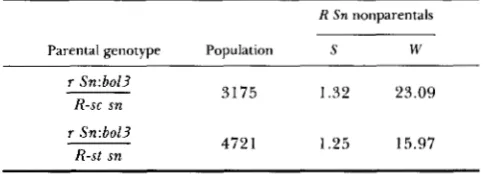
Instability ofSn:bol3: T h e Sn:bol3 accession differs from the others in that it confers a higher pigmenta- tion level in the mesocotyl and seed integuments, even in the absence of light, and in its instability. Two independent observations describe the phenomenon of instability. O n the one hand the term refers to the frequent yield of derivatives in the progeny of homo- zygous Sn:bo/3 stocks that differ from the parental variant by a significant reduction in their mesocotyl pigmentation level. They are collectively referred to as weak derivatives (Sn-w) while the parental form is indicated as Sn-s (-s and -w standing for strong and weak pigmentation respectively). The change of Sn-s
to Sn-w is generally unidirectional. Reversion can, however, be induced by treatment of Sn-w seeds with the deoxycytidine analog 5-aza-2'-deoxycytidine, thus suggesting an involvement of DNA modification in Sn expression (TONELLI et al. 1988). Continuous selfing of homozygous r Sn-s selections shows a constant
~ ~
Hypothesis Expected yleld of recombmants
1
J-
R-sc sn
~~
Rsc r Sn sn r Sn Sn
R- sc sn
-
L - r (-) Sn (+)
Rsc Sn (+) r (-) sn
FIGURE 1 .-Two alternative hypotheses to explain nonreciprocal
recombination. T h e first assumes that the r Sn chromosome carries two separate Sn genes, one closely linked to R and the other about two map units distal to R. T h e second hypothesis assumes that r is missing a function (-) essential for its gametic transmission and complemented by Sn(+).
TABLE 2
Yield (%) of R Sn nonparental chromosomes recovered in the
progeny of r Sn:bol3/R sn females pollinated by r-g sn males
~
R Sn nonparentals
Parental genotype Population S W
r Sn:bol3
R-sc sn
r Sn:bo/?
R-st sn
3175 1.32 23.09
472 1 1.25 15.97
S and W stand for strong and weak mesocotyl pigmentation.
pattern of instability, with a large majority of progeny plants maintaining the parental phenotype @ e . , strong red mesocotyl and light-independent seed glume pig- mentation) and a minority of derivatives, generally about 25%, with weakly colored mesocotyl and light- dependent seed glume pigmentation. We refer to this pattern of events as replicating instability.
On the other hand, the term instability is also used to describe the frequent appearance in the progeny of Sn-s/sn individuals of weak derivatives bearing Sn- w on the chromosome originally devoid of Sn, as if association of the two in the heterozygous parent resulted in frequent passages of Sn-w from one chro- mosome to the other. This event is illustrated in the data of Table
2
where the progeny of r Sn-s/R snheterozygotes receiving a nonparental R Sn-s chro- mosome are found at a rate expected from recombi- nation (1-2%), while the R Sn-w progeny far exceeds that value. T h e former are in fact the result of crossing over in the R-Sn segment while the latter represent a different event since they are not associated with outside marker recombination.
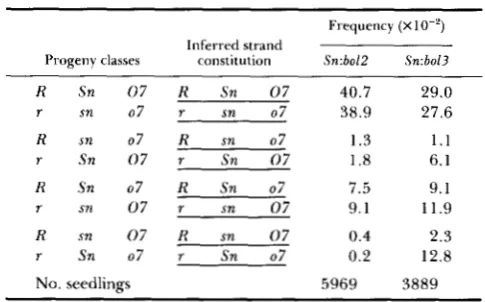
This point is illustrated in the results of three point testcrosses (Table 3) using 0 7 as outside marker ( 0 7 lying 26 cM distal to R ) where the progeny of R-st Sn/
addition, the segregation ratios for R and Sn, as ob- served in testcrossed progenies of such heterozygotes, are different. R-r in fact segregates as expected (1: l ) , while the Sn:sn segregation values exhibit an excess of Sn over sn (Table 4).
These unexpected features, i.e., passage of Sn from one chromosome to its homolog and a distorted seg- regation ratio for Sn, are not observed if the hetero- zygous genotypes carry other Sn sources on the donor chromosome.
These data taken together seem to indicate an over- replication of Sn and its frequent passage from one homolog to the other. These events are referred to as transactive instability to distinguish it from replicating instability. Both kinds of instability are observed only with the Sn:bol3 accession.
Effect of the R constitution on Sn instability: An intriguing and unexpected result is the effect of the R constitution of a normal chromosome 10 on the Sn instability of its homolog. If pollen of an r Sn-s line is used to pollinate R-r sn and R-g sn stocks to develop two genotypes sharing the r Sn-s chromosome but differing in the constitution of the other homolog, the outcome in the progeny of the two heterozygotes is strikingly different. R-g sn/r Sn-s females pollinated by r-g sn males yield, as expected, two preponderant progeny classes (seedlings receiving either one of the two parental chromosomes) and only one nonparental class consisting of R-g Sn-s or R-g Sn-w seedlings. T h e results observed with R-r sn/r Sn-s females, on the other hand, differ greatly. Instead of the parental R-
r sn and r Sn-s chromosomes, the progeny obtained
by testcrossing these heterozygotes consists of nonpar- ental chromosomes only: R Sn-s or R Sn-w, on the one hand, and r sn or r Sn-w, on the other. All four classes appear at about the same frequency. T h e data per- taining to this point are given in Table 5 together with the results obtained in the progeny of R-st sn/r Sn-s heterozygotes. The latter genotype is included in the Table to emphasize the fact that the recovery of a majority of nonparental chromosomes in the prog- eny of heterozygous plants is observed only when R-r is employed as contrasting allele.
“Transfer” of S n from one chromosome to its homolog: T o establish whether the Sn “transferred” from one homolog to another resides at the same location in the homolog receiving it, two independent cases of “transfer” originating from R-sc sn/r Sn:bol3 and R-r snlr Sn:bol3 respectively were studied. Het- erozygous R Sn +/r-g sn M-st females (where R stands for R-sc or R-r and the symbol
+
stands for absence of “ s t ) were mated to R-st sn+
males and recombi- nants in the R-M-st interval detectable as light stippled us. parental stippled kernels, were isolated. They rep- resent only one of the two reciprocal classes of recom- binants, r-g+, expected from R +/r-g M-st heterozy-TABLE 3
Effect of the Sn source (bo12 us. bo13) on the results of three
point testcrosses of R-st Sn 07/r sn 07 females with r sn 07 males
~ ~ ~ ~~ ~ ~~ ~~~
Frequency (XlO-’)
Progeny classes constitution Sn:bolP Sn:bol3 Inferred strand
R Sn 0 7 R Sn 0 7 40.7 29.0
r sn 07 r sn 07 38.9 27.6
R sn 07 R sn 07 1.3 1.1
r Sn 0 7 r Sn 0 7 1.8 6.1
R Sn 07 R Sn 07 7.5 9.1
r sn 0 7 r sn 0 7 9.1 11.9
R sn 0 7 R sn 0 7 0.4 2.3
r Sn 07 r Sn 07 0.2 12.8
No. seedlings 5969 3889
Sn-s and Sn-w derivatives observed when Sn:bol3 is analyzed are pooled together to make Sn:bol3 vs. Sn:bol2 results comparable.
gotes, since the second class, R “st, is not detectable in this cross.
A sample of the light stippled kernels was progeny tested to verify its Sn constitution as well as to ascertain the position of the transferred Sn in the R-M-st chro- mosome interval. Since the results obtained with the two R Sn derivatives are not significantly different they are considered together. Out of 38 verified light stippled recombinants 1 1 gained Sn and
27
were sn in phenotype. Since the observed frequency of light stippled recombinants is 5.07% (125/2465), the posi- tion of the transferred Sn can be inferred to be 1.47 cM distal to R , a value similar to the map position of Sn. These results could indicate that the “transferred” Sn from one homolog to another resides at the same location in the homolog receiving it.Functional relatedness of R and Sn: Even though R and Sn are separate chromosomal components there is evidence suggesting their functional interdepend- ence.
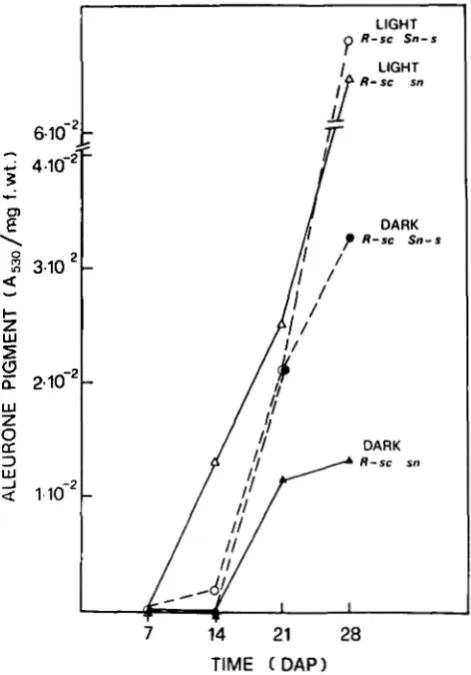
T h e evidence comes from the following observa- tions: (1) A comparison of the kinetics of pigment accumulation in the aleurone (a tissue of R-sc compe- tence) of homozygous R-sc Sn-s and R-sc sn stocks discloses a significant increase of pigment level in the former, particularly evident at 28 DAP, provided the immature seeds are kept in darkness (Figure 2). In the pericarp, a tissue of Sn competence, pigment accu- mulation takes place only in the presence of the R-sc Sn-s genotype and light (data not shown). The higher aleurone pigmentation of Rsc Sn-s us. R-sc sn geno- types in darkness suggests that Sn substitutes for light, at least in part, in eliciting R-sc gene expression. (2)
Instability of
TABLE 4
Instability of Sn:bol3 us. stability of .%:bo12
Parentals Nonparentals Segregation of
Selection Sn
No. source n R Sn r-g sn R sn r-g Sn R Sn
M 19-4 bo13 3896 47.9 (12.0) 32.4 1.8 16.1 (0.6) 49.7 64.0 M25-2 bo13 1820 47.5 (14.3) 36.1 1.9 14.5 (0.5) 49.4 62.0
bo12 4734 48.9 49.3 0.9 0.8 49.8 49.8
29- 1 bo13 1831 46.0 (18.0) 31.2 1
.o
21.7 (1.0) 47.1 67.8Instability of Sn:bol3 (three independent selections) compared with stability of Sn:bol2 (one selection only) as determined in the progeny
Progeny values are expressed as percentage. Those in brackets refer to Sn-s progeny seedlings while the accompanying values represent o f R-sc Sn/r-g sn females mated to r-g sn males.
total -s and -w variants. Sn:bol2 confers a homogeneous mesocotyl pigmentation intermediate between -s and -w.
TABLE 5
Effect of R constitution in trans on Sn instability
R allele constitution
Progeny
classes R-st R-g R-r
R sn 42.3 38.6 0.0
r S n 48.1 ( N D ~ 49.8 (43.8) 22.1 (0.1)
R Sn 9..5 (1.4) 11.9 (1.5) 49.7 (22.0)
r sn 0.0 0.0 28.3
Total No. 2639 4448 2677
seedlings
R-st sn, R-g sn or R-r sn plants heterozygous for r Sn-s were testcrossed by pollination with r-g sn.
Frequency (X and verified constitution of chromosomes recovered in the testcrossed progeny of heterozygous females with one chromosome marked r Sn-s and the other one carrying R-st sn, R-g sn or R-r sn. T h e heterozygotes were obtained by pollinating homo7ygous R-r, R-g and R-st plants with pollen of an r Sn-s line. Chromosomal constitution of each progeny seedling was ascertained by progeny test. Figures in brackets refer to the frequency of progeny seedlings with strong mesocotyl pigmentation (Sn-s).
a Not determined.
ever, until the Sn constitution of nonparental R Sn chromosomes can be defined in more precise terms.
DISCUSSION
T h e various Sn isolates we analyzed are alleles ob- tained from different natural populations that differ as to when and how much anthocyanin is synthesized in specific tissues. They share the same response to
PI
and show an identical pattern of nonreciprocal recom- bination. T h e uniformity of response to the unlinkedP1
factor suggests functional identity of the various Sn sources. T h e meaning and the mechanism of nonre- ciprocal recombination still remains poorly under- stood. For the moment two different hypotheses are proposed (Figure 1). One assumes that the original Sn chromosome conferring an r Sn phenotype carries two separate Sn genes, one at the R locus and a second one two map units distal to R. Heterozygotes carrying a normal R sn chromosome and the r Sn homolog, should yield two kinds of recombinants following crossing over between R and the distally located S n ,P
R-rc S n - s LIGHTi
14 21 28TIME ( DAP)
FIGURE 2.-Time course of anthocyanin accumulation in the
aleurone of immature seeds removed at different days after polli- nation (DAP) from homozygous R-sc Sn-s and R-sc sn ears. Seeds were illuminated or kept in darkness for 96 h r before pigment extraction.
TABLE 6
Frequency distribution and mean color scores of mesocotyls
from heterozygous Sn-s/sn seedlings differing in their R
constitution
Mesocotyl color
class at:
Genotype 0 1 2 3 4 score class 46 hr 96 hr
Mean Selected
R-sc Sn-s
10 60 2.80 3 12.1 52.0
r-g sn 2.6 16.0
3 24.0 42.0 1.2 11.4
r Sn-s 4 68.7 158.0
r g sn 2 4.4 31.0 R-r Sn-s
r-g sn 2 6 14 13 1.80
*
-
1 1 5 21 3.11Mesocotyl color class refers to the visual estimate of pigment content after 72 h r of continuous illumination. Mesocotyls were evaluated by tnatching them with a standard set of mesocotyls ranging from colorless (class 0) to strongly pigmented (class 4).
Selected class refers to the visual scoring value of rnesocotyls that were individually extracted to determine their pigment content spectrophotometrically. A,:w is the mean absorbance value at 530
nm/g fresh weight as determined after 46 and 96 h r of continuous illumination. Each value represents the mean of six independent readings of single mesocotyl extracts.
adjacent site. T h e original chromosome could be des- ignated r(-)Sn(+) to indicate this functional interde- pendence. Accordingly disruption of the r-Sn associ- ation by crossing over would lead to a r(-)sn chro- mosome impaired in some basic function and thus nontransmissibile, while the reciprocal R-sc Sn(+) class would be normally transmitted. Both hypotheses are consistent with the unusual pattern of recombination observed as well as with the resumption of normal recombination in heterozygous R Snlr sn plants. T h e second hypothesis, however, would imply a functional relatedness of the two genes that finds some support in the reciprocal effects exerted by R and Sn upon pigment accumulation in aleurone and seedling tissues (Figure 2 and Table 6). On the other hand, the recent finding that insertion of a transposable element into either the bz or R locus affects intragenic recombina- tion in various ways (DOONER and KERMICLE 1986) opens the way to other possible interpretations.
As emphasized in the RESULTS section, Sn:bol3 dif- fers from the other alleles in its instability. This is manifested as frequent changes of Sn from an Sn-s original allele to derivatives with significantly lower seedling pigmentation collectively referred to as Sn- w. It might well be that DNA modification could account for this instability since the frequent changes Sn:bol3 undergoes from strong to weak variants, gen- erally a unidirectional event, are specifically reversed by treatment with 5-azacytidine, a compound known to cause DNA hypomethylation (CEDAR 1988). Fur- ther experiments are required to confirm this possi- bility and to prove it at molecular level. However, this would not explain the appearance of weak derivatives of Sn on the nonparental chromosome in the progeny
. . .
.
. . .""-
"""""r sn
R - r
f \
...---
R - r Sn-w..
...
"""""
-
Sn s n )-
"""""r Sn-w
W
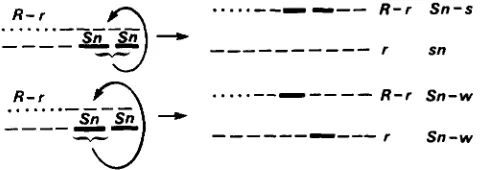
FIGURE 3,"Genetic constitution of nonparental chromosomes in
the progeny of R-r sn/r Sn-s heterozygotes on the assumption that
Sn-s is a compound structure consisting of two Sn elements capable
of individual nonreplicative transposition.
of Sn-s/sn heterozygous plants or the effect of R locus constitution on the transfer of Sn information to its homolog.
It seems, rather, that Sn undergoes frequent pas- sages from one chromosome to its homolog by trans- ferring partial information. T h e chromosome consti- tution of individuals obtained by testcrossing R-r sn/r Sn-s plants suggests that loss of Sn from the r marked homolog is associated with "contamination" of the R-
r bearing chromosome by Sn elements. Two kinds of gain-loss classes are found in the two chromosomes: (1) loss of Sn in the parental chromosome and gain on the other ( r sn and R-r Sn-s);
(2)
a partial loss and gain( r Sn-w and R-r Sn-w). These two reciprocal kinds of
classes are best interpreted as the result of comple- mentary events.
T o explain these data we suggest that Sn is com- posed of two units and that the strong and weak phenotypes recovered in the progeny of heterozygotes have two and one Sn units respectively. Both units can independently move from one chromosome to the other. In the progeny of a heterozygous r Sn-s/R sn
genotype both donor ( r Sn-s) and recipient ( R sn) chromosomes can thus bear 0, 1, 2 doses of Sn as a result of these movements (Figure 3). Presence of R-
r on the "recipient" chromosome would be instrumen- tal, according to the model, in eliciting this passage since other R alleles do not show such a transactive effect.
T h e observation that the weak Sn expression ex- pected in the presence of one Sn unit is represented by various levels of pigmentation could be explained by the occurrence of DNA modification events not detectable if two units are present. T h e high fre- quency of nonparental phenotypes could be explained by assuming that movements of the Sn units from one chromosome to the other are early events occurring in the germ cell line before meiosis. This assumption predicts the occurrence of sectors of seeds with non- parental seedling phenotype in the heterozygous pa- rental ear. Preliminary data (G. GAVAZZI, unpublished results) based on ear mapping analysis fail to show the existence of sectors thus ruling out the involvement of premeiotic events in Sn transfer.
the activation of a cryptic Sn gene by the active one carried on the other homolog. T h e finding that the rate of cryptic Sn activation is significantly increased
if R-r is present on the same chromosome would imply the involvement of the P component of R in this activation process.
Once activated Sn would be capable of secondary activation of a silent Sn residing on an other homolog. Evidence for the activation or transfer hypotheses can be provided by a detailed molecular analysis of indi- vidual R Sn derivatives obtained by testcrossing R sn/
r Sn parents to ascertain their Sn constitution. This analysis is presently under way.
Examples of transactive signals are well documented in plant literature, the most prominent being the phenomenon of paramutation (BRINK 1973) and, more recently, the finding in Antirrhinum of the activ- ity of a specific allele of the nivea locus in trans to repress the level of transcript produced by its homolog (COEN and CARPENTER 1988).
L I T E R A T U R E CITED
ASHMAN, R. B., 1970 The compound structure of the R-st allele
BRINK, R. A , , 1973 Paramutation. Annu. Rev. Genet. 7: 129- in maize. Genetics 64: 239-245.
152.
CEDAR, H., 1988 DNA methylation and gene activity. Cell 53: 3-
COE, E. H., and M. G. NEUFFER, 1977 The genetics of corn, pp. 1 1 1-224 in Corn and Corn Improvement, edited by G. F. SPRA- 4.
CUE. American Society of Agronomy, Madison, Wis. COEN, S. E., and R. CARPENTER, 1988 A semi-dominant allele,
niv-525, acts in trans to inhibit expression of its wild-type homologue in Antirrhinum mujus. EMBO J. 7: 877-883. DOONER, H . K., and J. L. KERMICLE, 1974 Reconstitution of the
R-r compound allele in maize. Genetics 78: 691-70 1 . DOONER, H. K., and J. L. KERMICLE, 1976 Displaced and tandem
duplications in the long arm of chromosome 10 in maize. Genetics 82: 309-322.
DOONER, H. K., and J. L. KERMICLE, 1986 T h e transposable element Ds affects the pattern of intragenic recombination at the bz and R loci in maize. Genetics 113: 135-143.
GAVAZZI, G., I . MIKEREZI, P. PAPINUTTI and C. TONELLI, 1985a Light induced effects on tissue specific gene expression in Zea mays. L. Maydica 3 0 309-3 19.
GAVAZZI, G., M. L. RACCHI, I . MIKEREZI and A. G. M. GERATS, 1985b Genetic instability of Sn, a tissue specific gene deter- minant in maize. Plant Genet. UCLA Symp. Mol. Cell. Biol. (New Series) 35: 5 2 3 - 5 3 5 .
GAVAZZI, G., I . VIANI, E. JACOMINI and B. HELM, 1986 The genetics of S n , a factor responsible for tissue-specific anthocy- anin formation in the maize plant, pp. 91 -1 03 in Gene Structure and Function in Hagher Plants, edited by G. M. REDDY and E.
H. COE, JR. Proc. Intern. Symp. Hyderabad (India).
KERMICLE, J. L., 1970 Somatic and meiotic instability of R-stzp- pled, an aleurone spotting factor in maize. Genetics 64: 247-
258.
KERMICLE, J. L., 1984 Recombination between components of a
mutable gene system in maize. Genetics 107: 489-500. NAGY, F., S. A. KAY and N. H. CHUA, 1988 Gene regulation by
phytochrome. Trends Genet. 4: 37-42.
TONELLI, C., G. CONSONNI, G. GAVAZZJ and A. VIOTTI, 1988 Is
DNA modification involved in Sn instability? Maize Genet. Coop. News Lett. 62: 93.