Saliency Based Video Object Recognition in
Single Concept Video
Raihanath A.S
1, Chithra Rani P R
21 P G Student, Department of Computer Science, Ilahia College of Engineering & Technology (ICET), Kerala, India
2 Assistant Professor,Department of IT, Ilahia College of Engineering & Technology (ICET)), Kerala, India
ABSTRACT: This paper presents a saliency based video object extraction and recognition framework. The extraction framework automatically extract foreground object of interest without any use of training data. The recognition system uses list of training data beforehand. For extracting the foreground object from a video, it uses visual and motion saliency features .A conditional random field is used to effectively combine the saliency induces features. Our proposed method is able to preserve spatial continuity and temporal consistency. Experiments results on variety video shows that our proposed system provides qualitatively satisfactory video object extraction (VOE) results.
KEYWORDS: Video Object Recognition, Visual Saliency, Conditional Random Field.
I. INTRODUCTION
Human can easily interpret the salient object from a video, using the capabilities of human brains. But, in computer vision it is very challenging to recognise the salient object. Researchers are trying to close the gap between the computer and human vision. It is very challenging for a computer vision algorithm to automatically extract the foreground object from a video without any of human interaction. However, if one needs to form a computer vision algorithm, some factors consider in advance.
1) Unknown subject category and unknown number of subject instances in video frame. 2) Complex motion of salient objects due to pose variation.
3) Ambiguous appearance in cluttered background.
It is infeasible to manipulate all foreground objects beforehand. One can extract foreground object from a video using foreground or background information. The extracted object can be utilised for further processing in video object recognition framework. Thus, the task of object recognition is done.
ISSN: 2319-8753
I
nternational
J
ournal of
I
nnovative
R
esearch in
S
cience,
E
ngineering and
T
echnology
(An ISO 3297: 2007 Certified Organization)
Vol. 3, Issue 9, September 2014
automatically extracted from the test input video in an unsupervised setting, and this cannot be easily achieved by most prior work.
II. RELATEDWORK
Previous work such as [8] and [9] focused on an interactive scheme and required users to manually provide the ground truth label information. Although excellent results were produced, methods which do not require user interaction are more practical for real world applications. Recently, several automatic segmentation techniques have been proposed. For example, Wu et al. [10] used a stereo camera setting which provides depth information as a cue for ground truth label. For videos captured by a monocular camera, literatures such as [11, 12] used a CRF framework which maximizes a joint probability of color, motion, etc. models to predict the label of each image pixel. Although the color features can be automatically determined from the input video, these methods required the trained object detectors to extract shape or motion features. A recently proposed method in [13] addressed the VOE problem without the use of any training data. It assumes that the motion of the background is dominant throughout the video, so the authors apply RANSAC [19] to extract candidate foreground regions, followed by a CRF which combines the associated color and motion features to determine the final foreground region.
On the other hand, unsupervised approaches do not train any specific object detectors or classifiers in advance. For videos captured by a static camera, extraction of foreground objects can be treated as a background subtraction problem. In other words, foreground objects can be detected simply by subtracting the current frame from a video sequence [24], [25]. However, if the background is consistently changing or is occluded by foreground objects, background modeling becomes a very challenging task. For such cases, researchers typically aim at learning the background model from the input video, and the foreground objects are considered as outliers to be detected. For example, an autoregression moving average model (ARMA) that estimates the intrinsic appearance of dynamic textures and regions was proposed in [26], and it particularly dealt with scenarios in which the back- ground consists of natural scenes like sea waves or trees.
Sun et al. [27] utilized color gradients of the background to determine the boundaries of the foreground objects. Some unsupervised approaches aim at observing features associated with the foreground object for VOE. For example, graph-based methods [28], [29] identify the foreground object regions by minimizing the cost between adjacent hidden nodes/pixels in terms of color, motion, etc. information.
More specifically, one can segment the foreground object by dividing a graph into disjoint parts whose total energy is minimized without using any training data. While impressive results were reported in [28], [29], these approaches typically assume that the background/camera motion is dominant across video frames. For general videos captured by freely moving cameras, these methods might not generalize well (as we verify later in experiments). Different from graph-based methods, Leordeanu and Collins [30] proposed to observe the co-occurrences of object features to identify the foreground objects in an unsupervised setting. Although promising results under pose, scale, occlusion, etc. variations were reported, their approach was only able to deal with rigid objects (like cars).
III.AUTOMATICOBJECTMODELINGANDEXTRACTION
Fig 1: CRF for object segmentation
3.1. Extraction of visual saliency
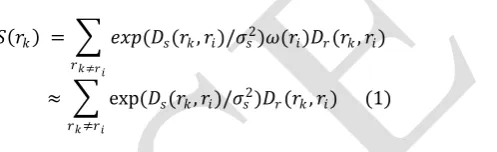
To extract visual saliency of each frame, we perform image segmentation on each video frame and extract color and contrast information. In our work, we advance Turbopixels proposed by [21] for segmentation, and the resulting image segments (superpixels) are applied to perform saliency detection. The use of Turbopixels allows us to produce edge- preserving superpixels with similar sizes, which would achieve improved visual saliency results as verified later. For the kth superpixel 𝑟𝑘, we calculate its saliency score 𝑆 𝑟𝑘 as follows:
𝑆 𝑟𝑘 = 𝑒𝑥𝑝(𝐷𝑠(𝑟𝑘, 𝑟𝑖)/𝜎𝑠2)𝜔(𝑟𝑖)𝐷𝑟(𝑟𝑘, 𝑟𝑖) 𝑟𝑘≠𝑟𝑖
≈ exp(𝐷𝑠(𝑟𝑘, 𝑟𝑖)/𝜎𝑠2)𝐷𝑟(𝑟𝑘, 𝑟𝑖) (1) 𝑟𝑘≠𝑟𝑖
where 𝐷𝑠is the Euclidean distance between the centroid of 𝑟𝑘and that of its surrounding superpixels 𝑟𝑖, while 𝜎𝑠controls
the width of the kernel. The parameter 𝜔(𝑟𝑖)is the weight of the neighbor superpixel 𝑟𝑖, which is proportional to the
number of pixels in 𝑟𝑖. Compared to [22], 𝜔(𝑟𝑖) can be treated as a constant for all superpixels due to the use of
Turbopixels (with similar sizes). The last term 𝐷𝑟(𝑟𝑘, 𝑟𝑖) measures the color difference between 𝑟𝑘and 𝑟𝑖, which is also
in terms of Euclidean distance. As suggested by [23], we consider the pixel i as a salient point if its saliency score satisfies 𝑆 𝑖 >0.8∗max(S), and the collection of the resulting salient pixels will be considered as a salient point set. Since image pixels which are closer to this salient point set should be visually more significant than those which are farther away, we further refine the saliency 𝑆 (𝑖) for each pixel i as follows:
𝑆 𝑖 = 𝑆 𝑖 ∗ (1 − 𝑑𝑖𝑠𝑡(𝑖)/𝑑𝑖𝑠𝑡𝑚𝑎𝑥) (2)
where 𝑆 𝑖 is the original saliency score derived by (1), and dist(i) measures the nearest Euclidian distance to the salient point set. We note that distmax in (2) is determined as the maximum distance from a pixel of interest to its nearest salient point within an image, thus it is an image dependent constant.
3.2. Extraction of motion cues
In our work, each moving part of a foreground object is assumed to form a complete sampling of the entire object of interest (as [11, 12, 13] did). We aim to extract different feature information from these moving parts for the later CRF construction. To detect the moving parts and their corresponding pixels, we perform dense optical flow forward and backward propagation [15] at every frame. A moving pixel 𝑞𝑡 at frame t is determined by:
𝑞𝑡 = 𝑞 𝑡,𝑡−1 𝑞 𝑡,𝑡+1 (3)
Where 𝑞𝑡 denotes the pixel pair detected by forward or backward optical flow propagation. Only if a pixel is identified
ISSN: 2319-8753
I
nternational
J
ournal of
I
nnovative
R
esearch in
S
cience,
E
ngineering and
T
echnology
(An ISO 3297: 2007 Certified Organization)
Vol. 3, Issue 9, September 2014
3.3. Learning shape cues
Since we assume each moving part of an object forms a complete sampling of the entire object, part based shape information induced by the above motion cues can be advanced to characterize the foreground object. To describe each moving part, we apply the histogram of oriented gradients (HOG) features. We first divide each frame into disjoint 8×8 pixel grids, and we compute HOG descriptors for each region (patch) of 4×4 = 16 grids. To capture scale invariant shape information, we further downgrade the resolution of each frame and repeat the above process (the lowest resolution of the scaled image is a quarter of that of the original one). We note that [20] also used a similar setting to extract their HOG descriptors. Since the use of sparse representation has been shown to be very effective in many computer vision tasks [16], once the HOG descriptors of the moving foreground regions are extracted, we learn an over complete codebook and determine the associated sparse representation of each HOG.
(a)
(b)
(c)
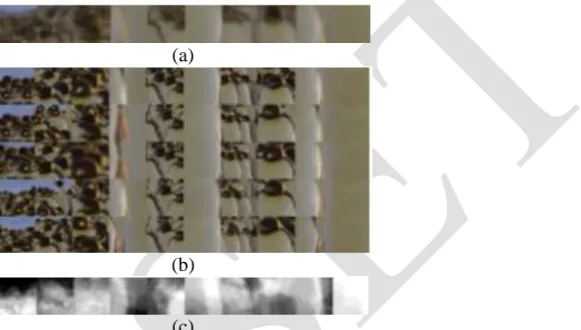
Fig 2: Visualization of sparse shape representation. (a) Example codewords for sparse shape representation. (b) Corresponding image patches (only top 5 matches shown). (c) Corresponding masks for each codeword.
After obtaining the dictionary and the masks to represent the shape of foreground objet, we use them to encode all image patches at each frame. This is to recover non moving regions of the foreground object which does not have significant motion and thus cannot be detected by motion cues. For each image patch, we derive its sparse coefficient vector, and each entry of this vector indicates the contribution of each shape codeword. Correspondingly, we use the associated masks and their weight coefficients to calculate the final mask for each image patch. The reconstruction image using foreground shape information is then formulated as:
𝑋 𝑡𝑆= 𝑛𝜖 𝐼𝑡 𝛼𝑛,𝑘∙ 𝑀𝑘 𝐾
𝑘=1 (4)
Figure 3 shows an example of the reconstruction of a video frame using shape information of the foreground object (induced by motion cues only). We note that b XS t serves as the likelihood of foreground object at frame t in terms of shape information. This shape likelihood function contributes to the shape energy function in CRF, i.e.
𝐸𝑆= −𝑤𝑠log(𝑋
𝑡𝑆) (5)
where 𝑤𝑠 controls the contribution of this shape energy term in the final CRF formulation. Comparing to the motion
Fig 3: Shape Likelihood
3.4. Learning color cues
Besides the motion induced shape information, we also combine the color cues into our CRF framework to better model the object of interest.
Fig 4: Object extraction example of (a) the input frame, using (b) motion, (c) foreground color, and (d) our proposed CRF integrating multiple types of motion induced features.
Constructing the background model is difficult because the sparse motion cues throughout the video might not be sufficient to indicate the foreground/background regions. This difficulty can be depicted in Figure 4(b) which is an example of foreground region extraction using only motion cues in a CRF. To apply the color information of both foreground objects and the remaining background regions into our CRF, we utilize the shape likelihood image obtained from the previous step, and threshold the resulting shape posterior probability 𝑋 𝑆. For the pixels of 𝑋 𝑆 whose
probability values are above a predetermined threshold, the associated regions will be potentially considered as foreground; those below the threshold will be thus grouped as candidate background regions. For these candidate foreground and background regions, we use Gaussian Mixture Models (GMM) 𝐺𝑐𝑓 and 𝐺𝑐𝑏 to model the RGB
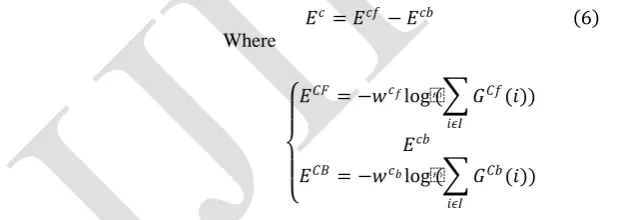
distribution for each, with the number of Gaussian components set to 10 for both cases. We now detail the learning of color cues for foreground object extraction. A single energy term which is associated with both foreground and background color models in our CRF is defined as follows:
𝐸𝑐= 𝐸𝑐𝑓− 𝐸𝑐𝑏 6
Where
𝐸𝐶𝐹= −𝑤𝑐𝑓log( 𝐺𝐶𝑓(𝑖)) 𝑖𝜖𝐼
𝐸𝑐𝑏
𝐸𝐶𝐵 = −𝑤𝑐𝑏log( 𝐺𝐶𝑏(𝑖)) 𝑖𝜖𝐼
As for the visual saliency cue at frame t, we convert the visual saliency score 𝑆 𝑡 derived in (2) into the following energy
term 𝐸𝑉 :
𝐸𝑉= −𝑤𝑣log( 𝑆
𝑡) (7)
Similar to (6), 𝑤𝑐𝑓 and 𝑤𝑐𝑏 in (7) weight the corresponding color models in the CRF. It is worth noting that only
ISSN: 2319-8753
I
nternational
J
ournal of
I
nnovative
R
esearch in
S
cience,
E
ngineering and
T
echnology
(An ISO 3297: 2007 Certified Organization)
Vol. 3, Issue 9, September 2014
3.5. Integration of multiple feature models via CRF
Induced by motion cues, we combine both shape and color (foreground and background) models into our CRF framework. Since we do not require prior knowledge of the object category, use of multiple types of motion induced features allows us to model the foreground object of interest without the need of user interaction or any training data. To provide the property of spatial coherence into our CRF model, we introduce a pairwise term to preserve local foreground/background structures.
We note that the above pairwise term is able to produce coherent labeling results even under low contrast or blurring effects. Finally, by integrating (6), (7), the objective energy function (2) and pair wise term of our CRF can be re written as:
𝐸 = 𝐸𝑢𝑛𝑎𝑟𝑦 + 𝐸𝑝𝑎𝑖𝑟𝑤𝑖𝑠𝑒
= 𝐸𝑆+ 𝐸𝐶𝐹− 𝐸𝐶𝐵) + 𝐸
𝑖,𝑗
= 𝐸𝑆+ 𝐸𝐶+ 𝐸𝑉+ 𝐸
𝑖,𝑗 (8)
To solve the above optimization problem, one can apply graph based energy minimization techniques such as max flow/min cut algorithms. When the above energy function is minimized, the labeling function output F indicates the class label (foreground or background) of each observed pixel.
IV.FOREGROUNDOBJECTRECOGNITION
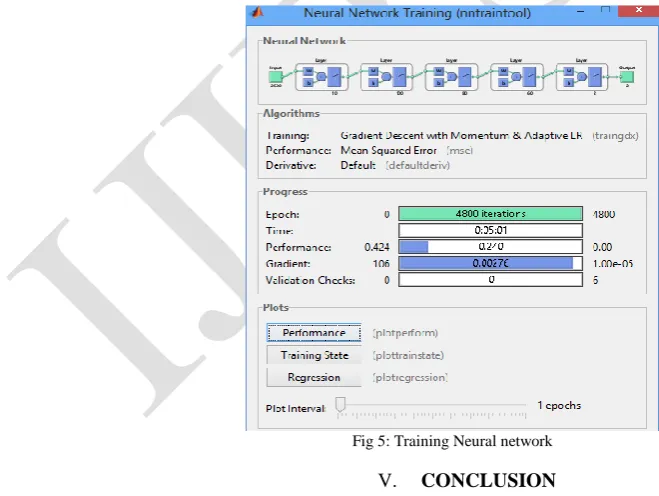
Object recognition is a process for identifying a specific object in a digital image or video. Here, neural networks are used for object recognition purpose. Neural Network provides functions and apps for modeling complex nonlinear systems that are not easily modeled with a closed form equation. Neural Network supports supervised learning with self organizing maps and competitive layers. With this we can design, train, visualize, and simulate neural networks.
Fig 5: Training Neural network
V. CONCLUSION
model describes the shape information of the foreground object in a probabilistic way, which allows us to extract and construct both foreground and background color models for the object of interest. Compared with prior work, our approach better models the foreground object due to the use of multiple types of motion induced feature models, while no prior knowledge of the object of interest, collection of training video data, or the design of object part detectors are required.
Future research will be directed at extensions of our approach for videos with multiple concepts (i.e. multiple foreground objects of interest), and the applications of VOE for higher level tasks such as action/activity recognition and video retrieval. For these applications, we expect to integrate features from heterogeneous domains (e.g. visual, audio, temporal, text, etc.), and we will provide a systematic way to select proper feature models for extracting particular types of the object of interest.
REFERENCES
[1] T. Bouwmans et al., ―Background modeling using mixture of gaussians for foreground detection – a survey,‖ Recent Patents on Computer Science, 2008.
[2] F. C. Cheng, S. C. Huang, and S. J. Ruan, ―Advanced background subtraction approach using laplacian distri bution model,‖ in ICME, 2010. [3] B. Wu and R. Nevatia, ―Detection and segmentation of multiple, partially occluded objects by grouping, merging, assigning part detection
responses,‖ IJCV, 2009.
[4] Z. Lin and L. S. Davis, ―Shape based human detection and segmentation via hierarchical part template matching,‖ IEEE PAMI, 2010. [5] L. Gorelick et al., ―Shape based detection and top down delineation using image segments,‖ IEEE PAMI, 2009.
[6] J. C. Niebles et al., ―Extracting moving people from internet videos,‖ in ECCV, 2008.
[7] J. C. Niebles, B. Han, and L. Fei Fei, ―Efficient extraction of human motion volumes by tracking,‖ in CVPR, 2010.
[8] Y. Y. Boykov and M. P. Jolly, ―Interactive graph cuts for optimal boundary and region segmentation of objects in n-d images,‖ in ICCV, 2001. [9] C. Rother, V. Kolmogorov, and A. Blake, ―‖grabcut‖: Interactive foreground extraction using iterated graph cuts,‖ ACM Trans. Graphics, 2004. [10] Y. Wu et al., ―Bilayer segmentation from stereo video sequences by fusing multiple cues,‖ in ICME, 2008.
[11] A. Criminisi, G. Cross, A. Blake, and V. Kolmogorov, ―Bilayer segmentation of live video,‖ in CVPR, 2006. [12] P. Yin et al., ―Bilayer segmentation of webcam videos using tree based classifiers,‖ IEEE PAMI, 2010.
[13] F. Liu and M. Gleicher, ―Learning color and locality cues for moving object detection and segmentation,‖ in CVPR, 2009.
[14] J. Lafferty, A. McCallum, and F. Pereira, ―Conditional random fields: Probabilistic models for segmenting and labeling sequence data,‖ in ICML, 2001.
[15] M. Werlberger et al., ―Anisotropic Huber L1 optical flow,‖ in BMVC, 2009.
[16] M. Elad and M. Aharon, ―Image denoising via sparse and redundant representations over learned dictionaries,‖ IEEE Trans. Image Processing, 2006.
[17] J. Mairal et al., ―Online learning for matrix factorization and sparse coding,‖ JMLR, 2010. [18] A. Blake et al., ―Interactive image segmentation using an adaptive gmmrf model,‖ in ECCV, 2004.
[19] M. A. Fischler and R. C. Bolles, ―Random sample consensus: a paradigm for model fitting with applications to image analysis and automated cartography,‖ in Commun. ACM, 1981.
[20] P. Felzenszwalb, et al., ―Object detection with discriminatively trained part based models,‖ IEEE PAMI, 2010.
[21] A. Levinshtein, A. Stere, K. N. Kutulakos, D. J. Fleet, and S. J. Dickin- son, ―TurboPixels: Fast superpixels using geometric flows,‖ IEEE Trans. Pattern Anal. Mach. Intell., vol. 31, no. 12, pp. 2290–2297, Dec. 2009.
[22] M.-M. Cheng, G.-X. Zhang, N. J. Mitra, X. Huang, and S.-M. Hu, ―Global contrast based salient region detection,‖ in Proc. IEEE Conf. Comput. Vis. Pattern Recognit., Jun. 2011, pp. 409–416.
[23] S. Goferman, L. Zelnik-Manor, and A. Tal, ―Context-aware saliency detection,‖ in Proc. IEEE Conf. Comput. Vis. Pattern Recognit., Jun. 2010, pp. 2376–2383.
[24] [9] T. Bouwmans, F. E. Baf, and B. Vachon, ―Background modeling using mixture of Gaussians for foreground detection—A survey,‖ Recent Patents Comput. Sci., vol. 3, no. 3, pp. 219–237, 2008.
[25] F.-C. Cheng, S.-C. Huang, and S.-J. Ruan, ―Advanced background subtraction approach using Laplacian distribution model,‖ in Proc. IEEE Int. Conf. Multimedia Expo, Jul. 2010, pp. 754–759.
[26] J. Zhong and S. Sclaroff, ―Segmenting foreground objects from a dynamic textured background via a robust Kalman filter,‖ in Proc. 9th IEEE Int. Conf. Comput. Vis., vol. 1. Oct. 2003, pp. 44–50.
[27] J. Sun, W. Zhang, X. Tang, and H.-Y. Shum, ―Background cut,‖ in Proc. 9th Eur. Conf. Comput. Vis., 2006, pp. 628–641.
[28] F. Liu and M. Gleicher, ―Learning color and locality cues for moving object detection and segmentation,‖ in Proc. IEEE Conf. Comput. Vis. Pattern Recognit., Jun. 2009, pp. 320–327.
[29] K.-C. Lien and Y.-C. F. Wang, ―Automatic object extraction in single- concept videos,‖ in Proc. IEEE Int. Conf. Multimedia Expo, Jul. 2011, pp. 1–6.