To Implement EAC Technique AC –AC
Converter
G.Vasumathi, Deepa.M
Assistant Professor, Department of Mechatronics, Bharath University, Chennai, India
ABSTRACT: The Ac voltage controllers are used to obtain variable output ac voltage from fixed ac voltage. In convention, Phase angle control and Integral cycle control have been extensively used in this type of controllers. These techniques have some inherent disadvantages like low power factor with respect to the firing angle and also the presence of lower order harmonic contents. This paper explores the technique, which improves the power factor and reduces the harmonics. It has its applications in domestic and industrial heating, starting and speed control of single phase, three phase ac drives. The implementation of extinction angle control technique (EAC) Moreover the performance evaluation of the proposed technique has been analyzed while supplying for both static and dynamic loads. Thus the difficulty caused by the conventional techniques in the ac voltage controllers to obtain variable ac voltage can be reduced to an appreciable extent using the proposed scheme.
KEYWORDS: AC/AC converters; Extinction Angle Control (EAC); Power Factor (PF); THD; static load; dynamic load.
I. INTRODUCTION
The Phase-angle control (PAC) and Integral-cycle control are the conventional techniques that have been extensively employed in this type of regulators for many applications. Such techniques offer some advantages as simplicity and the ability of controlling large amount of power economically. However, they suffer from inherent disadvantages such as retardation of the firing angle causes lagging power factor at the input side especially at large firing angles and high low order harmonic content in both of load and supply sides. Moreover, a discontinuity of power flow appears at both input and output sides. Trying to solve this problem with simple ac voltage converters is an almost impossible task. Thus, the present paper describes a simple scheme to generate a variable ac voltage directly from the line with few commutations at each period.
This is achieved by using the extinction angle control (EAC) control technique to control the extinction angle by making use of forced commutation nature of the switches while introducing a freewheeling path in parallel with the load terminals.
ISSN(Online) : 2319 - 8753
ISSN (Print) : 2347 - 6710
International Journal of Innovative Research in Science,
Engineering and Technology
(An ISO 3297: 2007 Certified Organization)
Vol. 4, Issue 4, April 2015
Copyright to IJIRSET DOI: 10.15680/IJIRSET.2015.0404139 2510 II. PROPOSED APPROACH
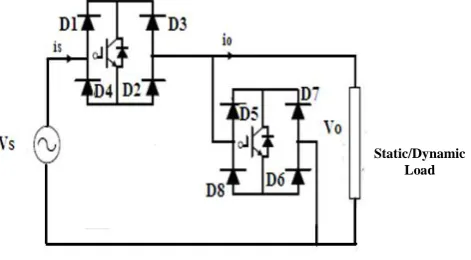
The circuit configuration of the ac/ac converter is shown in Fig.1.It consists of two controlled IGBT switches with two diode bridge rectifiers fed to a dynamic load. The static load considered is a RL load and dynamic load considered here is a single phase capacitor - start-run induction motor.
Figure 1. Proposed configuration of AC/AC converter with static/dynamic load.
the load current to discharge the stored energy of the inductance.[2]
A. Extinction Angle Control
The principle of Extinction Angle Control (EAC) is to start the conduction at the zero crossing of the supply voltage and forced commutated at certain angle at certain angle before the next zero crossing occurs. The switching pulses are shown in Fig.2 synchronized with the supply voltage and the output voltage is controlled by varying the extinction angle β. The conduction begins when switch S1 is turned on at t=0 and is turned off by force commutation at t= -β. The freewheeling path for the load current must be provided from t=-β to t= by the switch S2 to discharge the stored energy of the inductance. Thus the fundamental component of input current leads the input voltage and the power factor is leading. [4]
The average output voltage is given by,
Vo =Vm
π cos π−β + 1 (1) The rms output voltage is given by,
Vorms = Vm
2π π−β −
sin 2(π−β)
2 (2)
Figure 2. Input voltage, output current, switching pulses, output voltage and input current waveforms with extinction angle control.
III. PERFORMANCE CHARACTERISTICS OF AC/AC CONVERTER WITH STATIC LOAD USING EAC TECHNIQUE
The performance characteristics of an ac/ac converter applied to a static load using EAC technique is studied using MATLAB/Simulink package. The static RL load has the supply voltage of 230V, 50Hz with the switching frequency of 100Hz and the value of load resistance R=50Ω and L=110mH.[3]
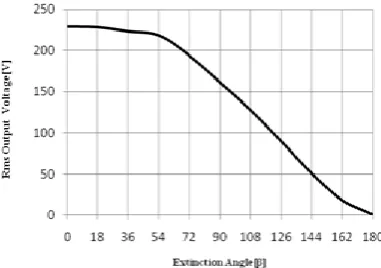
Figure 3.Variation of the rms output voltage with the extinction angle.
The Fig.3 shows the simulated variation of the rms values of the output voltage Vo with the extinction angle β. As
ISSN(Online) : 2319 - 8753
ISSN (Print) : 2347 - 6710
International Journal of Innovative Research in Science,
Engineering and Technology
(An ISO 3297: 2007 Certified Organization)
Vol. 4, Issue 4, April 2015
Copyright to IJIRSET DOI: 10.15680/IJIRSET.2015.0404139 2512
Figure 4. Variation of the input power factor with the extinction angle.
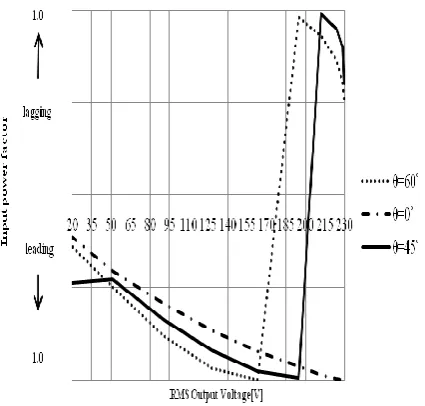
The Fig.4 shows the simulated variation of the input power factor with the extinction angle β over the complete range of control for three different load conditions namely a resistive load (ө=0°) and two inductive loads with load angles (ө=45°,60°) respectively. Thus it implies that as the extinction angle increases, the input power factor is improved gradually from its lagging value and it becomes leading after the extinction angle exceeds the load angle and also the input power factor gets more improved with the increase in the extinction angle. This feature gives more importance for EAC technique.[5]
Figure 5. Variation of the input power factor with the rms output voltage.
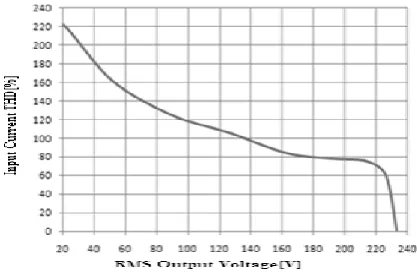
Figure 6.Variation of the Input current THD with the output voltage.
The Fig.6 shows the simulated variation of the input current THD with the rms output voltage for different load conditions. As the extinction angle increases, the rms output voltage decreases.This in turn results in increasing the THD of supply current. This doesn’t affect the leading nature of power factor.[7]
.
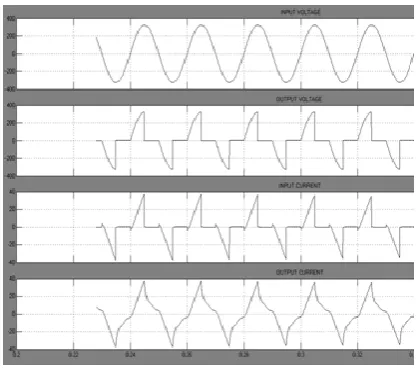
A. Simulation waveformss with EAC technique
Figure 7.Voltage and Current waveforms with EAC technique
ISSN(Online) : 2319 - 8753
ISSN (Print) : 2347 - 6710
International Journal of Innovative Research in Science,
Engineering and Technology
(An ISO 3297: 2007 Certified Organization)
Vol. 4, Issue 4, April 2015
Copyright to IJIRSET DOI: 10.15680/IJIRSET.2015.0404139 2514
Figure 8. Variation of the rms output voltage with the extinction angle
Fig.8 shows the simulated variation of the extinction angle with the output voltage. As the extinction angle increases the output voltage gets decreased.
Figure 9. Variation of the Input current THD with the output voltage
Fig 9. Show the simulated variation of the input current THD with the rms output voltage. As the extinction angle increases, the rms output voltage decreases .This in turn results in increasing the THD of supply current. This doesn’t affect the leading nature of power factor.
IVCONCLUSION
The proposed AC/AC converter has different configuration compared to the conventional converter. The need for this configuration is to improve the reliabity, decrease the switching losses and to enhance the converter efficiency. The proposed control technique EAC has some improvement over input power factor and the input current THD.
REFERENCES
[1] M. H. Rashid, Power Electronics: Circuits, Devices and Applications,2nd edition, Upper Saddle River, New Jersey: Prentice-Hall, 1993. [2] Babu T.A., Sharmila V., "Cefotaxime-induced near-fatal anaphylaxis in a neonate: A case report and review of literature", Indian Journal of
Pharmacology, ISSN : 0253-7613, 43(5) (2011) pp.611-612.
[3] Valiathan G.M., Thenumgal S.J., Jayaraman B., Palaniyandi A., Ramkumar H., Jayakumar K., Bhaskaran S., Ramanathan A., "Common docking domain mutation e322k of the erk2 gene is infrequent in oral squamous cell carcinomas", Asian Pacific Journal of Cancer Prevention, ISSN : 1513-7368, 13(12) (2012) pp.6155-6157.
[5] Mani Sundar N., Krishnan V., Krishnaraj S., Hemalatha V.T., Alam M.N., 'Comparison of the salivary and the serum nitric oxide levels in chronic and aggressive periodontitis: A biochemical study", Journal of Clinical and Diagnostic Research, ISSN : 0973 - 709X, 7(6) (2013) pp.1223-1227.
[6] 1. 1. Barbi and J. C. Fagundes, “A compact ac/ac voltage regulator based on ac/ac high frequency flyback converter,” in Proc. IEEE PESC'91,
1991, pp. 846-852.
[7] Thirunavukkarasu A.B., Chandrasekaran V., 'Efficacy of anti-scorpion venom serum over prazosin in severe scorpion envenomation: Is the current evidence enough", Journal of Postgraduate Medicine, ISSN : 0022-3859, 57(1) (2011) pp.83-84.
[8] Thirunavukkarasu A.B., Chandrasekaran V., 'Efficacy of anti-scorpion venom serum over prazosin in severe scorpion envenomation: Is the current evidence enough", Journal of Postgraduate Medicine, ISSN : 0022-3859, 57(1) (2011) pp.83-84.
[9] Ms.P.Thamarai #1, Mr.B.Karthik, Network Data Security Using FPGA, International Journal of Advanced Research in Electrical, Electronics and Instrumentation Engineering, ISSN (Online): 2278 – 8875,pp 8318-8323, Vol. 3, Issue 4, April 2014
[10]P.Thamarai1, B.Karthik, ARM Based Automatic Meteorological Data Acquisition System, International Journal of Advanced Research in Electrical, Electronics and Instrumentation Engineering, ISSN (Online): 2278 – 8875,pp 6525-6529, Vol. 3, Issue 1, January 2014
[11]E.Kanniga, Dr.M.Sundararajan, Design And Modeling Of Bio Signal Amplifier For Signal Extractor Neuro feedback Interface Machine,International Journal of Advanced Research in Electrical, Electronics and Instrumentation Engineering,ISSN: 2278 – 8875,pp 1717-1725,Vol. 2, Issue 5, May 2013
[12]M.Bharathi, C.Selvakumar,Dynamic Modeling, Simulation and Control of MIMO Systems,International Journal of Advanced Research in Electrical, Electronics and Instrumentation Engineering,ISSN 2278 - 8875, pp 71-84 ,Vol. 1, Issue 2, August 2012.