UNIVERSIT
E
´
PARIS
-SUD
XI
T
H
ESE
`
pour obtenir le grade deD
OCTEUR DE L’U
NIVERSITE´
P
ARIS-S
UDXI
pr´epar´ee au LABORATOIRE DE RECHERCHE EN INFORMATIQUE
dans le cadre del’Ecole Doctorale d’Informatique de Paris-Sud”
pr´esent´ee et soutenue publiquement
par
Thomas LARGILLIER
le 29 novembre 2010Probabilistic algorithms for large
scale systems
Directeurs de th`ese :
M. Joffroy Beauquier et Sylvain Peyronnet
J
URYContents 2
1 French Summary 7
1.1 Introduction . . . 7
1.1.1 Les tricheurs sur la toile . . . 8
1.1.2 Les syst`emes `a grande ´echelle . . . 9
1.2 D´eclassement du Webspam . . . 10
1.2.1 Le Webspam . . . 10
1.2.2 Lutter contre le Webspam . . . 11
1.2.3 R´esultats . . . 11
1.3 Les r´eseaux de capteurs mobiles . . . 12
1.3.1 D´efinition et d´efis . . . 12
1.3.2 L’algorithme RaWMS . . . 13
1.3.3 Notre proposition . . . 14
1.4 Test pour les applications `a grande ´echelle . . . 15
1.5 Conclusion . . . 17
2 Preamble 19 2.1 Handling malicious users on the Web . . . 20
2.1.1 Diminishing the influence of malicious users of social networks . . . 20
2.1.2 Reducing the boosting effect of Webspam . . . 21
2.2 Large scale networks . . . 21
2.2.1 Improving data dissemination in sensor networks . . . . 22 2.2.2 Realistic evaluation of parallel and distributed applications 22
3
I Fighting malicious behaviours on the Web
25
3 Introduction 27
3.1 Collaborative news websites . . . 29
3.2 Fighting social spam . . . 30
3.3 WebSpam presentation . . . 31
3.4 Fighting Webspam . . . 34
3.5 Random walks . . . 35
3.6 Clustering . . . 38
3.6.1 Edge betweenness centrality . . . 39
3.6.2 Markov clustering technique . . . 41
4 Malicious behaviours in social networks 45 4.1 SpotRank algorithm . . . 46
4.1.1 Framework and principle . . . 46
4.1.2 Proposing a spot . . . 48
4.1.3 Voting for a spot . . . 48
4.1.4 Detecting cabals . . . 52
4.2 Experiments . . . 53
4.2.1 Log analysis of spotrank.fr . . . 54
4.2.2 Human Evaluation . . . 61
4.3 Discussion . . . 65
4.4 Conclusion . . . 65
5 Demoting WebSpam 67 5.1 Clustering Methods . . . 68
5.2 Experiments . . . 70
5.3 Statistical Test . . . 76
5.4 Conclusion . . . 78
6 Detecting WebSpam 79 6.1 Random walks against Webspam . . . 80
6.2 Experiment . . . 84
II Analysis & probabilistic solutions for large scale
sys-tems
91
7 Introduction 93
7.1 Message propagation in sensor networks . . . 94
7.1.1 Sensor Networks . . . 94
7.1.2 How to efficiently propagate messages in sensor networks 96 7.1.3 Related work: data dissemination in WSNs . . . 98
7.2 Large scale applications . . . 99
7.2.1 Cluster & Grids . . . 99
7.2.2 Managing failures in large-scale systems . . . 100
7.2.3 Evaluation of large-scale applications . . . 101
7.2.4 Existing solutions for large-scale applications development103 8 QoS in sensor networks 105 8.1 Supple description . . . 106
8.2 Rationale and system model . . . 107
8.3 Supple: formal presentation . . . 108
8.3.1 Tree construction . . . 108
8.3.2 Weight distribution . . . 109
8.3.3 Data dissemination . . . 110
8.3.3.1 Formal analysis . . . 112
8.3.4 Discussion . . . 114
8.4 Performance analysis . . . 115
8.4.1 Evaluation methodology . . . 115
8.4.1.1 Experimental setup . . . 115
8.4.1.2 Simulation parameters . . . 116
8.4.1.3 Evaluation metrics . . . 116
8.4.2 Simulated results . . . 117
8.4.2.1 Communication overhead . . . 118
8.4.2.2 Efficiency in data gathering . . . 120
8.4.2.3 Loss resilience . . . 122
8.4.3 Conclusion . . . 123
9 Test for large scale applications 125 9.1 V-DS Platform Description . . . 125
5
9.1.2 Low-level Network Virtualization . . . 127
9.2 Experiments . . . 128
9.2.1 Impact of the Low-Level Network Emulation . . . 129
9.2.2 TCP Broken Connection Detection Mechanism . . . 130
9.2.3 Stress of Fault-Tolerant Applications . . . 132
9.3 Conclusion . . . 136
IIIConclusion
137
10 Conclusion 139 10.1 Social spam . . . 13910.2 Webspam demotion . . . 139
10.3 Webspam detection . . . 140
10.4 Supple . . . 140
10.5 V-ds . . . 140
C
H
A
P
T
E
R
1
F
RENCH
S
UMMARY
1.1
Introduction
De nos jours, les syst`emes informatiques ont une taille sans cesse croissante pour r´epondre aux besoins des utilisateurs. Que ce soit dans le domaine du calcul scientifique o`u de plus en plus d’ordinateurs sont reli´es pour r´epondre `a des probl`emes sans cesse plus complexes ou dans le domaine du loisir avec un Internet grandissant pour satisfaire toujours plus la curiosit´e des utilisateurs.
Les d´efis qui concernent les r´eseaux `a grande ´echelle sont nombreux: pou-voir garantir aux utilisateurs d’un cluster que leur calcul arrivera `a terme et sans erreur dans un temps raisonnable, distribuer des donn´ees entre petites entit´es intelligentes efficacement ou encore prot´eger le Web contre les tricheurs.
Le but de ma th`ese est d’apporter des r´eponses pour les syst`emes `a grande ´echelle afin de garantir l’exp´erience utilisateur la plus agr´eable possible.
Les travaux r´ealis´es au sein de cette th`ese vont de la conception d’algorithmes `a la r´ealisation de modules pour le noyau d’un syst`eme (GNU/Linux). Les do-maines ´etudi´es vont des spammeurs sur le Web aux bancs d’essai pour les appli-cations `a tr`es grande ´echelle.
1.1.1
Les tricheurs sur la toile
De nos jours l’Internet est un endroit immense o`u chaque jour des millions d’internautes font des milliards de requˆetes. Afin de les aider, les moteurs de recherches classent les pages sur des crit`eres ind´ependants de la pertinence `a la requˆete afin de retourner les pages les plus populaires `a l’utilisateur.
Le Webspam est un enjeu important ´economiquement car il permet aux spam-meurs de se positionner id´ealement sur les requˆetes `a fort but lucratif. D`es lors il est primordial pour les moteurs de recherche de se d´ebarrasser des tricheurs ou `a tout le moins de les rel´eguer aux derni`eres pages de r´esultats.
J’ai travaill´e sur la d´etection et le d´eclassement du Webspam et dans cette th`ese je pr´esente deux m´ethodes pour lutter contre le Webspam. Ces deux m´ethodes sont rapides et ´economes en m´emoire, ce qui est primordial lorsque l’on travaille sur un graphe de la taille du Web. J’ai d´evelopp´e ces m´ethodes avec Sylvain Peyronnet, cela a donn´e lieu `a une publication `a la neuvi`eme conf´erence internationale Web Intelligence en 2010 [61] et `a un deuxi`eme article publi´e au premier workshop international Web Intelligent Systems and Services en 2010 [62]
Les Webspammeurs cherchent `a maximiser leur exposition sur la Toile afin d’augmenter leurs revenus. Les moteurs de recherche ne sont pas la seule cible des tricheurs. Avec l’arriv´ee du Web 2.0, les spammeurs peuvent avoir plus d’influence sur les contenus trouv´es sur le Web, notamment au travers des sites collaboratifs.
Les sites d’informations collaboratifs sont des sites Web o`u les utilisateurs proposent eux-mˆemes les liens vers des informations et peuvent voter pour celles qu’ils voudraient voir en premi`ere page. Le but des tricheurs est alors d’atteindre la premi`ere page pour maximiser leur exposition. Il est donc important de blo-quer les tentatives de ces tricheurs afin de rendre nulles leurs attaques sur le syst`eme.
1.1. INTRODUCTION 9
1.1.2
Les syst`emes `a grande ´echelle
Le nombre de machines requis pour mener `a bien un calcul `a tendance `a aug-menter au fil des ann´ees, ceci afin de faire perdurer la loi de Moore. On a donc vu apparaˆıtre les clusters puis les grilles de calcul afin de pouvoir mener `a bien les calculs scientifiques.
D´evelopper des applications `a cette ´echelle est ´evidemment plus compliqu´e lors de la conception mais aussi lors des tests. Il faut ˆetre certain de maˆıtriser un maximum de param`etres afin de pouvoir comprendre et reproduire les conditions exp´erimentales.
Durant cette th`ese, j’ai tout d’abord particip´e `a l’´elaboration d’un banc d’essai pour les applications parall`eles et distribu´ees `a grande ´echelle. L’objectif ´etait de fournir un ´emulateur afin de poss´eder un contrˆole complet de l’environnement pour tester les applications et pas un mod`ele de celles-ci.
Benjamin Qu´etier avait r´ealis´e une plateforme o`u les machines ´etaient vir-tualis´ees grˆace `a la technologie Xen [5] et o`u le r´eseau passait par des ma-chines FreeBSD. J’ai ´etendu ce banc d’essai en y ajoutant de la virtualisation r´eseau niveau bas avec le protocole EtherIP [52]. Il s’agit d’un travail joint avec Franck Cappello, Mathieu Jan, Thomas H´erault, Sylvain Peyronnet et Benjamin Qu´etier ayant donn´e lieu `a une publication `a la sixi`eme conf´erence internationale ACM Computing Frontiers [47] ainsi qu’`a un chapitre de livre publi´e chez IOS Press [46].
J’ai ensuite rejoint un groupe de travail compos´e d’Aline Carneiro-Viana, Thomas H´erault, Sylvain Peyronnet et Fatiha Za¨ıdi sur les r´eseaux de capteurs. Dans ces r´eseaux qui peuvent ˆetre tr`es ´etendus, les unit´es de calcul sont tr`es limit´ees en puissance et en m´emoire, de plus leur autonomie est aussi un facteur important car si un trop grand nombre d’entre elles tombent en panne cela peut d´econnecter le r´eseau.
1.2
D´eclassement du Webspam
1.2.1
Le Webspam
Le Webspam d´esigne l’ensemble des techniques malhonnˆetes pour accroˆıtre son classement dans les moteurs de recherche. En effet, il est facile mais ais´ement d´etectable d’augmenter artificiellement sa pertinence concernant une requˆete pour un moteur de recherche. De plus les spammeurs cherchent le plus sou-vent `a am´eliorer le classement de pages pertinentes et int´eressantes. En effet sur le Web on ne gagne pas d’argent directement avec les pages de spam.
Les spammeurs concentrent le plus souvent leurs attaques sur les algorithmes de popularit´e des moteurs de recherche. Ces algorithmes bien connus tel le PageRank [80] de Google o`u l’algorithme HITS [57] impl´ement´e dans des mo-teurs anglophones tr`es utilis´es commehttp://www.ask.com. L’algorithme de Google donne un score de popularit´ea priori `a toutes les pages. L’algorithme HITS quant `a lui classe les pages qui arrivent en r´esultats `a une requˆete. Dans un cas comme dans l’autre, le calcul de popularit´e est effectu´e sur des crit`eres purement structurels et ne fait pas appel au contenu des pages.
Les deux algorithmes se basent sur les liens rec¸us par les pages web pour ´evaluer leur popularit´e (PageRank) ou leur authorit´e (HITS). La philosophie derri`ere cette mani`ere de calculer la popularit´e est la suivante, lorsqu’un site A fait un lien vers un site B, A vote pour B indiquant aux surfeurs qu’ils peuvent y trouver du contenu int´eressant qui m´erite d’ˆetre vu.
Les spammeurs ont tr`es vite compris qu’il ´etait facile d’am´eliorer artificielle-ment sa popularit´e. En effet il suffit de cr´eer soi-mˆeme beaucoup de pages web qui vont voter pour la page cible. De ce fait on r´ecup`ere beaucoup de votes. Ces pages cr´e´ees dans ce seul but ne rec¸oivent quant `a elles pas de votes donc le leur ne vaut quasiment rien. Toutefois en en cr´eant suffisamment il est possible d’am´eliorer substantiellement mais frauduleusement son score.
Recevoir beaucoup de votes de petits votants n’est pas une strat´egie opti-male pour maximiser son score de popularit´e. Zoltan Gyongyiet al ont ´etudi´e la structure `a mettre en place pour maximiser la popularit´e d’une page dans le cadre du PageRank dans [38]. Christobald de Kerchove a lui r´esolu le probl`eme de maximiser le pagerank d’un ensemble de pages. Il propose l’architecture `a mettre en place dans [26].
1.2. D ´ECLASSEMENT DU WEBSPAM 11
pour ne plus les prendre en compte dans son calcul.
De nos jours, les Webspammeurs mettent en place de nombreuses pages avec une architecture particuli`ere afin de faire circuler le PageRank tout en augmen-tant le score de la page cible. Ces ensembles de pages cr´eees dans ce but sont commun´ement appel´ees des fermes de liens.
Il s’agit d’un enjeu important pour les moteurs de recherche. En effet la qualit´e des r´esultats est importante afin de gagner et garder la confiance des utilisateurs. Le placement frauduleux des spammeurs sur certaines requˆetes nuit `a la r´eputation du moteur de recherche.
1.2.2
Lutter contre le Webspam
On peut diviser en deux parties les techniques de lutte contre le Webspam: la d´etection et le d´eclassement. La premi`ere m´ethode cherche a rep´erer les tricheurs tandis que la deuxi`eme cherche `a annuler les effets de la triche sans pour autant pointer qui que ce soit du doigt.
Ntoulas propose une m´ethode d’identification du Webspam dans [76] bas´ee sur l’analyse du contenu des pages. A partir d’une dizaine de crit`eres il ´etablit un classificateur qui va ´etiquetter les pages analys´ees. Cette m´ethode pose un probl`eme parce qu’elle est coˆuteuse et les pages promues par le Webspam n’y appartiennent pas. D`es lors il faut identifier tout le Webspam autour d’une page pour r´eellement faire baisser son pagerank.
Gyongyiet al propose dans [39] une m´ethode pour rep´erer les tricheurs en diffusant de la confiance dans le graphe `a partir d’un ensemble de sites de confi-ance pr´ec´edemment s´electionn´es. Une m´ethode similaire est pr´esent´ee dans [58] par Krishnanet al. Elle consiste dans la diffusion d’“Anticonfiance”, elle poss`ede les mˆeme probl`emes que la premi`ere m´ethode `a savoir trouver le bon ensemble de d´epart qui va permettre de couvrir tout le graphe.
Une nouvelle variation de cette m´ethode est propos´ee dans [100] par Wuet al. La diff´erence c’est qu’ici est pris en compte l’ad´equation s´emantique.
Une autre m´ethode consiste `a calculer des pageranks biais´es pour ne pas prendre en compte les effets de la triche.
1.2.3
R´esultats
durement touch´e par un calcul de pagerank o`u les seuls contributeurs d’une page sont les pages qui appartiennent `a un cluster diff´erent.
Cependant les techniques classiques de partitionnement sont trop coˆuteuses pour ˆetre appliqu´ees `a l’ensemble du graphe du Web. Nous proposons donc plusieurs m´ethodes locales pour regrouper les noeuds du graphe.
La premi`ere m´ethode propos´ee consiste `a regrouper les noeuds qui ne font qu’un lien avec la page vers laquelle ils font ce lien. La deuxi`eme m´ethode con-siste `a regrouper ensemble tous les noeuds appartenant `a des boucles tr`es courtes (3 pas). Enfin la derni`ere m´ethode consiste `a lancer des marches al´eatoires cour-tes depuis une page et de la regrouper avec celle sur laquelle le plus de marches ce sont arrˆet´ees si ce nombre d´epasser un certain seuil.
La premi`ere m´ethode est inefficace tandis que la deuxi`eme et la troisi`eme font baisser significativement le pagerank des pages qui semblent tricher. Toute-fois il n’existe de preuve statistique que pour la deuxi`eme m´ethode de regroupe-ment.
La deuxi`eme technique de lutte contre le Webspam se base, elle, compl`etement sur les marches al´eatoires et ne fait plus de r´etrogradation. Les pages profitant du Webspam sont ici identifi´ees. Pour ce faire on lance une marche al´eatoire depuis les noeuds suspects du graphe en ne stockant pas les identifiant des noeuds dans le graphe mais leur distance par rapport au point de d´epart de la marche al´eatoire. On calcule ensuite un vecteur qui repr´esente la fr´equence des n-grammes dans cette marche al´eatoire. A partir de ce moment il ne reste plus qu’`a identifier des motifs dans ces vecteurs.
Cette technique est plus coˆuteuse que la premi`ere et ne peut ˆetre appliqu´ee sur l’ensemble du graphe. C’est pourquoi il faut tout d’abord s´electionner les pages suspectes,ie appartenant `a un certain intervalle de pagerank ou ayant un degr´e entrant anormalement ´elev´e.
Il faut aussi poss´eder une bonne biblioth`eque de motifs `a comparer avec les vecteurs de fr´equence. Nous avons obtenu de tr`es bons r´esultats en utilisant une petite biblioth`eque de motifs.
1.3
Les r´eseaux de capteurs mobiles
1.3.1
D´efinition et d´efis
obser-1.3. LES R ´ESEAUX DE CAPTEURS MOBILES 13
vations m´et´eorologiques, pr´evenir en cas de d´epart d’incendie. . . Ces senseurs sont de petites unit´es de calcul qui doivent coop´erer pour arriver `a un r´esultat. Les donn´ees r´ecup´er´ees par les senseurs sont ensuite rassembl´ees par un noeud collecteur qui ne poss`ede aucune limitation de ressources.
Le noeud collecteur peut ˆetre soit statique soit mobile mais doit ˆetre reli´e au r´eseau par au moins un senseur. Dans le cas o`u le noeud collecteur est mobile, sa trajectoire au dessus des capteurs mobiles peut ˆetre pr´ed´efinie.
Le probl`eme dans les r´eseaux de capteurs est donc de bien distribuer les donn´ees `a travers le r´eseau afin qu’elles puissent ˆetre collect´ees de mani`ere effi-cace. Il existe 2 approches, l’approche r´eactive et l’approche proactive. Dans le cas r´eactif il s’agit d’amener les donn´ees vers les collecteurs statiques ou alors de r´eagir `a la position des collecteurs mobiles afin d’amener les donn´ees acquises sur sa trajectoire.
Dans le cas proactif, une zone est d´efinie pour le stockage des donn´ees dans laquelle le collecteur pourra d´efinir une trajectoire une fois que les noeuds stock-ant l’information seront connus ou alors se balader al´eatoirement dans la zone pr´ed´efinie.
Le plus gros probl`eme `a prendre en compte dans les r´eseaux de capteurs mo-biles est le faible niveau de ressources que poss`edent les senseurs. Les sch´emas de distribution doivent ˆetre simples et avoir un faible surcoˆut. De plus les senseurs n’ayant qu’une connaissance locale du r´eseau, il est important de bien choisir les noeuds qui vont stocker les donn´ees.
1.3.2
L’algorithme RaWMS
L’algorithme pr´esent´e ci-dessous s’inscrit dans le cadre de la diss´emination proac-tive.
Fonctionnement. Ici il s’agit de distribuer l’information dans un r´eseau de capteur o`u l’ensemble du r´eseau constitue la zone de r´ecup´eration des donn´ees. Chaque noeud poss`ede une m´emoire limit´ee de tailles(n)et ne peut donc stocker l’ensemble des informations du r´eseau. De plus le collecteur se d´eplacera libre-ment dans la zone de collecte une fois la diss´emination achev´ee.
donn´ee en utilisant des marches al´eatoires. Les marches al´eatoires sont l´eg`erement biais´ees afin d’arriver `a une distribution stationnaire uniforme sur l’ensemble des noeuds.
Chaque noeud r´ep`ete sa diss´emination tous les ∆ p´eriodes de temps. De cette mani`ere il est possible de garantir une excellente r´ecup´eration des donn´ees par le collecteur mobile.
Cette approche est efficace car elle permet une bonne r´ecup´eration des donn´ees par un collecteur mobile, de plus elle est tr`es robuste aux pannes des capteurs car les marches al´eatoires ´evitent naturellement les noeuds en panne.
Analyse. N´eanmoins cette m´ethode ´echange beaucoup de messages puisque pour choisir un noeud la marche al´eatoire doit ˆetre suffisamment longue. En effet si la distribution stationnaire est uniforme, cela n’est pas forc´ement le cas apr`es seulementtpas. Il faut donc garantir quetsoit sup´erieur `a l’-temps de mixage de la marche al´eatoire. Au del`a de ce nombre de pas la distribution obtenue sur les noeuds estproche de la distribution stationnaire. Le temps de mixage d´epend du graphe sous-jacent au r´eseau mais est dans le cas qui nous int´eresse de l’ordre du nombre de noeuds du r´eseau. De ce fait le nombre de messages `a ´echanger pour garantir une bonne propagation des donn´ees du r´eseau est en
O(n2).
D`es lors il est important de conserver les points positifs de cette m´ethode, `a savoir la bonne diss´emination et la robustesse tout en am´eliorant le nombre de messages ´echang´es afin de rendre ce dernier plus raisonnable.
1.3.3
Notre proposition
Lors de travaux r´ealis´es en collaboration avec Aline Carneiro-Viana, Thomas H´erault, Sylvain Peyronnet et Fatiha Za¨ıdi, nous proposons une approche proac-tive pour la diss´emination de donn´ees dans les r´eseaux de capteurs mobiles qui am´eliorent le pr´ec´edent r´esultat d’un facteur exponentiel.
Nous utilisons les mˆemes hypoth`eses que la m´ethode expos´ee plus haut, `a l’exception de la zone de r´ecup´eration des donn´ees qui chez nous est d´efinie par l’utilisateur et pas forc´ement ´egale `a l’ensemble du r´eseau.
L’id´ee derri`ere notre m´ethode est de plaquer une structure sur le r´eseau afin de guider les marches al´eatoires sans pour autant les biaiser.
1.4. TEST POUR LES APPLICATIONS `A GRANDE ´ECHELLE 15
Construction de l’arbre. Afin de garantir un nombre de messages relative-ment faible pendant la diss´emination des donn´ees, nous construisons un arbre sur notre r´eseau. Cet arbre doit ˆetre au moins binaire et assurer une distance logarithmique entre toutes les paires de senseurs. Il est primordial de s’assurer que l’arbre n’est pas compl`etement d´esiquilibr´e. Chaque noeud connaˆıt ses fils et son p`ere dans l’arbre.
N’importe quelle technique qui ´etablit un arbre sur un r´eseau de capteurs peut faire l’affaire comme par exemple PeerNet [28] qui construit un arbre bi-naire. Lors de nos exp´eriences nous avons utilis´e un algorithme glouton, toute-fois notre m´ethode peut ˆetre adapt´ee pour toute topologie garantissant un nombre logarithmique de sauts entre chaque paire de noeuds.
Distribution des poids. Pour choisir la zone dans laquelle les donn´ees doivent arriver et quels noeuds doivent ˆetre privil´egi´es, il faut poser des poids sur les noeuds. Un poids > 0indiquant que le noeud fait partie de la zone de collecte. N’importe quelle distribution marche sachant qu’un noeud i sera au final choisi avec une probabilit´e P poids(i)
k∈Noeudspoids(k).
Chaque noeud fait ensuite remonter son poids dans l’arbre de la mani`ere suivante: les feuilles font remonter leur poids `a leur parent, les noeuds internes font remonter la somme de leur poids et de celui de chacun de ses sous-arbres. Au final un noeud stocke son poids plus le poids de chacun de ses sous-arbres, ce qui implique un surcoˆut en m´emoire pour les senseurs. C’est pourquoi il est important que l’arbre restek-aire aveckassez petit.
Diss´emination des donn´ees. Chaque noeud fait remonter sa donn´ee `a la racine de l’arbre en un nombre logarithmique d’´etapes. Ensuite chaque noeud d´ecide de l’avenir de la donn´ee dans l’arbre en tirant selon son poids et celui de ses sous-arbres si il conserve la donn´ee ou dans quel sous-arbre elle doit descendre. Au pire la donn´ee atteindra une feuille en un nombre logarithmique de pas.
La complexit´e de notre m´ethode en nombre de messages est donc la suiv-ante: O(nlog(n)) pour la construction de l’arbre et la propagation des poids.
O(nlog(n))pour la diss´emination des donn´ees. Ceci repr´esente un gain de lognn par rapport `a la m´ethode pr´esent´ee pr´ec´edemment.
du bon d´eveloppement de telles applications est primordial `a cause de la com-plexit´e de leur mise au point.
Des solutions existent pour tester ces applications. On peut les distinguer en trois cat´egories. Les simulateurs, les ´emulateurs et les exp´eriences. Dans un simulateur, l’utilisateur a un contrˆole complet sur les conditions exp´erimentales puisqu’il va simuler toutes les ressources physiques n´ecessaires. Toutefois `a l’interieur d’un simulateur ne tourne qu’un mod`ele de l’application ce qui ne per-met pas de juger l’application finale. A l’oppos´e se trouve l’exp´erimentation qui consiste `a lancer l’application `a tester et voir comment les choses se d´eroulent. Ici le probl`eme pour les applications parall`eles et distribu´ees est l’allocation de ressources. Il est souvent difficile de pouvoir disposer d’autant de machines que souhait´e.
Au milieu de ces deux m´ethodes, profitant des avantages de l’une et de l’autre, se trouve l’´emulation, qui consiste `a virtualiser les ressources physiques afin de ne pas ˆetre limit´e et de contrˆoler l’environnement tout en faisant tourner l’application finale afin de pouvoir r´ecup´erer de vraies donn´ees sur son ex´ecution. Des solutions existent, tout d’abord avec des simulateurs tels que Simgrid [18], Gridsim [15], Gangsim [27], Optorsim [7], etc. . . Mais le probl`eme principal avec les simulateurs reste la pr´ecision mˆeme si ils r´eussissent `a isoler correcte-ment les processus. Les abstractions faites peuvent cacher des probl`emes lors du lancement de l’application et invalider les conclusions du simulateur.
Le nombre de plateformes de test pour les applications distribu´ees et/ou par-all`eles `a grande ´echelle a r´ecemment augment´e. Toutefois certaines ´etant des infrastructures li´ees `a la production comme DEISA [74] ne peuvent ˆetre ex-ploit´ees. Quant `a celles d´evellopp´ees pour la recherche, seule Grid’5000 [16] peut correspondre `a nos besoins.
En effet, Planetlab [22] connecte les noeuds `a travers l’Internet, d`es lors il y a un manque de contrˆole ´evident sur les conditions exp´erimentales puisqu’il est impossible de suivre les paquets de bout en bout. Les r´esultats obtenus avec Planetlab ne peuvent donc ˆetre transpos´es `a d’autres environnements comme montr´e par [40].
En ce qui concerne Grid’5000 [16], il s’agit de 9 sites g´eographiques diss´emin´es en France. L’environnement peut ˆetre controll´e de mani`ere suffisamment fine. Toutefois il lui manque des outils pour tester la robustesse des applications par l’injection de fautes et des outils pour pouvoir sauvegarder les conditions exp´erimentales afin de pouvoir les rejouer.
1.5. CONCLUSION 17
projet se concentre sur la compl`ete reconfiguration de la pile r´eseau. Les ma-chines virtuelles utilis´ees au sein d’Emulab sont bas´ees sur les mama-chines Jail de FreeBSD dont elles sont une extension. Tuer une de ces machines virtuelles revient `a tuer un processus ce qui ne permet pas de simuler de vraies pannes machines.
Lors de cette th`ese j’ai poursuivi les travaux effectu´es par Benjamin Qu´etier sur un ´emulateur nomm´e V-ds [82]. V-ds utilise des machines virtuelles Xen pour virtualiser les ressources physiques. Ceci permet de limiter le nombre de machines physiques dont il faut disposer. Les machines communiquent par l’interm´ediaire de machines BSD pour assurer une meilleure ´equit´e.
J’ai rajout´e la virtualisation du r´eseau bas niveau pour ´emuler des grilles sur cluster avec l’ajout du protocole EtherIP [52]. Ce protocole permet d’envoyer des trames Ethernet en utilisant le protocole IP. Pour ce faire j’ai utilis´e un outil FreeBSD appel´e Netgraph qui permet d’int´eragir avec le r´eseau de mani`ere sim-ple et intuitive. J’ai ´egalement ajout´e un outil qui permet de d´ecrire la topologie que l’on souhaite utiliser en langage DOT1 pour qu’elle soit mise en place de mani`ere automatique.
1.5
Conclusion
Cette th`ese propose des solutions `a plusieurs probl`emes concernant les syst`emes `a grande ´echelle.
Test d’application. Premi`erement, avec la poursuite des travaux de Benjamin Qu´etieret al [82], la plateforme V-ds permet maintenant de tester des applica-tions `a plus grande ´echelle en ´emulant des grilles de calcul sur des clusters grˆace `a la virtualisation de la couche 2 du r´eseau avec le protocole EtherIP [52]. Ce travail a ´et´e publi´e en conf´erence internationale [47] sous forme d’article court ainsi que sous forme de chapitre de livre [46].
R´eseaux de capteurs mobiles. Les travaux effectu´es avec Aline Carneiro-Viana et al sur la diss´emination de donn´ees dans les r´eseaux de capteurs mo-biles ont abouti `a un sch´ema de distribution proactif qui surpasse le pr´ec´edent sch´ema d’un facteur exponentiel. De plus notre sch´ema est plus adaptable dans
1
la mesure o`u la zone d’arriv´ee peut ˆetre r´egl´ee en utilisant un syst`eme de poids sur les noeuds et ce sans surcoˆut pour l’algorithme.
Lutte conte le Webspam. Plusieurs m´ethodes ont ´et´e pr´esent´ees dans cette th`ese pour lutter contre le Webspam. Une pour son d´eclassement et une pour sa d´etection. Les m´ethodes pr´esent´ees sont l´eg`eres, ce qui est un caract`ere indis-pensable tant le graphe du Web est vaste.
Concernant le d´eclassement du Webspam, la m´ethode s’appuie sur le cluster-ing du graphe car il est ´evident que les tricheurs construisent des structures avec un plus fort taux de clustering pour ˆetre sˆur que la marche al´eatoire du PageR-ank ne s’´eloigne pas trop. Notre m´ethode a donc choisi plusieurs m´ethodes de clustering n’utilisant que des informations locales afin de d´eterminer si cette approche ´etait viable sur le graphe du Web. Il ressort de notre analyse que 2 m´ethodes arrivent efficacement `a d´eclasser le Webspam avec une preuve statis-tique pour l’une d’entre elles.
La m´ethode pr´esent´ee pour la d´etection du Webspam utilise les marches al´eatoires, outil pratique car proche de la m´ethode utilis´ee pour calculer le rang des pages et ne g´en´erant qu’un surcoˆut constant. Lors de la marche al´eatoire on stocke la distance des noeuds au point de d´epart de la marche. Ensuite on regarde la projection statistique de cette marche al´eatoire avant de la comparer `a une biblioth`eque de motifs de triche.
C
H
A
P
T
E
R
2
P
REAMBLE
Nowadays, computerized systems are at a scale so large that it induces issues regarding the conception, the maintenance, . . . Such systems can be divided into two categories, databases indexing a tremendous amount of content and compu-tation infrastructures that gather a huge number of machines (tens of thousands or beyond). Designing algorithms fitted for this scale is a challenge in itself. Designers must realize tractable and efficient algorithms, moreover they should always keep in mind that the applications have to be fault-tolerant to overcome the failures that will happen when using a system this huge.
This thesis consider three kinds of problems,
1. While browsing the Web, one should notice that some content seems to have an inappropriate prevalence. Malicious webmasters try to maximize their visibility. Their manipulations target search engines’ ranking algo-rithm or social websites where the content is produced by the community.
2. Large scale networks like sensor networks have increasing sizes as the cost of sensors becomes cheaper and cheaper. Those networks main ac-tions consists into gathering and diffusing information, it is of the utmost importance to utilize efficient data dissemination protocols that minimize the number of messages exchanged.
3. The development of large-scale applications is fussy, indeed the applica-tions need a good mechanism to distribute the computation and must be fault-tolerant. Even if the algorithm is proved fault-tolerant, it is really important to thoroughly assess the behavior of its implementation in the presence of various adversarial conditions: fail-stop failures or even bizan-tine behaviors.
2.1
Handling malicious users on the Web
During the early 2000s, the time spent daily on the Internet knew an enormous growth. The online trade knew the same expansion. People realized that it is possible to earn money on the Web without selling any products. By proposing interesting content to users, it is possible to earn massive amounts of money with advertising. This lead to a increasing proportion of users that tried to augment their visibility on the Web using every mean at their disposal.
One of this thesis’ objectives is to limit the influence of those users i.e., diminishing their visibility on the Web to propose content fairly exposed to users. This thesis concentrates on malicious users of social news websites and people trying to trick search engines’ ranking algorithms by creating many dull pages (so-called Webspam).
2.1.1
Diminishing the influence of malicious users of social
networks
With the emergence of Web 2.01, users became a more prominent part of the system. It was made easier for surfers to publish content. With the apparition of blogs and wikis, the user generated content is made more visible on the Web.
Users want to produce and promote their own content. The information can travel faster using those new media since today anybody witnessing something important can bring it to the Web via information sites or social networks.
This gave ideas to malicious users, since being on the first page of a site like digg2 may redirect a huge amount of traffic to your site. Their objective is to manipulate the algorithm that rank news by manipulating the votes for their news in order to appear closer to the top position and secure a place on the front
1
http://oreilly.com/web2/archive/what-is-web-20.html 2
2.2. LARGE SCALE NETWORKS 21
page. These users may regroup into “cabals” (collusion of users) in order to maximize the efficiency of their manipulations.
In chapter 4, I describe a robust voting scheme that prevent spam content from reaching the front page.
2.1.2
Reducing the boosting effect of Webspam
People quickly understood that it is possible to earn money on the web without selling anything, only through advertising’s income. Thus they need to attract as many users as possible on their pages. Since a huge portion of the traffic comes from search engines, the higher you appear on the result’s list the bigger the chance is that users will click on the link.
Search engines have many mechanisms to sort pages that appear on the re-sults list, the two principal are the relevance and the popularity mechanisms. The easier to manipulate is the relevance one. But search engines’ countermeasures regarding these manipulations are now really effective. Moreover the pages pro-moted are usually genuine pages that do not need pertinence boost. The metric often abused by malicious users is the popularity one. It is the PageRank in the Google search engine.
One way of artificially increasing the popularity of one page p is to create many pages that will make one outlink towards the target pagep. This technique is deprecated and easy to spot. Cheaters indulge in a weapon race with search engine regarding the promotion of their pages. They now organise their dull pages into specific structures to maximize the obtained PageRank.
Chapters 5 and 6 present techniques that respectively demote Webspam and detect pages benefiting from Webspam.
2.2
Large scale networks
Networks have increasing sizes introducing scalability issues into the develop-ment of applications supposed to run on them. People tend to use more and more computers for a single computation to solve bigger and bigger instances of prob-lems. The cost of one unit of a network (either a sensor or a computer) tends to decrease, therefore it is possible to use bigger systems reaching sizes in tens of thousands or beyond.
Since they use a huge number of machines, the probability that at least one will fail during the experiment or the computation is high on the long-run. Therefore users need to thoroughly test their application during the development.
2.2.1
Improving data dissemination in sensor networks
Sensor networks are principally used to monitor a zone. They can be used to detect abnormalities and send a early warning for natural catastrophes. In order to do so, sensors collect and report data to decision entities. The size of these networks increase as the price of a single sensor decrease.
In our model of those networks, sensors are really simple machines with limited resources. They don’t have any indications regarding the topology of the network, each node only knows its neighbors. Nodes’ data is collected by an external entity that may be either static (the data should be brought to it) or mobile (travel over the network to collect it).
When the collecting entity is mobile it is important to ensure that it does not need to cover the whole network to gather all the information. Then the network should possess a decent data dissemination scheme to ensure that the data is well distributed over the recuperation zone.
I present in chapter 8, a new data dissemination scheme that can be used in wireless sensor networks to report the data. It requires a number of exchanged messages much smaller than previous approaches.
2.2.2
Realistic evaluation of parallel and distributed
applications
Developers of large scale applications, for clusters and grids for example, have to face many issues while developing. They must ensure that, while attaining high performances in terms of computation steps, the computation must end correctly. It is well known that messages will be lost or altered and machines will crash at this scale.
2.2. LARGE SCALE NETWORKS 23
Part I
Fighting malicious behaviours on
the Web
C
H
A
P
T
E
R
3
I
NTRODUCTION
The World Wide Web [9] represents a huge data collection organised in Web pages. The Web pages are accessed using the HyperText Transfer Protocol [30] (HTTP) and connected through hyperlinks. The navigation inside this collection is made almost exclusively through search engines.
At the beginning of the 2000s, the commercial Web arises. There are two ways of making money on the Web: the first is through a commercial website where you sell products online. It is also possible to earn money without any-thing to sell, only by displaying ads on your websites. You can be rewarded either after a sufficient number of display of the ads or at each click made on the ad by a visitor.
On the Internet the majority of earnings are made with advertisement, for regular websites as well as for search engines. This could be explained by Google’s strategy that bases its income mostly on Adwords. Adwords is an ap-plication where sellers bid on search words so their publicity will appear when those words are typed in Google if they are amongst the highest bidders. Ev-erybody wants to maximize their profit, and it is basically proportionnal to their number of visitors. Genuine websites need to increase their visibility on the Web while search engines need to secure the loyalty of their users.
In order to do so, they need to provide users with interesting and popular websites. Therefore they need to make sure no cheater makes his way up to the
top of their ranking using malicious techniques.
With the advent of Web 2.0 [79], Internet users got more control on the ac-cessible content on the Web. It has eased the cheaters becoming more visible on the Web since they could “steal” links in blogs comments for example.
Malicious users tend to apply several techniques to maximize their visibility, the first one being the creation of dull pages which only objective is to create popularity that will be directed to a specific target page. This manipulation is referred to as Webspam. It is important to cheaters that this pages are indexed by search engines, that’s why they “steal” links over the Internet.
Another way to gather traffic is through collaborative websites, where users propose content and vote for content they like the most. All the content is then sorted according to the votes and the top news are displayed on the front page of the website.
I designed with Sylvain Peyronnet a robust voting scheme for social news websites called SpotRank. This scheme voids the effects of the attacks made by cheaters on collaborative news websites. It was implemented in a website1 de-veloped by Guillaume Peyronnet. SpotRank was presented at the 4th Workshop on Information Credibility on the Web (WICOW 2010) [60] in conjunction with 19th World Wide Web Conference (WWW 2010).
Fighting Webspam is a weapon race between search engines and cheaters, each side constantly re-enforcing its arsenal. Techniques to detect or demote the effects of Webspam have to have a low computational cost because the graph is huge and evolve to remain efficient overt time. In chapter 5, I describe a method to demote the effects of Webspam using lightweight clustering techniques. This work is published in the proceedings of the ninth international Conference on Web Intelligence (WI 2010) [61]. This work is co-authored with Sylvain Pey-ronnet.
I also present in chapter 6 another method that detects pages benefiting from Webspam using random walks from suspected nodes. This work is again realised with Sylvain Peyronnet and will be published in the proceedings of the 1st Inter-national Symposium on Web Intelligent Systems & Services (WISS 2010) [62] with the 11th International Conference on Web Information System Engineering (WISE 2010).
The following introduction is organised as follows. In section 3.1 the func-tioning of collaborative news websites and their weaknesses to cheaters attacks are presented. Studies and ranking methods for social websites are introduced in
1
3.1. COLLABORATIVE NEWS WEBSITES 29
section 3.2. Section 3.3 focuses on Webspam. In section 3.4 existing methods to fight Webspam are presented. Last, sections 3.5 and 3.6 introduce some of the tools I used to fight Webspam and social spam.
3.1
Collaborative news websites
In the last years, the way people interact with each others on the Web has dras-tically changed. Websites now provide information which is an aggregation of user-generated content, generally filtered using social recommendation methods to suggest relevant documents to users. The most known example of such a web-site isDigg2. This is a social news website: people share content they found on the web through the Digg interface, then users can vote for the news they like the most. Voting for a news is then considered as a recommendation, and (ac-cording to the result of a non disclosed algorithm) news with a sufficient number of recommendations are displayed on Digg’s front page.
Digg has been launched in November 2004, and since then numerous Digg clones (generally denoted asDigg-like) were created by webmasters. This huge success can be explained by the amount of traffic such a website aggregates and redistributes. Indeed, being on the front page of a website such as Digg seems to be very interesting since repeated testimonies amongst webmasters state that thousands of unique visitors are obtained within one day for a website on the front page of Digg (or similar sites). Since most websites follow an economic model based on advertisement, obtaining unique visitors is the best way to im-prove the income. It is then tempting for a user to use malicious techniques in order to obtain a good visibility for his websites.
A malicious technique is explained in details by Lerman in [64] where she recalls the Digg 2006 controversy. This controversy arose when a user posted on Digg an analysis proving that the top 30 users of Digg were responsible for a disproportionate fraction of the front page (latter studies ensure that 56% of the front page belong to the top 100 users only). This means that the top users are acting together in order to have their stories (e.g websites they support) displayed on the front page. The controversy led to a modification of the Digg algorithm in order to lower the power of this so-called bloc voting (collusion between a subset of users).
Since 2006, malicious users became more and more efficient (see for instance the paper of Heymannet al. [49]). Cabals (collusion of large group of users that
2
vote for each others) have been automatized using daily mailing lists, some users post hundreds of links in order to flood the system, others have several accounts and thus can vote for themselves (using several IP addresses) etc. To the best of our knowledge, no social news website implements a robust voting scheme that avoids the problem of dealing with malicious users while still providing a high quality of service (i.e. providing relevant news to users).
3.2
Fighting social spam
Regarding the analysis of social news websites there are only a few research papers available. The work done by Lerman (and her coauthors) in many pa-pers [64, 66, 65, 81, 63] is probably the most extensive done in this field. These papers analyse the behavior of users and content in social sites such as Digg andFlickr3. Abstract modeling of users is done and allows to infer the dynam-ics of users’ rank [63], but also to predict which news can obtain good ranking according to the first votes [66]. However, this work is analytic, the goal is to understand how social news websites work. We, on the other hand, aim at de-signing a robust voting scheme in an adversarial environment, thus our approach is normative.
In their paper [49], Heymann et al. present a survey on spam countermea-sures for social websites. They sorted three categories of such countermeacountermea-sures: identification-based methods (i.e. detection of spam and spammers), ranked-based method (i.e.demotion of spam) and limit-based method (preventing spam by making spam content difficult to publish). Clearly SpotRank falls in the scope of ranked-based method since our goal is to reduce the prominence of content that benefit from malicious votes.
Bian et al. [11] describe a machine learning based ranking framework for social media that is robust to some common forms of vote spam attacks. Some other work focusing on manipulation-resistant system, and using a notion close to the one of pertinence, can be found in [85].
A related field of research is the detection of click fraud in the Pay Per Click (PPC) advertising market, but also in Web search ranking. In PPC, webmasters display clickable advertisements on their website and are paid for each click going through the ad. In Web search ranking, the more a link to a website is used, the higher the site is ranked. For instance Jansen [55] give details of the impact of malicious clicks in PPC while Metwallyet al. [72], Immorlicaet al.
3
3.3. WEBSPAM PRESENTATION 31
[53] give strong analysis of the phenomenon together with algorithms to cope with it. Radlinski and Joachims [83] focus on randomized robust techniques that infer preferences from click-through logs.
The problem of providing the users of a community with a good selection of news seems to be a recommendation problem. Cosley et al.[24] study the relation between recommendation systems and users, while Lam and Riedl [59], and O’Mahonyet al. [78] address the problem of malicious users and robustness of systems. However, recommendations by friends has been proven to always be better than recommendations using automatic systems (see for instance the pa-pers of Sinha and Swearingen[92]). To overcome this problem, researchers from the recommendation systems field introduce the notion of trust as a reflection of users’ similarity.
In this thesis, I focus on completely different techniques that demote votes that are malicious, or done by users known to be malicious. The approach I developed together with Sylvain Peyronnet does not use machine learning meth-ods and is based on the notion ofpertinence. It is worth noting that despite the lack of research papers in this field, there are probably a lot of undisclosed work going on in social news websites’ teams.
3.3
WebSpam presentation
Notions and techniques introduced in the second part of this section are from [38] and [26].
Search engines rank Web pages according to two kind of metrics while de-livering results to the user. Relevance metrics and popularity metrics. The rel-evance score depends on the requests made by the user and is self-contained within each Web page. The popularity mechanism is on the other hand content independent and is most of time structurally related. An hyperlink from pagep1
to page p2 means in a human context, that webmaster of pagep1 recommends
pagep2. It is similar to a vote and many popularity mechanisms rely on
hyper-links to determine the popularity of one Web page.
S
S S
S
(a) Simplest example of spamdexing where Webspam is marked with an S and the target page is in red.
S
S S
S
(b) Optimal structure to maximize a unique page’s pagerank
Figure 3.1: Structures to increase the pagerank of one target page.
5 4 3 2 1
Figure 3.2: Optimal structure to maximize the pagerank of a set of 5 pages.
Other webmasters are ready to use whatever technique that helps increasing the ranking of his Web pages. Techniques not considered SEO are often referred to as spamdexing. Spamdexing can take many forms. The first one and the easiest is to try to trick the algorithm on the relevance of a specific Web page regarding a certain request. Multiplying the occurrences of keywords, providing a different page for crawlers and users, . . . These techniques are nowadays well-known by search engines and do not affect anymore the ranking of one page.
3.3. WEBSPAM PRESENTATION 33
relevance. It is worth noting that profitable pages are genuine pages and not forged Webspam. There are three kinds of pages on the Web for a webmaster. Inaccessiblepages that she can not alter in any way,accessiblepages which can be slightly modify by her like forums or blogs through their comments andown pages that belongs to the webmaster and that she shapes like she wants. The objective of the webspammer is to steal a maximum number of links from ac-cessible pages in order to index her Webspam in search engines. They may use several techniques like creatinghoney pots, technical pages like Unix documen-tation for example, that are naturally linked by users. They can also infiltrate web directories, steal links from blogs’ comments, forums or wikis. They also participate in link exchange between spammers or buy domains when they expire to hijack links made to these domains.
Indexing the Webspam is just one step required to artificially increase the pagerank of the target page(s). The Webspam has to be organised into a specific structure to maximize its efficiency.
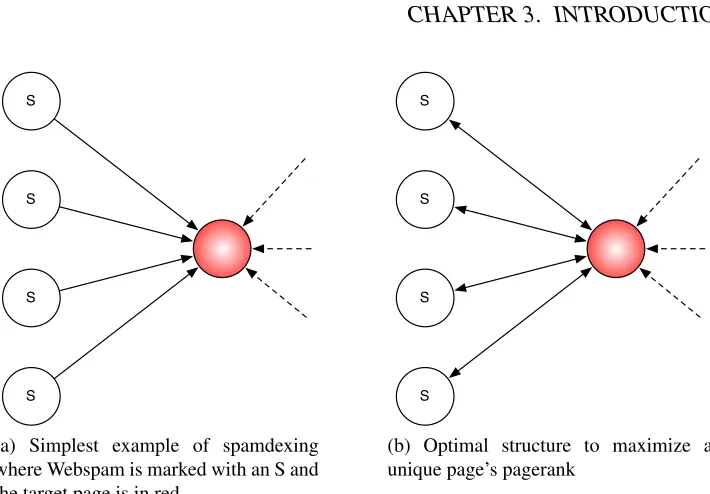
In order to increase the popularity score of one particular page, cheaters cre-ate many dull pages that will be organised in a specific architecture to maximize the popularity while avoiding automatic detection. Fig 3.1a represents the sim-plest architecture a cheater can put in place to increase its score. He creates as many spam pages as possible and all these pages only make one hyperlink to the target page. Dashed lines represent stolen links from accessible pages.
This structure is easily identifiable and easy to counter. It is deprecated nowa-days and can not be employed at large scale. Cheaters make these structures evolve constantly. Once one has been discovered and made inefficient by search engines, it is discarded and slightly modified to pursue its objective.
In [38], Gyongyiet alpropose the optimal structure to increase the pagerank of a single page. This structure is presented in Fig 3.1b. It is very similar to the structure in 3.1a, the difference being that links are mutual. Indeed spammers realized that the PageRank needs to circulate in order to grow.
De Kerchove in [26] solves the problem of maximizing the pagerank of a set of pages. The optimal structure forkpages numeroted from1tokis as follows,
• ∀1< i≤k,ilinks toi−1,
• ∀i∈[1, k],∀i≤j ≤k ilinks toj,
• 1 links to a page outside of the set (represented in blue in Fig 3.2).
random surfer will spend on these pages thus leading to an optimal structure. Both papers are exhibiting optimal structures for this purpose. However, since these structures have a very rigid architecture (thus being easy to detect) , spam-mers are constructing less efficient, but slightly different structures. As we will see in the next sections, our method performs well even on slightly modified spamming structures.
3.4
Fighting Webspam
Since search engines are based on well known popularity metrics such as the PageRank [80], spammers are trying to artificially boost their websites with re-spect to these metrics. At the same time, Webspam has been extensively studied since it is really important for search engines to be able to deal with it.
More recently the interest was concentrated on the evolution of Webspam and Chunget al. proposed a link spam study in [23] to see how it evolves through a series of Web snapshots.
With the apparition of Webspam, many techniques were developed to deal with its effects in order to ensure the user with a fair ranking. There are two basic types of methods to deal with Webspammers: the first one is detection,i.e. identifying Webspam or pages benefiting from it and demotion whose objective is to void the effects of such techniques without explicitly identifying Webspam. In the spirit of the first category, Ntoulas et al. propose to identify spam through content analysis. The method use several criteria presented in [76]. Unfortunately, this method does not scale up since the Web is growing too fast and studying every page in depth is way to costly. Other approaches to identify cheaters on the Web rely on the structure of the Web and not on the content of the web pages.
The paper [37] by Gyongyiet al. proposes a method whose goal is to identify link spam through the estimation of pagerank coming from spam pages for every node. It is first required to find a set of “good” pages and then run a biased PageRank to find the part of all pages’ pagerank that come from “good” pages. The drawback of this method is that it requires a preprocessing human step where people label pages as spam or non-spam.
3.5. RANDOM WALKS 35
Authors of [39] (resp. [58]) propose to give a Trust (resp. AntiTrust) score to pages to fight Webspam. These methods oblige the user to find a set of pages she trusts (resp. distrusts) and then use a propagation scheme a la PageRank. It is then tricky to find a good seed set that will cover the whole graph. The notion of TrustRank was then refined by Baoninget al. to add topicality in [100]. Authors of this paper first partition the seed set into topically coherent groups before computing the TrustRank for each topic. The final Trust score of one page is a combination of its topic-specific Trust scores. This approach improves the result obtained with TrustRank regarding the demotion of Webspam.
Andersen et al. in [2] propose to compute a Robust PageRank by first ap-proximating the supporting set of each pagei.e. the set of pages that contribute to its pagerank.
3.5
Random walks
A random walk on a graph consists in a simple algorithm that travels the graph. The next step of the walk is chosen uniformly at random between the neighbors of the current node. When the graph is finite, it is equivalent to a Markov Chain. A Markov chain is a random process where both time and space are discrete. Markov chains notions presented in this section are from [13, 75].
LetV be a countable set representing the nodes (called states)niof the graph.
Definition 1 Let(Xn)n≥o a series of random variables valued inV. (Xn)n≥ois
a Markov chain if
P(Xn=j|Xo =i0, . . . , Xn−2 =in−2, Xn−1 =i) =P(Xn=j|Xn−1 =i)
for alln >0and all n-tuple of statesi0, . . . , in−2, i, jfor which both sides of the
equality are defined.
A Markov chain is a series of random variables where the value of one variable depends only on the value of the one before and not on the rest of the history. A Markov chain is said to behomogeneous if∀n,P(Xn = j|Xn−1 = i)depends
oni andj and not n. In this case, it is possible to define the transition matrix
P = (pij)i,j∈V associated to the Markov chain wherepij = P(Xn =j|Xn−1 =
i). In the following we always consider homogeneous Markov chains.
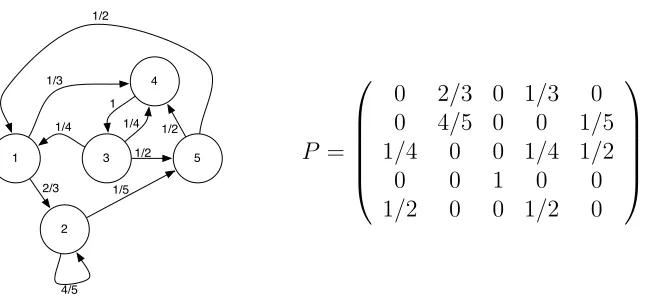
1 5 2 4 3 1/2 1/2 4/5 1/5 1 2/3 1/3 1/4 1/2 1/4 P =
0 2/3 0 1/3 0
0 4/5 0 0 1/5
1/4 0 0 1/4 1/2
0 0 1 0 0
1/2 0 0 1/2 0
Figure 3.3: Markov chain and its associated transition matrix.
case, the arc is labeled bypij. Fig 3.3 represents a Markov chain together with
its matrix. It is interesting to notice that Markov transition matrix are stochastic, i.e.Pjpij = 1.
It is interesting to study the probability (notedp(ijn)) of going fromitoj inn
steps in a Markov chain.
p(ijn) =P(Xn=j|X0 =i) = P(Xn+k=j|Xk =i) (n≥1, k≥1)
Then-steps transition matrix is notedP(n)and it can be shown thatP(n) =Pn.
Let’s now introduce thestate probabilities: πk(n) = P(Xn = k). The
dis-tribution ofXn can be written as vector withπ(n) = (π1(n), π2(n), . . .)where
P
kπk(n) = 1. We then have,
π(n+ 1) =π(n)P
π(n) = π(0)Pn ∀n≥0
The results above allow us to say that a Markov chain is completely defined if both its transition matrix and the distribution ofX0 are known. While speaking
of the probabilitiesπk(n) =P(Xn=k)of a Markov chain regarding the number
nof steps, one is studying thetransient stateof the random process. Generally, the distribution ofXndepends on the time and the initial distributionπ(0). If the
3.5. RANDOM WALKS 37
1 1/2 2 3 4
1/2
1
1 1
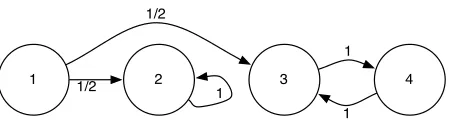
Figure 3.4: Example of a Markov chain.
Iflimn→∞(π(n)) =π exists, independently from the initial distribution and
if π is a probability distribution, we say that the Markov chain (Xn)n≥0
con-verges towardsπor has a limit distributionπ.
A discrete probability distribution π is stationary regarding the stochastic matrixP ifπP =π. A Markov chain is stationary if the distributionπ(n)of the random variableXn does not depend on n, i.e π(0) is a stationary distribution
of the random process. The following theorem concerns the existence of such stationary distributions.
Theorem 1 For a finite Markov chain, there always exists at least one stationary distribution. This is not the case when the state’s space is infinite.
To formulate the uniqueness criterion, we must first introduce a classification on the states of a Markov chain.
Two states are communicatingif we can go fromito j and fromj to i, i.e
∃m, n∈N, p(ijm) >0andp(jin) >0. It is then possible to define an equivalence
relation on the setV and then we partitionV in disjoint classes,V =C1∪C2∪
· · ·∪Cr. Any pair of states from the same class are always communicating while
states in different classes never communicate. It is then possible to distinguish two kinds of classes,
• A class is transientif it is possible to go outside of the class, but in this case the process can never re-enter this class.
• A class isrecurrentif it is impossible to go outside of the class.
The uniqueness criterion is in the following theorem,
In Fig 3.4, {1} is a transient class while {2} and {3,4} are recurrent classes. Since there is strictly more than one recurrent class, there is not an unique sta-tionary distribution. The computation gives thatxP =xifx= (0,1−2α, α, α)
withα∈[0,1/2].
If the unique recurrent class of a Markov chain C = V, i.e all states are communicating, the Markov chain is said to beirreducible.
Random walks are part of the computation of the PageRank of Web pages. They mimic the behavior of the random surfer starting from a random page and following hyperlinks to continue surfing. To calculate the PageRank, the random surfer can at each step, either choose an hyperlink uniformly at random from all present on the current page with probabilitypor with probability1−pchoose any page from the index uniformly at random. This prevent the random surfer to be stuck on one page without any outlink.
My hypothesis is that random walks can provide useful structural informa-tion for Webspam demoinforma-tion or detecinforma-tion. Our first approach was not precise enough, it consisted in identifying link farms using random walks with a limited storage capacity,i.e.random walks that remember theirklast steps. Using those traces we looked at the frequency of appearance of each node in the memory, i.e. the number of times a node was visited during the walk. Depending on the number of nodes found with a high frequency in the random walk, we tried to dissociate good nodes from spam ones. A more elaborate version, where random walks do not store nodes’ id but their distance to the starting point of the walk is presented in chapter 6 that proves the validity of the hypothesis.
3.6
Clustering
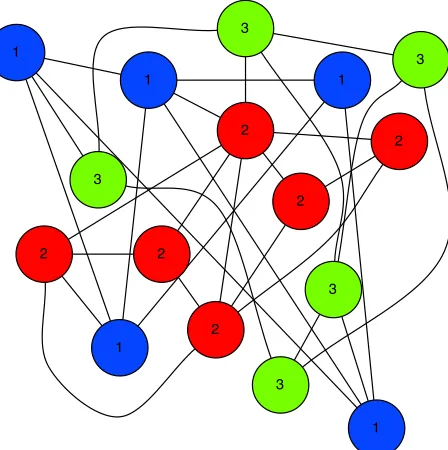
The objective of clustering on a graph is to regroup nodes that are densely con-nected,ienodes between which exists many paths. This corresponds to groups of pages on the Web. Fig 3.5 represents the execution of a clustering algorithm on a small graph where clusters are identified through ids and colors.
3.6. CLUSTERING 39
2
1 1
1 1
2 2
1
2
2
2 3
3 3
3
3
Figure 3.5: Clustered graph.
3.6.1
Edge betweenness centrality
This approach proposed by Girvan and Newman in 2003 [35] is based on the “edge betweenness” which is an extension of the “node betweenness” centrality notion. This notion first appeared in the field of social interactions [98] to de-termine the role of actors (nodes) inside a network (graph), the objective being to identify communities of sharing interest. This notion is based on the shortest paths in a graph. Between any pair of nodesi,j it may exists several paths from
itoj. Some of them may be paths of shortest length (in number of nodes on the path). The intuition is to regroup “central points” in the graph to regroup nodes. The “betweenness centrality” between i and j of node k is the number of shortest paths fromitojpassing throughk(notedσij(k)) divided by the number
of shortest paths form i to j (σij). Then the “node betweenness centrality” of
nodekis the sum of its betweenness centrality for all possible pair of nodes.
CB(k) =
X
i6=j
σij(k)
σij
Girvan and Newman extended this notion to edges. The “edge betweenness centrality” of edge{k, k0}is the following sum over all pair of nodesi,jdifferent
from bothk andk0
CB({k, k0}) =
X
i6=j
σij({k, k0})
σij
whereσij({k, k0}represents the number of shortest paths fromitojthat contain
the edge{k, k0}.
Considering a graph with two clusters, sets of nodes densely connected, with few connections between clusters. Shortest paths between nodes in different clusters must take the few edges connecting the clusters. Those edges are then provided with a high “edge betweenness centrality”. The EBC method is based on this idea. By iteratively removing edges with decreasing centrality, clusters will be disconnected. The method to discover clusters is an algorithm in two phases
1. Betweenness computation
Compute the edge betweenness centrality of all edges. Remove the one with the maximal score and recompute the centrality for all edges until they are no more edges in the graph.
2. Cluster construction
At the beginning every node is its own cluster. Arcs between clusters are added in the inverse order from which they were removed in the previous phase. If an arc joins two nodes in different clusters they merge.
The second phase produces iteratively sets of clusters on the graph. By adding arcs in the inverse order from which they were removed, arcs added first must be intra-clusters arcs while arcs added in the end are inter-clusters arcs. It is important to determine the moment the second phase stops adding intra-clusters arcs and begins connecting clusters. Girvan and Newman propose a metric called “modularity”,
M(C) =
NC X c=0 " dc L − lc L 2#
whereNC is the number of clusters in a setC, dc is the number of intra-cluster
arcs in a given clusterc, lc is the total degree (number of arcs) of nodes in the
3.6. CLUSTERING 41
C are intra-cluster arcs and0if the proportion of intra- and inter-cluster arcs is equal. The optimal set of clusters is thus the one with the maximal modularity in the second phase of the algorithm.
This method belongs to the ones that scale up best reaching 100,000 arcs graphs. We are far from the size of the Web graph and thus this method won’t scale up to our needs since it is impossible to compute the “edge betweenness centrality” for every edge of the graph and the modularity in the second phase. Those operations require a global knowledge of the graph and have a too high complexity to be computed as often as required by the fight against Webspam.
3.6.2
Markov clustering technique
The MCL method simulates stochastic flows to partition the graph into clusters. It is a fast approach that is only limited by the number of nodes in the graph. It was designed by Stijn van Dongen [94].
As said previously clusters are groups of nodes tightly connected. Thus there should exist many paths of bigger length between nodes that belong to the same cluster. The number of these paths is expected to be bigger that the one between two nodes in different clusters. From another perspective, random walks in a graph have a few chances to leave a cluster. The intuition behind the algorithm is the same as the human behavior, find huge “blocks” densely connected with few connections between blocks.
The MCL method finds the cluster structure of a graph by using a bootstrap-ping technique. The process deterministically computes the probabilities of the random walks in the graph, using two operators transforming a set of probabil-ities into an other. This is made possible by the use of column stochastic (or Markov) matrices (see previous section).
The MCL algorithm simulates random walks on the graph by alternating two operations: the expansion and the inflation, both parameterized. The expansion operator consists in taking the stochastic matrix to the powerkusing classic ma-trix multiplication. The inflation operatorΓtakes the matrix to itsrthHadamard power with a normalization step afterward to keep the matrix stochastici.ecells of the matrix are probability values.
application of the inflation operator is the following,
Γr(Mij) =
(Mij)r
P
i(Mij)r
With a coefficient r > 1 it is easy to see that the application of the inflation operator will favor more probable walks for a particular node (column of the matrix).
The expansion phase computes the probabilities for random walks of longer length thus changing the values of the matrix. The valueMij being the
proba-bility that a random walk starting in j stops ini after a given number of steps depending on the parameter k of the expansion. Since nodes in clusters are densely connected, the probability will be much higher that a random walk starts and stops in the same cluster that it takes an inter-cluster arc. Thus the inflation operator will increase the probability of intra-cluster paths and lower the prob-ability of random walks using inter-cluster arcs. This is done without any prior knowledge about the organisation of the graph in clusters but simply due to the presence of clusters in the graph.
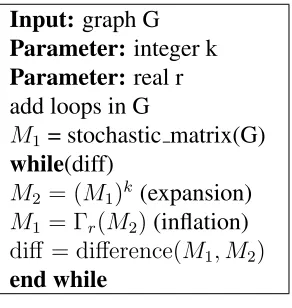
Finally iterating the expansion and the inflation operators will separate the graph into groups of nodes that will be interpreted as clusters. Classically the value of the parameters arek = 2andr = 2. Then the MCL algorithm can be written as it appears in Fig 3.6.
Input:graph G
Parameter: integer k
Parameter: real r add loops in G
M1= stochastic matrix(G)
while(diff)
M2 = (M1)k(expansion)
M1 = Γr(M2)(inflation)
diff = difference(M1, M2)
end while
Figure 3.6: MCL algorithm
3.6. CLUSTERING 43
reached. A steady state corresponds to a double idempotent matrix, i.e a ma-trix that does not change with any more application of both the expansion and the inflation operator. The graph associated with such a matrix is composed of oriented connected components. Each component is interpreted as a cluster, is star-shaped, with an attractor at the center and every member of the component linking to the attractor. Clusters with more than one attractor may appear or nodes belonging to several clusters. The fact that clusters may be overlapping can be an advantage in certain situations where nodes must be connected to sev-eral clusters without belonging to any of them.
Regarding the convergence, it can be proved that the process simulated by the MCL algorithm converges in a quadratic time to a steady state. In practice the algorithm stars to converge after a few iterations (around ten). The global convergence is something very hard to prove but it can be conjectured that the algorithm always converges when the input graph is symmetric. As for today there is no mathematical evidence that the algorithm actually converges.
A really important thing about this algorithm is that it identifies the clustered structure of the graphviathe trace left by this structure on the flux process. The algorithm is fast and support huge graphs (up to hundreds of thousands of nodes, the limitation being the matrix multiplication). Both parametersk and r allow to set the clusters granularity. Mathematics associated with the MCL algorithm show that there is an close relationship between the simulated process and the clustering structure of the graph. The formulation of the algorithm is simple and elegant.
C
H
A
P
T
E
R
4
M
ALICIOUS BEHAVIOURS IN
SOCIAL NETWORKS
This chapter presents SpotRank, which is our answer to malicious users on social news websites. SpotRank is a robust voting scheme for social news websites and the name of the website that implements this scheme.
This chapter first introduces the design of the SpotRank algorithm which is a set of heuristic techniques whose objective is not to detect and suppress ma-licious voting behaviors in social news website, but rather demote the effects of these behaviors, thus leading to lower the interest of such manipulations for spammers. SpotRank is built over ad-hoc statistical filters, a collusion detec-tion mechanism and also over the computadetec-tion of thepertinence of voters and proposed news.
In a second time, I present a strong experimental analysis, a website that im-plements this algorithm and shows evidence of the efficiency of the approach, both from a statistical and human point of view. This analysis is twofold: I give evidence that using SpotRank maintains a behavior for the social news website which corresponds to a regular behavior, and also provide a study of the per-ceived quality of the algorithm on 114 users of the experimental platform (viaa comparison with others french social news websites).
4.1
SpotRank algorithm
In this section I first present the framework on which Spotrank is built together with its principle. I then describe independently each step of the algorithm.
4.