Copyright © 2015 by The American Society of Tropical Medicine and Hygiene
Dengue Knowledge and Preventive Practices in Iquitos, Peru
Valerie A. Paz-Soldán,* Amy C. Morrison, Jhonny J. Cordova Lopez, Audrey Lenhart, Thomas W. Scott, John P. Elder, Moises Sihuincha, Tadeusz J. Kochel, Eric S. Halsey, Helvio Astete, and Philip J. McCall
Global Community Health and Behavioral Sciences Department, Tulane University School of Public Health and Tropical Medicine, New Orleans, Louisiana; Facultad de Salud Pública y Administración, Universidad Peruana Cayetano Heredia, Lima, Peru; United States Naval Medical Research Unit No. 6, Iquitos, Peru; Department of Entomology and Nematology, University of California at Davis, Davis, California; Liverpool
School of Tropical Medicine, Iquitos, Peru; Vector Biology Department, Liverpool School of Tropical Medicine, Liverpool, United Kingdom; Fogarty International Center, National Institutes of Health, Bethesda, Maryland; Institute for Behavioral and Community Health (IBACH),
San Diego State University, San Diego, California; Internal Medicine Department, Hospital Apoyo, Iquitos, Peru; Virology Department, Naval Medical Research Center, Silver Spring, Maryland; Malaria Branch, Centers for Disease Control and Prevention, Atlanta, Georgia
Abstract. As part of a cluster-randomized trial to evaluate insecticide-treated curtains for dengue prevention in Iquitos, Peru, we surveyed 1,333 study participants to examine knowledge and reported practices associated with dengue and its prevention. Entomological data from 1,133 of these households were linked to the survey. Most participants knew that dengue was transmitted by mosquito bite (85.6%), but only few (18.6%) knew that dengue vectors bite during daytime. Most commonly recognized dengue symptoms were fever (86.6%), headache (76.4%), and muscle/joint pain (67.9%). Most commonly reported correct practices for mosquito control were cleaning homes (61.6%), using insecticide sprays (23%), and avoiding having standing water at home (12.3%). Higher education was associated with higher knowl-edge about dengue, including transmission and vector control. Higher socioeconomic status was associated with increased reported use of preventive practices requiring money expenditure. We were less likely to findAedes aegyptieggs, larvae, or pupae in households that had < 5-year-old children at home. Although dengue has been transmitted in Iquitos since the 1990s and the Regional Health Authority routinely fumigates households, treats domestic water containers with larvicide, and issues health education messages through mass media, knowledge of dengue transmission and household practices for prevention could be improved.
INTRODUCTION
Dengue viruses (DENVs) are transmitted by the day-biting mosquitoAedes aegyptiand cause more human morbidity and mortality than any other arthropod-borne virus.1,2 Annually, there are an estimated 390 million cases of dengue fever world-wide.3Although considerable progress has been made, nei-ther a dengue vaccine nor effective antiviral medication for dengue treatment is currently available.3–5As such, vector con-trol remains the primary component of most dengue preven-tion programs.3
DENV transmission has been continuous in Iquitos, Peru, since its reemergence in 1990 after a 30-year absence, with epi-demics caused by sequential virus serotype invasions.6–13In the city of Iquitos, local health and political authorities conduct routine Ae. aegypticontrol activities including larviciding and health education activities utilizing billboards, radio, and TV messages focusing on preventive vector control activities (con-tainer removal and management) and recognition of symp-toms, especially early warning signs for severe disease. In response to increases in dengue cases or mosquito indices, emergency measures, indoor space spray applications, and city-wide cleanup campaigns (collection of water-holding con-tainer that serve asAedeslarval habitats) are instigated.
Despite extensive epidemiologic and entomological studies in Iquitos over the past three decades,6–17little has been reported about residents’knowledge of dengue, its vector, and what people do in their homes to prevent infection. Although knowl-edge does not equate with behavior change, examining what people currently know and do for dengue prevention can help
guide future vector control promotion and strategies. With adequate knowledge the community can reduce Ae. aegypti
production sites in their homes reducing adult indices18–24and reduce mortality associated with dengue by recognizing warn-ing signs in ill family members.18
As part of a cluster-randomized intervention trial testing the efficacy of insecticide-treated curtains (ITCs) to control DENV transmission, we investigated a wide range of param-eters about local knowledge of dengue and its prevention. Data from our knowledge–attitudes–practices (KAP) survey was linked to entomological data from the same households, providing a unique opportunity to analyze reported dengue prevention practices with observed objective outcomes. Herein, we report on 1) knowledge associated withAe. aegyptinatural history and control and dengue, 2) individuals’reported per-ception of risk for dengue disease, 3) reportedAe. aegypti
control practices in conjunction with objective measures of
Ae. aegyptipopulation reduction; and 4) sociodemographic and economic factors associated with reported knowledge, attitude, and practice outcomes.
METHODS
Study site.The study was carried out in the southern San Juan district (approximate population 102,000)25 of Iquitos, which is the largest population center (population approxi-mately 407,000)25 in the Peruvian Amazon, located in the northeastern Peru. This district has undergone rapid urbani-zation and development over the last three decades, and in general, neighborhoods have been more recently incorpo-rated than in other parts of the city; therefore, house con-struction materials and overall neighborhood infrastructure is of poorer quality or less developed (i.e., dirt versus asphalted streets, underground pipes unavailable).26
The cluster-randomized trial was initiated in November 2009, with 10 clusters (each cluster with approximately 90 households *Address correspondence to Valerie A. Paz-Soldán, Global
Commu-nity Health and Behavioral Sciences Department, Tulane University School of Public Health and Tropical Medicine, 1440 Canal Street, Suite 2200, New Orleans, LA 70112. E-mail: [email protected]
distributed between 1 and 3 city blocks) receiving ITC and 10 clusters serving as controls. All clusters were adjacent to one another. In the weeks prior to ITC distribution (November– December 2009), one resident in every intervention and control household (N = 1,742) was invited to respond to questions in a baseline KAP survey associated with dengue andAe. aegypticontrol; 1,333 households participated in the KAP survey (November–December 2009). Baseline serologi-cal and entomologiserologi-cal samples were collected within weeks of each other (also November–December 2009). Pupal demo-graphic surveys, including immature forms of Ae. aegypti, were conducted by a two-person team, and adult mosqui-toes of all species, includingAe. aegypti, were collected using Prokopack aspirators (Emory University, Atlanta, GA)27 and processed as described by Morrison and others.28
Participation in the KAP survey was requested from one adult member of each household who was responsible for con-tainer management or keeping the household clean and insect free. The KAP survey was made up of close-ended questions developed by a Peruvian social scientist (V. A. Paz-Soldán) uti-lizing information obtained from ~20 focus groups with Iquitos residents where dengue knowledge and preventive practices were discussed.29,30Questions were extensively field tested. The KAP surveyors received training and supervision from the lead social scientist and research team coordinator to ensure consistency. Although this study was part of a larger research project for which entomological and serological data were collected, this manuscript focuses on results from our baseline KAP survey and relevant baseline entomological data linked to outcomes of KAP interest.
Ethics statement. Our study received approval from the Institutional Review Boards (IRBs) at the Liverpool School of Tropical Medicine, the Tulane School of Public Health and Tropical Medicine, the London School of Hygiene and Tropi-cal Medicine, the University of California at Davis, and the U.S. Naval Medical Research Center Detachment in Peru. The latter had interinstitutional IRB agreements with the Tulane School of Public Health and Tropical Medicine and the University of California at Davis. The Regional Health Authority (DIRESA), the local branch of the Ministry of Health, also provided approval. The trial was registered with the International Standard Randomized Controlled Trial Number Register: ISRCTN08474420.
Analysis. STATA 11.0 software (StataCorp LP, College Station, TX)31was used to calculate medians and frequencies for variables of interest, to conduct χ2tests to examine indepen-dence between selected sociodemographic characteristics and variables of interest, and to conduct logistic regressions to calcu-late odds ratios (ORs) and confidence intervals for the adjusted analyses. Multicollinearity was assessed by testing the correlation between parameters, as well as computing the variance inflation factor to verify the appropriateness of the models. STATA robust cluster commands were used to correct the standard errors estimated for models, using the neighborhood clusters.
Because income does not always capture an individual’s wealth or assets adequately, principal component analysis was used to create a socioeconomic status (SES) index variable.32 The SES index was created based on the research team’s obser-vations of the following variables: housing materials (walls, roof, floor, and window), availability of certain household appliances (refrigerator, TV, DVD, computer, radio, washing machine, motorcycle, and type of stove), number of rooms in the house, and having a phone (landline) and electricity.
Description of variables.Most variables used in the analy-sis were based on participants’responses to survey questions. The research team used information recorded by Regional Health Authority (DIRESA) on the front door of each house as date of the most recent fumigation or larvicide application. The presence of immature forms of Ae. aegypti
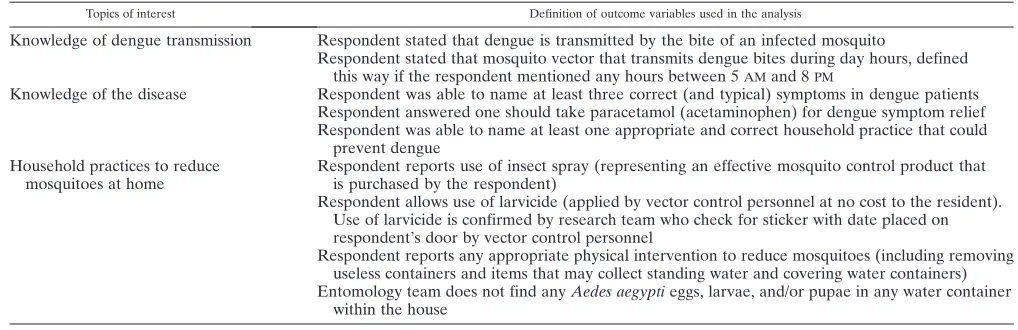
in water containers was obtained from our entomology sur-veys. Multiple questions were asked to assess knowledge about dengue transmission, prevention, and symptoms. Nine variables were selected as outcome variables for multivariate analyses: two were related to knowledge of dengue transmis-sion, three were related to knowledge of the disease, and four were related to preventive practices (see descriptions in Table 1). Because residents did not differentiate between
Ae. aegyptiand other mosquitoes, participant responses about preventive practices pertain to control of all mosquito species.
RESULTS
Study population. The intervention study included a total of 1,742 lots visited, 1,512 (86.8%) of which were houses. The remaining lots were either vacant houses (188, 10.8%), nonresidential (25, 1.4%; churches, nursery schools, and
TABLE1
Description of outcome variables used in multivariate analyses
Topics of interest Definition of outcome variables used in the analysis
Knowledge of dengue transmission Respondent stated that dengue is transmitted by the bite of an infected mosquito
Respondent stated that mosquito vector that transmits dengue bites during day hours, defined this way if the respondent mentioned any hours between 5AMand 8PM
Knowledge of the disease Respondent was able to name at least three correct (and typical) symptoms in dengue patients Respondent answered one should take paracetamol (acetaminophen) for dengue symptom relief Respondent was able to name at least one appropriate and correct household practice that could
prevent dengue Household practices to reduce
mosquitoes at home
Respondent reports use of insect spray (representing an effective mosquito control product that is purchased by the respondent)
Respondent allows use of larvicide (applied by vector control personnel at no cost to the resident). Use of larvicide is confirmed by research team who check for sticker with date placed on respondent’s door by vector control personnel
Respondent reports any appropriate physical intervention to reduce mosquitoes (including removing useless containers and items that may collect standing water and covering water containers) Entomology team does not find anyAedes aegyptieggs, larvae, and/or pupae in any water container
warehouses), or empty lots (17, 1.0%). Of the residences, 1,345 (89.0%) were enrolled in the ITC study, and of those 1,333 (99.1%) agreed to participate in the KAP survey. Of the remaining houses that did not participate in the study, 82 (4.7%) refused to participate and 85 (4.9%) residents were never found at home despite multiple visits. Hence, our sample consists of 1,333 who completed the KAP survey; and entomological data were available for 1,133 of the households for which we also conducted KAP surveys.
The majority of respondents were women (73.9%). The majority of the interviewees had at least some secondary (56.2%), or postsecondary technical or university education (22.3%; see Table 2). The most frequently cited occupation by respon-dents was“housewife”(46.0%), followed by unskilled laborer (∼20%; i.e., construction, transportation, and warehouse/shop workers) or “merchants or small business owners”(∼18%; i.e., informal workers at stalls in the market or on their door-step, with products such as fruits or vegetables).
Within a city block, houses were constructed in rows, sharing walls, which were constructed of wood (58.6%), or bricks and concrete (41.4%), and roofed with corrugated sheet metal (82.5%) or palm leaves (17.5%). Above the shared walls, the majority of houses had high open spaces beneath the roof and open eaves, allowing free indoor movement of mosquitoes. Untreated mosquito bed net use was common but window screens were rare. Nearly one-third (31.8%) of the study population did not have sewage lines or piped water.
Knowledge of DENV transmission and symptoms.Although most individuals (85.6%) knew that infected mosquitoes trans-mit DENV, only 18.6% knew that the dengue vectors bite during the day or early evening (5 AMto 8 PM) (Table 3). Most respondents stated that they did not know what time
“dengue”-transmitting mosquitoes bite (76.6%). Only 19.4% knew that the vector has white stripes on its legs, and 14.9% knew the name was Ae. aegypti. Knowledge about dengue symptoms was higher than about transmission: most
inter-viewees named at least one correct dengue symptom (93.3%); the most symptoms named were fever (86.6%), headache (76.4%), and joint/muscle aches (67.9%).
Risk perception and preventive practices. Of the respon-dents, 65% reported knowing someone who had had dengue— including 20.6% who had a DENV infection themselves—yet only 34.7% considered themselves at high risk of contracting dengue. The two main responses given by respondents on how to prevent dengue (knowledge variable) were to use mosquito bed nets (54.3%) and to clean one’s house (46.8%). Other responses included actions to reducing larval development sites by removing (37.1%) or covering (26.4%) water con-tainers. When participants were asked specifically about what they do to reduce mosquito populations, the most common response was cleaning one’s home (61.6%). Of the partici-pants, 41% said they applied chemical products such as petro-leum, creoline, kerosene, or bleach to their floors to repel mosquitoes. About half of the houses had been fumigated with insecticide (55.4%) or treated with larvicide (58.1%) within 6 months prior to the survey. Overall, both education and SES were positively associated with increased knowl-edge of DENV transmission, symptoms, and preventive prac-tices in bivariate analyses (see Table 3, columns 3–6).
Entomological findings.Aedes aegyptieggs, larvae, or pupae were found in 73 houses (6.4%) at baseline. Of these, 58 of the homes (5.1%) had containers considered useless by residents. The most common adult mosquito species collected wereCulex
spp. (81.5%), followed by Ae. aegypti (17.6%). At least one adultAe. aegyptiwas collected in 37.4% of the homes and at least one adult femaleAe. aegyptiwas collected in 26.6% of the homes. Adult mosquito samples ranged from 0 to 294, with a median of 3. The mean number of male mosquitoes per home (4.15) collected was slightly higher than females (3.32).
Examining socioeconomic and demographic factors asso-ciated with DENV knowledge and preventive practices. In adjusted models, we found that more education (secondary or university studies versus having 7 years or less of school), knowing someone who had had dengue (versus not), and being female were all significantly, positively associated with the two selected knowledge variables about dengue transmis-sion (see Table 4). Hence, the odds of knowing that DENV is transmitted by infectedAe. aegypti(OR = 5.0,P< 0.01) or that this mosquito bites during the day/early evening (OR = 3.1,
P< 0.01) were higher in the highest educational group (tech-nical or university studies) compared with those with fewer than 7 years of education.
Being in the higher educational groups, being in the highest SES category, knowing someone who had had dengue, and being female were also significantly, positively associated with knowing three or more dengue symptoms, one or more ways to prevent DENV infection, and the utility of paracetamol for relief from dengue symptoms (see Table 5). The odds of knowing at least three dengue symptoms and of paraceta-mol for dengue relief were highest among those who knew someone who has had dengue (OR = 2.7,P< 0.01; OR = 2.8,
P < 0.01, respectively) compared with those who reported not knowing anyone who had dengue. The odds of women knowing at least three dengue symptoms (OR = 2.3,P< 0.01) and that one should take paracetamol for relief (OR = 2.6,
P< 0.01) were also significantly higher than for men. Respondents in the highest and middle SES groups were 3.8 (P < 0.01) and 1.8 times (P < 0.01), respectively, more TABLE2
Sociodemographic characteristics of sample (N= 1,333)
Characteristics
Frequency % (n)
Age 39 (median),
16–88 (range) Sex
Female 73.9 (985)
Male 26.1 (348)
Education*
< 7 years 21.5 (287)
7–11 years 56.2 (749)
> 11 years 22.3 (297)
Occupation
Housewife 46.0 (613)
Merchant/small businessmen 17.6 (235)
Unskilled labor 20.6 (274)
Skilled, independent labor 6.2 (82) Health/education professionals 5.8 (77)
Unemployed/retired 1.8 (24)
Student 2.1 (28)
Household information
Number of people living in home 5 (median), 1–17 (range) Have children < 5 years old at home 39.5 (526) Pregnant woman/women living at home 7.1 (94)
likely to report purchasing an effective vector control product (insect spray) than those in the lowest SES group (Table 6). Similarly, larvicide use (Table 1) showed a similar trend with greater observed use among those in the highest (OR = 2.6,
P< 0.01) and middle (OR = 1.8,P< 0.01) SES groups com-pared with the lowest SES group.
Education was the only factor significantly associated with reported activities to reduce larval development sites—those in the highest educational group were 2.4 times more likely to report taking actions to reduce breeding sites than those with fewer than 7 years of education (P< 0.01). Entomological surveys corroborated participant responses; of 73 houses with
Ae. aegyptiof any developmental stage, only three (4.2%) were
in households that reported practices to remove vector breed-ing sites, and no unused containers with standbreed-ing water were observed in these houses.
Examining associations with a verified entomological out-come (absence ofAe. aegyptiof any developmental stage in that home) that could be attributed to a reported practice (i.e., reduction of development sites), households where respondents had children under 5 years of age were signifi-cantly less likely to haveAe. aegypti present (OR = 1.95,
P< 0.01). Examining the association between the sociodemo-graphic and economic variables and presence of at least one adult Ae. aegyptiin the home or at least one adult female
Ae. aegyptishowed a positive association between older (over TABLE3
KAP associated with dengue and frequencies by education and socioeconomic status Total
(N= 1,333)
Education < 7 years (N= 287)
Education > 11 years (N= 298)
Lowest SES (N= 348)
Highest SES (N= 450)
% (n) % (n) % (n) % (n) % (n)
Knowledge on dengue transmission
Dengue is transmitted through mosquito bite 85.6 (1,141) 75.6 (217)** 93.6 (279)** 82.2 (286)* 88.4 (398)* Aedes aegyptitransmits dengue 14.9 (198) 1.7 (5)** 34.2 (102)** 7.8 (27)** 22.4 (101)** “Dengue”mosquito usually bites during
Day/evening 18.6 (248) 12.2 (35)** 29.2 (87)** 15.8 (55) 21.8 (98)*
Does not know 76.6 (1,021) 81.5 (234)* 67.1 (200)** 78.7 (274) 73.8 (332)
Knowledge about dengue illness Knows following dengue symptoms
Fever 86.6 (1,154) 79.4 (228)** 90.6 (270) 83.9 (292) 90.4 (407)**
Headache 76.4 (1,019) 72.8 (209) 75.2 (224) 75.3 (262) 79.8 (359)*
Muscle/joint/body pain 67.9 (905) 67.3 (193) 69.8 (208) 64.4 (224) 71.1 (320)
Nausea/vomiting 25.1 (334) 24.0 (69) 26.9 (80) 23.6 (82) 26.0 (117)
Rash 8.1 (108) 4.5 (13)* 9.4 (28) 6.6 (23) 8.4 (38)
Loss of appetite 5.3 (70) 4.9 (14) 9.7 (29)** 3.2 (11)* 8.0 (36)**
Bleeding from gums, nose, or mouth 5.1 (68) 3.1 (9) 4.7 (14) 3.5 (12) 5.6 (25)
Eye pain 4.7 (62) 3.5 (10) 6.4 (19) 4.3 (15) 5.1 (23)
Knows three or more correct symptoms 76.1 (1,015) 70.0 (201)** 77.2 (230) 71.6 (249)* 81.3 (366)** Knowledge on preventive practices
One can prevent dengue by
Using mosquito nets 54.3 (724) 48.8 (140)* 58.4 (174) 51.4 (179) 53.6 (241)
Cleaning one’s house 46.8 (624) 43.6 (125) 48.0 (143) 42.8 (149) 51.8 (233)**
Removing useless water-collecting containers 37.1 (495) 32.1 (92) * 45.0 (134)** 33.1 (115) 44.0 (198)**
Covering water containers 26.4 (352) 20.6 (59)* 26.5 (79) 25.9 (90) 28.0 (126)
Fumigating one’s house 17.7 (236) 12.2 (35)** 23.5 (70)** 14.7 (51) 20.9 (94)*
Using various chemical products 13.5 (180) 10.1 (29) 14.4 (43) 9.2 (32)** 17.8 (80)**
Reducing standing water in house 4.5 (60) 2.4 (7) 6.4 (19) 2.6 (9)* 4.4 (20)
Treating the water (with bleach, etc.) 3.7 (49) 3.1 (9) 3.4 (10) 3.5 (12) 4.2 (19)
Using insect repellent 2.0 (26) 1.4 (4) 4.0 (12)** 1.2 (4) 2.7 (12)
Perception of risk
Know someone who has had dengue 65.0 (866) 59.9 (172)* 75.2 (224)** 62.1 (216) 67.1 (302) Practices to reduce mosquitoes
Cleans the house 61.6 (821) 61.0 (175) 62.4 (186) 57.5 (200) 67.3 (303)**
Uses petroleum, creoline, kerosene, or bleach 41.0 (547) 42.2 (121) 33.9 (101)** 35.6 (124)* 42.7 (192)
Uses insecticide spray 23.0 (307) 17.1 (49)** 30.5 (91)** 11.8 (41)** 35.3 (159)**
Avoids having standing water in house 12.3 (164) 9.8 (28) 18.5 (55)** 12.0 (42) 12.9 (58)
Uses insecticide coils 10.8 (144) 9.8 (28) 11.4 (34) 10.6 (37) 13.3 (60)*
Burns leaves and other items to smoke out mosquitoes 6.7 (89) 9.8 (28)* 6.4 (19) 8.6 (30) 5.6 (25)
Takes out trash 4.2 (56) 3.1 (9) 4.7 (14) 4.3 (15) 3.8 (17)
Carries out physical intervention at home† 66.5 (886) 64.5 (185) 71.5 (213)* 61.8 (215)* 72.4 (326)** Reduces breeding sites through various activities 14.8 (197) 11.9 (34) 21.5 (64)** 14.9 (52) 15.1 (68) Outside interventions for mosquito control
Home fumigated in last 6 months 55.4 (739) 53.3 (153) 53.7 (160) 54.0 (188) 55.6 (250) Larvicide used in home in last 6 months 58.1 (775) 56.5 (162) 64.1 (191)* 44.0 (153)** 68.7 (309)** Fumigation was conducted by
Regional health authority or municipality 84.3 (1,124) 87.5 (251) 82.6 (246) 84.2 (293) 84.0 (378)
Home owner 4.1 (54) 2.8 (8) 6.7 (20)** 0.6 (2)** 8.2 (37)**
Entomological variables
Useless containers found in home 5.1 (58) 4.7 (12) 4.7 (11) 5.3 (16) 4.3 (16)
Larvae, pupae, or eggs are found in home 6.4 (73) 7.0 (18) 8.2 (19) 7.3 (22) 5.6 (21)
KAP = knowledge, attitudes, and practices; SES = socioeconomic status. *P< 0.05; **P< 0.01.
44 years of age) respondents for both outcomes (OR = 1.5,
P < 0.01 for both). We also found a positive association between those with highest levels of education and pres-ence of at least one adultAe. aegypti(OR = 1.4,P< 0.05).
DISCUSSION
Higher education levels were associated with better knowl-edge about dengue, preventive practices, and with reported
attempts to reduce mosquito production sites. Higher SES was associated with higher reported use of protective mea-sures that required spending money, for example, insect spray. Knowledge about dengue and its symptoms was higher among women than men, perhaps because they have more of a role in caring for ill family members. Not surprisingly, higher knowl-edge about dengue and its symptoms was associated knowing someone who had had dengue in the past.
In contrast, the knowledge about Ae. aegypti’s daytime biting behavior and the ability to distinguish it from other mosquito species were poor. When interviewing participants about dengue prevention practices, we asked about mosquito control practices generally, rather thanAe. aegypti, because most interviewees did not differentiate between mosquito species. From a programmatic standpoint, health education messages could be designed to improve people’s knowledge of DENV transmission, emphasizing on the different kinds of mosquitoes and that prevention may not work on all species, to improve acceptability of dengue-specific prod-ucts and practices (i.e., indoor emergency space sprays). For example, findings from a qualitative study in this community revealed that interventions targetingAe. aegypti were per-ceived as ineffective if other nuisance mosquitoes were not also affected (unpublished data), potentially leading to the perception of product inadequacy or even failure, and poten-tially eventual abandonment.
While some knowledge of dengue prevention practices was incorrect, notably, the use of bed nets for protection against diurnally active Ae. aegypti (although this is not one of the practices recommended for dengue control in Iquitos, recent literature suggests bed nets could reduceAe. aegypti infesta-tions in houses33), many correctly identified proper methods of reducing mosquito production and were consistent with well-publicized vector control messages, that is, house clean-ing, removal and management of water containers. Improving people’s knowledge about dengue transmission may lead to TABLE4
Multivariate analysis of sociodemographic and economic factors asso-ciated with knowledge of dengue transmission, reporting ORs and 95% CIs (N= 1,333)
Dengue transmitted by bite of infected mosquito
Mosquito that transmits dengue bites during
day/early evening OR (95% CI) OR (95% CI)
Housewife 1.21 0.93
(0.769, 1.889) (0.637, 1.371)
< 30 years old 0.82 0.97
(0.544, 1.251) (0.645, 1.456)
> 44 years old 0.88 1.42*
(0.585, 1.321) (1.022, 1.969)
Female 1.35 1.33
(0.862, 2.120) (0.903, 1.946) 7–11 years of education† 2.05** 1.63**
(1.488, 2.812) (1.129, 2.348) ≥11 years of education† 4.95** 3.08**
(2.593, 9.455) (1.928, 4.923)
Middle SES‡ 1.08 0.94
(0.735, 1.577) (0.635, 1.402)
Highest SES 1.21 1.02
(0.821, 1.783) (0.732, 1.431) Know someone who
has had dengue
1.88** 2.23**
(1.444, 2.460) (1.494, 3.315) Child < 5 years living
in home
1.26 0.80
(0.948, 1.681) (0.591, 1.090)
CI = confidence interval; OR = odds ratio; SES = socioeconomic status. *P< 0.05; **P< 0.01.
†Reference group are those with less than 7 years of education.
‡Reference group are those in the lowest SES group.
TABLE5
Multivariate analysis of sociodemographic and economic factors associated with knowledge of dengue symptoms, treatment, and prevention (N= 1,333)
Sociodemographic characteristics
Knows three or more dengue symptoms Knows to take paracetamol for dengue Knows at least one way to protect from dengue
OR (95% CI) OR (95% CI) OR (95% CI)
Housewife 1.47* 1.46* 1.12
(1.056, 2.040) (1.082, 1.961) (0.821, 1.538)
< 30 years old 0.66 0.77* 1.17
(0.399, 1.077) (0.589, 0.997) (0.841, 1.637)
> 44 years old 0.77 0.81 1.04
(0.585, 1.024) (0.615, 1.060) (0.791, 1.375)
Female 2.32** 2.70** 1.21
(1.831, 2.937) (2.094, 3.493) (0.897, 1.634)
7–11 years of education† 1.62** 1.14 1.74**
(1.167, 2.246) (0.782, 1.669) (1.329, 2.284)
≥11 years of education† 1.64* 1.64 2.69**
(1.029, 2.599) (0.977, 2.756) (1.534, 4.701)
Middle SES‡ 1.08 1.27 1.01
(0.762, 1.517) (0.916, 1.748) (0.754, 1.346)
Highest SES 1.66** 1.54* 1.69*
(1.155, 2.373) (1.032, 2.306) (1.054, 2.719)
Knows someone who has had dengue 2.75** 2.88** 1.23
(2.176, 3.465) (2.301, 3.613) (0.944, 1.591)
Child < 5 years of age in home 1.04 1.16 1.04
(0.786, 1.365) (0.883, 1.514) (0.783, 1.386)
CI = confidence interval; OR = odds ratio; SES = socioeconomic status. *P< 0.05; **P< 0.01.
†Reference group are those with less than 7 years of education.
increased understanding and reinforcement of why certain practices are more effective for dengue prevention than others (i.e., reducing larval development sites in the home) and why others may not reduce dengue, which in turn may help people make better choices regarding which preventive prac-tices to implement.
In bivariate analyses, higher education and SES levels were strongly associated with greater knowledge of DENV trans-mission and prevention and with active mosquito control prac-tices. When these variables and others were included in the multivariate analysis, we observed that persons with higher education were more likely to know about DENV transmis-sion and report preventive actions to reduce mosquitoes that were of no cost. Only those with higher SES were more likely to report taking action with costly products, such as insecticide sprays or other chemical options. It is possible that the middle to high SES group was more likely than the lower SES group to use relatively expensive insecticide aerosol sprays, which can reduce DENV transmission,34because they could afford them. For this reason, under emergency conditions, the feasi-bility of subsidizing costs of effective consumer product inter-ventions merits further examination as an alternative rapid response to city-wide adulticide spray campaigns led by the regional health authority that are often delayed due to gov-ernment budget constraints and implementation logistics.
We detected a positive significant association between accep-tance of larviciding and SES (but not with education levels), but unlike the case with insecticide sprays, there are no costs associ-ated with larviciding. This result was puzzling; larviciding, as well as fumigation, is carried out by the regional health authority and neither education level nor SES was associated with com-pliance in fumigation campaigns (data not shown). One pos-sibility is that those with higher SES were more likely to have larger water storage containers, cisterns, and even swimming
pools that would require larvicides. Another possibility might be related to timing: fumigation often occurs around 5AM or 5PMwhen most people, regardless of SES, are home, while larviciding occurs throughout the day. Potentially, people in higher SES groups could be more likely to have someone at home at all times who can let the regional health authority team in. Alternatively, fumigation could have simply been more acceptable than larviciding, or the more frequent application of larvicides could have led to decreased confidence in this intervention. More study is required to understand why compli-ance with larviciding, a relatively cost-effective way to reduce mosquito production, was greater in the higher SES groups.
The presence ofAe. aegyptieggs, larvae, or pupae was less likely in houses where there was a child under 5 years of age. The practices of keeping yards and houses free of standing water, trash containers, and other potential mosquito breeding sites requires time and effort. Individuals with young children (< 5 years of age) may have been more motivated to keep their homes free of mosquitoes to protect their children. It is also possible that mothers with young children were more likely to spend more time at home, with more opportunities to clean the home environment.
We identified a strong positive association between reported prevention behaviors to reduce larval development sites and a higher level of education. Though not statistically sig-nificant, those with higher education were more likely to have
Ae. aegyptieggs, larvae, or pupae in their homes, contradicting their reported mosquito control practices. Note that the pres-ence of Ae. aegypti eggs, larvae, or pupae in the household was the closest indicator of behavior to reduce mosquito devel-opment sites, rather than directly observed evidence of those practices. Doing this, however, would be limited by people changing their behavior in response to the observer and the ability to validate that the practice was sustained overtime. TABLE6
Multivariate analysis of sociodemographic and economic factors associated with reported and observed household practices to prevent dengue, as well as the absence of immature forms ofAedes aegypti(N= 1,333)
Sociodemographic characteristics
Uses insect spray†
Larvicide used in house in last 6 months (verified)
(N= 1,133)
Reported reduction of breeding sites
Absence ofAe. aegyptieggs, larvae and/or pupae
(N= 1,133)
OR (95% CI) OR (95% CI) OR (95% CI) OR (95% CI)
Housewife 0.89 1.26 1.09 1.62
(0.631, 1.256) (0.934, 1.688) (0.745, 1.590) (0.968, 2.714)
< 30 years old 1.47* 0.81 1.08 1.05
(1.008, 2.135) (0.575, 1.130) (0.707, 1.652) (0.508, 2.180)
> 44 years old 1.07 1.31 1.48 1.38
(0.792, 1.436) (0.972, 1.772) (0.917, 2.379) (0.797, 2.385)
Female 0.90 1.04 0.93 1.08
(0.653, 1.228) (0.775, 1.388) (0.603, 1.421) (0.560, 2.094)
7–11 years of education 1.16 1.05 1.29 1.35
(0.820, 1.630) (0.810, 1.355) (0.851, 1.970) (0.810, 2.237)
≥11 years of education 1.23 1.27 2.35** 1.02
(0.830, 1.829) (0.973, 1.650) (1.459, 3.790) (0.453, 2.292)
Middle SES 1.80** 1.76** 0.84 1.17
(1.225, 2.644) (1.288, 2.416) (0.514, 1.376) (0.653, 2.092)
Highest SES 3.83** 2.59** 0.75 1.39
(2.517, 5.826) (1.736, 3.870) (0.443, 1.283) (0.690, 2.785)
Knows someone who has had dengue 1.11 1.12 1.32 1.42
(0.785, 1.568) (0.830, 1.498) (0.912, 1.904) (0.835, 2.427)
Child < 5 years living in home 0.67* 1.04 0.84 1.95**
(0.468, 0.958) (0.831, 1.303) (0.611, 1.155) (1.313, 2.907)
CI = confidence interval; OR = odds ratio; SES = socioeconomic status.
Most preventive practices are based on respondents’reported practices and labeled as such (i.e.,“reported”practice); larviciding and absence ofAe. aegyptieggs, larvae, and pupae were veri-fied by the research team, and only in 1,133 of the households.
*P< 0.05; **P< 0.01.
Alternatively, it is possible that those with higher education did not actually reduce breeding sites around their homes any more than others, but they reported this due to social desir-ability bias, for example, the knowledge that this is consid-ered a desirable behavior by others. It is also possible that the houses of people with higher education were larger or constructed differently, making container management more difficult—although we would have expected to see this effect more strongly among those in a higher SES versus those with highest education. Though it was not a goal of this study to evaluate health education, Iquitos residents are exposed to dengue health education messages primarily focused on cover-ing, cleancover-ing, or removing containers that accumulate water. Those with higher education levels may be more likely to understand the messages (whether they carry them out or not), or may feel more confident in their ability to carry out the recommended practices. One programmatic implication from our findings is that health education messages need to be field tested with diverse audiences to ensure the message is clear and understandable to those with less education.
Knowledge about a subject does not always translate into behavior change—for example, despite well-known benefits from exercise, many do not exercise. In locations like Iquitos, although you might take preventive measures in your own home, residents cannot control practices of their neighbors or their exposure outside their home. Some individuals may feel unmotivated to do anything simply because dengue may be perceived as“inevitable”to them regardless of what they do. That said, at a population scale, we would expect that some individuals would be motivated to reduce their or their family’s risk if they know what to do. Beyond traditional health promo-tion activities, learning from others around one (social learn-ing) or feeling normative pressure from neighbors or friends to implement preventive strategies at home should lead to others carrying out these practices at home. However, for any of this to occur, there needs to be a certain amount of aware-ness and education in the community about dengue, how it is transmitted, and what one can do to reduce transmission. This health education can be promoted via various methods: health education campaigns, word of mouth (sometimes triggered by conversations about a campaign), or health workers. In a future study, we plan to examine whether our dengue research team’s long-term presence in certain communities in Iquitos has resulted in higher dengue knowledge and increased pre-ventive practices in these communities compared with others– we hypothesize this may have been an unintended, but positive, effect of many years of presence in some communities.
Despite exposure to dengue-related information over many years, Iquitos residents’knowledge about DENV transmission and its prevention can be improved. Programmatic implications include increasing health education about DENV transmission and ensuring health education materials are developed for people with a range of education backgrounds. More research is necessary to understand larviciding compliance, a program provided at no cost by vector control authorities, to ensure all households can benefit from it. A cost-effectiveness analysis would also help to determine whether subsidizing commer-cially available products with proven efficacy for adult mos-quito control could increase preventive practices. Improvements in dengue knowledge and preventive practices in Iquitos are needed to enhance the success of community-based aspects of dengue intervention methods and strategies.
Received February 2, 2015. Accepted for publication August 7, 2015.
Published online October 26, 2015.
Acknowledgments: We would like to express our gratitude to the survey and entomology teams for their hard work gathering the baseline information. The survey team included Alfonso Simoné Vizcarra, Jessica Mori Guzman, Patricia Cardenas Garcia, Katia Lopez Sifuentes, Anilu Tecco Rodriguez, Giannina Villalobos Babilonia, Luis Arturo Saavedra Vela, and Jhonny Cordova Lopez. The entomology team included Gerson Pérez, Jimmy Castillo, Fernando Chota, Victor Elespuru, Rusbel Huinapi, Guillermo Inapi, Nestor Nonato, Edson Pilco, Manuel Ruiz, Abner Varsallo, Fernando Espinoza, Angel Puertas, Federico Reategui, Juan Luis Sifuentes, Rommel Vasquez, and Jimmy Espinoza. We would also like to thank the study participants for giving us their time during the interview process.
Financial support: This research was supported by funding from the Wellcome Trust (WT085714MA), the U.S. National Institutes of Health, National Institute of Allergy and Infectious Diseases (NIH/ NIAID) award number R01 AI069341-01, the NIH/NIAID award number P01 AI098670, the Armed Forces Health Surveillance Center Global Emerging Infections Systems Research Program (847705.82000.25GB.B0016), and the Military Infectious Disease Research Program (S0263_10_LI and S0216_09_LI). Valerie A. Paz-Soldán received supported from the Fogarty International Center, award number K01 TW008414-01A1. Thomas W. Scott received sup-port from the Research and Policy for Infectious Disease Dynamics (RAPIDD) program of the Science and Technology Directorate, U.S. Department of Homeland Security, and the Fogarty International Center, National Institutes of Health.
Copyright statement: Eric S. Halsey and Tadeusz J. Kochel are mili-tary service members. This work was prepared as part of their offi-cial duties. Title 17 U.S.C. §105 provides that“Copyright protection under this title is not available for any work of the United States Government.”Title 17 U.S.C. §101 defines a U.S. Government work as a work prepared by a military service member or employee of the U.S. Government as part of that person’s official duties.
Disclaimer: The views expressed in this article are those of the authors and do not necessarily reflect the official policy or position of the Department of the Navy, Department of Defense, National Institutes of Health, and the U.S. Government.
Disclosure: The corresponding author had full access to all data in the study and final responsibility for the decision to submit this publication.
Authors’addresses: Valerie A. Paz-Soldán, Global Community Health and Behavioral Sciences Department, Tulane University School of Public Health and Tropical Medicine, New Orleans, LA, E-mail: [email protected]. Amy C. Morrison, Department of Entomology and Nematology, University of California at Davis, Davis, CA, E-mail: [email protected]. Jhonny J. Cordova Lopez, U.S. Naval Medi-cal Research Center Detachment, Iquitos, Peru, E-mail: jjcordova_ [email protected]. Audrey Lenhart, Entomology Branch, Division of Parasitic Diseases and Malaria, U.S. Centers for Disease Control and Prevention, Center for Global Health, Atlanta, GA, E-mail: [email protected]. Thomas W. Scott, Department of Entomology and Nematology, University of California at Davis, Davis, CA, and Fogarty International Center, National Institutes of Health, Bethesda, MD, E-mail: [email protected]. John P. Elder, School of Public Health, San Diego State University, San Diego, CA, E-mail: jelder@ mail.sdsu.edu. Moises Sihuincha, Internal Medicine Department, Hos-pital Apoyo, Iquitos, Peru, E-mail: [email protected]. Tadeusz J. Kochel, Department of Virology, Naval Medical Research Center, Silver Spring, MD, E-mail: [email protected]. Eric S. Halsey, Centers for Disease Control and Prevention, Atlanta GA, E-mail: [email protected]. Helvio Astete, U.S. Naval Medical Research Unit No. 6, Iquitos, Peru, E-mail: [email protected]. Philip J. McCall, Vector Biology Department, Liverpool School of Tropical Medicine, Liverpool, United Kingdom, E-mail: philip.mccall@lstmed .ac.uk.
REFERENCES
1. Farrar J, Focks D, Gubler D, Barrera R, Guzman MG, Simmons C, Kalayanarooj S, Lum L, McCall PJ, Lloyd L, Horstick O, Dayal-Drager R, Nathan MB, Kroeger A; WHO/TDR Dengue Scientific Working Group, 2007. Editorial: towards a global dengue research agenda.Trop Med Int Health 12:695–699. 2. Kroeger A, Lenhart A, Ochoa M, Villegas E, Levy M, Alexander N,
McCall PJ, 2006. Effective control of dengue vectors with curtains and water container covers treated with insecticide in Mexico and Venezuela: cluster randomised trials.BMJ 332:1247–1252. 3. Bhatt S, Gething PW, Brady OJ, Messina JP, Farlow AW, Moyes
CL, Drake JM, Brownstein JS, Hoen AG, Sankoh O, Myers MF, George DB, Jaenisch T, Wint GR, Simmons CP, Scott TW, Farrar JJ, Hay SI, 2013. The global distribution and burden of dengue.Nature 496:504–507.
4. Capeding MR, Tran NH, Hadinegoro SR, Ismail HI, Chotpitayasunondh T, Chua MN, Luong CQ, Rusmil K, Wirawan DN, Nallusamy R, Pitisuttithum P, Thisyakorn U, Yoon IK, van der Vliet D, Langevin E, Laot T, Hutagalung Y, Frago C, Boaz M, Wartel TA, Tornieporth NG, Saville M, Bouckenooghe A; CYD14 Study Group, 2014. Clinical efficacy and safety of a novel tetravalent dengue vaccine in healthy children in Asia: a phase 3, randomised, observer-masked, placebo-controlled trial. Lancet 384:1358–1365.
5. Whitehorn J, Yacoub S, Anders KL, Macareo LR, Cassetti MC, Nguyen Van VC, Shi PY, Wills B, Simmons CP, 2014. Dengue therapeutics, chemoprophylaxis, and allied tools: state of the art and future directions.PLoS Negl Trop Dis 8:e3025. 6. Stoddard ST, Wearing HJ, Reiner RC Jr, Morrison AC, Astete
H, Vilcarromero S, Alvarez C, Ramal-Asayag C, Sihuincha M, Rocha C, Halsey ES, Scott TW, Kochel TJ, Forshey BM, 2014. Long-term and seasonal dynamics of dengue in Iquitos, Peru.PLoS Negl Trop Dis 8:e3003.
7. Liebman KA, Stoddard ST, Morrison AC, Rocha C, Minnick S, Sihuincha M, Russell KL, Olson JG, Blair PJ, Watts DM, Kochel T, Scott TW, 2012. Spatial dimensions of dengue virus transmission across interepidemic and epidemic periods in Iquitos, Peru (1999–2003).PLoS Negl Trop Dis 6:e1472. 8. Durand Velazco S, Fiestas Solorzano V, Sihuincha Maldonado M,
Chávez Lencinas C, Vásquez Vela V, Torrejón Flores C, Rodríguez Ferruchi H, Cabezas Sánchez C, 2011. Impact of the dengue epidemic due to a new lineage of DENV-2 American/Asian geno-type in the health services demand in hospital“Cesar Garayar Garcia”, Iquitos.Rev Peru Med Exp Salud Publica 28:157–159. 9. Morrison AC, Minnick SL, Rocha C, Forshey BM, Stoddard ST,
Getis A, Focks DA, Russell KL, Olson JG, Blair PJ, Watts DM, Sihuincha M, Scott TW, Kochel TJ, 2010. Epidemiology of den-gue virus in Iquitos, Peru 1999 to 2005: interepidemic and epi-demic patterns of transmission.PLoS Negl Trop Dis 4:e670. 10. Forshey BM, Morrison AC, Cruz C, Rocha C, Vilcarromero S,
Guevara C, Camacho DE, Alava A, Madrid C, Beingolea L, Suarez V, Comach G, Kochel TJ, 2009. Dengue virus serotype 4, northeastern Peru, 2008.Emerg Infect Dis 15:1815–1818. 11. Mamani E, Alvarez C, Garcia MM, Figueroa D, Gatti M, Guio
H, Merino S, Valencia P, Calampa C, Franco L, Cabezas C, 2011. Circulation of a different lineage of dengue virus sero-type 2 American/Asian genosero-type in the Peruvian Amazon, 2010.Rev Peru Med Exp Salud Publica 28:72–77.
12. Hayes CG, Phillips IA, Callahan JD, Griebenow WF, Hyams KC, Wu SJ, Watts DM, 1996. The epidemiology of dengue virus infection among urban, jungle, and rural populations in the Amazon region of Peru.Am J Trop Med Hyg 55:459–463. 13. Phillips I, Need J, Escamilla J, Colán E, Sánchez S, Rodríguez
M, Vásquez L, Seminario J, Betz T, da Rosa AT, 1992. First documented outbreak of dengue in the Peruvian Amazon region.Bull Pan Am Health Organ 26:201–207.
14. Morrison AC, Gray K, Getis A, Astete H, Sihuincha M, Focks D, Watts D, Stancil JD, Olson JG, Blair P, Scott TW, 2004. Tempo-ral and geographic patterns ofAedes aegypti(Diptera: Culicidae) production in Iquitos, Peru.J Med Entomol 41:1123–1142. 15. Getis A, Morrison AC, Gray K, Scott TW, 2003. Characteristics
of the spatial pattern of the dengue vector,Aedes aegypti, in Iquitos, Peru.Am J Trop Med Hyg 69:494–505.
16. Morrison AC, Sihuincha M, Stancil JD, Zamora E, Astete H, Olson JG, Vidal-Ore C, Scott TW, 2006. Aedes aegypti
(Diptera: Culicidae) production from non-residential sites in the Amazonian city of Iquitos, Peru.Ann Trop Med Parasitol 100 (Suppl 1):S73–S86.
17. Schneider JR, Morrison AC, Astete H, Scott TW, Wilson ML, 2004. Adult size and distribution of Aedes aegypti(Diptera: Culicidae) associated with larval habitats in Iquitos, Peru. J Med Entomol 41:634–642.
18. Kittigul L, Suankeow K, Sujirarat D, Yoksan S, 2003. Dengue hemorrhagic fever: knowledge, attitude and practice in Ang Thong Province, Thailand.Southeast Asian J Trop Med Public Health 34:385–392.
19. Arunachalam N, Tana S, Espino F, Kittayapong P, Abeyewickreme W, Wai KT, Tyagi BK, Kroeger A, Sommerfeld J, Petzold M, 2010. Eco-bio-social determinants of dengue vector breeding: a multicountry study in urban and periurban Asia.Bull World Health Organ 88:173–184.
20. Winch PJ, Leontsini E, Rigau-Pérez JG, Ruiz-Pérez M, Clark GG, Gubler DJ, 2002. Community-based dengue prevention pro-grams in Puerto Rico: impact on knowledge, behavior, and res-idential mosquito infestation.Am J Trop Med Hyg 67:363–370. 21. Castro M, Sánchez L, Pérez D, Carbonell N, Lefèvre P,
Vanlerberghe V, Van der Stuyft P, 2012. A community empow-erment strategy embedded in a routine dengue vector control programme: a cluster randomised controlled trial.Trans R Soc Trop Med Hyg 106:315–321.
22. Espinoza-Gómez F, Hernández-Suárez CM, Coll-Cárdenas R, 2002. Educational campaign versus malathion spraying for the control of Aedes aegyptiin Colima, Mexico.J Epidemiol Community Health 56:148–152.
23. Leontsini E, Gil E, Kendall C, Clark GG, 1993. Effect of a community-basedAedes aegypticontrol programme on mos-quito larval production sites in El Progreso, Honduras.Trans R Soc Trop Med Hyg 87:267–271.
24. Koenraadt CJ, Tuiten W, Sithiprasasna R, Kijchalao U, Jones JW, Scott TW, 2006. Dengue knowledge and practices and their impact on Aedes aegypti populations in Kamphaeng Phet, Thailand.Am J Trop Med Hyg 74:692–700.
25. Instituto Nacional de Estadística e Informática, 2007. Censo Nacional 2007. XI de Población y VI de Vivienda. Cuadros Estadísticos para Departamento de Loreto, Provincia de Maynas. Available at: http://www.inei.gob.pe/estadisticas/censos/. 26. Morrison AC, Forshey BM, Notyce D, Astete H, Lopez V, Rocha C,
Carrion R, Carey C, Eza D, Montgomery JM, Kochel TJ, 2008. Venezuelan equine encephalitis virus in Iquitos, Peru: urban transmission of a sylvatic strain.PLoS Negl Trop Dis 2:e349. 27. Vazquez-Prokopec GM, Galvin WA, Kelly R, Kitron U, 2009.
A new, cost-effective, battery-powered aspirator for adult mosquito collections.J Med Entomol 46:1256–1259.
28. Morrison AC, Astete H, Chapilliquen F, Ramirez-Prada C, Diaz G, Getis A, Gray K, Scott TW, 2004. Evaluation of a sampling methodology for rapid assessment ofAedes aegyptiinfestation levels in Iquitos, Peru.J Med Entomol 41:502–510.
29. Paz-Soldán VA, Plasai V, Morrison AC, Rios-Lopez EJ, Guedez-Gonzales S, Grieco JP, Mundal K, Chareonviriyaphap T, Achee NL, 2011. Initial assessment of the acceptability of a push-pull Ae. aegypti control strategy in Iquitos, Peru and Kanchanaburi, Thailand.Am J Trop Med Hyg 84:208–217. 30. Paz Soldán V, Stoddard S, Morrison A, Elder J,
Vasquez-Prokopec G, Kitron U, Scott T, 2010. Assessing and maximiz-ing the acceptability of GPS device use for studymaximiz-ing the role of human movement in dengue virus transmission in Iquitos, Peru.Am J Trop Med Hyg 82:723–730.
31. Stata Corporation, 2011. Stata Statistical Software, Release 11. College Station, TX: Stata Corporation.
32. Bollen K, Glanville J, Stecklov G, 2002. Economic status proxies in studies of fertility in developing countries: does the measure matter?Popul Stud (Camb) 56:81–96.
33. Lenhart A, Orelus N, Maskill R, Alexander N, Streit T, McCall PJ, 2008. Insecticide-treated bednets to control dengue vectors: preliminary evidence from a controlled trial in Haiti.Trop Med Int Health 13:56–67.